

ISO/IEC 10747:1994
(Main)Information technology — Telecommunications and information exchange between systems — Protocol for exchange of inter-domain routeing information among intermediate systems to support forwarding of ISO 8473 PDUs
General Information
- Abstract
Specifies a protocol to be used by boundary intermediate systems to acquire and maintain information for the purpose of routeing NPDUs between different routeing domains. Lays down the procedures for the exchange of inter-domain reachability and path information between BISs, the procedures for maintaining inter-domain routeing information bases within a BIS, the encoding of protocol data units used to distribute inter-domain routeing information between BISs, the functional requirements for implementations that claim conformance to this standard. The protocol described operates at the level of individual routeing domains. Does not cover the establishment of administrative domains.
- Status
- Published
- Publication Date
- 05-Oct-1994
- Drafting Committee
- ISO/IEC JTC 1/SC 6/WG 7 - Network, transport and future network
- Current Stage
- 9093 - International Standard confirmed
- Start Date
- 16-Dec-1999
- Completion Date
- 29-Aug-2026
Buy Documents
ISO/IEC 10747:1994 - Information technology — Telecommunications and information exchange between systems — Protocol for exchange of inter-domain routeing information among intermediate systems to support forwarding of ISO 8473 PDUs Released:10/6/1994
Overview
ISO/IEC 10747:1994 specifies an inter-domain routing protocol for Boundary Intermediate Systems (BISs) to exchange reachability and path information that supports forwarding of ISO 8473 PDUs. Often referenced as the IDRP (Inter‑Domain Routeing Protocol) standard, it sits at the top of the network layer and defines the procedures, message encodings and functional requirements for maintaining inter‑domain routeing information bases (RIBs). The standard focuses on inter‑domain interaction and does not mandate internal intra‑domain routing protocols or the establishment of administrative domains.
Key topics and technical requirements
- Protocol scope and architecture: operation at the network‑layer level between routing domains; BIS roles and types of routeing domains (intra/inter‑administrative).
- BISPDU formats and PDUs: encoding and use of OPEN, UPDATE, KEEPALIVE, CEASE, RIB‑REFRESH and ERROR PDUs for exchanging inter‑domain information.
- Routeing Information Bases (RIBs): structure, validation, RIB refresh and maintenance procedures for inter‑domain RIBs.
- Path attributes and NLRI: definition, encoding and use of path attributes (examples in the standard include NEXT‑HOP, MULTI‑EXIT‑DISC, ROUTE‑SEPARATOR, RD‑PATH, DIST lists and security attributes) and how NPDU‑derived distinguishing attributes are matched against RIB‑Atts.
- Policy and decision processes: configuration language and statements for policy, aggregation, distribution and preference; decision phases for preference calculation, route selection and dissemination.
- Connection management and security: BIS‑BIS connection state machines, authentication types, checksum and error‑handling mechanisms for robust inter‑domain exchanges.
- Management and conformance: system management (GDMO) definitions, ASN.1 modules, PICS/PIGS proforma and conformance requirements for implementations.
Applications and who uses it
- Network equipment vendors implementing BIS (boundary router) functionality for multi‑domain interconnection.
- Large service providers and enterprise network architects designing inter‑administrative and inter‑domain peering, policy enforcement and route aggregation.
- Systems integrators and network operators who need standardized procedures for exchanging reachability/path information and for interoperability across domains.
- Standards and compliance teams validating implementations against IDRP conformance and management specifications.
Related standards (for context)
- ISO 8473 - supports the NPDU/transfer service used by IDRP.
- ISO/IEC 7498 family - OSI Reference Model and addressing/naming.
- Other referenced standards for service definitions and management (ISO/IEC 8348, 8208, etc.).
Keywords: ISO/IEC 10747, IDRP, inter‑domain routing, Boundary Intermediate System, ISO 8473, routeing information base, path attributes, NEXT‑HOP, MULTI‑EXIT‑DISC, inter‑domain policy.
Relations
- Effective Date
- 06-Jun-2022
- Effective Date
- 15-Apr-2008
Buy Documents
ISO/IEC 10747:1994 - Information technology — Telecommunications and information exchange between systems — Protocol for exchange of inter-domain routeing information among intermediate systems to support forwarding of ISO 8473 PDUs Released:10/6/1994
Get Certified
Connect with accredited certification bodies for this standard

BSI Group
BSI (British Standards Institution) is the business standards company that helps organizations make excellence a habit.

NYCE
Mexican standards and certification body.
Sponsored listings
Frequently Asked Questions
ISO/IEC 10747:1994 is a standard published by the International Organization for Standardization (ISO). Its full title is "Information technology — Telecommunications and information exchange between systems — Protocol for exchange of inter-domain routeing information among intermediate systems to support forwarding of ISO 8473 PDUs". This standard covers: Specifies a protocol to be used by boundary intermediate systems to acquire and maintain information for the purpose of routeing NPDUs between different routeing domains. Lays down the procedures for the exchange of inter-domain reachability and path information between BISs, the procedures for maintaining inter-domain routeing information bases within a BIS, the encoding of protocol data units used to distribute inter-domain routeing information between BISs, the functional requirements for implementations that claim conformance to this standard. The protocol described operates at the level of individual routeing domains. Does not cover the establishment of administrative domains.
Specifies a protocol to be used by boundary intermediate systems to acquire and maintain information for the purpose of routeing NPDUs between different routeing domains. Lays down the procedures for the exchange of inter-domain reachability and path information between BISs, the procedures for maintaining inter-domain routeing information bases within a BIS, the encoding of protocol data units used to distribute inter-domain routeing information between BISs, the functional requirements for implementations that claim conformance to this standard. The protocol described operates at the level of individual routeing domains. Does not cover the establishment of administrative domains.
ISO/IEC 10747:1994 is classified under the following ICS (International Classification for Standards) categories: 35.100.30 - Network layer. The ICS classification helps identify the subject area and facilitates finding related standards.
ISO/IEC 10747:1994 has the following relationships with other standards: It is inter standard links to ISO/IEC 10747:1994/Amd 1:1996; is excused to ISO/IEC 10747:1994/Amd 1:1996. Understanding these relationships helps ensure you are using the most current and applicable version of the standard.
ISO/IEC 10747:1994 is available in PDF format for immediate download after purchase. The document can be added to your cart and obtained through the secure checkout process. Digital delivery ensures instant access to the complete standard document.
Standards Content (Sample)
INTERNATIONAL ISO/IEC
STANDARD
First edition
1994-l o-01
Information technology -
Telecommunications and information
exchange between systems - Protocol for
exchange of inter-domain routeing
information among intermediate systems
to support forwarding of IS0 8473 PDUs
- T&&ommunications et Gchange
Technologies de /‘information
- Pro tocole pour kchange d ‘informa tion
d ‘information en tre systkmes
inter-domaine de routage parmi /es syst&mes intermgdiaires supportant la
transmission de PDlJs de I’ISO 8473
ISOAEC 10747: 1994 (E)
0 ISOAEC
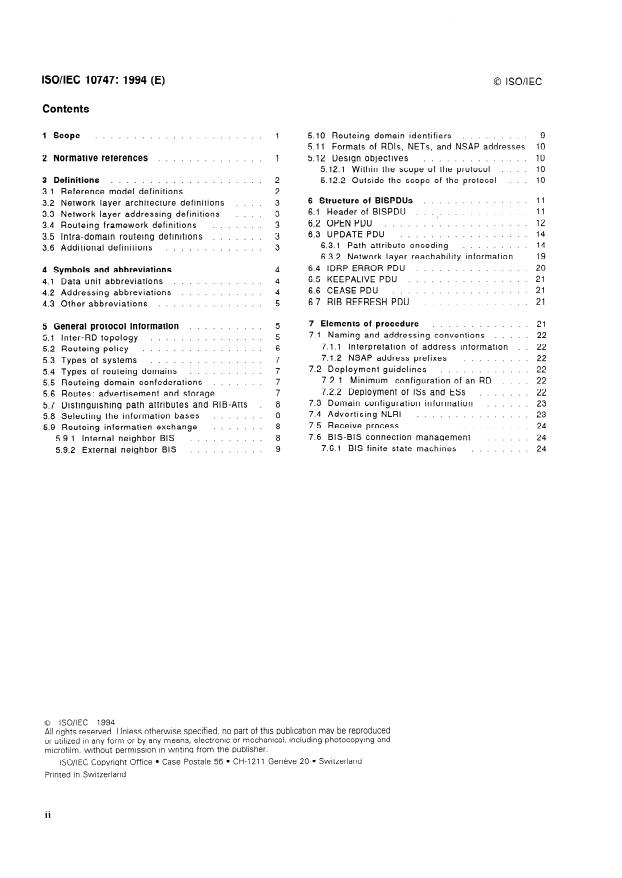
Contents
1 Scope . . . . . . . . . . . . . . . . . . . . . . 1
5.10 Routeing domain identifiers . . . . . . . . . 9
5.11 Formats of RDls, NETS, and NSAP addresses 10
2 Normative references . . . . . . . . . . . . . .
1 5.12 Design objectives
. . . . . . . . . . . . . . 10
5.12.1 Within the scope of the protocol . . . . 10
3 Definitions . 2
5.12.2 Outside the scope of the protocol
. . . 10
3.1 Reference model definitions . 2
6 Structure of BlSPDUs .
3.2 Network layer architecture definitions 11
.... 3
6.1 Header of BISPDU .
3.3 Network layer addressing definitions 11
.... 3
6.2 OPEN PDU . 12
3.4 Routeing framework definitions .
6.3 UPDATE PDU . 14
3.5 Intra-domain routeing definitions . 3
6.3.1 Path attribute encoding
3.6 Additional definitions . 14
............. 3
6.3.2 Network layer reachability information
. 19
6.4 IDRP ERROR PDU .
4 Symbols and abbreviations . 20
6.5 KEEPALIVE PDU . 21
4.1 Data unit abbreviations . 4
6.6 CEASE PDU . 21
4.2 Addressing abbreviations . 4
4.3 Other abbreviations 6.7 RIB REFRESH PDU . 21
.............. 5
7 Elements of procedure
5 General protocol information . 5 21
7.1 Naming and addressing conventions . . . . . 22
5.1 Inter-RD topology . 5
7.1.1 Interpretation of address information . . 22
5.2 Routeing policy . 6
7.1.2 NSAP address prefixes
............... . . . . . . . . . 22
5.3 Types of systems 7
7.2 Deployment guidelines . . . . . . . . . . . . 22
5.4 Types of routeing domains .
7.2.1 Minimum configuration of an RD . . . . 22
5.5 Routeing domain confederations . 7
7.2.2 Deployment of ISs and ESs . . . . . . . 22
5.6 Routes: advertisement and storage . 7
7.3 Domain configuration information . . . . . . 23
5.7 Distinguishing path attributes and RIB-Atts . 8
7.4 Advertising NLRI
5.8 Selecting the information bases . . . . . . . . . . . . . . . . 23
7.5 Receive process . . . . . . . . . . . . . . . . 24
5.9 Routeing information exchange .
7.6 BIS-BIS connection management
5.9.1 Internal neighbor BIS . 8 . . . . . . 24
7.6.1 BIS finite state machines
5.9.2 External neighbor BIS . 9 . . . . . . . . 24
0 lSO/lEC 1994
All rights reserved. Unless otherwise specified, no part of this publication may be reproduced
or utilized in any form or by any means, electronic or mechanical, including photocopyrng and
microfilm, without permission in writing from the publisher.
I SO/I EC Copyright Off ice l Case Postale 56 l CH-1211 Geneve 20 l Switzerland
Printed in Switzerland
ii
0 ISOAEC
ISOAEC 10747: 1994 (E)
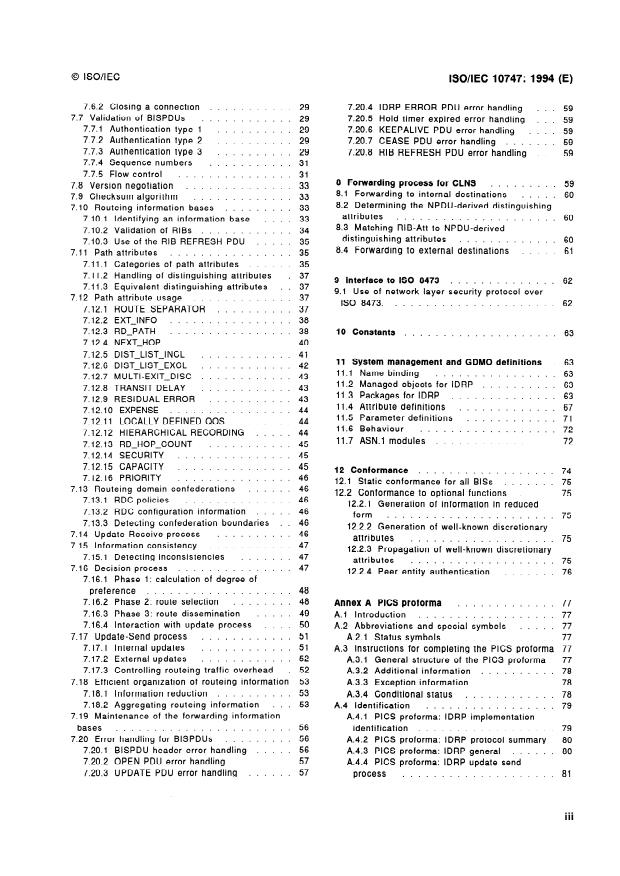
........... 29
7.6.2 Closing a connection 7.20.4 IDRP ERROR PDU error handling
. . _ 59
7.7 Validation of BISPDUs . 29 7.20.5 Hold timer expired error handling . . . 59
7.7.1 Authentication type I . 29 7.20.6 KEEPALIVE PDU error handling
. . . . 59
7.7.2 Authentication type 2 . 29 7.20.7 CEASE PDU error handling . . . . . . . 59
.......... 29
7.7.3 Authentication type 3 7.20.8 RIB REFRESH PDU error handling . . . 59
7.7.4 Sequence numbers . 31
7.7.5 Flow control . 31
8 Forwarding process for CLNS . . . . . . . . . 59
7.8 Version negotiation . 33
8.1 Forwarding to internal destinations
. . . . . 60
............. 33
7.9 Checksum algorithm
8.2 Determining the NPDU-derived distinguishing
7.10 Routeing information bases . 33
attributes . . . . . . . . . . . . . . . . . . . . . 60
7.10.1 Identifying an information base .
8.3 Matching RIB-Att to NPDU-derived
............ 34
7.10.2 Validation of RIBS
distinguishing attributes . . . . . . . . . . . . . 60
..... 35
7.10.3 Use of the RIB REFRESH PDU
8.4 Forwarding to external destinations . . . . . 61
7.11 Path attributes . 35
7.11.1 Categories of path attributes . 35
7.11.2 Handling of distinguishing attributes . 37
9 Interface to IS0 8473 . . . . . . . . . . . . . . 62
7.11.3 Equivalent distinguishing attributes . . 37
9.1 Use of network layer security protocol over
7.12 Path attribute usage . 37
IS0 8473. . . . . . . . . . . . . . . . . . . . . . 62
7.12.1 ROUTE-SEPARATOR . 37
................ 38
7.12.2 EXT-INFO
7.12.3 RD-PATH . 38
10 Constants . . . . . . . . . . . . . . . . . . . . 63
7.12.4 NEXT-HOP . 40
7.12.5 DIST-LIST-INCL . 41
11 System management and GDMO definitions . 63
7.12.6 DIST-LIST-EXCL .
11.1 Name binding
................ 63
7.12.7 MULTI-EXIT-DISC . 43
11.2 Managed objects for IDRP
.......... 63
7.12.8 TRANSIT DELAY . 43
11.3 Packages for IDRP 63
..............
7.12.9 RESIDUAL ERROR . 43
11.4 Attribute definitions . 67
................ 44
7.12.10 EXPENSE
11.5 Parameter definitions
............ 71
7.12.11 LOCALLY DEFINED QOS . 44
11.6 Behaviour
.................. 72
7.12.12 HIERARCHICAL RECORDING . 44
11.7 ASN.1 modules 72
................
7.12.13 RD-HOP-COUNT . 45
............... 45
7.12.14 SECURITY
7.12.15 CAPACITY . 45
12 Conformance . . . . . . . . . . . . . . . . . . 74
7.12.16 PRIORITY . 46
12.1 Static conformance for all BISs . . . . . . . 75
......
7.13 Routeing domain confederations 46
12.2 Conformance to optional functions . . . . . 75
7.13.1 RDC policies . 46
12.2.1 Generation of information in reduced
7.13.2 RDC configuration information . 46
form . . . . . . . . . . . . . . . . . . . . . . 75
7.13.3 Detecting confederation boundaries . . 46
12.2.2 Generation of well-known discretionary
.......... 46
7.14 Update-Receive process
attributes . . . . . . . . . . . . . . . . . . . 75
7.15 Information consistency . 47
12.2.3 Propagation of well-known discretionary
7.15.1 Detecting inconsistencies . 47
attributes . . . . . . . . . . . . . . . . . . . 75
7.16 Decision process . 47
12.2.4 Peer entity authentication . . . . . . . 76
7.16.1 Phase 1: calculation of degree of
...................
preference 48
7.16.2 Phase 2: route selection . 48
Annex A PICS proforma . . . . . . . . . . . . . 77
7.16.3 Phase 3: route dissemination . 49
A.1 Introduction . . . . . . . . . . . . . . . . . . 77
7.16.4 Interaction with update process . 50
A.2 Abbreviations and special symbols . . . . . 77
7.17 Update-Send process . 51
A.2.1 Status symbols . . . . . . . . . . . . . 77
7.17.1 Internal updates . 51
A.3 Instructions for completing the PIGS proforma 77
7.17.2 External updates . 52 A.3.1 General structure of the PIGS proforma 77
7.17.3 Controlling routeing traffic overhead . 52 A.3.2 Additional information . . . . . . . . . . 78
7.18 Efficient organization of routeing information 53 A.3.3 Exception information . . . . . . . . . . 78
7.18.1 Information reduction . 53 A.3.4 Conditional status . . . . . . . . . . . . 78
7.18.2 Aggregating routeing information . 53
A.4 Identification . . . . . . . . . . . . . . . . . 79
7.19 Maintenance of the forwarding information
A.4.1 PIGS proforma: IDRP implementation
bases . 56 identification . . . . . . . . . . . . . . . . . . 79
7.20 Error handling for BISPDUs . 56 A.4.2 PIGS proforma: IDRP protocol summary 80
7.20.1 BISPDU header error handling . 56 A.4.3 PIGS proforma: IDRP general . . . . . . 80
7.20.2 OPEN PDU error handling . 57 A.4.4 PIGS proforma: IDRP update send
......
7.20.3 UPDATE PDU error handling 57 process . . . . . . . . . . . . . . . . . . . . 81
0 ISOAEC
lSO/IEC 10747: 1994 (E)
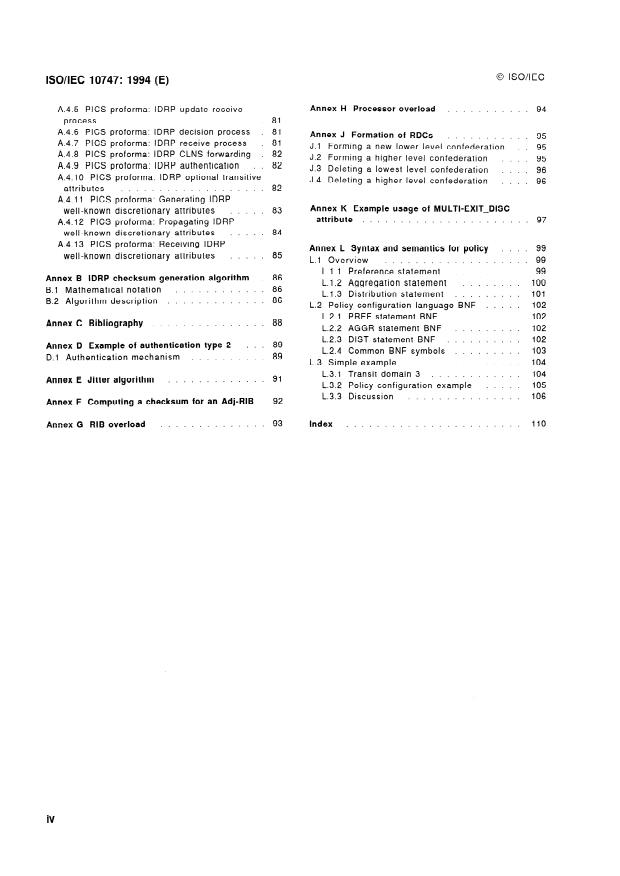
Annex H Processor overload . . . . . . . . . . . 94
A.45 PIGS proforma: IDRP update receive
process . . . . . . . . . . . . . . . . . . . . 81
A.4.6 PIGS proforma: lDRP decision process . 81
Annex J Formation of RDCs
. . . . . . . . . . . 95
A.4.7 PIGS proforma: IDRP receive process . 81
J.l Forming a new lower level confederation . . 95
A.4.8 PIGS proforma: IDRP CLNS forwarding . 82
J.2 Forming a higher level confederation
. . . . 95
A.4.9 PIGS proforma: IDRP authentication . . 82
J.3 Deleting a lowest level confederation
. . . . 96
A.4.10 PIGS proforma: IDRP optional transitive
J.4 Deleting a higher level confederation
. . . . 96
attributes . . . . . . . . . . . . . . . . . . . 82
A.4.1 1 PICS proforma: Generating IDRP
Annex K Exa of MULTI-EXIT-DISC
well-known discretionary attributes . . . . . 83
attrib ute . . . . . . . . . . . . . . . 97
A.4.12 PIGS proforma: Propagating IDRP
well-known discretionary attributes . . . . . 84
A.4.13 PICS proforma: Receiving IDRP
Annex L Syntax and semantics for policy . 99
well-known discretionary attributes . . . . . 85
L.l Overview .
L.l.l Preference statement . 99
Annex B IDRP checksum generation algorithm . 86
L.1.2 Aggregation statement . 100
B.l Mathematical notation . . . . . . . . . . . . 86
L.1.3 Distribution statement . 101
B.2 Algorithm description . _ . . . . . . . . . . . 86
L.2 Policy configuration language BNF . 102
L.2.1 PREF statement BNF . 102
Annex C Bibliography . . . . . . . . . . . . . . . 88
L.2.2 AGGR statement BNF . 102
1.2.3 DIST statement BNF .
. . . 89
Annex D Examp of authentication type 2
......... 103
L.2.4 Common BNF symbols
mechanism . . . . . . . . . . 89
D.l Auth enticati
L.3 Simple example . 104
L.3.1 Transit domain 3 . 104
. . . . . . . . . . . . . 91
Annex E Jitter algorithm
L.3.2 Policy configuration example . 105
L.3.3 Discussion . 106
Annex F Computing a checksum for an Adj-RIB
Index . . . . . . . . . . . . . . . . . . . . . . . 110
Annex G RIB overload . . . . . . . . . . . . . . 93
iv
0 ISOAEC
ISOAEC 10747: 1994 (E)
Figures
Tables
1. Field of Application 2
............. 1. The IDRP Information Bases ........ 9
2. intermediate Routeing Domains and End 2.
BIS Finite State Machine . 26
Routeing Domains
.............. 4 3. Path Attribute Characteristics 36
.......
3. Position of IDRP within Network Layer . 6
4. NPDU-Derived Attribute Set . 61
4. Inter-domain Routeing Components . 7 5. IDRP-CL Primitives
............. 63
5. Structure of the UPDATE PDU . 15 6. Architectural Constants of IDRP
...... 64
Illustration of Authentication Types 1 and 3
6. 30
7. Routeing Information Base 34
.........
8. A Transitive Fully Connected Subnetwork . 41
9. IDRP Naming and Containment Hierarchy _ 65
D.l An Example of the Authentication Type 2 . 90
Example 1 Configuration
K.l . 98
K.2 Example 2 Configuration
.......... 98
L.l A Portion of an Internet . 105
0 ISOAEC
ISOIIEC 10747: 1994 (E)
_-
Foreword
IS0 (the International Organization for Standardization) and IEC (the Inter-
national Electrotechnical Commission) form the specialized system for
worldwide standardization. National bodies that are members of IS0 or
IEC participate in the development of International Standards through
technical committees established by the respective organization to deal
with particular fields of technical activity. IS0 and IEC technical commit-
tees collaborate in fields of mutual interest. Other international organiza-
tions, governmental and non-governmental, in liaison with IS0 and IEC,
also take part in the work.
In the field of information technology, IS0 and IEC have established a joint
technical committee, lSO/IEC JTC 1. Draft International Standards adopted
by the joint technical committee are circulated to national bodies for vot-
ing. Publication as an International Standard requires approval by at least
75 % of the national bodies casting a vote.
International Standard ISO/IEC 10747 was prepared by Joint Technical
Committee lSO/IEC JTC 1, Information technology, Subcommittee SC 6,
Telecommunications and information exchange between systems.
Annexes A and B form an integral part of this International Standard. An-
nexes C, D, E, F, G, H, J, K and L are for information only.
0 ISOAEC
ISOAEC 10747: 1994 (E)
the BIS, using the methods of this inter-domain
Introduction
routeing protocol, will calculate a path to a Boundary
Intermediate system in an adjacent routeing domain
This Protocol is one of a set of International Stand-
lying on a path to the destination. After arriving at
ards which facilitate the interconnection of open
the next routeing domain, the NPDU may also travel
systems. They cover the services and protocols
within that domain on its way towards a BIS located
required to achieve such interconnection.
in the next domain along its path. This process will
continue on a hop-by-hop basis until the NPDU arrives
This Protocol is positioned with respect to other
at a BIS in the routeing domain which contains the
related standards by the layered structure defined in
destination End system. The Boundary IS in this
IS0 7498, and by the Network layer organization
routeing domain will hand the incoming NPDU over to
defined in IS0 8648. It is located at the top of the
the domain’s intra-domain routeing protocol, which
Network layer and relies on the services of IS0 8473.
will construct a path to the destination End system.
This protocol permits a routeing domain to exchange
information with other routeing domains to facilitate
This inter-domain IS-IS routeing protocol places
the operation of the routeing and relaying functions of
requirements on the type of information that a
the Network Layer. It applies to the following catego-
routeing domain must provide and on the methods by
ries of routeing, which are described in
which this information will be distributed to other
ISO/IEC TR 9575, making no distinction between
routeing domains. These requirements are intended
them:
to be minimal, addressing only the interactions
- Intra-Administrative Domain routeing between between Boundary ISs; all other internal operations of
routeing domains each routeing domain are outside the scope of this
- Inter-Administrative Domain routeing between protocol. That is, this Inter-domain routeing protocol
does not mandate that a routeing domain run a par-
routeing domains.
ticular intra-domain routeing protocol: for example, it
Within the hierarchical relations between routeing would be a local choice as to whether a domain
protocols, as described in ISO/IEC TR 9575, this pro- implements a standard intra-domain protocol (such as
tocol is situated above the intra-domain routeing pro- ISO/IEC 10589) or a private protocol.
tocols. That is, this Inter-domain IS-IS protocol:
The methods of this protocol differ from those gener-
- maintains information about the interconnections
ally adopted for an intra-domain routeing protocol
between routeing domains, but does not require
because they emphasize the interdependencies
detailed information about their internal struc-
between efficient route calculation and the preserva-
tures
tion of legal, contractual, and administrative concerns.
- calculates path segments on a hop-by-hop basis This protocol calculates routes which will be efficient,
loop-free, and in compliance with the domain’s local
routeing policies. IDRP may be used when routeing
This protocol calculates path segments which consist
of Boundary Intermediate systems and the links that domains do not fully trust each other; it imposes no
interconnect them. An NPDU destined for an End upper limit on the number of routeing domains that
system in another routeing domain will be routed via can participate in this protocol; and it provides iso-
lation between its operations and the internal oper-
Intra-domain routeing to a Boundary Intermediate
ations of each routeing domain.
system (BIS) in the source routeing domain. Then,
vii
0 ISOAEC
ISOAEC 10747: 1994 (E)
INTERNATIONAL STANDARD 0 MMEC
ISO/IEC 10747: 1994 (E)
Information technology - Telecommunications and information
exchange between systems -
Protocol for exchange of inter-
domain routeing information among intermediate systems to
support forwarding of is0 8473 PDUs
1 Scope
2 Normative references
This International Standard specifies a protocol to be The following standards contain provisions which,
used by Boundary Intermediate systems (defined in
through reference in this text, constitute provisions of
3.6) to acquire and maintain information for the
this International Standard. At the time of publica-
purpose of routeing NPDUs between different routeing
tion, the editions indicated were valid. All standards
domains. Figure 1 illustrates the field of application are subject to revision, and parties to agreements
of this International Standard. based on this International Standard are encouraged
to investigate the possibility of applying the most
This International Standard specifies:
recent editions of the standards listed below.
Members of IEC and IS0 maintain registers of cur-
the procedures for the exchange of inter-domain
rently valid International Standards.
reachability and path information between BlSs
the procedures for maintaining inter-domain IS0 7498: 1984, Information processing systems -
routeing information bases within a BIS Open Systems Interconnection - Basic Reference
the encoding of protocol data units used to dis- Model.
tribute inter-domain routeing information between
IS0 7498lAdd. 1: 1984, Information processing systems -
BlSs
Open Systems Interconnection - Basic Reference Model -
the functional requirements for implementations
Addendum 7: Connectionless-mode transmission.
that claim conformance to this International
Standard IS0 7498-3:1989, Information processing systems - Open
Sys terns Interconnection - Basic Reference Model - Part 3:
Naming and addressing.
The procedures are defined in terms of:
- interactions between Boundary Intermediate lSO/IEC 7498-4:1989, Information processing systems -
Open Systems Interconnection - Basic Reference Model -
systems through the exchange of protocol data
Part 4: Management frame work.
units
- interactions between this protocol and the under-
ISO/IEC 8208:1990, Information technology - Data
lying Network Service through the exchange of
communjcations - X.25 Packet Layer Protocol for Data
service primitives
Terminal Equipment.
- constraints on policy feasibility and enforcement
ISO/IEC 8348:i 993, Information technology - Network
which must be observed by each Boundary Inter-
mediate system in a routeing domain Service Definition.
IS0 8473:1988, Information processing systems - Data
The boundaries of Administrative Domains are real-
communjcations - Protocol for providing the
ized as artifacts of the placement of policy constraints
connectionless-mode network service.
and the aggregation of network layer reachability
IS0 8648: 1988, Information processing systems -
information; they are not manifested explicitly in the
Telecommunications and information exchange
protocol. The protocol described in this International
between systems - internal organiza tjon of the
Standard operates at the level of individual routeing
domains. The establishment of administrative Network Layer.
domains is outside the scope of this International
IS0 9542:1988, Information processing systems -
Standard.
Telecommunications and information exchange
between systems - End system to Intermediate system
routeing exchange protocol for use in conjunction with
the Protocol fos providing the connectionless-mode
network service (IS0 8473).
ISO/IEC 10747: 1994 (E)
0 ISOAEC
:ps c=apa.
f
>
End
Pnmm+a4mam End
~f%ll+~l~u
End
Eoutelng
Damin
Eoutelng
Dulnti
I
Figure 1 - Field of Application: The inter-domain Routeing Protocol operates between routeing domains; intra-
domain routeing is not within its scope.
ISO/I EC TR 9575: 1990, information techndogy - Me-
3 Definitions
communications and information exchange between
systems - OS/ Routeing Framework.
For the purposes of this International Standard, the
ISO/I EC TR 9577: 1993, Information technology - Tele- following definitions apply.
communications and information exchange between
systems - Protocol identification in the Network Layer.
3.1 Reference model definitions
ISO/IEC 10030: 1990, Information technology - Tele-
communications and information exchange between
This International Standard uses the following terms
systems - End System Routeing Information Exchange
defined in IS0 7498:
Protocol for use in conjunction with IS0 8878.
a) Network entity
ISO/I EC 10589: 1992, Information technology - 7%/e-
b) Network Layer
communications and information exchange between
c) Network Protocol
systems - Intermediate system to intermediate system
d) Network Protocol Data Unit
intra-domain routeing routine information exchange
e) Network relay
protocol for use in conjunction with the protocol for
f) Network Service Access Point
providing the connectionless-mode Network Service
g) Network Service Access Point Address
(IS0 8473).
h) Real system
ISO/IEC 10165-4: 1992, Information technology - Open ’
i) Routeing
- Structure of management
Sys terns Interconnection
information: Guidelines for the definition of managed
This International Standard uses the following term
objet ts.
defined in IS0 7498-3:
ISO/IEC 10165-2:1992, Information technology - Open
a) (N)-entity title
Systems Interconnection - Structure of management
information: Definition of management information.
0 ISOAEC
ISO/IEC 10747: 1994 (E)
3.2 Network layer architecture definitions 3.6.3 Boundary Intermediate system: An intermediate
system that runs the protocol specified in this lnterna-
This International Standard uses the following terms tional Standard, has at least one inter-domain link
defined in IS0 8648: attached to it, and may optionally have intra-domain
links attached to it.
a) End system
b) Intermediate System 3.6.4 End Routeing Domain: A routeing domain whose
local policies permit its BISs to calculate inter-domain
c) Subnetwork
path segments only for PDUs whose source is located
within that routeing domain. There are two varieties
3.3 Network layer addressing definitions
of End routeing domains: stub and multi-homed. A
stub ERD has inter-domain links to only one adjacent
This International Standard uses the following term
routeing domain, while a multi-homed ERD has inter-
defined in lSO/IEC 8348:
domain links to several adjacent routeing domains.
a) Subnetwork point of attachment
For example, the domains labelled as multi-homed
ERDs in Figure 2 have policies which prohibit them
from providing relaying functions; it is these policies,
3.4 Routeing framework definitions
not the topology of their interconnections, that make
them ERDs.
This International Stan dard uses the foll owin g terms
defin ed in IS0 95 75: 3.6.5 Transit Routeing Domain: A routeing domain
whose policies permit its BlSs to calculate inter-
a) Administrative Domain
domain path segments for PDUs whose source is
b) Common Domain
located either in the local routeing domain or in a dif-
c) Fire wall
ferent routeing domain. That is, it can provide a
d) Routeing Domain
relaying service for such PDUs. See Figure 2 for an
illustration of TRDs.
3.5 Intra-domain routeing definitions
3.6.6 Adjacent RDs: Two RDs (“A” and “B”) are adja-
cent to one another if there is a at least one pair of
This International Standard uses the following terms
BISs, one located in “A” and the other in “B”, that are
defined in IS0 10589:
attached to each other by means of a real subnet-
work.
a) Adjacency
b) Link
3.6 Additional definitions
3.6.8 Routeing Domain Confederation: A set of
For pu rpos es of this International Stan dard, the fol-
routeing domains which have agreed to join together
lowing defi nitions apply:
and to conform to the rules in 7.13 of this Interna-
tional Standard. To the outside world, a confeder-
3.6.1 Intra-domain IS-IS routeing protocol: A routeing
ation is indistinguishable from a routeing domain.
protocol that is run between Intermediate systems in
a single routeing domain to determine routes that
pass through only systems and links wholly contained
within the domain.
NOTE 1: Unless reference is made to a specific protocol,
a) all members of RDC-A are also members of
this term is used as a general designator, encom-
RDC-B
passing both private and internationally standard-
b) there are some members of RDC-B that are not
ized protocols.
members of RDC-A
3.6.2 Inter-domain link: A real (physical) or virtual
(logical) link between two or more Boundary Interme-
diate systems (see Figure 2). A link between two
BlSs in the same routeing domain carry both intra-
domain traffic and inter-domain traffic; a link between
a) there are some members of RDC-A that are also
two BISs located in adjacent routeing domains can
members of RDC-B, and
carry inter-domain traffic, but not intra-domain traffic.
b) there are some members of RDC-A that are not
members of RDC-B, and
c) there are some members of RDC-B that are not
members of RDC-A.
ISO/IEC 10747: 1994 (E)
0 ISOAEC
Stub
ERD
adjacent routaing domcrina
------ Links between BEs in
the wrne routeing domain
@;li-homad)
Bcrundcwy IS
lEi!F J
irdsrd
Figure 2 - Intermediate Routeing Domains and End Routeing Domains: The classification of a routeing domain
as an TRD or an ERD depends upon its relaying policies.
3.6.11 Disjoint RDCs: Two routeing domain confeder-
4.1 Data unit abbreviations
ations, RDC-A and RDC-B, are disjoint from one
BISPDU Boundary Intermediate System PDU
another when there are no routeing domains which
are simultaneously members of both RDC-A and
DT PDU IS0 8473 Data Protocol Data Unit
RDC-B.
ER PDU IS0 8473 Error Protocol Data Unit
3.6.12 Policy Information Base: The collection of
NPDU Network Protocol Data Unit
routeing policies that a BIS will apply to the routeing
information that it learns using this International
NSDU Network Service Data Unit
standard. It is not required that all routeing domains
PDU Protocol Data Unit
use the same syntax and semantics to express policy;
that is, the format of the Policy Information Base is
left as a local option.
4.2 Addressing abbreviations
3.6.13 Route Origin: Each route or component of an
AFI Authority and Format Identifier
aggregated route has a single unique origin. This is
DSP Domain Specific Part
the RD or RDC in which the route’s destinations are
located.
IDI Initial Domain Identifier
IDP Initial Domain Part
LSAP Link Service Access Point
4 Symbols and abbreviations
NET Network Entity Title
NPAI Network Protocol Address information
The symbols, acronyms, and abbreviations listed in
the following clauses are used in this International
Standard.
Network Service Access Point IDRP relies on the underlying Network service to
provide for fragmentation and reassembly of
Subnetwork Point of Attachment
BISPDUs. IDRP queues Outbound BISPDUs as input
to the underlying Network Layer service, retaining a
copy of each BISPDU until an acknowledgement is
received. Similarly, inbound BlSPDUs are queued as
Boundary Intermediate System
input to the BISPDU-Receive process.
csnnectisnless ode
IDRP exchanges BlSPDUs in a reliable fashion. It pro-
Connectionfess Mode Network Service
vides mechanisms for the ordered delivery of
BlSPDUs and for the detection and retransmission of
Confederation ember
lost or corrupted BlSPDUs. The mechanisms for
End Routeing Domain
achieving reliable delivery of BlSPDUs are described
in 7.7; methods for establishing BIS-BIS connections
ES End System
are described in 7.6.
FIB Forwarding Information Base
IDRP is consistent with the routeing model presented
FSM Finite State Machine
in IS0 TR 9575. To emphasize its policy-based
IDRP Inter-domain Routeing Protocol (an acronym
nature, the IDRP routeing model includes a Policy
for the protocol described in this Interna-
Information Base, as shown in Figure 4. IDRP can be
tional Standard)
described in terms of four major components:
IPI Initial Protocol Identifier
BISPDU-Receive Process: responsible for
a)
accepting and processing control and routeing
MIB Management Information Base
information from the local environment and from
Network layer reachability information
NLRI
BlSPDUs of other BISs. This information is used
for a variety of purposes, such as receiving error
Network layer security protocol
NLSP
reports and guaranteeing reliable reception of
OSIE OSI Environment
BlSPDUs from neighboring BISs. (For example,
the Update-R*eceive process (see 7.14) is the part
PCI Protocol Control Information
of the BISPDU-Receive process that deals with
PIB Policy Information Base
the reception of routeing information after a
BIS-BIS connection has been established.)
QOS Quality of Service
BISPDU-Send Process: responsible for con-
W
Routeing Domain Confederation
RDC
structing BISPDUs which contain control and
Routeing Domain Identifier
RDI
BISPDUs are used by the
routeing information.
local BIS for a variety of purposes, such as
RIB Routeing Information Base
advertising routeing information to other BISs,
SPI Subsequent Protocol Identifier
initiating BIS-BIS communication, and validating
BIS routeing information bases.
SNICP Subnetwork independent convergence pro-
tocol
Decision Process: responsible for calculating
C)
routes which will be consistent with local routeing
TRD Transit Routeing Domain
policies. It operates on information in both the
PIB and the Adj-RIBS, using it to create the Local
RIBS (Lot-RIBS) and the local Forwarding Infor-
mation Bases (see 7.10).
5 General protocol information
Forwarding Process: responsible for supplying
d)
resources to accomplish relaying of NPDUs to
their destinations. It uses the FIB(s) created by
IDRP is a routeing information exchange protocol
the Decision Process.
which is located within the Network layer and inter-
faces to IS0 8473, which serves as a SNICP (see
Figure 3). In particular, BISPDUs are encapsulated as
5.1 Inter-RD topology
the data portion of IS0 8473 NPDUs. IDRP is a
connection-oriented protocol which is implemented
This protocol views the overall global OSIE as an arbi-
only in Intermediate systems. Routeing and control
trary interconnection of Transit Routeing Domains and
information is carried in BISPDUs (as in clause 6),
End Routeing Domains which are connected by real
which flow on connections between pairs of BlSs.
inter-domain links placed between BISs located in the
Each BISPDU is packaged within one or more NPDUs
respective routeing domains. This International
for transmission by the underlying Network service.
ISOAEC 10747: 1994 (E)
0 ISOAEC
Net work
luyer
Figure 3 - Position of IDRP within Network Layer
Standard provides for the direct exchange of routeing will then select the paths that it will advertise
information between BISs, which may be located externally.
either in the same routeing domain or in adjacent
To enforce routeing policies and to insure that poli-
routeing domains.
.
cies are both feasible and consistent, this protocol:
- carries path information, expressed in terms of
5.2 Routeing policy
Routeing Domain Identifiers (RDls) and various
The direct exchange of policy information is outside
path attributes, in its UPDATE PDUs
the scope of IDRP. Instead, IDRP communicates
policy information indirectly in its UPDATE PDUs
- permits a routeing domain to selectively propa-
which reflect the effects of the local policies of RDs on
gate its reachability information to a limited set of
the path to the destination. Since all BlSs within a
other routeing domains
routeing domain must enforce consistent active
- provides a method to detect policy inconsisten-
routeing policies, IDRP provides methods for
cies within the set of BlSs located in a single
detecting the existence of active inconsistent policies
routeing domain
within a routeing domain. However, the semantics of
routeing policies and the methods for establishing - permits each routeing domain to set its policies
them are outside the scope of this International
individually: that is, global coordination of policy
Standard.
is not required.
NOTE 2: Annex L illustrates a policy description method and
The set of rules that comprises the routing policy
its associated semantics as one example of how
policies might be expressed. enforced by a BIS are held in a Policy Information
Base (PIB), which is separate from the RIB.
Depending on local Security and QOS requirements,
.Each routeing domain chooses its routeing policies
the PIB may also contain:
independently, and insures that all its BISs calculate
inter-domain paths which satisfy those policies. Local
a) rules for the aggregation of routes that include
routeing policies are applied to information in the
the SECURITY and LOCALLY DEFINED QOS path
Routeing Information Base (RIB) to determine a
attributes (see 7.18.2)
degree of preference for potential paths (see 7.16).
b) rules for enforcing local QOS Maintenance Poli-
From those paths which are not rejected by the
cies and the effective Security Policy, during
routeing policy, a BIS selects the paths which it will
NPDU forwarding
use locally; from the locally selected paths, the BIS
0 ISOAEC
ISOAEC 10747: 1994 (E)
c) rules for updating SECURITY and LOCALLY
5.5 Routeing domain confederations
DEFINED QOS path attributes in routes that are
re-advertised to external routeing domains.
IDRP provides support for Routeing Domain Confeder-
ations (RDCs); this optional function permits groups of
routeing domains to be organized in a hierarchical
5.3 Types of systems
fashion.
An Intermediate system that implements the protocol
An RDC is formed by means outside the scope of this
described in this International Standard is called a
protocol, and composed of a set of confederation
Boundary Intermediate system (BIS). Each BIS
members. Confederation members (CMs) are either
resides in a single routeing domain, and may
individual routeing domains or routeing domain con-
optionally act simultaneously as a BIS and as an
federations. Thus, the definition of an RDC is recur-
intra-domain IS within its own routeing domain. For
sive: a confederation member may be a single
example, a single systern could simultaneously play
routeing domain or another confederation.
the roles of a BIS for Inter-domain routeing and a
level-2 IS for Intra-domain routeing as described in
ISO/IEC 10589.
5.6 Routes: advertisement and storage
For purposes of this protocol, a route is defined as a
5.4 Types of routeing domains
unit of information that pairs destinations with the
attributes of a path to those destinations:
The protocol described in this International Standard
recognizes two types of routeing domains, end - Routes are advertised between a pair of BISs in
routeing domains and transit routeing domains; each UPDATE PDUS: the destinations are the systems
of them may contain both ISs and ESs. whose NSAP prefixes are reported in the NLRI
field, and the path is the information reported in
the path attributes fields of the same UPDATE
PDU.
s
PDUs
FTi’ BEPD US
--- -
~1~ I-- AA r-fsra-~f
rwI J’rwil-\E
1 1 Adj-RIB-In 1
I
- _ - I,. II
t-w I ,I’
1 LOO-RN3 1
I I I _ _
II rGiLl
Rou teing Inform tbn Buses
f -
k
.
II
b FIB ~ NPDUs
NPDUs
- -
Forwwrdhg Inform&h Base J
Figure 4 - Inter-domain Routeing Components
- Routes are stored in the Routeing Information
The number of RIB-Atts is limited by the number of
Bases: namely, the Adj-RIBS-In, the Lot-RIBS,
distinct sets of permissible distinguishing attributes
and the Adj-RIBS-Out. Routes that will be adver-
(see 7.11.2); this in turn limits the number of RIBS and
tised to other BISs must be present in the
FIBS that a BIS can support. The number of RIBS and
Adj-RIBS-Out; routes that will be used by the local FIBS can be further constrained by local decisions-a
BIS must be present in the Lot-RIBS, and the next
BIS may choose to support only a limited number of
hop for each of these routes must present in the
distinct routeing information bases (that is, a limited
local BlS’s Forwarding Information Bases; and number of RIB-Atts, as described in 7.10.1).
routes that are received from other BlSs are
present in the Adj-RIBS-In.
5.8 Selecting the information bases
- A Route-ID is assigned to each route that is
advertised by a BIS. This identifier is unambig-
Each RIB is identified by a RIB-Att (RIB attribute), and
uous in the context of the BIS-BIS connection
the same RIB-Att also uniquely identifies the associ-
between the advertising BIS and the receiving
ated FIB.
BIS.
For an UPDATE PDU, the BIS determines the
A BIS can support multiple routes to the same desti-
ROUTE-ID, LOCAL-PREF, and the set of distinguishing
nation by maintaining multiple RIBS and the corre-
path attributes associated with each route that is
sponding multiple FIBS. Each Lot-RIB will be
advertised. The set of distinguishing path attributes
identified by a different RIB-Att (see 5.7 and 5.8); an
contained between a pair of consecutively occurring
Adj-RIB-Out shall contain at most one route to a par-
ROUTE-SEPARATORS or between the last
ticular destination.
ROUTE-SEPARATOR and the end of the BISPDU
unambiguously determine the RIB-Att for that route.
If the BIS chooses to advertise the route, it may add
to or modify the path attributes of the route before
For an NPDU, the BIS unambiguously determines the
advertising it to adjacent BISs. For example, it is pos-
FIB that should be used for forwarding this NPDU. It
sible under certain circumstances to aggregate path
maps certain fields in NPDU’s header into a RIB-Att,
attributes, NLRI, or entire routes, as described more
which then unambiguously identifies a particular FIB
fully in 7.18.2; or, as another example, the further dis-
(see 8.2 and 8.3).
tribution of a route may be restricted through the use
of the DIST-LIST-EXCL attribute, as described in
A summary of IDRP’s information bases is presented
7.12.6.
in Table 1.
IDRP also provides mechanisms by which a BIS can
5.9 Routeing informat ion exchange
inform its neighbor that a previously advertised route
is no longer available for use. There are three
This International Standard provides several rules
methods by which a given BIS can indicate that a
governing the distribution and exchange of routeing
route has been withdrawn from service:
information:
a) the Route-ID for a previously advertised route
information inter-
- rules for distri buting routei
K3
can be advertised in the WITHDRAWN ROUTES
(to BlSs within a rout ein g domain)
nally
field of an UPDATE PDU, thus marking the associ-
ated route as being no longer available for use
for distr ibuting outeing information
- rules
b) a replacement route (with the same distinguishing
mains)
exter nall BlSs in adjacen t routeing do
Y 00
attributes and NLRI) can be advertised, or
c) the BIS-BIS connection can be closed, which
Routeing information is carried in the protocol’s
implicitly removes from service all routes which
BISPDUs, which are generated on an event-driven
the pair of BlSs had advertised to each other.
basis whenever a BIS receives information which
causes it advertise new paths.
5.7 Distinguishing path attributes and RIB-Atts
5.9.1 Internal neighbor BIS
Certain path attributes are classified as Distjnguishing
Each BIS establishes and maintains communications
Attributes. Each distinct combination of such attri-
with all other BlSs located in its routeing domain.
butes identifies a particular information base which
The identity of all BlSs within a routeing domain is
will be used to store information about the route.
contained in managed object INTERNAL-BIS
Each combination of distinguishing attributes is called
described in 7.3.
a RIB-Att (RIB attribute); the RIB-Att is a common
identifier for the Adj-RIB-In, Lot-RIB, Adj-RIB-Out, and
FIB with which the route information is associated.
0 ISOAEC
ISOAEC 10747: 1994 (E)
Table 1
- The IDRP Information Bases:
The indexing variables and contents of the RIBS and FIBS are
shown.
Information Base Indexed by.
Contains.
Adj- RIB-In - NET of adjacent BIS
- Path attributes
- RIB-Atts - NLRI
- Route-l D
Lot-RIB - RIB-Atts
- Path attributes
- NLRI
Adj- RIB- Out - NET of adjacent BIS
- Path attributes
- RI B-Atts - NLRI
- Route-l D
FIB
- RI B-Atts - NET of next hop BIS
- NLRI
- Output SNPA of local BIS
- Input SNPA of next hop BIS
- minimum priority associated with this subnet-
work, when the RIB-Att contains the PRIORITY
attribute
- security related information associated with this
subnetwork, when the RIB-Att contains the
SECURITY attribute
- QOS metric value, when the RIB-Att contains a
RESIDUAL ERROR, TRANSIT DELAY, EXPENSE,
or LOCALLY DEFINED QOS attribute
NOTES:
a) As a local option, a BIS may elect to apply information reduction techniques to path attributes and NLRI information.
b) For each adjacent BIS, a given BIS maintains an Adj-RIB-In for each RIB-Att (including the Empty RIB-Att) that it sup-
ports.
c) A BIS maintains a separate Lot-RIB for each RIB-Att (including the Empty RIB-Att) that it supports.
d) For each adjacent BIS, a given BIS maintains an Adj-RIB-Out for each set of RIB-Atts (including the Empty RIB-Att) that
it advertises to that neighbor.
e) A given BIS maintains a separate FIB for each set of RIB-Atts (including the empty RIB-Att) that it supports- that is,
each FIB corresponds to a Lot-RIB.
To facilitate the forwarding process, a BIS can organize each of its FIBS into two conceptual parts: one containing
information for NLRI located within its own RD, and another for NLRI located in other RDs (as in clause 8). For external
NLRI, a BIS can further organize the FIB information based on whether the next-hop-BIS is located within its own RD or
in another RD (see 8.4, items “a” and “b”). And finally, for those next-hop BlSs located in its own RD, the local BIS can
organize the information according to a specific forwarding mechanism (see 8.4, items “bl” and “b2”).
in managed object EXTERNAL-BIS-NEIGHBORS is
5.9.2 External neighbor BIS
located on a common subnetwork with itself, a local
BIS can include the IS0 8473 Complete Route
Each BIS may establish and maintain communications
Record parameter so that the recipient of the
with other BISs in adjacent routeing domains. A BIS
BISPDU can determine whether the sending BIS is
has no direct communications link with any BIS in
located on the same subnetwork as itself.
another routeing domain unless that RD is adjacent to
it, as defined in 3.6: that is, a BIS does not communi-
cate directly with a BIS located in a different routeing 5.10 Routeing domain identifiers
domain unless the pair of BlSs are attached to at
...