

ISO/IEC 17875:2000
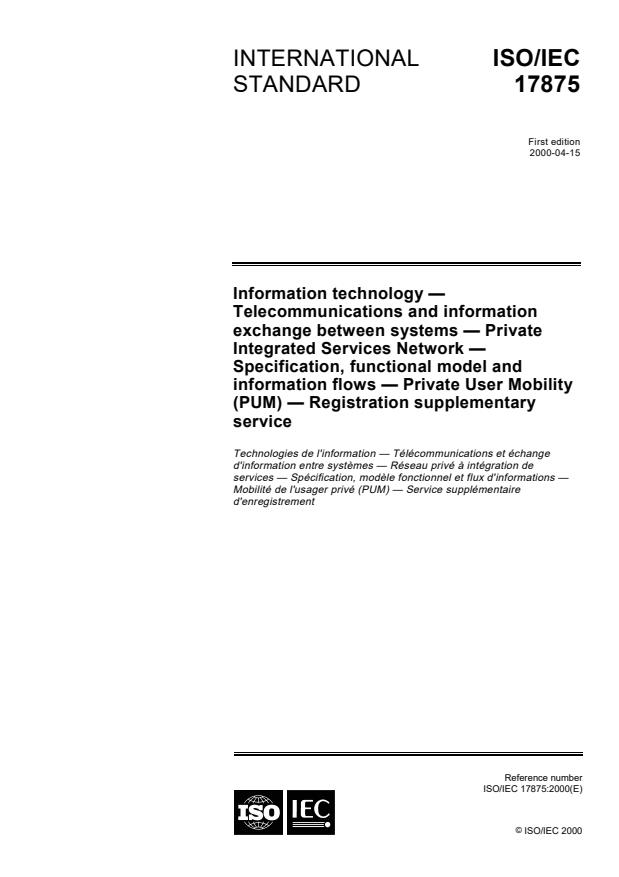
(Main)Information technology — Telecommunications and information exchange between systems — Private Integrated Services Network — Specification, functional model and information flows — Private User Mobility (PUM) — Registration supplementary service
General Information
- Abstract
This International Standard specifies the Supplementary Service (SS) Private User Mobility Registration (PUMR), which is applicable to various basic services supported by Private Integrated Services Networks (PISN). Basic services are specified in ISO/IEC 11574. SS-PUMR is a supplementary service that enables a PUM user to register at, or de-register from, any wired or wireless terminal within the PISN. The ability to register at different wired and wireless terminals in the PISN at different times enables the PUM user to maintain the provided services (including the ability to make and receive calls) at different access points. Supplementary service specifications are produced in three stages, according to the method described in CCITT Rec. I.130. This International Standard contains the stage 1 and stage 2 specifications of SS-PUMR. The stage 1 specification (clause 6) specifies the general feature principles and capabilities. The stage 2 specification (clause 7) identifies the Functional Entities involved in the supplementary service and the information flows between them.
- Status
- Published
- Publication Date
- 19-Apr-2000
- Current Stage
- 9093 - International Standard confirmed
- Start Date
- 23-May-2025
- Completion Date
- 29-Aug-2026
Buy Documents
ISO/IEC 17875:2000 - Information technology — Telecommunications and information exchange between systems — Private Integrated Services Network — Specification, functional model and information flows — Private User Mobility (PUM) — Registration supplementary service Released:4/20/2000
Overview
ISO/IEC 17875:2000 defines the Private User Mobility Registration (SS‑PUMR) supplementary service for Private Integrated Services Networks (PISN). The standard covers stage 1 (feature principles and capabilities) and stage 2 (functional model and information flows) of PUM registration, enabling a PUM user to register or de‑register at any wired or wireless terminal within a PISN so that services (making/receiving calls) follow the user to different access points. It is intended for PISN environments and references basic services in ISO/IEC 11574.
Key topics and technical requirements
- Service scope and behaviour
- Definition of PUM registration, de‑registration, registration session, AllCall / InCall / OutCall options.
- Ability for registration requests to be accepted or rejected by the network.
- Functional model (stage 2)
- Identification of Functional Entities (FEs) involved in PUMR and their relationships to basic call FEs (CC, CCA).
- Allocation of FEs to physical equipment and mapping to PISN architecture (PINX, HDB, VDB).
- Information flows
- Detailed information flow definitions and sequences between FEs supporting registration, location updates and hosting address resolution.
- Use of Specification and Description Language (SDL) to describe behaviour and message sequences.
- Databases and addressing
- Home Data Base (HDB) and Visitor Data Base (VDB) concepts, Home PINX and Visitor PINX, and the notion of a hosting address where a user is currently registered.
- Interaction and interworking
- Interaction with other supplementary services and additional network features (e.g., CLIP, CFU, WTLR, WTAT) and considerations for interworking with related PISN services.
- Conformance
- Stage 3 (protocols and signalling) is required to claim full conformance; ISO/IEC 17875 provides requirements that stage 3 specifications must support.
Applications and users
- Target users:
- PBX / PISN vendors, telecom equipment manufacturers and firmware developers.
- Enterprise network architects and system integrators implementing mobility across wired and wireless endpoints.
- Standards engineers, test labs and interoperability teams creating stage‑3 signalling protocols and conformance test suites.
- Practical uses:
- Enabling corporate users to retain a single PISN identity (PUM number) while moving between desks, rooms or wireless coverage areas.
- Supporting unified call handling, consistent incoming/outgoing call behavior, and location‑aware service delivery in private networks.
Related standards
- ISO/IEC 11574 (basic call services), ISO/IEC 11571 (addressing), ISO/IEC 11579‑1 (PINX), ISO/IEC 15428 / 15430 / 15432 (wireless terminal features), ISO/IEC 17877 (PUM call handling), and ITU‑T Rec. I.130 / I.112 / I.210 / Z.100.
Keywords: ISO/IEC 17875, PUMR, Private User Mobility, PISN, PUM registration, Home Data Base, Visitor Data Base, PINX, supplementary service.
Relations
- Effective Date
- 06-Jun-2022
Buy Documents
ISO/IEC 17875:2000 - Information technology — Telecommunications and information exchange between systems — Private Integrated Services Network — Specification, functional model and information flows — Private User Mobility (PUM) — Registration supplementary service Released:4/20/2000
Get Certified
Connect with accredited certification bodies for this standard

ANCE
Mexican certification and testing association.

Intertek Slovenia
Intertek testing, inspection, and certification services in Slovenia.

LNE (Laboratoire National de Métrologie et d'Essais)
French national laboratory for metrology and testing.
Sponsored listings
Frequently Asked Questions
ISO/IEC 17875:2000 is a standard published by the International Organization for Standardization (ISO). Its full title is "Information technology — Telecommunications and information exchange between systems — Private Integrated Services Network — Specification, functional model and information flows — Private User Mobility (PUM) — Registration supplementary service". This standard covers: This International Standard specifies the Supplementary Service (SS) Private User Mobility Registration (PUMR), which is applicable to various basic services supported by Private Integrated Services Networks (PISN). Basic services are specified in ISO/IEC 11574. SS-PUMR is a supplementary service that enables a PUM user to register at, or de-register from, any wired or wireless terminal within the PISN. The ability to register at different wired and wireless terminals in the PISN at different times enables the PUM user to maintain the provided services (including the ability to make and receive calls) at different access points. Supplementary service specifications are produced in three stages, according to the method described in CCITT Rec. I.130. This International Standard contains the stage 1 and stage 2 specifications of SS-PUMR. The stage 1 specification (clause 6) specifies the general feature principles and capabilities. The stage 2 specification (clause 7) identifies the Functional Entities involved in the supplementary service and the information flows between them.
This International Standard specifies the Supplementary Service (SS) Private User Mobility Registration (PUMR), which is applicable to various basic services supported by Private Integrated Services Networks (PISN). Basic services are specified in ISO/IEC 11574. SS-PUMR is a supplementary service that enables a PUM user to register at, or de-register from, any wired or wireless terminal within the PISN. The ability to register at different wired and wireless terminals in the PISN at different times enables the PUM user to maintain the provided services (including the ability to make and receive calls) at different access points. Supplementary service specifications are produced in three stages, according to the method described in CCITT Rec. I.130. This International Standard contains the stage 1 and stage 2 specifications of SS-PUMR. The stage 1 specification (clause 6) specifies the general feature principles and capabilities. The stage 2 specification (clause 7) identifies the Functional Entities involved in the supplementary service and the information flows between them.
ISO/IEC 17875:2000 is classified under the following ICS (International Classification for Standards) categories: 33.040.35 - Telephone networks. The ICS classification helps identify the subject area and facilitates finding related standards.
ISO/IEC 17875:2000 has the following relationships with other standards: It is inter standard links to ISO 18778:2005. Understanding these relationships helps ensure you are using the most current and applicable version of the standard.
ISO/IEC 17875:2000 is available in PDF format for immediate download after purchase. The document can be added to your cart and obtained through the secure checkout process. Digital delivery ensures instant access to the complete standard document.
Standards Content (Sample)
INTERNATIONAL ISO/IEC
STANDARD 17875
First edition
2000-04-15
Information technology —
Telecommunications and information
exchange between systems — Private
Integrated Services Network —
Specification, functional model and
information flows — Private User Mobility
(PUM) — Registration supplementary
service
Technologies de l'information — Télécommunications et échange
d'information entre systèmes — Réseau privé à intégration de
services — Spécification, modèle fonctionnel et flux d'informations —
Mobilité de l'usager privé (PUM) — Service supplémentaire
d'enregistrement
Reference number
©
ISO/IEC 2000
PDF disclaimer
This PDF file may contain embedded typefaces. In accordance with Adobe's licensing policy, this file may be printed or viewed but shall not
be edited unless the typefaces which are embedded are licensed to and installed on the computer performing the editing. In downloading this
file, parties accept therein the responsibility of not infringing Adobe's licensing policy. The ISO Central Secretariat accepts no liability in this
area.
Adobe is a trademark of Adobe Systems Incorporated.
Details of the software products used to create this PDF file can be found in the General Info relative to the file; the PDF-creation parameters
were optimized for printing. Every care has been taken to ensure that the file is suitable for use by ISO member bodies. In the unlikely event
that a problem relating to it is found, please inform the Central Secretariat at the address given below.
© ISO/IEC 2000
All rights reserved. Unless otherwise specified, no part of this publication may be reproduced or utilized in any form or by any means, electronic
or mechanical, including photocopying and microfilm, without permission in writing from either ISO at the address below or ISO's member body
in the country of the requester.
ISO copyright office
Case postale 56 � CH-1211 Geneva 20
Tel. + 41 22 749 01 11
Fax + 41 22 734 10 79
E-mail copyright@iso.ch
Web www.iso.ch
Printed in Switzerland
ii © ISO/IEC 2000 – All rights reserved
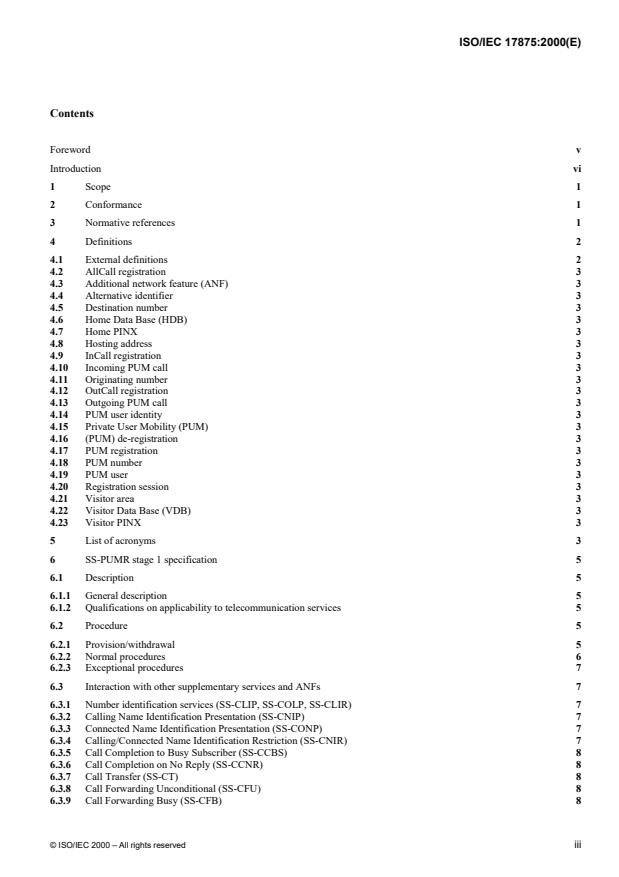
Contents
Foreword v
Introduction vi
1 Scope 1
2 Conformance 1
3 Normative references 1
4 Definitions 2
4.1 External definitions 2
4.2 AllCall registration 3
4.3 Additional network feature (ANF) 3
4.4 Alternative identifier 3
4.5 Destination number 3
4.6 Home Data Base (HDB) 3
4.7 Home PINX 3
4.8 Hosting address 3
4.9 InCall registration 3
4.10 Incoming PUM call 3
4.11 Originating number 3
4.12 OutCall registration 3
4.13 Outgoing PUM call 3
4.14 PUM user identity 3
4.15 Private User Mobility (PUM) 3
4.16 (PUM) de-registration 3
4.17 PUM registration 3
4.18 PUM number 3
4.19 PUM user 3
4.20 Registration session 3
4.21 Visitor area 3
4.22 Visitor Data Base (VDB) 3
4.23 Visitor PINX 3
5 List of acronyms 3
6 SS-PUMR stage 1 specification 5
6.1 Description 5
6.1.1 General description 5
6.1.2 Qualifications on applicability to telecommunication services 5
6.2 Procedure 5
6.2.1 Provision/withdrawal 5
6.2.2 Normal procedures 6
6.2.3 Exceptional procedures 7
6.3 Interaction with other supplementary services and ANFs 7
6.3.1 Number identification services (SS-CLIP, SS-COLP, SS-CLIR) 7
6.3.2 Calling Name Identification Presentation (SS-CNIP) 7
6.3.3 Connected Name Identification Presentation (SS-CONP) 7
6.3.4 Calling/Connected Name Identification Restriction (SS-CNIR) 7
6.3.5 Call Completion to Busy Subscriber (SS-CCBS) 8
6.3.6 Call Completion on No Reply (SS-CCNR) 8
6.3.7 Call Transfer (SS-CT) 8
6.3.8 Call Forwarding Unconditional (SS-CFU) 8
6.3.9 Call Forwarding Busy (SS-CFB) 8
© ISO/IEC 2000 – All rights reserved iii
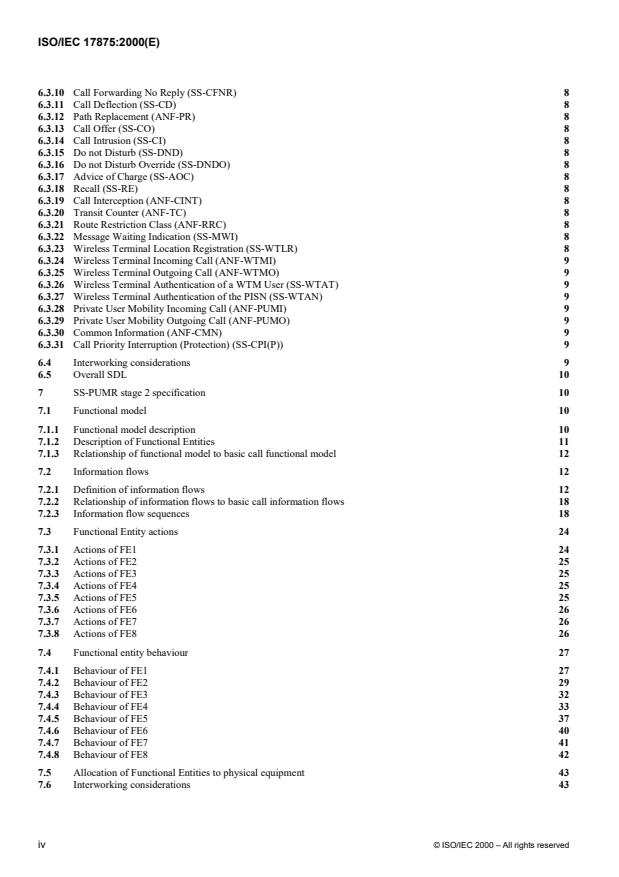
6.3.10 Call Forwarding No Reply (SS-CFNR) 8
6.3.11 Call Deflection (SS-CD) 8
6.3.12 Path Replacement (ANF-PR) 8
6.3.13 Call Offer (SS-CO) 8
6.3.14 Call Intrusion (SS-CI) 8
6.3.15 Do not Disturb (SS-DND) 8
6.3.16 Do not Disturb Override (SS-DNDO) 8
6.3.17 Advice of Charge (SS-AOC) 8
6.3.18 Recall (SS-RE) 8
6.3.19 Call Interception (ANF-CINT) 8
6.3.20 Transit Counter (ANF-TC) 8
6.3.21 Route Restriction Class (ANF-RRC) 8
6.3.22 Message Waiting Indication (SS-MWI) 8
6.3.23 Wireless Terminal Location Registration (SS-WTLR) 8
6.3.24 Wireless Terminal Incoming Call (ANF-WTMI) 9
6.3.25 Wireless Terminal Outgoing Call (ANF-WTMO) 9
6.3.26 Wireless Terminal Authentication of a WTM User (SS-WTAT) 9
6.3.27 Wireless Terminal Authentication of the PISN (SS-WTAN) 9
6.3.28 Private User Mobility Incoming Call (ANF-PUMI) 9
6.3.29 Private User Mobility Outgoing Call (ANF-PUMO) 9
6.3.30 CommonInformation(ANF-CMN) 9
6.3.31 Call Priority Interruption (Protection) (SS-CPI(P)) 9
6.4 Interworking considerations 9
6.5 Overall SDL 10
7 SS-PUMR stage 2 specification 10
7.1 Functional model 10
7.1.1 Functional model description 10
7.1.2 Description of Functional Entities 11
7.1.3 Relationship of functional model to basic call functional model 12
7.2 Information flows 12
7.2.1 Definition of information flows 12
7.2.2 Relationship of information flows to basic call information flows 18
7.2.3 Information flow sequences 18
7.3 Functional Entity actions 24
7.3.1 Actions of FE1 24
7.3.2 Actions of FE2 25
7.3.3 Actions of FE3 25
7.3.4 Actions of FE4 25
7.3.5 Actions of FE5 25
7.3.6 Actions of FE6 26
7.3.7 Actions of FE7 26
7.3.8 Actions of FE8 26
7.4 Functional entity behaviour 27
7.4.1 Behaviour of FE1 27
7.4.2 Behaviour of FE2 29
7.4.3 Behaviour of FE3 32
7.4.4 Behaviour of FE4 33
7.4.5 Behaviour of FE5 37
7.4.6 Behaviour of FE6 40
7.4.7 Behaviour of FE7 41
7.4.8 Behaviour of FE8 42
7.5 Allocation of Functional Entities to physical equipment 43
7.6 Interworking considerations 43
iv © ISO/IEC 2000 – All rights reserved
Foreword
ISO (the International Organization for Standardization) and IEC (the International Electrotechnical Commission) form the
specialized system for worldwide standardization. National bodies that are members of ISO or IEC participate in the
development of International Standards through technical committees established by the respective organization to deal with
particular fields of technical activity. ISO and IEC technical committees collaborate in fields of mutual interest. Other
international organizations, governmental and non-governmental, in liaison with ISO and IEC, also take part in the work.
International Standards are drafted in accordance with the rules given in the ISO/IEC Directives, Part 3.
In the field of information technology, ISO and IEC have established a joint technical committee, ISO/IEC JTC 1. Draft
International Standards adopted by the joint technical committee are circulated to national bodies for voting. Publication as an
International Standard requires approval by at least 75 % of the national bodies casting a vote.
Attention is drawn to the possibility that some of the elements of this International Standard may be the subject of patent rights.
ISO and IEC shall not be held responsible for identifying any or all such patent rights.
International Standard ISO/IEC 17875 was prepared by ECMA (as ECMA-281) and was adopted, under a special “fast-track
procedure”, by Joint Technical Committee ISO/IEC JTC 1, Information technology, in parallel with its approval by national
bodies of ISO and IEC.
© ISO/IEC 2000 – All rights reserved v
Introduction
This International Standard is one of a series of standards defining services and signalling procedures applicable to Private
Integrated Services Networks (PISNs). The series uses ISDN concepts as developed by ITU-T and conforms to the framework
of International Standards for Open Systems Interconnection as defined by ISO/IEC.
This International Standard specifies the Private User Mobility Registration (PUMR) supplementary service.
This International Standard is based upon the practical experience of ECMA member companies and the results of their active
and continuous participation in the work of ISO/IEC JTC1, ITU-T, ETSI and other international and national standardization
bodies. It represents a pragmatic and widely based consensus.
There is currently no equivalent service specified by ITU-T or ETSI for public ISDN.
vi © ISO/IEC 2000 – All rights reserved
INTERNATIONAL STANDARD ISO/IEC 17875:2000(E)
Information technology — Telecommunications and information exchange between
systems — Private Integrated Services Network — Specification, functional model
and information flows — Private User Mobility (PUM) — Registration
supplementary service
1Scope
This International Standard specifies the Supplementary Service (SS) Private User Mobility Registration (PUMR), which is
applicable to various basic services supported by Private Integrated Services Networks (PISN). Basic services are specified in
ISO/IEC 11574.
SS-PUMR is a supplementary service that enables a PUM user to register at, or de-register from, any wired or wireless
terminal within the PISN. The ability to register at different wired and wireless terminals in the PISN at different times enables
the PUM user to maintain the provided services (including the ability to make and receive calls) at different access points.
Supplementary service specifications are produced in three stages, according to the method described in CCITT Rec. I.130.
This International Standard contains the stage 1 and stage 2 specifications of SS-PUMR. The stage 1 specification (clause 6)
specifies the general feature principles and capabilities. The stage 2 specification (clause 7) identifies the Functional Entities
involved in the supplementary service and the information flows between them.
2 Conformance
In order to conform to this International Standard, a stage 3 standard shall specify signalling protocols and equipment
behaviour that are capable of being used in a PISN which supports the supplementary service specified in this International
Standard. This means that, to claim conformance, a stage 3 standard is required to be adequate for the support of those aspects
of clause 6 (stage 1) and clause 7 (stage 2) which are relevant to the interface or equipment to which the stage 3 standard
applies.
3 Normative references
The following standards contain provisions which, through reference in this text, constitute provisions of this International
Standard. At the time of publication, the editions indicated were valid. All standards are subject to revision, and parties to
agreements based on this International Standard are encouraged to investigate the possibility of applying the most recent
editions of the standards indicated below. Members of IEC and ISO maintain registers of currently valid International
Standards.
ISO/IEC 11571:1998, Information technology — Telecommunications and information exchange between systems — Private
Integrated Services Network — Addressing.
ISO/IEC 11574:1994, Information technology — Telecommunications and information exchange between systems — Private
Integrated Services Network — Circuit-mode 64 kbit/s bearer services — Service description, functional capabilities and
information flows.
ISO/IEC 11579-1:1994, Information technology — Telecommunications and information exchange between systems — Private
Integrated Services Network — Part 1: Reference configuration for PISN exchanges (PINX).
ISO/IEC 13866:1995, Information technology — Telecommunications and information exchange between systems — Private
Integrated Services Network — Specification, functional model and information flows — Call completion supplementary
services.
ISO/IEC 15428:1999, Information technology — Telecommunications and information exchange between systems — Private
Integrated Services Network — Specification, functional model and information flows — Wireless Terminal Location
Registration supplementary service and Wireless Terminal Information Exchange additional network feature.
ISO/IEC 15430:1999, Information technology — Telecommunications and information exchange between systems — Private
Integrated Services Network — Specification, functional model and information flows — Wireless terminal call handling
additional network features.
© ISO/IEC 2000 – All rights reserved 1
ISO/IEC 15432:1999, Information technology — Telecommunications and information exchange between systems — Private
Integrated Services Network — Specification, functional model and information flows — Wireless Terminal Authentication
supplementary services (WTAT and WTAN).
ISO/IEC 17877:2000, Information technology — Telecommunications and information exchange between systems — Private
Integrated Services Network — Specification, functional model and information flows — Private User Mobility (PUM) — Call
handling additional network features.
CCITT Rec. I.130,1988, Method for the characterization of telecommunication services supported by an ISDN and network
capabilities of an ISDN (Blue Book).
ITU-T Rec. I.112:1993, Vocabulary of terms for ISDNs.
ITU-T Rec. I.210:1993, Principles of telecommunication services supported by an ISDN and the means to describe them.
ITU-T Rec. Z.100:1993, Specification and description language.
4 Definitions
For the purposes of this International Standard the following definitions apply.
4.1 External definitions
This International Standard uses the following terms defined in other documents:
— Basic service (ITU-T Rec. I.210)
— Call (Basic call) (ISO/IEC 11574)
— PISN Number (ISO/IEC 11571)
— Private Integrated Services Network (PISN) (ISO/IEC 11579-1)
— Private Integrated Services Network Exchange (PINX) (ISO/IEC 11579-1)
— Service (ITU-T Rec. I.112)
— Signalling (ITU-T Rec. I.112)
— Supplementary Service (ITU-T Rec. I.210)
— User (ISO/IEC 11574)
This International Standard refers to the following basic call Functional Entities (FE) defined in ISO/IEC 11574:
— Call Control (CC)
— CallControl Agent(CCA)
This International Standard refers to the following basic call inter-FE relationships defined in ISO/IEC 11574:
—r1
—r2
—r3
This International Standard refers to the following basic call information flows defined in ISO/IEC 11574:
— SETUP request/indication
— SETUP response/confirm
— RELEASE request/indication
This International Standard refers to the following service elements defined for basic call control in ISO/IEC 11574:
— Call History
— Connection Type
— Destination Number
— Destination Subaddress
2 © ISO/IEC 2000 – All rights reserved
— Originating Category
— Originating Number
— Originating Subaddress
4.2 AllCall registration : PUM registration for both incoming and outgoing calls. These two components are combined into a
single service option, and cannot be separated.
4.3 Additional network feature (ANF) : A capability provided by a PISN, not generally directly to a User, over and above
that of the Basic call.
4.4 Alternative identifier : An identifier, other than the PISN number, which identifies the PUM user uniquely.
4.5 Destination number : The PISN number of the original called user.
4.6 Home Data Base (HDB) : The database in which the data on the current location and associated parameters of a wireless
terminal or a mobile user are stored.
4.7 Home PINX : The PINX that has direct access to the HDB entry for a particular PUM user.
4.8 Hosting address : The complete PISN number of the entity within the network to which incoming calls for the PUM user
are directed by the Home PINX (i.e., the address where a PUM user is currently registered).
4.9 InCall registration : PUM registration for incoming calls.
4.10 Incoming PUM call : A call where the called user is a PUM user.
4.11 Originating number : The PISN number of the user initiating a call.
4.12 OutCall registration : PUM registration for outgoing calls.
4.13 Outgoing PUM call : A call originated by a PUM user.
4.14 PUM user identity : A PUM number or alternative identifier used to uniquely identify the PUM user.
4.15 Private User Mobility (PUM) : The capability of a PISN user to register at any PISN terminal, and so receive the PISN
services at the hosting terminal.
4.16 (PUM) de-registration : The process whereby a PUM registration is cancelled.
4.17 PUM registration : The operation performed by a PUM user to inform the PISN of the PISN address that should be used
for locating the user.
4.18 PUM number : A number which uniquely identifies a PUM user. This is the number used by the caller to reach the PUM
user.
4.19 PUM user : For the purpose of this International Standard, a PUM user is defined as the user of the SS-PUMR
supplementary service.
4.20 Registration session : The period following registration at a hosting address that the PUM user is registered to make
calls, receive calls, or make and receive calls.
4.21 Visitor area : The coverage area of a visitor data base.
4.22 Visitor Data Base (VDB) : The database in which location information concerning a wireless terminal or a mobile user is
stored, as long as the wireless terminal or the mobile user are localized in the corresponding visitor area.
4.23 Visitor PINX : The PINX that has direct access to the VDB currently associated with a particular PUM user.
5 Listofacronyms
ANF Additional Network Feature
AOC Advice Of Charge
CC Call Control (Functional Entity)
CCA Call Control Agent (Functional Entity)
CCBS Call Completion to Busy Subscriber
CCNR Call Completion on No Reply
© ISO/IEC 2000 – All rights reserved 3
CD Call Deflection
CFB Call Forwarding Busy
CFNR Call Forwarding No Reply
CFU Call Forwarding Unconditional
CI Call Intrusion
CICL Call Intrusion Capability Level
CINT Call INTerception
CLIP Calling Line Identification Presentation
CLIR Calling/Connected Line Identification Restriction
CMN CoMmoN Information
CNIP Calling Name Identification Presentation
CNIR Calling/Connected Name Identification Restriction
CO Call Offer
COLP Connected Line Identification Presentation
CONP Connected Name Identification Presentation
CPI Call Priority Interruption
CPICL Call Priority Interruption Capability Level
CPIP Call Priority Interruption Protection
CPIPL Call Priority Interruption Protection Level
CT Call Transfer
DND Do Not Disturb
DNDO Do Not Disturb Override
FE Functional Entity
FEA Functional Entity Action
HDB Home Data Base
ISDN Integrated Services Digital Network
MWI Message Waiting Indication
PIN Personal Identification Number
PINX Private Integrated Services Network Exchange
PISN Private Integrated Services Network
PR Path Replacement
PUM Private User Mobility
PUMI PUM Incoming Call Handling
PUMO PUM Outgoing Call Handling
PUMR Private User Mobility Registration
RE REcall
SDL Specification and Description Language
SS Supplementary Service
TC Transit Counter
4 © ISO/IEC 2000 – All rights reserved
TE Terminal Equipment
VDB Visitor Data Base
WT Wireless Terminal
WTAU Wireless Terminal AUthentication
WTLR Wireless Terminal Location Registration
WTM Wireless Terminal Mobility
WTM Wireless Terminal Mobility
WTMI Wireless Terminal Mobility Incoming call
WTMO Wireless Terminal Mobility Outgoing call
6 SS-PUMR stage 1 specification
6.1 Description
6.1.1 General description
PUM Registration (PUMR) identifies to the PISN the address at which a PUM user will subsequently make calls, receive calls
or make and receive calls.
A request to register a PUM user at an address can be rejected.
SS-PUMR also allows a PUM user to indicate to the PISN that the existing registration at the hosting address is to be
terminated (de-registration).
6.1.2 Qualifications on applicability to telecommunication services
SS-PUMR is applicable to all basic services defined in ISO/IEC 11574.
6.2 Procedure
6.2.1 Provision/withdrawal
SS-PUMR shall be provided and withdrawn by arrangement with the PISN authority on a per PISN number basis. This service
may be provided separately for each basic service subscribed to.
The mandatory and optional PUMR service options in a PISN are specified in table 1.
Table 1 — Service options for PUM registration
Service option Status
Registration for incoming calls Mandatory
(InCall registration)
Registration for outgoing calls Optional
(OutCall registration)
Registration for both incoming and outgoing calls Optional
(AllCall registration)
For each of the service options listed in table 1, at least the parameter(s) specified in table 2 shall be supported.
Table 2 — Parameters for the service options
Service option Parameter(s)
InCall registration Maximum duration of each InCall registration session
OutCall registration Maximum duration of each OutCall registration session, or
maximum number of outgoing calls per OutCall registration session
AllCall registration Maximum duration of each AllCall registration session
© ISO/IEC 2000 – All rights reserved 5
In a PISN where the PUM user is not required to specify a service option parameter, the session may continue indefinitely until
it is either terminated by the PISN or a PISN user.
6.2.2 Normal procedures
6.2.2.1 Activation, deactivation and interrogation
SS-PUMR shall be activated on provision and deactivated on withdrawal on a per PISN number basis.
The PUMR service may provide the PUM user with the ability to obtain information on the current registration sessions
(interrogation). If interrogation is supported, it shall be possible to obtain the addresses of all current registration sessions,
optionally requested on a per service option basis. Furthermore, the PUM user may be provided with the ability to request the
following items of information for a specified registration session:
— Type of the registration session (InCall, OutCall, or AllCall);
— Time left in the registration session (if applicable);
— Number of outgoing calls left in the registration session (if applicable).
6.2.2.2 Invocation and operation
SS-PUMR shall be invoked to register the PUM user at a specified address. If, at the time of invocation, more than one of the
options listed in table 1 are available, the PUM user shall indicate which option to select.
Upon successful completion of SS-PUMR, an indication of successful completion shall be sent to the PUM user.
6.2.2.2.1 Registration for incoming calls (InCall registration)
The PUM user may specify the duration of the InCall registration session.
A PISN may support InCall registration sessions for one or more PUM users concurrently at the same hosting address.
Upon successful completion of an InCall registration, the PISN shall terminate the PUM user's previous InCall registration
session (if applicable). Similarly, upon successful completion of an InCall registration, the PISN shall terminate the PUM
user's previous AllCall registration session (if applicable).
The invocation of an InCall registration may leave the PUM user's existing OutCall registration session (if applicable)
unaffected.
6.2.2.2.2 Registration for outgoing calls (OutCall registration)
The PUM user may specify the number of outgoing calls or the duration of the OutCall registration session.
A PISN may support OutCall registration sessions for one or more PUM users concurrently at the same hosting address.
Upon successful completion of an OutCall registration, the PISN may leave the PUM user's existing OutCall, InCall, and
AllCall registration sessions (if applicable) unaffected.
6.2.2.2.3 Registration for both incoming and outgoing calls (AllCall registration)
The PUM user may specify the duration of the AllCall session.
A PISN may support AllCall registration sessions for one or more PUM users concurrently at the same hosting address.
Upon successful completion of an AllCall registration, the PISN shall terminate the PUM user's previous AllCall registration
session (if applicable). Similarly, upon successful completion of an AllCall registration, the PISN shall terminate the PUM
user's previous InCall registration session (if applicable).
The invocation of an AllCall registration may leave the PUM user's existing OutCall registration session (if applicable)
unaffected.
6.2.2.2.4 Local and remote registration
It shall be possible to invoke SS-PUMR from the hosting address (local registration). Additionally, as an implementation
option, a PISN may allow SS-PUMR to be invoked from a PISN address other than the hosting address (remote registration).
6.2.2.2.5 PUM de-registration
SS-PUMR may be invoked to de-register a PUM user from the current hosting address. The following PUM de-registration
mechanisms are specified:
6 © ISO/IEC 2000 – All rights reserved
a) Explicit de-registration: The PUM user shall be able to de-register from the hosting address by means of a manual operation
carried out on the hosting address. As an implementation option, the PUM user may be permitted to specify that the de-
registration is to apply to:
— a specified remote hosting address;
— a specified type of registration session; or
— all registration sessions regardless of hosting address or type.
b) Conditional de-registration: If finite values for the parameters listed in table 2 are supported, the PISN shall de-register the
PUM user when a specified criterion is met.
c) Forced de-registration: As an implementation option, an authorized user may be permitted to de-register a visiting PUM
user by means of a manual operation carried out on the hosting address.
Upon successful completion of the de-registration process, the PUM de-registration may be confirmed to the PUM user.
NOTE 1 - During a period when a PUM user is not registered at any address, the PISN can assign a default address for incoming and / or outgoing calls.
Alternatively, incoming PUM calls can receive implementation-specific processing (e.g., a voice announcement).
6.2.2.2.6 Identification
As part of the registration and explicit de-registration procedures, the PUM user shall provide identification which may be
either the PUM number or an alternative unique identifier.
6.2.2.2.7 Authentication
As part of the registration and explicit de-registration procedures, the PUM user may be required to provide a PIN for
authentication.
NOTE 2 - More complex authentication procedures can be used, but such procedures are outside the scope of this International Standard.
6.2.3 Exceptional procedures
6.2.3.1 Activation, deactivation, and interrogation
Not applicable.
6.2.3.2 Invocation and operation
The invocation of SS-PUMR shall be rejected under at least the following circumstances:
— PUM user identity not known;
— PUM user not permitted to register on the specified address;
— PUM user not subscribed to the specified option or parameter;
— PUM user failed authentication;
— PUM registration temporarily not possible.
An indication of the reason for rejection shall be sent to the PUM user.
PUM de-registration shall be rejected if the PUM user is not registered at the specified address.
6.3 Interaction with other supplementary services and ANFs
Interactions with other supplementary services and ANFs for which PISN standards were available at the time of publication of
this International Standard are specified below.
6.3.1 Number identification services (SS-CLIP, SS-COLP, SS-CLIR)
No interaction.
6.3.2 Calling Name Identification Presentation (SS-CNIP)
No Interaction.
6.3.3 Connected Name Identification Presentation (SS-CONP)
No interaction.
6.3.4 Calling/Connected Name Identification Restriction (SS-CNIR)
No interaction.
© ISO/IEC 2000 – All rights reserved 7
6.3.5 Call Completion to Busy Subscriber (SS-CCBS)
If the PUM user is either the served (calling) user or the called user in a call completion attempt, the invocation of SS-PUMR
may cause call completion to be cancelled.
6.3.6 Call Completion on No Reply (SS-CCNR)
If the PUM user is either the served (calling) user or the called user in a call completion attempt, the invocation of SS-PUMR
may cause call completion to be cancelled.
6.3.7 Call Transfer (SS-CT)
No interaction.
6.3.8 Call Forwarding Unconditional (SS-CFU)
No interaction.
6.3.9 Call Forwarding Busy (SS-CFB)
No interaction.
6.3.10 Call Forwarding No Reply (SS-CFNR)
No interaction.
6.3.11 Call Deflection (SS-CD)
No interaction.
6.3.12 Path Replacement (ANF-PR)
No interaction.
6.3.13 Call Offer (SS-CO)
No interaction.
6.3.14 Call Intrusion (SS-CI)
No interaction.
6.3.15 Do not Disturb (SS-DND)
No interaction.
6.3.16 Do not Disturb Override (SS-DNDO)
No interaction.
6.3.17 Advice of Charge (SS-AOC)
No interaction.
6.3.18 Recall (SS-RE)
No interaction.
6.3.19 Call Interception (ANF-CINT)
No interaction.
6.3.20 Transit Counter (ANF-TC)
No interaction.
6.3.21 Route Restriction Class (ANF-RRC)
No interaction.
6.3.22 Message Waiting Indication (SS-MWI)
No interaction.
6.3.23 Wireless Terminal Location Registration (SS-WTLR)
The invocation of SS-PUMR may be rejected if attempted between the invocation and completion of the SS-WTLR
procedures.
The invocation of SS-WTLR shall not cause a PUM registration which may exist on the relevant WT to be cancelled.
8 © ISO/IEC 2000 – All rights reserved
6.3.24 Wireless Terminal Incoming Call (ANF-WTMI)
An incoming call to a wireless terminal may be rejected if it occurs between the invocation and completion of the SS-PUMR
procedures on that terminal.
6.3.25 Wireless Terminal Outgoing Call (ANF-WTMO)
No interaction.
6.3.26 Wireless Terminal Authentication of a WTM User (SS-WTAT)
The invocation of SS-PUMR may be rejected if attempted between the invocation and completion of the SS-WTAT
procedures.
6.3.27 Wireless Terminal Authentication of the PISN (SS-WTAN)
The invocation of SS-PUMR may be rejected if attempted between the invocation and completion of the SS-WTAN
procedures.
6.3.28 Private User Mobility Incoming Call (ANF-PUMI)
An incoming call to a PUM user may be rejected if it occurs between the invocation and completion of the SS-PUMR
procedures or if the incoming call occurs during a period of de-registration.
6.3.29 Private User Mobility Outgoing Call (ANF-PUMO)
No interaction.
6.3.30 Common Information (ANF-CMN)
No interaction.
6.3.31 Call Priority Interruption (Protection) (SS-CPI(P))
No interaction.
6.4 Interworking considerations
Not applicable.
© ISO/IEC 2000 – All rights reserved 9
6.5 Overall SDL
Figure 1 contains the dynamic description of SS-PUMR using the Specification and Description Language (SDL) defined in
ITU-T Rec. Z.100 (1993). The SDL process represents the behaviour of the PISN in providing SS-PUMR.
Process Stage_1 1(1)
SS-PUMR
Idle
PUM PUM De-
From User
Registration From PUM User registration
or Network
Request Request
No No
Request Request
Acceptable Acceptable
Yes Yes
Deregister User
Register User
From Specified
At Specified
Address
Address
PUM PUM
Registration To PUM User Deregistration To PUM User
Indication Indication
SS-PUMR
Idle
Figure 1 — SS-PUMR, overall SDL
7 SS-PUMR stage 2 specification
7.1 Functional model
7.1.1 Functional model description
The functional model shall comprise the following Functional Entities (FE):
FE1 Service initiating control entity;
FE2 Service control entity;
FE3 PUM user's local service agent entity;
FE4 VDB function control entity;
FE5 HDB function control entity;
FE6 Old VDB function control entity;
FE7 PUM user's old local service agent entity;
FE8 Identification mapping entity.
10 © ISO/IEC 2000 – All rights reserved
The following functional relationships shall exist between these FEs:
ra between FE1 and FE2;
rb between FE2 and FE4;
rc between FE3 and FE4;
rd between FE4 and FE5;
re between FE5 and FE6;
rf between FE6 and FE7;
rg between FE2 and FE8, and between FE4 and FE8;
rh between FE2 and FE5.
Figure 2 shows these FEs and relationships.
re rf
FE7
FE5 FE6
rh rd
rc
ra rb
FE1 FE2 FE4 FE3
rg rg
FE8
Figure 2 — Functional model for the registration procedures of a PUM user
7.1.2 Description of Functional Entities
7.1.2.1 Service initiating control entity, FE1
This FE initiates and forwards requests for PUM registration, de-registration and interrogation. A request can be initiated by a
user or the PISN.
7.1.2.2 Service control entity, FE2
This FE forwards PUM registration, de-registration and interrogation requests and responses between FE1 and FE4, and
between FE1 and FE5. FE2 also communicates with FE8 to have alternative identifiers translated into PUM numbers.
7.1.2.3 PUM user's local service agent entity, FE3
This FE serves the PUM user at the hosting address.
7.1.2.4 VDB function control entity, FE4
This FE is responsible for the maintenance of PUM location information while the PUM user is registered in the visitor area. It
inserts an entry in the VDB when the PUM user registers in the visitor area, and deletes the entry when the PUM user's
registration in the visitor area is cancelled. FE4 also communicates with FE8 to have alternative identifiers translated into PUM
numbers.
FE4 communicates with FE5 to supply the interrogated registration session information.
7.1.2.5 HDB function control entity, FE5
This FE stores the new visitor area of the PUM user and requests the deletion of location information in the old visitor area (if
applicable).
FE5 communicates with all FE4s to collect information about the registration sessions when interrogated by FE2.
7.1.2.6 Old VDB function control entity, FE6
This FE is the VDB function control in the previous visitor area and is responsible for the deletion of location information that
is no longer required.
7.1.2.7 PUM user's old local service agent entity, FE7
This FE is the PUM user's service agent in the previous visitor area.
© ISO/IEC 2000 – All rights reserved 11
7.1.2.8 Identification mapping entity, FE8
This FE converts an identity (alternative identifier) supplied by the PUM user to the PUM number.
7.1.3 Relationship of functional model to basic call functional model
The functional model for SS-PUMR is independent of the basic call functional model.
7.2 Information flows
7.2.1 Definition of information flows
In the tables listing the service elements in information flows, the column headed "Request" indicates which of these elements
are mandatory (M) and which are optional (O) in a request/indication information flow, and the column headed "Confirm"
(confirmed information flows only) indicates which of these elements are mandatory (M) and which are optional (O) in a
response/confirmation information flow.
7.2.1.1 PUM-R
PUM-R is a confirmed information flow that is used to perform a PUM registration. PUM-R Requests are sent across
relationship ra from FE1 to FE2, relayed by FE2 across relationship rb towards FE4 and then sent across relationship rd
towards FE5. Table 3 lists the elements within the PUM-R information flow.
Table 3 — Contents of PUM-R
Service element Allowed value Request Confirm
PUM user's identity - PUM number M
- alternative identifier
Hosting address M
Basic service indicator - a specific basic service M
- all basic services
Activating user's address O (NOTE 3)
Service option - InCall registration O O (NOTE 4)
- OutCall registration
- AllCall registration
Parameter(s) for service option - Duration of the O O (NOTE 4)
registration session (for
InCall, OutCall and
AllCall registration)
- Number of outgoing
calls (for OutCall
registration)
PUM user's PIN O (NOTE 5)
Result - accepted M
- rejected
PUM number O (NOTE 6)
Cause of rejection - PUM user's identity not O (NOTE 7)
known;
- PUM user not permitted
to register at this
address;
- PUM user not subscribed
to this service option or
parameter;
- PUM user failed
authentication;
- hosting address invalid.
12 © ISO/IEC 2000 – All rights reserved
NOTE 3 - This service element shall be included over relationship rb, and shall not be included over relationship ra.
NOTE 4 - This service element shall be included if it is present in the corresponding received PUM-R information flow.
NOTE 5 - This service element is used for authentication purposes, see clause 6.2.2.2
NOTE 6 - This service element is mandatory if the result is "accepted".
NOTE 7 - This service element shall only be included if the result is "rejected".
7.2.1.2 R-DEL
This confirmed information flow is used to request the deletion of a PUM user's location information in FE4 or FE6. It is sent
across relationship rd from FE5 to FE4 and across relationship re from FE5 to FE6. Table 4 lists the elements within the
R-DEL information flow.
Table 4 — Contents of R-DEL
Service elements Allowed value Request Confirm
PUM number M
Hosting address M
Basic service indicator - a specific basic service M
- all basic services
Service option - InCall registration M
- OutCall registration
- AllCall registration
- all registrations for this
PUM number at this
hosting address
Result - accepted M
- rejected
Cause of rejection - de-registration not O (NOTE 8)
possible
- PUM user not registered
NOTE 8 - This service element shall only be included if the result is "rejected".
© ISO/IEC 2000 – All rights reserved 13
7.2.1.3 PUM-DR1
This confirmed information flow is used to perform an explicit PUM de-registration at a specific hosting address. PUM-DR1
Requests are sent across relationship ra from FE1 to FE2, and relayed by FE2 across relationship rh towards FE5. Table 5 lists
the elements within the PUM-DR1 information flow.
Table 5 — Contents of PUM-DR1
Service elements Allowed value Request Confirm
PUM user's identity - PUM number M
- alternative identifier
Hosting address O (NOTE 9)
Basic service indicator - a specific basic service M
- all basic services
Activating user's address O (NOTE 10)
Service option - InCall registration O (NOTE 11)
- OutCall registration
- AllCall registration
- all registrations for this
PUM user at specified
hosting address(es)
PUM user's PIN O (NOTE 12)
Result - accepted M
- rejected
Cause of rejection - PUM user's identity not O (NOTE 13)
known;
- PUM user not registered;
- PUM user failed
authentication;
- de-registration not
possible;
- hosting address invalid.
NOTE 9 - If this service element is omitted, it shall be interpreted as a request to de-register the PUM user at all hosting addresses.
NOTE 10 - This service element shall be included over relationship rb, and shall not be included over relationship ra.
NOTE 11 - If this service element is omitted, it shall be interpreted as "all registrations for this PUM user at specified hosting address(es)".
NOTE 12 - This service element is used for authentication purposes, see clause 6.2.2.2
NOTE 13 - This service element shall only be included if the result is "rejected".
14 © ISO/IEC 2000 – All rights reserved
7.2.1.4 PUM-DR2
This confirmed information flow is used to perform a conditional PUM de-registration at a specific hosting address. PUM-DR2
Requests are sent across relationship rd from FE4 to FE5. Table 6 lists the elements within the PUM-DR1 information flow.
Table 6 — Contents of PUM-DR2
Service elements Allowed value Request Confirm
PUM user's identity - PUM number M
Hosting address M
Basic service indicator - a specific basic service M
- all basic services
Service option - InCall registration M
- OutCall registration
- AllCall registration
Result - accepted M
- rejected
Cause of rejection - PUM user not registered; O (NOTE 14)
- de-registration not
possible;
- hosting address invalid.
NOTE 14 - This service element shall only be included if the result is "rejected".
© ISO/IEC 2000 – All rights reserved 15
7.2.1.5 PUM-I1
This confirmed information flow is used to perform a PUM service interrogation. PUM-I1 Requests are sent across relationship
ra from FE1 to FE2, and (possibly after an inquiry to FE8) relayed by FE2 across relationship rh towards FE5. Table 7 lists the
elements within the PUM-I1 information flow.
Table 7 — Contents of PUM-I1
Service elements Allowed value Request Confirm
PUM user's identity - PUM number M (NOTE 15)
- alternative identifier
Hosting address M
Basic service indicator - a specific basic service MO
- all basic services
Interrogation Type - basic information M
- complete information
Activating user's address O (NOTE 16)
Service option - InCall registration O (NOTE 17) O (NOTE 18)
- all OutCall registrations
- AllCall registration
- all registrations
O (NOTE 19)
PUM user's PIN
Result - accepted M
- rejected
Basic Interrogation parameter(s) - hosting address(es) O (NOTE 18)
- time remaining in limited
Complete Interrogation O (NOTE 20)
period registration
parameter(s)
- number of calls
remaining in limited call
count registration
Cause of rejection - PUM user's identity not O (NOTE 21)
known;
- PUM user not registered;
- PUM user failed
authentication;
- interrogation not
allowed.
NOTE 15 - Across relationship rh, this value shall be the PUM number.
NOTE 16 - This service element shall be included over relationship rh, and shall not be included over relationship ra.
NOTE 17 - If this service element is omitted, it shall be interpreted as "all registrations".
NOTE 18 - This service element shall only be included if the result is "accepted"
NOTE 19 - This service element is used for authentication purposes, see clause 6.2.2.2
NOTE 20 - This service element shall only be included in the Confirm information flow if the result is "accepted" and service element "Interrogation type" was
set to "complete information" in the corresponding Request information flow.
NOTE 21 - This service element shall only be included if the result is "rejected".
16 © ISO/IEC 2000 – All rights reserved
7.2.1.6 PUM-I2
This confirmed information flow is used to request PUM service information from the Visitor PINX in the case where an
interrogation with complete information is specified. PUM-I2 Requests are sent across relationship rd from FE5 to FE4.
Table 8 lists the elements within the PUM-I2 information flow.
Table 8 — Contents of PUM-I2
Service elements Allowed value Request Confirm
PUM user's identity - PUM number M
Basic service indicator - a specific basic service MO
- all basic services
Service option - InCall registration O (NOTE 22) O (NOTE 23)
- all OutCall registrations
- AllCall registration
- all registrations
Result - accepted M
- rejected
- hosting address(es)
Basic Interrogation parameter(s) O (NOTE 24)
- time remaining in limited
Complete Interrogation O (NOTE 25)
period registration
parameter(s)
- number of calls
remaining in limited call
count registration
Cause of rejection - PUM user not registered; O (NOTE 26)
NOTE 22 - If this service element is omitted, it shall be interpreted as "all registrations".
NOTE 23 - This service element shall only be included in the Confirm information flow if the result is "accepted" and service element "Service option" was set
to "all registrations" in the corresponding request information flow.
NOTE 24 - This service element shall only be included in the Confirm information flow if the result is "accepted" and service element "Service option" was set
to "all OutCall registrations" or "all registrations" in the corresponding request information flow.
NOTE 25 - This service element shall only be included if the result is "accepted".
NOTE 26 - This service element shall only be included if the result is "rejected".
7.2.1.7 PISN-ENQ
This confirmed information flow is used to request the PUM number for a PUM user identified by an alternative identifier. It
shall be sent across relationship rg. Table 9 lists the elements within the PISN-ENQ information flow.
Table 9 — Contents of PISN-ENQ
Service elements Allowed value Request Confirm
PUM user's identity alternative identifier M
PUM number O (NOTE 27)
Result - accepted M
- rejected
NOTE 27 - This service element is mandatory if the result is "accepted".
© ISO/IEC 2000 – All rights reserved 17
ISO/IE
...