

ISO/TR 23644:2023
(Main)Blockchain and distributed ledger technologies (DLTs) — Overview of trust anchors for DLT-based identity management
General Information
- Abstract
This document describes concepts and considerations on the use of trust anchors for systems leveraging blockchain and distributed ledger technologies (DLTs) for identity management, i.e. the mechanism by which one or more entities can create, be given, modify, use and revoke a set of identity attributes.
- Status
- Published
- Publication Date
- 15-May-2023
- Technical Committee
- ISO/TC 307 - Blockchain and distributed ledger technologies
- Drafting Committee
- ISO/TC 307 - Blockchain and distributed ledger technologies
- Current Stage
- 6060 - International Standard published
- Start Date
- 16-May-2023
- Due Date
- 21-Sep-2023
- Completion Date
- 16-May-2023

Overview
ISO/TR 23644:2023 - Blockchain and distributed ledger technologies (DLTs) - Overview of trust anchors for DLT‑based identity management - is a technical report that explains concepts and considerations for using trust anchors in identity systems that leverage blockchain and other DLTs. The document maps the different forms of trust anchors (legal, data, cryptographic, cybersecurity and social), outlines levels of assurance, and describes how trust anchors interact in decentralized identity architectures such as PKI, self‑sovereign identity (SSI), DIDs and zero‑knowledge proof (ZKP) solutions.
Key technical topics and considerations
This report does not prescribe a single implementation; rather it highlights technical topics and practical requirements to address when designing DLT‑based identity systems:
- Types of trust anchors: legal, data, cryptographic, cybersecurity and social - their roles, risks and interdependencies.
- Levels of assurance (LoA): a four‑level spectrum (low to very high) for identity, authentication and data quality that guides risk mitigation.
- Cryptographic anchors: roots of trust for authentication, signing, revocation and key management (PKI, federated PKI, DKMS, KERI, MPC, TPM).
- Data trust anchors: authoritative data sources and the need for high data quality, provenance and governance.
- Governance and chains of trust: modelling shared and distributed governance, policy decision/enforcement points (PDP/PEP), and legal baselines.
- Architectures covered: public PKI, federated PKI, DID/SSI approaches, ZKP‑based partial SSI solutions, and practical interactions with DLTs.
- Security and operational controls: assurance, testing, incident detection/response and certification regimes (blue/red teaming).
- Risk representation: vectors of trust, multi‑dimensional risk, and how to combine anchors to achieve required assurance.
Practical applications and who uses this standard
ISO/TR 23644:2023 is valuable for practitioners and decision‑makers involved in digital identity and DLT projects:
- Identity architects and system designers building blockchain‑backed identity infrastructures (SSI, DID, PKI).
- Relying parties and service providers (RPs, IDPs) assessing trust and assurance of credentials and identifiers.
- Governments and regulators designing trust frameworks and eID policies (e.g., eIDAS interactions).
- Security and compliance teams defining anchors for certification, incident response and risk management.
- Standards bodies and implementers seeking conceptual alignment between legal, technical and data governance aspects.
Keywords: ISO TR 23644:2023, trust anchors, DLT‑based identity management, blockchain identity, decentralized identity, PKI, SSI, DIDs, verifiable credentials, level of assurance.
Related standards and references
- ISO 22739:2020 (DLT vocabulary)
- ISO/IEC 24760‑1 (identity management)
- ISO/IEC 29115 (entity authentication assurance)
- ISO/TR 23249 (DLT identity considerations)
- eIDAS Regulation (EU) - referenced for data trust anchors and regulatory context
ISO/TR 23644:2023 is an overview and guidance resource to help design and govern trustworthy DLT‑based identity ecosystems.
Get Certified
Connect with accredited certification bodies for this standard

BSI Group
BSI (British Standards Institution) is the business standards company that helps organizations make excellence a habit.

Bureau Veritas
Bureau Veritas is a world leader in laboratory testing, inspection and certification services.

DNV
DNV is an independent assurance and risk management provider.
Sponsored listings
Frequently Asked Questions
ISO/TR 23644:2023 is a technical report published by the International Organization for Standardization (ISO). Its full title is "Blockchain and distributed ledger technologies (DLTs) — Overview of trust anchors for DLT-based identity management". This standard covers: This document describes concepts and considerations on the use of trust anchors for systems leveraging blockchain and distributed ledger technologies (DLTs) for identity management, i.e. the mechanism by which one or more entities can create, be given, modify, use and revoke a set of identity attributes.
This document describes concepts and considerations on the use of trust anchors for systems leveraging blockchain and distributed ledger technologies (DLTs) for identity management, i.e. the mechanism by which one or more entities can create, be given, modify, use and revoke a set of identity attributes.
ISO/TR 23644:2023 is classified under the following ICS (International Classification for Standards) categories: 35.030 - IT Security; 35.240.40 - IT applications in banking; 35.240.99 - IT applications in other fields. The ICS classification helps identify the subject area and facilitates finding related standards.
ISO/TR 23644:2023 is available in PDF format for immediate download after purchase. The document can be added to your cart and obtained through the secure checkout process. Digital delivery ensures instant access to the complete standard document.
Standards Content (Sample)
TECHNICAL ISO/TR
REPORT 23644
First edition
2023-05
Blockchain and distributed ledger
technologies (DLTs) — Overview of
trust anchors for DLT-based identity
management
Reference number
© ISO 2023
All rights reserved. Unless otherwise specified, or required in the context of its implementation, no part of this publication may
be reproduced or utilized otherwise in any form or by any means, electronic or mechanical, including photocopying, or posting on
the internet or an intranet, without prior written permission. Permission can be requested from either ISO at the address below
or ISO’s member body in the country of the requester.
ISO copyright office
CP 401 • Ch. de Blandonnet 8
CH-1214 Vernier, Geneva
Phone: +41 22 749 01 11
Email: copyright@iso.org
Website: www.iso.org
Published in Switzerland
ii
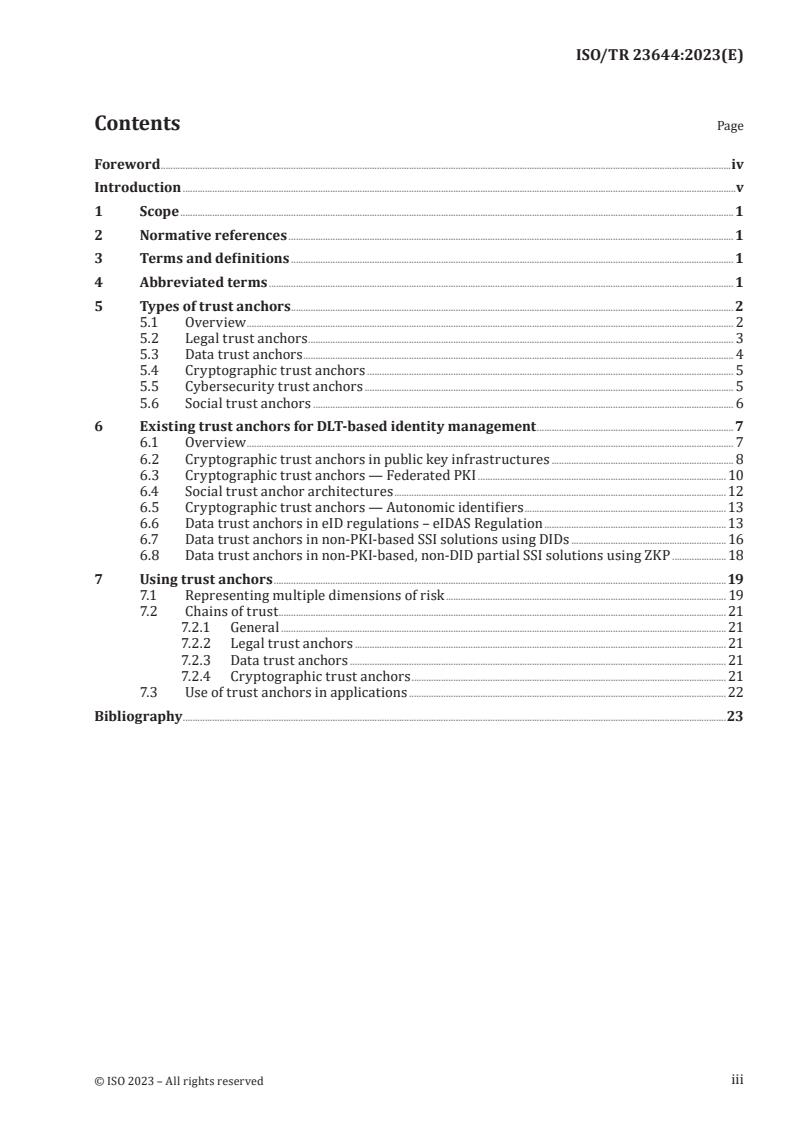
Contents Page
Foreword .iv
Introduction .v
1 Scope . 1
2 Normative references . 1
3 Terms and definitions . 1
4 Abbreviated terms . 1
5 Types of trust anchors . 2
5.1 Overview . 2
5.2 Legal trust anchors . 3
5.3 Data trust anchors . 4
5.4 Cryptographic trust anchors . 5
5.5 Cybersecurity trust anchors . 5
5.6 Social trust anchors . 6
6 Existing trust anchors for DLT-based identity management . 7
6.1 Overview . 7
6.2 Cryptographic trust anchors in public key infrastructures . 8
6.3 Cryptographic trust anchors — Federated PKI . 10
6.4 Social trust anchor architectures .12
6.5 Cryptographic trust anchors — Autonomic identifiers .13
6.6 Data trust anchors in eID regulations – eIDAS Regulation .13
6.7 Data trust anchors in non-PKI-based SSI solutions using DIDs . 16
6.8 Data trust anchors in non-PKI-based, non-DID partial SSI solutions using ZKP . 18
7 Using trust anchors .19
7.1 Representing multiple dimensions of risk . 19
7.2 Chains of trust . 21
7.2.1 General . 21
7.2.2 Legal trust anchors . 21
7.2.3 Data trust anchors . 21
7.2.4 Cryptographic trust anchors . 21
7.3 Use of trust anchors in applications . 22
Bibliography .23
iii
Foreword
ISO (the International Organization for Standardization) is a worldwide federation of national standards
bodies (ISO member bodies). The work of preparing International Standards is normally carried out
through ISO technical committees. Each member body interested in a subject for which a technical
committee has been established has the right to be represented on that committee. International
organizations, governmental and non-governmental, in liaison with ISO, also take part in the work.
ISO collaborates closely with the International Electrotechnical Commission (IEC) on all matters of
electrotechnical standardization.
The procedures used to develop this document and those intended for its further maintenance are
described in the ISO/IEC Directives, Part 1. In particular, the different approval criteria needed for the
different types of ISO document should be noted. This document was drafted in accordance with the
editorial rules of the ISO/IEC Directives, Part 2 (see www.iso.org/directives).
ISO draws attention to the possibility that the implementation of this document may involve the use
of (a) patent(s). ISO takes no position concerning the evidence, validity or applicability of any claimed
patent rights in respect thereof. As of the date of publication of this document, ISO had not received
notice of (a) patent(s) which may be required to implement this document. However, implementers are
cautioned that this may not represent the latest information, which may be obtained from the patent
database available at www.iso.org/patents. ISO shall not be held responsible for identifying any or all
such patent rights.
Any trade name used in this document is information given for the convenience of users and does not
constitute an endorsement.
For an explanation of the voluntary nature of standards, the meaning of ISO specific terms and
expressions related to conformity assessment, as well as information about ISO's adherence to
the World Trade Organization (WTO) principles in the Technical Barriers to Trade (TBT), see
www.iso.org/iso/foreword.html.
This document was prepared by Technical Committee ISO/TC 307, Blockchain and distributed ledger
technologies, in collaboration with Joint Technical Committee ISO/IEC JTC 1, Information technology,
Subcommittee SC 27, Information security, cybersecurity and privacy protection.
Any feedback or questions on this document should be directed to the user’s national standards body. A
complete listing of these bodies can be found at www.iso.org/members.html.
iv
Introduction
In recent years, new decentralized digital identity management systems have emerged, some of
them based in distributed ledger technologies (DLTs) providing support functions. As explained in
ISO/TR 23249, these include associating identifiers with public keys, supporting the attestation of
credentials, enabling credentials revocation, defining common credential templates or implementing
trust anchors.
DLT systems provide and rely on different types of trust anchors for DLT-based identity management,
each being important in terms of some dimension of policy, technology, data, security, assurance, etc.
Each trust anchor presents opportunities and risks to a DLT-based identity management system, and the
DLT-based identity management system actors need guidance and standards to develop an appropriate
operating model and risk mitigation strategy.
However, the DLT-based identity management system actors have also to take into account risks,
including those shared with other organizations in chains of trust, and to have a governance model
that is suitable for distributed and decentralized ecosystems formed by multiple actors. The DLT-
based identity management system actors have to consider technological change and new types of
technology with new risks that can address, create or result in opportunities and threats. The overall
effectiveness of the DLT-based identity management system is critically dependent on the quality of the
data it holds and shares; this is a high priority in DLT-based identity management system governance
and operational models.
This document provides an overview of trust anchors for DLT-based identity management systems.
v
TECHNICAL REPORT ISO/TR 23644:2023(E)
Blockchain and distributed ledger technologies (DLTs) —
Overview of trust anchors for DLT-based identity
management
1 Scope
This document describes concepts and considerations on the use of trust anchors for systems leveraging
blockchain and distributed ledger technologies (DLTs) for identity management, i.e. the mechanism by
which one or more entities can create, be given, modify, use and revoke a set of identity attributes.
2 Normative references
The following documents are referred to in the text in such a way that some or all of their content
constitutes requirements of this document. For dated references, only the edition cited applies. For
undated references, the latest edition of the referenced document (including any amendments) applies.
ISO 22739:2020, Blockchain and distributed ledger technologies — Vocabulary
3 Terms and definitions
For the purposes of this document, the terms and definitions given in ISO 22739:2020 apply.
ISO and IEC maintain terminology databases for use in standardization at the following addresses:
— ISO Online browsing platform: available at https:// www .iso .org/ obp
— IEC Electropedia: available at https:// www .electropedia .org/
4 Abbreviated terms
AML anti-money laundering
BIP bitcoin improvement proposal
CA certification authority
CAB Certification Authority Browser (CA/Browser)
DID decentralized identifier
DKMI decentralized key management infrastructure
DKMS decentralized key management system
DLT distributed ledger technology
eIDAS electronic identification, authentication and trust services
ETSI European Telecommunication Standards Institute
EU European Union
ID identity
IDP identity provider
IETF Internet Engineering Task Force
IoT internet of things
IP internet protocol
KERI key event receipt infrastructure
KYC know your customer
LoA level of assurance
LoIP level of identity proofing
MPC multi-party computation
OID object identifier
PDP policy decision point
PKI public key infrastructure
RFC request for comments
RP relying party
SED self-encrypting drive
SSI self-sovereign identity
ToIP trust over IP
TPM trusted platform module
UID unique identifier
VC verifiable credential
ZKP zero knowledge proof
ZVE zero knowledge proof verification engine
5 Types of trust anchors
5.1 Overview
Identity management is defined in ISO/IEC 24760-1:2019, 3.4.1, as the “processes and policies involved
in managing the lifecycle and value, type and optional metadata of attributes in identities known in a
particular domain”. ISO/IEC 24760-1:2019, 3.1.2, defines identity as a “set of attributes related to an
entity”, and ISO/IEC 24760-1:2019, 3.1.3, defines an attribute as a “characteristic or property of an
entity”. Parties involved in identity management, such as relying parties (RPs), typically have trust
relationships among them based in various features, which can be collectively designated as trust
anchors.
There is no single definition of a trust anchor because it can mean different things to different people.
NOTE Some authors identify different types of trust anchors, including government trust anchors (i.e. see
Reference [38]).
However, for the purposes of this document, the following five different types of trust anchor are
described that exist within any governance model, even if they are not obvious (there can be more):
— Legal trust anchors are the trust anchors established and/or recognized by the legislation and
regulations of relevant jurisdictions, by the contractual agreements and organizational by-
laws. They set a legal foundation for the trust frameworks and underpin the operating rules and
procedures. Legal trust anchors can mention or include references to other trust anchors.
— Data trust anchors are authoritative data sources that relate to the entities and attributes to be
processed, where very high data quality is vitally important.
— Cryptographic trust anchors, which provide the roots of cryptographic trust and enable
cryptographic binding, revocation, authentication, signing, encryption and other trust functions.
— Cybersecurity trust anchors, which monitor, detect and respond to policy violations, and enforce
policy compliance. This includes assurance, testing and certification regimes, possibly augmented
by the combined effort of a group responsible for defending an enterprise’s use of information
systems by maintaining its security (so-called “blue team”), known to the defenders, and a group of
mock attackers (“red team”), unknown to the defenders.
— Social trust anchors. Subjective trust anchors can exist, particularly in the context of social situations
and informal relationships where each individual can have a different view on the assessed risks
and the requirements for risk mitigation or legal remedy.
In this document, reference is made to different levels of assurance, borrowed from ISO/IEC 29115
and reflected in other ISO and ISO/IEC standards (maybe using different words) in order to provide
a spectrum of risk mitigation measures in response to internal, external and shared risks. Broadly
speaking, these are as follows:
a) Level 1. Low assurance. Little confidence in identity, cybersecurity, counter fraud, data quality, etc.
No significant risk mitigation strategy. No government-issued identity (ID) documents. Requires
repeatability, e.g. user ID, email address. Major use case: social media.
b) Level 2. Medium assurance. Medium confidence. Consumer-centric low-cost risk mitigation
strategy for low-value financial risks. Expect failures. Some/increasing use of government-issued
ID documents. Major use case: consumer credit/debit cards.
c) Level 3. High assurance. High confidence. Strong risk mitigation strategy to address financial
and non-financial risks, with the goal of preventing failures. Good use of government-issued ID
documents and real-time authentication/validation. Major use case: employer/employee binding
for employees acting digitally internally and externally on behalf of the organization.
d) Level 4. Very high assurance. Very high confidence. Multiple government ID documents or real-time
authentication/validation. Major use cases involve danger to life, public safety, high economic risk
and national security.
There are other ways to convey this information, such as vectors of trust, as defined in IETF RFC 8485,
that essentially provide the assurance information in a more granular way, considering different
components or categories of information relevant in the context of authentication processes.
5.2 Legal trust anchors
Trust frameworks exist to describe the policies, procedures and mechanisms for the operation of digital
trust across a community of trust, whether that exists in a legally binding agreement or whether it is
mandatory across the nation or jurisdiction under the rule of law. In almost all cases, the starting point
for a trust framework is the legal baseline upon which a policy framework is built, which forms the core
of the trust framework. These policies, based upon legislation, are encapsulated and implemented in
rulesets within the technological system, which are controlled through architectural components such
as policy decision points (PDPs) and policy enforcement points (PEPs). Legal trust anchors underpin
the operating rules.
Examples of relevant legislation include:
— national policy and infrastructure;
— national security;
— financial regulation, anti-money laundering (AML), counter fraud, Revised Payment Service
Directive (PSD2, Directive (EU) 2015/2366), Markets in Financial Instruments Directive 2 (MiFID 2,
Directive (EU) 2014/65);
— property regulation, real estate, intellectual property;
— privacy and other human rights; General Data Protection Regulation (GDPR, Directive (EU)
2016/679), Network Information Security (NIS) Directive 2 (Directive (EU) 2022/2555);
— identity, US Real ID Act, electronic identification, authentication and trust services (eIDAS, EU
Regulation 910/2014).
NOTE Legislation and government policy can refer to international and national standards for guidance and
normative controls.
Many forms of integration of a legal trust anchor into DLT based identity systems are possible. For
example, a smart contract that queries legal trust anchors for sanctioned accounts can be used as an
input to PDPs.
5.3 Data trust anchors
Several major technologies are emerging to provide new opportunities and new risks; all are driven
by and depend critically on high quality data. They can’t function properly, or at all, without assured
high quality data. One or more measures or levels of data quality can be used to indicate relevant
properties, such as timeliness, completeness, uniqueness, accuracy and authority. Any or all of these
can be combined in a matrix to give a vector or vectors for data quality assurance.
Any trusted system requires access to high quality data from authoritative data sources. These
authoritative data sources can be trust anchors, upon which the overall trust framework and the
operational system depend. The term “authoritative” usually means that the data are legally admissible
in a court of law, and there is a presumption of its reliability. For example, ISO/IEC TS 29003:2018,
3.3, defines authoritative party as an “entity that has the recognized right to create or record, and has
responsibility to directly manage, an identifying attribute”.
There is a second kind of data trust anchor, which is the register for a unique identifier (UID) and
attributes bound to that identifier. This UID register is normally be considered an authoritative source
under either legislation or contract law.
EXAMPLE 1 Each nation has a national passport office that is appointed in law to issue passports with a
passport number. The passport office is the authoritative source for passport numbers and associated attributes,
although an attribute such as date of birth can come from a date of births and deaths register, which is also a
legally appointed authoritative source.
EXAMPLE 2 A community of interest such as a supply chain can have a community contract that specifies
Company X as the authoritative source for a UID, which is used throughout the supply chain.
The relationship between the two organizations in Example 1 is a chain of trust. Chains of trust
normally work forward and are validated backwards. The passport can be issued if the person is
recorded as born but not dead in the births and deaths register. Once the person is recorded as dead,
then the register immediately notifies the revocation of the “living” attribute to the passport authority,
which revokes the passport. Extending the chain, a living person relies upon their passport to prove
their identity to their employer who issues an employee ID – Identifier to the person. If the person’s
passport is reported stolen, their employee ID – Identifier can be revoked.
Important data trust anchors include the following, each of which can support many business use case
scenarios and functional use cases:
— organization registers for companies, partnerships, non-profits, charities, government organizations,
police, etc.;
— high assurance government registers for citizen ID and resident ID: passports, eID cards, benefits
payments, pension payments, tax payments, voting registers, military ID, police ID, driving licences,
firearm licences, etc.;
— other government registers for persons, including foreign workers, asylum seekers and refugees;
— health patient records and prescription drug purchases;
— land, building, postal and mapping registers for proof of location;
— databases of utility companies for proof of address;
— financial know your customer (KYC) and AML registers for bank accounts and other related assets;
— domain name registers for domain names and, through the CAB Forum, secure sockets layer (SSL);
— internet service providers for internet protocol (IP) address and locator/identifier separation
protocol (LISP) mappings;
— telecommunication companies for phone [international mobile equipment identity (IMEI)] and
subscriber identity module (SIM) [international mobile subscriber identity (IMSI)];
— certificate authorities for public key infrastructure (PKI) certificates and policy object identifier
(OID) arc references.
5.4 Cryptographic trust anchors
Cryptographic trust anchors provide the roots of cryptographic trust, bind entities and attributes to
data subjects and data principals, as well as to actors (direct persons and delegates, either automated
or otherwise) within the systems that operate the trust framework.
The certificate issuance and management life cycle, as well as the governance model, are important
for most types of centralized and distributed identity management systems. There are identity
management systems that do not use public key certificates.
Different examples of cryptographic trust anchors include using a DLT to bind public keys used to
control decentralized identifiers (DIDs) to users, or to validate anonymous identity credentials.
5.5 Cybersecurity trust anchors
As with any infrastructure and the people who operate it, there usually exists a risk management
model and a cybersecurity framework. The risk management model addresses the main areas of risk
management in accordance with ISO 31000, ISO/IEC 27001 and ISO/IEC 27005 or other standards such
as NIST SP 800-53, as follows:
— Identify: The identification of risks.
— Prevent: This includes risk assessment and risk treatment, using options such as risk transfer and
risk mitigation, and the monitoring of any remaining risks.
— Detect: Prevention is never 100 %. Its purpose is to buy time to detect threats and incidents, and to
respond.
— Respond: The response to a detected threat aims to contain and defeat it, ensuring at the same time
business continuity.
— Recover: The risk mitigation strategy includes a recovery to normality.
The risk mitigation strategy can include a range of controls, backed by a cybersecurity framework.
ISO/IEC TS 27110 provides the guidelines for developing a cybersecurity framework.
Blockchain and DLT raise additional requirements and challenges regarding cybersecurity. These
additional requirements cover the following several important areas:
— the cybersecurity policy framework for the distributed or decentralized blockchain/DLT, based
upon existing legal requirements;
— the governance model for the maintenance, implementation, operation and enforcement of the
cybersecurity policy framework;
— the ecosystem of DLT use cases, conforming to existing jurisdictional and regulatory requirements;
— the consensus model, whether based on lottery or voting (if based on voting, this includes the
authentication and authorization model, backed by an audit trail;
— the node architecture, implementation and operation;
— the incident management plan for attacks or incidents affecting the blockchain/DLT.
There are trust anchors that operate as both cryptographic and cybersecurity trust anchors.
EXAMPLE Self-encrypting drives (SEDs) have an internal trusted platform module (TPM), attestation key
and cryptographic store separate from the TPM in any other device. The SED can hold the last “known good”
state of its host device (e.g. laptop) and provide a secure reference at boot time. If the SED TPM reports an error,
then the parent device will not start its operating system. Similarly, if the SED (or another SED) is held on the
network, then the basic input/output system (BIOS) layer on the connecting device will validate with the SED on
the network for the last known good state of the connecting device. If there is an error, then the laptop will not
be allowed to connect to the network; the network policy is that “only known good devices” can connect to the
network.
Each community of trust, and the organizations within it, depend on effective collaborative governance
of the community and also corporate governance within each organization. Individually and collectively,
the following possibilities are considered:
— a governance model of policies and procedures to describe how the community and each organization
is going to behave and work;
— a governance organizational structure to develop, operate and enforce the governance model;
— technological and digital mechanisms to make the procedures and processes efficient, effective, re-
usable, enforceable and policy compliant;
— establishment of trust anchors for the mechanisms to use.
ISO 37000:2021 gives guidance on the governance of organizations. ISO/IEC 38500 provides
guiding principles, and ISO/IEC TR 38502 provides information on a framework and model on
the use of information technology (IT) within an organization. ISO/IEC 27014 gives guidance on
concepts, objectives and processes for the governance of information security for an organization. A
comprehensive governance model considers the above standards including others.
5.6 Social trust anchors
The trust anchors described in 5.2 to 5.5 are all objective in the sense that they are governed by defined
legislations, regulations, rules and standards, which have normative requirements reflected in a
governance structure that addresses collective risks in a defined manner.
However, other subjective trust anchors can exist, particularly in the context of social situations and
informal relationships where each individual can have a different view on the assessed risks and the
requirements for risk mitigation or legal remedy. These are described as “social trust anchors”.
The majority of decentralized identity management models rely on a specific (often centralized)
certification or verification service to provide a level of assurance (LoA). This LoA is representational
to the level of trust the RP can have regarding the relationship between the “real-life” identity [e.g.
natural person, legal person, internet of things (IoT) device] and the identifier used to represent them
within the identity management system.
In many instances, a centralized trust service is provided by a known, recognized and authoritative
entity (e.g. government department, regulated service provider, licensed entity). However, there are
examples of novel approaches and architectures. These architectures view trust as being determined
by the communication of a series of verifiable relational links between network participants.
The network-based trust models have also been termed “web of trust”, “socially verified” or “graph-
based” models of trust. The proposed architectures imply that the root of trust lays within the network,
specifically the component relationships and explicit relations that can be verified by chains of
cryptographically verified interaction between participants. Ultimately, the assurance is distributed
across a number of network participants allowing for a LoA to be communicated to those inside and
outside of the network (i.e. the RP).
These trust models are based on architectures proposed to be more similar to real life, where assurance
of an identity (and its identifier) is distributed across a number of other identities (and their identifiers).
A common example provided in the literature is when a potential employer telephones a number of
“references” to check the presented attributes and characteristics asserted by the potential employee.
In this example, trust is distributed through the social web of the candidate, which is similar (in this
instance) to distributing trust through a network of participants in the context of decentralized digital
identity management systems.
6 Existing trust anchors for DLT-based identity management
6.1 Overview
There are many different types of trust model and they use these trust anchors differently. The greater
the risks (particularly regulatory), the higher the LoA and the need for strong authentication in a way
that is assured or certified by government. Hence, government authoritative sources usually operate
at LoA 3 or 4, and also provide a root trust anchor in a chain of trust where the downstream credential
issuers can be commercial operators supporting industry or consumer purposes.
Until recently, most digital credentials were authenticated between the user and the authority, and
the authority issued an assertion or authentication result to the RP. However, recently there has been
increased interest in the concept of self-sovereign identity (SSI), where the user holds a credential
issued by the authoritative source and controls its use in a consent model; this can be done using a
stateless or a stateful trusted intermediary, where the credential is held in the intermediary or held by
the user in a secure device, e.g. trusted execution environment (TEE) in a mobile phone. Depending on
the policy, the RP can choose whether or not to accept the credential held by the user, or to verify the
credential against the issuing authority. While the verification can normally succeed, the verification
can fail for reasons of elapsed time or policy exceptions, which can be anticipated in the risk mitigation
strategy.
There are other models and technologies that rely on various mixes of authentication factors, which can
also affect the architecture.
EXAMPLE A two-sided model at the end point. An authenticator exists in the user device. The user and the
device authenticate to the authenticator on one side (locally) and the network interacts (externally) with the
1)
other side of the authenticator. Europay, MasterCard® and Visa® (EMV) Worldpay operate this way.
1) MasterCard® and Visa® are examples of suitable products available commercially. This information is given for
the convenience of users of this document and does not constitute an endorsement by ISO of these products.
Some of these models are listed below:
— cryptographic trust anchors in PKI;
— federated PKI;
— social trust anchor architectures;
— autonomic identifiers used as cryptographic trust anchors;
— data trust anchors in eID regulations – eIDAS regulation;
— data trust anchors in non-PKI-based SSI solutions using DIDs;
— data trust anchors in non-PKI-based, non-DID partial SSI solutions using zero knowledge proof
(ZKP).
6.2 Cryptographic trust anchors in public key infrastructures
ITU-T Recommendation X.509 | ISO/IEC 9594-8 defines a set of frameworks for public key certificates
and attribute certificates upon which full services can be based. IETF has extensive experience in the
treatment of cryptographic trust anchors, especially in PKI. Some DLT-based identity management
systems are based in PKI.
IETF RFC 5280, the X.509 profile technical specification for the internet, refers to trust anchors in the
context of the validation of certification paths, as part of the certification validation procedure, but it
does not define what a trust anchor is.
According to IETF RFC 5914:2010, “a trust anchor is an authoritative entity represented by a public key
and associated data. The public key is used to verify digital signatures, and the associated data is used
to constrain the types of information or actions for which the trust anchor is authoritative”.
Moreover, according to IETF RFC 5934:2010, “a trust anchor contains a public key that is used to validate
digital signatures”. This specification differentiates three types of trust anchors: apex trust anchors,
management trust anchors and identity trust anchors. The latter “are used to validate certification
paths, and they represent the trust anchor for a public key infrastructure”, being “most often used in
the validation of certificates associated with non-management applications”.
IETF RFC 6024:2010 states that “a trust anchor represents an authoritative entity via a public key and
associated data. The public key is used to verify digital signatures, and the associated data is used to
constrain the types of information for which the trust anchor is authoritative. An RP uses trust anchors
to determine if a digitally signed object is valid by verifying a digital signature using the trust anchor’s
public key, and by enforcing the constraints expressed in the associated data for the trust anchor”.
In the IETF model, trust anchors are used as “roots” of hierarchical PKIs, thus supporting chains of trust,
i.e. an end-entity digital signature is verified with the end-entity’s public key included in a certificate
signed by a subordinate certification authority (CA); the subordinate CA’s signature is verified with the
subordinate CA’s public key included in a certificate issued by a root CA; this root public key is a typical
example of a trust anchor, as seen in Figure 1:
Key
certifies
chain of CAs
trust anchor certifies CA
trust relationship
NOTE Source: ISO/IEC 9594-8:2020, Figure 2.
Figure 1 — Example chain of trust
Trust anchor collections can be, and usually are, represented by a trust anchor list, conforming to the
syntax defined in IETF RFC 5914, with the aim to publish them to applications (trust anchor stores)
used by RPs when validating a digital signature. This trust anchor list is typically signed to protect and
authenticate the information contained within.
The concept of trust anchor, initially defined in the context of hierarchical PKIs, later was adopted for
decentralized PKI and used, e.g. in SSI management systems.
From a technical perspective, this verifiable, self-sovereign digital identifier is based on a type of
identifier called a “decentralized identifier” (DID), and, in technical terms, it is a URL, i.e. an identifier
universal or uniform resource locator, with its own rules of syntax and processing, that relates a
subject with a DID document, and which describes how such DID is used, and, in particular, how the DID
document supports the authentication of the subject associated with the DID, as shown in Figure 2.
One of the peculiarities of a DID is that it is based in DLT or other forms of decentralized networks,
so it does not require a centralized registration system. This allows the implementation of a
decentralized public key infrastructure (DPKI), a combination of DIDs for decentralized identification
and a decentralized key management system (DKMS). This is in opposition to the classic hierarchical
PKI systems, which are precisely based on the centralization of the issuing function in the hands of
a provider, although with nuances. In fact, the PKI is not an absolutely centralized system either, but
there are multiple providers, with their own PKIs, that compete with each other, which has forced
trust models to be established that are somewhat decentralized (although it can be said that the
centralization of trust management has shifted towards trusted lists and browsers).
NOTE Source: Reference [44].
Figure 2 — Relationships between DID, DID document and subject
Thus, DKMS is proposed as a new approach to cryptographic key management intended for use with
blockchain and DLTs where there are no centralized authorities, inverting the core assumption of
conventional PKI architecture, namely that public key certificates will be issued by centralized or
federated CAs, because with DKMS the initial “root of trust” for all participants is any distributed ledger
[44]
that supports a DID.
Starting from a DID (e.g. did: example: 123456789abcdefghi), anyone can go to the internet to obtain the
corresponding DID document that describes the DID in question (an operation called “DID resolution”),
and use its contents to authenticate the subject and to obtain attributes or claims about it, such as name
and surname, or other personal information to share. The DID document can be stored on chain or off
chain, if compliance with data protection regulations is needed. Consideration is given as to whether a
DID is being stored on-chain for a natural person, especially with regards to data protection compliance.
Another identified use of the cryptographic trust anchor relates to the prior setup required by certain
[28]
protocols for anonymous credentials, such as the Camenisch-Lysyanskaya signature scheme or
the cryptographic accumulator system used for non-revocation proof currently implemented by
2) [39]
Hyperledger® Indy-Aries-Ursa technologies.
6.3 Cryptographic trust anchors — Federated PKI
PKI Federation has already been outlined. Figure 3 shows just the top-level CAs in the US Federal
[49]
Government Federal PKI Bridge and its external federation through the Federal Bridge Certification
Authority (FBCA) to a wide range of external CAs. Some of these, such as the CertiPath bridges, extend
out to major CAs supporting global corporations (such as Boeing, Northrop Grumman and Lockheed
Martin) and industries, as well as linking to other governments, such as the Netherlands Ministry
of Defence. Hundreds more CAs exist under the US Federal Common Policy which are not shown in
Figure 3.
2) Hyperledger® is an example of a suitable product available commercially. This information is given for the
convenience of users of this document and does not constitute an endorsement by ISO of this product.
Figure 3 — US PKI Federation
Many other governments operate similarly large PKI federations within and across government
organizations and with industry, particularly in Asia. The opportunity for cross-border inter-federation
is significant and this is expected to grow as IoT, payments, logistics sensors, mobile and autonomous
sensors and smart cities increase.
There are several key features about PKI federation, including:
— the certificate contains information for the RP to be able to navigate to the issuing certificate
authority, where the certificate can be validated; this is known as path discovery and validation;
— there can be resilience between multiple CAs using cross-signing;
— the user is required to authenticate to the issuing CA, so the CA can send an attestation or validation
response back to the RP;
— certificates contain references to policy object IDs, which are stored offline; a certificate typically
supports one policy OID for a specific set of policies at an appropriate LoA for a given use case
scenario;
— certificates usually exist within a hardware token/smartcard or device, which can hold multiple
certificates to support authentication [logical access control system (LACS)], digital signature,
encryption, secure email and physical access control system (PACS) to buildings, etc.;
— it is crucial to maintain the security of all CAs, especially when using hierarchical CA structures, e.g.
if a root CA is affected by a security issue, all following CAs in the chain of trust are affected as well.
The business use cases for PKI federation are almost exclusively for government and industry employees
involved in highly regulated and collaborative activities at LoA 3 and 4.
A few national citizen eID schemes are based on PKI standards and so they can, theoretically, federate
with other nations. However, at present, there are no known citizen or consumer PKI federations.
This is a possibility in the future, particularly once the challenges of cross-technology federation are
addressed, including identity-related resources description, registration, access control, service level
agreements, usage policies, management, life cycle, operational procedures, legal framework and
[52]
provider/user incentives, among others.
Many of the lessons learnt in the establishment and governance of PKI federations can be applicable
to the decentralized identity management systems that need to connect and interoperate. Thus, it is
possible to imagine federations of different decentralized identity management systems which are
based in diverse DLT networks and systems, by using specific technologies such as Polkadot sharded
[51]
protocol , that enable cross-blockchain transfers of any type of data or asset.
6.4 Social trust anchor architectures
[25]
Examples of social trust anchor architectures are found within the BrightID whitepaper and also the
[37]
“pre-formal digital identity” proposal outlined by Immorlica et al.
[37]
Immorlica et al. propose that the followin
...