

ISO/IEC 15067-3:2012
(Main)Information technology — Home Electronic System (HES) application model — Part 3: Model of a demand-response energy management system for HES
General Information
- Abstract
ISO/IEC 15067-3:2012(E) specifies an energy management model for programs that manage the consumer demand for electricity using a method known as "demand response". Three types of demand response are specified in this standard: direct control, local control and distributed control. It replaces ISO/IEC TR 15067-3, first edition, published in 2000, and constitutes a technical revision. It includes the following significant technical changes with respect to the previous edition: - the demand response options have been expanded; - distributed energy resources such as local generation and storage have been included; - the terminology for demand response has been aligned with smart grid.
- Status
- Withdrawn
- Publication Date
- 12-Jul-2012
- Technical Committee
- ISO/IEC JTC 1/SC 25 - Interconnection of information technology equipment
- Current Stage
- 9599 - Withdrawal of International Standard
- Start Date
- 13-Sep-2024
- Completion Date
- 29-Aug-2026
Overview
ISO/IEC 15067-3:2012 - Information technology - Home Electronic System (HES) application model - Part 3 - specifies a high-level energy management model for demand‑response (DR) programs that manage consumer electricity demand. The standard defines three DR approaches - direct control, local control, and distributed control - and extends earlier guidance (replacing ISO/IEC TR 15067-3, 2000) by incorporating distributed energy resources (DER) (local generation and storage) and aligning DR terminology with the smart grid ecosystem.
Key topics and technical requirements
- Energy management model for HES: Logical and physical components that enable coordination between utilities, premises equipment and consumer devices.
- Demand‑response methods: Definitions and models for
- Direct load control (utility-initiated control actions),
- Demand response via pricing and event notification (price-to-device strategies),
- Local and distributed control (on-premises decision-making and automated responses).
- Distributed control architectures and strategies: Role of smart appliances, price signals, and autonomous device behaviors.
- Energy Management Agent (EMA): Functional model describing grid-to-home and home-to-grid interactions, mediation between utility signals and device actions.
- HES taxonomy and lexicon: Standardized use cases (e.g., local control, direct control with/without supervision, advanced distributed control, utility telemetry) and a message lexicon to support interoperability.
- Conformance and normative references: Requirements for implementing systems to demonstrate compliance and ensure consistent integration with other HES components.
Practical applications and who uses this standard
ISO/IEC 15067-3:2012 is intended for stakeholders involved in residential and small‑building energy management, particularly where interoperable demand‑response is required:
- Utilities and grid operators designing DR programs and pricing schemes
- Aggregators and third‑party demand‑response service providers
- Home network developers and HES platform vendors
- Appliance, DER (PV, batteries), and smart meter manufacturers
- Homebuilders, energy consultants and system integrators implementing on‑site energy management
- Regulators and standards bodies specifying smart grid interoperability
Practical benefits include enabling automated load shifting, integrating local generation and storage, supporting price‑driven device behavior, and fostering vendor-agnostic interoperability across smart appliances and energy services.
Related standards
- Other parts of the ISO/IEC 15067 series (e.g., Part 2: Lighting model for HES; Part 4: Security model for HES)
- Smart grid and home automation standards addressing measurement, communications and security (referenced within the standard’s normative references)
Keywords: ISO/IEC 15067-3:2012, Home Electronic System, HES, demand response, energy management, smart grid, direct load control, distributed energy resources, EMA, smart appliances.
Relations
- Effective Date
- 14-Sep-2024
- Effective Date
- 14-Nov-2009
Get Certified
Connect with accredited certification bodies for this standard

BSI Group
BSI (British Standards Institution) is the business standards company that helps organizations make excellence a habit.

NYCE
Mexican standards and certification body.
Sponsored listings
Frequently Asked Questions
ISO/IEC 15067-3:2012 is a standard published by the International Organization for Standardization (ISO). Its full title is "Information technology — Home Electronic System (HES) application model — Part 3: Model of a demand-response energy management system for HES". This standard covers: ISO/IEC 15067-3:2012(E) specifies an energy management model for programs that manage the consumer demand for electricity using a method known as "demand response". Three types of demand response are specified in this standard: direct control, local control and distributed control. It replaces ISO/IEC TR 15067-3, first edition, published in 2000, and constitutes a technical revision. It includes the following significant technical changes with respect to the previous edition: - the demand response options have been expanded; - distributed energy resources such as local generation and storage have been included; - the terminology for demand response has been aligned with smart grid.
ISO/IEC 15067-3:2012(E) specifies an energy management model for programs that manage the consumer demand for electricity using a method known as "demand response". Three types of demand response are specified in this standard: direct control, local control and distributed control. It replaces ISO/IEC TR 15067-3, first edition, published in 2000, and constitutes a technical revision. It includes the following significant technical changes with respect to the previous edition: - the demand response options have been expanded; - distributed energy resources such as local generation and storage have been included; - the terminology for demand response has been aligned with smart grid.
ISO/IEC 15067-3:2012 is classified under the following ICS (International Classification for Standards) categories: 35.200 - Interface and interconnection equipment; 35.240.99 - IT applications in other fields. The ICS classification helps identify the subject area and facilitates finding related standards.
ISO/IEC 15067-3:2012 has the following relationships with other standards: It is inter standard links to ISO/IEC 15067-3:2024, ISO/IEC TR 15067-3:2000. Understanding these relationships helps ensure you are using the most current and applicable version of the standard.
ISO/IEC 15067-3:2012 is available in PDF format for immediate download after purchase. The document can be added to your cart and obtained through the secure checkout process. Digital delivery ensures instant access to the complete standard document.
Standards Content (Sample)
ISO/IEC 15067-3
Edition 1.0 2012-07
INTERNATIONAL
STANDARD
colour
inside
Information technology – Home electronic system (HES) application model –
Part 3: Model of a demand-response energy management system for HES
All rights reserved. Unless otherwise specified, no part of this publication may be reproduced or utilized in any form
or by any means, electronic or mechanical, including photocopying and microfilm, without permission in writing from
either IEC or IEC's member National Committee in the country of the requester.
If you have any questions about ISO/IEC copyright or have an enquiry about obtaining additional rights to this
publication, please contact the address below or your local IEC member National Committee for further information.
IEC Central Office Tel.: +41 22 919 02 11
3, rue de Varembé Fax: +41 22 919 03 00
CH-1211 Geneva 20 info@iec.ch
Switzerland www.iec.ch
About the IEC
The International Electrotechnical Commission (IEC) is the leading global organization that prepares and publishes
International Standards for all electrical, electronic and related technologies.
About IEC publications
The technical content of IEC publications is kept under constant review by the IEC. Please make sure that you have the
latest edition, a corrigenda or an amendment might have been published.
Useful links:
IEC publications search - www.iec.ch/searchpub Electropedia - www.electropedia.org
The advanced search enables you to find IEC publications The world's leading online dictionary of electronic and
by a variety of criteria (reference number, text, technical electrical terms containing more than 30 000 terms and
committee,…). definitions in English and French, with equivalent terms in
It also gives information on projects, replaced and additional languages. Also known as the International
withdrawn publications. Electrotechnical Vocabulary (IEV) on-line.
IEC Just Published - webstore.iec.ch/justpublished Customer Service Centre - webstore.iec.ch/csc
Stay up to date on all new IEC publications. Just Published If you wish to give us your feedback on this publication
details all new publications released. Available on-line and or need further assistance, please contact the
also once a month by email. Customer Service Centre: csc@iec.ch.
ISO/IEC 15067-3
Edition 1.0 2012-07
INTERNATIONAL
STANDARD
colour
inside
Information technology – Home electronic system (HES) application model –
Part 3: Model of a demand-response energy management system for HES
INTERNATIONAL
ELECTROTECHNICAL
COMMISSION
PRICE CODE
Q
ICS 35.200 ISBN 978-2-83220-191-6
– 2 – 15067-3 © ISO/IEC:2012(E)
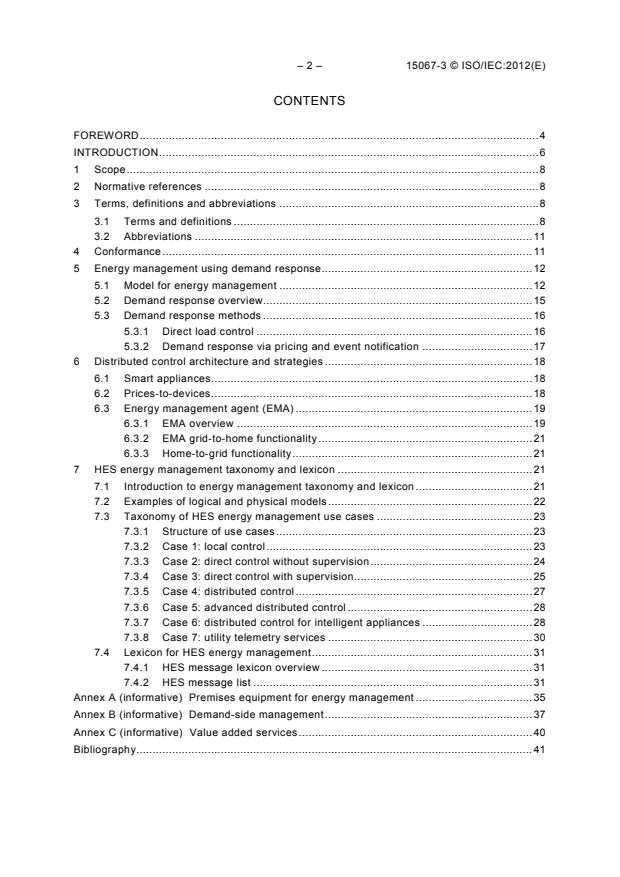
CONTENTS
FOREWORD . 4
INTRODUCTION . 6
1 Scope . 8
2 Normative references . 8
3 Terms, definitions and abbreviations . 8
3.1 Terms and definitions . 8
3.2 Abbreviations . 11
4 Conformance . 11
5 Energy management using demand response . 12
5.1 Model for energy management . 12
5.2 Demand response overview. 15
5.3 Demand response methods . 16
5.3.1 Direct load control . 16
5.3.2 Demand response via pricing and event notification . 17
6 Distributed control architecture and strategies . 18
6.1 Smart appliances. 18
6.2 Prices-to-devices . 18
6.3 Energy management agent (EMA) . 19
6.3.1 EMA overview . 19
6.3.2 EMA grid-to-home functionality . 21
6.3.3 Home-to-grid functionality . 21
7 HES energy management taxonomy and lexicon . 21
7.1 Introduction to energy management taxonomy and lexicon . 21
7.2 Examples of logical and physical models . 22
7.3 Taxonomy of HES energy management use cases . 23
7.3.1 Structure of use cases . 23
7.3.2 Case 1: local control . 23
7.3.3 Case 2: direct control without supervision . 24
7.3.4 Case 3: direct control with supervision . 25
7.3.5 Case 4: distributed control . 27
7.3.6 Case 5: advanced distributed control . 28
7.3.7 Case 6: distributed control for intelligent appliances . 28
7.3.8 Case 7: utility telemetry services . 30
7.4 Lexicon for HES energy management . 31
7.4.1 HES message lexicon overview . 31
7.4.2 HES message list . 31
Annex A (informative) Premises equipment for energy management . 35
Annex B (informative) Demand-side management . 37
Annex C (informative) Value added services . 40
Bibliography . 41
15067-3 © ISO/IEC:2012(E) – 3 –
Figure 1 – Elements of the HES energy management model . 13
Figure 2 – HES energy management model . 14
Figure 3 – Example of building energy management . 15
Figure 4 – Direct load control . 16
Figure 5 – Price-to-devices . 19
Figure 6 – Distributed load control system . 20
Figure 7 – Energy management agent . 20
Figure 8 – Typical HES energy management model components . 22
Figure 9 – Logical model for HES energy management . 23
Figure 10 – Logical model of minimal HES energy management . 23
Figure 11 – Case 1: local control, physical model . 24
Figure 12 – Case 1: local control, logical model . 24
Figure 13 – Case 2: direct control, physical model . 25
Figure 14 – Case 2: direct control, logical model . 25
Figure 15 – Case 3: direct control with supervision, physical model . 26
Figure 16 – Case 3: direct control with supervision, logical model . 26
Figure 17 – Case 7: utility telemetry services, physical model . 30
Figure 18 – Case 7: utility telemetry services, logical model . 30
– 4 – 15067-3 © ISO/IEC:2012(E)
INFORMATION TECHNOLOGY –
HOME ELECTRONIC SYSTEM (HES) APPLICATION MODEL –
Part 3: Model of a demand-response energy
management system for HES
FOREWORD
1) ISO (International Organization for Standardization) and IEC (International Electrotechnical Commission) form the
specialized system for worldwide standardization. National bodies that are members of ISO or IEC participate in
the development of International Standards. Their preparation is entrusted to technical committees; any ISO and
IEC member body interested in the subject dealt with may participate in this preparatory work. International
governmental and non-governmental organizations liaising with ISO and IEC also participate in this preparation.
2) In the field of information technology, ISO and IEC have established a joint technical committee, ISO/IEC JTC 1.
Draft International Standards adopted by the joint technical committee are circulated to national bodies for voting.
Publication as an International Standard requires approval by at least 75 % of the national bodies casting a vote.
3) The formal decisions or agreements of IEC and ISO on technical matters express, as nearly as possible, an
international consensus of opinion on the relevant subjects since each technical committee has representation
from all interested IEC and ISO member bodies.
4) IEC, ISO and ISO/IEC publications have the form of recommendations for international use and are accepted
by IEC and ISO member bodies in that sense. While all reasonable efforts are made to ensure that the
technical content of IEC, ISO and ISO/IEC publications is accurate, IEC or ISO cannot be held responsible for
the way in which they are used or for any misinterpretation by any end user.
5) In order to promote international uniformity, IEC and ISO member bodies undertake to apply IEC, ISO and
ISO/IEC publications transparently to the maximum extent possible in their national and regional publications.
Any divergence between any ISO/IEC publication and the corresponding national or regional publication
should be clearly indicated in the latter.
6) ISO and IEC provide no marking procedure to indicate their approval and cannot be rendered responsible for
any equipment declared to be in conformity with an ISO/IEC publication.
7) All users should ensure that they have the latest edition of this publication.
8) No liability shall attach to IEC or ISO or its directors, employees, servants or agents including individual experts
and members of their technical committees and IEC or ISO member bodies for any personal injury, property
damage or other damage of any nature whatsoever, whether direct or indirect, or for costs (including legal fees)
and expenses arising out of the publication of, use of, or reliance upon, this ISO/IEC publication or any other IEC,
ISO or ISO/IEC publications.
9) Attention is drawn to the normative references cited in this publication. Use of the referenced publications is
indispensable for the correct application of this publication.
10) Attention is drawn to the possibility that some of the elements of this International Standard may be the subject of
patent rights. ISO and IEC shall not be held responsible for identifying any or all such patent rights.
International Standard ISO/IEC 15067-3 was prepared by subcommittee 25: Interconnection
of information technology equipment, of ISO/IEC joint technical committee 1: Information
technology.
This International Standard replaces ISO/IEC TR 15067-3, first edition, published in 2000, and
constitutes a technical revision.
This edition includes the following significant technical changes with respect to the previous
edition:
− the demand response options have been expanded;
− distributed energy resources such as local generation and storage have been included;
− the terminology for demand response has been aligned with smart grid.
15067-3 © ISO/IEC:2012(E) – 5 –
The list of all currently available parts of the ISO/IEC 15067 series, under the general title
Information technology – Home electronic system (HES) application model, can be found on
the IEC web site.
This International Standard has been approved by vote of the member bodies, and the voting
results may be obtained from the address given on the second title page.
This publication has been drafted in accordance with the ISO/IEC Directives, Part 2.
IMPORTANT – The 'colour inside' logo on the cover page of this publication indicates
colours which are considered to be useful for the correct
that it contains
understanding of its contents. Users should therefore print this document using a
colour printer.
– 6 – 15067-3 © ISO/IEC:2012(E)
INTRODUCTION
ISO/IEC 15067 currently consists of three parts. All parts were previously published as
Technical Reports. ISO/IEC 15067-3, energy management, is being upgraded to a standard at
the request of the IEC Standards Management Board study group on energy efficiency (SG1
SMB-SG 1/0027/INF, July 2008, Recommendation 16). Energy management is becoming an
essential part of the worldwide development of smart grids for electricity.
Part 2: Lighting model for HES
Part 3: Model of a demand-response energy management system for HES (this document)
Part 4: Model of a security system for HES
SC 25/WG 1, the Home Electronic System (HES) working group, has developed these models
to foster interoperability among products from competing or complementary manufacturers.
Product interoperability is essential when using home control standards, such as HES. This
International Standard defines a standard framework for a generic energy management
system and describes the communications services needed. A high-level model for an energy
management system using HES is presented.
Homebuilders, suppliers of building materials and consumer product manufacturers all affect
energy consumption in buildings. Products and services intended for energy management can
be provided by
• programs developed for consumers by electricity suppliers, typically a public utility,
• products purchased by consumers independent of electricity supplier programs.
Various methods for managing the electricity supply network, called the “electricity grid,” have
been developed. The goal of these methods is to match the customer demand for power with
the available supply. The need for such methods results from
• electric supply limitations,
• public resistance to building large generating plants,
• public concern for environmental pollution, including greenhouse gases,
• public opposition to siting of new transmission lines,
• an anticipated demand for and availability of electricity for charging electric vehicles,
• public interest and support for renewable sources of energy,
• the introduction of distributed energy resources (DER) with local generators such as wind
turbines and solar photo-voltaic (PV) panels,
• the variable and unpredictable nature of wind and solar distributed generation with output
that may fluctuate with time and weather,
• the development of batteries and other advanced premises storage technologies plus
power conditioning and management equipment,
• the introduction of alternative electricity pricing methods or tariffs that encourage
efficiency.
The model presented in this standard focuses primarily on methods known as “demand
response” (DR). Because demand response systems extend beyond the meter into customer
premises, those impacted by demand response technology choices include utilities, third-
party suppliers of demand response services, home network developers, appliance and DER
manufacturers and consumers. An example of a third-party provider of demand response
services is an aggregator serving a large building or neighbourhood.
Three types of DR are specified in this standard: direct control, local control and distributed
control. The choice of DR method will vary by utility to achieve the load shape that aligns with
supply limitations, transmission and distribution capabilities, regulatory constraints and
15067-3 © ISO/IEC:2012(E) – 7 –
business considerations. However, distributed control offers consumers the most flexibility in
adapting appliance operation to constraints imposed by the utility. The various standards
developed by JTC 1/SC 25 for the Home Electronic System are important for effective
distributed control, as specified.
DR is one element in the concept of the “smart grid”. The smart grid for electricity integrates
subsystems for generation, transmission, distribution and customer services to improve the
reliability and efficiency of electricity systems. The smart grid also extends these subsystems
to accommodate distributed energy resources and demand response. A goal of the smart grid
is to enable all these subsystems to interoperate using information technology. Therefore, this
standard is an important contribution to the smart grid.
As the market develops for energy management products, consumer electronics companies,
appliance manufacturers and other residential suppliers may offer products that combine load
management using demand response with energy conservation. Energy conservation may
offer methods for consumers to reduce energy consumption overall, in addition to reducing
consumption at times of peak demand. These methods include products and systems for
electricity generation, storage and management. Such products and systems are located on
premises and can communicate with other on-premises products and systems in order to
interoperate as a larger system. Examples are included in Annex A. Standards for these
products are anticipated to expand this energy management model in future updates.
– 8 – 15067-3 © ISO/IEC:2012(E)
INFORMATION TECHNOLOGY –
HOME ELECTRONIC SYSTEM (HES) APPLICATION MODEL –
Part 3: Model of a demand-response energy
management system for HES
1 Scope
This part of ISO/IEC 15067 focuses on products and services that can manage energy
consumption and generation of devices dynamically in response to electricity supply and
prices that may vary over time. The model specified here for energy management is intended
to be generic and representative of a wide range of situations. This part of ISO/IEC 15067
applies to the customer services portion of the electricity smart grid.
This standard specifies an energy management model for programs that manage the
consumer demand for electricity using a method known as “demand response”. Three types of
demand response are specified in this standard: direct control (5.3.1), local control (5.3.2.2)
and distributed control (5.3.2.3).
NOTE Customers and customer equipment may use these methods to control the energy consumption and
generation of devices such as appliances and distributed energy resources (for example, photo-voltaic [PV], wind,
fuel cell [FC], combined heat and power [CHP], electric vehicle [EV], and stationary battery [SB]).). The taxonomy
and lexicon of an energy management model that supports these demand response methods are presented in 7.3
and 7.4.
2 Normative references
The following referenced documents are indispensable for the application of this document.
For dated references, only the edition cited applies. For undated references, the latest edition
of the referenced document (including any amendments) applies.
ISO/IEC 14543-2-1, Information technology – Home electronic system (HES) architecture –
Part 2-1: Introduction and device modularity
3 Terms, definitions and abbreviations
3.1 Terms and definitions
For the purposes of this document, the following terms and definitions apply.
3.1.1
application domain
logically related group of components that provides the functions of an application in a home
or building
3.1.2
demand charge
charge for electricity based on the peak power consumed during a specified interval of time,
subject to a time-smoothing algorithm
3.1.3
demand response
method for matching the demand for energy to the available supply of energy
15067-3 © ISO/IEC:2012(E) – 9 –
3.1.4
direct load control
demand response via remote control of one or more appliances by a utility or third-party
service provider
Note 1 to entry: With direct control the utility uses a communications network or other signalling method (e.g. a
control frequency signal) to control appliance operation remotely.
3.1.5
disaggregated bill
utility bill that shows energy consumption by major appliances
3.1.6
distributed load control
demand response based on dynamic price for electricity, event notices, or other information
sent from the utility to smart appliances or to an energy management agent
3.1.7
DR supplier
utility or third-party supplier of demand response energy management services
3.1.8
electricity grid
electricity supply network
3.1.9
energy
electric energy
3.1.10
energy management agent
set of control functions that manage energy consumption as an agent for the customer
3.1.11
energy management gateway
residential gateway facilitating direct load control, distributed load control or demand
response for electrical energy usage
Note 1 to entry: A residential gateway may provide gateway functions for energy management. If the residential
gateway provides no other services, such as TV or Internet access, it is equivalent to an energy management
gateway, which is a gateway limited to energy management. Some electric utilities use the term energy services
interface for an energy management gateway.
3.1.12
energy reliability
enhanced availability of energy enabled for example by business and technical procedures
3.1.13
HAN device
device located in the home that can communicate via a home area network (HAN) wirelessly
or via wires
Note 1 to entry: HAN is defined in ISO/IEC 15045-1. A wired HAN may use cabling specified in ISO/IEC 15018.
3.1.14
HES gateway
residential gateway that conforms to ISO/IEC 15045-1
Note 1 to entry: ISO/IEC 15045-1 is published. ISO/IEC 15045-2 is to be published.
– 10 – 15067-3 © ISO/IEC:2012(E)
3.1.15
local load control
demand response via publication of time-of-use electric rates
Note 1 to entry: With local load control the utility typically informs customers of the electric rates by a notice sent
with the electric bill or via simple electrical signalling to a user interface such as various coloured lamps at the
customer premises, and does not directly control appliances. The customer may use these rate data to select the
times for an appliance to operate.
Note 2 to entry: In some implementations the utility sends a signal across the grid to a receiver at the premises
that switches device operation between at least two different states according to the electricity tariff.
3.1.16
major appliance
household device using large amounts of energy compared to other appliances
Note 1 to entry: Examples include oven, microwave, refrigerator, cooking range, washing machine and dryer. Also
called “white goods”. Most of the appliances listed use large amounts on power when operating in some modes.
However, the appliances that are appropriate for energy management are those that consume large amounts of
energy.
3.1.17
residential gateway
communications function that interconnects two or more networks using different
communications protocols, with at least one network outside the premises and one or more
networks inside the premises
3.1.18
smart appliance
home appliance that exchanges command and control data with other units on a home area
network
Note 1 to entry: Depending on the application, smart appliances can communicate via the HAN with other
appliances, with an application controller or with a utility for energy management. Smart appliance specifications
are under development by appliance manufacturers and trade associations.
3.1.19
smart grid
electric energy distribution system using information and communications technology with
automation for improving the stability and availability of electricity
Note 1 to entry: Some smart grids integrate into the electric grid excess power generated locally from sun and
wind-driven devices.
Note 2 to entry: Technically, a grid is a network. However, in common usage the term “smart grid” refers to the
entire energy system, which include generation, transmission, distribution, and customer systems.
3.1.20
supply indication
static or dynamic signal or message related to electricity supply
3.1.21
value-added services
optional services offered by a utility that may or may not be related to energy and may
generate additional revenue
3.1.22
white goods
large sized household appliances using larger amounts of energy
Note 1 to entry: Examples include: oven, microwave, refrigerator, cooking range, washing machine, dryer. Also
called “major appliances”.
15067-3 © ISO/IEC:2012(E) – 11 –
3.2 Abbreviations
The following acronyms and abbreviations, commonly used in other industry publications, are
used in this document.
CFL Compact Fluorescent Lamp
CHP Combined Heat and Power
DER Distributed Energy Resources
DR Demand Response
DRAM Demand Response and Advanced Metering Coalition
DSM Demand-Side Management
EMA Energy Management Agent
EPRI Electric Power Research Institute
EV Electric Vehicle
FC Fuel Cell
HAN Home Area Network
HES Home Electronic System
HVAC Heating, Ventilation and Air-Conditioning
LED Light Emitting Diode
PV Photo-Voltaic
RTP Real-Time Pricing
SB Stationary Battery
TOU Time-of-Use
UPS Uninterruptible Power Supply
WAN Wide Area Network
4 Conformance
This standard specifies methods for demand response that may be implemented by an electric
utility or by a third-party supplier of energy management services. For compliance with this
standard one or more of the demand response methods in Clause 5 shall be implemented.
NOTE 1 Which method of demand response is chosen may be subject to local regulations and/or market
conditions.
Utilities may offer value-added services in conjunction with demand response, as listed in
5.3.2.4, which are optional.
For those utilities choosing distributed load control for demand response, Clause 6 shall be
implemented.
Any framework for the demand response options in Clause 5 shall use the taxonomy and
lexicon of Clause 7. 7.3 and 7.4 define the taxonomy and lexicon corresponding to the options
for demand response according to the HES demand-response energy management model.
These include a combination of control signals, pricing data and event notices. An
implementation claims conformance with this standard shall meet the requirements of at least
one of the use cases specified in 7.3.2 to 7.3.8.
NOTE 2 Note that in some countries approvals from government regulators are required for the implementation of
demand response.
– 12 – 15067-3 © ISO/IEC:2012(E)
5 Energy management using demand response
5.1 Model for energy management
Efficient interaction of energy management in premises (homes and buildings) with the
electrical power grid and distributed energy resources (DER) requires a common
understanding of
• the elements of an electrical power system,
• measures to manage the energy usage in premises,
• the necessary interfaces between premises control systems, power grid systems and
DER.
A common understanding requires a common model. The abstract model for energy
management that fulfils the framework for demand response and that is the basis for this
standard is presented in this subclause. Figure 1 lists the elements used in the model. Each
element is identified by one the following unique graphical shapes.
• Oval shape represents the gateway.
• Circles represent power-using appliances that can communicate via a HAN.
• Rectangular shapes represent energy-using loads (e.g., appliances) that are not able to
communicate. These elements are also called power sinks. Any control of these loads
(e.g. switching on/off, dimming, changing a closed-loop control variable such as a
temperature set point, or restricting usage via a schedule or maximum power level) shall
be done directly by the power circuits supplying these loads.
• Octagonal shape represents a power conversion device, such as a device that transforms
electrical power from a given voltage and frequency to another voltage and frequency, or a
power conditioner that may include functions of an inverter, charger and/or circuit
controller.
• Cross shapes represent power storage devices such as a battery, a flywheel or pumped
hydro storage.
• Triangular shapes represent DER power-generating devices.
• Rectangle with curved corners represents utility elements such as a meter, WAN, service
entrance, etc. These functions are sometimes called the power exchange. The point of
interface between two entities or organisations (in this case the utility and customer).
Typically, the electrical energy flowing between the entities is measured at this point with
a power meter. With DER installed, power may be measured when flowing in either
direction, according to the utility tariff.
• Diamond shape represents a sensor or controller element (e.g., DR switch).
• Pentagon shape represents grid elements such as generators, transmission, and
distribution.
15067-3 © ISO/IEC:2012(E) – 13 –
•
Power using elements
smart
– Appliances or other loads (either smart or non-communicating)
•
Power generating elements
– Solar PV, wind turbines, generators, fuel cells, other DER .
elements
•
Power storage elements
– Batteries, flywheels, electric vehicles, other DER elements, etc.
•
Power conversion/conditioning elements
–
Inverters, chargers, power factor compensators, etc.
•
Power controlling elements
– Sensors, switching devices, energy management agents, etc.
•
Communication network elements
–
Gateways, WANs, HANs, etc.
•
Utility elements (power exchange)
–
Utility meters, utility WANs, service entrance, etc.
•
Grid elements
– Generators (fossil fuel, nuclear, wind turbines, hydro-electric,
solar power), transmission, and distribution
•
Power
•
WAN Data
•
HAN Data
Figure 1 – Elements of the HES energy management model
Figure 2 depicts a generalised HES energy management model. It shows the system
architecture and interrelationship among the elements. The green arrows represent electrical
power paths, and the red and brown arrows represent communication paths. These paths may
be two-way or one-way. The demarcation line is the boundary between the HES domain and
the external domain. The WAN (wide area network) is any external access network (e.g.,
cable, DSL, wireless, power-line carrier, etc.). The meter is the grid connection and premises
service entrance, and may also support additional utility WAN communications (e.g., in the
case of a “smart meter” network). Grid power sources may include fossil fuel power
generation plant, a nuclear plant, wind turbines, a hydro-electric power plant or a solar power
plant. The grid communications network and home network do not usually use the same
communications protocol. In the case where they do, the gateway protocol translation function
is null. Similarly, if the devices within the home use the same communications protocol, the
gateway protocol translation function is null.
– 14 – 15067-3 © ISO/IEC:2012(E)
Demarcation
Home/premises
HES domain Load
Power
appliance)
(
generating
Smart load
element
( smart
appliance)
Switch
Power
conversion/
Meter Load
Grid
conditioning
element
WAN HES gateway
Utility/provider
(ISO/IEC15045
Server
and 18012)
Power
storage
element
HES
energy
Sensor
management
agent
Figure 2 – HES energy management model
To facilitate the comprehension of the HES energy management model, Figure 3 shows an
example of a building energy management system. The functions are very similar to the HES
model using typical equipment icons. The grid communications network and building network
do not usually use the same communications protocol. In the case where they do, the
gateway protocol translation function is null. The building control system manages the power
source and power sink entities in the building according to rules set by the building operator.
The operator considers information provided by the utility via the data associated with the
power exchange entity. HES does not assume the presence of a building operator. In the HES
environment, one or a combination of the following entities participates in performing energy
management, which are:
• the utility (or service provider);
• devices in the home such as the energy management agent;
• smart appliances;
• the user.
15067-3 © ISO/IEC:2012(E) – 15 –
Photovoltaic
Building
G
system
DC 110 V
Air
Lighting
conditioner
system
Utility meter
AC Battery
A 230 V
Utility
G
grid
B
Utility
power plant
WAN
Ctrl Ctrl
WAN Building
gateway energy
Ctrl
Lighting
Thermostat
management
controller
controller
Key to functional entities
A
G Ctrl
B
Power Power Power Power Power Power Communication
source sink exchange converter storage control network
element element
Power and
Communications WAN
transmission Data
communication transmission
Figure 3 – Example of building energy management
5.2 Demand response overview
Demand response (DR) is a form of demand-side management (DSM). DSM is described in
Annex B. DR uses incentive-based and indirect methods for controlling how much electricity is
consumed during a specified time interval by end-devices such as water heaters, air-
conditioners and appliances. The more innovative methods of load control depend on market
forces for exerting control by varying the price of electricity at the retail level according to
market conditions with limited or no advanced notice to customers.
One or more demand response (DR) methods shall be implemented when an electric utility
determines that DR would address a mismatch between the supply and demand for power. An
electric utility or other provider (also called “third-party supplier”) of energy management
services shall choose one or more of the methods described in the following list to design a
demand response system in order to influence the customer’s use of power. The methods
include
• direct load control (5.3.1),
• local load control (5.3.2.2),
• distributed load control (5.3.2.3 and Clause 6).
Customers may implement multiple demand response systems in parallel depending on the
capabilities of the appliances, the communications networks and the availability of auxiliary
equipment such as an energy management agent. Separate communications channels (logical
connections) may be needed for each demand response program.
– 16 – 15067-3 © ISO/IEC:2012(E)
NOTE All demand response methods described could co-exist. All methods described have been independently
implemented or are being planned by utilities or service providers. The ability to adapt to changes in demand
response programs depends on the capabilities of home appliances and the availability of auxiliary equipment such
as an energy management agent.
5.3 Demand response methods
5.3.1 Direct load control
To implement direct load control (described in Clause B.4), the utility or third-party supplier of
demand-response energy management services (collectively called the DR supplier) shall
send control signals to interrupt the operation of selected devices such as air-conditioners
and water heaters remotely from outside the house.
NOTE In a typical version of direct load control the utility sends a signal via the power line, radio, telephone line,
Internet or cable television channel to a switch that limits the run time of air-conditioners to (0 to 15) min each half-
hour for up to six hours each day. Water heaters are generally turned off entirely for (2 to 6) h.
Appliances and devices such as thermostats that participate in direct load control shall
include internal or external communications interfaces to receive and execute electronic
commands sent by the utility. Figure 4 illustrates the architecture of direct load control. Not all
appliances participate in demand response, such as the television shown in Figure 4.
Figure 4 – Direct load control
Direct load control requires prior arrangements with customers for permission and equipment
installation. The signalling method, choice of communications channel and appliance
interfaces are outside the scope of this standard. Figure 4 illustrates a uniform path to deliver
the utility control signal to the selected appliances. The appliance interfaces are outside the
scope of this standard. If the same communications protocols are implemented outside and
inside the home, the translation functions of the communications gateway are null. The HES
gateway is recommended. If the customer denies permission for direct load control, the
customer may opt out of a direct load control program or configure the gateway to block direct
load control signals.
NOTE Direct load control is subject to agreements or contracts between utilities or service providers and
customers.
15067-3 © ISO/IEC:2012(E) – 17 –
The elements to generate, encode, transmit, decode and execute demand-response data for
the purpose of demand-response energy management are communications interfaces and a
communications network. These elements are outside the scope of the framework in this
standard.
5.3.2 Demand response via pricing and event notification
5.3.2.1 Indirect control of customer demand
With indirect control methods utility suppliers do not operate any customer appliances or
devices remotely. Instead, they issue a static or dynamic signal or message related to
electricity supply (called the “supply indication”) in order to influence customers to make
choices about appliances and device operations. Customers may use local controllers to help
in these choices. Such supply indications may include the following.
a) Price signals: A multi-level signal that indicates at least two different states corresponding
to the electricity price.
b) Time-of-use pricing: A static rate structure (called a tariff) with specified rates that change
at specified times in a repeating pattern.
c) Real-time pricing: Prices that change dynamically, as explained in 6.3.1. The specific
price, time duration of this price and amount of prior notification before this price level is in
effect vary by utility practice.
d) Event notices sent by the utility to customers about pending supply limitations that are
usually temporary.
e) Event notices sent by the utility to customers about temporary rate changes.
NOTE 1 A typical time-of-use tariff may include a high rate during peak usage times (e.g., (7 to 10) AM and
(4 to 7) PM), a medium rate during the day (10 AM to 4 PM) and a low rate for evenings and weekends. Time-of-
use pricing may also include a top tier called “critical peak pricing.” Time-varying retail prices may respond to
market forces as wholesale power prices fluctuate.
NOTE 2 The utility supplier specifies the format and encoding of real-time price and event messages.
International standards are being written. Manufacturers are advised to check.
Methods for customers to exercise control that affect electricity demand in response to these
supply indications are specified in 5.3.2.2 and 5.3.2.3 (with details in Clause 6).
5.3.2.2 Local load control
Utility suppliers choosing local load control shall issue supply indications using price signals
(option a) in 5.3.2.1) or time-of-use pricing (option b) in 5.3.2.1).
NOTE 1 For price signal indication the utility sends a signal across the grid to a receiver at the premises. The
user decides how to direct this signal to end-devices that may switch device operation between at least two
different states according to the electricity tariff indicated by the price signal. This signal may be delivered via an
interface in an electric meter.
NOTE 2 For time-of-use (TOU) pricing it is recommended that the TOU tariff rates be published for customers
prior to implementation of the TOU rates and prior to any changes of the TOU rates. The method for publishing
TOU may vary by utility. Utilities typically deliver TOU pricing data to the customers via a mailed letter or
electronically to a user interface for display or to a residential gateway. The purpose of publishing such pricing is to
motivate customers to alter or shift the demand for electricity. Customers may need guidance to help them select
which appliances to operate and when, in order to avoid peak power charges, or have such functions done
automatically.
5.3.2.3 Distributed load control
Utility suppliers choosing distributed load control shall issue supply indications using “real-
time” pricing (option c) in 5.3.2.1) and may issue event notices (options d) and e) in 5.3.2.1).
Utility suppliers shall make these data available via a communications pathway to each
customer with connections to a home area network (HAN). The HAN shall be linked to a utility
network, possibly via a residential gateway. If a gateway is involved, the HES gateway is
recommended. The architectural choices for distributed control are specified in Clause 6.
– 18 – 15067-3 © ISO/IEC:2012(E)
NOTE Distributed load control combines the features local and direct load control with much increased flexibility
and customer control to accommodate time-varying prices that change dynamically. Time-of-use (TOU) prices
change at pre-determined times. Time-varying price levels or times of change may not be pre-determined. This is
why the actual price data are communicated to customer devices as specified in Clause 6.
5.3.2.4 Value-added services
Demand response and automated meter reading require two-way communications between
customers and the utility or a third-party energy-ma
...