

ISO 7211-1:1984
(Main)Textiles — Woven fabrics — Construction — Methods of analysis — Part 1: Methods for the presentation of a weave diagram and plans for drafting, denting and lifting
General Information
- Abstract
The weave repeat shown on design paper is adopted as the means for showing the weave of fabric, and provision is made in the repeat for showing the disposition of different yarns in relation to the weave when there is more than one yarn in the warp or weft.
- Status
- Published
- Publication Date
- 29-Feb-1984
- Current Stage
- 9093 - International Standard confirmed
- Start Date
- 16-Mar-2023
- Completion Date
- 29-Aug-2026
Buy Documents
ISO 7211-1:1984 - Textiles — Woven fabrics — Construction — Methods of analysis — Part 1: Methods for the presentation of a weave diagram and plans for drafting, denting and lifting Released:3/1/1984
ISO 7211-1:1984 - Textiles — Tissus — Construction — Méthodes d'analyse — Partie 1: Représentation du dessin d'armure, du rentrage, du piquage au peigne et du levage Released:3/1/1984
ISO 7211-1:1984 - Textiles — Tissus — Construction — Méthodes d'analyse — Partie 1: Représentation du dessin d'armure, du rentrage, du piquage au peigne et du levage Released:3/1/1984
Overview
ISO 7211-1:1984 is an international standard published by the International Organization for Standardization (ISO), focusing on textiles, specifically woven fabrics. This part of ISO 7211 provides standardized methods for the presentation of weave diagrams as well as plans for drafting, denting, and lifting. The document serves as a foundational guide for the detailed representation and analysis of woven fabric construction, facilitating consistent communication and understanding in the textile industry.
The standard adopts the weave repeat shown on design paper as the primary method to depict fabric weave patterns. It also accounts for fabrics containing more than one type of yarn in the warp or weft by including provisions to show the arrangement and sequence of different yarns in relation to the weave. This ensures an accurate and comprehensive visualization of complex textile structures.
Key Topics
Weave Repeat Representation
The weave repeat is depicted using vertical rows representing warp threads and horizontal rows representing weft threads. Marks indicate the interlacing points, showing which threads float over others. The standard supports both full and condensed weave repeats to optimize clarity and usability.Drafting Plans
Drafting plans illustrate how warp threads are assigned to loom shafts. Presented above the weave repeat on the same design paper, these plans include crosses within a grid to indicate the passage of warp ends through heald eyes, facilitating the understanding of loom setup for fabric production.Denting Plans
Denting plans specify the distribution of warp threads across the dents of the reed. These are marked by thick horizontal lines between rows to indicate how many threads pass through each dent, important for loom tuning and fabric density control.Lifting Plans
Lifting diagrams display which shafts are raised during weaving for each pick. Vertically arranged rows correspond to shafts, while horizontal rows align with picks in the weave, providing an essential guide to the weaving process, especially for complex patterns.Yarn Arrangement
Methods for showing the sequence and arrangement of different warp and weft yarns are included. Color coding in tabular form represents various yarn types, lengths, and repeating sequences, enabling precise documentation of compound and multi-yarn fabrics.Specimen Preparation and Analysis
The standard outlines procedures for fabric sample selection and examination. It recommends extracting samples with complete weave repeats and using low-power magnifiers and dissecting needles to analyze yarn interlacing and record fabric construction accurately.
Applications
ISO 7211-1:1984 is essential for professionals involved in textile manufacturing, fabric analysis, and quality control. Its applications include:
Textile Design and Development
Designers use the standard’s methods to create accurate weave diagrams that can be communicated to production teams and machinery operators.Quality Control and Testing
Textile laboratories apply the standardized analysis procedures to verify fabric structure and yarn arrangements, ensuring product consistency and performance.Loom Setup and Production Planning
Weaving engineers employ drafting, denting, and lifting plans to precisely program looms, improving efficiency and reducing errors during fabric manufacture.Education and Research
Widely utilized in academic and research settings, the standard provides a clear framework for teaching textile construction and the analysis of complex woven fabrics.
Related Standards
ISO 2959: Textiles - Woven fabric descriptions
Provides terminology and parameters for describing woven fabrics, complementing ISO 7211-1’s focus on construction analysis.ISO 3572: Textiles - Weaves - Definitions of general terms and basic weaves
Defines key weave terms used within ISO 7211-1, ensuring consistent use of terminology.ISO 7211 Series
Other parts of the ISO 7211 series cover different aspects of woven fabric construction and analysis, extending the methodology introduced in Part 1.
By adhering to the methods detailed in ISO 7211-1:1984, textile professionals can achieve consistent, accurate documentation and analysis of woven fabrics. This promotes standardization across the global textile industry, supporting innovation, quality assurance, and efficient production workflows.
Relations
- Effective Date
- 25-Aug-2026
Buy Documents
ISO 7211-1:1984 - Textiles — Woven fabrics — Construction — Methods of analysis — Part 1: Methods for the presentation of a weave diagram and plans for drafting, denting and lifting Released:3/1/1984
ISO 7211-1:1984 - Textiles — Tissus — Construction — Méthodes d'analyse — Partie 1: Représentation du dessin d'armure, du rentrage, du piquage au peigne et du levage Released:3/1/1984
ISO 7211-1:1984 - Textiles — Tissus — Construction — Méthodes d'analyse — Partie 1: Représentation du dessin d'armure, du rentrage, du piquage au peigne et du levage Released:3/1/1984
Get Certified
Connect with accredited certification bodies for this standard

Control Union Certifications
Global certification for agriculture and sustainability.

Hohenstein Institut
Textile testing and certification.

Bureau Veritas Bangladesh
Bureau Veritas certification services in Bangladesh.
Sponsored listings
Frequently Asked Questions
ISO 7211-1:1984 is a standard published by the International Organization for Standardization (ISO). Its full title is "Textiles — Woven fabrics — Construction — Methods of analysis — Part 1: Methods for the presentation of a weave diagram and plans for drafting, denting and lifting". This standard covers: The weave repeat shown on design paper is adopted as the means for showing the weave of fabric, and provision is made in the repeat for showing the disposition of different yarns in relation to the weave when there is more than one yarn in the warp or weft.
The weave repeat shown on design paper is adopted as the means for showing the weave of fabric, and provision is made in the repeat for showing the disposition of different yarns in relation to the weave when there is more than one yarn in the warp or weft.
ISO 7211-1:1984 is classified under the following ICS (International Classification for Standards) categories: 59.080.30 - Textile fabrics. The ICS classification helps identify the subject area and facilitates finding related standards.
ISO 7211-1:1984 has the following relationships with other standards: It is inter standard links to EN 16315:2014. Understanding these relationships helps ensure you are using the most current and applicable version of the standard.
ISO 7211-1:1984 is available in PDF format for immediate download after purchase. The document can be added to your cart and obtained through the secure checkout process. Digital delivery ensures instant access to the complete standard document.
Standards Content (Sample)
Foreword
IS0 (the International Organization for Standardization) is a worldwide federation of
national standards bodies (IS0 member bodies). The work of developing International
Standards is carried out through IS0 technical committees. Every member body
interested in a subject for which a technical committee has been authorized has the
right to be represented on that committee. International organizations, governmental
and non-governmental, in liaison with ISO, also take part in the work.
Draft International Standards adopted by the technical committees are circulated to
the member bodies for approval before their acceptance as International Standards by
the IS0 Council.
International Standard IS0 7211/l was developed by Technical Committee
ISO/TC 38, Textiles, and was circulated to the member bodies in November 1982.
It has been approved by the member bodies of the following countries:
Australia
Iran Romania
Belgium
Iraq South Africa, Rep. of
Brazil
Israel Spain
Bulgaria
Italy Sweden
Canada Tanzania
Jamaica
China Japan Thailand
Czechoslovakia Korea, Rep. of Turkey
Egypt, Arab Rep. of Mexico United Kingdom
Finland
Netherlands USSR
Ghana New Zealand Venezuela
Hungary Poland
India Portugal
The member body of the following country expressed disapproval of the document on
technical grounds :
France
0 International Organization for Standardization, 1984
Printed in Switzerland
IS0 7211/l-1984 (E)
INTERNATIONAL STANDARD
Textiles - Woven fabrics - Construction - Methods of
analysis -
Part 1: Methods for the presentation of a weave diagram
and plans for drafting, denting and lifting
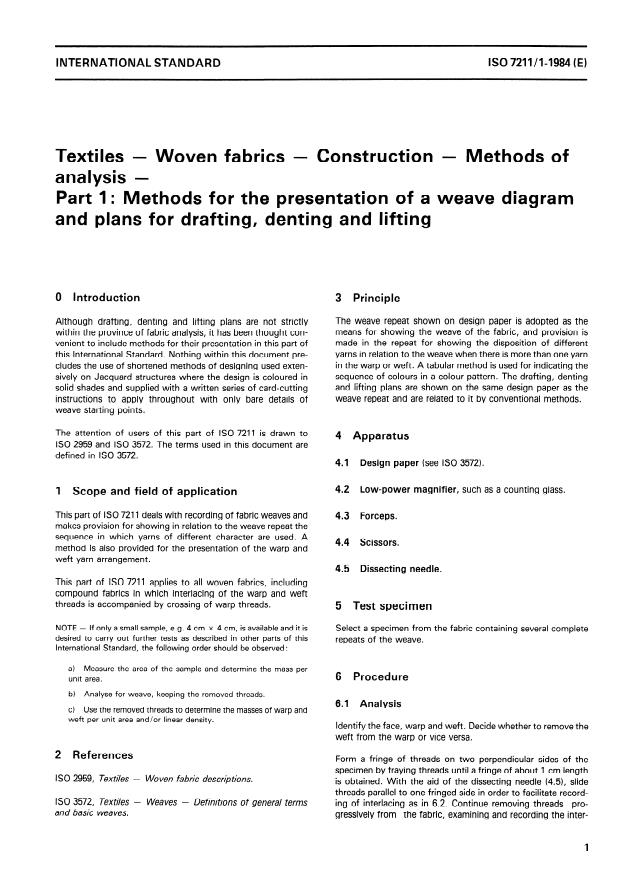
3 Principle
0 Introduction
The weave repeat shown on design paper is adopted as the
Although drafting, denting and lifting plans are not strictly
means for showing the weave of the fabric, and provision is
within the province of fabric analysis, it has been thought con-
made in the repeat for showing the disposition of different
venient to include methods for their presentation in this part of
yarns in relation to the weave when there is more than one yarn
this International Standard. Nothing within this document pre-
in the warp or weft. A tabular method is used for indicating the
cludes the use of shortened methods of designing used exten-
sequence of colours in a colour pattern. The drafting, denting
sively on Jacquard structures where the design is coloured in
and lifting plans are shown on the same design paper as the
solid shades and supplied with a written series of card-cutting
weave repeat and are related to it by conventional methods.
instructions to apply throughout with only bare details of
weave starting points.
The attention of users of this part of IS0 7211 is drawn to
4 Apparatus
IS0 2959 and IS0 3572. The terms used in this document are
defined in IS0 3572.
4.1 Design paper (see IS0 3572).
4.2 Low-power magnifier, such as a counting glass.
1 Scope and field of application
This part of IS0 7211 deals with recording of fabric weaves and 4.3 Forceps.
makes provision for showing in relation to the weave repeat the
sequence in which yarns of different character are used. A
4.4 Scissors.
method is also provided for the presentation of the warp and
weft yarn arrangement.
4.5 Dissecting needle.
This part of IS0 7211 applies to all woven fabrics, including
compound fabrics in which interlacing of the warp and weft
threads is accompanied by crossing of warp threads.
5 Test specimen
NOTE - If only a small sample, e.g. 4 cm x 4 cm, is available and it is Select a specimen from the fabric containing several complete
desired to carry out further tests as described in other parts of this
repeats of the weave.
International Standard, the following order should be observed:
a) Measure the area of the sample and determine the mass per
6 Procedure
unit area.
b) Analyse for weave, keeping the removed threads.
6.1 Analysis
c) Use the removed threads to determine the masses of warp and
weft per unit area and/or linear density.
Identify the face, warp and weft. Decide whether to remove the
weft from the warp or vice versa.
2 References
Form a fringe of threads on two perpendicular sides of the
specimen by fraying threads until a fringe of about 1 cm length
IS0 2959, Textiles - Woven fabric descriptions.
is obtained. With the aid of the dissecting needle (4.51, slide
threads parallel to one fringed side in order to facilitate record-
IS0 3572, Textiles - Weaves - Definitions of general terms
ing of interlacing as in 6.2. Continue removing threads pro-
and basic weaves.
gressively from the fabric, examining and recording the inter-
IS0 7211/l-1984 (El
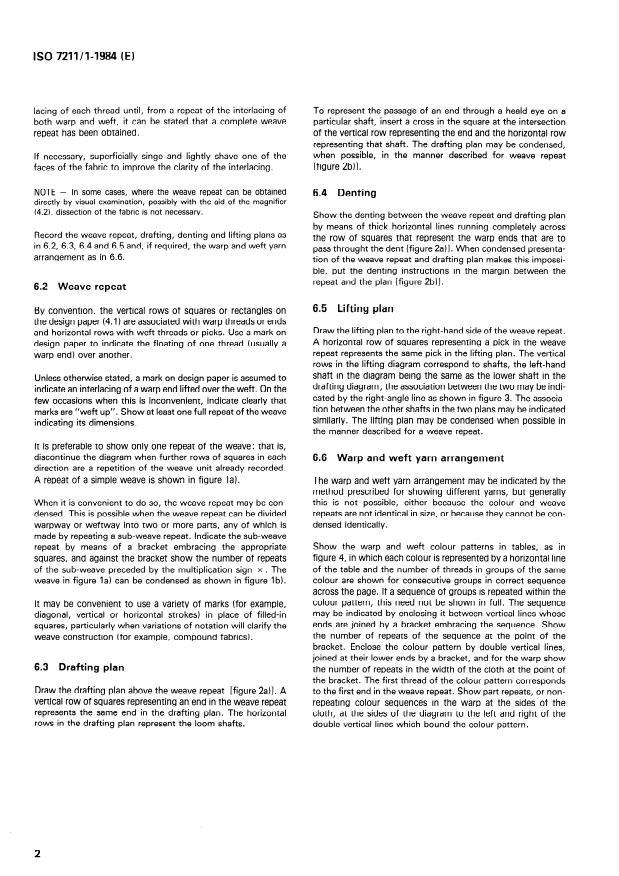
lacing of each thread until, from a repeat of the interlacing of To represent the passage of an end through a heald eye on a
both warp and weft, it can be stated that a complete weave particular shaft, insert a cross in the square at the intersection
repeat has been obtained. of the vertical row representing the end and the horizontal row
representing that shaft. The drafting plan may be condensed,
when possible, in the manner described for weave repeat
If necessary, superficially singe and lightly shave one of the
[figure 2b)l.
faces of the fabric to improve the clarity of the interlacing.
NOTE - In some cases, where the weave repeat can be obtained
6.4 Denting
directly by visual examination, possibly with the aid of the magnifier
(4.2), dissection of the fabric is not necessary.
Show the denting between the weave repeat and drafting plan
by
...
7211/1
Norme internationale
INTERNATIONAL ORGANIZATION FOR STANDARDIZATION.ME)YHAPO~HAR OPTAHt43AUMR fl0 CTAH~APTM3Al&lM.ORGANISA~ION INTERNATIONALE DE NORMALISATION
Textiles - Tissus - Construction - Méthodes d’analyse -
Partie 1: Représentation du dessin d’armure, du rentrage,
du piquage au peigne et du levage
Textiles - Woven fabrics - Construction - Methods of analysis - Part 7: Methods for the presentation of a weave diagrarn and
plans for drafting, der!ting and lifting
Première édition - 1984-03-15
CDU 677.064 : 677.017.35 : 003.63
Réf. no : ISO 7211/1-1984 (F)
Descripteurs : textile, tissu, armure textile, diagramme, enregistrement.
Prix basé sur 5 pages
Avant-propos
L’ISO (Organisation internationale de normalisation) est une fédération mondiale
d’organismes nationaux de normalisation (comités membres de I’ISO). L’élaboration
des Normes internationales est confiée aux comités techniques de I’ISO. Chaque
comité membre intéressé par une étude a le droit de faire partie du comité technique
correspondant. Les organisations internationales, gouvernementales et non gouverne-
mentales, en liaison avec I’ISO, participent également aux travaux.
Les projets de Normes internationales adoptés par les comités techniques sont soumis
aux comités membres pour approbation, avant leur acceptation comme Normes inter-
nationales par le Conseil de I’ISO.
La Norme internationale ISO 7211 /l a été élaborée par le comité technique ISO/TC 38,
Textles, et a été soumise aux comités membres en novembre 1982.
Les comités membres des pays suivants l’ont approuvée:
Afrique du Sud, Rép. d’
Hongrie Portugal
Australie
Inde Roumanie
Belgique Iran Royaume-Uni
Brésil
Iraq Suède
Bulgarie Israël Tanzanie
Canada Italie Tchécoslovaquie
Chine Jamaïque Thaïlande
Corée, Rép. de Turquie
Japon
Égypte, Rép. arabe d’ Mexique URSS
Espagne Nouvelle-Zélande
Venezuela
Finlande Pays-Bas
Ghana Pologne
Le comité membre du pays suivant l’a désapprouvée pour des raisons techniques:
France
0 Organisation internationale de normalisation, 1984
Imprimé en Suisse
NORME INTERNATIONALE ISO 7211/1-1984 (F)
Textiles - Tissus - Construction - Méthodes d’analyse -
Partie 1: Représentation du dessin d’armure, du rentrage,
du piquage au peigne et du levage
3 Principe
0 Introduction
Le rapport d’armure représenté sur le papier d’armure est
Bien que le rentrage, le piquage au peigne, le levage ne soient
retenu comme moyen de représenter les armures de tissus et
pas strictement du domaine de l’analyse des tissus, il a été
des précautions sont prises dans celui-ci pour représenter la
estimé utile d’inclure dans la présente Norme internationale les
disposition des différents fils en relation avec l’armure quand
méthodes traitant de leur représentation. Rien dans ce docu-
il y a plus d’un fil en chaîne ou en trame. Une méthode tabulaire
ment n’empêche l’emploi de méthodes simplifiées de représen-
est employée pour indiquer le plan des couleurs à employer
tation très utilisées dans les contextures Jacquard où le papier
pour la mise en carte. Le rentrage, le piquage au peigne, le
est peint en nuances solides et est préparé avec des légendes
levage sont indiqués sur le même papier d’armure que le rap-
d’instructions pour le piquage des cartons s’appliquant à
port d’armure. Ils seront en relation avec ce dernier par des
l’ensemble, avec seulement quelques simples détails concer-
méthodes conventionnelles.
nant les points de départ du tissage.
L’attention des utilisateurs de la présente partie de I’ISO 7211
4 Appareillage
est attirée sur I’ISO 2959 et I’ISO 3572. Les termes employés
dans le présent document sont définis dans I’ISO 3572.
4.1 Papier d’armure (voir ISO 3572).
1 Objet et domaine d’application
4.2 Loupe de faible grossissement, tel qu’un compte-fils.
La présente partie de I’ISO 7211 traite de la représentation des
4.3 Pinces brucelles.
armures de tissu, et des dispositions ont été prises pour mon-
trer, en relation avec le rapport d’armure, la séquence dans
laquelle les fils de différentes caractéristiques sont utilisés. Une 4.4 Ciseaux.
méthode est aussi indiquée pour la présentation de la disposi-
tion des fils de chaîne et de trame.
4.5 Aiguille à détisser.
La présente partie de I’ISO 7211 s’applique à tous les tissus y
compris les tissus à base d’armures combinées où I’entrecroise- 5 Éprouvette
ment des fils de chaîne et de trame est accompagné par la tra-
Choisir une éprouvette de tissu contenant plusieurs fois le rap-
versée de fils de chaîne.
port d’armure.
NOTE - Si seul un petit échantillon est disponible, par exemple de
4 cm x 4 cm de dimensions, et si l’on désire effectuer d’autres essais
6 Mode opératoire
tels que ceux décrits dans les autres parties de I’ISO 7211, procéder
dans l’ordre suivant:
6.1 Analyse
a) mesurer la surface de l’échantillon et déterminer la masse par
unité de surface;
Repérer le côté du tissu présentant un effet de chaîne ou un
b) analyser l’armure en conservant les fils extraits;
effet de trame. Choisir de détisser la chaîne de la trame ou vice
versa.
c) utiliser Ies fils extraits pour déterminer les masses des fils de
chaîne et de trame par unité de surface et/ou la masse linéique.
Former une frange de fils sur les deux côtés perpendiculaires de
l’éprouvette, en effilochant les fils de facon à obtenir une
2 Références frange d’environ 1 cm de longueur. À I’aide’de l’aiguille à détis-
ser (4.51, glisser les fils parallèles à l’un des bords effilochés
- Description des étoffes tissées.
ISO 2959, TextlJles pour faciliter le repérage de l’entrecroisement comme indiqué
en 6.2. Continuer à dégager les fils du tissu progressivement en
ISO 3572, Armures - Définition des termes généraux et des examinant et repérant l’entrecroisement de chaque fil jusqu’à
armures de base.
ce que, à partir d’une répétition de l’entrecroisement des fils de
ISO 7211/1-1984 (F)
de la colonne verticale représentant le fil et de la rangée hori-
chaîne et des fils de trame, il puisse être constaté que le rapport
d’armure complet a été obtenu. Si nécessaire, brûler superfi- zontale représentant cette lame. L’ordre de rentrage peut être
condensé, si cela est possible, de la manière décrite pour le rap-
ciellement et raser légèrement une des faces du tissu pour amé-
liorer la clarté de l’entrelacement des fils. port d’armure [figure 2bH.
NOTE - Dans certains cas, le détissage du tissu n’est pas nécessaire
6.4 Plan de piquage au peigne
quand le rapport d’armure peut être obtenu directement par examen
visuel à l’oeil nu ou à l’aide de la loupe (4.2).
Représenter le plan de piquage au peigne entre le rapport
Noter le rapport d’armure, le rentrage, le piquage au
...
7211/1
Norme internationale
INTERNATIONAL ORGANIZATION FOR STANDARDIZATION.ME)YHAPO~HAR OPTAHt43AUMR fl0 CTAH~APTM3Al&lM.ORGANISA~ION INTERNATIONALE DE NORMALISATION
Textiles - Tissus - Construction - Méthodes d’analyse -
Partie 1: Représentation du dessin d’armure, du rentrage,
du piquage au peigne et du levage
Textiles - Woven fabrics - Construction - Methods of analysis - Part 7: Methods for the presentation of a weave diagrarn and
plans for drafting, der!ting and lifting
Première édition - 1984-03-15
CDU 677.064 : 677.017.35 : 003.63
Réf. no : ISO 7211/1-1984 (F)
Descripteurs : textile, tissu, armure textile, diagramme, enregistrement.
Prix basé sur 5 pages
Avant-propos
L’ISO (Organisation internationale de normalisation) est une fédération mondiale
d’organismes nationaux de normalisation (comités membres de I’ISO). L’élaboration
des Normes internationales est confiée aux comités techniques de I’ISO. Chaque
comité membre intéressé par une étude a le droit de faire partie du comité technique
correspondant. Les organisations internationales, gouvernementales et non gouverne-
mentales, en liaison avec I’ISO, participent également aux travaux.
Les projets de Normes internationales adoptés par les comités techniques sont soumis
aux comités membres pour approbation, avant leur acceptation comme Normes inter-
nationales par le Conseil de I’ISO.
La Norme internationale ISO 7211 /l a été élaborée par le comité technique ISO/TC 38,
Textles, et a été soumise aux comités membres en novembre 1982.
Les comités membres des pays suivants l’ont approuvée:
Afrique du Sud, Rép. d’
Hongrie Portugal
Australie
Inde Roumanie
Belgique Iran Royaume-Uni
Brésil
Iraq Suède
Bulgarie Israël Tanzanie
Canada Italie Tchécoslovaquie
Chine Jamaïque Thaïlande
Corée, Rép. de Turquie
Japon
Égypte, Rép. arabe d’ Mexique URSS
Espagne Nouvelle-Zélande
Venezuela
Finlande Pays-Bas
Ghana Pologne
Le comité membre du pays suivant l’a désapprouvée pour des raisons techniques:
France
0 Organisation internationale de normalisation, 1984
Imprimé en Suisse
NORME INTERNATIONALE ISO 7211/1-1984 (F)
Textiles - Tissus - Construction - Méthodes d’analyse -
Partie 1: Représentation du dessin d’armure, du rentrage,
du piquage au peigne et du levage
3 Principe
0 Introduction
Le rapport d’armure représenté sur le papier d’armure est
Bien que le rentrage, le piquage au peigne, le levage ne soient
retenu comme moyen de représenter les armures de tissus et
pas strictement du domaine de l’analyse des tissus, il a été
des précautions sont prises dans celui-ci pour représenter la
estimé utile d’inclure dans la présente Norme internationale les
disposition des différents fils en relation avec l’armure quand
méthodes traitant de leur représentation. Rien dans ce docu-
il y a plus d’un fil en chaîne ou en trame. Une méthode tabulaire
ment n’empêche l’emploi de méthodes simplifiées de représen-
est employée pour indiquer le plan des couleurs à employer
tation très utilisées dans les contextures Jacquard où le papier
pour la mise en carte. Le rentrage, le piquage au peigne, le
est peint en nuances solides et est préparé avec des légendes
levage sont indiqués sur le même papier d’armure que le rap-
d’instructions pour le piquage des cartons s’appliquant à
port d’armure. Ils seront en relation avec ce dernier par des
l’ensemble, avec seulement quelques simples détails concer-
méthodes conventionnelles.
nant les points de départ du tissage.
L’attention des utilisateurs de la présente partie de I’ISO 7211
4 Appareillage
est attirée sur I’ISO 2959 et I’ISO 3572. Les termes employés
dans le présent document sont définis dans I’ISO 3572.
4.1 Papier d’armure (voir ISO 3572).
1 Objet et domaine d’application
4.2 Loupe de faible grossissement, tel qu’un compte-fils.
La présente partie de I’ISO 7211 traite de la représentation des
4.3 Pinces brucelles.
armures de tissu, et des dispositions ont été prises pour mon-
trer, en relation avec le rapport d’armure, la séquence dans
laquelle les fils de différentes caractéristiques sont utilisés. Une 4.4 Ciseaux.
méthode est aussi indiquée pour la présentation de la disposi-
tion des fils de chaîne et de trame.
4.5 Aiguille à détisser.
La présente partie de I’ISO 7211 s’applique à tous les tissus y
compris les tissus à base d’armures combinées où I’entrecroise- 5 Éprouvette
ment des fils de chaîne et de trame est accompagné par la tra-
Choisir une éprouvette de tissu contenant plusieurs fois le rap-
versée de fils de chaîne.
port d’armure.
NOTE - Si seul un petit échantillon est disponible, par exemple de
4 cm x 4 cm de dimensions, et si l’on désire effectuer d’autres essais
6 Mode opératoire
tels que ceux décrits dans les autres parties de I’ISO 7211, procéder
dans l’ordre suivant:
6.1 Analyse
a) mesurer la surface de l’échantillon et déterminer la masse par
unité de surface;
Repérer le côté du tissu présentant un effet de chaîne ou un
b) analyser l’armure en conservant les fils extraits;
effet de trame. Choisir de détisser la chaîne de la trame ou vice
versa.
c) utiliser Ies fils extraits pour déterminer les masses des fils de
chaîne et de trame par unité de surface et/ou la masse linéique.
Former une frange de fils sur les deux côtés perpendiculaires de
l’éprouvette, en effilochant les fils de facon à obtenir une
2 Références frange d’environ 1 cm de longueur. À I’aide’de l’aiguille à détis-
ser (4.51, glisser les fils parallèles à l’un des bords effilochés
- Description des étoffes tissées.
ISO 2959, TextlJles pour faciliter le repérage de l’entrecroisement comme indiqué
en 6.2. Continuer à dégager les fils du tissu progressivement en
ISO 3572, Armures - Définition des termes généraux et des examinant et repérant l’entrecroisement de chaque fil jusqu’à
armures de base.
ce que, à partir d’une répétition de l’entrecroisement des fils de
ISO 7211/1-1984 (F)
de la colonne verticale représentant le fil et de la rangée hori-
chaîne et des fils de trame, il puisse être constaté que le rapport
d’armure complet a été obtenu. Si nécessaire, brûler superfi- zontale représentant cette lame. L’ordre de rentrage peut être
condensé, si cela est possible, de la manière décrite pour le rap-
ciellement et raser légèrement une des faces du tissu pour amé-
liorer la clarté de l’entrelacement des fils. port d’armure [figure 2bH.
NOTE - Dans certains cas, le détissage du tissu n’est pas nécessaire
6.4 Plan de piquage au peigne
quand le rapport d’armure peut être obtenu directement par examen
visuel à l’oeil nu ou à l’aide de la loupe (4.2).
Représenter le plan de piquage au peigne entre le rapport
Noter le rapport d’armure, le rentrage, le piquage au
...