

ISO 20480-1:2017/Amd 1:2024
(Amendment)Fine bubble technology — General principles for usage and measurement of fine bubbles — Part 1: Terminology — Amendment 1
General Information
- Abstract
- Status
- Published
- Publication Date
- 21-Feb-2024
- Technical Committee
- ISO/TC 281 - Fine bubble technology
- Drafting Committee
- ISO/TC 281 - Fine bubble technology
- Current Stage
- 6060 - International Standard published
- Start Date
- 22-Feb-2024
- Due Date
- 14-Nov-2024
- Completion Date
- 22-Feb-2024

Overview
ISO 20480-1:2017/Amd 1:2024 is an amendment to the international standard defining key terminology for fine bubble technology. Fine bubble technology involves the generation, measurement, and use of extremely small gas bubbles in liquids, typically with diameters of less than 100 micrometers. This standard update provides clarifications and new terms that support the consistent understanding and application of fine bubble concepts across industries. Maintaining precise terminology is vital for manufacturers, researchers, and users to communicate effectively and apply fine bubble innovations accurately.
Key Topics
- Fine Bubble Definition: Bubbles with a volume equivalent diameter smaller than 100 μm.
- Ultrafine Bubble (UFB): A subcategory of fine bubbles with diameters less than 1 μm, essential in applications requiring extremely small bubble sizes.
- Microbubble (MB): Defined as fine bubbles in the size range of 1 μm up to but not including 100 μm.
- Coalescence: The process by which two or more bubbles combine to form larger bubbles, impacting bubble stability.
- Microbubble Generating System: Equipment designed to produce microbubbles in a liquid medium, crucial for applications involving enhanced gas-liquid interactions.
- Number Concentration Index: A metric representing the number-based concentration of bubbles within a dispersion measured by standard industrial methods.
- Volume Concentration Index: A measure reflecting the volume-based concentration of bubbles in a fine bubble dispersion.
- Bubble Collapse: The sudden fragmentation of a bubble into smaller parts, an important phenomenon affecting fine bubble longevity and functionality.
Applications
Fine bubble technology is widely utilized across diverse sectors due to its unique properties and enhanced interaction with liquids. Some practical applications include:
- Water Treatment: Fine bubbles improve oxygen transfer efficiency, enhancing biological treatment processes and contaminant removal.
- Agriculture: Increased oxygenation in irrigation water promotes healthier crop growth and soil microbiology.
- Healthcare and Medicine: Ultrafine bubbles support novel drug delivery systems and diagnostic imaging enhancements.
- Food and Beverage Processing: Microbubbles are used to improve texture, carbonation, and preservation processes.
- Industrial Cleaning: Fine bubbles aid in removing contaminants by improving penetration and reducing chemical usage.
- Aquaculture: Enhanced aeration helps maintain optimal oxygen levels for fish and aquatic life.
Related Standards
ISO 20480-1:2017/Amd 1:2024 is part of the broader ISO 20480 series on fine bubble technology, which covers general principles, measurement methods, and applications of fine bubbles. Collaboration with related ISO standards on water quality, measurement techniques, and materials testing ensures comprehensive guidance aligns with global best practices.
For detailed information and further updates, users can consult the ISO website and the respective national standards bodies. This facilitates harmonized implementation and supports ongoing innovation within fine bubble technology.
Keywords: fine bubble technology, ultrafine bubble, microbubble, bubble coalescence, bubble collapse, microbubble generating system, number concentration index, volume concentration index, ISO 20480-1, fine bubble terminology, industrial fine bubble standards, fine bubble measurement, bubble technology applications.
Relations
- Effective Date
- 19-Nov-2022
Frequently Asked Questions
ISO 20480-1:2017/Amd 1:2024 is a standard published by the International Organization for Standardization (ISO). Its full title is "Fine bubble technology — General principles for usage and measurement of fine bubbles — Part 1: Terminology — Amendment 1". This standard covers: Fine bubble technology — General principles for usage and measurement of fine bubbles — Part 1: Terminology — Amendment 1
Fine bubble technology — General principles for usage and measurement of fine bubbles — Part 1: Terminology — Amendment 1
ISO 20480-1:2017/Amd 1:2024 is classified under the following ICS (International Classification for Standards) categories: 01.040.07 - Natural and applied sciences (Vocabularies); 07.030 - Physics. Chemistry. The ICS classification helps identify the subject area and facilitates finding related standards.
ISO 20480-1:2017/Amd 1:2024 has the following relationships with other standards: It is inter standard links to ISO 20480-1:2017. Understanding these relationships helps ensure you are using the most current and applicable version of the standard.
ISO 20480-1:2017/Amd 1:2024 is available in PDF format for immediate download after purchase. The document can be added to your cart and obtained through the secure checkout process. Digital delivery ensures instant access to the complete standard document.
Standards Content (Sample)
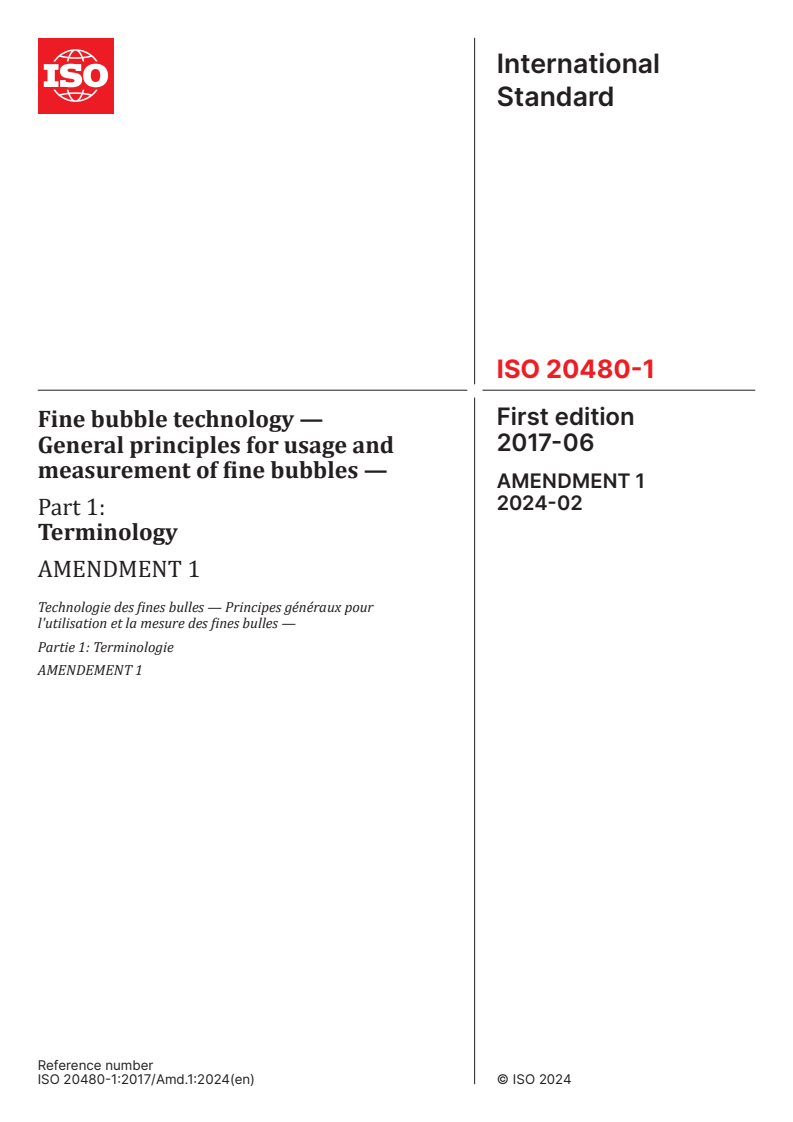
International
Standard
ISO 20480-1
First edition
Fine bubble technology —
2017-06
General principles for usage and
measurement of fine bubbles —
AMENDMENT 1
2024-02
Part 1:
Terminology
AMENDMENT 1
Technologie des fines bulles — Principes généraux pour
l'utilisation et la mesure des fines bulles —
Partie 1: Terminologie
AMENDEMENT 1
Reference number
ISO 20480-1:2017/Amd.1:2024(en) © ISO 2024
ISO 20480-1:2017/Amd.1:2024(en)
© ISO 2024
All rights reserved. Unless otherwise specified, or required in the context of its implementation, no part of this publication may
be reproduced or utilized otherwise in any form or by any means, electronic or mechanical, including photocopying, or posting on
the internet or an intranet, without prior written permission. Permission can be requested from either ISO at the address below
or ISO’s member body in the country of the requester.
ISO copyright office
CP 401 • Ch. de Blandonnet 8
CH-1214 Vernier, Geneva
Phone: +41 22 749 01 11
Email: copyright@iso.org
Website: www.iso.org
Published in Switzerland
ii
ISO 20480-1:2017/Amd.1:2024(en)
Foreword
ISO (the International Organization for Standardization) is a worldwide federation of national standards
bodies (ISO member bodies). The work of preparing International Standards is normally carried out through
ISO technical committees. Each member body interested in a subject for which a technical committee
has been established has the right to be represented on that committee. International organizations,
governmental and non-governmental, in liaison with ISO, also take part in the work. ISO collaborates closely
with the International Electrotechnical Commission (IEC) on all matters of electrotechnical standardization.
The procedures used to develop this document and those intended for its further maintenance are described
in the ISO/IEC Directives, Part 1. In particular, the different approval criteria needed for the different types
of ISO document should be noted. This document was drafted in accordance with the editorial rules of the
ISO/IEC Directives, Part 2 (see www.iso.org/directives).
ISO draws attention to the possibility that the implementation of this document may involve the use of (a)
patent(s). ISO takes no position concerning the evidence, validity or applicability of any claimed patent
rights in respect thereof. As of the date of publication of this document, ISO had not received notice of (a)
patent(s) which may be required to implement this document. However, implementers are cautioned that
this may not represent the latest information, which may be obtained from the
...