

ISO 9491-1:2026
(Main)Biotechnology — Predictive computational models in personalized medicine research — Part 1: Constructing, verifying and validating models
- Abstract
This document specifies requirements and recommendations for the design, development and implementation of predictive computational models for research purposes in the field of personalized medicine and health product development. This document addresses the set-up, formatting, validation, simulation, storing and sharing of computational models used for personalized medicine. Requirements and recommendations for data used to construct or required for validating such models are also specified. This includes rules for formatting, descriptions, annotations, interoperability, integration, access and provenance of such data. This document does not apply to computational models used for standard routine clinical, diagnostic or therapeutic purposes.
- Status
- Published
- Publication Date
- 17-Jun-2026
- Technical Committee
- ISO/TC 276 - Biotechnology
- Drafting Committee
- ISO/TC 276/WG 5 - Data processing and integration
- Current Stage
- 6060 - International Standard published - 60 Publication
- Start Date
- 18-Jun-2026
- Due Date
- 20-Jun-2026
- Completion Date
- 20-Jun-2026


ISO 9491-1:2026 is an International Standard from ISO for predictive computational models in personalized medicine research. It specifies requirements and recommendations for designing, developing, verifying, validating, storing, sharing and simulating models and their data for research in personalized medicine and health product development. The standard is aimed at researchers, modellers, and organizations that need interoperable, well-documented computational models rather than routine clinical, diagnostic or therapeutic use.
What does ISO 9491-1:2026 specify?
ISO 9491-1:2026 specifies how predictive computational models in personalized medicine research are set up, formatted, validated, simulated, stored and shared. It also sets out requirements and recommendations for the data used to build and validate those models, including formatting, description, annotation, interoperability, integration, access and provenance.
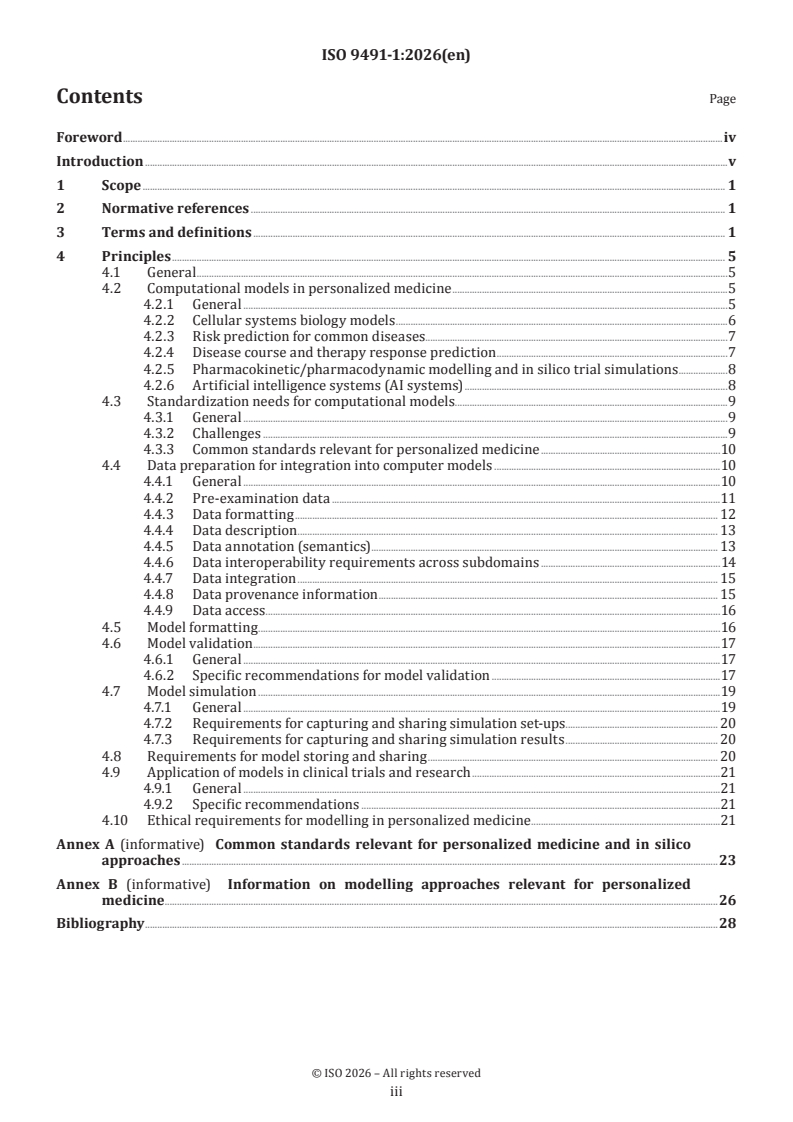
The document is organized into Clause 1 to Clause 4, followed by two informative annexes.
| Annex | What it covers |
|---|---|
| Annex A | Common standards relevant for personalized medicine and in silico approaches |
| Annex B | Information on modelling approaches relevant for personalized medicine |
Clause 4 is the main technical part. It moves from general principles to specific model domains, data preparation, model formatting, validation, simulation, storage and sharing, application in clinical trials and research, and ethical requirements. That structure matters in practice because a reader can go directly from data handling to validation or from validation to ethical review.
What are the key requirements of ISO 9491-1:2026?
ISO 9491-1:2026 puts the strongest emphasis on data integration, model validation, traceability and interoperability. In practice, the standard is about making a model understandable, reusable and defensible across teams, tools and studies.
Data used to build or validate models must be interoperable and traceable
Clause 4.4 requires data for model construction to use accepted interoperable formats, structured metadata, semantic annotation, interoperability frameworks and provenance information. Controlled-access data should be available through harmonized data access agreements (hDAAs) when open access is not possible.
For a reader, this means the model is only as useful as the quality and traceability of the data going into it. If the data cannot be linked back to its origin, described consistently, and exchanged across systems, the model will be hard to reuse or validate.
Pre-examination information has to be documented
Clause 4.4.2 requires documentation of specimen collection, storage, transport, reception, processing and analyte isolation. The clause points to biobank-related metadata and standard date-time representation for key events.
In practice, this protects model quality by showing how biological material changed before analysis. That matters because pre-analytical variation can distort the profile that a predictive model sees.
Data formatting and semantic annotation have to be consistent
Clause 4.4.3 requires data sets to be formatted in interoperable standard formats and to have the format and version documented. Clause 4.4.4 requires structured metadata describing content, context and provenance. Clause 4.4.5 adds semantic annotation using domain standards and terminologies.
This means the model developer has to make data machine-readable and meaningful at the same time. A dataset is not enough on its own if software cannot interpret it or if different terms are used for the same concept.
Data integration across subdomains needs defined interoperability
Clause 4.4.6 calls for a data interoperability framework that can handle different data types, metadata and levels of integration. Clause 4.4.7 explains that integration can happen at individual level, variable level, unstructured-data level, or by federation and validation of findings.
This matters when combining clinical, laboratory, omics, imaging or patient-reported data. The standard makes clear that integration is not just technical file merging, but semantic and organizational alignment as well.
Provenance and access control are part of model credibility
Clause 4.4.8 requires machine-actionable provenance information using ISO 23494-1 and ISO 23494-2. Clause 4.4.9 requires harmonized data access agreements for restricted data.
For users, this means the history of the data and the rules for using it have to travel with the data. That is important for auditability, repeatability and lawful sharing.
Model formatting, simulation and results must be reproducible
Clause 4.5 requires predictive computational models to be encoded in accepted interoperable model formats and to have the format and version documented. Clause 4.7 requires simulation set-ups to be captured separately from model code, with the minimum information about a simulation experiment (MIASE) provided, and simulation results to be reported in recognized formats with any post-processing described.
In practice, this means another team should be able to rerun the simulation and understand what was changed, what was calculated and how the output was produced.
Validation has to be transparent and fit for the model type
Clause 4.6 says models should generalize to new data and be validated with transparent, consistent methods. It also says validation should compare calibrated output with measured data independent of the calibration set, and uncertainty should be characterized.
The standard also gives different recommendations for cellular systems biology models, risk prediction, disease course and therapy response, pharmacokinetic/pharmacodynamic (PK/PD) modelling and in silico trial simulations, and artificial intelligence systems (AI systems). For AI systems, it recommends a three-phase validation process, which helps users avoid relying on a black-box prediction without evidence of performance.
Ethical and stakeholder requirements are explicit
Clause 4.9 requires a stepwise development path - choose the data set, train the algorithm, test it on unseen data. Clause 4.10 requires attention to research ethics, patient rights, privacy, discrimination, transparency and accountability, with qualified staff and ethics committee approval.
For practical use, this means technical performance is not enough. The model also has to be used in a way that is ethically reviewed and acceptable to the stakeholders involved.
What terms does ISO 9491-1:2026 define?
- Artificial intelligence (AI) - Research and development of mechanisms and applications of AI systems.
- Artificial intelligence system (AI system) - An engineered system that generates outputs such as content, forecasts, recommendations or decisions for human-defined objectives.
- Computational model - A biological system described mathematically, graphically, or both, and studied with a computer.
- Data-driven model - A model developed from test data, process output, real-world data or routinely acquired primary care data.
- Data integration - The systematic combining of data from different independent and potentially heterogeneous sources into a more unified view for research.
- Model validation - Comparison between the output of a calibrated model and measured data that were not used for calibration.
- Model verification - Confirmation that the mathematical elements of the model behave as intended.
- Personalized medicine - A medical model that uses phenotypes and genotypes to tailor therapy, assess disease predisposition or guide prevention.
Who uses ISO 9491-1:2026?
ISO 9491-1:2026 is used by researchers and developers working in personalized medicine, biotechnology, biomolecular and cellular research, clinical trials and drug development. It is also relevant to computational biologists, bioinformaticians, data scientists, laboratory specialists, biobank staff, quality managers and regulatory teams who prepare, validate, document or review models and the data behind them.
The document is especially useful where multiple data sources need to be linked, such as clinical records, laboratory data, imaging, omics, sample data and trial data. It also supports organizations that need to decide how to store, share, access and validate models for collaborative research.
What changed in ISO 9491-1:2026 from the previous edition?
ISO 9491-1:2026 is the second edition and cancels and replaces ISO/TS 9491-1:2023. The foreword states that it has been technically revised.
The changes listed in the document are:
- Clause 2 normative references were consolidated, updated and revised.
- Terminology was updated and clarified, including alignment with ISO/TS 9491-2.
- The content was updated to match the latest developments in the domain.
- The bibliography was revised and updated.
- Editorial wording was revised and clarified.
Which standards are used with ISO 9491-1:2026?
ISO 9491-1:2026 names four normative references that support the way the document handles data, biobanking and provenance:
- ISO 20691 - supports data formatting and description in the life sciences, and is used for standard data and model formats, metadata and interoperability.
- ISO 20387:2026 - supports biobanking requirements, including additional metadata for specimens derived from or stored in a biobank.
- ISO 23494-1 - supports provenance information model design concepts and general requirements for biological material and data.
- ISO 23494-2 - supports the common provenance model used to document data history and chain of custody.
What does the ISO 9491-1:2026 document contain?
ISO 9491-1:2026 contains a principles-based technical framework, not a step-by-step software method. It includes a figure showing the modelling approach for personalized medicine and another figure showing data integration and model validation as key standardization points.
The body of the document includes:
- Table 1 on metadata collected during pre-examination workflows
- Table 2 on metadata properties
- Table 3 with model-validation recommendations by modelling approach
- Table 4 with typical simulation methods for biochemical systems
- Table 5 with recommendations for applying models in clinical trials and research
Annex A lists common standards for sequence data, mass spectrometry, imaging and semantic integration. Annex B explains modelling approaches such as risk prediction for common diseases, AI systems, and the minimum information needed to understand a model.
Relations
- Effective Date
- 24-Jun-2023
Frequently Asked Questions
ISO 9491-1:2026 is a standard published by the International Organization for Standardization (ISO). Its full title is "Biotechnology — Predictive computational models in personalized medicine research — Part 1: Constructing, verifying and validating models". This standard covers: This document specifies requirements and recommendations for the design, development and implementation of predictive computational models for research purposes in the field of personalized medicine and health product development. This document addresses the set-up, formatting, validation, simulation, storing and sharing of computational models used for personalized medicine. Requirements and recommendations for data used to construct or required for validating such models are also specified. This includes rules for formatting, descriptions, annotations, interoperability, integration, access and provenance of such data. This document does not apply to computational models used for standard routine clinical, diagnostic or therapeutic purposes.
This document specifies requirements and recommendations for the design, development and implementation of predictive computational models for research purposes in the field of personalized medicine and health product development. This document addresses the set-up, formatting, validation, simulation, storing and sharing of computational models used for personalized medicine. Requirements and recommendations for data used to construct or required for validating such models are also specified. This includes rules for formatting, descriptions, annotations, interoperability, integration, access and provenance of such data. This document does not apply to computational models used for standard routine clinical, diagnostic or therapeutic purposes.
ISO 9491-1:2026 is classified under the following ICS (International Classification for Standards) categories: 07.080 - Biology. Botany. Zoology. The ICS classification helps identify the subject area and facilitates finding related standards.
ISO 9491-1:2026 has the following relationships with other standards: It is inter standard links to ISO/TS 9491-1:2023. Understanding these relationships helps ensure you are using the most current and applicable version of the standard.
ISO 9491-1:2026 is available in PDF format for immediate download after purchase. The document can be added to your cart and obtained through the secure checkout process. Digital delivery ensures instant access to the complete standard document.
Standards Content (Sample)
Contents
- Introduction
- 1 Scope
- 2 Normative references
- 3 Terms and definitions
- 3.1 artificial intelligence
- 3.2 artificial intelligence system
- 3.3 big data
- 3.4 community consensus standard
- 3.5 computational model
- 3.6 data-driven model
- 3.7 harmonization of data concepts
- 3.8 data integration
- 3.9 genome-wide association studies
- 3.10 in silico clinical trial
- 3.11 in silico approach
- 3.12 machine learning
- 3.13 mathematical model
- 3.14 mechanism-based
- 3.15 model validation
- 3.16 model verification
- 3.17 molecular biomarker
- 3.18 personalized medicine
- 3.19 phenotype
- 3.20 raw data
- 4 Principles
- 4.1 General
- 4.2 Computational models in personalized medicine
- 4.3 Standardization needs for computational models
- 4.4 Data preparation for integration into computer models
- 4.5 Model formatting
- 4.6 Model validation
- 4.7 Model simulation
- 4.8 Requirements for model storing and sharing
- 4.9 Application of models in clinical trials and research
- 4.10 Ethical requirements for modelling in personalized medicine
- Annex A
- Annex B
- Bibliography
Introduction
The capacity to generate data in life sciences and health research has greatly increased in the last decade. In combination with patient/personal-derived data, such as electronic health records, patient registries and databases, as well as lifestyle information, this big data holds an immense potential for clinical applications, especially for computer-based models with predictive capacities in personalized medicine. However, and despite the ever-progressing technological advances in producing data, the exploitation of big data to generate new knowledge for medical benefits, while guaranteeing data privacy and security, is lacking behind its full potential. A reason for this obstacle is the inherent heterogeneity of big data and the lack of broadly accepted standards allowing interoperable integration of heterogeneous health data to perform analysis and interpretation for predictive modelling approaches in health research, such as personalized medicine.
Common standards lead to a mutual understanding and improve information exchange within and across research communities and are indispensable for collaborative work. In order to setup computer models in personalized medicine, data integration from heterogeneous and different sources at different times plays a key role. Consistent documentation of data, models and simulation results based on basic guiding principles [6] for data management practices, such as FAIR (findable, accessible, interoperable, reusable) or ALCOA (attributable, legible, contemporaneous, original, accurate), and standards can ensure that the data and the corresponding metadata (data describing the data and its context), as well as the models, methods and visualizations, are of reliable high quality.
Hence, standards for biomedical and clinical data, simulation models and data exchange are a prerequisite [7] for reliable integration of health-related data . Such standards, together with harmonized ways to describe their metadata, ensure the interoperability of tools used for data integration and modelling, as well as the reproducibility of the simulation results. In this sense, modelling standards are agreed ways of consistently structuring, describing, and associating models and data, their respective parts and their graphical visualization, as well as the information about applied methods and the outcome of model simulations. Such standards also assist in describing how constituent parts interact, or are linked together, and how they are embedded in their physiological context.
Major challenges in the field of personalized medicine are to:
a) harmonize the standardization efforts that refer to different data types, approaches and technologies; b) make the standards interoperable, so that the data can be compared and integrated into models. An overall goal is to FAIRify data and processes in order to improve data integration and reuse. An additional challenge is to ensure a legal and ethical framework enabling interoperability. This document presents computational modelling requirements and recommendations for research in the field of personalized medicine, especially with focus on collaborative research, such that healthrelated data can be optimally used for translational research and personalized medicine worldwide. The recommendations are primarily oriented towards the application of computational modelling in the biotechnology domain (e.g. biomolecular and cellular research, as well as in clinical trials and drug development), but also can be applied in other fields of personalized medicine research.
International Standard ISO 9491-1:2026(en) Biotechnology — Predictive computational models in personalized medicine research — Part 1:
Constructing, verifying and validating models
1 Scope
This document specifies requirements and recommendations for the design, development and implementation of predictive computational models for research purposes in the field of personalized medicine and health product development.
This document addresses the set-up, formatting, validation, simulation, storing and sharing of computational models used for personalized medicine. Requirements and recommendations for data used to construct or required for validating such models are also specified. This includes rules for formatting, descriptions, annotations, interoperability, integration, access and provenance of such data. This document does not apply to computational models used for standard routine clinical, diagnostic or therapeutic purposes.
2 Normative references
The following documents are referred to in the text in such a way that some or all of their content constitutes requirements of this document. For dated references, only the edition cited applies. For undated references, the latest edition of the referenced document (including any amendments) applies. 1) ISO 20691, Biotechnology — Requirements for data formatting and description in the life sciences 2) ISO 20387:2026, Biotechnology — Biobanking — General requirements for biobanks ISO 23494-1, Biotechnology — Provenance information model for biological material and data — Part 1: Design concepts and general requirements ISO 23494-2, Biotechnology — Provenance information model for biological material and data — Part 2:
Common Provenance Model
3 Terms and definitions
For the purposes of this document, the following terms and definitions apply. ISO and IEC maintain terminology databases for use in standardization at the following addresses:
- ISO Online browsing platform: available at https:// www .iso .org/ obp - IEC Electropedia: available at https:// www .electropedia .org/ 1) https:// fairsharing .org/ 3533 2) Under preparation. Stage at the time of publication: ISO/FDIS 20387:2026.
ISO 9491-1:2026(en)
3.1 artificial intelligence
AI <discipline> research and development of mechanisms and applications of AI systems (3.2) Note 1 to entry: Research and development can take place across any number of fields such as computer science, data science, humanities, mathematics and natural sciences.
[SOURCE: ISO/IEC 22989:2022, 3.1.3]
3.2 artificial intelligence system
AI system engineered system that generates outputs such as content, forecasts, recommendations or decisions for a given set of human-defined objectives Note 1 to entry: The engineered system can use various techniques and approaches related to artificial intelligence to develop a model to represent data, knowledge, processes, etc. which can be used to conduct tasks. Note 2 to entry: AI systems are designed to operate with varying levels of automation. [SOURCE: ISO/IEC 22989:2022, 3.1.4]
3.3 big data
extensive datasets — primarily in the data characteristics of volume, variety, velocity, and/or variability — that require a scalable technology for efficient storage, manipulation, management, and analysis Note 1 to entry: Big data is commonly used in many different ways, for example as the name of the scalable technology used to handle big data extensive datasets.
EXAMPLE High volume, high diversity biological, clinical, environmental, and lifestyle information collected from single individuals to large cohorts, in relation to their health and wellness status, at one or several time points (see reference [8] for additional information).
[SOURCE: ISO/TR 24291:2021, 3.2, modified — EXAMPLE added.]
3.4 community consensus standard
standard that reflects the results of a consensus standardization effort from a specific domain-specific expert group outside of recognized standard defining organizations and their technical committees Note 1 to entry: Created by domain-specific professional societies, scientific standardization initiatives, individual organizations or research communities (often in collaboration with industry partners) Note 2 to entry: Often publicly available, open and not proprietary
3.5 computational model
in silico model description of a biological system in either a mathematical expression or graphical form, or both, that is implemented and studied with a computer highlighting objects and their interactions Note 1 to entry: An object distributed processing (ODP) concept. [SOURCE: ISO/IEC 16500-8:1999, 3.6, modified — Admitted term added. “biological”, “mathematical expression or”, “, or both, that is implemented and studied with a computer” added, “interfaces” changed to “interactions” and “as such it is similar to the OMT and UML notion of a class diagram” deleted from the definition. “An object distributed processing (ODP) concept” moved to Note 1 to entry.]
ISO 9491-1:2026(en)
3.6 data-driven model
model developed through the use of data derived from tests or from the output of investigated process or from real world data or routinely acquired primary care data [SOURCE: ISO 15746-1:2015, 2.4, modified — “or from real world data or routinely acquired primary care data” added]
3.7 harmonization of data concepts
data harmonization process of reconciling differences in semantics, structure and syntax of similar data concepts Note 1 to entry: Harmonization can include the establishment of a single pervasive definition for each data concept (i.e. standardization), but can also encompass flexible approaches in which definitions can be understood to grow closer without becoming identical.
[SOURCE: ISO/TR 25100:2012, 2.1.4, modified — “harmonisation” replaced by “harmonization”, “may” in Note 1 to entry replaced by “can”.]
3.8 data integration
systematic combining of data from different independent and potentially heterogeneous sources, to create a more compatible, unified view of these data for research purpose [SOURCE: ISO 5127:2017, 3.1.11.24]
3.9 genome-wide association studies
GWAS testing of genetic variants across the genomes of many individuals to identify genotype–phenotype associations
3.10 in silico clinical trial
use of computer modelling and simulation(s) to mimic human experimentation in the development or regulatory evaluation process of a medicinal product (e.g. medical device) or medical intervention, under defined conditions using verified and validated models Note 1 to entry: It is a subdomain of ‘in silico medicine’, the discipline that encompasses the use of individualised computer simulations in all aspects of the prevention, diagnosis, prognostic assessment, and treatment of disease. [SOURCE: Reference [9], modified — Note 1 to entry added.]
3.11 in silico approach
computer-executable analyses of mathematical model(s) (3.13) to study and simulate a biological system
3.12 machine learning
ML computer technology with the ability to automatically learn and improve from experience without being explicitly programmed EXAMPLE Speech recognition, predictive text, spam detection, or optimizing model parameters through computational techniques, such that the model's behaviour reflects the data or experience. [SOURCE: ISO 20252:2019, 3.52, modified — Abbreviated term “ML” added and EXAMPLES changed to “Speech recognition, predictive text, spam detection, or optimizing model parameters through computational techniques, such that the model's behaviour reflects the data or experience.”.]
ISO 9491-1:2026(en)
3.13 mathematical model
set of equations that describes the behaviour of a physical system [SOURCE: ISO 16730-1:2015, 3.11]
3.14 mechanism-based
approach in computational modelling that aims for a structural representation
3.15 model validation
comparison between the output of the calibrated model and the measured data, independent of the data set used for calibration [SOURCE: ISO 14837-1:2005, 3.7]
3.16 model verification
confirmation that the mathematical elements of the model behave as intended [SOURCE: ISO 14837-1:2005, 3.8]
3.17 molecular biomarker
biomarker molecular marker detectable and/or quantifiable molecule or group of molecules used to indicate a biological condition, state, identity or characteristic of an organism (e.g. an individual) EXAMPLE Nucleic acid sequences, proteins, small molecules such as metabolites, other molecules such as lipids and polysaccharides.
[SOURCE: ISO 16577:2022, 3.4.28, modified — “or an” changed to “of an” and “(e.g. an individual)” added to definition.]
3.18 personalized medicine
precision medicine medical model using characterization of individuals’ phenotypes and genotypes for tailoring the right therapeutic strategy for the right person at the right time, and/or to determine the predisposition to disease and/or to deliver timely and targeted prevention Note 1 to entry: Examples for individuals’ phenotypes and genotypes are molecular profiling, medical imaging and lifestyle data.
Note 2 to entry: Medical decisions, prevention strategies and therapies in personalized medicine are based on this individuality.
[10] [SOURCE: EU 2015/C 421/03, modified — Notes 1 and 2 to entry added and “(e.g. molecular profiling, medical imaging, lifestyle data)” deleted from definition.]
3.19 phenotype
set of observable characteristics of an organism resulting from the interaction of its genotype with the environment [SOURCE: ISO 4454:2022, 3.14, modified — Note 1 to entry deleted.]
ISO 9491-1:2026(en)
3.20 raw data
data in its originally acquired, direct form from its source before subsequent processing [SOURCE: ISO 5127:2017, 3.1.10.04]
4 Principles
4.1 General
Research in the field of personalized medicine is highly dependent on the exchange of data from different sources, as well as harmonized integrative analysis of large-scale personalized medicine data (big data in health research). Computational modelling approaches play a key role for understanding, simulating and predicting the molecular processes and pathways that characterize human biology. Modelling approaches in biomedical research also lead to a more profound understanding of the mechanisms and factors that drive diseases, and consequently allow for adapting personalized treatment strategies that are guided by central clinical questions. Patients can greatly benefit from this development in research that equips personalized medicine with predictive capabilities to simulate in silico clinically relevant questions, such as the effect of therapies, the response to drug treatments or the progression of disease.
4.2 Computational models in personalized medicine
4.2.1 General
Computational models have the potential to translate in vitro, non-clinical and clinical results (and their related uncertainty) into descriptive or predictive expressions. The added value of such models in medicine [11][12][13][14] and pharmacology has increasingly been recognized by the scientific community, as well as by [15] regulatory bodies such as the European Medicines Agency (e.g. EMA guideline on PBPK reporting ), or [16][17] the US Food and Drug Administration (FDA). Computational models are integrated in different fields in medicine as well as in the development of drugs and other health products, expanding from disease modelling, molecular and physiological biomarker research to assessment of drug and medical device efficacy [18] and safety. In silico approaches are also expanding in neighbouring fields, such as pharmacoeconomics, [19] [20][21] [22][23] analytical chemistry and biology that are out of scope of this document . Model creation starts with a clinical question and the collection of data (see Figure 1). The data employed need harmonized approaches for data integration to start the model construction. The initial model usually undergoes several refinement and improvement iterations to enhance predictive capabilities. Common standards (see 4.3.3) should be used for the model building and curation process. Accuracy measurements and validation processes are key, and should be transparent, while model output and function should ideally be interpretable or explainable.
A number of computational modelling approaches in pre-clinical and clinical research already address these questions in detail (see 4.2.2 to 4.2.6) and, therefore, play a leading role for the future development of personalized medicine.
ISO 9491-1:2026(en) Figure 1 — Modelling approach for personalized medicine
4.2.2 Cellular systems biology models
4.2.2.1 General
For the simulation of complex dynamic biological processes and networks, models can be either data-driven (“bottom-up”) or mechanism-based (“top-down”).
Mechanism-based concepts aim for a structural representation of the governing physiological processes based [24] on model equations with limited amount of data, which are required for the base model establishment or, [25][26] [11][27] alternatively, on static interacting networks. Data-driven approaches require sufficiently rich and quantitative (e.g. time-course) data to train and to validate the model. Due to the occasional black-box nature of data-driven approaches, the model validation process relies on performance tests against known results.
4.2.2.2 Challenges
The challenges are as follows:
a) the creation of models that balance the level of abstraction with comprehensiveness to make modelling efforts reproducible and reusable (abstraction versus size); b) the development of prediction models that can be adapted easily to individual patient profiles; c) efficient parameter estimation tools to cope with population and disease heterogeneity;
ISO 9491-1:2026(en) d) overfitting of the model to the experimental/patient data and optimization methods for model predictions in a realistic parametric uncertainty; e) flexibility in models to cope with missing data (e.g. diverse patient profiles); f) scaling from cellular to organ and to organism levels (e.g. high clinical relevance, high hurdles for regulatory acceptancy).
4.2.3 Risk prediction for common diseases
4.2.3.1 General
Predictive models stratify patients into distinct subgroups at different levels of risk for clinical outcomes (risk prediction for disease). By training the algorithm on clinical data, phenotypic or genotypic subgroups can be identified which have identifiably different patterns of clinical markers. By then identifying which patterns a patient fits best, the model can place a particular patient within the most similar trajectory, thereby also stratifying the patient to a particular level of risk. Clinical markers used in such models can be any health feature, which can be tokenized to be analysable by the model. These health features range from disease history symptoms, treatment and other exposure data, family history, laboratory data, etc., to genetic data.
4.2.3.2 Challenges
The challenges are as follows:
a) understanding the possible implication to patients at an individual level:
1) What can be inferred?
2) How to test the inference made?
b) limited replication of measurements and analyses (e.g. genetic associations) and poor application of diverse populations (e.g. too poorly represented to be of interest for specific analyses), specifically of mixed or non-European ancestry; c) varying transparency of methodological choices and reproducibility; d) limited cellular/tissue context and harmonized functional data availability across populations/studies; e) missing environmental information coupled to genetic data.
4.2.4 Disease course and therapy response prediction
4.2.4.1 General
Prediction of the disease behaviour (mild versus severe, stable versus progressive) early in the disease course based on specific molecular biomarkers can allow an improved timing of therapy introduction, as [28] well as the choice of therapy scheme (targeted therapy). Ideally, these models can provide a prediction of multi-factorial diseases at unprecedented resolution, in a way that clinicians can use the information in their daily decision-making.
4.2.4.2 Challenges
The challenges are as follows:
...