


ISO/IEC 21617-1:2025
(Main)Information technology — JPEG Trust — Part 1: Core foundation
Information technology — JPEG Trust — Part 1: Core foundation
This document specifies a framework for establishing trust in media. This framework includes aspects of authenticity, provenance and integrity through secure and reliable annotation of the media assets throughout their life cycle.
Titre manque — Partie 1: Titre manque
General Information
- Status
- Published
- Publication Date
- 27-Jan-2025
- Current Stage
- 9092 - International Standard to be revised
- Start Date
- 28-Jan-2025
- Completion Date
- 12-Feb-2026
Overview
ISO/IEC 21617-1:2025 - Information technology - JPEG Trust - Part 1: Core foundation - defines a framework for establishing trust in media assets. The standard focuses on authenticity, provenance, and integrity by specifying secure, reliable annotation and metadata structures for media throughout its life cycle. It is the first edition (2025) and forms the core foundation for the JPEG Trust family of standards.
Key topics and technical scope
The standard organizes trust mechanisms and metadata for media via a set of interoperable components:
Trust Record & Trust Manifests
- Structure and components of a manifest that records assertions about a media asset.
- Manifest details, declarations and how to reference active manifests.
Trust Credentials, Indicators and Profiles
- Credential models for media content, manifests, claims, signatures and verifiable credentials.
- Trust indicators and profile definitions used to express levels or types of trust.
Trust Report
- Specification for generation and content of reports that summarize verification and trust status.
Media asset life cycle annotations
- Assertions for actions, IPR, metadata bindings (hashes) and extent of modifications.
- Guidance on using existing metadata standards and actor metadata.
Embedding and referencing
- Use of JUMBF and embedding techniques for JPEG 1, JPEG XT, JPEG XL, JPEG 2000, JPEG XS and other assets.
- Support for external manifests and references to active manifests.
Identification, content binding and validation
- Actor identification (including verifiable credentials), cryptographic binding to content, digital signatures and validation procedures.
Privacy and protection
- Anonymization, redaction, obfuscation techniques and guidance for protecting assertions and media content.
Informative annexes cover threat vectors and the relationship with other initiatives (e.g., C2PA).
Practical applications and who uses it
ISO/IEC 21617-1 is intended for organizations and professionals that create, manage, distribute or verify visual media:
- Media and image software developers implementing provenance metadata and secure embedding.
- Content platforms and social networks that need standardized trust indicators and validation.
- Newsrooms, journalists and fact-checkers for verifying authenticity and provenance.
- Digital asset managers and archives ensuring long-term integrity of collections.
- Forensic analysts and security teams validating media integrity and assembling trust reports.
- Standards bodies and implementers aligning with or extending JPEG Trust and related ecosystems.
Related standards and keywords
- Related standards: other parts of the ISO 21617 series, JPEG format standards.
- SEO keywords: ISO/IEC 21617-1, JPEG Trust, media provenance, media authenticity, digital provenance, trust manifest, trust credential, JUMBF, embedding metadata, verifiable credentials.

Get Certified
Connect with accredited certification bodies for this standard

BSI Group
BSI (British Standards Institution) is the business standards company that helps organizations make excellence a habit.

NYCE
Mexican standards and certification body.
Sponsored listings
Frequently Asked Questions
ISO/IEC 21617-1:2025 is a standard published by the International Organization for Standardization (ISO). Its full title is "Information technology — JPEG Trust — Part 1: Core foundation". This standard covers: This document specifies a framework for establishing trust in media. This framework includes aspects of authenticity, provenance and integrity through secure and reliable annotation of the media assets throughout their life cycle.
This document specifies a framework for establishing trust in media. This framework includes aspects of authenticity, provenance and integrity through secure and reliable annotation of the media assets throughout their life cycle.
ISO/IEC 21617-1:2025 is classified under the following ICS (International Classification for Standards) categories: 35.040.30 - Coding of graphical and photographical information. The ICS classification helps identify the subject area and facilitates finding related standards.
ISO/IEC 21617-1:2025 is available in PDF format for immediate download after purchase. The document can be added to your cart and obtained through the secure checkout process. Digital delivery ensures instant access to the complete standard document.
Standards Content (Sample)
International
Standard
ISO/IEC 21617-1
First edition
Information technology — JPEG
2025-01
Trust —
Part 1:
Core foundation
Reference number
© ISO/IEC 2025
All rights reserved. Unless otherwise specified, or required in the context of its implementation, no part of this publication may
be reproduced or utilized otherwise in any form or by any means, electronic or mechanical, including photocopying, or posting on
the internet or an intranet, without prior written permission. Permission can be requested from either ISO at the address below
or ISO’s member body in the country of the requester.
ISO copyright office
CP 401 • Ch. de Blandonnet 8
CH-1214 Vernier, Geneva
Phone: +41 22 749 01 11
Email: copyright@iso.org
Website: www.iso.org
Published in Switzerland
© ISO/IEC 2025 – All rights reserved
ii
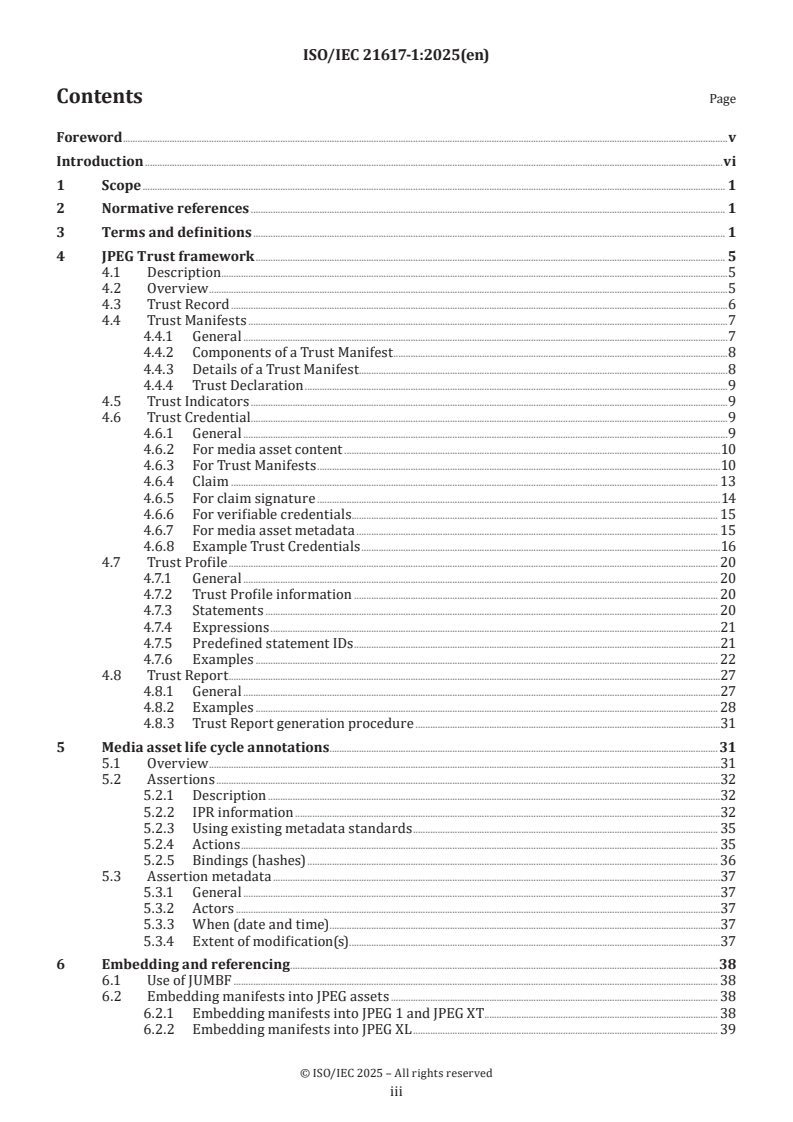
Contents Page
Foreword .v
Introduction .vi
1 Scope . 1
2 Normative references . 1
3 Terms and definitions . 1
4 JPEG Trust framework . 5
4.1 Description .5
4.2 Overview .5
4.3 Trust Record .6
4.4 Trust Manifests .7
4.4.1 General .7
4.4.2 Components of a Trust Manifest .8
4.4.3 Details of a Trust Manifest . .8
4.4.4 Trust Declaration .9
4.5 Trust Indicators .9
4.6 Trust Credential . .9
4.6.1 General .9
4.6.2 For media asset content .10
4.6.3 For Trust Manifests .10
4.6.4 Claim . 13
4.6.5 For claim signature .14
4.6.6 For verifiable credentials . . 15
4.6.7 For media asset metadata . 15
4.6.8 Example Trust Credentials .16
4.7 Trust Profile . 20
4.7.1 General . 20
4.7.2 Trust Profile information . 20
4.7.3 Statements . 20
4.7.4 Expressions .21
4.7.5 Predefined statement IDs .21
4.7.6 Examples . 22
4.8 Trust Report .27
4.8.1 General .27
4.8.2 Examples . 28
4.8.3 Trust Report generation procedure .31
5 Media asset life cycle annotations.31
5.1 Overview .31
5.2 Assertions .32
5.2.1 Description .32
5.2.2 IPR information .32
5.2.3 Using existing metadata standards . 35
5.2.4 Actions . 35
5.2.5 Bindings (hashes) . 36
5.3 Assertion metadata .37
5.3.1 General .37
5.3.2 Actors .37
5.3.3 When (date and time) .37
5.3.4 Extent of modification(s) . .37
6 Embedding and referencing.38
6.1 Use of JUMBF . 38
6.2 Embedding manifests into JPEG assets . 38
6.2.1 Embedding manifests into JPEG 1 and JPEG XT. 38
6.2.2 Embedding manifests into JPEG XL . 39
© ISO/IEC 2025 – All rights reserved
iii
6.2.3 Embedding manifests into JPEG 2000 . . 39
6.2.4 Embedding manifests into JPEG XS . 40
6.3 Embedding manifests into other asset types . 40
6.4 External manifests . 40
6.5 Embedding a reference to the active manifest . 40
7 Identification of actors .40
7.1 Identity and actors . 40
7.1.1 Verifiable credentials . 40
8 Media asset content binding .43
8.1 General .43
8.2 Cryptographic binding to content .43
8.3 Use of digital signatures .43
8.4 Validation .43
9 Privacy and protection .44
9.1 General . 44
9.2 Anonymization . 44
9.2.1 W3C Verifiable Credentials . 44
9.2.2 Redaction .45
9.3 Obfuscation .47
9.3.1 General .47
9.3.2 Protecting an assertion .47
9.3.3 Protecting the media asset content . 49
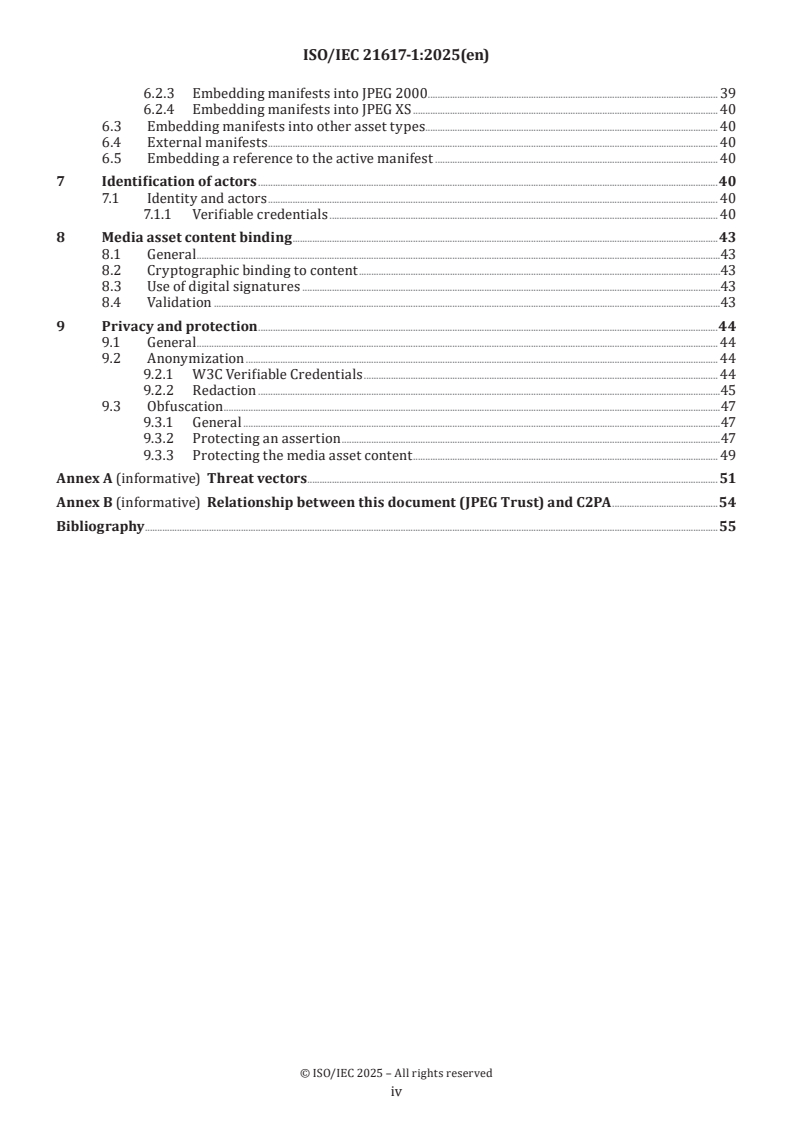
Annex A (informative) Threat vectors . 51
Annex B (informative) Relationship between this document (JPEG Trust) and C2PA .54
Bibliography .55
© ISO/IEC 2025 – All rights reserved
iv
Foreword
ISO (the International Organization for Standardization) and IEC (the International Electrotechnical
Commission) form the specialized system for worldwide standardization. National bodies that are
members of ISO or IEC participate in the development of International Standards through technical
committees established by the respective organization to deal with particular fields of technical activity.
ISO and IEC technical committees collaborate in fields of mutual interest. Other international organizations,
governmental and non-governmental, in liaison with ISO and IEC, also take part in the work.
The procedures used to develop this document and those intended for its further maintenance are described
in the ISO/IEC Directives, Part 1. In particular, the different approval criteria needed for the different types
of document should be noted. This document was drafted in accordance with the editorial rules of the ISO/
IEC Directives, Part 2 (see www.iso.org/directives or www.iec.ch/members_experts/refdocs).
ISO and IEC draw attention to the possibility that the implementation of this document may involve the
use of (a) patent(s). ISO and IEC take no position concerning the evidence, validity or applicability of any
claimed patent rights in respect thereof. As of the date of publication of this document, ISO and IEC had
received notice of (a) patent(s) which may be required to implement this document. However, implementers
are cautioned that this may not represent the latest information, which may be obtained from the patent
database available at www.iso.org/patents and https://patents.iec.ch. ISO and IEC shall not be held
responsible for identifying any or all such patent rights.
Any trade name used in this document is information given for the convenience of users and does not
constitute an endorsement.
For an explanation of the voluntary nature of standards, the meaning of ISO specific terms and expressions
related to conformity assessment, as well as information about ISO's adherence to the World Trade
Organization (WTO) principles in the Technical Barriers to Trade (TBT) see www.iso.org/iso/foreword.html.
In the IEC, see www.iec.ch/understanding-standards.
This document was prepared by Joint Technical Committee ISO/IEC JTC 1, Information technology,
Subcommittee SC 29, Coding of audio, picture, multimedia and hypermedia information.
A list of all parts in the ISO 21617 series can be found on the ISO and IEC websites.
Any feedback or questions on this document should be directed to the user’s national standards
body. A complete listing of these bodies can be found at www.iso.org/members.html and
www.iec.ch/national-committees.
© ISO/IEC 2025 – All rights reserved
v
Introduction
Current technologies permit the modification or synthetic creation of media assets. Some, like deep learning
methods, can create media assets that are hard for people to distinguish from natural media assets. These
technologies open new, creative opportunities that are useful for business and research usage. However,
these technologies can also lead to issues relating to the use of manipulated media to spread misinformation
or disinformation. Misuse of manipulated media can cause social unrest, spread rumours for political gain
or encourage hate crimes.
Media modifications are not always negative as they are increasingly a normal and legal component of many
production pipelines. However, in many application domains, creators need or want to declare the type of
modifications that were performed on the media asset. A lack of such declarations in these situations may
reveal the lack of trustworthiness of media assets or the intention to hide the existence of manipulations.
To address such problems and attempt to avoid negative impacts, some companies, including social media
platforms and news outlets, are developing mechanisms to clearly detect and annotate manipulated media
when they are shared.
There is a need to have a standardized way to annotate media assets (regardless of the intent) and securely
link the assets and annotations together. This document (JPEG Trust) ensures interoperability between a
wide range of applications dealing with media asset creation and modification, providing a set of standard
mechanisms to describe and embed information about the creation and modification of media assets.
Furthermore, a key aspect of understanding the trustworthiness of a media asset is the nature of trust
itself. No single trust model can accommodate all the expressions of media asset trust in society. This means
that the standard requires a flexible architecture for accommodating diverse trust models. Through the
mechanism of user-defined trust profiles, this document empowers various communities to define trust
models that meet the specific demands of their trust requirements.
This document (JPEG Trust) provides a comprehensive framework for individuals, organizations, and
governing institutions interested in establishing an environment of trust for the media that they use, and
to support trust in the media they share online. This framework addresses aspects of providing provenance
information, extracting and evaluating trust indicators, and handling privacy and security concerns.
© ISO/IEC 2025 – All rights reserved
vi
International Standard ISO/IEC 21617-1:2025(en)
Information technology — JPEG Trust —
Part 1:
Core foundation
1 Scope
This document specifies a framework for establishing trust in media. This framework includes aspects
of authenticity, provenance and integrity through secure and reliable annotation of the media assets
throughout their life cycle.
2 Normative references
The following documents are referred to in the text in such a way that some or all of their content constitutes
requirements of this document. For dated references, only the edition cited applies. For undated references,
the latest edition of the referenced document (including any amendments) applies.
ISO/IEC 10918-1, Information technology — Digital compression and coding of continuous-tone still images:
Requirements and guidelines
ISO/IEC 15444-1:2024, Information technology — JPEG 2000 image coding system — Part 1: Core coding system
ISO/IEC 18181-2:2024, Information technology — JPEG XL image coding system — Part 2: File format
ISO/IEC 18477-1, Information technology — Scalable compression and coding of continuous-tone still images —
Part 1: Core coding system specification
ISO/IEC 18477-3, Information technology — Scalable compression and coding of continuous-tone still images —
Part 3: Box file format
ISO/IEC 19566-4, Information technologies — JPEG systems — Part 4: Privacy and security
ISO/IEC 19566-5:2023, Information technologies — JPEG systems — Part 5: JPEG universal metadata box
format (JUMBF)
ISO/IEC 19566-6, Information technologies — JPEG systems — Part 6: JPEG 360
ISO/IEC 19566-7, Information technologies — JPEG systems — Part 7: JPEG linked media format (JLINK)
ISO/IEC 19566-8, Information technologies — JPEG systems — Part 8: JPEG Snack
ISO/IEC 21122-1, Information technology — JPEG XS low-latency lightweight image coding system — Part 1:
Core coding system
IETF RFC 4122, A Universally Unique IDentifier (UUID) URN Namespace, available at: https:// www .rfc -editor
.org/ info/ rfc4122
W3C Recommendation JSON-LD 1.1, A JSON-based Serialization for Linked Data, available at: https:// www .w3
.org/ TR/ json -ld11/
3 Terms and definitions
For the purposes of this document, the following terms and definitions apply.
© ISO/IEC 2025 – All rights reserved
ISO and IEC maintain terminology databases for use in standardization at the following addresses:
— ISO Online browsing platform: available at https:// www .iso .org/ obp
— IEC Electropedia: available at https:// www .electropedia .org/
3.1
actor
actors
human or non-human (hardware or software) that is participating in the media ecosystem.
EXAMPLE Camera (capture device), generation or editing software, cloud service or the person using such tools.
3.2
media asset
digital assets including images, videos, audio or text
3.3
media asset content
portion of a media asset (3.2) that represents the actual content, such as the pixel data of an image, along
with any additional technical metadata required to understand or render the content (e.g. a colour profile or
encoding parameters)
3.4
media asset metadata
portion of a media asset (3.2) that represents non-technical information about the media asset or its content,
such as location, creator, annotations or IPR information
3.5
natural media asset
sensor acquired media asset
3.6
region of interest
ROI
subset within the media asset content (3.3) identified for a particular purpose
EXAMPLE the face portion of a portrait image, an extracted foreground object(s) or scene cuts of a video
3.7
synthetic media asset
synthetically generated media asset
media asset (3.2) generated at least partially by a computer program
3.8
generative AI media asset
media asset (3.2) created by means of artificial intelligence (AI) and machine learning (ML)
3.9
JPEG 1
common image compression data format and means of reference to ISO/IEC 10918-1
3.10
digital master
master media asset as intended by its creator
3.11
manipulated media asset
manipulated media
media asset (3.2) that has been changed with the intention to induce misinterpretation
© ISO/IEC 2025 – All rights reserved
3.12
media asset original
media asset (3.2) produced by a device or method without any modifications
3.13
media asset provenance
set of information about a media asset (3.2) including the trail of modifications starting from an actor (3.1)
EXAMPLE Media asset origin.
Note 1 to entry: Modifications that are missing from the asset’s provenance are treated the same as an invalid or
unverifiable provenance chain.
3.14
media asset source
non-human actor (3.1) that created the media asset original (3.12)
3.15
modified media asset
media asset (3.2) that has been changed
3.16
assertion
data structure which represents a statement asserted by an actor (3.1) concerning the media asset (3.2)
Note 1 to entry: This data is a part of the trust manifest (3.19).
3.17
claim
digitally signed and tamper-evident data structure that references one or more assertion (3.16) by one or more
actors (3.1), concerning a media asset (3.2) and the information necessary to represent the content_binding
Note 1 to entry: If any assertion was redacted, then a declaration to that effect is included. This data is a part of the
trust manifest (3.19).
3.18
claim signature
digital signature on the claim (3.17) using the private key of an actor (3.1)
Note 1 to entry: The claim_signature is a part of the trust manifest (3.19).
3.19
trust manifest
set of information about the media asset provenance (3.13) of a media asset (3.3). A trust manifest is part of a
trust record (3.23)
3.20
trust declaration
specific type of trust manifest (3.19) that, when present, is always first in the trust record (3.21). It represents
the actor (3.1) that created the media asset (3.2) and contains only mandatory assertions
3.21
trust record
collection of one or more trust manifest (3.21) that can either be embedded into a media asset (3.2) or be
external to its media asset
3.22
trust indicators
information derived from a combination of the media asset (3.2) and the trust record (3.21) that indicate a
level of trustworthiness of a media asset in a given context
© ISO/IEC 2025 – All rights reserved
3.23
trust credential
the set of trust indicators (3.22) that are derived from a media asset (3.2) and its trust record (3.23)
3.24
trust profile
set of expressions that are used to evaluate each trust indicators (3.22) in a given trust credential (3.23) to
indicate a level of trustworthiness for a given media asset (3.3)
3.25
trust report
result of evaluating a trust credential (3.23) against a trust profile (3.24)
3.26
authentic media asset
media asset (3.2) that is verifiable (3.27) or trustworthy (3.28) or both
3.27
verifiable
able to be checked
3.28
trustworthy
able to be relied on as being what it is asserted to be
3.29
media asset integrity
lack of corruption of a media asset (3.2)
3.30
registration
process of storing information (e.g. media asset, metadata or provenance) about a media asset (3.2), separate
from the media asset itself
3.31
signer
actor (3.1) who digitally signs a media asset (3.2)
3.32
signing
process that establishes the relation between an actor (3.1) and a media asset (3.2) in a tamper-evident manner
3.33
intellectual property rights
IPR
exclusive right of the actor (3.1) to the intellectual work of their creation
3.34
anonymization
process of altering data in a media asset with the aim to protect the privacy of an actor (3.1) by obscuring
identifiable features
3.35
obfuscation
process of altering data in a media asset with the aim to protect unauthorized access
3.36
JUMBF
universal format to embed any type of metadata in any box-based JPEG file format and means of reference to
ISO/IEC 19566-5
© ISO/IEC 2025 – All rights reserved
4 JPEG Trust framework
4.1 Description
This document describes a framework for establishing trust in media that comply with the JPEG standards
developed by ISO/IEC JTC1 SC 29 including ISO/IEC 10918-1 (JPEG 1), ISO/IEC 15444-1 (JPEG 2000),
ISO/IEC 18477-1 (JPEG XT), ISO/IEC 18181-2 (JPEG XL), ISO/IEC 21122-1 (JPEG XS), ISO/IEC 19566-6 (JPEG
360), ISO/IEC 19566-7 (JLINK) and ISO/IEC 19566-8 (JPEG Snack)). The core components of the framework
are built on the ISO/IEC 19566-5 (JPEG Universal Metadata Box Format, JUMBF), as described in 6.1.
Therefore, the core principles can also be applied on other types of media that can embed JUMBF containers.
The model for storing and accessing cryptographically verifiable information about a media asset is aligned
with the technical aspects of the C2PA architecture.
NOTE For more information about the relationship between this document (JPEG Trust) and C2PA, see Annex B.
4.2 Overview
The JPEG Trust framework establishes that a media asset consists of the media asset content, media asset
metadata, and a Trust Record. The Trust Record (4.3) is a tamper-evident unit consisting of a one or more
Trust Manifests. The Trust Manifests contain a series of statements, called assertions, that cover areas such
as asset creation, creation device details, authorship, edit actions, bindings to content and other information
associated with the media asset.
A set of Trust Indicators (4.5) can be derived from the trust record as well as from other metadata or the
media asset content. These Trust Indicators are gathered together into a Trust Credential (4.6), which can be
used to assess the trustworthiness of a media asset in a given context through the use of a specified Trust
Profile (4.7). The result of this evaluation is documented in a Trust Report (4.8).
The framework and its core components are illustrated in Figure 1.
© ISO/IEC 2025 – All rights reserved
Figure 1 — Trust Framework
4.3 Trust Record
The Trust Record is a JUMBF superbox composed of a series of other JUMBF boxes and superboxes, each
identified by their own UUID and label in their JUMBF Description box. The Trust Record Description box
shall have a label of c2pa, a UUID of 0x63327061-0011-0010-8000-00AA00389B71 (c2pa) and shall contain one
or more Trust Manifest superboxes (which may be a Trust Manifest or a Trust Declaration). The Trust Record
may also contain JUMBF boxes and superboxes whose UUIDs are not defined in this document.
NOTE Allowing other boxes and superboxes enables custom extensions to this document (JPEG Trust) as well as
enabling the addition of new boxes in future versions of this document without breaking compatibility.
A Trust Record (see Figure 2) shall contain at least one Trust Manifest. The set of Trust Manifests, as stored
in the asset’s Trust Record, represents its Media Asset Provenance.
© ISO/IEC 2025 – All rights reserved
Figure 2 — A Trust Record
4.4 Trust Manifests
4.4.1 General
A Trust Manifest (see Figure 3) is the set of information about the media asset provenance, while a Trust
Declaration is a special type of Trust Manifest with only mandatory assertions that always comes first in the
Trust Record.
© ISO/IEC 2025 – All rights reserved
Figure 3 — A Trust Manifest
4.4.2 Components of a Trust Manifest
Each Trust Manifest may contain a Verifiable Credentials (VC) Store, Assertions, a Claim, and a Claim
Signature.
Assertions (5.2) are statements about the media asset provenance of a given media asset; such as asset
creation, capture device details, authorship, edit actions, and bindings to content. Assertions are wrapped
up with additional information into a digitally signed entity called a Claim.
[14]
The W3C Verifiable Credentials of individual actors that are involved in the creation of the Assertions can
be added to the VCStore of a Trust Record to provide additional Trust Indicators concerning actors.
Together, these Assertions, Claims, Verifiable Credentials and Signatures are all bound together into the
Trust Manifest by a hardware or software component called a Claim Generator.
4.4.3 Details of a Trust Manifest
The Trust Manifest is a JUMBF superbox composed of a series of other JUMBF boxes and superboxes, each
identified by their own UUID and label in their JUMBF Description box. The UUID for each Trust Manifest shall
be either 0x63326D61-0011-0010-8000-00AA00389B71 (c2ma), 0x6332636D-0011-0010-8000-00AA00389B71
(c2cm), 0x6332756D-0011-0010-8000-00AA00389B71 (c2um), or 0x63326D64-0011-0010-8000-00AA00389B71
(c2md) depending on the type of manifest. In order to enable uniquely identifying each Trust Manifest, they
shall be labelled with a RFC 4122 (UUID) optionally proceeded by an identifier of the claim generator and a :.
EXAMPLE A label for the fictitious ACME claim generator might look like acme:urn:uuid:F9168C5E-CEB2-
4FAA-B6BF-329BF39FA1E4.
[6]
NOTE More information about the JUMBF structure of Trust Manifests can be found in the C2PA specification.
© ISO/IEC 2025 – All rights reserved
4.4.4 Trust Declaration
A Trust Declaration is a specific type of Trust Manifest (which is specified using the UUID: 0x63326D64-0011-
0010-8000-00AA00389B71 (c2md)) that shall only be defined during creation of a media asset and shall only
contain a specific set of mandatory assertions, as well as the Claim and Claim Signature. The Requestable and
Label Present toggles shall both be set in the JUMBF Description box of the Trust Manifest’s JUMBF superbox.
These mandatory Assertions are:
— exactly one hard binding to content assertion
— either a c2pa.hash.data, c2pa.hash.boxes, or c2pa.hash.bmff.v2 based on the type of asset and version
for which the manifest is destined.
— exactly one actions assertion
— consisting of a single c2pa.created action that specifies the time of creation and a digitalSourceType
field whose values indicate if it was created by a camera, software tool or generative AI.
NOTE The digitalSourceType field would have the value https://cv.iptc.org/newscodes/digitalsourcetype/
trainedAlgorithmicMedia when the media asset is created from scratch by generative AI. When a generative AI
uses existing media assets in addition to newly created ones, then the value of https://cv.iptc.org/newscodes/
digitalsourcetype/compositedWithtrainedAlgorithmicMedia is used.
If a specific workflow requires additional assertions, those requirements can be reflected through the use
of a Trust Profile (4.7) that would be used to evaluate the Trust Credential (4.6) of the media assets. For
example, a workflow might require that a media asset contain the date, time and location when it is created.
4.5 Trust Indicators
Trust Indicators are parameters that may be used to assess the trustworthiness of a media asset in a given
context. Trust Indicators are derived from one or more of the following sources: media asset content, the
trust record, and the media asset metadata. Each of these is represented as a separate “section” of the Trust
Credential, along with any additional indicators that a given workflow may produce. Trust Indicators are
expressed in the Trust Credential as specified in 4.6.
NOTE While some Trust Indicators are declared in this document, new Trust Indicators can be defined at any
time to suit specific workflows.
4.6 Trust Credential
4.6.1 General
The Trust Credential consists of Trust Indicators extracted from the two portions of the media asset, namely
metadata (including both Trust Record and other metadata) and content.
A Trust Credential should be serialized into a JSON-LD object, with fields representing groupings of the Trust
Indicators. Additionally, this document describes how to map well known serializations to JSON-LD for the
purposes of consistent processing by a validator.
NOTE Other serializations, whether ephemeral or persistent, are possible, but are not specified in this document.
The Trust Credential’s JSON-LD serialization shall contain an JSON-LD standard @context field (such as
Figure 4) whose value shall be either an object or an array listing terms (also known as namespaces) that
are used in the Trust Credential. In the case of an object, the terms shall be listed as key-value pairs, where
the key is the term name and the value is the URI of the term. In the case of an array, only the URI is required
since it shall apply to all terms not otherwise identified by a specific term.
© ISO/IEC 2025 – All rights reserved
Figure 4 — Example of a JSON-LD @context field
Since a @context element can appear inside of any object in JSON-LD, it is possible to have custom values,
and their associated @context elements in multiple places throughout a single JSON-LD document, where the
terms are localized to that specific object, such as in Figure 6.
4.6.2 For media asset content
A Trust Credential may contain a field named content whose value is an object containing information that
represents the Trust Indicators derived from the media asset content. There are currently no pre-defined
fields of the content object, but workflow-centric Trust Indicators may be added to the content object along
with their associated @context. For example, Figure 5 shows a content object that contains information
about the image, such as its width and height.
Figure 5 — Custom content Trust Indicators
4.6.3 For Trust Manifests
4.6.3.1 General
As described in 4.4, a Trust Manifest consists of a set of Assertions, Claims, and Signatures (and possibly
other things) that are bound together into a single entity. There are two types of Trust Manifests: Trust
Declarations and standard Trust Manifests. If a Trust Declaration is present, its Trust Indicators shall be
represented as fields of the declaration object. For any Trust Manifests present, there shall be an object in
the manifests array, which is the value of the manifests field of the Trust Credential. Each of those objects
shall contain a list of Trust Indicators derived from the Trust Manifest.
NOTE It is possible to produce a Trust Credential for a media asset that contains neither a Trust Declaration nor
any Trust Manifests. This is a valid state and the lack of a Trust Declaration or any Trust Manifests serves as a valid
trust indicator (4.5).
4.6.3.2 JSON-LD serialized assertions
For any Assertion which is serialized into JSON-LD that will be incorporated into the Trust Credential, the
Trust Indicator shall be described using the same JSON-LD object. An example stds.iptc assertion is shown
in Figure 6.
© ISO/IEC 2025 – All rights reserved
Figure 6 — A JSON-LD serialized assertion
NOTE The various terms and context namespaces in Figure 6 are defined as part of IPTC Photo Metadata
[12]
Standard.
4.6.3.3 CBOR serialized assertions
For each Assertion, which is serialized into CBOR, that will be incorporated into the Trust Credential,
the Trust Indicator shall be described as the same key name in the CBOR map and its value type shall be
determined by Table 1:
Table 1 — Mapping from CBOR to JSON-LD
CBOR Type(s) JSON-LD Type
integer, unsigned integer unsigned number
negative integer integer
byte string string (base64 encoded)
UTF-8 string string
array array
map object
False, True boolean
Null null
half-precision float, single-precision float, double-precision float float
date-time string (as defined in ISO 8601-1)
Since CBOR allows map keys of any type, whereas JSON-LD only allows strings as keys in object values, CBOR
maps with keys other than UTF-8 strings shall have those keys converted to UTF-8 strings. An example of
a CBOR serialized assertion is shown in Figure 7, and its equivalent JSON-LD representation is shown in
Figure 8.
© ISO/IEC 2025 – All rights reserved
Figure 7 — CBOR Diagnostics for an Actions assertion
© ISO/IEC 2025 – All rights reserved
Figure 8 — JSON-LD representation of Figure 7
4.6.4 Claim
Since a Claim is a special type of Assertion, it shall be serialized in the same manner as a CBOR serialized
assertion (4.6.3.3). An example is found in Figure 9.
In addition, the following two fields shall be present in all Claim objects:
signature_status [6]
A field whose value is a single C2PA status code determined from validation of the
signature.
assertion_status
A field whose value is an object, where each field is the label of the Assertion and its
[6]
value is the C2PA status code determined from validation.
For the active Trust Manifest, the following additional field shall be present in the Claim object:
content_status [6]
A field whose value is a single C2PA status code determined from validation of the
content bindings.
NOTE This is present only in the active Trust Manifest, since that is the only one that can be used to check the
validity of the content bindings.
© ISO/IEC 2025 – All rights reserved
Figure 9 — A JSON-LD serialized claim
4.6.5 For claim signature
The JSON-LD representation of the X.509 certificate from the claim signature is based on a logical mapping
of its ASN.1 serialization as defined in IETF RFC 5280 to JSON-LD. An example certificate is in Figure 10.
Additional mappings, such as the mapping of the distinguished name (as defined in IETF RFC 4514) to JSON-
LD shall also be done in the most logical fashion possible.
NOTE An X.509 certificate can contain all sorts of information, but only the information that is relevant to the
trust framework would be included in the JSON-LD representation.
Figure 10 — Representation of an X.509 Certificate
An
...
Questions, Comments and Discussion
Ask us and Technical Secretary will try to provide an answer. You can facilitate discussion about the standard in here.
Loading comments...