


ISO/IEC 8825-4:2002/Amd 1:2004
(Amendment)Information technology — ASN.1 encoding rules: XML Encoding Rules (XER) — Part 4: — Amendment 1: EXTENDED-XER
Information technology — ASN.1 encoding rules: XML Encoding Rules (XER) — Part 4: — Amendment 1: EXTENDED-XER
Technologies de l'information — Règles de codage ASN.1: Règles de codage XML (XER) — Partie 4: — Amendement 1: Instructions de codage XER et règles de codage XML étendues (EXTENDED-XER)
General Information
- Status
- Withdrawn
- Publication Date
- 11-Oct-2004
- Withdrawal Date
- 11-Oct-2004
- Drafting Committee
- ISO/IEC JTC 1/SC 6/WG 7 - Network, transport and future network
- Current Stage
- 9599 - Withdrawal of International Standard
- Start Date
- 15-Dec-2009
- Completion Date
- 12-Feb-2026
Relations
- Effective Date
- 06-Jun-2022
- Effective Date
- 17-Mar-2009
- Effective Date
- 15-Apr-2008
Get Certified
Connect with accredited certification bodies for this standard

BSI Group
BSI (British Standards Institution) is the business standards company that helps organizations make excellence a habit.

NYCE
Mexican standards and certification body.
Sponsored listings
Frequently Asked Questions
ISO/IEC 8825-4:2002/Amd 1:2004 is a standard published by the International Organization for Standardization (ISO). Its full title is "Information technology — ASN.1 encoding rules: XML Encoding Rules (XER) — Part 4: — Amendment 1: EXTENDED-XER". This standard covers: Information technology — ASN.1 encoding rules: XML Encoding Rules (XER) — Part 4: — Amendment 1: EXTENDED-XER
Information technology — ASN.1 encoding rules: XML Encoding Rules (XER) — Part 4: — Amendment 1: EXTENDED-XER
ISO/IEC 8825-4:2002/Amd 1:2004 is classified under the following ICS (International Classification for Standards) categories: 35.100.60 - Presentation layer. The ICS classification helps identify the subject area and facilitates finding related standards.
ISO/IEC 8825-4:2002/Amd 1:2004 has the following relationships with other standards: It is inter standard links to ISO/IEC 8825-4:2002, ISO/IEC 8825-4:2008; is excused to ISO/IEC 8825-4:2002. Understanding these relationships helps ensure you are using the most current and applicable version of the standard.
ISO/IEC 8825-4:2002/Amd 1:2004 is available in PDF format for immediate download after purchase. The document can be added to your cart and obtained through the secure checkout process. Digital delivery ensures instant access to the complete standard document.
Standards Content (Sample)
INTERNATIONAL ISO/IEC
STANDARD 8825-4
First edition
2002-12-15
AMENDMENT 1
2004-10-15
Information technology — ASN.1
encoding rules: XML Encoding Rules
(XER)
AMENDMENT 1: EXTENDED-XER
Technologies de l'information — Règles de codage ASN.1: Règles de
codage XML (XER)
AMENDEMENT 1: Règles de codage XML étendu
Reference number
ISO/IEC 8825-4:2002/Amd.1:2004(E)
©
ISO/IEC 2004
ISO/IEC 8825-4:2002/Amd.1:2004(E)
PDF disclaimer
This PDF file may contain embedded typefaces. In accordance with Adobe's licensing policy, this file may be printed or viewed but
shall not be edited unless the typefaces which are embedded are licensed to and installed on the computer performing the editing. In
downloading this file, parties accept therein the responsibility of not infringing Adobe's licensing policy. The ISO Central Secretariat
accepts no liability in this area.
Adobe is a trademark of Adobe Systems Incorporated.
Details of the software products used to create this PDF file can be found in the General Info relative to the file; the PDF-creation
parameters were optimized for printing. Every care has been taken to ensure that the file is suitable for use by ISO member bodies. In
the unlikely event that a problem relating to it is found, please inform the Central Secretariat at the address given below.
© ISO/IEC 2004
All rights reserved. Unless otherwise specified, no part of this publication may be reproduced or utilized in any form or by any means,
electronic or mechanical, including photocopying and microfilm, without permission in writing from either ISO at the address below or
ISO's member body in the country of the requester.
ISO copyright office
Case postale 56 • CH-1211 Geneva 20
Tel. + 41 22 749 01 11
Fax + 41 22 749 09 47
E-mail copyright@iso.org
Web www.iso.org
Published in Switzerland
ii © ISO/IEC 2004 – All rights reserved
ISO/IEC 8825-4:2002/Amd.1:2004(E)
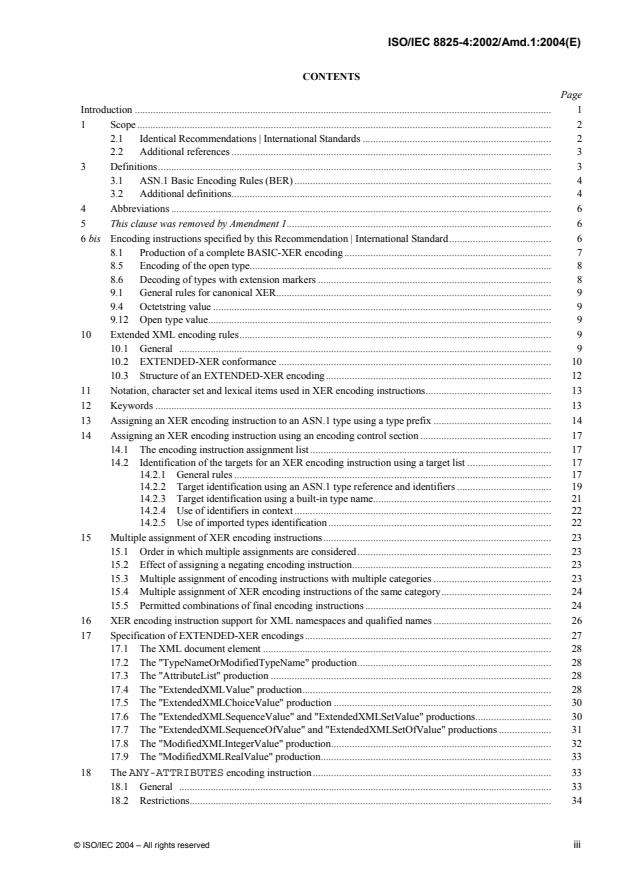
CONTENTS
Page
Introduction . 1
1 Scope . 2
2.1 Identical Recommendations | International Standards. 2
2.2 Additional references. 3
3 Definitions. 3
3.1 ASN.1 Basic Encoding Rules (BER). 4
3.2 Additional definitions. 4
4 Abbreviations . 6
5 This clause was removed by Amendment 1. 6
6 bis Encoding instructions specified by this Recommendation | International Standard. 6
8.1 Production of a complete BASIC-XER encoding. 7
8.5 Encoding of the open type. 8
8.6 Decoding of types with extension markers. 8
9.1 General rules for canonical XER. 9
9.4 Octetstring value . 9
9.12 Open type value. 9
10 Extended XML encoding rules. 9
10.1 General . 9
10.2 EXTENDED-XER conformance. 10
10.3 Structure of an EXTENDED-XER encoding. 12
11 Notation, character set and lexical items used in XER encoding instructions. 13
12 Keywords . 13
13 Assigning an XER encoding instruction to an ASN.1 type using a type prefix. 14
14 Assigning an XER encoding instruction using an encoding control section. 17
14.1 The encoding instruction assignment list. 17
14.2 Identification of the targets for an XER encoding instruction using a target list. 17
14.2.1 General rules. 17
14.2.2 Target identification using an ASN.1 type reference and identifiers. 19
14.2.3 Target identification using a built-in type name. 21
14.2.4 Use of identifiers in context. 22
14.2.5 Use of imported types identification. 22
15 Multiple assignment of XER encoding instructions. 23
15.1 Order in which multiple assignments are considered. 23
15.2 Effect of assigning a negating encoding instruction. 23
15.3 Multiple assignment of encoding instructions with multiple categories. 23
15.4 Multiple assignment of XER encoding instructions of the same category. 24
15.5 Permitted combinations of final encoding instructions. 24
16 XER encoding instruction support for XML namespaces and qualified names. 26
17 Specification of EXTENDED-XER encodings. 27
17.1 The XML document element. 28
17.2 The "TypeNameOrModifiedTypeName" production. 28
17.3 The "AttributeList" production. 28
17.4 The "ExtendedXMLValue" production. 28
17.5 The "ExtendedXMLChoiceValue" production. 30
17.6 The "ExtendedXMLSequenceValue" and "ExtendedXMLSetValue" productions. 30
17.7 The "ExtendedXMLSequenceOfValue" and "ExtendedXMLSetOfValue" productions. 31
17.8 The "ModifiedXMLIntegerValue" production. 32
17.9 The "ModifiedXMLRealValue" production. 33
18 The ANY-ATTRIBUTES encoding instruction. 33
18.1 General . 33
18.2 Restrictions. 34
© ISO/IEC 2004 – All rights reserved iii
ISO/IEC 8825-4:2002/Amd.1:2004(E)
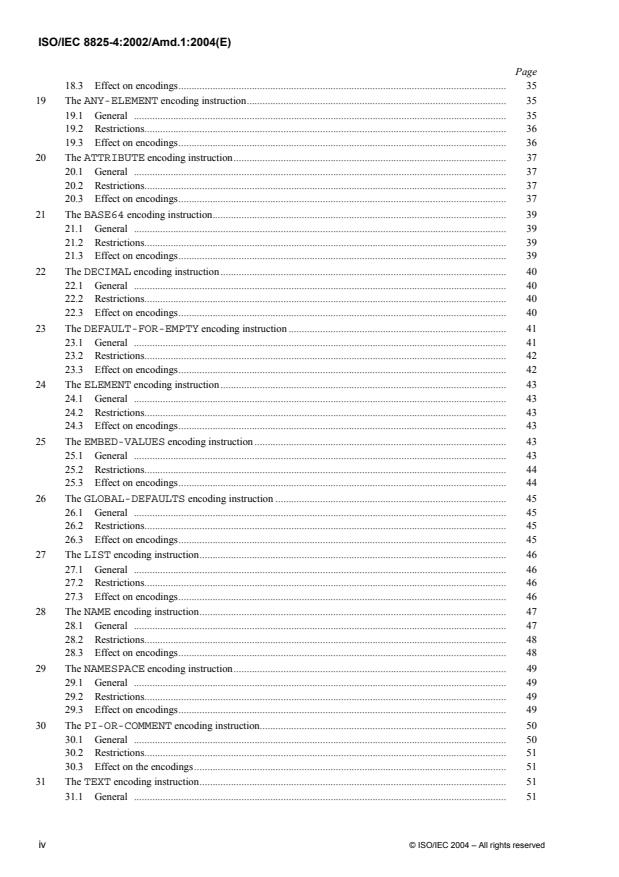
Page
18.3 Effect on encodings. 35
19 The ANY-ELEMENT encoding instruction. 35
19.1 General . 35
19.2 Restrictions. 36
19.3 Effect on encodings. 36
20 The ATTRIBUTE encoding instruction. 37
20.1 General . 37
20.2 Restrictions. 37
20.3 Effect on encodings. 37
21 The BASE64 encoding instruction. 39
21.1 General . 39
21.2 Restrictions. 39
21.3 Effect on encodings. 39
22 The DECIMAL encoding instruction. 40
22.1 General . 40
22.2 Restrictions. 40
22.3 Effect on encodings. 40
23 The DEFAULT-FOR-EMPTY encoding instruction. 41
23.1 General . 41
23.2 Restrictions. 42
23.3 Effect on encodings. 42
24 The ELEMENT encoding instruction. 43
24.1 General . 43
24.2 Restrictions. 43
24.3 Effect on encodings. 43
25 The EMBED-VALUES encoding instruction. 43
25.1 General . 43
25.2 Restrictions. 44
25.3 Effect on encodings. 44
26 The GLOBAL-DEFAULTS encoding instruction. 45
26.1 General . 45
26.2 Restrictions. 45
26.3 Effect on encodings. 45
27 The LIST encoding instruction. 46
27.1 General . 46
27.2 Restrictions. 46
27.3 Effect on encodings. 46
28 The NAME encoding instruction. 47
28.1 General . 47
28.2 Restrictions. 48
28.3 Effect on encodings. 48
29 The NAMESPACE encoding instruction. 49
29.1 General . 49
29.2 Restrictions. 49
29.3 Effect on encodings. 49
30 The PI-OR-COMMENT encoding instruction. 50
30.1 General . 50
30.2 Restrictions. 51
30.3 Effect on the encodings. 51
31 The TEXT encoding instruction. 51
31.1 General . 51
iv © ISO/IEC 2004 – All rights reserved
ISO/IEC 8825-4:2002/Amd.1:2004(E)
Page
31.2 Restrictions. 52
31.3 Effect on encodings. 52
32 The UNTAGGED encoding instruction. 53
32.1 General . 53
32.2 Restrictions. 54
32.3 Effect on encodings. 54
33 The USE-NIL encoding instruction. 55
33.1 General . 55
33.2 Restrictions. 55
33.3 Effect on encodings. 56
34 The USE-NUMBER encoding instruction. 56
34.1 General . 56
34.2 Restrictions. 56
34.3 Effect on encodings. 56
35 The USE-ORDER encoding instruction. 57
35.1 General . 57
35.2 Restrictions. 57
35.3 Effect on encodings. 58
36 The USE-QNAME encoding instruction. 58
36.1 General . 58
36.2 Restrictions. 58
36.3 Effect on encodings. 59
37 The USE-TYPE encoding instruction. 59
37.1 General . 59
37.2 Restrictions. 59
37.3 Effect on encodings. 60
38 The USE-UNION encoding instruction. 60
38.1 General . 60
38.2 Restrictions. 60
38.3 Effect on encodings. 61
39 The WHITESPACE encoding instruction. 62
39.1 General . 62
39.2 Restrictions. 62
39.3 Effect on encodings. 62
40 Object identifier values referencing the encoding rules. 63
Annex A - Examples of BASIC-XER and CXER encodings. 64
A.1 ASN.1 description of the record structure. 64
A.2 ASN.1 description of a record value. 64
A.3 Basic XML representation of this record value. 64
A.4 Canonical XML representation of this record value. 65
Annex B Partial XML content and deterministic encodings. 66
B.1 Partial XML content. 66
B.2 Recommended restrictions on encodings producing partial XML element content. 66
Annex C Examples of EXTENDED-XER encodings using XER encoding instructions. 69
C.1 Introduction. 69
C.2 Simple examples . 69
C.2.1 A base-ball card. 69
C.2.2 An employee. 70
C.3 More complex examples. 70
C.3.1 Using a union of two simple types. 70
C.3.2 Using a type identification attribute. 70
C.3.3 Using enumeration values. 71
C.3.4 Using an empty encoding for a default value. 71
C.3.5 Using embedded-values for notification of a payment due. 71
© ISO/IEC 2004 – All rights reserved v
ISO/IEC 8825-4:2002/Amd.1:2004(E)
Foreword
ISO (the International Organization for Standardization) and IEC (the International Electrotechnical
Commission) form the specialized system for worldwide standardization. National bodies that are members of
ISO or IEC participate in the development of International Standards through technical committees
established by the respective organization to deal with particular fields of technical activity. ISO and IEC
technical committees collaborate in fields of mutual interest. Other international organizations, governmental
and non-governmental, in liaison with ISO and IEC, also take part in the work. In the field of information
technology, ISO and IEC have established a joint technical committee, ISO/IEC JTC 1.
International Standards are drafted in accordance with the rules given in the ISO/IEC Directives, Part 2.
The main task of the joint technical committee is to prepare International Standards. Draft International
Standards adopted by the joint technical committee are circulated to national bodies for voting. Publication as
an International Standard requires approval by at least 75 % of the national bodies casting a vote.
Attention is drawn to the possibility that some of the elements of this document may be the subject of patent
rights. ISO and IEC shall not be held responsible for identifying any or all such patent rights.
Amendment 1 to International Standard ISO/IEC 8825-4:2002 was prepared by Joint Technical Committee
ISO/IEC JTC 1, Information technology, Subcommittee SC 6, Telecommunications and information exchange
between systems, in collaboration with ITU-T. The identical text is published as Amendment 1 to ITU-T
Rec. X.693.
vi © ISO/IEC 2004 – All rights reserved
ISO/IEC 8825-4:2002/Amd.1:2004 (E)
INTERNATIONAL STANDARD
ITU-T RECOMMENDATION
Information technology – ASN.1 encoding rules: XML Encoding Rules (XER)
Amendment 1
XER encoding instructions and EXTENDED-XER
NOTE – All new or changed text in this amendment is underlined in clauses being replaced (but not in new clauses). When
merging all such text into the base Recommendation, the underlining is to be removed.
Replace the Introduction with the following:
Introduction
The publications ITU-T Rec. X.680 | ISO/IEC 8824-1, ITU-T Rec. X.681 | ISO/IEC 8824-2, ITU-T Rec. X.682 |
ISO/IEC 8824-3, ITU-T Rec. X.683 | ISO/IEC 8824-4 together describe Abstract Syntax Notation One (ASN.1), a
notation for the definition of messages to be exchanged between peer applications.
This Recommendation | International Standard defines encoding rules that may be applied to values of ASN.1 types
defined using the notation specified in the Recommendations | International Standards listed above. Application of these
encoding rules produces a transfer syntax for such values. It is implicit in the specification of these encoding rules that
they are also to be used for decoding.
There is more than one set of encoding rules that can be applied to values of ASN.1 types. This Recommendation |
International Standard defines three sets of encoding rules that use the Extensible Markup Language (XML). These
encoding rules all produce an XML document compliant to W3C XML 1.0. The first set is called the basic XML
Encoding Rules (BASIC-XER). The second set is called the Canonical XML Encoding Rules (CANONICAL-XER, or
CXER) because there is only one way of encoding an ASN.1 value using these encoding rules. (Canonical encoding
rules are generally used for applications using security-related features such as digital signatures.) The third set is called
the extended XML Encoding Rules (EXTENDED-XER). The extended XML Encoding Rules allow additional
encoders options, and take account of encoding instructions that specify variations of the BASIC-XER encodings in
order to support specific styles of XML documents (see below). The extended XML Encoding Rules are not canonical,
and there is no canonical form for these rules defined in this Recommendation | International Standard.
There are many aspects of an XML representation of data (such as the use of XML attributes instead of child elements,
or the use of white-space delimited lists) whose use is a matter of style and XML designer choice. If a type defined in
an ASN.1 specification is encoded by BASIC-XER or by CXER, then there is a single fixed style used for the XML
representation, with no user control of stylistic features. This ITU-T Recommendation | International Standard specifies
the syntax and semantics of XER encoding instructions which specify the stylistic features of the XML in an
EXTENDED-XER encoding. XER encoding instructions can also be used to determine the possible insertion of XML
processing instructions in an EXTENDED-XER encoding. XER encoding instructions are ignored by BASIC-XER and
by CXER, but are used by EXTENDED-XER.
NOTE – "Stylistic features", such as use of attributes or white-space delimited lists, can also affect the size of an encoding and
the ease with which it can be processed, so use of such features is not just a matter of style. Where such issues are important,
EXTENDED-XER with encoding instructions may be preferred over BASIC-XER or CXER.
Clause 8 specifies the BASIC-XER encoding of ASN.1 types.
Clause 9 specifies the CXER encoding of ASN.1 types.
Clause 10 specifies the EXTENDED-XER encoding of ASN.1 types, referencing later clauses which define the XER
encoding instructions.
Clauses 11 to 14 list and categorize the XER encoding instructions and specify the syntax for their assignment to an
ASN.1 type or component using either an XER type prefix (see ITU-T Rec. X.680 | ISO/IEC 8824-1, 30.3) or an XER
encoding control section (see ITU-T Rec. X.680 | ISO/IEC 8824-1, clause 50).
ITU-T Rec. X.693 (2001)/Amd.1 (10/2003) 1
ISO/IEC 8825-4:2002/Amd.1:2004 (E)
Clause 15 defines the order of precedence if XER encoding instructions are present in both an XER type prefix and in
an XER encoding control section.
Clause 16 specifies the XER encoding instruction support for XML namespaces when using EXTENDED-XER.
Clause 17 specifies EXTENDED-XER encodings.
Clauses 18 to 39 specify:
a) the syntax of each XER encoding instruction used in a type prefix or an encoding control section;
b) restrictions on the XER encoding instructions that can be associated with a particular ASN.1 type
(resulting from inheritance and multiple assignments);
c) modifications to the XER encoding rules that are required in an EXTENDED-XER encoding when an
XER encoding instruction is applied.
Annex A is informative and contains examples of BASIC-XER and CXER encodings.
Annex B is informative and contains a description of the partial XML content that is produced when constructions such
as sequence and sequence-of have their surrounding tags removed, together with restrictions on EXTENDED-XER
specifications that enable easy determination of the ASN.1 component that an XML element is associated with.
Annex C is informative and contains examples of XER encoding instructions and of the corresponding
EXTENDED-XER encodings.
Replace clause 1 with the following:
1 Scope
This Recommendation | International Standard specifies a set of basic XML Encoding Rules (BASIC-XER) that may be
used to derive a transfer syntax for values of types defined in ITU-T Rec. X.680 | ISO/IEC 8824-1 and ITU-T Rec.
X.681 | ISO/IEC 8824-2. This Recommendation | International Standard also specifies a set of Canonical XML
Encoding Rules (CXER) which provide constraints on the basic XML Encoding Rules and produce a unique encoding
for any given ASN.1 value. This Recommendation | International Standard further specifies a set of extended XML
Encoding Rules (EXTENDED-XER) which adds further encoders options, and also allows the ASN.1 specifier to vary
the encoding that would be produced by BASIC-XER. It is implicit in the specification of these encoding rules that they
are also used for decoding.
The encoding rules specified in this Recommendation | International Standard:
– are used at the time of communication;
– are intended for use in circumstances where displaying of values and/or processing them using
commonly available XML tools (such as browsers) is the major concern in the choice of encoding rules;
– allow the extension of an abstract syntax by addition of extra values for all forms of extensibility
described in ITU-T Rec. X.680 | ISO/IEC 8824-1.
This Recommendation | International Standard also specifies the syntax and semantics of XER encoding instructions,
and the rules for their assignment and combination. XER encoding instructions can be used to control the EXTENDED-
XER encoding for specific ASN.1 types.
Replace subclause 2.1 with the following:
2.1 Identical Recommendations | International Standards
– ITU-T Recommendation X.680 (2002) | ISO/IEC 8824-1:2002, Information technology – Abstract
Syntax Notation One (ASN.1): Specification of basic notation.
– ITU-T Recommendation X.680 (2002)/Amd.1 (2003) | ISO/IEC 8824-1:2002/Amd.1:2003, Information
technology – Abstract Syntax Notation One (ASN.1): Specification of basic notation – Amendment 1:
Support for EXTENDED-XER.
– ITU-T Recommendation X.681 (2002) | ISO/IEC 8824-2:2002, Information technology – Abstract
Syntax Notation One (ASN.1): Information object specification.
2 ITU-T Rec. X.693 (2001)/Amd.1 (10/2003)
ISO/IEC 8825-4:2002/Amd.1:2004 (E)
– ITU-T Recommendation X.681 (2002)/Amd.1 (2003) | ISO/IEC 8824-2:2002/Amd.1:2003, Information
technology – Abstract Syntax Notation One (ASN.1): Information object specification – Amendment 1:
Support for EXTENDED-XER.
– ITU-T Recommendation X.682 (2002) | ISO/IEC 8824-3:2002, Information technology – Abstract
Syntax Notation One (ASN.1): Constraint specification.
– ITU-T Recommendation X.683 (2002) | ISO/IEC 8824-4:2002, Information technology – Abstract
Syntax Notation One (ASN.1): Parameterization of ASN.1 specifications.
– ITU-T Recommendation X.690 (2002) | ISO/IEC 8825-1:2002, Information technology – ASN.1
encoding rules: Specification of Basic Encoding Rules (BER), Canonical Encoding Rules (CER) and
Distinguished Encoding Rules (DER).
– ITU-T Recommendation X.690 (2002)/Amd.1 (2003) | ISO/IEC 8825-1:2002/Amd.1:2003, Information
technology – ASN.1 encoding rules: Specification of Basic Encoding Rules (BER), Canonical Encoding
Rules (CER) and Distinguished Encoding Rules (DER) – Amendment 1: Support for EXTENDED-XER.
– ITU-T Recommendation X.691 (2002) | ISO/IEC 8825-2:2002, Information technology – ASN.1
encoding rules: Specification of Packed Encoding Rules (PER).
– ITU-T Recommendation X.691 (2002)/Amd.1 (2003) | ISO/IEC 8825-2:2002/Amd.1:2003, Information
technology – ASN.1 encoding rules: Specification of Packed Encoding Rules (PER) – Amendment 1:
Support for EXTENDED-XER.
– ITU-T Recommendation X.692 (2002) | ISO/IEC 8825-3:2002, Information technology – ASN.1
encoding rules: Specification of Encoding Control Notation (ECN).
Replace subclause 2.2 with the following:
2.2 Additional references
– IETF RFC 2045 (1996), Multipurpose Internet Mail Extensions (MIME) Part One: Format of Internet
Message Bodies.
– IETF RFC 2141 (1997), URN Syntax.
– IETF RFC 2396 (1998), Uniform Resource Identifiers (URI): Generic Syntax.
– IETF RFC 3061 (2001), A URN Namespace of Object Identifiers.
– ISO/IEC 10646-1:2000, Information technology – Universal Multiple-Octet Coded Character
Set (UCS) – Part 1: Architecture and Basic Multilingual Plane.
– The Unicode Standard, Version 3.2.0, The Unicode Consortium. (Reading, MA, Addison-Wesley)
NOTE – The graphics characters (and their encodings) defined by the above reference are identical to those
defined by ISO/IEC 10646-1, but the above reference is included because it also specifies the names of control
characters.
– W3C XML 1.0:2000, Extensible Markup Language (XML) 1.0 (Second Edition), W3C Recommendation,
Copyright © [6 October 2000] World Wide Web Consortium, (Massachusetts Institute of Technology,
Institut National de Recherche en Informatique et en Automatique, Keio University),
http://www.w3.org/TR/2000/REC-xml-20001006.
– W3C XML Namespaces:1999, Namespaces in XML, W3C Recommendation, Copyright © [14 January
1999] World Wide Web Consortium, (Massachusetts Institute of Technology, Institut National de
Recherche en Informatique et en Automatique, Keio University), http://www.w3.org/TR/1999/REC-xml-
names-19990114.
NOTE – The reference to a document within this Recommendation | International Standard does not give it, as a
stand-alone document, the status of a Recommendation or International Standard.
Replace clause 3 with the following:
3 Definitions
For the purposes of this Recommendation | International Standard, the definitions of ITU-T Rec. X.680 |
ISO/IEC 8824-1 and the following definitions apply.
ITU-T Rec. X.693 (2001)/Amd.1 (10/2003) 3
ISO/IEC 8825-4:2002/Amd.1:2004 (E)
3.1 ASN.1 Basic Encoding Rules (BER)
This Recommendation | International Standard makes use of the following terms defined in ITU-T Rec. X.690 |
ISO/IEC 8825-1:
a) data value;
b) dynamic conformance;
c) encoding (of a data value);
d) receiver.
e) sender;
f) static conformance.
3.2 Additional definitions
For the purposes of this Recommendation | International Standard, the following definitions apply.
3.2.1 ASN.1 schema: The definition of the content and structure of data using an ASN.1 type definition.
NOTE – This enables encoding rules to produce binary encodings of the values of an ASN.1 type, or encodings using XML.
Insert four new subclauses 3.2.1 bis, 3.2.1 ter, 3.2.1 quat, and 3.2.1 quin as follows:
3.2.1 bis associated empty-element tag: The XML empty-element tag that can replace an associated preceding tag and
an associated following tag, when present.
NOTE – Some encoding instructions remove the associated tags of an "XMLValue".
3.2.1 ter associated encoding instructions (for a type): A set of XER encoding instructions associated with a type.
3.2.1 quat associated following tag: The XML end-tag following the "XMLValue" of a type in the absence of
encoding instructions that remove the associated tags.
3.2.1 quin associated preceding tag: The XML start-tag preceding the "XMLValue" of a type in the absence of
encoding instructions that remove the associated tags.
Insert 16 new subclauses 3.2.2 bis through, 3.2.2 septdec as follows:
3.2.2 bis canonical valid XML document (for an ASN.1 schema): An XML document which is well-formed (see
W3C XML 1.0) and whose content conforms to the CXER specification for the encoding of an ASN.1 type specified by
an ASN.1 schema.
3.2.2 ter character-encodable type: An ASN.1 type to which an ATTRIBUTE encoding instruction can be applied
(see 20.2.1).
3.2.2 quat control namespace: A namespace that is used to identify attributes that perform functions or carry values
that control an EXTENDED-XER encoding.
NOTE 1 – An example would be a type identification attribute. The control namespace defaults to the ASN.1 namespace
specified in 16.9, but can be changed by the GLOBAL-DEFAULTS encoding instruction.
NOTE 2 – The control namespace may also contain names for attributes that may be present, but which are ignored by
EXTENDED-XER decoders (see 10.2.10). An example of such an attribute name could be schemaLocation.
3.2.2 quin enclosed (ASN.1) type: An ASN.1 type whose "XMLValue" in a BASIC-XER encoding is enclosed
directly within the "XMLValue" of an ASN.1 type (the enclosing type).
NOTE – All types in a BASIC-XER or EXTENDED-XER encoding are enclosed types unless they are used as the root type (see
10.3.1 b) in an encoding.
3.2.2 sex enclosing element (of an ASN.1 type): An "ExtendedXMLTypedValue", "ExtendedXMLChoiceValue",
"ExtendedXMLNamedValue" or "ExtendedXMLDelimitedItem" that has as its "ExtendedXMLValue" the
"ExtendedXMLValue" encoding of the type (see 17.1, 17.5, 17.6 and 17.7).
3.2.2 sept enclosing type (of an ASN.1 type): An ASN.1 type whose "XMLValue" in a BASIC-XER encoding
directly encloses the "XMLValue" of an ASN.1 type (an enclosed type).
NOTE – The enclosing type can be a sequence type, a set type, a choice type, a sequence-of type, a set-of type, an open type, or
an octetstring or bitstring type (with a CONTAINING and without an ENCODED BY).
3.2.2 oct final encoding instructions (for a type): The set of XER encoding instructions associated with a type as a
result of the complete ASN.1 specification, and which are applied in producing encodings of that type.
4 ITU-T Rec. X.693 (2001)/Amd.1 (10/2003)
ISO/IEC 8825-4:2002/Amd.1:2004 (E)
3.2.2 non inherited encoding instructions: XER encoding instructions that are associated with the type identified by
a type reference.
3.2.2 dec namespace-qualified name: A name in an XML document that has an XML namespace prefix or is an
XML element name in the scope of an XML default namespace declaration.
NOTE – XML default namespace declarations affect only XML element names, not the names of attributes. A namespace prefix
can be applied to either.
3.2.2 unodec nil identification attribute: An XML attribute that can appear on any element to identify whether the
content has a nil value (see clause 33).
3.2.2 duodec partial XML element content: XML child elements defined by an ASN.1 type which is UNTAGGED, and
which provides part of the XML element content generated by the enclosing type.
NOTE – If the enclosing type is itself UNTAGGED, then that enclosing type may also be generating only partial XML element
content.
3.2.2 tredec prefixed encoding instructions: XER encoding instructions that are assigned using a type prefix.
NOTE – Prefixed encoding instructions can delete, replace, or add to the associated encoding instructions of a type.
3.2.2 quatdec qualifying information: Information supplied as part of the specification of a target for the assignment
of an encoding instruction that identifies specific values of the target type.
3.2.2 quindec targeted encoding instructions: XER encoding instructions that are assigned using a target list in an
XER encoding control section.
NOTE – Targeted encoding instructions can delete, replace, or add to the associated encoding instructions of a type.
3.2.2 sexdec type identification attribute: An XML attribute that can appear on any element to identify the type of
that element (see clause 37).
3.2.2 septdec Uniform Resource Identifier (URI): A globally unambiguous identifier, assigned according to any one
of a number of URI schemes, used to provide identification of namespaces in EXTENDED-XER encodings.
NOTE – The URI scheme used by default for ASN.1 enables an ASN.1 object identifier value to be used to identify namespaces
(see 16.9 and 29.1.5).
Replace subclause 3.2.3 with the following:
3.2.3 valid XML document (for an ASN.1 schema): An XML document which is well-formed (see W3C XML
1.0) and whose content conforms to the BASIC-XER, CXER or EXTENDED-XER specification for the encoding of an
ASN.1 type specified by an ASN.1 schema, possibly including XER encoding instructions.
Insert four
...
NORME ISO/CEI
INTERNATIONALE 8825-4
Première édition
2002-12-15
AMENDEMENT 1
2004-10-15
Technologies de l'information — Règles
de codage ASN.1: Règles de codage
XML (XER)
AMENDEMENT 1: Instructions de codage
XER et règles de codage XML étendues
(EXTENDED-XER)
Information technology — ASN.1 encoding rules: XML Encoding
Rules (XER)
AMENDMENT 1: EXTENDED-XER
Numéro de référence
ISO/CEI 8825-4:2002/Amd.1:2004(F)
©
ISO/CEI 2004
ISO/CEI 8825-4:2002/Amd.1:2004(F)
PDF – Exonération de responsabilité
Le présent fichier PDF peut contenir des polices de caractères intégrées. Conformément aux conditions de licence d'Adobe, ce fichier
peut être imprimé ou visualisé, mais ne doit pas être modifié à moins que l'ordinateur employé à cet effet ne bénéficie d'une licence
autorisant l'utilisation de ces polices et que celles-ci y soient installées. Lors du téléchargement de ce fichier, les parties concernées
acceptent de fait la responsabilité de ne pas enfreindre les conditions de licence d'Adobe. Le Secrétariat central de l'ISO décline toute
responsabilité en la matière.
Adobe est une marque déposée d'Adobe Systems Incorporated.
Les détails relatifs aux produits logiciels utilisés pour la création du présent fichier PDF sont disponibles dans la rubrique General Info
du fichier; les paramètres de création PDF ont été optimisés pour l'impression. Toutes les mesures ont été prises pour garantir
l'exploitation de ce fichier par les comités membres de l'ISO. Dans le cas peu probable où surviendrait un problème d'utilisation,
veuillez en informer le Secrétariat central à l'adresse donnée ci-dessous.
© ISO/CEI 2004
Droits de reproduction réservés. Sauf prescription différente, aucune partie de cette publication ne peut être reproduite ni utilisée sous
quelque forme que ce soit et par aucun procédé, électronique ou mécanique, y compris la photocopie et les microfilms, sans l'accord écrit
de l'ISO à l'adresse ci-après ou du comité membre de l'ISO dans le pays du demandeur.
ISO copyright office
Case postale 56 • CH-1211 Geneva 20
Tel. + 41 22 749 01 11
Fax. + 41 22 749 09 47
E-mail copyright@iso.org
Web www.iso.org
Version française parue en 2005
Publié en Suisse
ii © ISO/CEI 2004 – Tous droits réservés
ISO/CEI 8825-4:2002/Amd.1:2004(F)
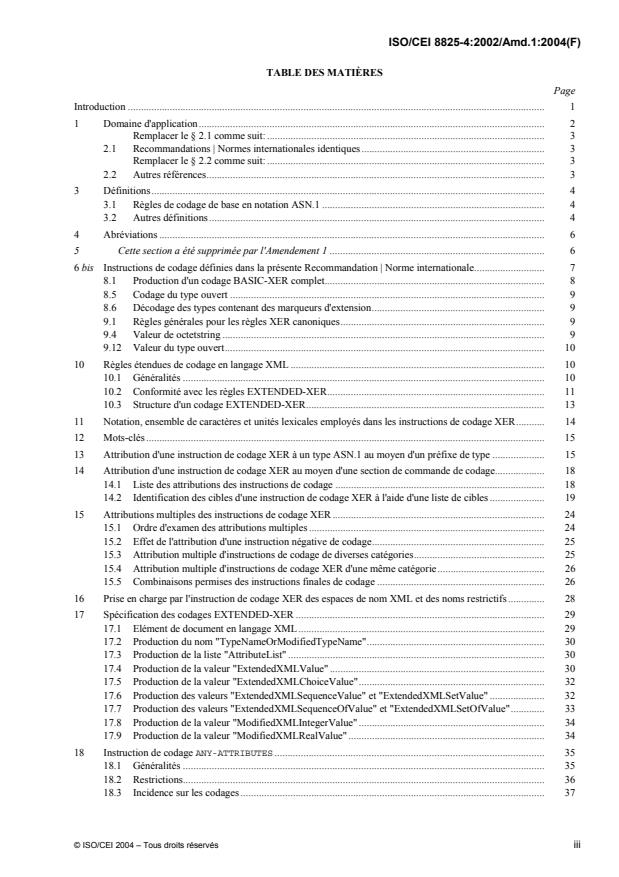
TABLE DES MATIÈRES
Page
Introduction . 1
1 Domaine d'application. 2
Remplacer le § 2.1 comme suit: . 3
2.1 Recommandations | Normes internationales identiques. 3
Remplacer le § 2.2 comme suit: . 3
2.2 Autres références. 3
3 Définitions. 4
3.1 Règles de codage de base en notation ASN.1 . 4
3.2 Autres définitions. 4
4 Abréviations . 6
5 Cette section a été supprimée par l'Amendement 1. 6
6 bis Instructions de codage définies dans la présente Recommandation | Norme internationale. 7
8.1 Production d'un codage BASIC-XER complet. 8
8.5 Codage du type ouvert . 9
8.6 Décodage des types contenant des marqueurs d'extension. 9
9.1 Règles générales pour les règles XER canoniques. 9
9.4 Valeur de octetstring . 9
9.12 Valeur du type ouvert. 10
10 Règles étendues de codage en langage XML . 10
10.1 Généralités . 10
10.2 Conformité avec les règles EXTENDED-XER. 11
10.3 Structure d'un codage EXTENDED-XER. 13
11 Notation, ensemble de caractères et unités lexicales employés dans les instructions de codage XER. 14
12 Mots-clés . 15
13 Attribution d'une instruction de codage XER à un type ASN.1 au moyen d'un préfixe de type . 15
14 Attribution d'une instruction de codage XER au moyen d'une section de commande de codage. 18
14.1 Liste des attributions des instructions de codage . 18
14.2 Identification des cibles d'une instruction de codage XER à l'aide d'une liste de cibles . 19
15 Attributions multiples des instructions de codage XER . 24
15.1 Ordre d'examen des attributions multiples . 24
15.2 Effet de l'attribution d'une instruction négative de codage. 25
15.3 Attribution multiple d'instructions de codage de diverses catégories. 25
15.4 Attribution multiple d'instructions de codage XER d'une même catégorie. 26
15.5 Combinaisons permises des instructions finales de codage . 26
16 Prise en charge par l'instruction de codage XER des espaces de nom XML et des noms restrictifs . 28
17 Spécification des codages EXTENDED-XER . 29
17.1 Elément de document en langage XML. 29
17.2 Production du nom "TypeNameOrModifiedTypeName". 30
17.3 Production de la liste "AttributeList" . 30
17.4 Production de la valeur "ExtendedXMLValue" . 30
17.5 Production de la valeur "ExtendedXMLChoiceValue". 32
17.6 Production des valeurs "ExtendedXMLSequenceValue" et "ExtendedXMLSetValue" . 32
17.7 Production des valeurs "ExtendedXMLSequenceOfValue" et "ExtendedXMLSetOfValue". 33
17.8 Production de la valeur "ModifiedXMLIntegerValue" . 34
17.9 Production de la valeur "ModifiedXMLRealValue". 34
18 Instruction de codage ANY-ATTRIBUTES. 35
18.1 Généralités . 35
18.2 Restrictions. 36
18.3 Incidence sur les codages . 37
© ISO/CEI 2004 – Tous droits réservés iii
ISO/CEI 8825-4:2002/Amd.1:2004(F)
Page
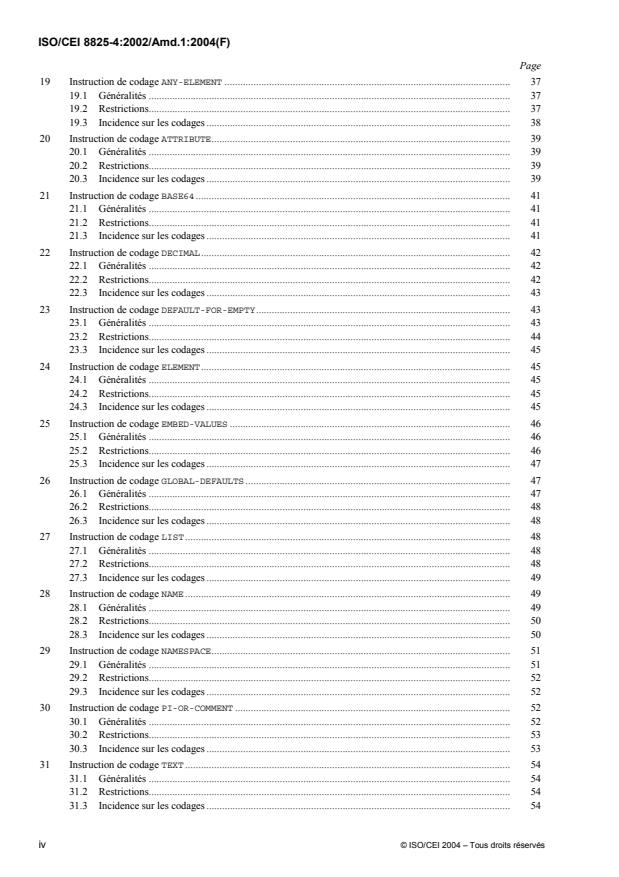
19 Instruction de codage ANY-ELEMENT. 37
19.1 Généralités . 37
19.2 Restrictions. 37
19.3 Incidence sur les codages . 38
20 Instruction de codage ATTRIBUTE. 39
20.1 Généralités . 39
20.2 Restrictions. 39
20.3 Incidence sur les codages . 39
21 Instruction de codage BASE64. 41
21.1 Généralités . 41
21.2 Restrictions. 41
21.3 Incidence sur les codages . 41
22 Instruction de codage DECIMAL. 42
22.1 Généralités . 42
22.2 Restrictions. 42
22.3 Incidence sur les codages . 43
23 Instruction de codage DEFAULT-FOR-EMPTY. 43
23.1 Généralités . 43
23.2 Restrictions. 44
23.3 Incidence sur les codages . 45
24 Instruction de codage ELEMENT. 45
24.1 Généralités . 45
24.2 Restrictions. 45
24.3 Incidence sur les codages . 45
25 Instruction de codage EMBED-VALUES. 46
25.1 Généralités . 46
25.2 Restrictions. 46
25.3 Incidence sur les codages . 47
26 Instruction de codage GLOBAL-DEFAULTS. 47
26.1 Généralités . 47
26.2 Restrictions. 48
26.3 Incidence sur les codages . 48
27 Instruction de codage LIST. 48
27.1 Généralités . 48
27.2 Restrictions. 48
27.3 Incidence sur les codages . 49
28 Instruction de codage NAME. 49
28.1 Généralités . 49
28.2 Restrictions. 50
28.3 Incidence sur les codages . 50
29 Instruction de codage NAMESPACE. 51
29.1 Généralités . 51
29.2 Restrictions. 52
29.3 Incidence sur les codages . 52
30 Instruction de codage PI-OR-COMMENT. 52
30.1 Généralités . 52
30.2 Restrictions. 53
30.3 Incidence sur les codages . 53
31 Instruction de codage TEXT. 54
31.1 Généralités . 54
31.2 Restrictions. 54
31.3 Incidence sur les codages . 54
iv © ISO/CEI 2004 – Tous droits réservés
ISO/CEI 8825-4:2002/Amd.1:2004(F)
Page
32 Instruction de codage UNTAGGED. 55
32.1 Généralités . 55
32.2 Restrictions. 56
32.3 Incidence sur les codages . 56
33 Instruction de codage USE-NIL. 57
33.1 Généralités . 57
33.2 Restrictions. 57
33.3 Incidence sur les codages . 58
34 Instruction de codage USE-NUMBER. 58
34.1 Généralités . 58
34.2 Restrictions. 58
34.3 Incidence sur les codages . 58
35 Instruction de codage USE-ORDER. 59
35.1 Généralités . 59
35.2 Restrictions. 59
35.3 Incidence sur les codages . 60
36 Instruction de codage USE-QNAME. 60
36.1 Généralités . 60
36.2 Restrictions. 61
36.3 Incidence sur les codages . 61
37 Instruction de codage USE-TYPE. 61
37.1 Généralités . 61
37.2 Restrictions. 61
37.3 Incidence sur les codages . 62
38 Instruction de codage USE-UNION. 62
38.1 Généralités . 62
38.2 Restrictions. 63
38.3 Incidence sur les codages . 63
39 Instruction de codage WHITESPACE. 64
39.1 Généralités . 64
39.2 Restrictions. 64
39.3 Incidence sur les codages . 65
40 Valeurs des identificateurs d'objet faisant référence aux règles de codage . 65
Annexe A – Exemples de codage selon les règles en langage de balisage extensible
de base et canoniques. 66
A.1 Description en notation ASN.1 de la structure d'un dossier. 66
A.2 Description en notation ASN.1 de la valeur d'un dossier. 66
A.3 Représentation de cette valeur de dossier en langage XML de base. 66
A.4 Représentation de cette valeur de dossier en langage XML canonique . 67
Ajouter la nouvelle Annexe B comme suit: . 67
Annexe B – Contenu partiel en langage de balisage extensible et codage déterministe. 67
B.1 Contenu partiel en langage XML . 67
B.2 Restrictions recommandées en ce qui concerne les codages produisant des contenus partiels
d'élément en langage XML . 68
Annexe C – Exemples de codage selon les règles étendues en langage de balisage extensible
employant des instructions de codage. 70
C.1 Introduction. 70
C.2 Exemples simples. 71
C.2.1 Carte de base-ball. 71
C.2.2 Employé . 71
© ISO/CEI 2004 – Tous droits réservés v
ISO/CEI 8825-4:2002/Amd.1:2004(F)
Page
C.3 Exemples plus complexes . 72
C.3.1 Emploi du regroupement de deux types simples. 72
C.3.2 Emploi d'un attribut d'identification de type . 72
C.3.3 Emploi de valeurs d'énumération . 72
C.3.4 Emploi d'un codage blanc pour une valeur par défaut . 72
C.3.5 Emploi de valeurs imbriquées pour la notification d'un paiement dû . 72
vi © ISO/CEI 2004 – Tous droits réservés
ISO/CEI 8825-4:2002/Amd.1:2004(F)
Avant-propos
L'ISO (Organisation internationale de normalisation) et la CEI (Commission électrotechnique internationale)
forment le système spécialisé de la normalisation mondiale. Les organismes nationaux membres de l'ISO ou
de la CEI participent au développement de Normes internationales par l'intermédiaire des comités techniques
créés par l'organisation concernée afin de s'occuper des domaines particuliers de l'activité technique. Les
comités techniques de l'ISO et de la CEI collaborent dans des domaines d'intérêt commun. D'autres
organisations internationales, gouvernementales et non gouvernementales, en liaison avec l'ISO et la CEI
participent également aux travaux. Dans le domaine des technologies de l'information, l'ISO et la CEI ont créé
un comité technique mixte, l'ISO/CEI JTC 1.
Les Normes internationales sont rédigées conformément aux règles données dans les Directives ISO/CEI,
Partie 2.
La tâche principale du comité technique mixte est d'élaborer les Normes internationales. Les projets de
Normes internationales adoptés par le comité technique mixte sont soumis aux organismes nationaux pour
vote. Leur publication comme Normes internationales requiert l'approbation de 75 % au moins des
organismes nationaux votants.
L'attention est appelée sur le fait que certains des éléments du présent document peuvent faire l'objet de
droits de propriété intellectuelle ou de droits analogues. L'ISO et la CEI ne sauraient être tenues pour
responsables de ne pas avoir identifié de tels droits de propriété et averti de leur existence.
L'Amendement 1 à l’ISO/CEI 8825-4:2002 a été élaboré par le comité technique mixte ISO/CEI JTC 1,
Technologies de l'information, sous-comité SC 6, Téléinformatique, en collaboration avec l'UIT-T. Le texte
identique est publié en tant qu’Amendement 1 à la Rec. UIT-T X.693.
© ISO/CEI 2004 – Tous droits réservés vii
ISO/CEI 8825-4:2002/Amd.1:2004 (F)
NORME INTERNATIONALE
RECOMMANDATION UIT-T
Technologies de l'information – Règles de codage ASN.1: Règles de codage XML (XER)
Amendement 1
Instructions de codage XER et règles de codage XML étendues (EXTENDED-XER)
NOTE – Dans le présent amendement, tout texte nouveau ou modifié a été souligné dans les paragraphes à modifier. Lors de
l'incorporation de ce texte dans la Recommandation de base, il convient de supprimer ce soulignement.
Remplacer l'introduction par ce qui suit:
Introduction
Dans l'ensemble des Recommandations UIT-T X.680 | ISO/CEI 8824-1, UIT-T X.681 | ISO/CEI 8824-2, UIT-T X.682 |
ISO/CEI 8824-3 et UIT-T X.683 | ISO/CEI 8824-4 est décrite la notation de syntaxe abstraite numéro un (ASN.1,
abstract syntax notation one), qui permet de définir les messages échangés par des applications homologues.
Dans la présente Recommandation | Norme internationale sont définies les règles de codage, qui pourront être
appliquées à des valeurs de types en notation ASN.1, déterminés au moyen de la notation spécifiée dans les
Recommandations | Normes internationales susmentionnées. L'application de ces règles de codage produit une syntaxe
de transfert pour ces valeurs. Il est implicitement entendu, lors de la spécification de ces règles de codage, que celles-ci
pourront aussi servir au décodage.
Plusieurs ensembles de règles de codage peuvent être appliqués à des valeurs de types en notation ASN.1. Dans la
présente Recommandation | Norme internationale sont définis trois ensembles de règles de codage utilisant le langage
de balisage extensible (XML, extensible markup language). Ces règles de codage produisent toutes un document en
langage XML, conforme à la version XML 1.0 du Consortium W3C. Le premier ensemble consiste en les règles de
codage en langage XML (XER, XML encoding rule) de base (BASIC-XER, basic XML encoding rules), le deuxième
ensemble englobe les règles canoniques de codage en langage XML (CANONICAL-XER ou CXER, canonical XML
encoding rules), celles-ci ne permettant de coder une valeur en notation ASN.1 que d'une seule manière (les règles
canoniques de codage sont généralement employées pour des applications où interviennent des fonctions liées à la
sécurité telles que les signatures numériques), tandis que le troisième ensemble regroupe les règles de codage en
langage XML étendues (EXTENDED-XER, extended XML encoding rules). Ces dernières permettent de disposer de
plus d'options pour les codeurs, et de tenir compte des instructions de codage qui spécifient les variantes des codages
selon les règles BASIC-XER, de manière à prendre en charge les styles particuliers d'un document en langage XML
(voir ci-après). Les règles étendues de codage en langage XML ne sont pas canoniques, et il n'en est pas donné de forme
canonique dans la présente Recommandation | Norme internationale.
De nombreux aspects de la représentation des données en langage XML (tels que l'emploi des attributs en langage XML
au lieu des éléments descendants, ou l'emploi de listes délimitées par des blancs) sont une question de style et de choix
du concepteur en langage XML. Lorsqu'un type défini dans une spécification en notation ASN.1 est codé selon les
règles BASIC-XER ou CXER, la représentation en langage XML ne permet d'employer qu'un style déterminé, sans
intervention possible de l'utilisateur en ce qui concerne la stylistique. Dans la présente Recommandation UIT-T | Norme
internationale sont spécifiées la syntaxe et la sémantique des instructions de codage selon les règles XER, qui
définissent la stylistique du langage XML dans un codage selon les règles EXTENDED-XER. Il n'est pas tenu compte
de ces instructions de codage selon les règles XER dans les règles BASIC-XER ou CXER, mais uniquement dans les
règles EXTENDED-XER.
NOTE − La "stylistique", telle que l'emploi des attributs ou de listes délimitées par des blancs, peut aussi avoir une incidence sur
la dimension d'un codage et sur sa facilité de traitement, de sorte que l'emploi de ces caractéristiques n'est pas simplement une
question de style. Lorsque ces questions sont importantes, on peut vouloir préférer pour les instructions de codage les règles
EXTENDED-XER aux règles BASIC-XER ou CXER.
Rec. UIT-T X.693(2001)/Amd.1 (10/2003) 1
ISO/CEI 8825-4:2002/Amd.1:2004 (F)
Le § 8 définit le codage des types en notation ASN.1 selon les règles BASIC-XER.
Le § 9 définit le codage des types en notation ASN.1 selon les règles CXER.
Le § 10 spécifie le codage des types en notation ASN.1 selon les règles EXTENDED-XER, se référant à des
paragraphes ultérieurs où sont définies les instructions de codage XER.
Dans les § 11 à 14 sont énumérées et classées les instructions de codage selon les règles XER, et est indiquée la syntaxe
permettant de les attribuer à un type ou à une composante en notation ASN.1 au moyen soit d'un préfixe de type
conforme aux règles XER (voir la Rec. UIT-T X.680 | ISO/CEI 8824-1, § 30.3) soit d'une section de commande de
codage selon les règles XER (voir la Rec. UIT-T X.680 | ISO/CEI 8824-1, § 50).
Le § 15 définit l'ordre de préséance lorsque les instructions de codage selon les règles XER sont présentes tant dans un
préfixe de type conforme aux règles XER que dans une section de commande de codage selon les règles XER.
Le § 16 décrit la prise en charge de l'instruction de codage selon les règles XER pour les espaces de noms en langage
XML lors de l'emploi des règles EXTENDED-XER.
Le § 17 spécifie les codages selon les règles EXTENDED-XER.
Dans les § 18 à 39 sont définies:
a) la syntaxe pour chacune des instructions de codage selon les règles XER, qui sont employées dans un
préfixe de type ou dans une section de commande de codage;
b) les restrictions concernant les instructions de codage selon les règles XER, qui peuvent être associées à
un type particulier en notation ASN.1 (résultant de l'héritage ou des attributions multiples);
c) les modifications à apporter aux règles de codage XER, qui sont requises dans un codage selon les règles
EXTENDED-XER lorsqu'une instruction de codage selon les règles XER est appliquée.
A l'Annexe A sont donnés, à titre informatif, des exemples des codages selon les règles BASIC-XER et CXER.
A l'Annexe B est donnée, à titre informatif, une description du contenu partiel en langage XML, qui est produit lorsque
les étiquettes entourant des entités telles qu'une séquence ou une sequence-of sont enlevées, et que sont appliquées des
restrictions sur les spécifications qui permettent une détermination facile de la composante en notation ASN.1 à laquelle
un élément du langage XML est associé.
A l'Annexe C sont donnés, à titre informatif, des exemples d'instructions de codage selon les règles XER et les codages
selon les règles EXTENDED-XER correspondants.
Remplacer le § 1 par le suivant:
1 Domaine d'application
Dans la présente Recommandation | Norme internationale est défini un ensemble de règles de codage en langage XML
de base (BASIC-XER), qui peuvent être utilisées pour élaborer une syntaxe de transfert applicable à des valeurs de
types définis dans les Recommandations UIT-T X.680 | ISO/CEI 8824-1 et UIT-T X.681 | ISO/CEI 8824-2. Y est aussi
défini un ensemble de règles canoniques de codage en langage XML (CXER), qui impose des contraintes aux règles de
codage en langage XML de base de manière à produire un codage unique pour toute valeur donnée en notation ASN.1.
Finalement, y est aussi spécifié un ensemble de règles étendues de codage en langage XML (EXTENDED-XER), qui
offre aux codeurs d'autres options et permet aussi au responsable de la formulation en notation ASN.1 de modifier le
codage par rapport à celui qui serait produit par le codage selon les règles BASIC-XER. Il est implicitement entendu,
lors de la spécification de ces règles de codage, que celles-ci pourront aussi servir au décodage.
Les règles de codage définies dans la présente Recommandation | Norme internationale:
– sont utilisées au moment de la communication;
– sont destinées à être employées dans des circonstances où l'affichage de valeurs ou leur traitement au
moyen d'outils du langage XML courants (tels que des navigateurs) sont les principales considérations
dans le choix des règles de codage;
– permettent l'extension d'une syntaxe abstraite au moyen de l'adjonction de valeurs supplémentaires pour
toutes les formes d'extension décrites dans la Rec. UIT-T X.680 | ISO/CEI 8824-1.
Dans la présente Recommandation | Norme internationale sont également spécifiées la syntaxe et la sémantique des
instructions de codage selon les règles XER, ainsi que les règles de leur attribution et de leur combinaison. Les
instructions de codage selon les règles XER peuvent être employées pour commander le codage selon les règles
EXTENDED-XER pour des types particuliers en notation ASN.1.
2 Rec. UIT-T X.693 (2001)/Amd.1 (10/2003)
ISO/CEI 8825-4:2002/Amd.1:2004 (F)
Remplacer le § 2.1 comme suit:
2.1 Recommandations | Normes internationales identiques
– Recommandation UIT-T X.680 (2002) | ISO/CEI 8824-1:2002, Technologies de l'information – Notation
de syntaxe abstraite numéro un: spécification de la notation de base.
− Recommandation UIT-T X.680 (2002)/Amd.1 (2003) | ISO/CEI 8824-1:2002/Amd.1:2003, Technologies
de l'information – Notation de syntaxe abstraite numéro un: spécification de la notation de base –
Amendement 1: prise en charge des règles de codage XML étendues (EXTENDED-XER).
– Recommandation UIT-T X.681 (2002) | ISO/CEI 8824-2:2002, Technologies de l'information – Notation
de syntaxe abstraite numéro un: spécification des objets informationnels.
– Recommandation UIT-T X.681 (2002)/Amd.1 (2003) | ISO/CEI 8824-2:2002/Amd.1:2003, Technologies
de l'information – Notation de syntaxe abstraite numéro un: spécification des objets informationnels –
Amendement 1: prise en charge des règles de codage XML étendues (EXTENDED-XER).
– Recommandation UIT-T X.682 (2002) | ISO/CEI 8824-3:2002, Technologies de l'information – Notation
de syntaxe abstraite numéro un: spécification des contraintes.
– Recommandation UIT-T X.683 (2002) | ISO/CEI 8824-4:2002, Technologies de l'information – Notation
de syntaxe abstraite numéro un: paramétrage des spécifications de la notation de syntaxe abstraite
numéro un.
– Recommandation UIT-T X.690 (2002) | ISO/CEI 8825-1:2002, Technologies de l'information – Règles
de codage ASN.1: spécification des règles de codage de base, des règles de codage canoniques et des
règles de codage distinctives.
– Recommandation UIT-T X.690 (2002)/Amd.1 (2003) | ISO/CEI 8825-1:2002/Amd.1:2003, Technologies
de l'information – Règles de codage ASN.1: spécification des règles de codage de base, des règles de
codage canoniques et des règles de codage distinctives – Amendement 1: prise en charge des règles de
codage XML étendues (EXTENDED-XER).
– Recommandation UIT-T X.691 (2002) | ISO/CEI 8825-2:2002, Technologies de l'information – Règles
de codage ASN.1: spécification des règles de codage compact.
– Recommandation UIT-T X.691 (2002)/Amd.1 (2003) | ISO/CEI 8825-2:2002/Amd.1:2003, Technologies
de l'information – Règles de codage ASN.1: spécification des règles de codage compact –
Amendement 1: prise en charge des règles de codage XML étendues (EXTENDED-XER).
– Recommandation UIT-T X.692 (2002) | ISO/CEI 8825-3:2002, Technologies de l'information – Règles
de codage ASN.1: spécification de la notation de contrôle de codage (ECN).
Remplacer le § 2.2 comme suit:
2.2 Autres références
– IETF RFC 2045 (1996), Multipurpose Internet Mail Extensions (MIME) Part One: Format of Internet
Message Bodies.
– IETF RFC 2141 (1997), URN Syntax.
– IETF RFC 2396 (1998), Uniform Resource Identifiers (URI): Generic Syntax.
– IETF RFC 3061 (2001), A URN Namespace of Object Identifiers.
– ISO/CEI 10646-1:2000, Technologies de l'information – Jeu universel de caractères codés à plusieurs
octets – Partie 1: Architecture et table multilingue.
– The Unicode Standard, Version 3.2.0, The Unicode Consortium. (Reading, MA, Addison-Wesley)
NOTE – Les caractères graphiques (et leur codage) définis dans la référence susmentionnée sont identiques à ceux
qui sont spécifiés dans la norme ISO/CEI 10646-1, mais la référence ci-dessus a été incluse parce qu'elle définissait
aussi les noms des caractères de commande.
– W3C XML 1.0:2000, Extensible Markup Language (XML) 1.0 (deuxième édition), Recommandation du
Consortium W3C, Copyright © [6 octobre 2000] World Wide Web Consortium, (Massachusetts Institute
of Technology, Institut National de Recherche en Informatique et en Automatique, Keio University),
http://www.w3.org/TR/2000/REC-xml-20001006.
Rec. UIT-T X.693(2001)/Amd.1 (10/2003) 3
ISO/CEI 8825-4:2002/Amd.1:2004 (F)
− W3C XML Namespaces:1999, Namespaces in XML, Recommandation du Consortium W3C, Copyright
© [14 janvier 1999] World Wide Web Consortium, (Massachusetts Institute of Technology, Institut
National de Recherche en Informatique et en Automatique, Keio University),
http://www.w3.org/TR/1999/REC-xml-names-19990114.
NOTE − La référence à un document dans la présente Recommandation | Norme internationale ne donne pas à ce
document en tant que tel le statut d'une Recommandation ou Norme internationale.
Remplacer le § 3 comme suit:
3 Définitions
Aux fins de la présente Recommandation | Norme internationale, les définitions de la Rec. UIT-T X.680 |
ISO/CEI 8824-1, ainsi que les définitions suivantes s'appliquent.
3.1 Règles de codage de base en notation ASN.1
La présente Recommandation | Norme internationale utilise les termes suivants définis dans la Rec. UIT-T X.690 |
ISO/CEI 8825-1:
a) valeur de donnée;
b) conformité dynamique;
c) codage (d'une valeur de donnée);
d) destinataire;
e) expéditeur;
f) conformité statique.
3.2 Autres définitions
Pour les besoins de la présente Recommandation | Norme internationale, les définitions suivantes s'appliquent.
3.2.1 schéma en notation ASN.1: définition du contenu et de la structure des données, utilisant une définition de
type en notation ASN.1.
NOTE – Cela permet aux règles de codage de produire des codages binaires des valeurs d'un type en notation ASN.1 ou des
codages utilisant le langage XML.
Ajouter les 4 nouveaux § 3.2.1 bis, 3.2.1 ter, 3.2.1 quat et 3.2.1 quin comme suit:
3.2.1 bis étiquette associée d'élément vide: étiquette d'élément vide en langage XML, qui peut remplacer, lorsqu'elles
sont présentes, une étiquette associée précédente et une étiquette associée suivante.
3.2.1 ter instruction associée de codage (pour un type): ensemble d'instructions de codage selon les règles XER,
associées à un type.
3.2.1 quat étiquette associée suivante: étiquette de fin en langage XML, qui suit la valeur "XMLValue" d'un type
en l'absence d'instructions de codage permettant d'enlever les étiquettes associées.
3.2.1 quin étiquette associée précédente: étiquette de début en langage XML, qui précède la valeur "XMLValue"
d'un type en l'absence d'instructions de codage permettant d'enlever les étiquettes associées.
Ajouter les 16 nouveaux § 3.2.2 bis à 3.2.2 septdec comme suit:
3.2.2 bis document canonique valable en langage XML (pour un schéma en notation ASN.1): document en
langage XML bien formé (voir la version XML 1.0 du Consortium W3C), dont le contenu est conforme à la
spécification des règles CXER pour le codage d'un type en notation ASN.1, défini par un schéma en notation ASN.1.
3.2.2 ter type susceptible d'être codé au moyen de caractères: type en notation ASN.1, auquel une instruction de
codage ATTRIBUTE peut être appliquée (voir le § 20.2.1).
3.2.2 quat espace de nom de commande: espace de nom employé pour identifier les attributs qui assurent les
fonctions ou permettent d'acheminer les valeurs commandant le codage selon les règles EXTENDED-XER.
NOTE 1 – L'attribut d'identification du type en est un exemple. L'espace de nom de commande est par défaut celui en notation
ASN.1, qui est spécifié dans le § 16.9, mais peut être modifié par l'instruction de codage GLOBAL-DEFAULTS.
NOTE 2 – L'espace de nom de commande peut aussi contenir les noms des attributs qui peuvent être présents, mais dont les
décodeurs selon les règles EXTENDED-XER ne tiennent pas compte (voir le § 10.2.10). Un tel nom d'attribut est par exemple
schemaLocation.
4 Rec. UIT-T X.693 (2001)/Amd.1 (10/2003)
ISO/CEI 8825-4:2002/Amd.1:2004 (F)
3.2.2 quin type (en notation ASN.1) contenu: type en notation ASN.1 dont la valeur "XMLValue" dans un codage
selon les règles BASIC-XER est contenue directement dans la valeur "XMLValue" d'un type en notation ASN.1 (le
type contenant).
NOTE
...
Questions, Comments and Discussion
Ask us and Technical Secretary will try to provide an answer. You can facilitate discussion about the standard in here.
Loading comments...