

ISO/IEC 21992:2003
(Main)Information technology — Telecommunications and information exchange between systems — Private Integrated Services Network — Mapping functions for the tunnelling of QSIG through IP networks
General Information
- Abstract
ISO/IEC 21992:2003(E) specifies functions for using a packet network that uses the Internet Protocol (IP) as its network layer protocol and UDP and TCP as its transport layer protocols, to interconnect two Private Integrated services Network eXchanges (PINXs) forming part of a Private Integrated Services Network (PISN). Interconnection is achieved by carrying the inter-PINX signalling protocol directly over the Transmission Control Protocol (TCP) and inter-PINX user information (e.g. voice) over the Real-time Transport Protocol (RTP), RTP being carried over the User Datagram Protocol (UDP). The inter-PINX signalling protocol is assumed to be QSIG, as specified in ISO/IEC 11572, ISO/IEC 11582 and other International Standards. ISO/IEC 21992:2003(E) provides for two types of interconnection: on-demand, where a separate TCP connection for QSIG is established at the start of each call and cleared down at the end of that call; and semi-permanent, where a single TCP connection with an indefinite lifetime carries QSIG on behalf of many single calls. ISO/IEC 21992:2003(E) is applicable to PINXs that can be interconnected to form a PISN using QSIG as the inter-PINX signalling protocol.
- Status
- Published
- Publication Date
- 16-Jun-2003
- Current Stage
- 9093 - International Standard confirmed
- Start Date
- 14-Jan-2025
- Completion Date
- 29-Aug-2026
Buy Documents


ISO/IEC 21992:2003 - Information technology — Telecommunications and information exchange between systems — Private Integrated Services Network — Mapping functions for the tunnelling of QSIG through IP networks Released:6/17/2003
Overview
ISO/IEC 21992:2003 - "Information technology - Telecommunications and information exchange between systems - Private Integrated Services Network - Mapping functions for the tunnelling of QSIG through IP networks" defines how to tunnel QSIG-based inter-PINX signalling and user information over IP networks. The standard maps QSIG D-channels (signalling) onto TCP and U-channels (user/voice) onto RTP over UDP, enabling Private Integrated services Network eXchanges (PINXs) to interconnect across an IP-based Intervening Network (IVN) to form a PISN.
Key topics & requirements
- Transport mapping: carry inter-PINX signalling (QSIG) directly over TCP; carry inter-PINX user information (for example voice) over RTP/UDP.
- Channel model: distinguishes D-channel (QSIG signalling) and U-channel (user bearer) and specifies mapping to IP-layer IPCs.
- Connection modes:
- On-demand: a TCP connection for QSIG is established per call and cleared after the call.
- Semi-permanent: a single long-lived TCP connection carries QSIG for multiple calls; per-call UDP/RTP streams are created for U-channels.
- Resource Control Information (RCI): exchanged over the TCP connection to establish and manage UDP/RTP streams; message syntax for RCI is provided (see Annex B).
- QPKT: a packet format defined in the standard to convey QSIG messages and RCI over the IP transport.
- Conformance: implementations declare capabilities using the Implementation Conformance Statement (ICS) proforma in Annex A.
Practical applications & users
This standard is intended for organizations and professionals who need to interconnect legacy and enterprise telephony systems over IP while preserving QSIG signaling semantics:
- PBX and PINX vendors implementing QSIG tunnelling over IP
- Network architects planning PISN interconnections across IP networks
- Telecom integrators performing migration from circuit-switched IPLs to IP-based transport
- Interoperability and test labs validating QSIG over TCP/RTP behavior
- Enterprises seeking to preserve ISDN/QSIG supplementary services across an IP backbone
Benefits include leveraging IP infrastructures for cost-efficient inter-PINX links while retaining QSIG feature transparency.
Related standards
Relevant references include:
- ISO/IEC 11572, 11582, 11579-1 (QSIG and PINX reference configuration)
- ISO/IEC 11574 (bearer services)
- IETF RFCs for IP, TCP, UDP, RTP (RFC 760, 761, 768, 1889) These documents complement ISO/IEC 21992 for full implementation and interoperability planning.
Keywords: ISO/IEC 21992:2003, QSIG tunnelling, PINX, PISN, TCP, RTP, UDP, QPKT, Resource Control Information, inter-PINX connection.
Buy Documents
ISO/IEC 21992:2003 - Information technology — Telecommunications and information exchange between systems — Private Integrated Services Network — Mapping functions for the tunnelling of QSIG through IP networks Released:6/17/2003
Get Certified
Connect with accredited certification bodies for this standard

ANCE
Mexican certification and testing association.

Intertek Slovenia
Intertek testing, inspection, and certification services in Slovenia.

LNE (Laboratoire National de Métrologie et d'Essais)
French national laboratory for metrology and testing.
Sponsored listings
Frequently Asked Questions
ISO/IEC 21992:2003 is a standard published by the International Organization for Standardization (ISO). Its full title is "Information technology — Telecommunications and information exchange between systems — Private Integrated Services Network — Mapping functions for the tunnelling of QSIG through IP networks". This standard covers: ISO/IEC 21992:2003(E) specifies functions for using a packet network that uses the Internet Protocol (IP) as its network layer protocol and UDP and TCP as its transport layer protocols, to interconnect two Private Integrated services Network eXchanges (PINXs) forming part of a Private Integrated Services Network (PISN). Interconnection is achieved by carrying the inter-PINX signalling protocol directly over the Transmission Control Protocol (TCP) and inter-PINX user information (e.g. voice) over the Real-time Transport Protocol (RTP), RTP being carried over the User Datagram Protocol (UDP). The inter-PINX signalling protocol is assumed to be QSIG, as specified in ISO/IEC 11572, ISO/IEC 11582 and other International Standards. ISO/IEC 21992:2003(E) provides for two types of interconnection: on-demand, where a separate TCP connection for QSIG is established at the start of each call and cleared down at the end of that call; and semi-permanent, where a single TCP connection with an indefinite lifetime carries QSIG on behalf of many single calls. ISO/IEC 21992:2003(E) is applicable to PINXs that can be interconnected to form a PISN using QSIG as the inter-PINX signalling protocol.
ISO/IEC 21992:2003(E) specifies functions for using a packet network that uses the Internet Protocol (IP) as its network layer protocol and UDP and TCP as its transport layer protocols, to interconnect two Private Integrated services Network eXchanges (PINXs) forming part of a Private Integrated Services Network (PISN). Interconnection is achieved by carrying the inter-PINX signalling protocol directly over the Transmission Control Protocol (TCP) and inter-PINX user information (e.g. voice) over the Real-time Transport Protocol (RTP), RTP being carried over the User Datagram Protocol (UDP). The inter-PINX signalling protocol is assumed to be QSIG, as specified in ISO/IEC 11572, ISO/IEC 11582 and other International Standards. ISO/IEC 21992:2003(E) provides for two types of interconnection: on-demand, where a separate TCP connection for QSIG is established at the start of each call and cleared down at the end of that call; and semi-permanent, where a single TCP connection with an indefinite lifetime carries QSIG on behalf of many single calls. ISO/IEC 21992:2003(E) is applicable to PINXs that can be interconnected to form a PISN using QSIG as the inter-PINX signalling protocol.
ISO/IEC 21992:2003 is classified under the following ICS (International Classification for Standards) categories: 33.040.35 - Telephone networks. The ICS classification helps identify the subject area and facilitates finding related standards.
ISO/IEC 21992:2003 is available in PDF format for immediate download after purchase. The document can be added to your cart and obtained through the secure checkout process. Digital delivery ensures instant access to the complete standard document.
Standards Content (Sample)
INTERNATIONAL ISO/IEC
STANDARD 21992
First edition
2003-06-01
Information technology —
Telecommunications and information
exchange between systems — Private
Integrated Services Network — Mapping
functions for the tunnelling of QSIG
through IP networks
Technologies de l'information — Télécommunications et échange
d'information entre systèmes — Réseau privé à intégration de
services — Tracé de fonctions pour le «tunnelling» de QSIG par des
réseaux IP
Reference number
©
ISO/IEC 2003
PDF disclaimer
This PDF file may contain embedded typefaces. In accordance with Adobe's licensing policy, this file may be printed or viewed but
shall not be edited unless the typefaces which are embedded are licensed to and installed on the computer performing the editing. In
downloading this file, parties accept therein the responsibility of not infringing Adobe's licensing policy. The ISO Central Secretariat
accepts no liability in this area.
Adobe is a trademark of Adobe Systems Incorporated.
Details of the software products used to create this PDF file can be found in the General Info relative to the file; the PDF-creation
parameters were optimized for printing. Every care has been taken to ensure that the file is suitable for use by ISO member bodies. In
the unlikely event that a problem relating to it is found, please inform the Central Secretariat at the address given below.
© ISO/IEC 2003
All rights reserved. Unless otherwise specified, no part of this publication may be reproduced or utilized in any form or by any means,
electronic or mechanical, including photocopying and microfilm, without permission in writing from either ISO at the address below or
ISO's member body in the country of the requester.
ISO copyright office
Case postale 56 • CH-1211 Geneva 20
Tel. + 41 22 749 01 11
Fax + 41 22 749 09 47
E-mail copyright@iso.org
Web www.iso.org
Published in Switzerland
ii © ISO/IEC 2003 — All rights reserved
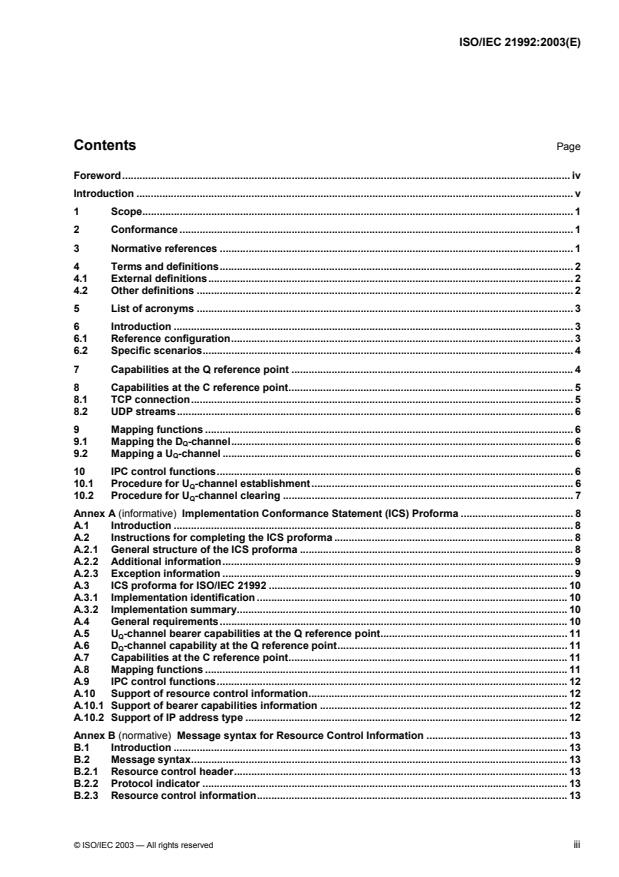
Contents Page
Foreword. iv
Introduction . v
1 Scope. 1
2 Conformance. 1
3 Normative references. 1
4 Terms and definitions. 2
4.1 External definitions. 2
4.2 Other definitions. 2
5 List of acronyms . 3
6 Introduction. 3
6.1 Reference configuration. 3
6.2 Specific scenarios. 4
7 Capabilities at the Q reference point . 4
8 Capabilities at the C reference point. 5
8.1 TCP connection. 5
8.2 UDP streams. 6
9 Mapping functions. 6
9.1 Mapping the D -channel. 6
Q
9.2 Mapping a U -channel . 6
Q
10 IPC control functions. 6
10.1 Procedure for U -channel establishment. 6
Q
10.2 Procedure for U -channel clearing . 7
Q
Annex A (informative) Implementation Conformance Statement (ICS) Proforma . 8
A.1 Introduction. 8
A.2 Instructions for completing the ICS proforma . 8
A.2.1 General structure of the ICS proforma . 8
A.2.2 Additional information. 9
A.2.3 Exception information. 9
A.3 ICS proforma for ISO/IEC 21992 . 10
A.3.1 Implementation identification. 10
A.3.2 Implementation summary. 10
A.4 General requirements. 10
A.5 U -channel bearer capabilities at the Q reference point. 11
Q
A.6 D -channel capability at the Q reference point. 11
Q
A.7 Capabilities at the C reference point. 11
A.8 Mapping functions. 11
A.9 IPC control functions. 12
A.10 Support of resource control information. 12
A.10.1 Support of bearer capabilities information . 12
A.10.2 Support of IP address type . 12
Annex B (normative) Message syntax for Resource Control Information . 13
B.1 Introduction. 13
B.2 Message syntax. 13
B.2.1 Resource control header. 13
B.2.2 Protocol indicator. 13
B.2.3 Resource control information. 13
© ISO/IEC 2003 — All rights reserved iii
Foreword
ISO (the International Organization for Standardization) and IEC (the International Electrotechnical
Commission) form the specialized system for worldwide standardization. National bodies that are members of
ISO or IEC participate in the development of International Standards through technical committees
established by the respective organization to deal with particular fields of technical activity. ISO and IEC
technical committees collaborate in fields of mutual interest. Other international organizations, governmental
and non-governmental, in liaison with ISO and IEC, also take part in the work. In the field of information
technology, ISO and IEC have established a joint technical committee, ISO/IEC JTC 1.
International Standards are drafted in accordance with the rules given in the ISO/IEC Directives, Part 2.
The main task of the joint technical committee is to prepare International Standards. Draft International
Standards adopted by the joint technical committee are circulated to national bodies for voting. Publication as
an International Standard requires approval by at least 75 % of the national bodies casting a vote.
Attention is drawn to the possibility that some of the elements of this document may be the subject of patent
rights. ISO and IEC shall not be held responsible for identifying any or all such patent rights.
ISO/IEC 21992 was prepared by ECMA (as ECMA-336) and was adopted, under a special “fast-track
procedure”, by Joint Technical Committee ISO/IEC JTC 1, Information technology, in parallel with its approval
by national bodies of ISO and IEC.
iv © ISO/IEC 2003 — All rights reserved
Introduction
This International Standard is one of a series of standards defining mapping functions in exchanges of Private
Integrated Services Networks required for the utilization of intervening network scenarios. The series uses the
ISDN concepts as developed by ITU-T (formerly CCITT) and is also within the framework of standards for
open systems interconnection as defined by ISO/IEC.
This International Standard is based upon the practical experience of ECMA member companies and the
results of their active and continuous participation in the work of ISO/IEC JTC 1, ITU-T, ETSI and other
international and national standardization bodies. It represents a pragmatic and widely based consensus.
© ISO/IEC 2003 — All rights reserved v
INTERNATIONAL STANDARD ISO/IEC 21992:2003(E)
Information technology — Telecommunications and information
exchange between systems — Private Integrated Services
Network — Mapping functions for the tunnelling of QSIG
through IP networks
1 Scope
This International Standard specifies functions for using a packet network that uses the Internet Protocol (IP)
as its network layer protocol and UDP and TCP as its transport layer protocols, to interconnect two Private
Integrated services Network eXchanges (PINXs) forming part of a Private Integrated Services Network (PISN).
Interconnection is achieved by carrying the inter-PINX signalling protocol directly over the Transmission
Control Protocol (TCP) and inter-PINX user information (e.g., voice) over the Real-time Transport Protocol
(RTP), RTP being carried over the User Datagram Protocol (UDP). The inter-PINX signalling protocol is
assumed to be QSIG, as specified in ISO/IEC 11572, ISO/IEC 11582 and other International Standards.
This International Standard provides for two types of interconnection:
on-demand, where a separate TCP connection for QSIG is established at the start of each call and
cleared down at the end of that call; and
semi-permanent, where a single TCP connection with an indefinite lifetime carries QSIG on behalf of
many single calls.
This International Standard is applicable to PINXs that can be interconnected to form a PISN using QSIG as
the inter-PINX signalling protocol.
2 Conformance
In order to conform to this International Standard, a PINX shall satisfy the requirements identified in the
Implementation Conformance Statement (ICS) proforma in Annex A.
3 Normative references
The following referenced documents are indispensable for the application of this document. For dated
references, only the edition cited applies. For undated references, the latest edition of the referenced
document (including any amendments) applies.
ISO/IEC 11572:2000, Information technology — Telecommunications and information exchange between
systems — Private Integrated Services Network — Circuit mode bearer services — Inter-exchange signalling
procedures and protocol
ISO/IEC 11574:2000, Information technology — Telecommunications and information exchange between
systems — Private Integrated Services Network — Circuit-mode 64 kbit/s bearer services — Service
description, functional capabilities and information flows
ISO/IEC 11579-1:1994, Information technology — Telecommunications and information exchange between
systems — Private integrated services network — Part 1: Reference configuration for PISN Exchanges (PINX)
ISO/IEC 11582:2002, Information technology — Telecommunications and information exchange between
systems — Private Integrated Services Network — Generic functional protocol for the support of
supplementary services — Inter-exchange signalling procedures and protocol
© ISO/IEC 2003 — All rights reserved 1
ITU-T Rec. I.112:1993, Vocabulary of terms for ISDNs
ITU-T Rec. I.210:1993, Principles of telecommunication services supported by an ISDN and the means to
describe them
IETF RFC 760, Internet Protocol
IETF RFC 761, Transmission Control Protocol
IETF RFC 768, User Datagram Protocol
IETF RFC 1889, RTP: A Transport Protocol for Real-Time Applications
IETF RFC 2126, ISO Transport Service on top of TCP (ITOT)
4 Terms and definitions
For the purposes of this document, the following terms and definitions apply.
4.1 External definitions
This International Standard uses the following terms defined in other documents:
IVN (ISO/IEC 11579-1)
PINX (ISO/IEC 11579-1)
PISN (ISO/IEC 11579-1)
Service (ITU-T Rec. I.112)
Signalling (ITU-T Rec. I.112)
4.2 Other definitions
4.2.1
Calling PINX
In the context of a call or call-independent signalling connection across an IPL, the PINX that transmits the
QSIG SETUP message.
4.2.2
Called PINX
In the context of a call or call-independent signalling connection across an IPL, the PINX that receives the
QSIG SETUP message.
4.2.3
Channel
A means of bi-directional transmission of user or signalling information between two points.
4.2.3.1
D -Channel
Q
A channel used to convey call control information between the Q reference points of two peer PINXs.
4.2.3.2
U -Channel
Q
A channel used to convey user information between the Q reference points of two peer PINXs.
2 © ISO/IEC 2003 — All rights reserved
4.2.4
Resource Control Information
Information exchanged between peer PINXs for the purpose of establishing UDP streams.
4.2.5
Inter-PINX Connection (IPC)
A connection provided by an IVN between two C reference points used to transport inter-PINX information
from the PISN control plane and/or the PISN user plane.
4.2.6
QPKT
A packet format defined within this International Standard for conveying QSIG message and RCI (Resource
Control Information).
5 List of acronyms
IP Internet Protocol
IPC Inter-PINX connection
IPL Inter-PINX Link
IVN InterVening Network
PINX Private Integrated services Network eXchange
PISN Private Integrated Services Network
QSIG Signalling information flows at the Q reference point
RCI Resource Control Information
RTCP Realtime Transport Control Protocol
RTP Realtime Transport Protocol
TCP Transmission Control Protocol
UDP User Datagram Protocol
6 Introduction
6.1 Reference configuration
ISO/IEC 11579-1 defines a reference configuration for a PINX. Logically the switching and call control
functions of a PINX communicate over an instance of the Q reference point with a peer PINX. This
communication is known as an Inter-PINX Link (IPL) and comprises a signalling channel, known as a D -
Q
channel, and one or more user information channels, each known as a U -channel; see Figure 1. One or
Q
more IPLs can be established between the same pair of PINXs.
PINX PINX
Q reference Q reference
point point
Switching
Switching
and Call
and Call
D -channel
Q
Control
Control
functions
functions
UQ-channel
UQ-channel
Inter-PINX link
Figure 1 — IPL concept
There are many ways of implementing an IPL. In general, the IPL uses services of another network, known as
an Intervening Network (IVN). A PINX interfaces to the IVN at the C reference point. The IVN provides
© ISO/IEC 2003 — All rights reserved 3
connections, known as Inter-PINX Connections (IPCs) between the C reference points of the peer PINXs.
Mapping functions within each PINX map the D -channel and the U -channels at the Q reference point onto
Q Q
one or more IPCs at the C reference point.
6.2 Specific scenarios
This International Standard specifies mapping functions for use when the IVN is an IP-based network that is
used to provide the following types of IPC:
a TCP connection for carrying signalling information and Resource Control Information; and
a pair of UDP streams, one stream in each direction, for carrying user information over RTP.
A single IPL requires a single TCP connection, for support of the D -channel, and one pair of UDP streams
Q
per U -channel. In addition to carrying the QSIG protocol, the TCP connection is also required to carry
Q
resource control information for establishing the UDP streams.
This International Standard supports two types of interconnection between peer PINXs:
On-demand, where a single TCP connection for QSIG and a pair of UDP streams for user information are
established at the start of each call and cleared down at the end of that call;
Semi-permanent, where a single TCP connection with an indefinite lifetime carries QSIG on behalf of
many calls.
In the semi-permanent case, the TCP connection can support zero, one or more than one call at the same
time. A pair of UDP streams for user information is established at the start of each call and cleared down at
the end of that call. Figure 2 illustrates these concepts.
PINX IVN (IP network) PINX
Q reference C reference C reference Q reference
point point point point
Switching Mapping Mapping Switching
and Call functions functions and Call
D -channel TCP connection D -channel
Q Q
Control Control
functions functions
U -channel Pair of UDP streams U -channel
Q Q
U -channel Pair of UDP streams U -channel
Q Q
Inter-PINX connections
Inter-PINX link
Figure 2 — IPC concept (Semi-permanent)
7 Capabilities at the Q reference point
For each instance of the Q reference point:
one signalling channel (D ) for carrying the inter-PINX Layer 3 signalling protocol, and
Q
zero, one or more user channels (U )
Q
shall be provided.
NOTE In the special case of an on-demand interconnection used only for a call independent signalling connection, no
U -channels are provided.
Q
4 © ISO/IEC 2003 — All rights reserved
---------------------- Pag
...