


ISO/IEC/IEEE FDIS 26512
(Main)Systems and software engineering — Requirements for acquirers and suppliers of information products and services
Systems and software engineering — Requirements for acquirers and suppliers of information products and services
This document supports the interest of system users in having consistent, complete, accurate, and usable information. It addresses both available approaches to standardization: a) process standards, which specify the way that information products are to be acquired and supplied; and b) information product standards, which specify the characteristics and functional requirements of the information. As defined in ISO/IEC/IEEE 12207 and ISO/IEC/IEEE 15288:2015, the acquisition and supply activities make up the agreement processes of the software or system life cycle. Acquisition and supply of information for users and related services are specializations of those processes. Such services can be acquired and supplied for any part of the information management process, such as the following: - information management; - information design and development; - information editing and review coordination; - information testing, particularly usability testing; - information production and packaging; - information distribution and delivery; - advice on the selection and implementation of information development tools and supporting systems; and - information development process improvement. This document provides an overview of the information management processes that are relevant to the acquisition and supply of information for users. It applies the Agreement processes (acquisition and supply) to information for users, and addresses the preparation of requirements for this information. These requirements are central to the information for users specification and statement of work discussed in this document. This document also addresses requirements for primary document outputs of the acquisition and supply process: the request for proposal and the proposal for documentation products and services. This document is intended for use in acquiring or supplying any type of information for users and is independent of information development or management tools or methodologies. This document might be helpful for acquiring and supplying the following types of information, although it does not cover all aspects of them: - multimedia systems using animation, video, and sound; - computer-based training (CBT) packages and specialized course materials intended primarily for use in formal training programs; - maintenance documentation describing the internal operation of systems software; - collaboratively generated, often known as "wiki", documentation, which will usually need to be curated periodically; and - information for users incorporated into the user interface. This document is applicable to acquirers and suppliers of information for users, including a variety of specialists: - analysts (e.g., business analysts, human factors engineers) who identify the tasks that the intended users will perform with the system; - managers of the software or system development process or the information management process; - managers of the acquisition process, and those who authorize and approve acquisitions; and - managers and authors involved in proposal preparation. It can also be consulted by those with other roles and interests in the information development process: - information designers and architects who plan the structure, format, and content requirements of information products; - experienced authors and editors who develop the written content for information for users; - graphic designers with expertise in electronic media; - user interface designers and ergonomics experts working together to design the presentation of the information on the screen; - usability testers, information development reviewers, technical contacts; - developers of tools for creating on-screen information for users.
Ingénierie du logiciel et des systèmes — Exigences pour les acquéreurs et les fournisseurs de produits et de services d'information
General Information
- Status
- Not Published
- Technical Committee
- ISO/IEC JTC 1/SC 7 - Software and systems engineering
- Drafting Committee
- ISO/IEC JTC 1/SC 7/WG 2 - System software documentation
- Current Stage
- 5060 - Close of voting Proof returned by Secretariat
- Start Date
- 04-Feb-2026
- Completion Date
- 03-Feb-2026
Relations
- Effective Date
- 07-Jan-2025
Overview
ISO/IEC/IEEE FDIS 26512 specifies requirements for acquirers and suppliers of information products and services. The standard supports consistent, complete, accurate and usable information for system users and applies the acquisition and supply (agreement) processes defined in ISO/IEC/IEEE 12207 and 15288. It addresses both process-oriented and product-oriented approaches and is applicable to printed, on-screen and other media including multimedia, CBT, maintenance documentation, wiki-style content and embedded user-interface information.
This document is intended for managers, analysts, information designers, authors, usability testers and procurement specialists involved in preparing requirements, statements of work (SOW), requests for proposal (RFP) and supplier proposals.
Key Topics
- Acquisition & Supply Processes: Applies agreement processes to the information development life cycle and clarifies acquisition and supply activities.
- Requirements & Constraints: Defines aspects such as schedule, usability, localization, legal, safety, security and quality management requirements.
- Specification & SOW: Guidance for creating the information-for-users specification and the statement of work that drives procurement and delivery.
- Requests for Proposal (RFP) & Proposals: Topics and expected contents for RFPs and supplier proposals, including project objectives, deliverables, processes, capabilities, schedules and pricing.
- Usability & Testing: Emphasis on usability testing and review coordination as part of acceptance criteria for information products and services.
- Reuse & Single-Source: Recognizes managed reuse and single-source documentation practices without prescribing specific tools or CMS implementations.
Applications
This standard delivers practical value across procurement and delivery of information for users by:
- Helping acquirers define clear, testable requirements and acceptance criteria for information deliverables.
- Guiding suppliers in preparing proposals that demonstrate understanding of scope, processes, experience, resources and schedules.
- Improving user experience through explicit usability and localization requirements that reduce training and support costs.
- Enabling robust RFP and SOW documents that include confidentiality, IP, evaluation criteria and deliverable lists.
- Supporting diverse media: printed manuals, online help, on-screen guidance, multimedia and training materials.
Related Standards
- ISO/IEC/IEEE 12207 - Software life cycle processes (agreement processes reference).
- ISO/IEC/IEEE 15288 - System life cycle processes (information management integration).
- ISO/IEC/IEEE 26514 - Design and development of user information (related guidance).
- ISO/IEC/IEEE 26513 - Test methods and acceptance for user information.
- IEEE 3119-2025 - Procurement of automated systems (noted as related).
By following FDIS 26512, organizations can better align procurement, usability, localization and quality requirements for information products and services, resulting in clearer contracts, measurable acceptance criteria and improved end-user outcomes.

ISO/IEC/IEEE FDIS 26512 - Systems and software engineering — Requirements for acquirers and suppliers of information products and services Released:11/25/2025

REDLINE ISO/IEC/IEEE FDIS 26512 - Systems and software engineering — Requirements for acquirers and suppliers of information products and services Released:11/25/2025
Get Certified
Connect with accredited certification bodies for this standard

BSI Group
BSI (British Standards Institution) is the business standards company that helps organizations make excellence a habit.

BSCIC Certifications Pvt. Ltd.
Established 2006, accredited by NABCB, JAS-ANZ, EIAC, IAS. CDSCO Notified Body.

Intertek India Pvt. Ltd.
Delivers Assurance, Testing, Inspection & Certification since 1993 with 26 labs and 32 offices.
Sponsored listings
Frequently Asked Questions
ISO/IEC/IEEE FDIS 26512 is a draft published by the International Organization for Standardization (ISO). Its full title is "Systems and software engineering — Requirements for acquirers and suppliers of information products and services". This standard covers: This document supports the interest of system users in having consistent, complete, accurate, and usable information. It addresses both available approaches to standardization: a) process standards, which specify the way that information products are to be acquired and supplied; and b) information product standards, which specify the characteristics and functional requirements of the information. As defined in ISO/IEC/IEEE 12207 and ISO/IEC/IEEE 15288:2015, the acquisition and supply activities make up the agreement processes of the software or system life cycle. Acquisition and supply of information for users and related services are specializations of those processes. Such services can be acquired and supplied for any part of the information management process, such as the following: - information management; - information design and development; - information editing and review coordination; - information testing, particularly usability testing; - information production and packaging; - information distribution and delivery; - advice on the selection and implementation of information development tools and supporting systems; and - information development process improvement. This document provides an overview of the information management processes that are relevant to the acquisition and supply of information for users. It applies the Agreement processes (acquisition and supply) to information for users, and addresses the preparation of requirements for this information. These requirements are central to the information for users specification and statement of work discussed in this document. This document also addresses requirements for primary document outputs of the acquisition and supply process: the request for proposal and the proposal for documentation products and services. This document is intended for use in acquiring or supplying any type of information for users and is independent of information development or management tools or methodologies. This document might be helpful for acquiring and supplying the following types of information, although it does not cover all aspects of them: - multimedia systems using animation, video, and sound; - computer-based training (CBT) packages and specialized course materials intended primarily for use in formal training programs; - maintenance documentation describing the internal operation of systems software; - collaboratively generated, often known as "wiki", documentation, which will usually need to be curated periodically; and - information for users incorporated into the user interface. This document is applicable to acquirers and suppliers of information for users, including a variety of specialists: - analysts (e.g., business analysts, human factors engineers) who identify the tasks that the intended users will perform with the system; - managers of the software or system development process or the information management process; - managers of the acquisition process, and those who authorize and approve acquisitions; and - managers and authors involved in proposal preparation. It can also be consulted by those with other roles and interests in the information development process: - information designers and architects who plan the structure, format, and content requirements of information products; - experienced authors and editors who develop the written content for information for users; - graphic designers with expertise in electronic media; - user interface designers and ergonomics experts working together to design the presentation of the information on the screen; - usability testers, information development reviewers, technical contacts; - developers of tools for creating on-screen information for users.
This document supports the interest of system users in having consistent, complete, accurate, and usable information. It addresses both available approaches to standardization: a) process standards, which specify the way that information products are to be acquired and supplied; and b) information product standards, which specify the characteristics and functional requirements of the information. As defined in ISO/IEC/IEEE 12207 and ISO/IEC/IEEE 15288:2015, the acquisition and supply activities make up the agreement processes of the software or system life cycle. Acquisition and supply of information for users and related services are specializations of those processes. Such services can be acquired and supplied for any part of the information management process, such as the following: - information management; - information design and development; - information editing and review coordination; - information testing, particularly usability testing; - information production and packaging; - information distribution and delivery; - advice on the selection and implementation of information development tools and supporting systems; and - information development process improvement. This document provides an overview of the information management processes that are relevant to the acquisition and supply of information for users. It applies the Agreement processes (acquisition and supply) to information for users, and addresses the preparation of requirements for this information. These requirements are central to the information for users specification and statement of work discussed in this document. This document also addresses requirements for primary document outputs of the acquisition and supply process: the request for proposal and the proposal for documentation products and services. This document is intended for use in acquiring or supplying any type of information for users and is independent of information development or management tools or methodologies. This document might be helpful for acquiring and supplying the following types of information, although it does not cover all aspects of them: - multimedia systems using animation, video, and sound; - computer-based training (CBT) packages and specialized course materials intended primarily for use in formal training programs; - maintenance documentation describing the internal operation of systems software; - collaboratively generated, often known as "wiki", documentation, which will usually need to be curated periodically; and - information for users incorporated into the user interface. This document is applicable to acquirers and suppliers of information for users, including a variety of specialists: - analysts (e.g., business analysts, human factors engineers) who identify the tasks that the intended users will perform with the system; - managers of the software or system development process or the information management process; - managers of the acquisition process, and those who authorize and approve acquisitions; and - managers and authors involved in proposal preparation. It can also be consulted by those with other roles and interests in the information development process: - information designers and architects who plan the structure, format, and content requirements of information products; - experienced authors and editors who develop the written content for information for users; - graphic designers with expertise in electronic media; - user interface designers and ergonomics experts working together to design the presentation of the information on the screen; - usability testers, information development reviewers, technical contacts; - developers of tools for creating on-screen information for users.
ISO/IEC/IEEE FDIS 26512 is classified under the following ICS (International Classification for Standards) categories: 35.080 - Software. The ICS classification helps identify the subject area and facilitates finding related standards.
ISO/IEC/IEEE FDIS 26512 has the following relationships with other standards: It is inter standard links to ISO/IEC/IEEE 26512:2018. Understanding these relationships helps ensure you are using the most current and applicable version of the standard.
ISO/IEC/IEEE FDIS 26512 is available in PDF format for immediate download after purchase. The document can be added to your cart and obtained through the secure checkout process. Digital delivery ensures instant access to the complete standard document.
Standards Content (Sample)
FINAL DRAFT
International
Standard
ISO/IEC/IEEE
FDIS
ISO/IEC JTC 1/SC 7
Systems and software
Secretariat: BIS
engineering — Requirements
Voting begins on:
for acquirers and suppliers of
2025-12-09
information products and services
Voting terminates on:
2026-02-03
RECIPIENTS OF THIS DRAFT ARE INVITED TO SUBMIT,
WITH THEIR COMMENTS, NOTIFICATION OF ANY
RELEVANT PATENT RIGHTS OF WHICH THEY ARE AWARE
AND TO PROVIDE SUPPOR TING DOCUMENTATION.
IN ADDITION TO THEIR EVALUATION AS
BEING ACCEPTABLE FOR INDUSTRIAL, TECHNO
LOGICAL, COMMERCIAL AND USER PURPOSES, DRAFT
INTERNATIONAL STANDARDS MAY ON OCCASION HAVE
TO BE CONSIDERED IN THE LIGHT OF THEIR POTENTIAL
TO BECOME STAN DARDS TO WHICH REFERENCE MAY BE
MADE IN NATIONAL REGULATIONS.
Reference number © ISO/IEC 2025
FINAL DRAFT
International
Standard
ISO/IEC/IEEE
FDIS
ISO/IEC JTC 1/SC 7
Systems and software
Secretariat: BIS
engineering — Requirements
Voting begins on:
for acquirers and suppliers of
information products and services
Voting terminates on:
RECIPIENTS OF THIS DRAFT ARE INVITED TO SUBMIT,
WITH THEIR COMMENTS, NOTIFICATION OF ANY
© ISO/IEC 2025
RELEVANT PATENT RIGHTS OF WHICH THEY ARE AWARE
AND TO PROVIDE SUPPOR TING DOCUMENTATION.
© IEEE 2025
IN ADDITION TO THEIR EVALUATION AS
All rights reserved. Unless otherwise specified, or required in the context of its implementation, no part of this publication may
BEING ACCEPTABLE FOR INDUSTRIAL, TECHNO
be reproduced or utilized otherwise in any form or by any means, electronic or mechanical, including photocopying, or posting
LOGICAL, COMMERCIAL AND USER PURPOSES, DRAFT
on the internet or an intranet, without prior written permission. Permission can be requested from either ISO or IEEE at the INTERNATIONAL STANDARDS MAY ON OCCASION HAVE
TO BE CONSIDERED IN THE LIGHT OF THEIR POTENTIAL
respective address below or ISO’s member body in the country of the requester.
TO BECOME STAN DARDS TO WHICH REFERENCE MAY BE
ISO copyright office Institute of Electrical and Electronics Engineers, Inc MADE IN NATIONAL REGULATIONS.
CP 401 • Ch. de Blandonnet 8 3 Park Avenue, New York
CH-1214 Vernier, Geneva NY 10016-5997, USA
Phone: +41 22 749 01 11
Email: copyright@iso.org Email: stds.ipr@ieee.org
Website: www.iso.org Website: www.ieee.org
Published in Switzerland
Reference number © ISO/IEC 2025
© ISO/IEC 2025, © IEEE 2025 – All rights reserved
ii
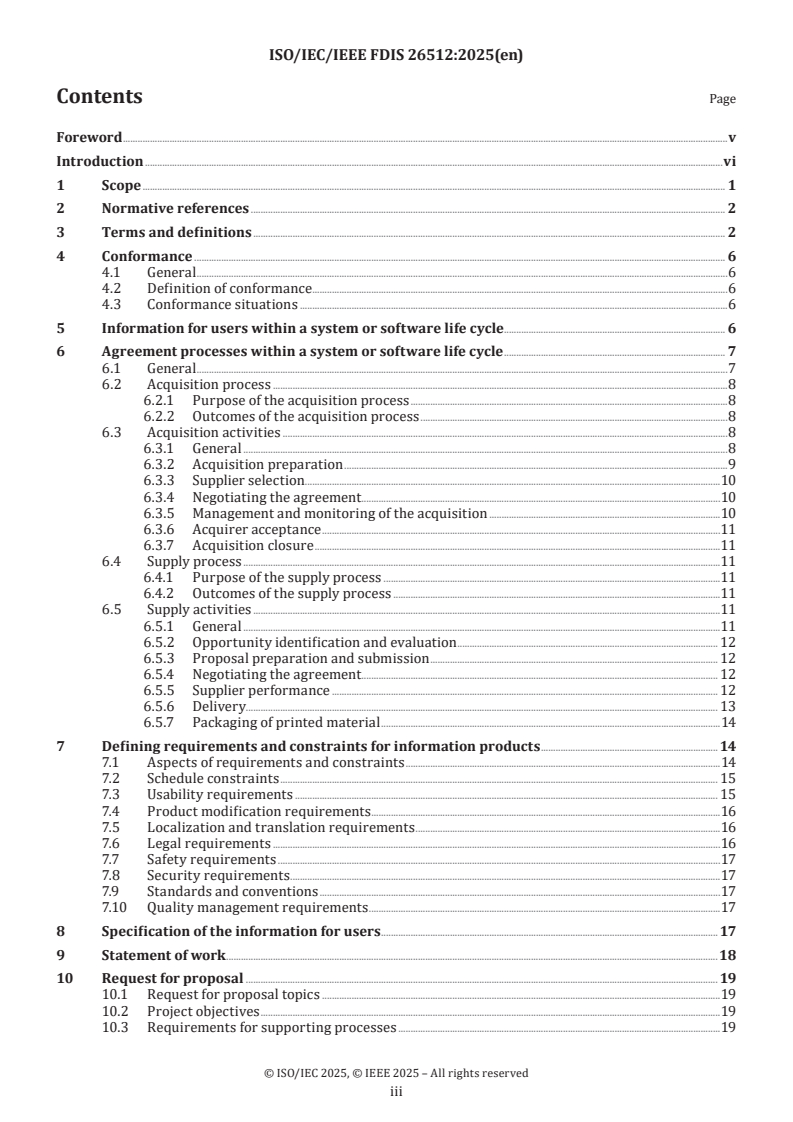
Contents Page
Foreword .v
Introduction .vi
1 Scope . 1
2 Normative references . 2
3 Terms and definitions . 2
4 Conformance . 6
4.1 General .6
4.2 Definition of conformance . . .6
4.3 Conformance situations .6
5 Information for users within a system or software life cycle . 6
6 Agreement processes within a system or software life cycle . 7
6.1 General .7
6.2 Acquisition process .8
6.2.1 Purpose of the acquisition process .8
6.2.2 Outcomes of the acquisition process .8
6.3 Acquisition activities .8
6.3.1 General .8
6.3.2 Acquisition preparation .9
6.3.3 Supplier selection.10
6.3.4 Negotiating the agreement . .10
6.3.5 Management and monitoring of the acquisition .10
6.3.6 Acquirer acceptance .11
6.3.7 Acquisition closure .11
6.4 Supply process .11
6.4.1 Purpose of the supply process .11
6.4.2 Outcomes of the supply process .11
6.5 Supply activities .11
6.5.1 General .11
6.5.2 Opportunity identification and evaluation . 12
6.5.3 Proposal preparation and submission . 12
6.5.4 Negotiating the agreement . . 12
6.5.5 Supplier performance . 12
6.5.6 Delivery. 13
6.5.7 Packaging of printed material .14
7 Defining requirements and constraints for information products . 14
7.1 Aspects of requirements and constraints .14
7.2 Schedule constraints . 15
7.3 Usability requirements . 15
7.4 Product modification requirements .16
7.5 Localization and translation requirements .16
7.6 Legal requirements .16
7.7 Safety requirements .17
7.8 Security requirements . .17
7.9 Standards and conventions .17
7.10 Quality management requirements .17
8 Specification of the information for users . 17
9 Statement of work .18
10 Request for proposal . 19
10.1 Request for proposal topics .19
10.2 Project objectives .19
10.3 Requirements for supporting processes .19
© ISO/IEC 2025, © IEEE 2025 – All rights reserved
iii
10.4 Supplier capabilities and experience .19
10.5 Instructions for bidders . 20
10.6 List of deliverable information products or services . 20
10.7 Confidentiality and intellectual property . 20
10.8 Proposal evaluation criteria .21
11 Proposal contents and format .21
11.1 General .21
11.2 Understanding of requirements . .21
11.3 Scope of the project . 22
11.4 Processes . 22
11.5 Experience, capabilities, and available resources . 22
11.6 Schedule . 23
11.7 Deliverables . 23
11.8 Price proposal . 23
Bibliography .24
IEEE notices and abstract .25
© ISO/IEC 2025, © IEEE 2025 – All rights reserved
iv
Foreword
ISO (the International Organization for Standardization) and IEC (the International Electrotechnical
Commission) form the specialized system for worldwide standardization. National bodies that are
members of ISO or IEC participate in the development of International Standards through technical
committees established by the respective organization to deal with particular fields of technical activity.
ISO and IEC technical committees collaborate in fields of mutual interest. Other international organizations,
governmental and non-governmental, in liaison with ISO and IEC, also take part in the work.
The procedures used to develop this document and those intended for its further maintenance are described
in the ISO/IEC Directives, Part 1. In particular, the different approval criteria needed for the different types
of document should be noted. This document was drafted in accordance with the editorial rules of the ISO/
IEC Directives, Part 2 (see www.iso.org/directives or www.iec.ch/members_experts/refdocs).
IEEE Standards documents are developed within IEEE Societies and subcommittees of IEEE Standards
Association (IEEE SA) Board of Governors. IEEE develops its standards through an accredited consensus
development process, which brings together volunteers representing varied viewpoints and interests to
achieve the final product. IEEE standards are documents developed by volunteers with scientific, academic,
and industry-based expertise in technical working groups. Volunteers are not necessarily members of
IEEE or IEEE SA and participate without compensation from IEEE. While IEEE administers the process and
establishes rules to promote fairness in the consensus development process, IEEE does not independently
evaluate, test, or verify the accuracy of any of the information or the soundness of any judgments contained
in its standards.
ISO and IEC draw attention to the possibility that the implementation of this document may involve the
use of (a) patent(s). ISO and IEC take no position concerning the evidence, validity or applicability of any
claimed patent rights in respect thereof. As of the date of publication of this document, ISO and IEC had not
received notice of (a) patent(s) which may be required to implement this document. However, implementers
are cautioned that this may not represent the latest information, which may be obtained from the patent
database available at www.iso.org/patents and https://patents.iec.ch. ISO and IEC shall not be held
responsible for identifying any or all such patent rights.
Any trade name used in this document is information given for the convenience of users and does not
constitute an endorsement.
For an explanation of the voluntary nature of standards, the meaning of ISO specific terms and expressions
related to conformity assessment, as well as information about ISO's adherence to the World Trade
Organization (WTO) principles in the Technical Barriers to Trade (TBT), see www.iso.org/iso/foreword.html.
In the IEC, see www.iec.ch/understanding-standards.
This document was prepared by Joint Technical Committee ISO/IEC JTC 1, Information technology,
Subcommittee SC 7, Software and systems engineering, in cooperation with the Systems and Software
Engineering Standards Committee of the IEEE Computer Society, under the Partner Standards Development
Organization cooperation agreement between ISO and IEEE.
This third edition cancels and replaces the second edition (ISO/IEC/IEEE 26512:2018), which has been
technically revised.
The main changes are as follows:
— removal of superfluous definitions;
— updated version of the information management process from ISO/IEC/IEEE 15288;
— updates to the Bibliography.
Any feedback or questions on this document should be directed to the user’s national standards
body. A complete listing of these bodies can be found at www.iso.org/members.html and
www.iec.ch/national-committees.
© ISO/IEC 2025, © IEEE 2025 – All rights reserved
v
Introduction
This document supports the interest of system users in having consistent, complete, accurate, and usable
information. It addresses both available approaches to standardization:
a) process standards, which specify the way that information products are to be acquired and supplied;
b) information product standards, which specify the characteristics of the information.
As defined in ISO/IEC/IEEE 12207 and ISO/IEC/IEEE 15288, the acquisition and supply activities make up
the agreement processes of the software or system life cycle. Acquisition and supply of information for users
and related services are specializations of those processes. Such services can be acquired and supplied for
any part of the information management process, such as the following:
— information management;
— information design and development;
— information editing and review coordination;
— information testing, particularly usability testing;
— information production and packaging of physical materials;
— information distribution and delivery;
— advice on the selection and implementation of information development tools and supporting systems; and
— information development process improvement.
This document was developed to assist users of ISO/IEC/IEEE 15288 or ISO/IEC/IEEE 12207 to acquire
or supply systems and software information for users and information services as part of the life cycle
processes. It defines the information development process from the acquirer’s standpoint and the supplier’s
standpoint. This document addresses the identification, definition, and fulfilment of requirements for
information for users as part of the acquisition and supply processes.
This document covers the requirements for information items used in the acquisition of information for
users: the acquisition plan, information product specification, statement of work, request for proposals, and
the proposal.
This document is independent of the software tools that can be used to produce information for users, and
applies to both printed and on-screen material, and to other media such as video or augmented reality
systems. Much of its guidance is applicable to information for users for systems including hardware as well
as software.
Earlier standards tended to view the results of the information development process as a single book or
multivolume set: a one-time deliverable. Increasingly, information acquirers and suppliers recognize that
most information for users is now produced from managed re-use of previously developed information
(single-source documentation) adapted for new software or system versions, or presentation in various
on-screen and printed media. While this document does not describe how to set up a content management
system, it is applicable for organizations practicing single-source documentation, as well as for acquirers
and suppliers of one-time deliverables.
Anyone who uses products that contain software needs accurate information about how the software helps
the user accomplish a task. Information for users can be the first tangible item that the user sees, and so
influences the user’s first impressions of the product. If the information is supplied in a convenient form and
is easy to find and understand, the user can quickly become proficient at using the product. Therefore, well-
designed information for users not only assists the user and helps to reduce the cost of training and support,
but also enhances the reputation of the product, its producer, and its suppliers.
Although software developers intend to design user interfaces that behave so intuitively that very little
separate information is needed, this is rarely possible. Today’s software offers increasingly robust
© ISO/IEC 2025, © IEEE 2025 – All rights reserved
vi
functionality, not only within applications, but also across applications which intelligently exchange
information with one another. Further, most software includes underlying rules and calculations, or
algorithms that affect the results a user can obtain when using the software. These underlying programming
mechanics are discernible by users, but only through laborious testing. For these and other reasons,
information for users remains an essential component of usable software products and systems.
Information for users is often regarded as something done after the system has been implemented. However,
for high-quality information, its development must be regarded as an integral part of the software or system
life cycle. In fact, quality information for users or information management services are important enough
to require specific planning.
Related standards for those acquiring and supplying information for software users include
ISO/IEC/IEEE 26514, ISO/IEC/IEEE 26513 and IEEE 3119-2025. Other International Standards address the
information for users and information management processes from the viewpoint of managers and agile
projects.
This document is consistent with ISO/IEC/IEEE 12207 and ISO/IEC/IEEE 15288 as an implementation of
the acquisition and supply processes, which comprise the agreement processes, and of the information
management process.
This document is intended for use in all types of organizations, whether they have a department dedicated
to information for users or not. It can be used as a basis for local standards and procedures. Readers are
assumed to have experience or knowledge of general agreement processes for acquisition and supply of
products and services.
The order of clauses in this document does not imply that the order of the acquisition activities to be
performed, nor does it imply the order of development or presentation of information for users.
In each clause, the requirements are media-independent, as far as possible.
The Bibliography contains references to source material used in the development of this document, as well
as sources of additional information that can be useful to acquirers and suppliers.
© ISO/IEC 2025, © IEEE 2025 – All rights reserved
vii
FINAL DRAFT International Standard ISO/IEC/IEEE FDIS 26512:2025(en)
Systems and software engineering — Requirements for
acquirers and suppliers of information products and services
1 Scope
This document provides an overview of the information management processes that are relevant to the
acquisition and supply of information for users. It applies the agreement processes (acquisition and supply)
to information for users, and addresses the preparation of requirements for this information. These
requirements are central to the information for users specification and statement of work discussed in this
document. This document also addresses requirements for primary information outputs of the acquisition
and supply process: the request for proposal and the proposal for information products and services.
This document is intended for use in acquiring or supplying any type of information for users and is
independent of information development or management tools or methodologies.
This document can be helpful for acquiring and supplying the following types of information, although it
does not cover all aspects of them:
— multimedia systems using animation, video, and sound;
— computer-based training (CBT) packages and specialized course materials intended primarily for use in
formal training programs;
— maintenance information describing the internal operation of systems software;
— virtual reality and augmented reality;
— collaboratively generated, often known as “wiki”, information, which is curated periodically;
— information for users incorporated into the user interface.
This document is applicable to acquirers and suppliers of information for users, including a variety of
specialists:
— analysts (e.g. business analysts, human factors engineers) who identify the tasks that the intended users
perform with the system;
— managers of the software or system development process or the information management process;
— managers of the acquisition process, and those who authorize and approve acquisitions;
— managers and authors involved in proposal preparation.
It can also be consulted by those with other roles and interests in the information development process:
— information designers and architects who plan the structure, format, and content requirements of
information products;
— experienced authors and editors who develop the written content for information for users;
— graphic designers with expertise in electronic media;
— user interface designers and ergonomics experts working together to design the presentation of the
information on the screen;
— usability testers, information development reviewers, subject-matter experts;
© ISO/IEC 2025, © IEEE 2025 – All rights reserved
— developers of tools for creating on-screen information.
2 Normative references
The following document is referred to in the text in such a way that some or all of its content constitutes
requirements of this document. For dated references, only the edition cited applies. For undated references,
the latest edition of the referenced document (including any amendments) applies.
ISO/IEC/IEEE 12207:2017, Systems and software engineering — Software life cycle processes
ISO/IEC/IEEE 15288:2023, Systems and software engineering — System life cycle processes
3 Terms and definitions
For the purposes of this document, the following terms and definitions apply.
ISO, IEC and IEEE maintain terminology databases for use in standardization at the following addresses:
— ISO Online browsing platform: available at https:// www .iso .org/ obp
— IEC Electropedia: available at http:// www .electropedia .org
— IEEE Standards Dictionary Online: available at http:// dictionary .ieee .org
NOTE For additional terms and definitions in the field of systems and software engineering, see
ISO/IEC/IEEE 24765, which is published periodically as a “snapshot” of the SEVOCAB (Systems and Software
Engineering Vocabulary) database and is publicly accessible at www .computer .org/ sevocab.
3.1
accessibility
extent to which products (3.17), systems, services, environments, and facilities can be used by people from a
population with the widest range of characteristics and capabilities to achieve a specified goal in a specified
context of use
Note 1 to entry: Although “accessibility” typically addresses users (3.27) who have disabilities, the concept is not
limited to disability issues.
[SOURCE: ISO/IEC 25064:2013, 4.1, modified — The original note 1 to entry has been replaced by a new one.]
3.2
agreement
mutual acknowledgment of terms and conditions under which a working relationship is conducted
Note 1 to entry: In many countries, agreements do not have to be written but the terms of the agreements referred to
in this document are defined in writing.
Note 2 to entry: The relationship can have other names, such as “contract”. The acquirer determines which term is to
be used in the application of this document.
[SOURCE: ISO/IEEE 15288:2023, 3.4, modified — EXAMPLE has been removed; notes 1 and 2 to entry have
been added.]
3.3
audience
category of users (3.27) sharing the same or similar characteristics and needs
Note 1 to entry: There can be different audiences for information for users (e.g. management, data entry, maintenance)
that determine the content, structure, and use of the information.
Note 2 to entry: An example of user needs is the reason for using the information, tasks, education level, abilities,
training and experience.
© ISO/IEC 2025, © IEEE 2025 – All rights reserved
3.4
change control procedure
actions taken to identify, describe, review, and authorize changes to a software (3.21) or information
product (3.17)
Note 1 to entry: The procedures help to ensure that the validity of changes is confirmed, that the effects on other items
are examined, and that those people concerned with the development (3.8) are notified of the changes.
3.5
configuration management
discipline applying technical and administrative direction and surveillance to identify and describe the
functional and physical characteristics of a configuration item, control changes to those characteristics,
record and report change processing and implementation status, and verify compliance with specified
requirements
3.6
customization
adaptation of a software (3.21) or information product (3.17) to the needs of a particular audience (3.3)
3.7
design
process (3.16) of determining the content, structure, and format of an information product (3.17) or set of
information products
3.8
development
activity of preparing information for users (3.27) after it has been designed
[SOURCE: ISO/IEC/IEEE 26514:2022, 3.1.18]
3.9
document
uniquely identified unit of information for human use
EXAMPLE A report, specification, manual, or book in printed or electronic form.
Note 1 to entry: A document can be a single information item or part of a larger information item.
[SOURCE: ISO/IEC/IEEE 15289:2019, 3.1.10]
3.10
documentation
collection of documents (3.9) related to a given subject
EXAMPLE Printed manuals, on-screen information (3.14), standalone online help, videos, pop-up help.
Note 1 to entry: The information can be provided as documentation that can be used independently of the system
or embedded within the product (3.17) and accessible as an integral part of it, or both. In this document, the term
"information for users” is synonymous with the terms “documentation” and “software user documentation.” Other
forms of documentation (e.g. “system documentation”) are clearly identified as such.
[SOURCE: IEC/IEEE 82079-1:2019, 3.11, modified — EXAMPLE and note 1 to entry have been added.]
3.11
illustration
visually perceptible figure, artificially created to transmit specific information, excluding safety signs and
graphical symbols
Note 1 to entry: In this document, the term “illustration” is used as the generic term for tables, figures, exhibits, screen
captures, flow charts, diagrams, drawings, icons, and other types of graphics.
[SOURCE: IEC/IEEE 82079-1:2019, 3.16, modified — EXAMPLE has been removed; note 1 to entry has
been added.]
© ISO/IEC 2025, © IEEE 2025 – All rights reserved
3.12
internationalization
process (3.16) of developing information so that it is suitable for an international audience (3.3)
Note 1 to entry: See also localization (3.13).
[SOURCE: ISO/IEC/IEEE 26514:2022, 3.1.31]
3.13
localization
creation of a national or specific regional version of a product (3.17) and its information for users (3.27)
Note 1 to entry: Localization may be carried out separately from the translation process (3.16).
Note 2 to entry: See also internationalization (3.12).
[SOURCE: ISO/IEC/IEEE 26514:2022, 3.1.32]
3.14
on-screen information
information that is intended to be read on the screen by the user (3.27) while using the software (3.21)
EXAMPLE Pop-up help and help text on a screen.
[SOURCE: ISO/IEC/IEEE 26514:2022, 3.1.36, modified — In the term and the definition, "information for
users" has been replaced by "information"; note 1 to entry has been removed.]
3.15
printed information
information that is either provided in printed form, or provided in electronic form for the customer or user
(3.27) to print
3.16
process
set of interrelated or interacting activities that use inputs to deliver an intended result
[SOURCE: ISO 9000:2015, 3.4.1, modified — Notes to entry have been removed.]
3.17
product
result of a process (3.16)
[SOURCE: ISO/IEC/IEEE 12207:2017, 3.1.36, modified — Note 1 to entry has been removed.]
3.18
product owner
stakeholder responsible for the capabilities, acceptance, and use of a product (3.17)
[SOURCE: ISO/IEC TR 24587:2021, 3.12, modified — Note 1 to entry has been removed.]
3.19
project
endeavour with defined start and finish criteria undertaken to create a product (3.17) or service in
accordance with specified resources and requirements
[SOURCE: ISO/IEC/IEEE 12207:2017, 3.1.37, modified — Note 1 to entry has been removed.]
3.20
quality management
coordinated activities to direct and control an organization with regard to quality
[SOURCE: ISO/IEC/IEEE 12207:2017, 3.1.42]
© ISO/IEC 2025, © IEEE 2025 – All rights reserved
3.21
software
all or part of the programs, procedures, rules, and associated documentation (3.10) of an information
processing system
Note 1 to entry: For the purposes of this document, the term “software” does not include on-screen information (3.14).
[SOURCE: IEEE Std 828-2012]
3.22
style
set of language-specific editorial conventions covering grammar, terminology, punctuation, capitalization,
and word choice
[SOURCE: ISO/IEC/IEEE 26514:2022, 3.1.49]
3.23
subject-matter expert
person responsible for providing technical information or for checking the technical accuracy of drafts of
information for users (3.27)
[SOURCE: ISO/IEC/IEEE 26514:2022, 3.1.50, modified — The abbreviated term "SME" has been removed.]
3.24
topic
coherent part of an information product (3.17) with a heading that deals with a single subject
EXAMPLE Instructions on how to print the current document.
Note 1 to entry: In printed information (3.15), a topic is equivalent to a section (heading, subheading) and its content.
In on-screen information (3.14), a topic consists of a title (heading) and information about a subject (typically, a task or
a concept or reference information).
Note 2 to entry: For on-screen information, the system sometimes presents a topic without user (3.27) intervention.
[SOURCE: ISO/IEC/IEEE 26514:2022, 3.1.51, modified — "printed information for users" and "onscreen
information for users" have been replaced by "printed information" and "onscreen information" respectively.]
3.25
tutorial
instructional procedure in which the user (3.27) exercises software (3.21) functions, often using sample data
that is supplied with the system or information for users
[SOURCE: ISO/IEC/IEEE 26514:2022, 3.1.52, modified — "instructional information" has been replaced by
"instructional procedure"; "often" has been added.]
3.26
usability
extent to which a system or information product (3.17) can be used by specified users (3.27) to achieve
specified goals with effectiveness, efficiency, and satisfaction in a specified context of use
[SOURCE: ISO/IEC 25064:2013, 4.16, modified — "product or service" has been replaced by "or information
product"; note 1 to entry has been removed.]
3.27
user
individual or group that interacts with a system or benefits from a system during its utilization
[SOURCE: ISO/IEC/IEEE 12207:2017, 3.1.70, modified — Note 1 to entry has been removed.]
© ISO/IEC 2025, © IEEE 2025 – All rights reserved
3.28
ensemble of software (3.21) and hardware that allows a user (3.27) to interact with a computer system
[SOURCE: ISO/IEC/IEEE 26514:2022, 3.1.54]
4 Conformance
4.1 General
This document may be used as a conformance or a guidance document for projects and organizations
claiming conformance to ISO/IEC/IEEE 15288 or ISO/IEC/IEEE 12207.
4.2 Definition of conformance
This document is meant to be tailored so that only necessary and cost-effective requirements are applied.
Tailoring may take the form of specifying approaches to conform to the requirements of this document, or
altering its recommendations to reflect the particular product or service more explicitly. The acquirer may,
before entering into the agreement, involve other parties, including potential suppliers or any necessary
third parties (such as regulators), in determining the acquirer’s requirements for tailoring of this document
for the project. The tailoring process shall be in accordance with ISO/IEC/IEEE 12207:2017, Annex A.
Tailoring decisions made by the acquirer should be specified in the agreement.
Use of the nomenclature of this document for the parts of information for users (that is, chapters, topics,
pages, screens, windows) is not required to claim conformance.
4.3 Conformance situations
This document may be referenced in agreements when the parties (called the acquirer and the supplier)
agree that the supplier will deliver information for users in accordance with this document. It may also be
adopted as an in-house standard by a project or organization that decides to acquire information for users
from another part of the organization in accordance with this document.
5 Information for users within a system or software life cycle
Acquirers and suppliers of information for users work within the development life cycle of the product. The
agreement shall specify which of the following information management process activities are required:
— process implementation, which includes setting objectives; planning, management, and control;
preparation of an information development plan;
— analysis and design, which includes preparing the information designs for the project; collecting
information about the product and users, their tasks, and their needs for information, and designing
information based on those needs;
— development and review, which includes structuring the content for usability, applying the information
design by creating the written and graphic content, implementing the information in the specified media,
and evaluating the information for users with the rest of the product;
— production, which includes the integration, preparation, reproduction, and packaging and delivery of the
information;
— maintenance, which includes keeping the information for users accurate throughout the product life
cycle, including modifications for improved usability.
Since acquirers and suppliers of information for users work within the product life cycle, the information
for users should ideally be developed in conjunction with the software or system components, so that the
software or system and the information for users can be acquired and maintained together. The process
of specifying the information for users should be a part of the development of the product as a whole,
© ISO/IEC 2025, © IEEE 2025 – All rights reserved
not a separate exercise. Although accurate information for users cannot be completed until the software
component has been fully developed, the information for users and the product both benefit from concurrent
development.
For simplicity, the life cycle stages are presented as if there were a clear starting point and end point for
developing information for users. A single sequence of activities does not exist, however, that can be followed
in all cases for all products and all types of information. For example, design and implementation activities
for on-screen information are very closely interlinked, as are analysis and design, and the way they link
together, and the way they are delivered, varies between projects.
The classic information development process applies to the life cycle of a single new product with a single
new user manual, but it is much more likely that software or system and information for users are designed
and developed under more complex circumstances, such as the following:
— A software product with existing information for users is being upgraded, offered in a new version or
on different operating system platforms, or customized as part of system integration, and previous
information for users needs revision.
— Previous information for users is required using a different delivery vehicle, or in a different format
or different media, or in different languages or versions, such as tutorials, online help, or advanced
reference guides.
— Previous information for users is to be adapted or used as models for different products acquired or
supplied by an organization.
It is much easier to create information for users if other information produced during the life cycle is
available, s
...
ISO/IEC/IEEE DISFDIS 26512:2025(en)
ISO/IEC JTC 1/SC 7
Secretariat: BIS
Date: 2025-05-1311-24
Systems and software engineering — Requirements for acquirers and
suppliers of information products and services
Ingénierie des systèmes et du logiciel — Exigences pour acquéreurs et fournisseurs d'informations destinées aux
utilisateurs
FDIS stage
ISO/IEC/IEEE DISFDIS 26512:2025(en)
© ISO/IEC 2025, /Published in Switzerland
© IEEE 2025
All rights reserved. Unless otherwise specified, or required in the context of its implementation, no part of this publication
may be reproduced or utilized otherwise in any form or by any means, electronic or mechanical, including photocopying,
or posting on the internet or an intranet, without prior written permission. Permission can be requested from either ISO
at the address below or ISO'sISO’s member body in the country of the requester.
ISO copyright office Institute of Electrical and Electronics Engineers, Inc
CP 401 • Ch. de Blandonnet 8 • CP 401 3 Park Avenue, New York
CH1214CH-1214 Vernier, Geneva, Switzerland NY 100165997, USA Tel. +
Phone: + 41 22 749 01 11
E-mail: copyright@iso.org
Website: www.iso.org
Published in Switzerland
© ISO/IEC 2025, © /IEEE 2025 – All rights reserved
iii
Fax +41 22 749 09 47
© ISO/IEC/IEEE 2025 – All rights reserved
iv
ISO/IEC/IEEE DISFDIS 26512:2025(en)
Contents
Foreword . vii
Introduction . ix
1 Scope . 1
2 Normative references . 2
3 Terms and definitions . 2
4 Conformance . 6
4.1 General . 6
4.2 Definition of conformance . 7
4.3 Conformance situations . 7
5 Information for users within a system or software life cycle . 7
6 Agreement processes within a system or software life cycle . 8
6.1 General . 8
6.2 Acquisition process . 9
6.3 Acquisition activities . 9
6.4 Supply process . 12
6.5 Supply activities . 13
7 Defining requirements and constraints for information products . 15
7.1 Aspects of requirements and constraints . 15
7.2 Schedule constraints . 16
7.3 Usability requirements . 17
7.4 Product modification requirements. 17
7.5 Localization and translation requirements . 17
7.6 Legal requirements . 18
7.7 Safety requirements . 18
7.8 Security requirements . 19
7.9 Standards and conventions . 19
7.10 Quality management requirements . 19
8 Specification of the information for users . 19
9 Statement of work . 20
10 Request for proposal . 21
10.1 Request for proposal topics . 21
10.2 Project objectives . 21
10.3 Requirements for supporting processes . 21
10.4 Supplier capabilities and experience . 21
10.5 Instructions for bidders . 22
10.6 List of deliverable information products or services . 22
10.7 Confidentiality and intellectual property . 22
10.8 Proposal evaluation criteria . 23
11 Proposal contents and format . 23
11.1 General . 23
11.2 Understanding of requirements . 23
11.3 Scope of the project . 24
11.4 Processes . 24
11.5 Experience, capabilities, and available resources . 25
11.6 Schedule . 25
11.7 Deliverables . 25
© ISO/IEC 2025, © /IEEE 2025 – All rights reserved
v
11.8 Price proposal . 26
Bibliography . 27
IEEE notices and abstract . 29
© ISO/IEC/IEEE 2025 – All rights reserved
vi
ISO/IEC/IEEE DISFDIS 26512:2025(en)
Foreword
ISO (the International Organization for Standardization) and IEC (the International Electrotechnical
Commission) form the specialized system for worldwide standardization. National bodies that are members
of ISO or IEC participate in the development of International Standards through technical committees
established by the respective organization to deal with particular fields of technical activity. ISO and IEC
technical committees collaborate in fields of mutual interest. Other international organizations, governmental
and non-governmental, in liaison with ISO and IEC, also take part in the work.
The procedures used to develop this document and those intended for its further maintenance are described
in the ISO/IEC Directives, Part 1. In particular, the different approval criteria needed for the different types of
document should be noted. This document was drafted in accordance with the editorial rules of the ISO/IEC
Directives, Part 2 (see www.iso.org/directives or www.iec.ch/members_experts/refdocs).
IEEE Standards documents are developed within IEEE Societies and subcommittees of IEEE Standards
Association (IEEE SA) Board of Governors. IEEE develops its standards through an accredited consensus
development process, which brings together volunteers representing varied viewpoints and interests to
achieve the final product. IEEE standards are documents developed by volunteers with scientific, academic,
and industry-based expertise in technical working groups. Volunteers are not necessarily members of IEEE or
IEEE SA and participate without compensation from IEEE. While IEEE administers the process and establishes
rules to promote fairness in the consensus development process, IEEE does not independently evaluate, test,
or verify the accuracy of any of the information or the soundness of any judgments contained in its standards.
ISO and IEC draw attention to the possibility that the implementation of this document may involve the use of
(a) patent(s). ISO and IEC take no position concerning the evidence, validity or applicability of any claimed
patent rights in respect thereof. As of the date of publication of this document, ISO and IEC had not received
notice of (a) patent(s) which may be required to implement this document. However, implementers are
cautioned that this may not represent the latest information, which may be obtained from the patent database
available at www.iso.org/patents and https://patents.iec.ch. ISO and IEC shall not be held responsible for
identifying any or all such patent rights.
Any trade name used in this document is information given for the convenience of users and does not
constitute an endorsement.
For an explanation of the voluntary nature of standards, the meaning of ISO specific terms and expressions
related to conformity assessment, as well as information about ISO's adherence to the World Trade
Organization (WTO) principles in the Technical Barriers to Trade (TBT), see www.iso.org/iso/foreword.html.
In the IEC, see www.iec.ch/understanding-standards.
This document was prepared by Joint Technical Committee ISO/IEC JTC 1, Information technology,
Subcommittee SC 7, Software and systems engineering, in cooperation with the Systems and Software
Engineering Standards Committee of the IEEE Computer Society, under the Partner Standards Development
Organization cooperation agreement between ISO and IEEE.
This third edition cancels and replaces the second edition (ISO/IEC/IEEE 26512:2018), which has been
technically revised.
The main changes are as follows:
— — removal of superfluous definitions;
— — updated version of the information management process from ISO/IEC/IEEE 15288;
— — updates to the Bibliography.
© ISO/IEC 2025, © /IEEE 2025 – All rights reserved
vii
Any feedback or questions on this document should be directed to the user’s national standards body. A
complete listing of these bodies can be found at www.iso.org/members.html and www.iec.ch/national-
committees.
© ISO/IEC/IEEE 2025 – All rights reserved
viii
ISO/IEC/IEEE DISFDIS 26512:2025(en)
Introduction
This document supports the interest of system users in having consistent, complete, accurate, and usable
information. It addresses both available approaches to standardization:
a) a) process standards, which specify the way that information products are to be acquired and supplied;
b) and b) information product standards, which specify the characteristics of the information.
As defined in ISO/IEC/IEEE 12207 and ISO/IEC/IEEE 15288, the acquisition and supply activities make up the
agreement processes of the software or system life cycle. Acquisition and supply of information for users and
related services are specializations of those processes. Such services can be acquired and supplied for any part
of the information management process, such as the following:
— — information management;
— — information design and development;
— — information editing and review coordination;
— — information testing, particularly usability testing;
— — information production and packaging of physical materials;
— — information distribution and delivery;
— — advice on the selection and implementation of information development tools and supporting
systems; and
— — information development process improvement.
This document was developed to assist users of ISO/IEC/IEEE 15288 or ISO/IEC/IEEE 12207 to acquire or
supply systems and software information for users and information services as part of the life cycle processes.
It defines the information development process from the acquirer’s standpoint and the supplier’s standpoint.
This document addresses the identification, definition, and fulfilment of requirements for information for
users as part of the acquisition and supply processes.
This document covers the requirements for information items used in the acquisition of information for users:
the acquisition plan, information product specification, statement of work, request for proposals, and the
proposal.
This document is independent of the software tools that can be used to produce information for users, and
applies to both printed and on-screen material, and to other media such as video or augmented reality
systems. Much of its guidance is applicable to information for users for systems including hardware as well as
software.
Earlier standards tended to view the results of the information development process as a single book or
multivolume set: a one-time deliverable. Increasingly, information acquirers and suppliers recognize that
most information for users is now produced from managed re-use of previously developed information
(single-source documentation) adapted for new software or system versions, or presentation in various on-
screen and printed media. While this document does not describe how to set up a content management system,
it is applicable for organizations practicing single-source documentation, as well as for acquirers and suppliers
of one-time deliverables.
© ISO/IEC 2025, © /IEEE 2025 – All rights reserved
ix
Anyone who uses products that contain software needs accurate information about how the software helps
the user accomplish a task. Information for users can be the first tangible item that the user sees, and so
influences the user’s first impressions of the product. If the information is supplied in a convenient form and
is easy to find and understand, the user can quickly become proficient at using the product. Therefore, well-
designed information for users not only assists the user and helps to reduce the cost of training and support,
but also enhances the reputation of the product, its producer, and its suppliers.
Although software developers intend to design user interfaces that behave so intuitively that very little
separate information is needed, this is rarely possible. Today’s software offers increasingly robust
functionality, not only within applications, but also across applications which intelligently exchange
information with one another. Further, most software includes underlying rules and calculations, or
algorithms that affect the results a user can obtain when using the software. These underlying programming
mechanics are discernible by users, but only through laborious testing. For these and other reasons,
information for users remains an essential component of usable software products and systems.
Information for users is often regarded as something done after the system has been implemented. However,
for high-quality information, its development must be regarded as an integral part of the software or system
life cycle. In fact, quality information for users or information management services are important enough to
require specific planning.
Related standards for those acquiring and supplying information for software users include
ISO/IEC/IEEE 26514, ISO/IEC/IEEE 26513 and IEEE 3119-2025. Other International Standards address the
information for users and information management processes from the viewpoint of managers and agile
projects.
Related standards for those acquiring and supplying information for software users include ISO/IEC/IEEE
26514:2022, ISO/IEC/IEEE 26513 and IEEE 3119-2025 Standard for the Procurement of Artificial Intelligence
and Automated Decision Systems. Other International Standards address the information for users and
information management processes from the viewpoint of managers and agile projects.
This document is consistent with ISO/IEC/IEEE 12207 and ISO/IEC/IEEE 15288 as an implementation of the
acquisition and supply processes, which comprise the agreement processes, and of the information
management process.
This document is intended for use in all types of organizations, whether they have a department dedicated to
information for users or not. It can be used as a basis for local standards and procedures. Readers are assumed
to have experience or knowledge of general agreement processes for acquisition and supply of products and
services.
The order of clauses in this document does not imply that the order of the acquisition activities to be
performed, nor does it imply the order of development or presentation of information for users.
In each clause, the requirements are media-independent, as far as possible.
The Bibliography contains references to source material used in the development of this document, as well as
sources of additional information that can be useful to acquirers and suppliers.
© ISO/IEC/IEEE 2025 – All rights reserved
x
DRAFT International Standard ISO/IEC/IEEE DIS 26512:2025(en)
Systems and software engineering — Requirements for acquirers and
suppliers of information for usersproducts and services
1 Scope
This document provides an overview of the information management processes that are relevant to the
acquisition and supply of information for users. It applies the agreement processes (acquisition and supply)
to information for users, and addresses the preparation of requirements for this information. These
requirements are central to the information for users specification and statement of work discussed in this
document. This document also addresses requirements for primary information outputs of the acquisition and
supply process: the request for proposal and the proposal for information products and services.
This document is intended for use in acquiring or supplying any type of information for users and is
independent of information development or management tools or methodologies.
This document can be helpful for acquiring and supplying the following types of information, although it does
not cover all aspects of them:
— — multimedia systems using animation, video, and sound;
— — computer-based training (CBT) packages and specialized course materials intended primarily for use
in formal training programs;
— — maintenance information describing the internal operation of systems software;
— — virtual reality and augmented reality;
— — collaboratively generated, often known as “wiki”, information, which is curated periodically;
— — information for users incorporated into the user interface.
This document is applicable to acquirers and suppliers of information for users, including a variety of
specialists:
— — analysts (e.g. business analysts, human factors engineers) who identify the tasks that the intended
users perform with the system;
— — managers of the software or system development process or the information management process;
— — managers of the acquisition process, and those who authorize and approve acquisitions;
— — managers and authors involved in proposal preparation.
It can also be consulted by those with other roles and interests in the information development process:
— — information designers and architects who plan the structure, format, and content requirements of
information products;
— — experienced authors and editors who develop the written content for information for users;
© ISO/IEC 2025, © IEEE 2025 – All rights reserved
— — graphic designers with expertise in electronic media;
— — user interface designers and ergonomics experts working together to design the presentation of the
information on the screen;
— — usability testers, information development reviewers, subject-matter experts;
— — developers of tools for creating on-screen information.
2 Normative references
The following document is referred to in the text in such a way that some or all of its content constitutes
requirements of this document. For dated references, only the edition cited applies. For undated references,
the latest edition of the referenced document (including any amendments) applies.
ISO/IEC/IEEE 12207:2017, Systems and software engineering — Software life cycle processes
ISO/IEC/IEEE 15288:2023, Systems and software engineering — System life cycle processes
3 Terms and definitions
For the purposes of this document, the following terms and definitions apply.
ISO, IEC and IEEE maintain terminology databases for use in standardization at the following addresses:
— — ISO Online browsing platform: available at https://www.iso.org/obp
— — IEC Electropedia: available at http://www.electropedia.org
— — IEEE Standards Dictionary Online: available at http://dictionary.ieee.org
NOTE For additional terms and definitions in the field of systems and software engineering, see
ISO/IEC/IEEE 24765, which is published periodically as a “snapshot” of the SEVOCAB (Systems and Software Engineering
Vocabulary) database and is publicly accessible at www.computer.org/sevocab.
3.1 3.1
accessibility
extent to which products (3.17(3.17),), systems, services, environments, and facilities can be used by people
from a population with the widest range of characteristics and capabilities to achieve a specified goal in a
specified context of use
Note 1 to entry: Although “accessibility” typically addresses users (3.27(3.27)) who have disabilities, the concept is not
limited to disability issues.
[SOURCE: ISO/IEC 25064:2013, 4.1, modified — The original note 1 to entry has been replaced by a new one.]
3.2 3.2
agreement
mutual acknowledgment of terms and conditions under which a working relationship is conducted
Note 1 to entry: In many countries, agreements do not have to be written but the terms of the agreements referred to in
this document are defined in writing.
Note 2 to entry: The relationship can have other names, such as “contract”. The acquirer determines which term is to be
used in the application of this document.
© ISO/IEC/IEEE 2025 – All rights reserved
ISO/IEC/IEEE DISFDIS 26512:2025(en)
[SOURCE: ISO/IEEE 15288:2023, 3.4, modified — EXAMPLE has been removed; notes 1 and 2 to entry have
been added.]
3.3 3.3
audience
category of users (3.27(3.27)) sharing the same or similar characteristics and needs
Note 1 to entry: There can be different audiences for information for users (e.g. management, data entry, maintenance)
that determine the content, structure, and use of the information.
Note 2 to entry: An example of user needs is the reason for using the information, tasks, education level, abilities, training
and experience.
3.4 3.4
change control procedure
actions taken to identify, describe, review, and authorize changes to a software (3.21(3.21)) or information
product (3.17(3.17))
Note 1 to entry: The procedures help to ensure that the validity of changes is confirmed, that the effects on other items
are examined, and that those people concerned with the development (3.8(3.8)) are notified of the changes.
3.5 3.5
configuration management
discipline applying technical and administrative direction and surveillance to identify and describe the
functional and physical characteristics of a configuration item, control changes to those characteristics, record
and report change processing and implementation status, and verify compliance with specified requirements
3.6 3.6
customization
adaptation of a software (3.21(3.21)) or information product (3.17(3.17)) to the needs of a particular audience
(3.3(3.3))
3.7 3.7
design
process (3.16(3.16)) of determining the content, structure, and format of an information product (3.17(3.17))
or set of information products
3.8 3.8
development
activity of preparing information for users (3.27(3.27)) after it has been designed
[SOURCE: ISO/IEC/IEEE 26514:2022, 3.1.18]
3.9 3.9
document
uniquely identified unit of information for human use
EXAMPLE A report, specification, manual, or book in printed or electronic form.
Note 1 to entry: A document can be a single information item or part of a larger information item.
[SOURCE: ISO/IEC/IEEE 15289:2019, 3.1.10]
3.10 3.10
documentation
collection of documents (3.9(3.9)) related to a given subject
© ISO/IEC 2025, © /IEEE 2025 – All rights reserved
EXAMPLE Printed manuals, on-screen information (3.14(3.14),), standalone efonlineonline help, videos, pop-up
help.
Note 1 to entry: The information can be provided as documentation that can be used independently of the system or
embedded within the product (3.17(3.17)) and accessible as an integral part of it, or both. In this document, the term
"information for users” is synonymous with the terms “documentation” and “software user documentation.” Other forms
of documentation (e.g. “system documentation”) are clearly identified as such.
[SOURCE: IEC/IEEE 82079-1:2019, 3.11, modified — EXAMPLE and note 1 to entry have been added.]
3.11 3.11
illustration
visually perceptible figure, artificially created to transmit specific information, excluding safety signs and
graphical symbols
Note 1 to entry: In this document, the term “illustration” is used as the generic term for tables, figures, exhibits, screen
captures, flow charts, diagrams, drawings, icons, and other types of graphics.
[SOURCE: IEC/IEEE 82079-1:2019, 3.16, modified — EXAMPLE has been removed; note 1 to entry has been
added.]
3.12 3.12
internationalization
process (3.16(3.16)) of developing information so that it is suitable for an international audience (3.3(3.3))
Note 1 to entry: See also localization (3.13(3.13).).
[SOURCE: ISO/IEC/IEEE 26514:2022, 3.1.31]
3.13 3.13
localization
creation of a national or specific regional version of a product (3.17(3.17)) and its information for users
(3.27(3.27))
Note 1 to entry: Localization may be carried out separately from the translation process (3.16(3.16).).
Note 2 to entry: See also internationalization (3.12(3.12).).
[SOURCE: ISO/IEC/IEEE 26514:2022, 3.1.32]
3.14 3.14
on-screen information
information that is intended to be read on the screen by the user (3.27(3.27)) while using the software
(3.21(3.21))
EXAMPLE Pop-up help and help text on a screen.
[SOURCE: ISO/IEC/IEEE 26514:2022, 3.1.36, modified — In the term and the definition, "information for
users" has been replaced by "information"; note 1 to entry has been removed.]
3.15 3.15
printed information
information that is either provided in printed form, or provided in electronic form for the customer or user
(3.27(3.27)) to print
© ISO/IEC/IEEE 2025 – All rights reserved
ISO/IEC/IEEE DISFDIS 26512:2025(en)
3.16 3.16
process
set of interrelated or interacting activities that use inputs to deliver an intended result
[SOURCE: ISO 9000:2015, 3.4.1, modified — Notes to entry have been removed.]
3.17 3.17
product
result of a process (3.16output of an organization that can be produced without any transaction taking place
between the organization and the customer
)
[SOURCE: ISO/IEC/IEEE 12207:2017, 3.1.36, modified — Note 1 to entry has been removed.]
3.18 3.18
product owner
stakeholder responsible for the capabilities, acceptance, and use of a product (3.17(3.17))
[SOURCE: ISO/IEC TR 24587:2021, 3.12, modified — Note 1 to entry has been removed.]
3.19 3.19
project
endeavour with defined start and finish criteria undertaken to create a product (3.17(3.17)) or service in
accordance with specified resources and requirements
[SOURCE: ISO/IEC/IEEE 12207:2017, 3.1.37, modified — Note 1 to entry has been removed.]
3.20 3.20
quality management
coordinated activities to direct and control an organization with regard to quality
[SOURCE: ISO/IEC/IEEE 12207:2017, 3.1.42]
3.21 3.21
software
all or part of the programs, procedures, rules, and associated documentation (3.10) of an information
processing system
Note 1 to entry: For the purposes of this document, the term “software” does not include on-screen information
(3.14(3.14).).
[SOURCE: IEEE Std 828-2012]
3.22 3.22
style
set of language-specific editorial conventions covering grammar, terminology, punctuation, capitalization, and
word choice
[SOURCE: ISO/IEC/IEEE 26514:2022, 3.1.49]
3.23 3.23
subject-matter expert
person responsible for providing technical information or for checking the technical accuracy of drafts of
information for users (3.27(3.27))
© ISO/IEC 2025, © /IEEE 2025 – All rights reserved
[SOURCE: ISO/IEC/IEEE 26514:2022, 3.1.50, modified — The abbreviated term "SME" has been removed.]
3.24 3.24
topic
coherent part of an information product (3.17(3.17)) with a heading that deals with a single subject
EXAMPLE Instructions on how to print the current document.
Note 1 to entry: In printed information (3.15(3.15),), a topic is equivalent to a section (heading, subheading) and its
content. In on-screen information (3.14(3.14),), a topic consists of a title (heading) and information about a subject
(typically, a task or a concept or reference information).
Note 2 to entry: For on-screen information, the system sometimes presents a topic without user (3.27(3.27))
intervention.
[SOURCE: ISO/IEC/IEEE 26514:2022, 3.1.51, modified — "printed information for users" and "onscreen
information for users" have been replaced by "printed information" and "onscreen information" respectively.]
3.25 3.25
tutorial
instructional procedure in which the user (3.27(3.27)) exercises software (3.21(3.21)) functions, often using
sample data that is supplied with the system or information for users
[SOURCE: ISO/IEC/IEEE 26514:2022, 3.1.52, modified — "instructional information" has been replaced by
"instructional procedure"; "often" has been added.]
3.26 3.26
usability
extent to which a system or information product (3.17(3.17)) can be used by specified users (3.27(3.27)) to
achieve specified goals with effectiveness, efficiency, and satisfaction in a specified context of use
[SOURCE: ISO/IEC 25064:2013, 4.16, modified — "product or service" has been replaced by "or information
product"; note 1 to entry has been removed.]
3.27 3.27
user
individual or group that interacts with a system or benefits from a system during its utilization
[SOURCE: ISO/IEC/IEEE 12207:2017, 3.1.70], modified — Note 1 to entry has been removed.]
3.28
3.28
user interface
ensemble of software (3.21(3.21)) and hardware that allows a user (3.27(3.27)) to interact with a computer
system
[SOURCE: ISO/IEC/IEEE 26514:2022, 3.1.54]
4 Conformance
4.1 General
This document may be used as a conformance or a guidance document for projects and organizations claiming
conformance to ISO/IEC/IEEE 15288 or ISO/IEC/IEEE 12207.
© ISO/IEC/IEEE 2025 – All rights reserved
ISO/IEC/IEEE DISFDIS 26512:2025(en)
4.2 Definition of conformance
This document is meant to be tailored so that only necessary and cost-effective requirements are applied.
Tailoring may take the form of specifying approaches to conform to the requirements of this document, or
altering its recommendations to reflect the particular product or service more explicitly. The acquirer may,
before entering into the agreement, involve other parties, including potential suppliers or any necessary third
parties (such as regulators), in determining the acquirer’s requirements for tailoring of this document for the
project. The tailoring process shall be in accordance with ISO/IEC/IEEE 12207:2017, Annex A. Tailoring
decisions made by the acquirer should be specified in the agreement.
Use of the nomenclature of this document for the parts of information for users (that is, chapters, topics, pages,
screens, windows) is not required to claim conformance.
4.3 Conformance situations
This document may be referenced in agreements when the parties (called the acquirer and the supplier) agree
that the supplier will deliver information for users in accordance with this document. It may also be adopted
as an in-house standard by a project or organization that decides to acquire information for users from
another part of the organization in accordance with this document.
5 Information for users within a system or software life cycle
Acquirers and suppliers of information for users work within the development life cycle of the product. The
agreement shall specify which of the following information management process activities are required:
— — process implementation, which includes setting objectives; planning, management, and control;
preparation of an information development plan;
— — analysis and design, which includes preparing the information designs for the project; collecting
information about the product and users, their tasks, and their needs for information, and designing
information based on those needs;
— — development and review, which includes structuring the content for usability, applying the
information design by creating the written and graphic content, implementing the information in the
specified media, and evaluating the information for users with the rest of the product;
— — production, which includes the integration, preparation, reproduction, and packaging and delivery of
the information;
— — maintenance, which includes keeping the information for users accurate throughout the product life
cycle, including modifications for improved usability.
Since acquirers and suppliers of information for users work within the product life cycle, the information for
users should ideally be developed in conjunction with the software or system components, so that the
software or system and the information for users can be acquired and maintained together. The process of
specifying the information for users should be a part of the development of the product as a whole, not a
separate exercise. Although accurate information for users cannot be completed until the software component
has been fully developed, the information for users and the product both benefit from concurrent
development.
For simplicity, the life cycle stages are presented as if there were a clear starting point and end point for
developing information for users. A single sequence of activities does not exist, however, that can be followed
in all cases for all products and all types of information. For example, design and implementation activities for
on-screen information are very closely interlinked, as are analysis and design, and the way they link together,
and the way they are delivered, varies between projects.
© ISO/IEC 2025, © /IEEE 2025 – All rights reserved
The classic information development process applies to the life cycle of a single new product with a single new
user manual, but it is much more likely that software or system and information for users are designed and
developed under more complex circumstances, such as the following:
— — A software product with existing information for users is being upgraded, offered in a new version or
on different operating system platforms, or customized as part of system integration, and previous
information for users needs revision.
— — Previous information for users is required using a different delivery vehicle, or in a different format or
different media, or in different languages or versions, such as tutorials, online help, or advanced reference
guides.
— — Previous information for users is to be adapted or used as models for different products acquired or
supplied by an organization.
It is much easier to create information for users if other information produced during the life cycle is available,
such as an information development plan, system design document, system test plan, release records, and
problem reports. Other information specific to the information development process can be useful, such as
style guides and organizational procedures for information management and reviews of information for users.
NOTE ISO/IEC/IEEE 15289 provides recommended contents for information products throughout a system or
software life cycle.
Rather than focusing on supplying a single book or help system, acquirers and suppliers of information for
users perform their tasks to support the information management process. The agreement shall specify which
of the information management process activities specified in ISO/IEC/IEEE 15288:2023, 6.4.6.4 are required.
6 Agreement processes within a system or software life cycle
6.1 General
The acquisition and supply processes are complementary. Table 1Table 1 lists the processes, in approximate
time sequence, and shows their complementary relationships. They are discussed in 6.26.2 to 6.56.5.
Table 1 — Acquirer and supplier processes
Acquirer processes Supplier processes
6.2 6.2 Acquisition process 6.4 6.4 Supply process
Inserted Cells
6.2.1 6.2.1 Purpose of the acquisition 6.4.1 6.4.1 Purpose of the supply
Inserted Cells
process process
6.2.2 6.2.2 Outcomes of the acquisition 6.4.2 6.4.2 Outcomes of the supply
process process
6.3 6.3 Acquisition activities 6.5 6.5 Supply activities
6.5.2 6.5.2 Opportunity identification
Inserted Cells
and evaluation
6.3.2 6.3.2 Acquisition preparation 6.5.3 6.5.3 Proposal preparation and
Inserted Cells
submission
6.3.3 6.3.3 Supplier selection
Inserted Cells
6.3.4 6.3.4 Negotiating the agreement 6.5.4 6.5.4 Negotiating the agreement
Inserted Cells
6.3.5 6.3.5 Management and monitoring of 6.5.5 6.5.5 Supplier performance
the acquisition
© ISO/IEC/IEEE 2025 – All rights reserved
ISO/IEC/IEEE DISFDIS 26512:2025(en)
Acquirer processes Supplier processes
6.5.6 6.5.6 Delivery
Inserted Cells
6.3.6 6.3.6 Acquirer acceptance
Inserted Cells
6.3.7 6.3.7 Acquisition closure
Inserted Cells
6.2 Acquisition process
6.2.1 Purpose of the acquisition process
The acquisition process provides the means for conducting business with a supplier of information products
or services in support of an operational system, or of elements of a system being developed. The purpose of
the acquisition process is to obtain the product or service that satisfies the need expressed by the acquirer.
The process begins with the identification of customer needs and ends after the acceptance of the product or
service.
6.2.2 Outcomes of the acquisition process
As a result of successful performance of the acquisition process:
— — information needs and goals are defined;
— — acquisition strategies are defined;
— — product and service acceptance criteria are defined;
— — an agreement is developed that clearly expresses the expectations, responsibilities, and liabilities of
both the acquirer and the supplier;
— — one or more suppliers are selected;
— — information or information services are delivered and accepted, satisfying the acquirer’s stated need,
which usually specifies constraints on cost, schedule, and quality.
6.3 Acquisition activities
6.3.1 General
The acquirer shall implement the following activities in accordance with applicable organizational policies
and procedures to achieve the outcomes of the acquisition process:
— — acquisition preparation;
— — supplier selection;
— — finalizing the agreement;
— — agreement management and monitoring;
— — acquirer acceptance;
— — acquisition closure.
NOTE The activities and tasks in this process can apply to one or more suppliers simultaneously on the same project.
© ISO/IEC 2025, © /IEEE 2025 – All rights reserved
6.3.2 Acquisition preparation
6.3.2.1 General
This activity consists of the following tasks:
a) a) describing the need;
b) b) defining the information requirements;
c) c) identifying an acquisition strategy;
d) d) preparing an acquisition plan;
e) e) preparing a request for proposal;
f) f) appropriately publishing and publicizing the acquisition requirement.
6.3.2.2 Describing the need
The acquirer shall describe a need to acquire or enhance an information product or service.
6.3.2.3 Defining the requirements for information for users
The acquirer shall define and analyse the system requirements relating to information for users. The acquirer
may do this or may retain a supplier for the purpose. If the acquirer retains a supplier to perform requirements
analysis, the acquirer shall retain approval authority for the analysed requirements.
6.3.2.4 Identifying an acquisition strategy
The acquirer shall identify its acquisition strategy after performing make/buy analyses and considering the
criteria of risk, cost, and benefits for each option. Options include one or more of the following:
— — develop the information for users or obtain the service internally;
— — develop the information for users or obtain the service through an agreement with a supplier;
— — adapt or enhance existing items in the information for users.
6.3.2.5 Preparing a
...
Questions, Comments and Discussion
Ask us and Technical Secretary will try to provide an answer. You can facilitate discussion about the standard in here.
Loading comments...