


ISO 13044-2:2013
(Main)Road vehicles — Fully automatic coupling systems 24 V (FACS) for heavy commercial vehicle combinations — Part 2: 50 mm fifth wheel couplings — Electrical and pneumatic interface
Road vehicles — Fully automatic coupling systems 24 V (FACS) for heavy commercial vehicle combinations — Part 2: 50 mm fifth wheel couplings — Electrical and pneumatic interface
ISO 13044-2:2013 specifies the mechanical, electrical/electronic and pneumatic characteristics of a fully automated fifth wheel coupling system to ensure interchangeability between a tractor vehicle and a coupled semi-trailer(s) with 24 V nominal supply voltage. The two vehicles together constitute an articulated vehicle. ISO 13044-2:2013 also supports the smooth introduction of fully automated fifth wheel coupling systems in the market. It specifies features necessary for mixed mode operation; i.e. the combination of a fully automated coupling system (FACS) equipped tractor vehicle with a conventional semi-trailer, and vice versa, the combination of a conventional tractor vehicle with a FACS-equipped semi-trailer.
Véhicules routiers — Dispositifs d'attelage entièrement automatiques 24 V (FACS) pour ensembles routiers lourds — Partie 2: Sellettes d'attelage pour pivot de 50 mm — Interface électrique et pneumatique
General Information
- Status
- Withdrawn
- Publication Date
- 07-Aug-2013
- Withdrawal Date
- 07-Aug-2013
- Current Stage
- 9599 - Withdrawal of International Standard
- Start Date
- 05-Jan-2021
- Completion Date
- 12-Feb-2026
Relations
- Effective Date
- 23-Apr-2020
Get Certified
Connect with accredited certification bodies for this standard

TÜV Rheinland
TÜV Rheinland is a leading international provider of technical services.

TÜV SÜD
TÜV SÜD is a trusted partner of choice for safety, security and sustainability solutions.

AIAG (Automotive Industry Action Group)
American automotive industry standards and training.
Sponsored listings
Frequently Asked Questions
ISO 13044-2:2013 is a standard published by the International Organization for Standardization (ISO). Its full title is "Road vehicles — Fully automatic coupling systems 24 V (FACS) for heavy commercial vehicle combinations — Part 2: 50 mm fifth wheel couplings — Electrical and pneumatic interface". This standard covers: ISO 13044-2:2013 specifies the mechanical, electrical/electronic and pneumatic characteristics of a fully automated fifth wheel coupling system to ensure interchangeability between a tractor vehicle and a coupled semi-trailer(s) with 24 V nominal supply voltage. The two vehicles together constitute an articulated vehicle. ISO 13044-2:2013 also supports the smooth introduction of fully automated fifth wheel coupling systems in the market. It specifies features necessary for mixed mode operation; i.e. the combination of a fully automated coupling system (FACS) equipped tractor vehicle with a conventional semi-trailer, and vice versa, the combination of a conventional tractor vehicle with a FACS-equipped semi-trailer.
ISO 13044-2:2013 specifies the mechanical, electrical/electronic and pneumatic characteristics of a fully automated fifth wheel coupling system to ensure interchangeability between a tractor vehicle and a coupled semi-trailer(s) with 24 V nominal supply voltage. The two vehicles together constitute an articulated vehicle. ISO 13044-2:2013 also supports the smooth introduction of fully automated fifth wheel coupling systems in the market. It specifies features necessary for mixed mode operation; i.e. the combination of a fully automated coupling system (FACS) equipped tractor vehicle with a conventional semi-trailer, and vice versa, the combination of a conventional tractor vehicle with a FACS-equipped semi-trailer.
ISO 13044-2:2013 is classified under the following ICS (International Classification for Standards) categories: 43.040.70 - Couplings. The ICS classification helps identify the subject area and facilitates finding related standards.
ISO 13044-2:2013 has the following relationships with other standards: It is inter standard links to ISO 13044-2:2021. Understanding these relationships helps ensure you are using the most current and applicable version of the standard.
ISO 13044-2:2013 is available in PDF format for immediate download after purchase. The document can be added to your cart and obtained through the secure checkout process. Digital delivery ensures instant access to the complete standard document.
Standards Content (Sample)
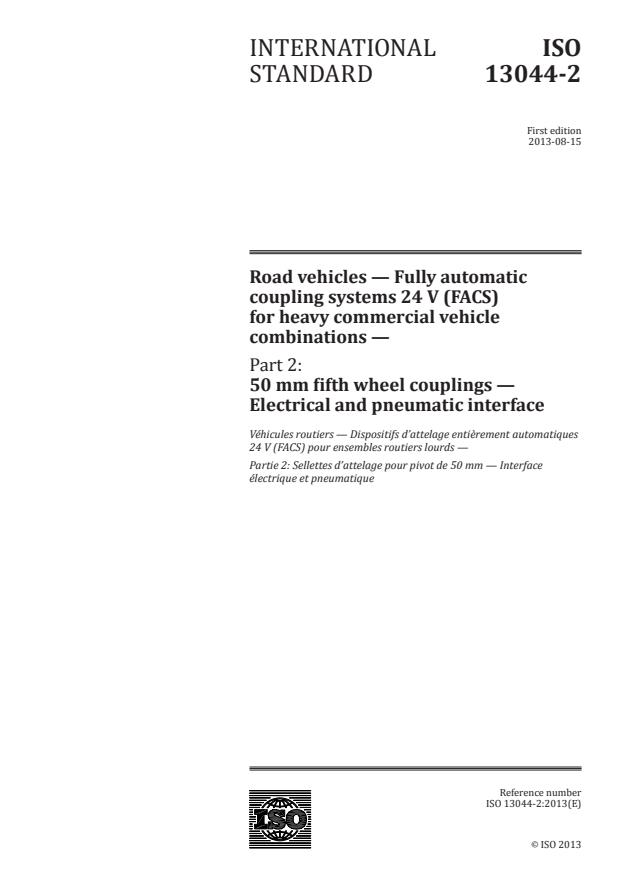
INTERNATIONAL ISO
STANDARD 13044-2
First edition
2013-08-15
Road vehicles — Fully automatic
coupling systems 24 V (FACS)
for heavy commercial vehicle
combinations —
Part 2:
50 mm fifth wheel couplings —
Electrical and pneumatic interface
Véhicules routiers — Dispositifs d’attelage entièrement automatiques
24 V (FACS) pour ensembles routiers lourds —
Partie 2: Sellettes d’attelage pour pivot de 50 mm — Interface
électrique et pneumatique
Reference number
©
ISO 2013
© ISO 2013
All rights reserved. Unless otherwise specified, no part of this publication may be reproduced or utilized otherwise in any form
or by any means, electronic or mechanical, including photocopying, or posting on the internet or an intranet, without prior
written permission. Permission can be requested from either ISO at the address below or ISO’s member body in the country of
the requester.
ISO copyright office
Case postale 56 • CH-1211 Geneva 20
Tel. + 41 22 749 01 11
Fax + 41 22 749 09 47
E-mail copyright@iso.org
Web www.iso.org
Published in Switzerland
ii © ISO 2013 – All rights reserved
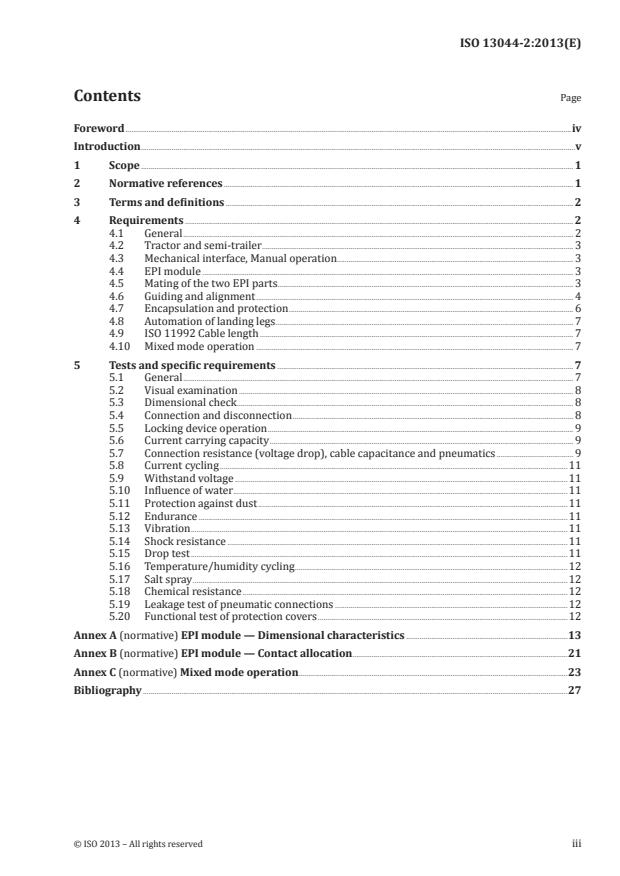
Contents Page
Foreword .iv
Introduction .v
1 Scope . 1
2 Normative references . 1
3 Terms and definitions . 2
4 Requirements . 2
4.1 General . 2
4.2 Tractor and semi-trailer . 3
4.3 Mechanical interface, Manual operation . 3
4.4 EPI module . 3
4.5 Mating of the two EPI parts. 3
4.6 Guiding and alignment . 4
4.7 Encapsulation and protection . 6
4.8 Automation of landing legs . 7
4.9 ISO 11992 Cable length . 7
4.10 Mixed mode operation . 7
5 Tests and specific requirements . 7
5.1 General . 7
5.2 Visual examination . 8
5.3 Dimensional check . 8
5.4 Connection and disconnection . 8
5.5 Locking device operation . 9
5.6 Current carrying capacity . 9
5.7 Connection resistance (voltage drop), cable capacitance and pneumatics . 9
5.8 Current cycling .11
5.9 Withstand voltage .11
5.10 Influence of water .11
5.11 Protection against dust .11
5.12 Endurance .11
5.13 Vibration .11
5.14 Shock resistance .11
5.15 Drop test .11
5.16 Temperature/humidity cycling .12
5.17 Salt spray .12
5.18 Chemical resistance .12
5.19 Leakage test of pneumatic connections .12
5.20 Functional test of protection covers .12
Annex A (normative) EPI module — Dimensional characteristics .13
Annex B (normative) EPI module — Contact allocation .21
Annex C (normative) Mixed mode operation .23
Bibliography .27
Foreword
ISO (the International Organization for Standardization) is a worldwide federation of national standards
bodies (ISO member bodies). The work of preparing International Standards is normally carried out
through ISO technical committees. Each member body interested in a subject for which a technical
committee has been established has the right to be represented on that committee. International
organizations, governmental and non-governmental, in liaison with ISO, also take part in the work.
ISO collaborates closely with the International Electrotechnical Commission (IEC) on all matters of
electrotechnical standardization.
The procedures used to develop this document and those intended for its further maintenance are
described in the ISO/IEC Directives, Part 1. In particular the different approval criteria needed for the
different types of ISO documents should be noted. This document was drafted in accordance with the
editorial rules of the ISO/IEC Directives, Part 2. www.iso.org/directives
Attention is drawn to the possibility that some of the elements of this document may be the subject of
patent rights. ISO shall not be held responsible for identifying any or all such patent rights. Details of
any patent rights identified during the development of the document will be in the Introduction and/or
on the ISO list of patent declarations received. www.iso.org/patents
Any trade name used in this document is information given for the convenience of users and does not
constitute an endorsement.
The committee responsible for this document is ISO/TC 22, Road Vehicles, Subcommittee SC 15,
Interchangeability of components of commercial vehicles and buses.
ISO 13044 consists of the following parts, under the general title Road vehicles — Fully automatic coupling
systems 24 V (FACS) for heavy commercial vehicle combinations:
— Part 1: General requirements and definitions
— Part 2: 50 mm fifth wheel couplings — Electrical and pneumatic interface
iv © ISO 2013 – All rights reserved
Introduction
This International Standard specifies the integrated electrical and pneumatic connections of an
automated fifth wheel coupling system for articulated vehicles and related components.
Fully Automated Coupling Systems improve safety and comfort of vehicle combinations.
a) Higher safety standards
reduction of operational accidents,
less injured drivers because no need for driver to stay in the dangerous zone between the towing and
the towed vehicle while uncoupling.
b) Higher comfort level
Fully Automated Coupling Systems eliminate necessity to access the coupling,
higher comfort makes “Driver-Job” easier and safer,
new components create space for future extensions and potentials.
c) Cost reduction for end user
less inactive periods for the vehicle combination due to less damage and repair,
less repair and maintenance of cables and pipes.
INTERNATIONAL STANDARD ISO 13044-2:2013(E)
Road vehicles — Fully automatic coupling systems 24 V
(FACS) for heavy commercial vehicle combinations —
Part 2:
50 mm fifth wheel couplings — Electrical and pneumatic
interface
1 Scope
This part of ISO 13044 specifies the mechanical, electrical/electronic and pneumatic characteristics of
a fully automated fifth wheel coupling system to ensure interchangeability between a tractor vehicle
and a coupled semi-trailer(s) with 24 V nominal supply voltage. The two vehicles together constitute an
articulated vehicle.
This part of ISO 13044 also supports the smooth introduction of fully automated fifth wheel coupling
systems in the market. It specifies features necessary for mixed mode operation; i.e. the combination of
a fully automated coupling system (FACS) equipped tractor vehicle with a conventional semi-trailer, and
vice versa, the combination of a conventional tractor vehicle with a FACS-equipped semi-trailer.
2 Normative references
The following documents, in whole or in part, are normatively referenced in this document and are
indispensable for its application. For dated references, only the edition cited applies. For undated
references, the latest edition of the referenced document (including any amendments) applies.
ISO 337, Road vehicles — 50 semi-trailer fifth wheel coupling pin — Basic and mounting/interchangeability
dimensions
ISO 1726-1, Road vehicles — Mechanical coupling between tractors and semi-trailers — Part 1:
Interchangeability between tractors and semi-trailers for general cargo
ISO 1726-2, Road vehicles — Mechanical couplings between tractors and semi-trailers — Part 2:
Interchangeability between low-coupling tractors and high-volume semi-trailers
ISO 3833, Road vehicles — Types — Terms and definitions
ISO 3842, Road vehicles — Fifth wheels — Interchangeability
ISO 4009, Commercial vehicles — Location of electrical and pneumatic connections between towing
vehicles and trailers
ISO 4091:2003, Road vehicles — Connectors for the electrical connection of towing and towed vehicles —
Definitions, tests and requirements
ISO 7638-1:2003, Road vehicles — Connectors for the electrical connection of towing and towed vehicles —
Part 1: Connectors for braking systems and running gear of vehicles with 24 V nominal supply voltage
ISO 11992 (all parts), Road vehicles — Interchange of digital information on electrical connections between
towing and towed vehicles
ISO 12098:2004, Road vehicles — Connectors for the electrical connection of towing and towed vehicles —
15-pole connector for vehicles with 24 V nominal supply voltage
ISO 16750-3:2012, Road vehicles — Environmental conditions and testing for electrical and electronic
equipment — Part 3: Mechanical loads
ISO 16750-5:2003, Road vehicles — Environmental conditions and testing for electrical and electronic
equipment — Part 5: Chemical loads
ISO 6150:1988, Pneumatic fluid power — Cylindrical quick-action couplings for maximum working pressures
of 10 bar, 16 bar and 25 bar (1 MPa, 1,6 Mpa, and 2,5 MPa) — Plug connecting dimensions, specifications,
application guidelines and testing
3 Terms and definitions
For the purposes of this part of ISO 13044, the terms and definitions given in ISO 13044-1 and the
following terms and definitions apply.
3.1
fully automated coupling system
FACS
coupling and uncoupling system where all operations, i.e. mechanical, electrical, pneumatic and
applicable auxiliary functions, are performed automatically, enabling the coupling and uncoupling
process to be completed without direct manual intervention
Note 1 to entry: As defined in ISO 13044-1:2012.
3.2
electrical/electronic-pneumatic interface module
EPI module
component, combining all electrical/electronic and pneumatic connections in one mating unit, consisting
of two complementary parts, the EPI plug module and the EPI socket module
3.2.1
EPI plug module
part of the EPI module containing the electric male contacts, pneumatic male connections and the
alignment pins. It is permanently attached to the kingpin side mounted on the semi-trailer
3.2.2
EPI socket module
part of the EPI module containing the electric female contacts, pneumatic female connections and the
alignment sockets. It is permanently attached to the fifth wheel which is mounted to the tractor vehicle
3.2.3
semi-trailer
towed vehicle which is designed to be coupled to either a towing vehicle or to a dolly axle, and to impose
a substantial vertical load either on the towing vehicle or on the dolly axle
3.2.4
alignment device
device placed on the trailer-side, which makes contact to the 5th wheel throat during the coupling
process and centres the EPI plug relative to the EPI socket
4 Requirements
4.1 General
In order to guarantee best functionality, comfort and safety, the use of FACS is recommended in
combination with spring-brake equipped semi-trailers only. FACS does not exonerate the driver from
ensuring the semi-trailer is correctly parked before coupling or uncoupling.
2 © ISO 2013 – All rights reserved
In order to guarantee best functionality, comfort and safety, the use of FACS is recommended in
combination with adjustable air-suspension on the rear axle equipped trucks only.
In the case of coupling systems that are not fully automatic, but utilize an automatic electro-pneumatic
interface, this interface shall comply with the requirements specified within this International Standard.
4.2 Tractor and semi-trailer
In order to ensure interchangeability between tractor vehicles and semi-trailers, the requirements of
ISO 3842 and ISO 1726-1 or ISO 1726-2 shall be met for vehicles to be equipped with FACS.
4.3 Mechanical interface, Manual operation
Fifth wheels installed on FACS-equipped tractor vehicles shall comply with the requirements of
ISO 3842. Fifth wheel coupling pins (king pins) installed on FACS-equipped semi-trailers shall comply
with the requirements of ISO 337. In the event of a failure of the remote control it shall be possible, in an
emergency, to open the coupling in at least one other way. If this requires the use of a tool then this shall
be included in the vehicle’s tool kit. Any manual operation shall not lead to any damages or malfunction
of the system components.
NOTE For fifth wheel versions with a throat angle other than 40° (e.g. 52°) optional versions would be allowed
under the condition that the alignment device (Figure 2, key 2 or Figure 1, key 2) would use a corresponding
angle. In this case the interchangeability will only be ensured within the individual version.
4.4 EPI module
4.4.1 EPI plug modules and EPI socket modules in accordance with this Standard shall provide the
following electrical connections with 24 V nominal supply voltage:
− 7 poles for the electrical connection of the braking systems and running gear (incl. 2 poles for
the CAN based communication compliant to ISO 11992-1 and −2);
− 23 poles for the electrical connection of equipment other than braking systems and running gear
(incl. 2 poles for the CAN-based communication compliant to ISO 11992-1 and −3);
The dimensional characteristics and location of the EPI module shall be in accordance with the
specifications of Annex A. Number, location and functionality shall be in accordance with the
specifications of Annex B. Electrical contacts shall only be used as specified.
CAUTION — Using the electrical contacts for non-specified purposes (including ground) may
cause damage to equipment. Any deviation from the contact allocation specified in Table 1 is not
allowed. However, depending on legislation and customer demand, only some of the 30 electrical
contacts may be required.
4.4.2 EPI plug modules and EPI socket modules in accordance with this International Standard shall
provide connections for the following two pneumatic braking lines:
− one control line;
− one supply line;
The dimensional characteristics of the pneumatic connections shall be in accordance with the
specifications of Annex A.
4.5 Mating of the two EPI parts
The mating of the EPI plug module and the EPI socket module shall be connected automatically during
the coupling process as illustrated in Annex A, Figure A.1.
4.6 Guiding and alignment
4.6.1 General
The guiding and alignment of the EPI module shall be made by a rigid alignment pin in the middle plus
two outer pins, which are preferably “self-aligning” designed to provide low forces during EPI mating;
see Annex A, Figure A.5. Each of the outer alignment pins shall have sufficient elasticity to permit a
maximum of 2 mm deflection in any direction relative to the longitudinal axis of the central alignment
pin. The deflection force shall be in the range from 50 N to 200 N.
The central alignment pin shall have the ability to align both EPI parts within a range ± 5 mm in both
horizontal and vertical directions. The two outer pins shall ensure the parallel orientation of both EPI
parts for connection alignment.
The positional tolerance between the contact surface of the alignment device and the fifth wheel shall
be a maximum of ± 2 mm, according to Figure 1.
Dimensions in millimetres
Key
1 Fifth wheel
2 Alignment device (movable in length direction, shown in contact position, see Figure 2)
3 EPIcentral alignment socket
Figure 1 — EPI female module positioning tolerance (displaced shown)
4 © ISO 2013 – All rights reserved
Dimensions in millimetres
Key
1 King pin
2 Alignment device (movable in length direction, shown in two positions)
3 EPI central alignment pin
Figure 2 — EPI male module positioning tolerance (displaced shown)
4.6.2 Installation requirements of tractor-mounted EPI module
4.6.2.1 Linear degree of freedom in the longitudinal direction of alignment pin:
4.6.2.1.1 No actuator: Displaceable from 0 to a minimum of 30 mm [s2, as shown in Figure A.2
C)], preloaded with a force between 250 N to 500 N (as both pneumatic lines are under pressure) when
uncoupled, achieved by means of either elastic elements or other stored energy. With the FACS coupled
the EPI socket module will be pushed forward by s1 = 15 mm [see Figure A.2 B)] which is the nominal
position. In the coupled position, a movement as described above shall be possible, without the EPI
modules being disconnected or damaged.
4.6.2.1.2 With actuator: The actuator shall move the EPI socket by at least the range described
in 4.6.2.1.1.
4.6.2.2 Linear degree of freedom in the lateral direction: essentially fixed.
4.6.2.3 Linear degree of freedom in the vertical direction: essentially fixed.
4.6.2.4 Rotational degree of freedom around the longitudinal axis of EPI tractor alignment socket:
essentially fixed.
4.6.2.5 Rotational degree of freedom around the lateral articulation axis: from horizontal to a minimum
of 12° [EPI module upwards, see Figure A.2 b)].
4.6.2.6 Rotational degree of freedom around the vertical axis: essentially fixed.
4.6.3 Installation requirements of semi-trailer-mounted EPI module
4.6.3.1 Linear degree of freedom in the longitudinal direction of the alignment pin: fixed.
4.6.3.2 Linear degree of freedom in the lateral direction: essentially fixed.
4.6.3.3 Linear degree of freedom in the vertical direction: essentially fixed.
4.6.3.4 Rotational degree of freedom around the longitudinal axis of the truck alignment pin: ± 2°.
4.6.3.5 Rotational degree of freedom around the lateral axis: ± 2°.
4.6.3.6 Rotational degree of freedom around the vertical axis: ±100
...
Questions, Comments and Discussion
Ask us and Technical Secretary will try to provide an answer. You can facilitate discussion about the standard in here.
Loading comments...