


ISO/IEC 10733:1993
(Main)Information technology — Telecommunications and information exchange between systems — Elements of management information relating to OSI Network Layer standards
Information technology — Telecommunications and information exchange between systems — Elements of management information relating to OSI Network Layer standards
Technologies de l'information — Télécommunications et échange d'informations entre systèmes — Éléments d'information de gestion relatifs à la structure de la couche OSI réseau
General Information
- Status
- Withdrawn
- Publication Date
- 19-May-1993
- Withdrawal Date
- 19-May-1993
- Current Stage
- 9599 - Withdrawal of International Standard
- Start Date
- 20-Dec-1998
- Completion Date
- 12-Feb-2026
Relations
- Effective Date
- 06-Jun-2022
- Effective Date
- 06-Jun-2022
- Effective Date
- 06-Jun-2022
- Effective Date
- 06-Jun-2022
- Effective Date
- 15-Apr-2008
- Effective Date
- 15-Apr-2008
- Effective Date
- 15-Apr-2008
- Effective Date
- 15-Apr-2008

Get Certified
Connect with accredited certification bodies for this standard

BSI Group
BSI (British Standards Institution) is the business standards company that helps organizations make excellence a habit.

NYCE
Mexican standards and certification body.
Sponsored listings
Frequently Asked Questions
ISO/IEC 10733:1993 is a standard published by the International Organization for Standardization (ISO). Its full title is "Information technology — Telecommunications and information exchange between systems — Elements of management information relating to OSI Network Layer standards". This standard covers: Information technology — Telecommunications and information exchange between systems — Elements of management information relating to OSI Network Layer standards
Information technology — Telecommunications and information exchange between systems — Elements of management information relating to OSI Network Layer standards
ISO/IEC 10733:1993 is classified under the following ICS (International Classification for Standards) categories: 35.100.30 - Network layer. The ICS classification helps identify the subject area and facilitates finding related standards.
ISO/IEC 10733:1993 has the following relationships with other standards: It is inter standard links to ISO 9241-9:2000, ISO/IEC 10733:1993/Amd 1:1996, ISO/IEC 10733:1993/Cor 2:1996, ISO/IEC 10733:1993/Cor 3:1997, ISO/IEC 10733:1998; is excused to ISO/IEC 10733:1993/Cor 3:1997, ISO/IEC 10733:1993/Amd 1:1996, ISO/IEC 10733:1993/Cor 2:1996. Understanding these relationships helps ensure you are using the most current and applicable version of the standard.
ISO/IEC 10733:1993 is available in PDF format for immediate download after purchase. The document can be added to your cart and obtained through the secure checkout process. Digital delivery ensures instant access to the complete standard document.
Standards Content (Sample)
I NTERNAT I O NA L
ISO/IEC
STANDARD
First edition
1993-06-01
Information technology -
Telecommunications and information
exchange between systems - Elements
of management information related to OS1
Network Layer standards
Technologies de l'information - Télécommunications et échange
d'informations entre systèmes - Éléments d'information de gestion
relatifs à la structure de la couche OS1 réseau
Reference number
O ISO/IEC
ISQ/IEC 10733:1993 (E)
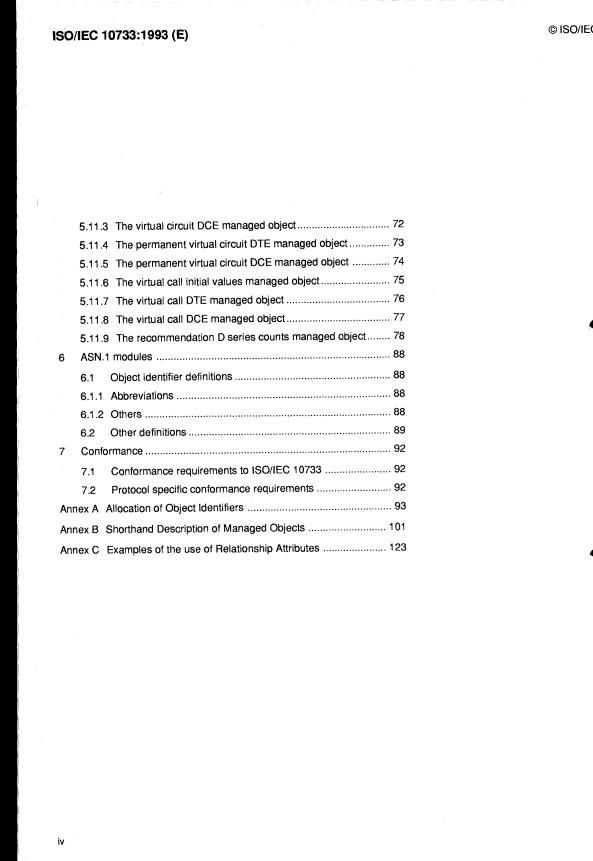
5.1 1.3 The virtual circuit DCE managed object . 72
5.1 1 . 4 The permanent virtual circuit DTE managed object . 73
5.1 1.5 The permanent virtual circuit DCE managed object . 74
5.1 1 . 6 The virtual call initial values managed object . 75
5.1 1 . 7 The virtual call DTE managed object . 76
5.1 1 . 8 The virtual call DCE managed object . 77
5.1 1.9 The recommendation D series counts managed object . 78
6 ASN.l modules . 88
6.1 Object identifier definitions . 88
..........................................................................
6.1 . 1 Abbreviations 88
6.1 . 2 Others . 88
6.2 Other definitions . 89
7 Conformance . 92
Conformance requirements to ISO/IEC 10733 . 92
7.1
Protocol specific conformance requirements . 92
7.2
Annex A Allocation of Object Identifiers . 93
Annex B Shorthand Description of Managed Objects . 101
Annex C Examples of the use of Relationship Attributes . 123
iv
I EC
ISOAEC 10733:1993 (E)
Foreword
IS0 (the International Organization for Standardization) and IEC (the Inter-
national Electrotechnical Commission) form the specialized system for
worldwide standardization. National bodies that are members of IS0 or
IEC participate in the development of International Standards through
technical committees established by the respective organization to deal
with particular fields of technical activity. IS0 and IEC technical com-
mittees collaborate in fields of mutual interest. Other international organ-
izations, governmental and non-governmental, in liaison with IS0 and IEC,
also take part in the work.
In the field of information technology, IS0 and IEC have established a joint
technical committee, ISO/IEC JTC 1. Draft International Standards adopted
by the joint technical committee are circulated to national bodies for vot-
ing. Publication as an International Standard requires approval by at least
75 % of the national bodies casting a vote.
International Standard ISO/IEC 10733 was prepared by Joint Technical
Committee ISO/IEC JTC 1, lnformation technology, Sub-committee SC 6,
Telecommunications and information exchange between systems.
Annex A forms an integral part of this International Standard. Annexes B
and C are for information only.
O ISO/IEC
ISO/IEC 1 üJ33:1993 (E)
Introduction
This document is one of a set of International Standards produced to facilitate the
interconnection of open systems. The set of International Standards covers the
services, protocols and management information required to achieve such intercon-
nection.
This International Standard is positioned with respect to other related International
Standards by the layers defined in the Reference Model for Open System Intercon-
nection (IS0 7498). In particular, it is concerned with the definition of Network
Layer management information.
vi
ITERNATIONAL STANDARD 0 ISOiIEC ISOllEC 10733:1993 (E)
iformation technology - Telecommunications and
iformation exchange between systems - Elements
If management information related to OS1 Network
,ayer standards
Scope
mis Intemational Standard provides the specification of management information within an Open System related to those op-
ations of the OS1 Network Layer specified by CCITT Recommendations and International Standards. Specifics on how Net-
ork layer management is accomplished is beyond the scope of this document. Network Layer management information is
:fined by specifying:
- the managed object class definition of Network Layer Managed Objects following guidelines put forth by the Structure of
Management Information (ISO/IEC 10165 and CCITT Recommendations X.720 - X.723),
- the relationship of the Managed Objects and attributes to both the operation of the layer and to other objects and attributes
of the layer, and
-
the action type operations on the attributes of Network Layer Managed Objects that are available to OS1 Systems Manage-
ment.
Normative references
he following CCITT Recommendations and International Standards contain provisions which, through reference in this text,
mtitute provisions of this International Standard. At the time of publication, the editions indicated were valid. Ail Recom-
endations and Standards are subject to revision, and parties to agreements based on this International Standard are encouraged
1 investigate the possibility of applying the most recent editions of the Recommendations and Standards listed below. Mem-
:rs of IEC and IS0 maintain registers of currently valid Intemational Standards. The CCITT Secretariat maintains a list of the
irrently valid CCITT Recommendations.
.1 Identical WITT Recommendations I International Standards
CI?T Recommendation X.213 (1992) ISOAEC 8348 : 1993. Information technology - Open Systems Intercorinection -
etwork Service Definition.
CITï Recommendation X.701 (1992) ISOfiEC 10040 : 1992, Information technology - Open Systems Interconnection -
vstems management overview.
CITï Recommendation X.720 (1992)
iSO/IEC 10165-1 : 1993, Information technology - Open Systems interconnection -
'ructure of management information : Management information model.
CIïT Recommendation X.721 (1992) I ISODEC 10165-2 : 1992, Information technology - Open Systems Interconnection -
tructure of management information : Definition of management information.
CITï Recommendation X.722 (1992) I ISO/IEC 10165-4 : 1992, Information technology - Open Systems Interconnection -
of management information : Guidelines for the definition of managed objects.
CITï Recommendation X.723 (1992) I ISOfiEC 10165-5 : 1993, Information technology - Open Systems Interconnection -
of management information : Generic management information.
CITï Recommendation X.730 (1992) I ISO/IEC 10164-1 : 1993, Information technology - Open Systems Interconnection -
: Object management function.
ISOIIEC 10733:1993 (E) O ISO/IEC
CCIïT Recommendation X.731 (1992) I ISO/EC 10164-2 : 1993, Information technology - Open Systems Interconnection
- Systems Management : State management function.
CCIïT Recommendation X.732 (1992) I ISO/lEC 10164-3 : 1993, Information technology - Open Systems Interconnection
- Systems Management : Attributes for representing relationships.
CCIïT Recommendation X.733 (1992) I ISO/iEC 10164-4 : 1992, Information technology - Open Systems Interconnection
- Systems Management : Alarm reporting function.
CCIïT Recommendation X.734 (1992) I ISO/IEC 10164-5 : 1993, Information technology - Open Systems Interconnection
- Systems Management : Event report management function.
2.2 Paired CCITT Recommendations I International Standards equivalent in
technical content
CCIïT Recommendation X.25 (1988), Interface between data terminal equipment (DTE) and data circuit-terminating equip-
ment (DCE) for terminals operating in the packet mode and connected to public data networks by dedicated circuit.
ISO/IEC 8208 : 1990, Information technology - Data communications - X.25 Packet Layer Protocol for Data Terminal
Equipment.
CCIïT Recommendation X.200 (1988), Reference Model of Open Systems Interconnection for CCIïT Applications.
IS0 7498 : 1984, Information processing systems - Open Systems Interconnection - Basic Reference Model.
CCIïT Recommendation X.208 (1988), Spec@cation of abstract syntax notation one (ASN.1).
ISO/IEC 8824 : 1990, Information technology - Open Systems Interconnection - Specification of the Abstract Syntax Nota-
tion One (ASN.1).
CCIïT Recommendation X.223 (1988), Use of X.25 to Provide the OSI Connection-mode Network Service for CCITT Appli-
cations.
ISOliEC 8878 : 1991, Information technology - Telecommunications and information exchange between systems - Use of
X.25 to provide the OSI Connection-mode Network Service.
CCIïT Recommendation X.700', Management Framework for Open Systems Interconnection for CCIïT Applications.
ISODEC 7498-4 : 1989, Information processing systems - Open Systems Interconnection -Basic Reference Model - Part
4: Management framework.
CCIïT Recommendation X.7 10 (199 1), Common Management Information Service Definition for CCITT Applications.
ISO/IEC 9595 : 199 1 :, Information technology - Open Systems Interconnection - Common management information service
definition.
CCITT Recommendation X.7 11 (199 1), Common Management Information Protocol Specification for CCITT Applications.
ISO/EC 9596-1 : 1991, Information technology - Open Systems Interconnection - Common management information proto-
col - Part I: Specification.
2.3 Additional references
IS0 8473 : 1988, Information processing systems - Data communications - Protocol for providing the Connectionless-mode
network service.
IS0 8648 : 1988, Information processing systems - Open Systems Interconnection - Internal organization of the Network
Layer.
'Presently at the state of draft Recommendation
1 ; 1990, Information technology - Telecommunications and information exchange between systems - Proto-
s to provide and support the OSI Network Service -Part 1 : General principles,
0-2 ; 1990, Information technology - Telecommunications and information exchange between systems - Proto-
ions to provide and support the OSI Network Service - Part 2: Provision and support of the connection-mode
; 1990, Information technology - Telecommunications and information exchange between systems - Proto-
and support the OSi Network Service - Part 3: Provision and support of the connectionless-
Information processing systems - Data communications - Use of the X.25 packet level protocol in
mation processing systems - Telecommunications and information exchange between systems - End
m routeing exchange protocol for use in conjunction with the protocol for providing the
Service (IS0 8473).
9571 ; 1990, Information technology - Telecommunications and information exchange between systems - Protocol
ation in the Network Layer.
Information technology - Telecommunications and information exchange between systems - End
routeing information exchange protocol for use in conjunction with IS0 8878.
C 10177 : 1993, Information technology - Data communications - Intermediate system support of the OSI
tion-mode network service using ISO/IEC 8208 in accordance with ISOIIEC I0028.
Information technology - Telecommunications and information exchange between systems - Inter-
ediate system intra-domain routeing information exchange protocol for use in conjunction with the
connectionless-mode Network Service (IS0 8473).
D. 10, General tariff principles for international public data networks.
D.11, Special tariff principles for international packet-switched public data communication services
eans of the virtual call facility.
Recornmendation D. 12, Measurement unit for charging by volume in the international packet-switched data communi-
E.164, The numbering plan for the ISDN era.
ITT Recommendation X.2 (1988), International data transmission services and optional user facilities in public data net-
,diTF Recommendation X. 121 (1988), International numbering plan for public data networks.
3 Definitions
Basic reference model
3.1
Tkis International Standard makes use of the following terms defined in IS0 7498.
:) Open System
il) (N)-Service Access Point
c) Network Layer
d) Network Protocol
(5) Layer Management
O ISO/IEC
ISOAEC 10733:1993 (E)
f) Systems Management
3.2 Information model
This International Standard makes use of the following terms defined in ISO/IEC 10165-1.
a) Attributes
b) Attribute Type
c) Containment
d) Distinguished Name
e) Inheritance
f) ManagedObject
g) Management Operations
h) Notifications
i) Object Class
j) Relative Distinguished Name
k) Subclass
1) Superclass
3.3 GDMO
This International Standard makes use of the following terms defined in ISO/IEC 10165-4.
a) Managed Object Class Definition
b) Template
c) Parameter
3.4 Management framework
This International Standard makes use of the following terms defined in ISO/IEC 7498-4.
a) Management Information
4 Symbols and abbreviations
Within the Managed Object definitions and GDMO templates the following abbreviations are used in the standard-name ele-
ment of a document-identifier when making references to other documents.
DMI CCITT RE. X.721(1992) I ISO/IEC 10165-2 : 1992
RE. X.723 I ISO/IEC 10165-5
GMI CCITT
This International Standard makes use of the following symbols and abbreviations.
BCUG Bilateral Closed User Group
CLNP Connectionless-mode Network Protocol
CLNS Connectionless-mode Network Service
CMIP Common Management Information Protocol
Common management Information Service Definition
CMIS
Closed user Group
End System >
End System Hello
Error Report Protocol Data Unit
Intermediate System
Intermediate System Hello
Initial Values Managed Object
Logical Channel Number
Managed Object
Network Service Access Point
Network Service Element
Network User Identification
Packet Layer Entity
Permanent Virtual Circuit
Redirect Protocol Data Unit
Relative Distinguished Name
Subnetwork Dependent Convergence Function
Subnetwork Point of Attachment
Virtual Call
vr
5 Elements of network layer management information
5.1 Managed object hierarchy
5.1.1 Summary of managed objects
:'he following set of managed object classes are defined for the OS1 Network Layer:
a) The network subsystem managed object (see 5.3).
b) The network entity managed object (see 5.4).
c) The NSAP managed object (see 5.5).
d) The connectionless-mode network service managed object (see 5.6).
e) The linkage managed object (see 5.7).
f) The connection-mode network service managed object (see 5.8).
I
g) The network connection managed object (see 5.9).
h) The X25 PLE DTE managed object (see 5.10.3).
i) The X.25 PLE DCE managed object (see 5.10.4).
j) The X.25 PLE DTE initial values managed object (see 5.10.5).
I
k) The X.25 PLE DCE initial values managed object (see 5.10.6).
1) The permanent virtual circuit DTE managed object (see 5.1 1.4).
m) The permanent virtual circuit DCE managed object (see 5.1 1.5).
n) The virtual call initial values managed object (see 5.1 1.6).
O) The virtual call DTE managed object (see 5.1 1.7).
p) The virtual call DCE managed object (see 5.11.8).
O ISO/IEC
ISO/CEC 10733:l 993 (E)
q) The recommendation D series counts managed object (see 5.1 1.9).
The following Managed Object classes are never instantiated, but exist only for the purposes of deriving subclasses.
a) The X.25 PLE managed object (see 5.10.1).
b) The X.25 PLE initial values managed object (see 5.10.2).
c) The virtual circuit managed object (see 5.1 1.1).
d) The virtual circuit DTE managed object (see 5.1 1.2).
e) The virtual circuit DCE managed object (see 5.11.3).
These Managed Objects represent OS1 Management’s view of those elements of an Open System which support the OS1 Net-
work Service subject to OS1 management operations.
5.1.2 Containment hierarchy
The containment hierarchy is illustrated in figure 1. Managed Objects which can have multiple instances are illustrated by
shadowed (multiple) boxes. These objects are defined in detail in the following clauses of this International Standard.
a.
-2,
-.
-.
P
‘.
....................
..................... .:
:: ::
linkage $[ -.
:: <:
ii 2
....................
....................
..
.....................................
..
..
..
..
.‘
.-
I
I I I
.*
..
..
..
..
.*
.*
.*
..
.*
..
....................................................................................... ..
Figure 1 - Network Layer Containment Hierarchy
TI
I networksubsystem MO is subordinate to the system MO. The x25PLE MO and IVMOs are examples of what are termed
‘I IPA’ MOs. The ‘SNPA’ MOs are subnetwork specific MOs. It is expected that there will in future be a number of addi-
tic
ial ‘SNPA’ MOs, for example for ISDN.
T : ‘SNPA’ MO is concerned with the protocol used to access a subnetwork. For example, there is an ‘SNPA’ MO corre-
nding to each X.25 Packet layer entity. The cLNS MO is concerned with the functions of the CLNS protocols (IS0 8473,
SI
IL ) 9542 and ISODEC 10589) which apply to the general operation of the protocol as a whole rather than being specifically
re
ited to individual points of attachment, whereas the linkage MO applies to the subnetwork dependent convergence func-
tit IS. The CONS MO and its associated linkage MOs apply similarly to protocols associated with CONS (ISODEC 8878,
I! )DEC 9574, IS0 10030, ISO/IEC 10177 etc.)
F the requirements regarding which MOs in the containment tree shall be instantiated for a conforming implementation see
tt of the conformance statement.
applicable clauses
O ISO/IEC
ISOAEC 10733:1993 (E)
5.1.3 Relationships
5.1.3.1 General
The following clauses describe the individual relationships. The use of relationship attributes is illustrated by examples in An-
nex C.
5.1.3.2 Linkage
There is a relationship (sN-ServiceProvider and sN-SAP both pointing to the same MO) between linkage MOs and ‘SNPA’
MOs. For example, a linkage concerned with the operation of the IS0 8473 SNDCF for X.25 has a relationship with an
x25PLE-DTE MO. A linkage has a relationship identifying only one ‘SNPA’, so in the case of a network entity containing one
IS0 8473 protocol machine operating over a number of X.25 Packet Layer Entities, there would be a number of linkage MOs,
each related to a different x25PLE-DTE MO. But although one linkage is related to only one ‘SNPA’, it is possible for a num-
ber of other linkages to be related to the same ‘SNPA’; for example, there could be CONS Linkages and cLNS linkages both
using the same x25PLE-DTE and therefore the same ‘SNPA’ MO.
In some cases of network layer operation there is no specific access protocol; for example, IS0 8473 contains an SNDCF for
use over the data link service directly. In such cases, the linkage has relationships (sN-Serviceprovider and sN-SAP pointing to
different MOs), not to an ‘SNPA, but to appropriate MOs in the Data Link Layer.
5.1.3.3 NSAPs
There is a relationship (1ocalSAPNames) between a networkEntity MO and an nSAP MO. Each nSAP MO is related to only
one networkEntity, although one networkEntity may be related to several nSAP MOs.
5.1.3.4 Layer n+l clients
The nSAP MO has a set of relationships (userEntityName) to Layer n+l clients (typically the Transport Layer Entity). The
Transport Layer Entity has a relationship (actualNSAP) to the nSAP MO.
5.1.3.5 Layer n-1 services
Both the linkage and x25PLE MOs have relationships (sN-ServiceProvider and sN-SAP) to the appropriate Data Link Layer
MOs.
5.1.3.6 Connections
There is a relationship (underlyingConnectionNames) between a transportConnection MO and its underlying
networkconnection MO (if one exists), and between the networkConnection MO and the underlying virtualCal1-DïE MO.
The relationship between the virtualcall-DTE MO and any underlying Datalink Layer MO is implicitly available as a result of
the parent x25PLE-DTEi or x25PLE-DCE MOs relationships to the Data Link Layer, as described above.
In addition there is a relationship (1ocaiNSAPMO) from the networkConnection MO to the corresponding nSAP MO.
5.1.4 Minimum event filtering capabilities
The network layer management definitions embodied in this International Standard imply the frequent, and possibly excessive,
generation of notifications during regular layer operation. These notifications are especially useful for effective fault manage-
ment, where they facilitate the tracing and pinpointing of error situations. To avoid the excessive dissemination of these event
reports under normal operating conditions, it is advisable for a managed system to have, as a minimum, the capability to per-
form discrimination based upon:
a) The source managed object class
b) The object identifier values in the probable cause and specific problems field of communication alarms, and the commu-
nication type field communication informations.
5.1.5 Use of optional fields
Where reference is made in this Intemational Standard to ASN.l syntax defined in Rec. X.723 I ISODEC 10165-5 or Rec.
X.721 I ISO/iEC 10165-2, only the following fields shall be employed:
ÇO/I EC ISO/IEC 10733:1993 (E)
) those which are not OPTIONAL in the ASN.1 syntax;
) those which are OPTIONAL, but whose use is explicitly required by this International Standard;
) those which are OPTIONAL, but whose ASN.l type is SET OF Managemenaxtension.
: use of any other fields is prohibited.
O ISOAEC
ISOAEC 10733:1993 (E)
5.2 Common behaviour templates
commonCreationDeletion-B BEHAVIOUR
DEFINED AS
!Managed object class imports the ISODEC 10165-2 objectcreation and
objectDeletion notifications. Used as follows:
objectcreation - Generated whenever an instance of the managed
object class is created. Implementations may optionally
include the sourceIndicator parameter in the notification.
If creation occurred as a result of internal operation of
the resource, the value 'resourceoperation' is used. If
creation occurred in response to a management operation, the
value 'managementOperation' is used. A value of 'unknown'
may be returned if it is not possible to determine the source
of the operation. None of the other optional parameters are used.
objectDeletion - Generated whenever an instance of the managed
object class is deleted. Implementations may optionally
include the sourceIndicator parameter in the notification.
If deletion occurred as a result of internal operation of
the resource, the value 'resourceOperation' is used. If
deletion occurred in response to a management operation, the
value 'managementoperation' is used. A value of 'unknown'
may be returned if it is not possible to determine the source
of the operation. None of tbe other optional parameters are used.!;
commonStateChange-B BEHAVIOUR
DEFINED AS
!Managed object class imports the ISO/iEC 10165-2 statechange notification.
Used to report the changes to the operationalstate attribute, and
where present, the administrativestate attribute. A
single parameter set is included in the State change definition field.
Only the (mandatory) attributeId and (optional) newAttributeValue
parameters are used.!;
octetsSentReceivedCounter-B BEHAVIOUR
DEFINED AS
The octetsSentCounter and octetsReceivedCounter shall count
only user data octets in valid data packets. They shall not count user data octets
in data packets which are rejected for any reason, nor user data octets in non data packets;
successfulConnectionEstablishment-B BEHAVIOUR
DEFINED AS
This Package imports the communicationsInformation
notification from "GMI".
It is used to report the following events.
successfulConnectionEstablishment: Generated when a
connection is successfully established. However, the precise
synchronization between the notification and the corresponding
protocol and service interface interactions is not defined
by this Specification.
The value NLM.successfulConnectionEstab1ishment shall be
reported in the informationType field.;
O/I EC
tivateconnection-B BEHAVIOUR
IEFINED AS
The Deactivate action causes the connection to be terminated. The
termination should occur as rapidly as practical, but no particular
time constraints are implied. Typically, this action simulates a
disconnect request received across the service interface. If a more
rapid means for terminating the connection exists, then this should
be used. The termination shall occur in conformance to the protocol
standard. The Managed Object remains in existence after completion
of the Deactivate action. It is subsequently deleted when the
connection is terminated, in the same way as if the connection has
been terminated by other means. A deactivate action may fail (with the
FYocessingError response) if it is temporarily not possible to
terminate the connection.;
.tingTimer-B BEHAVIOUR
IEFINED AS
This atmbute specifies the interval between certain events
in the operation of the protocol state machine. If the value of this
attribute is changed to a new value while the protocol state machine
is in operation, the implementation shall take the necessary steps
to ensure that for any time interval which was in progress when the
corresponding attribute was changed, the next expiration of that
interval takes place no later than the expiration of the interval in
progress or the specified interval whichever is the sooner. The
precision with which this time shall be implemented shall be the
same as that associated with the basic operation of the timer
attribute:
O ISO/IEC
ISO/IEC 1 û733:1993 (E)
5.3 The network subsystem managed object
-- Managed Object for Network Layer Subsystem
_-
-- There is exactiy one of these MOs within a system. It exists to provide a container for the
-- Network Entity MOs, nSAP MOs and the 'SNPA' MOs.
--
-- The networksubsystem managed object can not be created or deleted
-- explicitly by management operation. It exists inherently in a system;
-- created and deleted as part of system operation.
__
networksubsystem MANAGED OBJECT CLASS
DERIVED FROM "GMI'hubsystem;
CHARACTERIZED BY networksubsystem-P PACKAGE
ATTRIBUTES
"GM1":subsystemId
NLM.networkSubsystemId-Value
INITIAL VALUE
GET;
..
>>
REGISTERED AS { NLM.moi networksubsystem (1)) ;
-- Name Bindings
networksubsystem-system NAME BINDING
SUBORDINATE OBJECT CLASS networksubsystem AND SUBCLASSES;
NAMED BY
SUPERIOR OBJECT CLASS "DM1":system AND SUBCLASSES;
WITH ATTRIBUTE "GM1":subsystemId;
REGISTERED AS {NLM.nboi networksubsystem-system (1)) ;
;O/IEC ISOllEC 10733:1993 (E)
4 The network entity managed object
There may be multiple instances of these MOs within a system.
Its definition permits it to be deleted and created explicitly by
management operation, or to be created and deleted automatically
as part of system operation.
workEntity MANAGED OBJECT CLASS
DERIVED FROM "GM1":communicationsEntity;
CHARACTERIZED BY networkEntity-P PACKAGE
BEHAVIOUR commonCreationDeletion-B;
ATTRIBUTES
networkEntity Titles
GET-REPL ACE
ADD-REMOVE,
systemTypes GET;
NOTIFICATIONS
"DMI":objectDeletion,
"DM1":objectCreation;
..
9,
GISTERED AS {NLM.moi networkEntity (22));
Name Bindings
workEntity-networkSubsystem-Automatic NAME BINDING
SUBORDINATE OBJECT CLASS networkEntity AND SUBCLASSES;
NAMED BY
SUPERIOR OBJECT CLASS networkSubsystem AND SUBCLASSES;
WITH ATTRIBUTE "GM1":communicationsEntityId;
BEHAVIOUR networkEntity-networkSubsystem- Automatic-B BEHAVIOUR
DEFINED AS This name binding shall be used when the
networkEntity MO is created automatically by the operation
of the system. The details of these operations are outside
of this Specification.;;
the scope
GISTERED AS (NLM.nboi networkEntity-networkSubsystem-Automatic (27)) ;
workEntity-networkSubsystem-Management NAME BINDING
SUBORDINATE OBJECT CLASS networkEntity AND SUBCLASSES;
NAMED BY
SUPERIOR OBJECT CLASS networkSubsystem AND SUBCLASSES;
WITH ATTRIBUTE "GM1":communicationsEntityId;
BEHAVIOUR networkEntity-networkSubsystem-Management-B BEHAVIOUR
DEFINED AS This name binding shall be used when the
networkEntity MO is created automatically by system management.
,9
CREATE;
DELETE;
GISTERED AS [ NLM.nboi networkEntity-networkSubsystem-Management (28)) ;
SO/lEC
ISOAEC 10733:1993 (E)
i The NSAP managed object
There is one nSAP MO for each set of NSAPs supported by the Network Subsystem
associated with a single Transport layer client.
Each NSAP MO corresponds to a set of one or more NSAPs
supported by the Network Subsystem.
nSAP MO,
There is not more than one Transport layer client associated with a single
nSAP MO, and corresponding sets of NSAPs,
but there may be more than one
associated with a single Transport layer client.
Its definition permits it to be created and deleted explicitly by
management operation or to be created and deleted automatically as
part of system operation.
iP MANAGED OBJECT CLASS
DERIVED FROM"GMI":sap2;
CHARACTERIZED BY nSAP-P PACKAGE
BEHAVIOUR commonCreationDeletion-B;
ATTRIBUTES
"GMI": sap2Address
INITIAL VALUE DERIVATION RULE nAddressesIV-B
GET;
NOTIFICATIONS
"DMI":objectDeletion,
"DMI" :objectcreation;
>>
3ISTERED AS {NLM.moi nSAP (4));
Behaviours
IdressesIV-B BEHAVIOUR
DEFINED AS If the package is created using the nSAP-networksubsystem-Automatic
name binding the initiai value of this attribute is not constrained by this
Specification. However, if the package is created using the
nSAP-networksubsystem-Management name binding the initial value shall
be specified in the CMP create;
Name Bindings
LP-networksubsystem-Automatic NAME BINDING
SUBORDINATE OBJECT CLASS nSAP AND SUBCLASSES:
NAMED BY
SUPERIOR OBJECT CLASS networksubsystem AND SUBCLASSES;
WITH ATTRIBUTE "GM1":sapId;
BEHAVIOUR nSAP-networksubsystem-Automatic-B BEHAVIOUR
DEFINED AS This name binding shall be used when the nSAP MO is created automatically by the
operation of the network entity. For example, by the use of autoconfiguration or dynamic
NSAP Address assignment techniques. The details of the operation of these techniques are
outside the scope of this Specification.;;
JISTERED AS (NLM.nboi nSAP-networksubsystem-Automatic (4)) ;
O ISO/IEC
ISOAEC 10733:1993 (E)
nS AP-networkSubsystem-Management NAME BINDING
SUBORDINATE OBJECT CLASS nSAP AND SUBCLASSES;
NAMED BY
SUPERIOR OBJECT CLASS networkSubsystem AND SUBCLASSES;
WITH ATTRIBUTE "GM1":sapId;
BEHAVIOUR nSAP-networkSubsystem-Management-B BEHAVIOUR
DEFINED AS This name binding shall be used when the nSAP MO is created by system management.
The value of the sap2Address attribute shall be specified in the CMIP create;;
CREATE;
DELETE;
REGISTERED AS (NLM.nboi nSAP-networkSubsystem-Management (5)];
I
c ISOAEC
ISO/IEC 10733~ 993 (E)
I
.6 The connectionless-mode network service managed object
There is no more than one of these MOs per network entity.
Its definition permits it to be created and deleted explicitly by
management operation, but in some systems it will exist inherently
and neither creation nor deletion by management operation will be
possible. Name bindings are defined for both cases.
When the protocol machine is operable, the operationalstate shall
have the value 'enabled'; otherwise it shall have the value 'disabled'.
Transitions of operationalstate shall be reported using the
statechange notification. A cLNS MO may be created in the
'enabled' operational state.
dNS MANAGED OBJECT CLASS
DERIVED FROM "GM1":clProtocolMachine;
CHARACTERIZED BY cLNS-P PACKAGE
BEHAVIOUR commonStateChange-B,
commonCreationDeletion-B ;
ATTRIBUTES
"DMI" :administrativestate GET-REPLACE,
"GM1":clProtocolMachineId
INITIAL VALUE NLM.cLNSId-Value
GET,
supportedProtocols GET,
operationals ystemType
INITIAL VALUE DERIVATION RULE operationalS ystemTypeIV-B
GET;
ATTRIBUTE GROUPS
"DM1":state
"DM1":administrativeState
"DM1":operationalS tate;
ACTIONS
"GMI":activate,
"GM1":deactivate;
NOTIFICATIONS
"DMI":objectCreation,
"DMI" :objectDeletion,
"DMPstateChange;
..
3,
CONDITIONAL PACKAGES
cLNS8473 -P
IS0 8473 is used to implement the CLNS,
PRESENT IF The protocol defined in
cLNSChecksum-P
PRESENT IF The IS0 8473 Generate Checksum option is implemented,
O ISO, 'IEC
-- The following packages are associated with ISO/IEC 10589
"ISO/IEC 10589":cLNSISISBasic-P
PRESENT IF The system is an ISO/IEC 10589 IS,
"ISO/IEC 10589":cLNSISISAuthentication-P
PRESENT IF The system is an ISO/IEC 10589 IS
and the authentication procedures are implemented,
"ISO/IEC 10589":cLNSISISPartitionRepair-P
PRESENT IF The system is an ISOEC 10589 Level 2 IS
and the partition repair procedures are implemented,
"ISO/IEC 10589":cLNSISISLevel2-P
PRESENT IF The system is an ISO/IEC 10589 Level 2 IS,
"ISO/IEC 10589":cLNSISISLevel2Authentication-P
PRESENT IF The system is an ISODEC 10589 Level 2 IS
and the authentication procedures are implemented;
REGISTERED AS (NLM.moi cLNS (21));
-- Packages
cLNS8473-P PACKAGE
BEHAVIOUR cLNS8473-P-B BEHAVIOUR
DEFINED AS Present when IS0 8473 is used to provide the CLNS;,
cLNS8473PImportedNotifications-B,
cLNS8473PImportedCounters-B ;
ATTRIBUTES
"DM1":octetsSentCounter GET,
"DM1":octetsReceivedCounter GET,
segmentsReceived GET,
segmentssent GET,
segmentsDiscarded GET,
assemblingSegmentsDiscarded GET,
errorReportsReceived GET,
pDUDiscards GET,
CongestionDiscards GET,
maximumLifetime GET-REPLACE;
AïTRIBUTE GROUPS
"GM1":counters
"DMI":octetsSentCounter
"DMI":octetsReceivedCounter
segmentsReceived
segmentsDiscarded
assemblingsegmen tsDiscarded
errorReportsReceived
pDUDiscards
congestionDiscards;
NOTIFIC ATiONS
"DM1":communicationsAlarm
notificationPDUHeader;
REGISTERED AS (NLM.poi cLNS8473-P (20));
BEHAVIOUR cLNSChecksum-P-B BEHAVIOUR
DEFINED AS When present checksum generation is controlled by
the enablechecksum attribute;;
AïTRIBUTES
enablechecksum REPLACE- WITH-DEFAULT
DEFAULT VALUE NLM.false
GET-REPLACE;
REGISTERED AS (NLM.poi cLNSChecksum-P (1)) ;
-- Behaviours
cL.NS8473PImportedCounters-B BEHAVIOUR
DEFINED AS The cLNS8473-P package imports octetsSentCounter and octetsReceivedCounter from
ISO/iEC 10165-2. They are used to count the number of octets of data transmitted or received by
the local network entity in IS0 8473 Data PDUs. (i.e. those which which have a source or
destination N-Address, respectively, which corresponds to that one of those of the local network entity.)
a
cL,NS8473PImportedNotifications-B BEHAVIOUR
DEFINED AS The cLNS8473-P package imports the communications Alarm notification from
Ra. 721 I ISO/IEC 10165-2.
It is used to report the following cLNS managed object events.
pDUDiscard:
Generated when a data NPDU is discarded due
to any of the reasons specified in IS0 8473 Table 7, with the exception of
‘PDU Discarded due to Congestion’ The header of the PDU in error
shall be reported as a parameter in the additionalInformation field of the
communicationslilarm, using the notificationPDUHeader parameters.
The significance sub-parameter of each item of additionalInformation
shall be set to the value ‘False’ (i.e. not significant) so that a managing
system receiving the event report will be less likely to reject it.
The value NLM.pDUDiscard and that corresponding to the Reason For Discard
shall both be reported in the specificProblems parameter.
The probableCause shall be set to NLM.communicationsProtoco1Error.
The perceivedseventy shall be set to ‘Minor’. A subsequent communicationsAlarm
with a perceivedseverity value of ‘Cleared’ shall not be generated.
No other fields or parameters shall be used, with the exception of further
parameters in the AdditionalIn formation field.
A PDU which does not contain one of the protocol identifiers defined in IS0 8473
shall not cause this event.
A PDU with a protocol ID 1000 O001 shall not cause this event if it does not also contain
the VersionProtocoi Identifier extension defined in 7.2.4 of IS0 8473.
If an error report PDU is generated, the PDU header and Discard Reason in the error
report shall be the same as those in the corresponding notification.
O ISO/IEC
operationaiS ystemTypeIV-B BEHAVIOUR
DEFINED AS If the MO is created by management operation (using the
cLNS-networkEntity-Management or
CONS-networkEntity-Management name binding), the initial value of the
operationalS ystemType attribute shall be specified in the CMIP create. Otherwise,
the value shall be determined in an implementation specific manner. The value
shall be one of those present in the systemTypes attribute of the
superior Network Entity MO.
,
-- Name Bindings
cLNS-networkEntity-Management NAME BINDING
SUBORDINATE OBJECT CLASS cLNS AND SUBCLASSES;
BY
NAMED
SUPERIOR OBJECT CLASS networkEntity AND SUBCLASSES;
WITH ATTRIBUTE "GM1":clProtocolMachineId;
O
BEHAVIOUR cLNS -networkEntity-Management-B BEHAVIOUR
DEFINED AS The name binding that applies when the cLNS managed object
can be created and deleted by management;;
CREATE;
DELETE ONLY-IF-NO-CONTAINED-OBJECTS;
REGISTERED AS (NLM.nboi cLNS-networkEntity-Management (3) 1 ;
cLNS-networkEntity-Automatic NAME BINDING
SUBORDINATE OBJECT CLASS cLNS AND SUBCLASSES;
NAMED BY
SUPERIOR OBJECT CLASS networkEntity AND SUBCLASSES;
WITH ATTRIBUTE "GM1":clProtocolMachineId;
BEHAVIOUR cLNS-networkEntity-Automatic-B BEHAVIOUR
DEFINED AS The name binding that applies when the cLNS managed object
cannot be created or deleted by management;;
REGISTERED AS (NLM.nboi cLNS-networkEntity-Automatic (16)) ;
O
-- Attributes
assemblingSegmentsDiscarded ATTRIBUTE
DERIVED FROM "GMI":nonWrapping64BitCounter;
BEHAVIOUR assemblingSegmentsDiscarded-B BEHAVIOUR
DEFINED AS Counter of segments discarded due to reassembly time expiry.
This is the number of data and error report NPDUs discarded
due to reassembly time expiry;;
REGISTERED AS (NLM.aoi assemblingSegmentsDiscarded (8)) ;
congestionDiscards AïTRIBUïE
DERIVED FROM "GMI":nonWrapping64BitCounter;
BEHAVIOUR congestionDiscards-B BEHAVIOUR
DEFINED AS Counter of PDUs discarded due to congestion.
This is the number of data or error report PDUs discarded due to congestion.
This counter is incremented irrespective of the setting of the Error Report bit in the
received PDU;;
REGISTERED AS { NLM.aoi congestionDiscards (1 1)) ;
ISO/IEC
iablechecksum ATTRIBUTE
WITH A'lTRIBUTE SYNTAX NLM.Boolean;
MATCHES FOR EQUALITY;
BEHAVIOUR enablechecksum-B BEHAVIOUR
DEFINED AS When True, the generation of checksums is enabled.;;
EGISTERED AS (NLM.aoi enablechecksum (4));
TorReportsReceived ATTRIBUTE
DERIVED FROM "GMI":nonWrapping64BitCounter;
BEHAVIOUR errorReportsReceived-B BEHAVIOUR
DEFINED AS Counter of received error reports.
This is the number of error report NPDUs received which were addressed to the local
network entity;;
EGISTERED AS [ NLM.aoi errorReportsReceived (9)) ;
iaximumLifetime ATTRIBUTE
WITH ATTRIBUTE SYNTAX NLM.Lifetime;
MATCHES FOR EQUALITY, ORDERING;
BEHAVIOUR maximumlifetime-B BEHAVIOUR
DEFINED AS Maximum PDU lifetime (in half seconds).
This attribute controls the maximum value (in half seconds) which may be placed
IS0 8473 data or error report PDU generated by the local network entity.
in the lifetime field of any
It does not affect the lifetime field of any PDUs not generated by this network entity, for example
those relayed by this system acting as an Intermediate System. PDUs generated by the local
network entity are permitted to have a lower value of lifetime field than this attribute, but shall
not have a larger value. The means by which the value of the lifetime field is determined
for an individual PDU is outside the scope of this Specification, provided that it meets
the above constraints.;;
[ NLM.aoi maximumLifetime (102)) ;
EGISTERED AS
perationals ystemType ATTRIBUTE
WITH AïïRIBUTE SYNTAX NLM.SystemType;
MATCHES FOR EQUALITY;
BEHAVIOUR OperationalSystemType-B BEHAVIOUR
DEFINED AS The system role in which this instance is operating.
the system
A value of ES indicates that
shall perform no forwarding operations upon non-local PDUs.
A value of IS indicates that the system is permitted to perform
forwarding operations, but the decision to forward individual PDUs,
or not to forward them, shall be taken on the basis of the available
routing information.;;
EGISTERED AS { NLM.aoi operationalSystemType (109)) ;
O ISO/IEC
ISOAEC 10733:1993 (E)
pDUDiscards ATTRIBUTE
DERIVED FROM "GMPnonWrapping64BitCounter;
BEHAVIOUR pDUDiscards-B BEHAVIOUR
DEFINED AS Counter of PDUs discarded (except for congestion).
This is the number of data or error report PDUs discarded for any of the reasons
specified in IS0 8473 Table 7 with the exception of 'PDU discarded due to congestion'.
This counter is incremented irrespective of the setting of the Error Report bit in the
received PDU,;
-- Note: this counter is therefore a count of the number of
-- communicationsAlarm notifications with a specifichoblem value of
-- pDUDiscard generated (as opposed to CMIP events,
-- may be suppressed) as required by GDMO 9.8.5.
REGISTERED AS (NLM.aoi pDUDiscards (10)) ;
segmentsDiscarded ATTRIBUTE
DERIVED FROM "GMIt':nonWrapping64BitCounter;
BEHAVIOUR SegmentsDiscarded-B BEHAVIOUR
DEFINED AS Counter of segments discarded.
This is the number of data and error report NPDUs discarded
without being delivered to a Network Service user or forwarded. This includes
segments discarded for any reason except reassembly time expiry;;
REGISTERED AS {NLM.aoi segmentsDiscarded (7)) ;
segmentsReceived ATTRIBUTE
DERIVED FROM "GMI":nonWrapping64BitCounter;
BEHAVIOUR SegmentsReceived-B BEHAVIOUR
DEFINED AS Counter of segments received.
This is the number of data and error report "DUS received
prior to reassembly, including those which may subsequently be discarded;;
REGISTERED AS (NLM.aoi segmentsReceived (6)) ;
segmentssent ATTRIBUTE
DERIVED FROM "GMI":nonWrapping64BitCounter,
BEHAVIOUR segmentssent-B BEHAVIOUR
DEFINED AS Counter of segments Sent.
This is the number of data and error report NPDUs sent
after segmentation processing occurs;;
REGISTERED AS (NLM.aoi segmentssent (118));
supportedProtocols ATTRIBUTE
WITH ATTRIBUTE SYNTAX NLM.SupportedProtoco1s;
MATCHES FOR EQUALITY, SET-COMPARISON, SET-INTERSECTION;
BEHAVIOUR SüpportedProtocûls-B BEHAVIOUR
DEFINED AS The set of Connectionless Network protocols supported
by this instance of the cLNS protocol machine, expressed except
where otherwise indicated (for example because there are more
than one protocol described in a single International Standard)
as the registered object identifiers of the relevant
International standard. The operation of a particular protocol
is determined by the linkage
over a particular linkage
of the
operationaiProtocols attribute. The value
supportedprotocols attribute is determined by the implementation.;;
REGISTERED AS [ NLM.aoi supportedProtocols (1 10)) ;
ISOllEC 10733:1993 (E)
;O/l EC
Parameters
i ficationPDUHeader PARAMETER
CONTEXT E
...
Questions, Comments and Discussion
Ask us and Technical Secretary will try to provide an answer. You can facilitate discussion about the standard in here.
Loading comments...