

ISO 2903:2016
(Main)ISO metric trapezoidal screw threads — Tolerances
General Information
- Abstract
ISO 2903:2016 specifies a tolerance system for metric trapezoidal screw threads in accordance with ISO 2902. The tolerances refer to the design profile in accordance with ISO 2901. The tolerance system does not apply to trapezoidal screw threads with special requirements on axial displacement, for example, machine tool lead and feed screws and nuts.
- Status
- Published
- Publication Date
- 11-Aug-2016
- Technical Committee
- ISO/TC 1 - Screw threads
- Drafting Committee
- ISO/TC 1 - Screw threads
- Current Stage
- 9093 - International Standard confirmed
Buy Documents
ISO 2903:2016 - ISO metric trapezoidal screw threads -- Tolerances
ISO 2903:2016 - ISO metric trapezoidal screw threads — Tolerances/12/2016
ISO 2903:2016 - Filetages métriques trapézoidaux ISO -- Tolérances
ISO 2903:2016 - Filetages métriques trapézoïdaux ISO — Tolérances/12/2016
Overview
ISO 2903:2016 - "ISO metric trapezoidal screw threads - Tolerances" specifies a standardized tolerance system for metric trapezoidal screw threads. The standard defines how tolerances relate to the design profile (per ISO 2901) and the general plan (per ISO 2902). It is focused on tolerancing of thread form - major, pitch and minor diameters, tolerance positions and grades - and excludes trapezoidal threads that have special axial-displacement requirements (for example, machine tool lead and feed screws).
Key Topics
- Tolerance system basis: Aligned with the ISO general-purpose metric screw thread tolerance approach (see ISO 965‑1).
- Tolerance positions:
- Internal pitch diameters: position H (zero fundamental deviation EI).
- External pitch diameters: positions c and e (negative fundamental deviation es).
- Internal major/minor diameters: always H.
- External major/minor diameters: h (zero fundamental deviation).
- Fundamental deviations: Numerical fundamental deviation values are provided for a range of pitches; these set the basic offset for external vs internal pitch diameters.
- Tolerance grades and tables: Standardized grades and tabulated tolerances are given for:
- Minor diameter of internal threads (D1) - grade 4, tabled values (µm).
- Major diameter of external threads (d4) - grade 4, tabled values (µm).
- Pitch diameters of internal/external threads (D2, d2) - grades 7, 8, 9, with detailed tables by pitch and basic major diameter.
- Minor diameter of external threads (d3) - grades 7, 8, 9, with separate values for c and e positions.
- Thread engagement lengths: Classified into Normal (N) and Long (L) groups with dimensional limits (Table 7).
- Additional content: Formulae for deviations and tolerances, provisions for multiple-start threads, and designation rules.
Applications
ISO 2903:2016 is used wherever metric trapezoidal screw threads require controlled dimensional interchangeability and predictable fit between mating parts. Typical users include:
- Mechanical designers specifying trapezoidal lead screws and nuts
- Manufacturing engineers and machinists producing trapezoidal threads
- Quality control and metrology teams performing thread inspection (major/pitch/minor diameter checks)
- Fastener and machine-component manufacturers creating parts to standardized tolerances
- Standards committees and procurement specialists writing technical specifications
Using ISO 2903 ensures consistent thread tolerancing, facilitates interchangeability, and reduces rejection/fit problems in assemblies that use metric trapezoidal screw threads.
Related Standards
- ISO 2901 - Metric trapezoidal screw threads: Basic and design profiles
- ISO 2902 - Metric trapezoidal screw threads: General plan
- ISO 965-1 - General-purpose metric screw threads: Tolerances - Principles and basic data
- ISO 5408 - Terms and definitions for screw threads
Keywords: ISO 2903:2016, metric trapezoidal screw threads, tolerances, pitch diameter, major diameter, minor diameter, tolerance grades, thread engagement, fundamental deviation.
Relations
- Effective Date
- 09-Feb-2026
- Revised
ISO 2903-2:2025 - ISO metric trapezoidal screw threads — Tolerances — Part 2: Limits of sizes - Effective Date
- 13-Apr-2024
- Effective Date
- 04-Nov-2015
Buy Documents
ISO 2903:2016 - ISO metric trapezoidal screw threads -- Tolerances
ISO 2903:2016 - ISO metric trapezoidal screw threads — Tolerances/12/2016
ISO 2903:2016 - Filetages métriques trapézoidaux ISO -- Tolérances
ISO 2903:2016 - Filetages métriques trapézoïdaux ISO — Tolérances/12/2016
Frequently Asked Questions
ISO 2903:2016 is a standard published by the International Organization for Standardization (ISO). Its full title is "ISO metric trapezoidal screw threads — Tolerances". This standard covers: ISO 2903:2016 specifies a tolerance system for metric trapezoidal screw threads in accordance with ISO 2902. The tolerances refer to the design profile in accordance with ISO 2901. The tolerance system does not apply to trapezoidal screw threads with special requirements on axial displacement, for example, machine tool lead and feed screws and nuts.
ISO 2903:2016 specifies a tolerance system for metric trapezoidal screw threads in accordance with ISO 2902. The tolerances refer to the design profile in accordance with ISO 2901. The tolerance system does not apply to trapezoidal screw threads with special requirements on axial displacement, for example, machine tool lead and feed screws and nuts.
ISO 2903:2016 is classified under the following ICS (International Classification for Standards) categories: 21.040.10 - Metric screw threads. The ICS classification helps identify the subject area and facilitates finding related standards.
ISO 2903:2016 has the following relationships with other standards: It is inter standard links to EN ISO 15761:2020, ISO 2903-2:2025, ISO 2903:1993. Understanding these relationships helps ensure you are using the most current and applicable version of the standard.
ISO 2903:2016 is available in PDF format for immediate download after purchase. The document can be added to your cart and obtained through the secure checkout process. Digital delivery ensures instant access to the complete standard document.
Standards Content (Sample)
INTERNATIONAL ISO
STANDARD 2903
Third edition
2016-09-01
ISO metric trapezoidal screw
threads — Tolerances
Filetages métriques trapézoïdaux ISO — Tolérances
Reference number
©
ISO 2016
© ISO 2016, Published in Switzerland
All rights reserved. Unless otherwise specified, no part of this publication may be reproduced or utilized otherwise in any form
or by any means, electronic or mechanical, including photocopying, or posting on the internet or an intranet, without prior
written permission. Permission can be requested from either ISO at the address below or ISO’s member body in the country of
the requester.
ISO copyright office
Ch. de Blandonnet 8 • CP 401
CH-1214 Vernier, Geneva, Switzerland
Tel. +41 22 749 01 11
Fax +41 22 749 09 47
copyright@iso.org
www.iso.org
ii © ISO 2016 – All rights reserved
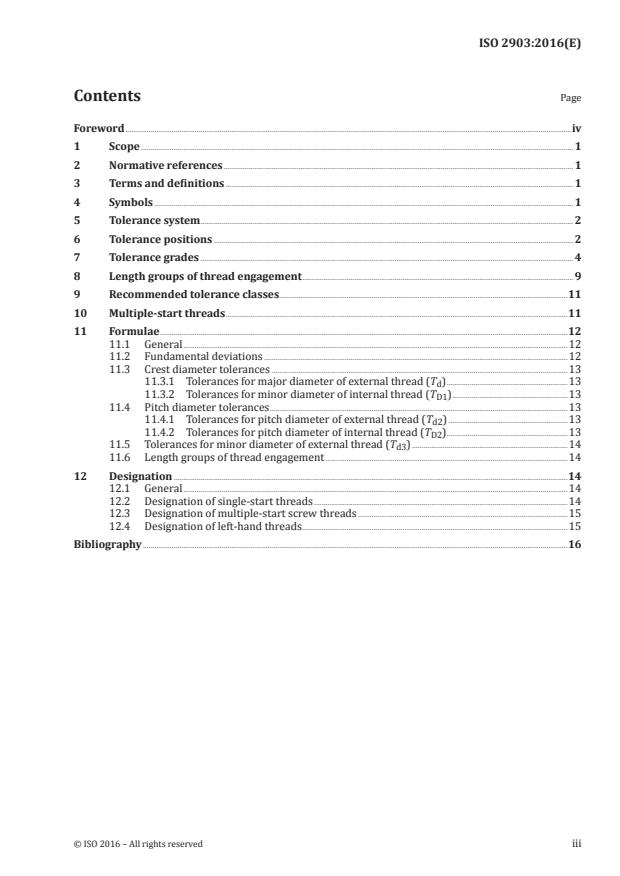
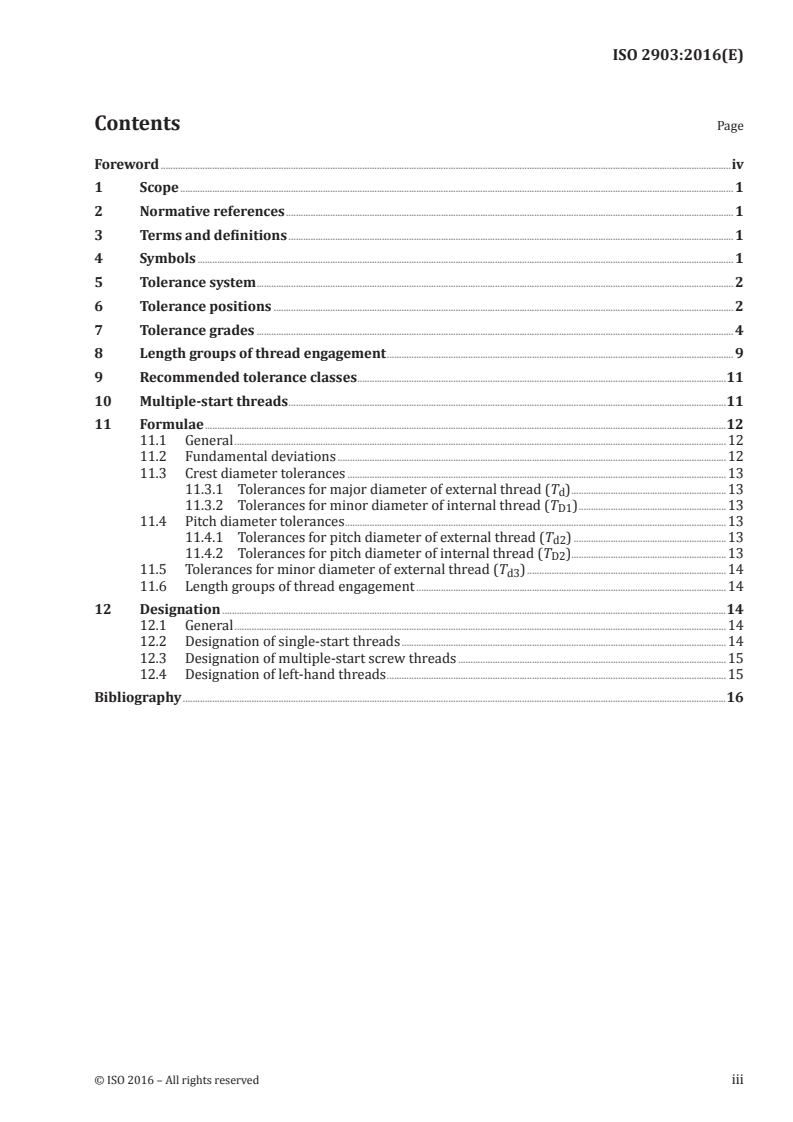
Contents Page
Foreword .iv
1 Scope . 1
2 Normative references . 1
3 Terms and definitions . 1
4 Symbols . 1
5 Tolerance system . 2
6 Tolerance positions . 2
7 Tolerance grades . 4
8 Length groups of thread engagement . 9
9 Recommended tolerance classes .11
10 Multiple-start threads .11
11 Formulae .12
11.1 General .12
11.2 Fundamental deviations .12
11.3 Crest diameter tolerances .13
11.3.1 Tolerances for major diameter of external thread (T ) .13
d
11.3.2 Tolerances for minor diameter of internal thread (T ) .13
D1
11.4 Pitch diameter tolerances .13
11.4.1 Tolerances for pitch diameter of external thread (T ) .13
d2
11.4.2 Tolerances for pitch diameter of internal thread (T ) .13
D2
11.5 Tolerances for minor diameter of external thread (T ) .14
d3
11.6 Length groups of thread engagement .14
12 Designation .14
12.1 General .14
12.2 Designation of single-start threads .14
12.3 Designation of multiple-start screw threads .15
12.4 Designation of left-hand threads .15
Bibliography .16
Foreword
ISO (the International Organization for Standardization) is a worldwide federation of national standards
bodies (ISO member bodies). The work of preparing International Standards is normally carried out
through ISO technical committees. Each member body interested in a subject for which a technical
committee has been established has the right to be represented on that committee. International
organizations, governmental and non-governmental, in liaison with ISO, also take part in the work.
ISO collaborates closely with the International Electrotechnical Commission (IEC) on all matters of
electrotechnical standardization.
The procedures used to develop this document and those intended for its further maintenance are
described in the ISO/IEC Directives, Part 1. In particular the different approval criteria needed for the
different types of ISO documents should be noted. This document was drafted in accordance with the
editorial rules of the ISO/IEC Directives, Part 2 (see www.iso.org/directives).
Attention is drawn to the possibility that some of the elements of this document may be the subject of
patent rights. ISO shall not be held responsible for identifying any or all such patent rights. Details of
any patent rights identified during the development of the document will be in the Introduction and/or
on the ISO list of patent declarations received (see www.iso.org/patents).
Any trade name used in this document is information given for the convenience of users and does not
constitute an endorsement.
For an explanation on the meaning of ISO specific terms and expressions related to conformity assessment,
as well as information about ISO’s adherence to the World Trade Organization (WTO) principles in the
Technical Barriers to Trade (TBT) see the following URL: www.iso.org/iso/foreword.html.
The committee responsible for this document is ISO/TC 1, Screw threads.
This third edition cancels and replaces the second edition (ISO 2903:1993), Clauses 1, 13 and 14, and
Table 7 of which have been technically revised (now Clauses 1, 11 and 12, and Table 5).
iv © ISO 2016 – All rights reserved
INTERNATIONAL STANDARD ISO 2903:2016(E)
ISO metric trapezoidal screw threads — Tolerances
1 Scope
This document specifies a tolerance system for metric trapezoidal screw threads in accordance with
ISO 2902. The tolerances refer to the design profile in accordance with ISO 2901.
The tolerance system does not apply to trapezoidal screw threads with special requirements on axial
displacement, for example, machine tool lead and feed screws and nuts.
2 Normative references
The following documents are referred to in the text in such a way that some or all of their content
constitutes requirements of this document. For dated references, only the edition cited applies. For
undated references, the latest edition of the referenced document (including any amendments) applies.
ISO 965-1, ISO general purpose metric screw threads — Tolerances — Part 1: Principles and basic data
ISO 2901, ISO metric trapezoidal screw threads — Basic and design profiles
ISO 2902, ISO metric trapezoidal screw threads — General plan
3 Terms and definitions
For the purposes of this document, the terms and definitions given in ISO 5408 apply.
ISO and IEC maintain terminological databases for use in standardization at the following addresses:
— IEC Electropedia: available at http://www.electropedia.org/
— ISO Online browsing platform: available at http://www.iso.org/obp
4 Symbols
For the purposes of this document, the following symbols apply.
D basic major diameter of internal thread
D nominal diameter (internal thread)
D basic pitch diameter of internal thread
D basic minor diameter of internal thread
d basic major diameter of external thread (nominal diameter)
d basic pitch diameter of external thread
d basic minor diameter of external thread
P pitch
Ph lead
N designation for normal group of thread engagement
L designation for long group of thread engagement
T tolerance
T , T , T , tolerances for D , D , d, d and d , respectively (no tolerance for D )
D2 D1 d 2 1 2 3 4
T , T
d2 d3
EI, ei lower limit deviations
ES, es upper limit deviations
5 Tolerance system
The system is based on the tolerance system for ISO general-purpose metric screw threads of ISO 965-1.
6 Tolerance positions
The following tolerance positions are standardized for the pitch diameters.
— For internal threads: H with zero fundamental deviation (EI). See Figure 1.
— For external threads: c and e with negative fundamental deviation (es). See Figure 2.
The tolerance position for the minor diameter (D ) and the major diameter (D ) of the internal threads
1 4
is always H, i.e. with zero fundamental deviation (EI).
The tolerance position for the major diameter (d) and minor diameter (d ) of the external threads is in
all cases h, i.e. with zero fundamental deviation (es), and it is independent of the tolerance positions of
the pitch diameter.
The fundamental deviations for the pitch diameters of internal and external threads are given in
Table 1.
Figure 1 — Internal threads with tolerance position H
2 © ISO 2016 – All rights reserved
Figure 2 — External threads with tolerance positions c and e for the pitch diameter
Table 1 — Fundamental deviations for the pitch diameters of internal and external threads
Fundamental deviations
Internal
External threads
Pitch threads
d
P D
H c e
EI es es
mm µm µm µm
1,5 0 −140 −67
2 0 −150 −71
3 0 −170 −85
4 0 −190 −95
5 0 −212 −106
6 0 −236 −118
7 0 −250 −125
8 0 −265 −132
9 0 −280 −140
10 0 −300 −150
12 0 −335 −160
14 0 −355 −180
16 0 −375 −190
18 0 −400 −200
20 0 −425 −212
22 0 −450 −224
24 0 −475 −236
28 0 −500 −250
32 0 −530 −265
36 0 −560 −280
40 0 −600 −300
44 0 −630 −315
7 Tolerance grades
The tolerance grades for the following screw thread diameters are standardized.
Tolerance grades
Minor diameter of internal threads, D 4
Major diameter of external threads, d 4
Pitch diameter of internal threads, D 7 8 9
Pitch diameter of external threads, d 7 8 9
Minor diameter of external threads, d 7 8 9
The tolerance grade for the minor diameter (d ) of the external thread is always the same as for the
pitch diameter (d ). However, the values for T and T are not the same for a same grade.
2 d3 d2
The minor diameter tolerances of internal thread (T ) are given in Table 2.
D1
The major diameter tolerances of external thread (T ) are given in Table 3.
d
Table 2 — Minor diameter tolerances of internal threads (T )
D1
Pitch
Tolerance grade 4
P
mm µm
1,5 190
2 236
3 315
4 375
5 450
6 500
7 560
8 630
9 670
10 710
12 800
14 900
16 1 000
18 1 120
20 1 180
22 1 250
24 1 320
28 1 500
32 1 600
36 1 800
40 1 900
44 2 000
4 © ISO 2016 – All rights reserved
Table 3 — Major diameter tolerances of external threads (T )
d
Pitch
Tolerance grade 4
P
mm µm
1,5 150
2 180
3 236
4 300
5 335
6 375
7 425
8 450
9 500
10 530
12 600
14 670
16 710
18 800
20 850
22 900
24 950
28 1 060
32 1 120
36 1 250
40 1 320
44 1 400
The pitch diameter tolerances of internal thread (T ) are given in Table 4.
D2
The pitch diameter tolerances of external thread (T ) are given in Table 5.
d2
Table 4 — Pitch diameter
...
INTERNATIONAL ISO
STANDARD 2903
Third edition
2016-09-01
ISO metric trapezoidal screw
threads — Tolerances
Filetages métriques trapézoïdaux ISO — Tolérances
Reference number
©
ISO 2016
© ISO 2016, Published in Switzerland
All rights reserved. Unless otherwise specified, no part of this publication may be reproduced or utilized otherwise in any form
or by any means, electronic or mechanical, including photocopying, or posting on the internet or an intranet, without prior
written permission. Permission can be requested from either ISO at the address below or ISO’s member body in the country of
the requester.
ISO copyright office
Ch. de Blandonnet 8 • CP 401
CH-1214 Vernier, Geneva, Switzerland
Tel. +41 22 749 01 11
Fax +41 22 749 09 47
copyright@iso.org
www.iso.org
ii © ISO 2016 – All rights reserved
Contents Page
Foreword .iv
1 Scope . 1
2 Normative references . 1
3 Terms and definitions . 1
4 Symbols . 1
5 Tolerance system . 2
6 Tolerance positions . 2
7 Tolerance grades . 4
8 Length groups of thread engagement . 9
9 Recommended tolerance classes .11
10 Multiple-start threads .11
11 Formulae .12
11.1 General .12
11.2 Fundamental deviations .12
11.3 Crest diameter tolerances .13
11.3.1 Tolerances for major diameter of external thread (T ) .13
d
11.3.2 Tolerances for minor diameter of internal thread (T ) .13
D1
11.4 Pitch diameter tolerances .13
11.4.1 Tolerances for pitch diameter of external thread (T ) .13
d2
11.4.2 Tolerances for pitch diameter of internal thread (T ) .13
D2
11.5 Tolerances for minor diameter of external thread (T ) .14
d3
11.6 Length groups of thread engagement .14
12 Designation .14
12.1 General .14
12.2 Designation of single-start threads .14
12.3 Designation of multiple-start screw threads .15
12.4 Designation of left-hand threads .15
Bibliography .16
Foreword
ISO (the International Organization for Standardization) is a worldwide federation of national standards
bodies (ISO member bodies). The work of preparing International Standards is normally carried out
through ISO technical committees. Each member body interested in a subject for which a technical
committee has been established has the right to be represented on that committee. International
organizations, governmental and non-governmental, in liaison with ISO, also take part in the work.
ISO collaborates closely with the International Electrotechnical Commission (IEC) on all matters of
electrotechnical standardization.
The procedures used to develop this document and those intended for its further maintenance are
described in the ISO/IEC Directives, Part 1. In particular the different approval criteria needed for the
different types of ISO documents should be noted. This document was drafted in accordance with the
editorial rules of the ISO/IEC Directives, Part 2 (see www.iso.org/directives).
Attention is drawn to the possibility that some of the elements of this document may be the subject of
patent rights. ISO shall not be held responsible for identifying any or all such patent rights. Details of
any patent rights identified during the development of the document will be in the Introduction and/or
on the ISO list of patent declarations received (see www.iso.org/patents).
Any trade name used in this document is information given for the convenience of users and does not
constitute an endorsement.
For an explanation on the meaning of ISO specific terms and expressions related to conformity assessment,
as well as information about ISO’s adherence to the World Trade Organization (WTO) principles in the
Technical Barriers to Trade (TBT) see the following URL: www.iso.org/iso/foreword.html.
The committee responsible for this document is ISO/TC 1, Screw threads.
This third edition cancels and replaces the second edition (ISO 2903:1993), Clauses 1, 13 and 14, and
Table 7 of which have been technically revised (now Clauses 1, 11 and 12, and Table 5).
iv © ISO 2016 – All rights reserved
INTERNATIONAL STANDARD ISO 2903:2016(E)
ISO metric trapezoidal screw threads — Tolerances
1 Scope
This document specifies a tolerance system for metric trapezoidal screw threads in accordance with
ISO 2902. The tolerances refer to the design profile in accordance with ISO 2901.
The tolerance system does not apply to trapezoidal screw threads with special requirements on axial
displacement, for example, machine tool lead and feed screws and nuts.
2 Normative references
The following documents are referred to in the text in such a way that some or all of their content
constitutes requirements of this document. For dated references, only the edition cited applies. For
undated references, the latest edition of the referenced document (including any amendments) applies.
ISO 965-1, ISO general purpose metric screw threads — Tolerances — Part 1: Principles and basic data
ISO 2901, ISO metric trapezoidal screw threads — Basic and design profiles
ISO 2902, ISO metric trapezoidal screw threads — General plan
3 Terms and definitions
For the purposes of this document, the terms and definitions given in ISO 5408 apply.
ISO and IEC maintain terminological databases for use in standardization at the following addresses:
— IEC Electropedia: available at http://www.electropedia.org/
— ISO Online browsing platform: available at http://www.iso.org/obp
4 Symbols
For the purposes of this document, the following symbols apply.
D basic major diameter of internal thread
D nominal diameter (internal thread)
D basic pitch diameter of internal thread
D basic minor diameter of internal thread
d basic major diameter of external thread (nominal diameter)
d basic pitch diameter of external thread
d basic minor diameter of external thread
P pitch
Ph lead
N designation for normal group of thread engagement
L designation for long group of thread engagement
T tolerance
T , T , T , tolerances for D , D , d, d and d , respectively (no tolerance for D )
D2 D1 d 2 1 2 3 4
T , T
d2 d3
EI, ei lower limit deviations
ES, es upper limit deviations
5 Tolerance system
The system is based on the tolerance system for ISO general-purpose metric screw threads of ISO 965-1.
6 Tolerance positions
The following tolerance positions are standardized for the pitch diameters.
— For internal threads: H with zero fundamental deviation (EI). See Figure 1.
— For external threads: c and e with negative fundamental deviation (es). See Figure 2.
The tolerance position for the minor diameter (D ) and the major diameter (D ) of the internal threads
1 4
is always H, i.e. with zero fundamental deviation (EI).
The tolerance position for the major diameter (d) and minor diameter (d ) of the external threads is in
all cases h, i.e. with zero fundamental deviation (es), and it is independent of the tolerance positions of
the pitch diameter.
The fundamental deviations for the pitch diameters of internal and external threads are given in
Table 1.
Figure 1 — Internal threads with tolerance position H
2 © ISO 2016 – All rights reserved
Figure 2 — External threads with tolerance positions c and e for the pitch diameter
Table 1 — Fundamental deviations for the pitch diameters of internal and external threads
Fundamental deviations
Internal
External threads
Pitch threads
d
P D
H c e
EI es es
mm µm µm µm
1,5 0 −140 −67
2 0 −150 −71
3 0 −170 −85
4 0 −190 −95
5 0 −212 −106
6 0 −236 −118
7 0 −250 −125
8 0 −265 −132
9 0 −280 −140
10 0 −300 −150
12 0 −335 −160
14 0 −355 −180
16 0 −375 −190
18 0 −400 −200
20 0 −425 −212
22 0 −450 −224
24 0 −475 −236
28 0 −500 −250
32 0 −530 −265
36 0 −560 −280
40 0 −600 −300
44 0 −630 −315
7 Tolerance grades
The tolerance grades for the following screw thread diameters are standardized.
Tolerance grades
Minor diameter of internal threads, D 4
Major diameter of external threads, d 4
Pitch diameter of internal threads, D 7 8 9
Pitch diameter of external threads, d 7 8 9
Minor diameter of external threads, d 7 8 9
The tolerance grade for the minor diameter (d ) of the external thread is always the same as for the
pitch diameter (d ). However, the values for T and T are not the same for a same grade.
2 d3 d2
The minor diameter tolerances of internal thread (T ) are given in Table 2.
D1
The major diameter tolerances of external thread (T ) are given in Table 3.
d
Table 2 — Minor diameter tolerances of internal threads (T )
D1
Pitch
Tolerance grade 4
P
mm µm
1,5 190
2 236
3 315
4 375
5 450
6 500
7 560
8 630
9 670
10 710
12 800
14 900
16 1 000
18 1 120
20 1 180
22 1 250
24 1 320
28 1 500
32 1 600
36 1 800
40 1 900
44 2 000
4 © ISO 2016 – All rights reserved
Table 3 — Major diameter tolerances of external threads (T )
d
Pitch
Tolerance grade 4
P
mm µm
1,5 150
2 180
3 236
4 300
5 335
6 375
7 425
8 450
9 500
10 530
12 600
14 670
16 710
18 800
20 850
22 900
24 950
28 1 060
32 1 120
36 1 250
40 1 320
44 1 400
The pitch diameter tolerances of internal thread (T ) are given in Table 4.
D2
The pitch diameter tolerances of external thread (T ) are given in Table 5.
d2
Table 4 — Pitch diameter
...
NORME ISO
INTERNATIONALE 2903
Troisième édition
2016-09-01
Filetages métriques trapézoïdaux
ISO — Tolérances
ISO metric trapezoidal screw threads — Tolerances
Numéro de référence
©
ISO 2016
DOCUMENT PROTÉGÉ PAR COPYRIGHT
© ISO 2016, Publié en Suisse
Droits de reproduction réservés. Sauf indication contraire, aucune partie de cette publication ne peut être reproduite ni utilisée
sous quelque forme que ce soit et par aucun procédé, électronique ou mécanique, y compris la photocopie, l’affichage sur
l’internet ou sur un Intranet, sans autorisation écrite préalable. Les demandes d’autorisation peuvent être adressées à l’ISO à
l’adresse ci-après ou au comité membre de l’ISO dans le pays du demandeur.
ISO copyright office
Ch. de Blandonnet 8 • CP 401
CH-1214 Vernier, Geneva, Switzerland
Tel. +41 22 749 01 11
Fax +41 22 749 09 47
copyright@iso.org
www.iso.org
ii © ISO 2016 – Tous droits réservés
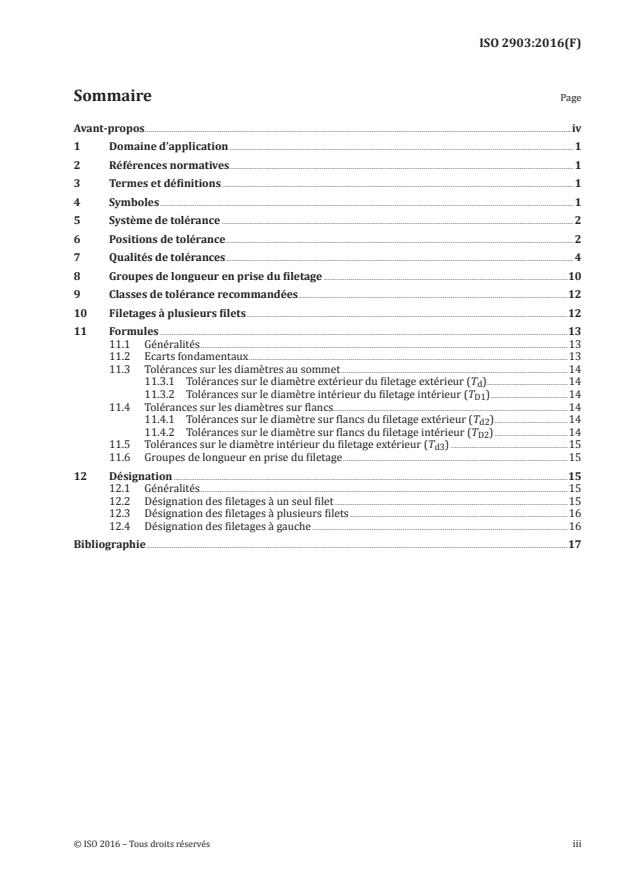
Sommaire Page
Avant-propos .iv
1 Domaine d’application . 1
2 Références normatives . 1
3 Termes et définitions . 1
4 Symboles . 1
5 Système de tolérance . 2
6 Positions de tolérance . 2
7 Qualités de tolérances . 4
8 Groupes de longueur en prise du filetage .10
9 Classes de tolérance recommandées .12
10 Filetages à plusieurs filets .12
11 Formules .13
11.1 Généralités .13
11.2 Ecarts fondamentaux .13
11.3 Tolérances sur les diamètres au sommet .14
11.3.1 Tolérances sur le diamètre extérieur du filetage extérieur (T ) .14
d
11.3.2 Tolérances sur le diamètre intérieur du filetage intérieur (T ) .14
D1
11.4 Tolérances sur les diamètres sur flancs.14
11.4.1 Tolérances sur le diamètre sur flancs du filetage extérieur (T ) .14
d2
11.4.2 Tolérances sur le diamètre sur flancs du filetage intérieur (T ) .14
D2
11.5 Tolérances sur le diamètre intérieur du filetage extérieur (T ) .15
d3
11.6 Groupes de longueur en prise du filetage .15
12 Désignation .15
12.1 Généralités .15
12.2 Désignation des filetages à un seul filet .15
12.3 Désignation des filetages à plusieurs filets .16
12.4 Désignation des filetages à gauche .16
Bibliographie .17
Avant-propos
L’ISO (Organisation internationale de normalisation) est une fédération mondiale d’organismes
nationaux de normalisation (comités membres de l’ISO). L’élaboration des Normes internationales est
en général confiée aux comités techniques de l’ISO. Chaque comité membre intéressé par une étude
a le droit de faire partie du comité technique créé à cet effet. Les organisations internationales,
gouvernementales et non gouvernementales, en liaison avec l’ISO participent également aux travaux.
L’ISO collabore étroitement avec la Commission électrotechnique internationale (IEC) en ce qui
concerne la normalisation électrotechnique.
Les procédures utilisées pour élaborer le présent document et celles destinées à sa mise à jour sont
décrites dans les Directives ISO/IEC, Partie 1 Il convient, en particulier, de prendre note des différents
critères d’approbation requis pour les différents types de documents ISO. Le présent document a été
rédigé conformément aux règles de rédaction données dans les Directives ISO/IEC, Partie 2 (voir www.
iso.org/directives).
L’attention est appelée sur le fait que certains des éléments du présent document peuvent faire l’objet de
droits de propriété intellectuelle ou de droits analogues. L’ISO ne saurait être tenue pour responsable
de ne pas avoir identifié de tels droits de propriété et averti de leur existence. Les détails concernant
les références aux droits de propriété intellectuelle ou autres droits analogues identifiés lors de
l’élaboration du document sont indiqués dans l’Introduction et/ou dans la liste des déclarations de
brevets reçues par l’ISO (voir www.iso.org/brevets).
Les appellations commerciales éventuellement mentionnées dans le présent document sont données
pour information, par souci de commodité, à l’intention des utilisateurs et ne sauraient constituer un
engagement.
Pour une explication de la signification des termes et expressions spécifiques de l’ISO liés à l’évaluation
de la conformité, ou pour toute information au sujet de l’adhésion de l’ISO aux principes de l’Organisation
mondiale du commerce (OMC) concernant les obstacles techniques au commerce (OTC), voir le lien
suivant: www.iso.org/iso/fr/avant-propos.html.
Le comité chargé de l’élaboration du présent document est l’ISO/TC 1, Filetages.
Cette troisième édition annule et remplace la deuxième édition (ISO 2903:1993), dont les Articles 1,
13 et 14 et le Tableau 7 ont fait l’objet d’une révision technique (maintenant les Articles 1, 11 et 12, et
Tableau 5).
iv © ISO 2016 – Tous droits réservés
NORME INTERNATIONALE ISO 2903:2016(F)
Filetages métriques trapézoïdaux ISO — Tolérances
1 Domaine d’application
Le présent document spécifie un système de tolérances pour filetages métriques trapézoïdaux
conformes à I’ISO 2902. Les tolérances se rapportent au profil nominal conforme à I’ISO 2901.
Le système de tolérances ne s’applique pas aux filetages trapézoïdaux ayant des exigences spéciales de
déplacement axial, par exemple pas hélicoïdal de la machine-outil et distributeurs à vis et écrous.
2 Références normatives
Les documents suivants sont référencés dans le texte de telle manière qu’une partie ou tout leur
contenu constitue des exigences du présent document. Pour les références datées, seule l’édition citée
s’applique. Pour les références non datées, la dernière édition du document de référence s’applique (y
compris les éventuels amendements).
ISO 965-1, Filetages métriques ISO pour usages généraux — Tolérances — Partie 1: Principes et données
fondamentales
ISO 2901, Filetages métriques trapézoïdaux ISO — Profils de base et nominal
ISO 2902, Filetages métriques trapézoïdaux ISO — Vue d’ensemble
3 Termes et définitions
Pour les besoins du présent document, les termes et définitions donnés dans ISO 5408 s’appliquent.
L’ISO et l’IEC maintiennent des bases de données terminologiques pour utilisation dans le domaine de la
normalisation aux adresses suivantes:
— IEC Electropedia: disponible à http://www.electropedia.org/
— ISO Online browsing platform: disponible à http://www.iso.org/obp
4 Symboles
Pour les besoins du présent document, les symboles suivants s’appliquent.
D diamètre extérieur de base de filetage intérieur
D diamètre nominal (filetage intérieur)
D diamètre sur flancs de filetage intérieur
D diamètre intérieur de base de filetage intérieur
d diamètre extérieur de base de filetage extérieur (diamètre nominal)
d diamètre sur flancs de filetage extérieur
d diamètre intérieur de base de filetage extérieur
P pas
Ph pas hélicoïdal
N désignation pour le groupe normal de longueur en prise du filetage
L désignation pour le groupe long de longueur en prise du filetage
T tolérance
T , T , T , tolérances pour D , D , d, d et d , respectivement (pas de tolérance pour D )
D2 D1 d 2 1 2 3 4
T , T
d2 d3
EI, ei écarts limites inférieurs
ES, es écarts limites supérieurs
5 Système de tolérance
Le système est base sur le système de tolérances pour filetages métriques ISO pour usages généraux de
I’ISO 965-1.
6 Positions de tolérance
Les positions de tolérances suivantes sont normalisées pour le diamètre sur flancs.
— pour filetages intérieurs: H avec écart fondamental zéro (EI). Voir Figure 1.
— pour filetages extérieurs: c et e avec écart fondamental négatif (es). Voir Figure 2.
La position de la tolérance pour le diamètre intérieur (D ) et le diamètre extérieur (D ) des filetages
1 4
internes est toujours H, c’est-à-dire avec écart fondamental zéro (EI).
La position de la tolérance pour le diamètre extérieur (d) et le diamètre intérieur (d ) des filetages
externes est toujours h, c’est-à-dire avec écart fondamental zéro (es), et elle est indépendante des
positions de tolérance du diamètre sur flancs.
Les écarts fondamentaux pour les diamètres sur flancs des filetages intérieur et extérieur sont donnés
dans le Tableau 1.
Figure 1 — Filetages intérieurs avec position de tolérance H
2 © ISO 2016 – Tous droits réservés
Figure 2 — Filetages extérieurs avec positions de tolérance c et e pour le diamètre sur flancs
Table 1 — Ecarts fondamentaux pour les diamètres sur flancs des filetages intérieur et
extérieur
Ecarts fondamentaux
Filetages
Filetages extérieurs
Pas
intérieurs
d
P
D
H c e
EI es es
mm µm µm µm
1,5 0 −140 −67
2 0 −150 −71
3 0 −170 −85
4 0 −190 −95
5 0 −212 −106
6 0 −236 −118
7 0 −250 −125
8 0 −265 −132
9 0 −280 −140
10 0 −300 −150
12 0 −335 −160
14 0 −355 −180
16 0 −375 −190
18 0 −400 −200
20 0 −425 −212
22 0 −450 −224
24 0 −475 −236
28 0 −500 −250
32 0 −530 −265
36 0 −560 −280
40 0 −600 −300
44 0 −630 −315
7 Qualités de tolérances
Les qualités de tolérance pour les diamètres de filetage suivants sont normalisées.
Qualités de tolérance
Diamètre intérieur de filetages intérieurs, D 4
Diamètre extérieur de filetages extérieurs, d 4
Diamètre sur flancs de filetages intérieurs, D 7 8 9
Diamètre sur flancs de filetages extérieur, d 7 8 9
Diamètre intérieur de filetages extérieurs, d 7 8 9
La qualité de tolérance pour le diamètre intérieur (d ) du filetage extérieur est toujours le même que
celui du diamètre sur flancs (d ). Les valeurs pour T et T ne sont cependant pas les mêmes pour une
2 d3 d2
même qualité.
4 © ISO 2016 – Tous droits réservés
Les tolérances de diamètres intérieurs pour filetage intérieur, (T ), sont données dans le Tableau 2.
D1
Les tolérances de diamètres extérieurs pour filetage extérieur, (T ), sont données dans le Tableau 3.
d
Tableau 2 — Tolérances de diamètre intérieur pour filetage intérieur (T )
D1
Pas
Qualité de tolérance 4
P
mm µm
1,5 190
2 236
3 315
4 375
5 450
6 500
7 560
8 630
9 670
10 710
12 800
14 900
16 1 000
18 1 120
20 1 180
22 1 250
24 1 320
28 1 500
32 1 600
36 1 800
40 1 900
44 2 000
Tableau 3 — Tolérances de diamètre extérieur pour filetage extérieur (T )
d
Pas
Qualité de tolérance 4
P
mm µm
1,5 150
2 180
3 236
4 300
5 335
6 375
7 425
8 450
9 500
10 530
12 600
14 670
16 710
18 800
20 850
22 900
24 950
28 1 060
32 1 120
36 1 250
40 1 320
44 1 400
Les tolérances de diamètre sur flancs pour filetage intérieur, (T ), sont données dans le Tableau 4.
D2
Les tolérances de diamètre sur flancs pour filetage extérieur, (T ),
...
NORME ISO
INTERNATIONALE 2903
Troisième édition
2016-09-01
Filetages métriques trapézoïdaux
ISO — Tolérances
ISO metric trapezoidal screw threads — Tolerances
Numéro de référence
©
ISO 2016
DOCUMENT PROTÉGÉ PAR COPYRIGHT
© ISO 2016, Publié en Suisse
Droits de reproduction réservés. Sauf indication contraire, aucune partie de cette publication ne peut être reproduite ni utilisée
sous quelque forme que ce soit et par aucun procédé, électronique ou mécanique, y compris la photocopie, l’affichage sur
l’internet ou sur un Intranet, sans autorisation écrite préalable. Les demandes d’autorisation peuvent être adressées à l’ISO à
l’adresse ci-après ou au comité membre de l’ISO dans le pays du demandeur.
ISO copyright office
Ch. de Blandonnet 8 • CP 401
CH-1214 Vernier, Geneva, Switzerland
Tel. +41 22 749 01 11
Fax +41 22 749 09 47
copyright@iso.org
www.iso.org
ii © ISO 2016 – Tous droits réservés
Sommaire Page
Avant-propos .iv
1 Domaine d’application . 1
2 Références normatives . 1
3 Termes et définitions . 1
4 Symboles . 1
5 Système de tolérance . 2
6 Positions de tolérance . 2
7 Qualités de tolérances . 4
8 Groupes de longueur en prise du filetage .10
9 Classes de tolérance recommandées .12
10 Filetages à plusieurs filets .12
11 Formules .13
11.1 Généralités .13
11.2 Ecarts fondamentaux .13
11.3 Tolérances sur les diamètres au sommet .14
11.3.1 Tolérances sur le diamètre extérieur du filetage extérieur (T ) .14
d
11.3.2 Tolérances sur le diamètre intérieur du filetage intérieur (T ) .14
D1
11.4 Tolérances sur les diamètres sur flancs.14
11.4.1 Tolérances sur le diamètre sur flancs du filetage extérieur (T ) .14
d2
11.4.2 Tolérances sur le diamètre sur flancs du filetage intérieur (T ) .14
D2
11.5 Tolérances sur le diamètre intérieur du filetage extérieur (T ) .15
d3
11.6 Groupes de longueur en prise du filetage .15
12 Désignation .15
12.1 Généralités .15
12.2 Désignation des filetages à un seul filet .15
12.3 Désignation des filetages à plusieurs filets .16
12.4 Désignation des filetages à gauche .16
Bibliographie .17
Avant-propos
L’ISO (Organisation internationale de normalisation) est une fédération mondiale d’organismes
nationaux de normalisation (comités membres de l’ISO). L’élaboration des Normes internationales est
en général confiée aux comités techniques de l’ISO. Chaque comité membre intéressé par une étude
a le droit de faire partie du comité technique créé à cet effet. Les organisations internationales,
gouvernementales et non gouvernementales, en liaison avec l’ISO participent également aux travaux.
L’ISO collabore étroitement avec la Commission électrotechnique internationale (IEC) en ce qui
concerne la normalisation électrotechnique.
Les procédures utilisées pour élaborer le présent document et celles destinées à sa mise à jour sont
décrites dans les Directives ISO/IEC, Partie 1 Il convient, en particulier, de prendre note des différents
critères d’approbation requis pour les différents types de documents ISO. Le présent document a été
rédigé conformément aux règles de rédaction données dans les Directives ISO/IEC, Partie 2 (voir www.
iso.org/directives).
L’attention est appelée sur le fait que certains des éléments du présent document peuvent faire l’objet de
droits de propriété intellectuelle ou de droits analogues. L’ISO ne saurait être tenue pour responsable
de ne pas avoir identifié de tels droits de propriété et averti de leur existence. Les détails concernant
les références aux droits de propriété intellectuelle ou autres droits analogues identifiés lors de
l’élaboration du document sont indiqués dans l’Introduction et/ou dans la liste des déclarations de
brevets reçues par l’ISO (voir www.iso.org/brevets).
Les appellations commerciales éventuellement mentionnées dans le présent document sont données
pour information, par souci de commodité, à l’intention des utilisateurs et ne sauraient constituer un
engagement.
Pour une explication de la signification des termes et expressions spécifiques de l’ISO liés à l’évaluation
de la conformité, ou pour toute information au sujet de l’adhésion de l’ISO aux principes de l’Organisation
mondiale du commerce (OMC) concernant les obstacles techniques au commerce (OTC), voir le lien
suivant: www.iso.org/iso/fr/avant-propos.html.
Le comité chargé de l’élaboration du présent document est l’ISO/TC 1, Filetages.
Cette troisième édition annule et remplace la deuxième édition (ISO 2903:1993), dont les Articles 1,
13 et 14 et le Tableau 7 ont fait l’objet d’une révision technique (maintenant les Articles 1, 11 et 12, et
Tableau 5).
iv © ISO 2016 – Tous droits réservés
NORME INTERNATIONALE ISO 2903:2016(F)
Filetages métriques trapézoïdaux ISO — Tolérances
1 Domaine d’application
Le présent document spécifie un système de tolérances pour filetages métriques trapézoïdaux
conformes à I’ISO 2902. Les tolérances se rapportent au profil nominal conforme à I’ISO 2901.
Le système de tolérances ne s’applique pas aux filetages trapézoïdaux ayant des exigences spéciales de
déplacement axial, par exemple pas hélicoïdal de la machine-outil et distributeurs à vis et écrous.
2 Références normatives
Les documents suivants sont référencés dans le texte de telle manière qu’une partie ou tout leur
contenu constitue des exigences du présent document. Pour les références datées, seule l’édition citée
s’applique. Pour les références non datées, la dernière édition du document de référence s’applique (y
compris les éventuels amendements).
ISO 965-1, Filetages métriques ISO pour usages généraux — Tolérances — Partie 1: Principes et données
fondamentales
ISO 2901, Filetages métriques trapézoïdaux ISO — Profils de base et nominal
ISO 2902, Filetages métriques trapézoïdaux ISO — Vue d’ensemble
3 Termes et définitions
Pour les besoins du présent document, les termes et définitions donnés dans ISO 5408 s’appliquent.
L’ISO et l’IEC maintiennent des bases de données terminologiques pour utilisation dans le domaine de la
normalisation aux adresses suivantes:
— IEC Electropedia: disponible à http://www.electropedia.org/
— ISO Online browsing platform: disponible à http://www.iso.org/obp
4 Symboles
Pour les besoins du présent document, les symboles suivants s’appliquent.
D diamètre extérieur de base de filetage intérieur
D diamètre nominal (filetage intérieur)
D diamètre sur flancs de filetage intérieur
D diamètre intérieur de base de filetage intérieur
d diamètre extérieur de base de filetage extérieur (diamètre nominal)
d diamètre sur flancs de filetage extérieur
d diamètre intérieur de base de filetage extérieur
P pas
Ph pas hélicoïdal
N désignation pour le groupe normal de longueur en prise du filetage
L désignation pour le groupe long de longueur en prise du filetage
T tolérance
T , T , T , tolérances pour D , D , d, d et d , respectivement (pas de tolérance pour D )
D2 D1 d 2 1 2 3 4
T , T
d2 d3
EI, ei écarts limites inférieurs
ES, es écarts limites supérieurs
5 Système de tolérance
Le système est base sur le système de tolérances pour filetages métriques ISO pour usages généraux de
I’ISO 965-1.
6 Positions de tolérance
Les positions de tolérances suivantes sont normalisées pour le diamètre sur flancs.
— pour filetages intérieurs: H avec écart fondamental zéro (EI). Voir Figure 1.
— pour filetages extérieurs: c et e avec écart fondamental négatif (es). Voir Figure 2.
La position de la tolérance pour le diamètre intérieur (D ) et le diamètre extérieur (D ) des filetages
1 4
internes est toujours H, c’est-à-dire avec écart fondamental zéro (EI).
La position de la tolérance pour le diamètre extérieur (d) et le diamètre intérieur (d ) des filetages
externes est toujours h, c’est-à-dire avec écart fondamental zéro (es), et elle est indépendante des
positions de tolérance du diamètre sur flancs.
Les écarts fondamentaux pour les diamètres sur flancs des filetages intérieur et extérieur sont donnés
dans le Tableau 1.
Figure 1 — Filetages intérieurs avec position de tolérance H
2 © ISO 2016 – Tous droits réservés
Figure 2 — Filetages extérieurs avec positions de tolérance c et e pour le diamètre sur flancs
Table 1 — Ecarts fondamentaux pour les diamètres sur flancs des filetages intérieur et
extérieur
Ecarts fondamentaux
Filetages
Filetages extérieurs
Pas
intérieurs
d
P
D
H c e
EI es es
mm µm µm µm
1,5 0 −140 −67
2 0 −150 −71
3 0 −170 −85
4 0 −190 −95
5 0 −212 −106
6 0 −236 −118
7 0 −250 −125
8 0 −265 −132
9 0 −280 −140
10 0 −300 −150
12 0 −335 −160
14 0 −355 −180
16 0 −375 −190
18 0 −400 −200
20 0 −425 −212
22 0 −450 −224
24 0 −475 −236
28 0 −500 −250
32 0 −530 −265
36 0 −560 −280
40 0 −600 −300
44 0 −630 −315
7 Qualités de tolérances
Les qualités de tolérance pour les diamètres de filetage suivants sont normalisées.
Qualités de tolérance
Diamètre intérieur de filetages intérieurs, D 4
Diamètre extérieur de filetages extérieurs, d 4
Diamètre sur flancs de filetages intérieurs, D 7 8 9
Diamètre sur flancs de filetages extérieur, d 7 8 9
Diamètre intérieur de filetages extérieurs, d 7 8 9
La qualité de tolérance pour le diamètre intérieur (d ) du filetage extérieur est toujours le même que
celui du diamètre sur flancs (d ). Les valeurs pour T et T ne sont cependant pas les mêmes pour une
2 d3 d2
même qualité.
4 © ISO 2016 – Tous droits réservés
Les tolérances de diamètres intérieurs pour filetage intérieur, (T ), sont données dans le Tableau 2.
D1
Les tolérances de diamètres extérieurs pour filetage extérieur, (T ), sont données dans le Tableau 3.
d
Tableau 2 — Tolérances de diamètre intérieur pour filetage intérieur (T )
D1
Pas
Qualité de tolérance 4
P
mm µm
1,5 190
2 236
3 315
4 375
5 450
6 500
7 560
8 630
9 670
10 710
12 800
14 900
16 1 000
18 1 120
20 1 180
22 1 250
24 1 320
28 1 500
32 1 600
36 1 800
40 1 900
44 2 000
Tableau 3 — Tolérances de diamètre extérieur pour filetage extérieur (T )
d
Pas
Qualité de tolérance 4
P
mm µm
1,5 150
2 180
3 236
4 300
5 335
6 375
7 425
8 450
9 500
10 530
12 600
14 670
16 710
18 800
20 850
22 900
24 950
28 1 060
32 1 120
36 1 250
40 1 320
44 1 400
Les tolérances de diamètre sur flancs pour filetage intérieur, (T ), sont données dans le Tableau 4.
D2
Les tolérances de diamètre sur flancs pour filetage extérieur, (T ),
...