


ISO 13819-2:1995
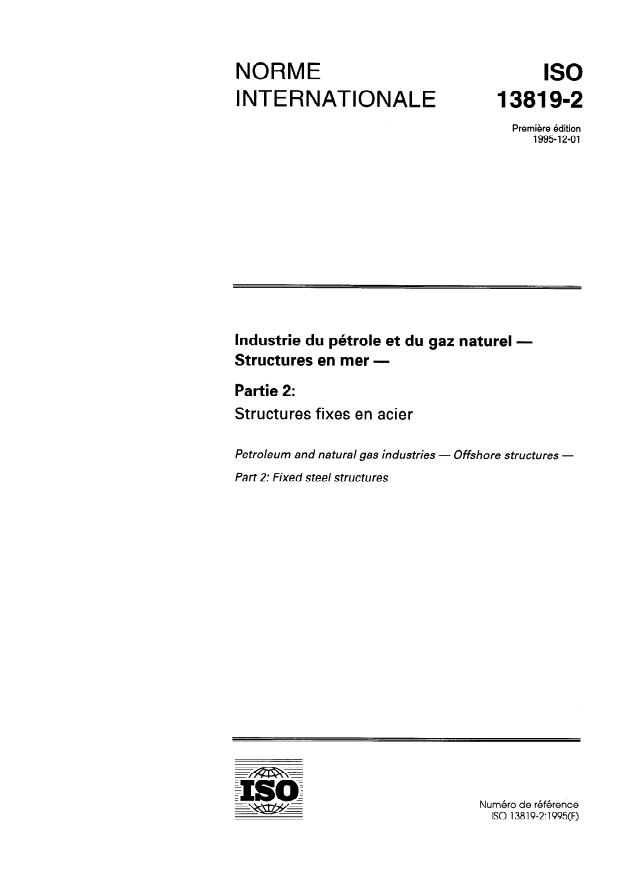
(Main)Petroleum and natural gas industries — Offshore structures — Part 2: Fixed steel structures
Petroleum and natural gas industries — Offshore structures — Part 2: Fixed steel structures
Contains guidelines for the design of steel, fixed offshore platforms and contains provisions for specific regional areas. Applicable to the design of complete platform structures including substructures, topside structures and foundations. Specifies design principles that are also applicable to the successive stages in construction (fabrication, transportation and installation).
Industries du pétrole et du gaz naturel — Structures en mer — Partie 2: Structures fixes en acier
General Information
- Status
- Withdrawn
- Publication Date
- 26-Dec-1995
- Withdrawal Date
- 26-Dec-1995
- Technical Committee
- ISO/TC 67/SC 7 - Offshore structures
- Drafting Committee
- ISO/TC 67/SC 7/WG 3 - Fixed steel structures
- Current Stage
- 9599 - Withdrawal of International Standard
- Start Date
- 26-Nov-2007
- Completion Date
- 14-Feb-2026
Relations
- Consolidated By
ISO 8230-3:2008 - Safety requirements for dry-cleaning machines — Part 3: Machines using combustible solvents - Effective Date
- 06-Jun-2022
- Effective Date
- 15-Apr-2008
Buy Documents
ISO 13819-2:1995 - Petroleum and natural gas industries -- Offshore structures
ISO 13819-2:1995 - Industries du pétrole et du gaz naturel -- Structures en mer
ISO 13819-2:1995 - Industries du pétrole et du gaz naturel -- Structures en mer
Get Certified
Connect with accredited certification bodies for this standard

ABS Quality Evaluations Inc.
American Bureau of Shipping quality certification.

Element Materials Technology
Materials testing and product certification.

ABS Group Brazil
ABS Group certification services in Brazil.
Sponsored listings
Frequently Asked Questions
ISO 13819-2:1995 is a standard published by the International Organization for Standardization (ISO). Its full title is "Petroleum and natural gas industries — Offshore structures — Part 2: Fixed steel structures". This standard covers: Contains guidelines for the design of steel, fixed offshore platforms and contains provisions for specific regional areas. Applicable to the design of complete platform structures including substructures, topside structures and foundations. Specifies design principles that are also applicable to the successive stages in construction (fabrication, transportation and installation).
Contains guidelines for the design of steel, fixed offshore platforms and contains provisions for specific regional areas. Applicable to the design of complete platform structures including substructures, topside structures and foundations. Specifies design principles that are also applicable to the successive stages in construction (fabrication, transportation and installation).
ISO 13819-2:1995 is classified under the following ICS (International Classification for Standards) categories: 75.180.10 - Exploratory, drilling and extraction equipment. The ICS classification helps identify the subject area and facilitates finding related standards.
ISO 13819-2:1995 has the following relationships with other standards: It is inter standard links to ISO 8230-3:2008, ISO 19902:2007. Understanding these relationships helps ensure you are using the most current and applicable version of the standard.
ISO 13819-2:1995 is available in PDF format for immediate download after purchase. The document can be added to your cart and obtained through the secure checkout process. Digital delivery ensures instant access to the complete standard document.
Standards Content (Sample)
INTERNATIONAL
ISO
STANDARD
13819-2
First edition
1995-12-01
Petroleum and natura1 gas industries -
Offshore structures -
Part 2:
Fixed steel structures
Industries du phrole et du gaz naturel- Structures en mer -
Partie 2: Structures fixes en acier
Number of reference
ISO 13819=2:1995(E)
Page
Contents
. . .
Ill
Foreword . . . . . . . . . . . . . . . . . . . . . . .“.*.
iv
Introduction . . .“.“.~.
1 Scope . . . . . . . . . . . . . . . . . . . . . . . . . . . . . . . . . . . . . . . . . . . . . . . . . . . . . . . . . . . . . . . . . . . . . . . . . . . . . . . . . . . . . . . . . . . . . . . . . . . . . . . . . . .=.
2 Def initions . . . . . . . . . . . . . . . . . . . . . . . . . . . . . . . . . . . . . .“.~.
3 Informative references . . . . . . . . . . . . . . . . . . . . . . . . . . . . . .*.
4 Design recommendations . . . . . . . . . . . . . . . . . . . . . . . . . . . . . . . . . . . . . . . . . . . . . . . . . . . . . . . . . . . . . . . . . . . . . . . . . . . . . . . . . . . . . . . . . . . . . . . . . . . . . . . . . .“.
Annexes
. . . . . . . . . . . . . . . . . . . . . . . . . . . . . . . . . . . . . . . 3
A Design Recommendations (API RP2A-LRFD - First Edition, 1 July 1993)
B Regional Information . . . . . . . . . . . . . . . . . . . . . . . . . . . . . . . . . . . . . . . . . . . . . . . . . . . . . . . . . . . . . . . . . . . . . . . . . . . . . . . . . . . . . . . . . . . . . . . . . . . . . . . . . . . . . . . . . . . . . . . . .
B.1 North-West Europe . . . . . . . . .~.*.
B.2 Mediterranean . . . . . . . . . . . . . . . . . . . . . . . . . . . . . . . . . . . .*.*.
B.3 Brazil . . . . . . . . . . . . . . . . . . . . . . . . . . . . . . . . . . . . . . . . . . . . . . . . . . . . . . . . . . . . . . . . . . . . . . . . . . . . . . . . . . . . . . . . . . . . . . . . . . . . . . . . . . . . . . . . . . . . . . . . .
0 ISO 1995
All rights reserved. Unless otherwise specified, no part sf thrs publicatron may be
reproduced or utilized in any form or by any means, eiectronrc or mechanical, rncluding
photocopying and microfilm, without Permission in writing from the publisher.
International Organization for Standardization
Case Postale 56 l CH-121 1 Geneve 20 l Switzerland
Printed in Switzerland
@ ISO ISO 13819=2:1995(E)
Foreword
ISO (the International Organization for Standardization) is a worldwide federation of national Standards
bodies (ISO member bodies). The work of preparing International Standards is normally carried out
through ISO technical committees. Esch member body interested in a subject for which a technical
committee has been established has the right to be represented on that committee. International
organizations, governmental and non-governmental in liaison with ISO, also take part in the work.
Draft International Standards adopted by the technical committees are circulated to the member
bodies for approval before their acceptance as International Standards by the ISO council. They are
approved in accordance with ISO procedures requiring at least 75 % approval by the member bodies
voting.
International Standard ISO 13819-2 was prepared by Technical Committee lSO/TC 67, Materials
equipment and offshore structures for Petroleum and natura/ gas industries, Sub-committee SC 7,
Offshore structures. Annex A was prepared as ANSI/API RP2A-LRFD-93 by the American Petroleum
Institute.
and natura1 gas
ISO 13819 will consist of the following Parts, under the general title Petroleum
indus tries - Offshore structures:
- Part 7: General requirements
- Part 2: Fixed steel structures
- Part 3: Fixed concrete sturctures
- Part 4: Floating Systems
- Part 5: Arctic structures
- Part 6: Site specific assessment of MODUS
Annexes A and B of this part of ISO 13819 are for information only.
@ ISO
ISO 13819=2:1995(E)
Introduction
It is important to recognize that structural integrity is an Overall concept comprising models for
describing actions, structural analyses, design rules, safety elements, workmanship, quality control
procedures and national requirements, all of which are mutually dependent. The modifications of one
aspect of design in isolation tan disturb the balance of reliability inherent in the Overall concept or
structural System. The implications involved in modifications, therefore, need to be considered in
relation to the Overall reliability of all offshore structural Systems.
International Standard ISO 13 8 19 constitutes a common basis covering those aspects that address
design requirements and assessments of all structures used by the Petroleum and natura1 gas industries
worldwide. Through its application, the intention is to achieve reliability levels appropriate for
manned and unmanned offshore structures, whatever the nature or combination of the materials used.
The Standard is intended to provide a wide latitude in the choice of structural configurations, materials
and techniques and to allow for incorporation of technological advances without hindering innovation.
It is, therefore, essential that it is used in conjunction with Sound engineering judgement.
The primary objectives of Part 2 of International Standard ISO 138 19 are to provide a safe place of
work for Personne1 and to protect the environment.
The detailed provisions given in this part of ISO 138 19 implement the general principles in
ISO 138 19-1 and are specific to fixed steel structures. While some of the provisions of this part of
ISO 138 19 are applicable worldwide, others are applicable to specific geographic regions only. Where
this is appropriate, ISO/TC 67/SC 7 is actively striving to harmonize the differing regional technical
provisions. Once harmonized, these provisions will be incorporated in an updated version of this
Standard.
International Standard ISO 13 8 19-2 includes the following informative annexes:
Annex A, which reproduces API RP2A-LRFD, First Edition, July 1, 1993,
a)
Recommended Practice for Planning, Designing and Constructing Fixed Offshore
Platforms -
Load and Resistance Factor design.
The API document in Annex A is reproduced in this Standard by Permission of the
American Petroleum Institute, 1200 L Street, Northwest, Washington DC 2005
U.S.A.
ISO, in endorsing this API document as an informative annex, recognizes that in
certain respects the latter does not comply with all current ISO rules on the
presentation and content of an International Standard.
Information given in the POLICY is relevant to the API publication only.
ISO/TC 67/SC 7 is however currently engaged in updating this API document in
conjunction with the American Petroleum Institute. An updated Version, in a form
complying with ISO rules, will be issued when practicable.
Annex B, which identifies regionally applicable provisions that Supplement those of
b)
ISO 138 19-1 and/or annex A of this part of ISO 138 19.
iv
INTERNATIONAL STANDARD @ ISO
ISO 13819=2:1995(E)
Petroleum and natura1 gas industries - Offshore
structures -
Part 2:
Fixed steel structures
1 Scope
This part of ISO 138 19 contains provisions for the design and assessment of fixed offshore structures
constructed of steel, including jackets, towers, and free standing caissons. The provisions for member
resistance also apply to elements of compliant towers and possibly other types of structures to the
extent that these provisions are relevant.
This part of ISO 138 19 is applicable to the design of complete structures including substructures,
topside structures and foundations.
It specifies design principles that are also applicable to the successive stages in construction (namely
fabrication, transportation and installation), to the use of the structure during its intended life, and to
its abandonment. Generally, the principles are also applicable to the reassessment or modification of
existing structures. Aspects relating to quality control are also addressed.
2 Definitions
For the purposes of this International Standard, the following definition applies:
2.1 Fixed structure: Structure that is bottom founded and transfers all actions that act upon it to
the sea floor.
3 Informative references
Standards referenced in Annex A that primarily address structural design of nontubular components
may be replaced by equivalent ISO, CEN or national Standards that tan be shown to meet or exceed
the requirements of the referenced Standards.
4 Design recommendations
4.1 Technical provisions
Technical provisions and criteria are given in Annex A which also contains requirements and criteria
specific to United States offshore regions, including partial factors.
ISO 13819=2:1995(E) @ ISO
The resistance factors that are provided in Annex A are consistent with the load factors in Annex A
and should be applied to the nominal resistances for nontubular components. Equivalent International,
CEN or National Standards may also be used provided consistent load and resistance factors are used.
When establishing partial factors for other geographic areas, differentes in practices or in the nature
of the environmental conditions should be considered to ensure that required reliability levels are
achieved. The regional information given in Annex B should be consulted for guidance.
4.2 Supplementary information
In some cases, Annex A might need to be supplemented to allow for regional environmental
conditions, governmental requirements and local design, construction and operating practices.
Information on these aspects is contained in Annex B.
Esch section of Annex B contains technical provisions and criteria for a specific geographic region,
that should be used for that region in preference to the recommendations of Annex A .
NOTE 1: Depending on the legislative System of a country, some of these provisions might be
mandatory within the jurisdiction of the country concemed.
NOTE 2: Further regionally-specifk information will be added to Annex B as and when required.
4.3 Other regions
For regions where there is no specific information given in Annex B, the technical provisions and
criteria of Annex A may be substituted by corresponding technical provisions and criteria providing
these are appropriate and consistent. The user is, however, wamed that certain regional provisions and
criteria, for example environmental criteria and partial factors for loads, generally require
development on a case-by-case basis. In such cases, reference may be made to appropriate national
Standards where these have been developed specifically for offshore conditions.
@ ISO ISO 13819=2:1995(E)
Annex A
(informative)
Design recommendations
The Informative Annex A of this part of ISO 13819 contains guidelines for the design of steel, fixed
offshore platforms. Annex A is the American Petroleum Institute Recommended Practice for
Planning, Designing and Constructing fixed Offshore Platforms - Load and Resistance Factor Design,
(API RP2A=LRFD), First Edition, July 1, 1993. Annex A is supplemented by Annex B, which
includes provisions for specific regional areas. The regional provisions for United States territorial
waters are included in Annex A.
Annex A provisions are based on a reliability-based calibration of the American Petroleum Institute
Recommended Practice for Planning, Designing and Constructing jixed OfSshore Platforms -
Working Stress Design (API RP2A - WSD), which has served widely as the de facto basis for design
of offshore platforms over the last 15 years. This calibration process was carried out on a
component-type by component-type basis. The load and resistance factors were developed for each
component-type such that target reliabilities for Annex A are on the average consistent with those for
the API RP2A-WSD.
Annex A is based on limit states design principles and the general format is consistent with
ISO 138194.
Annex A relies on the use of the nominal resistances for nontubular components provided in the
American Institute for Steel Construction entitled Load and Resistance Factor Design Speczjication
for Structural Steel Buildings.
The partial factors in Annex A reflect the practices and the target reliability levels in the Gulf of
Mexico and other locations where the API RP2A-WSD has served as a reference design Standard.
(Blank Page)
ISO 13819=2:1995(E)
Recommended Practice for
Planning, Designing and Constructing
Load and
Fixed Offshore Platforms -
Resistance Factor Design
API RECOMMENDED PRACTICE 2A-LRFD (RP 2A-LRFD)
FIRST EDITION, JULY 1, 1993
’ American National Standard
ANSVAPI RP2A-LRFD-93
Approved: April 13, 1994
American Petroleum Institute
1220 L Street, Northwest
Washington, DC 20005
ISO 13819=2:1995(E)
Issued by
AMERICAN PETROLEUM INSTITUTE
Production Department
FOR INFORMATION CONCERNING TECHNICAL CONTENTS OF
THIS PUBLICATION CONTACT THE API PRODUCTION DEPARTMENT,
1201 MAIN STREET, SUITE 2535, DALLAS, TX 75202-3994 - (214) 74&3841.
SEE BACK SIDE FOR INFORMATION CONCERNING HOW TO OBTAIN
ADDITIONAL COPIES OF THIS PUBLICATION.
Users of this publication should become familiar with its scope
and content. This publication is intended to Supplement rather
than replace individual engineering judgment.
OFFICIAL PUBLICATION
REG. U.S. PATENT OFFICE
Copyright Q 1993 American Petroleum Institute
ISO 13819=2:1995(E)
ERRATA
.
(OCTOBER, 1993)
Recommended Practice for
Planning, Designing and Constructing
Load and
Fixed Offshore Platforms -
Resistance Factor Design
API RECOMMENDED PRACTICE 2A-LRFD (RP 2A-LRFD)
FIRST EDITION, JULY 1,1993
American Petroleum Institute
1220 L Street, Northwest
Washington, DC 20005
ISO 1381902:1995(E)
Issued by
AMERICAN PETROLEUM INSTITUTE
Production Department
FOR INFORMATION CONCERNING TECHNICAL CONTENTS OF
THIS PUBLICATION CONTACT THE API PRODUCTION DEPARTMENT,
1201 MAIN STREET, SUITE 2535, DALLAS, TX 7520203994 - (214) 748-3841.
SEE BACK SIDE FOR INFORMATION CONCERNING HOW TO OBTAIN
ADDITIONAL COPIES OF THIS PUBLICATION.
Users of this publication should become familiar with its scope
and content. This publication is intended to Supplement rather
than replace individual engineering judgment.
OFFICIAL PUBLICATION
REG. U.S. PATENT OFFICE
Copyright 0 1993 American Petroleum Institute
ISO 13819=2:1995(E)
Page 2, Table of Contents. Change Ad.7 to red
A.3.7 Deck Elevation
Page 33, Section C.3.4.2.3 Turbulente Intensity.
Change Equatim c.Y-8 to the following:
o.15(%/z,p~125 for ti 28
. . . . . (C.3.8)
I(zgE tJ&#v(l hr, 2) =
0.15(Z/%&J-OZ75 for 2 > G
Page 52, Section D.3.2.1 Cylindrical Members.
Change Equatiun D.s.z-1 to the following:
. . . . . . (D.3.201)
Change Equatiun D.s.z-s to the following:
c XC. (D.3.2-3)
f,-=O
Page 55, Section E.l Connections of Tension and
Compression Members. Add the following note after
the -Definition of Fy for Equatim EL%1:
Note: The tensile strength limitation on Fy is intended
to apply throughout Section E.
Page 83, Table 1.1 Structural Steel Plates. Change
information shown under Group 11, Class C, to the
folloting:
TENSILE STRENGTH
YIELD STRENGTH
MPa ksi
GROUP CLASS SPECIFICATION & GRADE MPa ksi
C ASTM A572 Grade 42 (to 2” thick)* 290
42 415 min. 60 min.
ASTM A5’72 Grade 50 (to 2” thick;
ASTM S91 required over #‘)* 345
50 450 min. 65 min.
Page 84, Table 1.2 Structural Steel Shapes. Change
information shown under Group 11, Class C to the
followi?ag:
ASTM YIELD STRENGTH TENSILE STRENGTH
GROUP CLASS SPECIFICATION & GRADE MPa ksi MPa ksi
11 C A572 Grade 42 (to 50 mm (2 in) thick)l
290 42 415 min. 60 min.
A572 Grade 50 (to 50 mm (2 in) thick;
345 50 450 min. 65 min.
S91 required over 13 mm (g in) thick)l
Page 127, Commentary Comm.C.3.1 Strength Re-
quirements, Fourth Paragraph, Third Sentence.
Change b to L1.
ISO 13819=2:1995(E)
Order No. 811-00211
Additlonal copies available from
AMERICAN PETROLEUM INSTITUTE
Publications and Distribution Section
1220 L Street, NW
Washington, DC 20005
(202) 682-8375
IO
ISO 13819=2:1995(E)
(Blank Page)
ISO 13819=2:1995(E)
American Petroleum Institute
CONTENTS
Page
POLICY .
FOREWORD .
.............................................. 20
SEC. A - PLANNING
...........................................
A.l GENERAL
A.l.l Planning .
............................... 20
A.1.2 Design Criteria
.......................... 20
A.1.3 Codes and Standards
................................. 20
A.2 PLATFORM TYPES
............................... 20
A.2.1 Fixed Platforms
............................. 20
A.2.1.1 Template
A.2.1.2 Tower .
................. 20
A.2.1.3 Minimum Structures
.............................. 20
A.2.1.4 Gravity
...............................
A.2.2 Other Platforms
.........................
A.2.2.1 Guyed Tower
................. 20
A.2.2.2 Tension Leg Platform
.................. 20
A.2.2.3 Compliant Platform
............................... 20
A.2.2.4 Others
................ 20
OPERATIONAL CONSIDERATIONS
A.3
...................................... 20
A.3.1 Function
...................................... 20
A.3.2 Location
...................................
A.3.3 Orientation
.................................. 20
A.3.4 Water Depth
.................
A.3.5 Access and Auxiliary Systems
................................
A.3.6 Fire Protection
..............................
A.3.7 Deck Evaluation
..............................
A.3.8 Wells and Risers
.............. 21
A.3.9 Equipment and Material Layouts
...............
A.3.10 Personne1 and Material Transfer
....................
A.3.11 Spillage and Contamination
..................................... 21
A.3.12 Exposure
........... 21
A.4 ENVIRONMENTAL CONSIDERATIONS
A.4.1 General .
A.4.2 Winds .
Waves .
A.4.3
Tides .
A.4.4
......................................
A.4.5 Currents
................................ 22
A.4.6 Marine Growth
A.4.7 Floating Ice .
A.4.8 Other Oceanographic and Meteorological
Information .
...................... 22
Active Geologie Processes
A.4.9
.............................. 22
A.4.9.1 General
......................... 22
A.4.9.2 Earthquakes
A.4.9.3 Faults .
................... 22
A.4.9.4 Seafloor Instability
................................ 22
A.4.9.5 Scour
.......................... 23
A.4.9.6 Shallow Gas
............. 23
A.4.10 Site Investigation - Foundations
........................... 23
A.4.lO.l Objectives
..................
A.4.10.2 Seabottom Surveys
........ 23
A.4.10.3 Soil Investigatiouand Testing
.......... 23
A.5 SELECTING THE DESIGN CONDITIONS
................................
A.6 PLATFORM REUSE
.....................................
A.7 REGULATIONS
ISO 13819=2:1995(E)
RP ZA-LRFD: Planning, Designing and Constructing Fixed Offshore Platfomm - Load and Resistance Factor Design
CONTENTS (Continued)
..............................
SEC. B - IESIGN REQUIREMENTS
3.1 SCOPE .
............. 25
3.2 DESIGN FOR IN-PLACE CONDITIONS
3.3 DESIGN FOR CONSTRUCTION CONDITIONS . 25
........ 25
3.4 THE STRENGTH AND STABILITY CHECK
3.5 STRUCTURE ANALYSIS .
..................................... 25
3.6 REDUNDANCY
......................... 25
3.7 CORROSION PROTECTION
3.8 DEFORMATION LOADS .
SEC. C - LOADS .
C.l SCOPE .
C.2 GRAVITY LOADS .
........................ 26
c.2.1 Factored Gravity Loads
c.2.2 Dead Load 1, D, .
C.2.3 Dead Load 2, D, .
C.2.4 Live Load 1, b .
C.2.5 Live Load 2, I+ .
........................ 26
C.2.6 Unintentional Flooding
........... 26
C.2.7 Position and Range of Gravity Loads.
........................... 26
C.2.8 Carry Down Factors
................................... 26
c.2.9 Area Loads
. . . . . . . . . . . . . 26
C.3 WIND, WAVE AND CURRENT LOADS
C.3.1 Strength Requirements . . . . . . . . . . . . . . . . . . . . . . . . 26
. . . . . . . . . . . . . . . . . . . . . . .
C.3.1.1 Factored Loads
C.3.1.2 Extreme Wind, Wave and Current
Load, We . . . . . . . . . . . . . . . . . . . . . . . . . . . . .
C.3.1.3 Direction of Wind, Wave and Current . . 27
C.3.1.4 Operating Wind, Wave and Current
Load . . . . . . . . . . . . . . . . . . . . . . . . . . . . . . . . .
C.3.2 Static Wave Analysis . . . . . . . . . . . . . . . . . . . . . . . . . .
................ 27
C.3.2.1 Apparent Wave Period
.... 27
C.3.2.2 Two-Dimensional Wave Kinematics
.............. 29
C.3.2.3 Wave Kinematics Factor
.............. 29
C.3.2.4 Current Blockage Factor
... 29
C.3.2.5 Combined Wave/Current Kinematics
....................... 29
C.3.2.6 Marine Growth
.......... 29
C.3.2.7 Drag and Inertia Coefficients
........... 31
C.3.2.8 Conductor Shielding Factor
c.3.2.9 Hydrodynamit Models
.................... 31
for Appurtenances
..................... 31
C.3.2.10 Morison Equation
............... 32
C.3.2.11 Global Structure Fortes
Local Member Design . 32
C.3.2.12
..............
C.3.3 Extreme-Wave Dynamit Analysis
Extreme Inertial Load, D n . 32
C.3.3.1
........ 32
C.3.3.2 Global Dynamit Wave Analysis
... 32
C.3.3.2.1 Dynamit Analysis Methods
.............. 32
C.3.3.2.2 Design Seastate
.... 33
C.3.3.2.3 Fluid Forte on a Member
C.3.3.2.4 Mass .
..................... 33
C.3.3.2.5 Damping
..................... 33
C.3.3.2.6 Stiffness
...................... 33
Member Design.
C.3.3.3
...................................
C.3.4 Wind Forte
.............................. 33
C.3.4.1 General
ISO 13819=2:1995(E)
4 American Petroleum Institute
CONTENTS (Continued)
C.3.4.2 Wind Properties . 33
Mean Profile . 33
C.3.4.2.1
................ 33
C.3.4.2.2 Gust Factor
C.3.4.2.3 Turbulente Intensity . 33
C.3.4.2.4 Wind Spectra . 33
C.3.4.2.5 Spatial Coherence . 34
C.3.4.3 Wind Velocity and Forte Relationship . 34
C.3.4.4 Local Wind Forte Considerations . 34
C.3.4.5 Shape Coefficients . 34
C.3.4.6 Shielding Coefficients . 34
C.3.4.7 Wind Tunnel Data . 34
C.3.5 Current Forte . 34
C.3.5.1 Current Forte Only . 34
C.3.5.2 Current Associated With Waves . 34
C.3.6 Deck Clearance . 34
C.3.7 Hydrodynamit Forte Guidelines
for U.S. Waters . 35
C.3.7.1 General . . . 35
C.3.7.2 Intent . 35
C.3.7.3 Guideline Design Metocean Criteria
for the Gulf of Mexico, North of 27’
N Latitude and West of 86O
W Longitude . 35
C.3.7.3.1 Omnidirectional Wave Height VS
Water Depth . 35
C.3.7.3.2 Principal Direction Associated
With the Omnidirectional
Wave Height . 40
C.3.7.3.3 Wave Height VS Direction .
C.3.7.3.4 Currents Associated With the
: 40
Wave Height by Direction .
C.3.7.3.5 Associated Wave Period .
....... 40
C.3.7.3.6 Associated Storm Tide
...... 40
C.3.7.3.7 Associated Wind Speed.
C.3.7.4 Guideline Design Wave, Wind,
and Current Fortes for the Gulf
of Mexico, North of 27' N Latitude
and West of 86OW Longitude .
..... 40
C.3.7.4.1 Wave Kinematics Factor
.............. 40
C.3.7.4.2 Marine Growth
................. 40
C.3.7.4.3 Deck Height
C.3.7.5 Guideline Design Metocean Criteria for
Other U.S. Waters .
C.3.7.5.1 Waves, Currents, and Storm
....................... 42
Tides
C.3.7.5.2 Winds .
C.3.7.5.3 Current Profile . 42
C.3.7.5.4 Local Site Effects . 42
C.3.7.6 Guideline Design Wave, Wind, and
Current Fortes for Other U.S. Waters . . 42
C.3.7.6.1 Wave Kinematics Factor . 42
C.3.7.6.2 Marine Growth . 43
C.3.7.6.3 Deck Height . 43
C.3.8 References . 43
C.4 EARTHQUAKE LOADS . 43
C.4.1 General . . 43
ISO 13819=2:1995(E)
Load and Resistance Factor Design
RP BA-LRFD: Planning, Designing and Constructing Fixed Offshore Platforms -
CONTENTS (Continued)
c.4.1.1 scope .
......... 44
C.4.1.2 Evaluation of Seismic Activity
C.4.1.3 Evaluation for Zones of Low Seismic
..............................
Activity
........................ 44
C.4.2 Strength Requirements
.......................
c.4.2.1 Factored Loads
......... 44
C.4.2.2 Strength Level Earthquake, E
..................
C.4.2.3 Structural Modeling
....................
C.4.2.4 Response Analysis 44
..................
C.4.2.5 Response Assessment 45
........................
C.4.3 Ductility Requirements 45
C.4.3.1 General .
C.4.3.2 Structures Not Requiring Ductility
Analysis .
C.4.3.3 Structures Requiring Ductility
Analysis . 45
..........................
Additional Guidelines 45
C.4.4
........................
C.4.4.1 Tubular Joints 45
C.4.4.2 Deck Appurtenances and Equipment . . 45
..... 46
C.5 FABRICATION AND INSTALLATION LOADS
C.5.1 General .
C.5.2 Dynamit Effects .
C.5.3 Load Factors .
.................................. 47
Local Effects
C.5.4
................................. 47
C.5.5 Lifting Fortes
.............................. 47
C.5.5.1 General
...................
C.5.5.2 Effect of Tolerantes 47
.......... 47
C.5.5.3 Slings, Shackles and Fittings
................................ 47
C.5.6 badout Fortes
C.5.6.1 Direct Lift .
...... 47
C.5.6.2 Horizontal Movement onto Barge
......................... 47
C.5.7 Transportation Fortes
C.5.7.1 General .
............... 47
C.5.7.2 Environmental Criteria
............... 47
C.5.7.3 Determination of Fortes
.................. 48
C.5.7.4 Other Considerations
...... 48
C.5.8 Launching Fortes and Uprighting Fortes
.................. 48
C.5.8.1 Launched Structures
................ 48
C.5.8.2 Uprighting Structures
............... 48
C.5.8.3 Submergence Pressures
................. 48
C.5.9 Installation Foundation Fortes
C.5.9.1 General .
............. 48
C.5.9.2 Environmental Conditions
...................... 48
C.5.9.3 Structure Loads
...............................
C.5.10 Removal Fortes
.............................. 48
C.6 ACCIDENTAL LOADS
SEC. D - CYLINDRICAL MEMBER DESIGN
D-1 GENERAL . . . . . . . . . . . . . . . . . . . . . . . . . . . . . . . . . . . . . . . . . .
D.2 CYLINDRICAL MEMBERS UNDER TENSION,
COMPRESSION, BENDING, SHEAR OR
. . . . . . . . . . . . . . . . . . . . . . . . 49
HYDROSTATIC PRESSURE
. . . . . . . . . . . . . . . . . . . . . . . . . . . . . . . . . 49
D.2.1 Axial Tension
. . . . . . . . . . . . . . . . . . . . . . . . . . . . 49
D.2.2 Axial Compression
D.2.2.1 Column Buckling . . . . . . . . . . . . . . . . . . . . . 49
. . . . . . . . . . . . . . . . . . . . . . . 49
D.2.2.2 Local Buckling
ISO 13819=2:1995(E)
6 American Petroleum Institute
CONTENTS (Continued)
D.2.3 Bending .
D.2.4 Shear
......................... ................ 40
D-2-4-1 Beam Shear . 50
D.2.4.2 Torsional Shear
...................... 50
D.2.5 Hydrostatic Pressure 50
..........................
D.2.5.1 Design Hydrostatic Head 50
.............
D.2.5.2 Hoop Buckling . 50
D.2.5.3 Ring Stiffener Design. 51
................
D.2.5.4 Geometrie Imperfections . 51
D.3 CYLINDRICAL MEMBERS UNDER COMBINED
LOADS . . 51
D.3.1 Combined Axial Tension and Bending 51
..........
D.3.2 Combined Axial Compression and Bending . 51
D.3.2.1 Cylindrical Members 52
.................
D.3.2.2 Piles . 52
D.3.2.3 Slenderness Ratio and Reduction
Factor . . 52
D.3.3 Combined Axial Tension, Bending and
Hydrostatic Pressure . . 53
D.3.4 Combined Axial Compression, Bending and
Hydrostatic Pressure . 53
D.4 CONICAL TRANSITIONS 53
...........................
D.4.1 Axial Compression and Bending 53
...............
D.4.1.1 Geometry . 53
D.4.1.2 Local Buckling . . 53
D.4.1.3 Unstiffened Cone-Cylinder Junctions . . 53
D.4.1.4 Cone-Cylinder Junction Rings . 54
D.4.2 Hydrostatic Pressure 54
..........................
D-4-2-1 Cone Design . 54
D.4.2.2 Intermediate Stiffening Rings . 54
D.4.2.3 Cone-Cylinder Junction Rings . 54
SEC. E - CONNECTIONS
E-1 CONNECTIONS OF TENSION AND
COMPRESSION MEMBERS
........................ 55
E-2 RESTRAINT AND SHRINKAGE
....................
E-3 TUBULAR JOINTS
.................................
E.3.1 Simple Joints
............... .................. 55
E.3.1.1 Strength Check
....................... 57
E.3.1.2 Design Practice
............. ......... 58
E-3-2 Overlapping Joints . . 58
E.3.3 Congested Joints
..............................
E-3-4 Load Transfer Across Chords
.................. 59
E.3.5 Other Complex Joints
..........................
SEC. F - FATIGUE
F.1 FATIGUE DESIGN
..................................
F.2 FATIGUE ANALYSIS
...............................
F.3 S-N CURVES FOR MEMBERS AND CONNECTIONS,
EXCEPT FOR TUBULAR MEMBERS
............... 61
F.4 S-N CURVES FOR TUBULAR CONNECTIONS
...... 63
F.5 STRESS CONCENTRATION FACTORS
............. 63
SEC. G - FOUNDATION DESIGN
G-1 GENERAL . .
G.2 PILE FOUNDATIONS
.............................. 64
ISO 13819=2:1995(E)
RP ZA-LRFD: Planning, Designing and Constructing Fixed Offshore Platforms - Load and Resistance Factor Design
CONTENTS (Continued)
G.2.1 Driven Piles .
G.2.2 Drilled and Grouted Piles .
.................................
G.2.3 Belled Piles
......................................
G.3 PILE DESIGN
G.3.1 Foundation Size .
........................
G-3-2 Foundation Response
.................... 65
G.3.3 Deflections and Rotations
......................... 65
G-3-4 Foundation Capacity
G.3.5 Scour .
G.4 PILE CAPACITY FOR AXIAL BEARING LOADS . . 65
................... 65
G.4.1 Ultimate Bearing Capacity
G.4.2 Skin Friction and End Bearing in
Cohesive Soils .
G.4.3 Shaft Friction and End Bearing in
Cohesionless Soils .
G.4.4 Skin Friction and End Bearing of
........................ 68
Grouted Piles in Rock
G.5 PILE CAPACITY FOR AXIAL PULLOUT LOADS . . 68
..................... 68
G.6 AXIAL PILE PERFORMANCE
................
G.6.1 Static Axial Response of Piles
................
G.6.2 Cyclic Axial Response of Piles
............... 68
G.6.3 Overall Axial Response of Piles
G.7 SOIL REACTION FOR AXIALLY LOADED
PILES .
.....................................
G.7.1 General
.............
G.7.2 Axial Load Transfer (t-z) Curves
.............
G.7.3 Tip Load - Displacement Curve
G.8 SOIL REACTION FOR LATERALLY LOADED
PILES .
.....................................
G.8.1 General
........ 71
Lateral Bearing Capacity for Soft Clay
G.8.2
..... 71
G.8.3 Load-Deflection (p-y) Curves for Soft Clay
....... 72
G.8.4 Lateral Bearing Capacity for Stiff Clay
.... 72
Load-Deflection (p-y) Curves for Stiff Clay
G.8.5
........... 72
Lateral Bearing Capacity for Sand
G.8.6
........ 73
G.8.7 Load-Deflection (p-y) Curves for Sand.
G-9 PILE GROUP ACTION .
..................................... 73
General
G.9.1
. 73
G.9.2 Axial Behavior .
............................
G.9.3 Lateral Behavior
... 73
G.9.4 Pile Group Stiffness and Structure Dynamits
..........................
G.10 PILE WALL THICKNESS
....................................
G. 10.1 General
.................................. 73
G.lO.2 Pile Loads
......................... 73
G.lO.3 Pile Design Checks
G.10.4 Load Check Due to Weight of Hammer
................. 73
During Hammer Placement
.................... 74
G. 10.5 Stresses During Driving
................... 74
G.10.6 Minimum Wall Thickness
.... 74
G.10.7 Allowance for Underdrive and Overdrive
...............................
G. 10.8 Driving Shoe
..............................
G.lO.9 Driving Head
.....................
G.ll LENGTH OF PILE SECTIONS
........................ 75
G.12 SHALLOW FOUNDATIONS
....... 75
G.13 STABILITY OF SHALLOW FOUNDATIONS
................
G. 13.1 Shallow Foundation Capacity
.................
G.13.2 Undrained Bearing Capacity
ISO 13819=2:1995(E)
American Petroleum Institute
CONTENTS (Continued)
G.13.3 Drained Bearing Capacity .
G. 13.4 Sliding Stability . 76
G.13.5 Capacity of Shallow Foundations . 76
G.14 STATIC DEFORMATION OF SHALLOW
FOUNDATIONS .
G.14.1 Short Term Deformation. .
G.14.2 Long Term Deformation .
G.15 DYNAMIC BEHAVIOR OF SHALLOW
FOUNDATIONS .
G.16 HYDRAULIC INSTABILITY OF SHALLOW
FOUNDATIONS .
................. 77
G. 16.1 Scour .
G. 16.2 Piping .
G.17 INSTALLATION AND REMOVAL OF SHALLOW
FOUNDATIONS .
SEC. H - STRUCTURAL COMPONENTS AND SYSTEMS
...................... 78
H-1 SUPERSTRUCTURE DESIGN
................. 78
H-l.1 Deck Model for Jacket Design
........................... 78
H-l.2 Deck Design Model
Factors . 78
H.l.3 Deck Design Load
Other Deck Design Considerations .
H-l.4
H.2 NONTUBULAR STRUCTURAL SHAPES
DESIGN .
...................................... 78
H.2.1 General
Resistance Factors . 78
H.2.2
........................... 78
H.2.3 Plate Girder Design
...............
H.3 CRANE SUPPORTING STRUCTURE
H.3.1 Static Design .
Dynamit Design . 79
H.3.2
............................... 79
H.3.3 Fatigue Design
H.4 GROUTED PILE-TO-STRUCTURE
.................................... 79
CONNECTIONS
H.4.1 General . 79
H.4.2 Computation of Applied Axial Forte .
......... 79
H.4.3 Computation of Allowable Axial Forte
H.4.3.1 Plain Pipe Connections .
H.4.3.2 Shear Key Connections . 80
H.4.3.3 Limitations .
H.4.3.4 Other Design Methods .
H.4.4 Loadings Other Than Axial Load .
H.5 CONDUCTORS .
H.6 GUYLINE SYSTEM DESIGN .
H.6.1 General . . .
H.6.2 Components . 80
H.6.2.1 Lead Lines . 80
H.6.2.2 Clumpweights .
H.6.2.3 Anchor Lines . 81
H.6.2.4 Anchor .
........ 81
H.6.2.5 Terminations at the Structure
....
H.6.2.6 Terminations at Clump or Anchor. 81
H.6.3 Configuration . 81
H.6.4 Analysis . 81
H.6.5 Design Requirements .
H.6.5.1 Guyed Stiff Structures .
.......... 81
H.6.5.2 Guyed Compliant Structures
H.6.6 Fatigue . 81
ISO 13819=2:1995(E)
RP ZA-LRFD: Planning, Deaigning and Constrwting Fixed Offihore Platforms - Load and Resistance Factor Design
CONTENTS (Continued)
SEC. 1 - MATERIAL
1.1 STRUCTURAL STEEL . 82
1.1.1 General .
1.1.2 Steel Groups .
1.1.3 Steel Classes .
1.1.4 Structural Plate and Shape Specifications . 82
1.2 STRUCTURAL STEEL PIPE .
1.2.1 Specifications . 82
1.2.2 Fabrication . 82
1.2.3 Selections for Conditions of Service . 82
1.3 STEEL FOR TUBULAR JOINTS . 85
1.3.1 Underwater Joints . 85
1.3.2 Above Water Joints . 85
1.3.3 Critical Joints . 85
1.3.4 Brate Ends . 85
1.4 CEMENT GROUT AND CONCRETE . 85
1.4.1 Cement Grout . 85
1.4.2 Concrete . 85
SEC. J - DRAWINGS AND SPECIFICATIONS
Jl . GENERAL . . . . . . . . . . . . . . . . . . . . . . . . . . . . . . . . . . . . . . . . . . . 86
52 . CONCEPTUAL DRAWINGS . . . . . . . . . . . . . . . . . . . . . . . . . . 86
53 . BID DRAWINGS AND SPECIFICATIONS . . . . . . . . . . . . 86
54 * DESIGN DRAWINGS AND SPECIFICATIONS . . . . . . . 86
95 . FABRICATION DRAWINGS AND
SPECIFICATIONS . . . . . . . . . . . . . . . . . . . . . . . . . . . . . . . . . . . 87
J6 . SHOP DRAWINGS . . . . . . . . . . . . . . . . . . . . . . . . . . . . . . . . . . . 87
57 . INSTALLATION DRAWINGS AND
SPECIFICATIONS . . . . . . . . . . . . . . . . . . . . . . . . . . . . . . . . . . . 87
J8 . AS-BUILT DRAWINGS AND SPECIFICATIONS . . . . . 87
SEC. K - WELDING
K-1 GENERAL . 89
K-l.1 Specifications . 89
K-l.2 Welding Procedures . 89
K-l.3 Welding Procedure Limitations . 89
K-l.4 Welders and Welding Operators. . 89
K.2 QUALIFICATIONS . 89
K.2.1 General . 89
K.2.2 Impact Requirements . 89
K.2.3 Mechanical Testing in Procedure
Qualifications . 89
K.2.4 Prior Qualifications . 89
K.3 WEILDING . 89
K.3.1 General . 89
K.3.2 Specified Welds . 90
K.3.3 Groove Welds Made From One Side . 90
.................................... 90
K.3.4 Seal Welds
.................................. 90
K.3.5 Stress Relief
...........................
K.3.6 Installation Welding 90
................................... 90
K.3.7 Arc Strikes
.............................. 90
K.3.8 Air-Arc Gouging
K.3.9 Temporary Attachments . 90
K.4 RECORDS AND DOCUMENTATION . 90
ISO 13819=2:1995(E)
10 American Petroleum Institute
CONTENTS (Continued)
SEC. L - FABRICATION
L-1 ASSEMBLY 91
.........................................
L.l.l General 91
.......................................
L. 1.2 Splices . . 91
L.1.2.1 Pipe . 91
L.l.2.2 Beams . 91
L.1.2.3 Joint Cans . 91
L-l.3 Welded Tubular Connections
................... 91
L.l.3.1 General 91
...............................
L.1.3.2 Fabrication Sequence 91
..................
L.l.3.3 Joint Details 91
..........................
L.1.3.4 Weld Profile Control 91
...................
L.1.3.5
Special Details . 91
L.1.3.6 Slotted Members
...................... 91
L-l.4 Plate Girder Fabrication and Welding 91
..........
L.1.5 Final Fabrication Tolerantes 93
...................
L.l.5.1 General. 93
.............................
L.1.5.2 Jacket and Deck Section Columns . 93
L.1.5.3 Jacket and Deck Section Bracing
....... 93
L.1.5.4 Deck Beams 93
...........................
L.l.5.5 Cap Beams 93
............................
L.1.5.6 Grating . 93
L.1.5.7 Fencing and Handrails 93
................
L.1.5.8 Landings and Stairways 93
...............
L.1.5.9 Piles 93
..................................
L-l.6 Provisions for Grouted Pile to
Sleeve Connections
............................. 94
L-l.7 Temporary Attachments 94
.......................
L.2 CORROSION PROTECTION 94
.........................
L.2.1 Coatings 94
.......................................
L.2.2 Splash Zone Protection 94
.........................
L.2.3 Cathodic Protection 94
............................
L-3 STRUCTURAL MATERIAL 94
.........................
L.3.1 General 94
.......................................
L.3.2 Mill Certificates 94
...............................
L.3.3 Material Identification 94
.........................
L-4 LOADOUT. 94
..........................................
L-5 RECORDS AND DOCUMENTATION . 94
SEC. M - INSTALLATION
M-1 GENERAL 95
...
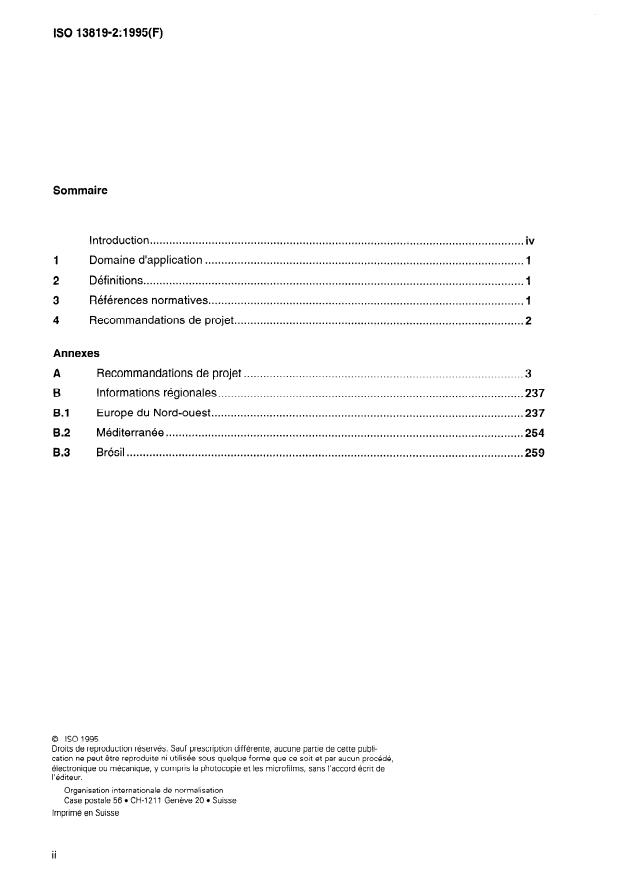
NORME
IS0
INTERNATIONALE
1381 9-2
Premiere édition
1995-1 2-01
Industrie du pétrole et du gaz naturel
Structures en mer -
Partie 2:
Structures fixes en acier
Petroleum and natural gas industries -'- Offshore structures -
Part 2: Fixed steel structures
.-
Numéro de reference
IS0 13819-2:1995(F)
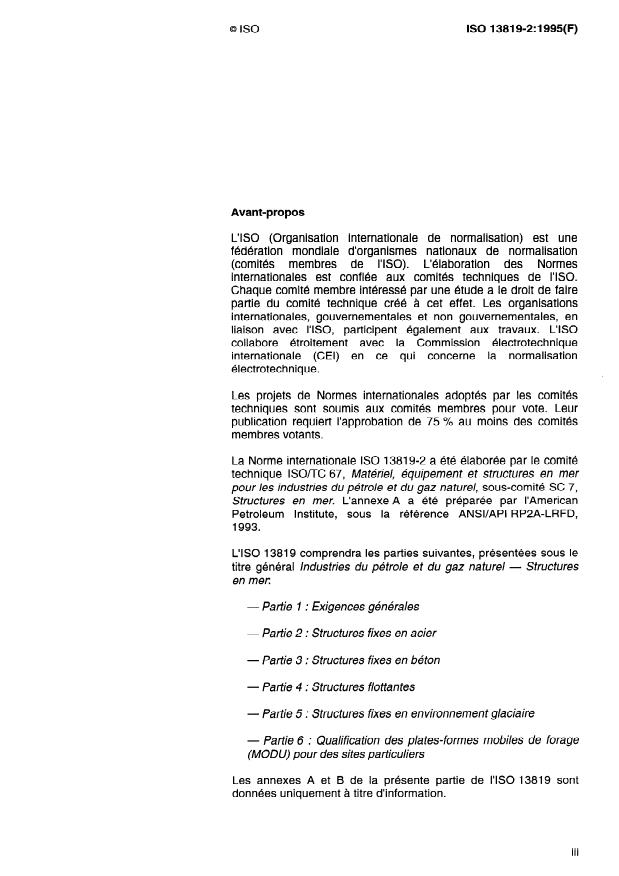
-- -
IS0 13819-2:1995(F)
Sommaire
Introduction .
., . iv
1 Domaine d'application . I
2 Définitions . . 1
3 Références normatives . 1
4 Recommandations de projet . 2
Annexes
A Recommandations de projet . 3
B Informations régionales . 237
6.1 Europe du Nord-ouest . 237
B.2 Méditerranée . 254
8.3 Brésil . 259
0 IS0 1995
Droits de reproduction réservés. Sauf prescription différente, aucune partie de cette publi-
cation ne peut &re reproduite ni utilisée sous quelque forme que ce soit et par aucun procedé,
électronique ou mécanique, y compris la photocopie et les microfilms, sans l'accord écrit de
I'éditeur.
Organisation internationale de normalisation
Case postale 56 CH-1 21 1 Genève 20 Suisse
Imprimé en Suisse
ii
-
-
---
I
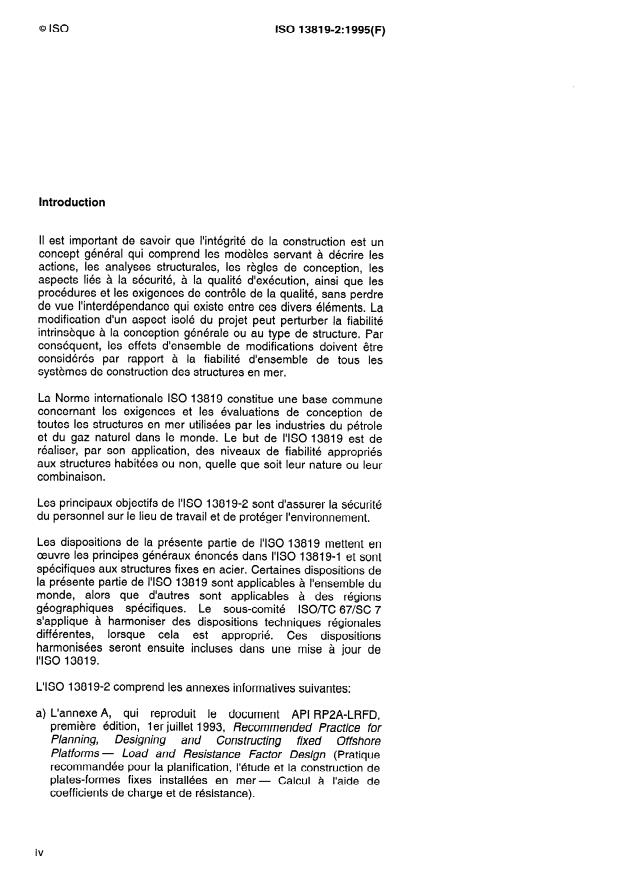
IS0 13819-2:1995(F)
Avant-propos
L'ISO (Organisation internationale de normalisation) est une
fédération mondiale d'organismes natioinaux de normalisation
(comités membres de I'ISO). L'élakiloration des Normes
internationales est confiée aux comités; techniques de I'ISO.
Chaque comité membre intéressé par une étude a le droit de faire
partie du comité technique créé a cet effet. Les organisations
internationales, gouvernementales et non gouvernementales, en
liaison avec I'ISO, participent également aux travaux. L'ISO
collabore étroitement avec la Commission électrotechnique
internationale (CEI) en ce qui concerne la normalisation
électrotechnique.
Les projets de Normes internationales adoptés par les comités
techniques sont soumis aux comites membres pour vote. Leur
publication requiert l'approbation de 75 % au moins des comités
membres votants.
La Norme internationale IS0 1381 9-2 a éte\ élaborée par le comité
technique lSO/TC 67, Matériel, équipemer?t et structures en mer
pour les industries du pétrole et du gaz nafurel, sous-comité SC 7,
Structures en mer. L'annexe A a été préparée par I'American
Petroleum Institute, sous la reference ANSVAPI RP2A-LRFDI
1993.
L'ISO 1381 9 comprendra les parties SuivanIfes, présentées sous le
titre général lndustries du pétrole et du gaz naturel - Structures
en mer:
- Partie 1 : Exigences générales
- Partie 2 : Structures fixes en acier
- Partie 3 : Structures fixes en béton
- Partie 4 : Structures flottantes
- Partie 5 : Structures fixes en environnlement glaciaire
- Partie 6 : Qualification des plates-formes mobiles de forage
(MODU) pour des sites particuliers
Les annexes A et B de la présente partie de I'ISO 13819 sont
données uniquement à titre d'information.
I_-
-
Q IS0
IS0 1381 9-2: 1 995( F)
Introduction
II est important de savoir que l'intégrité de la construction est un
concept général qui comprend les modèles servant à décrire les
actions, les analyses structurales, les règles de conception, les
aspects liés à la sécurité, à la qualité d'exécution, ainsi que les
procédures et les exigences de contrôle de la qualité, sans perdre
de vue l'interdépendance qui existe entre ces divers éléments. La
modification d'un aspect isolé du projet peut perturber la fiabilité
intrinsèque A la conception générale ou au type de structure. Par
conséquent, les effets d'ensemble de modifications doivent &re
considérés par rapport à la fiabilité d'ensemble de tous les
systèmes de construction des structures en mer.
La Norme internationale IS0 1381 9 constitue une base commune
concernant les exigences et les évaluations de conception de
toutes les structures en mer utilisées par les industries du pétrole
et du gaz naturel dans le monde. Le but de I'ISO 13819 est de
réaliser, par son application, des niveaux de fiabilité appropriés
aux structures habitées ou non, quelle que soit leur nature ou leur
combinaison.
Les principaux objectifs de I'ISO 1381 9-2 sont d'assurer la sécurité
du personnel sur le lieu de travail et de protéger l'environnement.
Les dispositions de la présente partie de I'ISO 13819 mettent en
œuvre les principes généraux énonces dans I'ISO 13819-1 et sont
spécifiques aux structures fixes en acier. Certaines dispositions de
la présente partie de I'ISO 13819 sont applicables à l'ensemble du
monde, alors que d'autres sont applicables à des régions
géographiques spécifiques. Le sous-comité lSO/TC 67/SC 7
s'applique à harmoniser des dispositions techniques régionales
différentes, lorsque cela est approprié. Ces dispositions
harmonisées seront ensuite incluses dans une mise à jour de
I'ISO 13819.
L'ISO 1381 9-2 comprend les annexes informatives suivantes:
a) L'annexe A, qui reproduit le document API RP2A-LRFDI
première édition, 1 er juillet 1993, Recommended Practice for
Planning, Designing and Constructing fixed Offshore
Platforms - Load and Resistance Factor Design (Pratique
recommandée pour la planification, 1'6tude et la construction de
plates-formes fixes installées en mer- Calcul à l'aide de
coefficients de charge et de résistance).
iv
0 IS0 IS0 13819-2:1995(F)
Ce document est reproduit avec l'autorisation de I'American
Petroleum Institute, 1200 L Street, Northwest, Washington
DC 2005, USA.
En incluant ce document API en tant qu'annexe informative,
I'ISO reconnait que celui-ci, par certairis aspects, ne répond pas
à toutes les règles en vigueur concernant la présentation et le
contenu d'une Norme internationale.
Les informations de la section ((POLICY,) ne sont valables que
pour les publications API.
Le sous-comité ISO/TC67/SC7 travaille actuellement à la
phase 2 de son programme de travail qui consiste en la mise à
jour de ce document API conjointement à I'American Petroleum
Institute. Une nouvelle édition conformai? aux règles de I'ISO sera
publiée dès que possible.
b) L'annexe B, qui identifie des dispositions applicables à I'échelle
régionale et qu'il convient d'utiliser en complément des
dispositions de I'ISO 1381 9-1 eVou de l'annexe A de la présente
partie de I'ISO 1381 9.
NORME INTERNATIONALE 0 IS0 IS0 13819-2:1995(F)
Industrie du pétrole et du gaz naturel - Structurelis en mer -
Partie 2:
Structures fixes en acier
1 Domaine d'application
La présente partie de I'ISO 13819 définit les prescriptions relatives a I'étude et à I'évaluation des
structures en mer fixes, construites en acier, telles que les charpentes métalliques tubulaires (ou
,(jackets))), les tours et les caissons autoporteurs. Les dispositions relatives à la résistance des
éléments tubulaires sont également applicables aux elements de tours souples et éventuellement à
d'autres types de structures, dans la mesure OÙ ces dispositions sont pertineintes.
La présente partie de I'ISO 13819 est applicable à I'étude de structures corvpletes, y compris les sous-
structures, les superstructures et les fondations.
Elle prescrit des principes de calcul qui sont également applicables aux étapes successives de la
construction (c'est-à-dire à la fabrication, au transport et à l'installation), Ci l'utilisation de la structure
pendant sa durée de vie, et a son abandon. D'une manière plus générale, les principes sont également
applicables à la réévaluation ou à la modification des structures existantes. L.es aspects liés au contrôle
de qualité sont également traités dans la présente partie de I'ISO 1381 9.
2 Définition
Pour les besoins de la présente partie de I'ISO 1381 9, la définition suivante s'applique.
2.1 structure fixe
Structure qui prend appui sur le fond de la mer et qui transfère au fond mariin toutes les charges qui lui
sont appliquées.
3 Références informatives
Les normes citées à l'annexe A, qui portent principalement sur l'étude structurale d'éléments non
tubulaires, peuvent être remplacées par des normes ISO, CEN ou nJitionales équivalentes qui
remplissent la condition suivante:
II est possible d'utiliser d'autres normes reconnues a I'échelle nationale ou internationale, à condition
d'être en mesure de démontrer que ces normes satisfont ou dépassent les exigences des normes
citées en référence.
IS0 13819-2:1995(F) @ IS0
4 Recommandations de projet
4.1 Dispositions techniques
L'annexe A donne des dispositions et des critères techniques. L'annexe A contient également des
prescriptions et des critères spécifiques aux regions situées au large des États-Unis, y compris des
coefficients partiels.
Les coefficients de résistance fournis a l'annexe A sont compatibles avec leis coefficients de charge
indiqués à l'annexe A. Pour des éléments non tubulaires, il convient d'appliquer les coefficients de
résistance aux résistances nominales. II est également possible d'utiliser des normes internationales,
CEN, ou nationales équivalentes, à condition d'utiliser des coefficients de charge et des coefficients de
résistance homogènes.
Lors de la détermination de coefficients partiels relatifs à d'autres zones géographiques, il convient de
tenir compte des différences liées à la pratiques ou a la nature des conditions (d'environnement, afin de
s'assurer que les niveaux de fiabilité requis sont atteints. II convient de consulter les renseignements
régionaux donnés dans l'annexe B, qui servent de guide.
4.2 Informations supplémentaires
Dans certains cas, des informations supplémentaires peuvent &re nécessaires pour compléter les
informations fournies à l'annexe A, concernant les conditions régionales d'environnement, les
exigences gouvernementales, ainsi que les pratiques locales en matière d'éludes de construction et
d'exploitation. Les informations relatives à ces aspects sont données à l'annexe B.
Chaque section de l'annexe B contient des dispositions et des critères techniques relatifs à une région
géographique spécifique, qu'il convient d'utiliser pour la région considérée, en lieu et place des
recommandations de l'annexe A.
NOTES
1 Selon le système législatif en vigueur dans le pays, certaines de ces dispositions peuvent avoir un caractere
obligatoire dans la juridiction du pays concerné.
2 D'autres informations spécifiques à une région seront ajoutées à l'annexe BI selon les besoins.
4.3 Autres regions
En ce qui concerne les régions pour lesquelles aucune information splécifique n'est fournie à
l'annexe B, il est possible d'utiliser les dispositions et les critères techniques de l'annexe A, à condition
que ces dispositions et critères techniques soient appropriés et homogènes. Toutefois, l'utilisateur est
averti du fait qu'un certain nombre de dispositions et de critères généraux, par exemple des critères
d'environnement et des coefficients partiels applicables à des charges, nécessitent généralement un
développement au cas par cas. Dans ces cas, il est possible de se référer aux normes nationales
appropriées, lorsque celles-ci ont été spécifiquement élaborées en tenant compte des particularités des
conditions marines.
.---- - I-
0 IS0 IS0 13819-2:1995(F)
Annexe A
(informative)
Recommandations de projet
La présente annexe contient des recommandations pour I'étude de plates-formes fixes en acier,
installées en mer. L'annexe A est le document API RP2A-LRFD de I'Anierican Petroleum Institute
intitulé Recommended Practice for Planning, Designing and Constructing fixed Offshore Platforms -
Load and Resistance Factor Design (Pratique recommandée pour la planification, I'étude et la
construction de plates-formes fixes installées en mer - Calcul a l'aide de coefficients de charge et de
résistance), première édition, 1 er juillet 1993. L'annexe A est complétée par l'annexe B qui contient des
dispositions applicables à des régions spécifiques. Les dispositions appliciables à I'échelle régionale
pour les eaux territoriales des États-Unis, sont spécifiées à l'annexe A.
Les dispositions de l'annexe A proviennent d'un étalonnage basé sur la fiiabilité des dispositions du
document API RP2A-WSD, Recommended Practice for Planning, Designmg and Constructing fixed
Offshore Platforms - Working Stress Design (Pratique recommandée pour Ya planification, I'étude et la
construction de plates-formes fixes installées en mer - Calcul a l'aide des contraintes admissibles),qui
a largement servi comme base de facto pour I'étude de plates-formes en mer, au cours des
15 dernières années. Cet étalonnage a été réalisé type d'élément par type d'élément. Les coefficients
d'action et de résistance ont été développés pour chaque type d'élément, de telle sorte que les niveaux
de fiabilité visés à l'annexe A sont, en général, homogènes avec ceux du document API RP2A-WSD.
L'annexe A se fonde sur les principes du calcul aux états limites et la méthode générale est cohérente
avec I'ISO 1381 9-1.
Pour des éléments non tubulaires, l'annexe A s'appuie sur l'utilisation (les résistances nominales
définies dans le document de I'American Institute for Steel Construction inritulé Load and Resistance
Factor Design Specification for Structural Steel Buildings (Spécification de ctilcul à l'aide de coefficients
de charge et de résistance pour les bâtiments en acier de construction).
Les coefficients partiels définis dans l'annexe A traduisent les méthodes pratiques et les niveaux de
fiabilité visés pour le Golfe du Mexique et pour d'autres zones, pour lesquels le document
API RP2A-WSD a servi de norme de calcul de référence.
-
-
6 IS0
IS0 1381 9-2: 1995(F)
(Page btanche)
U--- -a
IS0 13819-2:1995(F)
Recommended Practice for
Planning, Designing and Constructing
Fixed Offshore Platforms - Load and
Resistance Factor Design
API RECOMMENDED PRACTICE 2A-LRFD (RP 2A-LRFD)
FIRST EDITION, JULY 1, 1993
American National Standard
ANSVAPI RP2A-LRFD-93
Approved: April 13, 1994
Americrin Petroleum Institute
1220 L Sitreet. Northwest
Washington, DC 20005
11’
- -
IS0 13819-2:1995(F)
Issued by
AMERICAN PETROLEUM INSTITUTE
Production Department
FOR INFORMATION CONCERNING TECHNICAL CONTENTS OF
THIS PUBLICATION CONTACT THE API PRODUCTION DEPARTMENT,
1201 MAIN STREET, SUITE 2535, DALLAS, TX 75202-3894 - (214) 74a3a~i.
SEE BACK SIDE FOR INFORMATION CONCERNING HOW TO OBTAIN
ADDITIONAL COPIES OF THIS PUBLICATION.
Users of this publication should become familiar with its scope
and content. This publication is intended to supplement rather
than replace individual engineering Judgment.
OFFlIClAL PUBLICATION
REG. U.S. PATENT OFFICE
Copyright Q 1993 American Petroleum Institute
--- - 8-
IS0 13819-2:1995(F)
ERRATA
(OCTOBER, 1993)
Recommended Practice for
Planning, Designing and Constructing
Fixed Offshore Platforms - Lolad and
Resistance Factor Design
API RECOMMENDED PRACTICE 2A-LRFD (RP 2A-L,RFD)
FIRST EDITION, JULY 1,1993
American Petroleum Institute
1220 L Street, Northwest
Washington, DC, 20005
Issued by
AMERICAN PETROLEUM INSTITUTE
Production Department
FOR INFORMATION CONCERNING TECHNICAL CONTENTS OF
THIS PUBLICATION CONTACT THE API PRODUCTJON DEPARTMENT,
1201 MAlN STREET, SUITE 2535, DALLAS, TX 75202-3994 - (214) 746-3641.
SEE BACK SIDE FOR INFORMATION CONCERNING HOW TO OBTAIN
ADDITIONAL COPIES OF THIS PUBLICATION.
Users of this publication should become familiar with its scope
and content. This publication is intended to supplement rather
than replace individual engineering judgment.
OFFICIAL PUBLICATION
REO. U.S. PATENT OFFICE
Copyright 8 1993 American Petroleum Institute
--- -7
IS0 13819-2:1995(F)
Page 2, Table of Contents. Change A.8.7 to red
A.3.7 Deck Elevation
Page 33, Section C.3.4.2.3 Turbulence Intensity.
Change Equation C.9-8 to the following:
Page 52, Section D.3.2.1 Cylindrical Members.
Change Equation D.8.2-1 to the following:
...... (D.3.2-1)
Change Equation D.8.2-8 to tb following:
t, <#J~F,, . (D.3.2-3)
Page 55, Section E.l Connections of Tension and
Compression Members. Add the following note after
the definition ofFy for Equation E.8-1:
Note: The tensile strength limitation on F,. is intended
to apply throughout Section E.
Page 83, Table 1.1 Structural Steel Plates. Change
information shown under Group II, Class C, to the
following:
YIELD STRENGTH TENSILE STRENGTH
GROUP CLASS SPECIFICATION & GRADE MPa ksi M Pa ksi
II C ASTM A672 Grade 42 (to 2" thick)* 290 42 416 min. 60 min.
ASTM A672 Grade 60 (to 2" thick:
ASTM S91 required over X")* 346 50 450 min. 65 min.
Page 84, Table 1.2 Structural Steel Shapes. Change
information shown under Group II, Class C to the
following:
ASTM YIELD STRENGTH TENSILE STRENGTH
GROUP CLASS SPECIFICATION & GRADE M Pa ksi MPa ksi
I1 C A672 Grade 42 (to 60 mm (2 in) thick)' 290 42 416 min. 60 min.
A672 Grade 50 (to 50 mm (2 in) thick: 346 50 460 min. 65 min.
S91 reauired over 13 mm (% in) thick11
Page 127, Commentary Comm.C.8.1 Strength Re-
quirements, Fourth Paragraph, Third sentence.
Change to LI.
--
__I---
---
IS0 13819-2:1995(F)
Order No. 811-00211
Addltlonal copler avallable from
AMERICAN PETROLEUM INSTITUTE
Publications and Distribution Section
1220 L Street, NW
Washington, DC 20005
(202) 682-8375
-- --
IS0 13819-2:1995( F)
(Page blanche)
. .
IS0 13819-2:1995(F)
2 American Petroleum Institute
CONTENTS
Page
POLICY . 18
FOREWORD . 19
SEC . A . PLANNING . 20
A.l GENERAL . 20
...................................... 20
A.1.1 Planning
A.1.2 Design Criteria . 20
A.1.3 Codes and Standards . 20
A.2 PLATFORM TYPES . 20
A.2.1 Fixed Platforms . 20
A.2.1.1 Template . 20
................................ 20
A.2.1.2 Tower
A.2.1.3 Minimum Structures . 20
A.2.1.4 Gravity . 20
A.2.2 Other Platforms . 20
A.2.2.1 Guyed Tower . 20
A.2.2.2 Tension Leg Platform . 20
A.2.2.3 Compliant Platform . 20
A.2.2.4 Others . 20
A.3 OPERATIONAL CONSIDERATIONS., . 20
A.3.1 Function . 20
A.3.2 Location . 20
A.3.3 Orientation . 20
A.3.4 Water Depth . 20
................. 21
A.3.5 Access and Auxiliary Systems
A.3.6 Fire Protection . 21
A.3.7 Deck Evaluation . 21
A.3.8 Wells and Risers . 21
A.3.9 Equipment and Material Layouts . 21
A.3.10 Personnel and Material Transfer . 21
A.3.11 Spillage and Contamination . 21
A.3.12 Exposure . 21
A.4 ENVIRONMENTAL CONSIDERATIONS . 21
A.4.1 General . 21
A.4.2 Winds . 21
A.4.3 Waves . 21
A.4.4 Tides . 21
A.4.5 Currents. . 21
A.4.6 Marine Growth . 22
................................... 22
A.4.7 FloatingIce
A.4.8 Other Oceanographic and Meteorological
Information., . 22
A.4.9 Active Geologic Processes . 22
A.4.9.1 General . 22
......................... 22
A.4.9.2 Earthquakes
A.4.9.3 Faults . 22
A.4.9.4 Seafloor Instability . 22
A.4.9.5 Scour . 22
A.4.9.6 Shallow Gas . 23
Site Investigation - Foundations . 23
A.4.10
A.4.10.1 Objectives . 23
A.4.10.2 Seabottom Surveys . 23
A.4.10.3 Soil Investigation and Testing . 23
A.5 SELECTING THE DESIGN CONDITIONS . 23
A.6 PLATFORM REUSE . 24
A.7 REGULATIONS., . 24
.
-.
... ..
IS0 13819-2:1995( F)
RP PA-LRFD Planning. Designing and Constructing Fixed Offshore Platforms . Load and Resistance Factor Design
CONTENTS (Continued)
SEC . B . DES
IGNREQUIREMENTS .
....... 25
B . 1
SCOPE .
....... 25
B.2
DESIGN FOR IN-PLACE CONDITIONS .
...... 25
B.3 DESIGN FOR CONSTRUCTION CONDITIONS
...... 25
B.4 THE STRENGTH AND STABILITY CHECK . .
...... 25
B.5 STRUCTURE ANALYSIS .
...... 25
B.6 REDUNDANCY .
...... 25
B.7 CORROSION PROTECTION .
...... 25
B.8 DEFORMATION LOADS .
...... 25
SEC.C-LOADS . 26
C.l SCOPE . 26
C.2 GRAVITY LOADS . 26
C.2.1 Factored Gravity Loads . 26
C.2.2 Dead Load 1. D, . 26
(2.2.3 Dead Load 2, D, . 26
(2.2.4 Live Load 1, & . 26
C.2.5 Live Load 2, . 26
C.2.6 Unintentional k looding . ,. . 26
C.2.7 Position and Range of Gravity Loads . 26
C.2.8 Carry Down Factors . 26
C.2.9 Area Loads . 26
.............. 26
C.3 WIND. WAVE AND CURRENT LOADS
C.3.1 Strength Requirements . 26
C.3.1.1 Factored Loads . 26
C.3.1.2 Extreme Wind, Wave and Current
Load. We . 27
C.3.1.3 Direction of Wind, Wave and Current . . 27
C.3.1.4 Operating Wind. Wave and Current
Load . 27
C.3.2 Static Wave Analysis . 27
C.3.2.1 Apparent Wave Period . 27
(2.3.2.2 Two-Dimensional Wave Kinematics . 27
C.3.2.3 Wave Kinematics Factor . 29
C.3.2.4 Current Blockage Factor . 29
C.3.2.5 Combined Wave/Current Kinematics . 29
C.3.2.6 Marine Growth . 29
C.3.2.7 Drag and Inertia Coefficients . , . 29
C.3.2.8 Conductor Shielding Factor . 31
(2.3.2.9 Hydrodynamic Models
for Appurtenances . 31
C.3.2.10 Morison Equation . 31
C.3.2.11 Global Structure Forces . 32
C.3.2.12 Local Member Design . 32
C.3.3 Extreme-Wave Dynamic Analysis . 32
C.3.3.1 Extreme Inertial Load. D, . 32
C.3.3.2 Global Dynamic Wave Analysis . 32
C.3.3.2.1 Dynamic Analysis Methods . 32
C.3.3.2.2 Design Seastate . ,. . 32
C.3.3.2.3 Fluid Force on a Member . 33
C.3.3.2.4 Mass . 33
(2.3.3.2.5 Damping . 33
C.3.3.2.6 Stiffness . 33
C.3.3.3 Member Design . 33
C.3.4 Wind Force . 33
C.3.4.1 General . 33
. - .
.-.
__I__
........
. .
IS0 1381 9-2: 1995(F)
4 American Petroleum Institute
CONTENTS (Continued)
C.3.4.2 Wind Properties . 33
C.3.4.2.1 Mean Profile . 33
(3.3.4.2.2 Gust Factor . 33
C.3.4.2.3 Turbulence Intensity., . 33
C.3.4.2.4 Wind Spectra . 33
C.3.4.2.5 Spatial Coherence . 34
(2.3.4.3
Wind Velocity and Force Relationship . 34
C.3.4.4
Local Wind Force Considerations . 34
.................... 34
C.3.4.5 Shape Coefficients
C.3.4.6 Shielding Coefficients . 34
.................... 34
C.3.4.7 Wind Tunnel Data
C.3.5 Current Force . 34
C.3.5.1 Current Force Only . 34
C.3.6.2 Current Associated With Waves . 34
C.3.6 Deck Clearance . 34
C.3.7 Hydrodynamic Force Guidelines
for U.S. Waters . 35
C.3.7.1 General . 35
Intent . 35
C.3.7.2
c.3.7.3 Guideline Design Metocean Criteria
for the Gulf of Mexico. North of 27"
N Latitude and West of 86'
.......................... 35
W Longitude
C.3.7.3.1 Omnidirectional Wave Height vs
Water Depth . 35
C.3.7.3.2 Principal Direction Associated
With the Omnidirectional
Wave Height . 40
C.3.7.3.3 Wave Height vs Direction . 40
C.3.7.3.4 Currents Associated With the
Wave Height by Direction . 40
C.3.7.3.6 Associated Wave Period . 40
C.3.7.3.6 Associated Storm Tide . 40
C.3.7.3.7 Associated Wind Speed. . 40
c.3.7.4 Guideline Design Wave. Wind.
and Current Forces for the Gulf
of Mexico. North of 27' N Latitude
and West of 86" W Longitude . 40
C.3.7.4.1 Wave Kinematics Factor . 40
.............. 40
C.3.7.4.2 MarineGrowth
C.3.7.4.3 Deck Height . 40
c . 3.7.5 Guideline Design Metocean Criteria for
Other U.S. Waters . 40
C.3.7.5.1 Waves. Currents. and Storm
Tides . 42
C.3.7.5.2 Winds . 42
C.3.7.5.3 Current Profile . 42
C.3.7.5.4 Local Site Effects . 42
C.3.7.6 Guideline Design Wave. Wind. and
Current Forces for Other U.S. Waters . 42
C.3.7.6.1 Wave Kinematics Factor . 42
C.3.7.6.2 Marine Growth . 43
C.3.7.6.3 Deck Height . 43
a.-.
C.3.8 References . 43
C.4 EARTHQUAKE LOADS . 43
C.4.1 General . 43
.
.
...
IS0 1381 9-211 995( F)
RP 2A-LRFD: Planning. Designing and Constructing Fixed Ofhhore PIatforms . Loul and Rerishnce Factor Design
CONTENTS (Continued)
C.4.1.1 Scope . 43
C.4.1.2 Evaluation of Seismic Activity . 44
C.4.1.3 Evaluation for Zones of Low Seismic
Activity . 44
C.4.2 Strength Requirements . 44
C.4.2.1 Factored Loads . 44
C.4.2.2 Strength Level Earthquake. E . 44
C.4.2.3 Structural Modeling . 44
C.4.2.4 Response Analysis . 44
C.4.2.5 Response Assessment . 45
C.4.3 Ductility Requirements . 45
C.4.3.1 General . 45
C.4.3.2 Structures Not Requiring Ductility
..................... ,. ........ 45
Analysis
C.4.3.3 Structures Requiring Ductility
Analysis . 45
C.4.4 Additional Guidelines . 45
C.4.4.1 Tubular Joints . 45
C.4.4.2 Deck Appurtenances and Equipment . . 45
C.5 FABRICATION AND INSTALLATION LOADS . 46
C.5.1 General . 46
C.5.2 Dynamic Effects . 46
(3.5.3 Load Factors . 46
C.5.4 Local Effects . 47
................................. 47
C.5.5 Lifting Forces
............................... 47
C.5.5.1 General
C.5.5.2 Effect of Tolerances . ., . 47
C.5.5.3 Slings. Shackles and Fittings . 47
C.5.6 Loadout Forces . 47
C.5.6.1 Direct Lift . 47
C.5.6.2 Horizontal Movement onto Barge . 47
C.5.7 Transportation Forces . ,. . 47
C.5.7.1 General . 47
C.5.7.2 Environmental Criteria . 47
(2.5.7.3 Determination of Forces . 47
C.5.7.4 Other Considerations . 48
C.5.8 Launching Forces and Uprighting Forces . 48
C.5.8.1 Launched Structures . 48
(2.5.8.2 Uprighting Structures . 48
C.5.8.3 Submergence Pressures . 48
C.5.9 Installation Foundation Forces . a, . 48
(2.5.9.1 General . 48
C.5.9.2 Environmental Conditions. . 48
C.5.9.3 Structure Loads . 48
C.5.10 Removal Forces . 48
C.6 ACCIDENTAL LOADS . 48
SEC . D - CYLINDRICAL MEMBER DESIGN
D.l GENERAL . 49
D.2 CYLINDRICAL MEMBERS UNDER TENSION.
COMPRESSION. BENDING. SHEAR OR
HYDROSTATIC PRESSURE . 49
D.2.1 Axial Tension . 49
D.2.2 Axial Compression . 49
D.2.2.1 Column Buckling . 49
D.2.2.2 Local Buckling . 49
..
._.
-.
..-.
IS0 1381 9-2: 1995(Fl
6 American Petroleum Institute
CONTENTS (Continued)
D.2.3 Bending . 50
D.2.4 Shear . 40
D.2.4.1 Beam Shear . 50
D.2.4.2 Torsional Shear . 50
D.2.5 Hydrostatic Pressure . 50
D.2.5.1 Design Hydrostatic Head . 50
D.2.5.2 Hoop Buckling . 50
D.2.5.3 Ring Stiffener Design . 51
D.2.5.4 Geometric Imperfections . 51
D.3 CYLINDRICAL MEMBERS UNDER COMBINISD
LOADS . 51
D.3.1 Combined Axial Tension and Bending . 51
D.3.2 Combined Axial Compression and Bending: . 51
D.3.2.1 Cylindrical Members . 52
D.3.2.2 Piles . 52
D.3.2.3 Slenderness Ratio and Reduction
Factor . 52
D.3.3 Combined Axial Tension. Bending and
Hydrostatic Pressure . 53
D.3.4 Combined Axial Compression, Bending and
Hydrostatic Pressure . 53
D.4 CONICALTRANSITIONS . 53
D.4.1 Axial Compression and Bending . 53
............................ 53
D.4.1.1 Geometry
D.4.1.2 Local Buckling . 53
D.4.1.3 Unstiffened Cone-Cylinder Junctions . . 53
D.4.1.4 Cone-Cylinder Junction Rings . 54
D.4.2 Hydrostatic Pressure . 54
D.4.2.1 Cone Design . 54
D.4.2.2 Intermediate Stiffening Rings . 54
D.4.2.3 Cone-Cylinder Junction Rings . 54
SEC . E - CONNECTIONS
E.l CONNECTIONS OF TENSION AND
COMPRESSION MEMBERS . 55
E.2 RESTRAINT AND SHRINKAGE . 55
E.3 TUBULAR JOINTS . 55
E.3.1 Simple Joints . 55
E.3.1.1 Strength Check . 57
E.3.1.2 Design Practice . 58
E.3.2 Overlapping Joints . 58
E.3.3 Congested Joints . 59
Load Transfer Across Chords . 59
E.3.4
E.3.5 Other Complex Joints . 59
SEC . F - FATIGUE
F.l FATIGUE DESIGN. . 61
F.2 FATIGUE ANALYSIS., . 61
F.3 S-N CURVES FOR MEMBERS AND CONNECTIONS,
EXCEPT FOR TUBULAR MEMBERS . 61
F.4 S-N CURVES FOR TUBULAR CONNECTIONS . 63
F.5 STRESS CONCENTRATION FACTORS . 63
SEC . G - FOUNDATION DESIGN
G.l GENERAL . 64
.............................. 64
(3.2 PILE FOUNDATIONS
.
..
..
IS0 13819-2:1995(F)
RP BA-LRFD: Planning . Designing and Constructing Fixed Offshore Platforma . Load and Resistance Factor Design
CONTENTS (Continued)
G.2.1 Driven Piles . 64
G.2.2 Drilled and Grouted Piles . 64
G.2.3 Belled Piles . 64
G.3 PILE DESIGN . 65
G.3.1 Foundation Size . 65
G.3.2 Foundation Response . 65
G.3.3 Deflections and Rotations . 65
G.3.4 Foundation Capacity . 65
G.3.5 Scour . 65
G.4
PILE CAPACITY FOR AXIAL BEARING LOADS . . 65
G.4.1 Ultimate Bearing Capacity . 65
G.4.2 Skin Friction and End Bearing in
Cohesive Soils . 66
G.4.3 Shaft Friction and End Bearing in
Cohesionless Soils . 66
G.4.4 Skin Friction and End Bearing of
Grouted Piles in Rock . 68
G.5 PILE CAPACITY FOR AXIAL PULLOUT LOADS . . 68
G.6
AXIAL PILE PERFORMANCE., . 68
G.6.1 Static Axial Response of Piles . 68
G.6.2 Cyclic Axial Response of Piles . 68
G.6.3 Overall Axial Response of Piles . 68
G.7 SOIL REACTION FOR AXIALLY LOADED
PILES . 69
G.7.1 General . 69
G.7.2 Axial Load Transfer (t-z) Curves . 69
G.7.3 Tip Load - Displacement Curve . 69
G.8 SOIL REACTION FOR LATERALLY LOADED
PILES . 69
.................................... 69
G.8.1 General
G.8.2 Lateral Bearing Capacity for Soft Clay" . 71
G.8.3 Load-Deflection (p-y) Curves for Soft Clay . 71
G.8.4 Lateral Bearing Capacity for Stiff Clay . 72
G.8.5 Load-Deflection (p-y) Curves for Stiff Clay . 72
G.8.6 Lateral Bearing Capacity for Sand . 72
G.8.7 Load-Deflection (p-y) Curves for Sand . 73
PILE GROUP ACTION . 73
G.9
G.9.1 General . 73
G.9.2 Axial Behavior . 73
G.9.3 Lateral Behavior . 73
G.9.4 Pile Group Stiffness and Structure Dynamics . 73
G.10 PILE WALL THICKNESS . 73
G.10.1 General . 73
G.10.2 Pile Loads. . 73
G.10.3 Pile Design Checks . 73
G.10.4 Load Check Due to Weight of Hammer
During Hammer Placement . 73
G.10.5 Stresses During Driving . 74
G.10.6 Minimum Wall Thickness . 74
G.10.7 Allowance for Underdrive and Overdrive . 74
G.10.8 Driving Shoe . 74
G.10.9 DrivingHead . 75
G.11 LENGTH OF PILE SECTIONS . 75
G.12 SHALLOW FOUNDATIONS . 75
G.13 STABILITY OF SHALLOW FOUNDATIONS . 75
G.13.1 Shallow Foundation Capacity . 75
................. 75
G.13.2 Undrained Bearing Capacity
IS0 13819-2:1995(F)
a American Petroleum Institute
CONTENTS (Continued)
G.13.3 Drained Bearing Capacity . 76
G.13.4 Sliding Stability . 76
G.13.5 Capacity of Shallow Foundations . 76
G.14 STATIC DEFORMATION OF SHALLOW
FOUNDATIONS . 76
G.14.1 Short Term Deformation . 76
G.14.2
Long Term Deformation . 77
G.15 DYNAMIC BEHAVIOR OF SHALLOW
FOUNDATIONS . 77
G.16 HYDRAULIC INSTABILITY OF SHALLOW
FOUNDATIONS . 77
G.16.1 Scour . 77
G.16.2 Piping . 77
G.17 INSTALLATION AND REMOVAL OF SHALLOW
FOUNDATIONS . 77
SEC . H . STRUCTURAL COMPONENTS AND SYSTEMS
H.1 SUPERSTRUCTURE DESIGN . 78
H.l.l Deck Model for Jacket Design . 78
.
H.1.2 Deck Design Model . 78
H.1.3 Deck Design Load Factors . 78
H.1.4 Other Deck Design Considerations . 78
H.2 NONTUBULAR STRUCTURAL SHAPES
DESIGN . 78
H.2.1 General . 78
H.2.2 Resistance Factors . 78
H.2.3 Plate Girder Design. . 78
H.3 CRANE SUPPORTING STRUCTURE . 79
H.3.1 Static Design . 79
H.3.2 Dynamic Design . 79
H.3.3 Fatigue Design . 79
H.4 GROUTED PILE-TO-STRUCTURE
CONNECTIONS . 79
H.4.1 General . 79
H.4.2 Computation of Applied Axial Force . 79
H.4.3 Computation of Allowable Axial Force . 79
H.4.3.1 Plain Pipe Connections . 79
H.4.3.2 Shear Key Connections . 80
H.4.3.3 Limitations . 80
H.4.3.4 Other Design Methods . 80
H.4.4 Loadings Other Than Axial Load . 80
H.5 CONDUCTORS . 80
H.6 GUYLINE SYSTEM DESIGN . 80
H.6.1 General . 80
H.6.2 Components . 80
H.6.2.1 Lead Lines . 80
H.6.2.2 Clumpweights . 81
H.6.2.3 Anchor Lines . 81
H.6.2.4 Anchor . 81
H.6.2.5 Terminations at the Structure . 81
H.6.2.6 Terminations at Clump or Anchor . 81
H.6.3 Configuration . 81
H.6.4 Analysis . 81
H.6.5 Design Requirements . 81
Guyed Stiff Structures . 81
H.6.5.1
Guyed Compliant Structures. . 81
H.6.6.2
H.6.6 Fatigue . 81
.
-.-
_I
IS0 13819-2: 1995( F)
RP PA-LRFD: Planning. Designing and Constructing Fixed Offshore Platform . Lord and Renishnce Fxtor Design
CONTENTS (Continued)
SEC . I . MATERIAL
1.1 STRUCTURAL STEEL . 82
1.1.1 General . 82
1.1.2 Steel Groups . 82
1.1.3 Steel Classes . 82
~~
1.1.4 Structural Plate and Shape Specifications . 82
1.2 STRUCTURAL STEEL PIPE . 82
~ .
1.2.1 Specifications . 82
1.2.2 Fabrication . 82
1.2.3 Selections for Conditions of Service . 82
1.3 STEEL FOR TUBULAR JOINTS . 85
1.3.1 Underwater Joints . 85
1.3.2 Above Water Joints . 85
1.3.3 Critical Joints . 85
1.3.4 Brace Ends . 85
1.4 CEMENTGROUTANDCONCRETE . 85
1.4.1 Cement Grout . 85
1.4.2 Concrete . 85
SEC . J . DRAWINGS AND SPECIFICATIONS
5.1 GENERAL . 86
5.2 CONCEPTUAL DRAWINGS . 86
5.3 BID DRAWINGS AND SPECIFICATIONS . 86
....... 86
5.4 DESIGN DRAWINGS AND SPECIFICATIONS
5.5 FABRICATION DRAWINGS AND
SPECIFICATIONS . 87
5.6 SHOP DRAWINGS . 87
5.7 INSTALLATION DRAWINGS AND
SPECIFICATIONS . 87
5.8 AS-BUILT DRAWINGS AND SPECIFICATIONS . 87
SEC . K -WELDING
K . 1 GENERAL . 89
K.1.1 Specifications . 89
K.1.2 Welding Procedures . 89
K.1.3 Welding Procedure Limitations . 89
K.1.4 Welders and Welding Operators . 89
K.2
QUALIFICATIONS . 89
K.2.1 General . 89
K.2.2 Impact Requirements . 89
K.2.3 Mechanical Testing in Procedure
Qualifications . . 89
K.2.4 Prior Qualifications . 89
K.3 WELDING . 89
K.3.1 General . 89
K.3.2 Specified Welds . 90
K.3.3 Groove Welds Made From One Side . 90
K.3.4 Seal Welds . 90
K.3.5 Stress Relief . 90
K.3.6 Installation Welding . 90
K.3.7 Arc Strikes . 90
K.3.8 Air-Arc Gouging . 90
....................... 90
K.3.9 Temporary Attachments
RECORDS AND DOCUMENTATION . 90
K.4
-8
IS0 13819-2:1995(F)
10 American Petroleum Institute
CONTENTS (Continued)
SEC . L . FABRICATION
L.l ASSEMBLY . 91
L.l.l General . 91
L.1.2 Splices . 91
L.1.2.1 Pipe . 91
L.1.2.2 Beams . 91
L.1.2.3 Joint Cans . 91
L.1.3 Welded Tubular Connections . 91
L.1.3.1 General . 91
L.1.3.2 Fabrication Sequence . 91
L.1.3.3 Joint Details . 91
L.1.3.4 Weld Profile Control . 91
L.1.3.5 Special Details . 91
L.1.3.6 Slotted Members . 91
L.1.4 Plate Girder Fabrication and Welding . 91
L.1.5 Final Fabrication Tolerances . 93
L.1.5.1 General . 93
L.1.5.2 . 93
Jacket and Deck Section Columns.
L.1.5.3 Jacket and Deck Section Bracing . 93
L.1.5.4 Deck Beams . 93
L.1.5.5 Cap Beams . 93
L.1.5.6 Grating . 93
L.1.5.7 Fencing and Handrails . 93
L.1.5.8 Landings and Stairways . 93
L.1.5.9 Piles . 93
for Grouted Pile to
L.1.6 Provisions
...
NORME
ISO
INTERNATIONALE
13819-2
Première édition
1995-l 2-01
Industrie du pétrole et du gaz naturel -
Structures en mer -
Partie 2:
Structures fixes en acier
Petroleum and natural gas industries - Offshore structures -
Part 2: Fixed steel structures
Numéro de référence
ISO 138 19-2: 1995(F)
ISO 13819-2: 1995(F)
Sommaire
. . . . . . .~. iv
introduction
. . . . . . . . . . . . . . . . . . . . . . . . . . . . . . . . . . . . . . . . . . . . . . . . . . . . . . . . . . . . . . . . . . . . . . . . . . . . . . . . .“. 1
Domaine d’application
. . . . . . . . . . . . . . . . . . . . . . . . . . . . . .~.”.~. 1
Définitions
Références normatives . . . . . . . . . . . . . . . . . . . . . . . . . . . . . . . . . . . . . . . . . . .*.
Recommandations de projet . . . . . . . . . . . . . . . . . . . . . . . . . . . . . . . . . . . . . . . . . . . . . . . . . . . . . . . . . . . . . . . . . . . . . . . . . . . . . . . . . . . . . . . . . 2
Annexes
. . . . . . . . . . . . . . . . . . . . . . . . . . . . . . . . . . . . . . . .~. 3
A Recommandations de projet
informations régionales . . . . . . . . . . . . . . . . . . . . . . . . . . . . . . . . . . . . . . . . . . . . . . . . . . . . . . . . . . . . . . . . . . . . . . . . . . . . . . . . . . . . . . . . . . . . . . 237
B
Europe du Nord-ouest . . . . . . . . . . . . . . . . . . . . . . . . . . . . . . . . . . . . . . . . . . . . . . . . . . . . . . . . . . . . . . . . . . . . . . . . . . . . .~.~. 237
61 .
Méditerranée . . . . . . . . . . . . . . . . . . . . . . . . . . . . . . . . . . . . . . . . . . . . . . . . . . . . . . . . . . . . . . . . . . . . . . . . . . . . . . . . . . . . . . . . . . . . . . . . . . . . . . . . . . . . . . 254
B2 .
B3 . Brésil . . . . . . . . . . . . . . . . . . . . . . . . . . . . . . . . . . . . . . . . . . . . . . . . . . . . . . . . . . . . . . . . . . . . . . . . . . . . . . . . . . . . . . . . . . . . . . . . . . . . . . . . . . . . . . . . . . . . . . . . .
0 ISO 1995
Droits de reproduction réservés. Sauf prescription différente, aucune partie de cette publi-
cation ne peut être reproduite ni utilisée sous quelque forme que ce soit et par aucun procédé,
électronique ou mécanique, y compris la photocopie et les microfilms, sans l’accord écrit de
l’éditeur.
Organisation internationale de normalisation
Case postale 56 l CH-121 1 Genève 20 0 Suisse
Imprimé en Suisse
ii
@ iso ISO 13819-2: 1995(F)
Avant-propos
L’ISO (Organisation internationale de normalisation) est une
fédération mondiale d’organismes nationaux de normalisation
(comités membres de I’ISO). L’élaboration des Normes
internationales est confiée aux comités techniques de I’ISO.
Chaque comité membre intéressé par une étude a le droit de faire
partie du comité technique créé à cet effet. Les organisations
internationales, gouvernementales et non gouvernementales, en
liaison avec I’ISO, participent également aux travaux. L’ISO
collabore étroitement avec la Commission électrotechnique
internationale (CEI) en ce qui concerne la normalisation
électrotechnique.
Les projets de Normes internationales adoptés par les comités
techniques sont soumis aux comités membres pour vote. Leur
publication requiert l’approbation de 75 % au moins des comités
membres votants.
La Norme internationale ISO 13819-2 a été élaborée par le comité
technique ISO/TC 67, Matériel, équipement et structures en mer
pour /es industries du pétrole et du gaz nature/, sous-comité SC 7,
Structures en mer. L’annexe A a été préparée par I’American
Petroleum Institute, sous la référence ANSVAPI RPLSA-LRFD,
1993.
L’ISO 13819 comprendra les parties suivantes, présentées sous le
titre général Industries du pétrole et du gaz nature/ - Structures
en mer:
- Partie 1 : Exigences générales
- Partie 2 : Structures fixes en acier
- Parfie 3 : Structures fixes en béton
- Par?ie 4 : Structures flottantes
- Partie 5 : Structures fixes en environnement glaciaire
- Partie 6 : Qualification des plates-formes mobiles de forage
(MODU) pour des sites particuliers
Les annexes A et B de la présente partie de I’ISO 13819 sont
données uniquement à titre d’information.
ISO 13819-2: 1995(F)
@ ISO
Introduction
Il est important de savoir que l’intégrité de la construction est un
concept général qui comprend les modèles servant à décrire les
actions, les analyses structurales, les règles de conception, les
aspects liés à la sécurité, à la qualité d’exécution, ainsi que les
procédures et les exigences de contrôle de la qualité, sans perdre
de vue l’interdépendance qui existe entre ces divers éléments. La
modification d’un aspect isolé du projet peut perturber la fiabilité
intrinsèque à la conception générale ou au type de structure. Par
conséquent, les effets d’ensemble de modifications doivent être
considérés par rapport à la fiabilité d’ensemble de tous les
systèmes de construction des structures en mer.
La Norme internationale ISO 13819 constitue une base commune
concernant les exigences et les évaluations de conception de
toutes les structures en mer utilisées par les industries du pétrole
et du gaz naturel dans le monde. Le but de I’ISO 13819 est de
réaliser, par son application, des niveaux de fiabilité appropriés
aux structures habitées ou non, quelle que soit leur nature ou leur
combinaison.
Les principaux objectifs de I’ISO 13819-2 sont d’assurer la sécurité
du personnel sur le lieu de travail et de protéger l’environnement.
Les dispositions de la présente partie de I’ISO 13819 mettent en
œuvre les principes généraux énoncés dans I’ISO 138194 et sont
spécifiques aux structures fixes en acier. Certaines dispositions de
la présente partie de I’ISO 13819 sont applicables à l’ensemble du
monde, alors que d’autres sont applicables à des régions
géographiques spécifiques. Le sous-comité ISO/TC 67/SC 7
s’applique à harmoniser des dispositions techniques régionales
différentes, lorsque cela est approprié.
Ces dispositions
harmonisées seront ensuite incluses dans une mise à jour de
I’ISO 13819.
L’ISO 13819-2 comprend les annexes informatives suivantes:
a) L’annexe A, qui reproduit le document API RP2A-LRFD,
première édition, 1 er juillet 1993, Recommended Practice for
Planning, Designing and Constructing fixed Offshore
Load and Resistance Factor Design (Pratique
Pla tforms -
recommandée pour la planification, l’étude et la construction de
plates-formes fixes installées en mer - Calcul à l’aide de
coefficients de charge et de résistance).
iv
0 ISO ISO 13819-2: 1995(F)
Ce document est reproduit avec l’autorisation de I’American
Petroleum Institute, 1200 L Street, Northwest, Washington
DC 2005, USA.
En incluant ce document API en tant qu’annexe informative,
I’ISO reconnaît que celui-ci, par certains aspects, ne répond pas
à toutes les règles en vigueur concernant la présentation et le
contenu d’une Norme internationale.
Les informations de la section ((POLICY)) ne sont valables que
pour les publications API.
Le sous-comité ISO/TC67/SC7 travaille actuellement à la
phase 2 de son programme de travail qui consiste en la mise à
jour de ce document API conjointement à I’American Petroleum
Institute. Une nouvelle édition conforme aux règles de I’ISO sera
publiée dès que possible.
b) L’annexe B, qui identifie des dispositions applicables à l’échelle
régionale et qu’il convient d’utiliser en complément des
dispositions de I’ISO 138194 et/ou de l’annexe A de la présente
partie de I’ISO 13819.
Page blanche
NORME INTERNATIONALE @ ISO ISO 13819=2:1995(F)
Industrie du pétrole et du gaz naturel - Structures en mer -
Partie 2:
Structures fixes en acier
Domaine d’application
La présente partie de I’ISO 13819 définit les prescriptions relatives à l’étude et à l’évaluation des
structures en mer fixes, construites en acier, telles que les charpentes métalliques tubulaires (ou
+Mets)+, les tours et les caissons autoporteurs. Les dispositions relatives à la résistance des
éléments tubulaires sont également applicables aux éléments de tours souples et éventuellement à
d’autres types de structures, dans la mesure où ces dispositions sont pertinentes,
La présente partie de I’ISO 13819 est applicable à l’étude de structures complètes, y compris les sous-
structures, les superstructures et les fondations.
Elle prescrit des principes de calcul qui sont également applicables aux étapes successives de la
construction (c’est-à-dire à la fabrication, au transport et à l’installation), à l’utilisation de la structure
pendant sa durée de vie, et à son abandon. D’une manière plus générale, les principes sont également
applicables à la réévaluation ou à la modification des structures existantes. Les aspects liés au contrôle
de qualité sont également traités dans la présente partie de I’ISO 13819.
2 Définition
Pour les besoins de la présente partie de I’ISO 13819, la définition suivante s’applique.
21 . structure fixe
Structure qui prend appui sur le fond de la mer et qui transfère au fond marin toutes les charges qui lui
sont appliquées.
3 Références informatives
Les normes citées à l’annexe A, qui portent principalement sur l’étude structurale d’éléments non
tubulaires, peuvent être remplacées par des normes ISO, CEN ou nationales équivalentes qui
remplissent la condition suivante:
II est possible d’utiliser d’autres normes reconnues à l’échelle nationale ou internationale, à condition
d’être en mesure de démontrer que ces normes satisfont ou dépassent les exigences des normes
citées en référence.
ISO 13819=2:1995(F)
4 Recommandations de projet
4.1 Dispositions techniques
L’annexe A donne des dispositions et des critères techniques. L’annexe A contient également des
prescriptions et des critères spécifiques aux régions situées au large des États-Unis, y compris des
coefficients partiels.
Les coefficients de résistance fournis à l’annexe A sont compatibles avec les coefficients de charge
indiqués à l’annexe A. Pour des éléments non tubulaires, il convient d’appliquer les coefficients de
résistance aux résistances nominales. II est également possible d’utiliser des normes internationales,
CEN, ou nationales équivalentes, à condition d’utiliser des coefficients de charge et des coefficients de
résistance homogènes.
Lors de la détermination de coefficients partiels relatifs à d’autres zones géographiques, il convient de
tenir compte des différences liées à la pratiques ou à la nature des conditions d’environnement, afin de
s’assurer que les niveaux de fiabilité requis sont atteints. II convient de consulter les renseignements
régionaux donnés dans l’annexe B, qui servent de guide.
4.2 Informations supplémentaires
Dans certains cas, des informations supplémentaires peuvent être nécessaires pour compléter les
informations fournies à l’annexe A, concernant les conditions régionales d’environnement, les
exigences gouvernementales, ainsi que les pratiques locales en matière d’études de construction et
d’exploitation. Les informations relatives à ces aspects sont données à l’annexe B.
Chaque section de l’annexe B contient des dispositions et des critères techniques relatifs à une région
géographique spécifique, qu’il convient d’utiliser pour la région considérée, en lieu et place des
recommandations de l’annexe A.
NOTES
1 Selon le système législatif en vigueur dans le pays, certaines de ces dispositions peuvent avoir un caractère
obligatoire dans la juridiction du pays concerné.
2 D’autres informations spécifiques à une région seront ajoutées à l’annexe B, selon les besoins.
4.3 Autres régions
En ce qui concerne les régions pour lesquelles aucune information spécifique n’est fournie à
l’annexe B, il est possible d’utiliser les dispositions et les critères techniques de l’annexe A, à condition
que ces dispositions et critères techniques soient appropriés et homogènes. Toutefois, l’utilisateur est
averti du fait qu’un certain nombre de dispositions et de critères généraux, par exemple des critères
d’environnement et des coefficients partiels applicables à des charges, nécessitent généralement un
développement au cas par cas. Dans ces cas, il est possible de se référer aux normes nationales
appropriées, lorsque celles-ci ont été spécifiquement élaborées en tenant compte des particularités des
conditions marines.
ISO 13819=2:1995(F)
Annexe A
(informative)
Recommandations de projet
La présente annexe contient des recommandations pour l’étude de plates-formes fixes en acier,
installées en mer. L’annexe A est le document API RP2A-LRFD de I’American Petroleum Institute
intitulé Recommended Practice for Planning, Designing and Constructing fixed Offshore Platforms -
Load and Resistance Factor Design (Pratique recommandée pour la planification, l’étude et la
construction de plates-formes fixes installées en mer - Calcul à l’aide de coefficients de charge et de
résistance), première édition, ler juillet 1993. L’annexe A est complétée par l’annexe B qui contient des
dispositions applicables à des régions spécifiques. Les dispositions applicables à l’échelle régionale
pour les eaux territoriales des États-Unis, sont spécifiées à l’annexe A.
Les dispositions de l’annexe A proviennent d’un étalonnage basé sur la fiabilité des dispositions du
document API RP2A-WSD, Recommended Practice for Planning, Designing and Constructing fixed
Offshore Pla tforms - Working Stress Design (Pratique recommandée pour la planification, l’étude et la
construction de plates-formes fixes installées en mer - Calcul à l’aide des contraintes admissibles),qui
a largement servi comme base de facto pour l’étude de plates-formes en mer, au cours des
15 dernières années. Cet étalonnage a été réalisé type d’élément par type d’élément. Les coefficients
d’action et de résistance ont été développés pour chaque type d’élément, de telle sorte que les niveaux
de fiabilité visés à l’annexe A sont, en général, homogènes avec ceux du document API RP2A-WSD.
L’annexe A se fonde sur les principes du calcul aux états limites et la méthode générale est cohérente
avec I’ISO 13819-l.
Pour des éléments non tubulaires, l’annexe A s’appuie sur l’utilisation des résistances nominales
définies dans le document de I’American Institute for Steel Construction intitulé Load and Resistance
Factor Design Specification for Structura/ Steel Buildings (Spécification de calcul à l’aide de coefficients
de charge et de résistance pour les bâtiments en acier de construction).
Les coefficients partiels définis dans l’annexe A traduisent les méthodes pratiques et les niveaux de
fiabilité visés pour le Golfe du Mexique et pour d’autres zones, pour lesquels le document
API RP2A-WSD a servi de norme de calcul de référence.
ISO 13819=2:1995(F)
(Page blanche)
Recommended Practice for
Planning, Designing and Constructing
Fixed Offshore Platforms
- Load and
Resistance Factor Design
API RECOMMENDED PRACTICE 2A-LRFD (RP 2A-LRFD)
FIRST EDITION, JULY 1, 1993
* American National Standard
ANSVAPI RP2A-LRFD-93
Approved: April 13, 1994
American Petroleum Institute
1220 L Street, Northwest
Washington, DC 20005
Issued by
AMERICAN PETROLEUM INSTITUTE
Production Department
FOR INFORMATION CONCERNING TECHNICAL CONTENTS OF
THIS PUBLICATION CONTACT THE API PRODUCTION DEPARTMENT,
1201 MAIN STREET, SUITE 2535, DALLAS, TX 75202-3894 - (214) 748-3841.
SEE BACK SIDE FOR INFORMATION CONCERNING HOW TO OBTAIN
ADDITIONAL COPIES OF THIS PUBLICATION.
Mers of this publication should become familiar with its scope
and content. This publication is intended to supplement rather
than replace individual engineering judgment.
OFFICML PUBLICATION
REC3. U.S. PATENT OFFICE
Copyright Q 1993 American Petroleum lnstitute
ISO 13819=2:1995(F)
ERRATA
(OCTOBER, 1993)
Recom.mended Practice for
Planning, Designing and Constructing
Fixed Offshore Platforms - Load and
Resistance Factor Design
API RECOMMENDED PRACTICE 2A-LRFD (RP 2A-LRFD)
FIRST EDITION, JULY 1,1993
Amerlcan Petroleum Instltute
1220 L Street, Northwest
Washington, DC 20005
Issued by
AMERICAN PETROLEUM INSTITUTE
Production Department
FOR INFORMATION CONCERNING TECHNICAL CONTENTS OF
THIS PUBLICATION CONTACT THE API PRODUCTION DEPARTMENT,
1201 MAIN STREET, SUITE 2535, DALLAS, TX 7520203994 - (214) 748-3841.
SEE BACK SIDE FOR INFORMATION CONCERNING HOW TO OBTAIN
ADDITIONAL COPIES OF THIS PUBLICATION.
Users of this publication should become familiar with its scope
and content. This publication is intended to supplement rather
than replace individual engineering judgment.
OFFICIAL PUBLICATION
REG. U.S. PATENT OFFICE
Copyright 8 1993 American Petroleum Institute
ISO 13819=2:1995(F)
Page 2, Table of Contents. Change A.8.7 to reack
A.3.7 Deck Elevation
Page 33, Section C.3.4.2.3 Turbulence Intensity.
Change Equation ci?-8 ta the following:
O.l5(z/z,)oJ2S for & Z~
I(zE o(#v(l hr, z) = . . . . . (C.3.8)
0.1S(z/z8)@J’~ for 2 > 5
Page 62, Section D.3.2.1 Cylindrical Members.
Change Equation D.8.2-1 to the foltowing:
. . . . . . (D.3.201)
Change Equation D.M-8 to the following:
c XC. (D.3.2-3)
f,
Page 56, Section E.1 Connections of Tension and
Compression Members. Add the following note after
the definition of Fy for Equation ES1:
Note: The tensile strength limitation on F,, is intended
te apply throughout Section E.
Page 83, Table 1.1 Structural Steel Plates. Change
information shown under Croup II, Claas C, to the
following=
YIELD STRENCTH TENSILE STRENGTH
CROUP CLASS SPECIFICATION & GRADE MPa ksi MPa ksi
290 42 415 min. 60 min.
II C ASTM A572 Grade 42 (to 2” thick)+
ASTM A572 Grade 50 (te 2” thick;
ASTM S91 reauired over ‘/2”)* 345 50 450 min. 65 min.
Page 84, Table 1.2 Structural Steel Shapes. Change
information shown under Croup II, Glass C to the
followi?tg:
ASTM
YIELD STRENGTH TENSILE STRENGTH
CROUP CLASS SPECIFICATION & GRADE MPa ksi MPa ksi
290 42 415 min. 60 min.
II C A572 Grade 42 (to 50 mm (2 in) thick)*
A572 Grade 50 (to 50 mm (2 in) thick; 345 50 450 min. 65 min.
S91 required over 13 mm (s in) thick)l
Page 127, Commentary Comm.C.3.1 Strength Re-
.
quirements, Fourth Paragraph, Third Sentence.
Change b to Ll.
ISO 13819=2:1995(F)
Order No. 81 l-0021 1
Addltional copies avallable from
AMERICAN PETROLEUM INSTITUTE
Publications and Distribution Section
1220 L Street, NW
Washington, DC 20005
(202) 682-8375
ISO 13819=2:1995(F)
(Page blanche)
ISO 13819=2:1995(F)
American Petroleum Institute
CONTENTS
Page
............................................................. 18
POLICY
........................................................
FOREWORD
.............................................. 20
SEC. A - PLANNING
...........................................
A.1 GENERAL
A.l.l Planning .
............................... 20
AS.2 Design Criteria
.......................... 20
A.1.3 Codes and Standards
................................. 20
A.2 PLATFORM TYPES
A.2.1 Fixed Platforms .
A.2.1.1 Template .
A.2.1.2 Tower .
................. 20
A.2.1.3 Minimum Structures
A.2.1.4 Gravity .
...............................
A.2.2 Other Platforms
......................... 20
A.2.2.1 Guyed Tower
................. 20
A.2.2.2 Tension Leg Platform
.................. 20
A.2.2.3 Compliant Platform
A.2.2.4 Others .
................ 20
A.3 OPERATIONAL CONSIDERATIONS
...................................... 20
A.3.1 Function
A.3.2 Location .
A.3.3 Orientation .
A.3.4 Water Depth .
.................
A.3.5 Access and Auxiliary Systems 21
................................ 21
A.3.6 Fire Protection
A.3.7 Deck Evaluation .
A.3.8 Wells and Risers .
.............. 21
A.3.9 Equipment and Material Layouts
............... 21
A.3.10 Personnel and Material Transfer
................... 21
A.3.11 Spillage and Contamination.
A.3.12 Exposure .
........... 21
A.4 ENVIRONMENTAL CONSIDERATIONS
A.4.1 General .
A.4.2 Winds .
A.4.3 Waves .
.........................................
A.4.4 Tides
......................................
A.4.5 Currents
................................ 22
A.4.6 Marine Growth
A.4.7 Floating Ice .
A.4.8 Other Oceanographic and Meteorological
................................... 22
Information
...................... 22
A.4.9 Active Geologic Processes
A.4.9.1 General .
A.4.9.2 Earthquakes .
A.493 Faults .
................... 22
A.494 Seafloor Instability
A.4.9.5 Scour .
.......................... 23
A.4.9.6 Shallow Gas
............. 23
A.4.10 Site Investigation - Foundations
........................... 23
A.4.10.1 Objectives
.................. 23
A.4.10.2 Seabottom Surveys
........ 23
A.4.10.3 Soi1 Investigation’and Testing
.......... 23
A.5 SELECTING THE DESIGN CONDITIONS
................................
A.6 PLATFORM REUSE
.....................................
A.7 REGULATIONS
ISO 13819=2:1995(F)
- Load and Resistance Factor Design 3
RP ZA-LRFD: Planning, Designing and Constructing Fixed Offshore Platforms
CONTENTS (Continued)
SEC. B - DESIGN REQUIREMENTS
.............................. 25
B.l SCOPE .
B.2 DESIGN FOR IN-PLACE CONDITIONS . 25
B.3
DESIGN FOR CONSTRUCTION CONDITIONS . 25
B.4 THE STRENGTH AND STABILITY CHECK
........ 25
B.5 STRUCTURE ANALYSIS . 25
B.6 REDUNDANCY
..................................... 25
B.7 CORROSION PROTECTION . 25
B.8 DEFORMATION LOADS . 25
SEC. C - LOADS . . 26
C.l SCOPE . . 26
C.2 GRAVITY LOADS
................................... 26
C.2.1 Factored Gravity Loads
........................ 26
C.2.2 Dead Load 1, D,
............................... 26
C.2.3 Dead Load 2, D, . 26
C.2.4 Live Load 1, b
................................ 26
C.2.5 Live Load 2, L,
................................ 26
C.2.6 Unintentional Flooding
........................ 26
C.2.7 Position and Range of Gravity Loads . 26
C.2.8 Carry Down Factors .
C.2.9 Area Loads .
C.3 WIND, WAVE AND CURRENT LOADS
............. 26
C.3.1 Strength Requirements
........................ 26
C.3.1.1 Factored Loads 26
.......................
C.3.1.2 Extreme Wind, Wave and Current
Load, W, . . 27
C.3.1.3 Direction of Wind, Wave and Current . . 27
C.3.1.4 Operating Wind, Wave and Current
Load . 27
C.3.2 Static Wave Analysis . 27 .
C.3.2.1 Apparent Wave Period . 27
C.3.2.2 Two-Dimensional Wave Kinematics . 27
C.3.2.3 Wave Kinematics Factor . 29
C.3.2.4 Current Blockage Factor . 29
C.3.2.5 Combined Wave/Current Kinematics . 29
C.3.2.6 Marine Growth 29
.......................
C.3.2.7 Drag and Inertia Coefficients 29
..........
C.3.2.8 Conductor Shielding Factor . 31
C.3.2.9 Hydrodynamic Models
for Appurtenances . 31
C.3.2.10 Morison Equation 31
.....................
C.3.2.11 Global Structure Forces . 32
C.3.2.12 Local Member Design . 32
C.3.3 Extreme-Wave Dynamic Analysis
.............. 32
C.3.3.1 Extreme Inertial Load, D
” . 32
C.3.3.2 Global Dynamic Wave Analysis . 32
C.3.3.2.1 Dynamic Analysis Methods . 32
C.3.3.2.2 Design Seastate . 32
C.3.3.2.3 Fluid Force on a Member . 33
C.3.3.2.4 Mass
........................ 33
C.3.3.2.5 Damping 33
....................
C.3.3.2.6 Stiffness
............... .:. ... 33
C.3.3.3 Member Design
....................... 33
C.3.4 Wind Force . 33
C.3.4.1 General . 33
American Petdeum Institute
CONTENTS (Continued)
C.3.4.2 Wind Properties
...................... 33
C.3.4.2.1 Mean Profile 33
...............
C.3.4.2.2 Gust Factor . 33
C.3.4.2.3 Turbulence Intensity 33
........
C.3.4.2.4 Wind Spectra
............... 33
C.3.4.2.5 Spatial Coherence 34
...........
C.3.4.3 Wind Velocity and Force Relationship . 34
C.3.4.4 Local Wind Force Considerations 34
......
C.3.4.5 Shape Coefficients
.................... 34
C.3.4.6 Shielding Coefficients
................. 34
C.3.4.7 Wind Tunnel Data
.................... 34
C.3.5 Current Force
................................. 34
C.3.5.1 Current Force Only . 34
C.3.5.2 Current Associated With Waves . 34
C.3.6 Deck Clearance
............................... 34
C.3.7 Hydrodynamic Force Guidelines
for U.S. Waters . 35
C.3.7.1 General . 35
C.3.7.2 Intent . 35
C.3.7.3 Guideline Design Metocean Criteria
for the Gulf of Mexico, North of 27"
N Latitude and West of 86”
W Longitude .
C.3.7.3.1 Omnidirectional Wave Height vs
Water Depth . 35
C.3.7.3.2 Principal Direction Associated
With the Omnidirectional
Wave Height . 40
C.3.7.3.3 Wave Height vs Direction . 40
C.3.7.3.4 Currents Associated With the
Wave Height by Direction . : 40
C.3.7.3.5 Associated Wave Period
...... 40
C.3.7.3.6 Associated Storm Tide . 40
C.3.7.3.7 Associated Wind Speed . 40
C.3.7.4 Guideline Design Wave, Wind,
and Current Forces for the Gulf
of Mexico, North of 27” N Latitude
and West of 86O W Longitude
........... 40
C.3.7.4.1 Wave Kinematics Factor
..... 40
C.3.7.4.2 Marine Growth
.............. 40
C.3.7.4.3 Deck Height
................. 40
C.3.7.5 Guideline Design Metocean Criteria for
Other U.S. Waters . 40
C.3.7.5.1 Waves, Currents, and Storm
Tides . 42
C.3.7.5.2 Winds . 42
C.3.7.5.3 Current Profile
.............. 42
C.3.7.5.4 Local Site Effects
............ 42
C.3.7.6 Guideline Design Wave, Wind, and
Current Forces for Other U.S. Waters . . 42
C.3.7.6.1 Wave Kinematics Factor . 42
C.3.7.6.2 Marine Growth
.............. 43
C.3.7.6.3 Deck Height
................. 43
C.3.8 References . 43
C.4 EARTHQUAKE LOADS . 43
C.4.1 General
....................................... 43
ISO 13819=2:1995(F)
RP BA-LRFD: Planning, Designing and Constructing Fixed Offshore Platforms - Ltmd and R&&ance Factor Design 6 ,
CONTENTS (Continued)‘
. . .
C.4.1.1 Scope . 43
C.4.1.2 Evaluation of Seismic Activity . 44
C.4.1.3 Evaluation for Zones of Low Seismic
Activity l ******************.*******.** 44
C.4.2 Strength Requirements 44
........................
C.4.2.1 Factored Loads 44
.......................
C.4.2.2 Strength Level Earthquake, E . 44
C.4.2.3 Structural Modeling . 44
C.4.2.4 Response Analysis . 44
C.4.2.5 Response Assessment 45
..................
C.4.3 Ductility Requirements . . . . . . . . . . . . . . . .
........ 45
C.4.3.1 General
. . . . . . . . . . . . . . . . . . . . . . . 45
.
C.4.3.2 Structures Not Requiring Ducti 11ty
Analysis :. . . . . . . . . . . . . . . . . . . . . 45
........
C.4.3.3 Structures Requiring Ductility
Analysis l ****o**.**e**o**~*.
........ 45
C.4.4 Additional Guidelines
.......................... 45
C.4.4.1 Tubular Joints
........................ 45
C.4.4.2 Deck Appurtenances and Equipment . . 45
C.5 FABRICATION AND INSTALLATION LOADS
..... 46
C.5.1 General .
C.5.2 Dynamic Effects . 46
C.5.3 Load Factors . 46
C.5.4 Local Effects
.................................. 47
C.5.5 Lifting Forces
................................. 47
C.5.5.1 General
.............................. 47
C.5.5.2 Effect of Tolerances
................... 47
C.5.5.3 Slings, Shackles and Fittings
.......... 47
C.5.6 Loadout Forces .
C.5.6.1 Direct Lift
............................ 47
C.5.6.2 Horizontal Movement onto Barge . 47
C.5.7 Transportation Forces . 47
C.5.7.1 General . 47
C.5.7.2 Environmental Criteria 47
...............
C.5.7.3 Determination of Forces.
.............. 47
C.5.7.4 Other Considerations
.................. 48
Launching Forces and Uprighting Forces
C.5.8 . 48
C.5.8.1 Launched Structures 48
..................
C.5.8.2 Uprighting Structures . 48
C.5.8.3 Submergence Pressures . 48
C.5.9 Installation Foundation Forces 48
.................
C.5.9.1 General .
C.5.9.2 Environmental Conditions
............. 48
C.5.9.3 Structure Loads
...................... 48
C.5.10 Removal Forces .
C.6 ACCIDENTAL LOADS . 48
SEC. D - CYLINDRICAL MEMBER DESIGN
D.1 GENERAL . . . . . . . . . . . . . . . . . . . . . . . . . . . . . . . . . . . . . . . . . . 49
D.2 CYLINDRICAL MEMBERS UNDER TENSION,
COMPRESSION, BENDING, SHEAR OR
HYDROSTATIC PRESSURE . . . . . . . . . . . . . . . . . . . . . . . . 49
D.2.1 Axial Tension . . . . . . . . . . . . . . . . . . . . . . . . . . . . . . . . . 49
D.2.2 Axial Compression . . . . . . . . . . . . . . . . . . . .*. 49
D.2.2.1 Column Buckling . . . . . . . . . . . . . . . . . . . . . 49
D.2.2.2 Local Buckling . . . . . . . . . . . . . . . . . . . . . . . 49
American Petroleum Institute
CONTENTS (Continued)
D.2.3 Bending . 50
D.2.4 Shear . 40
D.2.4.1 Beam Shear . 50
D.2.4.2 Torsional Shear . 50
D.2.5 Hydrostatic Pressure . 50
D.2.5.1 Design Hydrostatic Head . 50
D.2.5.2 Hoop Buckling . 50
D.2.5.3 Ring Stiffener Design 51
.................
D.2.5.4 Geometric Imperfections
.............. 51
D.3 CYLINDRICAL MEMBERS UNDER COMBINED
LOADS .
D.3.1 Combined Axial Tension and Bending
.......... 51
D.3.2 Combined Axial Compression and Bending
..... 51
D.3.2.1 Cylindrical Members .
D.3.2.2 Piles .
D.3.2.3 Slenderness Ratio and Reduction
Factor . 52
D.3.3 Combined Axial Tension, Bending and
Hydrostatic Pressure . 53
D.3.4 Combined Axial Compression, Bending and
Hydrostatic Pressure .
D.4 CONICAL TRANSITIONS
........................... 53
D.4.1 Axial Compression and Bending
............... 53
D.4.1.1 Geometry . 53
D.4.1.2 Local Buckling
....................... 53
D.4.1.3 Unstiffened Cone-Cylinder Junctions . . 53
D.4.1.4 Cone-Cylinder Junction Rings . 54
D.4.2 Hydrostatic Pressure
.......................... 54
D.4.2.1 Cone Design . 54
D.4.2.2 Intermediate Stiffening Rings . 54
D.4.2.3 Cone-Cylinder Junction Rings .
SEC. E - CONNECTIONS
E.l CONNECTIONS OF TENSION AND
COMPRESSION MEMBERS
........................
E.2 RESTRAINT AND SHRINKAGE
....................
E.3 TUBULAR JOINTS
.................................
E.3.1 Simple Joints .
E.3.1.1 Strength Check
....................... 57
E.3.1.2 Design Practice
...................... 58
E.3.2 Overlapping Joints .
E.3.3 Congested Joints .
E.3.4 Load Transfer Across Chords
.................. 59
E.3.5 Other Complex Joints . 59
SEC. F - FATIGUE
F.l FATIGUE DESIGN . . . . . . . . . . . . . . . . . . . . . . . . . . . . . . . . . .
F.2 FATIGUE ANALYSIS . . . . . . . . . . . . . . . . . . . . . . . . . . . . . . .
F.3 S-N CURVES FOR MEMBERS AND CONNECTIONS,
EXCEPT FOR TUBULAR MEMBERS . . . . . . . . . . . . . . . 61
F.4 S-N CURVES FOR TUBULAR CONNECTIONS. . . . l 63
F.5 STRESS CONCENTRATION FACTORS . . . . . . . . . . . . . 63
SEC. G - FOUNDATION DESIGN
G.l GENERAL . . . . . . . . . . . . . . . . . . . . . . . . . . . . . . . . . . . . . . . . .
G.2 PILE FOUNDATIONS
. . . . . . . . . . . . . . . . . . . . . . .*. 64
ISO 13819=2:.l995(F)
Load and Resistance F&or Design
RP 2A-LRFD: Planning, Designing and Constructing Fixed Offshore Platforms -
CONTENTS (Continued)
G.2.1 Driven Piles .
G.2.2 Drilled and Grouted Piles .
G.2.3 Belled Piles .
G3 . PILE DESIGN .
G.3.1 Foundation Size .
G.3.2 Foundation Response .
G.3.3 Deflections and Rotations .
G.3.4 Foundation Capacity . 65
G.3.5 Scour . 65
G4 . PILE CAPACITY FOR AXIAL BEARING LOADS . . 65
Ultimate Bearing Capacity . 65
G.4.1
G.4.2 Skin Friction and End Bearing in
Cohesive Soils . 66
G.4.3 Shaft Friction and End Bearing in
Cohesionless Soils . 66
Skin Friction and End Bearing of
G.4.4
Grouted Piles in Rock . 68
.
G5 PILE CAPACITY FOR AXIAL PULLOUT LOADS . . 68
..................... 68
G6 . AXIAL PILE PERFORMANCE
................ 68
G.6.1 Static Axial Response of Piles
................ 68
G.6.2 Cyclic Axial Response of Piles
............... 68
G.6.3 Overall Axial Response of Piles
G7 . SOIL REACTION FOR AXIALLY LOADED
PILES . 69
..................................... 69
G.7.1 General
............. 69
G.7.2 Axial Load Transfer (t-z) Curves
............. 69
G.7.3 Tip Load - Displacement Curve
G8 . SOIL REACTION FOR LATERALLY LOADED
.............................................. 69
PILES
G.8.1 General . 69
G.8.2 Lateral Bearing Capacity for Soft Clay . 71
.....
G.8.3 Load-Deflection (p-y) Curves for Soft Clay 71
....... 72
G.8.4 Lateral Bearing Capacity for Stiff Clay
.... 72
G.8.5 Load-Deflection (p-y) Curves for Stiff Clay
........... 72
G.8.6 Lateral Bearing Capacity for Sand
........ 73
G.8.7 Load-Deflection (p-y) Curves for Sand.
G9 . PILE GROUP ACTION .
G.9.1 General .
.............................. 73
G.9.2 Axial Behavior
............................ 73
G.9.3 Lateral Behavior
... 73
G.9.4 Pile Group Stiffness and Structure Dynamics
.......................... 73
G.10 PILE WALL THICKNESS
G. 10.1 General .
.................................. 73
G.lO.2 Pile Loads
......................... 73
G.10.3 Pile Design Checks
G.10.4 Load Check Due to Weight of Hammer
................. 73
During Hammer Placement
.................... 74
G.10.5 Stresses During Driving
Minimum Wall Thickness . 74
G.10.6
.... 74
G.10.7 Allowance for Underdrive and Overdrive
............................... 74
G.10.8 Driving Shoe
G.10.9 Driving Head .
..................... 75
G.11 LENGTH OF PILE SECTIONS
........................ 75
G.12 SHALLOW FOUNDATIONS
STABILITY OF SHALLOW FOUNDATIONS . 75
G.13
................ 75
G.13.1 Shallow Foundation Capacity
Undrained Bearing Capacity . 75
G.13.2
ISO 13819=2:1995(F)
American Petroleum Institut-e
CONTENTS (Continued)
...................
G.13.3 Drained Bearing Capacity
.............................
G.13.4 Sliding Stability
............. 76
G.13.5 Capacity of Shallow Foundations
STATIC DEFORMATION OF SHALLOW
G.14
...................................
FOUNDATIONS
.................... 76
Short Term Deformation.
G.14.1
G.14.2 Long Term Deformation .
DYNAMIC BEHAVIOR OF SHALLOW
G.15
...................................
FOUNDATIONS
G.16 * HYDRAULIC INSTABILITY OF SHALLOW
FOUNDATIONS .
G. 16.1 Scour .
......... 77
G.16.2 Piping .
INSTALLATION AND REMOVAL OF SHALLOW
G.17
FOUNDATIONS .
SEC. H - STRUCTURAL COMPONENTS AND SYSTEMS
......................
H.l SUPERSTRUCTURE DESIGN
.................
H.l.l Deck Mode1 for Jacket Design
........................... 78
H.1.2 Deck Design Mode1
.....................
H.1.3 Deck Design Load Factors
............. 78
Other Deck Design Considerations
H.l.4
H.2 NONTUBULAR STRUCTURAL SHAPES
DESIGN .
H.2.1 General .
H.2.2 Resistance Factors .
H.2.3 Plate Girder Design .
...............
CRANE SUPPORTING STRUCTURE
H.3
H.3.1 Static Design .
.............................. 79
H.3.2 Dynamic Design
............................... 79
H.3.3 Fatigue Design
H.4 GROUTED PILE-TO-STRUCTURE
CONNECTIONS .
H.4.1 General .
...........
H.4.2 Computation of Applied Axial Force
......... 79
H.4.3 Computation of Allowable Axial Force
............... 79
H.4.3.1 Plain Pipe Connections
............... 80
H.4.3.2 Shear Key Connections
H.4.3.3 Limitations .
................. 80
Other Design Methods
H.4.3.4
..............
H.4.4 Loadings Other Than Axial Load
......................................
H.5 CONDUCTORS
.......................
H.6 GUYLINE SYSTEM DESIGN
......................................
H.6.1 General
H.6.2 Components .
H.6.2.1 Lead Lines .
.......................
H.6.2.2 Clumpweights
........................
H.6.2.3 Anchor Lines
..............................
H.6.2.4 Anchor
........ 81
H.6.2.5 Terminations at the Structure
..... 81
H.6.2.6 Terminations at Clump or Anchor
.................................
H.6.3 Configuration
......................................
H.6.4 Analysis
H.6.5 Design Requirements .
............... 81
H.6.5.1 Guyed Stiff Structures
..........
H.6.5.2 Guyed Compliant Structures
H.6.6 Fatigue .
ISO 13819=2:1995(F)
RP BA-LRFD: Planning, Designing and Comtructing Fixed Offshore Platforms 9
- Lad and Resistance Factor Design
CONTENTS (Continued)
SEC. 1 - MATERIAL
1.1 STRUCTURAL STEEL
...............................
1.1.1 General .
1.1.2 Steel Groups .
1.1.3 Steel Classes .
1.1.4
Structural Plate and Shape Specifications
......... 82
1.2 STRUCTURAL STEEL PIPE
......................... 82
1.2.1 Specifications
...................................
1.2.2 Fabrication
.....................................
1.2.3
Selections for Conditions of Service
1.3 STEEL FOR TUBULAR JOINTS
...... .::::::::::::::: 85
1.3.1 Underwater Joints
...............................
1.3.2 Above Water Joints
..............................
1.3.3 Critical Joints
...................................
1.3.4 Brace Ends
.....................................
1.4 CEMENT GROUT AND CONCRETE
.......... :. ...... 85
1.4.1 Cernent Grout
...................................
1.4.2 Concrete
........................................
SEC. J - DRAWINGS AND SPECIFICATIONS
J.1 GENERAL
...........................................
5.2 CONCEPTUAL DRAWINGS
..........................
5.3
BID DRAWINGS AND SPECIFICATIONS.
........... 86
5.4 DESIGN DRAWINGS AND SPECIFICATIONS
....... 86
3.5 FABRICATION DRAWINGS AND
SPECIFICATIONS
...................................
J.6 SHOP DRAWINGS
...................................
5.7 INSTALLATION DRAWINGS AND
SPECIFICATIONS
...................................
5.8 AS-BUILT DRAWINGS AND SPECIFICATIONS
..... 87
SEC. K - WELDING
K.l GENERAL
..........................................
K.l.l Specifications
.................................
K.1.2 Welding Procedures
........................... 89
K.1.3 Welding Procedure Limitations
................ 89
K.1.4 Welders and Welding Operators.
............... 89
K.2 QUALIFICATIONS
.................................
K.2.1 General
.......................................
K.2.2 Impact Requirements
......................... 89
K.2.3 Mechanical Testing in Procedure
Qualifications
.................................
K.2.4 Prior Qualifications
...........................
K.3 WELDING
..........................................
K.3.1 General
...........................
............ 89
K.3.2 Specified Welds
...............................
K.3.3 Groove Welds Made From One Side
............ 90
K.3.4 Seal Welds
....................................
K.3.5 Stress Relief
..................................
K.3.6 Installation Welding
...........................
K.3.7 Arc Strikes
...................................
K.3.8 Air-Arc Gouging
..............................
K.3.9 Temporary Attachments
....................... 90
K.4 RECORDS AND DOCUMENTATION
................ 90
American Petroleum Institute
CONTENTS (Continued)
SEC. L - FABRICATION
L.1 ASSEMBLY . 91
L.1.1 General . 91
...
Questions, Comments and Discussion
Ask us and Technical Secretary will try to provide an answer. You can facilitate discussion about the standard in here.
Loading comments...