

ISO/IEC 16350:2015
(Main)Information technology — Systems and software engineering — Application management
General Information
- Abstract
ISO 16350:2015 establishes a common framework for application management processes with well-defined terminology that can be referenced by the software industry. It contains processes, activities, and tasks that apply during the stage of operation and use from the point of view of the supplier organization that enhances, maintains, and renews the application software and the software-related products such as data-structures, architecture, designs, and other documentation. It applies to the supply, maintenance, and renewal of applications, whether performed internally or externally with respect to the organization that uses the applications.
- Status
- Published
- Publication Date
- 19-Jul-2015
- Technical Committee
- ISO/IEC JTC 1/SC 7 - Software and systems engineering
- Drafting Committee
- ISO/IEC JTC 1/SC 7/WG 7 - Life cycle management
- Current Stage
- 9060 - Close of review
- Completion Date
- 02-Sep-2031
Buy Documents
ISO/IEC 16350:2015 - Information technology -- Systems and software engineering -- Application management
ISO/IEC 16350:2015 - Information technology — Systems and software engineering — Application management/20/2015
Overview
ISO/IEC 16350:2015 - Information technology - Systems and software engineering - Application management - establishes a common framework and terminology for application management processes during the stage of operation and use. The standard addresses the supply, maintenance, enhancement and renewal of application software and related artifacts (data structures, architectures, designs, documentation). It is focused on the post‑development lifecycle where applications are in production, and it supports both internal and external supplier organizations.
Key topics and requirements
ISO/IEC 16350:2015 defines processes, activities and tasks oriented to application management. Key technical topics include:
- Application support processes: use support (incident and request handling), configuration management, application operation management, continuity management.
- Maintenance and renewal: impact analysis, software design, construction and integration, software testing, and preparation for transfer to production.
- Connecting processes: application change management, software control and distribution.
- Management processes: agreement management, planning and control, quality management, financial management, supplier management.
- Strategy processes: IT developments analysis, customer and environment analysis, application life‑cycle and portfolio management.
- Organization strategy: account/market definition, capability and technology definition, sourcing and service delivery definitions.
- Conformance models: provisions for full conformance and tailored conformance to outcomes and tasks, enabling assessment and continuous improvement.
Practical applications and users
ISO/IEC 16350:2015 is practical for organizations that must ensure long‑term support and evolution of software in production:
- Application management teams responsible for software maintenance, updates, and operational support.
- IT service providers and third‑party vendors delivering managed application services.
- DevOps, release and configuration management teams coordinating transfers to production.
- Quality assurance, testing teams and release managers implementing software testing and distribution controls.
- CIOs, IT planners and portfolio managers shaping application lifecycle and application portfolio management.
- Procurement and supplier management functions aligning service agreements and financial controls.
Benefits include clearer roles and responsibilities, standardized terminology, improved change management, controlled software distribution, and a framework to assess and improve application management maturity.
Related standards
- ISO/IEC 12207 (systems and software life cycle processes) - complements by addressing development lifecycle.
- ISO/IEC 20000‑1 (IT service management) - overlaps in service delivery and operational controls.
- ISO/IEC 15504‑8 (process assessment) - referenced for assessment perspectives.
Use keywords naturally when searching or implementing: ISO/IEC 16350:2015, application management, software maintenance, application lifecycle, configuration management, continuity management, application support, software testing, and application portfolio management.
Buy Documents
ISO/IEC 16350:2015 - Information technology -- Systems and software engineering -- Application management
ISO/IEC 16350:2015 - Information technology — Systems and software engineering — Application management/20/2015
Get Certified
Connect with accredited certification bodies for this standard

BSI Group
BSI (British Standards Institution) is the business standards company that helps organizations make excellence a habit.

BSCIC Certifications Pvt. Ltd.
Established 2006, accredited by NABCB, JAS-ANZ, EIAC, IAS. CDSCO Notified Body.

Intertek India Pvt. Ltd.
Delivers Assurance, Testing, Inspection & Certification since 1993 with 26 labs and 32 offices.
Sponsored listings
Frequently Asked Questions
ISO/IEC 16350:2015 is a standard published by the International Organization for Standardization (ISO). Its full title is "Information technology — Systems and software engineering — Application management". This standard covers: ISO 16350:2015 establishes a common framework for application management processes with well-defined terminology that can be referenced by the software industry. It contains processes, activities, and tasks that apply during the stage of operation and use from the point of view of the supplier organization that enhances, maintains, and renews the application software and the software-related products such as data-structures, architecture, designs, and other documentation. It applies to the supply, maintenance, and renewal of applications, whether performed internally or externally with respect to the organization that uses the applications.
ISO 16350:2015 establishes a common framework for application management processes with well-defined terminology that can be referenced by the software industry. It contains processes, activities, and tasks that apply during the stage of operation and use from the point of view of the supplier organization that enhances, maintains, and renews the application software and the software-related products such as data-structures, architecture, designs, and other documentation. It applies to the supply, maintenance, and renewal of applications, whether performed internally or externally with respect to the organization that uses the applications.
ISO/IEC 16350:2015 is classified under the following ICS (International Classification for Standards) categories: 35.080 - Software. The ICS classification helps identify the subject area and facilitates finding related standards.
ISO/IEC 16350:2015 is available in PDF format for immediate download after purchase. The document can be added to your cart and obtained through the secure checkout process. Digital delivery ensures instant access to the complete standard document.
Standards Content (Sample)
INTERNATIONAL ISO/IEC
STANDARD 16350
First edition
2015-08-01
Information technology — Systems
and software engineering —
Application management
Technologies de l’information — Gestion d’application — Exigences
pour la gestion d’application
Reference number
©
ISO/IEC 2015
© ISO/IEC 2015, Published in Switzerland
All rights reserved. Unless otherwise specified, no part of this publication may be reproduced or utilized otherwise in any form
or by any means, electronic or mechanical, including photocopying, or posting on the internet or an intranet, without prior
written permission. Permission can be requested from either ISO at the address below or ISO’s member body in the country of
the requester.
ISO copyright office
Ch. de Blandonnet 8 • CP 401
CH-1214 Vernier, Geneva, Switzerland
Tel. +41 22 749 01 11
Fax +41 22 749 09 47
copyright@iso.org
www.iso.org
ii © ISO/IEC 2015 – All rights reserved
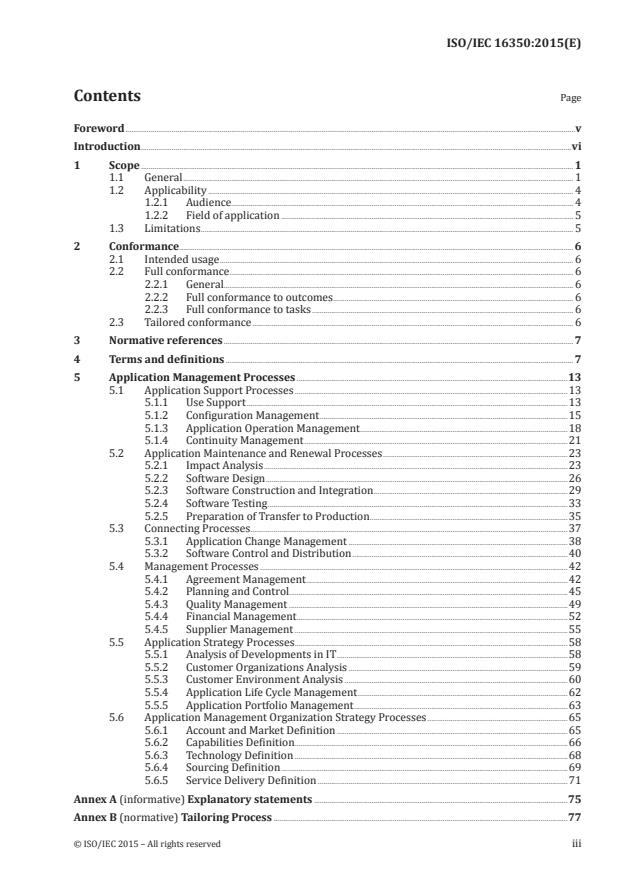
Contents Page
Foreword .v
Introduction .vi
1 Scope . 1
1.1 General . 1
1.2 Applicability . 4
1.2.1 Audience. 4
1.2.2 Field of application . 5
1.3 Limitations . 5
2 Conformance . 6
2.1 Intended usage . 6
2.2 Full conformance. 6
2.2.1 General. 6
2.2.2 Full conformance to outcomes . 6
2.2.3 Full conformance to tasks . 6
2.3 Tailored conformance . 6
3 Normative references . 7
4 Terms and definitions . 7
5 Application Management Processes .13
5.1 Application Support Processes .13
5.1.1 Use Support .13
5.1.2 Configuration Management .15
5.1.3 Application Operation Management .18
5.1.4 Continuity Management .21
5.2 Application Maintenance and Renewal Processes .23
5.2.1 Impact Analysis .23
5.2.2 Software Design .26
5.2.3 Software Construction and Integration .29
5.2.4 Software Testing .33
5.2.5 Preparation of Transfer to Production .35
5.3 Connecting Processes .37
5.3.1 Application Change Management .38
5.3.2 Software Control and Distribution .40
5.4 Management Processes .42
5.4.1 Agreement Management .42
5.4.2 Planning and Control.45
5.4.3 Quality Management .49
5.4.4 Financial Management .52
5.4.5 Supplier Management .55
5.5 Application Strategy Processes .58
5.5.1 Analysis of Developments in IT .58
5.5.2 Customer Organizations Analysis .59
5.5.3 Customer Environment Analysis .60
5.5.4 Application Life Cycle Management .62
5.5.5 Application Portfolio Management .63
5.6 Application Management Organization Strategy Processes .65
5.6.1 Account and Market Definition .65
5.6.2 Capabilities Definition .66
5.6.3 Technology Definition .68
5.6.4 Sourcing Definition .69
5.6.5 Service Delivery Definition .71
Annex A (informative) Explanatory statements .75
Annex B (normative) Tailoring Process .77
© ISO/IEC 2015 – All rights reserved iii
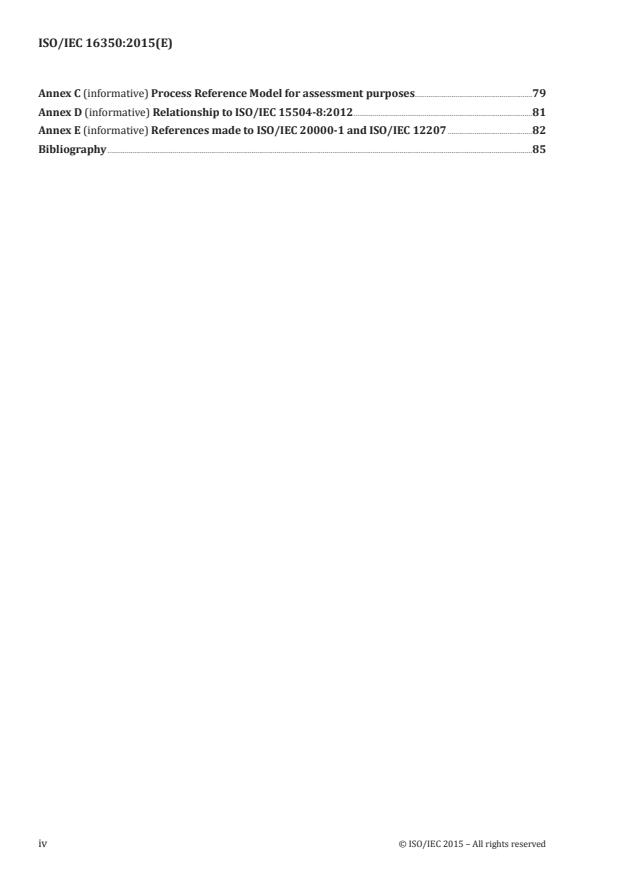
Annex C (informative) Process Reference Model for assessment purposes .79
Annex D (informative) Relationship to ISO/IEC 15504-8:2012 .81
Annex E (informative) References made to ISO/IEC 20000-1 and ISO/IEC 12207 .82
Bibliography .85
iv © ISO/IEC 2015 – All rights reserved
Foreword
ISO (the International Organization for Standardization) and IEC (the International Electrotechnical
Commission) form the specialized system for worldwide standardization. National bodies that are
members of ISO or IEC participate in the development of International Standards through technical
committees established by the respective organization to deal with particular fields of technical
activity. ISO and IEC technical committees collaborate in fields of mutual interest. Other international
organizations, governmental and non-governmental, in liaison with ISO and IEC, also take part in the
work. In the field of information technology, ISO and IEC have established a joint technical committee,
ISO/IEC JTC 1.
The procedures used to develop this document and those intended for its further maintenance are
described in the ISO/IEC Directives, Part 1. In particular the different approval criteria needed for
the different types of document should be noted. This document was drafted in accordance with the
editorial rules of the ISO/IEC Directives, Part 2 (see www.iso.org/directives).
Attention is drawn to the possibility that some of the elements of this document may be the subject
of patent rights. ISO and IEC shall not be held responsible for identifying any or all such patent rights.
Details of any patent rights identified during the development of the document will be in the Introduction
and/or on the ISO list of patent declarations received (see www.iso.org/patents).
Any trade name used in this document is information given for the convenience of users and does not
constitute an endorsement.
For an explanation on the meaning of ISO specific terms and expressions related to conformity
assessment, as well as information about ISO’s adherence to the WTO principles in the Technical Barriers
to Trade (TBT) see the following URL: Foreword - Supplementary information.
The committee responsible for this document is ISO/IEC JTC 1, Information technology, Subcommittee
SC 7, Software and systems engineering.
Its contents are based on the Dutch national standard, NEN 3434, Information technology — Application
management — Requirements for application management, which will be withdrawn after publication of
this International Standard.
© ISO/IEC 2015 – All rights reserved v
Introduction
Applications can live for decades. Applications that were developed twenty or thirty years ago are still
being used and most applications that have recently been developed will still be in use for the many
years to come. During their life cycle, these applications and the related data structures will have to be
monitored, enhanced, and sometimes renewed or renovated. This means that very often, in total, more
money and work is needed for the stage of operation and use than for the initial development stage.
But the emphasis very often lies at the initial development stage; there are various frameworks and
(international) standards covering initial application development. For the stage of operation and use,
there are little frameworks and standards. This International Standard has been developed to fill this gap.
initial
Stage of operation
development
anduse
Figure 1 — Stage of the lifecycle in scope
The initial development of applications usually takes place in a rather protected project environment
with a relatively small amount of operational interaction with the business processes, as they are not yet
supported by the application under development. The project has its own pace and rules, its own governance,
and a limited lifespan. In the final development stage, the application is transferred to operation then the
rules change. The business processes of the user organizations become largely or fully dependent on the
application. In that stage, the following two major types of actions will have to take place:
a) supporting use and operation of the application;
b) adapting the application based on changing demands or based on quality improvements (fixes,
patches, and releases).
These actions and all the responsibilities, activities, and tasks around it, we call application management
and the stage in which a version of an application actually is in use and in operation is the subject of this
International Standard.
This International Standard aims to offer application management organizations a well-defined, directly
applicable, and complete standard for their specific activities. Although this International Standard is
partially overlapping with ISO/IEC 20000 and ISO/IEC 12207, this International Standard is a standard
organized from the viewpoint of application management and contributes to the convenience of users
who work in that area.
This International Standard provides a common framework for establishing the processes, tasks, and
activities of service providers that enhance, maintain, and/or renew applications or application objects
after the initial development (that is at the stage of exploitation and use) and that supports other service
providers that run the application in production environments and user organizations that use the
applications.
This International Standard also supports the definition, control, assessment, and improvement of such
processes. These processes can be applied uniquely, in conjunction, sequentially, or in parallel.
vi © ISO/IEC 2015 – All rights reserved
INTERNATIONAL STANDARD ISO/IEC 16350:2015(E)
Information technology — Systems and software
engineering — Application management
1 Scope
1.1 General
This International Standard establishes a common framework for application management processes
with well-defined terminology that can be referenced by the software industry. It contains processes,
activities, and tasks that apply during the stage of operation and use from the point of view of the supplier
organization that enhances, maintains, and renews the application software and the software-related
products such as data-structures, architecture, designs, and other documentation.
This International Standard applies to the supply, maintenance, and renewal of applications, whether
performed internally or externally with respect to the organization that uses the applications.
Application management comprises all of the tasks, responsibilities, and activities with the aim that
the support of business processes by applications continues to meet the requirements and needs of the
organizations that use these applications throughout the entire life span of their business processes.
This International Standard therefore focuses on the following:
— day-to-day management of applications (the software) and the related data structures and support
of costumer organizations, including handling calls such as incidents and service requests;
— maintenance and renewal of applications and data structures in accordance with changing
requirements and needs;
— opportunities, threats, and changes in the business and/or technology that influence the future of
the applications and, based on that, the strategy for maintaining and renewing the applications;
— organization and strategy of application management organizations.
Before retirement, the life cycle of an application consists of two important stages: the stage of initial
development of the application and the stage of operation and use (when the software is in use, in
operation, supported, modified, and renewed). This stage of operation and use is the subject of this
International Standard. The initial development of an application is not within the scope of this
International Standard, however the project that is responsible for the initial development has to
take the requirements of the application management organization that will enhance and maintain
the application into consideration. This means that the application management organization will
ask the project to deliver initial requirements, architecture products, design, standards, and other
documentation, in order to use these products during enhancement and maintenance.
© ISO/IEC 2015 – All rights reserved 1
Stage of operationand use
Initial development
of application
IT
infrastructure
management
Business
information
management
Application
management
Figure 2 — Domains involved
In the stage of operation and use, the following three domains play a role:
a) business information management representing the business and end users of the application (use);
b) IT infrastructure management hosting the application (operation) and maintaining the technical
infrastructure;
c) application management
1) supporting the use and the operation;
2) maintaining and renewing the application software and data structures.
Business information management constitutes the demand side of information technology (IT) and
information provisioning. Business information management is responsible for supporting users in the
use of the information provisioning and represents the business organization as the client of the IT-
suppliers. Business information management acts as the customer of the IT organizations (application
management plus IT infrastructure management).
Specific tasks of business information management include the following:
— support of end users in how the information provisioning are to be used;
— define how information and IT are to look like (the functionality, the appearance, etc);
— advise and support business management with the prioritization of requirements and management
of their budgets for IT;
— assign work to IT providers and monitor their delivered services;
— define long term policy and plans regarding the information provisioning.
IT infrastructure management is responsible for managing the operation of the information system,
including maintaining the infrastructure (e.g. network, hardware), running the software, and data
processing. In brief, this is the organization that runs the information systems and aims to keep the
infrastructure in good order.
The activities of business information management and IT infrastructure management are closely
related to application management but not within the scope of this International Standard.
Application management is responsible for the management and maintenance of the application and
definition of the data structures used in databases and data files. This form of management requires
knowledge of software programming, information system development, design, day-to-day management
of applications, and application maintenance. Core qualities of the application management personnel are
in-depth knowledge of the customer or (at least) in-depth knowledge of the customer’s business processes
and in-depth knowledge of the existing applications (application objects), design, architecture, etc.
2 © ISO/IEC 2015 – All rights reserved
This International Standard consists of the following three levels of processes:
— operational;
— managerial;
— strategic.
These process levels and the processes are interconnected with one another.
Figure 3 provides an overview of the processes within each of the process levels.
Figure 3 — Process overview
There are no separate processes defined for security, issues, risks, and/or vulnerability. These topics
form an important part of the Continuity Management Process, but they are also part of other processes.
Security, for instance, is an important part of the functionality of the application, so it is addressed in the
Impact Analysis process and dealt with within the specifications of the application and defined in the
Software Design Process and also within the service levels and, therefore, specified in the Agreement
Management and Supplier Management Processes. Other processes which deal with these topics are the
management processes planning and control, quality management and financial management, and, for
instance, the strategic process technology definition, where risk and vulnerability are important features.
© ISO/IEC 2015 – All rights reserved 3
1.2 Applicability
1.2.1 Audience
This International Standard is intended to be used by application management organizations. The
application management service providers that enhance, maintain, and/or renew applications or
application objects and that support infrastructure management organizations and user organization
in the stage operation and use.
Other users of this International Standard can be application software developers, quality assurance
managers (or consultants), and customers of application management organizations.
The purpose of this International Standard is to provide a defined set of processes to facilitate
communication among all parties involved in application management.
Different parties can carry out different activities in the field of application management. For example,
some parties are responsible for maintenance of the application after the development stage while others
also support the user organization and the IT infrastructure management organization. Some parties
just change the software items while others are responsible for the entire chain of impact analysis,
design, build, test, and release of changes. These different parties can be all in one organization or in
different internal and external organizations.
Key
AM application management
COTS commercial off-the-shelf
SaaS software as a service
Figure 4 — Examples of application management organizations
The following are examples of different types of application management organizations shown in Figure 4:
— organization that produces and maintains a specific component;
— organization that supplies and maintains standard products or standard components;
— organization that delivers custom services to an individual customer, either with or without
integration with other systems or the infrastructure;
— organization that manages and maintains a custom application;
4 © ISO/IEC 2015 – All rights reserved
— organization that implements software.
The following are other examples of application management organizations:
— integrator that merges or combines services;
— producer of configurable software platforms;
— organization that configures and maintains such platforms for customers.
These types of application management organizations have a strong impact on the way in which the
processes are implemented and operated. The processes shown in Figure 3 therefore vary in importance
and characteristics.
1.2.2 Field of application
This International Standard is applicable to all the following organizations using the processes that play
a role in application management within the scope mentioned in 1.1:
— anyone performing application management activities;
— those responsible for establishing and continuously improving application management processes;
— those responsible for executing application management processes at a project level;
— customers and suppliers involved in subcontracting application management activities;
— those responsible for assessing application management processes.
Annex C provides information regarding the use of the application management processes as a process
reference model. It defines the basic activities needed to perform tailoring of this International
Standard. It has to be noted that tailoring might diminish the perceived value of a claim of conformance
to this International Standard. An organization asserting a single-party claim of conformance to this
International Standard might find it advantageous to claim full conformance to a smaller list of processes
rather than tailored conformance to a larger list of processes.
1.3 Limitations
The initial development of an application is not within the scope of this International Standard.
The activities of business information management and IT infrastructure management are not within
the scope of this International Standard.
This International Standard does not detail the application management processes in terms of methods
or working procedures required to meet the requirements and outcomes of a process.
This International Standard does not detail documentation to be used or produced within the activities
described in the processes in Clause 5 in terms of name, format, explicit content, and recording media.
The International Standard might require development of documents of similar class or type. The
International Standard, however, does not imply that such documents have to be developed or packaged
separately or combined in some fashion. These decisions are left to the user of this International Standard.
This International Standard does not prescribe a specific application management methodology, design
methodology, development methodology, test methodology, project management method, or other
methods, models, or techniques. The users of this International Standard are responsible for selecting
these methods and mapping the processes, activities, and tasks in this International Standard onto
those methods. The users of this International Standard are also responsible for selecting and applying
the methods and for performing the activities and tasks suitable for application management.
This International Standard is not intended to be in conflict with any organization’s policies, procedures,
and standards or with any national laws and regulations. Any such conflict has to be resolved before
using this International Standard.
© ISO/IEC 2015 – All rights reserved 5
2 Conformance
2.1 Intended usage
The requirements in this International Standard are contained in Clause 5 and Annex B. This International
Standard provides requirements for a number of processes suitable for usage in the field of application
management. It is recognized that particular projects or organizations might not need to use all of the
processes provided by this International Standard. Therefore, implementation of this International
Standard typically involves selecting and declaring a set of processes suitable to the organization or project.
There are two ways that an implementation can be claimed to conform to the provisions of this
International Standard: full conformance and tailored conformance.
There are two criteria for claiming full conformance. Achieving either criterion suffices for conformance,
although the chosen criterion (or criteria) is to be stated in the claim.
— Claiming “full conformance to tasks” asserts that all of the requirements of the activities and tasks
of the declared set of processes are achieved.
— Alternatively, claiming “full conformance to outcomes” asserts that all of the required outcomes of
the declared set of processes are achieved.
Full conformance to outcomes permits greater freedom in the implementation of conforming processes
and can be useful for implementing processes to be used in the context of an innovative application
management organization.
2.2 Full conformance
2.2.1 General
A claim of full conformance declares the set of processes for which conformance is claimed. Full
conformance is achieved by demonstrating that all of the requirements of the declared set of processes
have been satisfied using the outcomes as evidence.
2.2.2 Full conformance to outcomes
A claim of full conformance declares the set of processes for which conformance is claimed. Full conformance
to outcomes is achieved by demonstrating that all of the outcomes of the declared set of processes have
been achieved. In this situation, the provisions for activities and tasks of the declared set of processes are
guidance rather than requirements, regardless of the verb form that is used in the provision.
2.2.3 Full conformance to tasks
A claim of full conformance declares the set of processes for which conformance is claimed. Full
conformance to tasks is achieved by demonstrating that all of the requirements of the activities and tasks
of the declared set of processes have been achieved. In this situation, the provisions for the outcomes of
the declared set of processes are guidance rather than requirements, regardless of the verb form that is
used in the provision.
2.3 Tailored conformance
When this International Standard is used as a basis for establishing a set of processes that do not qualify
for full conformance, the clauses of this International Standard are selected or modified in accordance
with the tailoring process prescribed in Annex B. The tailored text, for which tailored conformance is
6 © ISO/IEC 2015 – All rights reserved
claimed, is declared. Tailored conformance is achieved by demonstrating that the outcomes, activities,
and tasks, as tailored, have been achieved.
NOTE 1 When this International Standard is used to help develop an agreement between an acquirer and a
supplier, clauses of this International Standard can be selected for incorporation in the agreement with or without
modification. In this case, it is more appropriate for the acquirer and supplier to claim compliance with the
agreement than conformance with this International Standard.
NOTE 2 Any organization (for example, national, industrial association, company) imposing this International
Standard as a condition of trade has to specify and make public the minimum set of required processes, outcomes,
activities, and tasks which constitute suppliers’ compliance with the conditions of trade.
NOTE 3 Requirements of this International Standard are marked by the use of the verb “shall”.
Recommendations are marked by the use of the verb “should”. Permissions are marked by the use of the verb
“may”. However, despite the verb that is used, some requirements do not apply depending on which criteria are
to be applied in claiming conformance.
NOTE 4 A claim of full conformance to tasks can be appropriate in contractual situations where an acquirer or
a regulator requires detailed understanding of the suppliers’ processes.
3 Normative references
No normative reference cited in this document.
4 Terms and definitions
For the purposes of this document, the following terms and definitions apply.
4.1
application
system for collecting, storing, processing, and presenting data by means of a computer
[SOURCE: ISO/IEC 24570:2005]
Note 1 to entry: The generic term system in context of this International Standard is used to mean a software system.
4.2
application management
domain responsible for all of the tasks and activities that are aimed at managing, supporting, maintaining,
and renewing existing applications and related data structures
Note 1 to entry: Application management includes all of the tasks, responsibilities, and activities that serve to
bring applications into a state where they meet the requirements and needs of their owners throughout the entire
life cycle of the business processes that are supported by the applications.
4.3
application management organization
organizational unit that is responsible for application management for one or more applications
Note 1 to entry: An application management organization may be an internal or external unit in relation to the
user organization.
4.4
application object
component that is directly related to or forms part of an application
EXAMPLE Programs, sources, databases, documentation, data structures, test files, and scripts.
© ISO/IEC 2015 – All rights reserved 7
4.5
application portfolio
collection of applications managed by an application management organization or an entity within that
application management organization
Note 1 to entry: The scope of the application portfolio may be the entire portfolio of that application management
organization, but it may also be the applications of one or some customer organizations of entity within part of a
certain customer organization.
4.6
application software
software of an application
Note 1 to entry: Application software is the software that the application management organization produces,
services, and maintains. There is also system software: the software to produce and maintain the application
software and to run the application software on its platform. The application management organization is one of
the users of the system software.
4.7
availability
ability of an application object to perform its required function at an agreed instant or over an agreed
period of time
[SOURCE: ISO/IEC 20000–1:2011, modified]
Note 1 to entry: This concerns the start and finish (execution) of the application, the processing at the correct
times and in the correct order, the execution of incidental processing, the opening times of online processing, and
the storage period of files.
4.8
business information management
domain responsible for all of the tasks and activities that are aimed at supporting the end users in the
use of the application and at acting as the customer of the IT organizations
Note 1 to entry: Business information management represents the business as the customer organization or client
of the application management and IT infrastructure management organizations in maintaining the functionality
of the information provisioning and the information systems. It is the demand side of the information provisioning.
Note 2 to entry: An information system may have non-automated elements such as forms and user guides. Those
elements are usually maintained by the business information management organization.
4.9
call
request for service(s) or action(s) with respect to an application or a related service
Note 1 to entry: A call might concern a
— request for service, information or advice,
— disruption or error reporting (incident),
— request for change,
— assignment( for instance an instruction to start an off-schedule production run), and
— complaint.
4.10
change package
collection of objects that have been changed and approved and will be transferred to the production
environment
Note 1 to entry: The current system documentation is also included in a change package.
8 © ISO/IEC 2015 – All rights reserved
Note 2 to entry: In case of multiple releases, there are (similarly) multiple change packages.
4.11
change set
collection of objects which can undergo change as the result of a release
Note 1 to entry: These are the objects that are potentially allocated to a release or change.
4.12
configuration item
CI
item or aggregation of software that is designed to be managed as a single entity and its underlying
components such as documentation, data structures, scripts, etc
[SOURCE: ISO/IEC 19770–1:2006, modified]
4.13
configuration management database
CMDB
database containing all the relevant details of each configuration item and details of the important
relationships between them
[SOURCE: ISO/IEC 19770–2:2009]
4.14
customer
organization or part of an organization that receives a service or services or products of the application
management organization
[SOURCE: ISO 9000:2005, modified]
Note 1 to entry: An application management organization may have the following two types of customers, whether
these customers are within the same organization or not is of no importance; in both cases, the application
management organization has the role of supplier:
— internal or external business information management organizations;
— other application management organizations.
Note 2 to entry: Sometimes, the term User is also used. A user or end user is a person that actually uses the application
software, where a customer is a person or organization that decides about and acquires the products or services.
Note 3 to entry: The customer or user organization is, in its relationships with application management,
represented by business information management.
4.15
data model
graphical and/or lexical representation of data, specifying their properties, structures, and
interrelationships
[SOURCE: ISO/IEC 19778-1:2008]
Note 1 to entry: In this International Standard, a distinction is made between a logical (or functional) and a
technical data model. A logical data model is a representation of an organization’s data, organized in terms of
entities and relationships and is independent of any particular data management technology. In a technical data
model, it is determined in what form data are recorded in the database and in which way the data are approached.
© ISO/IEC 2015 – All rights reserved 9
4.16
data structure
physical or logical relationship among data elements, designed to support specific data manipulation
functions
[SOURCE: ISO/IEC/IEEE 24765:2010]
Note 1 to entry: The data structures are usually documented in technical and logical data models.
4.17
efficiency
relationship between the result achieved and the resources used
[SOURCE: ISO 9000:2005]
Note 1 to entry: Efficiency is the degree to which an information system efficiently uses the technical infrastructure
and thus becomes useable for the customer. The most important underlying topic here is the capacity of the
platform in relation to the demand.
4.18
final transfer set
collection of changed objects that are to be transferred integrally to one or more production environments,
including implementation instructions
Note 1 to entry: See also 5.3.2 and Figure 5.
Note 2 to entry: Transfer means to transfer from one environment to another. Application management transfers
the objects from development environment A to development environment B, from development to test and
from test to the infrastructure management organization(s). Application management doesn’t manage the final
production environment. Deployment to the production environment is done by the infrastructure management
organization. So application management does not deploy (to the user environment) but finally transfers the new
release to the various (internal and external) IT infrastructure management organizations.
Note 3 to entry: The distribution to an IT infrastructure management organization that deploys to the production
environment can also take place in steps. This means that multiple distributions (transfers) might be necessary
or desirable.
4.19
functional system design
specification of the functions of the components of a software system and of the working relationships
between them
[SOURCE: ISO/IEC 2382-20:1990, modified]
4.20
information provisioning
collection of all the infrastructure tools, software applications, non-automated elements, data sets, user
documentation, and organizational structures which serve to supply information to the business
4.21
information system
all of the functions (input, output, transport, processing, and storage) of an application, databases,
technical facilities, and manual procedures which support business processes
4.22
IT infrastructure
all the technical components, system software, databases and data files and deployed application
software, technical procedures, and technical documentation used to make the information available
10 © ISO/IEC 2015 – All rights reserved
4.23
IT infrastructure management
domain responsible for all of the tasks and activities aimed at managing, maintaining, and renewing the
IT infrastructure of the information system, including the operation of the information system
Note 1 to entry: IT infrastructure management includes all of the tasks, responsibilities and activities that aim for
a correct technical operation of the information system, consisting of hardware, (system) software, and data sets.
Note 2 to entry: The IT infrastructure management organization is responsible for running the application
software in the production environment.
4.24
manageability
degree to which IT infrastructure management can attain and keep an application in its operational state
Note 1 to entry: Manageability involves the transparency and manageability of applications from an infrastructure
point of view. Production documentation (including the requirements, control and adjustment abilities of the
application in processing, and various other aspects) provides much of the information here.
Note 2 to entry: It is a task of the IT infrastructure management organization to keep the software in operation in
the production environment. The application management organization delivers software that can be managed
by the IT infrastructure organization and supports the IT infrastructure organization, if necessary. Means of
support are documentation, scripts, and personal assistance.
4.25
organization chain
constellation of organizations that have business relationships with one another
Note 1 to entry: The following are two types of chains identified:
— supply chains of the I
...
INTERNATIONAL ISO/IEC
STANDARD 16350
First edition
2015-08-01
Information technology — Systems
and software engineering —
Application management
Technologies de l’information — Gestion d’application — Exigences
pour la gestion d’application
Reference number
©
ISO/IEC 2015
© ISO/IEC 2015, Published in Switzerland
All rights reserved. Unless otherwise specified, no part of this publication may be reproduced or utilized otherwise in any form
or by any means, electronic or mechanical, including photocopying, or posting on the internet or an intranet, without prior
written permission. Permission can be requested from either ISO at the address below or ISO’s member body in the country of
the requester.
ISO copyright office
Ch. de Blandonnet 8 • CP 401
CH-1214 Vernier, Geneva, Switzerland
Tel. +41 22 749 01 11
Fax +41 22 749 09 47
copyright@iso.org
www.iso.org
ii © ISO/IEC 2015 – All rights reserved
Contents Page
Foreword .v
Introduction .vi
1 Scope . 1
1.1 General . 1
1.2 Applicability . 4
1.2.1 Audience. 4
1.2.2 Field of application . 5
1.3 Limitations . 5
2 Conformance . 6
2.1 Intended usage . 6
2.2 Full conformance. 6
2.2.1 General. 6
2.2.2 Full conformance to outcomes . 6
2.2.3 Full conformance to tasks . 6
2.3 Tailored conformance . 6
3 Normative references . 7
4 Terms and definitions . 7
5 Application Management Processes .13
5.1 Application Support Processes .13
5.1.1 Use Support .13
5.1.2 Configuration Management .15
5.1.3 Application Operation Management .18
5.1.4 Continuity Management .21
5.2 Application Maintenance and Renewal Processes .23
5.2.1 Impact Analysis .23
5.2.2 Software Design .26
5.2.3 Software Construction and Integration .29
5.2.4 Software Testing .33
5.2.5 Preparation of Transfer to Production .35
5.3 Connecting Processes .37
5.3.1 Application Change Management .38
5.3.2 Software Control and Distribution .40
5.4 Management Processes .42
5.4.1 Agreement Management .42
5.4.2 Planning and Control.45
5.4.3 Quality Management .49
5.4.4 Financial Management .52
5.4.5 Supplier Management .55
5.5 Application Strategy Processes .58
5.5.1 Analysis of Developments in IT .58
5.5.2 Customer Organizations Analysis .59
5.5.3 Customer Environment Analysis .60
5.5.4 Application Life Cycle Management .62
5.5.5 Application Portfolio Management .63
5.6 Application Management Organization Strategy Processes .65
5.6.1 Account and Market Definition .65
5.6.2 Capabilities Definition .66
5.6.3 Technology Definition .68
5.6.4 Sourcing Definition .69
5.6.5 Service Delivery Definition .71
Annex A (informative) Explanatory statements .75
Annex B (normative) Tailoring Process .77
© ISO/IEC 2015 – All rights reserved iii
Annex C (informative) Process Reference Model for assessment purposes .79
Annex D (informative) Relationship to ISO/IEC 15504-8:2012 .81
Annex E (informative) References made to ISO/IEC 20000-1 and ISO/IEC 12207 .82
Bibliography .85
iv © ISO/IEC 2015 – All rights reserved
Foreword
ISO (the International Organization for Standardization) and IEC (the International Electrotechnical
Commission) form the specialized system for worldwide standardization. National bodies that are
members of ISO or IEC participate in the development of International Standards through technical
committees established by the respective organization to deal with particular fields of technical
activity. ISO and IEC technical committees collaborate in fields of mutual interest. Other international
organizations, governmental and non-governmental, in liaison with ISO and IEC, also take part in the
work. In the field of information technology, ISO and IEC have established a joint technical committee,
ISO/IEC JTC 1.
The procedures used to develop this document and those intended for its further maintenance are
described in the ISO/IEC Directives, Part 1. In particular the different approval criteria needed for
the different types of document should be noted. This document was drafted in accordance with the
editorial rules of the ISO/IEC Directives, Part 2 (see www.iso.org/directives).
Attention is drawn to the possibility that some of the elements of this document may be the subject
of patent rights. ISO and IEC shall not be held responsible for identifying any or all such patent rights.
Details of any patent rights identified during the development of the document will be in the Introduction
and/or on the ISO list of patent declarations received (see www.iso.org/patents).
Any trade name used in this document is information given for the convenience of users and does not
constitute an endorsement.
For an explanation on the meaning of ISO specific terms and expressions related to conformity
assessment, as well as information about ISO’s adherence to the WTO principles in the Technical Barriers
to Trade (TBT) see the following URL: Foreword - Supplementary information.
The committee responsible for this document is ISO/IEC JTC 1, Information technology, Subcommittee
SC 7, Software and systems engineering.
Its contents are based on the Dutch national standard, NEN 3434, Information technology — Application
management — Requirements for application management, which will be withdrawn after publication of
this International Standard.
© ISO/IEC 2015 – All rights reserved v
Introduction
Applications can live for decades. Applications that were developed twenty or thirty years ago are still
being used and most applications that have recently been developed will still be in use for the many
years to come. During their life cycle, these applications and the related data structures will have to be
monitored, enhanced, and sometimes renewed or renovated. This means that very often, in total, more
money and work is needed for the stage of operation and use than for the initial development stage.
But the emphasis very often lies at the initial development stage; there are various frameworks and
(international) standards covering initial application development. For the stage of operation and use,
there are little frameworks and standards. This International Standard has been developed to fill this gap.
initial
Stage of operation
development
anduse
Figure 1 — Stage of the lifecycle in scope
The initial development of applications usually takes place in a rather protected project environment
with a relatively small amount of operational interaction with the business processes, as they are not yet
supported by the application under development. The project has its own pace and rules, its own governance,
and a limited lifespan. In the final development stage, the application is transferred to operation then the
rules change. The business processes of the user organizations become largely or fully dependent on the
application. In that stage, the following two major types of actions will have to take place:
a) supporting use and operation of the application;
b) adapting the application based on changing demands or based on quality improvements (fixes,
patches, and releases).
These actions and all the responsibilities, activities, and tasks around it, we call application management
and the stage in which a version of an application actually is in use and in operation is the subject of this
International Standard.
This International Standard aims to offer application management organizations a well-defined, directly
applicable, and complete standard for their specific activities. Although this International Standard is
partially overlapping with ISO/IEC 20000 and ISO/IEC 12207, this International Standard is a standard
organized from the viewpoint of application management and contributes to the convenience of users
who work in that area.
This International Standard provides a common framework for establishing the processes, tasks, and
activities of service providers that enhance, maintain, and/or renew applications or application objects
after the initial development (that is at the stage of exploitation and use) and that supports other service
providers that run the application in production environments and user organizations that use the
applications.
This International Standard also supports the definition, control, assessment, and improvement of such
processes. These processes can be applied uniquely, in conjunction, sequentially, or in parallel.
vi © ISO/IEC 2015 – All rights reserved
INTERNATIONAL STANDARD ISO/IEC 16350:2015(E)
Information technology — Systems and software
engineering — Application management
1 Scope
1.1 General
This International Standard establishes a common framework for application management processes
with well-defined terminology that can be referenced by the software industry. It contains processes,
activities, and tasks that apply during the stage of operation and use from the point of view of the supplier
organization that enhances, maintains, and renews the application software and the software-related
products such as data-structures, architecture, designs, and other documentation.
This International Standard applies to the supply, maintenance, and renewal of applications, whether
performed internally or externally with respect to the organization that uses the applications.
Application management comprises all of the tasks, responsibilities, and activities with the aim that
the support of business processes by applications continues to meet the requirements and needs of the
organizations that use these applications throughout the entire life span of their business processes.
This International Standard therefore focuses on the following:
— day-to-day management of applications (the software) and the related data structures and support
of costumer organizations, including handling calls such as incidents and service requests;
— maintenance and renewal of applications and data structures in accordance with changing
requirements and needs;
— opportunities, threats, and changes in the business and/or technology that influence the future of
the applications and, based on that, the strategy for maintaining and renewing the applications;
— organization and strategy of application management organizations.
Before retirement, the life cycle of an application consists of two important stages: the stage of initial
development of the application and the stage of operation and use (when the software is in use, in
operation, supported, modified, and renewed). This stage of operation and use is the subject of this
International Standard. The initial development of an application is not within the scope of this
International Standard, however the project that is responsible for the initial development has to
take the requirements of the application management organization that will enhance and maintain
the application into consideration. This means that the application management organization will
ask the project to deliver initial requirements, architecture products, design, standards, and other
documentation, in order to use these products during enhancement and maintenance.
© ISO/IEC 2015 – All rights reserved 1
Stage of operationand use
Initial development
of application
IT
infrastructure
management
Business
information
management
Application
management
Figure 2 — Domains involved
In the stage of operation and use, the following three domains play a role:
a) business information management representing the business and end users of the application (use);
b) IT infrastructure management hosting the application (operation) and maintaining the technical
infrastructure;
c) application management
1) supporting the use and the operation;
2) maintaining and renewing the application software and data structures.
Business information management constitutes the demand side of information technology (IT) and
information provisioning. Business information management is responsible for supporting users in the
use of the information provisioning and represents the business organization as the client of the IT-
suppliers. Business information management acts as the customer of the IT organizations (application
management plus IT infrastructure management).
Specific tasks of business information management include the following:
— support of end users in how the information provisioning are to be used;
— define how information and IT are to look like (the functionality, the appearance, etc);
— advise and support business management with the prioritization of requirements and management
of their budgets for IT;
— assign work to IT providers and monitor their delivered services;
— define long term policy and plans regarding the information provisioning.
IT infrastructure management is responsible for managing the operation of the information system,
including maintaining the infrastructure (e.g. network, hardware), running the software, and data
processing. In brief, this is the organization that runs the information systems and aims to keep the
infrastructure in good order.
The activities of business information management and IT infrastructure management are closely
related to application management but not within the scope of this International Standard.
Application management is responsible for the management and maintenance of the application and
definition of the data structures used in databases and data files. This form of management requires
knowledge of software programming, information system development, design, day-to-day management
of applications, and application maintenance. Core qualities of the application management personnel are
in-depth knowledge of the customer or (at least) in-depth knowledge of the customer’s business processes
and in-depth knowledge of the existing applications (application objects), design, architecture, etc.
2 © ISO/IEC 2015 – All rights reserved
This International Standard consists of the following three levels of processes:
— operational;
— managerial;
— strategic.
These process levels and the processes are interconnected with one another.
Figure 3 provides an overview of the processes within each of the process levels.
Figure 3 — Process overview
There are no separate processes defined for security, issues, risks, and/or vulnerability. These topics
form an important part of the Continuity Management Process, but they are also part of other processes.
Security, for instance, is an important part of the functionality of the application, so it is addressed in the
Impact Analysis process and dealt with within the specifications of the application and defined in the
Software Design Process and also within the service levels and, therefore, specified in the Agreement
Management and Supplier Management Processes. Other processes which deal with these topics are the
management processes planning and control, quality management and financial management, and, for
instance, the strategic process technology definition, where risk and vulnerability are important features.
© ISO/IEC 2015 – All rights reserved 3
1.2 Applicability
1.2.1 Audience
This International Standard is intended to be used by application management organizations. The
application management service providers that enhance, maintain, and/or renew applications or
application objects and that support infrastructure management organizations and user organization
in the stage operation and use.
Other users of this International Standard can be application software developers, quality assurance
managers (or consultants), and customers of application management organizations.
The purpose of this International Standard is to provide a defined set of processes to facilitate
communication among all parties involved in application management.
Different parties can carry out different activities in the field of application management. For example,
some parties are responsible for maintenance of the application after the development stage while others
also support the user organization and the IT infrastructure management organization. Some parties
just change the software items while others are responsible for the entire chain of impact analysis,
design, build, test, and release of changes. These different parties can be all in one organization or in
different internal and external organizations.
Key
AM application management
COTS commercial off-the-shelf
SaaS software as a service
Figure 4 — Examples of application management organizations
The following are examples of different types of application management organizations shown in Figure 4:
— organization that produces and maintains a specific component;
— organization that supplies and maintains standard products or standard components;
— organization that delivers custom services to an individual customer, either with or without
integration with other systems or the infrastructure;
— organization that manages and maintains a custom application;
4 © ISO/IEC 2015 – All rights reserved
— organization that implements software.
The following are other examples of application management organizations:
— integrator that merges or combines services;
— producer of configurable software platforms;
— organization that configures and maintains such platforms for customers.
These types of application management organizations have a strong impact on the way in which the
processes are implemented and operated. The processes shown in Figure 3 therefore vary in importance
and characteristics.
1.2.2 Field of application
This International Standard is applicable to all the following organizations using the processes that play
a role in application management within the scope mentioned in 1.1:
— anyone performing application management activities;
— those responsible for establishing and continuously improving application management processes;
— those responsible for executing application management processes at a project level;
— customers and suppliers involved in subcontracting application management activities;
— those responsible for assessing application management processes.
Annex C provides information regarding the use of the application management processes as a process
reference model. It defines the basic activities needed to perform tailoring of this International
Standard. It has to be noted that tailoring might diminish the perceived value of a claim of conformance
to this International Standard. An organization asserting a single-party claim of conformance to this
International Standard might find it advantageous to claim full conformance to a smaller list of processes
rather than tailored conformance to a larger list of processes.
1.3 Limitations
The initial development of an application is not within the scope of this International Standard.
The activities of business information management and IT infrastructure management are not within
the scope of this International Standard.
This International Standard does not detail the application management processes in terms of methods
or working procedures required to meet the requirements and outcomes of a process.
This International Standard does not detail documentation to be used or produced within the activities
described in the processes in Clause 5 in terms of name, format, explicit content, and recording media.
The International Standard might require development of documents of similar class or type. The
International Standard, however, does not imply that such documents have to be developed or packaged
separately or combined in some fashion. These decisions are left to the user of this International Standard.
This International Standard does not prescribe a specific application management methodology, design
methodology, development methodology, test methodology, project management method, or other
methods, models, or techniques. The users of this International Standard are responsible for selecting
these methods and mapping the processes, activities, and tasks in this International Standard onto
those methods. The users of this International Standard are also responsible for selecting and applying
the methods and for performing the activities and tasks suitable for application management.
This International Standard is not intended to be in conflict with any organization’s policies, procedures,
and standards or with any national laws and regulations. Any such conflict has to be resolved before
using this International Standard.
© ISO/IEC 2015 – All rights reserved 5
2 Conformance
2.1 Intended usage
The requirements in this International Standard are contained in Clause 5 and Annex B. This International
Standard provides requirements for a number of processes suitable for usage in the field of application
management. It is recognized that particular projects or organizations might not need to use all of the
processes provided by this International Standard. Therefore, implementation of this International
Standard typically involves selecting and declaring a set of processes suitable to the organization or project.
There are two ways that an implementation can be claimed to conform to the provisions of this
International Standard: full conformance and tailored conformance.
There are two criteria for claiming full conformance. Achieving either criterion suffices for conformance,
although the chosen criterion (or criteria) is to be stated in the claim.
— Claiming “full conformance to tasks” asserts that all of the requirements of the activities and tasks
of the declared set of processes are achieved.
— Alternatively, claiming “full conformance to outcomes” asserts that all of the required outcomes of
the declared set of processes are achieved.
Full conformance to outcomes permits greater freedom in the implementation of conforming processes
and can be useful for implementing processes to be used in the context of an innovative application
management organization.
2.2 Full conformance
2.2.1 General
A claim of full conformance declares the set of processes for which conformance is claimed. Full
conformance is achieved by demonstrating that all of the requirements of the declared set of processes
have been satisfied using the outcomes as evidence.
2.2.2 Full conformance to outcomes
A claim of full conformance declares the set of processes for which conformance is claimed. Full conformance
to outcomes is achieved by demonstrating that all of the outcomes of the declared set of processes have
been achieved. In this situation, the provisions for activities and tasks of the declared set of processes are
guidance rather than requirements, regardless of the verb form that is used in the provision.
2.2.3 Full conformance to tasks
A claim of full conformance declares the set of processes for which conformance is claimed. Full
conformance to tasks is achieved by demonstrating that all of the requirements of the activities and tasks
of the declared set of processes have been achieved. In this situation, the provisions for the outcomes of
the declared set of processes are guidance rather than requirements, regardless of the verb form that is
used in the provision.
2.3 Tailored conformance
When this International Standard is used as a basis for establishing a set of processes that do not qualify
for full conformance, the clauses of this International Standard are selected or modified in accordance
with the tailoring process prescribed in Annex B. The tailored text, for which tailored conformance is
6 © ISO/IEC 2015 – All rights reserved
claimed, is declared. Tailored conformance is achieved by demonstrating that the outcomes, activities,
and tasks, as tailored, have been achieved.
NOTE 1 When this International Standard is used to help develop an agreement between an acquirer and a
supplier, clauses of this International Standard can be selected for incorporation in the agreement with or without
modification. In this case, it is more appropriate for the acquirer and supplier to claim compliance with the
agreement than conformance with this International Standard.
NOTE 2 Any organization (for example, national, industrial association, company) imposing this International
Standard as a condition of trade has to specify and make public the minimum set of required processes, outcomes,
activities, and tasks which constitute suppliers’ compliance with the conditions of trade.
NOTE 3 Requirements of this International Standard are marked by the use of the verb “shall”.
Recommendations are marked by the use of the verb “should”. Permissions are marked by the use of the verb
“may”. However, despite the verb that is used, some requirements do not apply depending on which criteria are
to be applied in claiming conformance.
NOTE 4 A claim of full conformance to tasks can be appropriate in contractual situations where an acquirer or
a regulator requires detailed understanding of the suppliers’ processes.
3 Normative references
No normative reference cited in this document.
4 Terms and definitions
For the purposes of this document, the following terms and definitions apply.
4.1
application
system for collecting, storing, processing, and presenting data by means of a computer
[SOURCE: ISO/IEC 24570:2005]
Note 1 to entry: The generic term system in context of this International Standard is used to mean a software system.
4.2
application management
domain responsible for all of the tasks and activities that are aimed at managing, supporting, maintaining,
and renewing existing applications and related data structures
Note 1 to entry: Application management includes all of the tasks, responsibilities, and activities that serve to
bring applications into a state where they meet the requirements and needs of their owners throughout the entire
life cycle of the business processes that are supported by the applications.
4.3
application management organization
organizational unit that is responsible for application management for one or more applications
Note 1 to entry: An application management organization may be an internal or external unit in relation to the
user organization.
4.4
application object
component that is directly related to or forms part of an application
EXAMPLE Programs, sources, databases, documentation, data structures, test files, and scripts.
© ISO/IEC 2015 – All rights reserved 7
4.5
application portfolio
collection of applications managed by an application management organization or an entity within that
application management organization
Note 1 to entry: The scope of the application portfolio may be the entire portfolio of that application management
organization, but it may also be the applications of one or some customer organizations of entity within part of a
certain customer organization.
4.6
application software
software of an application
Note 1 to entry: Application software is the software that the application management organization produces,
services, and maintains. There is also system software: the software to produce and maintain the application
software and to run the application software on its platform. The application management organization is one of
the users of the system software.
4.7
availability
ability of an application object to perform its required function at an agreed instant or over an agreed
period of time
[SOURCE: ISO/IEC 20000–1:2011, modified]
Note 1 to entry: This concerns the start and finish (execution) of the application, the processing at the correct
times and in the correct order, the execution of incidental processing, the opening times of online processing, and
the storage period of files.
4.8
business information management
domain responsible for all of the tasks and activities that are aimed at supporting the end users in the
use of the application and at acting as the customer of the IT organizations
Note 1 to entry: Business information management represents the business as the customer organization or client
of the application management and IT infrastructure management organizations in maintaining the functionality
of the information provisioning and the information systems. It is the demand side of the information provisioning.
Note 2 to entry: An information system may have non-automated elements such as forms and user guides. Those
elements are usually maintained by the business information management organization.
4.9
call
request for service(s) or action(s) with respect to an application or a related service
Note 1 to entry: A call might concern a
— request for service, information or advice,
— disruption or error reporting (incident),
— request for change,
— assignment( for instance an instruction to start an off-schedule production run), and
— complaint.
4.10
change package
collection of objects that have been changed and approved and will be transferred to the production
environment
Note 1 to entry: The current system documentation is also included in a change package.
8 © ISO/IEC 2015 – All rights reserved
Note 2 to entry: In case of multiple releases, there are (similarly) multiple change packages.
4.11
change set
collection of objects which can undergo change as the result of a release
Note 1 to entry: These are the objects that are potentially allocated to a release or change.
4.12
configuration item
CI
item or aggregation of software that is designed to be managed as a single entity and its underlying
components such as documentation, data structures, scripts, etc
[SOURCE: ISO/IEC 19770–1:2006, modified]
4.13
configuration management database
CMDB
database containing all the relevant details of each configuration item and details of the important
relationships between them
[SOURCE: ISO/IEC 19770–2:2009]
4.14
customer
organization or part of an organization that receives a service or services or products of the application
management organization
[SOURCE: ISO 9000:2005, modified]
Note 1 to entry: An application management organization may have the following two types of customers, whether
these customers are within the same organization or not is of no importance; in both cases, the application
management organization has the role of supplier:
— internal or external business information management organizations;
— other application management organizations.
Note 2 to entry: Sometimes, the term User is also used. A user or end user is a person that actually uses the application
software, where a customer is a person or organization that decides about and acquires the products or services.
Note 3 to entry: The customer or user organization is, in its relationships with application management,
represented by business information management.
4.15
data model
graphical and/or lexical representation of data, specifying their properties, structures, and
interrelationships
[SOURCE: ISO/IEC 19778-1:2008]
Note 1 to entry: In this International Standard, a distinction is made between a logical (or functional) and a
technical data model. A logical data model is a representation of an organization’s data, organized in terms of
entities and relationships and is independent of any particular data management technology. In a technical data
model, it is determined in what form data are recorded in the database and in which way the data are approached.
© ISO/IEC 2015 – All rights reserved 9
4.16
data structure
physical or logical relationship among data elements, designed to support specific data manipulation
functions
[SOURCE: ISO/IEC/IEEE 24765:2010]
Note 1 to entry: The data structures are usually documented in technical and logical data models.
4.17
efficiency
relationship between the result achieved and the resources used
[SOURCE: ISO 9000:2005]
Note 1 to entry: Efficiency is the degree to which an information system efficiently uses the technical infrastructure
and thus becomes useable for the customer. The most important underlying topic here is the capacity of the
platform in relation to the demand.
4.18
final transfer set
collection of changed objects that are to be transferred integrally to one or more production environments,
including implementation instructions
Note 1 to entry: See also 5.3.2 and Figure 5.
Note 2 to entry: Transfer means to transfer from one environment to another. Application management transfers
the objects from development environment A to development environment B, from development to test and
from test to the infrastructure management organization(s). Application management doesn’t manage the final
production environment. Deployment to the production environment is done by the infrastructure management
organization. So application management does not deploy (to the user environment) but finally transfers the new
release to the various (internal and external) IT infrastructure management organizations.
Note 3 to entry: The distribution to an IT infrastructure management organization that deploys to the production
environment can also take place in steps. This means that multiple distributions (transfers) might be necessary
or desirable.
4.19
functional system design
specification of the functions of the components of a software system and of the working relationships
between them
[SOURCE: ISO/IEC 2382-20:1990, modified]
4.20
information provisioning
collection of all the infrastructure tools, software applications, non-automated elements, data sets, user
documentation, and organizational structures which serve to supply information to the business
4.21
information system
all of the functions (input, output, transport, processing, and storage) of an application, databases,
technical facilities, and manual procedures which support business processes
4.22
IT infrastructure
all the technical components, system software, databases and data files and deployed application
software, technical procedures, and technical documentation used to make the information available
10 © ISO/IEC 2015 – All rights reserved
4.23
IT infrastructure management
domain responsible for all of the tasks and activities aimed at managing, maintaining, and renewing the
IT infrastructure of the information system, including the operation of the information system
Note 1 to entry: IT infrastructure management includes all of the tasks, responsibilities and activities that aim for
a correct technical operation of the information system, consisting of hardware, (system) software, and data sets.
Note 2 to entry: The IT infrastructure management organization is responsible for running the application
software in the production environment.
4.24
manageability
degree to which IT infrastructure management can attain and keep an application in its operational state
Note 1 to entry: Manageability involves the transparency and manageability of applications from an infrastructure
point of view. Production documentation (including the requirements, control and adjustment abilities of the
application in processing, and various other aspects) provides much of the information here.
Note 2 to entry: It is a task of the IT infrastructure management organization to keep the software in operation in
the production environment. The application management organization delivers software that can be managed
by the IT infrastructure organization and supports the IT infrastructure organization, if necessary. Means of
support are documentation, scripts, and personal assistance.
4.25
organization chain
constellation of organizations that have business relationships with one another
Note 1 to entry: The following are two types of chains identified:
— supply chains of the I
...