

ISO 11359-3:2026
(Main)Plastics — Thermomechanical analysis (TMA) — Part 3: Determination of penetration temperature
General Information
- Abstract
This document specifies a method for the determination of the penetration temperature of thermoplastics using thermomechanical analysis (TMA). NOTE This method can also be used to measure the softening point.
- Status
- Published
- Publication Date
- 31-Mar-2026
- Technical Committee
- ISO/TC 61/SC 5 - Physical-chemical properties
- Drafting Committee
- ISO/TC 61/SC 5/WG 8 - Thermal analysis
- Current Stage
- 6060 - International Standard published
- Start Date
- 01-Apr-2026
- Due Date
- 20-Nov-2026
- Completion Date
- 01-Apr-2026
Overview
ISO 11359-3:2026 is an international standard published by ISO focusing on the determination of penetration temperature of thermoplastics using thermomechanical analysis (TMA). This method is essential for assessing the behavior of plastics under heat and mechanical force, helping identify the point at which a material softens and is penetrated by a probe. Understanding the penetration temperature is vital for quality assurance, material selection, and engineering applications in the plastics industry.
Key Topics
- Penetration Temperature Measurement: The standard outlines a reproducible method for determining the temperature at which a thermoplastic specimen is penetrated by a probe under controlled force and heating conditions.
- Thermomechanical Analysis (TMA): TMA is used to measure dimensional changes of a material as a function of temperature, and in this context, specifically probes softening and penetration properties.
- Softening Point: The penetration temperature determined by this method may also be applied as a measure of the softening point of plastics.
- Test Procedure and Equipment:
- Details the necessary TMA apparatus and specifications for penetration probes.
- Specifies sample preparation, conditioning (with reference to ISO 291), and test procedures, including heating rates, measurement atmosphere, and calibration.
- Expression and Reporting of Results: Calculation methods and requirements for reporting penetration temperature, including consideration for multi-stage transitions.
- Precision and Deviations: Guidance on test precision, what to include in the test report, and how to handle deviations or unusual results.
Applications
ISO 11359-3:2026 is widely applicable in various sectors where thermoplastics are used, providing vital data for:
- Material Quality Control: Ensures that thermoplastic products meet consistency and specification requirements by determining critical thermal properties.
- Product Development: Supports research and development by enabling material scientists and engineers to compare the thermal behavior of different plastic formulations.
- Manufacturing Processes: Helps select materials with suitable thermal resistance for processes such as molding, extrusion, and thermoforming.
- Failure Analysis: Used to analyze material performance under elevated temperatures, shedding light on product or component failures due to thermal softening.
Industries that benefit from this standard include automotive, packaging, electronics, construction, and consumer goods manufacturing-anywhere thermoplastics are processed or subjected to heat and load.
Related Standards
To ensure comprehensive compliance and deeper understanding, consider these related standards:
- ISO 11359-1: Plastics - Thermomechanical analysis (TMA) - Part 1: General principles.
- ISO 291: Plastics - Standard atmospheres for conditioning and testing.
- ISO 472: Plastics - Vocabulary.
Together, these ISO standards build a framework for consistent terminology, proper sample conditioning, and generalized TMA practices, supporting the implementation of ISO 11359-3:2026 in industrial and laboratory settings.
ISO 11359-3:2026 reinforces the importance of standardized methods for evaluating the thermal and mechanical properties of plastics, ensuring reliable measurements that support quality, safety, and innovation in plastic materials and products. For more details and purchase options, visit iso.org.
Relations
- Effective Date
- 07-Jan-2025
Get Certified
Connect with accredited certification bodies for this standard

DIN CERTCO
DIN Group product certification.

Smithers Quality Assessments
US management systems and product certification.
Sponsored listings
Frequently Asked Questions
ISO 11359-3:2026 is a standard published by the International Organization for Standardization (ISO). Its full title is "Plastics — Thermomechanical analysis (TMA) — Part 3: Determination of penetration temperature". This standard covers: This document specifies a method for the determination of the penetration temperature of thermoplastics using thermomechanical analysis (TMA). NOTE This method can also be used to measure the softening point.
This document specifies a method for the determination of the penetration temperature of thermoplastics using thermomechanical analysis (TMA). NOTE This method can also be used to measure the softening point.
ISO 11359-3:2026 is classified under the following ICS (International Classification for Standards) categories: 83.080.01 - Plastics in general. The ICS classification helps identify the subject area and facilitates finding related standards.
ISO 11359-3:2026 has the following relationships with other standards: It is inter standard links to ISO 11359-3:2019. Understanding these relationships helps ensure you are using the most current and applicable version of the standard.
ISO 11359-3:2026 is available in PDF format for immediate download after purchase. The document can be added to your cart and obtained through the secure checkout process. Digital delivery ensures instant access to the complete standard document.
Standards Content (Sample)
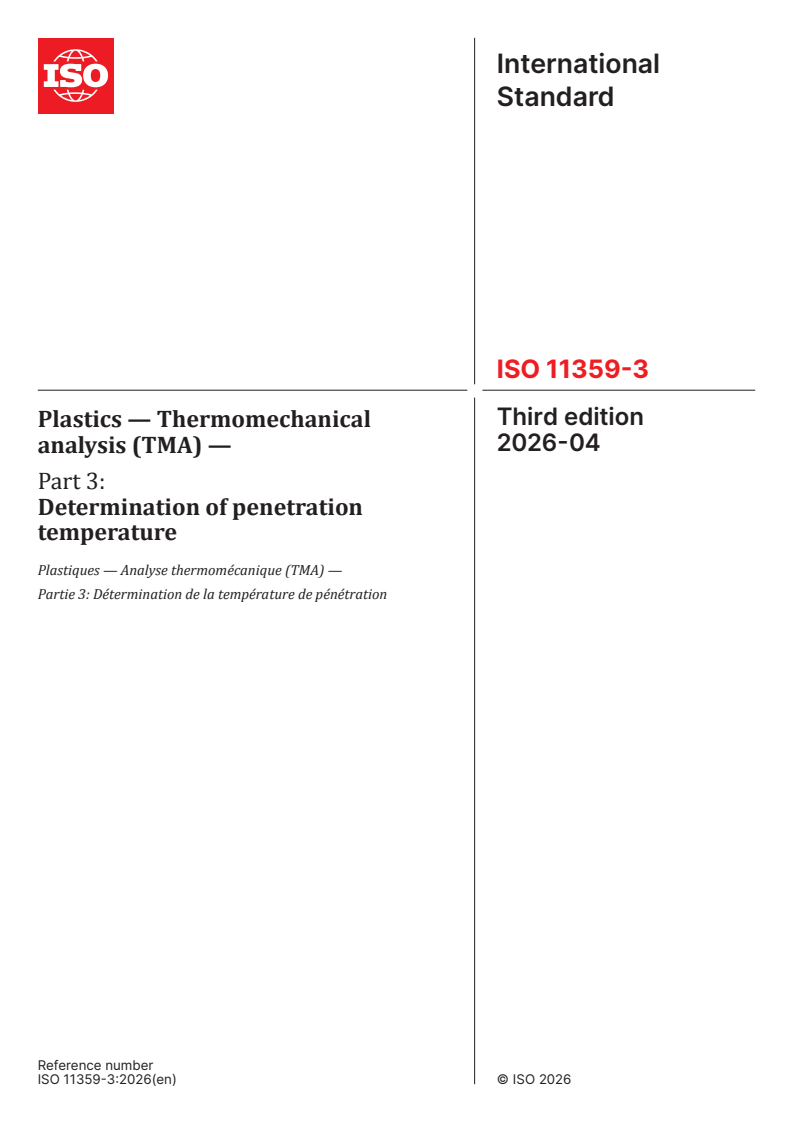
International
Standard
ISO 11359-3
Third edition
Plastics — Thermomechanical
2026-04
analysis (TMA) —
Part 3:
Determination of penetration
temperature
Plastiques — Analyse thermomécanique (TMA) —
Partie 3: Détermination de la température de pénétration
Reference number
© ISO 2026
All rights reserved. Unless otherwise specified, or required in the context of its implementation, no part of this publication may
be reproduced or utilized otherwise in any form or by any means, electronic or mechanical, including photocopying, or posting on
the internet or an intranet, without prior written permission. Permission can be requested from either ISO at the address below
or ISO’s member body in the country of the requester.
ISO copyright office
CP 401 • Ch. de Blandonnet 8
CH-1214 Vernier, Geneva
Phone: +41 22 749 01 11
Email: copyright@iso.org
Website: www.iso.org
Published in Switzerland
ii
Contents Page
Foreword .iv
1 Scope . 1
2 Normative references . 1
3 Terms and definitions . 1
4 Principle . 1
5 Apparatus . 2
5.1 TMA apparatus .2
5.2 Penetration probe .2
6 Test specimen . 2
6.1 Preparation .2
6.2 Conditioning.2
7 Procedure . 2
7.1 Calibration of apparatus .2
7.2 Measurement .2
8 Expression of results . 3
9 Precision . 3
10 Test report . 3
Bibliography . 5
iii
Foreword
ISO (the International Organization for Standardization) is a worldwide federation of national standards
bodies (ISO member bodies). The work of preparing International Standards is normally carried out through
ISO technical committees. Each member body interested in a subject for which a technical committee
has been established has the right to be represented on that committee. International organizations,
governmental and non-governmental, in liaison with ISO, also take part in the work. ISO collaborates closely
with the International Electrotechnical Commission (IEC) on all matters of electrotechnical standardization.
The procedures used to develop this document and those intended for its further maintenance are described
in the ISO/IEC Directives, Part 1. In particular, the different approval criteria needed for the different types
of ISO document should be noted. This document was drafted in accordance with the editorial rules of the
ISO/IEC Directives, Part 2 (see www.iso.org/directives).
ISO draws attention to the possibility that the implementation of this document may involve the use of (a)
patent(s). ISO takes no position concerning the evidence, validity or applicability of any claimed patent
rights in respect thereof. As of the date of publication of this document, ISO had not received notice of (a)
patent(s) which may be required to implement this document. However, implementers are cautioned that
this may not represent the latest information, which may be obtained from the patent database available at
www.iso.org/patents. ISO shall not be held responsible for identifying any or all such patent rights.
Any trade name used in this document is information given for the convenience of users and does not
constitute an endorsement.
For an explanation of the voluntary nature of standards, the meaning of ISO specific terms and expressions
related to conformity assessment, as well as information about ISO's adherence to the World Trade
Organization (WTO) principles in the Technical Barriers to Trade (TB
...