

ISO/IEC 15430:1999
(Main)Information technology — Telecommunications and information exchange between systems — Private Integrated Services Network — Specification, functional model and information flows — Wireless terminal call handling additional network features
General Information
- Abstract
This International Standard specifies the Wireless terminal call handling additional network features (ANF-WTMI, ANF-WTMO), which are applicable to various basic services supported by Private Integrated Services Networks (PISN). Basic services are specified in ISO/IEC 11574. Additional network feature Wireless terminal incoming call (ANF-WTMI) directs incoming calls to a WTMI user within a PISN regardless of the WTMI user's geographical location within the PISN, provided the WTMI user's location is known. Additional network feature Wireless terminal outgoing call (ANF-WTMO) detects an outgoing call from a WTMO user and establishes it as a basic call, regardless of the user's geographical location within the PISN. It also provides the WTMO user's service profile for use by outgoing call control, or alternatively passes the call to the WTMO user's home location for processing. Service specifications are produced in three stages, according to the method described in CCITT Recommendation I.130. This International Standard contains the stage 1 and stage 2 specifications of ANF-WTMI and ANF-WTMO. The stage 1 specification (clauses 6 and 7) specifies the service as seen by users of PISNs. The stage 2 specification (clauses 8 and 9) identifies the functional entities involved in the service and the information flows between them.
- Status
- Published
- Publication Date
- 01-Sep-1999
- Current Stage
- 9093 - International Standard confirmed
- Start Date
- 23-May-2025
- Completion Date
- 29-Aug-2026
Buy Documents
ISO/IEC 15430:1999 - Information technology — Telecommunications and information exchange between systems — Private Integrated Services Network — Specification, functional model and information flows — Wireless terminal call handling additional network features Released:9/2/1999
Overview
ISO/IEC 15430:1999 defines Wireless Terminal call-handling additional network features for Private Integrated Services Networks (PISN). The standard specifies two features: ANF‑WTMI (Wireless Terminal Incoming call) and ANF‑WTMO (Wireless Terminal Outgoing call). It provides stage 1 (service view) and stage 2 (functional model and information flows) specifications to enable routing and control of incoming and outgoing calls for mobile or nomadic wireless terminals within a PISN.
Key topics and technical requirements
- Scope: Applies to basic services in PISNs (see ISO/IEC 11574).
- ANF‑WTMI: Directs incoming calls to a WTMI user anywhere in the PISN when the user’s location is known. Requires a maintained mapping of user location to PISN access address.
- ANF‑WTMO: Detects outgoing calls from a WTMO user, establishes them as basic calls regardless of geographical location, and supplies the WTMO user’s service profile for outgoing call control or forwards the call to the user’s home location for processing.
- Service stages: Contains stage 1 (clauses 6–7) describing the service as seen by users and stage 2 (clauses 8–9) detailing functional entities and information flows.
- Functional entities & flows: References Call Control (CC), Call Control Agent (CCA), Home/Visitor PINX, Home Data Base (HDB), Visitor Data Base (VDB) and information flows (e.g., SETUP, RELEASE). Stage 2 defines behaviour, actions, and allocation of FEs to equipment.
- Interactions: Specifies interactions with supplementary services; for example, Call Forwarding Unconditional (SS‑CFU) takes precedence over ANF‑WTMI. Many common supplementary services have no interaction.
- Conformance: To claim conformance a stage 3 specification (signalling protocols and equipment behaviour) must support the relevant stage 1 and 2 aspects.
Practical applications and users
- Enterprise telephony / PBX vendors: Implement mobility-aware call routing and outgoing-call handling for wireless handsets in private networks.
- System integrators and telecom engineers: Design and configure PISN exchanges (PINX) supporting wireless terminal mobility and location-based routing.
- Network architects: Model functional entities, deploy HDB/VDB mechanisms, and design inter-PINX information flows.
- Standards developers and test labs: Use the stage 1/2 definitions as the basis for developing stage 3 signalling protocols and conformance tests.
Related standards
- ISO/IEC 11574 (basic services), ISO/IEC 11571 (numbering), ISO/IEC 11579‑1 (PINX reference), ISO/IEC 15428 (WT location / info exchange), ISO/IEC 15432 (WT authentication), ITU‑T I.130, I.210, Z.100.
Keywords: ISO/IEC 15430:1999, PISN, ANF‑WTMI, ANF‑WTMO, wireless terminal mobility, incoming call routing, outgoing call control, Call Control (CC), functional model, information flows.
Relations
- Effective Date
- 06-Jun-2022
Buy Documents
ISO/IEC 15430:1999 - Information technology — Telecommunications and information exchange between systems — Private Integrated Services Network — Specification, functional model and information flows — Wireless terminal call handling additional network features Released:9/2/1999
Get Certified
Connect with accredited certification bodies for this standard

ANCE
Mexican certification and testing association.

Intertek Slovenia
Intertek testing, inspection, and certification services in Slovenia.

LNE (Laboratoire National de Métrologie et d'Essais)
French national laboratory for metrology and testing.
Sponsored listings
Frequently Asked Questions
ISO/IEC 15430:1999 is a standard published by the International Organization for Standardization (ISO). Its full title is "Information technology — Telecommunications and information exchange between systems — Private Integrated Services Network — Specification, functional model and information flows — Wireless terminal call handling additional network features". This standard covers: This International Standard specifies the Wireless terminal call handling additional network features (ANF-WTMI, ANF-WTMO), which are applicable to various basic services supported by Private Integrated Services Networks (PISN). Basic services are specified in ISO/IEC 11574. Additional network feature Wireless terminal incoming call (ANF-WTMI) directs incoming calls to a WTMI user within a PISN regardless of the WTMI user's geographical location within the PISN, provided the WTMI user's location is known. Additional network feature Wireless terminal outgoing call (ANF-WTMO) detects an outgoing call from a WTMO user and establishes it as a basic call, regardless of the user's geographical location within the PISN. It also provides the WTMO user's service profile for use by outgoing call control, or alternatively passes the call to the WTMO user's home location for processing. Service specifications are produced in three stages, according to the method described in CCITT Recommendation I.130. This International Standard contains the stage 1 and stage 2 specifications of ANF-WTMI and ANF-WTMO. The stage 1 specification (clauses 6 and 7) specifies the service as seen by users of PISNs. The stage 2 specification (clauses 8 and 9) identifies the functional entities involved in the service and the information flows between them.
This International Standard specifies the Wireless terminal call handling additional network features (ANF-WTMI, ANF-WTMO), which are applicable to various basic services supported by Private Integrated Services Networks (PISN). Basic services are specified in ISO/IEC 11574. Additional network feature Wireless terminal incoming call (ANF-WTMI) directs incoming calls to a WTMI user within a PISN regardless of the WTMI user's geographical location within the PISN, provided the WTMI user's location is known. Additional network feature Wireless terminal outgoing call (ANF-WTMO) detects an outgoing call from a WTMO user and establishes it as a basic call, regardless of the user's geographical location within the PISN. It also provides the WTMO user's service profile for use by outgoing call control, or alternatively passes the call to the WTMO user's home location for processing. Service specifications are produced in three stages, according to the method described in CCITT Recommendation I.130. This International Standard contains the stage 1 and stage 2 specifications of ANF-WTMI and ANF-WTMO. The stage 1 specification (clauses 6 and 7) specifies the service as seen by users of PISNs. The stage 2 specification (clauses 8 and 9) identifies the functional entities involved in the service and the information flows between them.
ISO/IEC 15430:1999 is classified under the following ICS (International Classification for Standards) categories: 33.040.35 - Telephone networks. The ICS classification helps identify the subject area and facilitates finding related standards.
ISO/IEC 15430:1999 has the following relationships with other standards: It is inter standard links to ISO 15798:2010. Understanding these relationships helps ensure you are using the most current and applicable version of the standard.
ISO/IEC 15430:1999 is available in PDF format for immediate download after purchase. The document can be added to your cart and obtained through the secure checkout process. Digital delivery ensures instant access to the complete standard document.
Standards Content (Sample)
INTERNATIONAL ISO/IEC
STANDARD 15430
First edition
1999-09-01
Information technology —
Telecommunications and information
exchange between systems — Private
Integrated Services Network —
Specification, functional model and
information flows — Wireless terminal call
handling additional network features
Technologies de l'information — Télécommunications et échange
d'information entre systèmes — Réseau privé à intégration de services —
Spécification, modèle fonctionnel et flux d'information — Caractéristiques
de réseau additionnelles pour le traitement d'appel de terminal sans fil
Reference number
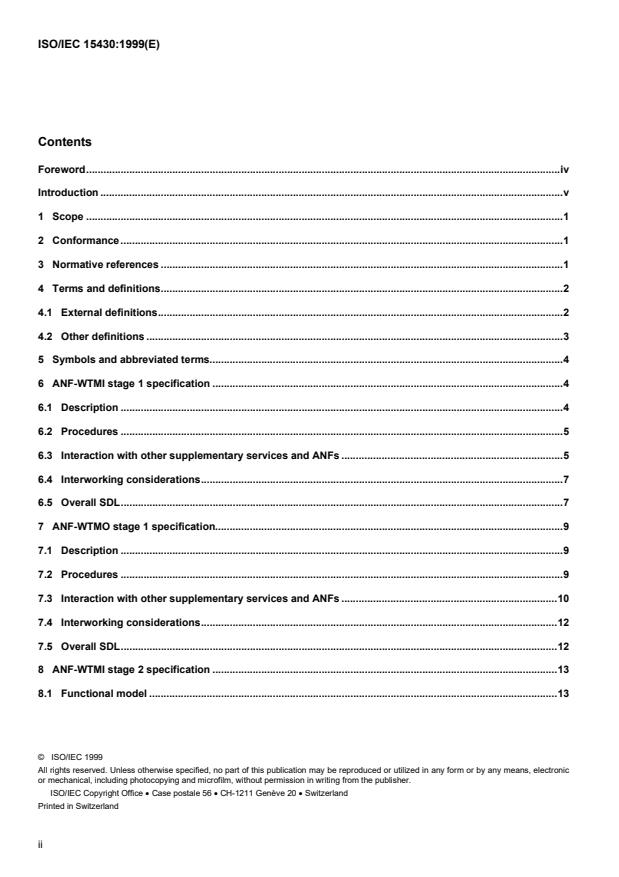
Contents
Foreword.iv
Introduction .v
1 Scope .1
2 Conformance.1
3 Normative references .1
4 Terms and definitions.2
4.1 External definitions.2
4.2 Other definitions .3
5 Symbols and abbreviated terms.4
6 ANF-WTMI stage 1 specification .4
6.1 Description .4
6.2 Procedures .5
6.3 Interaction with other supplementary services and ANFs .5
6.4 Interworking considerations.7
6.5 Overall SDL.7
7 ANF-WTMO stage 1 specification.9
7.1 Description .9
7.2 Procedures .9
7.3 Interaction with other supplementary services and ANFs .10
7.4 Interworking considerations.12
7.5 Overall SDL.12
8 ANF-WTMI stage 2 specification .13
8.1 Functional model .13
© ISO/IEC 1999
All rights reserved. Unless otherwise specified, no part of this publication may be reproduced or utilized in any form or by any means, electronic
or mechanical, including photocopying and microfilm, without permission in writing from the publisher.
ISO/IEC Copyright Office � Case postale 56 � CH-1211 Genève 20 � Switzerland
Printed in Switzerland
ii
© ISO/IEC
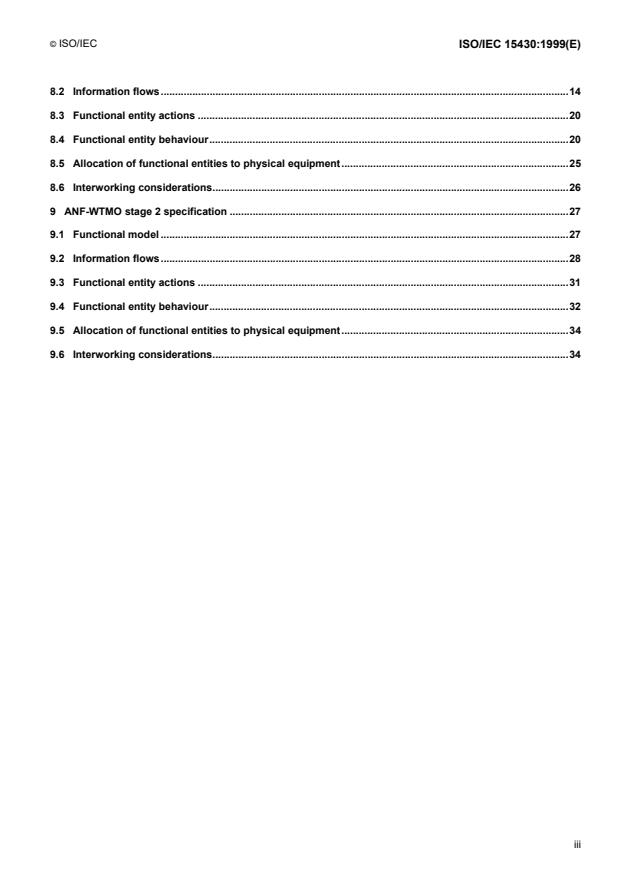
8.2 Information flows.14
8.3 Functional entity actions .20
8.4 Functional entity behaviour.20
8.5 Allocation of functional entities to physical equipment.25
8.6 Interworking considerations.26
9 ANF-WTMO stage 2 specification .27
9.1 Functional model .27
9.2 Information flows.28
9.3 Functional entity actions .31
9.4 Functional entity behaviour.32
9.5 Allocation of functional entities to physical equipment.34
9.6 Interworking considerations.34
iii
© ISO/IEC
Foreword
ISO (the International Organization for Standardization) and IEC (the International Electrotechnical Commission)
form the specialized system for worldwide standardization. National bodies that are members of ISO or IEC
participate in the development of International Standards through technical committees established by the
respective organization to deal with particular fields of technical activity. ISO and IEC technical committees
collaborate in fields of mutual interest. Other international organizations, governmental and non-governmental, in
liaison with ISO and IEC, also take part in the work.
International Standards are drafted in accordance with the rules given in the ISO/IEC Directives, Part 3.
In the field of information technology, ISO and IEC have established a joint technical committee, ISO/IEC JTC 1.
Draft International Standards adopted by the joint technical committee are circulated to national bodies for voting.
Publication as an International Standard requires approval by at least 75 % of the national bodies casting a vote.
International Standard ISO/IEC 15430 was prepared by Joint Technical Committee ISO/IEC JTC 1, Information
technology,SubcommitteeSC6, Telecommunications and information exchange between systems.
iv
© ISO/IEC
Introduction
This International Standard is one of a series of International Standards defining services and signalling protocols
applicable to Private Integrated Services Networks (PISNs). The series uses ISDN concepts as developed by
ITU-T and conforms to the framework of International Standards for Open Systems Interconnection as defined by
ISO/IEC.
This particular International Standard specifies the Wireless terminal call handling additional network features.
v
INTERNATIONAL STANDARD © ISO/IEC ISO/IEC 15430:1999(E)
Information technology — Telecommunications and information
exchange between systems — Private Integrated Services
Network — Specification, functional model and information
flows — Wireless terminal call handling additional network
features
1 Scope
This International Standard specifies the Wireless terminal call handling additional network features (ANF-WTMI,
ANF-WTMO), which are applicable to various basic services supported by Private Integrated Services Networks
(PISN). Basic services are specified in ISO/IEC 11574.
Additional network feature Wireless terminal incoming call (ANF-WTMI) directs incoming calls to a WTMI user
within a PISN regardless of the WTMI user's geographical location within the PISN, provided the WTMI user's
location is known.
Additional network feature Wireless terminal outgoing call (ANF-WTMO) detects an outgoing call from a WTMO
user and establishes it as a basic call, regardless of the user's geographical location within the PISN. It also
provides the WTMO user's service profile for use by outgoing call control, or alternatively passes the call to the
WTMO user's home location for processing.
Service specifications are produced in three stages, according to the method described in CCITT Recommendation
I.130. This International Standard contains the stage 1 and stage 2 specifications of ANF-WTMI and ANF-WTMO.
The stage 1 specification (clauses 6 and 7) specifies the service as seen by users of PISNs. The stage 2
specification (clauses 8 and 9) identifies the functional entities involved in the service and the information flows
between them.
2 Conformance
In order to conform to this International Standard, a stage 3 International Standard shall specify signalling protocols
and equipment behaviour that are capable of being used in a PISN which supports the services specified in this
International Standard. This means that, to claim conformance, a stage 3 International Standard is required to be
adequate for the support of those aspects of clauses 6 and 7 (stage 1) and clauses 8 and 9 (stage 2) which are
relevant to the interface or equipment to which the stage 3 International Standard applies.
3 Normative references
The following normative documents contain provisions which, through reference in this text, constitute provisions of
this International Standard. For dated references, subsequent amendments to, or revisions of, any of these
publications do not apply. However, parties to agreements based on this International Standard are encouraged to
investigate the possibility of applying the most recent editions of the normative documents indicated below. For
undated references, the latest edition of the normative document referred to applies. Members of ISO and IEC
maintain registers of currently valid International Standards.
ISO/IEC 11571:1994, Information technology - Telecommunications and information exchange between systems -
Numbering and sub-addressing in private integrated services networks.
© ISO/IEC
ISO/IEC 11574:1994, Information technology - Telecommunications and information exchange between systems -
Private Integrated Services Network – Circuit-mode 64 kbit/s bearer services - Service description, functional
capabilities and information flows.
ISO/IEC 11579-1:1994, Information technology - Telecommunications and information exchange between systems -
Private integrated services network - Part 1: Reference configuration for PISN Exchanges (PINX).
ISO/IEC 13242:1997, Information technology - Telecommunications and information exchange between systems -
Private Integrated Services Network - Specification, functional model and information flows - Route Restriction
Class additional network feature.
ISO/IEC 13872:1995, Information technology - Telecommunications and information exchange between systems -
Private Integrated Services Network - Specification, functional model and information flows - Call diversion
supplementary services.
ISO/IEC 15055:1997, Information technology - Telecommunications and information exchange between systems -
Private Integrated Services Network - Specification, functional model and information flows - Transit counter
additional network feature.
ISO/IEC 15428:1999, Information technology - Telecommunications and information exchange between systems -
Private Integrated Services Network - Specification, functional model and information flows - Wireless Terminal
Location Registration supplementary service and Wireless Terminal Information Exchange additional network
feature.
ISO/IEC 15432:1999, Information technology - Telecommunications and information exchange between systems -
Private Integrated Services Network - Specification, functional model and information flows - Wireless Terminal
Authentication supplementary services (WTAT and WTAN).
ITU-T Rec. I.112:1993, Vocabulary of terms for ISDNs.
CCITT Rec. I.130:1988, Method for the characterization of telecommunication services supported by an ISDN and
network capabilities of an ISDN (Blue Book).
ITU-T Rec. I.210:1993, Principles of telecommunication services supported by an ISDN and the means to describe
them.
ITU-T Rec. Z.100:1993, Specification and Description Language.
4 Terms and definitions
For the purposes of this International Standard, the following definitions apply.
4.1 External definitions
This International Standard uses the following terms defined in other documents:
— Address (ISO/IEC 11571)
— Additional network feature (ANF) (ISO/IEC 15428)
— Basic service (ITU-T Rec. I.210)
— Call, basic call (ISO/IEC 11574)
— Complete (PISN) number (ISO/IEC 11571)
— Fixed part (FP) (ISO/IEC 15428)
— Home data base (HDB) (ISO/IEC 15428)
— Home PINX (ISO/IEC 15428)
— Number, PISN number (ISO/IEC 11571)
© ISO/IEC
— Partial (PISN) number (ISO/IEC 11571)
— Private Integrated Services Network (PISN) (ISO/IEC 11579-1)
— Private Integrated Services Network Exchange (PINX) (ISO/IEC 11579-1)
— Route access class (RAC) (ISO/IEC 13242)
— Service (ITU-T Rec. I.112)
— Service profile (ISO/IEC 15428)
— Signalling (ITU-T Rec. I.112)
— Supplementary Service (ITU-T Rec. I.210)
— User (ISO/IEC 11574)
— Visitor data base (VDB) (ISO/IEC 15428)
— Visitor PINX (ISO/IEC 15428)
— Wireless Terminal Mobility (WTM) (ISO/IEC 15428)
This International Standard refers to the following basic call functional entities (FEs) defined in ISO/IEC 11574:
— Call Control (CC)
— Call Control Agent (CCA)
This International Standard refers to the following basic call inter-FE relationships defined in ISO/IEC 11574:
— r1
— r2
— r3
This International Standard refers to the following basic call information flows defined in ISO/IEC 11574:
— RELEASE request/indication
— SETUP request/indication
— SETUP response/confirmation
— SETUP REJECT request/indication
This International Standard refers to the following basic call information flow service elements defined in
ISO/IEC 11574:
— Call History
— Connection Type
— Destination Number
— Destination Subaddress
— Originating Number
— Originating Subaddress
4.2 Other definitions
4.2.1
WTM call: A call which is processed by ANF-WTMI or ANF-WTMO.
© ISO/IEC
4.2.2
WTMI user: A user whose incoming calls are processed by ANF-WTMI.
4.2.3
WTMO user: A user whose outgoing calls are processed by ANF-WTMO.
4.2.4
Incoming WTM call: A call whose called user is a WTMI user.
4.2.5
Outgoing WTM call: A call whose calling user is a WTMO user.
5 Symbols and abbreviated terms
ANF Additional Network feature
ANF-WTMI ANF Wireless TerMinal Incoming call
ANF-WTMO ANF Wireless TerMinal Outgoing call
CC Call Control (functional entity)
CCA Call Control Agent (functional entity)
FE Functional Entity
FP Fixed Part
HDB Home Data Base
ISDN Integrated Services Digital Network
PINX Private Integrated Services Network Exchange
PISN Private Integrated Services Network
RAC Route Access Class
SDL Specification and Description Language
SS Supplementary Service
VDB Visitor Data Base
WTM Wireless Terminal Mobility
6 ANF-WTMI stage 1 specification
6.1 Description
6.1.1 General description
ANF-WTMI enables calls to be directed to a WTMI user within the PISN. As there is no predetermined access for
the connection of a WTMI user to the PISN, the directing of such calls requires that information regarding the
location of the WTMI user is available.
6.1.2 Qualifications on applicability to telecommunication services
ANF-WTMI is applicable to all basic services defined in ISO/IEC 11574.
© ISO/IEC
6.2 Procedures
6.2.1 Provision/withdrawal
Not applicable
6.2.2 Normal procedures
6.2.2.1 Activation/deactivation/registration/interrogation
ANF-WTMI shall be permanently activated.
Registration and interrogation are not applicable to this ANF.
6.2.2.2 Invocation and operation
For each WTMI user, information shall be maintained relating to the location of the WTMI user within the PISN.
ANF-WTMI shall be invoked for an incoming call when analysis of the destination number indicates that the called
user is a WTMI user. Once invoked, ANF-WTMI shall route the call to the WTMI user using the destination number
to determine the address of the PISN access currently in use by the WTMI user.
Further processing of the call shall follow normal basic call procedures.
6.2.3 Exceptional procedures
6.2.3.1 Activation/deactivation/registration/interrogation
Not applicable
6.2.3.2 Invocation and operation
If the PISN is unable to complete an incoming call to a WTMI user, an indication that the call was unsuccessful
shall be sent to the calling user. Normal basic call failure procedures shall be used.
6.3 Interaction with other supplementary services and ANFs
Interactions with other supplementary services and ANFs for which PISN International Standards were available at
the time of publication of this International Standard are specified below.
6.3.1 Calling Line Identification Presentation (SS-CLIP)
No interaction
6.3.2 Connected Line Identification Presentation (SS-COLP)
No interaction
6.3.3 Calling/Connected Line Identification Restriction (SS-CLIR)
No interaction
6.3.4 Calling Name Identification Presentation (SS-CNIP)
No interaction
6.3.5 Connected Name Identification Presentation (SS-CONP)
No interaction
© ISO/IEC
6.3.6 Calling/Connected Name Identification Restriction (SS-CNIR)
No interaction
6.3.6 Call Completion to Busy Subscriber (SS-CCBS)
No interaction
6.3.7 Call Completion on No Reply (SS-CCNR)
No interaction
6.3.8 Call Transfer (SS-CT)
No interaction
6.3.9 Call Forwarding Unconditional (SS-CFU)
If SS-CFU has been activated, the invocation of SS-CFU shall take precedence over the directing of calls by means
of ANF-WTMI.
6.3.10 Call Forwarding Busy (SS-CFB)
No interaction
NOTE SS-CFB may not be available to the WTMI user.
6.3.11 Call Forwarding No Reply (SS-CFNR)
No interaction
NOTE SS-CFNR may not be available to the WTMI user.
6.3.12 Call Deflection (SS-CD)
No interaction
6.3.13 Path Replacement (ANF-PR)
No interaction
6.3.14 Call Offer (SS-CO)
No interaction
6.3.15 Call Intrusion (SS-CI)
No interaction
6.3.16 Do Not Disturb (SS-DND)
No interaction
6.3.17 Do Not Disturb Override (SS-DNDO)
No interaction
6.3.18 Advice of Charge (SS-AOC)
No interaction
© ISO/IEC
6.3.19 Recall (SS-RE)
No interaction
6.3.20 Call Interception (ANF-CINT)
No interaction
NOTE Failure of ANF-WTMI can be a cause for invoking ANF-CINT.
6.3.21 Transit Counter (ANF-TC)
ANF-TC may apply to the redirected call to the WTMI user.
6.3.22 Route restriction class (ANF-RRC)
Either the calling user's RAC or the WTMI user's RAC shall be used.
6.3.23 Message Waiting Indication (SS-MWI)
A message waiting indication for the WTMI user shall be directed to the visited location.
6.3.24 Wireless terminal location registration (SS-WTLR)
An incoming call to a WTMI user may be rejected if it occurs while SS-WTLR is invoked or if the WTMI user is in
the deregistered state.
NOTE ANF-WTMI requires that SS-WTLR has been invoked for the WTMI user at that location.
6.3.25 Wireless terminal information (ANF-WTINFO)
No interaction
6.3.26 Wireless terminal outgoing call (ANF-WTMO)
No interaction
6.3.27 Authentication of wireless terminal (SS-WTAT)
ANF-WTMI may cause the invocation of SS-WTAT.
6.3.28 Authentication of network (SS-WTAN)
No interaction
6.4 Interworking considerations
No specific requirements.
6.5 Overall SDL
Figure 1 contains the dynamic description of ANF-WTMI using the Specification and Description Language (SDL)
defined in ITU-T Rec. Z.100. The SDL process represents the behaviour of the PISN in providing ANF-WTMI. Input
and output signals represent stimuli from/to basic call control.
© ISO/IEC
ANF-WTMI
Idle
Incoming call to
WTMI user
Determine address
of WTMI user's
current access
Present call to
continue with
WTMI user (via
basic call
current access)
ANF-WTMI
Idle
Figure 1 - ANF-WTMI, overall SDL
© ISO/IEC
7 ANF-WTMO stage 1 specification
7.1 Description
7.1.1 General description
ANF-WTMO permits the PISN to verify the identity of a WTMO user when it initiates a call from its current visited
location. ANF-WTMO also provides access to the WTMO user's service profile for use by outgoing call control, or
alternatively, passes the call to the WTMO user's home location for processing.
7.1.2 Qualifications on applicability to telecommunication services
ANF-WTMO is applicable to all basic services defined in ISO/IEC 11574.
7.2 Procedures
7.2.1 Provision/withdrawal
Not applicable
7.2.2 Normal procedures
7.2.2.1 Activation/deactivation/registration/interrogation
ANF-WTMO shall be permanently activated.
Registration and interrogation are not applicable to this ANF.
7.2.2.2 Invocation and operation
ANF-WTMO is an extension of basic call control which replaces certain procedures that basic call control is unable
to perform satisfactorily for WTMO users. It may be invoked when a call request is recognised as being initiated by
aWTMO user.
NOTE 1 The PISN need not invoke ANF-WTMO on all outgoing calls. Examples of when it might not be invoked are:
- when applying a fixed service profile to all WTMO users;
- when allowing outgoing WTM calls without prior location registration.
If ANF-WTMO is invoked, the PISN shall verify that the WTMO user is registered as a visiting user, and if so, set
the originating number to the complete PISN number of the WTMO user, unless it is already that.
NOTE 2 Positive identification does not guarantee that the WTMO user's identity is actually the one claimed to be; this
additional validation would be part of supplementary service SS-WTAT.
ANF-WTMO shall then make the WTMO user's service profile available for use by outgoing call control, with further
call establishment following normal basic call procedures. Alternatively, the call may be processed at the WTMO
user's home location.
NOTE 3 The criteria to be used in determining whether the call should be processed locally or at the home location are beyond
the scope of this International Standard but could include the following:
- service not supported at visitor location;
- all outgoing WTM calls are processed at the home location;
- service profile details not complete at visitor location.
7.2.3 Exceptional procedures
7.2.3.1 Activation/deactivation/registration/interrogation
Not applicable
© ISO/IEC
7.2.3.2 Invocation and operation
The PISN may reject the call request with an appropriate failure indication for any of the following reasons:
- no originating number provided;
- the indicated WTMO user is not registered at that location area.
Furthermore, all restrictions and exceptional procedures for basic call establishment shall apply.
7.3 Interaction with other supplementary services and ANFs
Interactions with other supplementary services and ANFs for which PISN International Standards were available at
the time of publication of this International Standard are specified below.
7.3.1 Calling Line Identification Presentation (SS-CLIP)
No interaction
7.3.2 Connected Line Identification Presentation (SS-COLP)
No interaction
7.3.3 Calling/Connected Line Identification Restriction (SS-CLIR)
No interaction
7.3.4 Calling Name Identification Presentation (SS-CNIP)
No interaction
7.3.5 Connected Name Identification Presentation (SS-CONP)
No interaction
7.3.6 Calling/Connected Name Identification Restriction (SS-CNIR)
No interaction
7.3.7 Call Completion to Busy Subscriber (SS-CCBS)
No interaction
7.3.8 Call Completion on No Reply (SS-CCNR)
No interaction
7.3.9 Call Transfer (SS-CT)
No interaction
7.3.10 Call Forwarding Unconditional (SS-CFU)
No interaction
7.3.11 Call Forwarding Busy (SS-CFB)
No interaction
7.3.12 Call Forwarding No Reply (SS-CFNR)
No interaction
© ISO/IEC
7.3.13 Call Deflection (SS-CD)
No interaction
7.3.14 Path Replacement (ANF-PR)
No interaction
7.3.15 Call Offer (SS-CO)
No interaction
7.3.16 Call Intrusion (SS-CI)
No interaction
7.3.17 Do Not Disturb (SS-DND)
No interaction
7.3.18 Do Not Disturb Override (SS-DNDO)
No interaction
7.3.19 Advice of Charge (SS-AOC)
No interaction
7.3.20 Recall (SS-RE)
No interaction
7.3.21 Call Interception (ANF-CINT)
No interaction
7.3.22 Transit Counter (ANF-TC)
ANF-TC may apply for an outgoing call. The transit counter value may be reset at the home location.
7.3.23 Route restriction class (ANF-RRC)
No interaction
7.3.24 Message Waiting Indication (SS-MWI)
No interaction
7.3.25 Wireless terminal location registration (SS-WTLR)
No interaction
NOTE ANF-WTMO may require that SS-WTLR has been invoked for the WTMO user at that location.
7.3.26 Wireless terminal information (ANF-WTINFO)
No interaction
7.3.27 Wireless terminal incoming call (ANF-WTMI)
No interaction
© ISO/IEC
7.3.28 Authentication of wireless terminal (SS-WTAT)
ANF-WTMO may cause the invocation of SS-WTAT.
7.3.29 Authentication of network (SS-WTAN)
No interaction
7.4 Interworking considerations
No specific requirements.
7.5 Overall SDL
Figure 2 contains the dynamic description
...