


ISO/IEC/IEEE 32430:2025
(Main)Software engineering — Software non-functional size measurement
Software engineering — Software non-functional size measurement
This document defines a method for measuring the non-functional size of the software. It complements ISO/IEC 20926:2009, which defines a method for measuring the functional size of the software. This document also describes the complementarity of functional and non-functional sizes, so that deriving the sizes from the functional and the non-functional requirements does not result in duplication in the distinct functional and non-functional sizes. In general, there are many types of non-functional requirements. Moreover, non-functional requirements and their classification evolve over time as the technology advances. This document does not intend to define the type of NFR for a given context. Users can choose ISO 25010 or any other standard for the definition of NFR. It is assumed that users size the NFR based on the definitions they use. This document covers a subset of non-functional requirements. It is expected that, with time, the state of the art can improve and that potential future versions of this document can define an extended coverage. The ultimate goal is a version that, together with ISO/IEC 20926:2009, covers every aspect that can be required of any prospective piece of software, including aspects such as process and project directives that are hard or impossible to trace to the software's algorithm or data. The combination of functional and non-functional sizes would then correspond to the total size necessary to bring the software into existence. Estimating the cost, effort and duration of the implementation of the NFR is outside the scope of this document.
Ingénierie du logiciel — Norme pour la quantification des caractéristiques non fonctionnelles des logiciels
General Information
- Status
- Published
- Publication Date
- 05-Feb-2025
- Technical Committee
- ISO/IEC JTC 1/SC 7 - Software and systems engineering
- Drafting Committee
- ISO/IEC JTC 1/SC 7 - Software and systems engineering
- Current Stage
- 6060 - International Standard published
- Start Date
- 06-Feb-2025
- Due Date
- 20-Jul-2026
- Completion Date
- 06-Feb-2025
Relations
- Effective Date
- 24-Dec-2022
Overview
ISO/IEC/IEEE 32430:2025 - Software engineering - Software non-functional size measurement (Second edition, 2025) defines a standardized method to measure the non-functional size of software. It is explicitly complementary to ISO/IEC 20926:2009 (functional size measurement), describing how functional and non‑functional sizes relate so that sizing non‑functional requirements (NFRs) does not duplicate functional sizing. The standard covers a defined subset of NFRs, supports user-selected NFR taxonomies (for example ISO 25010), and anticipates future extensions to broaden coverage. Note: estimating cost, effort or schedule from non‑functional size is outside the scope.
Key topics
- Purpose and scope - formalizes a repeatable approach for quantifying non‑functional characteristics of software products and enhancements.
- Categories and sub‑categories - provides a taxonomy of non‑functional size areas (e.g., Data operations, Interface design, Technical environment, Architecture) and detailed sub‑categories such as data entry validation, user interfaces, multiple platforms, component‑based software, and more.
- Sizing process - prescribes a stepwise workflow (gather documentation; define scope, purpose and boundary; identify NFRs; map NFRs to sub‑categories and sizing units; compute SNAP/non‑functional size; document/report results).
- Complementarity rules - explains how to avoid double counting when deriving sizes from functional user requirements (FUR) and NFRs.
- Sizing of code data & technical considerations - guidance on handling code data and platform/technology factors that affect non‑functional sizing.
- Evolution and adaptability - acknowledges evolving NFR classifications and allows organizations to adopt their preferred NFR definitions (e.g., ISO 25010).
Applications and who uses it
ISO/IEC/IEEE 32430:2025 is practical for:
- Software estimators and project managers seeking consistent non‑functional size metrics to inform scope, planning, procurement and benchmarking.
- Requirements analysts and architects who need to quantify NFRs and maintain traceability between requirements and size.
- Quality assurance and measurement teams implementing software measurement programs (SNAP/non‑functional sizing).
- Vendors and procurement officers requiring objective size measures for contracts, change requests and enhancements.
- Portfolio managers and PMOs comparing projects across products and platforms.
Practical uses include sizing development or enhancement projects, documenting NFR scope in proposals, tracking changes to non‑functional scope, and improving transparency when functional and non‑functional work must be estimated separately.
Related standards
- ISO/IEC 20926:2009 - functional size measurement (complementary).
- ISO 25010 - quality model for defining NFR types (recommended reference).
- ISO/IEC/IEEE 32430 integrates into existing software measurement ecosystems to provide a standardized approach to quantifying non‑functional scope.

Get Certified
Connect with accredited certification bodies for this standard

BSI Group
BSI (British Standards Institution) is the business standards company that helps organizations make excellence a habit.

BSCIC Certifications Pvt. Ltd.
Established 2006, accredited by NABCB, JAS-ANZ, EIAC, IAS. CDSCO Notified Body.

Intertek India Pvt. Ltd.
Delivers Assurance, Testing, Inspection & Certification since 1993 with 26 labs and 32 offices.
Sponsored listings
Frequently Asked Questions
ISO/IEC/IEEE 32430:2025 is a standard published by the International Organization for Standardization (ISO). Its full title is "Software engineering — Software non-functional size measurement". This standard covers: This document defines a method for measuring the non-functional size of the software. It complements ISO/IEC 20926:2009, which defines a method for measuring the functional size of the software. This document also describes the complementarity of functional and non-functional sizes, so that deriving the sizes from the functional and the non-functional requirements does not result in duplication in the distinct functional and non-functional sizes. In general, there are many types of non-functional requirements. Moreover, non-functional requirements and their classification evolve over time as the technology advances. This document does not intend to define the type of NFR for a given context. Users can choose ISO 25010 or any other standard for the definition of NFR. It is assumed that users size the NFR based on the definitions they use. This document covers a subset of non-functional requirements. It is expected that, with time, the state of the art can improve and that potential future versions of this document can define an extended coverage. The ultimate goal is a version that, together with ISO/IEC 20926:2009, covers every aspect that can be required of any prospective piece of software, including aspects such as process and project directives that are hard or impossible to trace to the software's algorithm or data. The combination of functional and non-functional sizes would then correspond to the total size necessary to bring the software into existence. Estimating the cost, effort and duration of the implementation of the NFR is outside the scope of this document.
This document defines a method for measuring the non-functional size of the software. It complements ISO/IEC 20926:2009, which defines a method for measuring the functional size of the software. This document also describes the complementarity of functional and non-functional sizes, so that deriving the sizes from the functional and the non-functional requirements does not result in duplication in the distinct functional and non-functional sizes. In general, there are many types of non-functional requirements. Moreover, non-functional requirements and their classification evolve over time as the technology advances. This document does not intend to define the type of NFR for a given context. Users can choose ISO 25010 or any other standard for the definition of NFR. It is assumed that users size the NFR based on the definitions they use. This document covers a subset of non-functional requirements. It is expected that, with time, the state of the art can improve and that potential future versions of this document can define an extended coverage. The ultimate goal is a version that, together with ISO/IEC 20926:2009, covers every aspect that can be required of any prospective piece of software, including aspects such as process and project directives that are hard or impossible to trace to the software's algorithm or data. The combination of functional and non-functional sizes would then correspond to the total size necessary to bring the software into existence. Estimating the cost, effort and duration of the implementation of the NFR is outside the scope of this document.
ISO/IEC/IEEE 32430:2025 is classified under the following ICS (International Classification for Standards) categories: 35.080 - Software. The ICS classification helps identify the subject area and facilitates finding related standards.
ISO/IEC/IEEE 32430:2025 has the following relationships with other standards: It is inter standard links to ISO/IEC/IEEE 32430:2021. Understanding these relationships helps ensure you are using the most current and applicable version of the standard.
ISO/IEC/IEEE 32430:2025 is available in PDF format for immediate download after purchase. The document can be added to your cart and obtained through the secure checkout process. Digital delivery ensures instant access to the complete standard document.
Standards Content (Sample)
International
Standard
ISO/IEC/IEEE 32430
Second edition
Software engineering — Software
2025-02
non-functional size measurement
Ingénierie du logiciel — Norme pour la quantification des
caractéristiques non fonctionnelles des logiciels
Reference number
© IEEE 2025
All rights reserved. Unless otherwise specified, or required in the context of its implementation, no part of this publication may
be reproduced or utilized otherwise in any form or by any means, electronic or mechanical, including photocopying, or posting
on the internet or an intranet, without prior written permission. Permission can be requested from either ISO or IEEE at the
respective address below or ISO’s member body in the country of the requester.
Institute of Electrical and Electronics Engineers, Inc
3 Park Avenue, New York
NY 10016-5997, USA
Email: stds.ipr@ieee.org
Website: www.ieee.org
Published in Switzerland
© IEEE 2025 – All rights reserved
ii
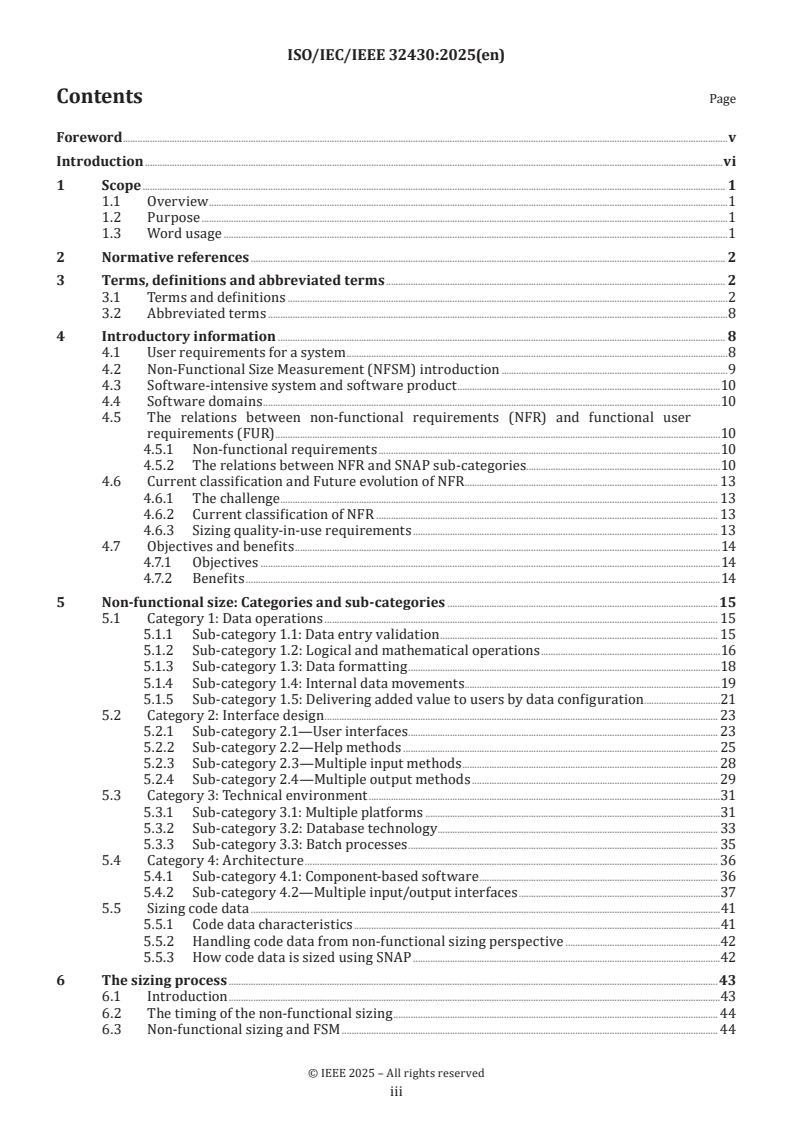
Contents Page
Foreword .v
Introduction .vi
1 Scope . 1
1.1 Overview .1
1.2 Purpose .1
1.3 Word usage .1
2 Normative references . 2
3 Terms, definitions and abbreviated terms . 2
3.1 Terms and definitions .2
3.2 Abbreviated terms .8
4 Introductory information . 8
4.1 User requirements for a system .8
4.2 Non-Functional Size Measurement (NFSM) introduction .9
4.3 Software-intensive system and software product .10
4.4 Software domains . .10
4.5 The relations between non-functional requirements (NFR) and functional user
requirements (FUR) .10
4.5.1 Non-functional requirements .10
4.5.2 The relations between NFR and SNAP sub-categories.10
4.6 Current classification and Future evolution of NFR . 13
4.6.1 The challenge . 13
4.6.2 Current classification of NFR . 13
4.6.3 Sizing quality-in-use requirements . 13
4.7 Objectives and benefits .14
4.7.1 Objectives .14
4.7.2 Benefits .14
5 Non-functional size: Categories and sub-categories .15
5.1 Category 1: Data operations . 15
5.1.1 Sub-category 1.1: Data entry validation . 15
5.1.2 Sub-category 1.2: Logical and mathematical operations .16
5.1.3 Sub-category 1.3: Data formatting .18
5.1.4 Sub-category 1.4: Internal data movements .19
5.1.5 Sub-category 1.5: Delivering added value to users by data configuration .21
5.2 Category 2: Interface design . . 23
5.2.1 Sub-category 2.1—User interfaces . 23
5.2.2 Sub-category 2.2—Help methods . 25
5.2.3 Sub-category 2.3—Multiple input methods . 28
5.2.4 Sub-category 2.4—Multiple output methods . 29
5.3 Category 3: Technical environment .31
5.3.1 Sub-category 3.1: Multiple platforms .31
5.3.2 Sub-category 3.2: Database technology . 33
5.3.3 Sub-category 3.3: Batch processes . 35
5.4 Category 4: Architecture . 36
5.4.1 Sub-category 4.1: Component-based software . 36
5.4.2 Sub-category 4.2—Multiple input/output interfaces .37
5.5 Sizing code data .41
5.5.1 Code data characteristics .41
5.5.2 Handling code data from non-functional sizing perspective .42
5.5.3 How code data is sized using SNAP .42
6 The sizing process .43
6.1 Introduction .43
6.2 The timing of the non-functional sizing . 44
6.3 Non-functional sizing and FSM . 44
© IEEE 2025 – All rights reserved
iii
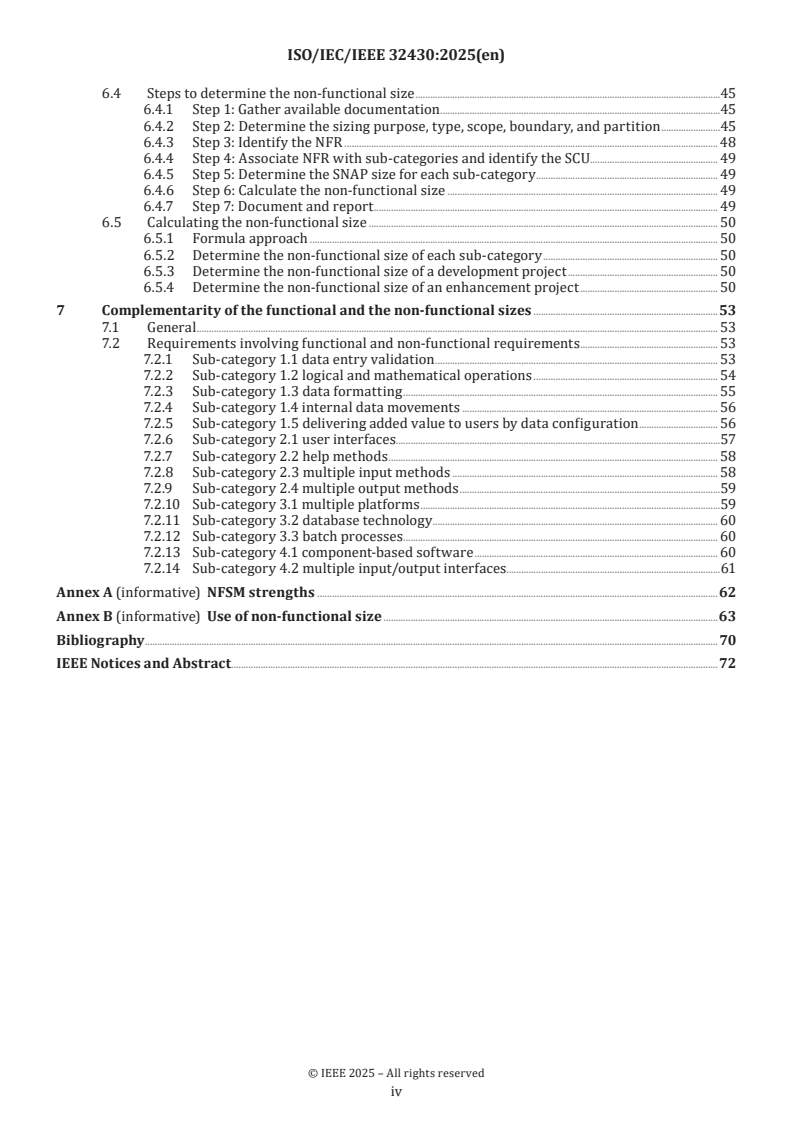
6.4 Steps to determine the non-functional size .45
6.4.1 Step 1: Gather available documentation .45
6.4.2 Step 2: Determine the sizing purpose, type, scope, boundary, and partition .45
6.4.3 Step 3: Identify the NFR . 48
6.4.4 Step 4: Associate NFR with sub-categories and identify the SCU. 49
6.4.5 Step 5: Determine the SNAP size for each sub-category . 49
6.4.6 Step 6: Calculate the non-functional size . 49
6.4.7 Step 7: Document and report . 49
6.5 Calculating the non-functional size . 50
6.5.1 Formula approach . 50
6.5.2 Determine the non-functional size of each sub-category . 50
6.5.3 Determine the non-functional size of a development project . 50
6.5.4 Determine the non-functional size of an enhancement project . 50
7 Complementarity of the functional and the non-functional sizes .53
7.1 General . 53
7.2 Requirements involving functional and non-functional requirements . 53
7.2.1 Sub-category 1.1 data entry validation . 53
7.2.2 Sub-category 1.2 logical and mathematical operations . 54
7.2.3 Sub-category 1.3 data formatting . 55
7.2.4 Sub-category 1.4 internal data movements . 56
7.2.5 Sub-category 1.5 delivering added value to users by data configuration . 56
7.2.6 Sub-category 2.1 user interfaces.57
7.2.7 Sub-category 2.2 help methods . 58
7.2.8 Sub-category 2.3 multiple input methods . 58
7.2.9 Sub-category 2.4 multiple output methods .59
7.2.10 Sub-category 3.1 multiple platforms .59
7.2.11 Sub-category 3.2 database technology . 60
7.2.12 Sub-category 3.3 batch processes . 60
7.2.13 Sub-category 4.1 component-based software . 60
7.2.14 Sub-category 4.2 multiple input/output interfaces.61
Annex A (informative) NFSM strengths .62
Annex B (informative) Use of non-functional size .63
Bibliography .70
IEEE Notices and Abstract.72
© IEEE 2025 – All rights reserved
iv
Foreword
ISO (the International Organization for Standardization) and IEC (the International Electrotechnical
Commission) form the specialized system for worldwide standardization. National bodies that are
members of ISO or IEC participate in the development of International Standards through technical
committees established by the respective organization to deal with particular fields of technical activity.
ISO and IEC technical committees collaborate in fields of mutual interest. Other international organizations,
governmental and non-governmental, in liaison with ISO and IEC, also take part in the work.
The procedures used to develop this document and those intended for its further maintenance are described
in the ISO/IEC Directives, Part 1. In particular, the different approval criteria needed for the different types
of document should be noted. This document was drafted in accordance with the editorial rules of the ISO/
IEC Directives, Part 2 (see www.iso.org/directives or www.iec.ch/members_experts/refdocs).
IEEE Standards documents are developed within IEEE Societies and subcommittees of IEEE Standards
Association (IEEE SA) Board of Governors. IEEE develops its standards through an accredited consensus
development process, which brings together volunteers representing varied viewpoints and interests to
achieve the final product. IEEE standards are documents developed by volunteers with scientific, academic,
and industry-based expertise in technical working groups. Volunteers are not necessarily members of
IEEE or IEEE SA and participate without compensation from IEEE. While IEEE administers the process and
establishes rules to promote fairness in the consensus development process, IEEE does not independently
evaluate, test, or verify the accuracy of any of the information or the soundness of any judgments contained
in its standards.
ISO and IEC draw attention to the possibility that the implementation of this document may involve the
use of (a) patent(s). ISO and IEC take no position concerning the evidence, validity or applicability of any
claimed patent rights in respect thereof. As of the date of publication of this document, ISO and IEC had not
received notice of (a) patent(s) which may be required to implement this document. However, implementers
are cautioned that this may not represent the latest information, which may be obtained from the patent
database available at www.iso.org/patents and https://patents.iec.ch. ISO and IEC shall not be held
responsible for identifying any or all such patent rights.
Any trade name used in this document is information given for the convenience of users and does not
constitute an endorsement.
For an explanation of the voluntary nature of standards, the meaning of ISO specific terms and expressions
related to conformity assessment, as well as information about ISO's adherence to the World Trade
Organization (WTO) principles in the Technical Barriers to Trade (TBT), see www.iso.org/iso/foreword.html.
In the IEC, see www.iec.ch/understanding-standards.
This document was prepared by Joint Technical Committee ISO/IEC/JTC 1, Information technology,
Subcommittee SC 7, Software and systems engineering, in cooperation with the Systems and Software
Engineering Standards Committee of the IEEE Computer Society, under the Partner Standards Development
Organization cooperation agreement between ISO and IEEE.
This second edition cancels and replaces the first edition (ISO/IEC/IEEE 32430:2021), which has been
technically revised.
The main changes are as follows:
— clarifications of terminology regarding software size and software non-functional requirements.
Any feedback or questions on this document should be directed to the user’s national standards
body. A complete listing of these bodies can be found at www.iso.org/members.html and
www.iec.ch/national-committees.
© IEEE 2025 – All rights reserved
v
Introduction
Used in conjunction with functional size measurement (FSM), non-functional size measurement (NFSM)
assists organizations in multiple ways. It provides insight into the delivery of software projects and
maintenance of software and assists in estimating the effort and in the analysis of key performance
indicators, such as quality and productivity.
Having both software functional size and non-functional size provides significant information for the
management of software product development. The functional size is quantifiable and represents a
standardized measure of the functional project/application size. Providing a quantifiable measure derived
from the non-functional requirements (NFR) for the software allows organizations to build historical
data repositories that can be referenced to assist in decision making for the technical or quality aspects of
applications.
By learning the method as described in this document and by performing the non-functional sizing together
with functional sizing, users avoid duplication of measurement effort.
Having this information enables software professionals to do the following:
a) plan and estimate projects;
b) compare projects and compare the project to benchmarks;
c) identify areas of improvement and analyze trends of improvement;
d) quantify the impacts of the current non-functional strategies;
e) assist in determining future non-functional strategies;
f) provide specific data when communicating non-functional issues to various audiences;
g) communicate the impact of non-functional requirements (NFR) on the project with users and customers;
h) help users determine the benefit of an application package to their organization by assessing portions
or categories that specifically match their requirements;
i) determine the non-functional size of a purchased application package.
NFSM is independent of the way NFR are defined. Analyzing the requirements to measure the non-functional
size can assist in identifying implicit requirements.
This document contains rules on how to use ISO/IEC 20926:2009 (IFPUG FSM) and NFSM together, so that
there are no gaps and no overlaps between the functional size and the non-functional size. A software
requirement that contains both functional and non-functional aspects can be sized using ISO/IEC 20926:2009
for its functional aspects and this document for its non-functional aspects.
FSM and NFSM together can provide a broader view of the size of the software product.
© IEEE 2025 – All rights reserved
vi
International Standard ISO/IEC/IEEE 32430:2025(en)
Software engineering — Software non-functional size
measurement
1 Scope
1.1 Overview
This document defines a method for measuring the non-functional size of the software. It complements
ISO/IEC 20926:2009, which defines a method for measuring the functional size of the software.
This document also describes the complementarity of functional and non-functional sizes, so that deriving
the sizes from the functional and the non-functional requirements does not result in duplication in the
distinct functional and non-functional sizes.
In general, there are many types of non-functional requirements. Moreover, non-functional requirements
and their classification evolve over time as the technology advances. This document does not intend to define
the type of NFR for a given context. Users can choose ISO 25010 or any other standard for the definition of
NFR. It is assumed that users size the NFR based on the definitions they use.
This document covers a subset of non-functional requirements. It is expected that, with time, the state of the
art can improve and that potential future versions of this document can define an extended coverage. The
ultimate goal is a version that, together with ISO/IEC 20926:2009, covers every aspect that can be required
of any prospective piece of software, including aspects such as process and project directives that are hard
or impossible to trace to the software's algorithm or data. The combination of functional and non-functional
sizes would then correspond to the total size necessary to bring the software into existence.
Estimating the cost, effort and duration of the implementation of the NFR is outside the scope of this
document.
1.2 Purpose
The purpose of this document is to define a method for measuring the non-functional size of the software.
1.3 Word usage
The word "shall" indicates mandatory requirements strictly to be followed in order to conform to the
1),2)
standard and from which no deviation is permitted ("shall" equals is required to).
The word "should" indicates that among several possibilities one is recommended as particularly suitable,
without mentioning or excluding others; or that a certain course of action is preferred but not necessarily
required ("should" equals is recommended that).
The word "may" is used to indicate a course of action permissible within the limits of the standard ("may"
equals is permitted to).
The word "can" is used for statements of possibility and capability, whether material, physical, or causal
("can" equals is able to).
1) The use of the word "must" is deprecated and shall not be used when stating mandatory requirements, must is used
only to describe unavoidable situations.
2) The use of "will" is deprecated and shall not be used when stating mandatory requirements, "will" is only used in
statements of fact.
© IEEE 2025 – All rights reserved
2 Normative references
The following documents are referred to in the text in such a way that some or all of their content constitutes
requirements of this document. For dated references, only the edition cited applies. For undated references,
the latest edition of the referenced document (including any amendments) applies.
ISO/IEC 14143-1:2007, Information technology — Software measurement — Functional size measurement —
Part 1: Definition of concepts
ISO/IEC 20926:2009, Software and systems engineering — Software measurement — IFPUG functional size
measurement method 2009
3 Terms, definitions and abbreviated terms
3.1 Terms and definitions
For the purposes of this document, the following terms and definitions apply.
ISO, IEC and IEEE maintain terminology databases for use in standardization at the following addresses:
— ISO Online browsing platform: available at https:// www .iso .org/ obp
— IEC Electropedia: available at https:// www .electropedia .org/
— IEEE Standards Dictionary Online: available at: http:// dictionary .ieee .org
NOTE For additional terms and definitions in the field of systems and software engineering, see
ISO/IEC/IEEE 24765, which is published periodically as a “snapshot” of the SEVOCAB (Systems and Software
Engineering Vocabulary) database and is publicly accessible at www .computer .org/ sevocab.
3.1.1
algorithm
finite ordered set of well-defined rules for the solution (3.1.41) of a problem
[SOURCE: ISO/IEC 2382:2015, 2121376, modified — Notes to entry have been removed.]
3.1.2
application
cohesive collection of automated procedures and data supporting a business objective, consisting of one or
more components, modules, or subsystems
EXAMPLE Accounts payable, accounts receivable, payroll, procurement, shop production, assembly line control,
air search radar, target tracking, weapons firing, flight line scheduling, and passenger reservations.
[SOURCE: ISO/IEC 20926:2009, 3.2]
3.1.3
boundary
conceptual interface between the software under study and its users (3.1.42)
Note 1 to entry: In this document, "application boundary" is used.
[SOURCE: ISO/IEC 14143-1:2007, 3.3, modified — Note 1 to entry has been added.]
3.1.4
code data
list data
translation data
substitutable data, which provide a list of valid values that a descriptive attribute may have
EXAMPLE Examples of code data include:
© IEEE 2025 – All rights reserved
— State
— State code
— State name
— Payment type
— Payment type code
— Payment description
Note 1 to entry: Typically the attributes of the code data are code, description and/or other ‘standard’ attributes
describing the code.
Note 2 to entry: When codes are used in the business data, it is necessary to have a means of translating to convert the
code into something more recognizable to the user (3.1.42). In order to satisfy non-functional user requirements (e.g.,
usability, readability, maintainability) developers often create one or more tables containing the code data.
3.1.5
data configuration
process of adding, changing or deleting reference data or code data (3.1.4) information from the database or
data storage with no change in software code or the database structure
3.1.6
data element type
DET
unique, user (3.1.42)-recognizable, non-repeated attribute
Note 1 to entry: A DET can be in business data, reference data, or code data (3.1.4). The number of different types of
data elements of all tables is the number of DETs (3.1.27). Instances of control information are also counted as a DET,
such as the “Enter” key to facilitate an external input (EI) (3.1.12).
[SOURCE: ISO/IEC 20926:2009, 3.15, modified — Note 1 to entry has been added.]
3.1.7
data function
functionality provided to the user (3.1.42) to meet internal or external data storage requirements
Note 1 to entry: A data function is either an internal logical file (3.1.21) or an external interface file (3.1.14).
[SOURCE: ISO/IEC 20926:2009, 3.16]
3.1.8
database view
result set of a stored query on the data, which the database users (3.1.42) can query just as they would in a
persistent database collection object
Note 1 to entry: This stored (pre-established query) command is kept in the database dictionary. Unlike ordinary base
tables in a relational database, it is a virtual table computed or collated dynamically from data in the database, when
access to that view is requested. Changes applied to the data in a relevant underlying table are reflected in the data
shown in subsequent invocations of the view.
3.1.9
elementary process
EP
smallest unit of activity that is meaningful to the user (3.1.42)
[SOURCE: ISO/IEC 20926:2009, 3.21, modified — The abbreviated term "EP" has been added.]
© IEEE 2025 – All rights reserved
3.1.10
extensive mathematical operation
mathematical operation that includes one or more series of mathematical equations and calculations
executed in conjunction with, or according to, logical operators, to produce results identifiable to the user
(3.1.42)
EXAMPLE A program evaluation review technique (PERT) to calculate the expected completion date of a project.
Note 1 to entry: See also: algorithm (3.1.1).
3.1.11
extensive logical operation
logical operation either containing a minimum of four nesting levels, containing more than 38 DETs (3.1.6)
required to operate the logical operation, or both
Note 1 to entry: These DETs do not necessarily have to cross the application (3.1.2) boundary (3.1.3).
3.1.12
external input
EI
elementary process (EP) (3.1.9) that processes data or control information sent from outside the boundary (3.1.3)
[SOURCE: ISO/IEC 20926:2009, 3.27, modified — Note 1 to entry has been removed.]
3.1.13
external inquiry
EQ
elementary process (EP) (3.1.9) that sends data or control information outside the boundary (3.1.3)
[SOURCE: ISO/IEC 20926:2009, 3.28, modified — Note 1 to entry has been removed.]
3.1.14
external interface file
EIF
user (3.1.42)-recognizable group of logically related data or control information, which is referenced by
the application (3.1.2) being measured, but which is maintained within the boundary (3.1.3) of another
application
[SOURCE: ISO/IEC 20926:2009, 3.29, modified — Note 1 to entry has been removed.]
3.1.15
external output
EO
elementary process (EP) (3.1.9) that sends data or control information outside the boundary (3.1.3) and
includes additional processing logic beyond that of an external inquiry (3.1.13)
[SOURCE: ISO/IEC 20926:2009, 3.30, modified — Note 1 to entry has been removed.]
3.1.16
family of platforms
software platforms (3.1.29) that are serving the same purpose
EXAMPLE Operating systems; browsers.
3.1.17
file type referenced
FTR
data function (3.1.7) read or maintained by a transactional function
Note 1 to entry: A file type referenced includes an internal logical file (3.1.21) read or maintained by a transactional
function, or an external interface file (3.1.14) read by a transactional function.
[SOURCE: ISO/IEC 20926:2009, 3.31, modified — Note 1 to entry has been added.]
© IEEE 2025 – All rights reserved
3.1.18
function point
FP
unit of measure for functional size
[SOURCE: ISO/IEC 20926:2009, 3.35]
3.1.19
functional size measurement
FSM
process of measuring the functional size
[SOURCE: ISO/IEC 14143-1:2007, 3.7]
3.1.20
functional user requirement
FUR
sub-set of the user (3.1.42) requirement that describes what the software does, in terms of tasks and services
Note 1 to entry: FUR include but are not limited to:
— data transfer (for example: input customer data; send control signal);
— data transformation (for example: calculate bank interest; derive average temperature);
— data storage (for example: store customer order; record ambient temperature over time);
— data retrieval (for example: list current employees; retrieve latest aircraft position).
User requirements that are not FUR include, but are not limited to:
— quality constraints (for example: usability, reliability, efficiency and portability);
— organizational constraints (for example: locations for operation, target hardware and compliance to standards);
— environmental constraints (for example: interoperability, security, privacy, and safety);
— implementation constraints (for example: development language, delivery schedule).
[SOURCE: ISO/IEC 14143-1:2007, 3.8]
3.1.21
internal logical file
ILF
user (3.1.42)-recognizable group of logically related data or control information maintained within the
boundary (3.1.3) of the application (3.1.2) being measured
[SOURCE: ISO/IEC 20926:2009, 3.39, modified — Note 1 to entry has been removed.]
3.1.22
logical file
logical group of data as seen by the users (3.1.42)
[SOURCE: ISO/IEC 24570:2018]
3.1.23
multiple instance approach
case where each method of delivery of the same functionality is counted separately
Note 1 to entry: See also: single instance approach (3.1.33).
3.1.24
non-functional size
size of the software derived by quantifying the non-functional requirements (3.1.25) for the software, defined
by a set of rules
© IEEE 2025 – All rights reserved
3.1.25
non-functional requirement
NFR
requirement for a software-intensive system (3.1.40) or for a software product (3.1.38), including how it
should be developed and maintained, and how it should perform in operation, except any functional user
requirement (3.1.20) for the software
3.1.26
NFR for software
non-functional requirements for software
portion of the non-functional requirements (NFR) (3.1.25) that are realized by the software
3.1.27
number of DETs
sum of all data element types (DETs) (3.1.6) that are part of the input/output/query of the elementary process
(EP) (3.1.9), plus the data elements which are read or maintained internally to the boundary (3.1.3)
3.1.28
partition
set of software functions within an application (3.1.2) boundary (3.1.3) that share common criteria and values
EXAMPLE Partitions can be used to improve maintainability by dividing the application into two modules
(within a boundary), each needing different expertise. Integrating the modules requires additional effort, which is not
reflected when sizing the functional aspect of the project or product, using function point (3.1.18) analysis.
Note 1 to entry: Setting partitions is not based on technical or physical considerations.
Note 2 to entry: Partitions do not overlap.
3.1.29
platform
type of computer or hardware device or associated operating system, or a virtual environment, on which
software can be installed or run
Note 1 to entry: Combination of an operating system and hardware that makes up the operating environment in which
a program runs. A platform is distinct from the unique instances of that platform, which are typically referred to as
devices or instances.
3.1.30
precautionary principle
principle that the introduction of a new product or process whose ultimate effects are unknown or disputed
should be resisted until such risks are appropriately mitigated
Note 1 to entry: The precautionary principle denotes a duty to prevent harm, when it is within our power to do so, even
when all the evidence is not in. This principle has been codified in several international treaties and in international law.
3.1.31
primary intent
intent that is first in importance
3.1.32
record element type
RET
user (3.1.42) recognizable sub-group of data element types (DETs) (3.1.6) within a data function (3.1.7)
[SOURCE: ISO/IEC 20926:2009, 3.46]
3.1.33
single instance approach
case where all methods of delivery of the same functionality are counted as one
Note 1 to entry: See also multiple instance approach (3.1.23).
© IEEE 2025 – All rights reserved
3.1.34
SNAP category
software non-functional assessment process category
group of components, processes or activities that are used in order to measure the non-functional size
(3.1.24) of the software
Note 1 to entry: Categories classify the method and are generic enough to allow for future technologies. Categories
are divided into sub-categories, so that the SNAP category groups the sub-categories based on similar operations or
similar types of sizing activities.
3.1.35
SNAP counting unit
SCU
software non-functional assessment process counting unit
component, process or activity, in which non-functional size (3.1.24) is measured
Note 1 to entry: The SCU is identified according to the nature of each sub-category. It can contain both functional
and non-functional characteristics; therefore, sizing an SCU is performed for its functional sizing, using function point
(3.1.18) analysis (FPA), and for its non-functional sizing, using SNAP.
3.1.36
SNAP point
SP
software non-functional assessment process point
unit of measurement to express the non-functional size (3.1.24) of the software
3.1.37
SNAP sub-category
software non-functional assessment process sub-category
component, process or activity performed within the project, to meet a non-functional requirement (3.1.25)
Note 1 to entry: A non-functional requirement may be sized using more than one sub-category.
3.1.38
software product
set of computer programs, procedures, and possibly associated documentation and data
Note 1 to entry: A software product is a software system viewed as the output (product) resulting from a process.
[SOURCE: ISO/IEC/IEEE 12207:2017, 3.1.54]
3.1.39
software project
set of work activities, both technical and managerial, required to satisfy the terms and conditions of a
project agreement
Note 1 to entry: A software project has specific starting and ending dates, well-defined objectives and constraints,
established responsibilities, a budget and a schedule. A software project may be self-contained or may be part of a
larger project. In some cases, a software project may span only a portion of the software development cycle. In other
cases, a software project may span many years and consist of numerous subprojects, each being a well-defined and
self-contained software project.
3.1.40
software-intensive system
system for which software is a major technical challenge and is perhaps the major factor that affects system
schedule, cost and risk
Note 1 to entry: In the most general case, a software-intensive system is comprised of hardware, software, people and
manual procedures.
[SOURCE: IEEE 1062-2015, 3.1]
© IEEE 2025 – All rights reserved
3.1.41
solution
combination of people, processes and technologies to implement a desired capability
[SOURCE: IEEE 7005-2021, 3.1]
3.1.42
user
any person or thing that communicates or interacts with the software at any time
EXAMPLE Software applications, animals, sensors, or other hardware.
[SOURCE: ISO/IEC 14143-1:2007, 3.11]
3.2 Abbreviated terms
API application programming interface
EDI electronic data interchange
FAQ frequently asked questions
FPA function point analysis
GUI graphical user interface
HR human resources
IATA International Air Transport Association
IFPUG International Function Point Users Group
NFR non-functional requirement(s)
NFSM non-functional size measurement
PDF Portable Document Format
SOA service-oriented architecture
SNAP software non-functional assessment process
UI user interface
WCAG Web Content Accessibility Guidelines
XML eXtensible Markup Language
4 Introductory information
4.1 User requirements for a system
Figure 1 illustrates how requirements can be classified.
© IEEE 2025 – All rights reserved
Key
1 FUR
2 NFR for software
3 requirements for hardware and other non-software
a
The boundary between functional requirements and NFR does not have a universally agreed definition (see 4.5.1 and
7.1). Although opinions can vary as to whether a given requirement is considered a functional or a non-functional
requirement, the same requirement is not counted in both types (See Clause 7 for details).
Figure 1 — Classifying user requirements for a system
The term FUR is used to describe section 1 and is sized by an FSM. The term NFR for software, as used in
this document, describes section 2 and is sized by an NFSM.
This document defines the process of measuring the non-functional size of the software, measuring the size
of section 2.
4.2 Non-Functional Size Measurement (NFSM) introduction
In software engineering, size is an important attribute of software. For instance, the size of a piece of
software-under-planning is used to calculate the resources (including time) necessary to develop the
software, provided historical or benchmark productivity data is available. The size of a piece of software
once developed is used for the normalization of certain software performance indicators (e.g., the number
of defects found in the software) or for the calculation of the development organization's performance,
including its productivity. This information is used to estimate the effort of future software projects.
The size of software can be measured in several ways, with different units of measure. For software that
already exists, size can be measured by counting the source statements that form the software's algorithm
and data. However, one major disadvantage of “source statement” as a unit of measure is that early in the
development of software there are no statements yet to count. The substitute for estimating the number of
source statements needed to satisfy the software requirements is quite imprecise due to a dependency on
implementation specifics typically decided later in the project. This imprecision can be avoided by basing
the sizing activity on present software requirements instead of future source statements.
Several sizing methods have been put forward that are based on software requirements. One of these
methods is defined in ISO/IEC 20926:2009, which focuses on a subtype of the software requirements, the
FUR, and assigns “function points” (FPs) (the unit of measure) to elements of FUR.
© IEEE 2025 – All rights reserved
In addition to functional and non-functional size, o
...
Questions, Comments and Discussion
Ask us and Technical Secretary will try to provide an answer. You can facilitate discussion about the standard in here.
Loading comments...