

ISO/IEC 19770-3:2016
(Main)Information technology — IT asset management — Part 3: Entitlement schema
General Information
- Abstract
ISO/IEC 19770-3:2016 establishes a set of terms and definitions which may be used when discussing software entitlements (an important part of software licenses). It also provides specifications for a transport format which enables the digital encapsulation of software entitlements, including associated metrics and their management. This common set of terms and associated transport format is intended to facilitate the management of software entitlements. The intended benefits of the better management of entitlements include easier demonstration of proof of ownership, cost optimization of the use of entitlements and easier license compliance management. Furthermore, one of the benefits of having a standard for entitlement structure is that it may encourage the normalization by industry of names for and the details of, different types of entitlements. A common lexicon is critical to standardization and shared understanding. The terms in this part of ISO/IEC 19770 should form a part of that lexicon over time. It should be noted that within this text, attributes of an XML entity will be denoted with angle brackets, . XML elements are noted with quotes, "Element". ISO/IEC 19770-3:2016 deals only with software entitlements, which are defined as the subset of software licenses that are concerned with usage rights. It is expected that the original documentation of licensing terms and conditions will be definitive for legal purposes, and will always take precedence over the Ent encapsulation. ISO/IEC 19770-3:2016 does not detail ITAM processes required for discovery and management of software (which is provided for in ISO/IEC 19770‑1) or software identification tags (as defined by ISO/IEC 19770‑2). ISO/IEC 19770-3:2016 does not consider identifying mechanisms for product activation. ISO/IEC 19770-3:2016 is not intended to conflict with any organization's policies, procedures and standards, or with any national laws and regulations. Any such conflict should be resolved before using this part of ISO/IEC 19770. In case the conflict cannot be resolved, the specification shall not be implemented.
- Status
- Published
- Publication Date
- 14-Apr-2016
- Technical Committee
- ISO/IEC JTC 1/SC 7 - Software and systems engineering
- Drafting Committee
- ISO/IEC JTC 1/SC 7/WG 21 - Information technology asset management
- Current Stage
- 9093 - International Standard confirmed
- Start Date
- 24-May-2022
- Completion Date
- 29-Aug-2026
Overview
ISO/IEC 19770-3:2016 - "Information technology - IT asset management - Part 3: Entitlement schema" defines a common lexicon and XML transport format for software entitlements. It standardizes terms and provides a machine-readable encapsulation (Ent files/XSD) for entitlement data - rights, metrics, limits, issuance and lifecycle actions - to support consistent software license management, entitlement exchange and interoperability across ITAM tools. The standard is explicit that original legal license documents remain definitive and that it does not cover activation mechanisms.
Key Topics and Requirements
- Terms and definitions: A canonical set of vocabulary for software entitlements to promote consistent naming and understanding.
- Entitlement transport format: XML-based schema (XSD in Annex A) for creating portable entitlement documents - elements such as , "Ent", "EntMeta", "Entity", "Metric", "Contract", "InvoiceData" and related constructs.
- Interoperability and identifiers: Guidance on unique identifiers (global and organizational), registration IDs (regid) and design decisions to support reliable exchange and consolidation of entitlement records.
- Ent lifecycle use cases: Issuance, allocations, transfers, consolidations, revocations and archiving of Ents are described to guide implementers.
- Conformance and trust: Product and organizational conformance profiles, plus recommendations on authenticity, storage, filenames and recovery of Ent files.
- Scope limits: Focused exclusively on software entitlements (usage rights). It does not define ITAM discovery processes (see ISO/IEC 19770‑1), software identification tags (ISO/IEC 19770‑2), or activation mechanisms.
Applications and Who Uses It
ISO/IEC 19770-3 is practical for organizations and vendors involved in:
- IT asset management (ITAM) teams seeking standardized entitlement records for better license compliance and proof of ownership.
- Software vendors and licensors packaging entitlement metadata for customers, resellers or service providers.
- SAM/ITAM tooling vendors implementing import/export, consolidation and entitlement reconciliation functions.
- Procurement and finance teams automating invoice-to-entitlement reconciliation and cost optimization. Benefits include improved license compliance, clearer proof-of-ownership, automated entitlement consolidation and more accurate usage metering.
Related Standards
- ISO/IEC 19770-1 - ITAM processes and framework (discovery/management).
- ISO/IEC 19770-2 - Software identification tags (SWID). These parts together form the ISO/IEC 19770 family for comprehensive software asset management.
Keywords: ISO/IEC 19770-3, entitlement schema, IT asset management, software entitlements, entitlement transport format, license compliance, Ent XML, ITAM, software license management.
Get Certified
Connect with accredited certification bodies for this standard

BSI Group
BSI (British Standards Institution) is the business standards company that helps organizations make excellence a habit.
BSCIC Certifications Pvt. Ltd.
Established 2006, accredited by NABCB, JAS-ANZ, EIAC, IAS. CDSCO Notified Body.

Intertek India Pvt. Ltd.
Delivers Assurance, Testing, Inspection & Certification since 1993 with 26 labs and 32 offices.
Sponsored listings
Frequently Asked Questions
ISO/IEC 19770-3:2016 is a standard published by the International Organization for Standardization (ISO). Its full title is "Information technology — IT asset management — Part 3: Entitlement schema". This standard covers: ISO/IEC 19770-3:2016 establishes a set of terms and definitions which may be used when discussing software entitlements (an important part of software licenses). It also provides specifications for a transport format which enables the digital encapsulation of software entitlements, including associated metrics and their management. This common set of terms and associated transport format is intended to facilitate the management of software entitlements. The intended benefits of the better management of entitlements include easier demonstration of proof of ownership, cost optimization of the use of entitlements and easier license compliance management. Furthermore, one of the benefits of having a standard for entitlement structure is that it may encourage the normalization by industry of names for and the details of, different types of entitlements. A common lexicon is critical to standardization and shared understanding. The terms in this part of ISO/IEC 19770 should form a part of that lexicon over time. It should be noted that within this text, attributes of an XML entity will be denoted with angle brackets, . XML elements are noted with quotes, "Element". ISO/IEC 19770-3:2016 deals only with software entitlements, which are defined as the subset of software licenses that are concerned with usage rights. It is expected that the original documentation of licensing terms and conditions will be definitive for legal purposes, and will always take precedence over the Ent encapsulation. ISO/IEC 19770-3:2016 does not detail ITAM processes required for discovery and management of software (which is provided for in ISO/IEC 19770‑1) or software identification tags (as defined by ISO/IEC 19770‑2). ISO/IEC 19770-3:2016 does not consider identifying mechanisms for product activation. ISO/IEC 19770-3:2016 is not intended to conflict with any organization's policies, procedures and standards, or with any national laws and regulations. Any such conflict should be resolved before using this part of ISO/IEC 19770. In case the conflict cannot be resolved, the specification shall not be implemented.
ISO/IEC 19770-3:2016 establishes a set of terms and definitions which may be used when discussing software entitlements (an important part of software licenses). It also provides specifications for a transport format which enables the digital encapsulation of software entitlements, including associated metrics and their management. This common set of terms and associated transport format is intended to facilitate the management of software entitlements. The intended benefits of the better management of entitlements include easier demonstration of proof of ownership, cost optimization of the use of entitlements and easier license compliance management. Furthermore, one of the benefits of having a standard for entitlement structure is that it may encourage the normalization by industry of names for and the details of, different types of entitlements. A common lexicon is critical to standardization and shared understanding. The terms in this part of ISO/IEC 19770 should form a part of that lexicon over time. It should be noted that within this text, attributes of an XML entity will be denoted with angle brackets, . XML elements are noted with quotes, "Element". ISO/IEC 19770-3:2016 deals only with software entitlements, which are defined as the subset of software licenses that are concerned with usage rights. It is expected that the original documentation of licensing terms and conditions will be definitive for legal purposes, and will always take precedence over the Ent encapsulation. ISO/IEC 19770-3:2016 does not detail ITAM processes required for discovery and management of software (which is provided for in ISO/IEC 19770‑1) or software identification tags (as defined by ISO/IEC 19770‑2). ISO/IEC 19770-3:2016 does not consider identifying mechanisms for product activation. ISO/IEC 19770-3:2016 is not intended to conflict with any organization's policies, procedures and standards, or with any national laws and regulations. Any such conflict should be resolved before using this part of ISO/IEC 19770. In case the conflict cannot be resolved, the specification shall not be implemented.
ISO/IEC 19770-3:2016 is classified under the following ICS (International Classification for Standards) categories: 35.080 - Software. The ICS classification helps identify the subject area and facilitates finding related standards.
ISO/IEC 19770-3:2016 is available in PDF format for immediate download after purchase. The document can be added to your cart and obtained through the secure checkout process. Digital delivery ensures instant access to the complete standard document.
Standards Content (Sample)
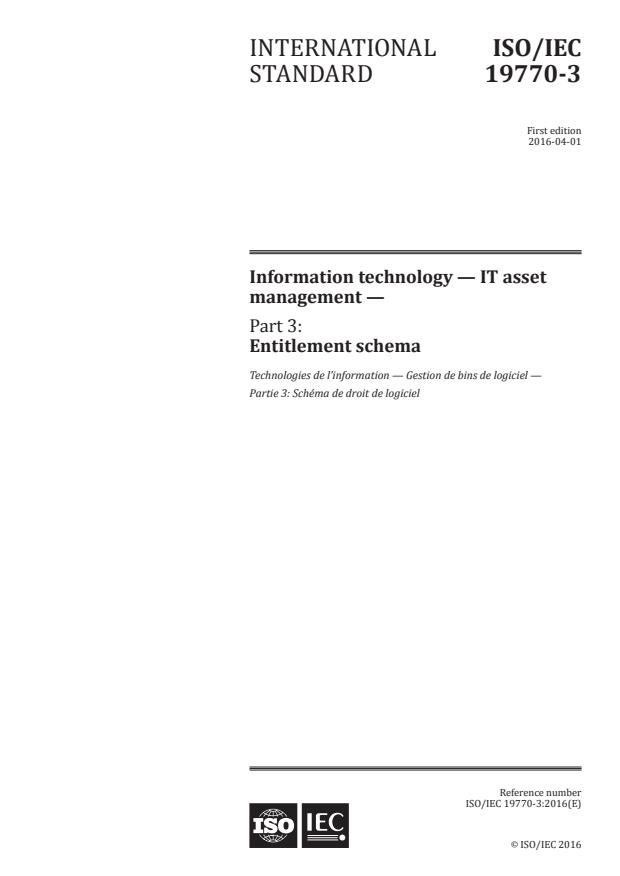
INTERNATIONAL ISO/IEC
STANDARD 19770-3
First edition
2016-04-01
Information technology — IT asset
management —
Part 3:
Entitlement schema
Technologies de l’information — Gestion de bins de logiciel —
Partie 3: Schéma de droit de logiciel
Reference number
©
ISO/IEC 2016
© ISO/IEC 2016, Published in Switzerland
All rights reserved. Unless otherwise specified, no part of this publication may be reproduced or utilized otherwise in any form
or by any means, electronic or mechanical, including photocopying, or posting on the internet or an intranet, without prior
written permission. Permission can be requested from either ISO at the address below or ISO’s member body in the country of
the requester.
ISO copyright office
Ch. de Blandonnet 8 • CP 401
CH-1214 Vernier, Geneva, Switzerland
Tel. +41 22 749 01 11
Fax +41 22 749 09 47
copyright@iso.org
www.iso.org
ii © ISO/IEC 2016 – All rights reserved
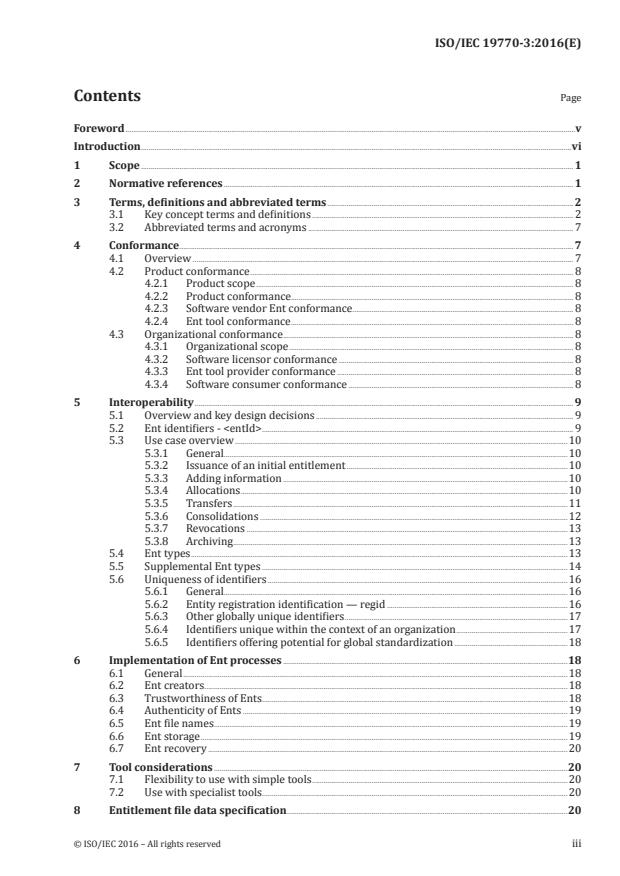
Contents Page
Foreword .v
Introduction .vi
1 Scope . 1
2 Normative references . 1
3 Terms, definitions and abbreviated terms . 2
3.1 Key concept terms and definitions . 2
3.2 Abbreviated terms and acronyms . 7
4 Conformance . 7
4.1 Overview . 7
4.2 Product conformance . 8
4.2.1 Product scope . 8
4.2.2 Product conformance. 8
4.2.3 Software vendor Ent conformance . 8
4.2.4 Ent tool conformance . 8
4.3 Organizational conformance . 8
4.3.1 Organizational scope . 8
4.3.2 Software licensor conformance . 8
4.3.3 Ent tool provider conformance . 8
4.3.4 Software consumer conformance . 8
5 Interoperability . 9
5.1 Overview and key design decisions . 9
5.2 Ent identifiers - . 9
5.3 Use case overview .10
5.3.1 General.10
5.3.2 Issuance of an initial entitlement .10
5.3.3 Adding information .10
5.3.4 Allocations .10
5.3.5 Transfers .11
5.3.6 Consolidations .12
5.3.7 Revocations .13
5.3.8 Archiving .13
5.4 Ent types .13
5.5 Supplemental Ent types .14
5.6 Uniqueness of identifiers .16
5.6.1 General.16
5.6.2 Entity registration identification — regid .16
5.6.3 Other globally unique identifiers .17
5.6.4 Identifiers unique within the context of an organization .17
5.6.5 Identifiers offering potential for global standardization .18
6 Implementation of Ent processes .18
6.1 General .18
6.2 Ent creators .18
6.3 Trustworthiness of Ents .18
6.4 Authenticity of Ents .19
6.5 Ent file names .19
6.6 Ent storage .19
6.7 Ent recovery .20
7 Tool considerations .20
7.1 Flexibility to use with simple tools .20
7.2 Use with specialist tools . .20
8 Entitlement file data specification .20
© ISO/IEC 2016 – All rights reserved iii
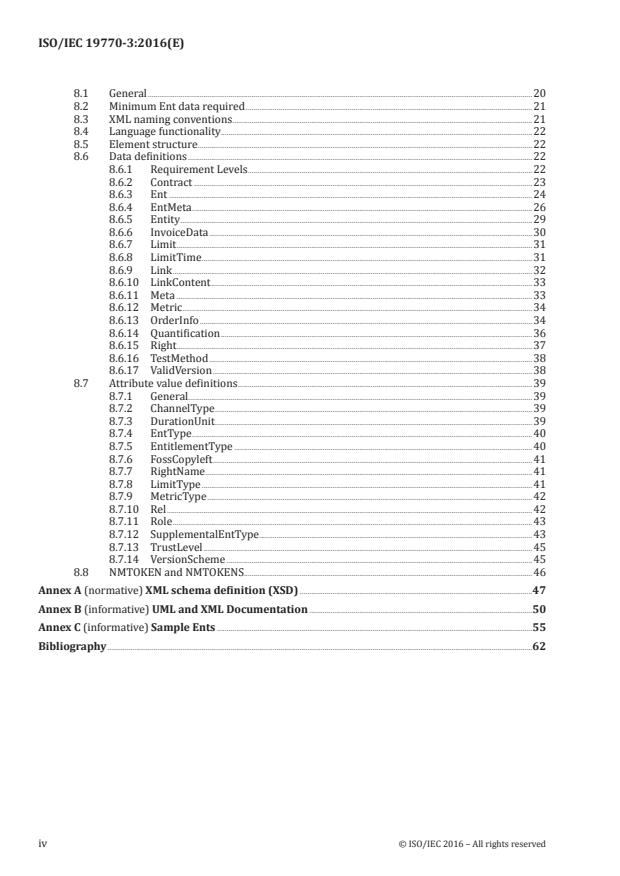
8.1 General .20
8.2 Minimum Ent data required .21
8.3 XML naming conventions .21
8.4 Language functionality.22
8.5 Element structure .22
8.6 Data definitions .22
8.6.1 Requirement Levels .22
8.6.2 Contract .23
8.6.3 Ent .24
8.6.4 EntMeta .26
8.6.5 Entity .29
8.6.6 InvoiceData .30
8.6.7 Limit .31
8.6.8 LimitTime .31
8.6.9 Link .32
8.6.10 LinkContent .33
8.6.11 Meta .33
8.6.12 Metric .34
8.6.13 OrderInfo .34
8.6.14 Quantification .36
8.6.15 Right .37
8.6.16 TestMethod .38
8.6.17 ValidVersion .38
8.7 Attribute value definitions .39
8.7.1 General.39
8.7.2 ChannelType .39
8.7.3 DurationUnit .39
8.7.4 EntType .40
8.7.5 EntitlementType .40
8.7.6 FossCopyleft .41
8.7.7 RightName .41
8.7.8 LimitType .41
8.7.9 MetricType .42
8.7.10 Rel .42
8.7.11 Role .43
8.7.12 SupplementalEntType .43
8.7.13 TrustLevel .45
8.7.14 VersionScheme .45
8.8 NMTOKEN and NMTOKENS .46
Annex A (normative) XML schema definition (XSD) .47
Annex B (informative) UML and XML Documentation .50
Annex C (informative) Sample Ents .55
Bibliography .62
iv © ISO/IEC 2016 – All rights reserved
Foreword
ISO (the International Organization for Standardization) and IEC (the International Electrotechnical
Commission) form the specialized system for worldwide standardization. National bodies that are
members of ISO or IEC participate in the development of International Standards through technical
committees established by the respective organization to deal with particular fields of technical
activity. ISO and IEC technical committees collaborate in fields of mutual interest. Other international
organizations, governmental and non-governmental, in liaison with ISO and IEC, also take part in the
work. In the field of information technology, ISO and IEC have established a joint technical committee,
ISO/IEC JTC 1.
The procedures used to develop this document and those intended for its further maintenance are
described in the ISO/IEC Directives, Part 1. In particular the different approval criteria needed for
the different types of document should be noted. This document was drafted in accordance with the
editorial rules of the ISO/IEC Directives, Part 2 (see www.iso.org/directives).
Attention is drawn to the possibility that some of the elements of this document may be the subject
of patent rights. ISO and IEC shall not be held responsible for identifying any or all such patent
rights. Details of any patent rights identified during the development of the document will be in the
Introduction and/or on the ISO list of patent declarations received (see www.iso.org/patents).
Any trade name used in this document is information given for the convenience of users and does not
constitute an endorsement.
For an explanation on the meaning of ISO specific terms and expressions related to conformity
assessment, as well as information about ISO’s adherence to the WTO principles in the Technical
Barriers to Trade (TBT) see the following URL: Foreword - Supplementary information
The committee responsible for this document is ISO/IEC JTC 1, Information technology, SC 7, Software
and systems engineering.
ISO/IEC 19770 consists of the following parts, under the general title Information technology — Software
asset management:
— Part 1: Processes and tiered assessment of conformance
— Part 2: Software identification tag
— Part 3: Entitlement schema
— Part 5: Overview and vocabulary
The following part is under preparation:
— Part 4: Resource Utilization Measurement (RUM)
The following part is planned:
— Part 22: Guidance for the use of ISO/IEC 19770-2 Software IdentificationTag information in Cyber
Security
© ISO/IEC 2016 – All rights reserved v
Introduction
This part of ISO/IEC 19770 provides a technical definition of a schema that can encapsulate the details
of software entitlements, including usage rights, limitations and metrics.
The primary intentions of this part of ISO/IEC 19770 are
a) to provide a basis for common terminology to be used when describing entitlement rights,
limitations and metrics, and
b) to provide a schema which allows effective description of rights, limitations and metrics attaching
to a software license.
The specific information provided by an entitlement schema (Ent) may be used to help ensure
compliance with license rights and limits, to optimize license usage and to control costs. Though Ent
creators are encouraged to provide the data that allow for the automatic processing, it is not mandated
that data be automatically measurable. The data structure is intended to be capable of containing any
kind of terms and conditions included in a software license agreement.
This part of ISO/IEC 19770 supports software asset management (SAM) processes as defined in
ISO/IEC 19770-1. It is also designed to work together with software identification tags as defined in
ISO/IEC 19770-2. Standardization in the field of software entitlements provides uniform, measurable
data for both the license compliance, and license optimization, processes of SAM practice.
This part of ISO/IEC 19770 does not provide requirements or recommendations for processes related to
software asset management or Ents. The software asset management processes are within the scope of
ISO/IEC 19770-1.
This part of ISO/IEC 19770 has been developed with the following practical principles in mind.
— Maximum possible usability with legacy entitlement information. The Ent or software
entitlement schema, is intended to provide the maximum possible usability with existing entitlement
information, including all historical licensing transactions. While the specifications provide many
opportunities for improvement in entitlement processes and practices, they should also able to
handle existing licensing transactions without imposing requirements which would prevent such
transactions being codified into Ent records.
— Maximum possible alignment with ISO/IEC 19770-2. This part of ISO/IEC 19770 (entitlement
schema) is intended to align closely with part ISO/IEC 19770-2 (software identification tags). This
should facilitate both understanding and their joint use.
It is intended that this standardized schema will be of benefit to all stakeholders involved in the
creation, licensing, distribution, release, installation and ongoing management of software and
software entitlements.
— Benefits to software licensors who provide Ents include, but are not limited to:
— immediate software consumer recognition of details of the usage rights derived from their
software entitlement;
— ability to specify details to customers that allow software assets to be measured and reported
for license compliance purposes;
— increased awareness of software license compliance issues on the part of end-customers;
vi © ISO/IEC 2016 – All rights reserved
— improved software consumer relationships through quicker and more effective license
compliance audits.
— Benefits to SAM tool providers, deployment tool providers, resellers, resellers, software packagers
and release managers include, but are not limited to:
— receipt of consistent and uniform data from software licensors and Ent creators;
— more consistent and structured entitlement information, supporting the use of automated
techniques to determine the need for remediation of software licensing;
— improved reporting from additional categorization made possible by the use of Ents;
— improved SAM tool entitlement reconciliation capabilities resulting from standardization in
location and format of software entitlement data;
— ability to deliver value added functionality for compliance management through the consumption
of entitlement data.
— The benefits for software consumers, SAM practitioners, IT support professionals and end-users
include, but are not limited to:
— receipt of consistent and uniform data from software licensors, resellers and SAM tools
providers;
— more consistent and structured entitlement information supporting the use of automated
techniques to determine the need for remediation of software licensing;
— improved reporting from additional categorization made possible by the use of Ents;
— improved SAM and software license compliance capabilities stemming from standardized,
software licensor-supplied, ISO/IEC 19770-2 software identification tags to reconcile with
these Ents;
— improved ability to avoid software license under-procurement or over-procurement with
subsequent cost optimization;
— standardized usage across multiple platforms, rendering heterogeneous computing
environments more manageable.
© ISO/IEC 2016 – All rights reserved vii
INTERNATIONAL STANDARD ISO/IEC 19770-3:2016(E)
Information technology — IT asset management —
Part 3:
Entitlement schema
1 Scope
This part of ISO/IEC 19770 establishes a set of terms and definitions which may be used when discussing
software entitlements (an important part of software licenses). It also provides specifications for a
transport format which enables the digital encapsulation of software entitlements, including associated
metrics and their management.
This common set of terms and associated transport format is intended to facilitate the management of
software entitlements. The intended benefits of the better management of entitlements include easier
demonstration of proof of ownership, cost optimization of the use of entitlements and easier license
compliance management.
Furthermore, one of the benefits of having a standard for entitlement structure is that it may encourage
the normalization by industry of names for and the details of, different types of entitlements. A common
lexicon is critical to standardization and shared understanding. The terms in this part of ISO/IEC 19770
should form a part of that lexicon over time.
It should be noted that within this text, attributes of an XML entity will be denoted with angle brackets,
. XML elements are noted with quotes, “Element”.
This part of ISO/IEC 19770 deals only with software entitlements, which are defined as the subset of
software licenses that are concerned with usage rights. It is expected that the original documentation
of licensing terms and conditions will be definitive for legal purposes, and will always take precedence
over the Ent encapsulation.
This part of ISO/IEC 19770 does not detail ITAM processes required for discovery and management
of software (which is provided for in ISO/IEC 19770-1) or software identification tags (as defined by
ISO/IEC 19770-2).
This part of ISO/IEC 19770 does not consider identifying mechanisms for product activation.
This part of ISO/IEC 19770 is not intended to conflict with any organization’s policies, procedures
and standards, or with any national laws and regulations. Any such conflict should be resolved before
using this part of ISO/IEC 19770. In case the conflict cannot be resolved, the specification shall not be
implemented.
2 Normative references
The following documents, in whole or in part, are normatively referenced in this document and are
indispensable for its application. For dated references, only the edition cited applies. For undated
references, the latest edition of the referenced document (including any amendments) applies.
ISO/IEC 19770-2, Information technology — Software asset management — Part 2: Software
identification tag
ISO/IEC 19770-5, Information technology — IT asset management — Part 5: Overview and vocabulary
1)
RFC 3986, Uniform Resource Identifier (URI): Generic Syntax
1) https://www.ietf.org/rfc/rfc3986.txt
© ISO/IEC 2016 – All rights reserved 1
3 Terms, definitions and abbreviated terms
For the purposes of this document, the following terms and definitions apply.
3.1 Key concept terms and definitions
3.1.1
allocation of an entitlement
process of assigning some or all of a given entitlement to a subsidiary or other associated organizational
unit which manages its own Ent library
Note 1 to entry: The Ent enables the recording of entitlement allocations. See Allocations (5.3.4).
3.1.2
bundle
grouping of products which is the result of a marketing/licensing strategy to sell entitlements to
multiple products as one purchased item
Note 1 to entry: A bundle can be referred to as a “suite”, if the products are closely related and typically integrated
(such as an office suite containing a spreadsheet, word processor, presentation and other related items).
Note 2 to entry: Bundles can also refer to software titles that are less closely related such as a game, a virus
scanner and a utility “bundled” together with a new computer, or to groups of entitlements, such as multiple
entitlements for a backup software product.
[SOURCE: ISO/IEC 19770-5, 3.5]
3.1.3
channel
distribution channel
approach to distributing products and services from the original supplier to the end-user organization
Note 1 to entry: Typical channels for software include direct, VAR, OEM, reseller, and educational reseller.
Organizations which are included in the channel, but which are not the original supplier or end-user organization,
are typically called channel partner (3.1.4).
3.1.4
channel partner
person or entity working with a software licensor or another person/entity within the channel (3.1.3)
who facilitates the sale of software to the end-user
Note 1 to entry: Channel partners may be referred to by names such as reseller, vendor and original equipment
manufacturer (OEM).
3.1.5
consolidation of an entitlement
process of combining 2 or more entitlements into a single, unified entitlement
Note 1 to entry: Entitlements may be consolidated to simplify understanding of the current position or as
the result of a licensor negotiation. The Ent enables the recording of entitlement consolidations. See 5.3.6
(Consolidations).
3.1.6
customer
organization or person that receives a product or service
[SOURCE: ISO/IEC 19770-5, 3.10]
3.1.7
downgrade right
right granted to receive, install, and/or use an installation of a previous version of software than the
currently granted entitlement
2 © ISO/IEC 2016 – All rights reserved
3.1.8
element
component of an XML document or part of the Ent schema that provides information related to the
entitlement represented by the Ent
[SOURCE: ISO/IEC 19770-5, 3.12, modified]
3.1.9
end-user
person or persons who will ultimately be using the system for its intended purpose
[SOURCE: ISO/IEC 19770-5, 3.13]
3.1.10
Ent creator
entity that initially creates an Ent
Note 1 to entry: This entity can be part of the organization that created or published the software to which
the Ent relates, in which case the Ent creator and software creator will be the same. The Ent creator can also
be a separate organization which holds the licensing rights or even a third party organization unrelated to
the software creator (such as in the case where Ents are created for legacy software by a consultant or tool
developer).
3.1.11
entitlement schema
software entitlement schema
Ent
information structure containing a digital encapsulation of a licensing transaction and its associated
entitlement information
Note 1 to entry: A single transaction does not necessarily encapsulate a full (or effective) entitlement. An effective
entitlement may need to be determined by an analysis of multiple licensing transactions, of a full license and then
of upgrades and/or maintenance transactions assessed together with it.
3.1.12
Ent library
construct which holds data about multiple Ents
Note 1 to entry: The Ent library is typically a database, but could also be a file or other data storage mechanism.
3.1.13
extensible markup language
XML
license-free and platform-independent markup language that carries rules for generating text formats
that contain structured data
[SOURCE: W3C Recommendation Extensible Markup Language (XML) 1,1 (Second Edition), 1,2]
3.1.14
initial Ent
Ent that is referenced by later Ents
Note 1 to entry: The initial Ent is typically a record of the first transaction between software licensor and end
customer. An initial Ent is a type of primary Ent (3.1.19)
3.1.15
license model
class of licenses with common characteristics
Note 1 to entry: Examples of license models can be site license, OEM license and per-computer.
[SOURCE: ISO/IEC 19770-5]
© ISO/IEC 2016 – All rights reserved 3
3.1.16
limit
restriction on rights or privileges granted by a software entitlement
3.1.17
original equipment manufacturer license
OEM license
license for products or components that are created or manufactured by one company and licensed by
another company
3.1.18
perpetual license
license for a software entitlement granted in perpetuity
Note 1 to entry: The alternative to a perpetual license is a term or subscription-based license (3.1.39).
3.1.19
primary Ent
Ent which encapsulates basic information about an entitlement
Note 1 to entry: Primary Ents have an of “Initial”, “Consolidation”, “AllocationReceived”, or
“TransferReceived”. These are base Ents which allow for initial population of an Ent into an Ent library (with the
exception of “Consolidation” which may be used to replace several previous Ents if desired). Other Ents (called
supplemental Ents) can extend the data in these base type Ents.
3.1.20
release
collection of one or more new or changed configuration items deployed into the live environment as a
result of one or more changes
[SOURCE: ISO/IEC 19770-5, 3.28]
3.1.21
revocation
process of revoking an entitlement or Ent
Note 1 to entry: An entitlement may sometimes be revoked by the organization which originally issued it and the
Ent enables the recording of entitlement revocations. Specific Ent transactions may also be revoked, to correct
errors or record the rescinding of entitlement allocations. See 5.3.7 (Renovations).
3.1.22
right
privilege or benefit granted by a software entitlement
3.1.23
registration identifier
regid
identifier created from a domain name (see Reference [7]) and the date when the domain was owned by
a specific individual or organization, allowing an individual or organization to have their own unique
namespace and be their own registration authority for all software configuration items they publish
without requiring a separate industry based registration authority
[SOURCE: ISO/IEC 19770-5, 3.27]
3.1.24
SAM practitioner
individual involved in the practice or role of managing software assets
Note 1 to entry: A SAM practitioner is often involved in the collection or reconciliation of software inventory
and/or software entitlements.
[SOURCE: ISO/IEC 19770-5, 3.31]
4 © ISO/IEC 2016 – All rights reserved
3.1.25
SAM tool
software used to assist in and automate parts of the process of management of software assets
3.1.26
software
all or part of the programs, procedures, rules, and associated documentation of an information
processing system
Note 1 to entry: There are multiple definitions of software in use. For the purpose of this part of ISO/IEC 19770,
it is typically important to include both executable and non-executable software, such as fonts, graphics, audio
and video recordings, templates, dictionaries, documents and information structures, such as database records.
[SOURCE: ISO/IEC 24765:2010, 3.34]
3.1.27
software asset management
SAM
control and protection of software and related assets within an organization, and control and protection
of information about related assets which are needed in order to control and protect software assets
Note 1 to entry: For reference, a corresponding industry definition is “all of the infrastructure and processes
necessary for the effective management, control and protection of the software assets within an organization,
throughout all stages of their lifecycle”.
[SOURCE: ISO/IEC 19770-5, 3.35]
3.1.28
software creator
person or organization that creates a software product or package
Note 1 to entry: This entity might or might not own the rights to sell or distribute the software.
[SOURCE: ISO/IEC 19770-5, 3.38]
3.1.29
software entitlement
entitlement
software license use rights as defined through agreements between a software licensor and a software
consumer
Note 1 to entry: Effective use rights take into account any contracts and all applicable licenses, including full
licenses, upgrade licenses and maintenance agreements.
[SOURCE: ISO/IEC 19770-5, 3.39]
3.1.30
software entitlement reconciliation
process of comparing software entitlements owned with those required (granted and deployed),
usually to determine compliance with software license agreements
3.1.31
software identification tag
-2 tag
SWID tag
SWID
set of structured data elements containing authoritative identification information about a software
configuration item
[SOURCE: ISO/IEC 19770-2, 3.40]
© ISO/IEC 2016 – All rights reserved 5
3.1.32
software license
legal rights to use software in accordance with terms and conditions specified by the software licensor
Note 1 to entry: “Using a software product” can include: accessing, copying, distributing, installing and executing
the software product, depending on the license’s terms and conditions.
[SOURCE: ISO/IEC 19770-5, 3.41]
3.1.33
software licensee
person or organization granted a license to use a specific software product
3.1.34
software licensor
person or organization who is authorized to issue a software license for a specific software package
[SOURCE: ISO/IEC 19770-5, 3.43]
3.1.35
software maintenance
entitlement of additional rights (such as additional functionality, upgrade or support) for a previously
granted software entitlement
3.1.36
software package
complete and documented set of software supplied for a specific application or function
Note 1 to entry: Note to entry: In the ISO/IEC 19770 family of standards, the term software package refers to the
set of files associated with a specific set of business functionality that can be installed on a computing device and
has a set of specific licensing requirements. In the ISO/IEC 19770 family of standards, the terms “product” and
“software package” are used synonymously depending on the context of the item described.
[SOURCE: ISO/IEC 19770-5, 3.44]
3.1.37
software product
complete set of software designed for delivery to a software consumer or end-user that may contain
computer programs, procedures and associated documentation and data
Note 1 to entry: In the ISO/IEC 19770 family of standards, the terms “software product” and “software package”
are used interchangeably depending on the context of the item described.
[SOURCE: ISO/IEC 19770-5, 3.46]
3.1.38
stock keeping unit
SKU
identification, usually alphanumeric, of a particular product that allows it to be tracked for inventory
and software entitlement purposes
Note 1 to entry: The term “stock keeping unit” is traditionally associated with physical goods. In the sense of
licenses it refers to a unique identifier, sometimes also called “part number”.
Note 2 to entry: The term “stock keeping unit” is typically associated with unique products for sales purposes,
such as software entitlements. It may not correspond uniquely to specific software products, but may instead
represent packages of software, and/or specific terms and conditions related to software products, such as
whether it relates to a full product, upgrade product, or maintenance on an existing product.
[SOURCE: ISO/IEC 19770-1, 3.48]
6 © ISO/IEC 2016 – All rights reserved
3.1.39
subscription-based license
term-based license
service-based license
license for an entitlement that is for a limited amount of time
Note 1 to entry: This type of license shall be renewed to remain in force. Specifically it is not a perpetual license.
3.1.40
supplemental Ent
Ent which has an of “Supplemental”
Note 1 to entry: Supplemental Ents provide extended information about a primary Ent and are linked to primary
Ents by the attribute.
3.1.41
transfer of an entitlement
process of assigning a given entitlement to a separate legal entity
Note 1 to entry: The Ent enables the recording of entitlement transfers (see 5.3.5). Transfers shall be done in
accordance with the contractual terms and conditions between the software licensor and end-user.
Note 2 to entry: Transfers often occurs when a large organization divests a part of itself into a separate legal entity.
3.1.42
XML schema definition
XSD
language that describes the structure of XML information
[SOURCE: ISO/IEC 19770-5, 3.2.35]
3.2 Abbreviated terms and acronyms
Ent software entitlement schema, entitlement schema
GUID globally unique identifier
OEM original equipment manufacturer
regid registration identifier
SAM software asset management
SKU stock keeping unit
UNSP- united nations standard products and services code
SC
URI uniform resource identifier
URL uniform resource locator
W3C World Wide Web Consortium
XML extensible markup language
XSD XML schema document
4 Conformance
4.1 Overview
Conformance to this part of ISO/IEC 19770 may apply to a product or an organization. For organizational
conformance, the scope defined shall cover both the organizational scope, as well as the products that
are included in scope.
© ISO/IEC 2016 – All rights reserved 7
If a claim of conformance is made for a product or organization, the claim shall specify the scope for
which conformance was tested.
4.2 Product conformance
4.2.1 Product scope
There shall be a clear statement for product scope describing the software products to which a
statement of conformance applies.
4.2.2 Product conformance
Full conformance for a product shall be achieved by supplying each licensed software consumer with
an appropriate Ent that meets the requirements of this part of ISO/IEC 19770, for the product specified
within the scope.
4.2.3 Software vendor Ent conformance
Full conformance for a software vendor that provides Ents shall be achieved by demonstrating that all
Ents provided comply with all mandatory requirements of this part of ISO/IEC 19770.
4.2.
...