

ISO/IEC 14756:1999
(Main)Information technology — Measurement and rating of performance of computer-based software systems
General Information
- Abstract
This International Standard defines how user oriented performance of computer-based software systems (CBSS) may be measured and rated. A CBSS is a data processing system as it is seen by its users, e.g. by users at various terminals, or as it is seen by operational users and business users at the data processing center. A CBSS includes hardware and all its software (system software and application software) which is needed to realize the data processing functions required by the users or what may influence to the CBSS's time behaviour. This International Standard is applicable for tests of all time constrained systems or system parts. Also a network may be part of a system or may be the main subject of a test. The method defined in this International Standard is not limited to special cases like classic batch or terminal-host systems, e.g. also included are client server systems or, with a broader comprehension of the definition of ?task', real time systems. But the practicability of tests may be limited by the expenditure required to test large environments. This International Standard specifies the key figures of user oriented performance terms and specifies a method of measuring and rating these performance values. The specified performance values are those which describe the execution speed of user orders (tasks), namely the triple of: - execution time, - throughput, - timeliness. The user orders, subsequently called tasks, may be of simple or complex internal structure. A task may be a job, transaction, process or a more complex structure, but with a defined start and end depending on the needs of the evaluator. When evaluating the performance it is possible to use this International Standard for measuring the time behaviour with reference to business transaction completion times in addition to other individual response times. The rating is done with respect to users requirements or by comparing two or more measured systems (types or versions). Intentionally no proposals for measuring internal values, such as: - utilisation values, - mean instruction rates, - path lengths, - cache hit rates, - queuing times, - service times, are given, because the definition of internal values depends on the architecture of the hardware and the software of the system under test. Contrary to this the user oriented performance values which are defined in this International Standard are independent of architecture. The definition of internal performance values can be done independently from the definition of user oriented performance values. They may be used and can be measured in addition to the user oriented performance values. Also the definition of terms for the efficiency with which the user oriented values are produced can be done freely. In addition this International Standard gives guidance on how to establish at a data processing system a stable and reproducible state of operation. This reproducible state may be used to measure other performance values such as the above mentioned internal values. This International Standard focuses on: - application software; - system software; - turn-key systems (i.e. systems consisting of an application software, the system software and the hardware for which it was designed); - general data processing systems. This International Standard specifies the requirements for an emulation (by a technical system - the so-called remote terminal emulator (RTE) - of user interactions with a data processing system. It is the guideline for precisely measuring and rating the user oriented performance values. It provides the guideline for estimating these values with the required accuracy and repeatability of CBSSs with deterministic as well as random behaviour of users. It is also a guidance for implementing a RTE or proving whether it works according to this International Standard. This International Standard provides the guideline to measure and rate the perf
- Status
- Published
- Publication Date
- 15-Dec-1999
- Technical Committee
- ISO/IEC JTC 1/SC 7 - Software and systems engineering
- Drafting Committee
- ISO/IEC JTC 1/SC 7/WG 6 - Software Product and System Quality
- Current Stage
- 9093 - International Standard confirmed
- Start Date
- 03-Jan-2025
- Completion Date
- 29-Aug-2026
Overview
ISO/IEC 14756:1999 specifies a user-oriented method for measuring and rating the performance of computer-based software systems (CBSS). The standard defines how to measure the time behaviour of a complete system as seen by its users - including hardware, system software, application software and networks - and how to convert measured values into performance ratings. Primary performance metrics are the execution time, throughput, and timeliness of user orders (tasks). The standard requires reproducible, statistically valid measurements using automated user emulation rather than human testers.
Keywords: ISO/IEC 14756, performance measurement, user-oriented performance, CBSS, execution time, throughput, timeliness, remote terminal emulator, workload emulation.
Key topics and requirements
- Scope and applicability: Applies to interactive, batch, client–server and real-time systems and networks where time-constrained behaviour is important.
- User-oriented metrics: Focus on execution time, throughput and timeliness (completion within required time windows).
- User emulation: Requires a Remote Terminal Emulator (RTE) to reproduce user actions deterministically or stochastically; includes workload parameter sets and validation criteria.
- Measurement procedure: Specifies configuration requirements, time phases, logging (measurement logfile), computation result files, and steps to reach a stable reproducible state.
- Validation and statistical rigor: Requires proof of computational correctness, RTE accuracy, and statistical significance of results.
- Rating method: Defines how to compute reference values and rating values, enabling evaluation against user requirements or comparison between systems/versions.
- Separation from internal metrics: Intentionally excludes architecture-dependent internal measures (e.g., CPU utilisation, cache hit rates); these may be measured separately but are not defined by the standard.
Applications
- Performance testing and benchmarking of enterprise systems, turn-key solutions, client-server applications, and networks.
- Product evaluation during procurement or acceptance testing to verify that user-facing response times meet requirements.
- Comparative assessments of software versions, configurations or platforms to guide tuning, optimization and capacity planning.
- Establishing reproducible test environments for performance regression testing.
Who should use this standard
- Performance engineers, system integrators and test engineers
- Software quality assurance teams and test labs
- IT procurement officers and technical evaluators
- Organizations needing reproducible, standards-based performance ratings
Related guidance
ISO/IEC 14756 was developed by ISO/IEC JTC 1/SC 7 (software engineering). It is typically used alongside other software quality and testing standards and organizational performance-testing best practices to produce defensible, repeatable user-oriented performance measurements.
Relations
- Consolidated By
ISO 8192:2007 - Water quality — Test for inhibition of oxygen consumption by activated sludge for carbonaceous and ammonium oxidation - Effective Date
- 06-Jun-2022
Get Certified
Connect with accredited certification bodies for this standard

BSI Group
BSI (British Standards Institution) is the business standards company that helps organizations make excellence a habit.

BSCIC Certifications Pvt. Ltd.
Established 2006, accredited by NABCB, JAS-ANZ, EIAC, IAS. CDSCO Notified Body.

Intertek India Pvt. Ltd.
Delivers Assurance, Testing, Inspection & Certification since 1993 with 26 labs and 32 offices.
Sponsored listings
Frequently Asked Questions
ISO/IEC 14756:1999 is a standard published by the International Organization for Standardization (ISO). Its full title is "Information technology — Measurement and rating of performance of computer-based software systems". This standard covers: This International Standard defines how user oriented performance of computer-based software systems (CBSS) may be measured and rated. A CBSS is a data processing system as it is seen by its users, e.g. by users at various terminals, or as it is seen by operational users and business users at the data processing center. A CBSS includes hardware and all its software (system software and application software) which is needed to realize the data processing functions required by the users or what may influence to the CBSS's time behaviour. This International Standard is applicable for tests of all time constrained systems or system parts. Also a network may be part of a system or may be the main subject of a test. The method defined in this International Standard is not limited to special cases like classic batch or terminal-host systems, e.g. also included are client server systems or, with a broader comprehension of the definition of ?task', real time systems. But the practicability of tests may be limited by the expenditure required to test large environments. This International Standard specifies the key figures of user oriented performance terms and specifies a method of measuring and rating these performance values. The specified performance values are those which describe the execution speed of user orders (tasks), namely the triple of: - execution time, - throughput, - timeliness. The user orders, subsequently called tasks, may be of simple or complex internal structure. A task may be a job, transaction, process or a more complex structure, but with a defined start and end depending on the needs of the evaluator. When evaluating the performance it is possible to use this International Standard for measuring the time behaviour with reference to business transaction completion times in addition to other individual response times. The rating is done with respect to users requirements or by comparing two or more measured systems (types or versions). Intentionally no proposals for measuring internal values, such as: - utilisation values, - mean instruction rates, - path lengths, - cache hit rates, - queuing times, - service times, are given, because the definition of internal values depends on the architecture of the hardware and the software of the system under test. Contrary to this the user oriented performance values which are defined in this International Standard are independent of architecture. The definition of internal performance values can be done independently from the definition of user oriented performance values. They may be used and can be measured in addition to the user oriented performance values. Also the definition of terms for the efficiency with which the user oriented values are produced can be done freely. In addition this International Standard gives guidance on how to establish at a data processing system a stable and reproducible state of operation. This reproducible state may be used to measure other performance values such as the above mentioned internal values. This International Standard focuses on: - application software; - system software; - turn-key systems (i.e. systems consisting of an application software, the system software and the hardware for which it was designed); - general data processing systems. This International Standard specifies the requirements for an emulation (by a technical system - the so-called remote terminal emulator (RTE) - of user interactions with a data processing system. It is the guideline for precisely measuring and rating the user oriented performance values. It provides the guideline for estimating these values with the required accuracy and repeatability of CBSSs with deterministic as well as random behaviour of users. It is also a guidance for implementing a RTE or proving whether it works according to this International Standard. This International Standard provides the guideline to measure and rate the perf
This International Standard defines how user oriented performance of computer-based software systems (CBSS) may be measured and rated. A CBSS is a data processing system as it is seen by its users, e.g. by users at various terminals, or as it is seen by operational users and business users at the data processing center. A CBSS includes hardware and all its software (system software and application software) which is needed to realize the data processing functions required by the users or what may influence to the CBSS's time behaviour. This International Standard is applicable for tests of all time constrained systems or system parts. Also a network may be part of a system or may be the main subject of a test. The method defined in this International Standard is not limited to special cases like classic batch or terminal-host systems, e.g. also included are client server systems or, with a broader comprehension of the definition of ?task', real time systems. But the practicability of tests may be limited by the expenditure required to test large environments. This International Standard specifies the key figures of user oriented performance terms and specifies a method of measuring and rating these performance values. The specified performance values are those which describe the execution speed of user orders (tasks), namely the triple of: - execution time, - throughput, - timeliness. The user orders, subsequently called tasks, may be of simple or complex internal structure. A task may be a job, transaction, process or a more complex structure, but with a defined start and end depending on the needs of the evaluator. When evaluating the performance it is possible to use this International Standard for measuring the time behaviour with reference to business transaction completion times in addition to other individual response times. The rating is done with respect to users requirements or by comparing two or more measured systems (types or versions). Intentionally no proposals for measuring internal values, such as: - utilisation values, - mean instruction rates, - path lengths, - cache hit rates, - queuing times, - service times, are given, because the definition of internal values depends on the architecture of the hardware and the software of the system under test. Contrary to this the user oriented performance values which are defined in this International Standard are independent of architecture. The definition of internal performance values can be done independently from the definition of user oriented performance values. They may be used and can be measured in addition to the user oriented performance values. Also the definition of terms for the efficiency with which the user oriented values are produced can be done freely. In addition this International Standard gives guidance on how to establish at a data processing system a stable and reproducible state of operation. This reproducible state may be used to measure other performance values such as the above mentioned internal values. This International Standard focuses on: - application software; - system software; - turn-key systems (i.e. systems consisting of an application software, the system software and the hardware for which it was designed); - general data processing systems. This International Standard specifies the requirements for an emulation (by a technical system - the so-called remote terminal emulator (RTE) - of user interactions with a data processing system. It is the guideline for precisely measuring and rating the user oriented performance values. It provides the guideline for estimating these values with the required accuracy and repeatability of CBSSs with deterministic as well as random behaviour of users. It is also a guidance for implementing a RTE or proving whether it works according to this International Standard. This International Standard provides the guideline to measure and rate the perf
ISO/IEC 14756:1999 is classified under the following ICS (International Classification for Standards) categories: 35.080 - Software. The ICS classification helps identify the subject area and facilitates finding related standards.
ISO/IEC 14756:1999 has the following relationships with other standards: It is inter standard links to ISO 8192:2007. Understanding these relationships helps ensure you are using the most current and applicable version of the standard.
ISO/IEC 14756:1999 is available in PDF format for immediate download after purchase. The document can be added to your cart and obtained through the secure checkout process. Digital delivery ensures instant access to the complete standard document.
Standards Content (Sample)
INTERNATIONAL ISO/IEC
STANDARD 14756
First edition
1999-11-15
Information technology — Measurement
and rating of performance of
computer-based software systems
Technologies de l'information — Mesurage et gradation de la performance
des systèmes de logiciels d'ordinateurs
Reference number
B C
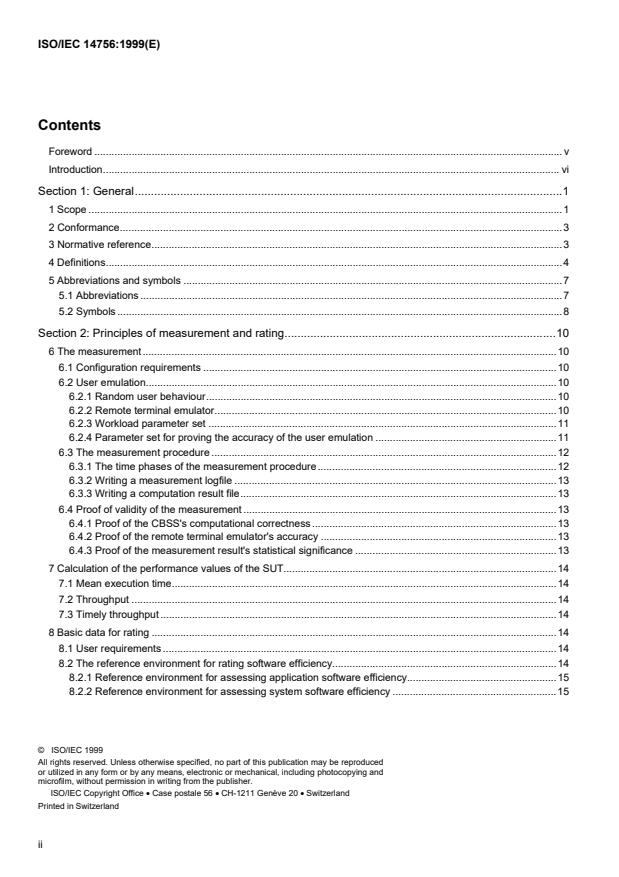
Contents
Foreword . v
Introduction. vi
Section 1: General.1
1 Scope .1
2 Conformance.3
3 Normative reference.3
4 Definitions.4
5 Abbreviations and symbols .7
5.1 Abbreviations .7
5.2 Symbols .8
Section 2: Principles of measurement and rating.10
6 The measurement.10
6.1 Configuration requirements .10
6.2 User emulation.10
6.2.1 Random user behaviour.10
6.2.2 Remote terminal emulator.10
6.2.3 Workload parameter set .11
6.2.4 Parameter set for proving the accuracy of the user emulation .11
6.3 The measurement procedure .12
6.3.1 The time phases of the measurement procedure.12
6.3.2 Writing a measurement logfile .13
6.3.3 Writing a computation result file.13
6.4 Proof of validity of the measurement .13
6.4.1 Proof of the CBSS's computational correctness .13
6.4.2 Proof of the remote terminal emulator's accuracy .13
6.4.3 Proof of the measurement result's statistical significance .13
7 Calculation of the performance values of the SUT.14
7.1 Mean execution time.14
7.2 Throughput .14
7.3 Timely throughput .14
8 Basic data for rating .14
8.1 User requirements .14
8.2 The reference environment for rating software efficiency.14
8.2.1 Reference environment for assessing application software efficiency.15
8.2.2 Reference environment for assessing system software efficiency .15
© ISO/IEC 1999
All rights reserved. Unless otherwise specified, no part of this publication may be reproduced
or utilized in any form or by any means, electronic or mechanical, including photocopying and
microfilm, without permission in writing from the publisher.
ISO/IEC Copyright Office • Case postale 56 • CH-1211 Genève 20 • Switzerland
Printed in Switzerland
ii
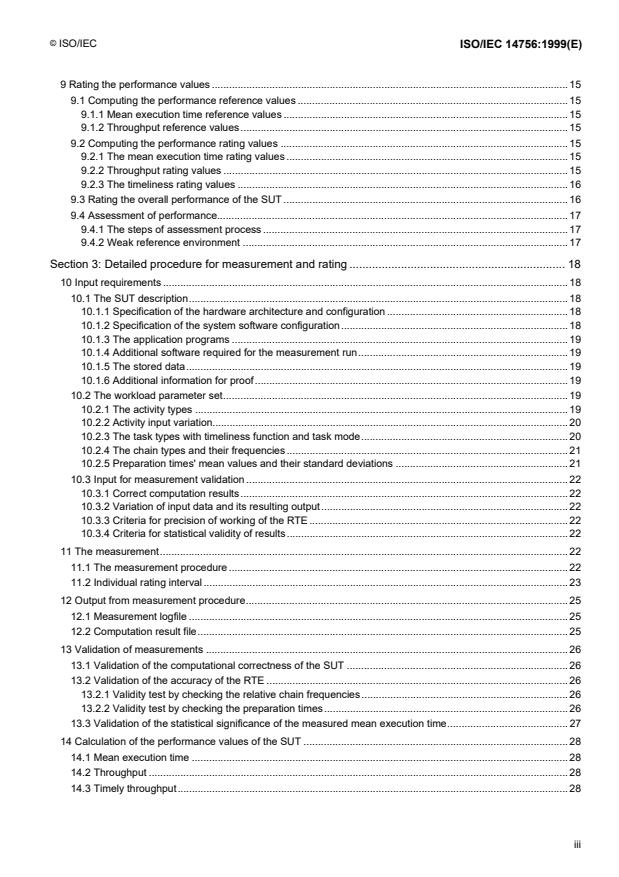
©
ISO/IEC
9 Rating the performance values . 15
9.1 Computing the performance reference values . 15
9.1.1 Mean execution time reference values . 15
9.1.2 Throughput reference values. 15
9.2 Computing the performance rating values . 15
9.2.1 The mean execution time rating values . 15
9.2.2 Throughput rating values . 15
9.2.3 The timeliness rating values . 16
9.3 Rating the overall performance of the SUT . 16
9.4 Assessment of performance. 17
9.4.1 The steps of assessment process . 17
9.4.2 Weak reference environment . 17
Section 3: Detailed procedure for measurement and rating . 18
10 Input requirements . 18
10.1 The SUT description. 18
10.1.1 Specification of the hardware architecture and configuration . 18
10.1.2 Specification of the system software configuration. 18
10.1.3 The application programs . 19
10.1.4 Additional software required for the measurement run. 19
10.1.5 The stored data. 19
10.1.6 Additional information for proof. 19
10.2 The workload parameter set. 19
10.2.1 The activity types . 19
10.2.2 Activity input variation. 20
10.2.3 The task types with timeliness function and task mode. 20
10.2.4 The chain types and their frequencies . 21
10.2.5 Preparation times' mean values and their standard deviations . 21
10.3 Input for measurement validation . 22
10.3.1 Correct computation results. 22
10.3.2 Variation of input data and its resulting output. 22
10.3.3 Criteria for precision of working of the RTE . 22
10.3.4 Criteria for statistical validity of results. 22
11 The measurement. 22
11.1 The measurement procedure. 22
11.2 Individual rating interval . 23
12 Output from measurement procedure. 25
12.1 Measurement logfile . 25
12.2 Computation result file. 25
13 Validation of measurements . 26
13.1 Validation of the computational correctness of the SUT . 26
13.2 Validation of the accuracy of the RTE . 26
13.2.1 Validity test by checking the relative chain frequencies. 26
13.2.2 Validity test by checking the preparation times. 26
13.3 Validation of the statistical significance of the measured mean execution time. 27
14 Calculation of the performance values of the SUT . 28
14.1 Mean execution time . 28
14.2 Throughput . 28
14.3 Timely throughput. 28
iii
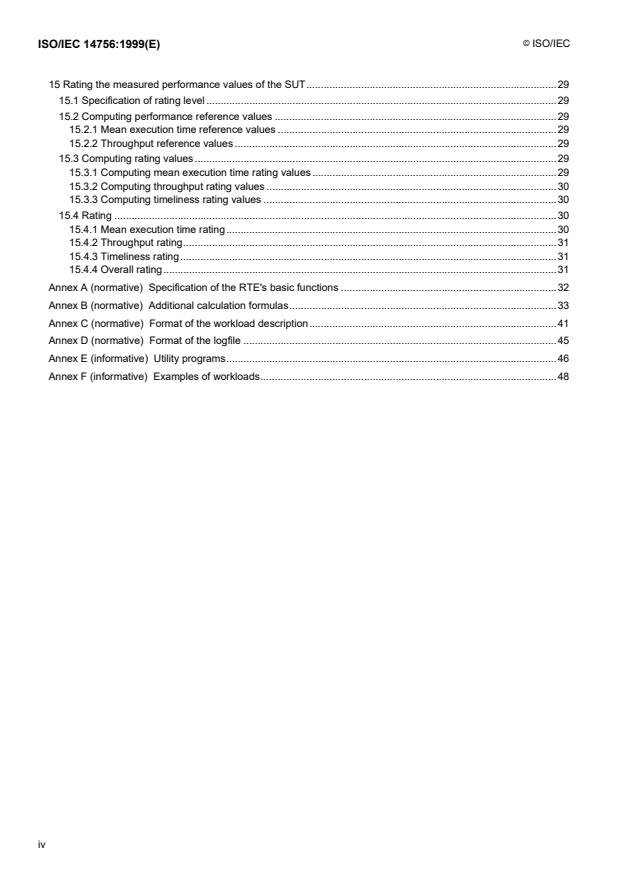
©
ISO/IEC
15 Rating the measured performance values of the SUT.29
15.1 Specification of rating level .29
15.2 Computing performance reference values .29
15.2.1 Mean execution time reference values .29
15.2.2 Throughput reference values .29
15.3 Computing rating values.29
15.3.1 Computing mean execution time rating values.29
15.3.2 Computing throughput rating values .30
15.3.3 Computing timeliness rating values .30
15.4 Rating .30
15.4.1 Mean execution time rating.30
15.4.2 Throughput rating.31
15.4.3 Timeliness rating.31
15.4.4 Overall rating.31
Annex A (normative) Specification of the RTE's basic functions .32
Annex B (normative) Additional calculation formulas.33
Annex C (normative) Format of the workload description.41
Annex D (normative) Format of the logfile .45
Annex E (informative) Utility programs.46
Annex F (informative) Examples of workloads.48
iv
©
ISO/IEC
Foreword
ISO (the International Organization for Standardization) and IEC (the International Electrotechnical Commission)
form the specialized system for worldwide standardization. National bodies that are members of ISO or IEC
participate in the development of International Standards through technical committees established by the
respective organization to deal with particular fields of technical activity. ISO and IEC technical committees
collaborate in fields of mutual interest. Other international organizations, governmental and non-governmental, in
liaison with ISO and IEC, also take part in the work.
In the field of information technology, ISO and IEC have established a joint technical committee, ISO/IEC JTC 1.
Draft International Standards adopted by the joint technical committee are circulated to national bodies for voting.
Publication as an International Standard requires approval by at least 75 % of the national bodies casting a vote.
Information
International Standard ISO/IEC 14756 was prepared by Joint Technical Committee ISO/IEC JTC 1,
technology, Subcommittee SC 7, Software engineering.
Annexes A to D form an integral part of this International Standard. Annexes E and F are for information only.
v
©
ISO/IEC
Introduction
In both the planning and using of data processing systems, the speed of execution is a significant property. This
property is influenced greatly by the efficiency of the software used in the system. Measuring the speed of the
system as well as the influence of the efficiency of the software is of elementary interest.
In order to measure the influence of software on the time behaviour of a data processing system it is necessary to
measure the time behaviour of the whole system. Based on the metrics of the measurement procedure proposed in
this standard it is possible to define and to compute the values of the time efficiency of the software.
It is important that time behaviour characteristics are estimated in a reproducible way. Therefore it is not possible to
use human users in the experiment. One reason is that human users cannot reproduce longer phases of computer
usage several times without deviations in characteristics of usage. Another reason is that it would be too expensive
to carry out such experiments with human users if the job or task stream comes from many users. Therefore an
emulator is used which emulates all users by use of a second data processing system.
This means that measurement and rating of performance according to this International Standard needs a tool. This
tool is the emulator which shall work according to the specifications of this standard. It has to be proven that the
emulator used actually fulfils these specifications.
All relevant details of this experiment are recorded in a logfile by the user emulator. From this logfile the values
which describe the time behaviour (for instance response times and throughput values) can be computed. From
these performance values the software efficiency rating values will be computed.
Not all of these values are always necessary to carry out a measurement and rating procedure. For instance if a
simple workload having only a few interactive task types or only a simple sequence of batch jobs is used, then only
a small subset of all terms and values which are defined is required. This method also allows the measuring and
rating of a large and complex computer-based software system (CBSS) processing a complex job or task stream
which is generated by a large set of many different users. As far as it is necessary the definitions include
mathematical terms. This is in order to obtain an exact mathematical basis for the computations of performance
and rating values and for checking the correctness of the measurement run and rating steps as well as for the
(statistical) significance of the performance values and rating results.
The result of a measurement consists of the calculated performance values. These are throughput values and
execution time values. The final result of performance assessment of a CBSS consists of the rating values. They
are gained by comparing the calculated performance values with the user’s requirements. In addition it is possible
- if desired - to rate the performance values of the CBSS under test by comparing them with those of a reference
CBSS (for instance having the same hardware configuration but another version of the application program with the
same functionality).
The result of the rating procedure is a set of values, each being greater than, less than or equal to 1. The rating
values have the meaning of "better than", "worse than" or "equal to" the defined requirements (or the properties of a
second system under test used as a reference). The final set of rating values assesses each task type which are
defined separately in the workload.
Annexes E and F contain software as well as special data that are not printable. Therefore they are delivered on the
CD-ROM which constitutes this International Standard. A short overview is provided in both annexes.
vi
©
INTERNATIONAL STANDARD ISO/IEC ISO/IEC 14756:1999(E)
Information technology - Measurement and rating of performance
of computer-based software systems
Section 1: General
1 Scope
This International Standard defines how user oriented performance of computer-based software systems (CBSS)
may be measured and rated. A CBSS is a data processing system as it is seen by its users, e.g. by users at various
terminals, or as it is seen by operational users and business users at the data processing center.
A CBSS includes hardware and all its software (system software and application software) which is needed to
realize the data processing functions required by the users or what may influence to the CBSS’s time behaviour.
This International Standard is applicable for tests of all time constrained systems or system parts. Also a network
may be part of a system or may be the main subject of a test. The method defined in this International Standard is
not limited to special cases like classic batch or terminal-host systems, e.g. also included are client server systems
or, with a broader comprehension of the definition of ‘task’, real time systems. But the practicability of tests may be
limited by the expenditure required to test large environments.
This International Standard specifies the key figures of user oriented performance terms and specifies a method of
measuring and rating these performance values. The specified performance values are those which describe the
execution speed of user orders (tasks), namely the triple of:
-
execution time,
- throughput,
- timeliness.
The user orders, subsequently called tasks, may be of simple or complex internal structure. A task may be a job,
transaction, process or a more complex structure, but with a defined start and end depending on the needs of the
evaluator. When evaluating the performance it is possible to use this International Standard for measuring the time
behaviour with reference to business transaction completion times in addition to other individual response times.
The rating is done with respect to users requirements or by comparing two or more measured systems (types or
versions).
Intentionally no proposals for measuring internal values, such as:
-
utilisation values,
- mean instruction rates,
- path lengths,
-
cache hit rates,
-
queuing times,
- service times,
©
ISO/IEC
are given, because the definition of internal values depends on the architecture of the hardware and the software of
the system under test. Contrary to this the user oriented performance values which are defined in this International
Standard are independent of architecture. The definition of internal performance values can be done independently
from the definition of user oriented performance values. They may be used and can be measured in addition to the
user oriented performance values. Also the definition of terms for the efficiency with which the user oriented values
are produced can be done freely. In addition this International Standard gives guidance on how to establish at a
data processing system a stable and reproducible state of operation. This reproducible state may be used to
measure other performance values such as the above mentioned internal values.
This International Standard focuses on:
- application software;
- system software;
- turn-key systems (i.e. systems consisting of an application software, the system software and the
hardware for which it was designed);
-
general data processing systems.
This International Standard specifies the requirements for an emulation (by a technical system - the so-called
remote terminal emulator (RTE) - of user interactions with a data processing system. It is the guideline for precisely
measuring and rating the user oriented performance values. It provides the guideline for estimating these values
with the required accuracy and repeatability of CBSSs with deterministic as well as random behaviour of users. It is
also a guidance for implementing a RTE or proving whether it works according to this International Standard.
This International Standard provides the guideline to measure and rate the performance of CBSS with random user
behaviour when the accuracy and repeatability is required. It specifies in detail how to prepare and carry out the
measurement procedure. Along with a description of the analysis of the measured values, the formulas for
computing the performance value and the rating value, are provided.
This International Standard also gives guidance on:
- how to design a user oriented benchmark test using a:
*
transaction oriented workload,
*
batch oriented workload,
* or transaction and batch mixed workload.
It specifies:
- how to describe such a workload,
-
how to perform the measurement procedure,
-
how to rate the measured results.
This International Standard is of interest to:
- evaluators,
- developers,
-
buyers (including users of a data processing system),
-
system integrators
of CBSSs.
NOTE 1 The field of application of this International Standard may be extended to include the following aspects.
Workloads fulfilling the specifications of this standard and having a sufficiently general structure may be used as standard
workloads. They may be used to measure and rate performance of data processing systems used in specific fields. E.g. a
standard workload for word-processing may be used to compare the time efficiency of different software products or
different versions of the same product running on the same hardware system. Such a standard workload may also be
used if always applying the same application software version and the same hardware to compare the efficiency of the
system software. When applying the same application software and workload to different systems, consisting of hardware
and system software, as normally sold by system vendors, the efficiency of the data processing systems may be
compared with respect to the application and workload used.
©
ISO/IEC
2 Conformance
Rating a software system without comparing to another can be done following the rules of this International
Standard by rating against user requirements. In case of comparing performance values developed through the use
of this International Standard, the comparisons depends upon equivalent functions in the compared systems. The
values are most useful when comparing different releases or platform versions of the same software system, or
comparing software systems which are known to have equivalent functions, or comparing hardware by using
software with equivalent functions. The values are not useful for comparing software systems which do not have
known equivalency.
To conform to this International Standard the requirements in
-
subclauses 6.1 and 10.1 for descriptions of the configuration including the system under test,
- subclauses 6.2 and 10.2 and annexes A and C for user emulation,
- subclauses 6.3, 11, 12 and annex D for measurement procedures,
- clauses 7, 14 and annex B for calculating performance values,
-
clauses 8, 9 and 15 for rating procedures
shall be fulfilled.
For results of a measurement in addition all requirements in this International Standard shall be fulfilled and the
tests in 6.4 and - in more detail - in clause 13 shall be carried out successfully without any ensuing failures. It is the
responsibility of the tester to submit proof of the results of the measurements done in accordance with this
International Standard. Therefore the tester should supply additional documents of their own choice in addition to
the documents requested in this International Standard, which are suitable to repeat the measurement by a third
party to attain the same results.
3 Normative reference
The following normative document contains provisions which, through reference in this text, constitute provisions of
this International Standard. For dated references, subsequent amendments to, or revisions of, any of these
publications do not apply. However, parties to agreements based on this International Standard are encouraged to
investigate the possibility of applying the most recent edition of the normative document indicated below. For
undated references, the latest edition of the normative document referred to applies. Members of ISO and IEC
maintain registers of currently valid International Standards.
ISO/IEC 14598-1:1999, Information technology — Software product evaluation — Part 1: General overview.
©
ISO/IEC
4 Definitions
For the purposes of this International Standard, the following definitions apply.
4.1 activity: An order submitted to the system under test (SUT) by a user or an emulated user demanding
the execution of a data processing operation according to a defined algorithm to produce specific output data from
specific input data and (if requested) stored data.
4.2 activity type: A classification of activities defined by the execution of the same algorithm.
4.3 chain: One or more tasks submitted to the SUT in a defined sequence.
4.4 chain type: A classification of chains which is defined by the sequence of tasks types.
NOTES
2 The emulated users submit only chains of specified chain types to the SUT.
3 The mathematical symbol for the current number of the chain type is l. The mathematical symbol for the total number
of chain types is u.
4.5 computer-based software system (CBSS): A software system running on a computer.
NOTE 4 A CBSS may be a data processing system as seen by human users at their terminals or at equivalent
machine-user-interfaces. It includes hardware and all software (system software and application software) which is
necessary for realizing data processing functions required by its users.
4.6 emulated user: The imitation of a user, with regard to the tasks he submits and his time behaviour,
realized by a technical system.
4.7 execution time: The time which elapses between task submission and completion.
NOTES
5 In case of a task is representing a batch job the execution time is the elapsed time for the completion of the job. In
case of an interactive task the execution time is the response time (submit until complete response) of the task.
6 The reader should notify that the definition (and therefore the measurement and rating) of the begin and end of the
execution time does not depend on the task mode. In case of "NO WAIT“ task mode for the following task it is possible
and solved by the method described in this Intentional Standard, that the execution time of the following task may overlap
one or more preparation and execution times of subsequent tasks of the same emulated user.
4.8 mean execution time: The mean value of all execution times of tasks of the j-th task type which were
submitted within the rating interval.
NOTE 7 The mathematical symbol is T (j) corresponding to the j-th task type.
ME
4.9 mean execution time rating value: The quotient (corresponding to the j-th task type) of the mean
execution time reference value and the measured mean execution time.
R (j)
NOTE 8 The mathematical symbol is corresponding to the j-th task type.
ME
4.10 mean execution time reference value: The mean execution time maximally accepted by the emulated
user. It shall be computed from the workload parameter set (see 9.1.1, 15.2.1 and clause B.1).
NOTES
9 The mathematical symbol is T (j) corresponding to the j-th task type.
Ref
4.11 observation period: The time interval, where the measurement procedure is observed for collecting
(logging) measurement results for rating or validation, consisting of the rating interval and the supplementary run.
©
ISO/IEC
4.12 preparation time: The time which elapses before the task submission. The event of starting the
preparation time depends on the definition of the task mode of the following task. The preparation time value is the
random chosen representation of an distributed variable with a defined mean and a standard deviation. They
depend on the task type of the following task and the type of the emulated user generating the task.
NOTES
10 The preparation time starts with the preceding task completion of the same emulated user if task mode of the
following task equals 1, it starts with the preceding task submission if task mode equals 0, (see definition of task mode),
regardless whether the preceding task belongs to the same chain or to the preceding chain.
11 The mathematical symbol of the mean preparation time is h(i,j) with its standard deviation s(i,j) corresponding to the
i-th user type the j-th task type.
4.13 rating interval: The time interval of the measurement procedure from the time the SUT reaches a
stable state of operation to the time the measurement results are fulfilling the required statistical significance.
T .
NOTE 12 The mathematical symbol of the duration is
R
4.14 relative chain frequency: The relative frequency of using the l-th chain type by an emulated user of
the i-th type.
NOTE 13 The mathematical symbol is q(i,l) corresponding to the i-th user type and the l-th chain type.
4.15 remote terminal emulator (RTE): A data processing system realizing a set of emulated users.
4.16 stabilization phase: The time interval of the measurement procedure when the RTE starts submitting
tasks until the SUT reaches a stable state of operation.
4.17 supplementary run: The time interval of the measurement procedure from the time the measurement
results fulfil the required statistical significance to the time when all tasks, which were submitted during the rating
interval, are completed.
4.18 system under test (SUT): The parts of the CBSS to be tested. All components which may influence
the SUT’s time behaviour shall be part of the SUT and if the influence depends on some workload, this workload
shall be represented by the RTE too. Except if an influence to the time behaviour is impossible or not evident the
emulation of the parts beside may be omitted.
NOTE 14 The SUT may consist of hardware, system software, data communication features or application software or
a combination of them. Testing a part of a system, means that all parts of the system, which may influence the time
behaviour of the part to be tested, are an integral part of the SUT, e.g. testing the time behaviour of one host application
beside others on the same host, the workload of all applications have to be defined and emulated by the RTE with a
representative workload parameter set.
4.19 task: The combination of:
- a specific activity;
- a demanded execution time, defined by a specific timeliness function;
- a specific task mode.
4.20 task completion: Timely event when for a specific task the total output string or, in case of a set of
output strings, all parts are completely received by to the emulated user or another instance. If the task does not
submit an output to the user (i.e.: during the measurement: to the RTE) a functionality, producing an „artificial
output“, indicating the task completion, may be added to the task for usage during the measurement.
NOTES
15 The time of task completion defines the end time of the preceding preparation time and the begin time of the
execution time of the following task.
16 The correctness of the received output is validated by checking the computational result of the task (see 6.4.3, and
in more detail 10.3.1 and 13.1).
©
ISO/IEC
4.21 task mode: Indication of whether the user's preparation time begins immediately with the task
submission of the preceding task (value = 0, i.e. "NO WAIT") or begins when the preceding task has been
completed (task completion) (value = 1, i.e. "WAIT").
NOTES
17 This is not standard usage mode of “Dialog” or “Batch” in UNIX based systems.
18 The mathematical symbol of the task mode is M(j) corresponding to the j-th task type.
4.22 task submission: Timely event when the input string is completely submitted from the emulated user
to the SUT and the execution of the task may start, regardless if the SUT starts the execution immediately or not.
The task submission is also indicated by the time when the action of the emulated user for this tasks ends.
Following this International Standard, the task submission shall not be defined (and measured) by the event, when
the SUT has received or interpreted the input string or when a receipt string, which may be send by the SUT after
receiving and interpreting the input string, is received by the emulated user.
NOTE 19 Normally the task submission is defined internally by the submission of a special character (e.g. Carriage
Return) or a character sequence at the end of the input string or at the end of several parts of the input string. Also it often
happens that the task submission event is defined by the submission of the last character of an specified number
characters in a string. For a classic batch task the task submission may be defined by the submission of the last character
of the last string of the batch command sequence.
4.23 task type: A classification of tasks which is defined by the combination of:
- the activity type, or
a set of activity types which are all belonging to an identical timeliness function and task mode;
-
the timeliness function;
-
the task mode.
NOTES
20 Emulated users submit only these types of tasks to the SUT.
j m
21 The mathematical symbol for the current number of the task type is . The total number of task types is .
4.24 throughput: The rate (i.e. the average number per time unit with respect to the rating interval) of all
tasks of a task type submitted to the SUT.
NOTES
22 The mathematical symbol is B(j) corresponding to the j-th task type.
23 Usually throughput is defined by the rate of terminated tasks during a period of time. In order to specify a
supplementary run and not a “heads run” in this standard, throughput is defined in this standard by the rate of tasks
submitted. Nevertheless the correct task completion is validated by checking the computational result of the task.
4.25 throughput rating value: The quotient (corresponding to the j-th task type) of the (actual) throughput
and the throughput reference value.
R (j)
NOTE 24 The mathematical symbol is corresponding to the j-th task type.
TH
4.26 throughput reference value: The minimum throughput required by the set of emulated users.
NOTE 25 The mathematical symbol is B (j) corresponding to the j-th task type.
Ref
4.27 time class: A time limit, combined with a relative frequency corresponding to the ratio of the number of
tasks (of a specific task type) - with an execution time less than or equal to the corresponding time limit - to the total
amount of tasks (of that particular task type), used for comparison with the execution time of a task (of that
particular task type).
NOTE 26 The mathematical symbol for the total number of time classes of the j-th task type is z(j) ; the time limit
is g (j,c) where j is the current number of the task type and c is the current number of the time class, running
T
from 1 to z(j); the relative frequency is r (j,c) corresponding to the time limit g (j,c).
T T
©
ISO/IEC
4.28 timeliness rating value: The quotient (corresponding to the j-th task type) of the timely throughput and
the total throughput.
NOTE 27 The mathematical symbol is R (j) corresponding to the j-th task type.
TI
4.29 timeliness function: A description of the user requirements with respect to the execution times of
tasks of a specific task type. It consists of one or more time classes. The relative frequency of the time class with
the highest time limit shall be 1.0 (i.e. = 100%).
NOTES
z(j)
28 The timeliness function corresponding to the j-th task type consists of time classes, each time class consisting
g (j,c) r (j,c)
of the pairs of numbers and .
T T
z(j) = 2
29 An example of a timeliness function with 2 classes ( ) is:
The completion of on-line transactions of a specific type have to be done within:
- 1,5 seconds by at least 90% of the transactions;
- 4,0 seconds by 100% of the transactions.
Up to 10% of the response times may have more than 1,5 seconds but not more than 4,0 seconds; response times
greater than 4.0 seconds are not accepted. Assuming the timeliness function is defined for a task type with the number
j = 4
this would result in the following tabled timeliness function:
task type time class limit relative class frequency
time class
j = 4 c = 1 g (4,1) = 1,5 sec r (4,1) = 0,9
T T
j = 4 c = 2 g (4,2) = 4,0 sec r (4,2) = 1,0
T T
4.30 timely throughput: Throughput of all of those tasks whose execution times are accepted with respect
to the timeliness function.
NOTE 30 The mathematical symbol is E(j) corresponding to the j-th task type.
4.31 user: A person (or instance) who uses the functions of a CBSS via a terminal (or an equivalent
machine-user-interface) by submitting tasks and receiving the computed results.
4.32 user type: A classification of emulated users which is defined by the combination of:
- the relative frequencies of the use of chain types;
-
the preparation times (mean values and their standard deviations).
5 Abbreviations and symbols
5.1 Abbreviations
For the purposes of this International Standard, the following abbreviations apply.
CBSS computer-based software system
LAN local area network
RTE remote terminal emulator
SUT system under test
WAN wide area network
©
ISO/IEC
5.2 Symbols
For the purposes of this International Standard, the following symbols apply.
ALPHA Confidence coefficient of mean execution time
B(j) Throughput corresponding to the j-th task type
B (j)
Reference value of throughput corresponding to the j-th task type
Ref
c
Current number of a time class in a timeliness function
d(j) Half width of the confidence interval of mean execution time corresponding to the
j-th task type
DELTA Required RTE precision indicator of mean preparation time. It is the maximally accepted
h
relative difference of the actual mean preparation time to h(i,j)
DELTA Required RTE precision indicator of chain frequency. It is the maximally accepted relative
q
q(i,l)
difference of the actual chain frequency to
DELTA
Required RTE precision indicator of the standard deviations of the preparation times. It is the
s
maximally accepted relative difference of the actual standard deviations of the preparation
time to s(i,j)
DIFF RTE precision indicator of mean preparation time. It is the relative difference of the actual
h
mean preparation time to h(i,j) that has occurred during the observation period
DIFF RTE precision indicator of chain frequency. It is the relative difference of the actual chain
...