


ISO/TR 22957:2009
(Main)Document management — Analysis, selection and implementation of electronic document management systems (EDMS)
Document management — Analysis, selection and implementation of electronic document management systems (EDMS)
ISO/TR 22957:2009 presents a recommended set of procedures and activities that are advisable when performing analysis, selection and implementation of project phases associated with electronic document management systems technologies. ISO/TR 22957:2009 provides user-level information outlining specific recommended activities to be completed throughout the various project phases typically performed when implementing these technologies. It outlines the steps and activities, together with compliance with relevant industry standards and guidelines that need to be examined and “certified” to ensure relevant technologies have been analysed, designed, implemented and managed, ensuring document/record validity when used in a business or government environment. ISO/TR 22957:2009 provides both user- and technical-level information and guidance detailing specific recommended activities and project tasks/phases recognized throughout the EDMS industry as being the EDMS industry best practice related to analysing business processes, evaluating appropriate/relevant technologies and ensuring complete technology implementation where required by the organization.
Gestion de documents — Analyse, choix et mise en oeuvre de systèmes de gestion de documents électroniques (EDMS)
General Information
- Status
- Withdrawn
- Publication Date
- 02-Dec-2009
- Withdrawal Date
- 02-Dec-2009
- Technical Committee
- ISO/TC 171/SC 2 - Document file formats, EDMS systems and authenticity of information
- Drafting Committee
- ISO/TC 171/SC 2/WG 11 - EDMS Guidelines
- Current Stage
- 9599 - Withdrawal of International Standard
- Start Date
- 07-Dec-2018
- Completion Date
- 12-Feb-2026
Relations
- Effective Date
- 18-Jun-2016
Frequently Asked Questions
ISO/TR 22957:2009 is a technical report published by the International Organization for Standardization (ISO). Its full title is "Document management — Analysis, selection and implementation of electronic document management systems (EDMS)". This standard covers: ISO/TR 22957:2009 presents a recommended set of procedures and activities that are advisable when performing analysis, selection and implementation of project phases associated with electronic document management systems technologies. ISO/TR 22957:2009 provides user-level information outlining specific recommended activities to be completed throughout the various project phases typically performed when implementing these technologies. It outlines the steps and activities, together with compliance with relevant industry standards and guidelines that need to be examined and “certified” to ensure relevant technologies have been analysed, designed, implemented and managed, ensuring document/record validity when used in a business or government environment. ISO/TR 22957:2009 provides both user- and technical-level information and guidance detailing specific recommended activities and project tasks/phases recognized throughout the EDMS industry as being the EDMS industry best practice related to analysing business processes, evaluating appropriate/relevant technologies and ensuring complete technology implementation where required by the organization.
ISO/TR 22957:2009 presents a recommended set of procedures and activities that are advisable when performing analysis, selection and implementation of project phases associated with electronic document management systems technologies. ISO/TR 22957:2009 provides user-level information outlining specific recommended activities to be completed throughout the various project phases typically performed when implementing these technologies. It outlines the steps and activities, together with compliance with relevant industry standards and guidelines that need to be examined and “certified” to ensure relevant technologies have been analysed, designed, implemented and managed, ensuring document/record validity when used in a business or government environment. ISO/TR 22957:2009 provides both user- and technical-level information and guidance detailing specific recommended activities and project tasks/phases recognized throughout the EDMS industry as being the EDMS industry best practice related to analysing business processes, evaluating appropriate/relevant technologies and ensuring complete technology implementation where required by the organization.
ISO/TR 22957:2009 is classified under the following ICS (International Classification for Standards) categories: 37.080 - Document imaging applications. The ICS classification helps identify the subject area and facilitates finding related standards.
ISO/TR 22957:2009 has the following relationships with other standards: It is inter standard links to ISO/TR 22957:2018. Understanding these relationships helps ensure you are using the most current and applicable version of the standard.
ISO/TR 22957:2009 is available in PDF format for immediate download after purchase. The document can be added to your cart and obtained through the secure checkout process. Digital delivery ensures instant access to the complete standard document.
Standards Content (Sample)
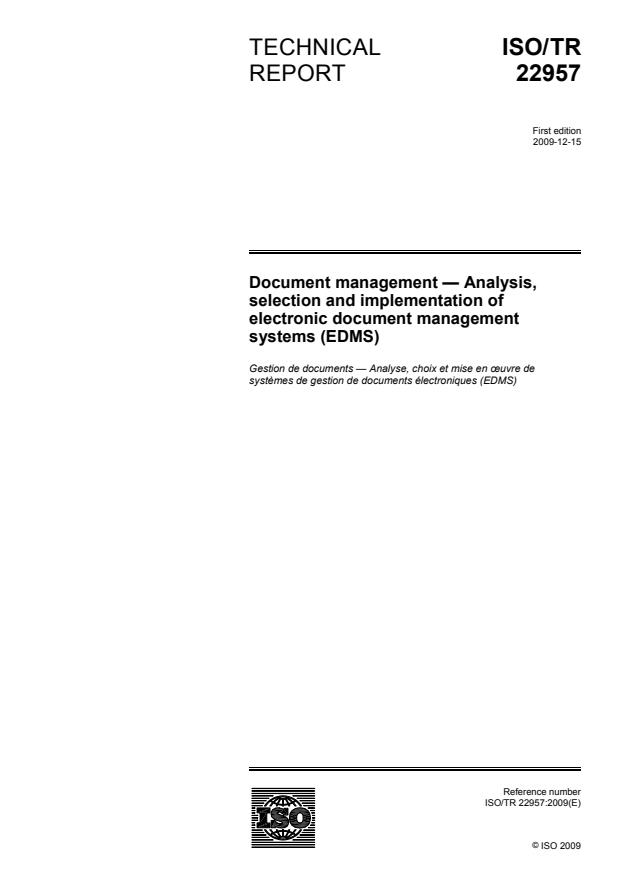
TECHNICAL ISO/TR
REPORT 22957
First edition
2009-12-15
Document management — Analysis,
selection and implementation of
electronic document management
systems (EDMS)
Gestion de documents — Analyse, choix et mise en œuvre de
systèmes de gestion de documents électroniques (EDMS)
Reference number
©
ISO 2009
PDF disclaimer
This PDF file may contain embedded typefaces. In accordance with Adobe's licensing policy, this file may be printed or viewed but
shall not be edited unless the typefaces which are embedded are licensed to and installed on the computer performing the editing. In
downloading this file, parties accept therein the responsibility of not infringing Adobe's licensing policy. The ISO Central Secretariat
accepts no liability in this area.
Adobe is a trademark of Adobe Systems Incorporated.
Details of the software products used to create this PDF file can be found in the General Info relative to the file; the PDF-creation
parameters were optimized for printing. Every care has been taken to ensure that the file is suitable for use by ISO member bodies. In
the unlikely event that a problem relating to it is found, please inform the Central Secretariat at the address given below.
© ISO 2009
All rights reserved. Unless otherwise specified, no part of this publication may be reproduced or utilized in any form or by any means,
electronic or mechanical, including photocopying and microfilm, without permission in writing from either ISO at the address below or
ISO's member body in the country of the requester.
ISO copyright office
Case postale 56 • CH-1211 Geneva 20
Tel. + 41 22 749 01 11
Fax + 41 22 749 09 47
E-mail copyright@iso.org
Web www.iso.org
Published in Switzerland
ii © ISO 2009 – All rights reserved
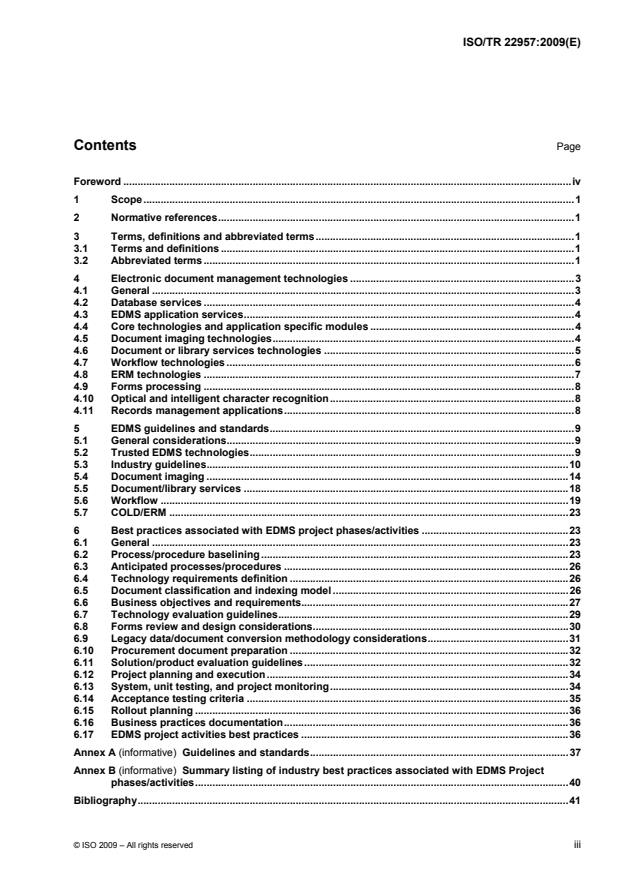
Contents Page
Foreword .iv
1 Scope.1
2 Normative references.1
3 Terms, definitions and abbreviated terms.1
3.1 Terms and definitions .1
3.2 Abbreviated terms.1
4 Electronic document management technologies .3
4.1 General .3
4.2 Database services .4
4.3 EDMS application services.4
4.4 Core technologies and application specific modules .4
4.5 Document imaging technologies.4
4.6 Document or library services technologies .5
4.7 Workflow technologies .6
4.8 ERM technologies .7
4.9 Forms processing .8
4.10 Optical and intelligent character recognition.8
4.11 Records management applications.8
5 EDMS guidelines and standards.9
5.1 General considerations.9
5.2 Trusted EDMS technologies.9
5.3 Industry guidelines.10
5.4 Document imaging .14
5.5 Document/library services .18
5.6 Workflow .19
5.7 COLD/ERM .23
6 Best practices associated with EDMS project phases/activities .23
6.1 General .23
6.2 Process/procedure baselining .23
6.3 Anticipated processes/procedures .26
6.4 Technology requirements definition .26
6.5 Document classification and indexing model .26
6.6 Business objectives and requirements.27
6.7 Technology evaluation guidelines.29
6.8 Forms review and design considerations.30
6.9 Legacy data/document conversion methodology considerations.31
6.10 Procurement document preparation .32
6.11 Solution/product evaluation guidelines.32
6.12 Project planning and execution .34
6.13 System, unit testing, and project monitoring.34
6.14 Acceptance testing criteria .35
6.15 Rollout planning .36
6.16 Business practices documentation.36
6.17 EDMS project activities best practices .36
Annex A (informative) Guidelines and standards.37
Annex B (informative) Summary listing of industry best practices associated with EDMS Project
phases/activities.40
Bibliography.41
Foreword
ISO (the International Organization for Standardization) is a worldwide federation of national standards bodies
(ISO member bodies). The work of preparing International Standards is normally carried out through ISO
technical committees. Each member body interested in a subject for which a technical committee has been
established has the right to be represented on that committee. International organizations, governmental and
non-governmental, in liaison with ISO, also take part in the work. ISO collaborates closely with the
International Electrotechnical Commission (IEC) on all matters of electrotechnical standardization.
International Standards are drafted in accordance with the rules given in the ISO/IEC Directives, Part 2.
The main task of technical committees is to prepare International Standards. Draft International Standards
adopted by the technical committees are circulated to the member bodies for voting. Publication as an
International Standard requires approval by at least 75 % of the member bodies casting a vote.
In exceptional circumstances, when a technical committee has collected data of a different kind from that
which is normally published as an International Standard (“state of the art”, for example), it may decide by a
simple majority vote of its participating members to publish a Technical Report. A Technical Report is entirely
informative in nature and does not have to be reviewed until the data it provides are considered to be no
longer valid or useful.
Attention is drawn to the possibility that some of the elements of this document may be the subject of patent
rights. ISO shall not be held responsible for identifying any or all such patent rights.
ISO/TR 22957 was prepared by Technical Committee ISO/TC 171, Document management applications,
Subcommittee SC 2, Application issues.
iv © ISO 2009 – All rights reserved
Introduction
This Technical Report provides detailed information associated with the analysis, selection and
implementation procedures associated with electronic document management systems (EDMS). The
development of this Technical Report is a result of organizational requests to receive vendor-neutral industry
information associated with technology standards, technical reports, guidelines and best practices related to
project activities.
Terms and acronyms associated with various aspects of EDMS technologies commonly change over time, as
technology developers and vendors update product lines and solutions to address customer requirements. In
most cases, the new terms and acronyms reflect updates and changes to how these technologies are used,
incorporating additional levels of functionality, and they are very rarely a result of an entirely new core
technology. This is important to note, as the core EDMS technologies are constantly maturing and solution
providers are not only identifying new approaches to addressing organizational issues and requirements, but
also expanding the use of these technologies into areas previously unconsidered.
For purposes of discussion, the terms “document management” and “content management” can be
considered to be synonymous. As the electronic content management industry (previously referred to as the
document management industry) has matured over the years, the ability to store electronic information has
greatly expanded from hard copy document scanning into digital images in the early 1980s, to the
management of any digital or electronic document that today is referred to as electronically stored information.
It is important to note that as the various technologies associated with storing and managing electronically
stored information continue to mature and change, terms and acronyms will continue to change and, at times,
be used to denote something different than previously used in the past. As such, organizations are constantly
challenged to keep pace with how an updated technology is currently being referenced, especially when the
same core technology is referenced differently between vendors, and at times various groups of suppliers.
The first section of this Technical Report provides detailed information describing each of these technologies,
and how they operate and inter-operate.
The second section of this Technical Report provides detailed information associated with currently available
industry standards and technical reports.
The third section of this Technical Report provides detailed information related to industry best practices
associated with all the customary project phases for EDMS technology analysis, selection and implementation.
These project activities are considered to be industry best practices. It has been demonstrated over the past
10 years that organizations following all the recommended steps and activities have a much greater level of
project success while greatly decreasing, and in most cases, eliminating unnecessary technologies, user
licenses, etc. This is very important, especially with most organizations carefully examining all expenditures
related to technology procurements.
This Technical Report provides detailed guidance to organizations considering the use of any of those
technologies that comprise EDMS (document imaging, document/library services, routing//workflow, records
management applications, forms management, enterprise report management, etc.). A complete records
management programme is critical to any organization and is integral to any complete and thorough
management plan associated with electronic information, regardless of whether it is internally referred to as a
“document”, “record”, “audio”, “video”, etc., by the organization.
All relevant project steps, tasks and activities contained within this Technical Report, together with compliance
with relevant industry standards and guidelines, should be examined and “certified” by the technical
implementation team as being in compliance with these industry best practices, thereby ensuring, especially
for organizations that are required by government codes and/or regulations, that industry best practices,
guidelines, and/or standards established by ANSI, AIIM, and/or ISO are followed.
The term “electronic document management” used throughout this Technical Report is intended as an “all-
encompassing” term referring to inputting technologies [scanning, indexing, optical character recognition
(OCR), forms, digital creation, etc.], management technologies (document services, workflow and other work
management tools) and storage (primarily non-alterable or write-once read-many) technologies. This
Technical Report provides information to users related to what technical reports, guidelines and standards
have been developed for technologies commonly available in document management systems.
Over the years, the industry has utilized various terms and acronyms to describe these core technologies,
including, but not limited to,
⎯ technology utilization,
⎯ eCommerce,
⎯ content management,
⎯ B2B,
⎯ P2G,
⎯ G2G,
⎯ knowledge management,
⎯ EDMS,
⎯ ECM,
⎯ ERMS,
⎯ EDRMS,
⎯ EC3M,
⎯ WCM,
⎯ BPM,
⎯ etc.
It is important for organizations to recognize that technology vendors commonly develop new terms and
acronyms to present updated product technology and new uses for existing technologies. While these
applications and/or products typically provide additional level of functionality, they are still based on at least
one of the following core EDMS technologies, including
⎯ document/library services,
⎯ document imaging,
⎯ forms management,
⎯ routing/workflow, and
⎯ ERM.
Additionally, it is important for organizations to recognize that many acronyms have different meanings,
depending on which industry and/or organization is using those terms. For example, the acronym BPM is used
to describe business process management, which is a process undertaken by the organization, is also used to
vi © ISO 2009 – All rights reserved
reference business process modelling, and is currently being used by some vendors and vendor-specific
organizations to redefine workflow. The use of this term is a good example of how vendors re-use terms
commonly utilized by the industry for other purposes. Throughout this Technical Report and specifically in the
document subclauses describing various implementation process and activities, the business reviews how
processes function and how the organization manages these business processes. From that perspective, the
entire lifecycle of any EDMS project can be referred to as business process management. This is not to
indicate that there can be only one definition for any term, but it is necessary for organizations to consider
carefully the context in which the vendors/suppliers are using these redefined terms to ensure the
desired/anticipated technology is implemented.
Another example is the use of ERM, which is used to describe electronic report management, but is also used
by records managers to describe electronic record management. This Technical Report provides information
related to those terms and acronyms recognized by the document management industry that best describe
the underlying technologies, enabling readers to have a foundation from which they can determine what is
required by the organization, regardless of the product name or acronym used by various vendors.
This Technical Report is not intended to be an all-inclusive paper on electronic document or content
management and does not attempt to influence any single technology or provide legal guidance or legal
opinions. While there are storage technologies other than optical/magnetic currently available (i.e. microfilm,
microfiche and hybrid storage systems) that are not included in this Technical Report, it is advisable to review
those technologies if they are determined to be appropriate by the end-user organization.
TECHNICAL REPORT ISO/TR 22957:2009(E)
Document management — Analysis, selection and
implementation of electronic document management systems
(EDMS)
1 Scope
This Technical Report presents a recommended set of procedures and activities that are advisable when
performing analysis, selection and implementation of project phases associated with electronic document
management systems technologies. This Technical Report provides user-level information outlining specific
recommended activities to be completed throughout the various project phases typically performed when
implementing these technologies. It outlines the steps and activities, together with compliance with relevant
industry standards and guidelines that need to be examined and “certified” to ensure relevant technologies
have been analysed, designed, implemented and managed, ensuring document/record validity when used in a
business or government environment.
This Technical Report provides both user- and technical-level information and guidance detailing specific
recommended activities and project tasks/phases recognized throughout the EDMS industry as being the
EDMS industry best practice related to analysing business processes, evaluating appropriate/relevant
technologies and ensuring complete technology implementation where required by the organization.
2 Normative references
The following referenced documents are indispensable for the application of this document. For dated
references, only the edition cited applies. For undated references, the latest edition of the referenced
document (including any amendments) applies.
ISO 12651:1999, Electronic imaging — Vocabulary
ISO 15489-1, Information and documentation — Records management — Part 1: General
ISO/TR 15489-2, Information and documentation — Records management — Part 2: Guidelines
3 Terms, definitions and abbreviated terms
3.1 Terms and definitions
For the purposes of this document, the terms and definitions given in ISO 12651, ISO 15489-1 and
ISO/TR 15489-2 apply.
3.2 Abbreviated terms
API application programming interface
ASAP asynchronous service access protocol
B2B business-to-business
BPM business process management
BPR business process re-engineering
COLD computer output to laser disk
COM computer output microfilm
COTS commercially available off the shelf
CSF critical success factors
CWAD common workflow audit data
DMA Document Management Alliance
1) 2)
ECM enterprise content management or electronic content management
EC3M enterprise content, collaboration and communications management
3)
EDMS electronic document management systems
EDRMS electronic document records management systems
ERM enterprise report management
ERMS electronic records management systems
G2G government-to-government
ICR intelligent character recognition
IDL interface design language
IT information technology
OCR optical character recognition
ODBC open database connectivity
ODMA Open Document Management API
OLE object linking and embedding
OMG object management group
OMR optical mark reader
P2G public-to-government
RFP request for proposal
RMA records management applications
SOAP simple object access protocol
WAPI workflow application programming interfaces
WCM web content management
WfMC Workflow Management Coalition
1) Enterprise content management is defined in ISO 12651-1 as a set of tools and methods that allows an organization
to obtain, organize, store and deliver information crucial to its operation. It can be broken down into five major components
consisting of capture, manage, store, preserve and deliver content.
2) Electronic content management is the same as EDMS in that it focuses on the technology aspects of the overall
environment.
3) Although there is a difference between enterprise content management, electronic content management and
electronic document management systems, in this Technical Report the acronyms EDMS and ECM are used
synonymously from the perspective that both require the use of core technologies, together with policies, procedures and
methodologies to successfully design, implement and manage electronically stored information.
2 © ISO 2009 – All rights reserved
4 Electronic document management technologies
4.1 General
Even in today's world, many organizations still function almost entirely in a “paper-driven” environment. This
environment is a direct result of the need to maintain information on all aspects of the organization and can be
seen throughout many organizations. When considering EDMS technologies, organizations should consider
implementing the necessary foundational components and then add other functionalities as required.
Electronic document management systems (EDMS) has become an all-encompassing term, referring to the
integration of various underlying technologies including
⎯ document imaging (used to convert hard copy documents into digital format),
⎯ document/library services (used to manage digitally born documents) (most EDMS systems allow users
to use this technology to also manage scanned documents, if desired),
⎯ workflow (used to route, track, and otherwise manage electronic documents and work activities),
⎯ enterprise report management (ERM) (used to store electronic formatted reports),
⎯ forms management (used to incorporate interactive forms and manage related forms data),
⎯ optical character recognition (OCR)/intelligent character recognition (ICR) technologies,
⎯ various applications (also considered add-ons) such as records management applications, legacy system
integration tools, etc.
Electronic document management systems provide users with greater access to digital information from a
common user interface, through the utilization of industry standard Internet browser technology. One of the
primary reasons users prefer this level of technology is the distributed functionality and extent of digital
information availability that can be accessed almost immediately after implementation.
The structure of EDMS technologies can be viewed as a set of building blocks as noted below in Figure 1. The
lowest level is the operating system.
Database services and storage device drivers are installed onto the server as the second layer. The selection
of the database to be used is typically at the discretion of the organization, but has become standardized
through the use of open database connectivity (ODBC) tools which have resulted in the database components
to be considered a “commodity item”, rather than a specialized tool.
Records
Document Document/ Routing/ Forms
management
imaging library services workflow processing
application(s)
Base application services
Database devices Storage device drivers
Operating system
Figure 1 — EDMS technology building blocks
The third layer includes the base ECM application components and services provided by the service provider.
This layer typically includes the solution configuration tools, application programming interfaces, and
application components that integrate the core applications components with the database services and
provide the components integrating the storage environment with the overall solution.
The fourth layer incorporates the various core technologies of EDMS. Each of these core technologies (with
the exception of the operating system layer) are further described in 4.2 to 4.11.
4.2 Database services
There has been a significant shift from developing custom technology solutions at the database level to
configuring or implementing commercially available software over the past 10 years. As the EDMS industry
and associated technologies matured, end-user organizations were able to shift from a “development” model
to a “configuration” model for the base technological components.
This is an important consideration for any organization evaluating EDMS technologies from the perspective
that almost all of today's EDMS solutions have moved away from the need to have specialized database
administrators towards actually discouraging organizations from changing and/or modifying the EDMS
database table structures and configuration, which in many cases now result in the solution provider
withdrawing solution support. While years ago it was important for the organization to hire dedicated EDMS
database administrators, this is no longer the case. Over the past 5 years, the industry has noticed that almost
all EDMS solutions (with the exception of highly specialized solutions) have effectively standardized on the
most commonly used database platforms, enabling the solution providers to offer standardized support,
thereby significantly reducing the organizational cost associated with hiring database specialists solely or
primarily dedicated to managing the EDMS solutions.
4.3 EDMS application services
The next layer in the “building block” is considered to be the EDMS server application. Early in the
development and maturity cycle of EDMS technologies, end-user organizations were required to provide
database administration and resources. During the late 1980s and early 1990s, the EDMS technologies had
not matured to the level approaching the commercially available off the shelf (COTS). While the EDMS
technologies were maturing, end-user organizations were required to maintain the database together with the
application.
Current versions of enterprise EDMS solutions have shifted the database administrative functions back to the
vendor with the end-user organization responsible for daily application maintenance and periodic server
maintenance. Most enterprise EDMS solution providers provide their products with technical support including
system installation, initial configuration, application updates/patches, etc. This major shift from requiring
significant technical resources at the end-user level to vendor-supported solutions has resulted in an
extensive amount of vertical market penetration. This has been achieved through the use of the standard
technology components configured to address specific environments and business needs.
4.4 Core technologies and application-specific modules
There are various core technologies and application-specific modules that provide specific functionality
including some or all of the following core technologies: document imaging, document/library services,
workflow, forms processing, etc. All enterprise EDMS solutions have at least one of these core technologies
and in most cases include multiple components. Furthermore, many solutions have integrated both the
document imaging and document or library services components into a single application, while other
solutions simply integrate these components together as required by the organization.
4.5 Document imaging technologies
Document imaging technologies enable users to scan hard-copy documents into the system and store them in
digital format. These technologies enable users to index or enter “metadata” into the system and always utilize
some form of storage technology to save the digital version of the document. The following are the four basic
components to document imaging systems:
⎯ input;
⎯ identification;
4 © ISO 2009 – All rights reserved
⎯ storage;
⎯ retrieval.
The input components typically consist of multiple single-sided (simplex) and/or double-sided (duplex)
document scanners (or other input devices such as facsimile). The scanning stations are used to convert hard
copy documents into a digital format for subsequent storage and management in the document imaging
system. The identification stations allow users to identify (or index) incoming documents, allowing them to be
retrieved at a later date. The storage part of the system consists of various components connected to the
document management or workflow server and is used to store, retrieve and manage digital information. The
retrieval part of the system consists of the user issuing a request for information that is then processed by the
server. These requests are processed and the information is retrieved from the appropriate storage media
connected to the server.
4.6 Document or library services technologies
Document or library services technologies enable organizations to manage digitally born documents.
Document or library services applications utilize applets, or thin-clients, to control the authoring, check-in/out,
and/or version control of documents being developed, managed or stored. This enables collaborative
development when desired, together with a mechanism to store or manage digitally born document libraries.
The basic capabilities of these technologies include allowing authorized users to
a) load or import digitally born documents directly into the system,
b) enter relevant metadata associated with the document,
c) create virtual folders linking various documents together,
d) check information in/out of the repository,
e) co-author documents also referred to as collaborative development,
f) secure access at document level,
g) maintain detailed audit trails,
h) make changes and check the modified information back into the repository,
i) manage whether original documents are updated or replaced during the update operations,
j) establish security levels for groupings of documents.
The management portion of document or library services technologies includes the ability to restrict access to
certain documents or group of documents to only authorized users. Together with security controls, these
technologies enable users to be granted different levels of access. For example, the author of a document
might only grant read access to all users outside of a specific organization while granting “check-in/out” control
to others who are working on updating the document. As the other users prepare to update the document,
they would “check” the document out of the library, update the information, and then “check” the document
back in.
Document/library services technologies ensure that any other user attempting to check the document out
would not be allowed to check it out, and they would be notified that someone already has a copy being
updated. Upon completion of the update cycle, the system automatically updates the version number of the
document and makes it available to all authorized users.
Similar to document imaging, there are four basic processes associated with document/library services
technologies (it should be noted that these terms may vary depending on various perspectives records
management versus content management versus archival management, but the underlying functions remain
the same with slightly different terminology and/or descriptions):
⎯ import;
⎯ identification;
⎯ storage;
⎯ management/retrieval.
The import components typically consist of enabling users to import digitally born information into the system.
This digitally born information can be any format/structure and can be loaded into the system in original or
native format. Digital data does not need to be modified prior to being stored and should include all relevant
indexing or metadata associated with the information. The identification components allow users to identify (or
index) this digital information, allowing it to be retrieved at a later date, as well as providing a vehicle to store
information related to the digital data itself [such as author, purpose, subject(s)], and all types of information
required by the end-user organization to fully track all necessary metadata. The storage part of the system
consists of various components connected to the EDMS or workflow server and is used to store, retrieve and
manage digital information. The management/retrieval part of the system consists of the user issuing a
request for information that is then processed by the server. These requests are processed and the
information is retrieved from the appropriate storage media connected to the server.
4.7 Workflow technologies
Workflow technologies can provide different levels of routing, tracking and administration. These technologies
can be grouped into three categories:
⎯ administrative;
⎯ ad-hoc;
⎯ production.
Administrative workflow is typically used by organizations where the processes do not change, or change very
infrequently. Ad-hoc workflow provides the ability for a user to create a “work process map” for a specific piece
or type of work. Production workflow incorporates administrative workflow and ad-hoc workflow capabilities
and provides extensive tracking and logging capabilities. When considering production workflow technologies,
the organization should consider whether to use role-based or user-based technologies. User-based
technologies require specific users to be assigned to specific tasks, while role-based technologies enable
organizations to assign and re-assign users to groups or “roles” which are easily managed.
Workflow provides for the automation of business processes enabling users to control the process logic. This
ability to control the various business processes enables mission-critical, content-centric business applications
to operate in an environment otherwise cumbersome to implement and manage. This has resulted in most
EDMS vendors offering an integrated workflow engine or integrating the workflow engine with various
workflow products readily available throughout the industry. The primary difference between these two
approaches is whether the product consists of only those components developed by the primary product
supplier or whether the primary product supplier has integrated specialized technologies developed by other
suppliers.
In the new approach to organizational networking, workflow is becoming a tool in the automation of processes
and information posting to a website. In these environments, workflow applications are becoming tightly
integrated to legacy applications. The actual integration of workflow and other EDMS technologies has
become more prevalent as various coalitions, standards committees and EDMS vendors have completed
development of various standards.
6 © ISO 2009 – All rights reserved
The maturity of workflow technology and the associated trends are based on the separation of the processing
rules from the processing scripts or work routing. In more sophisticated workflow environments, workflow
scripts are tightly integrated to specific activities making the routing, editing, approval and submissions of
content manageable at the user level. Interaction with the various thin-clients would trigger sub-processes as
defined in the workflow script, resulting in the appropriate applet being downloaded and/or launched.
Workflow computing is the automation of work processes performed throughout an organization. A workflow
application automates the sequence of actions, activities or tasks used to run the process. This includes
tracking the status of each occurrence of the process and providing tools to manage the process. The
following are the four basic components to a workflow system.
a) Processes: An automated workflow application is made up of the different tasks or activities that are
necessary to be completed to achieve a business goal. The workflow engine manages these processes.
The workflow application works in conjunction with the engine to manage the work process.
b) Work queues: Work items are created and distributed according to preset rules and placed into work
queues. Users or groups of users are assigned to various work queues as required for processing. Work
items within these queues can also be automated.
c) Tools: There are various tools accessed by the user, including forms display, word processors, terminal
emulators, legacy applications, etc. These tools are used to access existing host applications and perform
office related activities as required to complete work.
d) Object data: “Object data” is another term for any digital content referenced and/or used by the workflow
system. The term became more prevalent after the computing technology was able to support video,
audio and other forms of information into the workflow system. These objects become the work item to be
processed during the normal course of business.
4.8 ERM technologies
Enterprise report management (ERM), which was previously known as computer output to laser disk (COLD),
is an integrated software and hardware solution that stores and indexes formatted computer output (pages) on
optical disks, magnetic disks, or magnetic tape as an alternative to paper printouts or computer output
microfilm (COM). This formatted output consists of point-in-time reports, such as transaction listings of
statements and invoices. Once this page output is stored on the ERM subsystem, it can be electronically
retrieved, viewed, printed, faxed, and distributed to workstations and host computer terminals within
organizations or throughout an enterprise.
While there are many different data types in the computing environment, the type of data with which ERM
technology is concerned is typically the result of transactions (data files and database records) being
formatted by the application into page-oriented form for printing on paper or COM. The structure and format of
this output is known. This data is time-period focused, i.e. it is a snapshot of an internal system at a given
point in time. These reports are often the basis for analysis or comparative reporting and they include the
printed record received by users such as a statement or invoice. ERM systems have been designed primarily
to handle this formatted output.
Essentially, the ERM process involves two procedures: recording (indexing and storing the data) and
retrieving (making the data available to users). Within these two simple procedures, however, lies a myriad of
complex tasks. Data should be downloaded or transferred to the ERM system server before being processed.
The method used to transfer the data from the mainframe/host system to the ERM subsystem will vary
depending on the communications capabilities currently in place. Recording consists of writing new
documents to the storage media and then making them available for retrieval. Recording speeds vary from
system to system and are most critical in high volume systems. The recording process involves
⎯ transferring the data to the storage subsystem from the host,
⎯ processing the pages from the transferred file (i.e. extracting index keys, compressing and writing to
optical storage), and
⎯ adding the index records to the associated ERM database.
The retrieval process consists of the users accessing the system and selecting the appropriate report, or part
of the report, for viewing. The selection of the information to be retrieved is based on information entered, by
the user, into the query screen part of the viewing software. After the user selects the report, or part of the
report, to be viewed, the system retrieves the information, displaying it on the user's workstation.
4.9 Forms processing
The creation and utilization of electronic forms enables organizations to collect data in a standardized format
and automatically enter or load the data into an EDMS solution. Electronic forms are typically created either
using a forms design package or through the use of standard HTML editors. Forms design packages typically
include not only the forms design components, but also enable organizations to “tag” or identify each field on
the form and relate that data to a database or application that would receive and further process the
information. These forms management tools also enable organizations to validate and/or perform edit checks
on the forms as they are being completed to simplify data entry.
The use of forms within the EDM industry has become widespread and most EDMS solutions incorporate
some level of forms design and/or management as a portion of the standard product offering. In many cases,
the use of forms design and management tools are replacing the older style of programmed forms that was
required in the 1990s. With using these tools, organizations are able to quickly develop and deploy forms
driven data entry across the Internet without significant development efforts.
4.10 Optical and intelligent character recognition
Optical character and intelligent character recognition enable organizations to quickly capture information from
hard copy documents that need to be processed after document imaging and storage. Optical character
recognition (OCR) and intelligent character recognition (ICR) can greatly reduce the time required to index
documents while enabling organizations to develop in-depth full-text searchable databases.
The valu
...
Questions, Comments and Discussion
Ask us and Technical Secretary will try to provide an answer. You can facilitate discussion about the standard in here.
Loading comments...