

ISO 11600:2002/Amd 1:2011
(Amendment)Building construction — Jointing products — Classification and requirements for sealants — Amendment 1
General Information
- Abstract
- Status
- Published
- Publication Date
- 13-Jul-2011
- Technical Committee
- ISO/TC 59/SC 8 - Sealants
- Drafting Committee
- ISO/TC 59/SC 8 - Sealants
- Current Stage
- 6060 - International Standard published
- Start Date
- 14-Jul-2011
- Due Date
- 26-Sep-2011
- Completion Date
- 26-Sep-2011
Buy Documents

ISO 11600:2002/Amd 1:2011 - Building construction — Jointing products — Classification and requirements for sealants — Amendment 1 Released:7/14/2011

ISO 11600:2002/Amd 1:2011 - Construction immobiliere — Produits pour joints — Classification et exigences pour les mastics — Amendement 1 Released:7/14/2011
Overview
ISO 11600:2002/Amd 1:2011 is an important amendment to the international standard governing jointing products used in building construction. Specifically, it focuses on the classification and performance requirements for sealants. Sealants play a critical role in ensuring the durability, weatherproofing, and structural integrity of construction joints. This amendment, published by ISO in 2011, updates the criteria for sealant classification to reflect improved materials and testing methods.
The standard is maintained by ISO Technical Committee ISO/TC 59, Subcommittee SC 8, which specializes in sealant materials and jointing techniques for buildings and civil engineering works. The amendment revises key test parameters and classification tables, ensuring sealants meet updated elastic recovery, deformation, adhesion, and volume loss requirements.
Key Topics
- Sealant Classification: The document updates the classification of construction sealants by defining seven specific classes based on performance properties such as elasticity, elongation, and modulus at different temperatures.
- Elastic Recovery Requirements: Sealants must demonstrate specific minimum percentages of elastic recovery to maintain flexibility and accommodate joint movement after strain.
- Deformation Properties: Includes strict limits on secant modulus at +23 °C and –20 °C to define sealant stiffness and flexibility under varying temperatures.
- Adhesion and Cohesion Testing: Sealants undergo adhesion/cohesion tests at constant and variable temperatures, including after immersion in water, to ensure long-term joint durability.
- Volume Loss Limits: The amendment specifies maximum allowable volume loss percentages for different sealant types to prevent shrinkage and joint failure over time.
- Sag Resistance: Sealants’ resistance to sagging when applied in vertical joints is measured to guarantee proper application performance.
Applications
ISO 11600:2002/Amd 1:2011 serves as a benchmark for manufacturers, contractors, and quality control specialists working with jointing sealants in various building projects:
- Building Envelope Integrity: Ensures sealants reliably seal expansion joints, curtain walls, and façade elements to prevent air and water penetration.
- Structural Joints: Provides guidelines for sealants in concrete, precast, and metal joints subject to large movements and temperature variations.
- Renovation and Maintenance: Supports proper selection and evaluation of sealants used in repair work, improving longevity and performance.
- Compliance and Procurement: Architects and engineers specify ISO 11600 sealant classes in tenders to guarantee products meet recognized international standards.
- Testing Laboratories: Provides testing protocols and performance benchmarks for certifying sealant products according to ISO requirements.
Related Standards
- ISO 8330 Series: Addresses terminology and definitions related to sealants and jointing products.
- ISO 9046 and ISO 9047: Cover adhesion/cohesion test methods under variable and constant temperature conditions.
- ISO 10590 and ISO 10591: Specify sealant testing after immersion in water, verifying adhesive durability.
- ISO 7390: Describes sag resistance tests essential for evaluating vertical application properties of sealants.
By adhering to ISO 11600:2002/Amd 1:2011, stakeholders in building construction ensure that sealants perform reliably under the stresses of joint movement, environmental exposure, and aging-contributing to safer, more durable, and energy-efficient buildings worldwide. This amendment enhances the standard’s relevance by integrating modern performance criteria and testing procedures for today’s advanced sealant technologies.
Relations
- Effective Date
- 12-Feb-2026
- Effective Date
- 06-Jun-2022
- Effective Date
- 06-Jun-2022
- Effective Date
- 15-Apr-2008
Buy Documents
ISO 11600:2002/Amd 1:2011 - Building construction — Jointing products — Classification and requirements for sealants — Amendment 1 Released:7/14/2011
ISO 11600:2002/Amd 1:2011 - Construction immobiliere — Produits pour joints — Classification et exigences pour les mastics — Amendement 1 Released:7/14/2011
Get Certified
Connect with accredited certification bodies for this standard

DIBt (Deutsches Institut für Bautechnik)
German Institute for Building Technology.
DIN CERTCO
DIN Group product certification.

Aboma Certification B.V.
Specialized in construction, metal, and transport sectors.
Sponsored listings
Frequently Asked Questions
ISO 11600:2002/Amd 1:2011 is a standard published by the International Organization for Standardization (ISO). Its full title is "Building construction — Jointing products — Classification and requirements for sealants — Amendment 1". This standard covers: Building construction — Jointing products — Classification and requirements for sealants — Amendment 1
Building construction — Jointing products — Classification and requirements for sealants — Amendment 1
ISO 11600:2002/Amd 1:2011 is classified under the following ICS (International Classification for Standards) categories: 91.100.50 - Binders. Sealing materials. The ICS classification helps identify the subject area and facilitates finding related standards.
ISO 11600:2002/Amd 1:2011 has the following relationships with other standards: It is inter standard links to EN ISO 11600:2003/A1:2011, ISO 16061:2000, ISO 11600:2002; is excused to ISO 11600:2002. Understanding these relationships helps ensure you are using the most current and applicable version of the standard.
ISO 11600:2002/Amd 1:2011 is available in PDF format for immediate download after purchase. The document can be added to your cart and obtained through the secure checkout process. Digital delivery ensures instant access to the complete standard document.
Standards Content (Sample)
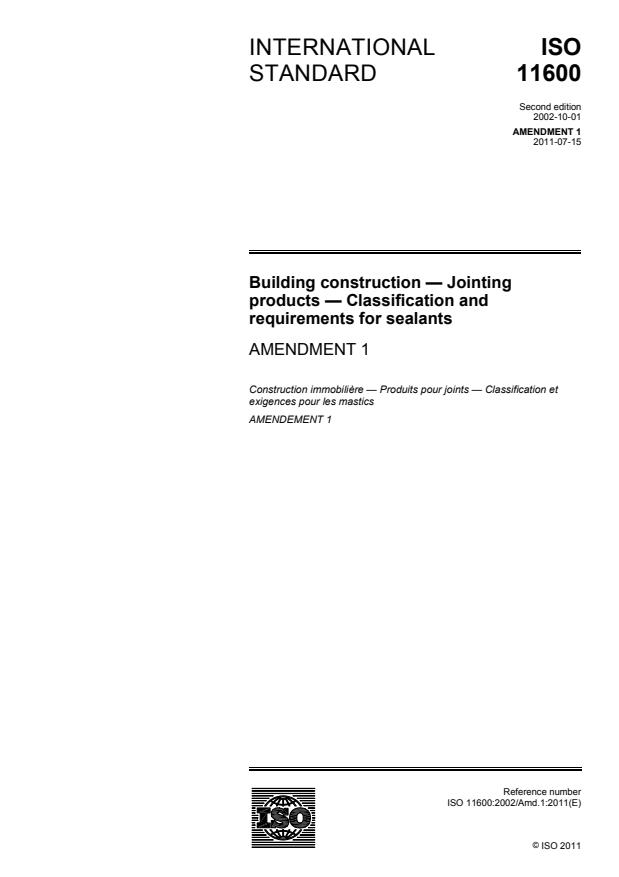
INTERNATIONAL ISO
STANDARD 11600
Second edition
2002-10-01
AMENDMENT 1
2011-07-15
Building construction — Jointing
products — Classification and
requirements for sealants
AMENDMENT 1
Construction immobilière — Produits pour joints — Classification et
exigences pour les mastics
AMENDEMENT 1
Reference number
ISO 11600:2002/Amd.1:2011(E)
©
ISO 2011
ISO 11600:2002/Amd.1:2011(E)
© ISO 2011
All rights reserved. Unless otherwise specified, no part of this publication may be reproduced or utilized in any form or by any means,
electronic or mechanical, including photocopying and microfilm, without permission in writing from either ISO at the address below or
ISO's member body in the country of the requester.
ISO copyright office
Case postale 56 • CH-1211 Geneva 20
Tel. + 41 22 749 01 11
Fax + 41 22 749 09 47
E-mail copyright@iso.org
Web www.iso.org
Published in Switzerland
ii © ISO 2011 – All rights reserved
ISO 11600:2002/Amd.1:2011(E)
Foreword
ISO (the International Organization for Standardization) is a worldwide federation of national standards bodies
(ISO member bodies). The work of preparing International Standards is normally carried out through ISO
technical committees. Each member body interested in a subject for which a technical committee has been
established has the right to be represented on that committee. International organizations, governmental and
non-governmental, in liaison with ISO, also take part in the work. ISO collaborates closely with the
International Electrotechnical Commission (IEC) on all matters of electrotechnical standardization.
International Standards are drafted in accordance with the rules given in the ISO/IEC Directives, Part 2.
The main task of technical committees is to prepare International Standards. Draft International Standards
adopted by the technical committees are circulated to the member bodies for voting. Publication as an
International Standard requires approval by at least 75 % of the member bodies casting a vote.
Attention is drawn to the possibility that some of the elements of this document may be the subject of patent
rights. I
...
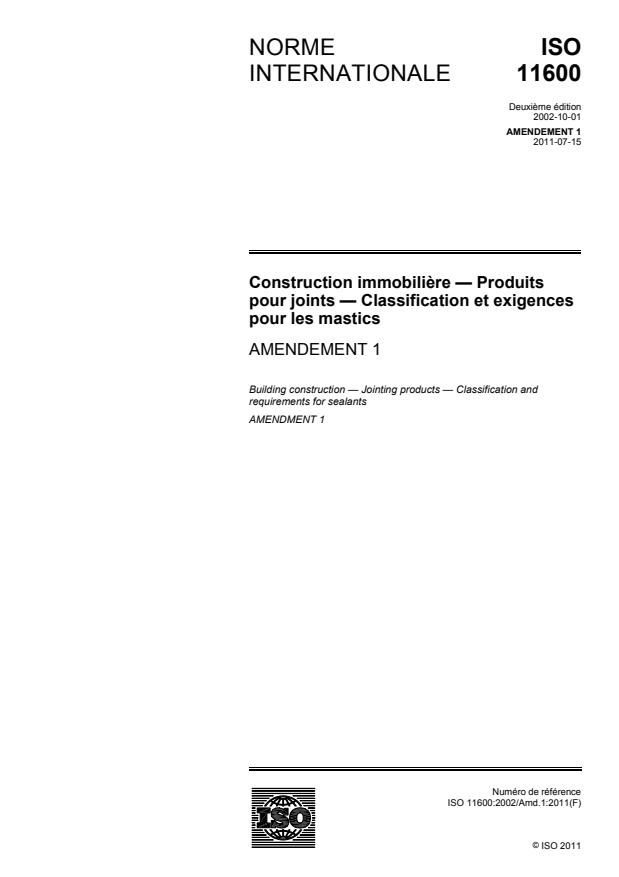
NORME ISO
INTERNATIONALE 11600
Deuxième édition
2002-10-01
AMENDEMENT 1
2011-07-15
Construction immobilière — Produits
pour joints — Classification et exigences
pour les mastics
AMENDEMENT 1
Building construction — Jointing products — Classification and
requirements for sealants
AMENDMENT 1
Numéro de référence
ISO 11600:2002/Amd.1:2011(F)
©
ISO 2011
ISO 11600:2002/Amd.1:2011(F)
DOCUMENT PROTÉGÉ PAR COPYRIGHT
© ISO 2011
Droits de reproduction réservés. Sauf prescription différente, aucune partie de cette publication ne peut être reproduite ni utilisée sous
quelque forme que ce soit et par aucun procédé, électronique ou mécanique, y compris la photocopie et les microfilms, sans l'accord écrit
de l'ISO à l'adresse ci-après ou du comité membre de l'ISO dans le pays du demandeur.
ISO copyright office
Case postale 56 • CH-1211 Geneva 20
Tel. + 41 22 749 01 11
Fax + 41 22 749 09 47
E-mail copyright@iso.org
Web www.iso.org
Publié en Suisse
ii © ISO 2011 – Tous droits réservés
ISO 11600:2002/Amd.1:2011(F)
Avant-propos
L'ISO (Organisation internationale de normalisation) est une fédération mondiale d'organismes nationaux de
normalisation (comités membres de l'ISO). L'élaboration des Normes internationales est en général confiée
aux comités techniques de l'ISO. Chaque comité membre intéressé par une étude a le droit de faire partie du
comité technique créé à cet effet. Les organisations internationales, gouvernementales et non
gouvernementales, en liaison avec l'ISO participent également aux travaux. L'ISO collabore étroitement avec
la Commission électrotechnique internationale (CEI) en ce qui concerne la normalisation électrotechnique.
Les Normes internationales sont rédigées conformément aux règles données dans les Directives ISO/CEI,
Partie 2.
La tâche principale des comités techniques est d'élaborer les Normes internationales. Les projets de Normes
internationales adoptés par les comités techniques sont soumis aux comités membres pour vote. Leur
publication comme Normes internationales requiert l'approbation de 75 % au moins des comités membres
votants.
L'attention est appelée sur le fait que certains des éléments du présent document peuvent faire l'objet de
droits de propriété intellectuelle ou de droits analogues. L'ISO ne saurait être tenue pour responsable de ne
...