


ISO 7503-1:2016
(Main)Measurement of radioactivity — Measurement and evaluation of surface contamination — Part 1: General principles
Measurement of radioactivity — Measurement and evaluation of surface contamination — Part 1: General principles
ISO 7503 (all parts) and ISO 8769 are addressed to the people responsible for determining the radioactivity present on solid surfaces. ISO 7503 is published in three parts and can be used jointly or separately according to needs. ISO 7503-1:2016 relates to the assessment of surface contamination by direct and indirect measurements and the calibration of the associated instrumentation. The standard applies to alpha-, beta- and photon emitters and is intended for use by hospitals, universities, police, or industrial establishments. The standard also can be used in the assessment of activity on trucks, containers, parcels, equipment and is applicable in any organization which handles radioactive materials. Generally, it is applicable to well defined flat surfaces where direct methods are applicable, however, it can also be used for surfaces which are not flat and where indirect wipe tests would be appropriate. These investigations may be carried out on containers, inaccessible areas, non-flat areas where wipe tests can be used. This part of ISO 7503 may be useful in emergency situations, i.e. in nuclear accidents where health physics professionals would be involved. ISO 7503-1:2016 does not apply to the evaluation of contamination of the skin, of clothing and of loose material such as gravel. NOTE The test method using wipe-test samples for the evaluation of radioactive surface contaminations is dealt with in ISO 7503-2. The calibration of instruments for the evaluation of radioactive surface contaminations is dealt with in ISO 7503-3.
Mesurage de la radioactivité — Mesurage et évaluation de la contamination de surface — Partie 1: Principes généraux
L'ISO 7503 (toutes les parties) et l'ISO 8769 s'adressent aux personnes chargées de déterminer la radioactivité présente sur des surfaces solides. L'ISO 7503 est publiée en trois parties qui peuvent être utilisées conjointement ou séparément, selon les besoins. L'ISO 7503-1:2016 porte sur l'évaluation de la contamination de surface par mesurages directs et indirects, ainsi que sur l'étalonnage de l'instrumentation associée. L'ISO 7503-1:2016 est applicable aux émetteurs alpha, bêta et photoniques et destinée aux établissements hospitaliers, universitaires, policiers ou industriels. Elle peut également servir à l'évaluation de l'activité des camions, conteneurs, colis ou équipements et est applicable à toute organisation qui manipule des matières radioactives. De manière générale, elle s'applique aux surfaces planes bien définies auxquelles les méthodes directes sont applicables, mais elle peut également être utilisée pour les surfaces non planes et lorsque des essais indirects par frottis seraient appropriés. Ces études peuvent être réalisées sur des conteneurs, des zones inaccessibles ou des surfaces non planes où des essais par frottis peuvent être réalisés. L'ISO 7503‑1:2016 peut s'avérer utile dans les situations d'urgence, telles que les accidents nucléaires, qui nécessiteraient l'intervention de spécialistes en radioprotection. L'ISO 7503-1:2016 ne s'applique pas à l'évaluation de la contamination de la peau, des vêtements et des matériaux en vrac (gravier, par exemple). NOTE La méthode d'essai par frottis qui utilise des échantillons pour l'évaluation de la contamination des surfaces radioactives est traitée dans l'ISO 7503‑2. L'étalonnage des instruments utilisés pour l'évaluation de la contamination des surfaces radioactives est traité dans l'ISO 7503‑3.
Merjenje radioaktivnosti - Merjenje in vrednotenje površinske kontaminacije - 1. del: Splošna načela
Standarda ISO 7503 (vsi deli) in ISO 8769 sta namenjena osebam, ki so odgovorne za določanje prisotnosti radioaktivnosti na trdnih površinah. Standard ISO 7503 je objavljen v treh delih, ki jih je mogoče uporabljati skupaj ali ločeno glede na potrebe.
Ta del standarda ISO 7503 se navezuje na ocenjevanje površinske kontaminacije z neposrednimi in posrednimi meritvami ter umerjanjem povezanih instrumentov.
Standard se uporablja za alfa in beta oddajnike ter fotonske oddajnike in je namenjen za uporabo v bolnišnicah, na univerzah, pri delu policije ali v industrijskih obratih. Uporabljati ga je mogoče tudi pri ocenjevanju dejavnosti na tovornjakih, vsebnikih, paketih in opremi ter se uporablja v kateri koli organizaciji, ki se ukvarja z radioaktivnimi snovmi. Na splošno se uporablja za natančno opredeljene ravne površine, kjer je primerna uporaba neposrednih metod, vendar ga je mogoče uporabljati tudi za površine, ki niso ravne in kjer bi bili primerni posredni preskusi z brisanjem. Te preiskave se lahko izvajajo na vsebnikih, nedostopnih območjih in neravnih območjih, kjer je mogoče uporabiti preskuse z brisanjem. Ta del standarda ISO 7503 je lahko uporaben v izrednih razmerah, tj. pri jedrskih nesrečah, kjer bi bili vključeni strokovnjaki za zdravstveno fiziko.
Ta del standarda ISO 7503 se ne uporablja za vrednotenje kontaminacije kože, oblačil in sipkega materiala, kot je gramoz.
OPOMBA: Preskusna metoda z uporabo vzorcev za brisanje za vrednotenje površinske radioaktivne kontaminacije je obravnavana v standardu ISO 7503-2. Umerjanje instrumentov za vrednotenje površinske radioaktivne kontaminacije je obravnavano v standardu ISO 7503-3.
General Information
Relations
Standards Content (Sample)
SLOVENSKI STANDARD
01-januar-2025
Merjenje radioaktivnosti - Merjenje in vrednotenje površinske kontaminacije - 1.
del: Splošna načela
Measurement of radioactivity - Measurement and evaluation of surface contamination -
Part 1: General principles
Mesurage de la radioactivité — Mesurage et évaluation de la contamination de surface
— Partie 1: Principes généraux
Ta slovenski standard je istoveten z: ISO 7503-1:2016
ICS:
13.280 Varstvo pred sevanjem Radiation protection
2003-01.Slovenski inštitut za standardizacijo. Razmnoževanje celote ali delov tega standarda ni dovoljeno.
INTERNATIONAL ISO
STANDARD 7503-1
Second edition
2016-01-15
Corrected version
2018-02-15
Measurement of radioactivity —
Measurement and evaluation of
surface contamination —
Part 1:
General principles
Mesurage de la radioactivité — Mesurage et évaluation de la
contamination de surface —
Partie 1: Principes généraux
Reference number
©
ISO 2016
© ISO 2016, Published in Switzerland
All rights reserved. Unless otherwise specified, no part of this publication may be reproduced or utilized otherwise in any form
or by any means, electronic or mechanical, including photocopying, or posting on the internet or an intranet, without prior
written permission. Permission can be requested from either ISO at the address below or ISO’s member body in the country of
the requester.
ISO copyright office
Ch. de Blandonnet 8 • CP 401
CH-1214 Vernier, Geneva, Switzerland
Tel. +41 22 749 01 11
Fax +41 22 749 09 47
copyright@iso.org
www.iso.org
ii © ISO 2016 – All rights reserved
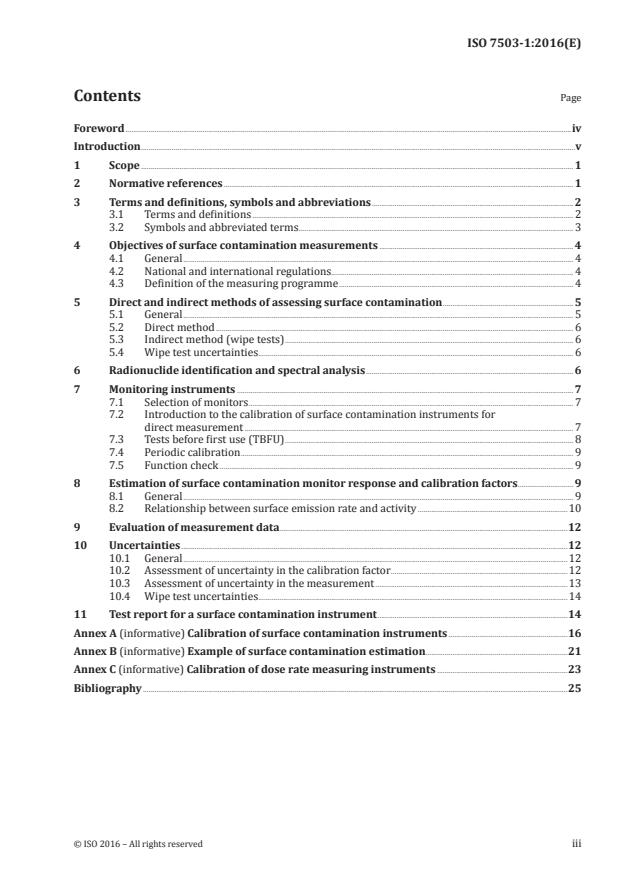
Contents Page
Foreword .iv
Introduction .v
1 Scope . 1
2 Normative references . 1
3 Terms and definitions, symbols and abbreviations . 2
3.1 Terms and definitions . 2
3.2 Symbols and abbreviated terms. 3
4 Objectives of surface contamination measurements . 4
4.1 General . 4
4.2 National and international regulations. 4
4.3 Definition of the measuring programme . 4
5 Direct and indirect methods of assessing surface contamination . 5
5.1 General . 5
5.2 Direct method . 6
5.3 Indirect method (wipe tests) . 6
5.4 Wipe test uncertainties . 6
6 Radionuclide identification and spectral analysis . 6
7 Monitoring instruments . 7
7.1 Selection of monitors . 7
7.2 Introduction to the calibration of surface contamination instruments for
direct measurement . 7
7.3 Tests before first use (TBFU) . 8
7.4 Periodic calibration . 9
7.5 Function check . 9
8 Estimation of surface contamination monitor response and calibration factors.9
8.1 General . 9
8.2 Relationship between surface emission rate and activity .10
9 Evaluation of measurement data.12
10 Uncertainties .12
10.1 General .12
10.2 Assessment of uncertainty in the calibration factor .12
10.3 Assessment of uncertainty in the measurement .13
10.4 Wipe test uncertainties .14
11 Test report for a surface contamination instrument .14
Annex A (informative) Calibration of surface contamination instruments .16
Annex B (informative) Example of surface contamination estimation.21
Annex C (informative) Calibration of dose rate measuring instruments .23
Bibliography .25
Foreword
ISO (the International Organization for Standardization) is a worldwide federation of national standards
bodies (ISO member bodies). The work of preparing International Standards is normally carried out
through ISO technical committees. Each member body interested in a subject for which a technical
committee has been established has the right to be represented on that committee. International
organizations, governmental and non-governmental, in liaison with ISO, also take part in the work.
ISO collaborates closely with the International Electrotechnical Commission (IEC) on all matters of
electrotechnical standardization.
The procedures used to develop this document and those intended for its further maintenance are
described in the ISO/IEC Directives, Part 1. In particular the different approval criteria needed for the
different types of ISO documents should be noted. This document was drafted in accordance with the
editorial rules of the ISO/IEC Directives, Part 2 (see www .iso .org/ directives).
Attention is drawn to the possibility that some of the elements of this document may be the subject of
patent rights. ISO shall not be held responsible for identifying any or all such patent rights. Details of
any patent rights identified during the development of the document will be in the Introduction and/or
on the ISO list of patent declarations received (see www .iso .org/ patents).
Any trade name used in this document is information given for the convenience of users and does not
constitute an endorsement.
For an explanation on the meaning of ISO specific terms and expressions related to conformity
assessment, as well as information about ISO's adherence to the WTO principles in the Technical
Barriers to Trade (TBT) see the following URL: Foreword - Supplementary information
The committee responsible for this document is ISO/TC 85, Nuclear energy nuclear technologies and
radiological protection, Subcommittee SC 2, Radiation protection.
This second edition cancels and replaces the first edition (ISO 7503-1:1988), which has been technically
revised.
ISO 7503 consists of the following parts, under the general title Measurement of radioactivity —
Measurement and evaluation of surface contamination:
— Part 1: General principles
— Part 2: Test method using wipe-test samples
— Part 3: Apparatus calibration
This corrected version of ISO 7503-1:2016 incorporates the following corrections:
-2 -1 -1 -2
— In 3.2, for I(A), replace "(Bq·cm )/s " by "s /(Bq·cm )";
— In Clause 9, replace the first paragraph which has been rephrased.
iv © ISO 2016 – All rights reserved
Introduction
ISO 7503 gives guidance on the measurement of surface contamination. This International Standard is
applicable to many situations where radioactive contamination can occur. Contamination arises from
the release of radioactivity into the local environment. In most circumstances, the release is inadvertent
but, on occasion, may be deliberate. Although the purpose and scope of the investigation may differ, the
approaches taken to measure the levels and extent of the contamination are essentially similar.
Radioactive contamination can arise from a number of activities or events such as the following:
— routine laboratory use of radio-chemicals;
— medical treatments;
— industrial applications;
— transport accidents;
— equipment malfunctions;
— malevolent incidents;
— nuclear accidents.
Without process knowledge or documentation, it is not always possible to identify or distinguish the
different radionuclides constituting a surface contamination, and the evaluation of such a contamination
cannot be made on a quantitative basis. Instead of using instruments with nuclide specific calibrations,
it may be necessary to use other instruments which are fit for such a purpose.
However, there may be cases (e.g. a contaminated fuel material transport container) where the
radionuclide or the radionuclide mixture can be clearly characterized. A surface contamination
evaluation exceeding a pure qualitative assessment of fixed and removable surface contamination
may then be needed. Moreover, following requirements laid down in national regulations and in
international conventions, a measured surface contamination activity per unit area has to be compared
with surface contamination guideline values or surface contamination limits.
Surface contamination guideline values are radionuclide-specific and thus require complex
radionuclide-specific calibrations of measurement equipment. Calibration quality assurance is crucial
in order to avoid non-detection (i.e. type II decision errors) leading to incorrectly assuming compliance
with given surface contamination guideline values or limits. Evaluation of surfaces contaminated by a
mixture of radionuclides with known ratios requires respectively proportionated calibration factors.
ISO 7503 is concerned with the measurement and estimation of radioactivity levels. It does not provide
advice on decommissioning, planning and surveillance techniques.
Surface contamination is specified in terms of activity per unit area and the limits are based on the
recommendations by the International Commission on Radiological Protection (ICRP 103).
This part of ISO 7503 deals with the evaluation of surface contamination by direct measurement using
a surface contamination instrument, and in the case of the indirect method, using wipe tests. This
part of ISO 7503 is primarily concerned with direct monitoring, practical guidance on measurements,
it describes principles to keep an instrument in a fitness-for-purpose state. This part of ISO 7503
also presents instrument calibration principles and compiles the basic uncertainties of both surface
contamination evaluation methods.
INTERNATIONAL STANDARD ISO 7503-1:2016(E)
Measurement of radioactivity — Measurement and
evaluation of surface contamination —
Part 1:
General principles
1 Scope
ISO 7503 (all parts) and ISO 8769 are addressed to the people responsible for determining the
radioactivity present on solid surfaces. ISO 7503 is published in three parts and can be used jointly or
separately according to needs.
This part of ISO 7503 relates to the assessment of surface contamination by direct and indirect
measurements and the calibration of the associated instrumentation.
The standard applies to alpha-, beta- and photon emitters and is intended for use by hospitals,
universities, police, or industrial establishments. The standard also can be used in the assessment of
activity on trucks, containers, parcels, equipment and is applicable in any organization which handles
radioactive materials. Generally, it is applicable to well defined flat surfaces where direct methods are
applicable, however, it can also be used for surfaces which are not flat and where indirect wipe tests
would be appropriate. These investigations may be carried out on containers, inaccessible areas, non-
flat areas where wipe tests can be used. This part of ISO 7503 may be useful in emergency situations,
i.e. in nuclear accidents where health physics professionals would be involved.
This part of ISO 7503 does not apply to the evaluation of contamination of the skin, of clothing and of
loose material such as gravel.
NOTE The test method using wipe-test samples for the evaluation of radioactive surface contaminations is
dealt with in ISO 7503-2. The calibration of instruments for the evaluation of radioactive surface contaminations
is dealt with in ISO 7503-3.
2 Normative references
The following documents, in whole or in part, are normatively referenced in this document and are
indispensable for its application. For dated references, only the edition cited applies. For undated
references, the latest edition of the referenced document (including any amendments) applies.
ISO 8769, Reference sources — Calibration of surface contamination monitors — Alpha-, beta- and photon
emitters
ISO 11929, Determination of the characteristic limits (decision threshold, detection limit, and limits of the
confidence interval) for measurements of ionizing radiation — Fundamentals and application
ISO/IEC 17025, General requirements for the competence of testing and calibration laboratories
3 Terms and definitions, symbols and abbreviations
3.1 Terms and definitions
For the purposes of this document, the following terms and definitions apply.
3.1.1
activity per unit area
ratio between the activity of the radionuclides present on a surface and the area of that surface,
expressed in becquerels per square centimetre
3.1.2
surface contamination
radioactive substances deposited on defined surfaces
3.1.3
fixed surface contamination
surface contamination which cannot be removed or transferred by non-destructive means
3.1.4
removable surface contamination
radioactive material that can be removed from surfaces by non-destructive means, including casual
contact, wiping, or washing
Note 1 to entry: It should be noted that under the influence of moisture, chemicals, etc., or as a result of corrosion
or diffusion, fixed contamination may become removable or vice versa without any human action. Furthermore,
surface contaminations may decrease due to evaporation and volatilization.
Note 2 to entry: It should be emphasized that the ratio between fixed and removable contamination can vary
over time, and that some decisions, such as those related to clearance, should be based on total activity with the
potential to become removable over time, not just the amount that is removable at the time of a survey.
3.1.5
direct measurement of surface contamination
measurement of surface contamination by means of a contamination meter or monitor
3.1.6
indirect evaluation of surface contamination
evaluation of the removable surface contamination by means of a wipe test
3.1.7
wipe test
test to determine if removable contamination is present through wiping the surface with a dry or wet
material, followed by evaluation of the wipe material for removable contamination
3.1.8
wiping efficiency
ratio of the activity of the radionuclides removed from the surface by one wipe sample to the activity of
the radionuclides of the removable surface contamination prior to this sampling
Note 1 to entry: In practice, it is almost impossible to measure the total amount of removable activity on the
surface, and in most cases, a value for the wiping efficiency cannot be assessed but can only be estimated.
3.1.9
surface emission rate of a source
number of particles of a given type above a given energy or of photons emerging from the front face of
the source per unit time
2 © ISO 2016 – All rights reserved
3.1.10
instrument efficiency
ratio between the instrument net reading and the surface emission rate of a source under given
geometrical conditions
3.1.11
emission instrument response
instrument efficiency times detector window area, equals the observed net count rate per surface
emission rate per unit area of a calibration source
3.1.12
activity instrument response
instrument efficiency times detector window area times the probability of a particle or photon leaving
the source surface, equals the observed net count rate per Bq per unit area of a calibration source
3.1.13
emission calibration factor
reciprocal of instrument efficiency times window area
3.1.14
activity calibration factor
reciprocal of instrument efficiency times window area times probability of a particle leaving the
source surface
3.1.15
calibration
operation that, under specified conditions, in a first step, establishes a relation between the quantity
values with measurement uncertainties provided by measurement standards and corresponding
indications with associated measurement uncertainties and, in a second step, uses this information to
establish a relation for obtaining a measurement result from an indication
3.1.16
guideline value
value which corresponds to scientific, legal or other requirements for which the measuring procedure
is intended to assess
3.2 Symbols and abbreviated terms
For the purposes of this part of ISO 7503, the following symbols apply:
−1 −1 −2
I(E) emission instrument response in s /(s ·cm )
−1
ρ observed count rate from the calibration source in s
c
−1
ρ background count rate in s
−1
R emission rate of the calibration source in s
c
S area of the calibration source in cm
c
−1 −2
I(A) activity instrument response in s /(Bq·cm )
A activity of the calibration source in Bq
c
P inverse of probability of a particle emerging from the surface, equal ratio of the particle or photon
−1 −1
generation rate (activity) and the emission rate from the surface in Bq /s
S effective detector or probe area in cm
p
−1 −2 −1
C(E) emission calibration factor in (s ·cm )/s
−2 −1
C(A) activity calibration factor in (Bq·cm )/s
−1 −1
ε instrument efficiency in s /s
−2
A activity per unit area of fixed and removable contamination in Bq·cm
s
−1
ρ measured total (gross) count rate in s
g
4 Objectives of surface contamination measurements
4.1 General
Initial investigations into possible surface contamination need to assume a worst case scenario. The
area, environment or premises need to be approached assuming that there may be significant dose-
rates. If the initial investigation establishes that the dose rates do not present a radiological hazard
where shielding may be necessary, the issue of contamination needs to be addressed.
If the investigation is routine, then the initial investigation into possible high dose rates does not need
to be undertaken. The investigation only needs to proceed into possible surface contamination.
Having established the presence of surface contamination, the question of contamination
instrumentation needs to be considered. Factors such as the instrument response to the likely
radionuclide contamination and other aspects shall be assessed. The area to be monitored may
determine the size of the most suitable detectors.
The bibliography contains publications which provide guidance on suitable instrumentation.
4.2 National and international regulations
It is necessary to comply with current national and international regulations or existing standards and
guidance in addition to the customer requirements. National and international regulations provide
guidance on averaging areas. In particular, it is essential to establish the areas over which measurements
may be averaged for the purposes of demarcating areas on the basis of contamination levels.
4.3 Definition of the measuring programme
The objectives of a surface contamination measurement programme are
— the detection of ionizing particles or photons emitted from a surface contaminated with radioactive
material, and
— the evaluation of the instrument readings which can be used to provide an estimate of the quantities
and characteristics radioactive contaminants.
In order to achieve these objectives with a reasonable degree of confidence, it is necessary to plan the
monitoring procedure. In many organizations, there are standard procedures that state how routine
radiation protection monitoring should be done. The monitoring takes place in familiar areas, carried
out by an organization‘s own staff, using its own monitoring equipment and reporting system.
In some circumstances, there may be no standard procedures in place to develop a suitable
measurement programme. In these circumstances, information needs to be gathered, which might
include the collection and documentation of the following details:
a) identification of the operator;
b) defining the areas or items to be monitored;
c) history of the areas to be monitored to include
1) radionuclides used in the area and at what times and in what quantities,
4 © ISO 2016 – All rights reserved
2) refurbishment, repair and maintenance histories, and
3) previous survey results and possibly trend analysis;
d) the level of detail and levels of accuracy required by the operator;
e) the sampling strategy;
f) the need to distinguish between fixed and removable contamination;
g) the need for any direct or indirect measurements;
h) types and quantities of equipment required for specific measurements and available including
status of calibration;
i) details of current dose rate levels around and within the areas to be surveyed;
j) limitations on access;
k) need for personal protective equipment (overalls, breathing apparatus, rubber gloves);
l) facilities for disposal of radioactive waste;
m) liaison with other organizations (e.g. police, national regulatory agencies);
n) environmental conditions (e.g. temperature, humidity);
o) types of surfaces to be monitored (e.g. rough concrete, painted contaminated surfaces).
Having gathered the relevant information listed above, an appropriate measurement programme
should be developed and documented. The measurement programme should include the calculations
and assumptions used in establishing the action levels. It is recommended that the measurement
programme expresses where possible, the action levels in the same units that are displayed on the
specified instruments. The measurement programme should include the steps to be taken whenever
those levels are exceeded and the designation of those personnel who can authorize the resumption of
the measurement programme if action levels have been exceeded.
5 Direct and indirect methods of assessing surface contamination
5.1 General
Contamination on a surface can be assessed either directly or indirectly.
The initial investigation into the contamination of premises should assume the worst case. The premises
should be approached assuming that there may be a significant dose rate. This may be applicable to
only one laboratory or maybe the whole building. If the initial investigation establishes that the dose
rate does not present a shielding problem or radiological hazard, then the issue of contamination can
then be addressed.
The applicability and the reliability of direct measurement or indirect evaluation of surface
contamination are strongly dependent on the particular circumstances, i.e. the physical and chemical
form of the contamination, the adherence of contamination on the surface (fixed or removable), the
accessibility of the surface for measurement or the presence of interfering radiation fields.
Direct measurement is used when the surface is readily accessible without
— interfering inactive liquid or solid deposits that cannot be taken into account, or
— interfering radiation fields that cannot be taken into account.
Indirect evaluation of surface contamination is generally more applicable when the surfaces are not
readily accessible because of difficult location or configuration, or where interfering radiation fields
adversely affect contamination monitors, or when methods of direct measurement with standard
instrumentation are not available. An indirect method cannot assess fixed contamination, and because
of the great uncertainty usually related to the wiping efficiency, application of the indirect method
usually results in conservative estimations of removable contamination.
Due to the inherent shortcomings of both the direct measurement and the indirect evaluation of surface
contamination, in many cases, the use of both methods in tandem can help ensure results which best
meet the aims of the evaluation.
5.2 Direct method
The direct method is the best approach whenever possible. In the direct method, the monitor probe
is moved over a surface, with the face of the probe at a minimal distance of approximately 3 mm from
the surface. The probe shall be kept stationary for a minimum to obtain sufficient accuracy. This
measurement can then be used to determine the radiation emitted from the surface.
There are many circumstances where the above measurement might not be possible. A surface may be
so convoluted that it is not possible to monitor it directly, or the background radiation may be so high
that it is impossible to obtain meaningful results from the measurements; however, these results should
be recorded because a calibration could be provided later. In these instances, an indirect measurement
has to be made using a wipe test.
5.3 Indirect method (wipe tests)
A test procedure is often carried out using a filter paper or other wipe, typically 20 mm to 60 mm in
diameter, which can be placed in commercial holder for measurement. The filter paper should be wiped
over the area, usually at least 100 cm , or whatever area is locally defined for the surface that may be
contaminated with radionuclides. The filter paper can either be placed in a lab counter drawer to assess
the level and type of activity, or sent to a radiochemistry laboratory for a full assessment of nuclide type
and activity. In both instances, all measurements should be traceable to national standards or governed
by local requirements.
Wipe tests can be either “dry wipe” or “wet wipe”. In general, it is a senior health physics professional
who makes the decision on which to use.
The indirect surface evaluation contamination method is described in detail in ISO 7503-2.
5.4 Wipe test uncertainties
A brief discussion on uncertainties is given in 10.3.
6 Radionuclide identification and spectral analysis
Normally, the radionuclides are known. If not, they need to be identified. Radionuclide identification
of contaminants using hand-held instruments is only practicable where the contaminants are gamma
emitting nuclides with energies in the range of 50 keV to 1500 keV. If the contaminant does not emit
photons in this range, it may not be possible to identify the radionuclide with hand-held instruments.
In cases such as an accident or where only one radionuclide is in use, it may not be necessary for it to
be determined as the contamination is known. Otherwise, more sophisticated techniques such as beta
and alpha spectroscopy are required and these techniques are usually only available in a well-equipped
laboratory where samples from the contaminated site can be prepared and analysed.
Small hand-held instruments exist that permit spectroscopic analysis of gamma radiation. In general,
the instruments use a small, approximately 40 mm × 40 mm, NaI crystal as the principle detector. The
sensitivity of a NaI crystal to gamma radiation makes these instruments particularly useful as “search
and locate” devices particularly for finding and identifying lost or hidden gamma sources. However, it
is not possible to make an accurate assessment of contamination levels using this type of instrument.
A small NaI crystal connected to a multichannel analyser (MCA) permits spectral analysis of the
6 © ISO 2016 – All rights reserved
ambient radiation. The MCA may also contain an electronic library of many common nuclides and their
associated photo-peaks.
The instrument shall be properly calibrated before use in a calibration facility that can provide
traceability to national standards. The calibration should confirm not only the dose rate accuracy but
also that the Multi Channel Analyser (MCA) has been correctly set up. If the MCA is not properly set
up, the instrument is not able to perform automatic nuclide identification. The user should understand
that automatic nuclide identification is limited to those nuclides in the instrument library. If peaks
occur in the gamma spectrum, that are not automatically identified, the photon peak energy should be
assessed from the spectrum and the literature consulted to try and identify the parent radionuclide.
Alternatively, the user should consult with an experienced health physics professional or radio chemist.
In a situation where there are a number of gamma emitting nuclides present, the instrument may be
unable to resolve the individual photo peaks because the resolution of small NaI crystals is poor when
compared with germanium crystals. In this situation, germanium detectors can be used instead.
The time taken to collect a spectrum is mainly dependent on the ambient background radiation and the
level of contamination. If the background is high or variable, it may be difficult or impossible to collect
an adequate spectrum. If the background is particularly high, it may cause a spectrum shift which
prevents automatic nuclide identification. Well shielded apparatus is also recommended.
7 Monitoring instruments
7.1 Selection of monitors
NOTE Dose rate monitors are included in this clause as, prior to any survey to assess surface contamination,
it is good practice to measure the ambient dose rates.
The selection of appropriate monitors depends on the following:
— the type(s) of radiation that are expected to be encountered (alpha, beta, photon);
— the levels of contamination that may be expected;
— the detection limits required;
— the accuracy required from the measurements.
The selection should be undertaken under the advice of a suitably qualified expert.
7.2 Introduction to the calibration of surface contamination instruments for direct
measurement
For regulatory purposes, the maximum permissible levels for surface contamination are expressed in
−2
terms of activity per unit area (Bq·cm ).
In most situations, it is possible to identify the individual radionuclide which is the major constituent
99m
of the surface contamination. For example, in a hospital which only uses Tc for routine diagnostic
purposes and no other radionuclides are brought onto the site, the nature of the contamination is
obvious. The surfaces which might have become contaminated may also be well-defined in terms of
material and surface finish. In this scenario, it would be appropriate to calibrate the contamination
monitor(s) directly with the radionuclide concerned by depositing traceable activities to samples of the
surfaces that might be affected by contamination. Exposing the monitor to these surfaces, at defined
distances, provides a series of calibration factors which, during normal monitoring procedures, can be
selected according to the relevant monitoring characteristics such as the nature of the surface, source
to detector separation, and contamination area. These calibration factors can be expressed in units of
response per unit area (activity per unit area).
In many other situations, this simple scenario does not occur. The worst case situation is that multiple
unidentified radionuclides are involved in varying activity concentrations and on a variety of different
surfaces. These could include distributions of activity below the surface up to and beyond the maximum
path length of any particulate ionizing radiations. In such a case, the immediate concern is to determine
the extent of the spread, and the variation in levels of the contamination. Random sampling combined
with spectrometry can provide some estimate of the radionuclide mix and relative activities. Combined
with knowledge of the response characteristics of the surface contamination monitor, an estimate can
then be made of the surface contamination.
The calibration of individual monitors for every potential scenario is impracticable. The practical
alternative is to demonstrate that the monitor is fit for purpose so that users can rely on type test
data and other published response data which provide sufficient information to determine the energy-
response characteristics for alpha-, beta- and photon emissions. The approach to calibration of
individual monitors is to confirm that they comply with type test data. This can be a very simple, rapid,
robust and inexpensive exercise. It can be performed with a minimum of high quality reference sources,
which do not need to be representative of the surfaces to be monitored in practice. The confirmation
of compliance with type test data then allows response factors to be interpolated for all radionuclides
based on the known decay data; this interpolation can either be carried out in-house or by third parties.
Calibration is described in detail in ISO 7503-3.
All monitors should be calibrated to standards that meet the legal requirements of the relevant country.
All monitors should be recalibrated periodically, in line with national regulations, usually every 12
months, but in many countries, longer than 12 months.
Calibration should be done in calibration laboratories that provide traceability to national standards
and meet the quality assurance requirements of ISO/IEC 17025.
The calibration status of the monitor shall not be expired.
New instruments should be thoroughly checked to ensure they meet the manufacturer’s specifications.
Occasionally, the manufacturer provides this service, but it may also be necessary for the user to have
the instrument checked and calibrated by an independent qualified laboratory. This is sometimes
known as Test Before First Use (TBFU).
The nature of the calibration programmes for surface contamination and dose monitors are determined
by the nature of the contamination scenarios that are expected to be encountered.
7.3 Tests before first use (TBFU)
The TBFU should, as appropriate, provide information on the following characteristics of the
instrument:
Surface contamination monitors
a) response to the type(s) and energy(s) of ionizing radiation appropriate to the intended use
b) linearity of response with emission rate over the likely range of use
c) relative sensitivity to different types of ionizing radiation
d) sensitivity to light
e) uniformity of response across the entrance window of the detector probe
f) the effects of any special environmental conditions deemed relevant
g) over range indication
h) background specification
i) detection limits
j) alarm threshold
8 © ISO 2016 – All rights reserved
Dose rate meters
k) response to the type(s) and energy(s) of ionizing radiation appropriate to the intended use
l) response to high dose rates
m) linearity of response with dose rate over the likely range of use
n) energy dependence
o) directional dependence
p) response to possible interfering ionizing radiations
q) the effects of any special environmental conditions deemed relevant
r) demonstration of correct operation when used in unusual circumstances, for example instruments
used in unusual orientations, such as upside down
It is essential that the instrument is set up in accordance with the manufacturer's specifications
and has a current calibration certificate.
7.4 Periodic calibration
Instruments should undergo a periodic calibration. The calibration interval is dependent on relevant
national legislation, however, annually is generally accepted as a suitable period. If there is no
legislative guidance, the recommended period is annually, and also, following any repair or adjustment
which is likely to affect the detection characteristics. The periodic calibration should include checks a)
to d) above and a thorough check on the condition of the instrument, for example, the battery state
and any physical damage. Specific guidance on the calibration of monitors is given in Annex A (surface
contamination monitors) and Annex C (dose meters).
7.5 Function check
It may also be necessary, depending on the way the instrument is used and the conditions of use, to
do frequent function checks. Function checks are not calibrations but they give a reasonable degree of
confidence that the instrument is still operating correctly and the calibration is still valid. A function
check can be as simple as ensuring the instrument is giving the correct response to background or
exposing it to a small radioactive source to confirm the reading is normal. Before the test of first use,
it is important that the background, alarm threshold, alarm indication and rate meter constant is also
checked.
8 Estimation of surface contamination monitor response and calibration factors
8.1 General
When response or calibration factors are not available for the particular combination of radionuclide(s)
and surfaces that are being monitored, it is necessary to estimate the appropriate response and
calibration factors. The fit for purpose calibration procedure described in Annex A provides
characterization data which may be used to make these estimations. The standard method is to
measure the calibration factor with traceable sources.
Monitors respond to the emissions which enter their detection volumes, they do not respond directly to
activity. The same activity on two different surfaces, which have two different emissions, can produce
two different responses from the monitors. The measured quantity is the response of the instrument to
the emissions incident on the detector entrance window. In practice, surfaces emit ionizing radiations
into 2π. The basic response factor is the response of the instrument either to (a) the emissions per unit
area from the surface for a spread source, or (b) the emissions from a point source. In practice, the
former is more useful.
The response factors may be expressed in any one of two forms which are linked to each other. The
factors are:
ρρ−
c0
IE , Instrument response Emission = (1)
() ()
R/ S
()
cc
−1 −1 −2
Units: s /(s cm )
where
−1
ρ is the observed count rate from the calibration source, in s ;
c
−1
ρ is the background count rate, in s ;
−1
R is the emission rate of the calibration source, in s ;
c
S is the area of the calibration source, in cm .
c
ρρ− ρρ−
c0 c0
IA , Instrument response Activity == (2)
() ()
R/ SP× A /S
() ()
cc ccc
−1 −2
Units: s /(Bq·cm )
where
A is the activity of the calibration source, in Bq;
c
P is the ratio of the particle or photon generation rate (activity) and the emission rate from
the surface (see ISO 7503-3).
8.2 Relationship between surface emission rate and activity
If the instrument indicates “becquerels per square centimetre”, a calibration factor has been stored
in the instrument. Conversion of counts per second to becquerels per square centimetre can be
complicated. A method to do this can be found in ISO 7503-3. This task requires a comprehensive
knowledge of the decay schemes, instrument performance and an estimation of how the local conditions
(e.g. surface construction) might affect the observed count rate. Measurements should be made using
calibrated reference sources.
A calibration certificate records the instrument’s response to a range of ISO 8769 reference sources at
a specified distance. These are a set of specialist sources produced for the purpose of calib
...
FINAL
INTERNATIONAL ISO/FDIS
DRAFT
STANDARD 7503-1
ISO/TC 85/SC 2
Measurement of radioactivity —
Secretariat: AFNOR
Measurement and evaluation of
Voting begins on:
2015-09-17 surface contamination —
Voting terminates on:
Part 1:
2015-11-17
General principles
Mesurage de la radioactivité — Mesurage et évaluation de la
contamination de surface —
Partie 1: Principes généraux
RECIPIENTS OF THIS DRAFT ARE INVITED TO
SUBMIT, WITH THEIR COMMENTS, NOTIFICATION
OF ANY RELEVANT PATENT RIGHTS OF WHICH
THEY ARE AWARE AND TO PROVIDE SUPPOR TING
DOCUMENTATION.
IN ADDITION TO THEIR EVALUATION AS
Reference number
BEING ACCEPTABLE FOR INDUSTRIAL, TECHNO-
ISO/FDIS 7503-1:2015(E)
LOGICAL, COMMERCIAL AND USER PURPOSES,
DRAFT INTERNATIONAL STANDARDS MAY ON
OCCASION HAVE TO BE CONSIDERED IN THE
LIGHT OF THEIR POTENTIAL TO BECOME STAN-
DARDS TO WHICH REFERENCE MAY BE MADE IN
©
NATIONAL REGULATIONS. ISO 2015
ISO/FDIS 7503-1:2015(E)
© ISO 2015, Published in Switzerland
All rights reserved. Unless otherwise specified, no part of this publication may be reproduced or utilized otherwise in any form
or by any means, electronic or mechanical, including photocopying, or posting on the internet or an intranet, without prior
written permission. Permission can be requested from either ISO at the address below or ISO’s member body in the country of
the requester.
ISO copyright office
Ch. de Blandonnet 8 • CP 401
CH-1214 Vernier, Geneva, Switzerland
Tel. +41 22 749 01 11
Fax +41 22 749 09 47
copyright@iso.org
www.iso.org
ii © ISO 2015 – All rights reserved
ISO/FDIS 7503-1:2015(E)
Contents Page
Foreword .iv
Introduction .v
1 Scope . 1
2 Normative references . 1
3 Terms and definitions, symbols and abbreviations . 2
3.1 Terms and definitions . 2
3.2 Symbols and abbreviated terms. 4
4 Objectives of surface contamination measurements . 4
4.1 General . 4
4.2 National and international regulations. 4
4.3 Definition of the measuring programme . 5
5 Direct and indirect methods of assessing surface contamination . 6
5.1 General . 6
5.2 Direct method . 6
5.3 Indirect method (wipe tests) . 6
5.4 Wipe test uncertainties . 7
6 Radionuclide identification and spectral analysis . 7
7 Monitoring instruments . 7
7.1 Selection of monitors . 7
7.2 Introduction to the calibration of surface contamination instruments for
direct measurement . 8
7.3 Tests before first use (TBFU) . 9
7.4 Periodic calibration . 9
7.5 Function check .10
8 Estimation of surface contamination monitor response and calibration factors.10
8.1 General .10
8.2 Relationship between surface emission rate and activity .11
9 Evaluation of measurement data.12
10 Uncertainties .13
10.1 General .13
10.2 Assessment of uncertainty in the calibration factor .13
10.3 Assessment of uncertainty in the measurement .14
10.4 Wipe test uncertainties .14
11 Test report for a surface contamination instrument .15
Annex A (informative) Calibration of surface contamination instruments .16
Annex B (informative) Example of surface contamination estimation.21
Annex C (informative) Calibration of dose rate measuring instruments .23
Bibliography .25
ISO/FDIS 7503-1:2015(E)
Foreword
ISO (the International Organization for Standardization) is a worldwide federation of national standards
bodies (ISO member bodies). The work of preparing International Standards is normally carried out
through ISO technical committees. Each member body interested in a subject for which a technical
committee has been established has the right to be represented on that committee. International
organizations, governmental and non-governmental, in liaison with ISO, also take part in the work.
ISO collaborates closely with the International Electrotechnical Commission (IEC) on all matters of
electrotechnical standardization.
The procedures used to develop this document and those intended for its further maintenance are
described in the ISO/IEC Directives, Part 1. In particular the different approval criteria needed for the
different types of ISO documents should be noted. This document was drafted in accordance with the
editorial rules of the ISO/IEC Directives, Part 2 (see www.iso.org/directives).
Attention is drawn to the possibility that some of the elements of this document may be the subject of
patent rights. ISO shall not be held responsible for identifying any or all such patent rights. Details of
any patent rights identified during the development of the document will be in the Introduction and/or
on the ISO list of patent declarations received (see www.iso.org/patents).
Any trade name used in this document is information given for the convenience of users and does not
constitute an endorsement.
For an explanation on the meaning of ISO specific terms and expressions related to conformity
assessment, as well as information about ISO’s adherence to the WTO principles in the Technical
Barriers to Trade (TBT) see the following URL: Foreword - Supplementary information
The committee responsible for this document is ISO/TC 85, Nuclear energy nuclear technologies and
radiological protection, Subcommittee SC 2, Radiation protection.
This second edition cancels and replaces the first edition (ISO 7503-1:1988), which has been
technically revised.
ISO 7503 consists of the following parts, under the general title Measurement of radioactivity —
Measurement and evaluation of surface contamination:
— Part 1: General principles
— Part 2: Test method using wipe-test samples
— Part 3: Apparatus calibration
iv © ISO 2015 – All rights reserved
ISO/FDIS 7503-1:2015(E)
Introduction
ISO 7503 gives guidance on the measurement of surface contamination. This International Standard is
applicable to many situations where radioactive contamination can occur. Contamination arises from
the release of radioactivity into the local environment. In most circumstances, the release is inadvertent
but, on occasion, may be deliberate. Although the purpose and scope of the investigation may differ, the
approaches taken to measure the levels and extent of the contamination are essentially similar.
Radioactive contamination can arise from a number of activities or events such as the following:
— routine laboratory use of radio-chemicals;
— medical treatments;
— industrial applications;
— transport accidents;
— equipment malfunctions;
— malevolent incidents;
— nuclear accidents.
Without process knowledge or documentation, it is not always possible to identify or distinguish the
different radionuclides constituting a surface contamination, and the evaluation of such a contamination
cannot be made on a quantitative basis. Instead of using instruments with nuclide specific calibrations,
it may be necessary to use other instruments which are fit for such a purpose.
However, there may be cases (e.g. a contaminated fuel material transport container) where the
radionuclide or the radionuclide mixture can be clearly characterized. A surface contamination
evaluation exceeding a pure qualitative assessment of fixed and removable surface contamination
may then be needed. Moreover, following requirements laid down in national regulations and in
international conventions, a measured surface contamination activity per unit area has to be compared
with surface contamination guideline values or surface contamination limits.
Surface contamination guideline values are radionuclide-specific and thus require complex
radionuclide-specific calibrations of measurement equipment. Calibration quality assurance is crucial
in order to avoid non-detection (i.e. type II decision errors) leading to incorrectly assuming compliance
with given surface contamination guideline values or limits. Evaluation of surfaces contaminated by a
mixture of radionuclides with known ratios requires respectively proportionated calibration factors.
ISO 7503 is concerned with the measurement and estimation of radioactivity levels. It does not provide
advice on decommissioning, planning and surveillance techniques.
Surface contamination is specified in terms of activity per unit area and the limits are based on the
recommendations by the International Commission on Radiological Protection (ICRP 103).
This part of ISO 7503 deals with the evaluation of surface contamination by direct measurement using
a surface contamination instrument, and in the case of the indirect method, using wipe tests. This
part of ISO 7503 is primarily concerned with direct monitoring, practical guidance on measurements,
it describes principles to keep an instrument in a fitness-for-purpose state. This part of ISO 7503
also presents instrument calibration principles and compiles the basic uncertainties of both surface
contamination evaluation methods.
FINAL DRAFT INTERNATIONAL STANDARD ISO/FDIS 7503-1:2015(E)
Measurement of radioactivity — Measurement and
evaluation of surface contamination —
Part 1:
General principles
1 Scope
ISO 7503 (all parts) and ISO 8769 are addressed to the people responsible for determining the
radioactivity present on solid surfaces. ISO 7503 is published in three parts and can be used jointly or
separately according to needs.
This part of ISO 7503 relates to the assessment of surface contamination by direct and indirect
measurements and the calibration of the associated instrumentation.
The standard applies to alpha-, beta- and photon emitters and is intended for use by hospitals,
universities, police, or industrial establishments. The standard also can be used in the assessment of
activity on trucks, containers, parcels, equipment and is applicable in any organization which handles
radioactive materials. Generally, it is applicable to well defined flat surfaces where direct methods are
applicable, however, it can also be used for surfaces which are not flat and where indirect wipe tests
would be appropriate. These investigations may be carried out on containers, inaccessible areas, non-
flat areas where wipe tests can be used. This part of ISO 7503 may be useful in emergency situations,
i.e. in nuclear accidents where health physics professionals would be involved.
This part of ISO 7503 does not apply to the evaluation of contamination of the skin, of clothing and of
loose material such as gravel.
NOTE The test method using wipe-test samples for the evaluation of radioactive surface contaminations is
dealt with in ISO 7503-2. The calibration of instruments for the evaluation of radioactive surface contaminations
is dealt with in ISO 7503-3.
2 Normative references
The following documents, in whole or in part, are normatively referenced in this document and are
indispensable for its application. For dated references, only the edition cited applies. For undated
references, the latest edition of the referenced document (including any amendments) applies.
ISO 8769, Reference sources — Calibration of surface contamination monitors — Alpha-, beta- and
photon emitters
ISO 11929, Determination of the characteristic limits (decision threshold, detection limit, and limits of the
confidence interval) for measurements of ionizing radiation — Fundamentals and application
ISO/IEC 17025, General requirements for the competence of testing and calibration laboratories
ISO/FDIS 7503-1:2015(E)
3 Terms and definitions, symbols and abbreviations
3.1 Terms and definitions
For the purposes of this document, the following terms and definitions apply.
3.1.1
activity per unit area
ratio between the activity of the radionuclides present on a surface and the area of that surface,
expressed in becquerels per square centimetre
3.1.2
surface contamination
radioactive substances deposited on defined surfaces
3.1.3
fixed surface contamination
surface contamination which cannot be removed or transferred by non-destructive means
3.1.4
removable surface contamination
radioactive material that can be removed from surfaces by non-destructive means, including casual
contact, wiping, or washing
Note 1 to entry: It should be noted that under the influence of moisture, chemicals, etc., or as a result of corrosion
or diffusion, fixed contamination may become removable or vice versa without any human action. Furthermore,
surface contaminations may decrease due to evaporation and volatilization.
Note 2 to entry: It should be emphasized that the ratio between fixed and removable contamination can vary
over time, and that some decisions, such as those related to clearance, should be based on total activity with the
potential to become removable over time, not just the amount that is removable at the time of a survey.
3.1.5
direct measurement of surface contamination
measurement of surface contamination by means of a contamination meter or monitor
3.1.6
indirect evaluation of surface contamination
evaluation of the removable surface contamination by means of a wipe test
3.1.7
wipe test
test to determine if removable contamination is present through wiping the surface with a dry or wet
material, followed by evaluation of the wipe material for removable contamination
3.1.8
wiping efficiency
ratio of the activity of the radionuclides removed from the surface by one wipe sample to the activity of
the radionuclides of the removable surface contamination prior to this sampling
Note 1 to entry: In practice, it is almost impossible to measure the total amount of removable activity on the
surface, and in most cases, a value for the wiping efficiency cannot be assessed but can only be estimated.
3.1.9
surface emission rate of a source
number of particles of a given type above a given energy or of photons emerging from the front face of
the source per unit time
2 © ISO 2015 – All rights reserved
ISO/FDIS 7503-1:2015(E)
3.1.10
instrument efficiency
ratio between the instrument net reading and the surface emission rate of a source under given
geometrical conditions
3.1.11
emission instrument response
instrument efficiency times detector window area, equals the observed net count rate per surface
emission rate per unit area of a calibration source
3.1.12
activity instrument response
instrument efficiency times detector window area times the probability of a particle or photon leaving
the source surface, equals the observed net count rate per Bq per unit area of a calibration source
3.1.13
emission calibration factor
reciprocal of instrument efficiency times window area
3.1.14
activity calibration factor
reciprocal of instrument efficiency times window area times probability of a particle leaving the
source surface
3.1.15
calibration
operation that, under specified conditions, in a first step, establishes a relation between the quantity
values with measurement uncertainties provided by measurement standards and corresponding
indications with associated measurement uncertainties and, in a second step, uses this information to
establish a relation for obtaining a measurement result from an indication
3.1.16
guideline value
value which corresponds to scientific, legal or other requirements for which the measuring procedure
is intended to assess
ISO/FDIS 7503-1:2015(E)
3.2 Symbols and abbreviated terms
For the purposes of this part of ISO 7503, the following symbols apply:
−1 −1 −2
I(E) emission instrument response in s /(s cm )
−1
ρ observed count rate from the calibration source in s
c
−1
ρ background count rate in s
−1
R emission rate of the calibration source in s
c
S area of the calibration source in cm
c
−1 −1 −2 −1 −2
I(A) activity instrument response in s /(s cm ) or s /(Bq cm )
A activity of the calibration source in Bq
c
P inverse of probability of a particle emerging from the surface, equal ratio of the particle or photon
generation rate (activity) and the emission rate from the surface
S effective detector or probe area in cm
p
−1 −2 −1
C(E) emission calibration factor in (s cm )/s
−1 −2 −1 −1 −2
C(A) activity calibration factor in (s cm )/s or s /(Bq cm )
ε instrument efficiency
−2
A activity per unit area of fixed and removable contamination in Bq cm
s
−1
ρ measured total (gross) count rate in s
g
4 Objectives of surface contamination measurements
4.1 General
Initial investigations into possible surface contamination need to assume a worst case scenario. The
area environment or premises need to be approached assuming that there may be significant dose-
rates. If the initial investigation establishes that the dose rates do not present a radiological hazard
where shielding may be necessary, the issue of contamination needs to be addressed.
If the investigation is routine, then the initial investigation into possible high dose rates does not need
to be undertaken. The investigation only needs to proceed into possible surface contamination.
Having established the presence of surface contamination, the question of contamination
instrumentation needs to be considered. Factors such as the instrument response to the likely
radionuclide contamination and other aspects shall be assessed. The area to be monitored may
determine the size of the most suitable detectors.
The bibliography contains publications which provide guidance on suitable instrumentation.
4.2 National and international regulations
It is necessary to comply with current national and international regulations or existing standards and
guidance in addition to the customer requirements. National and international regulations provide
guidance on averaging areas. In particular, it is essential to establish the areas over which measurements
may be averaged for the purposes of demarcating areas on the basis of contamination levels.
4 © ISO 2015 – All rights reserved
ISO/FDIS 7503-1:2015(E)
4.3 Definition of the measuring programme
The objectives of a surface contamination monitoring programme are
— the detection of ionizing particles or photons emitted from a surface contaminated with radioactive
material, and
— the evaluation of the instrument readings which can be used to provide an estimate of the quantities
and characteristics radioactive contaminants.
In order to achieve these objectives with a reasonable degree of confidence, it is necessary to plan the
monitoring procedure. In many organizations, there are standard procedures that state how routine
radiation protection monitoring should be done. The monitoring takes place in familiar areas, carried
out by an organization‘s own staff, using its own monitoring equipment and reporting system.
In some circumstances, there may be no standard procedures in place to develop a suitable monitoring
programme. In these circumstances, information needs to be gathered, which might include the
collection and documentation of the following details:
a) identification of the operator;
b) defining the areas or items to be monitored;
c) history of the areas to be monitored to include
1) radionuclide’s used in the area and at what times and in what quantities,
2) refurbishment, repair and maintenance histories, and
3) previous survey results and possibly trend analysis;
d) the level of detail and levels of accuracy required by the operator;
e) the sampling strategy;
f) the need to distinguish between fixed and removable contamination;
g) the need for any direct or indirect measurements;
h) types and quantities of monitoring equipment required for specific measurements and available
including status of calibration;
i) details of current dose rate levels around and within the areas to be surveyed;
j) limitations on access;
k) need for personal protective equipment (overalls, breathing apparatus, rubber gloves);
l) facilities for disposal of radioactive waste;
m) liaison with other organizations (e.g. police, national regulatory agencies);
n) environmental conditions (e.g. temperature, humidity);
o) types of surfaces to be monitored (e.g. rough concrete, painted contaminated surfaces).
Having gathered the relevant information listed above, an appropriate measurement programme
should be developed and documented. The measurement programme should include the calculations
and assumptions used in establishing the action levels. It is recommended that the monitoring
programme expresses where possible, the action levels in the same units that are displayed on the
specified instruments. The measurement program should include the steps to be taken whenever those
levels are exceeded and the designation of those personnel who can authorize the resumption of the
monitoring programme if action levels have been exceeded.
ISO/FDIS 7503-1:2015(E)
5 Direct and indirect methods of assessing surface contamination
5.1 General
Contamination on a surface can be assessed either directly or indirectly.
The initial investigation into the contamination of premises should assume the worst case. The premises
should be approached assuming that there may be a significant dose rate. This may be applicable to
only one laboratory or maybe the whole building. If the initial investigation establishes that the dose
rate does not present a shielding problem or radiological hazard, then the issue of contamination can
then be addressed.
The applicability and the reliability of direct measurement or indirect evaluation of surface
contamination are strongly dependent on the particular circumstances, i.e. the physical and chemical
form of the contamination, the adherence of contamination on the surface (fixed or removable), the
accessibility of the surface for measurement or the presence of interfering radiation fields.
Direct measurement is used when the surface is readily accessible without
— interfering inactive liquid or solid deposits that cannot be taken into account, or
— interfering radiation fields that cannot be taken into account.
Indirect evaluation of surface contamination is generally more applicable when the surfaces are not
readily accessible because of difficult location or configuration, or where interfering radiation fields
adversely affect contamination monitors, or when methods of direct measurement with standard
instrumentation are not available. An indirect method cannot assess fixed contamination, and because
of the great uncertainty usually related to the wiping efficiency, application of the indirect method
usually results in conservative estimations of removable contamination.
Due to the inherent shortcomings of both the direct measurement and the indirect evaluation of surface
contamination, in many cases, the use of both methods in tandem can help ensures results which best
meet the aims of the evaluation.
Having established that the investigation does not present a significant radiological hazard, the choice
of contamination measurement instrumentation needs to be addressed.
5.2 Direct method
The direct method is the best approach whenever possible. In the direct method, the monitor probe
is moved over a surface, with the face of the probe at a minimal distance of approximately 3 mm from
the surface. The probe shall be kept stationary for a minimum to obtain sufficient accuracy. This
measurement can then be used to determine the radiation emitted from the surface.
There are many circumstances where the above measurement might not be possible. A surface may be
so convoluted that it is not possible to monitor it directly, or the background radiation may be so high
that it is impossible to obtain meaningful results from the measurements; however, these results should
be recorded because a calibration could be provided later. In these instances, an indirect measurement
has to be made using a wipe test.
5.3 Indirect method (wipe tests)
A test procedure is often carried out using a filter paper or other wipe, typically 20 mm to 60 mm in
diameter, which can be placed in commercial holder for measurement. The filter paper should be wiped
over the area, usually at least 100 cm , or whatever area is locally defined for the surface that may be
contaminated with radionuclides. The filter paper can either be placed in a lab counter drawer to assess
the level and type of activity, or sent to a radiochemistry laboratory for a full assessment of nuclide type
and activity. In both instances, all measurements should be traceable to national standards or governed
by local requirements.
6 © ISO 2015 – All rights reserved
ISO/FDIS 7503-1:2015(E)
Wipe tests can be either “dry wipe” or “wet wipe”. In general, it is a senior health physics professional
who makes the decision on which to use.
The indirect surface evaluation contamination method is described in detail in ISO 7503-2.
5.4 Wipe test uncertainties
A brief discussion on uncertainties is given in 10.3.
6 Radionuclide identification and spectral analysis
Normally, the radionuclides are known, if not, they need to be identified. Radionuclide identification
of contaminants using hand-held instruments is only practicable where the contaminants are gamma
emitting nuclides with energies in the range of 50 keV to 1500 keV. If the contaminant does not emit
photons in this range, it may not be possible to identify the radionuclide with hand-held instruments.
In cases such as an accident or where only one radionuclide is in use, it may not be necessary for it to
be determined as the contamination is known. Otherwise, more sophisticated techniques such as beta
and alpha spectroscopy are required and these techniques are usually only available in a well-equipped
laboratory where samples from the contaminated site can be prepared and analysed.
Small hand-held instruments exist that permit spectroscopic analysis of gamma radiation. In general,
the instruments use a small, approximately 40 mm × 40 mm, NaI crystal as the principle detector. The
sensitivity of a NaI crystal to gamma radiation makes these instruments particularly useful as “search
and locate” devices particularly for finding and identifying lost or hidden gamma sources. However, it
is not possible to make an accurate assessment of contamination levels using this type of instrument.
A small NaI crystal connected to a multichannel analyser (MCA) permits spectral analysis of the
ambient radiation. The MCA may also contain an electronic library of many common nuclides and their
associated photo-peaks.
The instrument shall be properly calibrated before use in a calibration facility that can provide
traceability to national standards. The calibration should confirm not only the dose rate accuracy but
also that the Multi Channel Analyser (MCA) has been correctly set up. If the MCA is not properly set
up, the instrument is not able to perform automatic nuclide identification. The user should understand
that automatic nuclide identification is limited to those nuclides in the instrument library. If peaks
occur in the gamma spectrum, that is not automatically identified, the photon peak energy should be
assessed from the spectrum and the literature consulted to try and identify the parent radionuclide.
Alternatively, the user should consult with an experienced health physics professional or radio chemist.
In a situation where there are a number of gamma emitting nuclides present, the instrument may be
unable to resolve the individual photo peaks because the resolution of small NaI crystals is poor when
compared with germanium crystals. In this situation, germanium detectors can be used instead.
The time taken to collect a spectrum is mainly dependent on the ambient background radiation and the
level of contamination. If the background is high or variable, it may be difficult or impossible to collect
an adequate spectrum. If the background is particularly high, it may cause a spectrum shift which
prevents automatic nuclide identification. Well shielded apparatus is also recommended.
7 Monitoring instruments
7.1 Selection of monitors
NOTE Dose rate monitors are included in this clause as, prior to any survey to assess surface contamination,
it is good practice to measure the ambient dose rates.
The selection of appropriate monitors depends on the following:
— the type(s) of radiation that are expected to be encountered (alpha, beta, photon);
ISO/FDIS 7503-1:2015(E)
— the levels of contamination that may be expected;
— the detection limits required;
— the accuracy required from the measurements.
The selection should be undertaken under the advice of a suitably qualified expert.
7.2 Introduction to the calibration of surface contamination instruments for direct
measurement
For regulatory purposes, the maximum permissible levels for surface contamination are expressed in
−2
terms of activity per unit area (Bq cm ).
In most situations, it is possible to identify the individual radionuclide which is the cause of the surface
99m
contamination. For example, in a hospital which only uses Tc for routine diagnostic purposes and no
other radionuclides are brought onto the site, the nature of the contamination is obvious. The surfaces
which might have become contaminated may also be well-defined in terms of material and surface
finish. In this scenario, it would be appropriate to calibrate the contamination monitor(s) directly with
the radionuclide concerned by depositing traceable activities to samples of the surfaces that might be
affected by contamination. Exposing the monitor to these surfaces, at defined distances, provides a
series of calibration factors which, during normal monitoring procedures, can be selected according to
the relevant monitoring characteristics such as the nature of the surface, source to detector separation,
and contamination area. These calibration factors can be expressed in units of response per unit area
(activity per unit area).
In many other situations, this simple scenario does not occur. The worst case situation is that multiple
unidentified radionuclides are involved in varying activity concentrations and on a variety of different
surfaces. These could include distributions of activity below the surface up to and beyond the maximum
path length of any particulate ionizing radiations. In such a case, the immediate concern is to determine
the extent of the spread, and the variation in levels of the contamination. Random sampling combined
with spectrometry can provide some estimate of the radionuclide mix and relative activities. Combined
with knowledge of the response characteristics of the surface contamination monitor, an estimate can
then be made of the surface contamination.
The calibration of individual monitors for every potential scenario is impracticable. The practical
alternative is to demonstrate that the monitor is fit for purpose so that users can rely on type test
data and other published response data which provide sufficient information to determine the
energy-response characteristics for alpha-, beta- and photon emissions. The approach to calibration
of individual monitors is to confirm that they comply with type test data. This can be a very simple,
rapid, robust and inexpensive exercise, which can be performed with a minimum of high quality
reference sources which do not need to be representative of the surfaces to be monitored in practice.
The confirmation of compliance with type test data then allows response factors to be interpolated for
all radionuclides based on the known decay data; this interpolation can either be carried out in-house
or by third parties.
Calibration is described in detail in ISO 7503-3.
All monitors should be calibrated to standards that meet the legal requirements of the relevant country.
All monitors should be recalibrated periodically, in line with national regulations, usually every 12
months, but in many countries, longer than 12 months.
Calibration should be done in calibration laboratories that provide traceability to national standards
and meet the quality assurance requirements of ISO/IEC 17025.
The calibration status of the monitor shall not be expired.
New instruments should be thoroughly checked to ensure they meet the manufacturer’s specifications.
Occasionally, the manufacturer provides this service, but it may also be necessary for the user to have
8 © ISO 2015 – All rights reserved
ISO/FDIS 7503-1:2015(E)
the instrument checked and calibrated by an independent qualified laboratory. This is sometimes
known as Test Before First Use (TBFU).
The nature of the calibration programmes for surface contamination and dose monitors are determined
by the nature of the contamination scenarios that are expected to be encountered.
7.3 Tests before first use (TBFU)
The TBFU should, as appropriate, provide information on the following characteristics of the instrument:
Surface contamination monitors
a) response to the type(s) and energy(s) of ionizing radiation appropriate to the intended use
b) linearity of response with emission rate over the likely range of use
c) relative sensitivity to different types of ionizing radiation
d) sensitivity to light
e) uniformity of response across the entrance window of the detector probe
f) the effects of any special environmental conditions deemed relevant
g) over range indication
h) background specification
i) detection limits
j) alarm threshold
Dose rate meters
k) response to the type(s) and energy(s) of ionizing radiation appropriate to the intended use
l) response to high dose rates
m) linearity of response with dose rate over the likely range of use
n) energy dependence
o) directional dependence
p) response to possible interfering ionizing radiations
q) the effects of any special environmental conditions deemed relevant
r) demonstration of correct operation when used in unusual circumstances, for example instruments
used in unusual orientations, such as upside down
It is essential that the instrument is set up in accordance with the manufacturer’s specifications
and has a current calibration certificate.
7.4 Periodic calibration
Instruments should undergo a periodic calibration. The calibration interval is dependent on relevant
national legislation, however, annually is generally accepted as a suitable period. If there is no
legislative guidance, the recommended period is annually, and also, following any repair or adjustment
which is likely to affect the detection characteristics. The periodic calibration should include checks a)
to d) above and a thorough check on the condition of the instrument, for example, the battery state
and any physical damage. Specific guidance on the calibration of monitors is given in Annex A (surface
contamination monitors) and Annex C (dose meters).
ISO/FDIS 7503-1:2015(E)
7.5 Function check
It may also be necessary, depending on the way the instrument is used and the conditions of use, to
do frequent function checks. Function checks are not calibrations but they give a reasonable degree of
confidence that the instrument is still operating correctly and the calibration is still valid. A function check
can be as simple as ensuring the instrument is giving the correct response to background or exposing it to
a small radioactive source to confirm the reading is normal. Before the test of first use, it is important that
the background, alarm threshold, alarm indication and rate meter constant is also checked.
8 Estimation of surface contamination monitor response and calibration factors
8.1 General
When response or calibration factors are not available for the particular combination of radionuclide(s)
and surfaces that are being monitored, it is necessary to estimate the appropriate response and
calibration factors. The fit for purpose calibration procedure described in Annex A provides
characterization data which may be used to make these estimations. The standard method is to
measure the calibration factor with traceable sources.
Monitors respond to the emissions which enter their detection volumes. They do not respond directly
to activity; the same activity on two different surfaces, which have two different emissions and produce
two different responses from the monitors. The measured quantity is the response of the instrument to
the emissions incident on the detector entrance window. In practice, surfaces emit ionizing radiations
into 2π. The basic response factor is the response of the instrument either to (a) the emissions per unit
area from the surface for a spread source, or (b) the emissions from a point source. In practice, the
former is more useful.
The response factors may be expressed in any one of two forms which are linked to each other. The
factors are:
ρρ−
c0
IE , Instrument response Emission = (1)
() ()
R/ S
()
cc
−1 −1 −2
Units: s /(s cm )
where
−1
ρ is the observed count rate from the calibration source, in s ;
c
−1
ρ is the background count rate, in s ;
−1
R is the emission rate of the calibration source, in s ;
c
S is the area of the calibration source, in cm .
c
ρρ− ρρ−
c0 c0
IA , Instrument response Activity == (2)
() ()
R/ SP× A /S
() ()
cc ccc
−1 −2
Units: s /(Bq cm )
where
−1
A is the activity of the calibration source, in s or Bq;
c
P is the ratio of the particle or photon generation rate (activity) and the emission rate from
the surface (see ISO 7503-3).
10 © ISO 2015 – All rights reserved
ISO/FDIS 7503-1:2015(E)
8.2 Relationship between surface emission rate and activity
If the instrument indicates “becquerels per square centimetre”, a calibration factor has been stored
in the instrument. Conversion of counts per second to becquerels per square centimetre can be
complicated. A method to do this can be found in ISO 7503-3. This task requires a comprehensive
knowledge of the decay schemes, instrument performance and an estimation of how the local conditions
(e.g. surface construction) might affect the observed count rate. Measurements should be made using
calibrated reference sources.
A calibration certificate records the instrument’s response to a range of ISO 8769 reference sources at
a specified distance. These are a set of specialist sources produced for the purpose of calibration. In the
case of photon emitters modified by filters, these sources should not be considered as realistic sources of a
particular radionuclide. These sources are designed to provide calibration laboratories with a consistent,
reproducible method of determining a detector’s response to a range of radiation types and energies.
The traceable quantity of a certified calibration source is the surface emission rate or the number of
particles/photons emitted fr
...
INTERNATIONAL ISO
STANDARD 7503-1
Second edition
2016-01-15
Corrected version
2018-02-15
Measurement of radioactivity —
Measurement and evaluation of
surface contamination —
Part 1:
General principles
Mesurage de la radioactivité — Mesurage et évaluation de la
contamination de surface —
Partie 1: Principes généraux
Reference number
©
ISO 2016
© ISO 2016, Published in Switzerland
All rights reserved. Unless otherwise specified, no part of this publication may be reproduced or utilized otherwise in any form
or by any means, electronic or mechanical, including photocopying, or posting on the internet or an intranet, without prior
written permission. Permission can be requested from either ISO at the address below or ISO’s member body in the country of
the requester.
ISO copyright office
Ch. de Blandonnet 8 • CP 401
CH-1214 Vernier, Geneva, Switzerland
Tel. +41 22 749 01 11
Fax +41 22 749 09 47
copyright@iso.org
www.iso.org
ii © ISO 2016 – All rights reserved
Contents Page
Foreword .iv
Introduction .v
1 Scope . 1
2 Normative references . 1
3 Terms and definitions, symbols and abbreviations . 2
3.1 Terms and definitions . 2
3.2 Symbols and abbreviated terms. 3
4 Objectives of surface contamination measurements . 4
4.1 General . 4
4.2 National and international regulations. 4
4.3 Definition of the measuring programme . 4
5 Direct and indirect methods of assessing surface contamination . 5
5.1 General . 5
5.2 Direct method . 6
5.3 Indirect method (wipe tests) . 6
5.4 Wipe test uncertainties . 6
6 Radionuclide identification and spectral analysis . 6
7 Monitoring instruments . 7
7.1 Selection of monitors . 7
7.2 Introduction to the calibration of surface contamination instruments for
direct measurement . 7
7.3 Tests before first use (TBFU) . 8
7.4 Periodic calibration . 9
7.5 Function check . 9
8 Estimation of surface contamination monitor response and calibration factors.9
8.1 General . 9
8.2 Relationship between surface emission rate and activity .10
9 Evaluation of measurement data.12
10 Uncertainties .12
10.1 General .12
10.2 Assessment of uncertainty in the calibration factor .12
10.3 Assessment of uncertainty in the measurement .13
10.4 Wipe test uncertainties .14
11 Test report for a surface contamination instrument .14
Annex A (informative) Calibration of surface contamination instruments .16
Annex B (informative) Example of surface contamination estimation.21
Annex C (informative) Calibration of dose rate measuring instruments .23
Bibliography .25
Foreword
ISO (the International Organization for Standardization) is a worldwide federation of national standards
bodies (ISO member bodies). The work of preparing International Standards is normally carried out
through ISO technical committees. Each member body interested in a subject for which a technical
committee has been established has the right to be represented on that committee. International
organizations, governmental and non-governmental, in liaison with ISO, also take part in the work.
ISO collaborates closely with the International Electrotechnical Commission (IEC) on all matters of
electrotechnical standardization.
The procedures used to develop this document and those intended for its further maintenance are
described in the ISO/IEC Directives, Part 1. In particular the different approval criteria needed for the
different types of ISO documents should be noted. This document was drafted in accordance with the
editorial rules of the ISO/IEC Directives, Part 2 (see www .iso .org/ directives).
Attention is drawn to the possibility that some of the elements of this document may be the subject of
patent rights. ISO shall not be held responsible for identifying any or all such patent rights. Details of
any patent rights identified during the development of the document will be in the Introduction and/or
on the ISO list of patent declarations received (see www .iso .org/ patents).
Any trade name used in this document is information given for the convenience of users and does not
constitute an endorsement.
For an explanation on the meaning of ISO specific terms and expressions related to conformity
assessment, as well as information about ISO's adherence to the WTO principles in the Technical
Barriers to Trade (TBT) see the following URL: Foreword - Supplementary information
The committee responsible for this document is ISO/TC 85, Nuclear energy nuclear technologies and
radiological protection, Subcommittee SC 2, Radiation protection.
This second edition cancels and replaces the first edition (ISO 7503-1:1988), which has been technically
revised.
ISO 7503 consists of the following parts, under the general title Measurement of radioactivity —
Measurement and evaluation of surface contamination:
— Part 1: General principles
— Part 2: Test method using wipe-test samples
— Part 3: Apparatus calibration
This corrected version of ISO 7503-1:2016 incorporates the following corrections:
-2 -1 -1 -2
— In 3.2, for I(A), replace "(Bq·cm )/s " by "s /(Bq·cm )";
— In Clause 9, replace the first paragraph which has been rephrased.
iv © ISO 2016 – All rights reserved
Introduction
ISO 7503 gives guidance on the measurement of surface contamination. This International Standard is
applicable to many situations where radioactive contamination can occur. Contamination arises from
the release of radioactivity into the local environment. In most circumstances, the release is inadvertent
but, on occasion, may be deliberate. Although the purpose and scope of the investigation may differ, the
approaches taken to measure the levels and extent of the contamination are essentially similar.
Radioactive contamination can arise from a number of activities or events such as the following:
— routine laboratory use of radio-chemicals;
— medical treatments;
— industrial applications;
— transport accidents;
— equipment malfunctions;
— malevolent incidents;
— nuclear accidents.
Without process knowledge or documentation, it is not always possible to identify or distinguish the
different radionuclides constituting a surface contamination, and the evaluation of such a contamination
cannot be made on a quantitative basis. Instead of using instruments with nuclide specific calibrations,
it may be necessary to use other instruments which are fit for such a purpose.
However, there may be cases (e.g. a contaminated fuel material transport container) where the
radionuclide or the radionuclide mixture can be clearly characterized. A surface contamination
evaluation exceeding a pure qualitative assessment of fixed and removable surface contamination
may then be needed. Moreover, following requirements laid down in national regulations and in
international conventions, a measured surface contamination activity per unit area has to be compared
with surface contamination guideline values or surface contamination limits.
Surface contamination guideline values are radionuclide-specific and thus require complex
radionuclide-specific calibrations of measurement equipment. Calibration quality assurance is crucial
in order to avoid non-detection (i.e. type II decision errors) leading to incorrectly assuming compliance
with given surface contamination guideline values or limits. Evaluation of surfaces contaminated by a
mixture of radionuclides with known ratios requires respectively proportionated calibration factors.
ISO 7503 is concerned with the measurement and estimation of radioactivity levels. It does not provide
advice on decommissioning, planning and surveillance techniques.
Surface contamination is specified in terms of activity per unit area and the limits are based on the
recommendations by the International Commission on Radiological Protection (ICRP 103).
This part of ISO 7503 deals with the evaluation of surface contamination by direct measurement using
a surface contamination instrument, and in the case of the indirect method, using wipe tests. This
part of ISO 7503 is primarily concerned with direct monitoring, practical guidance on measurements,
it describes principles to keep an instrument in a fitness-for-purpose state. This part of ISO 7503
also presents instrument calibration principles and compiles the basic uncertainties of both surface
contamination evaluation methods.
INTERNATIONAL STANDARD ISO 7503-1:2016(E)
Measurement of radioactivity — Measurement and
evaluation of surface contamination —
Part 1:
General principles
1 Scope
ISO 7503 (all parts) and ISO 8769 are addressed to the people responsible for determining the
radioactivity present on solid surfaces. ISO 7503 is published in three parts and can be used jointly or
separately according to needs.
This part of ISO 7503 relates to the assessment of surface contamination by direct and indirect
measurements and the calibration of the associated instrumentation.
The standard applies to alpha-, beta- and photon emitters and is intended for use by hospitals,
universities, police, or industrial establishments. The standard also can be used in the assessment of
activity on trucks, containers, parcels, equipment and is applicable in any organization which handles
radioactive materials. Generally, it is applicable to well defined flat surfaces where direct methods are
applicable, however, it can also be used for surfaces which are not flat and where indirect wipe tests
would be appropriate. These investigations may be carried out on containers, inaccessible areas, non-
flat areas where wipe tests can be used. This part of ISO 7503 may be useful in emergency situations,
i.e. in nuclear accidents where health physics professionals would be involved.
This part of ISO 7503 does not apply to the evaluation of contamination of the skin, of clothing and of
loose material such as gravel.
NOTE The test method using wipe-test samples for the evaluation of radioactive surface contaminations is
dealt with in ISO 7503-2. The calibration of instruments for the evaluation of radioactive surface contaminations
is dealt with in ISO 7503-3.
2 Normative references
The following documents, in whole or in part, are normatively referenced in this document and are
indispensable for its application. For dated references, only the edition cited applies. For undated
references, the latest edition of the referenced document (including any amendments) applies.
ISO 8769, Reference sources — Calibration of surface contamination monitors — Alpha-, beta- and photon
emitters
ISO 11929, Determination of the characteristic limits (decision threshold, detection limit, and limits of the
confidence interval) for measurements of ionizing radiation — Fundamentals and application
ISO/IEC 17025, General requirements for the competence of testing and calibration laboratories
3 Terms and definitions, symbols and abbreviations
3.1 Terms and definitions
For the purposes of this document, the following terms and definitions apply.
3.1.1
activity per unit area
ratio between the activity of the radionuclides present on a surface and the area of that surface,
expressed in becquerels per square centimetre
3.1.2
surface contamination
radioactive substances deposited on defined surfaces
3.1.3
fixed surface contamination
surface contamination which cannot be removed or transferred by non-destructive means
3.1.4
removable surface contamination
radioactive material that can be removed from surfaces by non-destructive means, including casual
contact, wiping, or washing
Note 1 to entry: It should be noted that under the influence of moisture, chemicals, etc., or as a result of corrosion
or diffusion, fixed contamination may become removable or vice versa without any human action. Furthermore,
surface contaminations may decrease due to evaporation and volatilization.
Note 2 to entry: It should be emphasized that the ratio between fixed and removable contamination can vary
over time, and that some decisions, such as those related to clearance, should be based on total activity with the
potential to become removable over time, not just the amount that is removable at the time of a survey.
3.1.5
direct measurement of surface contamination
measurement of surface contamination by means of a contamination meter or monitor
3.1.6
indirect evaluation of surface contamination
evaluation of the removable surface contamination by means of a wipe test
3.1.7
wipe test
test to determine if removable contamination is present through wiping the surface with a dry or wet
material, followed by evaluation of the wipe material for removable contamination
3.1.8
wiping efficiency
ratio of the activity of the radionuclides removed from the surface by one wipe sample to the activity of
the radionuclides of the removable surface contamination prior to this sampling
Note 1 to entry: In practice, it is almost impossible to measure the total amount of removable activity on the
surface, and in most cases, a value for the wiping efficiency cannot be assessed but can only be estimated.
3.1.9
surface emission rate of a source
number of particles of a given type above a given energy or of photons emerging from the front face of
the source per unit time
2 © ISO 2016 – All rights reserved
3.1.10
instrument efficiency
ratio between the instrument net reading and the surface emission rate of a source under given
geometrical conditions
3.1.11
emission instrument response
instrument efficiency times detector window area, equals the observed net count rate per surface
emission rate per unit area of a calibration source
3.1.12
activity instrument response
instrument efficiency times detector window area times the probability of a particle or photon leaving
the source surface, equals the observed net count rate per Bq per unit area of a calibration source
3.1.13
emission calibration factor
reciprocal of instrument efficiency times window area
3.1.14
activity calibration factor
reciprocal of instrument efficiency times window area times probability of a particle leaving the
source surface
3.1.15
calibration
operation that, under specified conditions, in a first step, establishes a relation between the quantity
values with measurement uncertainties provided by measurement standards and corresponding
indications with associated measurement uncertainties and, in a second step, uses this information to
establish a relation for obtaining a measurement result from an indication
3.1.16
guideline value
value which corresponds to scientific, legal or other requirements for which the measuring procedure
is intended to assess
3.2 Symbols and abbreviated terms
For the purposes of this part of ISO 7503, the following symbols apply:
−1 −1 −2
I(E) emission instrument response in s /(s ·cm )
−1
ρ observed count rate from the calibration source in s
c
−1
ρ background count rate in s
−1
R emission rate of the calibration source in s
c
S area of the calibration source in cm
c
−1 −2
I(A) activity instrument response in s /(Bq·cm )
A activity of the calibration source in Bq
c
P inverse of probability of a particle emerging from the surface, equal ratio of the particle or photon
−1 −1
generation rate (activity) and the emission rate from the surface in Bq /s
S effective detector or probe area in cm
p
−1 −2 −1
C(E) emission calibration factor in (s ·cm )/s
−2 −1
C(A) activity calibration factor in (Bq·cm )/s
−1 −1
ε instrument efficiency in s /s
−2
A activity per unit area of fixed and removable contamination in Bq·cm
s
−1
ρ measured total (gross) count rate in s
g
4 Objectives of surface contamination measurements
4.1 General
Initial investigations into possible surface contamination need to assume a worst case scenario. The
area, environment or premises need to be approached assuming that there may be significant dose-
rates. If the initial investigation establishes that the dose rates do not present a radiological hazard
where shielding may be necessary, the issue of contamination needs to be addressed.
If the investigation is routine, then the initial investigation into possible high dose rates does not need
to be undertaken. The investigation only needs to proceed into possible surface contamination.
Having established the presence of surface contamination, the question of contamination
instrumentation needs to be considered. Factors such as the instrument response to the likely
radionuclide contamination and other aspects shall be assessed. The area to be monitored may
determine the size of the most suitable detectors.
The bibliography contains publications which provide guidance on suitable instrumentation.
4.2 National and international regulations
It is necessary to comply with current national and international regulations or existing standards and
guidance in addition to the customer requirements. National and international regulations provide
guidance on averaging areas. In particular, it is essential to establish the areas over which measurements
may be averaged for the purposes of demarcating areas on the basis of contamination levels.
4.3 Definition of the measuring programme
The objectives of a surface contamination measurement programme are
— the detection of ionizing particles or photons emitted from a surface contaminated with radioactive
material, and
— the evaluation of the instrument readings which can be used to provide an estimate of the quantities
and characteristics radioactive contaminants.
In order to achieve these objectives with a reasonable degree of confidence, it is necessary to plan the
monitoring procedure. In many organizations, there are standard procedures that state how routine
radiation protection monitoring should be done. The monitoring takes place in familiar areas, carried
out by an organization‘s own staff, using its own monitoring equipment and reporting system.
In some circumstances, there may be no standard procedures in place to develop a suitable
measurement programme. In these circumstances, information needs to be gathered, which might
include the collection and documentation of the following details:
a) identification of the operator;
b) defining the areas or items to be monitored;
c) history of the areas to be monitored to include
1) radionuclides used in the area and at what times and in what quantities,
4 © ISO 2016 – All rights reserved
2) refurbishment, repair and maintenance histories, and
3) previous survey results and possibly trend analysis;
d) the level of detail and levels of accuracy required by the operator;
e) the sampling strategy;
f) the need to distinguish between fixed and removable contamination;
g) the need for any direct or indirect measurements;
h) types and quantities of equipment required for specific measurements and available including
status of calibration;
i) details of current dose rate levels around and within the areas to be surveyed;
j) limitations on access;
k) need for personal protective equipment (overalls, breathing apparatus, rubber gloves);
l) facilities for disposal of radioactive waste;
m) liaison with other organizations (e.g. police, national regulatory agencies);
n) environmental conditions (e.g. temperature, humidity);
o) types of surfaces to be monitored (e.g. rough concrete, painted contaminated surfaces).
Having gathered the relevant information listed above, an appropriate measurement programme
should be developed and documented. The measurement programme should include the calculations
and assumptions used in establishing the action levels. It is recommended that the measurement
programme expresses where possible, the action levels in the same units that are displayed on the
specified instruments. The measurement programme should include the steps to be taken whenever
those levels are exceeded and the designation of those personnel who can authorize the resumption of
the measurement programme if action levels have been exceeded.
5 Direct and indirect methods of assessing surface contamination
5.1 General
Contamination on a surface can be assessed either directly or indirectly.
The initial investigation into the contamination of premises should assume the worst case. The premises
should be approached assuming that there may be a significant dose rate. This may be applicable to
only one laboratory or maybe the whole building. If the initial investigation establishes that the dose
rate does not present a shielding problem or radiological hazard, then the issue of contamination can
then be addressed.
The applicability and the reliability of direct measurement or indirect evaluation of surface
contamination are strongly dependent on the particular circumstances, i.e. the physical and chemical
form of the contamination, the adherence of contamination on the surface (fixed or removable), the
accessibility of the surface for measurement or the presence of interfering radiation fields.
Direct measurement is used when the surface is readily accessible without
— interfering inactive liquid or solid deposits that cannot be taken into account, or
— interfering radiation fields that cannot be taken into account.
Indirect evaluation of surface contamination is generally more applicable when the surfaces are not
readily accessible because of difficult location or configuration, or where interfering radiation fields
adversely affect contamination monitors, or when methods of direct measurement with standard
instrumentation are not available. An indirect method cannot assess fixed contamination, and because
of the great uncertainty usually related to the wiping efficiency, application of the indirect method
usually results in conservative estimations of removable contamination.
Due to the inherent shortcomings of both the direct measurement and the indirect evaluation of surface
contamination, in many cases, the use of both methods in tandem can help ensure results which best
meet the aims of the evaluation.
5.2 Direct method
The direct method is the best approach whenever possible. In the direct method, the monitor probe
is moved over a surface, with the face of the probe at a minimal distance of approximately 3 mm from
the surface. The probe shall be kept stationary for a minimum to obtain sufficient accuracy. This
measurement can then be used to determine the radiation emitted from the surface.
There are many circumstances where the above measurement might not be possible. A surface may be
so convoluted that it is not possible to monitor it directly, or the background radiation may be so high
that it is impossible to obtain meaningful results from the measurements; however, these results should
be recorded because a calibration could be provided later. In these instances, an indirect measurement
has to be made using a wipe test.
5.3 Indirect method (wipe tests)
A test procedure is often carried out using a filter paper or other wipe, typically 20 mm to 60 mm in
diameter, which can be placed in commercial holder for measurement. The filter paper should be wiped
over the area, usually at least 100 cm , or whatever area is locally defined for the surface that may be
contaminated with radionuclides. The filter paper can either be placed in a lab counter drawer to assess
the level and type of activity, or sent to a radiochemistry laboratory for a full assessment of nuclide type
and activity. In both instances, all measurements should be traceable to national standards or governed
by local requirements.
Wipe tests can be either “dry wipe” or “wet wipe”. In general, it is a senior health physics professional
who makes the decision on which to use.
The indirect surface evaluation contamination method is described in detail in ISO 7503-2.
5.4 Wipe test uncertainties
A brief discussion on uncertainties is given in 10.3.
6 Radionuclide identification and spectral analysis
Normally, the radionuclides are known. If not, they need to be identified. Radionuclide identification
of contaminants using hand-held instruments is only practicable where the contaminants are gamma
emitting nuclides with energies in the range of 50 keV to 1500 keV. If the contaminant does not emit
photons in this range, it may not be possible to identify the radionuclide with hand-held instruments.
In cases such as an accident or where only one radionuclide is in use, it may not be necessary for it to
be determined as the contamination is known. Otherwise, more sophisticated techniques such as beta
and alpha spectroscopy are required and these techniques are usually only available in a well-equipped
laboratory where samples from the contaminated site can be prepared and analysed.
Small hand-held instruments exist that permit spectroscopic analysis of gamma radiation. In general,
the instruments use a small, approximately 40 mm × 40 mm, NaI crystal as the principle detector. The
sensitivity of a NaI crystal to gamma radiation makes these instruments particularly useful as “search
and locate” devices particularly for finding and identifying lost or hidden gamma sources. However, it
is not possible to make an accurate assessment of contamination levels using this type of instrument.
A small NaI crystal connected to a multichannel analyser (MCA) permits spectral analysis of the
6 © ISO 2016 – All rights reserved
ambient radiation. The MCA may also contain an electronic library of many common nuclides and their
associated photo-peaks.
The instrument shall be properly calibrated before use in a calibration facility that can provide
traceability to national standards. The calibration should confirm not only the dose rate accuracy but
also that the Multi Channel Analyser (MCA) has been correctly set up. If the MCA is not properly set
up, the instrument is not able to perform automatic nuclide identification. The user should understand
that automatic nuclide identification is limited to those nuclides in the instrument library. If peaks
occur in the gamma spectrum, that are not automatically identified, the photon peak energy should be
assessed from the spectrum and the literature consulted to try and identify the parent radionuclide.
Alternatively, the user should consult with an experienced health physics professional or radio chemist.
In a situation where there are a number of gamma emitting nuclides present, the instrument may be
unable to resolve the individual photo peaks because the resolution of small NaI crystals is poor when
compared with germanium crystals. In this situation, germanium detectors can be used instead.
The time taken to collect a spectrum is mainly dependent on the ambient background radiation and the
level of contamination. If the background is high or variable, it may be difficult or impossible to collect
an adequate spectrum. If the background is particularly high, it may cause a spectrum shift which
prevents automatic nuclide identification. Well shielded apparatus is also recommended.
7 Monitoring instruments
7.1 Selection of monitors
NOTE Dose rate monitors are included in this clause as, prior to any survey to assess surface contamination,
it is good practice to measure the ambient dose rates.
The selection of appropriate monitors depends on the following:
— the type(s) of radiation that are expected to be encountered (alpha, beta, photon);
— the levels of contamination that may be expected;
— the detection limits required;
— the accuracy required from the measurements.
The selection should be undertaken under the advice of a suitably qualified expert.
7.2 Introduction to the calibration of surface contamination instruments for direct
measurement
For regulatory purposes, the maximum permissible levels for surface contamination are expressed in
−2
terms of activity per unit area (Bq·cm ).
In most situations, it is possible to identify the individual radionuclide which is the major constituent
99m
of the surface contamination. For example, in a hospital which only uses Tc for routine diagnostic
purposes and no other radionuclides are brought onto the site, the nature of the contamination is
obvious. The surfaces which might have become contaminated may also be well-defined in terms of
material and surface finish. In this scenario, it would be appropriate to calibrate the contamination
monitor(s) directly with the radionuclide concerned by depositing traceable activities to samples of the
surfaces that might be affected by contamination. Exposing the monitor to these surfaces, at defined
distances, provides a series of calibration factors which, during normal monitoring procedures, can be
selected according to the relevant monitoring characteristics such as the nature of the surface, source
to detector separation, and contamination area. These calibration factors can be expressed in units of
response per unit area (activity per unit area).
In many other situations, this simple scenario does not occur. The worst case situation is that multiple
unidentified radionuclides are involved in varying activity concentrations and on a variety of different
surfaces. These could include distributions of activity below the surface up to and beyond the maximum
path length of any particulate ionizing radiations. In such a case, the immediate concern is to determine
the extent of the spread, and the variation in levels of the contamination. Random sampling combined
with spectrometry can provide some estimate of the radionuclide mix and relative activities. Combined
with knowledge of the response characteristics of the surface contamination monitor, an estimate can
then be made of the surface contamination.
The calibration of individual monitors for every potential scenario is impracticable. The practical
alternative is to demonstrate that the monitor is fit for purpose so that users can rely on type test
data and other published response data which provide sufficient information to determine the energy-
response characteristics for alpha-, beta- and photon emissions. The approach to calibration of
individual monitors is to confirm that they comply with type test data. This can be a very simple, rapid,
robust and inexpensive exercise. It can be performed with a minimum of high quality reference sources,
which do not need to be representative of the surfaces to be monitored in practice. The confirmation
of compliance with type test data then allows response factors to be interpolated for all radionuclides
based on the known decay data; this interpolation can either be carried out in-house or by third parties.
Calibration is described in detail in ISO 7503-3.
All monitors should be calibrated to standards that meet the legal requirements of the relevant country.
All monitors should be recalibrated periodically, in line with national regulations, usually every 12
months, but in many countries, longer than 12 months.
Calibration should be done in calibration laboratories that provide traceability to national standards
and meet the quality assurance requirements of ISO/IEC 17025.
The calibration status of the monitor shall not be expired.
New instruments should be thoroughly checked to ensure they meet the manufacturer’s specifications.
Occasionally, the manufacturer provides this service, but it may also be necessary for the user to have
the instrument checked and calibrated by an independent qualified laboratory. This is sometimes
known as Test Before First Use (TBFU).
The nature of the calibration programmes for surface contamination and dose monitors are determined
by the nature of the contamination scenarios that are expected to be encountered.
7.3 Tests before first use (TBFU)
The TBFU should, as appropriate, provide information on the following characteristics of the
instrument:
Surface contamination monitors
a) response to the type(s) and energy(s) of ionizing radiation appropriate to the intended use
b) linearity of response with emission rate over the likely range of use
c) relative sensitivity to different types of ionizing radiation
d) sensitivity to light
e) uniformity of response across the entrance window of the detector probe
f) the effects of any special environmental conditions deemed relevant
g) over range indication
h) background specification
i) detection limits
j) alarm threshold
8 © ISO 2016 – All rights reserved
Dose rate meters
k) response to the type(s) and energy(s) of ionizing radiation appropriate to the intended use
l) response to high dose rates
m) linearity of response with dose rate over the likely range of use
n) energy dependence
o) directional dependence
p) response to possible interfering ionizing radiations
q) the effects of any special environmental conditions deemed relevant
r) demonstration of correct operation when used in unusual circumstances, for example instruments
used in unusual orientations, such as upside down
It is essential that the instrument is set up in accordance with the manufacturer's specifications
and has a current calibration certificate.
7.4 Periodic calibration
Instruments should undergo a periodic calibration. The calibration interval is dependent on relevant
national legislation, however, annually is generally accepted as a suitable period. If there is no
legislative guidance, the recommended period is annually, and also, following any repair or adjustment
which is likely to affect the detection characteristics. The periodic calibration should include checks a)
to d) above and a thorough check on the condition of the instrument, for example, the battery state
and any physical damage. Specific guidance on the calibration of monitors is given in Annex A (surface
contamination monitors) and Annex C (dose meters).
7.5 Function check
It may also be necessary, depending on the way the instrument is used and the conditions of use, to
do frequent function checks. Function checks are not calibrations but they give a reasonable degree of
confidence that the instrument is still operating correctly and the calibration is still valid. A function
check can be as simple as ensuring the instrument is giving the correct response to background or
exposing it to a small radioactive source to confirm the reading is normal. Before the test of first use,
it is important that the background, alarm threshold, alarm indication and rate meter constant is also
checked.
8 Estimation of surface contamination monitor response and calibration factors
8.1 General
When response or calibration factors are not available for the particular combination of radionuclide(s)
and surfaces that are being monitored, it is necessary to estimate the appropriate response and
calibration factors. The fit for purpose calibration procedure described in Annex A provides
characterization data which may be used to make these estimations. The standard method is to
measure the calibration factor with traceable sources.
Monitors respond to the emissions which enter their detection volumes, they do not respond directly to
activity. The same activity on two different surfaces, which have two different emissions, can produce
two different responses from the monitors. The measured quantity is the response of the instrument to
the emissions incident on the detector entrance window. In practice, surfaces emit ionizing radiations
into 2π. The basic response factor is the response of the instrument either to (a) the emissions per unit
area from the surface for a spread source, or (b) the emissions from a point source. In practice, the
former is more useful.
The response factors may be expressed in any one of two forms which are linked to each other. The
factors are:
ρρ−
c0
IE , Instrument response Emission = (1)
() ()
R/ S
()
cc
−1 −1 −2
Units: s /(s cm )
where
−1
ρ is the observed count rate from the calibration source, in s ;
c
−1
ρ is the background count rate, in s ;
−1
R is the emission rate of the calibration source, in s ;
c
S is the area of the calibration source, in cm .
c
ρρ− ρρ−
c0 c0
IA , Instrument response Activity == (2)
() ()
R/ SP× A /S
() ()
cc ccc
−1 −2
Units: s /(Bq·cm )
where
A is the activity of the calibration source, in Bq;
c
P is the ratio of the particle or photon generation rate (activity) and the emission rate from
the surface (see ISO 7503-3).
8.2 Relationship between surface emission rate and activity
If the instrument indicates “becquerels per square centimetre”, a calibration factor has been stored
in the instrument. Conversion of counts per second to becquerels per square centimetre can be
complicated. A method to do this can be found in ISO 7503-3. This task requires a comprehensive
knowledge of the decay schemes, instrument performance and an estimation of how the local conditions
(e.g. surface construction) might affect the observed count rate. Measurements should be made using
calibrated reference sources.
A calibration certificate records the instrument’s response to a range of ISO 8769 reference sources at
a specified distance. These are a set of specialist sources produced for the purpose of calibration. In the
case of photon emitters modified by filters, these sources should not be considered as realistic sources
of a particular radionuclide. These sources are designed to provide calibration laboratories with a
consistent, reproducible method of determining a detector’s response to a range of radiation types and
energies.
The traceable quantity of a certified calibration source is the surface emission rate or the number of
particles/photons emitted from the surface of the source per second.
a) Instrument response I(E), in terms of emissions per unit area:
ρρ−
c0
IE = (3)
()
R/ S
()
cc
where
10 © ISO 2016 – All rights reserved
−1
ρ is the observed count rate from the calibration source, in s ;
c
−1
ρ is the background count rate, in s ;
−1
R is the emission rate of the calibration source, in s ;
c
S is the area of the calibration source, in cm .
c
80 cps
36 -1 -2
e.g. Cl response3 = = ,2 cps/ β s cm
()
-1 -2
25β s cm
This is the response to beta radiations of maximum energy 708 keV in terms of surface emission rate,
b) Instrument efficiency ε in terms o
...
NORME ISO
INTERNATIONALE 7503-1
Deuxième édition
2016-01-15
Mesurage de la radioactivité —
Mesurage et évaluation de la
contamination de surface —
Partie 1:
Principes généraux
Measurement of radioactivity — Measurement and evaluation of
surface contamination —
Part 1: General principles
Numéro de référence
©
ISO 2016
DOCUMENT PROTÉGÉ PAR COPYRIGHT
© ISO 2016, Publié en Suisse
Droits de reproduction réservés. Sauf indication contraire, aucune partie de cette publication ne peut être reproduite ni utilisée
sous quelque forme que ce soit et par aucun procédé, électronique ou mécanique, y compris la photocopie, l’affichage sur
l’internet ou sur un Intranet, sans autorisation écrite préalable. Les demandes d’autorisation peuvent être adressées à l’ISO à
l’adresse ci-après ou au comité membre de l’ISO dans le pays du demandeur.
ISO copyright office
Ch. de Blandonnet 8 • CP 401
CH-1214 Vernier, Geneva, Switzerland
Tel. +41 22 749 01 11
Fax +41 22 749 09 47
copyright@iso.org
www.iso.org
ii © ISO 2016 – Tous droits réservés
Sommaire Page
Avant-propos .iv
Introduction .v
1 Domaine d’application . 1
2 Références normatives . 1
3 Termes et définitions, symboles et abréviations . 2
3.1 Termes et définitions . 2
3.2 Symboles et abréviations . 3
4 Objectifs des mesurages de la contamination de surface . 4
4.1 Généralités . 4
4.2 Réglementations nationales et internationales . 4
4.3 Définition du programme de mesure . 4
5 Méthodes directe et indirecte pour évaluer la contamination de surface .5
5.1 Généralités . 5
5.2 Méthode directe . 6
5.3 Méthode indirecte (essais par frottis) . 6
5.4 Incertitudes des essais par frottis . 7
6 Identification des radionucléides et analyse spectrale . 7
7 Instruments de surveillance . 7
7.1 Sélection des contrôleurs . 7
7.2 Introduction à l’étalonnage des instruments destinés au mesurage direct de la
contamination de surface . 8
7.3 Essais avant la première utilisation . 9
7.4 Étalonnage périodique . 9
7.5 Vérification fonctionnelle .10
8 Estimation de la réponse du contrôleur de contamination de surface et des
facteurs d’étalonnage .10
8.1 Généralités .10
8.2 Relation entre le flux d’émission de surface et l’activité .11
9 Évaluation des données de mesure .13
10 Incertitudes.13
10.1 Généralités .13
10.2 Évaluation de l’incertitude sur le facteur étalonnage .13
10.3 Évaluation de l’incertitude sur le mesurage .14
10.4 Incertitudes des essais par frottis .15
11 Rapport d’essai pour un instrument de mesure de la contamination de surface .16
Annexe A (informative) Étalonnage des instruments de mesure de la contamination de surface .17
Annexe B (informative) Exemple d’estimation d’une contamination de surface .23
Annexe C (informative) Étalonnage des instruments de mesure de débit de dose .25
Bibliographie .27
Avant-propos
L’ISO (Organisation internationale de normalisation) est une fédération mondiale d’organismes
nationaux de normalisation (comités membres de l’ISO). L’élaboration des Normes internationales est
en général confiée aux comités techniques de l’ISO. Chaque comité membre intéressé par une étude
a le droit de faire partie du comité technique créé à cet effet. Les organisations internationales,
gouvernementales et non gouvernementales, en liaison avec l’ISO participent également aux travaux.
L’ISO collabore étroitement avec la Commission électrotechnique internationale (IEC) en ce qui
concerne la normalisation électrotechnique.
Les procédures utilisées pour élaborer le présent document et celles destinées à sa mise à jour sont
décrites dans les Directives ISO/IEC, Partie 1. Il convient, en particulier de prendre note des différents
critères d’approbation requis pour les différents types de documents ISO. Le présent document a été
rédigé conformément aux règles de rédaction données dans les Directives ISO/IEC, Partie 2 (voir www.
iso.org/directives).
L’attention est appelée sur le fait que certains des éléments du présent document peuvent faire l’objet de
droits de propriété intellectuelle ou de droits analogues. L’ISO ne saurait être tenue pour responsable
de ne pas avoir identifié de tels droits de propriété et averti de leur existence. Les détails concernant
les références aux droits de propriété intellectuelle ou autres droits analogues identifiés lors de
l’élaboration du document sont indiqués dans l’Introduction et/ou dans la liste des déclarations de
brevets reçues par l’ISO (voir www.iso.org/brevets).
Les appellations commerciales éventuellement mentionnées dans le présent document sont données
pour information, par souci de commodité, à l’intention des utilisateurs et ne sauraient constituer un
engagement.
Pour une explication de nature volontaire des normes, la signification des termes et expressions
spécifiques de l’ISO liés à l’évaluation de la conformité, ou pour toute information au sujet de l’adhésion
de l’ISO aux principes de l’OMC concernant les obstacles techniques au commerce (OTC), voir le lien
suivant: www.iso.org/iso/fr/foreword.html.
Le comité chargé de l’élaboration du présent document est l’ISO/TC 85, Énergie nucléaire, technologies
nucléaires et radioprotection, Sous-comité SC 2, Radioprotection.
Cette deuxième édition annule et remplace la première édition (ISO 7503-1:1988), qui a fait l’objet d’une
révision technique.
L’ISO 7503 comprend les parties suivantes, présentées sous le titre général Mesurage de la radioactivité —
Mesurage et évaluation de la contamination de surface:
— Partie 1: Principes généraux
— Partie 2: Méthode d’essai utilisant des échantillons d’essai de frottis
— Partie 3: Étalonnage de l’appareillage
iv © ISO 2016 – Tous droits réservés
Introduction
L’ISO 7503 fournit des lignes directrices pour le mesurage de la contamination de surface. La présente
Norme internationale est applicable à de nombreuses situations où peut survenir une contamination
radioactive résultant d’un rejet radioactif dans l’environnement local. Dans la majorité des cas, ce rejet
est accidentel mais il peut parfois être délibéré. Bien que le but et le domaine d’application de l’étude
puissent différer, les approches adoptées pour mesurer les niveaux et l’étendue de la contamination
sont sensiblement similaires.
La contamination radioactive peut résulter d’un certain nombre d’activités ou d’événements tels que:
— l’utilisation régulière de produits chimiques radioactifs en laboratoire;
— les traitements médicaux;
— les applications industrielles;
— les accidents de transport;
— les dysfonctionnements d’équipements;
— les incidents malveillants;
— les accidents nucléaires.
Sans connaissance des processus ni documentation, il n’est pas toujours possible d’identifier ou de
distinguer les différents radionucléides constituant une contamination de surface et cette contamination
ne peut pas être évaluée sur une base quantitative. Au lieu d’utiliser des instruments dont l’étalonnage est
spécifique à un nucléide, il peut être nécessaire d’utiliser des instruments spécialement conçus à cet effet.
Cependant, il peut exister certaines situations (contamination d’un conteneur de transport de
combustible, par exemple) où le radionucléide ou le mélange de radionucléides peut être clairement
caractérisé. Une évaluation de la contamination de surface allant au-delà d’une pure évaluation
qualitative de la contamination de surface fixée et non fixée peut alors être requise. En outre, sur la base
des exigences exposées dans les réglementations nationales et dans les conventions internationales, une
activité surfacique de la contamination de surface mesurée doit être comparée à des valeurs indicatives
et des limites de contamination de surface.
Les valeurs indicatives de contamination de surface sont spécifiques aux radionucléides et peuvent
donc nécessiter un étalonnage spécifique complexe des radionucléides de l’équipement de mesure.
L ‘assurance qualité de l’étalonnage est cruciale pour éviter une non-détection (c’est-à-dire les erreurs
de décision de type II) conduisant à supposer, à tort, la conformité aux valeurs indicatives ou aux
limites données de contamination de surface. L’évaluation des surfaces contaminées par un mélange
de radionucléides dont les rapports sont connus nécessite des facteurs d’étalonnage respectivement
proportionnels.
L’ISO 7503 porte sur le mesurage et l’estimation des niveaux de radioactivité. Elle ne donne aucun
conseil sur les techniques de déclassement, de planification et de surveillance.
La contamination de surface est spécifiée en termes d’activité surfacique et les limites sont fondées sur
les recommandations de la Commission Internationale de Protection Radiologique (ICRP 103).
La présente partie de l’ISO 7503 traite de l’évaluation de la contamination de surface par mesurage direct
à l’aide d’un instrument, ou par des essais par frottis dans le cas de la méthode indirecte. Cette partie de
l’ISO 7503 porte principalement sur la surveillance directe, fournit des lignes directrices pratiques pour
les mesurages et décrit des principes qui garantissent l’aptitude à l’emploi des instruments. Cette partie
de l’ISO 7503 présente également les principes d’étalonnage des instruments et indique les incertitudes
de base des deux méthodes d’évaluation de la contamination de surface.
NORME INTERNATIONALE ISO 7503-1:2016(F)
Mesurage de la radioactivité — Mesurage et évaluation de
la contamination de surface —
Partie 1:
Principes généraux
1 Domaine d’application
L’ISO 7503 (toutes les parties) et l’ISO 8769 s’adressent aux personnes chargées de déterminer la
radioactivité présente sur des surfaces solides. L’ISO 7503 est publiée en trois parties qui peuvent être
utilisées conjointement ou séparément, selon les besoins.
La présente partie de l’ISO 7503 porte sur l’évaluation de la contamination de surface par mesurages
directs et indirects, ainsi que sur l’étalonnage de l’instrumentation associée.
La présente norme est applicable aux émetteurs alpha, bêta et photoniques et destinée aux
établissements hospitaliers, universitaires, policiers ou industriels. Elle peut également servir à
l’évaluation de l’activité des camions, conteneurs, colis ou équipements et est applicable à toute
organisation qui manipule des matières radioactives. De manière générale, elle s’applique aux surfaces
planes bien définies auxquelles les méthodes directes sont applicables, mais elle peut également être
utilisée pour les surfaces non planes et lorsque des essais indirects par frottis seraient appropriés. Ces
études peuvent être réalisées sur des conteneurs, des zones inaccessibles ou des surfaces non planes
où des essais par frottis peuvent être réalisés. La présente partie de l’ISO 7503 peut s’avérer utile
dans les situations d’urgence, telles que les accidents nucléaires, qui nécessiteraient l’intervention de
spécialistes en radioprotection.
La présente partie de l’ISO 7503 ne s’applique pas à l’évaluation de la contamination de la peau, des
vêtements et des matériaux en vrac (gravier, par exemple).
NOTE La méthode d’essai par frottis qui utilise des échantillons pour l’évaluation de la contamination des
surfaces radioactives est traitée dans l’ISO 7503-2. L’étalonnage des instruments utilisés pour l’évaluation de la
contamination des surfaces radioactives est traité dans l’ISO 7503-3.
2 Références normatives
Les documents ci-après, dans leur intégralité ou non, sont des références normatives indispensables à
l’application du présent document. Pour les références datées, seule l’édition citée s’applique. Pour les
références non datées, la dernière édition du document de référence s’applique (y compris les éventuels
amendements).
ISO 8769, Sources de référence — Étalonnage des contrôleurs de contamination de surface — Émetteurs
alpha, bêta et photoniques.
ISO 11929, Détermination des limites caractéristiques (seuil de décision, limite de détection et extrémités
de l’intervalle de confiance) pour mesurages de rayonnements ionisants — Principes fondamentaux et
applications.
ISO/IEC 17025, Exigences générales concernant la compétence des laboratoires d’étalonnages et d’essais.
3 Termes et définitions, symboles et abréviations
3.1 Termes et définitions
Pour les besoins du présent document, les termes et définitions suivants s’appliquent.
3.1.1
activité surfacique
quotient de l’activité des radionucléides présents sur une surface par la valeur de l’aire de cette surface,
exprimé en becquerels par centimètre carré
3.1.2
contamination de surface
dépôt de substances radioactives sur des surfaces définies
3.1.3
contamination de surface fixée
contamination de surface qui ne peut pas être retirée ou transférée par des moyens non destructifs
3.1.4
contamination de surface non fixée
matière radioactive qui peut être retirée des surfaces par des moyens non destructifs, tels qu’un simple
contact, un frottis ou un lavage
Note 1 à l’article: Il convient de noter que sous l’effet de l’humidité, de produits chimiques, etc., ou sous l’effet
de phénomènes de corrosion ou de diffusion, une contamination fixée peut devenir non fixée ou vice versa sans
aucune action humaine. De plus, la contamination de surface peut également diminuer en raison de l’évaporation
et de la volatilisation.
Note 2 à l’article: Il convient de souligner que le rapport entre les contaminations fixée et non fixée peut varier
dans le temps et que certaines décisions, telles que celles liées aux déclassements, doivent être fondées sur
l’activité totale qui pourrait devenir non fixée au fil du temps, et non simplement sur la quantité qui n’est pas
fixée au moment de l’étude.
3.1.5
mesurage direct de la contamination de surface
mesurage de la contamination de surface au moyen d’un contaminamètre ou d’un contrôleur de
contamination
3.1.6
évaluation indirecte de la contamination de surface
évaluation de la contamination de surface non fixée au moyen d’un essai par frottis
3.1.7
essai par frottis
essai consistant à frotter la surface avec un matériau sec ou humide afin de déterminer la présence
éventuelle de contamination non fixée, suivi d’une évaluation de la contamination non fixée sur le
matériau utilisé pour frotter la surface
3.1.8
rendement du frottis
rapport entre l’activité des radionucléides retirés de la surface en un seul frottis, et l’activité des
radionucléides de la contamination de surface non fixée avant ce prélèvement
Note 1 à l’article: Dans la pratique, il est presque impossible de mesurer la quantité totale d’activité non fixée à la
surface et dans la majorité des cas, la valeur de rendement du frottis ne peut pas être évaluée et peut uniquement
être estimée.
2 © ISO 2016 – Tous droits réservés
3.1.9
flux d’émission de surface d’une source
nombre de particules d’un type donné et d’énergie supérieure à une énergie donnée, ou nombre de
photons sortant de la face avant de la source, par unité de temps
3.1.10
rendement d’un instrument
rapport entre l’indication nette de l’instrument et le flux d’émission de surface d’une source pour une
configuration géométrique donnée
3.1.11
réponse d’un instrument à l’émission de rayonnements
produit du rendement d’un instrument par la surface de la fenêtre du détecteur, égal au taux de
comptage net observé par flux d’émission de surface par unité de surface d’une source d’étalonnage
3.1.12
réponse d’un instrument à une activité
produit du rendement d’un instrument par la surface de la fenêtre du détecteur et par la probabilité de
sortie d’une particule ou d’un photon par la surface d’une source, égal au taux de comptage net observé
par Bq par unité de surface d’une source d’étalonnage
3.1.13
facteur d’étalonnage à l’émission
inverse du rendement de l’instrument multiplié par la surface de la fenêtre
3.1.14
facteur d’étalonnage pour une activité
inverse du rendement de l’instrument multiplié par la surface de la fenêtre et par la probabilité de sortie
d’une particule par la surface de la source
3.1.15
étalonnage
opération qui, dans des conditions spécifiées, établit en une première étape une relation entre les valeurs
et les incertitudes de mesure qui sont fournies par des étalons et les indications correspondantes avec
les incertitudes associées, puis utilise en une seconde étape cette information pour établir une relation
permettant d’obtenir un résultat de mesure à partir d’une indication
3.1.16
valeur indicative
valeur correspondant à des exigences scientifiques, légales ou autres que la procédure de mesure est
destinée à évaluer
3.2 Symboles et abréviations
Pour les besoins de la présente partie de l’ISO 7503, les symboles suivants s’appliquent:
−1 −1 −2
I(E) Réponse de l’instrument à l’émission, en s /(s cm )
−1
ρ Taux de comptage observé de la source d’étalonnage, en s
c
−1
ρ Taux de comptage du bruit de fond, en s
−1
R Flux d’émission de la source d’étalonnage, en s
c
S Surface de la source d’étalonnage, en cm
c
−2 −1
I(A) Réponse de l’instrument à une activité, en (Bq·cm )/s
A Activité de la source d’étalonnage, en Bq
c
P Inverse de la probabilité de sortie d’une particule de la surface, égal au rapport entre le taux de
génération de particules ou de photons (activité) et le taux d’émission à partir de la surface, en
−1 −1
Bq /s
S Surface efficace du détecteur ou de la sonde, en cm
p
−1 −2 −1
C(E) Facteur d’étalonnage à l’émission, en (s cm )/s
−2 −1
C(A) Facteur d’étalonnage pour une activité, en (Bq·cm )/s
−1 −1
ε Rendement de l’instrument, en s /s
−2
A Activité surfacique de la contamination fixée et non fixée, en Bq·cm
s
−1
ρ Taux de comptage (brut) total mesuré, en s
g
4 Objectifs des mesurages de la contamination de surface
4.1 Généralités
Les études initiales visant à détecter une éventuelle contamination de surface doivent nécessairement
supposer le scénario le plus défavorable. La surface, l’environnement ou les locaux concernés doivent
être approchés en prenant pour hypothèse l’existence de débits de dose significatifs. Si l’étude initiale
établit que les débits de dose ne présentent pas de risque radiologique nécessitant la mise en place d’un
blindage, le problème de la contamination doit être pris en compte.
S’il s’agit d’une étude de routine, l’étude initiale visant à détecter d’éventuels débits de dose élevés ne
doit pas nécessairement être réalisée. Elle doit uniquement porter sur une éventuelle contamination de
surface.
Après avoir établi la présence d’une contamination de surface, la question de l’instrumentation de
mesure doit être examinée. Les facteurs tels que la réponse des instruments à la contamination par les
radionucléides les plus probables et autres aspects, doivent être évalués. L’aire de la surface à surveiller
peut déterminer les dimensions des détecteurs les plus adaptés.
La bibliographie contient des publications qui fournissent des lignes directrices sur l’instrumentation
appropriée.
4.2 Réglementations nationales et internationales
Outre les exigences du demandeur, il est nécessaire de se conformer aux réglementations nationales et
internationales en vigueur, ainsi qu’aux normes et lignes directrices existantes. Les réglementations
nationales et internationales donnent des lignes directrices sur les aires de surface à utiliser pour
les calculs de moyenne. Il est notamment essentiel d’établir les aires sur lesquelles la moyenne des
mesurages peut être établie dans le but de délimiter des zones sur la base des niveaux de contamination.
4.3 Définition du programme de mesure
Les objectifs d’un programme de mesure de la contamination de surface sont:
— la détection des particules ionisantes ou des photons émis par une surface contaminée par une
matière radioactive; et
— l’évaluation des indications des instruments qui peuvent servir à donner une estimation des
quantités et des caractéristiques des contaminants radioactifs.
Pour atteindre ces objectifs avec un niveau de confiance raisonnable, il est nécessaire de planifier le
mode opératoire de surveillance. De nombreuses organisations ont établi des modes opératoires
normalisés afin de définir la manière dont il convient de réaliser la surveillance de routine en
4 © ISO 2016 – Tous droits réservés
radioprotection. Le personnel de l’organisation assure la surveillance de zones connues, en utilisant ses
propres équipements de surveillance et systèmes de production de rapports.
Dans certains cas, aucun mode opératoire normalisé n’est en place pour développer un programme de
mesure approprié. Dans ces situations, des informations doivent être recueillies et cette phase peut
inclure la collecte et la documentation des détails suivants:
a) identification de l’opérateur;
b) définition des zones ou éléments à surveiller;
c) historique des zones à surveiller, notamment:
1) radionucléides utilisés dans la zone, en précisant les durées d’utilisation et les quantités
utilisées;
2) historique des opérations de remise à neuf, de réparation et de maintenance; et
3) résultats d’études antérieures et analyses de tendances éventuelles;
d) niveaux de détail et d’exactitude exigés par l’opérateur;
e) stratégie d’échantillonnage;
f) nécessité d’opérer une distinction entre les contaminations fixée et non fixée;
g) nécessité de mesurages directs ou indirects;
h) type et nombre d’équipements requis pour des mesurages spécifiques et disponibles, y compris
leur état d’étalonnage;
i) détail des niveaux de débits de dose actuels autour et à l’intérieur des zones à examiner;
j) contraintes d’accès;
k) nécessité de porter des équipements de protection individuelle (combinaisons, appareillage
respiratoire, gants en caoutchouc);
l) équipement pour le traitement des déchets radioactifs;
m) liaison avec d’autres organisations (police ou organismes de réglementation nationaux, par
exemple);
n) conditions environnementales (température et humidité, par exemple);
o) types de surfaces à surveiller (béton brut ou surfaces contaminées revêtues de peinture, par
exemple).
Après avoir collecté les informations pertinentes énumérées ci-dessus, il convient d’élaborer et
de documenter un programme de mesure adapté. Il convient d’y inclure les calculs effectués et les
hypothèses formulées pour établir les niveaux d’action. Dans la mesure du possible, il est recommandé
d’exprimer, dans le programme de mesure, les niveaux d’action dans les mêmes unités que celles
affichées sur les instruments spécifiés. Il convient d’inclure dans le programme de mesure les actions
à exécuter en cas de dépassement de ces niveaux, ainsi que la désignation des personnes qui peuvent
autoriser la reprise du programme de mesure en cas de dépassement des niveaux d’action.
5 Méthodes directe et indirecte pour évaluer la contamination de surface
5.1 Généralités
La contamination d’une surface peut être évaluée de manière directe ou indirecte.
Lors de l’étude initiale de la contamination de locaux, il convient de prendre pour hypothèse le cas le
plus défavorable. Il est recommandé d’approcher les locaux en supposant l’existence éventuelle d’un
débit de dose significatif. Cette hypothèse peut être applicable à un seul laboratoire ou à l’ensemble du
bâtiment. Si l’étude initiale établit que le débit de dose ne constitue pas un problème de protection ou ne
présente pas de risque radiologique, la question de la contamination peut ensuite être examinée.
L’applicabilité et la fiabilité d’un mesurage direct ou d’une évaluation indirecte de la contamination
de surface dépendent fortement des circonstances particulières, c’est-à-dire des formes physique et
chimique de la contamination, de l’adhérence de la contamination (fixée ou non fixée) sur la surface, de
l’accessibilité de la surface pour les mesurages ou de la présence de champs de rayonnement parasites.
Le mesurage direct est utilisé lorsque la surface est facilement accessible:
— sans dépôts liquides ou solides inactifs parasites qui ne peuvent pas être pris en compte; ou
— sans champs de rayonnement parasites qui ne peuvent pas être pris en compte.
L’évaluation indirecte de la contamination de surface est généralement privilégiée lorsque les surfaces
ne sont pas facilement accessibles en raison de leur emplacement ou de leur configuration complexe,
ou lorsque les contaminamètres sont perturbés par des champs de rayonnement parasites, ou
lorsqu’aucune méthode de mesure direct n’est disponible avec une instrumentation normalisée. La
méthode indirecte ne permet pas d’évaluer la contamination fixée et, du fait de la grande incertitude
généralement liée au rendement du frottis, l’application de la méthode indirecte engendre généralement
des estimations conservatives de la contamination non fixée.
Dans de nombreux cas, du fait des imperfections inhérentes au mesurage direct et à l’évaluation
indirecte de la contamination de surface, l’utilisation en parallèle des deux méthodes produit des
résultats qui permettent d’atteindre les objectifs de l’évaluation de la meilleure façon possible.
5.2 Méthode directe
La méthode directe est la meilleure approche préconisée chaque fois que possible. Dans la méthode
directe, la sonde du contrôleur est déplacée au-dessus d’une surface, la face de cette sonde étant
maintenue à au moins 3 mm de la surface. La sonde doit être maintenue fixe pendant une durée
minimale afin d’obtenir une exactitude suffisante. Ce mesurage peut ensuite servir à déterminer le
rayonnement émis par la surface.
Il existe de nombreuses situations où le mesurage ci-dessus peut s’avérer impossible. Une surface peut
être si convolutée qu’il est impossible de la surveiller directement, ou le rayonnement de fond peut être
si élevé qu’il est impossible d’obtenir des résultats significatifs à partir des mesurages. Cependant, il
convient d’enregistrer ces résultats car un étalonnage ultérieur pourrait être prévu. Dans ces cas, un
mesurage indirect doit être effectué par un essai par frottis.
5.3 Méthode indirecte (essais par frottis)
Un mode opératoire d’essai courant consiste à utiliser un papier-filtre ou une autre pièce de tissu ayant
généralement de 20 mm à 60 mm de diamètre, qui peut être placé dans un support du commerce pour
mesurage. Il convient de frotter le papier-filtre sur la surface, en général sur au moins 100 cm , ou sur
n’importe quelle zone qui est localement définie comme étant susceptible d’être contaminée par des
radionucléides. Le papier-filtre peut être placé dans un tiroir de compteur de laboratoire afin d’évaluer
le niveau et le type d’activité, ou être envoyé à un laboratoire de radiochimie en vue d’une évaluation
complète du type de nucléide et de l’activité. Dans les deux cas, il convient de garantir la traçabilité de
tous les mesurages par rapport à des étalons nationaux, ou la conformité aux exigences locales.
Les essais par frottis peuvent être réalisés avec un matériau sec ou humide. La décision quant au type
de matériau à utiliser pour le frottis incombe généralement à un spécialiste en radioprotection.
La méthode d’évaluation indirecte de la contamination de surface est détaillée dans l’ISO 7503-2.
6 © ISO 2016 – Tous droits réservés
5.4 Incertitudes des essais par frottis
Les incertitudes de ces essais sont brièvement traitées au 10.3.
6 Identification des radionucléides et analyse spectrale
En général, les radionucléides sont connus. S’ils ne le sont pas, ils doivent être identifiés. L’identification
des radionucléides contaminants en utilisant des instruments portatifs n’est réalisable que lorsque les
contaminants sont des nucléides émetteurs gamma dont les énergies sont comprises entre 50 keV et
1 500 keV. Si le contaminant n’émet pas de photons dans cette plage, il peut être impossible d’identifier
le radionucléide en utilisant des instruments portatifs. Dans des cas tels qu’un accident ou lorsqu’un
seul radionucléide est utilisé, il peut être inutile de le déterminer lorsque la contamination est connue.
Sinon des techniques plus perfectionnées, telles que la spectroscopie bêta et alpha, sont requises et
sont généralement uniquement applicables dans un laboratoire bien équipé où les échantillons du site
contaminé peuvent être préparés et analysés.
Il existe de petits instruments portatifs qui permettent d’effectuer une analyse spectroscopique du
rayonnement gamma. En général, les instruments utilisent un petit cristal NaI de 40 mm × 40 mm
environ, comme détecteur de base. La sensibilité d’un cristal NaI au rayonnement gamma rend ces
instruments particulièrement utiles pour «la recherche et la localisation», en particulier pour détecter
et identifier les sources de rayonnement gamma perdues ou masquées. Cependant, ce type d’instrument
ne permet pas d’effectuer une évaluation précise des niveaux de contamination. Un petit cristal NaI relié
à un analyseur multicanal (MCA) permet une analyse spectrale du rayonnement ambiant. L’analyseur
MCA peut également contenir une bibliothèque électronique des nucléides les plus courants et de leurs
photo-pics associés.
L’instrument doit être correctement étalonné avant utilisation dans un dispositif d’étalonnage capable
d’assurer la traçabilité par rapport à des étalons nationaux. Il convient que l’étalonnage confirme non
seulement l’exactitude du débit de dose, mais aussi la configuration correcte de l’analyseur multicanal
(MCA). En cas de configuration incorrecte du MCA, l’instrument n’est pas capable d’identifier
automatiquement les nucléides. Il convient de sensibiliser l’utilisateur au fait que l’identification
automatique des nucléides se limite à ceux contenus dans la bibliothèque de l’instrument. Si des pics
qui apparaissent dans le spectre gamma ne sont pas automatiquement identifiés, il convient d’évaluer
l’énergie des photo-pics à partir du spectre et de consulter la littérature pour tenter d’identifier
le radionucléide parent. Une autre solution pour l’utilisateur est de consulter un spécialiste en
radioprotection ou un radiochimiste.
Dans une situation où un certain nombre de nucléides émetteurs gamma sont présents, l’instrument
peut s’avérer incapable de résoudre les photo-pics individuels car la résolution des petits cristaux NaI
est faible par rapport aux cristaux de germanium. Dans ce cas, des détecteurs au germanium peuvent
être utilisés en remplacement.
La durée de collecte d’un spectre dépend principalement du rayonnement de fond ambiant et du niveau
de contamination. Si le bruit de fond est élevé ou variable, il peut être difficile, voire impossible, de
collecter un spectre approprié. Si le bruit de fond est particulièrement élevé, il peut engendrer un
décalage spectral qui empêche l’identification automatique des nucléides. Il est également recommandé
d’utiliser un appareillage correctement blindé.
7 Instruments de surveillance
7.1 Sélection des contrôleurs
NOTE Les contrôleurs de débit de dose sont traités au présent paragraphe car, avant toute étude visant à
évaluer la contamination de surface, il est recommandé de mesurer les débits de dose ambiants.
La sélection d’un contrôleur approprié dépend des facteurs suivants:
— le(s) type(s) de rayonnement attendu(s) (alpha, bêta, photoniques);
— les niveaux de contamination susceptibles d’être rencontrés;
— les limites de détection requises;
— l’exactitude requise par les mesurages.
Il convient d’effectuer cette sélection après consultation d’un expert qualifié dans ce domaine.
7.2 Introduction à l’étalonnage des instruments destinés au mesurage direct de la
contamination de surface
Aux fins de la réglementation, les niveaux maximaux admissibles pour la contamination de surface sont
−2
exprimés en termes d’activité surfacique (Bq·cm ).
Dans la majorité des situations, il est possible d’identifier le radionucléide individuel qui est
principalement à l’origine de la contamination surface. Par exemple, dans un hôpital qui utilise
99m
uniquement le Tc à des fins de diagnostic de routine et si aucun autre radionucléide n’est introduit
sur le site, la nature de la contamination est évidente. Les surfaces susceptibles d’avoir été contaminées
peuvent également être bien définies en termes de matériau et d’état de surface. Dans ce scénario,
il conviendrait d’étalonner le(s) contrôleur(s) de contamination directement avec le radionucléide
concerné, en déposant des activités traçables sur des échantillons des surfaces susceptibles d’être
affectées par la contamination. L’exposition du contrôleur à ces surfaces, à des distances définies,
fournit une série de facteurs d’étalonnage qui, au cours des modes opératoires de surveillance normale,
peuvent être choisis en fonction des caractéristiques de surveillance pertinentes telles que la nature
de la surface, la séparation source-détecteur et la zone de contamination. Ces facteurs d’étalonnage
peuvent être exprimés en unités de réponse surfacique (activité surfacique).
Dans de nombreuses autres situations, ce scénario simple n’existe pas. La situation la plus défavorable
implique de multiples radionucléides non identifiés, dans des concentrations d’activité variables et sur
une diversité de surfaces différentes, qui pourraient inclure des distributions d’activité sous la surface,
jusqu’à la longueur de trajet maximale et au-delà de tous les rayonnements ionisants particulaires.
Dans ce cas, la première préoccupation est de déterminer l’étendue de la propagation et la variation
des niveaux de contamination. Un échantillonnage aléatoire combiné à une spectrométrie peut fournir
une estimation du mélange de radionucléides et des activités relatives. Combinée aux caractéristiques
de réponse connues du contrôleur de contamination, une estimation peut alors être faite de la
contamination de surface.
L’étalonnage de contrôleurs individuels pour chaque scénario potentiel est irréalisable. L’alternative
pratique consiste à démontrer que le contrôleur convient pour l’application afin que les utilisateurs
puissent se fier à des données d’essais de type et d’autres données de réponse publiées qui fournissent
des informations suffisantes pour déterminer les caractéristiques de réponse énergétique pour les
émissions alpha, bêta et photoniques. L’approche préconisée pour étalonner des contrôleurs individuels
consiste à confirmer qu’ils sont conformes aux données d’essais de type. Cette méthode peut s’avérer
très simple, rapide, robuste et peu coûteuse, et peut être appliquée en utilisant un minimum de sources
de référence de haute qualité qui ne doivent pas nécessairement être représentatives des surfaces à
surveiller dans la pratique. La confirmation de la conformité aux données des essais de type permet
ensuite d’interpoler des facteurs de réponse pour tous les radionucléides sur la base des données de
décroissance connues: cette interpolation peut être effectuée en interne ou par des tiers.
L’étalonnage est détaillé dans l’ISO 7503-3.
Il convient d’étalonner tous les contrôleurs par rapport à des étalons conformes aux exigences légales
du pays concerné. Il y a lieu de renouveler périodiquement l’étalonnage de tous les contrôleurs,
conformément à la réglementation nationale, en général tous les 12 mois, cet intervalle étant toutefois
supérieur à 12 mois dans de nombreux pays.
Il convient d’effectuer cette opération dans des laboratoires d’étalonnage qui garantissent la traçabilité
par rapport aux étalons nationaux et satisfont aux exigences d’assurance qualité de l’ISO/IEC 17025.
L’état d’étalonnage du contrôleur ne doit pas être arrivé à expiration.
8 © ISO 2016 – Tous droits réservés
Il convient de contrôler soigneusement les instruments neufs afin de s’assurer qu’ils satisfont aux
spécifications du fabricant. Le fabricant propose parfois ce service mais l’utilisateur peut être amené à
faire contrôler et étalonner son instrument par un laboratoire qualifié indépendant. Cette opération est
parfois appelée «essai avant la première utilisation».
La nature des programmes d’étalonnage pour les contrôleurs de contamination de surface et de débit
de dose est déterminée par la nature des scénarios de contamination attendus.
7.3 Essais avant la première utilisation
Il convient, le cas échéant, que l’essai avant la première utilisation fournisse des informations sur les
caractéristiques suivantes de l’instrument:
Contrôleurs de contamination de surface
a) réponse au(x) type(s) et à (aux) l’énergie(s) du rayonnement ionisant adaptée à l’usage prévu;
b) linéarité de la réponse avec le flux d’émission sur la plage d’utilisation probable;
c) sensibilité relative aux différents types de rayonnement ionisant;
d) sensibilité à la lumière;
e) uniformité de la réponse à travers la fenêtre d’entrée de la sonde du détecteur;
f) effet de toutes les conditions environnementales spéciales jugées pertinentes;
g) indication de dépassement de limites;
h) spécification du bruit de fond;
i) limites de détection;
j) seuil d’alarme.
Débitmètres
k) Réponse au(x) type(s) et à (aux) l’énergie(s) du rayonnement ionisant adaptée à l’usage prévu;
l) réponse aux débits de dose élevés;
m) linéarité de la réponse avec le débit de dose sur la plage d’utilisation probable;
n) dépendance énergétique;
o) dépendance directionnelle;
p) réponse aux éventuels rayonnements ionisants parasites;
q) effet de toutes les conditions environnementales spéciales jugées pertinentes;
r) démonstration du fonctionnement correct en cas d’utilisation dans des circonstances inhabituelles,
par exemple des instruments utilisés dans des orientations inhabituelles (à l’envers, par exemple).
Il est essentiel que l’instrument soit configuré conformément aux spécifications du fabricant et
accompagné d’un certificat d’étalonnage valide.
7.4 Étalonnage périodique
Il convient d’étalonner les instruments à intervalles réguliers. L’intervalle d’étalonnage dépend de la
législation nationale en vigueur, mais un intervalle annuel est généralement adopté. En l’absence de
directives législatives, la période recommandée est l’intervalle annuel ainsi qu’après toute réparation
ou réglage susceptible d’affecter les caractéristiques de détection. Il convient d’inclure dans l’étalonnage
périodique les contrôles a) à d) indiqués ci-dessus, ainsi qu’une vérification approfondie de l’état de
l’instrument (état de la batterie et tout éventuel dommage physique, par exemple). Les Annexes A
(contrôleurs de contamination de surface) et C (dosimètres) fournissent des lignes directrices
spécifiques sur l’étalonnage des contrôleurs.
7.5 Vérification fonctionnelle
Selon le mode d’utilisation de l’instrument et ses conditions d’utilisation, il peut a
...
SL OVEN SK I SIST ISO 7503-1
S T A NDA RD
januar 2025
Merjenje radioaktivnosti – Merjenje in vrednotenje površinske
kontaminacije – 1. del: Splošna načela
Measurement of radioactivity – Measurement and evaluation of surface
contamination – Part 1: General principles
Mesurage de la radioactivité – Mesurage et évaluation de la contamination de
surface – Partie 1: Principes généraux
Referenčna oznaka
ICS 13.280 SIST ISO 7503-1:2025 (sl)
Nadaljevanje na straneh 2 do 30
© 2026-01. Slovenski inštitut za standardizacijo. Razmnoževanje celote ali delov tega standarda ni dovoljeno.
SIST ISO 7503-1 : 2025
NACIONALNI UVOD
Standard SIST ISO 7503-1 (sl), Merjenje radioaktivnosti – Merjenje in vrednotenje površinske
kontaminacije – 1. del: Splošna načela, 2025, ima status slovenskega standarda in je istoveten z
mednarodnim standardom ISO 7503-1 (en), Measurement of radioactivity – Measurement and
evaluation of surface contamination – Part 1: General principles, 2016.
NACIONALNI PREDGOVOR
Mednarodni standard ISO 7503-1:2016 je pripravil tehnični odbor Mednarodne organizacije za
standardizacijo ISO/TC 85 Jedrska energija, jedrska tehnologija in radiološka zaščita, pododbor SC 2
Radiološka zaščita.
Slovenski standard SIST ISO 7503-1:2025 je prevod mednarodnega standarda 7503-1:2016. V primeru
spora glede besedila slovenskega prevoda v tem standardu je odločilen izvirni mednarodni standard v
angleškem jeziku.
Odločitev za izdajo tega prevoda standarda je 26. novembra 2024 sprejel Strokovni svet SIST za
splošno področje.
ZVEZA S STANDARDI
S privzemom tega mednarodnega standarda veljajo za omejeni namen referenčnih standardov vsi
standardi, navedeni v izvirniku, razen standardov, ki so že sprejeti v nacionalno standardizacijo:
SIST EN ISO 8769:2023 Merjenje radioaktivnosti – Radionuklidi, ki oddajajo alfa in beta žarke
ter fotone – Specifikacije referenčnega merilnega standarda za
kalibracijo merilnikov površinske kontaminacije (ISO 8769:2020)
SIST EN ISO/IEC 17025:2017 Splošne zahteve za usposobljenost preskuševalnih in kalibracijskih
laboratorijev (ISO/IEC 17025:2017)
OSNOVA ZA IZDAJO STANDARDA
– privzem standarda ISO 7503-1:2016
OPOMBI:
– Povsod, kjer se v besedilu standarda uporablja izraz "mednarodni standard", v SIST ISO 7503-
1:2025 to pomeni "slovenski standard".
– Nacionalni uvod in nacionalni predgovor nista sestavni del standarda.
SIST ISO 7503-1 : 2025
Vsebina Stran
Predgovor . 4
Uvod . 5
1 Področje uporabe . 6
2 Zveze s standardi . 6
3 Izrazi in definicije . 6
3.1 Izrazi in definicije . 6
3.2 Simboli in okrajšave . 8
4 Cilji meritev površinske kontaminacije . 9
4.1 Splošno . 9
4.2 Nacionalni in mednarodni predpisi . 9
4.3 Opredelitev programa merjenja . 9
5 Neposredne in posredne metode ocenjevanja površinske kontaminacije . 10
5.1 Splošno . 10
5.2 Neposredna metoda . 11
5.3 Posredna metoda (preizkus z odvzemom brisa) . 11
5.4 Negotovosti pri preizkusu z odvzemom brisa . 11
6 Identifikacija radionuklidov in spektralna analiza . 11
7 Instrumenti za nadzor sevanja (monitorji) . 12
7.1 Izbira monitorjev . 12
7.2 Uvod v umerjanje instrumentov za merjenje površinske kontaminacije (neposredna meritev) . 12
7.3 Preizkusi pred prvo uporabo . 13
7.4 Redna umerjanja . 14
7.5 Preverjanje delovanja . 14
8 Ocena odziva monitorja površinske kontaminacije in kalibracijskih faktorjev . 14
8.1 Splošno . 14
8.2 Razmerje med stopnjo površinskega sevanja in aktivnostjo . 15
9 Vrednotenje izmerjenih podatkov . 16
10 Negotovosti . 17
10.1 Splošno . 17
10.2 Ocena negotovosti kalibracijskega faktorja . 17
10.3 Ocena negotovosti meritve . 18
10.4 Negotovosti pri preizkusu z odvzemom brisa . 18
11 Poročilo o preizkusu za instrument za merjenje površinske kontaminacije . 19
Dodatek A (informativni): Umerjanje instrumentov za merjenje površinske
kontaminacije . 20
Dodatek B (informativni): Primer ocene površinske kontaminacije . 25
Dodatek C (informativni): Umerjanje instrumentov za merjenje hitrosti doz . 27
Viri in literatura . 29
SIST ISO 7503-1 : 2025
Predgovor
ISO (Mednarodna organizacija za standardizacijo) je svetovna zveza nacionalnih organov za standarde
(članov ISO). Mednarodne standarde navadno pripravljajo tehnični odbori ISO. Vsak član, ki želi delovati
na določenem področju, za katero je bil ustanovljen tehnični odbor, ima pravico biti zastopan v tem
odboru. Pri delu sodelujejo tudi mednarodne vladne in nevladne organizacije, povezane z ISO. V vseh
zadevah, ki so povezane s standardizacijo na področju elektrotehnike, ISO tesno sodeluje z
Mednarodno elektrotehniško komisijo (IEC).
Postopki, uporabljeni pri pripravi tega dokumenta, in predvideni postopki za njegovo vzdrževanje so
opisani v 1. delu direktiv ISO/IEC. Posebna pozornost naj se nameni različnim kriterijem odobritve,
potrebnim za različne vrste dokumentov ISO. Ta dokument je bil zasnovan v skladu z uredniškimi pravili
direktiv ISO/IEC, 2. del (glej www.iso.org/directives).
Opozoriti je treba na možnost, da za nekatere elemente tega dokumenta lahko veljajo patentne pravice.
ISO ne prevzema odgovornosti za identifikacijo katerihkoli ali vseh takih patentnih pravic. Podrobnosti
o morebitnih patentnih pravicah, ki so bile identificirane med pripravo tega dokumenta, bodo navedene
v uvodu in/ali na seznamu ISO s prejetimi patentnimi izjavami (glej www.iso.org/patents).
Trgovska imena, uporabljena v tem dokumentu, so informacije za uporabnike in ne pomenijo podpore
blagovni znamki.
Za razlago pomena specifičnih terminov in izrazov ISO, povezanih z ocenjevanjem skladnosti, ter
informacije o tem, kako ISO upošteva načela WTO o tehničnih ovirah pri trgovanju (TBT), glej naslednjo
povezavo: Predgovor - Dodatne informacije
Za ta dokument je pristojen tehnični odbor ISO/TC 85 Jedrska energija, jedrska tehnologija in varstvo
pred sevanji, pododbor SC 2 Varstvo pred sevanji.
Ta druga izdaja razveljavlja in nadomešča prvo izdajo (ISO 7503-1:1988), ki je bila strokovno revidirana.
Standard ISO 7503 sestavljajo naslednji deli pod skupnim naslovom Merjenje radioaktivnosti – Merjenje
in vrednotenje površinske kontaminacije:
– 1. del: Splošna načela
– 2. del: Preizkusna metoda z odvzemom brisa
– 3. del: Umerjanje naprave
Popravljena izdaja standarda ISO 7503-1:2016 vključuje naslednje popravke:
–2 –1 –1 –2
– v točki 3.2 je bil "(Bqcm )/s " za vrednost I(A) zamenjan s "s /(Bqcm )";
– prvi odstavek točke 9 je bil preoblikovan in zamenjan.
SIST ISO 7503-1 : 2025
Uvod
ISO 7503 vsebuje navodila za merjenje površinske kontaminacije. Ta mednarodni standard se uporablja
v številnih primerih, v katerih lahko pride do radioaktivne kontaminacije. Kontaminacija nastane pri
sproščanju radioaktivnosti v lokalno okolje. V večini primerov je sproščanje nenamerno, včasih pa je
lahko tudi namerno. Čeprav se namen in področje preiskave lahko razlikujeta, so pristopi za merjenje
stopenj in obsega kontaminacije v osnovi podobni.
Radioaktivna kontaminacija lahko nastane zaradi številnih dejavnosti ali dogodkov, kot so:
– rutinska uporaba radioaktivnih kemikalij v laboratoriju,
– medicinski posegi,
– industrijska uporaba,
– nesreče pri prevozu,
– nepravilno delovanje opreme,
– zlonamerni dogodki,
– jedrske nesreče.
Brez poznavanja procesa ali dokumentacije ni vedno mogoče prepoznati različnih radionuklidov, ki
tvorijo površinsko kontaminacijo, oziroma med njimi razlikovati ter takšne kontaminacije ni mogoče
ovrednotiti na kvantitativni osnovi. Namesto instrumentov, posebej umerjenih za nuklide, je morda treba
uporabiti druge instrumente, ki so primerni za tak namen.
V nekaterih primerih (npr. transportni zabojnik za kontaminirano gorivo) je mogoče radionuklid ali
mešanico radionuklidov jasno določiti, pri čemer je morda potrebno vrednotenje površinske
kontaminacije, ki presega izključno kvalitativno oceno fiksne in odstranljive površinske kontaminacije.
Poleg tega je treba v skladu z zahtevami iz nacionalnih predpisov in mednarodnih konvencij izmerjeno
aktivnost površinske kontaminacije na enoto površine primerjati s priporočenimi ali mejnimi vrednostmi
površinske kontaminacije.
Priporočene vrednosti površinske kontaminacije so specifične za radionuklide, zato zahtevajo
kompleksno merilno opremo, ki je posebej umerjena za radionuklide. Zagotavljanje kakovosti umerjanja
je ključnega pomena, da se prepreči nezaznavanje (tj. napake tipa II), posledica česar so napačne
predpostavke o skladnosti z danimi priporočenimi ali mejnimi vrednostmi površinske kontaminacije. Za
vrednotenje površin, kontaminiranih z mešanico radionuklidov z znanimi razmerji, je potrebna uporaba
ustreznih sorazmernih kalibracijskih faktorjev.
Standard ISO 7503 obravnava merjenje in ocenjevanje stopenj radioaktivnosti. Ne daje nasvetov o
tehnikah razgradnje, načrtovanja in nadzora.
Površinska kontaminacija je določena z aktivnostjo na enoto površine, mejne vrednosti pa temeljijo na
priporočilih Mednarodne komisije za varstvo pred sevanji (ICRP 103).
Ta del standarda ISO 7503 obravnava vrednotenje površinske kontaminacije z neposredno meritvijo z
uporabo instrumenta za merjenje površinske kontaminacije in – v primeru posredne metode – s preizkusi
z odvzemom brisov. Ta del standarda ISO 7503 zajema predvsem neposredni nadzor in praktična
navodila za meritve ter opisuje načela za vzdrževanje instrumenta v stanju primernosti za uporabo. Ta
del standarda ISO 7503 vsebuje tudi načela umerjanja instrumentov in navaja glavne negotovosti obeh
metod vrednotenja površinske kontaminacije.
SIST ISO 7503-1 : 2025
Merjenje radioaktivnosti – Merjenje in vrednotenje površinske kontaminacije –
1. del: Splošna načela
1 Področje uporabe
Standarda ISO 7503 (vsi deli) in ISO 8769 sta namenjena osebam, ki so odgovorne za določanje
prisotnosti radioaktivnosti na trdnih površinah. Standard ISO 7503 je objavljen v treh delih, ki jih je
mogoče uporabljati skupaj ali ločeno glede na potrebe.
Ta del standarda ISO 7503 se navezuje na ocenjevanje površinske kontaminacije z neposrednimi in
posrednimi meritvami ter na umerjanje povezanih instrumentov.
Standard se uporablja za sevalce alfa in beta ter vire, ki oddajajo fotone, ter je namenjen za uporabo v
bolnišnicah, na univerzah, pri policiji ali v industrijskih obratih. Uporabljati ga je mogoče tudi pri
ocenjevanju aktivnosti na tovornjakih, vsebnikih, paketih in opremi ter je uporaben v katerikoli
organizaciji, ki se ukvarja z radioaktivnimi snovmi. Na splošno se uporablja za dobro opredeljene ravne
površine, kjer je primerna uporaba neposrednih metod, vendar ga je mogoče uporabljati tudi za
površine, ki niso ravne in kjer bi bili primerni posredni preizkusi z odvzemom brisov. Te preiskave se
lahko izvajajo na vsebnikih, nedostopnih in neravnih območjih, kjer je mogoče uporabiti preizkuse z
odvzemom brisov. Ta del standarda ISO 7503 je lahko uporaben v izrednih razmerah, tj. pri jedrskih
nesrečah, kjer bi bili vključeni strokovnjaki za medicinsko fiziko.
Ta del standarda ISO 7503 se ne uporablja za vrednotenje kontaminacije kože, oblačil in sipkega
materiala, kot je gramoz.
OPOMBA: Preskusna metoda z uporabo vzorcev za odvzem brisov za vrednotenje površinske radioaktivne kontaminacije je
obravnavana v standardu ISO 7503-2. Umerjanje instrumentov za vrednotenje površinske radioaktivne
kontaminacije je obravnavano v standardu ISO 7503-3.
2 Zveze s standardi
Ta dokument se v celoti ali v delih normativno sklicuje na naslednje dokumente, ki so nepogrešljivi pri
njegovi uporabi. Pri datiranih sklicevanjih se uporablja zgolj navedena izdaja. Pri nedatiranih sklicevanjih
se uporablja zadnja izdaja navedenega dokumenta (vključno z dopolnili).
ISO 8769 Referenčni viri – Umerjanje merilnikov površinske kontaminacije – Sevalci
alfa in beta ter viri, ki oddajajo fotone
ISO 11929 Ugotavljanje karakterističnih mej (odločitveni prag, zaznavanje meje in
omejitev intervala pokritja) pri meritvah ionizirnega sevanja – Osnove in
uporaba
ISO/IEC 17025 Splošne zahteve za usposobljenost preskuševalnih in kalibracijskih
laboratorijev
3 Izrazi in definicije
3.1 Izrazi in definicije
V tem dokumentu se uporabljajo naslednji izrazi in definicije.
3.1.1
aktivnost na enoto površine
razmerje med aktivnostjo radionuklidov, prisotnih na površini, in območjem te površine, izraženo v
bekerelih na kvadratni centimeter
SIST ISO 7503-1 : 2025
3.1.2
površinska kontaminacija
radioaktivne snovi, odložene na določenih površinah
3.1.3
fiksna površinska kontaminacija
površinska kontaminacija, ki je ni mogoče odstraniti ali prenesti brez uničenja površine
3.1.4
odstranljiva površinska kontaminacija
radioaktivni material, ki ga je mogoče odstraniti s površin brez njihovega uničenja, vključno z naključnim
stikom, brisanjem ali pranjem
OPOMBA 1: Pod vplivom vlage, kemikalij itd. ali zaradi korozije ali difuzije lahko fiksna kontaminacija postane odstranljiva (ali
obratno) brez posredovanja človeka. Površinska kontaminacija se lahko zmanjša tudi zaradi izparevanja in
hlapnosti.
OPOMBA 2: Razmerje med fiksno in odstranljivo kontaminacijo se lahko sčasoma spremeni, zato naj bi nekatere odločitve, na
primer v zvezi s potrditvijo stanja (clearance), temeljile na celotni aktivnosti, ki lahko sčasoma postane odstranljiva,
ne zgolj na količini, ki je odstranljiva v času meritve.
3.1.5
neposredna meritev površinske kontaminacije
merjenje površinske kontaminacije z merilnikom ali monitorjem
3.1.6
posredno vrednotenje površinske kontaminacije
vrednotenje odstranljive površinske kontaminacije s preizkusom z odvzemom brisov
3.1.7
preizkus z odvzemom brisa
preizkus, s katerim se ugotavlja prisotnost odstranljive kontaminacije z brisanjem površine s suhim ali
mokrim materialom, čemur sledi vrednotenje materiala za brisanje glede na prisotnost kontaminacije
3.1.8
učinkovitost odvzema brisa
razmerje med aktivnostjo radionuklidov, odstranjenih s površine z enim vzorcem brisa, in aktivnostjo
radionuklidov odstranljive površinske kontaminacije pred tem vzorčenjem
OPOMBA 1: V praksi je celotno količino odstranljive aktivnosti na površini skoraj nemogoče izmeriti in v večini primerov je
mogoče podati le oceno vrednosti učinkovitosti odvzema brisa.
3.1.9
stopnja površinskega sevanja vira
število delcev določene vrste z energijo nad določeno mejo ali število fotonov, ki se na enoto časa
sprostijo s sprednje ploskve vira
3.1.10
učinkovitost instrumenta
razmerje med neto odčitkom instrumenta in stopnjo površinskega sevanja vira pod določenimi
geometrijskimi pogoji
3.1.11
odziv instrumenta pri sevanju
zmnožek učinkovitosti instrumenta in površine okenca detektorja, ki je enak ugotovljeni neto hitrosti
štetja za dano hitrost emisije na enoto površine kalibracijskega vira
SIST ISO 7503-1 : 2025
3.1.12
odziv instrumenta pri aktivnosti
zmnožek učinkovitosti instrumenta, površine okenca detektorja in verjetnosti sproščanja delca ali fotona
s površine vira, ki je enak ugotovljeni neto hitrosti štetja na bekerel na enoto površine kalibracijskega
vira
3.1.13
kalibracijski faktor sevanja
recipročna vrednost zmnožka učinkovitosti instrumenta in površine okenca
3.1.14
kalibracijski faktor aktivnosti
recipročna vrednost zmnožka učinkovitosti instrumenta, površine okenca in verjetnosti sproščanja delca
s površine vira
3.1.15
kalibracija, umerjanje
postopek, pri katerem se pod določenimi pogoji najprej vzpostavi razmerje med vrednostmi veličine z
merilnimi negotovostmi, ki jih zagotavljajo merilni standardi, in ustreznimi odčitki s povezanimi merilnimi
negotovostmi, nato pa se na podlagi teh informacij vzpostavi razmerje za pridobitev merilnega rezultata
iz odčitka
3.1.16
priporočena vrednost
vrednost, ki ustreza znanstvenim, pravnim ali drugim zahtevam, ki se preverjajo z merilnim postopkom
3.2 Simboli in okrajšave
V tem delu standarda ISO 7503 se uporabljajo naslednji simboli:
–1 –1 –2
I(E) odziv instrumenta na sevanje, izražen v s /(s cm )
–1
ρ ugotovljena hitrost štetja iz kalibracijskega vira, izražena v s
c
–1
ρ hitrost štetja v ozadju, izražena v s
–1
R stopnja sevanja kalibracijskega vira, izražena v s
c
S površina kalibracijskega vira, izražena v cm
c
–1 –2
I(A) odziv instrumenta na aktivnost, izražen v s /(Bqcm )
A aktivnost kalibracijskega vira, izražena v Bq
c
P inverzna vrednost verjetnosti sproščanja delca s površine, ki je enaka razmerju med hitrostjo
–1 –1
tvorjenja delcev ali fotonov (aktivnost) in stopnjo površinskega sevanja, izražena v Bq /s
S efektivno območje detektorja ali sonde, izraženo v cm
p
–1 –2 –1
C(E) kalibracijski faktor sevanja, izražen v (s cm )/s
–2 –1
C(A) kalibracijski faktor aktivnosti, izražen v (Bqcm )/s
–1 –1
ε učinkovitost instrumenta, izražena v s /s
–2
A aktivnost na enoto površine fiksne in odstranljive kontaminacije, izražena v Bqcm
s
–1
ρ izmerjena skupna (bruto) hitrost štetja, izražena v s
g
SIST ISO 7503-1 : 2025
4 Cilji meritev površinske kontaminacije
4.1 Splošno
Pri začetnih preiskavah morebitne površinske kontaminacije je treba predpostavljati najslabši možni
scenarij. Ob vstopu v območje, okolje ali prostore je treba domnevati, da so lahko prisotne znatne hitrosti
doz. Če se z začetno preiskavo ugotovi, da hitrosti doz ne predstavljajo sevalne nevarnosti, zaradi
katere bi lahko bila potrebna zaščita, je treba obravnavati možnost kontaminacije.
Pri rutinskem preverjanju začetna preiskava morebitnih visokih hitrosti doz ni potrebna. Preveriti je treba
zgolj prisotnost površinske kontaminacije.
Ko je površinska kontaminacija potrjena, je treba razmisliti o uporabi instrumentov za merjenje
kontaminacije. Oceniti je treba dejavnike, kot je odziv instrumentov na verjetno kontaminacijo z
radionuklidi, in druge vidike. Območje, ki ga je treba nadzorovati, lahko določa velikost najprimernejših
detektorjev.
V poglavju "Literatura" so navedene publikacije, ki zagotavljajo navodila v zvezi z ustreznostjo
instrumentov.
4.2 Nacionalni in mednarodni predpisi
Poleg zahtev strank je treba upoštevati tudi veljavne nacionalne in mednarodne predpise ter obstoječe
standarde in navodila. Nacionalni in mednarodni predpisi zagotavljajo navodila za določanje povprečnih
vrednosti na preiskovanih območjih. Zlasti je ključno določiti območja, za katera se lahko izračuna
povprečje meritev, da se nato razmejijo glede na stopnjo kontaminacije.
4.3 Opredelitev programa merjenja
Cilja programa merjenja površinske kontaminacije sta:
– zaznavanje ionizirajočih delcev ali fotonov, ki se sproščajo s površine, kontaminirane z
radioaktivnim materialom, ter
– vrednotenje odčitkov instrumentov, na podlagi katerih je mogoče oceniti veličine in značilnosti
radioaktivne kontaminacije.
Da bi dosegli ta cilja z razumno stopnjo zaupanja, je treba načrtovati postopek radiološkega nadzora. V
številnih organizacijah obstajajo standardni postopki, ki določajo način izvajanja rutinskega nadzora
varstva pred sevanji. Nadzor izvaja osebje posamezne organizacije na znanih območjih, pri čemer
uporablja lastno opremo za nadzor in sistem poročanja.
V nekaterih okoliščinah standardni postopki za razvoj ustreznega programa merjenja morda niso
vzpostavljeni. V takem primeru je treba pridobiti informacije, kar lahko vključuje zbiranje in
dokumentiranje naslednjih podatkov:
a) podatki o izvajalcu nadzora,
b) opredelitev območij ali predmetov, ki jih je treba nadzorovati,
c) zgodovina območij, ki jih je treba nadzorovati, kar zajema:
1) radionuklide, ki so bili uporabljeni na območju, ter kdaj in v kolikšnih količinah,
2) zgodovino obnov, popravil in vzdrževanja ter
3) rezultate prejšnjih nadzorov in morebitno analizo trendov,
d) raven podrobnosti in ravni točnosti, ki jih zahteva izvajalec nadzora,
e) strategija vzorčenja,
SIST ISO 7503-1 : 2025
f) potreba po razlikovanju med fiksno in odstranljivo kontaminacijo,
g) potreba po neposrednih ali posrednih meritvah,
h) vrsta in količina opreme, ki je potrebna za specifične meritve in je razpoložljiva, vključno s stanjem
umerjanja,
i) podrobnosti o trenutnih ravneh hitrosti doze okoli in znotraj območij, ki jih je treba pregledati,
j) omejitve dostopa,
k) potreba po osebni varovalni opremi (zaščitna oblačila, dihalni aparat, gumijaste rokavice),
l) objekti za odlaganje radioaktivnih odpadkov,
m) povezovanje z drugimi organizacijami (npr. policija, nacionalne regulativne agencije),
n) okoljski pogoji (npr. temperatura, vlažnost),
o) vrste površin, ki jih je treba nadzorovati (npr. grob beton, pobarvane kontaminirane površine).
Po končanem zbiranju zgoraj navedenih informacij naj se oblikuje in dokumentira ustrezen program
merjenja. Program merjenja naj vključuje izračune in predpostavke, uporabljene pri določanju ravni
akcijskih nivojev. Priporočljivo je, da so ravni aktivnosti v okviru programa merjenja izraženi v enakih
enotah, kot so prikazane na instrumentih, kadar je to mogoče. Program merjenja naj vključuje ukrepe,
ki jih je treba sprejeti, ko so te ravni presežene, in imenovano osebje, ki lahko v tem primeru odobri
njegovo nadaljevanje.
5 Neposredne in posredne metode ocenjevanja površinske kontaminacije
5.1 Splošno
Kontaminacijo na površini je mogoče oceniti neposredno ali posredno.
Začetna preiskava kontaminacije prostorov naj predpostavlja najslabši možni scenarij. Ob vstopu v
prostore naj se domneva, da je lahko prisotna znatna hitrost doze. To lahko velja le za en laboratorij
oziroma za celotno stavbo. Če se z začetno preiskavo ugotovi, da hitrost doze ne predstavlja težave z
zaščito ali radiološke nevarnosti, je nato mogoče obravnavati možnost kontaminacije.
Uporabnost in zanesljivost neposrednega merjenja ali posrednega vrednotenja površinske
kontaminacije sta močno odvisni od določenih okoliščin, tj. fizične in kemične oblike kontaminacije,
oprijemljivosti kontaminacije na površini (fiksna ali odstranljiva), dostopnosti površine za merjenje ali
prisotnosti motečih sevalnih polj.
Neposredno merjenje se uporablja, kadar je površina zlahka dostopna in brez:
– motečih neaktivnih tekočih ali trdnih usedlin, ki jih ni mogoče upoštevati, ali
– motečih polj sevanja, ki jih ni mogoče upoštevati.
Posredno vrednotenje površinske kontaminacije je na splošno uporabnejše, če površine niso zlahka
dostopne zaradi težavne lokacije ali ureditve, kadar moteča sevalna polja negativno vplivajo na
monitorje kontaminacije ali kadar metode neposrednih meritev s standardnimi instrumenti niso na voljo.
S posredno metodo ni mogoče ocenjevati fiksne kontaminacije, in ker je z učinkovitostjo brisanja
navadno povezana velika negotovost, so ocene odstranljive kontaminacije, pridobljene z uporabo te
metode, običajno konzervativne.
Zaradi pomanjkljivosti tako neposredne meritve kot tudi posrednega vrednotenja površinske
kontaminacije je v številnih primerih mogoče s hkratno uporabo obeh metod zagotoviti rezultate, ki
najbolje izpolnjujejo cilje vrednotenja.
SIST ISO 7503-1 : 2025
5.2 Neposredna metoda
Neposredna metoda je najboljši pristop, kadar je to mogoče. Pri tej metodi se sonda monitorja premika
po površini, pri čemer je najkrajša razdalja med sprednjo stranjo sonde in površino približno 3 mm.
Sondo je treba nekaj časa držati pri miru, da se doseže zadostna točnost. Na podlagi te meritve je nato
mogoče določiti sevanje, ki ga oddaja površina.
V številnih okoliščinah gornje meritve morda ne bo mogoče izvesti. Površina je lahko tako nagubana,
da je ni mogoče neposredno nadzorovati, ali pa je sevanje ozadja tako močno, da iz meritev ni mogoče
dobiti smiselnih rezultatov; a ti rezultati naj se zabeležijo, saj se lahko pozneje izvede umerjanje. V teh
primerih je treba izvesti posredno meritev z uporabo preizkusa z odvzemom brisa.
5.3 Posredna metoda (preizkus z odvzemom brisa)
Preizkus se pogosto izvaja s filtrirnim papirjem ali drugim materialom za brisanje, navadno s premerom
od 20 do 60 mm, ki ga je mogoče za izvajanje meritve namestiti v komercialni nosilec. S filtrirnim
papirjem naj se obriše površina (navadno vsaj 100 cm ) ali katerokoli lokalno določeno območje
površine, ki je lahko kontaminirana z radionuklidi. Filtrirni papir je mogoče postaviti v merilno okno
laboratorijskega števca, da se ocenita raven in vrsta aktivnosti, ali posredovati radiokemičnemu
laboratoriju, ki v celoti oceni vrsto in aktivnost nuklida. V obeh primerih naj bodo vse meritve sledljive do
nacionalnih standardov oziroma v skladu z lokalnimi zahtevami.
Preizkus lahko vključuje "suho brisanje" ali "mokro brisanje". Na splošno vrsto preizkusa določi
strokovnjak za varstvo pred sevanji.
Metoda posrednega vrednotenja površinske kontaminacije je podrobno opisana v ISO 7503-2.
5.4 Negotovosti pri preizkusu z odvzemom brisa
Negotovosti so na kratko obravnavane v točki 10.3.
6 Identifikacija radionuklidov in spektralna analiza
Navadno so radionuklidi znani. V nasprotnem primeru jih je treba identificirati. Identifikacijo prisotnih
radionuklidov v kontaminaciji je mogoče z ročnimi instrumenti izvesti le, kadar sevajo žarke gama z
energijo v območju od 50 keV do 1 500 keV. Če kontaminacija ne oddaja fotonov v tem območju,
radionuklida morda ne bo mogoče identificirati z ročnimi instrumenti. Kadar pride do nesreče ali je
uporabljen le en radionuklid, le-tega morda ne bo treba določiti, ker je vrsta kontaminacije znana. Sicer
so potrebne kompleksnejše tehnike, kot sta beta in alfa spektroskopija, ki so navadno na voljo le v dobro
opremljenem laboratoriju, v katerem je mogoče vzorce s kontaminiranega območja pripraviti in
analizirati.
Obstajajo majhni ročni instrumenti, ki omogočajo spektroskopsko analizo sevanja gama. Instrumenti kot
glavni detektor na splošno uporabljajo majhen kristal NaI (približno 40 mm × 40 mm). Zaradi občutljivosti
kristala NaI na sevanje gama so ti instrumenti uporabni zlasti kot naprave za "iskanje in določanje",
predvsem za iskanje in identifikacijo izgubljenih ali skritih virov sevanja gama. Vendar pa s to vrsto
instrumenta ni mogoče točno oceniti stopenj kontaminacije. Majhen kristal NaI, povezan z večkanalnim
analizatorjem (MCA), omogoča spektralno analizo sevanja v okolju. Večkanalni analizator lahko vsebuje
tudi elektronsko zbirko pogostih nuklidov in z njimi povezanih fotovrhov.
Instrument je treba pred uporabo ustrezno umeriti v kalibracijskem laboratoriju, ki lahko zagotovi
sledljivost do nacionalnih standardov. Z umerjanjem naj se potrdita tako točnost hitrosti doze kot pravilna
nastavitev večkanalnega analizatorja. Če večkanalni analizator ni pravilno nastavljen, instrument ne
more izvesti samodejne identifikacije nuklidov. Uporabnik naj razume, da je samodejna identifikacija
nuklidov omejena na nuklide v zbirki instrumenta. Če se v spektru gama pojavljajo vrhovi, ki niso
samodejno identificirani, naj se energija fotovrha oceni iz spektra ter poskusi identificirati starševski
radionuklid s pomočjo literature. Uporabnik se lahko tudi posvetuje z izkušenim strokovnjakom za
varstvo pred sevanji ali radiokemikom.
SIST ISO 7503-1 : 2025
Kadar je prisotnih več nuklidov, ki sevajo žarke gama, instrument morda ne bo mogel razločiti
posameznih fotovrhov, saj je ločljivost majhnih kristalov NaI v primerjavi s kristali germanija slabša. V
takem primeru je mogoče uporabiti detektor na osnovi germanija.
Čas, potreben za zbiranje spektra, je odvisen predvsem od sevanja v okolju (ozadje) in stopnje
kontaminacije. Če je sevanje v ozadju visoko ali spremenljivo, bo zbiranje ustreznega spektra oteženo
ali nemogoče. Če je sevanje v ozadju še posebej visoko, lahko povzroči premik spektra, kar onemogoča
samodejno identifikacijo nuklidov. Priporočljiva je tudi dobro ščitena naprava.
7 Instrumenti za nadzor sevanja (monitorji)
7.1 Izbira monitorjev
OPOMBA: V tej točki so vključeni tudi monitorji hitrosti doze, saj je pred vsakim pregledom za oceno površinske kontaminacije
treba izmeriti hitrosti doz v okolju.
Izbira ustreznih monitorjev je odvisna od:
– vrste pričakovanega sevanja (alfa, beta, foton),
– stopenj pričakovane kontaminacije,
– zahtevanih mejah zaznavanja,
– zahtevane točnosti meritev.
Instrument naj se izbere po nasvetu ustrezno usposobljenega strokovnjaka.
7.2 Uvod v umerjanje instrumentov za merjenje površinske kontaminacije (neposredna meritev)
Za upravne namene so največje dovoljene stopnje površinske kontaminacije izražene z aktivnostjo na
–2
enoto površine (Bqcm ).
V večini primerov je mogoče identificirati posamezni radionuklid, ki je glavni sestavni del površinske
99m
kontaminacije. V bolnišnici, ki za namene rutinske diagnostike uporablja samo vir Tc in ob tem ne
vnaša drugih radionuklidov, je vrsta kontaminacije očitna. Površine, ki so morda kontaminirane, so lahko
tudi dobro opredeljene z vidika materiala in površinske obdelave. V tem scenariju bi bilo ustrezno, da
se monitor kontaminacije umerja neposredno z zadevnim radionuklidom tako, da se sledljive aktivnosti
nanesejo na vzorce površin, ki bi lahko bile kontaminirane. Izpostavitev monitorja tem površinam na
določenih razdaljah zagotavlja vrsto kalibracijskih faktorjev. Med običajnimi postopki nadzora je mogoče
te faktorje izbrati glede na ustrezne značilnosti nadzora, kot so vrsta površine, razdalja med virom in
detektorjem ter območje kontaminacije. Te kalibracijske faktorje je mogoče izraziti v enotah odziva na
enoto površine (aktivnost na enoto površine).
V številnih drugih primerih se ta preprost scenarij ne zgodi. V najslabšem primeru je prisotnih več
neidentificiranih radionuklidov v različnih koncentracijah aktivnosti in na različnih površinah. To lahko
vključuje porazdelitve aktivnosti pod površino do največje dolžine poti kateregakoli ionizirajočega
sevanja delcev in dlje. V takem primeru je treba takoj določiti obseg širjenja in spremembe v stopnjah
kontaminacije. Z naključnim vzorčenjem v kombinaciji s spektrometrijo je mogoče približno oceniti
mešanico radionuklidov in relativne aktivnosti. Ob poznavanju odzivnih lastnosti monitorja površinske
kontaminacije je nato mogoče oceniti površinsko kontaminacijo.
Umerjanje posameznih monitorjev za vsak potencialni scenarij ni izvedljivo. Bolj praktično je dokazati
primernost monitorja za predvideni namen, da se lahko uporabniki zanesejo na podatke tipskih
preizkusov in druge objavljene podatke o odzivu, ki zajemajo dovolj informacij za določitev energijsko-
odzivnih lastnosti za sevanje alfa in beta ter fotonsko sevanje. Namen pristopa k umerjanju posameznih
monitorjev je potrditi njihovo skladnost s podatki tipskih preizkusov. To je lahko zelo preprost, hiter,
zanesljiv in stroškovno učinkovit postopek. Izvesti ga je mogoče z minimalnim številom
visokokakovostnih referenčnih virov, za katere ni nujno, da v praksi reprezentativno odražajo površine,
ki jih je treba nadzorovati. Potrditev skladnosti s podatki tipskih preizkusov omogoča interpolacijo
SIST ISO 7503-1 : 2025
odzivnih faktorjev za vse radionuklide na podlagi znanih podatkov o razpadu; interpolacijo je mogoče
izvesti interno ali jo naročiti pri zunanjih izvajalcih.
Umerjanje je podrobno opisano v ISO 7503-3.
Vsi monitorji naj se umerjajo na etalone, ki izpolnjujejo zakonske zahteve zadevne države. Vsi monitorji
naj se redno periodično umerjajo v skladu z nacionalnimi predpisi, navadno vsakih 12 mesecev, v
številnih državah pa v časovnih presledkih, daljših od 12 mesecev.
Umerjanje naj se izvaja v kalibracijskih laboratorijih, ki zagotavljajo sledljivost do nacionalnih etalonov
in izpolnjujejo zahteve za zagotavljanje kakovosti iz ISO/IEC 17025.
Status umerjanja monitorja ne sme poteči.
Novi instrumenti naj se temeljito pregledajo in preveri naj se, ali ustrezajo specifikacijam proizvajalca.
Občasno to storitev zagotovi proizvajalec, vendar bo instrument morda moral pregledati in umeriti tudi
uporabnik v neodvisnem pooblaščenem laboratoriju. To se včasih imenuje preizkus pred prvo uporabo
(TBFU).
Vrsto programov umerjanja za površinsko kontaminacijo in monitorje doze določajo pričakovani scenariji
kontaminacije.
7.3 Preizkusi pred prvo uporabo
S preizkusi pred prvo uporabo naj se po potrebi zagotovijo informacije o naslednjih lastnostih
instrumenta:
Monitorji površinske kontaminacije:
a) odziv na vrsto(-e) in energijo(-e) ionizirajočega sevanja, ki ustreza predvideni uporabi,
b) linearnost odziva s stopnjo sevanja, ki je večja od verjetnega območja uporabe,
c) relativna občutljivost na različne vrste ionizirajočega sevanja,
d) občutljivost na svetlobo,
e) enakomernost odziva po celotnem vstopnem okencu detektorske sonde,
f) učinki morebitnih posebnih okoljskih pogojev, ki se štejejo za pomembne,
g) odčitek prekoračitve območja,
h) specifikacija ozadja,
i) meje zaznavanja,
j) mejna alarmna vrednost.
Merilniki hitrosti doz:
k) odziv na vrsto(-e) in energijo(e) ionizirajočega sevanja, ki ustreza predvideni uporabi,
l) odziv na visoke hitrosti doz,
m) linearnost odziva glede na hitrost doze v pričakovanem območju uporabe,
n) odvisnost od energije,
o) odvisnost od smeri,
p) odziv na morebitno moteče ionizirajoče sevanje,
q) učinki morebitnih posebnih okoljskih pogojev, ki se štejejo za pomembne,
SIST ISO 7503-1 : 2025
r) prikaz pravilnega delovanja v nenavadnih okoliščinah (instrumenti, ki se uporabljajo v nenavadnih
položajih, na primer obrnjeni navzdol).
Ključno je, da je instrument nastavljen v skladu s specifikacijami proizvajalca in ima veljaven
certifikat o umeritvi.
7.4 Redna umerjanja
Instrumenti naj se redno umerjajo. Pogostost umerjanja je določena z ustrezno nacionalno zakonodajo,
vendar se letno obdobje na splošno šteje za primerno. Če ni zakonodajnih navodil, je priporočeno izvesti
umerjanje vsako leto oziroma po vsakem popravilu ali prilagoditvi, ki bi lahko vplivala na zmogljivost
merjenja. Redna umerjanja naj vključuje preglede od točke a) do d), navedene zgoraj, in temeljit pregled
stanja instrumenta (npr. stanje baterije in morebitne fizične poškodbe). Posebna navodila za umerjanje
monitorjev so podana v dodatku A (monitorji površinske kontaminacije) in dodatku C (merilniki doz).
7.5 Preverjanje delovanja
Glede na način uporabe instrumenta in pogoje uporabe bo morda treba pogosto preveriti delovanje.
Preverjanje delovanja ni umerjanje, vendar je mogoče z njim z razumno stopnjo zaupanja zagotoviti, da
instrument še vedno deluje pravilno in je umerjanje še vedno veljavno. Preverjanje delovanja lahko
zajema preprosto preverjanje, ali se instrument pravilno odzove na ozadje, ali izpostavitev instrumenta
majhnemu radioaktivnemu viru, da se potrdi normalen odčitek. Pred prvo uporabo je pomembno
preveriti tudi ozadje, mejno alarmno vrednost, prikaz alarma in konstanto merilnika hitrosti.
8 Ocena odziva monitorja površinske kontaminacije in kalibracijskih faktorjev
8.1 Splošno
Kadar odzivni ali kalibracijski faktorji niso na voljo za določeno kombinacijo radionuklidov in površin, za
katere se izvaja nadzor, je treba oceniti ustrezne odzivne in kalibracijske faktorje. Postopek umerjanja,
primeren za namen, ki je opisan v dodatku A, zagotavlja podatke o značilnostih, ki se lahko uporabijo
za ocene. Standardna metoda je merjenje kalibracijskega faktorja s sledljivimi viri.
Monitorji se odzivajo na sevanje, ki vstopa v njihovo območje zaznavanja; ne odzivajo se neposredno
na aktivnost. Enaka aktivnost na dveh različnih površinah, z dvema različnima ravnema sevanja, lahko
povzroči dva različna odziva monitorjev. Izmerjena veličina je odziv instrumenta na vpadno sevanje na
vstopnem okencu detektorja. V praksi površine oddajajo ionizirajoče sevanje v 2π. Osnovni odzivni
faktor je odziv instrumenta na (a) sevanje na enoto površine s površine za razpršen vir ali (b) sevanje iz
točkovnega vira. V praksi je uporabnejši prvi odziv.
Odzivni faktorji so lahko izraženi v eni od dveh oblik, ki sta med seboj povezani. Faktorji so:
𝜌𝜌−𝜌𝜌
𝑐𝑐 0
I(E), odziv instrumenta (sevanje) = (1)
(𝑅𝑅 /𝑆𝑆 )
𝑐𝑐 𝑐𝑐
–1 –1 –2
Enote: s /(s cm )
kjer so:
–1
ρ ugotovljena hitrost štetja iz kalibracijskega vira, izražena v s
c
–1
ρ hitrost štetja v ozadju, izražena v s
–1
R stopnja sevanja kalibracijskega vira, izražena v s
c
S površina kalibracijskega vira, izražena v cm
c
𝜌𝜌−𝜌𝜌 𝜌𝜌−𝜌𝜌
𝑐𝑐 0 𝑐𝑐 0
I(A), odziv instrumenta (aktivnost) = = (2)
( ) ( )
𝑅𝑅 /𝑆𝑆 ⨯𝑃𝑃 𝐴𝐴 /𝑆𝑆
𝑐𝑐 𝑐𝑐 𝑐𝑐 𝑐𝑐
–1 –2
Enote: s /(Bqcm )
SIST ISO 7503-1 : 2025
kjer sta:
A aktivnost kalibracijskega vira, izražena v Bq
c
P razmerje med hitrostjo tvorjenja delcev ali fotonov (aktivnost) in stopnjo površinskega sevanja
(glej ISO 7503-3)
8.2 Razmerje med stopnjo površinskega sevanja in aktivnostjo
Če instrument prikazuje "bekerele na kvadratni centimeter", je v instrumentu shranjen kalibracijski faktor.
Pretvorba števila razpadov na sekundo v bekerele na kvadratni centimeter je lahko zapletena. Postopek
je opisan v ISO 7503-3. Za izvedbo postopka sta potrebna obsežno znanje o razpadnih shemah in
delovanju instrumenta ter ocena vpliva lokalnih pogojev (npr. konstrukcija površine) na ugotovljeno
hitrost štetja. Meritve naj se izvajajo z uporabo kalibriranih referenčnih virov.
Certifikat o umeritvi navaja odziv instrumenta na različne referenčne vire iz ISO 8769 na določeni
razdalji. To je nabor specializiranih virov, ustvarjenih za namen umerjanja. Pri virih, ki oddajajo fotone
in vsebujejo filtre, naj se ti referenčni viri ne bi upoštevali kot realni viri določenega radionuklida. Zasnova
teh virov kalibracijskim laboratorijem zagotavlja dosledno in ponovljivo metodo za določanje odziva
detektorja na različne vrste in energije sevanja.
Sledljiva veličina certificiranega kalibracijskega vira je stopnja površinskega sevanja ali število
delcev/fotonov, ki se sproščajo s površine vira na sekundo.
a) Odziv instrumenta I(E) z vidika sevanja na enoto površine:
𝜌𝜌−𝜌𝜌
𝑐𝑐 0
I(E) = (3)
( )
𝑅𝑅 /𝑆𝑆
𝑐𝑐 𝑐𝑐
kjer so:
–1
ρ ugotovljena hitrost štetja iz kalibracijskega vira, izražena v s
c
–1
ρ hitrost štetja v ozadju, izražena v s
–1
R stopnja sevanja kalibracijskega vira, izražena v s
c
S površina kalibracijskega vira, izražena v cm
c
80 cps
36 –1 –2
Primer: odziv na vir Cl = = 3,2 cps /(βs cm )
−1 −2
25βs cm
To je odziv na sevanje beta z največjo energijo 708 keV z vidika stopnje površinske emisije.
b) Učinkovitost instrumenta ε z vidika stopnje površinskega sevanja. Vrednost je navadno izražena
kot odstotek:
Če je S ≥ S , potem velja:
c p
𝜌𝜌−𝜌𝜌
𝑐𝑐 0
𝜀𝜀 = (4)
(𝑅𝑅 /𝑆𝑆 ) 𝑆𝑆
𝑐𝑐 𝑐𝑐 𝑝𝑝
Če je S < S , potem velja:
c p
𝜌𝜌−𝜌𝜌
𝑐𝑐 0
𝜀𝜀 = (5)
𝑅𝑅
𝑐𝑐
kjer je:
S efektivno merilno območje detektorja (v tem primeru 10 cm ).
p
SIST ISO 7503-1 : 2025
60 cps
Primer: učinkovitost instrumenta za Co (filtrirano) = ⨯ 100 = 20 %
−1 −2 2
30γs cm ⨯10𝑐𝑐𝑐𝑐
To je učinkovitost za sevanje gama s povprečno energijo 124 keV (ne za radionuklid Co).
c) Kalibracijski faktor C(E) z vidika stopnje površinske emisije [C(E) je recipročna vrednost I(E)]:
( )
𝑅𝑅 /𝑆𝑆
𝑐𝑐 𝑐𝑐
C(E) = (6)
𝜌𝜌−𝜌𝜌
𝑐𝑐 0
−1 −2
25 αs cm
241 –1 –2 –1
Primer: C(E) za odziv na vir Am = = 0,2 αs cm /s
125 cps
To je kalibracijski faktor, ki se uporablja za množenje neto odčitka instrumenta, da bi dobili število
zaznanih delcev alfa s povprečno energijo 5,5 MeV.
d) Učinkovitost instrumenta I(A) z vidika aktivnosti:
Kalibracijski laboratorij lahko zagotovi odziv instrumenta na aktivnost vira v bekerelih (Bq). Za
vključene kalibracijske vire je v nadzorovanem okolju ta odziv dokaj enostavno oceniti:
𝜌𝜌−𝜌𝜌
𝑐𝑐 0
I(A) = (7)
( )
𝑅𝑅 /𝑆𝑆 𝑃𝑃
𝑐𝑐 𝑐𝑐
80 cps
36 36
Primer: odziv na vir Cl (za idealni vir Cl brez povratnega sipanja, P = 2) = =
−1 −2
25βs cm 2
–2
1,6 cps /(Bqcm )
To je odziv na sevanje beta z največjo energijo 708 keV z vidika aktivnosti.
9 Vrednotenje izmerjenih podatkov
Kadar je znano, da je za kontaminacijo odgovoren le en radionuklid, in če je vrsta kontaminirane
površine ustrezno opredeljena, je mogoče radioaktivno kontaminacijo na enoto površine oceniti iz
odziva monitorja, kot je opredeljeno v točki 8. Z uporabo ustreznega kalibracijskega faktorja aktivnos
...
Questions, Comments and Discussion
Ask us and Technical Secretary will try to provide an answer. You can facilitate discussion about the standard in here.