

ISO 19863:2016
(Main)Buildings and civil engineering works — Sealants — Determination of tear resistance
General Information
- Abstract
ISO 19863:2016 specifies a method for the determination of the tear resistance of sealants used in joints in building construction.
- Status
- Published
- Publication Date
- 03-Jan-2016
- Technical Committee
- ISO/TC 59/SC 8 - Sealants
- Drafting Committee
- ISO/TC 59/SC 8 - Sealants
- Current Stage
- 9020 - International Standard under periodical review
- Start Date
- 15-Jul-2026
- Completion Date
- 15-Jul-2026
Buy Documents
ISO 19863:2016 - Buildings and civil engineering works -- Sealants -- Determination of tear resistance
ISO 19863:2016 - Buildings and civil engineering works — Sealants — Determination of tear resistance/4/2016
Overview
ISO 19863:2016 specifies a laboratory method for the determination of tear resistance of sealants used in joints in building and civil engineering works. The standard defines specimen preparation, conditioning, test apparatus and the procedure to measure tear propagation in sealant joints. Results are reported as the increase in incision length (final − initial) and expressed to the nearest 0.5 mm, with the mean of three specimens recorded.
Key topics and requirements
- Principle: Sealant is bonded between two parallel substrates, an incision is made through the sealant thickness, the specimen is extended and held under defined elongation while tear propagation is measured.
- Apparatus and dimensions: Substrates per ISO 13640, spacers (12 mm × 12 mm), anti-adherent film (e.g., PE), tensile test machine (extension rate (5.5 ± 0.7) mm/min), knife blade (6 mm or 9 mm width), separators to hold elongation (25 %, 40 %, 50 % or agreed values).
- Specimen preparation: Work at (23 ± 2) °C, follow manufacturer instructions (primers, mixing), avoid air bubbles, tool surfaces flush with substrates, maintain spacers during curing.
- Conditioning methods:
- Method A: 28 days at (23 ± 2) °C and (50 ± 10) % RH.
- Method B: Method A followed by three cycles of heat and water exposure (oven at (70 ± 2) °C and distilled water at (23 ± 2) °C) - note: Method B is a standardized heat/water influence cycle and is not suitable for assessing long-term durability.
- Test procedure: Remove spacers, make incision through full sealant thickness (typically 12 mm), extend specimen to a defined width (e.g., to 15 mm, 16.8 mm or 18 mm for 25/40/50 % elongation), maintain for 24 h, measure incision length to 0.5 mm accuracy.
- Expression of results: Tear propagation = final length − initial length; report mean of three specimens to nearest 0.5 mm.
- Test report: Must include lab name/date, reference to ISO 19863, sealant name/type/colour/batch, substrate and primer, conditioning method, elongation, test duration, incision width and propagation per specimen, mean value, and deviations from the standard.
Applications and users
ISO 19863 is used to:
- Evaluate mechanical resistance to tear of sealants for building joints.
- Support product development, quality control and comparative testing by manufacturers.
- Provide standardized test evidence for specifiers, façade engineers, testing laboratories and certification bodies. Typical users: sealant manufacturers, independent test labs, façade consultants, building product certifiers and procurement teams specifying jointing materials.
Related standards
- ISO 6927 - Sealants vocabulary
- ISO 13640 - Test substrate specifications
- ISO 9047 - Adhesion/cohesion properties at variable temperatures
- ISO 11600, ISO 11618 - Classification/requirements for sealants
Keywords: ISO 19863, tear resistance, sealants, building construction, joint testing, conditioning, tear propagation, test procedure.
Buy Documents
ISO 19863:2016 - Buildings and civil engineering works -- Sealants -- Determination of tear resistance
ISO 19863:2016 - Buildings and civil engineering works — Sealants — Determination of tear resistance/4/2016
Get Certified
Connect with accredited certification bodies for this standard

DIBt (Deutsches Institut für Bautechnik)
German Institute for Building Technology.
DIN CERTCO
DIN Group product certification.

Aboma Certification B.V.
Specialized in construction, metal, and transport sectors.
Sponsored listings
Frequently Asked Questions
ISO 19863:2016 is a standard published by the International Organization for Standardization (ISO). Its full title is "Buildings and civil engineering works — Sealants — Determination of tear resistance". This standard covers: ISO 19863:2016 specifies a method for the determination of the tear resistance of sealants used in joints in building construction.
ISO 19863:2016 specifies a method for the determination of the tear resistance of sealants used in joints in building construction.
ISO 19863:2016 is classified under the following ICS (International Classification for Standards) categories: 91.100.50 - Binders. Sealing materials. The ICS classification helps identify the subject area and facilitates finding related standards.
ISO 19863:2016 is available in PDF format for immediate download after purchase. The document can be added to your cart and obtained through the secure checkout process. Digital delivery ensures instant access to the complete standard document.
Standards Content (Sample)
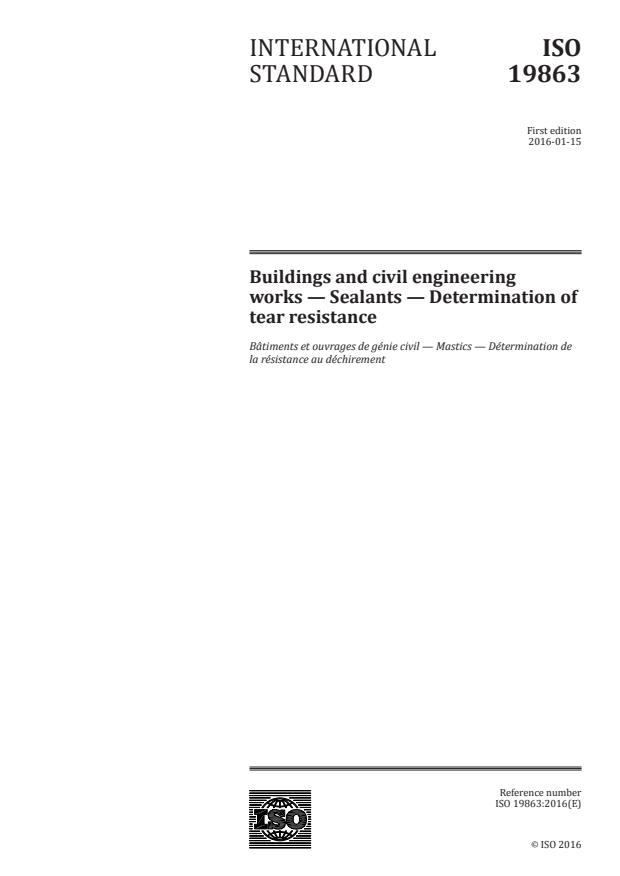
INTERNATIONAL ISO
STANDARD 19863
First edition
2016-01-15
Buildings and civil engineering
works — Sealants — Determination of
tear resistance
Bâtiments et ouvrages de génie civil — Mastics — Détermination de
la résistance au déchirement
Reference number
©
ISO 2016
© ISO 2016, Published in Switzerland
All rights reserved. Unless otherwise specified, no part of this publication may be reproduced or utilized otherwise in any form
or by any means, electronic or mechanical, including photocopying, or posting on the internet or an intranet, without prior
written permission. Permission can be requested from either ISO at the address below or ISO’s member body in the country of
the requester.
ISO copyright office
Ch. de Blandonnet 8 • CP 401
CH-1214 Vernier, Geneva, Switzerland
Tel. +41 22 749 01 11
Fax +41 22 749 09 47
copyright@iso.org
www.iso.org
ii © ISO 2016 – All rights reserved
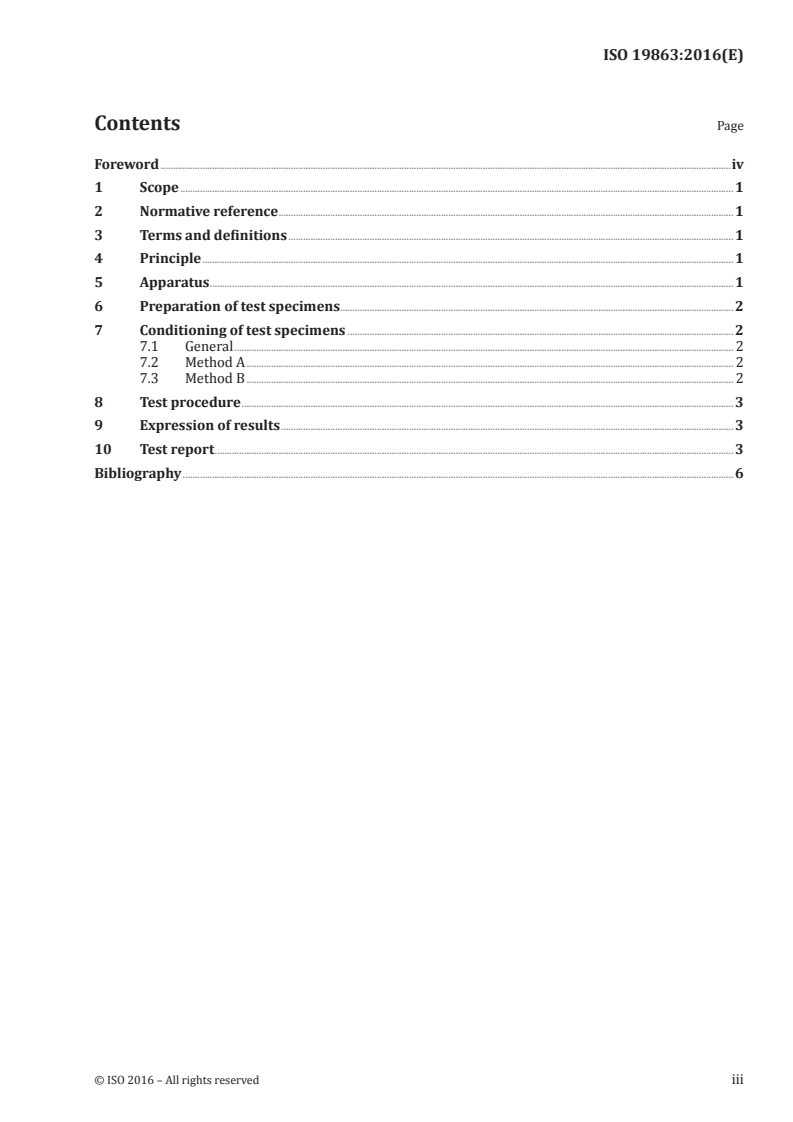
Contents Page
Foreword .iv
1 Scope . 1
2 Normative reference . 1
3 Terms and definitions . 1
4 Principle . 1
5 Apparatus . 1
6 Preparation of test specimens . 2
7 Conditioning of test specimens . 2
7.1 General . 2
7.2 Method A . 2
7.3 Method B . 2
8 Test procedure . 3
9 Expression of results . 3
10 Test report . 3
Bibliography . 6
Foreword
ISO (the International Organization for Standardization) is a worldwide federation of national standards
bodies (ISO member bodies). The work of preparing International Standards is normally carried out
through ISO technical committees. Each member body interested in a subject for which a technical
committee has been established has the right to be represented on that committee. International
organizations, governmental and non-governmental, in liaison with ISO, also take part in the work.
ISO collaborates closely with the International Electrotechnical Commission (IEC) on all matters of
electrotechnical standardization.
The procedures used to develop this document and those intended for its further maintenance are
described in the ISO/IEC Directives, Part 1. In particular the different approval criteria needed for the
different types of ISO documents should be noted. This document was drafted in accordance with the
editorial rules of the ISO/IEC Directives, Part 2 (see www.iso.org/directives).
Attention is drawn to the possibility that some of the elements of this document may be the subject of
patent rights. ISO shall not be held responsible for identifying any or all such patent rights. Details of
any patent rights identified during the development of the document will be in the Introduction and/or
on the ISO list of patent declarations received (see www.iso.org/patents).
Any trade name used in this document is information given for the convenience of users and does not
constitute an endorsement.
For an explanation on the meaning of ISO specific terms and expressions related to conformity
assessment, as well as information about ISO’s adherence to the WTO principles in the Technical
Barriers to Trade (TBT) see the following URL: Foreword - Supplementary information
The committee responsible for this document is ISO/TC 59, Buildings and civil engineering works,
Subcommittee SC 8, Sealants.
iv © ISO 2016 – All rights reserved
INTERNATIONAL STANDARD ISO 19863:2016(E)
Buildings and civil engineering works — Sealants —
Determination of tear resistance
1 Scope
This international standard specifies a method for the determination of the tear resistance of sealants
used in joints in building construction.
2 Normative reference
The following documents, in whole or in part, are normatively referenced in this document and are
indispensable for its application. For dated references, only the edition cited applies. For undated
references, the latest edition of the referenced document (including any amendments) applies.
ISO 6927, Buildings and civil engineering works — Sealants — Vocabulary
3 Terms and definitions
For the purposes of this document, the terms and definitions given in ISO 6927 apply.
4 Principle
Test specimens are prepared such that the sealant to be tested adheres to two parallel contact surfaces.
An incision is realized in the sealant to a defined length. The test specimens are extended to a defin
...
INTERNATIONAL ISO
STANDARD 19863
First edition
2016-01-15
Buildings and civil engineering
works — Sealants — Determination of
tear resistance
Bâtiments et ouvrages de génie civil — Mastics — Détermination de
la résistance au déchirement
Reference number
©
ISO 2016
© ISO 2016, Published in Switzerland
All rights reserved. Unless otherwise specified, no part of this publication may be reproduced or utilized otherwise in any form
or by any means, electronic or mechanical, including photocopying, or posting on the internet or an intranet, without prior
written permission. Permission can be requested from either ISO at the address below or ISO’s member body in the country of
the requester.
ISO copyright office
Ch. de Blandonnet 8 • CP 401
CH-1214 Vernier, Geneva, Switzerland
Tel. +41 22 749 01 11
Fax +41 22 749 09 47
copyright@iso.org
www.iso.org
ii © ISO 2016 – All rights reserved
Contents Page
Foreword .iv
1 Scope . 1
2 Normative reference . 1
3 Terms and definitions . 1
4 Principle . 1
5 Apparatus . 1
6 Preparation of test specimens . 2
7 Conditioning of test specimens . 2
7.1 General . 2
7.2 Method A . 2
7.3 Method B . 2
8 Test procedure . 3
9 Expression of results . 3
10 Test report . 3
Bibliography . 6
Foreword
ISO (the International Organization for Standardization) is a worldwide federation of national standards
bodies (ISO member bodies). The work of preparing International Standards is normally carried out
through ISO technical committees. Each member body interested in a subject for which a technical
committee has been established has the right to be represented on that committee. International
organizations, governmental and non-governmental, in liaison with ISO, also take part in the work.
ISO collaborates closely with the International Electrotechnical Commission (IEC) on all matters of
electrotechnical standardization.
The procedures used to develop this document and those intended for its further maintenance are
described in the ISO/IEC Directives, Part 1. In particular the different approval criteria needed for the
different types of ISO documents should be noted. This document was drafted in accordance with the
editorial rules of the ISO/IEC Directives, Part 2 (see www.iso.org/directives).
Attention is drawn to the possibility that some of the elements of this document may be the subject of
patent rights. ISO shall not be held responsible for identifying any or all such patent rights. Details of
any patent rights identified during the development of the document will be in the Introduction and/or
on the ISO list of patent declarations received (see www.iso.org/patents).
Any trade name used in this document is information given for the convenience of users and does not
constitute an endorsement.
For an explanation on the meaning of ISO specific terms and expressions related to conformity
assessment, as well as information about ISO’s adherence to the WTO principles in the Technical
Barriers to Trade (TBT) see the following URL: Foreword - Supplementary information
The committee responsible for this document is ISO/TC 59, Buildings and civil engineering works,
Subcommittee SC 8, Sealants.
iv © ISO 2016 – All rights reserved
INTERNATIONAL STANDARD ISO 19863:2016(E)
Buildings and civil engineering works — Sealants —
Determination of tear resistance
1 Scope
This international standard specifies a method for the determination of the tear resistance of sealants
used in joints in building construction.
2 Normative reference
The following documents, in whole or in part, are normatively referenced in this document and are
indispensable for its application. For dated references, only the edition cited applies. For undated
references, the latest edition of the referenced document (including any amendments) applies.
ISO 6927, Buildings and civil engineering works — Sealants — Vocabulary
3 Terms and definitions
For the purposes of this document, the terms and definitions given in ISO 6927 apply.
4 Principle
Test specimens are prepared such that the sealant to be tested adheres to two parallel contact surfaces.
An incision is realized in the sealant to a defined length. The test specimens are extended to a defin
...