


ISO/ASTM 51649:2015
(Main)Practice for dosimetry in an electron beam facility for radiation processing at energies between 300 keV and 25 MeV
Practice for dosimetry in an electron beam facility for radiation processing at energies between 300 keV and 25 MeV
ISO/ASTM 51649:2015 outlines dosimetric procedures to be followed in installation qualification (IQ), operational qualification (OQ) and performance qualifications (PQ), and routine processing at electron beam facilities. The electron beam energy range covered in this practice is between 300 keV and 25 MeV, although there are some discussions for other energies. Dosimetry is only one component of a total quality assurance program for adherence to good manufacturing practices used in radiation processing applications. Other measures besides dosimetry may be required for specific applications such as health care product sterilization and food preservation. ISO/ASTM 51649:2015 is one of a set of standards that provides recommendations for properly implementing and utilizing dosimetry in radiation processing. It is intended to be read in conjunction with ISO/ASTM 52628, "Practice for Dosimetry in Radiation Processing".
Pratique de la dosimétrie dans une installation de traitement par irradiation utilisant un faisceau d'électrons d'énergies comprises entre 300 keV et 25 MeV
General Information
Relations
Standards Content (Sample)
INTERNATIONAL ISO/ASTM
STANDARD 51649
Third edition
2015-03-15
Practice for dosimetry in an electron
beam facility for radiation processing at
energies between 300 keV and 25 MeV
Pratique de la dosimétrie dans une installation de traitement par
irradiation utilisant un faisceau d’électrons d’énergies comprises
entre 300 keV et 25 MeV
Reference number
© ISO/ASTM International 2015
PDF disclaimer
This PDF file may contain embedded typefaces. In accordance withAdobe’s licensing policy, this file may be printed or viewed but
shall not be edited unless the typefaces which are embedded are licensed to and installed on the computer performing the editing.
In downloading this file, parties accept therein the responsibility of not infringing Adobe’s licensing policy. Neither the ISO Central
Secretariat nor ASTM International accepts any liability in this area.
Adobe is a trademark of Adobe Systems Incorporated.
Details of the software products used to create this PDF file can be found in the General Info relative to the file; the PDF-creation
parameters were optimized for printing. Every care has been taken to ensure that the file is suitable for use by ISO member bodies
andASTM members. In the unlikely event that a problem relating to it is found, please inform the ISO Central Secretariat orASTM
International at the addresses given below.
© ISO/ASTM International 2015
All rights reserved. Unless otherwise specified, no part of this publication may be reproduced or utilized in any form or by any means, electronic or
mechanical, including photocopying and microfilm, without permission in writing from either ISO at the address below or ISO’s member body in the
country of the requester. In the United States, such requests should be sent to ASTM International.
ISO copyright office ASTM International,100 Barr Harbor Drive, PO Box C700,
Case postale 56 • CH-1211 Geneva 20 West Conshohocken, PA 19428-2959, USA
Tel. +41 22 749 01 11 Tel. +610 832 9634
Fax +41 22 749 09 47 Fax +610 832 9635
E-mail copyright@iso.org E-mail khooper@astm.org
Web www.iso.org Web www.astm.org
Published in Switzerland
ii © ISO/ASTM International 2015 – All rights reserved
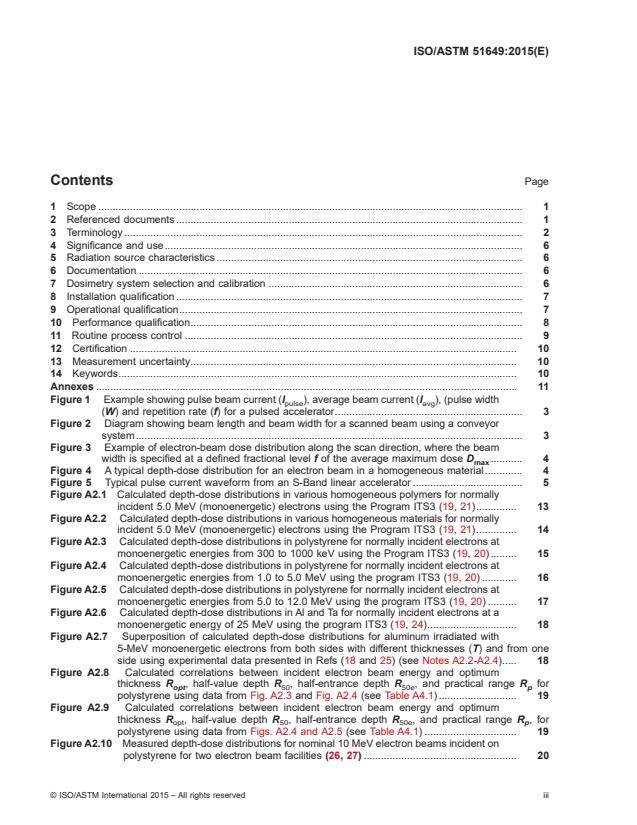
Contents Page
1 Scope. 1
2 Referenced documents. 1
3 Terminology. 2
4 Significance and use. 6
5 Radiation source characteristics. 6
6 Documentation. 6
7 Dosimetry system selection and calibration. 6
8 Installation qualification. 7
9 Operational qualification. 7
10 Performance qualification. 8
11 Routine process control. 9
12 Certification. 10
13 Measurement uncertainty. 10
14 Keywords. 10
Annexes. 11
Figure1 Exampleshowingpulsebeamcurrent(I ),averagebeamcurrent(I ),(pulsewidth
pulse avg
(W) and repetition rate (f) for a pulsed accelerator. 3
Figure 2 Diagram showing beam length and beam width for a scanned beam using a conveyor
system. 3
Figure 3 Example of electron-beam dose distribution along the scan direction, where the beam
width is specified at a defined fractional level f of the average maximum dose D . 4
max
Figure 4 A typical depth-dose distribution for an electron beam in a homogeneous material. 4
Figure 5 Typical pulse current waveform from an S-Band linear accelerator. 5
Figure A2.1 Calculated depth-dose distributions in various homogeneous polymers for normally
incident 5.0 MeV (monoenergetic) electrons using the Program ITS3 (19, 21). 13
FigureA2.2 Calculateddepth-dosedistributionsinvarioushomogeneousmaterialsfornormally
incident 5.0 MeV (monoenergetic) electrons using the Program ITS3 (19, 21). 14
FigureA2.3 Calculateddepth-dosedistributionsinpolystyrenefornormallyincidentelectronsat
monoenergetic energies from 300 to 1000 keV using the Program ITS3 (19, 20). 15
FigureA2.4 Calculateddepth-dosedistributionsinpolystyrenefornormallyincidentelectronsat
monoenergetic energies from 1.0 to 5.0 MeV using the program ITS3 (19, 20). 16
FigureA2.5 Calculateddepth-dosedistributionsinpolystyrenefornormallyincidentelectronsat
monoenergetic energies from 5.0 to 12.0 MeV using the program ITS3 (19, 20). 17
FigureA2.6 Calculated depth-dose distributions inAl andTa for normally incident electrons at a
monoenergetic energy of 25 MeV using the program ITS3 (19, 24). 18
Figure A2.7 Superposition of calculated depth-dose distributions for aluminum irradiated with
5-MeV monoenergetic electrons from both sides with different thicknesses (T) and from one
side using experimental data presented in Refs (18 and 25) (see Notes A2.2-A2.4). 18
Figure A2.8 Calculated correlations between incident electron beam energy and optimum
thickness R , half-value depth R , half-entrance depth R , and practical range R for
opt 50 50e p
polystyrene using data from Fig. A2.3 and Fig. A2.4 (see Table A4.1). 19
Figure A2.9 Calculated correlations between incident electron beam energy and optimum
thickness R , half-value depth R , half-entrance depth R , and practical range R , for
opt 50 50e p
polystyrene using data from Figs. A2.4 and A2.5 (see Table A4.1). 19
FigureA2.10 Measureddepth-dosedistributionsfornominal10MeVelectronbeamsincidenton
polystyrene for two electron beam facilities (26, 27). 20
© ISO/ASTM International 2015 – All rights reserved iii
Figure A2.11 Depth-dose distributions in stacks of cellulose acetate films backed with wood,
aluminum, and iron for incident electrons with 400 keV energy (30). 21
Figure A2.12 Depth-dose distributions with 2 MeV electrons incident on polystyrene absorbers
at various angles from the normal direction (31). 21
Figure A3.1 Stack measurement device. 22
Figure A3.2 Wedge measurement device. 23
Figure A5.1 Example of dose as function of average beam current (I), conveyor speed (V) and
beam width (W ). 26
b
Figure A7.1 Different scan characteristics used for electron beams. 28
Figure A7.2 Example of a scanned and pulsed beam with parameters needed for beam spot
calculations indicated. 28
FigureA8.1 Example of isodose curves obtained by irradiation at a 10-MeV electron accelerator
of expanded polystyrene foam (specific density approximately 0.1 g/cm ). 29
FigureA10.1 Electron energy deposition at the entrance surface of a polystyrene absorber as a
functionofincidentelectronenergyfrom0.3MeVto12MeVcorrespondingtotheMonteCarlo
calculated data shown in Figs. A2.3-A2.5. 31
FigureA10.2 Electron energy deposition at the entrance surface of a polystyrene absorber as a
function of incident electron energy from 0.3 MeV to 2.0 MeV corresponding to the Monte
Carlo calculated data shown in Fig. A2.3 and Fig. A2.4. 32
Table . 4
TableA2.1 Keyparametersformeasureddepth-dosedistributioncurvespresentedinFig.A2.10. 20
Table A3.1 Some relevant properties of common reference materials. 22
TableA4.1 Half-valuedepthR ,half-entrancedepthR ,optimumthicknessR andpractical
50 50e opt
rangeR inpolystyreneformonoenergeticelectronenergiesEfrom0.3to12MeVderivedfrom
p
Monte Carlo calculations (20). 25
TableA4.2 Half-value depthR , practical rangeR and extrapolated rangeR in aluminum for
50 p ex
monoenergetic.electronenergyEfrom2.5to25MeVderivedfromMonteCarlocalculations. (2525)
Table A10.1 Electron energy deposition at the entrance surface of a polystyrene absorber as a
function of incident electron energy from 0.3 MeV to 12 MeV corresponding to the calculated
curves shown in Figs. A2.3-A2.5. 32
Table A11.1 Needs for requalification following changes of an electron beam facility. 33
iv © ISO/ASTM International 2015 – All rights reserved
Foreword
ISO(theInternationalOrganizationforStandardization)isaworldwidefederationofnationalstandardsbodies
(ISO member bodies). The work of preparing International Standards is normally carried out through ISO
technical committees. Each member body interested in a subject for which a technical committee has been
established has the right to be represented on that committee. International organizations, governmental and
non-governmental, in liaison with ISO, also take part in the work. ISO collaborates closely with the
International Electrotechnical Commission (IEC) on all matters of electrotechnical standardization.
Draft International Standards adopted by the technical committees are circulated to the member bodies for
voting. Publication as an International Standard requires approval by at least 75% of the member bodies
casting a vote.
ASTM International is one of the world’s largest voluntary standards development organizations with global
participation from affected stakeholders. ASTM technical committees follow rigorous due process balloting
procedures.
A project between ISO and ASTM International has been formed to develop and maintain a group of
ISO/ASTM radiation processing dosimetry standards. Under this project, ASTM Committee E61, Radiation
Processing, is responsible for the development and maintenance of these dosimetry standards with
unrestricted participation and input from appropriate ISO member bodies.
Attention is drawn to the possibility that some of the elements of this document may be the subject of patent
rights. Neither ISO nor ASTM International shall be held responsible for identifying any or all such patent
rights.
International Standard ISO/ASTM 51649 was developed by ASTM Committee E61, Radiation Processing,
through Subcommittee E61.03, Dosimetry Application, and by Technical Committee ISO/TC 85, Nuclear
energy, nuclear technologies and radiological protection.
This third edition cancels and replaces the second edition (ISO/ASTM 51649:2005), which has been
technically revised.
© ISO/ASTM International 2015 – All rights reserved v
vi © ISO/ASTM International 2015 – All rights reserved
An American National Standard
Standard Practice for
Dosimetry in an Electron Beam Facility for Radiation
Processing at Energies Between 300 keV and 25 MeV
This standard is issued under the fixed designation ISO/ASTM 51649; the number immediately following the designation indicates the
year of original adoption or, in the case of revision, the year of last revision.
1. Scope priate safety and health practices and determine the applica-
bility of regulatory requirements prior to use.
1.1 This practice outlines dosimetric procedures to be fol-
lowed in installation qualification (IQ), operational qualifica-
2. Referenced documents
tion (OQ) and performance qualifications (PQ), and routine
2.1 ASTM Standards:
processing at electron beam facilities.
E170Terminology Relating to Radiation Measurements and
1.2 The electron beam energy range covered in this practice
Dosimetry
is between 300 keV and 25 MeV, although there are some
E2232Guide for Selection and Use of Mathematical Meth-
discussions for other energies.
ods for Calculating Absorbed Dose in Radiation Process-
1.3 Dosimetry is only one component of a total quality
ing Applications
assurance program for adherence to good manufacturing prac- E2303Guide for Absorbed-Dose Mapping in Radiation
tices used in radiation processing applications. Other measures
Processing Facilities
besides dosimetry may be required for specific applications F1355GuideforIrradiationofFreshAgriculturalProduceas
such as health care product sterilization and food preservation.
a Phytosanitary Treatment
F1356PracticeforIrradiationofFreshandFrozenRedMeat
1.4 Specific standards exist for the radiation sterilization of
and Poultry to Control Pathogens and Other Microorgan-
health care products and the irradiation of food. For the
isms
radiation sterilization of health care products, see ISO 11137-1
F1736Guide for Irradiation of Finfish and Aquatic Inverte-
(Requirements) and ISO 11137-3 (Guidance on dosimetric
brates Used as Food to Control Pathogens and Spoilage
aspects). For irradiation of food, see ISO 14470. In those areas
Microorganisms
covered by these standards, they take precedence. Information
F1885Guide for Irradiation of Dried Spices, Herbs, and
about effective or regulatory dose limits for food products is
Vegetable Seasonings to Control Pathogens and Other
notwithinthescopeofthispractice(seeASTMGuidesF1355,
Microorganisms
F1356, F1736, and F1885).
2.2 ISO/ASTM Standards:
1.5 This document is one of a set of standards that provides
51261Practice for Calibration of Routine Dosimetry Sys-
recommendations for properly implementing and utilizing
tems for Radiation Processing
dosimetry in radiation processing. It is intended to be read in
51275Practice for Use of a Radiochromic Film Dosimetry
conjunction with ISO/ASTM 52628, “Practice for Dosimetry
System
in Radiation Processing”.
51539Guide for the Use of Radiation-Sensitive Indicators
NOTE 1—For guidance in the calibration of routine dosimetry systems,
51608PracticeforDosimetryinanX-Ray(Bremsstrahlung)
seeISO/ASTMPractice51261.Forfurtherguidanceintheuseofspecific
Facility for Radiation Processing
dosimetry systems, see relevant ISO/ASTM Practices. For discussion of
radiation dosimetry for pulsed radiation, see ICRU Report 34. 51702Practice for Dosimetry in a Gamma Facility for
Radiation Processing
1.6 This standard does not purport to address all of the
51707Guide for Estimating Uncertainties in Dosimetry for
safety concerns, if any, associated with its use. It is the
Radiation Processing
responsibility of the user of this standard to establish appro-
51818Practice for Dosimetry in an Electron Beam Facility
for Radiation Processing at Energies Between 80 and 300
This practice is under the jurisdiction of ASTM Committee E61 on Radiation
keV
Processing and is the direct responsibility of Subcommittee E61.03 on Dosimetry
52628Practice for Dosimetry in Radiation Processing
Application, and is also under the jurisdiction of ISO/TC 85/WG 3.
Current edition approved Sept. 8, 2014. Published February 2015. Originally
published as E 1649–94. Last previous ASTM edition E 1649–00. ASTM
ε1 2
E1649–94 was adopted by ISO in 1998 with the intermediate designation ISO For referenced ASTM and ISO/ASTM standards, visit the ASTM website,
15569:1998(E). The present International Standard ISO/ASTM 51649:2015(E) is a www.astm.org, or contact ASTM Customer Service at service@astm.org. For
major revision of the last previous edition ISO/ASTM 51649:2005(E), which Annual Book of ASTM Standards volume information, refer to the standard’s
replaced ISO/ASTM 51649:2002(E). Document Summary page on the ASTM website.
© ISO/ASTM International 2015 – All rights reserved
52701Guide for Performance Characterization of Dosim- ISO/IEC 17025, or has a quality system consistent with the
eters and Dosimetry Systems for Use in Radiation Pro- requirements of ISO/IEC 17025.
cessing
3.1.2.1 Discussion—A recognized national metrology insti-
2.3 ISO Standards:
tute or other calibration laboratory accredited to ISO/IEC
ISO 11137-1Sterilization of Health Care Products–Radia-
17025 or its equivalent should be used for issue of reference
tion – Part 1: Requirements for development, validation,
standard dosimeters or irradiation of dosimeters in order to
and routine control of a sterilization process for medical
ensure traceability to a national or international standard. A
devices
calibration certificate provided by a laboratory not having
ISO 11137-3Sterilization of Health Care Products–Radia-
formal recognition or accreditation will not necessarily be
tion – Part 3: Guidance on dosimetric aspects
proof of traceability to a national or international standard.
ISO 14470 Food Irradiation – Requirements for the
3.1.3 average beam current—time-averaged electron beam
development,validationandroutinecontroloftheprocess
current; for a pulsed accelerator, the averaging shall be done
of irradiation using ionizing radiation for the treatment of
over a large number of pulses (see Fig. 1).
food
3.1.4 beam length—dimension of the irradiation zone along
ISO 10012Measurement Management Systems – Require-
the direction of product movement at a specified distance from
ments for Measurement Processes and Measuring Equip-
the accelerator window (see Fig. 2).
ment
ISO/IEC 17025General Requirements for the Competence 3.1.4.1 Discussion—Beam length is therefore perpendicular
of Calibration and Testing Laboratories tobeamwidthandtotheelectronbeamaxis.Incaseofproduct
that is stationary during irradiation, ‘beam length’ and ‘beam
2.4 International Commission on Radiation Units and Mea-
surements (ICRU) Reports: width’ may be interchangeable.
ICRU Report 34The Dosimetry of Pulsed Radiation
3.1.5 beam width (W )—dimension of the irradiation zone
b
ICRU Report 35Radiation Dosimetry: Electron Beams with
perpendicular to the direction of product movement at a
Energies Between 1 and 50 MeV
specified distance from the accelerator window (see Fig. 2).
ICRU Report 37Stopping Powers for Electrons and Posi-
3.1.5.1 Discussion—For a radiation processing facility with
trons
a conveyor system, the beam width is usually perpendicular to
ICRU Report 80Dosimetry for Use in Radiation Processing
the direction of motion of the conveyor (see Fig. 2). Beam
ICRU Report 85aFundamental Quantities and Units for
widthisthedistancebetweentwopointsalongthedoseprofile,
Ionizing Radiation
which are at a defined level from the maximum dose region in
2.5 Joint Committee for Guides in Metrology (JCGM)
theprofile(seeFig.3).Varioustechniquesmaybeemployedto
Reports:
produceanelectronbeamwidthadequatetocovertheprocess-
JCGM 100:2008, GUM 1995, with minor corrections,
ing zone, for example, use of electromagnetic scanning of a
Evaluationofmeasurementdata–Guidetotheexpression
pencil beam (in which case beam width is also referred to as
of uncertainty in measurement
scan width), defocussing elements, and scattering foils.
3. Terminology
3.1.6 compensating dummy—see simulated product.
3.1 Definitions:
3.1.7 depth-dose distribution—variation of absorbed dose
3.1.1 absorbed dose (D)—quantity of ionizing radiation
with depth from the incident surface of a material exposed to
energy imparted per unit mass of a specified material.
a given radiation.
3.1.1.1 Discussion—(1) The SI unit of absorbed dose is the
3.1.7.1 Discussion—Typical distributions along the beam
gray (Gy), where 1 gray is equivalent to the absorption of 1
axis in homogeneous materials produced by a normally inci-
joule per kilogram in the specified material (1 Gy = 1 J/kg).
dent monoenergetic electron beam are shown in Annex A2.
The mathematical relationship is the quotient of dε¯ by dm,
3.1.8 dose uniformity ratio (DUR)—ratio of the maximum
where dε¯ is the mean incremental energy imparted by ionizing
to the minimum absorbed dose within the irradiated product.
radiation to matter of incremental mass dm. (See ICRU Report
3.1.8.1 Discussion—The concept is also referred to as the
85a.)
max/min dose ratio.
D 5 dHε/dm
3.1.9 dosimetry system—system used for measuring ab-
3.1.1.2 Discussion—(2) Absorbed dose is sometimes re-
sorbed dose, consisting of dosimeters, measurement instru-
ferred to simply as dose.
ments and their associated reference standards, and procedures
3.1.2 approved laboratory—laboratory that is a recognized
for the system’s use.
nationalmetrologyinstitute;orhasbeenformallyaccreditedto
3.1.10 electron beam energy—kinetic energy of the acceler-
ated electrons in the beam. Unit: J
Available from International Organization for Standardization, 1 Rue de
3.1.10.1 Discussion—Electron volt (eV) is often used as the
Varembé, Case Postale 56, CH-1211 Geneva 20, Switzerland.
4 -19
Available from the International Commission on Radiation Units and
unit for electron beam energy where 1 eV = 1.602·10 J. In
Measurements, 7910 Woodmont Ave., Suite 800, Bethesda MD 20814, U.S.A.
radiation processing, where beams with a broad electron
Document produced byWorking Group 1 of the Joint Committee for Guides in
energy spectrum are frequently used, the terms most probable
Metrology (JCGM/WG 1). Available free of charge at the BIPM website (http://
www.bipm.org). energy (E ) and average energy (E ) are common. They are
p a
© ISO/ASTM International 2015 – All rights reserved
FIG. 1 Example showing pulse beam current (I ), average beam current (I ), (pulse width (W) and repetition rate (f) for a pulsed
pulse avg
accelerator
3.1.13 installation qualification (IQ)—process of obtaining
and documenting evidence that equipment has been provided
and installed in accordance with its specification.
3.1.14 operationalqualification(OQ)—processofobtaining
and documenting evidence that installed equipment operates
within predetermined limits when used in accordance with its
operational procedures.
3.1.15 performance qualification (PQ)—process of obtain-
ing and documenting evidence that the equipment, as installed
and operated in accordance with operational procedures, con-
sistently performs in accordance with predetermined criteria
and thereby yields product meeting its specification.
3.1.16 process load—volume of material with a specified
product loading configuration irradiated as a single entity.
3.1.17 production run—seriesofprocessloadsconsistingof
FIG. 2 Diagram showing beam length and beam width for a materials or products having similar radiation-absorption
scanned beam using a conveyor system
characteristics, that are irradiated sequentially to a specified
range of absorbed dose.
3.1.18 referencematerial—homogeneousmaterialofknown
linked to the practical electron range R and half-value
p
depth R by empirical equations (see Fig. 4 and Annex A4). radiation absorption and scattering properties used to establish
characteristics of the irradiation process, such as scan
3.1.11 electron beam facility—establishment that uses ener-
uniformity,depth-dosedistribution,andreproducibilityofdose
getic electrons produced by particle accelerators to irradiate
delivery.
product.
3.1.12 electron energy spectrum—particle fluence distribu- 3.1.19 reference plane—selected plane in the radiation zone
tion of electrons as a function of energy. that is perpendicular to the electron beam axis.
© ISO/ASTM International 2015 – All rights reserved
FIG. 3 Example of electron-beam dose distribution along the scan direction, where the beam width is specified at a defined fractional
level f of the average maximum dose D
max
where the relationship of the dose at this position with the
minimum and maximum dose has been established.
3.1.21 simulated product—material with radiation absorp-
tion and scattering properties similar to those of the product,
material or substance to be irradiated.
3.1.21.1 Discussion—Simulated product is used during irra-
diator characterization as a substitute for the actual product,
material or substance to be irradiated. When used in routine
production runs in order to compensate for the absence of
product, simulated product is sometimes referred to as com-
pensating dummy. When used for absorbed-dose mapping,
simulated product is sometimes referred to as phantom mate-
rial.
3.1.22 standardized depth (z)—thickness of the absorbing
material expressed as the mass per unit area, which is equal to
the product of depth in the material t and density ρ.
D : Dose at entrance surface
e
3.1.22.1 Discussion—If m is the mass of the material
R : Depth at which dose at descending part of curve equals D
opt e
R : Depth at which dose has decreased to 50 % of its maximum
beneath area A of the material through which the beam passes,
value
then:
R : Depth at which dose has decreased to 50 % of D
50e e
R : Depth where extrapolated straight line of descending curve
p z 5 m/A 5 tρ
meets depth axis
The SI unit of z is in kg/m , however, it is common practice
to express t in centimetres and ρ in grams per cm , then z is
FIG. 4 A typical depth-dose distribution for an electron beam in
in grams per square centimetre. Standardized depth may also
a homogeneous material
be referred to as surface density, area density, mass-depth or
mass-thickness.
3.2 Definitions of Terms Specific to This Standard:
3.1.20 routine monitoring position—position where ab-
3.2.1 beam power—product of the average electron beam
sorbed dose is monitored during routine processing to ensure
energy and the average beam current.
thattheproductisreceivingtheabsorbeddosespecifiedforthe
3.2.2 beam spot—shape of the unscanned electron beam
process.
incident on the reference plane.
3.1.20.1 Discussion—This position may be a location of
minimumormaximumdoseintheprocessloadoritmaybean 3.2.3 continuous-slowing-down-approximation (CSDA)
alternate convenient location in, on or near the process load range (r )—average pathlength traveled by a charged particle
© ISO/ASTM International 2015 – All rights reserved
as it slows down to rest, calculated in the continuous-slowing- 3.2.9 optimum thickness (R )—depth in homogeneous ma-
opt
down-approximation method. terial at which the absorbed dose equals its value at the
3.2.3.1 Discussion—In this approximation, the rate of en- entrance surface of the material (see Fig. 4).
ergy loss at every point along the track is assumed to be equal
3.2.10 practical electron range (R )—depth in homoge-
p
to the total stopping power. Energy-loss fluctuations are
neous material to the point where the tangent at the steepest
neglected. The CSDA range is obtained by integrating the
point (the inflection point) on the almost straight descending
reciprocal of the total stopping power with respect to energy.
portion of the depth-dose distribution curve meets the extrapo-
Valuesof r forawiderangeofelectronenergiesandformany
0 lated X-ray background (see Fig. 4 and Fig. A2.6 in Annex
materials can be obtained from ICRU Report 37.
A2).
3.2.4 duty cycle (for a pulsed accelerator)—fraction of time 3.2.10.1 Discussion—Penetration can be measured from
the beam is effectively on. experimental depth-dose distributions in a given material.
Other forms of electron range are found in the dosimetry
3.2.4.1 Discussion—Duty cycle is the product of the pulse
literature, for example, extrapolated range derived from depth-
width(w)insecondsandthepulserate(f)inpulsespersecond.
dose data and the continuous-slowing-down-approximation
3.2.5 electron beam range—penetration distance in a
range.Electronrangeisusuallyexpressedintermsofmassper
specific, totally absorbing material along the beam axis of the
-2
unit area (kg·m ), but sometimes in terms of thickness (m) for
electrons incident on the material.
a specified material.
3.2.6 extrapolated electron range (R )—depth in homoge-
ex
3.2.11 pulse beam current, for a pulsed accelerator—beam
neous material to the point where the tangent at the steepest
current averaged over the top ripples (aberrations) of the pulse
point (the inflection point) on the almost straight descending
current waveform.
portionofthedepth-dosedistributionmeetsthedepthaxis(see
Fig. A2.6 in Annex A2). 3.2.11.1 Discussion—Its value may be calculated as I /wf,
avg
where I is the average beam current, w is the pulse width,
3.2.7 half-entrance depth (R )—depth in homogeneous avg
50e
and f is the pulse rate (see Fig. 5).
material at which the absorbed dose has decreased to 50 % of
3.2.12 pulse rate (for a pulsed accelerator) (f)—pulse rep-
its value at the entrance surface of the material (see Fig. 4).
etition frequency in hertz, or pulses per second.
3.2.8 half value depth (R )—depth in homogeneous mate-
rial at which the absorbed dose has decreased to 50 % of its 3.2.12.1 Discussion—This is also referred to as the repeti-
maximum value (see Fig. 4). tion (rep) rate.
Horizontal axis: Time, µs
Vertical axis: Pulse beam current, mA
FIG. 5 Typical pulse current waveform from an S-Band linear accelerator
© ISO/ASTM International 2015 – All rights reserved
water. Materials commonly found in single-use disposable medical
3.2.13 pulse width (for a pulsed accelerator) (w)—time
devices and food are approximately equivalent to water in the absorption
intervalbetweentwopointsontheleadingandtrailingedgesof
of ionizing radiation.Absorbed dose in materials other than water may be
the pulse current waveform where the current is 50% of its
determined by applying conversion factors (5, 6).
peak value (see Fig. 5).
4.3 An irradiation process usually requires a minimum
3.2.14 scanned beam—electronbeamthatissweptbackand
absorbed dose to achieve the desired effect. There may also be
forth with a varying magnetic field.
a maximum dose limit that the product can tolerate while still
3.2.14.1 Discussion—This is most commonly done along
meeting its functional or regulatory specifications. Dosimetry
one dimension (beam width), although two-dimensional scan-
is essential, since it is used to determine both of these limits
ning (beam width and length) may be used with high-current
during the research and development phase, and also to
electron beams to avoid overheating the beam exit window of
confirm that the product is routinely irradiated within these
the accelerator or product under the scan horn.
limits.
3.2.15 scan frequency—number of complete scanning
4.4 The dose distribution within the product depends on
cycles per second.
process load characteristics, irradiation conditions, and operat-
3.2.16 scan uniformity—degree of uniformity of the dose
ing parameters.
measured along the scan direction.
4.5 Dosimetry systems must be calibrated with traceability
3.3 Definitions—Definitions of other terms used in this
to national or international standards and the measurement
standard that pertain to radiation measurement and dosimetry
uncertainty must be known.
may be found in ASTM Terminology E170. Definitions in
E170arecompatiblewithICRU85a;thatdocument,therefore,
4.6 Before a radiation facility is used, it must be character-
may be used as an alternative reference.
ized to determine its effectiveness in reproducibly delivering
known, controllable doses. This involves testing and calibrat-
4. Significance and use
ing the process equipment, and dosimetry system.
4.1 Various products and materials are routinely irradiated
4.7 Before a radiation process is commenced it must be
at pre-determined doses at electron beam facilities to preserve
validated. This involves execution of Installation Qualification
or modify their characteristics. Dosimetry requirements may
(IQ), Operational Qualification (OQ), and Performance Quali-
vary depending on the radiation process and end use of the
fication (PQ), based on which process parameters are estab-
product. A partial list of processes where dosimetry may be
lishedthatwillensurethatproductisirradiatedwithinspecified
used is given below.
limits.
4.1.1 Polymerization of monomers and grafting of mono-
4.8 Toensureconsistentandreproducibledosedeliveryina
mers onto polymers,
validated process, routine process control requires that docu-
4.1.2 Cross-linking or degradation of polymers,
mented procedures are established for activities to be carried
4.1.3 Curing of composite materials,
out before, during and after irradiation, such as for ensuring
4.1.4 Sterilization of health care products,
consistent product loading configuration and for monitoring of
4.1.5 Disinfection of consumer products,
critical operating parameters and routine dosimetry.
4.1.6 Food irradiation (parasite and pathogen control, insect
disinfestation, and shelf-life extension),
5. Radiation source characteristics
4.1.7 Control of pathogens and toxins in drinking water,
4.1.8 Control of pathogens and toxins in liquid or solid
5.1 Electron sources considered in this practice are either
waste,
direct-action (potential-drop) or indirect-action (Radio Fre-
4.1.9 Modification of characteristics of semiconductor
quency (RF) or microwave-powered accelerators. These are
devices,
discussed in Annex A1.
4.1.10 Color enhancement of gemstones and other
materials, and
6. Documentation
4.1.11 Research on radiation effects on materials.
6.1 Documentation for the irradiation facility must be re-
4.2 Dosimetry is used as a means of monitoring the irradia-
tained in accordance with the requirements of a quality
tion process.
management system. Typically, all facility related documenta-
NOTE 2—Dosimetry with measurement traceability and known uncer-
tion is retained for the life of the facility, and product related
tainty is required for regulated radiation processes such as sterilization of
health care products (see ISO 11137-1 and Refs (1-3 )) and preservation documentation is related for the life of the product.
of food (see ISO 14470 and Ref (4)). It may be less important for other
processes, such as polymer modification, which may be evaluated by
7. Dosimetry system selection and calibration
changesinthephysicalandchemicalpropertiesoftheirradiatedmaterials.
Nevertheless, routine dosimetry may be used to monitor the reproducibil-
7.1 Selection of dosimetry systems:
ity of the treatment process.
7.1.1 ISO/ASTM 52628 identifies requirements for selec-
NOTE 3—Measured dose is often characterized as absorbed dose in
tion of dosimetry systems. Consideration shall specifically be
giventothelimitedrangeofelectronswhichmightgiveriseto
6 dose gradients through the thickness of the dosimeter. By
TheboldfacenumbersinparenthesesrefertotheBibliographyattheendofthis
standard. choosing thin film dosimeters this problem can be minimized.
© ISO/ASTM International 2015 – All rights reserved
NOTE 6—Dose measurements for OQ may have to be carried out using
7.1.2 When selecting a dosimetry system, consideration
a dosimetry system calibration curve obtained by irradiation at another
shall be given to effects of influence quantities on the response
facility. This calibration curve should be verified as soon as possible, and
of the dosimeter (see ISO/ASTM 52701).
corrections applied to the OQ dose measurements as needed.
7.1.3 Different dosimetry systems may be selected for
NOTE7—Multiplebeamsystemscanbecharacterizedindividuallyoras
different dose measurement tasks due to different requirements
the combined facility.
on, for example, dosimetry systems for dose mapping and
9.2 The relevant OQ dose measurements are described in
dosimetry systems for routine monitoring.
more detail in Annex A2 – Annex A9. They typically include
7.2 Dosimetry system calibration:
the following:
7.2.1 The dosimetry system shall be calibrated in accor-
9.2.1 Depth-dose distribution and electron beam energy
dance with ISO/ASTM 51261, and the user’s procedures,
estimation—The depth-dose distribution is measured by irra-
which should specify details of the calibration process and
diatingdosimetersinastackofplatesofhomogeneousmaterial
quality assurance requirements.
or by placing dosimeters or a dosimeter strip at an angle
7.2.2 Thedosimetrysystemcalibrationispartofameasure-
through a homogeneous absorber. See Annex A2 and Annex
ment management system.
A3.Electronbeamenergycanbedeterminedusingestablished
relationshipsbetweenbeamenergyanddepth-dosedistribution
8. Installation qualification
parameters. The method used for energy calculation must be
8.1 Installation qualification (IQ) is carried out to obtain
specified. See Annex A4.
documented evidence that the irradiation equipment and any
9.2.2 Doseasfunctionofaveragebeamcurrent,beamwidth
ancillary items have been supplied and installed in accordance
and conveyor speed—Dose to the product irradiated in an
with their specifications.
electron beam facility is proportional to average beam current
8.2 The specification of the electron beam facility shall be
(I), and inversely proportional to conveyor speed (V) and to
documented in the agreement between the supplier and the beam width (W ), for a given electron beam energy. This
b
operator of the facility. This agreement shall contain details
relationship is valid for product that is conveyed through the
concerning the following: radiation zone perpendicular to the beam width. This is
8.2.1 Operating procedures for the irradiator and associated
expressed as:
conveyor system.
Dose 5 K * I ⁄ V * W (1)
~ ! ~ !
b
8.2.2 Test and verification procedures for process and an-
where:
cillary equipment, including associated software, to verify
operation to design specifications. The test method(s) shall be D = Absorbed dose (Gy),
I = Average beam current (A),
documented and the results shall be recorded.
-1
V = Conveyor speed (m s ),
8.2.3 Any modifications made to the irradiator during in-
Wb = Beam width (m), and
stallation.
K = Slope of the straight line relationship in Eq 1
8.2.4 The characteristics of the electron beam (such as
(Gy*m )/(A*2).
electron energy, average beam current, beam width and beam
uniformity) shall be determined and recorded.
In order to determine the relationship, dose shall be mea-
8.2.5 Specification for equipment for conveying product
sured at a specific location and for a specific irradiation
through the irradiation zone.
geometry using a number of selected parameter sets of beam
current,conveyorspeedandbeamwidthtocovertheoperating
NOTE 4—The dose measurements carried out during IQ will often be
range of the facility. See Annex A5.
the same as the ones carried out during Operational Qualification (OQ).
Details of these dose measurements are given under OQ.
9.2.3 Beam width—The beam width is measured by placing
8.2.6 IQ typically involves measurements of beam dosimeter strips or discrete dosimeters at selected intervals
penetration,beamwidthandbeamwidthuniformitythatcanbe overthefullbeamwidthandatdefineddistancefromthebeam
used to estimate process throughput to verify the equipment window. See Annex A6.
performance specifications.
9.2.4 Beam homogeneity:
8.2.7 A dosimetry system calibration curve obtained by
9.2.4.1 For scanned beams it shall be ensured that there is
dosimeter irradiation at another facility with similar operating
sufficient overlap between scans at the highest expected prod-
characteristics might be used for these dose measurements, but
uct speeds through the irradiation zone.
in order to ensure that the dose measurements are reliable, the
9.2.4.2 For scanned and pulsed beams it shall be ensured
calibration curve must be verified for the actual conditions of
that there is sufficient overlap between beam pulses in the scan
use.
direction at the highest expected scan frequency and lowest
NOTE 5—Calibration under the approximate conditions of use can only
expected pulse frequency.
be accomplished after installation qualification and after establishment of
process operating settings and appropriate process control procedures.
9.2.4.3 For a pulsed and scanned beam it is necessary to
have information about the beam diameter, because degree of
9. Operational qualification
overlap between scans and pulses can be calculated if the size
9.1 Operational qualification (OQ) is carried out to charac- and the shape of the beam spot are known. The beam spot can
terize the performance of the irradiation equipment with be measured by irradiating dosimeters or sheets of dosimeter
respect to reproducibility of dose to product. filmatdefineddistancefromthebeamwindow.SeeAnnexA7.
© ISO/ASTM International 2015 – All rights reserved
in 9.2.2 has been demonstrated.
9.2.5 Dose distribution in reference material—The distribu-
tion of dose in a homogeneous reference material shall be
10.3 OQ dose mapping can in some cases be used as PQ
measured by placing dosimeters in a specified pattern within
dose mapping. For example, this is the case for irradiation
the material. See Annex A8.
treatment of wide webs of infinite length or in the case where
9.2.6 Process interruption—A process interruption can be
no more than a single process load at a given time is processed
caused by, for example, failure of beam current delivery or the
at the facility. In most other cases, such as medical device
conveyorstoppage.Theeffectofaprocessinterruptionshallbe
sterilization,itisrequiredtocarryoutspecificPQproductdose
determined, so that decisions about possible product disposi-
mapping.
tion can be made. See Annex A9.
10.4 A loading pattern for product irradiation shall be
9.3 The measurements in 9.2 shall be repeated a sufficient
established for each product type. The specification includes:
number of times (three or more) to estimate the extent of the
10.4.1 dimensions and bulk density of the process load,
operatingparametervariabilitybasedonastatisticalevaluation
10.4.2 composition of product and all levels of packaging,
of the dose measurements.
10.4.3 orientation of the product within its package, and
NOTE 8—An estimate of operating parameter variability can be ob-
10.4.4 orientationoftheproductwithrespecttothematerial
tained from the scatter between repeated dose measurements made at
handling system and beam direction.
differenttimesusingidenticaloperatingparametersettings.Thismeasured
10.5 Dosimeters shall be placed throughout the volume of
dose variability has two sources: dosimetry unce
...
Questions, Comments and Discussion
Ask us and Technical Secretary will try to provide an answer. You can facilitate discussion about the standard in here.