


ISO 1572:1980
(Main)Tea — Preparation of ground sample of known dry matter content
Tea — Preparation of ground sample of known dry matter content
The method consists in grinding of the sample, and determination of the dry matter content of the ground sample by heating a test portion in an oven at 103 +/-2 degrees centigrade to constant mass.
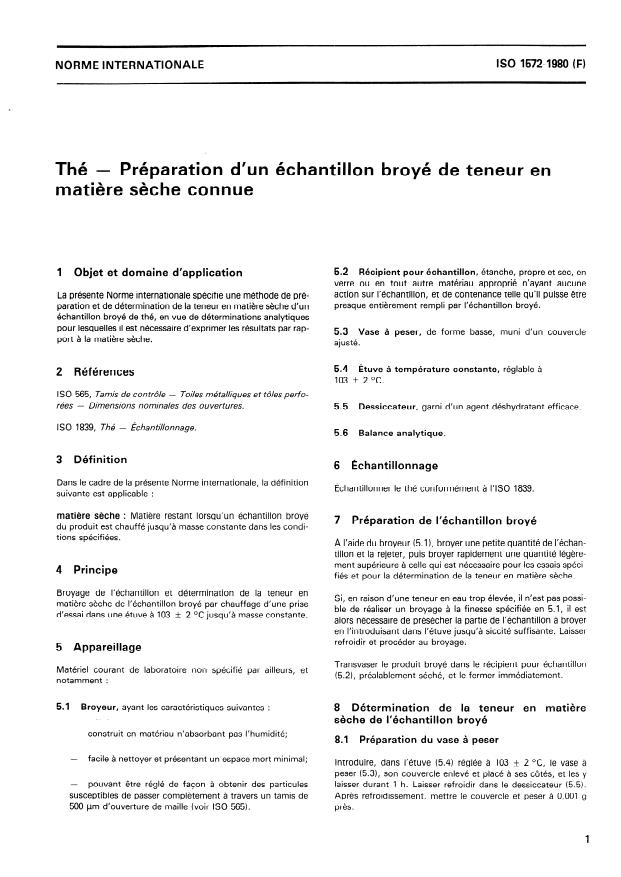
Thé — Préparation d'un échantillon broyé de teneur en matière sèche connue
La présente Norme internationale spécifie une méthode de préparation et de détermination de la teneur en matière sèche d'un échantillon broyé de thé, en vue de déterminations analytiques pour lesquelles il est nécessaire d'exprimer les résultats par rapport à la matière sèche.
General Information
- Status
- Published
- Publication Date
- 31-Jul-1980
- Technical Committee
- ISO/TC 34/SC 8 - Tea
- Drafting Committee
- ISO/TC 34/SC 8 - Tea
- Current Stage
- 9093 - International Standard confirmed
- Start Date
- 19-Dec-2025
- Completion Date
- 06-Jun-2026
Buy Documents

ISO 1572:1980 - Tea -- Preparation of ground sample of known dry matter content
ISO 1572:1980 - Tea — Preparation of ground sample of known dry matter content/1/1980

ISO 1572:1980 - Thé -- Préparation d'un échantillon broyé de teneur en matiere seche connue

ISO 1572:1980 - Thé -- Préparation d'un échantillon broyé de teneur en matiere seche connue
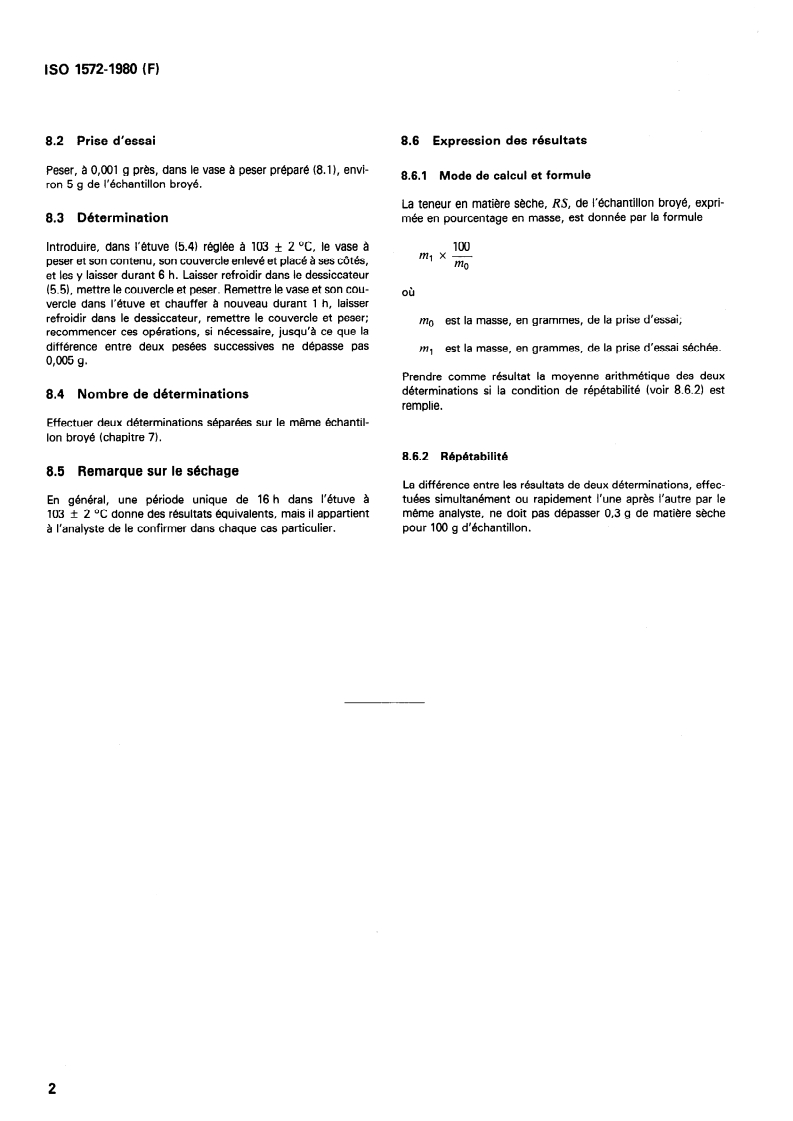
ISO 1572:1980 - Thé — Préparation d'un échantillon broyé de teneur en matière sèche connue/1/1980
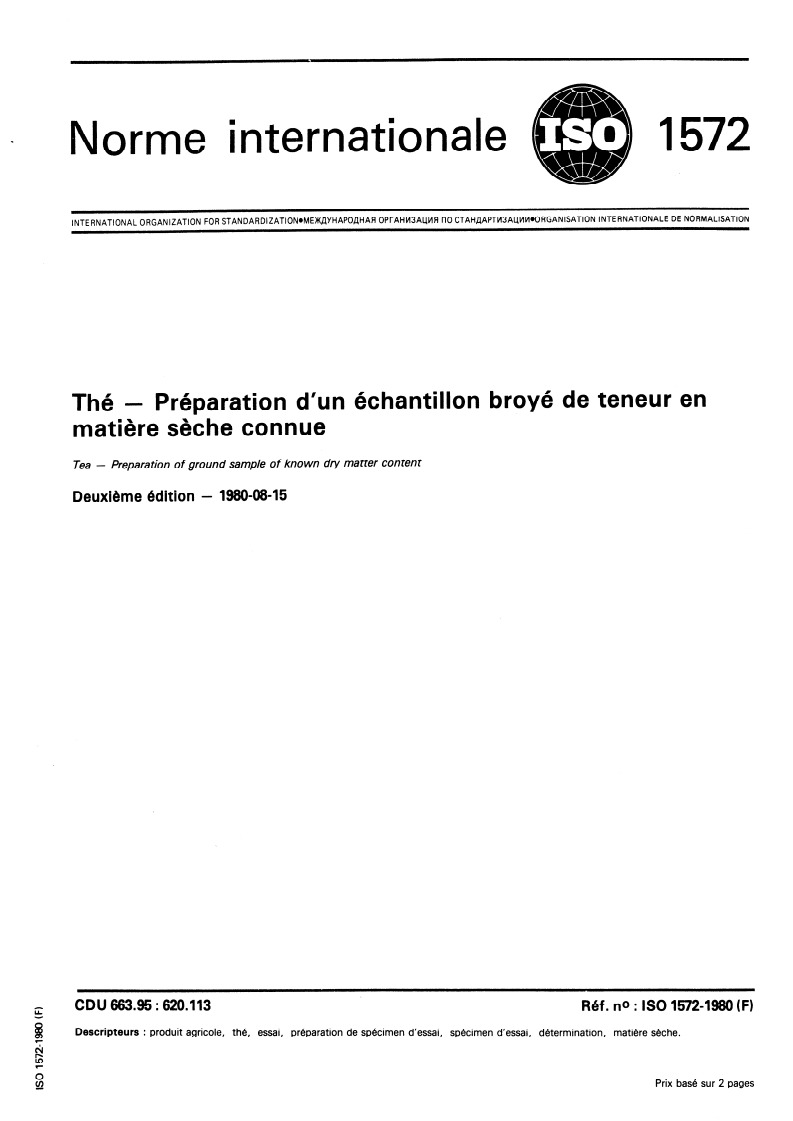
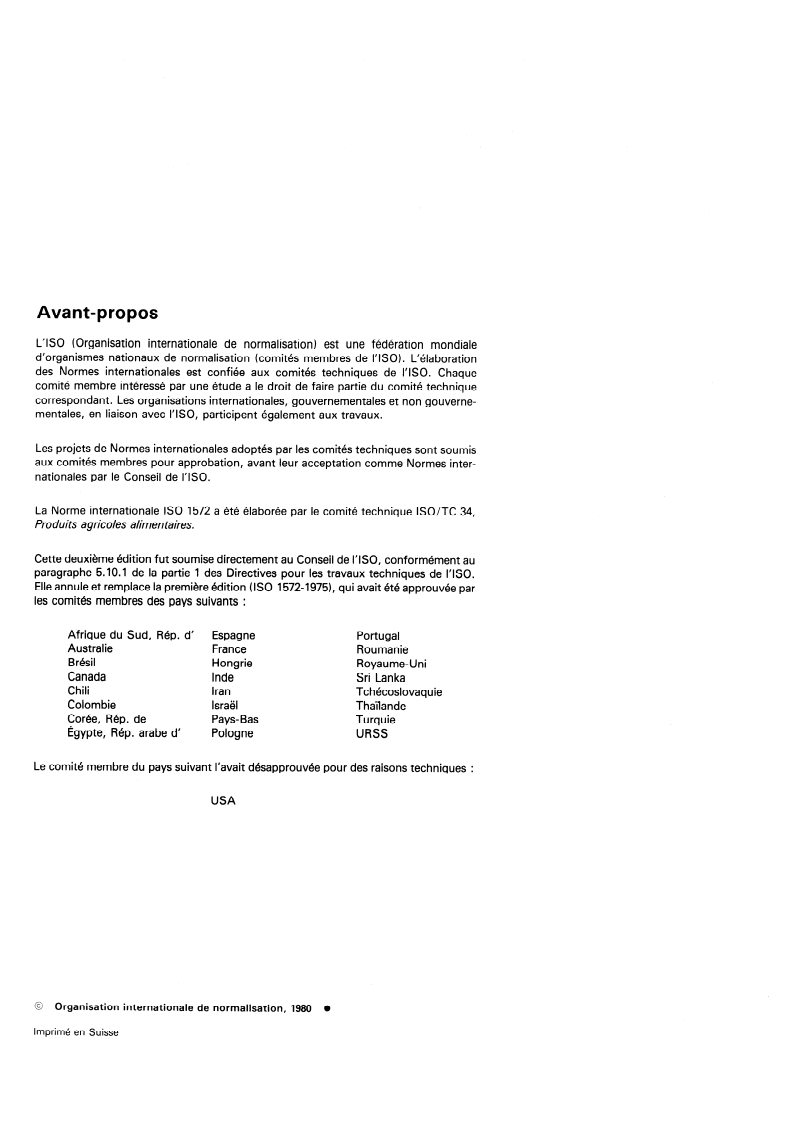
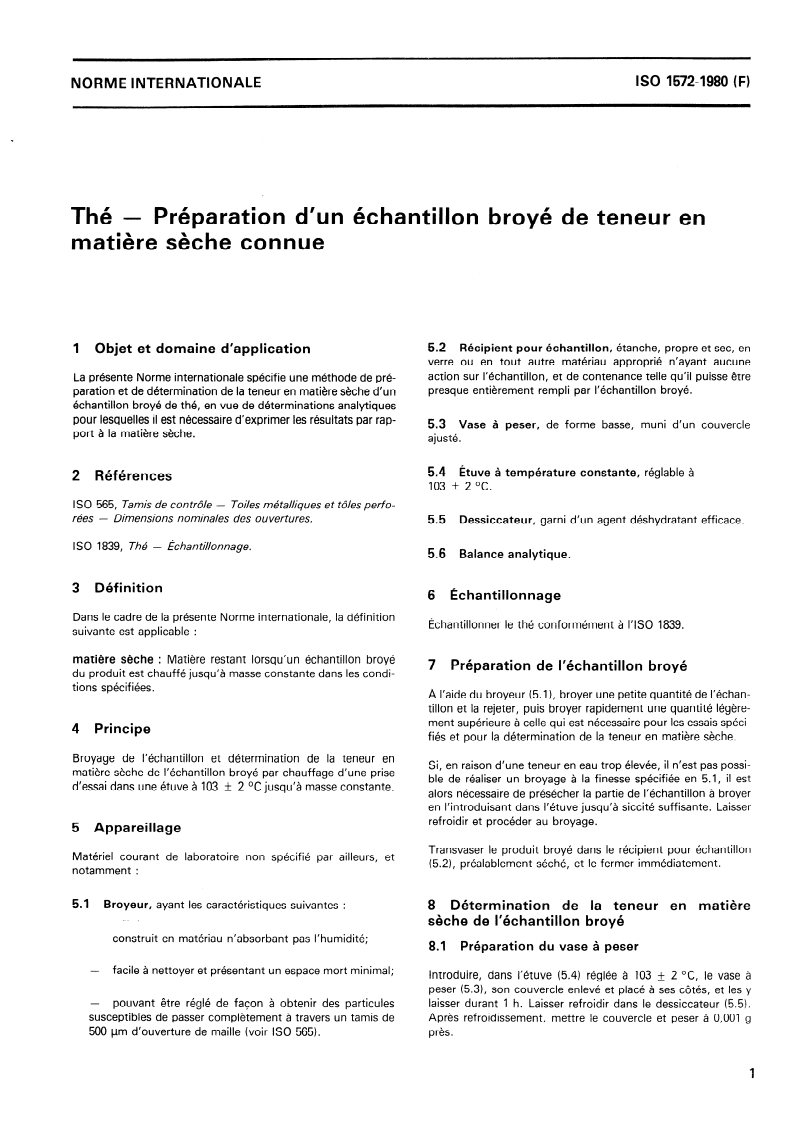
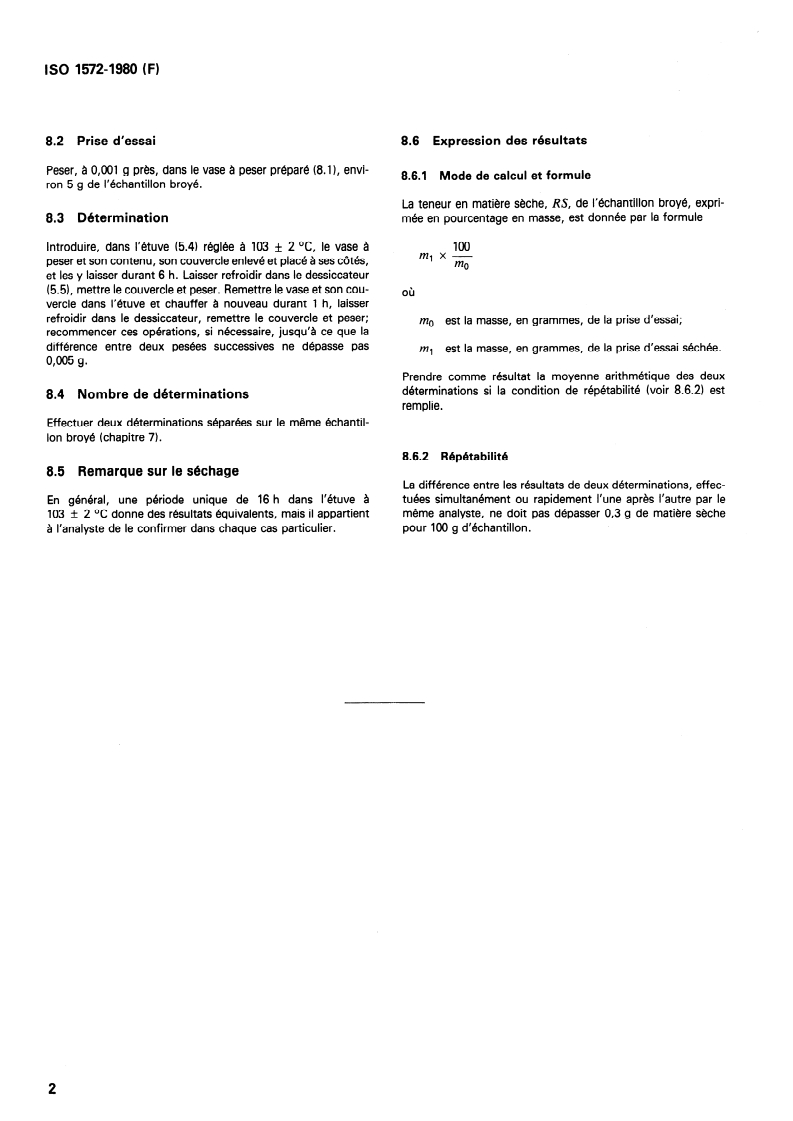
ISO 1572:1980 - Thé — Préparation d'un échantillon broyé de teneur en matière sèche connue/1/1980
ISO 1572:1980 - Tea — Preparation of ground sample of known dry matter content
Overview
ISO 1572:1980 specifies a standardized laboratory method for preparing a ground sample of tea and determining its dry matter content. The procedure ensures analytical results can be reported on a dry basis by grinding the sample to a defined fineness and drying a test portion in an oven at 103 ± 2 °C to constant mass.
Key topics and technical requirements
- Scope: Preparation of ground tea sample and determination of dry matter for analytical determinations requiring dry-basis results.
- Grinding: Use a grinding mill made of non‑moisture‑absorbing material, easy to clean and with minimal dead space. Ground material must pass a 500 µm sieve (see ISO 565).
- Pre-drying: If moisture is too high for satisfactory grinding, pre-dry a portion of the sample, cool, then grind.
- Sample handling:
- Transfer grindings into a clean, dry, airtight sample container (preferably glass) nearly filled by the ground sample.
- Use a squat weighing bottle with airtight lid for drying tests.
- Drying conditions:
- Heat weighing bottle and lid for 1 h at 103 ± 2 °C before use; cool in a desiccator and tare.
- Weigh a test portion (about 5 g) to 0.001 g accuracy.
- Dry with lid removed at 103 ± 2 °C, initially for 6 h, then repeat heating (typically 1 h) and cooling cycles until weight change between successive weighings is ≤ 0.005 g (constant mass).
- Calculation and repeatability:
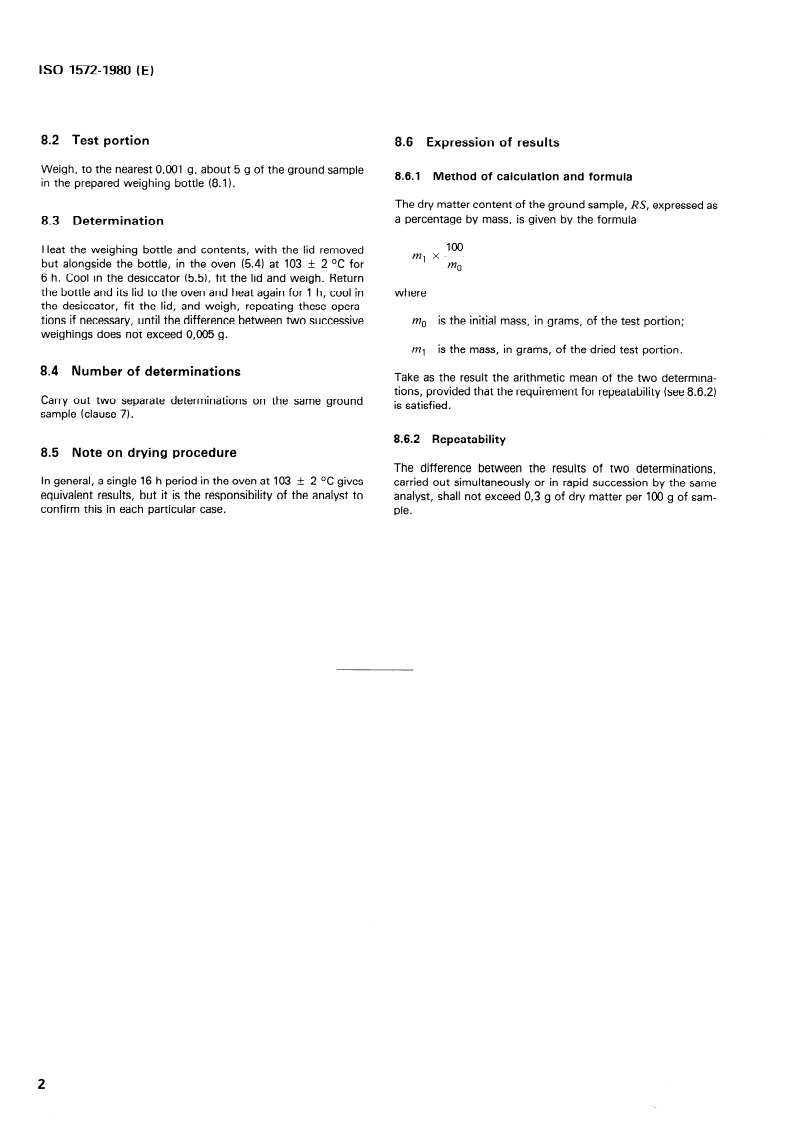
- Dry matter (%) = (mass of dried test portion / initial mass of test portion) × 100.
- Perform two determinations and report the mean, provided repeatability criteria are met.
- Repeatability requirement: difference between two determinations by the same analyst should not exceed 0.3 g dry matter per 100 g sample.
Applications and users
ISO 1572:1980 is primarily used by:
- Tea testing and quality-control laboratories
- Food and beverage analytical laboratories reporting results on a dry basis
- Manufacturers and processors verifying moisture/dry matter for product specification, shelf‑life and blending
- Regulatory bodies and certification agencies performing standardized moisture determinations
- Research groups studying tea composition or processing effects
Practical benefits include reproducible dry-matter values, improved comparability of moisture-related analyses (e.g., concentrations expressed on dry basis), and standardized sample preparation for downstream tests.
Related standards
- ISO 1839 - Tea - Sampling (for representative sample collection)
- ISO 565 - Test sieves - nominal aperture sizes (for sieve specification)
- ISO/TC 34 (Agricultural food products) is the responsible technical committee.
Keywords: ISO 1572:1980, tea, dry matter content, ground sample, oven 103±2°C, grinding mill, sample preparation, ISO 1839, ISO 565.
Buy Documents
ISO 1572:1980 - Tea -- Preparation of ground sample of known dry matter content
ISO 1572:1980 - Tea — Preparation of ground sample of known dry matter content/1/1980
ISO 1572:1980 - Thé -- Préparation d'un échantillon broyé de teneur en matiere seche connue
ISO 1572:1980 - Thé -- Préparation d'un échantillon broyé de teneur en matiere seche connue
ISO 1572:1980 - Thé — Préparation d'un échantillon broyé de teneur en matière sèche connue/1/1980
ISO 1572:1980 - Thé — Préparation d'un échantillon broyé de teneur en matière sèche connue/1/1980
ISO 1572:1980 - Tea — Preparation of ground sample of known dry matter content
Get Certified
Connect with accredited certification bodies for this standard

BSI Group
BSI (British Standards Institution) is the business standards company that helps organizations make excellence a habit.

Bureau Veritas
Bureau Veritas is a world leader in laboratory testing, inspection and certification services.

DNV
DNV is an independent assurance and risk management provider.
Sponsored listings
Frequently Asked Questions
ISO 1572:1980 is a standard published by the International Organization for Standardization (ISO). Its full title is "Tea — Preparation of ground sample of known dry matter content". This standard covers: The method consists in grinding of the sample, and determination of the dry matter content of the ground sample by heating a test portion in an oven at 103 +/-2 degrees centigrade to constant mass.
The method consists in grinding of the sample, and determination of the dry matter content of the ground sample by heating a test portion in an oven at 103 +/-2 degrees centigrade to constant mass.
ISO 1572:1980 is classified under the following ICS (International Classification for Standards) categories: 67.140.10 - Tea. The ICS classification helps identify the subject area and facilitates finding related standards.
ISO 1572:1980 is available in PDF format for immediate download after purchase. The document can be added to your cart and obtained through the secure checkout process. Digital delivery ensures instant access to the complete standard document.
Standards Content (Sample)
International Standard
INTERNATIONAL ORGANIZATION FOR STANDARDIZATION.MEXAYHAPOfiHAR OPTAHM3AuMR I-IO CTAH~APTkl3A~MWORGANlSATlON INTERNATIONALE DE NORMALISATION
- Preparation of ground Sample of known dry matter
Tea
content
Th& - Mparation d’un khantillon broye de teneur en mati&e Seche connue
Second edition - 1980-08-15
Ref. No. ISO 1572-1980 IE)
cii UDC 663.95 D 620.113
-
6> tea, tests, test specimen conditioning, test specimens, determination, dry matter.
Descriptors : agricultural products,
-
s;
cn
Price based on 2 pages
-
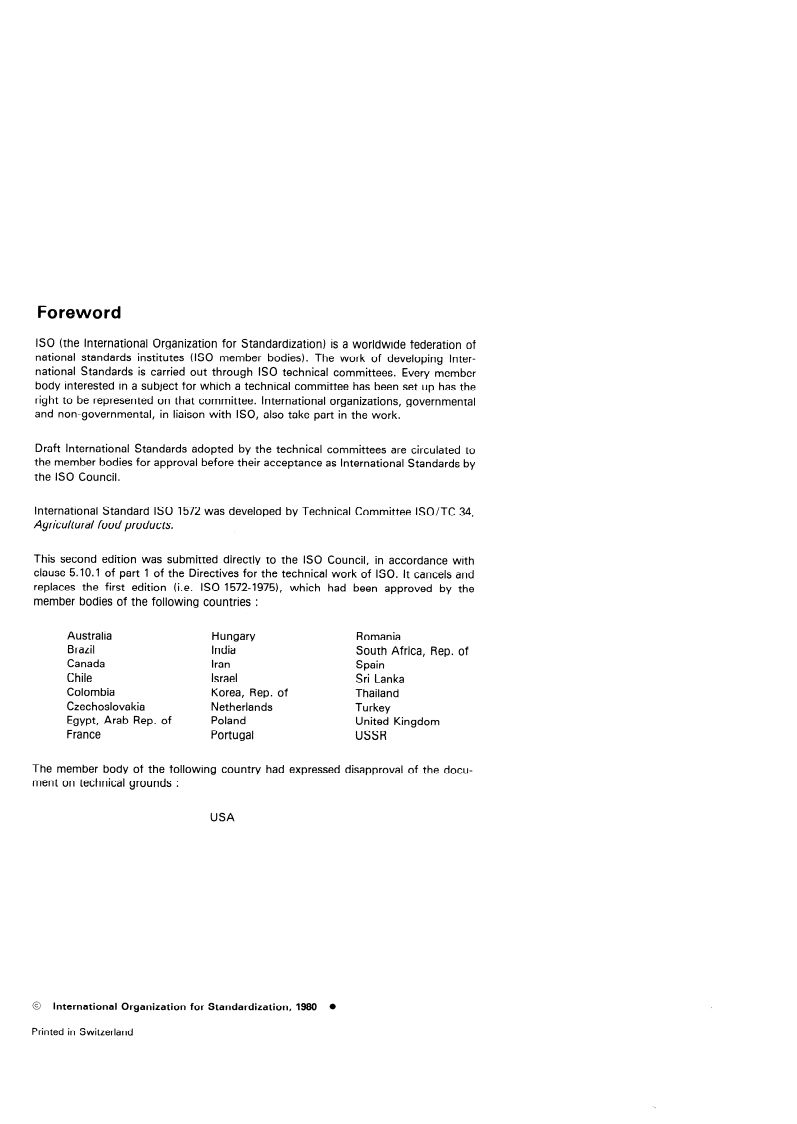
Foreword
ISO (the International Organization for Standardization) is a worldwide federation of
national Standards institutes (ISO member bedies). The work of developing lnter-
national Standards is carried out through ISO technical committees. Every member
body interested in a subject for which a technical committee has been set up has the
right to be represented on that committee. International organizations, governmental
and non-governmental, in liaison with ISO, also take part in the work.
Draft International Standards adopted by the technical committees are circulated to
the member bodies for approval before their acceptance as International Standards by
the ISO Council.
International Standard ISO 1572 was developed by Technical Committee ISO/TC 34,
Agricultural food products.
This second edition was submitted directly to the ISO Council, in accordance with
clause 5.10.1 of part 1 of the Directives for the technical work of ISO. lt cancels and
replaces the first edition (i.e. ISO 1572-1975), which had been approved by the
member bodies of the following countries :
Australia Hungary Romania
Brazil India South Africa, Rep. of
Canada Iran Spain
Chile Israel Sri Lanka
Korea, Rep. of Thailand
Colombia
Czechoslovakia Netherlands Turkey
Egypt, Arab Rep. of Poland United Kingdom
France Portugal USSR
The member body of the fo lowing country had expressed disapproval of the docu-
men
t on technical grounds :
USA
0 International Organkation for Standardkation, 1980
Printed in Switzerland
ISO 1572-1980 (E)
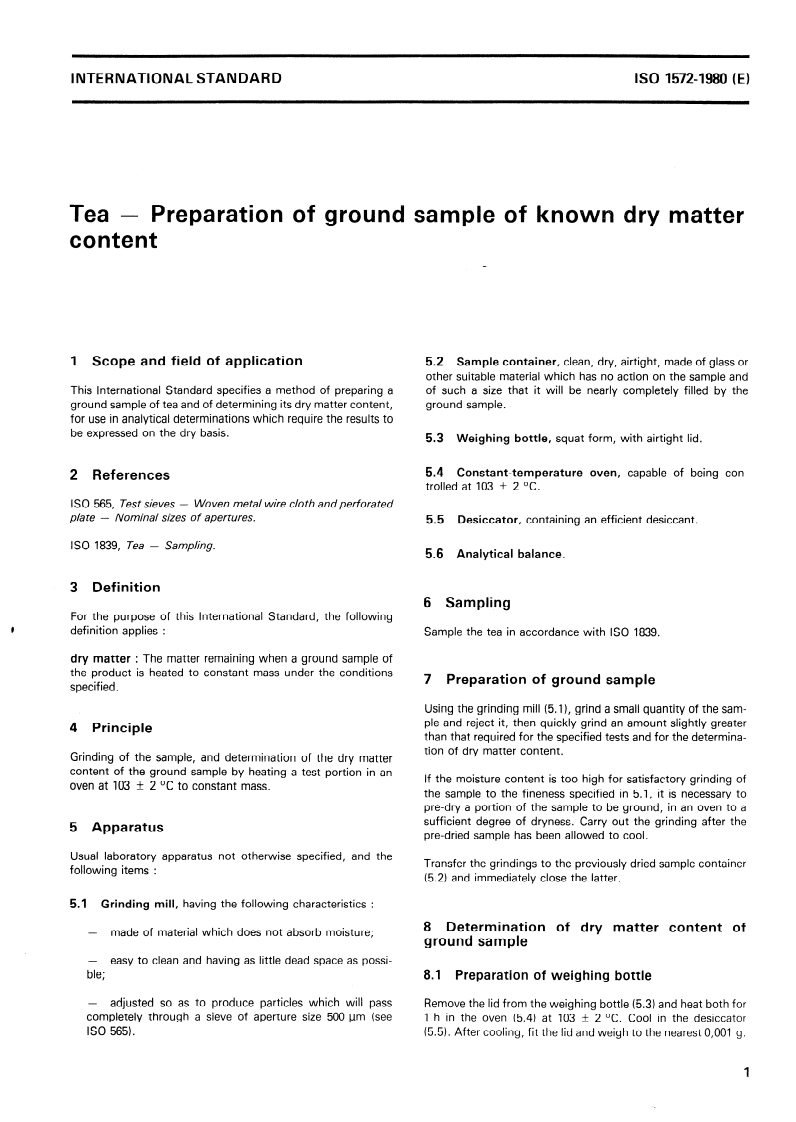
INTERNATIONAL STANDARD
Tea - Preparation of ground Sample of know ry matter
content
1 Scope and field of application 5.2 Sample Container, clean, dry, airtight, made of glass or
other suitable material which has no action on the Sample and
This International Standard specifies a method of preparing a of such a size that it will be nearly completely filled by the
ground Sample of tea and of determining its dry matter content, ground Sample.
for use in analytical determinations which require the results to
be expressed on the dry basis.
5.3 Weighing bottle, squat form, with airtight lid.
5.4 Konstant-temperature oven, capable of being con-
2 References
trolled at 103 & 2 OC.
ISO 565, Test sieves - Woven metal wire cloth and perforated
plate - Nominal sizes of apertures.
5.5 Desiccator, containing an efficient desiccant.
ISO 1839, Tea - Sampling.
5.6 Analytical balance.
3 Definition
6 Sampling
For the purpose of this International Standard, the following
definition applies : Sample the tea in accordance with ISO 1839.
dry matter : The matter
...
International Standard
INTERNATIONAL ORGANIZATION FOR STANDARDIZATION.MEXAYHAPOfiHAR OPTAHM3AuMR I-IO CTAH~APTkl3A~MWORGANlSATlON INTERNATIONALE DE NORMALISATION
- Preparation of ground Sample of known dry matter
Tea
content
Th& - Mparation d’un khantillon broye de teneur en mati&e Seche connue
Second edition - 1980-08-15
Ref. No. ISO 1572-1980 IE)
cii UDC 663.95 D 620.113
-
6> tea, tests, test specimen conditioning, test specimens, determination, dry matter.
Descriptors : agricultural products,
-
s;
cn
Price based on 2 pages
-
Foreword
ISO (the International Organization for Standardization) is a worldwide federation of
national Standards institutes (ISO member bedies). The work of developing lnter-
national Standards is carried out through ISO technical committees. Every member
body interested in a subject for which a technical committee has been set up has the
right to be represented on that committee. International organizations, governmental
and non-governmental, in liaison with ISO, also take part in the work.
Draft International Standards adopted by the technical committees are circulated to
the member bodies for approval before their acceptance as International Standards by
the ISO Council.
International Standard ISO 1572 was developed by Technical Committee ISO/TC 34,
Agricultural food products.
This second edition was submitted directly to the ISO Council, in accordance with
clause 5.10.1 of part 1 of the Directives for the technical work of ISO. lt cancels and
replaces the first edition (i.e. ISO 1572-1975), which had been approved by the
member bodies of the following countries :
Australia Hungary Romania
Brazil India South Africa, Rep. of
Canada Iran Spain
Chile Israel Sri Lanka
Korea, Rep. of Thailand
Colombia
Czechoslovakia Netherlands Turkey
Egypt, Arab Rep. of Poland United Kingdom
France Portugal USSR
The member body of the fo lowing country had expressed disapproval of the docu-
men
t on technical grounds :
USA
0 International Organkation for Standardkation, 1980
Printed in Switzerland
ISO 1572-1980 (E)
INTERNATIONAL STANDARD
Tea - Preparation of ground Sample of know ry matter
content
1 Scope and field of application 5.2 Sample Container, clean, dry, airtight, made of glass or
other suitable material which has no action on the Sample and
This International Standard specifies a method of preparing a of such a size that it will be nearly completely filled by the
ground Sample of tea and of determining its dry matter content, ground Sample.
for use in analytical determinations which require the results to
be expressed on the dry basis.
5.3 Weighing bottle, squat form, with airtight lid.
5.4 Konstant-temperature oven, capable of being con-
2 References
trolled at 103 & 2 OC.
ISO 565, Test sieves - Woven metal wire cloth and perforated
plate - Nominal sizes of apertures.
5.5 Desiccator, containing an efficient desiccant.
ISO 1839, Tea - Sampling.
5.6 Analytical balance.
3 Definition
6 Sampling
For the purpose of this International Standard, the following
definition applies : Sample the tea in accordance with ISO 1839.
dry matter : The matter
...
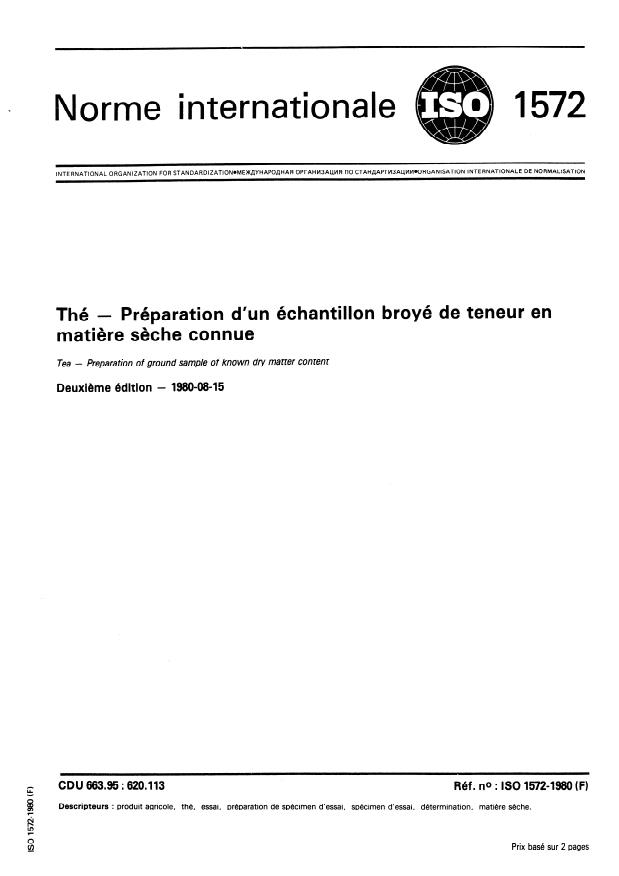
Norme internationale
INTERNATIONAL ORGANIZATION FOR STANDARDIZATION@ME>K~YHAPOflHAR OPrAHM3AWlR ll0 CTAH~APTltl3ALpWWORGANISATION INTERNATIONALE DE NORMALISATION
Thé - Préparation d’un échantillon broyé de teneur en
matière sèche connue
Preparation of ground sample of known dry matter content
Tea -
Deuxième 6dition - ~980-08-15
CDU 663.95 : 620.113 Rbf. no : ISO 15724960 (F)
Descripteurs : produit agricole, thé, essai, préparation de spécimen d’essai, spécimen d’essai, détermination, matiére séche.
Prix basé sur 2 pages
Avant-propos
L’ISO (Organisation internationale de normalisation) est une fédération mondiale
d’organismes nationaux de normalisation (comités membres de I’ISO). L’élaboration
des Normes internationales est confiée aux comités techniques de I’ISO. Chaque
comité membre intéressé par une étude a le droit de faire partie du comité technique
correspondant. Les organisations internationales, gouvernementales et non gouverne-
mentales, en liaison avec I’ISO, participent également aux travaux.
Les projets de Normes internationales adoptés par les comités techniques sont soumis
aux comités membres pour approbation, avant leur acceptation comme Normes inter-
nationales par le Conseil de I’ISO.
La Norme internationale ISO 1572 a été élaborée par le comité technique ISO/TC 34,
Produits agricoles alimentaires.
Cette deuxieme édition fut soumise directement au Conseil de I’ISO, conformément au
paragraphe 5.10.1 de la partie 1 des Directives pour les travaux techniques de I’ISO.
Elle annule et remplace la premiére edition (ISO 1572-19751, qui avait éte approuvée par
les comités membres des pays suivants :
Portugal
Afrique du Sud, Rép. d’ Espagne
Australie France Roumanie
Brésil Hongrie Royaume-Uni
Canada Inde Sri Lanka
Iran Tchécoslovaquie
Chili
Colombie Israël Thailande
Turquie
Corée, Rép. de Pays- Bas
Égypte, Rép. arabe d’ Pologne URSS
Le comite membre du pays suivant l’avait désapprouvée pour des raisons techniques :
USA
@ Organisation internationale de normalisation, 1980 0
Imprimé en Suisse
ISO 1572-1980 (F)
NORME INTERNATIONALE
Thé - Préparation d’un échantillon broyé de teneur en
matière sèche connue
5.2 Récipient pour échantillon, étanche, propre et sec, en
1 Objet et domaine d’application
verre ou en tout autre matériau approprié n’ayant aucune
action sur l’échantillon, et de contenance telle qu’il puisse être
La présente Norme internationale spécifie une méthode de pré-
presque entièrement rempli par l’échantillon broyé.
paration et de détermination de la teneur en matiére seche d’un
échantillon broyé de thé, en vue de déterminations analytiques
pour lesquelles il est nécessaire d’exprimer les résultats par rap-
5.3 Vase à peser, de forme basse, muni d’un couvercle
port à la matière sèche.
ajusté.
5.4 Étuve à température constante, réglable à
2 Références
103 I!I 2 OC.
I SO 565, Tamis de contrôle - Toiles métalliques et tôles perfo-
rées - Dimensions nominales des ouvertures.
5.5 Dessiccateur, garni d’un agent déshydratant efficace.
ISO 1839, Thé - &han tilonnage.
5.6 Balance analytique.
3 Définition
6 Échantillonnage
Dans le cadre de la présente Norme internationale, la définition
ichantillonner le thé conformément à I’ISO 1839.
suivante est applicable :
matière sèche : Matière restant lorsqu’un échantillon broyé
7 Préparation de l’échantillon broyé
du produit est chauff
...
Norme internationale
INTERNATIONAL ORGANIZATION FOR STANDARDIZATION@ME>K~YHAPOflHAR OPrAHM3AWlR ll0 CTAH~APTltl3ALpWWORGANISATION INTERNATIONALE DE NORMALISATION
Thé - Préparation d’un échantillon broyé de teneur en
matière sèche connue
Preparation of ground sample of known dry matter content
Tea -
Deuxième 6dition - ~980-08-15
CDU 663.95 : 620.113 Rbf. no : ISO 15724960 (F)
Descripteurs : produit agricole, thé, essai, préparation de spécimen d’essai, spécimen d’essai, détermination, matiére séche.
Prix basé sur 2 pages
Avant-propos
L’ISO (Organisation internationale de normalisation) est une fédération mondiale
d’organismes nationaux de normalisation (comités membres de I’ISO). L’élaboration
des Normes internationales est confiée aux comités techniques de I’ISO. Chaque
comité membre intéressé par une étude a le droit de faire partie du comité technique
correspondant. Les organisations internationales, gouvernementales et non gouverne-
mentales, en liaison avec I’ISO, participent également aux travaux.
Les projets de Normes internationales adoptés par les comités techniques sont soumis
aux comités membres pour approbation, avant leur acceptation comme Normes inter-
nationales par le Conseil de I’ISO.
La Norme internationale ISO 1572 a été élaborée par le comité technique ISO/TC 34,
Produits agricoles alimentaires.
Cette deuxieme édition fut soumise directement au Conseil de I’ISO, conformément au
paragraphe 5.10.1 de la partie 1 des Directives pour les travaux techniques de I’ISO.
Elle annule et remplace la premiére edition (ISO 1572-19751, qui avait éte approuvée par
les comités membres des pays suivants :
Portugal
Afrique du Sud, Rép. d’ Espagne
Australie France Roumanie
Brésil Hongrie Royaume-Uni
Canada Inde Sri Lanka
Iran Tchécoslovaquie
Chili
Colombie Israël Thailande
Turquie
Corée, Rép. de Pays- Bas
Égypte, Rép. arabe d’ Pologne URSS
Le comite membre du pays suivant l’avait désapprouvée pour des raisons techniques :
USA
@ Organisation internationale de normalisation, 1980 0
Imprimé en Suisse
ISO 1572-1980 (F)
NORME INTERNATIONALE
Thé - Préparation d’un échantillon broyé de teneur en
matière sèche connue
5.2 Récipient pour échantillon, étanche, propre et sec, en
1 Objet et domaine d’application
verre ou en tout autre matériau approprié n’ayant aucune
action sur l’échantillon, et de contenance telle qu’il puisse être
La présente Norme internationale spécifie une méthode de pré-
presque entièrement rempli par l’échantillon broyé.
paration et de détermination de la teneur en matiére seche d’un
échantillon broyé de thé, en vue de déterminations analytiques
pour lesquelles il est nécessaire d’exprimer les résultats par rap-
5.3 Vase à peser, de forme basse, muni d’un couvercle
port à la matière sèche.
ajusté.
5.4 Étuve à température constante, réglable à
2 Références
103 I!I 2 OC.
I SO 565, Tamis de contrôle - Toiles métalliques et tôles perfo-
rées - Dimensions nominales des ouvertures.
5.5 Dessiccateur, garni d’un agent déshydratant efficace.
ISO 1839, Thé - &han tilonnage.
5.6 Balance analytique.
3 Définition
6 Échantillonnage
Dans le cadre de la présente Norme internationale, la définition
ichantillonner le thé conformément à I’ISO 1839.
suivante est applicable :
matière sèche : Matière restant lorsqu’un échantillon broyé
7 Préparation de l’échantillon broyé
du produit est chauff
...
Norme internationale
INTERNATIONAL ORGANIZATION FOR STANDARDIZATION@ME>K~YHAPOflHAR OPrAHM3AWlR ll0 CTAH~APTltl3ALpWWORGANISATION INTERNATIONALE DE NORMALISATION
Thé - Préparation d’un échantillon broyé de teneur en
matière sèche connue
Preparation of ground sample of known dry matter content
Tea -
Deuxième 6dition - ~980-08-15
CDU 663.95 : 620.113 Rbf. no : ISO 15724960 (F)
Descripteurs : produit agricole, thé, essai, préparation de spécimen d’essai, spécimen d’essai, détermination, matiére séche.
Prix basé sur 2 pages
Avant-propos
L’ISO (Organisation internationale de normalisation) est une fédération mondiale
d’organismes nationaux de normalisation (comités membres de I’ISO). L’élaboration
des Normes internationales est confiée aux comités techniques de I’ISO. Chaque
comité membre intéressé par une étude a le droit de faire partie du comité technique
correspondant. Les organisations internationales, gouvernementales et non gouverne-
mentales, en liaison avec I’ISO, participent également aux travaux.
Les projets de Normes internationales adoptés par les comités techniques sont soumis
aux comités membres pour approbation, avant leur acceptation comme Normes inter-
nationales par le Conseil de I’ISO.
La Norme internationale ISO 1572 a été élaborée par le comité technique ISO/TC 34,
Produits agricoles alimentaires.
Cette deuxieme édition fut soumise directement au Conseil de I’ISO, conformément au
paragraphe 5.10.1 de la partie 1 des Directives pour les travaux techniques de I’ISO.
Elle annule et remplace la premiére edition (ISO 1572-19751, qui avait éte approuvée par
les comités membres des pays suivants :
Portugal
Afrique du Sud, Rép. d’ Espagne
Australie France Roumanie
Brésil Hongrie Royaume-Uni
Canada Inde Sri Lanka
Iran Tchécoslovaquie
Chili
Colombie Israël Thailande
Turquie
Corée, Rép. de Pays- Bas
Égypte, Rép. arabe d’ Pologne URSS
Le comite membre du pays suivant l’avait désapprouvée pour des raisons techniques :
USA
@ Organisation internationale de normalisation, 1980 0
Imprimé en Suisse
ISO 1572-1980 (F)
NORME INTERNATIONALE
Thé - Préparation d’un échantillon broyé de teneur en
matière sèche connue
5.2 Récipient pour échantillon, étanche, propre et sec, en
1 Objet et domaine d’application
verre ou en tout autre matériau approprié n’ayant aucune
action sur l’échantillon, et de contenance telle qu’il puisse être
La présente Norme internationale spécifie une méthode de pré-
presque entièrement rempli par l’échantillon broyé.
paration et de détermination de la teneur en matiére seche d’un
échantillon broyé de thé, en vue de déterminations analytiques
pour lesquelles il est nécessaire d’exprimer les résultats par rap-
5.3 Vase à peser, de forme basse, muni d’un couvercle
port à la matière sèche.
ajusté.
5.4 Étuve à température constante, réglable à
2 Références
103 I!I 2 OC.
I SO 565, Tamis de contrôle - Toiles métalliques et tôles perfo-
rées - Dimensions nominales des ouvertures.
5.5 Dessiccateur, garni d’un agent déshydratant efficace.
ISO 1839, Thé - &han tilonnage.
5.6 Balance analytique.
3 Définition
6 Échantillonnage
Dans le cadre de la présente Norme internationale, la définition
ichantillonner le thé conformément à I’ISO 1839.
suivante est applicable :
matière sèche : Matière restant lorsqu’un échantillon broyé
7 Préparation de l’échantillon broyé
du produit est chauff
...
Norme internationale
INTERNATIONAL ORGANIZATION FOR STANDARDIZATION@ME>K~YHAPOflHAR OPrAHM3AWlR ll0 CTAH~APTltl3ALpWWORGANISATION INTERNATIONALE DE NORMALISATION
Thé - Préparation d’un échantillon broyé de teneur en
matière sèche connue
Preparation of ground sample of known dry matter content
Tea -
Deuxième 6dition - ~980-08-15
CDU 663.95 : 620.113 Rbf. no : ISO 15724960 (F)
Descripteurs : produit agricole, thé, essai, préparation de spécimen d’essai, spécimen d’essai, détermination, matiére séche.
Prix basé sur 2 pages
Avant-propos
L’ISO (Organisation internationale de normalisation) est une fédération mondiale
d’organismes nationaux de normalisation (comités membres de I’ISO). L’élaboration
des Normes internationales est confiée aux comités techniques de I’ISO. Chaque
comité membre intéressé par une étude a le droit de faire partie du comité technique
correspondant. Les organisations internationales, gouvernementales et non gouverne-
mentales, en liaison avec I’ISO, participent également aux travaux.
Les projets de Normes internationales adoptés par les comités techniques sont soumis
aux comités membres pour approbation, avant leur acceptation comme Normes inter-
nationales par le Conseil de I’ISO.
La Norme internationale ISO 1572 a été élaborée par le comité technique ISO/TC 34,
Produits agricoles alimentaires.
Cette deuxieme édition fut soumise directement au Conseil de I’ISO, conformément au
paragraphe 5.10.1 de la partie 1 des Directives pour les travaux techniques de I’ISO.
Elle annule et remplace la premiére edition (ISO 1572-19751, qui avait éte approuvée par
les comités membres des pays suivants :
Portugal
Afrique du Sud, Rép. d’ Espagne
Australie France Roumanie
Brésil Hongrie Royaume-Uni
Canada Inde Sri Lanka
Iran Tchécoslovaquie
Chili
Colombie Israël Thailande
Turquie
Corée, Rép. de Pays- Bas
Égypte, Rép. arabe d’ Pologne URSS
Le comite membre du pays suivant l’avait désapprouvée pour des raisons techniques :
USA
@ Organisation internationale de normalisation, 1980 0
Imprimé en Suisse
ISO 1572-1980 (F)
NORME INTERNATIONALE
Thé - Préparation d’un échantillon broyé de teneur en
matière sèche connue
5.2 Récipient pour échantillon, étanche, propre et sec, en
1 Objet et domaine d’application
verre ou en tout autre matériau approprié n’ayant aucune
action sur l’échantillon, et de contenance telle qu’il puisse être
La présente Norme internationale spécifie une méthode de pré-
presque entièrement rempli par l’échantillon broyé.
paration et de détermination de la teneur en matiére seche d’un
échantillon broyé de thé, en vue de déterminations analytiques
pour lesquelles il est nécessaire d’exprimer les résultats par rap-
5.3 Vase à peser, de forme basse, muni d’un couvercle
port à la matière sèche.
ajusté.
5.4 Étuve à température constante, réglable à
2 Références
103 I!I 2 OC.
I SO 565, Tamis de contrôle - Toiles métalliques et tôles perfo-
rées - Dimensions nominales des ouvertures.
5.5 Dessiccateur, garni d’un agent déshydratant efficace.
ISO 1839, Thé - &han tilonnage.
5.6 Balance analytique.
3 Définition
6 Échantillonnage
Dans le cadre de la présente Norme internationale, la définition
ichantillonner le thé conformément à I’ISO 1839.
suivante est applicable :
matière sèche : Matière restant lorsqu’un échantillon broyé
7 Préparation de l’échantillon broyé
du produit est chauff
...
ة�يلود ة�يسا�يق ةفصاوم
�����
ISO 1572
يويج م ةمولعم ةنوجطم ةن�يع ز�يه�جت — ياشلا ة�ينايلا ةع�بطلا
��������������
1980-08
ةفا�جلا ةداملا
���
Tea — Preparation of ground sample of known dry matter content
عجرملاا م�قر International Organization for ©
ISO 1572:1980(ar) Standardization 1980
ISO 1572:1980(ar)
ة�يكلم قوقج�ن ة�يمجم ةق�يتو
�������
International Organization for Standardization 1980 ©
ال�ن ،ةــ�تك�تناك�تم و�ا ة�تنومتكاإا ةل�تسو �ي�ا�ن و�ا لاكس�الا نم لكس �ي�ا�ن ةماذحتسا و�ا روسنلاا اذه نم ءمجر �ي�ا خسن رو�ح�ي ال ،�كاذ �فالر ىلع صن�ي ما ام .ةظوقحم قوقحاا لك
���������������������������
وسإا وضع ةن�تهاا و�ا هانذ�ا ناونعاا ىلع وسإا نم �ي�ا نم نذإالا �تلظ نكل�ي .ق�نسم �ى�ناتك نذإا ىلع لوضحاا نوذ ،تنامتنإالا و�ا تنمتنإالا ىلع مسناا و�ا �ىنوضاا خسناا �كاذ �ى�ق
�������������������������������
.�تااطاا ذل�ن �ى�ق
ISO copyright office
CP 401 • Ch. de Blandonnet 8
CH-1214 Vernier, Geneva
Tel. + 41 22 749 01 11
E-mail copyright@iso.org
Website www.iso.org
امس�يوس �ى�ق تمسن
���
International Organization for Standardization 1980 ©
�ب
ISO 1572:1980(ar)
ةحقضاا با�تويجم
��
��
د . م�تدقت
��
1 . ق�ي�نطيلا قاطنو لا�جملا 1
����
1 . ة�يل�يمكيلا� جاازملا 2
��
1 . ف�تزعيلا 3
��
1 . ساس�ألا 4
1 . باود�ألاو �ةزهجا�ألا 5
��
1 . بان�يعلا دا�ا 6
����
2 . �ةنوجطملا �ةن�يعلا ز�يه�جت 7
����
2 . ةنوجطملا ةن�يعلل ةفا�جلا ةداملا يويجم ز�تدقت 8
����������
International Organization for Standardization 1980 ©
جج
ISO 1572:1980(ar)
م�تدقت
��
ة�ت اوذاا تاقصاولاا ذاذعإا مت�ي ام ا�نااعو ،(وم�ي�الا ى�ق ءاضع�الا) ة�تنظواا س�ت�تقتاا تاه�حا ىلااع ذاحيا ىه (س�ت�تقتلا ة�تاوذاا ةلطنلاا) وم�ي�الا
�����������������������
ة ا نوك�ي ن�ا ى�ق قحاا وضعاا اذها نإا�ق ، ة�تن�ق ةن�حا ةا تلكس ذ�ق عوصول�ن مالتهإا اها وضعاا ةه�حاا تناك اذإاو ، وم�ي�الا ة�تنقاا نا�حلاا لالر نم
���������������������������
.وم�ي�الا ةلطنم عم لصاوي اها ىتاا ة�تموكحاا م�تعو اهنم ة�تموكحاا ة�تاوذاا تالطنلااا �كاذك للعاا ى�ق �كراس�يو .ةن�حلاا �كلي ى�ق لتلم
�����������������������
اــهذالت عا ل�نق ةققاوللا ءاضع�الا لوذاا ىلع اهع�يروي مت�ي ة�تنقاا نا�حلاا ل�نق نم اهذاذعإا مت�ي ىتاا ة�تاوذاا ة�تسا�تقاا تاقصاولاا تاذوسم نإا
�������������������������
وم�ي�الا سل�حم ل�نق نم ة�تاوذ ة�تسا�تق ةقصاولك
��������
. ة�تعارماا ة�تناذعاا تا�حتنلاا ,ISO/TC 34 ة�تاوذاا ةن�حلاا ل�ن�ق نم اهذاذعإا مي ISO 1572 ة�تاوذاا ة�تسا�تقاا ةقصاولاا
�������������������
ىعلي ,ىــنقاا للعلا وم�ي�الا تاــه�تجروي نم 1 ءم�حاا نم )5.10.1) ذن�نلا ًاق�قو وم�ي�الا سل�حم ىاإا ة�تاوذاا ةقصاولاا نم ىناتاا راذصإالا ع�قر مي
�����������������������
:ة�تااتاا لوذلا ءاضع�الا ل�نق نم ة�تلع ةق�قاولاا مي يذاا ,( ISO 1572-1975 راذصإالا لحم لحيو
�����������
ا�تنامور ا�يراعنه ا�تاامتسا
����
ا�تق�يمق�ا �تونجر ذنهاا ل�يرام�ناا
�����
ا�تنا�نسا نام�يإا اذنك
���
اكنالم�تس ل�تنامسا ىل�تسي
�����
ذنال�ياي ا�يروك ا�ت�نمواوك
��
ا�تكمي اذناوه ا�تكاقولسك�تسي
�����
هذحتلاا ةكلللاا اذناو�ن مضم
����
ىت�تقوساا ذاحيالا لاعيم�ناا اسنمق
��������
: ة�تااتاا لوذلا ءاضع�الا ق�قاو�ي ما
����
اك�يمم�ا
International Organization for Standardization 1980 ©
د
ISO 1572:1980(ar) ة�يلود
...