


ISO 19901-7:2005
(Main)Petroleum and natural gas industries — Specific requirements for offshore structures — Part 7: Stationkeeping systems for floating offshore structures and mobile offshore units
Petroleum and natural gas industries — Specific requirements for offshore structures — Part 7: Stationkeeping systems for floating offshore structures and mobile offshore units
ISO 19901-7:2005 specifies methodologies for a) the design, analysis and evaluation of stationkeeping systems for floating structures used by the oil and gas industries to support production, storage, drilling, well intervention and production, production and storage, drilling, well intervention, production and storage, and b) the assessment of stationkeeping systems for site-specific applications of mobile offshore units (e.g. mobile offshore drilling units, construction units, and pipelay units).
Industries du pétrole et du gaz naturel — Exigences spécifiques relatives aux structures en mer — Partie 7: Systèmes de maintien en position des structures en mer flottantes et des unités mobiles en mer
General Information
- Status
- Withdrawn
- Publication Date
- 06-Dec-2005
- Withdrawal Date
- 06-Dec-2005
- Technical Committee
- ISO/TC 67/SC 7 - Offshore structures
- Drafting Committee
- ISO/TC 67/SC 7 - Offshore structures
- Current Stage
- 9599 - Withdrawal of International Standard
- Start Date
- 26-Apr-2013
- Completion Date
- 12-Feb-2026
Relations
- Effective Date
- 12-Feb-2026
- Effective Date
- 06-Jun-2022
- Effective Date
- 12-Feb-2011
- Effective Date
- 15-Apr-2008
Get Certified
Connect with accredited certification bodies for this standard

ABS Quality Evaluations Inc.
American Bureau of Shipping quality certification.

Element Materials Technology
Materials testing and product certification.

ABS Group Brazil
ABS Group certification services in Brazil.
Sponsored listings
Frequently Asked Questions
ISO 19901-7:2005 is a standard published by the International Organization for Standardization (ISO). Its full title is "Petroleum and natural gas industries — Specific requirements for offshore structures — Part 7: Stationkeeping systems for floating offshore structures and mobile offshore units". This standard covers: ISO 19901-7:2005 specifies methodologies for a) the design, analysis and evaluation of stationkeeping systems for floating structures used by the oil and gas industries to support production, storage, drilling, well intervention and production, production and storage, drilling, well intervention, production and storage, and b) the assessment of stationkeeping systems for site-specific applications of mobile offshore units (e.g. mobile offshore drilling units, construction units, and pipelay units).
ISO 19901-7:2005 specifies methodologies for a) the design, analysis and evaluation of stationkeeping systems for floating structures used by the oil and gas industries to support production, storage, drilling, well intervention and production, production and storage, drilling, well intervention, production and storage, and b) the assessment of stationkeeping systems for site-specific applications of mobile offshore units (e.g. mobile offshore drilling units, construction units, and pipelay units).
ISO 19901-7:2005 is classified under the following ICS (International Classification for Standards) categories: 75.180.10 - Exploratory, drilling and extraction equipment. The ICS classification helps identify the subject area and facilitates finding related standards.
ISO 19901-7:2005 has the following relationships with other standards: It is inter standard links to EN ISO 19901-7:2005, ISO/IEC ISP 10609-34:1995, ISO 19901-7:2013, ISO/TR 13637:1997. Understanding these relationships helps ensure you are using the most current and applicable version of the standard.
ISO 19901-7:2005 is available in PDF format for immediate download after purchase. The document can be added to your cart and obtained through the secure checkout process. Digital delivery ensures instant access to the complete standard document.
Standards Content (Sample)
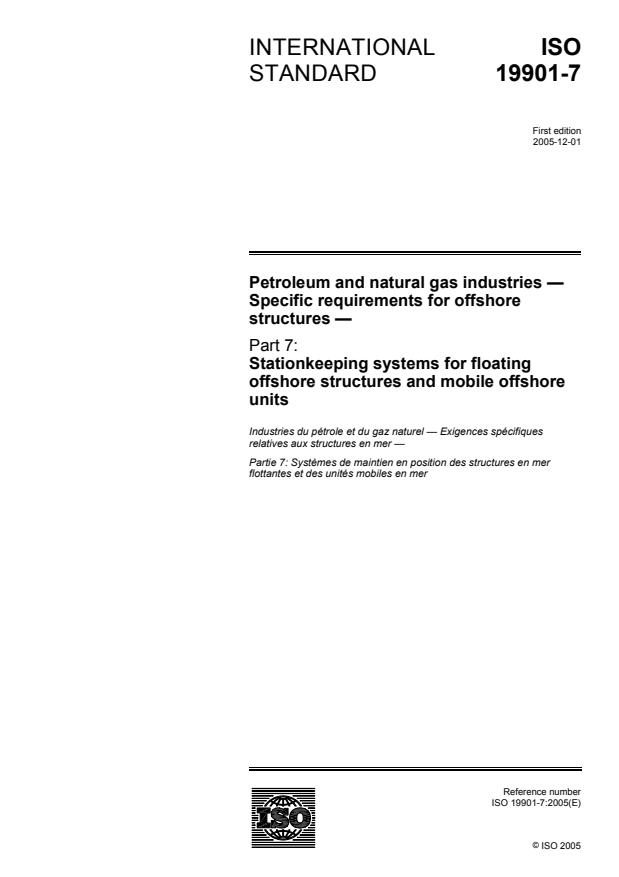
INTERNATIONAL ISO
STANDARD 19901-7
First edition
2005-12-01
Petroleum and natural gas industries —
Specific requirements for offshore
structures —
Part 7:
Stationkeeping systems for floating
offshore structures and mobile offshore
units
Industries du pétrole et du gaz naturel — Exigences spécifiques
relatives aux structures en mer —
Partie 7: Systèmes de maintien en position des structures en mer
flottantes et des unités mobiles en mer
Reference number
©
ISO 2005
PDF disclaimer
This PDF file may contain embedded typefaces. In accordance with Adobe's licensing policy, this file may be printed or viewed but
shall not be edited unless the typefaces which are embedded are licensed to and installed on the computer performing the editing. In
downloading this file, parties accept therein the responsibility of not infringing Adobe's licensing policy. The ISO Central Secretariat
accepts no liability in this area.
Adobe is a trademark of Adobe Systems Incorporated.
Details of the software products used to create this PDF file can be found in the General Info relative to the file; the PDF-creation
parameters were optimized for printing. Every care has been taken to ensure that the file is suitable for use by ISO member bodies. In
the unlikely event that a problem relating to it is found, please inform the Central Secretariat at the address given below.
© ISO 2005
All rights reserved. Unless otherwise specified, no part of this publication may be reproduced or utilized in any form or by any means,
electronic or mechanical, including photocopying and microfilm, without permission in writing from either ISO at the address below or
ISO's member body in the country of the requester.
ISO copyright office
Case postale 56 • CH-1211 Geneva 20
Tel. + 41 22 749 01 11
Fax + 41 22 749 09 47
E-mail copyright@iso.org
Web www.iso.org
Published in Switzerland
ii © ISO 2005 – All rights reserved
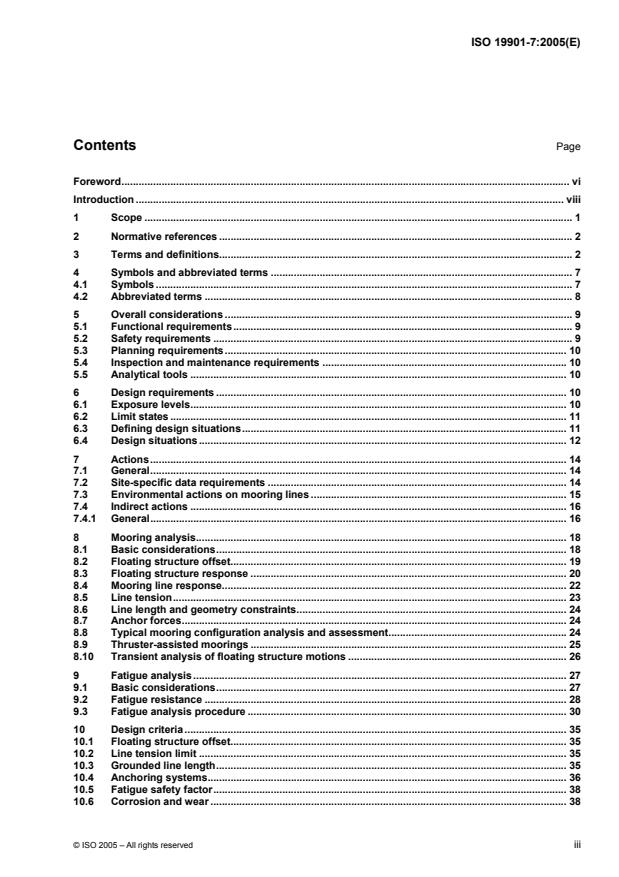
Contents Page
Foreword. vi
Introduction . viii
1 Scope. 1
2 Normative references. 2
3 Terms and definitions. 2
4 Symbols and abbreviated terms . 7
4.1 Symbols. 7
4.2 Abbreviated terms. 8
5 Overall considerations. 9
5.1 Functional requirements. 9
5.2 Safety requirements. 9
5.3 Planning requirements. 10
5.4 Inspection and maintenance requirements .10
5.5 Analytical tools. 10
6 Design requirements . 10
6.1 Exposure levels. 10
6.2 Limit states . 11
6.3 Defining design situations. 11
6.4 Design situations. 12
7 Actions. 14
7.1 General. 14
7.2 Site-specific data requirements . 14
7.3 Environmental actions on mooring lines . 15
7.4 Indirect actions . 16
7.4.1 General. 16
8 Mooring analysis. 18
8.1 Basic considerations. 18
8.2 Floating structure offset. 19
8.3 Floating structure response . 20
8.4 Mooring line response. 22
8.5 Line tension. 23
8.6 Line length and geometry constraints. 24
8.7 Anchor forces. 24
8.8 Typical mooring configuration analysis and assessment. 24
8.9 Thruster-assisted moorings. 25
8.10 Transient analysis of floating structure motions . 26
9 Fatigue analysis. 27
9.1 Basic considerations. 27
9.2 Fatigue resistance. 28
9.3 Fatigue analysis procedure . 30
10 Design criteria. 35
10.1 Floating structure offset. 35
10.2 Line tension limit . 35
10.3 Grounded line length. 35
10.4 Anchoring systems. 36
10.5 Fatigue safety factor. 38
10.6 Corrosion and wear . 38
10.7 Clearances. 39
10.8 Supporting structures . 39
11 Mooring hardware. 39
11.1 Mooring line components . 39
11.2 Winching equipment. 40
11.3 Monitoring equipment . 40
12 In-service inspection, monitoring and maintenance. 41
12.1 General. 41
12.2 Mobile moorings . 41
12.3 Permanent moorings. 41
13 Dynamic positioning system . 43
13.1 Basic considerations . 43
13.2 Design and analysis. 44
13.3 Design, test and maintenance . 45
13.4 Operating personnel . 45
13.5 Determination of stationkeeping capability . 45
14 Synthetic fibre rope mooring. 45
14.1 Basic considerations . 45
14.2 Fibre rope mooring analysis. 46
14.3 Fatigue analysis. 46
14.4 Creep analysis. 46
14.5 Design criteria. 47
14.6 Model testing. 48
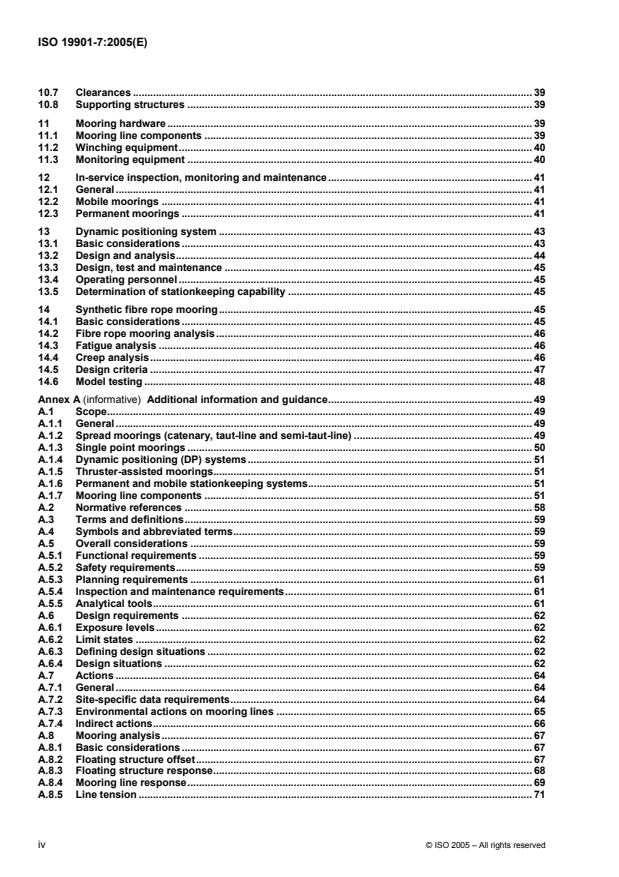
Annex A (informative) Additional information and guidance. 49
A.1 Scope. 49
A.1.1 General. 49
A.1.2 Spread moorings (catenary, taut-line and semi-taut-line) . 49
A.1.3 Single point moorings . 50
A.1.4 Dynamic positioning (DP) systems. 51
A.1.5 Thruster-assisted moorings. 51
A.1.6 Permanent and mobile stationkeeping systems. 51
A.1.7 Mooring line components . 51
A.2 Normative references. 58
A.3 Terms and definitions. 59
A.4 Symbols and abbreviated terms. 59
A.5 Overall considerations. 59
A.5.1 Functional requirements . 59
A.5.2 Safety requirements. 59
A.5.3 Planning requirements . 61
A.5.4 Inspection and maintenance requirements. 61
A.5.5 Analytical tools. 61
A.6 Design requirements . 62
A.6.1 Exposure levels. 62
A.6.2 Limit states . 62
A.6.3 Defining design situations . 62
A.6.4 Design situations . 62
A.7 Actions. 64
A.7.1 General. 64
A.7.2 Site-specific data requirements. 64
A.7.3 Environmental actions on mooring lines . 65
A.7.4 Indirect actions. 66
A.8 Mooring analysis. 67
A.8.1 Basic considerations . 67
A.8.2 Floating structure offset. 67
A.8.3 Floating structure response. 68
A.8.4 Mooring line response. 69
A.8.5 Line tension . 71
iv © ISO 2005 – All rights reserved
A.8.6 Line length and geometry constraints. 71
A.8.7 Anchor forces. 71
A.8.8 Typical mooring configuration analysis and assessment. 71
A.8.9 Thruster-assisted moorings. 73
A.8.10 Transient analysis of floating structure motions . 80
A.9 Fatigue analysis. 80
A.9.1 Basic considerations. 80
A.9.2 Fatigue resistance. 82
A.9.3 Fatigue analysis procedure . 84
A.10 Design criteria. 86
A.10.1 Floating structure offset. 86
A.10.2 Line tension limit . 87
A.10.3 Grounded line length. 87
A.10.4 Anchoring systems. 87
A.10.5 Fatigue safety factor. 95
A.10.6 Corrosion and wear . 95
A.10.7 Clearances. 95
A.10.8 Supporting structures . 95
A.11 Mooring hardware. 95
A.11.1 Mooring line components . 95
A.11.2 Winching equipment. 98
A.11.3 Monitoring equipment . 100
A.12 In-service inspection, monitoring and maintenance. 100
A.12.1 General. 100
A.12.2 Mobile moorings . 100
A.12.3 Permanent moorings. 100
A.13 Dynamic positioning system . 102
A.13.1 Basic considerations. 102
A.13.2 Design and analysis . 102
A.13.3 Design, test and maintenance . 103
A.13.4 Operating personnel. 104
A.13.5 Determination of stationkeeping capability . 104
A.14 Synthetic fibre rope mooring. 104
A.14.1 Basic considerations. 104
A.14.2 Fibre rope mooring analysis. 105
A.14.3 Fatigue analysis. 106
A.14.4 Creep analysis. 106
A.14.5 Design criteria. 108
A.14.6 Model testing. 108
Annex B (informative) Regional information . 109
B.1 Introduction . 109
B.1.1 General comments to the regional information. 109
B.1.2 Specific comments to the regional information . 109
B.2 Offshore Norway. 109
B.2.1 Description of region. 109
B.2.2 Regulatory framework. 109
B.2.3 Technical information. 110
B.2.4 Technical commentary. 112
B.2.5 Additional national requirements. 112
Bibliography . 113
Foreword
ISO (the International Organization for Standardization) is a worldwide federation of national standards bodies
(ISO member bodies). The work of preparing International Standards is normally carried out through ISO
technical committees. Each member body interested in a subject for which a technical committee has been
established has the right to be represented on that committee. International organizations, governmental and
non-governmental, in liaison with ISO, also take part in the work. ISO collaborates closely with the
International Electrotechnical Commission (IEC) on all matters of electrotechnical standardization.
International Standards are drafted in accordance with the rules given in the ISO/IEC Directives, Part 2.
The main task of technical committees is to prepare International Standards. Draft International Standards
adopted by the technical committees are circulated to the member bodies for voting. Publication as an
International Standard requires approval by at least 75 % of the member bodies casting a vote.
Attention is drawn to the possibility that some of the elements of this document may be the subject of patent
rights. ISO shall not be held responsible for identifying any or all such patent rights.
ISO 19901-7 was prepared by Technical Committee ISO/TC 67, Materials, equipment and offshore structures
for petroleum, petrochemical and natural gas industries, Subcommittee SC 7, Offshore structures.
This first edition of ISO 19901-7 cancels and replaces ISO/TR 13637:1997, of which it constitutes a technical
revision.
ISO 19901 consists of the following parts, under the general title Petroleum and natural gas industries —
Specific requirements for offshore structures:
⎯ Part 1: Metocean design and operating considerations
⎯ Part 2: Seismic design procedures and criteria
⎯ Part 4: Geotechnical and foundation design considerations
⎯ Part 5: Weight control during engineering and construction
⎯ Part 7: Stationkeeping systems for floating offshore structures and mobile offshore units
The following parts are under preparation:
⎯ Part 3: Topsides structure
⎯ Part 6: Marine operations
ISO 19901 is one of a series of standards for offshore structures. The full series consists of the following
International Standards.
⎯ ISO 19900, Petroleum and natural gas industries — General requirements for offshore structures
⎯ ISO 19901 (all parts), Petroleum and natural gas industries — Specific requirements for offshore
structures
vi © ISO 2005 – All rights reserved
1)
⎯ ISO 19902, Petroleum and natural gas industries — Fixed steel offshore structures
1)
⎯ ISO 19903, Petroleum and natural gas industries — Fixed concrete offshore structures
⎯ ISO 19904-1, Petroleum and natural gas industries — Floating offshore structures — Part 1: Monohulls,
2)
semi-submersibles and spars
⎯ ISO 19904-2, Petroleum and natural gas industries — Floating offshore structures — Part 2: Tension leg
3)
platforms
⎯ ISO 19905-1, Petroleum and natural gas industries — Site-specific assessment of mobile offshore
3)
units — Part 1: Jack-ups
⎯ ISO/TR 19905-2, Petroleum and natural gas industries — Site-specific assessment of mobile offshore
3)
units — Part 2: Jack-ups commentary
3)
⎯ ISO 19906, Petroleum and natural gas industries — Arctic offshore structures
1) To be published.
2) To be published.
3) Under preparation.
Introduction
The series of International Standards applicable to types of offshore structure, ISO 19900 to ISO 19906,
constitutes a common basis covering those aspects that address design requirements and assessments of all
offshore structures used by the petroleum, petrochemical and natural gas industries worldwide. Through their
application the intention is to achieve reliability levels appropriate for manned and unmanned offshore
structures, whatever type of structure and nature or combination of materials used.
It is important to recognize that structural integrity is an overall concept comprising models for describing
actions, structural analyses, design rules, safety elements, workmanship, quality control procedures and
national requirements, all of which are mutually dependent. The modification of one aspect of design in
isolation can disturb the balance of reliability inherent in the overall concept or structural system. The
implications involved in modifications, therefore, need to be considered in relation to the overall reliability of all
offshore structural systems.
The series of International Standards applicable to types of offshore structure is intended to provide wide
latitude in the choice of structural configurations, materials and techniques without hindering innovation.
Sound engineering judgement is therefore necessary in the use of these International Standards.
This part of ISO 19901 was developed in response to the worldwide offshore industry’s demand for a coherent
and consistent definition of methodologies to analyse, design and evaluate stationkeeping systems used for
floating production and/or storage platforms of various types (e.g. semi-submersibles, spar platforms, ship-
shaped structures) and to assess site-specific applications of mobile offshore units (such as mobile offshore
drilling units, pipelay units, construction units).
Stationkeeping is a generic term covering systems for keeping a floating structure, which is under the constant
influence of external actions, on a pre-defined location and/or heading with limited excursions. Stationkeeping
systems resist external actions by means of any combination of the following:
⎯ mooring systems (e.g. spread moorings or single point moorings);
⎯ dynamic positioning systems (generally consisting of thrusters).
The external actions generally consist of wind, wave, current and ice actions on the floating structure, mooring
and/or risers.
Some background to, and guidance on, the use of this part of ISO 19901 is provided in informative Annex A.
The clause numbering in Annex A is the same as in the normative text to facilitate cross referencing.
Regional information, where available, is provided in informative Annex B.
viii © ISO 2005 – All rights reserved
INTERNATIONAL STANDARD ISO 19901-7:2005(E)
Petroleum and natural gas industries — Specific requirements
for offshore structures —
Part 7:
Stationkeeping systems for floating offshore structures and
mobile offshore units
1 Scope
This part of ISO 19901 specifies methodologies for
a) the design, analysis and evaluation of stationkeeping systems for floating structures used by the oil and
gas industries to support
⎯ production,
⎯ storage,
⎯ drilling, well intervention and production,
⎯ production and storage,
⎯ drilling, well intervention, production and storage, and
b) the assessment of stationkeeping systems for site-specific applications of mobile offshore units (e.g.
mobile offshore drilling units, construction units, and pipelay units).
Most stationkeeping systems used with the class of floating structures covered by a) are termed “permanent
mooring systems”, for which this part of ISO 19901 is applicable to all aspects of the life cycle and includes
requirements relating to the manufacture of mooring components, as well as considerations for in-service
inspections. Most stationkeeping systems used with mobile offshore units, the class covered by b), are termed
“mobile mooring systems”. Throughout this document, the term “floating structure”, sometimes shortened to
“structure”, is used as a generic term to indicate any member of the two classes, a) and b).
This part of ISO 19901 is applicable to the following types of stationkeeping systems, which are either covered
directly in this document or through reference to other guidelines:
⎯ spread moorings (catenary, taut-line and semi-taut-line moorings);
⎯ single point moorings, anchored by spread mooring arrangements;
⎯ dynamic positioning systems;
⎯ thruster-assisted moorings.
Descriptions of the characteristics and of typical components of these systems are given in Annex A.
The requirements of this part of ISO 19901 mainly address spread mooring systems and single point mooring
systems with mooring lines composed of steel chain and wire rope. This document also provides guidance on
the application of the methodology to synthetic fibre rope mooring systems, and includes additional
requirements related to the unique properties of synthetic fibre ropes.
The document applies to single anchor leg moorings (SALMs) and other single point mooring systems (e.g.
tower soft yoke systems) only to the extent to which the requirements are relevant.
The requirements of this document do not apply to the vertical moorings of tension leg platforms (TLPs).
The methodology described in this part of ISO 19901 identifies a set of coherent analysis tools that, combined
with an understanding of the site-specific metocean conditions, the characteristics of the floating structure
under consideration, and other factors, can be used to determine the adequacy of the stationkeeping system
to meet the document’s functional requirements.
2 Normative references
The following referenced documents are indispensable for the application of this document. For dated
references, only the edition cited applies. For undated references, the latest edition of the referenced
document (including any amendments) applies.
ISO 19900, Petroleum and natural gas industries – General requirements for offshore structures
ISO 19901-1, Petroleum and natural gas industries — Specific requirements for offshore structures — Part 1:
Metocean design and operating considerations
ISO 19904-1, Petroleum and natural gas industries — Floating offshore structures — Part 1: Monohulls, semi-
submersibles and spars
3 Terms and definitions
For the purposes of this document, the following terms and definitions apply.
3.1
action
external load applied to the structure (direct action) or an imposed deformation or acceleration (indirect action)
EXAMPLE An imposed deformation can be caused by fabrication tolerances, settlement, temperature change or
moisture variation.
NOTE An earthquake typically generates imposed accelerations.
[ISO 19900:2002]
3.2
action effect
effect of actions on structural components
[ISO 19900:2002]
EXAMPLE Internal forces, moments, stresses, strains, rigid body motions or elastic deformations.
3.3
catenary mooring
mooring system where the restoring action is provided by the distributed weight of mooring lines
[ISO 19900:2002]
3.4
characteristic value
value assigned to a basic variable, an action or a resistance from which the design value can be found by the
application of a partial factor
2 © ISO 2005 – All rights reserved
NOTE 1 The value usually has a prescribed probability of not being violated which, in the case of an action, will
normally relate to a reference period.
NOTE 2 Adapted from ISO 19900:2002, definition 2.7.
3.5
design criteria
quantitative formulations that describe the conditions to be fulfilled for each limit state
[ISO 19900:2002]
3.6
design service life
assumed period for which a structure or a structural component is to be used for its intended purpose with
anticipated maintenance, but without substantial repair being necessary
NOTE Adapted from ISO 19900:2002, definition 2.12.
3.7
design situation
set of physical conditions during a certain reference period for which the design will demonstrate that relevant
limit states are not exceeded
NOTE Adapted from ISO 19900:2002, definition 2.13.
3.8
dynamic action
action that induces acceleration of a structure or a structural component of a magnitude sufficient to require
specific consideration
3.9
dynamic positioning
DP
stationkeeping technique consisting primarily of a system of automatically controlled on-board thrusters, which
generate appropriate thrust vectors to counter the mean and slowly varying induced actions
3.10
expected value
first-order statistical moment of the probability density function for the considered variable that, in the case of a
time-dependent parameter, can be associated with a specific reference period
3.11
fit-for-purpose
fitness-for-purpose
meeting the intent of an International Standard although not meeting specific provisions of that International
Standard in local areas, such that failures in these areas will not cause unacceptable risk to life safety or the
environment
[ISO 19900:2002]
3.12
floating structure
structure where the full weight is supported by buoyancy
[ISO 19900:2002]
NOTE The full weight includes lightship weight, mooring system pre-tension, riser pre-tension, operating weight, etc.
3.13
limit state
state beyond which the structure no longer fulfils the relevant design criteria
[ISO 19900:2002]
3.14
maintenance
set of activities performed during the operating life of a structure to ensure it is fit-for-purpose
3.15
minimum breaking strength
MBS
RCS certified strength of a chain, wire rope, fibre rope or accessories
3.16
mobile mooring system
mooring system, generally retrievable, intended for deployment at a specific location for a short-term operation,
such as those for mobile offshore units (MOUs)
3.17
mobile offshore drilling unit
MODU
structure capable of engaging in drilling and well intervention operations for exploration or exploitation of
subsea petroleum resources
3.18
mobile offshore unit
MOU
structure intended to be frequently relocated to perform a particular function
[ISO 19900:2002]
EXAMPLE Pipelaying vessel or barge, offshore construction structure, accommodation structure (floatel), service
structure, or mobile offshore drilling units.
3.19
mooring components
general class of components used in the mooring of floating structures
EXAMPLE Chain, steel wire rope, synthetic fibre rope, clump weight, buoy, winch/windlass, fairlead or anchor.
3.20
owner
representative of the company or companies which own a development, who can be the operator on behalf of
co-licensees
3.21
permanent mooring system
mooring system normally used to moor floating structures deployed for long-term operations, such as those
for a floating production system (FPS)
3.22
proximity
closeness in distance
NOTE 1 Mooring systems are considered to be in proximity to a surface installation (or facility) if any part of the other
installation lies within a contour described by the set of offsets coinciding with each line reaching 100 % MBS in the intact
or redundancy check condition, whichever is larger.
4 © ISO 2005 – All rights reserved
NOTE 2 Mooring systems are considered to be in proximity to a sea floor installation (or facility) if any part of the other
installation lies within a polygon formed by the anchor locations.
3.23
recognized classification society
RCS
member of the international association of classification societies (IACS), with recognized and relevant
competence and experience in floating structures, and with established rules and procedures for
classification/certification of installations used in petroleum-related activities
3.24
resistance
capacity of a structure, component or a cross-section of a component to withstand action effects without
exceeding a limit state
NOTE This definition is at variance with that specified in ISO 19900:2002.
3.25
return period
average period between occurrences of an event or of a particular value being exceeded
NOTE The offshore industry commonly uses a return period measured in years for environmental events. The return
period is equal to the reciprocal of the annual probability of exceedance of the event.
[ISO 19901-1:2005]
3.26
riser
piping connecting the process facilities or drilling equipment on the floating structure with the subsea facilities
or pipelines, or reservoir
NOTE 1 Possible functions include drilling and well intervention, production, injection, subsea systems control and
export of produced fluids.
NOTE 2 Adapted from ISO 19900:2002, definition 2.29.
3.27
semi-submersible
floating structure normally consisting of a deck structure with a number of widely spaced, large cross-section,
supporting columns connected to submerged pontoons
NOTE Pontoon/column geometry is usually chosen to minimize global motions in a broad range of wave frequencies.
3.28
serviceability
ability of a structure or structural component to perform adequately for normal functional use
3.29
significant value
statistical measure of the peak responses
NOTE In most offshore applications the significant value is taken as 2s, where s is the standard deviation of the time
series of the zero-mean random variable over the duration of the measurement.
3.30
single point mooring
mooring system that allows the floating structure to which it is connected to vary its heading (weathervane)
EXAMPLE One example of a single point mooring is a turret mooring system where a number of mooring lines are
attached to a turret, which includes bearings to allow the structure to rotate.
3.31
ship-shaped structure
monohull floating structure having a geometry similar to that of ocean-going ships
3.32
spar platform
deep-draught, small water-plane area floating structure
3.33
spread mooring
mooring system consisting of multiple mooring lines terminated at different locations on a floating structure,
and extending outwards, providing an almost constant structure heading
3.34
stationkeeping system
system capable of limiting the excursions of a floating structure within prescribed limits
3.35
structural component
physically distinguishable part of a structure
[ISO 19900:2002]
3.36
structure
organized combination of connected components designed to withstand actions and provide adequate rigidity
[ISO 19900:2002]
3.37
taut-line mooring
mooring system where the restoring action is provided by elastic deformation of mooring lines
[ISO 19900:2002]
3.38
thruster-assisted mooring
stationkeeping system consisting of mooring lines and thrusters
3.39
verification
examination made to confirm that an activity, product, or service is in accordance with specified requirements
3.40
weathervaning
process by which a floating structure passively varies its heading in response to time-varying environmental
actions
6 © ISO 2005 – All rights reserved
----------
...
Questions, Comments and Discussion
Ask us and Technical Secretary will try to provide an answer. You can facilitate discussion about the standard in here.
Loading comments...