


ISO/IEC 9646-3:1992
(Main)Information technology — Open Systems Interconnection — Conformance testing methodology and framework — Part 3: The Tree and Tabular Combined Notation (TTCN)
Information technology — Open Systems Interconnection — Conformance testing methodology and framework — Part 3: The Tree and Tabular Combined Notation (TTCN)
Technologies de l'information — Interconnexion de systèmes ouverts — Essais de conformité — Méthodologie générale et procédures — Partie 3: Notation combinée arborescente et tabulaire (TTCN)
General Information
- Status
- Withdrawn
- Publication Date
- 11-Nov-1992
- Withdrawal Date
- 11-Nov-1992
- Technical Committee
- ISO/IEC JTC 1 - Information technology
- Drafting Committee
- ISO/IEC JTC 1 - Information technology
- Current Stage
- 9599 - Withdrawal of International Standard
- Start Date
- 12-Nov-1998
- Completion Date
- 12-Feb-2026
Relations
- Effective Date
- 15-Apr-2008
Get Certified
Connect with accredited certification bodies for this standard

BSI Group
BSI (British Standards Institution) is the business standards company that helps organizations make excellence a habit.

NYCE
Mexican standards and certification body.
Sponsored listings
Frequently Asked Questions
ISO/IEC 9646-3:1992 is a standard published by the International Organization for Standardization (ISO). Its full title is "Information technology — Open Systems Interconnection — Conformance testing methodology and framework — Part 3: The Tree and Tabular Combined Notation (TTCN)". This standard covers: Information technology — Open Systems Interconnection — Conformance testing methodology and framework — Part 3: The Tree and Tabular Combined Notation (TTCN)
Information technology — Open Systems Interconnection — Conformance testing methodology and framework — Part 3: The Tree and Tabular Combined Notation (TTCN)
ISO/IEC 9646-3:1992 is classified under the following ICS (International Classification for Standards) categories: 35.100.01 - Open systems interconnection in general. The ICS classification helps identify the subject area and facilitates finding related standards.
ISO/IEC 9646-3:1992 has the following relationships with other standards: It is inter standard links to ISO/IEC 9646-3:1998. Understanding these relationships helps ensure you are using the most current and applicable version of the standard.
ISO/IEC 9646-3:1992 is available in PDF format for immediate download after purchase. The document can be added to your cart and obtained through the secure checkout process. Digital delivery ensures instant access to the complete standard document.
Standards Content (Sample)
ISQIIEC
I NTE R NAT1 0 N AL
Sl-ANDARD
First edition
1992-1 0-01
f?
information technology - Open Systems
Interconnection - Conformance testing
methodology and framework ---
Part 3:
'The Tree and Tabular Combined Notation (TTCN)
Intercon/,exioti rie sysi6tnes oitverts --
Tecliriologies de l'information
Essais de confor-rnifë -- h/léiiJodologie gértfira/e et I)roc&dor es --
Partie 3: Notation combinée arborescente et taliillair e (T7%N)
Reference number
ISO/IEC 9646-3:1902(E)
ISOAEC 9646-3 : 1992(E)
Page
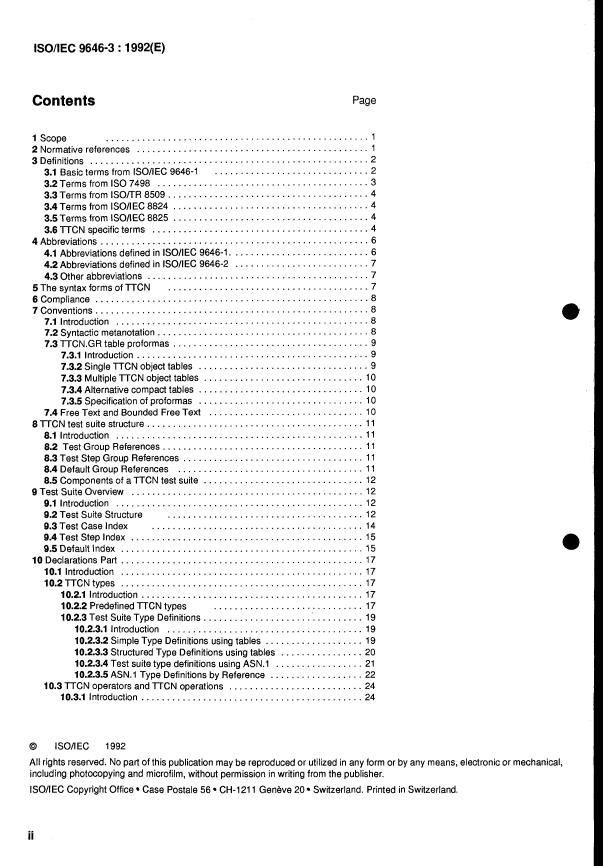
Contents
1 Scope . 1
2 Normative references . 1
3Definitions . 2
3.1 Basic terms from ISO/IEC 9646-1 . 2
3.2 Terms from IS0 7498 . 3
3.3 Terms from ISO/TR 8509 . 4
3.4 Terms from lSO/lEC 8824 . 4
3.5 Terms from lSO/iEC 8825 . 4
3.6 TTCN specific terms . 4
4Abbreviations . 6
4.1 Abbreviations defined in ISO/IEC 9646-1 . 6
4.2 Abbreviations defined in ISO/IEC 9646-2 . 7
4.3 Other abbreviations . 7
5 The syntax forms of TTCN . 7
6Compliance . 8
7Conventions . 8
7.1 Introduction . 8
7.2 Syntactic metanotation . 8
7.3 TTCN.GR table proformas . 9
7.3.1 Introduction . 9
7.3.2 Single TTCN object tables . 9
7.3.3 Multiple TTCN object tables . 10
7.3.4 Alternative compact tables . 10
7.3.5 Specification of proformas . 10
7.4 Free Text and Bounded Free Text . 10
8 TTCN test suite structure . 11
8.1 Introduction . 11
8.2 Test Group References . 11
8.3 Test Step Group References . 11
8.4 Default Group References . 11
8.5 Components of a TTCN test suite . 12
QTest SuiteOverview . 12
9.1 Introduction . 12
9.2 Test Suite Structure . 12
9.3TestCaselndex . 14
9.4 Test Step Index . 15
9.5 Default Index . 15
10 Declarations Part . 17
10.1 Introduction . 17
10.2TTCNtypes . 17
10.2.1 Introduction . 17
10.2.2 Predefined TTCN types . 17
10.2.3 Test Suite Type Definitions . 19
10.2.3.1 Introduction . 19
10.2.3.2 Simple Type Definitions using tables . 19
10.2.3.3 Structured Type Definitions using tables . 20
................. 21
10.2.3.4 Test suite type definitions using ASN.l
10.2.3.5 ASN.l Type Definitions by Reference . 22
10.3 TTCN operators and TTCN operations . 24
10.3.1 Introduction . 24
O ISOAEC 1992
All rights reserved . No part of this publication may be reproduced or utilized in any form or by any means. electronic or mechanical.
including photocopying and microfilm. without permission in writing from the publisher .
ISOAEC Copyright Office Case Postale 56 CH-121 1 Genève 20 Switzerland . Printed in Switzerland .
ii
ISOAEC 9646-3 : 1992( E)
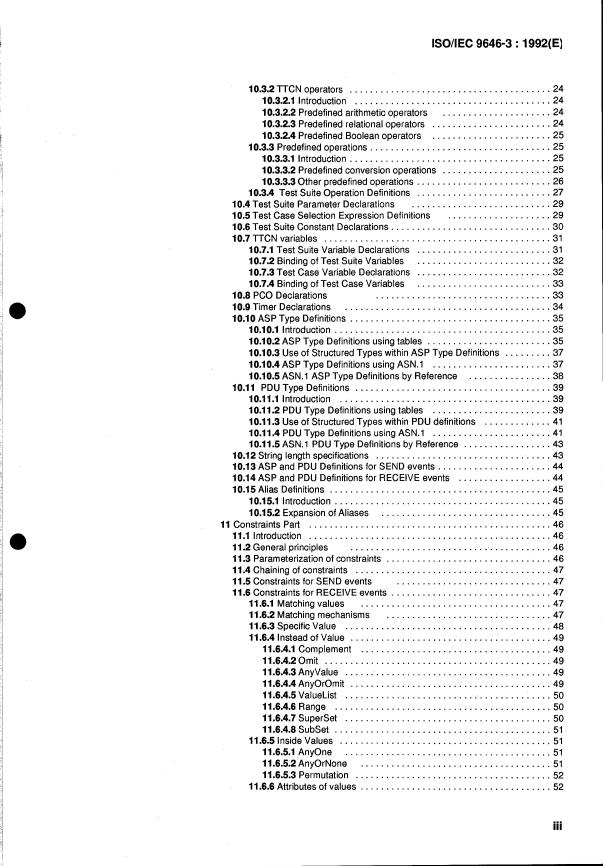
10.3.2 TTCN operators . 24
10.3.2.1 Introduction . 24
10.3.2.2 Predefined arithmetic operators . 24
....................... 24
10.3.2.3 Predefined relational operators
10.3.2.4 Predefined Boolean operators . 25
10.3.3 Predefined operations . 25
10.3.3.1 Introduction . 25
10.3.3.2 Predefined conversion operations . 25
10.3.3.3 Other predefined operations . 26
10.3.4 Test Suite Operation Definitions . 27
10.4 Test Suite Parameter Declarations . 29
10.5 Test Case Selection Expression Definitions . 29
10.6 Test Suite Constant Declarations . 30
10.7 TTCN variables . 31
10.7.1 Test Suite Variable Declarations . 31
10.7.2 Binding of Test Suite Variables . 32
10.7.3 Test Case Variable Declarations . 32
.......................... 33
10.7.4 Binding of Test Case Variables
10.8 PCO Declarations . 33
10.9 Timer Declarations . 34
10.10 ASP Type Definitions . 35
10.10.1 introduction . 35
10.10.2 ASP Type Definitions using tables . 35
10.10.3 Use of Structured Types within ASP Type Definitions . 37
10.10.4 ASP Type Definitions using ASN.l . 37
10.10.5 ASN.l ASP Type Definitions by Reference . 38
10.11 PDU Type Definitions . 39
10.1 1.1 Introduction . 39
10.11.2 PDU Type Definitions using tables . 39
10.11.3 Use of Structured Types within PDU definitions . 41
10.11.4 PDU Type Definitions using ASN.l . 41
10.11.5 ASN.l PDU Type Definitions by Reference . 43
10.12 String length specifications . 43
10.13 ASP and PDU Definitions for SEND events . 44
10.14 ASP and PDU Definitions for RECEIVE events . 44
10.15 Alias Definitions . 45
10.15.1 Introduction . 45
10.1 5.2 Expansion of Aliases . 45
11 ConstraintsPart . 46
11.1 Introduction . 46
11.2 General principles . 46
11.3 Parameterization of constraints . . . 46
11.4 Chaining of constraints . 47
11.5 Constraints for SEND events . 47
11.6 Constraints for RECEIVE events . 47
11.6.1 Matching values . 47
11.6.2 Matching mechanisms . 47
11.6.3 Specific Value . 48
11.6.4 Instead of Value . 49
11.6.4.1 Complement . 49
11.6.4.2 Omit . 49
11.6.4.3AnyValue . 49
11.6.4.4 AnyOrOmit . 49
11.6.4.5 ValueList . 50
11.6.4.6Range . 50
11.6.4.7 SuperSet . 50
11.6.4.8 Subset . 51
11.6.5 Inside Values . 51
11.6.5.1 Anyone . 51
11.6.5.2AnyOrNone . 51
11.6.5.3 Permutation . 52
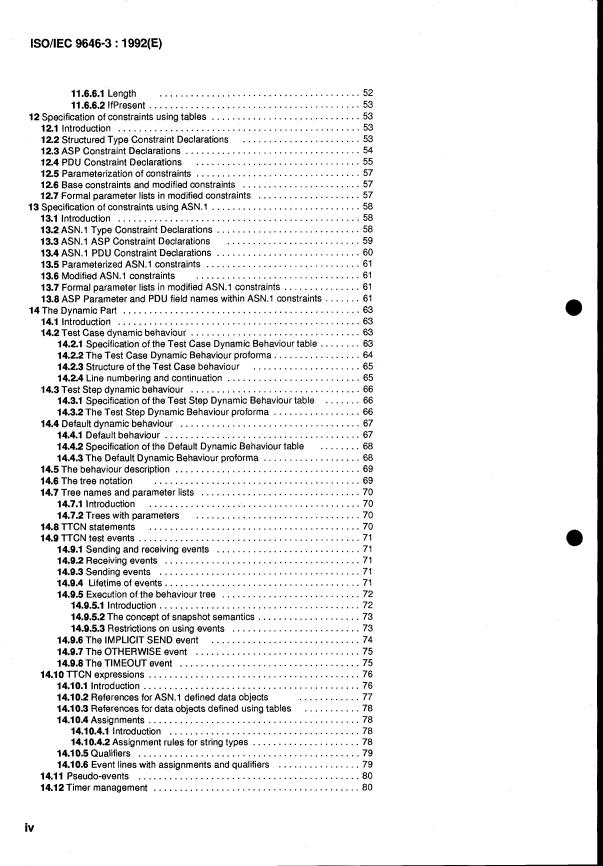
ISO/IEC 9646-3 : 1992(E)
11.6.6.1 Length . 52
11.6.6.2 IfPresent . 53
12 Specification of constraints using tables . 53
12.1 Introduction . 53
12.2 Structured Type Constraint Declarations . 53
12.3 ASP Constraint Declarations . 54
12.4 PDU Constraint Declarations . 55
12.5 Parameterization of constraints . 57
....................... 57
12.6 Base constraints and modified constraints
12.7 Formal parameter lists in modified constraints . 57
13 Specification of constraints using ASN.1 . 58
13.1 Introduction . 58
13.2 ASN.l Type Constraint Declarations . 58
13.3 ASN.l ASP Constraint Declarations . 59
13.4 ASN.l PDU Constraint Declarations . 60
13.5 Parameterized ASN.l constraints . 61
13.6 Modified ASN.l constraints . 61
13.7 Formal parameter lists in modified ASN.l constraints . 61
13.8ASP Parameter and PDU field names within ASN.l constraints . 61
14TheDynamicPart . 63
14.1lntroduction . 63
14.2 Test Case dynamic behaviour . 63
14.2.1 Specification of the Test Case Dynamic Behaviour table . 63
14.2.2 The Test Case Dynamic Behaviour proforma . 64
14.2.3 Structure of the Test Case behaviour . 65
14.2.4 Line numbering and continuation . 65
14.3 Test Step dynamic behaviour . 66
14.3.1 Specification of the Test Step Dynamic Behaviour table . 66
14.3.2 The Test Step Dynamic Behaviour proforma . 66
14.4 Default dynamic behaviour . 67
14.4.1 Default behaviour . 67
14.4.2 Specification of the Default Dynamic Behaviour table . 68
14.4.3 The Default Dynamic Behaviour proforma . 68
14.5 The behaviour description . 69
14.6 The tree notation . 69
14.7 Tree names and parameter lists . 70
14.7.1 Introduction . 70
14.7.2Trees with parameters . 70
14.8 TTCN statements . 70
14.9 TTCN test events . 71
14.9.1 Sending and receiving events . 71
14.9.2 Receiving events . 71
14.9.3 Sending events . 71
14.9.4 Lifetime of events . 71
14.9.5 Execution of the behaviour tree . 72
14.9.5.1 Introduction . 72
14.9.5.2 The concept of snapshot semantics . 73
14.9.5.3 Restrictions on using events . 73
14.9.6 The IMPLICIT SEND event . 74
14.9.7 The OTHERWISE event . 75
14.9.8 The TIMEOUT event . 75
14.10 TTCN expressions . 76
14.10.1 Introduction . 76
14.10.2 References for ASN.l defined data objects . 77
14.10.3 References for data objects defined using tables . 78
14.10.4 Assignments . 78
14.1 0.4.1 Introduction . 78
14.10.4.2 Assignment rules for string types . 78
14.10.5 Qualifiers . 79
14.10.6 Event lines with assignments and qualifiers . 79
14.1 1 Pseudo-events . 80
14.12 Timer management . 80
ISO/IEC 9646-3 : 1992(E)
14.1 2.1 Introduction . 80
14.12.2 The START operation . 80
14.12.3 The CANCEL operation . 81
14.12.4 The READ TIMER operation . 81
14.13 The ATTACH construct . 82
14.1 3.1 Introduction . 82
14.13.2 Scope of tree attachment . 82
14.13.3 Tree attachment basics . 82
14.13.4 The meaning of tree attachment . 83
14.13.5 Passing parameterized constraints . 85
14.13.6 Recursive tree attachment . 85
14.13.7 Tree attachment and Defaults . 85
14.14 Labels and the GOT0 construct . 85
14.15 The REPEAT construct . 86
14.16 The Constraints Reference . 87
14.16.1 Purpose of the Constraints Reference column . 87
14.16.2 Passing parameters in Constraint References . 87
14.16.3 Constraints and qualifiers and assignments . 88
14.17 Verdicts . 88
14.17.1 Introduction . 88
14.17.2 Preliminary results . 88
14.17.3 Final verdict . 89
14.17.4 Verdicts and OTHERWISE . 89
14.18 The meaning of Defaults . 89
14.1 8.1 Introduction . 89
14.18.2 Defaults and tree attachment . 90
14.19 Default References . 92
15Pagecontinuation . 94
15.1 Page continuation of TTCN tables . 94
15.2 Page continuation of dynamic behaviour tables . 94
Annexes
A (normative) Syntax and static semantics of TTCN . 96
A.1lntroduction . 96
A.2 Conventions for the syntax description . 96
A.2.1 Syntactic metanotation . 96
A.2.2 TTCN.MP syntax definitions . 96
A.3 The lTCN.MP syntax productions in BNF . 98
A.3.1 Test suite . 98
A.3.2 The Test Suite Overview . 98
A.3.2.1 General . 98
A.3.2.2 Test Suite Structure . 98
A.3.2.3 Test Case Index . 98
A.3.2.4 Test Step index . 98
A.3.2.5 Default Index . 98
A.3.3 The Declarations Part . 98
A.3.3.1 General . 98
A.3.3.2 Definitions . 99
A.3.3.2.1 General . 99
A.3.3.2.2 Test Suite Type Definitions . 99
A.3.3.2.3 Simple Type Definitions . 99
A.3.3.2.4 Structured Type Definitions . 99
A.3.3.2.5ASN.l Type Definitions . 100
A.3.3.2.6 ASN.l Type Definitions by Reference . 100
A.3.3.2.7 Test Suite Operation Definitions . 100
A.3.3.3 Parameterization and Selection . 100
A.3.3.3.1 General . 100
A.3.3.3.2 Test Suite Parameter Declarations . 101
A.3.3.3.3 Test Case Selection Expression Definitions . 101
A.3.3.4 Declarations . 101
V
ISOAEC 9646-3 : 1992(E)
A.3.3.4.1 General . 101
................. 101
A.3.3.4.2 Test Suite Constant Declarations
A.3.3.4.3 Test Suite Variable Declarations . 101
A.3.3.4.4 Test Case Variable Declarations . 101
A.3.3.4.5 PCO Declarations . 102
A.3.3.4.6 Timer Declarations . 102
A.3.3.5 ASP and PDU Type Definitions . 102
A.3.3.5.1 General . 102
A.3.3.5.2 ASP Type Definitions . 102
A.3.3.5.3 Tabular ASP Type Definitions . 102
A.3.3.5.4 ASN.l ASP Type Definitions . 103
A.3.3.5.5 ASN.l ASP Type Definitions by Reference . 103
A.3.3.5.6 PDU Type Definitions . 103
A.3.3.5.7 Tabular PDU Type Definitions . 103
A.3.3.5.8 ASN.l PDU Type Definitions . 104
A.3.3.5.9 ASN.1 PDU Type Definitions by Reference . 104
A.3.3.5.10 Alias Definitions . 104
A.3.4 The Constraints Part . 104
A.3.4.1 General . 104
A.3.4.2 Test Suite Type Constraint Declarations . 104
A.3.4.3 Structured Type Constraint Declarations . 104
A.3.4.4 ASN.l Type Constraint Declarations . 104
A.3.4.5 ASP Constraint Declarations . 105
A.3.4.6 Tabular ASP Constraint Declarations . 105
A.3.4.7 ASN.l ASP Constraint Declarations . 105
A.3.4.8 PDU Constraint Declarations . 105
A.3.4.9 Tabular PDU Constraint Declarations . 105
A.3.4.10 ASN.l PDU Constraint Declarations . 107
A.3.5 The Dynamic Pari . 107
A.3.5.1 General . 107
A.3.5.2 Test Cases . 107
A.3.5.3 Test Step Library . 108
A.3.5.4 Default Library . 108
A.3.5.5 Behaviour descriptions . 108
A.3.5.6 Behaviour lines . 109
A.3.5.7 TTCN statements . 109
A.3.5.8 Expressions . 110
A.3.5.9 Timer operations . 112
A.3.6 Types . 112
A.3.6.1 General . 112
A.3.6.2 Predefined types . 112
A.3.6.3 Referenced types . 112
A.3.7Values . 112
A.3.8 Miscellaneous productions . 113
A.4 General static semantics requirements . 114
A.4.1 Introduction . 114
A.4.2 Uniqueness of identifiers . 114
A.5 Differences between TTCN.GR and TTCN.MP . 117
A.5.1 Differences in syntax . 117
A.5.2 Additional static semantics in the TTCN.MP . 117
B (normative) Operational semantics of TTCN . 118
B.l Introduction . 118
B.2Precedence . 118
B.3 Processing of test case errors . 118
BA Transformation algorithms . 119
13.4.1 Introduction . 119
8.4.2 Appending default behaviour . 119
64.3 Removal of REPEAT constructs . 120
6.4.4 Expanding ATTACHED trees . 120
8.5 TTCN operational semantics . 121
8.5.1 Introduction . 121
6.5.2 Introduction to the pseudo-code notation . 121
vi
ISO/IEC 9646-3 : 1992(E)
B.5.3 Execution of a test case . 121
8.5.3.1 Execution of a Test Case . pseudo-code . 121
B.5.3.2 Execution of a Test Case . natural language
description . 122
B.5.4 Functions for TTCN events . 123
B.5.4.1 Functions for TTCN events . pseudo-code . 123
8.5.4.2 Functions for TTCN events . natural language
description . 123
B.5.5 Execution of the SEND event . 123
B.5.5.1 Execution of the SEND event . pseudo-code . 123
B.5.5.2 Execution of the SEND event . natural language
description . 124
B.5.6 Execution of the RECEIVE event . 124
8.5.6.1 Execution of the RECEIVE event . pseudo-code . 124
8.5.6.2 Execution of the RECEIVE event . natural language
description . 125
B.5.7 Execution of the OTHERWISE event . 126
B.5.7.1 Execution of the OTHERWISE event . pseudo-code . 126
B.5.7.2 Execution of the OTHERWISE event . natural
language description . 126
B.5.8 Execution of the TIMEOUT event . 127
8.5.8.1 Execution of the TIMEOUT event . pseudo-code . 127
B.5.8.2 Execution of the TIMEOUT event . natural language
description . 127
B.5.9 Execution of the IMPLICIT SEND event . 128
B.5.9.1 Execution of the IMPLICIT SEND event . pseudo-code . 128
8.5.9.2 Execution of IMPLICIT SEND . natural language
description . 128
8.5.10 Execution of the PSEUDO-EVENT . 128
B.5.10.1 Execution of PSEUDO-EVENTS . pseudo-code . 128
B.5.10.2 Execution of PSEUDO-EVENTS . natural language
description . 129
8.5.11 Execution of BOOLEAN expressions . 129
B.5.11.1 Execution of BOOLEAN expressions . pseudo-code . 129
8.5.1 1.2 Execution of BOOLEAN expressions . natural
language description . 129
8.5.12 Execution of ASSIGNMENTS . 129
8.5.12.1 Execution of EXECUTE-ASSIGNMENT . pseudo-code . 129
B.5.12.2 Execution of ASSIGNMENTS . natural language
description . 130
6.5.13 Execution of TIMER operations . 130
8.5.13.1 Execution of TIMER operations . pseudo-code . 130
B.5.13.2 Execution of START timer . natural language
description . 130
B.5.13.3 CANCEL timer . natural language description . 131
B.5.13.4 READTIMER . natural language description . 131
8.5.14 Functions for TTCN constructs . 131
B.5.14.1 Functions for TTCN constructs . pseudo-code . 131
B.5.14.2 Functions for TTCN constructs . natural language
description . 131
8.5.15 Execution of the GOTO construct . 132
B.5.15.1 Execution of the GOTO construct . pseudo-code . 132
B.5.15.2 Execution of the GOTO construct . natural language
description . 132
B.5.16 The VERDICT . 132
B.5.16.1 The VERDICT . pseudo-code . 132
B.5.16.2 The VERDICT . natural language description . 132
8.5.17 The Conformance Log . 133
B.5.17.1 The LOG . pseudo-code . 133
B.5.17.2 The conformance log . natural language description .
B.5.18 Other miscellaneous functions used by the pseudo-code . 133
vii
ISO/IEC 9646-3 : 1992(E)
C (normative) Compact proformas . 135
C.l Introduction . 135
C.2 Compact proformas for constraints . 135
C.2.1 Requirements . 135
C.2.2 Compact proformas for ASP constraints . 135
C.2.3 Compact proformas for PDU constraints . 136
C.2.3.1 Introduction . 136
.................... 137
C.2.3.2 Parameterized compact constraints
.......... 138
C.2.4 Compact proformas for Structured Type constraints
C.2.5 Compact proformas for ASN.l constraints . 140
C.3 Compact proforma for Test Cases . 141
C.3.1 Requirements . 141
C.3.2 Compact proforma for Test Case dynamic behaviours . 141
D (informative) Examples . 143
D.l Examples of tabular constraints . 143
D.l.l ASP and PDU definitions . 143
D.1.2 ASP/PDU constraints . 144
D.2 Examples of ASN1 constraints . 147
D.2.1 ASP and PDU definitions . 147
D.2.2 ASN.l ASP/PDU constraints . 148
D.2.3 Further examples of ASN.l constraints . 152
D.3 Base and modified constraints . 154
D.4 Type definition using macros . 155
D.5 Use of REPEAT . 156
D.6 Test suite operations . 157
D.7 Example of a Test Suite Overview . 157
D.8 Example of a Test Case in lTCN.MP Form . 159
E (informative) Style guide . 162
E.l Introduction . 162
E.2 Test case structure . 162
E.3 Use of TTCN with different abstract test methods . 163
E.3.1 Introduction . 163
E.3.2 lTCN and the LS test method . 163
E.3.3 TTCN and the DS test method . 163
E.3.4 lTCN and the CS test method . 163
E.3.5 lTCN and the RS test method . 164
E.4 Use of Defaults . 164
E.5 Limiting the execution time of a Test Case . 164
E.6 Structured Types . 164
E.7 Abbreviations . 165
.......................................... 165
E.8 Test descriptions
................................ 165
E.9 Assignments on SEND events
E.10 Multi-service PCOs . 165
F (informative) Summary of differences between Draft International Standard
........................ 166
and International Standard versions of TTCN
F.l Summary of differences . 166
F.l.l General . 166
F.1.2 Convergence with ASN.l . 166
F.1.3 Static semantics . 166
F.1.4 Table layout . 166
F.1.5 Test suite overview . 166
.......................................... 166
F.1.6 Declarations
F.1.7 Constraints . 167
F.1.8Behaviourpart . 167
F.1.9 Verdicts. defaults and OTHERWISE . 167
F.2 Summaryof major changes . 168
0 (informative) List of BNF production numbers . 169
0.1 Introduction . 169
0.2 The production index . 169
of part 3 . 173
H (informative) Index
H.l Introduction . 173
H.2Thelndex . 173
viii
ISO/IEC 9646-3 : 1992(E)
Foreword
IS0 (the International Organization for Standardization) and IEC (the
International Electrotechnical Commission) form the specialized system
for worldwide standardization. National bodies that are members of IS0
or IEC participate in the development of International Standards through
technical committees established by the respective organization to deal
with particular fields of technical activity. IS0 and IEC technical com-
mittees collaborate in fields of mutual interest. Other international or-
ganizations, governmental and non-governniental, in liaison with IS0
and IEC, also take part in the work.
In the field of information technology, IS0 and IEC have established a
joint technical committee, ISO/IEC JTC 1. Draft International Standards
adopted by the joint technical cornmittee are circulated to national bod-
ies for voting. Publication as an International Standard requires ap-
proval by at least 75 % of the national bodies casting a vote.
International Standard ISO/IEC 9646-3 was prepared by Joint Technical
Committee IÇOAEC JTC 1, lnformation technology.
IÇO/IEC 9646 consists of the following parts, under the general title ln-
formation technology - Open Systems Interconnection -- Conformance
testing methodology and framework:
- Part 1: General concepts
- Part 2: Abstract test suite specificafion
- Part 3; The Tree and Tabular Combined Notation (TTCN)
- Part 4: Test realization
- Part 5: Requiretnents on test laboratories and clients for the con-
formance assessment process
- Part 6: Protocol profile test specificaîion
- Part 7: lmplementaion conforniance statement -- Requirements
and guidance on ICs and ICs proformas
Annexes A, B and C form an integral part of this pari of ISO/IEC 9646.
Annexes D, E, F, G and H are for information only.
ix
ISO/IEC 9646-3 : 1992( E)
Introduction
This part of ISOilEC 9646, one of a multi-part International Standard defines
an informal test notation, called the Tree and Tabular Combined Notation
(TTCN), for use in the specification of OS1 abstract conformance test suites.
In constructing a standardized abstract test suite, a test notation is used to de-
scribe abstract test cases. The test notation can be an informal notation (with-
out formally defined semantics) or a formal description technique (FDT).
TTCN is an informal notation with clearly defined, but not formally defined, se-
mantics.
TEN is designed to meet the following objectives:
a) to provide a notation in which abstract test cases can be expressed in
standardized test suites;
b) to provide a notation which is independent of test methods, layers and
protocols;
c) to provide a notation which reflects the abstract testing methodology
defined in ISO/IEC 9646.
In the abstract testing methodology a test suite is looked upon as a hierarchy
ranging from the complete test suite, through test groups, test cases and test
steps, down to test events. TTCN provides a naming structure to reflect the po-
sition of test cases in this hierarchy. It also provides the means of structuring
test cases as a hierarchy of test steps culminating in test events. In TTCN the
basic test events are sending and receiving Abstract Service Primitives
(ASPS), Protocol Data Units (PDUs) and timer events.
Two forms of the notation are provided: a human-readable tabular form, called
TTCN.GR, for use in OS1 conformance test suite standards; and a machine-
processable form, called TTCN.MP, for use in representing TTCN in a canon-
ical form within computer systems and as the syntax to be used when trans-
ferring TTCN test cases between different computer systems. The two forms
are semantically equivalent.
This part of ISO/IEC 9646 is also to be published by CCITT as Recommenda-
tion X.292 (1992).
X
INTERNATIONAL STANDARD ISO/IEC 9646-3 : 1992(E)
Information technology - Open Systems Interconnection -
Conformance testing methodology and framework - Part 3:
The Tree and Tabular Combined Notation (TTCN)
1 Scope
This part of ISO/IEC 9646 defines an informal test notation, called the Tree and Tabular Combined Notation (TTCN),
for OS1 conformance test suites, which is independent of test methods, layers and protocols, and which reflects the
abstract testing methodology defined in ISO/IEC 9646-1 and ISO/IEC 9646-2.
It also specifies requirements and provides guidance for using TTCN in the specification of system-independent con-
formance test suites for one or more OS1 standards. It specifies two forms of the notation: one, a human-readable
form, applicable to the production of conformance test suite standards for OS1 protocols; and the other, a machine-
processable form, applicable to processing within and between computer systems.
This part of ISO/IEC 9646 applies to the specification of conformance test cases which can be expressed abstractly
in terms of control and observation of protocol data units and abstract service primitives. Nevertheless, for some pro-
tocols, test cases may be needed which cannot be expressed in these terms. The specification of such test cases is
outside the scope of this part of ISO/IEC 9646, although those test cases may need to be included in a conformance
test suite standard.
NOTE 1 - For example, some static conformance requirements related to an application service may require testing techniques
which are specific to that particular application.
This part of ISO/IEC 9646 specifies requirements on what a test suite standard may specify about a conforming real-
ization of the test suite, including the operational semantics of TTCN test suites.
NOTE 2 - ISOA EC 9646-4 specifies requirements concerning test realization including ETS derivation.
This part of ISO/IEC 9646 applies to the specification of conformance test suites for OS1 protocols in OS1 layers 2 to
7, specifically including Abstract Syntax Notation One (ASN.l) based protocols. The following are outside the scope
ISOllEC 9646:
of this part of
a) the specification of conformance test suites for multi-peer or Physical layer protocols;
b) the relationship between TTCN and formal description techniques;
c) the specification of test cases in which more than one behaviour description is to be run concurrently;
NOTE 3 - Use of parallel trees and synchronization between them is to be covered by a future amendment to this pari of ISO/
IEC 9646.
d) the means of realization of executable test suites (ETS) from abstract test suites.
2 Normative references
The following standards contain provisions which, through reference in this text, constitute provisions of this part of
ISO/IEC 9646. At the time of publication, the editions indicated were valid. All standards are subject to revision, and
parties to agreements based on this part of ISO/IEC 9646 are encouraged to investigate the possibility of applying
the most recent editions of the standards listed below. Members of IS0 and IEC maintain registers of currently valid
International Standards.
IS0 646 : 1991 , Information technology - IS0 7-bit coded character set for information interchange.
IS0 7498 : 1984, Information processing systems - Open Systems Interconnection - Basic Reference Model.
(See also CClTT Recommendation X.200 : 1988.)
ISO/IEC 9646-3 : 1992(E)
lSO/TR 8509 : 1 987, information processing systems - Open Systems Interconnection -Service conventions.
(See also CCITT Recommendation X.21 O : 1988.)
ISO/I EC 8824 : 1 990, information technology - Open Systems lnterconnection - Specification of Abstract Syntax No-
tation One (ASN. l).
(See also CCITT Recommendation X.208 : 1988.)
ISO/I EC 8825 : 1 990, information technology - Open Systems lnterconnection - Specification of Basic Encoding
Rules for Abstract Syntax Notation One (ASN. 1).
(See also CCITT Recommendation X.209 : 1988)
ISO/IEC 9646-1 : 1991, lnformation technology - Open Systems Interconnection - Conformance testing methodology
- Part 1: General concepts.
and framework
(See also CClTT Recommendation X.290 : - '1)
ISOlIEC 9646-2 : 1991, information technology - Open Systems lnterconnection - Conformance testing methodology
and framework - Part 2: Abstract test suite specification.
(See also CCITT Recommendation X.291 : - '1)
ISO/IEC 9646-4 : 1 991, lnformation technology - Open Systems Interconnection - Conformance testing methodology
and framework - Part 4: Test realization.
(See also CCITT Recommendation X.293 : - '1)
ISO/IEC 9646-5 : 1 991, Information technology - Open Systems lnterconnection - Conformance testing methodology
and framework - Part 5: Requirements on test laboratories and clients for the conformance assessmentprocess. (See
also CCllT Recommendation X.294 : - '1)
ISOllEC 10646-1 : - '1, lnformation technology - Multiple-Octet Coded Character Set - Part 1: Architecture and Basic
Multilingual Plane.
3 Definitions
3.1 Basic terms from ISO/IEC 9646-1
The following terms defined in ISOlIEC 9646-1 apply:
a) abstract service primitive
b) abstract testing methodology
c) abstract test case
d) abstract test method
e) abstract test suite
f) conformance log
g) conformance test suite
h) coordinated test method
i) distributed test method
j) executable test case
k) executable test case error
I) executable test suite
m) fail verdict
n) idle testing state
O) implementation under test
p) inconclusive verdict
q) invalid test event
r) local test method
I) To be published.
ISO/IEC 9646-3 : 1992(E]
s) lower tester
t) means of testing
U) pass verdict
v) PICS proforma
w) PlXlT proforma
x) protocol implementation conformance statement
y) protocol implementation extra information for testing
z) point of control and observation
aa) remote test method
ab) stable testing state
ac) standardized abstract test suite
ad) static conformance requirements
ae) syntactically invalid test event
af) system under test
ag) test body
ah) test case
ai) test case error
aj) test coordination procedures
ak) test event
al) test group
am) test group objective
an) test laboratory
ao) test management protocol
ap) test outcome
aq) (test) postamble
ar) (test) preamble
as) test purpose
at) test realization
au) test realizer
av) test step
aw) test suite
ax) test system
ay) upper tester
az) (test) verdict
ba) testing state
3.2 Terms from IS0 7498
The following terms defined in IS0 7498 apply:
a) application layer
b) protocol data unit
c) service access point
d) session layer
e) subnetwork
ISO/IEC 9646-3 : 1992( E)
f) transfer syntax
g) transport layer
3.3 Terms from ISO/TR 8509
The following terms defined in lSO/TR 8509 apply:
a) service-provider
3.4 Terms from ISOAEC 8824
The following terms defined in ISO/IEC 8824 apply:
a) bitstring type
b) characterstring type
c) enumerated type
d) external type
e) object identifier
f) octetstring type
g) real type
h) selection type
i) sequence type
j) sequence-of type
k) set type
I) set-of type
m) subtype
NOTE - Where there may be ambiguity with lTCN terms these terms are prefixed with the term ASN.l.
3.5 Terms from ISOAEC 8825
The following term defined in ISO/IEC 8825 applies:
encoding
3.6 TCN specific terms
For the purposes of this part of ISO/IEC 9646 the following definitions apply:
3.6.1 attach construct: A TTCN statement which attaches a Test Step to a calling tree.
3.6.2 base constraint: Specifies a set of default values for each and every field in an ASP or PDU type definition.
3.6.3 base type: The type from which a type defined in a test suite is derived.
3.6.4 behaviour line: An entry in a dynamic behaviour table representing a test event or other TTCN statement to-
gether with associated label, verdict, constraints reference and comment information as applicable.
3.6.5 behaviour tree: A specification of a set of sequences of test events, and other TTCN statements.
3.6.6 blank entry: In a modified compact constraint table a blank entry in a constraint parameter or field denotes that
a constraint value is to be inherited.
3.6.7 calling tree: The behaviour tree to which a Test Step is attached.
3.6.8 compact constraint table: Declaration of a set of constraints for an ASP, PDU or Structured Type arranged
in a single table.
3.6.9 compact test case table: Declaration of a set of Test Cases for a given Test Group arranged in a single table.
3.6.10 constraints part: That part of a TTCN test suite concerned with the specification of the values of ASP param-
eters and PDU fields being sent to the IUT, and conditions on ASP parameters and PDU fields received from the IUT.
3.6.1 1 constraints reference: A reference to a constraint, given in a behaviour line.
3.6.12 declarations part: That part of a TTCN test suite concerned with the definition and/or declaration of all non-
ISOllEC 9646-3 : 1992(E)
predefined components that are used in the test suite.
3.6.13 default behaviour: The events, and other TTCN statements, which may occur at any level of the associated
tree, and which are indicated in the Default behaviour proforma.
3.6.14 default group: A named set of default behaviours.
3.6.15 default group reference: A path specifying the logical location of a Default in the Default Library.
3.6.16 default identifier: A unique name for a Default.
3.6.17 default library: The set of the Default behaviours in a test suite.
3.6.18 default reference: A reference to a Default in the Default Library from a Test Case or Test Step table.
3.6.19 derivation path: An identifier, consisting of a base constraint identifier concatenated with one or more mod-
ified constraint identifiers, separated by dots and finishing with a dot.
3.6.20 dynamic chaining: The linking from constraint declarations of an ASP parameter or PDU field to the con-
straint declaration of another PDU by means of parameterization. Which PDUs are chained is specified in the con-
straints reference of a behaviour line.
3.6.21 dynamic part: That part of a TTCN test suite concerned with the specification of Test Case, Test Step and
Default dynamic behaviour descriptions.
3.6.22 implicit send event: A mechanism used in Remote Test Methods for specifying that the IUT should be made
to initiate a particular PDU or ASP.
3.6.23 level of indentation: Indicates the tree structure of a behaviour description. It is reflected in the behaviour
description by indentation of text.
3.6.24 local tree: A behaviour tree defined in the same proforma as its calling tree.
3.6.25 modified constraint: A constraint defined for an ASP or a PDU that already has a base constraint, and which
makes modifications on that base constraint.
3.6.26 operational semantics: Semantics explaining the execution of a TTCN behaviour tree.
3.6.27 otherwise event: The TTCN mechanism for dealing with unforeseen tes
...
Questions, Comments and Discussion
Ask us and Technical Secretary will try to provide an answer. You can facilitate discussion about the standard in here.
Loading comments...