


ISO/IEC 15909-3:2021
(Main)Systems and software engineering — High-level Petri nets — Part 3: Extensions and structuring mechanisms
Systems and software engineering — High-level Petri nets — Part 3: Extensions and structuring mechanisms
This document defines enrichments, extensions and structuring mechanisms of Petri nets, applied on the definitions proposed in ISO/IEC 15909-1. This document facilitates the definitions of new kinds of Petri nets and their interoperability, while remaining compatible with those defined in ISO/IEC 15909-1. This document is written as a reference for designers of new Petri net variants, by defining common enrichments, extensions and structuring mechanisms, as well as a generalized process for defining new ones. This document is applicable to a wide variety of concurrent discrete event systems and in particular distributed systems. Generic fields of application include: — requirements analysis; — development of specifications, designs and test suites; — descriptions of existing systems prior to re-engineering; — modelling business and software processes; — providing the semantics for concurrent languages; — simulation of systems to increase confidence; — formal analysis of the behaviour of systems; — and development of Petri net support tools. This document can be applied to the design of a broad range of systems and processes, including aerospace, air traffic control, avionics, banking, biological and chemical processes, business processes, communication protocols, computer hardware architectures, control systems, databases, defence command and control systems, distributed computing, electronic commerce, fault-tolerant systems, games, hospital procedures, information systems, Internet protocols and applications, legal processes, logistics, manufacturing systems, metabolic processes, music, nuclear power systems, operating systems, transport systems (including railway control), security systems, telecommunications and workflow.
Ingénierie du logiciel et des systèmes — Réseaux de Petri de haut niveau — Partie 3: Extensions et mécanismes de structuration
General Information
- Status
- Published
- Publication Date
- 08-Nov-2021
- Technical Committee
- ISO/IEC JTC 1/SC 7 - Software and systems engineering
- Drafting Committee
- ISO/IEC JTC 1/SC 7/WG 19 - Techniques for Specifying IT Systems
- Current Stage
- 6060 - International Standard published
- Start Date
- 09-Nov-2021
- Due Date
- 20-Nov-2023
- Completion Date
- 09-Nov-2021
Overview
ISO/IEC 15909-3:2021 - "Systems and software engineering - High-level Petri nets - Part 3: Extensions and structuring mechanisms" defines how to extend, enrich and structure high-level Petri nets (HLPNs) based on the semantic model in ISO/IEC 15909-1. The standard is a design reference for creating new Petri net variants, ensuring interoperability and compatibility with the core high-level Petri net definitions. It provides formal, abstract syntax and behavioral semantics (interleaving semantics) for enrichments, extensions and structuring mechanisms used in modelling concurrent and distributed systems.
Key Topics
- Enrichment mechanisms: common enrichments such as inhibitor arcs, reset arcs, read arcs and capacity places are specified, together with a generalized enrichment process (definition of nets with enrichment, enabling and firing rules, filtering functions and compatibility rules).
- Extension process: formal guidance for defining new net types (example: FIFO nets), including behavioral semantics and mappings to equivalent HLPNs where applicable.
- Structuring mechanisms: module definition and instantiation concepts including sort generators, module interfaces and implementations, signatures, homomorphisms, variables and algebraic structures for modular Petri net design.
- Conformance and interoperability: rules for conformance levels and how enrichments/extensions remain compatible with ISO/IEC 15909-1.
- Notation and tooling: abstract mathematical syntax and recommendations for graphical notation (Annex A), facilitating tool support and PNML-based exchange (see related standards).
Applications
ISO/IEC 15909-3:2021 is applicable across a wide range of domains where formal, concurrent or distributed behaviour must be modelled, analysed or exchanged:
- Requirements analysis and system specifications
- Design and verification of distributed systems, communication protocols and concurrent software
- Simulation and formal analysis to validate behaviours before implementation
- Model-driven tool development and Petri net exchange formats
- Business process modelling, workflow, logistics and industrial control
- Domains include aerospace, air traffic control, banking, telecommunications, healthcare, manufacturing, nuclear power, biological/chemical processes and more.
Who should use this standard
- Systems and software engineers designing formal models of concurrent and distributed systems
- Petri net tool vendors and implementers seeking interoperable exchange formats and semantics
- Researchers developing new Petri net variants or formal analysis techniques
- Architects specifying semantics for concurrent languages or protocols
- QA and verification teams conducting model-based testing or formal proofs
Related standards
- ISO/IEC 15909-1 - semantic model and core high-level Petri net definitions
- ISO/IEC 15909-2 - Petri Net Markup Language (PNML) for net exchange and tool interoperability
Keywords: ISO/IEC 15909-3:2021, high-level Petri nets, Petri net extensions, enrichments, structuring mechanisms, FIFO nets, inhibitor arcs, modelling concurrent systems, distributed systems.




ISO/IEC 15909-3:2021 - Systems and software engineering -- High-level Petri nets


ISO/IEC 15909-3:2021 - Systems and software engineering — High-level Petri nets — Part 3: Extensions and structuring mechanisms Released:11/9/2021
Get Certified
Connect with accredited certification bodies for this standard

BSI Group
BSI (British Standards Institution) is the business standards company that helps organizations make excellence a habit.

BSCIC Certifications Pvt. Ltd.
Established 2006, accredited by NABCB, JAS-ANZ, EIAC, IAS. CDSCO Notified Body.

Intertek India Pvt. Ltd.
Delivers Assurance, Testing, Inspection & Certification since 1993 with 26 labs and 32 offices.
Sponsored listings
Frequently Asked Questions
ISO/IEC 15909-3:2021 is a standard published by the International Organization for Standardization (ISO). Its full title is "Systems and software engineering — High-level Petri nets — Part 3: Extensions and structuring mechanisms". This standard covers: This document defines enrichments, extensions and structuring mechanisms of Petri nets, applied on the definitions proposed in ISO/IEC 15909-1. This document facilitates the definitions of new kinds of Petri nets and their interoperability, while remaining compatible with those defined in ISO/IEC 15909-1. This document is written as a reference for designers of new Petri net variants, by defining common enrichments, extensions and structuring mechanisms, as well as a generalized process for defining new ones. This document is applicable to a wide variety of concurrent discrete event systems and in particular distributed systems. Generic fields of application include: — requirements analysis; — development of specifications, designs and test suites; — descriptions of existing systems prior to re-engineering; — modelling business and software processes; — providing the semantics for concurrent languages; — simulation of systems to increase confidence; — formal analysis of the behaviour of systems; — and development of Petri net support tools. This document can be applied to the design of a broad range of systems and processes, including aerospace, air traffic control, avionics, banking, biological and chemical processes, business processes, communication protocols, computer hardware architectures, control systems, databases, defence command and control systems, distributed computing, electronic commerce, fault-tolerant systems, games, hospital procedures, information systems, Internet protocols and applications, legal processes, logistics, manufacturing systems, metabolic processes, music, nuclear power systems, operating systems, transport systems (including railway control), security systems, telecommunications and workflow.
This document defines enrichments, extensions and structuring mechanisms of Petri nets, applied on the definitions proposed in ISO/IEC 15909-1. This document facilitates the definitions of new kinds of Petri nets and their interoperability, while remaining compatible with those defined in ISO/IEC 15909-1. This document is written as a reference for designers of new Petri net variants, by defining common enrichments, extensions and structuring mechanisms, as well as a generalized process for defining new ones. This document is applicable to a wide variety of concurrent discrete event systems and in particular distributed systems. Generic fields of application include: — requirements analysis; — development of specifications, designs and test suites; — descriptions of existing systems prior to re-engineering; — modelling business and software processes; — providing the semantics for concurrent languages; — simulation of systems to increase confidence; — formal analysis of the behaviour of systems; — and development of Petri net support tools. This document can be applied to the design of a broad range of systems and processes, including aerospace, air traffic control, avionics, banking, biological and chemical processes, business processes, communication protocols, computer hardware architectures, control systems, databases, defence command and control systems, distributed computing, electronic commerce, fault-tolerant systems, games, hospital procedures, information systems, Internet protocols and applications, legal processes, logistics, manufacturing systems, metabolic processes, music, nuclear power systems, operating systems, transport systems (including railway control), security systems, telecommunications and workflow.
ISO/IEC 15909-3:2021 is classified under the following ICS (International Classification for Standards) categories: 35.080 - Software. The ICS classification helps identify the subject area and facilitates finding related standards.
ISO/IEC 15909-3:2021 is available in PDF format for immediate download after purchase. The document can be added to your cart and obtained through the secure checkout process. Digital delivery ensures instant access to the complete standard document.
Standards Content (Sample)
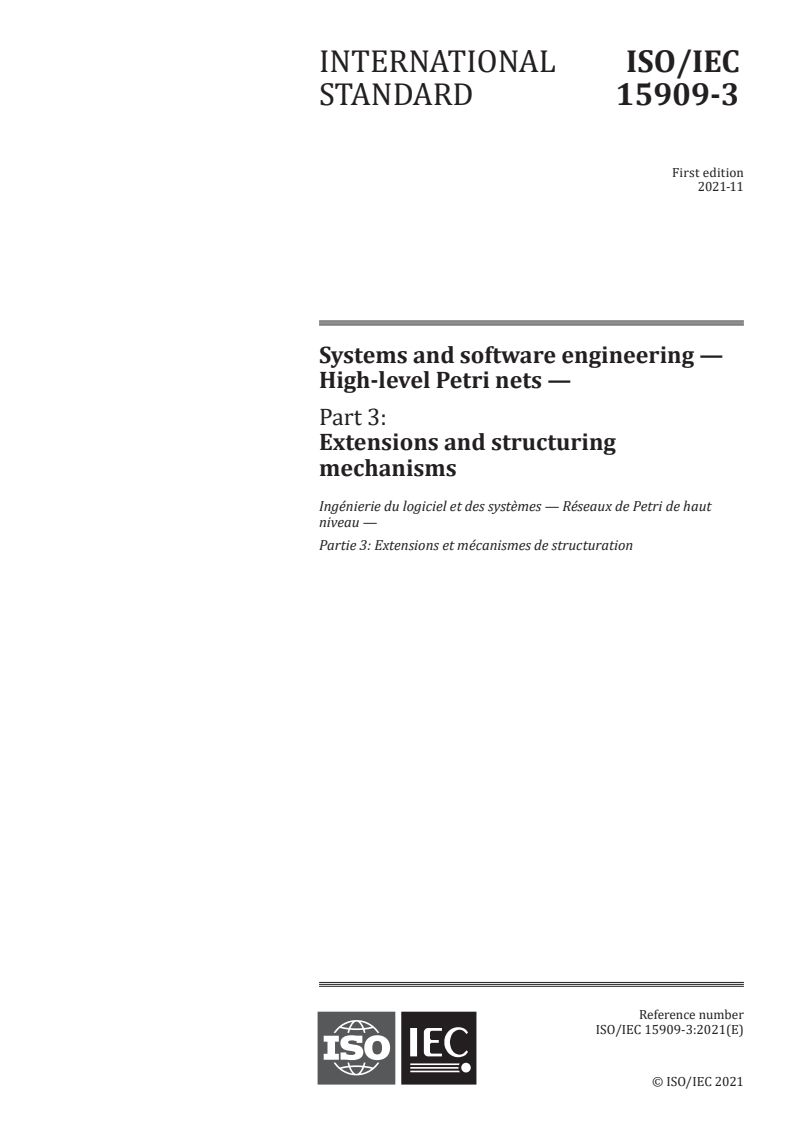
INTERNATIONAL ISO/IEC
STANDARD 15909-3
First edition
2021-11
Systems and software engineering —
High-level Petri nets —
Part 3:
Extensions and structuring
mechanisms
Ingénierie du logiciel et des systèmes — Réseaux de Petri de haut
niveau —
Partie 3: Extensions et mécanismes de structuration
Reference number
© ISO/IEC 2021
© ISO/IEC 2021
All rights reserved. Unless otherwise specified, or required in the context of its implementation, no part of this publication may
be reproduced or utilized otherwise in any form or by any means, electronic or mechanical, including photocopying, or posting on
the internet or an intranet, without prior written permission. Permission can be requested from either ISO at the address below
or ISO’s member body in the country of the requester.
ISO copyright office
CP 401 • Ch. de Blandonnet 8
CH-1214 Vernier, Geneva
Phone: +41 22 749 01 11
Email: copyright@iso.org
Website: www.iso.org
Published in Switzerland
ii
© ISO/IEC 2021 – All rights reserved
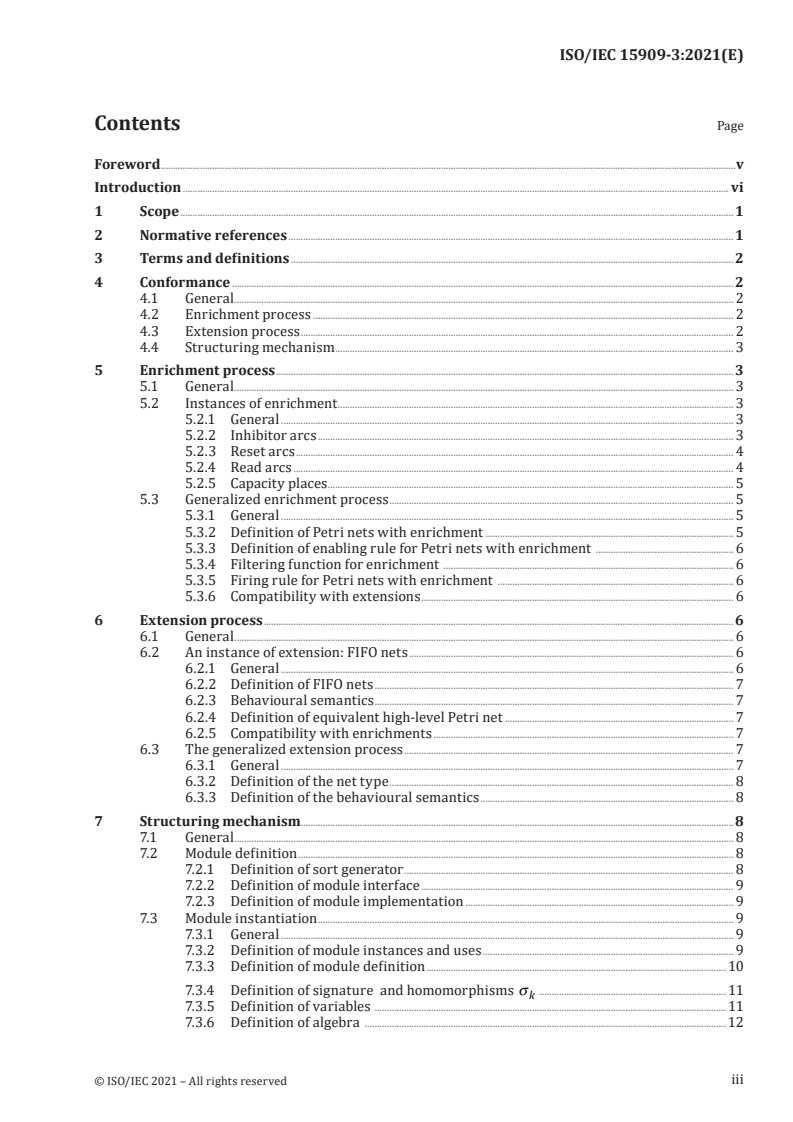
Contents Page
Foreword .v
Introduction . vi
1 Scope . 1
2 Normative references . 1
3 Terms and definitions . 2
4 Conformance . 2
4.1 General . 2
4.2 Enrichment process . 2
4.3 Extension process . 2
4.4 Structuring mechanism . 3
5 Enrichment process .3
5.1 General . 3
5.2 Instances of enrichment . 3
5.2.1 General . 3
5.2.2 Inhibitor arcs . 3
5.2.3 Reset arcs . 4
5.2.4 Read arcs . 4
5.2.5 Capacity places . 5
5.3 Generalized enrichment process . 5
5.3.1 General . 5
5.3.2 Definition of Petri nets with enrichment . 5
5.3.3 Definition of enabling rule for Petri nets with enrichment . 6
5.3.4 Filtering function for enrichment . 6
5.3.5 Firing rule for Petri nets with enrichment . 6
5.3.6 Compatibility with extensions . 6
6 Extension process . 6
6.1 General . 6
6.2 An instance of extension: FIFO nets . 6
6.2.1 General . 6
6.2.2 Definition of FIFO nets . 7
6.2.3 Behavioural semantics . 7
6.2.4 Definition of equivalent high-level Petri net . 7
6.2.5 Compatibility with enrichments . 7
6.3 The generalized extension process . 7
6.3.1 General . 7
6.3.2 Definition of the net type . 8
6.3.3 Definition of the behavioural semantics . 8
7 Structuring mechanism.8
7.1 General . 8
7.2 Module definition . 8
7.2.1 Definition of sort generator . 8
7.2.2 Definition of module interface . 9
7.2.3 Definition of module implementation . 9
7.3 Module instantiation . 9
7.3.1 General . 9
7.3.2 Definition of module instances and uses . 9
7.3.3 Definition of module definition . 10
7.3.4 Definition of signature and homomorphisms σ . 11
k
7.3.5 Definition of variables . 11
7.3.6 Definition of algebra .12
iii
© ISO/IEC 2021 – All rights reserved
ˆ
7.3.7 Definition of places and transitions T .12
Annex A (informative) Guidelines for graphical notations .13
Bibliography .15
iv
© ISO/IEC 2021 – All rights reserved
Foreword
ISO (the International Organization for Standardization) and IEC (the International Electrotechnical
Commission) form the specialized system for worldwide standardization. National bodies that are
members of ISO or IEC participate in the development of International Standards through technical
committees established by the respective organization to deal with particular fields of technical
activity. ISO and IEC technical committees collaborate in fields of mutual interest. Other international
organizations, governmental and non-governmental, in liaison with ISO and IEC, also take part in the
work.
The procedures used to develop this document and those intended for its further maintenance
are described in the ISO/IEC Directives, Part 1. In particular, the different approval criteria
needed for the different types of document should be noted. This document was drafted in
accordance with the editorial rules of the ISO/IEC Directives, Part 2 (see www.iso.org/directives or
www.iec.ch/members_experts/refdocs).
Attention is drawn to the possibility that some of the elements of this document may be the subject
of patent rights. ISO and IEC shall not be held responsible for identifying any or all such patent
rights. Details of any patent rights identified during the development of the document will be in the
Introduction and/or on the ISO list of patent declarations received (see www.iso.org/patents) or the IEC
list of patent declarations received (see patents.iec.ch).
Any trade name used in this document is information given for the convenience of users and does not
constitute an endorsement.
For an explanation of the voluntary nature of standards, the meaning of ISO specific terms and
expressions related to conformity assessment, as well as information about ISO's adherence to
the World Trade Organization (WTO) principles in the Technical Barriers to Trade (TBT) see
www.iso.org/iso/foreword.html. In the IEC, see www.iec.ch/understanding-standards.
This document was prepared by Joint Technical Committee ISO/IEC JTC 1, Information technology,
Subcommittee SC 7, Software and systems engineering.
A list of all parts in the ISO/IEC 15909 series can be found on the ISO and IEC websites.
Any feedback or questions on this document should be directed to the user’s national standards
body. A complete listing of these bodies can be found at www.iso.org/members.html and
www.iec.ch/national-committees.
v
© ISO/IEC 2021 – All rights reserved
Introduction
Petri nets have been used to describe a wide range of systems since their invention in 1962. The
technique is mathematically defined and can thus be used to provide unambiguous specifications
and descriptions of applications. It is also an executable technique, allowing specification prototypes
to be developed to test ideas at the earliest and cheapest opportunity. Specifications written in the
technique can be subjected to analysis methods to prove properties about the specifications, before
implementation commences, thus saving on testing and maintenance time and providing a high level of
quality assurance.
A problem with Petri nets is the explosion of the number of elements in their graphical form when they
are used to describe complex systems. High-level Petri nets were developed to overcome this problem
by introducing higher level concepts, such as the use of complex structured data as tokens, and using
algebraic expressions to annotate net elements. The use of “high-level” to describe these Petri nets
is analogous to the use of “high-level” in high-level programming languages (as opposed to assembly
languages), and is the usual term used in the Petri net community. Two of the early forms of high-level
nets that this document builds on are predicate-transition nets and coloured Petri nets, first introduced
in 1979 and developed during the 1980s. It also uses some of the notions developed for algebraic Petri
nets, first introduced in the mid-1980s. It is believed that this document captures the spirit of these
earlier developments (see Bibliography).
The technique has multiple uses. For example, it can be used directly to specify systems or to define
the semantics of other less formal languages. It can also serve to integrate techniques currently used
independently such as state-transition diagrams and data flow diagrams. The technique is particularly
suited to parallel and distributed systems development as it supports concurrency. The technique is
able to specify systems at a level that is independent of the choice of implementation (i.e. by software,
hardware (electronic and/or mechanical) or humans or a combination). This document may be cited
in contracts for the development of systems (particularly distributed systems) or used by application
developers or Petri net tool vendors or users.
The ISO/IEC 15909 series is concerned with defining a modelling language and its transfer format,
known as high-level Petri nets. ISO/IEC 15909-1 provides the mathematical definition of high-level
Petri nets, called the semantic model, the graphical form of the technique, known as high-level Petri net
graphs (HLPNGs), and its mapping to the semantic model. It also introduces some common notational
conventions for HLPNGs.
ISO/IEC 15909-2 defines a transfer format for high-level Petri nets in order to support the exchange of
high-level Petri nets among different tools. This format is called the Petri net markup language (PNML).
Since there are many different types of Petri nets in addition to high-level Petri nets, ISO/IEC 15909-2
defines the core concepts of Petri nets along with an XML syntax, which can be used for exchanging
any kind of Petri nets. Based on this PNML core model, ISO/IEC 15909-2 also defines the transfer
syntax for the types of Petri nets that are defined in ISO/IEC 15909-1: place/transition nets, symmetric
1)
nets , high-level Petri nets, Petri nets with priorities, and Petri nets with time. Place/transition nets
and symmetric nets can be considered to be restricted versions of high-level Petri nets. Petri nets with
priorities and Petri nets with time are considered as extensions of the other types.
This document defines extensions to the types of Petri nets that are defined in ISO/IEC 15909-1.
These extensions comprise enrichments of Petri net types and definitions of new Petri net types. This
document also defines structuring mechanisms for these Petri net types.
In this document, the semantics which is considered is always the interleaving semantics.
This document provides an abstract mathematical syntax and a formal semantics for the technique.
Conformance to the document is possible at several levels. The level of conformance depends on the
class of high-level net chosen. The usual graphical notations are depicted in Annex A.
1) Symmetric nets have been first introduced as well-formed nets and are currently standardized as ISO/IEC
15909-1.
vi
© ISO/IEC 2021 – All rights reserved
INTERNATIONAL STANDARD ISO/IEC 15909-3:2021(E)
Systems and software engineering — High-level Petri
nets —
Part 3:
Extensions and structuring mechanisms
1 Scope
This document defines enrichments, extensions and structuring mechanisms of Petri nets, applied on
the definitions proposed in ISO/IEC 15909-1. This document facilitates the definitions of new kinds of
Petri nets and their interoperability, while remaining compatible with those defined in ISO/IEC 15909-
1.
This document is written as a reference for designers of new Petri net variants, by defining common
enrichments, extensions and structuring mechanisms, as well as a generalized process for defining
new ones.
This document is applicable to a wide variety of concurrent discrete event systems and in particular
distributed systems. Generic fields of application include:
— requirements analysis;
— development of specifications, designs and test suites;
— descriptions of existing systems prior to re-engineering;
— modelling business and software processes;
— providing the semantics for concurrent languages;
— simulation of systems to increase confidence;
— formal analysis of the behaviour of systems;
— and development of Petri net support tools.
This document can be applied to the design of a broad range of systems and processes, including
aerospace, air traffic control, avionics, banking, biological and chemical processes, business processes,
communication protocols, computer hardware architectures, control systems, databases, defence
command and control systems, distributed computing, electronic commerce, fault-tolerant systems,
games, hospital procedures, information systems, Internet protocols and applications, legal processes,
logistics, manufacturing systems, metabolic processes, music, nuclear power systems, operating
systems, transport systems (including railway control), security systems, telecommunications and
workflow.
2 Normative references
The following documents are referred to in the text in such a way that some or all of their content
constitutes requirements of this document. For dated references, only the edition cited applies. For
undated references, the latest edition of the referenced document (including any amendments) applies.
ISO/IEC 15909-1, Systems and software engineering — High-level Petri nets — Part 1: Concepts, definitions
and graphical notation
© ISO/IEC 2021 – All rights reserved
3 Terms and definitions
For the purposes of this document, the terms and definitions given in ISO/IEC 15909-1 and the following
apply.
ISO and IEC maintain terminology databases for use in standardization at the following addresses:
— ISO Online browsing platform: available at https:// www .iso .org/ obp
— IEC Electropedia: available at https:// www .electropedia .org/
3.1
capacity
maximum multiset of tokens a capacity place (3.2) can hold
3.2
capacity place
special kind of place that can hold no more than a specified capacity (3.1)
3.3
FIFO
special kind of queue that is operated first in first out
3.4
inhibitor arc
special kind of arc that reverses the logic of an input place
Note 1 to entry: Instead of testing the presence of some tokens in the related place, it tests the lack of these.
3.5
read arc
special kind of arc that tests the presence of some tokens in the related place, without consumption
3.6
reset arc
special kind of arc that empties an input place
3.7
sort generator
generator of new sorts and operators built from a given signature (passed as a parameter)
4 Conformance
4.1 General
There are different levels of conformance to this document.
4.2 Enrichment process
A Petri net model is conformant to the enrichment process level when it contains a subset of the features
defined as enrichments by Clause 5.
4.3 Extension process
A Petri net model is conformant to the extension process level when it contains a single feature defined
as extension by Clause 6.
© ISO/IEC 2021 – All rights reserved
...
INTERNATIONAL ISO/IEC
STANDARD 15909-3
First edition
2021-11
Systems and software engineering —
High-level Petri nets —
Part 3:
Extensions and structuring
mechanisms
Ingénierie du logiciel et des systèmes — Réseaux de Petri de haut
niveau —
Partie 3: Extensions et mécanismes de structuration
Reference number
© ISO/IEC 2021
© ISO/IEC 2021
All rights reserved. Unless otherwise specified, or required in the context of its implementation, no part of this publication may
be reproduced or utilized otherwise in any form or by any means, electronic or mechanical, including photocopying, or posting on
the internet or an intranet, without prior written permission. Permission can be requested from either ISO at the address below
or ISO’s member body in the country of the requester.
ISO copyright office
CP 401 • Ch. de Blandonnet 8
CH-1214 Vernier, Geneva
Phone: +41 22 749 01 11
Email: copyright@iso.org
Website: www.iso.org
Published in Switzerland
ii
© ISO/IEC 2021 – All rights reserved
Contents Page
Foreword .v
Introduction . vi
1 Scope . 1
2 Normative references . 1
3 Terms and definitions . 2
4 Conformance . 2
4.1 General . 2
4.2 Enrichment process . 2
4.3 Extension process . 2
4.4 Structuring mechanism . 3
5 Enrichment process .3
5.1 General . 3
5.2 Instances of enrichment . 3
5.2.1 General . 3
5.2.2 Inhibitor arcs . 3
5.2.3 Reset arcs . 4
5.2.4 Read arcs . 4
5.2.5 Capacity places . 5
5.3 Generalized enrichment process . 5
5.3.1 General . 5
5.3.2 Definition of Petri nets with enrichment . 5
5.3.3 Definition of enabling rule for Petri nets with enrichment . 6
5.3.4 Filtering function for enrichment . 6
5.3.5 Firing rule for Petri nets with enrichment . 6
5.3.6 Compatibility with extensions . 6
6 Extension process . 6
6.1 General . 6
6.2 An instance of extension: FIFO nets . 6
6.2.1 General . 6
6.2.2 Definition of FIFO nets . 7
6.2.3 Behavioural semantics . 7
6.2.4 Definition of equivalent high-level Petri net . 7
6.2.5 Compatibility with enrichments . 7
6.3 The generalized extension process . 7
6.3.1 General . 7
6.3.2 Definition of the net type . 8
6.3.3 Definition of the behavioural semantics . 8
7 Structuring mechanism.8
7.1 General . 8
7.2 Module definition . 8
7.2.1 Definition of sort generator . 8
7.2.2 Definition of module interface . 9
7.2.3 Definition of module implementation . 9
7.3 Module instantiation . 9
7.3.1 General . 9
7.3.2 Definition of module instances and uses . 9
7.3.3 Definition of module definition . 10
7.3.4 Definition of signature and homomorphisms σ . 11
k
7.3.5 Definition of variables . 11
7.3.6 Definition of algebra .12
iii
© ISO/IEC 2021 – All rights reserved
ˆ
7.3.7 Definition of places and transitions T .12
Annex A (informative) Guidelines for graphical notations .13
Bibliography .15
iv
© ISO/IEC 2021 – All rights reserved
Foreword
ISO (the International Organization for Standardization) and IEC (the International Electrotechnical
Commission) form the specialized system for worldwide standardization. National bodies that are
members of ISO or IEC participate in the development of International Standards through technical
committees established by the respective organization to deal with particular fields of technical
activity. ISO and IEC technical committees collaborate in fields of mutual interest. Other international
organizations, governmental and non-governmental, in liaison with ISO and IEC, also take part in the
work.
The procedures used to develop this document and those intended for its further maintenance
are described in the ISO/IEC Directives, Part 1. In particular, the different approval criteria
needed for the different types of document should be noted. This document was drafted in
accordance with the editorial rules of the ISO/IEC Directives, Part 2 (see www.iso.org/directives or
www.iec.ch/members_experts/refdocs).
Attention is drawn to the possibility that some of the elements of this document may be the subject
of patent rights. ISO and IEC shall not be held responsible for identifying any or all such patent
rights. Details of any patent rights identified during the development of the document will be in the
Introduction and/or on the ISO list of patent declarations received (see www.iso.org/patents) or the IEC
list of patent declarations received (see patents.iec.ch).
Any trade name used in this document is information given for the convenience of users and does not
constitute an endorsement.
For an explanation of the voluntary nature of standards, the meaning of ISO specific terms and
expressions related to conformity assessment, as well as information about ISO's adherence to
the World Trade Organization (WTO) principles in the Technical Barriers to Trade (TBT) see
www.iso.org/iso/foreword.html. In the IEC, see www.iec.ch/understanding-standards.
This document was prepared by Joint Technical Committee ISO/IEC JTC 1, Information technology,
Subcommittee SC 7, Software and systems engineering.
A list of all parts in the ISO/IEC 15909 series can be found on the ISO and IEC websites.
Any feedback or questions on this document should be directed to the user’s national standards
body. A complete listing of these bodies can be found at www.iso.org/members.html and
www.iec.ch/national-committees.
v
© ISO/IEC 2021 – All rights reserved
Introduction
Petri nets have been used to describe a wide range of systems since their invention in 1962. The
technique is mathematically defined and can thus be used to provide unambiguous specifications
and descriptions of applications. It is also an executable technique, allowing specification prototypes
to be developed to test ideas at the earliest and cheapest opportunity. Specifications written in the
technique can be subjected to analysis methods to prove properties about the specifications, before
implementation commences, thus saving on testing and maintenance time and providing a high level of
quality assurance.
A problem with Petri nets is the explosion of the number of elements in their graphical form when they
are used to describe complex systems. High-level Petri nets were developed to overcome this problem
by introducing higher level concepts, such as the use of complex structured data as tokens, and using
algebraic expressions to annotate net elements. The use of “high-level” to describe these Petri nets
is analogous to the use of “high-level” in high-level programming languages (as opposed to assembly
languages), and is the usual term used in the Petri net community. Two of the early forms of high-level
nets that this document builds on are predicate-transition nets and coloured Petri nets, first introduced
in 1979 and developed during the 1980s. It also uses some of the notions developed for algebraic Petri
nets, first introduced in the mid-1980s. It is believed that this document captures the spirit of these
earlier developments (see Bibliography).
The technique has multiple uses. For example, it can be used directly to specify systems or to define
the semantics of other less formal languages. It can also serve to integrate techniques currently used
independently such as state-transition diagrams and data flow diagrams. The technique is particularly
suited to parallel and distributed systems development as it supports concurrency. The technique is
able to specify systems at a level that is independent of the choice of implementation (i.e. by software,
hardware (electronic and/or mechanical) or humans or a combination). This document may be cited
in contracts for the development of systems (particularly distributed systems) or used by application
developers or Petri net tool vendors or users.
The ISO/IEC 15909 series is concerned with defining a modelling language and its transfer format,
known as high-level Petri nets. ISO/IEC 15909-1 provides the mathematical definition of high-level
Petri nets, called the semantic model, the graphical form of the technique, known as high-level Petri net
graphs (HLPNGs), and its mapping to the semantic model. It also introduces some common notational
conventions for HLPNGs.
ISO/IEC 15909-2 defines a transfer format for high-level Petri nets in order to support the exchange of
high-level Petri nets among different tools. This format is called the Petri net markup language (PNML).
Since there are many different types of Petri nets in addition to high-level Petri nets, ISO/IEC 15909-2
defines the core concepts of Petri nets along with an XML syntax, which can be used for exchanging
any kind of Petri nets. Based on this PNML core model, ISO/IEC 15909-2 also defines the transfer
syntax for the types of Petri nets that are defined in ISO/IEC 15909-1: place/transition nets, symmetric
1)
nets , high-level Petri nets, Petri nets with priorities, and Petri nets with time. Place/transition nets
and symmetric nets can be considered to be restricted versions of high-level Petri nets. Petri nets with
priorities and Petri nets with time are considered as extensions of the other types.
This document defines extensions to the types of Petri nets that are defined in ISO/IEC 15909-1.
These extensions comprise enrichments of Petri net types and definitions of new Petri net types. This
document also defines structuring mechanisms for these Petri net types.
In this document, the semantics which is considered is always the interleaving semantics.
This document provides an abstract mathematical syntax and a formal semantics for the technique.
Conformance to the document is possible at several levels. The level of conformance depends on the
class of high-level net chosen. The usual graphical notations are depicted in Annex A.
1) Symmetric nets have been first introduced as well-formed nets and are currently standardized as ISO/IEC
15909-1.
vi
© ISO/IEC 2021 – All rights reserved
INTERNATIONAL STANDARD ISO/IEC 15909-3:2021(E)
Systems and software engineering — High-level Petri
nets —
Part 3:
Extensions and structuring mechanisms
1 Scope
This document defines enrichments, extensions and structuring mechanisms of Petri nets, applied on
the definitions proposed in ISO/IEC 15909-1. This document facilitates the definitions of new kinds of
Petri nets and their interoperability, while remaining compatible with those defined in ISO/IEC 15909-
1.
This document is written as a reference for designers of new Petri net variants, by defining common
enrichments, extensions and structuring mechanisms, as well as a generalized process for defining
new ones.
This document is applicable to a wide variety of concurrent discrete event systems and in particular
distributed systems. Generic fields of application include:
— requirements analysis;
— development of specifications, designs and test suites;
— descriptions of existing systems prior to re-engineering;
— modelling business and software processes;
— providing the semantics for concurrent languages;
— simulation of systems to increase confidence;
— formal analysis of the behaviour of systems;
— and development of Petri net support tools.
This document can be applied to the design of a broad range of systems and processes, including
aerospace, air traffic control, avionics, banking, biological and chemical processes, business processes,
communication protocols, computer hardware architectures, control systems, databases, defence
command and control systems, distributed computing, electronic commerce, fault-tolerant systems,
games, hospital procedures, information systems, Internet protocols and applications, legal processes,
logistics, manufacturing systems, metabolic processes, music, nuclear power systems, operating
systems, transport systems (including railway control), security systems, telecommunications and
workflow.
2 Normative references
The following documents are referred to in the text in such a way that some or all of their content
constitutes requirements of this document. For dated references, only the edition cited applies. For
undated references, the latest edition of the referenced document (including any amendments) applies.
ISO/IEC 15909-1, Systems and software engineering — High-level Petri nets — Part 1: Concepts, definitions
and graphical notation
© ISO/IEC 2021 – All rights reserved
3 Terms and definitions
For the purposes of this document, the terms and definitions given in ISO/IEC 15909-1 and the following
apply.
ISO and IEC maintain terminology databases for use in standardization at the following addresses:
— ISO Online browsing platform: available at https:// www .iso .org/ obp
— IEC Electropedia: available at https:// www .electropedia .org/
3.1
capacity
maximum multiset of tokens a capacity place (3.2) can hold
3.2
capacity place
special kind of place that can hold no more than a specified capacity (3.1)
3.3
FIFO
special kind of queue that is operated first in first out
3.4
inhibitor arc
special kind of arc that reverses the logic of an input place
Note 1 to entry: Instead of testing the presence of some tokens in the related place, it tests the lack of these.
3.5
read arc
special kind of arc that tests the presence of some tokens in the related place, without consumption
3.6
reset arc
special kind of arc that empties an input place
3.7
sort generator
generator of new sorts and operators built from a given signature (passed as a parameter)
4 Conformance
4.1 General
There are different levels of conformance to this document.
4.2 Enrichment process
A Petri net model is conformant to the enrichment process level when it contains a subset of the features
defined as enrichments by Clause 5.
4.3 Extension process
A Petri net model is conformant to the extension process level when it contains a single feature defined
as extension by Clause 6.
© ISO/IEC 2021 – All rights reserved
...
Questions, Comments and Discussion
Ask us and Technical Secretary will try to provide an answer. You can facilitate discussion about the standard in here.
Loading comments...