

ISO/IEC 9646-1:1994
(Main)Information technology — Open Systems Interconnection — Conformance testing methodology and framework — Part 1: General concepts
General Information
- Abstract
Cancels and replaces the first edition (1991). Specifies a general methodology for testing the conformance of products to OSI specifications which the products are claimed to implement. The methodology applies to testing conformance to the specification: of an OSI protocol; of a transfer syntax used in combination with a specific OSI protocol; of an OSI protocol profile, including the testing of conformance to any specified information objects used in combination with one or more of the protocols; of a combination of OSI protocols.
- Status
- Published
- Publication Date
- 21-Dec-1994
- Technical Committee
- ISO/IEC JTC 1 - Information technology
- Drafting Committee
- ISO/IEC JTC 1 - Information technology
- Current Stage
- 9093 - International Standard confirmed
- Start Date
- 21-Jun-2000
- Completion Date
- 29-Aug-2026
Buy Documents
ISO/IEC 9646-1:1994 - Information technology — Open Systems Interconnection — Conformance testing methodology and framework — Part 1: General concepts Released:12/22/1994
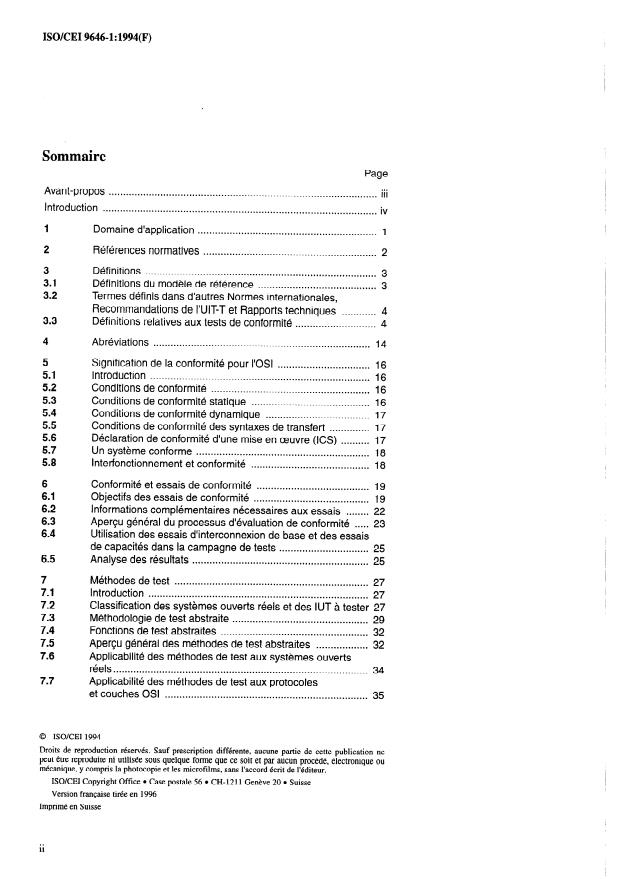
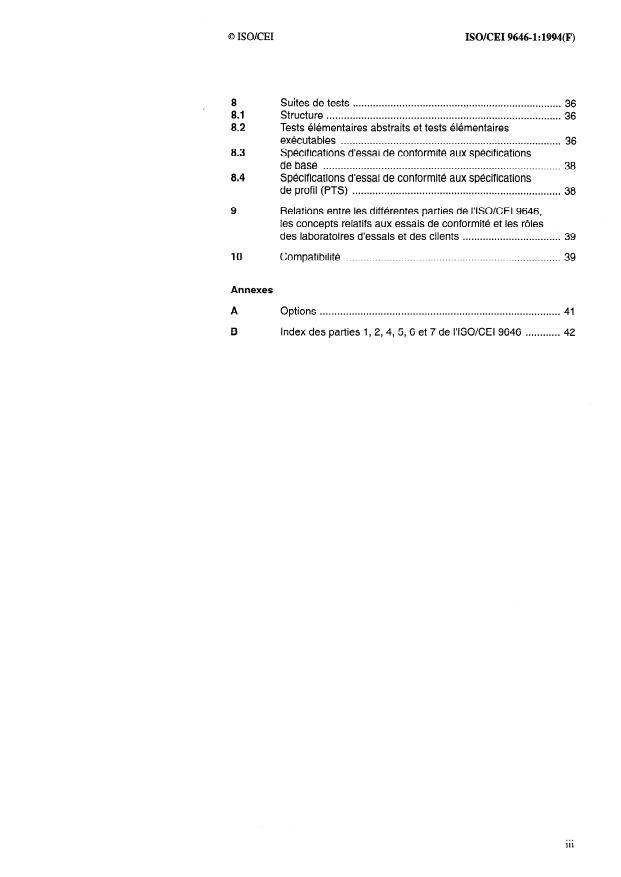
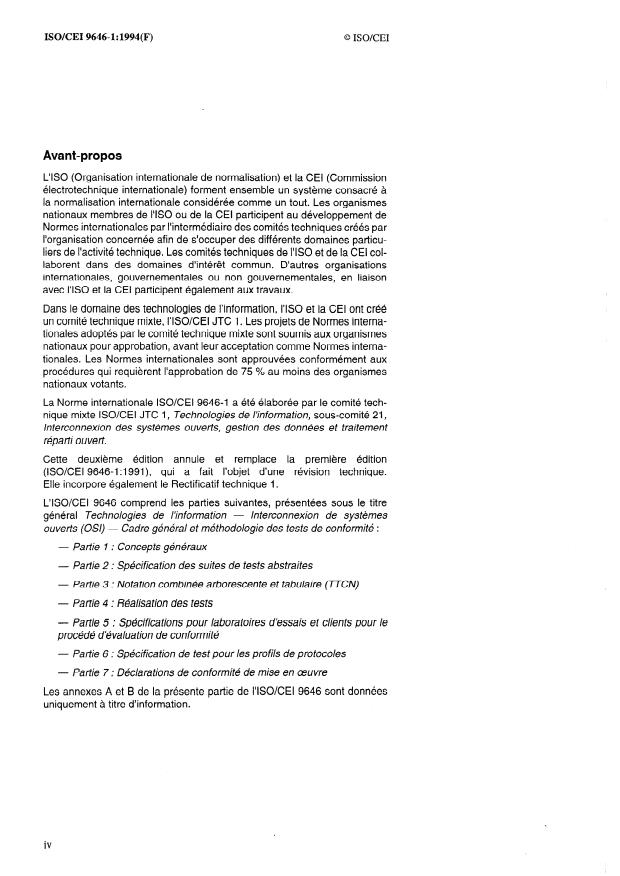
ISO/IEC 9646-1:1994 - Technologies de l'information — Interconnexion de systemes ouverts (OSI) — Cadre général et méthodologie des tests de conformité — Partie 1: Concepts généraux
Overview
ISO/IEC 9646-1:1994 - "Information technology - Open Systems Interconnection - Conformance testing methodology and framework - Part 1: General concepts" defines the general methodology and conceptual framework for testing whether products conform to OSI specifications. This second edition (1994) replaces the 1991 edition and establishes the scope, objectives and high-level procedures used throughout the multi-part ISO/IEC 9646 series for OSI conformance testing.
Key coverage includes conformance testing of:
- OSI protocols and protocol combinations
- Transfer syntaxes used with protocols
- Protocol profiles and information objects specified by a profile
The standard focuses on methodology (not certification or procurement) and supports comparable, repeatable, auditable test results.
Key topics and requirements
- Conformance concepts: Meaning of conformance in the OSI context; static vs. dynamic requirements; what constitutes a conforming system.
- Implementation statements: Use of Implementation Conformance Statements (ICS), Protocol Implementation Conformance Statements (PICS), Profile ICS and System Conformance Statements (SCS) to declare implementation capabilities.
- Test artefacts and extra information: Definitions for Implementation Extra Information for Testing (IXIT), Protocol Implementation Extra Information for Testing (PIXIT) and profile IXIT to support test execution.
- Test categories and objectives: Basic Interconnection Tests, capability tests, behaviour tests and conformance resolution tests; test outcomes, verdicts and reporting (PCTR, SCTR).
- Abstract testing methodology: Classification of Systems Under Test (SUT) and Implementations Under Test (IUT); Points of Control and Observation (PCOs); abstract test methods (local, distributed, coordinated, remote) and the context for single- and multi-party testing.
- Test-suite design and realization: Structure of Abstract Test Suites (ATSs), relationship between abstract and executable test cases, and guidance on Means of Testing (MOT) and repeatability/comparability of results.
- Limitations: Testing excludes performance, robustness and most physical-layer specifics; testing detects defects but cannot prove the absence of errors.
Applications and users
ISO/IEC 9646-1 is practical for:
- Test laboratories and conformance assessment bodies preparing test campaigns and reports
- Product suppliers and implementers developing and validating OSI protocol implementations
- Standards developers and profile authors creating Abstract Test Suites (ATSs) and Profile Test Specifications (PTS)
- Interoperability test events, procurement teams and quality assurance groups seeking repeatable conformance evidence
Practical uses include producing PICS/ICS, designing ATS-based test suites, implementing MOTs and conducting standardized protocol conformance testing to increase interoperability confidence.
Related standards
- ISO/IEC 9646 series (Parts 2–7) - ATS specification, TTCN notation, test realization, laboratory requirements, PTS and ICS guidance
- ISO 7498 (OSI Reference Model) and ISO/IEC 8825 (ASN.1 BER) - normative references that underpin OSI testing concepts
Keywords: ISO/IEC 9646-1, OSI conformance testing, Abstract Test Suite (ATS), PICS, ICS, IXIT, TTCN, conformance methodology, protocol testing.
Relations
- Effective Date
- 25-Aug-2026
- Effective Date
- 25-Aug-2026
- Effective Date
- 25-Aug-2026
- Effective Date
- 10-Feb-2026
- Effective Date
- 10-Feb-2026
- Effective Date
- 15-Apr-2008
Buy Documents
ISO/IEC 9646-1:1994 - Information technology — Open Systems Interconnection — Conformance testing methodology and framework — Part 1: General concepts Released:12/22/1994
ISO/IEC 9646-1:1994 - Technologies de l'information — Interconnexion de systemes ouverts (OSI) — Cadre général et méthodologie des tests de conformité — Partie 1: Concepts généraux
Get Certified
Connect with accredited certification bodies for this standard

BSI Group
BSI (British Standards Institution) is the business standards company that helps organizations make excellence a habit.

NYCE
Mexican standards and certification body.
Sponsored listings
Frequently Asked Questions
ISO/IEC 9646-1:1994 is a standard published by the International Organization for Standardization (ISO). Its full title is "Information technology — Open Systems Interconnection — Conformance testing methodology and framework — Part 1: General concepts". This standard covers: Cancels and replaces the first edition (1991). Specifies a general methodology for testing the conformance of products to OSI specifications which the products are claimed to implement. The methodology applies to testing conformance to the specification: of an OSI protocol; of a transfer syntax used in combination with a specific OSI protocol; of an OSI protocol profile, including the testing of conformance to any specified information objects used in combination with one or more of the protocols; of a combination of OSI protocols.
Cancels and replaces the first edition (1991). Specifies a general methodology for testing the conformance of products to OSI specifications which the products are claimed to implement. The methodology applies to testing conformance to the specification: of an OSI protocol; of a transfer syntax used in combination with a specific OSI protocol; of an OSI protocol profile, including the testing of conformance to any specified information objects used in combination with one or more of the protocols; of a combination of OSI protocols.
ISO/IEC 9646-1:1994 is classified under the following ICS (International Classification for Standards) categories: 35.100.01 - Open systems interconnection in general. The ICS classification helps identify the subject area and facilitates finding related standards.
ISO/IEC 9646-1:1994 has the following relationships with other standards: It is inter standard links to CEN ISO/TS 21189:2019, EN 16062:2015, EN 16062:2011, EN IEC 61375-2-8:2021, EN 62580-1:2016, ISO/IEC 9646-1:1991. Understanding these relationships helps ensure you are using the most current and applicable version of the standard.
ISO/IEC 9646-1:1994 is available in PDF format for immediate download after purchase. The document can be added to your cart and obtained through the secure checkout process. Digital delivery ensures instant access to the complete standard document.
Standards Content (Sample)
INTERNATIONAL
ISOJIEC
STANDARD
9646-1
Second edition
1994-12-15
Information technology - Open Systems
Interconnection
- Conformance testing
methodology and framework -
Part 1:
General concepts
Technologies de I’informa tion
- Interconnexion de systkmes ouverts -
Cadre g&&al et m&hodologie des tests de conformit OS/ -
Partie I: Concepts g&Graux
Reference number
lSO/IEC 9646-l :I 994(E)
ISO/IEC 9646-l: 1994(E)
Page
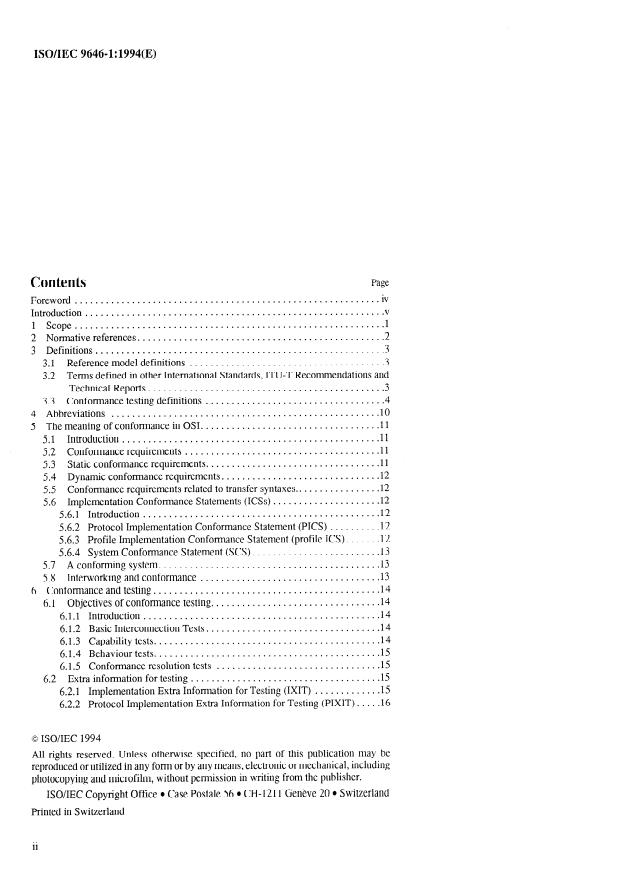
Contents
..i v
Foreword .
.
Introduction. .
..l
1 Scope .
.............................................. .2
2 Normative references.
....................................................... .3
3 Definitions
.....................................
.3
3.1 Reference model definitions
3.2 Terms defined in other International Standards, ITU-T Recommendations and
............................................ .3
Technical Reports.
.................................. .4
3.3 Conformance testing definitions
..10
4 Abbreviations
..................................................
..ll
5 ThemeaningofconforrnanceinOSI. .
................................................. .ll
5.1 Introduction
..................................... .ll
5.2 Conformance requirements
5.3 Static conformance requirements.
.................................
............................. .12
5.4 Dynamic conformance requirements.
................ .12
5.5 Conformance requirements related to transfer syntaxes
.................... .12
5.6 Implementation Conformance Statements (ICSs)
.12
5.6.1 Introduction. .
......... .12
5.6.2 Protocol Implementation Conformance Statement (PICS)
..... .12
5.6.3 Profile Implementation Conformance Statement (profile ICS).
........................
.13
5.6.4 System Conformance Statement (SCS)
.......................................... .13
5.7 Aconforming system
.................................. .13
5.8 Interworking and conformance
..........................................
“14
6 Confomnance and testing,
............................... .14
6.1 Objectives of conformance testing.
............................................. .14
6.1.1 Introduction
................................ .14
6.1.2 Basic Interconnection Tests.
.......................................... .14
6.1.3 Capability tests.
.......................................... .15
6.1.4 Behaviour tests.
............................... .15
6.1.5 Conformance resolution tests
.................................... .15
6.2 Extra information for testing
............ .15
6.2.1 Implementation Extra Information for Testing (IXIT)
.... .16
6.2.2 Protocol Implementation Extra Information for Testing (PIXIT)
0 ISO/IEC 1994
All rights reserved. Unless otherwise specified, no part of this publication may be
reproduced or utilized in any form or by any means, electronic or mechanical, including
photocopying and microfilm, without permission in writing from the publisher.
ISO/IEC Copyright Office l Case Postale 56 l CH-1211 Geneve 20 l Switzerland
Printed in Switzerland
ii
ISO/IEC 9646-l: 1994(E)
0 ISO/IEC
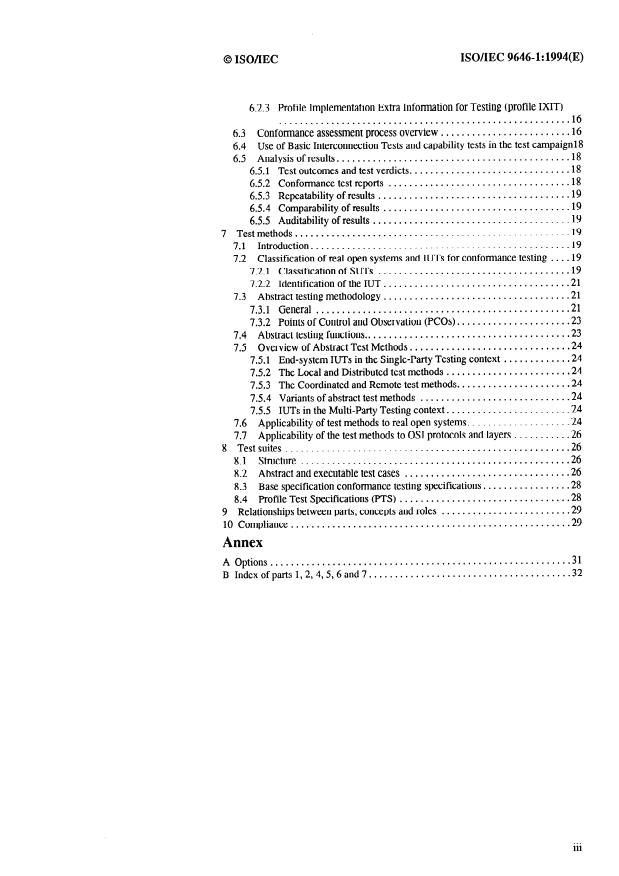
6.2.3 Profile Implementation Extra Information for Testing (profile IXIT)
. .16
6.3 Confkxk&~ &k&&t*ii&ei, b&-;ik*~ : : : : : : : : : : : : : : : : : : : : : : : . .16
6.4 Use of Basic Interconnection Tests and capability tests in the test campaign18
............................................
.18
6.5 Analysis of results
............................. .18
6.5.1 Test outcomes and test verdicts.
..................................
.18
6.5.2 Conformance test reports
....................................
.19
6.5.3 Repeatability of results
................................... .19
6.5.4 Comparability of results
..................................... .19
6.5.5 Auditability of results
7 Testmethods.l 9
7.1 Introduction.19
... .19
7.2 Classification of real open systems and IUTs for conformance testing
....................................
.19
7.2.1 Classification of SUTs
................................... .21
7.2.2 Identification of the IUT
................................... .21
7.3 Abstract testing methodology
................................................ .21
7.3.1 General
..................... .23
7.3.2 Points of Control and Observation (PCOs)
....................................... .23
7.4 Abstract testing functions
............................ ..2 4
7.5 Overview of Abstract Test Methods.
............ .24
7.5.1 End-system IUTs in the Single-Party Testing context
....................... .24
7.5.2 The Local and Distributed test methods
.................... .24
7.5.3 The Coordinated and Remote test methods.
............................
.24
7.5.4 Variants of abstract test methods
...................... 24
7.5.5 IUTs in the Multi-Party Testing context.
..................
.24
7.6 Applicability of test methods to real open systems.
.......... .26
7.7 Applicability of the test methods to OS1 protocols and layers
8 Testsuites.2 6
..2 6
8.1 Structure. .
............................... .26
8.2 Abstract and executable test cases
................ .28
8.3 Base specification conformance testing specifications
................................ .28
8.4 Profile Test Specifications (PTS)
........................ .29
9 Relationships between parts, concepts and roles
10 Comp~ance.2 9
Annex
A Op~oIls.3 1
...................................... .32
B Indexofparts 1.2.4.5.6and7
. . .
0 ISO/IEC
ISO/IEC 9646-l: 1994(E)
Foreword
IS0 (the International Organization for Standardization) and IEC (the Inter-
national Electrotechnical Commission) form the specialized system for worldwide
standardization. National bodies that are members of IS0 or IEC participate in the
development of International Standards through technical committees established
by the respective organization to deal with particular fields of technical activity.
IS0 and IEC technical committees collaborate in fields of mutual interest. Other
international organizations, governmental and non-governmental, in liaison with
IS0 and IEC, also take part in the work.
In the field of information technology, IS0 and IEC have established a joint
technical committee, ISO/IEC JTC 1. Draft International Standards adopted by the
joint technical committee are circulated to national bodies for voting. Publication
as an International Standard requires approval by at least 75 % of the national
bodies casting a vote.
International Standard ISO/IEC 9646-l was prepared by Joint Technical
Committee ISO/IEC JTC 1, Information technology, Subcommittee 21, Open
Systems Interconnection, data management and open distributed processing.
This second edition cancels and replaces the first edition (ISO/IEC 9646-l: 1991)
which has been technically revised. It also consolidates Technical Corrigendum 1.
ISO/IEC 9646 consists of the following parts, under the general title Information
technology - Open Systems Interconnection - Conformance testing methodol-
ogy and framework:
- Part I: General concepts
- Part 2: Abstract Test Suite specification
- Part 3: The Tree and Tabular Combined Notation
- Part 4: Test realization
- Part 5: Requirements on test laboratories and clients for the conformance
assessment process
- Part 6: Protocol profile test specification
- Part 7: Implementation conformance statements
Annexes A and B of this part of ISO/IEC 9646 are for information only.
0 ISO/IEC
ISO/IEC 9646=1:1994(E)
Introduction
The objective of OS1 will not be completely achieved until systems can be tested to
determine whether they conform to the relevant protocol and profile specifications.
The relevant ones can be OS1 International Standards, ITU-T Recommendations or
International Standardized Profiles.
Standardized Abstract Test Suites should be developed for each International
Standard or ITU-T Recommendation which specifies an OS1 protocol, for use by
suppliers or implementors in self-testing, by users of OS1 products, by
telecommunications administrations and recognized private operating agencies, or
by other third party testing organizations. Standardized Profile Test Specifications
should be developed for each OS1 profile defined in an International Standardized
Profile, or in an International Standard or ITU-T Recommendation, to specify how
to combine and select from these Abstract Test Suites for the purpose of testing
conformance of systems to that profile. This should lead to comparability and wide
acceptance of test results produced by different test laboratories, and thereby
minimize the need for repeated conformance testing of the same system.
The standardization of test suites requires international definition and acceptance of
a common testing methodology, together with appropriate testing methods and
procedures. It is the purpose of ISO/IEC 9646 to define the methodology, to provide
a framework for specifying conformance test suites, and to define the procedures to
be followed during testing.
Conformance testing involves testing both the capabilities and behaviour of an
implementation, and checking what is observed against the conformance
requirements in the relevant International Standards or ITU-T Recommendations
and if appropriate in the related International Standardized Profiles and against
what the implementor states the implementation capabilities are.
Conformance testing does not include assessment of the performance nor the
robustness or reliability of an implementation. It cannot give judgements on the
physical realization of the Abstract Service Primitives, how a system is
implemented, how it provides any requested service, nor the environment of the
protocol implementation. It cannot, except in an indirect way, prove anything about
the logical design of the protocol itself.
The purpose of conformance testing is to increase the probability that different OS1
implementations are able to interwork. However it should be borne in mind that the
complexity of most protocols makes exhaustive testing impractical on both
technical and economic grounds. Also, testing cannot guarantee conformance to a
specification since it detects errors rather than their absence. Thus conformance to
a test suite alone cannot guarantee inter-working. What it does do is give confidence
that an implementation has the required capabilities and that its behaviour conforms
consistently in representative instances of communication.
ISO/IEC 9646-l: 1994(E) 0 ISOAEC
It should be noted that the OS1 basic reference model (ISO 7498: 1984 or CCITT
X.200 (1984)) states (in 4.3):
“Only the external behuviour of Open Systems is retained as the
standard of behaviour of real Open Systems”
This means that although aspects of both internal and external behaviour are
described in OS1 International Standards and ITU-T Recommendations, it is only
the requirements on external behaviour that have to be met by real open systems.
Although some of the methods defined in ISO/IEC 9646-2 do impose certain
limitations on the implementor, for example that there be some means of realizing
control and observation at one or more Service Access Points, it should be noted that
other methods defined herein do not impose such limitations.
However, in the case of partial OS1 end-systems which provide OS1 protocols up to
a specific layer boundary, it is desirable to test not only the external behaviour of the
implemented protocol entities, but also the ability of those entities to support correct
external behaviour in higher layers.
Detailed investigation of relative benefits, efficiency and limitations of all methods
is addressed in various parts of ISO/IEC 9646. However, any organization
contemplating the use of test methods defined in ISOIIEC 9646-2 in a context such
as certification should carefully consider the limitations on their applicability and
the benefits of each.
Testing is voluntary as far as ISO/IEC and ITU-T are concerned. Requirements for
testing in procurement and other external contracts are not a matter for
standardization.
This part of ISO/IEC 9646 is also to be published by ITU-T as Recommendation
X.290 but not as identical text.
INTERNATIONAL STANDARD 0 ISO/IEC ISO/IEC 9646-l: 1994 (E)
Information technology - Open Systems Interconnection -
Conformance testing methodology and framework - Part 1:
General concepts
1 Scope
1.1 ISO/IEC 9646 is a multi-part International Standard which specifies a general methodology for testing the conformance of
products to OS1 specifications which the products are claimed to implement. The methodology applies to testing conformance to
a) the specification of an OS1 protocol;
b) the specification of a transfer syntax used in combination with a specific OS1 protocol;
specified information objects used
c) the specification of an OS1 protocol profile, including the testing of conformance to any
in combination with one or more of the protocols, as specified in the profile;
d) the specifications of a combination of OS1 protocols, possibly used in combination with a specified transfer syntax and/or
one or more specified information objects.
The OS1 specification to which conformance is tested may be contained in an International Standard, an ITU-T
Recommendation, or an International Standardized Profile.
1.2 ISO/IEC 9646 is in principle, applicable to conformance testing for Integrated Services Digital Network (ISDN).
1.3 ISO/IEC 9646 is applicable to conformance testing for those implementations of a protocol or set of protocols that require
communication between two or more real open systems to achieve their purpose (e.g. Message Handling Service (MHS)),
Directory Services, ISDN, Transaction Processing, Routeing, and Systems Management).
1.4 ISO/IEC 9646 is applicable to the different phases of the conformance testing process, these phases being characterized by
three major activities. These activities are:
a) the specification of Abstract Test Suites (ATSs) for particular OS1 protocols and Profile Test Specifications (PTSs) for
particular OS1 profiles;
b) realization of a Means of Testing (MOT) able to run an executable form of an Abstract Test Suite;
c) the conformance assessment process carried out by a test laboratory for a specific client on the basis of an Implementation
Conformance Statement (ICS), culminating in the production of a System Conformance Test Report (SCTR) and one or more
Protocol Conformance Test Reports (PCTR), one for each ATS used; the results are given in terms of the relevant protocol
specification(s) and test suite(s) used.
This part is applicable to all three activities, providing tutorial introductory material, together with definitions of common terms
and concepts.
NOTE - ISO/IEC 9646-2 deals with the requirements and guidance for the specification of ATSs, independent of test notation. ISO/IEC 9646-
3 defines the recommended test notation. ISOAEC 9646-4 deals with requirements and guidance for realization of the means of testing. ISO/
IEC 9646-5 deals with requirements and guidance for test laboratories and their clients for the conformance assessment process. ISO/IEC 9646
6 deals with the requirements and guidance for PTSs based upon ATSs for each of the protocols involved. ISO/IEC 9646-7 deals with the
requirements and guidance for ICSs, System Conformance Statements (SCSs), their proformas and Requirements Lists (RLs).
1.5 ISO/IEC 9646 specifies the requirements for and gives guidance on the procedures to be followed in OS1 conformance
testing.
1.6 ISO/IEC 9646 includes only such information as is necessary to meet the following objectives:
a) to achieve an adequate level of confidence in the tests as a guide to conformance;
b) to achieve comparability between the results of the corresponding tests on a particular OS1 implementation applied in
different places at different times;
c) to facilitate communication between the parties responsible for the activities described in 1.4 above.
0 1somc
ISO/IlK 9646-l: 1994(E)
1.7 This part of ISO/IEC 9646 includes tutorial introductory material which provides
a) an exposition of the meaning of conformance in the context of OSI;
b) a description of the major categories of conformance tests;
c) an introduction to the conformance assessment process;
d) an introduction to the Abstract Test Methods and their applicability;
e) an introduction to the concepts of test suite design.
In addition, this part describes the relationship between the other parts of ISO/IEC 9646 and the activities involved in
conformance testing, and introduces the concept of compliance with respect to the other parts of ISO/IEC 9646.
1.8 The following are outside the scope of ISO/IEC 9646:
a) certification, an administrative procedure which may follow conformance testing;
b) requirements for procurement and contracts;
c) testing by means of test methods which are specific to particular applications, protocols or systems;
d) testing by means other than PDU exchange;
NOTE - ISO/IEC 9646 does not apply fully to Physical layer protocols. Nevertheless, many of the concepts apply to all protocols.
2 Normative references
The following standards contain provisions which, through reference in this text, constitute provisions of this part of ISO/IEC
9646. At the time of publication, the editions indicated were valid. All standards are subject to revision, and parties to
agreements based on this part of ISO/IEC 9646 are encouraged to investigate the possibility of applying the most recent editions
of the standards listed below. Members of IEC and IS0 maintain registers of currently valid International Standards.
IS0 7498: 1984, Information processing systems - Open Systems Interconnection - Basic Reference Model.
(See also CCITI’ Recommendation X.200 (1984))
ISOITR 8509: 1987, Information processing systems - Open Systems Interconnection - Service conventions.
(See also CCITT Recommendation X.210 (1988))
ISO/IEC 8825: 1990, Information technology - Open Systems Interconnection - Specification of Basic Encoding Rules for
Abstract Syntax Notation One (ASN.1).
(See also CCI‘IT Recommendation X.209 (1988))
ISO/IEC 9646-2: 1994, Information technology - Open Systems Interconnection - Conformance testing methodology and
-
framework - Part 2: Abstract Test Suite spectfication.
(See also ITU-T Recommendation X.291 J))
ISO/IEC 9646-3: 1992, Information technology - Open Systems Interconnection - Conformance testing methodology and
framework - Part 3: The Tree and Tabular Combined Notation (TTCN).
(See also ITU-T Recommendation X.292 (1993))
ISO/IEC 9646-3 Amd 1: J, Information technology - Open Systems Interconnection - Conformance testing methodology and
framework - Part 3: Th.e Tree and Tabular Combined Notation - Amendment 1: TTCN extensions.
ISO/IEC 9646-4: 1994, Information technology - Open Systems Interconnection - Conformance testing methodology and
framework - Part 4: Test realization.
(See also ITU-T Recommendation X.293 J))
ISO/IEC 9646-5: 1994, Information technology - Open Systems Interconnection - Conformance testing methodology and
*
framework - Part 5: Requirements on test laboratories and clients for the conformance assessment process.
(See also ITU-T Recommendation X.294 -I))
Conformance testing methodology and
ISO/IEC 9646-6: 1994, Information technology - Open Systems Interconnection -
I
framework - Part 6: Protocol profile test specification.
(See also ITU-T Recommendation X.295 -I)).
ISOIIEC 9646-7: J), Information technology - Open Systems Interconnection - Conformance testing methodology and
framework - Part 7: Implementation Conformance Statements.
(See also ITU-T Recommendation X.296 J)).
1) To be published.
ISO/IEC 9646-l: 1994(E)
0 ISO/IEC
ISOIIEC TR 10000-l: 1990, Information technology - Framework and taxonomy of International Standardized Profiles,
Part 1 - Framework.
3 Definitions
3.1 Reference model definitions
This part of ISO/IEC 9646 is based upon the concepts developed in the Basic Reference Model for Open Systems
Interconnection (IS0 7498 1 CCITT X.200), and makes use of the following terms defined in that International Standard:
a) (N)-entity
b) (N)-layer
c) (N)-protocol
d) (N)-protocol-data-unit
e) (N)-relay
f) (N)-service
g) (N)-service-access-point
h) Application layer
i) Application-service-element
j) Data Link layer
k) Network layer
1) Physical layer
m) Presentation layer
n) real open system
0) real system
p) (N)-service data unit
q) Session layer
r) subnetwork
s) transfer syntax
t) Transport layer
3.2 Terms defined in other International Standards, ITU-T Recommendations and Technical Reports
3.2.1 This part of ISO/IEC 9646 uses the following terms defined in the OS1 Service Conventions (ISO/TR 8509
1 CCITT X.210):
a) service-user
b) service-provider
c) service primitive
3.2.2 This part of ISO/IEC 9646 uses the following term defined in the Specification of Basic Encoding Rules for
Abstract Syntax Notation One (ASN.l) (IS0 8825 1 CCITT X.209):
- encoding
3.2.3 This part of ISO/IEC 9646 uses the following terms defined in the Framework and Taxonomy of International
Standardized Profiles (ISO/IEC TR 10000-l):
a) International Standardized Profile
b) profile
c) base standard
0 ISO/IEC
ISO/IIK 9646-1: 1994(E)
NOTES
1 - In ISO/IEC 9646 the term profile is used to mean “protocol profile” as defined in 3.3.82 .
2 - In ISO/IEC 9646 the more general term “base specification” is used with similar meaning to base standard but independent of the status
of the specification, as defined in 3.3.10 .
3.3 Conformance testing definitions
For the purposes of this part of ISO/IEC 9646 the following definitions apply:
3.3.1 abnormal (test case) termination: The term used to describe the result of execution of an abstract test case when it
has been prematurely terminated by the test system.
3.3.2 abstract (N)-service-primitive [(N)-ASP]: An implementation-independent descri .ption of an interaction between a
service-user and a service-provider at an (N)-service boundary, as defined in an OS1 service defin ition.
3.3.3 abstract test case: A complete and independent specification of the actions required to achieve a specific test purpose,
defined at the level of abstraction of a particular Abstract Test Method, starting in a stable testing state and ending in a stable
testing state. This specification may involve one or more consecutive or concurrent connections.
NOTES
should be complete in the sense that it is sufficient to enable a test verdict to be assigned unambiguously
1 The specification to each
potentially observable test outcome (i.e. sequence of test events).
2 The specification should be independent in the sense that it should be possible to execute the derived executable test case in isolation
from other such test cases (i.e. the specification should always include the possibility of starting and finishing in the “idle” state).
3.3.4 abstract test case error: A test case error resulting from an error in the abstract test case.
3.3.5 (abstract) test method [ATM]: The description of how an IUT is to be tested, given at an appropriate level of
abstraction to make the description independent of any particular realization of a Means of Testing, but with enough detail to
enable abstract test cases to be specified for this test method.
3.3.6 abstract test suite [ATS]: A test suite composed of abstract test cases.
3.3.7 abstract test suite [ATS] specification: A specification that contains a standardised ATS together with related
information.
3.3.8 abstract testing context: Either a Multi-Party or Single-Party Testing context.
abstract testing methodology: An approach to describing and categorizing Abstract Test Methods,
3.3.9
3.3.10 base specification: A specification of a protocol, abstract syntax, encoding rules, or information object.
3.3.11 basic interconnection test [BIT]: A test of an IUT which has limited scope to determine whether or not there is
sufficient conformance to the relevant protocol(s) for interconnection to be possible, without trying to perform thorough
testing.
3.3.12 behaviour test: A test to determine the extent to which one or more dynamic conformance requirements are met by
the IUT.
3.3.13 capability (of an implementation): A set of functions in the relevant protocol(s) which is supported by the
implementation.
3.3.14 capability test: A test to verify the existence of one or more claimed capabilities of an IUT.
NOTE - Capability testing involves checking all mandatory capabilities and those optional ones that are stated in the ICS as supported, but
not checking those optional ones which are stated in the ICS as not supported by the KIT.
3.3.15 client (of a test laboratory): An organization that submits a system or implementation for conformance testing.
3.3.16 common (sub)profile: A profile or specified subset of a profile which is included by reference within one or more
other profiles.
3.3.17 comparability (of results): Characteristic of conformance assessment processes, such that their execution on the same
IUT, in different testing environments, leads to the same overall summary of conformance for the specified IUT.
3.3.18 comprehensive testing service: A service, offered to clients by a test laboratory, to perform the conformance
assessment process for one or more OS1 protocol(s), with a choice of test methods sufficient to make the service applicable to
all real open systems that claim to implement the specified protocols.
3.3.19 conformance assessment process: The complete process of accomplishing all conformance testing activities
necessary to assess the conformance of an implementation or a system to one or more OS1 specifications.
ISO/IEC 9646-l: 1994(E)
0 ISOIIEC
3.3.20 conformance log: A human-readable record of information produced as a result of a test campaign, which is
sufficient to record the observed test outcomes and verify the assignment of test results (including test verdicts).
3.3.21 conformance resolution test: A non-standardized, possibly system-specific test to fulfil a test purpose for which
a standardized abstract test case is not defined, in order to investigate the behaviour of an OS1 protocol implementation
with respect to one or more particular conformance requirements.
3.3.22 (conformance) test suite: A complete set of test cases, possibly combined into nested test groups, that is needed
to perform dynamic conformance testing for one or more OS1 protocols.
NOTE - It should cover both capability testing and behaviour testing. It may be qualified by the adjectives: abstract or executable, as
appropriate. Unless stated otherwise, an “abstract test suite” is meant.
3.3.23 conformance testing: Testing the extent to which an IUT is a conforming implementation.
3.3.24 conformance testing specification: One or more specifications that contain a standardized ATS, together with
its related TSS&TP, partial IXIT proforma, and TMP specification, if any.
3.3.25 conforming implementation: An IUT which satisfies both static and dynamic conformance requirements,
consistent with the capabilities stated in the ICS(s).
3.3.26 conforming system: A real system which satisfies both static and dynamic conformance requirements consistent
with the capabilities stated in the KS(s) referenced by the SCS.
3.3.27 Coordinated test method: An Abstract Test Method in which the Upper Tester is within the SUT and for which
a standardized TMP is defined for the TCP, enabling the control and observation to be specified solely in terms of the
Lower Tester activity, including the control and observation of Test Management PDUs.
3.3.28 Distributed test method: An Abstract Test Method in which the Upper Tester is within the SUT and there is a
PC0 at the upper service boundary of the IUT.
3.3.29 dynamic conformance requirement: One of the requirements which specifies what observable behaviou r is
permitted by the relevant specification(s) in instances of communication.
3.3.30 embedded testing: Testing specified for a single-protocol within a multi-protocol IUT including the specification
of the protocol activity above the one being tested, but without specifying control or observation at service boundaries
within the multi-protocol IUT.
NOTE - This definition assumes that the protocols of the IUT are ordered in a continuous adjacent user/provider relationship.
3.3.31 executable test case: A realization of an abstract test case.
executable test case error: A test case error in the realization of an abstract test case.
3.3.32
3.3.33 executable test suite [ETS]: A test suite composed of executable test cases.
3.3.34 fail (verdict): A test verdict given when the observed test outcome either demonstrates nonconformance with
respect to (at least one of) the conformance requirement(s) on which the test purpose of the test case is focused, or contains
at least one invalid test event, with respect to the relevant specification(s).
3.3.35 foreseen test outcome: An observed test outcome identified in the abstract test case.
NOTE - A foreseen test outcome may include an unidentified test event.
3.3.36 (KS (proforma)) item: A row in an ICS (proforma) table.
3.3.37 (ICS (proforma)) question: The question to be answered in the intersection of an ICS item and either a support
column (i.e. “Is this item supported in the context applying to this table and column?“) or supported values column (i.e.
“What values are supported for this item in the context applying to this table and column?“) in an ICS proforma table.
3.3.38 idle testing state: A stable testing state in which there is no established connection of the relevant protocol(s) and
in which the state of the SUT is independent of any previously executed test cases.
3.3.39 implementation conformance statement [ICS]: A statement made by the supplier of an implementation or
system claimed to conform to a given specification, stating which capabilities have been implemented.The ICS can take
several forms: protocol ICS, profile ICS, profile specific ICS, and information object ICS.
3.3.40 implementation conformance statement [KS] proforma: A document, in the form of a questionnaire, which
when completed for an implementation or system becomes an ICS.
3.3.41 implementation extra information for testing [IXIT] : A statement made by a supplier or implementor of an
TUT which contains or references all of the information (in addition to that given in the ICS) related to the IUT and its
0 ISOAEC
ISO/IK 9646-l: 1994(E)
testing environment, which will enable the test laboratory to run an appropriate test suite against the IUT. An IXIT can take
several forms: protocol IXIT, profile IXIT, profile specific IXIT, and information object IXIT, TMP implementation statement.
3.3.42 implementation extra information for testing [IXIT] proforma: A document, in the form of a questionnaire, which
when completed for an IUT or SUT becomes an IXIT.
NOTE - A complete IXIT profonna is developed in three stages. Firstly, the test suite specifier produces a “partial IXIT proforma” to
accompany the test specification (ATS, PSTS, or PTS). Secondly, the test realizer augments the partial IXIT proforma to produce an
“augmented partial IXIT proforma” for the Means of Testing. Thirdly, the test laboratory adds its own questions and information to produce
the complete IXIT proforma for a test service. The terms “partial IXIT proforma” and “augmented partial IXIT proforma” are only used
within ISO/IEC 9646 to distinguish the different stages of development.
3.3.43 implementation under test [IUT]: An implementation of one or more OS1 protocols in an adjacent user/provider
relationship, being that part of a real open system which is to be studied by testing.
3.3.44 inconclusive (verdict): A test verdict given when the observed test outcome is such that neither a pass nor a fail verdict
can be given.
3.3.45 information object implementation conformance statement [information object ICS]: An ICS for an
implementation or system claimed to conform to a given information object specification.
3.3.46 information object implementation extra information for testing [information object IXIT]: Ai1 IXIT for an
implementation or system claimed to conform to a given information object specification.
3.3.47 initial testing state: The testing state in which a test body starts.
NOTE - This may be either a stable testing state or a transient state.
which occurs when not allowed to do so by the relevant specification(s) to which
3.3.48 inopportune test event: A test event
conformance is being tested.
3.3.49 invalid test event: A test event that violates at least one conformance requirement of the relevant specification(s) to
which conformance is being tested.
NOTE - This term is not to be confused with the term “invalid event” as defined in IS0 7776 (X.25 level 2, High-level Data Link Control
(HDLC)).
3.3.50 IUT component: That part of an IUT which communicates with a specific Lower Tester.
3.3.51 Local test method: An Abstract Test Method in which both the Lower and Upper Testers are located within the test
system and there is a PC0 at the upper service boundary of the IUT.
3.3.52 lower tester [LT]: The representation in ISO/IEC 9646 of the means of providing, during test execution, indirect
control and observation of the lower service boundary of the IUT via the underlying service-provider.
immediately the (lowest) protocol which is the focus of testing. It may use one or more
NOTE - The underlying service-provider is beneath
OS1 layers, or only the Physical medium.
3.3.53 lower tester control function [LTCF]: the means of providing the coordination of Lower Testers and the assignment
of the verdict in the MPyT context.
3.3.54 means of testing [MOT] (IUTs): The combination of equipment and procedures that can perform the derivation,
selection, parameterization and execution of test cases, in conformance with a reference standardized AT& alxi can produce a
conformance log.
3.3.55 multi-party testing [MPyT] context: A context in which the IUT is tested as a whole, and is required to communicate
with multiple other real open systems concurrently.
3.3.56 multi-protocol testing: Testing of more than one protocol within the IUT by means of test cases which have test
purposes which cover conformance requirements that relate to more than one protocol.
requirement upon
in one specification which specifies a
3.3.57 multi-specification dependency: A conformance requirement
the support of another specification within a conforming system.
3.3.58 (observed) test outcome: The sequence of test events, together with associated data and/or parameter values, which
occurred during test execution of a specific parameterized executable test case.
3.3.59 parameterized abstract test case: An abstract test case in which all relevant parameters have been supplied with
values in accordance with specific ICS(s) and IXIT(s), as appropriate.
3.3.60 parameterized abstract test suite [PATS]: A Selected Abstract Test Suite in which all test cases have been
parameterized in accordance with the appropriate ICS(s) and IXIT(s).
0 ISO/IEC ISO/IEC 9646=1:1994(E)
3.3.61 parameterized executable test case: An executable test case, in which all appropriate parameters have been
supplied with values in accordance with specific ICS(s) and IXIT(s), as appropriate, and corresponding to a parameterized
abstract test case.
3.3.62 parameterized executable test suite [PETS]: A Selected Executable Test Suite, in which all test cases have been
parameterized in accordance with the relevant ICS(s) and IXIT(s), as appropriate, and corresponding to a Parameterized
Abstract Test Suite.
3.3.63 pass (verdict): A test verdict given when the observed test outcome gives evidence of conformance to the
conformance requirement(s) on which the test purpose of the test case is focused, and when no invalid test event has been
detected.
3.3.64 point of control and observation [PCO]: A point within a testing environment where the occurrence of test
events is to be controlled and observed, as defined in an Abstract Test Method.
NOTE - A PC0 is characterized by the set of ASPS and/or PDUs that can occur, according to the ATS, at that PCO.
3.3.65
preliminary result: Information to be recorded in the conformance log and to be used in determining the test
verdict.
3.3.66 profile conformance testing: Testing the extent to which an IUT conforms to a profile specification.
3.3.67 profile implementation conformance statement [profile ICS]: An ICS for a system claimed to conform to a
given profile, comprising the profile RL, plus the base specification ICSs plus the profile specific ICS, if any.
NOTE - The corresponding ISO/IEC TR 10000-l term is “ISP Implementation Conformance Statement” (ISPICS).
3.3.68 profile implementation conformance statement [profile ICS] proforma: A profile RL plus the set of ICS
proformas which when completed for a system and takkn together with the profile RL become a profile ICS.
3.3.69 profile implementation extra information for testing [profile IXIT]: An IXIT related to testing for
conformance to a given profile, comprising the profile XRL, plus the base specification IXITs, plus the profile specific
IXIT, if any.
3.3.70 profile implementation extra information for testing [profile IXIT] proforma: A profile XRL plus the set of
IXIT profomnas which when completed for an SUT and taken together with the profile XRL become a profile IXIT.
3.3.71 (profile) IXIT requirements list [XRL]: A specification, within a profile test specification, of constraints on the
answers allowed in base specification IXITs that are part of a profile IXIT for a system to be tested for conformance to
the relevant profile.
3.3.72 (profile) requirements list [RL]: A specification of profile conformance requirements in the form of
modifications to the status entries from the relevant base specification ICS proforrnas. These requirements specify
additional constraints on the answers allowed in base specification ICSs that are part of the profile ICS for a system
claimed to conform to the relevant profile.
3.3.73 profile specific implementation conformance statement [profile specific ICS]: An ICS for a system claimed
to conform to a given profile, answering questions which are profile-specific and additional to those of the base
specification ICS proforma items listed in the profile RL.
3.3.74 profile specific implementation extra information for testing [profile specific IXIT]: An IXIT related to
testing conformance to a given profile, answering questions related to the IUT and its testing environment, which are
profile-specific and additional to those of the base specification IXITs.
3.3.75 profile specific test specification [PSTS]: A specification which specifies the information necessary to extend
and adapt the set of standardised ATSs relevant to the base specifications referenced by a given profile, including test
cases for multi-protocol conformance requirements if necessary, in order to provide a complete set of abstract test cases
for that profile.
3.3.76 profile test specification [PTS]: A PTS-Sumrnary plus the set of documents referenced by it, including the set
of base specification TSS&TP and ATSs plus the PSTS for the given profile.
3.3.77 profile specification: A specification which specifies one or more profiles. A profile specification may be an ISP,
International Standard or a ITU-T Recommendation.
: A specification which references all the documents
3.3.78 profile test specification summary [PTS -Summary]
necessary to completely specify conformance testing for a given profile, including a TSS&TP and at least one ATS for
each base specification referenced by the profile, and the PSTS.
0 ISOAIX
ISO/IEC 9646-1: 1994(E)
3.3.79 protocol conformance test report [PCTR]: A document produced at the end of a conformance assessment process,
giving the details of the testing carried out using a particular ATS. It lists all of the abstract test cases and identifies those for
which corresponding executable test cases were run, together with the verdicts assigned.
[PICS]: An ICS for an implementation or system claimed
3.3.80 protocol implementation conformance statement to
conform to a given protocol specification.
3.3.81 protocol implementation extra information for testing [PIXIT]: An IXIT related to testing for conformance to a
given protocol specification.
3.3.82 (protocol) profile: A profile (as defined by ISO/IEC TR 10000-l) which specifies a selection of options from a set of
related protocols, possibly together with one or more transfer syntaxes and/or information objects.
NOTES
1 Throughout ISO/IEC 9646 “profile” should be taken to mean “protocol profile”. ISO/IEC 9646 in general refers to profiles and profile
specifications. An ISP is an example of a profile specification specifying one or more profiles.
2 The profile specification may be in an ISP, an International Standard or ITU-T Recommendation.
3.3.83 PSTS test case replacement list: The list of abstract test cases from base specification ATSs to be deselected for a
given profile and replaced by abstract test cases given in the PSTS.
3.3.84 reference (standardized) abstract test suite [reference (standardized) ATS]: The standardized ATS for which a
Means of Testing is realized.
3.3.85 Remote test method: An Abstract Test Method in which the control and observation of test events is specified solely
in terms of Lower Tester activity, and in which some requirements for TCP may be irnplied or informally expressed in the ATS,
but in which no assumption is made regarding their feasibility or realization.
(of results): Characteristic of a test case, such that repeated executions on the IUT under
3.3.86 repeatability same the
same test verdict, and by extension a characteristic of a test
conditions lead to the suite.
role (of an implementation in an instance of communication): A major category of operation defined in base or
3.3.87
to describe an implementation in an instance of communication.
profile specification, which can be used
NOTE - Possible roles are initiator, responder, invoker, performer, manager, agent and the different categories of operation applicable to
multi-party protocols.
3.3.88 selected abstract. test suite [SATS]: The subset of an ATS selected using the ICS(s) and IXIT(s), relevant to the IUT.
3.3.89 selected executable test suite [SETS]: The subset of an ETS selected using the ICS(s) and IXIT(s), relevant to the
IUT.
3.3.90 semantically invalid test event: A test event which is neither inopportune nor syntactically invalid, but which contains
a semantic error with respect to the relevant protocol specification (e.g. a PDU containing a parameter value outside the
negotiated range for that parameter).
3.3.91 single-party testing [SPyT] context: A context in which the TUT is required to communicate with a single other real
open system.
3.3.92 single-protocol testing: Testing specified for a single protocol within a single-protocol or multi-protocol IUT.
stable testing state: A testing state which can be maintained, without prescribed Lower Tester behaviour, sufficiently
3.3.93
between one test case and the next in a test campaign.
long to span the gap
3.3.94 standardized abstract test suite [standardi
...
NORME lSO/CEI
INTERNATIONALE 9646-l
.
Deuxième édition
1994-I 2-15
Technologies de l’information -
Interconnexion de systèmes ouverts
(OSI) - Cadre général et méthodologie des
tests de conformité -
Partie 1:
Concepts généraux
Open Systems Interconnection - Conformance
Information technolog y -
testing methodology and framework -
Part 1: General concepts
Numéro de référence
ISO/CEI 9646-1 :1994(F)
ISOKEI 9646-1: 1994(F)
Sommaire
Page
. . .
Avant-propos . . . . . . . . . . . . . . . . . . . . . . . . . . . . . . . . . . . . . . . . . . . . . . . . . . . . . . . . . . . . . . . . . . . . . . . . . . . . . . . . . . . . . . . . . . . . .
III
Introduction . . . . . . . . . . . . . . . . . . . . . . . . . . . . . . . .*.
iv
1 Domaine d’application
.............................................................. 1
2 Références normatives .
3 Définitions .
31 . Définitions du modèle de référence
......................................... 3
32 . Termes définis dans d’autres Normes internationales,
Recommandations de I’UIT-T et Rapports techniques
............ 4
33 . Définitions relatives aux tests de conformité
............................ 4
4 Abréviations .
5 Signification de la conformité pour I’OSI .
5.1 Introduction .
5.2 Conditions de conformité .
5.3 Conditions de conformité statique .
54 Conditions de conformité dynamique .
5:5 Conditions de conformité des syntaxes de transfert . 17
5.6 Déclaration de conformité d’une mise en œuvre (ICS) . 17
57 Un système conforme .
5:8 Interfonctionnement et conformité
......................................... 18
6 Conformité et essais de conformité
....................................... 19
. Objectifs des essais de conformité
61 . 19
. Informations complémentaires nécessaires aux essais
62 . 22
. Aperçu général du processus d’évaluation de conformité
63 . 23
64 . Utilisation des essais d’interconnexion de base et des essais
de capacités dans la campagne de tests
............................... 25
. Analyse des résultats .
65 25
7 .
Méthodes de test 27
............................................................................
71 Introduction 27
712 Classification des systèmes ouverts réels et des IUT à tester 27
Méthodologie de test abstraite
7.3 . 29
7.4 Fonctions de test abstraites .
Aperçu général des méthodes de test abstraites
7s .
Applicabilité des méthodes de test aux systèmes ouverts
7:6
........................................................................................
réels 34
Applicabilité des méthodes de test aux protocoles
7.7
......................................................................
et couches OSI 35
0 ISO/CEI 1994
Droits de reproduction réservés. Sauf prescription différente, aucune partie de cette publication ne
peut être reproduite ni utilisée sous quelque forme que ce soit et par aucun procédé, électronique ou
mécanique, y compris la photocopie et les microfilms, sans l’accord écrit de l’éditeur.
ISOKEI Copyright Office l Case postale 56 l CII-121 1 Genève 20 l Suisse
Version française tirée en 1996
Imprimé en Suisse
ii
0 ISOKEI ISO/CEI 9646=1:1994(F)
8 Suites de tests .,,.*.*.,.
,
81 . Structure . . . . . . . . . . . . . . . . . . . . . . . . . . . . . . . . . . . . . . . . . . . . . . . . . . . . . . . . . . . . . . . . . . . . . . . . . . . . .~.
82 . Tests élémentaires abstraits et tests élémentaires
exécutables . . . . . . . . . . . . .~.
83 . Spécifications d’essai de conformité aux spécifications
de base . . . .~.
84 . Spécifications d’essai de conformité aux spécifications
de profil (PTS) ,.,.,.,.
Relations entre les différentes parties de I’ISOKEI 9646,
les concepts relatifs aux essais de conformité et les rôles
des laboratoires d’essais et des clients . . . . . . . . . . . . . . . . . . . . . . . . . . . . . . . . . .
10 Compatibilité . . . . . . . . . . . . . . . . . . . . . . . . . . . . . . . . . . . . . . . . . . . . . . . . . . . . . . . . . . . . . . . . . . . . . . . . . .
Annexes
A Options . . . . . . . . . . . . . . . . . . . . . . . . . . . . . . . . . . . . . . . . . . . . . . . . . . . . . . . . . . . . . . . . . . . . . . . . . . .~.
B Index des parties 1, 2, 4, 5, 6 et 7 de I’ISOKEI 9646 . . . . . . . . . . . . 42
D . .
Ill
ISOKEI 9646-1: 1994(F) @ ISOKEI
Avant-propos
L’ISO (Organisation internationale de normalisation) et la CEI (Commission
électrotechnique internationale) forment ensemble un système consacré à
la normalisation internationale considérée comme un tout. Les organismes
nationaux membres de I’ISO ou de la CEI participent au développement de
Normes internationales par l’intermédiaire des comités techniques créés par
l’organisation concernée afin de s’occuper des différents domaines particu-
liers de l’activité technique. Les comités techniques de I’ISO et de la CEI col-
laborent dans des domaines d’intérêt commun. D’autres organisations
internationales, gouvernementales ou non gouvernementales, en liaison
avec I’ISO et la CEI participent également aux travaux.
Dans le domaine des technologies de l’information, I’ISO et la CEI ont créé
un comité technique mixte, I’ISO/CEI JTC 1. Les projets de Normes interna-
tionales adoptés par le comité technique mixte sont soumis aux organismes
nationaux pour approbation, avant leur acceptation comme Normes interna-
tionales. Les Normes internationales sont approuvées conformément aux
procédures qui requièrent l’approbation de 75 % au moins des organismes
nationaux votants.
La Norme internationale ISO/CEI 9646-l a été élaborée par le comité tech-
nique mixte ISO/CEl JTC 1, Technologies de l’information, sous-comité 21,
Interconnexion des systèmes ouverts, gestion des données et traitement
réparti ouvert.
Cette deuxième édition annule et remplace la première édition
(ISOKEI 9646-1:1991), qui a fait l’objet d’une révision technique.
Elle incorpore également le Rectificatif technique 1.
L’ISO/CEI 9646 comprend les parties suivantes, présentées sous le titre
général Technologies de l’information - Interconnexion de systèmes
Cadre générai et méthodologie des tests de conformité :
ouverts (OSI) -
- Partie 1 : Concepts généraux
- Partie 2 : Spécification des suites de tests abstraites
- Partie 3 : Notation combinée arborescente et tabulaire (TTCN)
- Partie 4 : Réalisation des tests
- Partie 5 : Spécifications pour laboratoires d’essais et clients pour le
procédé d’évaluation de conformité
- Partie 6 : Spécifica tion de test pour les profils de protocoles
- Partie 7 : Déclarations de conformité de mise en œuvre
Les annexes A et B de la présente partie de I’ISO/CEI 9646 sont données
uniquement à titre d’information.
iv
@ ISOKEI ISOKEI 9646-1: 1994(F)
Introduction
L’objectif de I’OSI ne sera pas complètement atteint tant qu’on ne saura pas
vérifier que des systèmes sont des mises en œuvre conformes de spécifica-
tions de protocoles et de profils, tels que spécifiés dans des Normes inter-
nationales OSI, des Recommandations de I’UIT-T ou des profils normalisés
internationaux.
Des normes d’essai de conformité devraient être développées pour chaque
Norme internationale ou Recommandation de I’UIT-T qui spécifie un proto-
cole OSI ; ces suites de tests sont à l’usage des fournisseurs, des respon-
sables de mises en œuvre pour leurs propres essais, des utilisateurs de
produits OSI, des administrations des télécommunications et des opéra-
teurs privés reconnus, ou des laboratoires d’essais indépendants. Des nor-
mes d’essai de conformité à un profil devraient être développées pour
chaque profil OSI défini par un profil normalisé international, une Norme
internationale ou une Recommandation de I’UIT-T ; cette norme d’essai spé-
cifie comment combiner et sélectionner les tests élémentaires parmi les sui-
tes abstraites de test pour tester la conformité des systèmes à ce profil. Ceci
devrait aboutir à la comparabilité et à l’acceptation générale des résultats de
test fournis par les différents laboratoires d’essais et donc réduire le besoin
de répéter les tests pour le même système.
La normalisation des suites de tests exige que soit définie et acceptée, au
niveau international, une méthodologie de test commune, ainsi que des
méthodes et procédures de test appropriées. Le but de I’ISOKEI 9646 est
de définir cette méthodologie, de fournir un cadre général pour la spécifica-
tion des suites de tests de conformité et de définir les procédures à suivre
au cours des essais.
Les essais de conformité comprennent les essais de capacités et de com-
portement d’une mise en œuvre. Les observations doivent être comparées
aux conditions de conformité spécifiées dans les normes ou recommanda-
tions, et éventuellement dans les profils normalisés internationaux et aux
déclarations du fournisseur en ce qui concerne les capacités de sa mise en
œuvre.
Les essais de conformité excluent l’évaluation des performances, de la
robustesse ou de la fiabilité de la mise en œuvre. Les essais de conformité
ne peuvent pas aider à juger la réalisation concrète des primitives de service
abstrait, ni à savoir comment la mise en œuvre est réalisée, ni à savoir com-
ment un système fournit un service, ni à connaître l’environnement de la
mise en œuvre du protocole. Les tests de conformité ne peuvent rien prou-
ver sur la conception logique du protocole, sauf de manière indirecte.
Le but des essais de conformité est d’accroître la probabilité d’interfonction-
nement des réalisations OSI. Cependant, il faut garder à l’esprit que la com-
plexité de la plupart des protocoles ne permet pas de conduire des essais
exhaustifs, tant sur le plan technique qu’économique. Par ailleurs, les essais
ne peuvent pas garantir la conformité à une spécification puisqu’ils permet-
tent de détecter des erreurs plutôt que l’absence d’erreurs. Ainsi, la confor-
mité à une suite de tests ne peut pas seule garantir l’interfonctionnement.
Elle donne l’assurance qu’une réalisation a les capacités requises et que
son comportement est conforme et cohérent au cours d’instances de com-
munication représentatives.
0 ISOKEI
ISOKEI 9646=1:1994(F)
Dans le modèle de référence de base OSI pour l’interconnexion de
systèmes ouverts, il est écrit [ISO 7498:1984 ou CCITT X.200 (1984),
paragraphe 4.31 :
&eul le comportement extérieur des systèmes ouverts est retenu
pour la définition du comporfement des systèmes ouverfs réels».
Ceci signifie que, bien que les comportements interne et externe soient
décrits dans les Normes internationales OSI et les Recommandations de
I’UIT-T, seules les conditions relatives au comportement externe doivent
être remplies par les systèmes ouverts réels. Si certaines des méthodes de
test définies dans I’ISO/CEI 9646-2 limitent la liberté des responsables de
mises en œuvre, du fait, par exemple, qu’elles supposent des moyens de
contrôle et d’observation au niveau des points d’accès aux services,
d’autres méthodes définies ici n’imposent pas les mêmes contraintes.
Cependant, dans le cas de systèmes d’extrémité partiels, qui fournissent les
couches de protocoles OSI jusqu’à une certaine frontière, il est souhaitable
de tester non seulement le comportement externe des entités de protocole
mais aussi la capacité de ces entités à prendre en charge le comportement
externe d’entités des couches supérieures.
Un inventaire détaillé des avantages, de l’efficacité et des limites des
méthodes de test est dressé en divers endroits des différentes parties de
I’ISO/CEI 9646. Cependant, toute organisation envisageant d’utiliser les
méthodes définies dans I’ISOKEI 9646-2 dans un but de certification par
exemple, devra évaluer soigneusement les limites de leur emploi et les
avantages de chacune d’elles.
Pour I’ISO/CEI et I’UIT-T, les essais de conformité sont facultatifs. Les con-
ditions d’essai imposées par les marchés publics ou autres contrats exter-
nes ne sont pas des sujets de normalisation.
La présente partie de I’ISO/CEI 9646 est également publiée par I’UIT-T en
tant que Recommandation X.290, mais avec un texte non identique.
vi
NORME INTERNATIONALE 0 ISO/CEI
ISO/CEI 9646-l :1994(F)
Technologies de l’information - Interconnexion de systèmes ouverts (OS) -
Cadre général et méthodologie des tests de conformité -
Partie 1:
Concepts généraux
1 Domaine d’application
1.1 L’ISOKEI 9646 est une Norme internationale constituée de plusieurs parties, qui spécifie une méthodologie
générale d’essais de conformité de produits aux spécifications OSI que ces produits sont déclarés mettre en œuvre.
La méthodologie s’applique aux essais de conformité :
a) de spécification de protocole OSI ;
b) de spécification spécifiant une syntaxe de transfert combinée à un protocole OSI spécifique ;
c) de spécification spécifiant un profil constitué de protocoles, incluant les essais de conformité aux objets d’infor-
mation utilisés en combinaison avec un ou plusieurs protocoles définissant le profil ;
d) de spécifications spécifiant une combinaison de protocoles OSI, utilisées éventuellement en combinaison avec
une norme de syntaxe de transfert et/ou un ou plusieurs objets d’information.
La norme OSI à laquelle est testée la conformité peut être une Norme internationale, une Recommandation de
I’UIT-T ou un profil normalisé international.
1.2 L’ISOKEI 9646 est aussi, en principe, applicable aux essais de conformité pour les protocoles de Réseaux
Numériques à Intégration de Services (RNIS).
1.3 L’ISOKEI 9646 est applicable aux essais de conformité pour les mises en œuvre de protocoles ou d’ensem-
bles de protocoles nécessitant la communication de deux ou plusieurs systèmes ouverts réels pour réaliser leur but
(comme par exemple les services de messagerie (MHS), les services d’annuaire, le RNIS, les systèmes transaction-
nels, le routage ou la gestion des systèmes).
1.4 L’ISOKEI 9646 est applicable aux différentes activités des essais de conformité et de leur normalisation. On
peut distinguer trois activités majeures :
a) la spécification de suites de tests abstraites (ATS) pour des protocoles OSI déterminés et des spécifications
d’essai de profils (PTS) pour des profils OSI déterminés ;
b) la réalisation d’outils de test capables d’exécuter la forme exécutable d’une suite de tests abstraite ;
c) le processus d’évaluation de conformité, exécuté par un laboratoire d’essais pour un client spécifique et basé
sur la déclaration de conformité d’une mise en œuvre (ICS) ; le processus aboutit à la production d’un rapport
d’essai de conformité du système (SCTR) et d’un ou plusieurs rapports d’essai de conformité au protocole
(PCTR), un rapport PCTR par ATS utilisée. Les résultats sont donnés en fonction d’une ou de plusieurs spécifi-
cations de protocoles et en fonction de la suite ou des suites de tests utilisées.
La présente partie de I’ISOKEI 9646 s’applique aux trois activités. Elle fournit une introduction générale ainsi que les
définitions des termes et concepts communs aux autres parties.
NOTE - L’ISO/CEI 9646-2 traite des conditions et directives pour la spécification de suites de tests abstraites, indépendamment de la notation
de test recommandée. L’ISO/CEI 9646-3 définit la notation de test recommandée. L’ISOKEI 9646-4 traite des conditions et directives pour la réa-
lisation des outils de test. L’ISOKEI 9646-5 traite des responsabilités des laboratoires d’essais et de leur clients au cours du processus d’évalua-
tion de conformité. L’ISOKEI 9646-6 traite des conditions et donne des directives pour les spécifications de test de profils (PTS) basées sur les
ATS de chaque protocole constituant les profils. L’ISOKEI 9646-7 traite des conditions et donne des directives pour les ICS, les déclarations de
conformité du système (SCS), leurs formulaires et les listes de conditions (RL).
ISO/CEI 9646-1 :1994(F)
0 ISO/CEI
1.5 L’ISO/CEI 9646 spécifie les conditions et donne des directives pour les procédures à suivre dans le domaine
des essais et des tests de conformité OSI.
1.6 L’ISOKEI 9646 donne les informations nécessaires à la réalisation des objectifs suivants :
a) atteindre un niveau de confiance suffisant dans les essais de conformité ;
b) parvenir à la comparabilité des résultats de tests d’une réalisation OSI donnée, réalisés en des lieux et temps
différents ;
c) faciliter la communication entre les parties responsables des activités décrites en 1.4 ci-dessus.
1.7 La présente partie de I’ISO/CEI 9646 est une introduction générale fournissant
a) une présentation des moyens de la conformité dans le contexte de I’OSI ;
b) une description des principales catégories d’essais de conformité ;
c) une introduction au processus d’évaluation de conformité ;
d) une introduction aux méthodes de test abstraites et à leur application ;
e) une introduction aux concepts de développement d’une suite de tests.
De plus, la présente partie décrit les relations existant entre les autres parties de I’ISOKEI 9646 et les activités
concernées par les essais de conformité ; elle présente le concept de compatibilité par rapport aux autres parties de
la présente norme.
18 . L’ISO/CEI 9646 ne traite pas des points suivants :
la certification et la procédure administrative qui peuvent suivre les essais de conformité ; .
a>
les conditions de recettes et contrats ;
b)
les essais par des méthodes de test spécifiques aux applications, protocoles ou systèmes particuliers ;
C>
les tests de conditions de conformité par des moyens autres que les échanges d’unités de données de proto-
d)
cole (PDU).
NOTE - L’ISO/CEI 9646 ne s’applique pas totalement aux protocoles de la couche Physique. Néanmoins, la plupart des concepts s’appliquent à
tous les protocoles.
2 Références normatives
Les normes suivantes contiennent des dispositions qui, par suite de la référence qui en est faite, constituent des dis-
positions valables pour la présente partie de I’ISO/CEI 9646. Au moment de la publication, les éditions indiquées
étaient en vigueur. Toute norme est sujette à révision et les parties prenantes des accords fondés sur la présente
partie de I’ISOKEI 9646 sont invitées à rechercher la possibilité d’appliquer les éditions les plus récentes des normes
indiquées ci-après. Les membres de la CEI et de I’ISO possèdent le registre des Normes internationales en vigueur
à un moment donné.
ISO 7498:1984, Systèmes de traitement de l’information - Interconnexion de systèmes ouverts - Modèle de réfé-
rence de base.
[Voir aussi Recommandation CCITT X.200 (1984)]
ISO/TR 8509:1987, Systèmes de traitement de l’information - Interconnexion de systèmes ouverts - Conventions
de services.
[Voir aussi Recommandation CCITT X.21 0 (1988)]
ISO/CEI 8825:1990, Technologies de l’information - Interconnexion de systèmes ouverts - Spécification des règles
de codage de base pour la notation de syntaxe abstraite numéro un (ASN. 1).
[Voir aussi Recommandation CCITT X.209 (1988)]
0 ISO/CEI ISO/CEI 9646-1 :1994(F)
ISO/CE I 9646-2: 1994, Technologies de l’information - Interconnexion de systèmes ouverts - Cadre général et
méthodologie des tests de conformité - Partie 2 : Spécification des suites de tests abstraites,
[Voir aussi Recommandation UIT-T X.291-1)]
ISO/CEI 9646.3:1992, Technologies de l’information - Interconnexion de systèmes ouverts - Essais de conformité
- Méthodologie générale et procédures - Partie 3 : Notation combinée arborescente et tabulaire (TTCN).
[Voir aussi Recommandation UIT-T X.292 (1993)]
ISO/CEI 9646-3 Amd l:- ’ ) , Technologies de l’information - Interconnexion de systèmes ouverts - Essais de
conformité - Méthodologie générale et procédures - Partie 3 : Notation combinée arborescente et tabulaire (TTCN)
-Amendement 1 : Extensions TTCN.
ISO/CEI 9646-4: 1994, Technologies de l’information - Interconnexion de systèmes ouverts - Cadre général et
méthodologie des tests de conformité - Partie 4 : Réalisation des tests.
[Voir aussi Recommandation UIT-T X.293-1)]
J
ISO/CEI 9646-5: 1994, Technologies de l’information - Interconnexion de systèmes ouverts - Cadre général et
méthodologie des tests de conformité - Parfie 5 : Spécifications pour laboratoires d’essais et clients pour le procédé
d’évaluation de conformité.
[Voir aussi Recommandation UIT-T X.294-1)]
ISO/CEI 9646-6: 1994, Technologies de l’information - Interconnexion de systèmes ouverts - Cadre général et
- Partie 6 : Spécifications de test pour les profils de protocoles.
méthodologie des tests de conformité
[Voir aussi Recommandation UIT-T X.295-1)]
’ ) Technologies de l’information
ISO/CEI 9646-7:- , - Interconnexion de systèmes ouverts - Cadre général et
méthodologie des tests de conformité - Partie 7 : Déclarations de conformité de mise en œuvre.
[Voir aussi Recommandation UIT-T X.296-1)]
ISO/CEI/TR 10000-l :1990, Technologies de l’information - Cadre et classement des profils normalisés
internationaux - Partie 1: Cadre.
3 Définitions
3.1 Définitions du modèle de référence
La présente partie de I’ISO/CEI 9646 est fondée sur les concepts développés dans le Modèle de référence de base
pour l’interconnexion de systèmes ouverts (ISO 7498KCITT X.200), et utilise les termes suivants qui y sont définis :
entité (N) ;
a>
couche (N) ;
b)
protocole (N) ;
C)
unité de données du protocole (N) ;
d)
relais (N) ;
e)
service (N) ;
f )
point d’accès à des services (N) ;
9)
couche Application ;
h)
élément de service d’application ;
.
couche Liaison de Données ;
1)
couche Réseau ;
k)
1) À publier.
ISO/CEI 9646-l :1994(F)
0 ISO/CEI
1) couche Physique ;
m) couche Présentation ;
n) système ouvert réel ;
0) système réel ;
p) unité de données du service (N) ;
q) couche Session ;
r) sous-réseau ;
s) syntaxe de transfert ;
t) couche Transport.
3.2 Termes définis dans d’autres Normes internationales, Recommandations de I’UIT-T et
Rapports techniques
La présente partie de I’ISO/CEI 9646 utilise les termes suivants, définis dans la norme de conventions de
3.2.1
service OSI (ISO/TR 8509CCITT X.210) :
a) utilisateur de service ;
b) fournisseur de service ;
c) primitive de service.
3.2.2 La présente partie de I’ISO/CEI 9646 utilise le terme suivant, défini dans la norme de règles d’encodage de
base pour la notation de syntaxe abstraite ASN.l (ISOKEI 8825KCITT X.209) :
- codage.
3.2.3 La présente partie de I’ISO/CEI 9646 utilise les termes suivants, définis dans la norme cadre et classement
des ISP (ISOCEI TR 10000-1) :
a) profil normalisé international ;
b) profil ;
c) norme de base.
NOTES
1 - Le terme <(profil>, utilisé dans I’ISOKEI 9646 sous-entend (
Le terme géneral >,
2- indépendamment du statut de la
spécification, tel que défini au paragraphe 3.3.10.
3.3 Définitions relatives aux tests de conformité
NOTE - Les définitions suivantes sont classées par ordre alphabétique dans la version anglaise. Le terme français est suivi par le terme anglais
(entre parenthèses), pour aider à la compréhension, lui-même suivi parfois de son abréviation [entre crochets].
Pour les besoins de la présente partie de I’ISO/CEI 9646, les définitions suivantes s’appliquent :
3.3.1 terminaison anormale (de test élémentaire) - (abnormal (test case) termination) : Expression utilisée pour
décrire le résultat de l’exécution d’un test élémentaire abstrait à laquelle le système de test a mis fin prématurément.
3.3.2 primitive de service (N) abstrait - (abstract (N)-service primitive) [ASP (N)]) : Description, indépendante de
la réalisation, d’une interaction, à une frontière de service (N), entre un utilisateur de service et un fournisseur de ser-
vice, définie dans une norme de service OSI.
0 ISO/CEI ISO/CEI 9646=1:1994(F)
3.3.3 test élémentaire abstrait - (abstract test case) : Spécification complète et indépendante des actions néces-
saires pour atteindre le but d’un test spécifique ; cette spécification est définie au niveau d’abstraction d’une méthode
de test abstraite particulière. Elle commence dans un état de test stable et se termine dans un état de test stable.
Cette spécification peut inclure une ou plusieurs connexions consécutives ou simultanées.
NOTES
1 - La spécification devra être complète ; cela signifie qu’elle devra suffire pour donner un verdict sans ambiguïté à chaque résultat observable
(c’est-à-dire : séquence d’événements de test).
La spécification devra être indépendante ; cela signifie qu’il devra être possible d’exécuter le test élémentaire exécutable qui en dérive, indé-
2-
pendamment d’autres tests élémentaires (c’est-à-dire : la spécification devra toujours inclure la possibilité de commencer et de terminer dans l’état
(( repos’).
3.3.4 erreur de test élémentaire abstrait - (abstract test case error) : Erreur de test élémentaire résultant d’une
erreur dans le test élémentaire abstrait.
3.3.5 méthode de test abstraite - (abstract test method) [ATM] : Description de la façon dont une IUT est testée ;
cette description étant suffisamment abstraite pour être indépendante de toute mise en œuvre d’outils de test ; mais
L
étant assez détaillée pour permettre la spécification des tests.
(abstract test suite)
3.3.6 suite de tests abstraite - Suite de tests abstraite composée de tests élémentai-
WSI
res abstraits.
spécification de suite de tests abstraite - (abstract test suite specification) : Spécification contenant une
3.3.7
ATS normalisée et les informations correspondantes.
3.3.8 mode d’essai - (abstract testing context) : Mode d’essai en multiparties ou partie unique.
3.3.9 méthodologie de test abstraite - (abstract testing methodology) : Description et classification des métho-
des de test abstraites.
3.3.10 spécification de base - (base specification) : Spécification contenant un protocole, une syntaxe abstraite,
des règles de codage ou un objet d’information.
3.3.11 essais et tests d’interconnexion de base - (basic interconnection test) [BIT] : Essais et tests limités d’une
IUT pour déterminer si elle se conforme, ou non, suffisamment aux caractéristiques principales du ou des protocoles
correspondants pour que l’interconnexion soit possible, sans faire de test minutieux.
3.3.12 essais et tests de comportement - (behaviour test) : Essais et tests pour déterminer jusqu’à quel point les
conditions de conformité dynamique sont remplies par I’IUT.
3.3.13 capacités (d’une réalisation) - (capability (of an implementation)) : Un ensemble de fonctions du ou des
protocoles correspondants qui est offert par la réalisation.
3.3.14 essais et tests de capacités - (capability test) : Essais et tests pour vérifier qu’une IUT a les capacités
déclarées.
a déclaré offrir dans I’ICS ; ce
NOTE - Ceci comprend le contrôle des capacités obligatoires, et des capacités optionnelles, que le fournisseur
contrôle ne concerne pas les capacités optionnelles que le fournisseur a déclaré ne pas offrir dans I’ICS.
3.3.15 client d’un laboratoire d’essais - (client of a test laboratory) : L’organisation qui soumet un système ou une
réalisation à un essai de conformité.
3.3.16 sous-profil commun - (common sub-profile) : Un profil ou un sous-ensemble de profils référencé depuis un
ou plusieurs autres profils.
3.3.17 comparabilité des résultats - (comparability of results) : Caractéristique d’un processus d’évaluation de
conformité, d’après lequel son exécution sur la même IUT, dans des environnements de test différents, conduit au
même résultat d’ensemble de conformité.
ISO/CEI 9646-1 :1994(F)
0 ISO/CEI
3.3.18 service d’essai complet - (comprehensive testing service) : Service offert par un laboratoire d’essais à des
clients pour réaliser le processus d’évaluation de conformité pour un ou plusieurs protocoles OSI ; le service com-
prend un choix de méthodes de test suffisant pour que le service soit applicable à tous les systèmes ouverts réels
déclarés mettre en œuvre les protocoles spécifiés.
3.3.19 processus d’évaluation de conformité - (conformance assessment process) : Accomplissement de
l’ensemble des activités d’essai de conformité nécessaire à l’évaluation de la conformité d’une réalisation ou d’un sys-
tème à une ou plusieurs spécifications OSI.
33.20 journal de conformité - (conformance log) : Enregistrement, lisible par l’homme, des informations résultant
d’une campagne de tests, servant à consigner les résultats observés et à vérifier l’attribution des résultats de test (y
compris les verdicts).
3.3.21 test de résolution de conformité - (conformance resolution test) : Test non normalisé, peut-être spécifique
au système, pour remplir des buts de tests pour lesquels ne sont pas définis de tests élémentaires abstraits, en vue
d’étudier le comportement d’une mise en œuvre de protocole OSI, en ce qui concerne une ou plusieurs conditions
de conformité spécifiques.
3.3.22 suite de tests (de conformité) - ((conformance) test suite) : Ensemble complet de tests élémentaires, pou-
vant être combinés en groupes de tests imbriqués ; cet ensemble est nécessaire à l’exécution des tests de conformité
dynamique pour un ou plusieurs protocoles OSI.
comprendre les tests de capacité et les tests de comportement. Elle peut être abstraite ou exécutable, suivant
NOTE -La suite de tests devrait
tests est supposée abstraite.
le cas. Sauf déclaration contraire, une suite de
3.3.23 essai de conformité - (conformance testing) : Déroulement d’un ensemble de tests dans le but de détermi-
ner qu’une IUT est une réalisation conforme.
3.3.24 spécification d’essai de conformité - (conformance testing specification) : Une ou plusieurs spécifications
contenant une ATS normalisée, ainsi que les TSS&TP correspondants, le formulaire IXIT partiel et le TMP, si appli-
cable.
3.3.25 réalisation conforme - (conforming implementation) : IUT qui satisfait aux conditions de conformité statique
et dynamique, en accord avec les capacités déclarées dans le ou les ICS
3.3.26 système conforme - (conforming system) : Système qui satisfait aux conditions de conformité statique et
dynamique, en accord avec les capacités déclarées dans le ou les ICS et référencées dans le SCS.
3.3.27 méthode de test coordonnée - (Coordinated test method) : Méthode de test abstraite pour laquelle le tes-
teur supérieur réside dans le SUT et pour laquelle est défini un protocole de gestion de tests (TMP) pour les procé-
dures de coordination des tests (TCP), permettant de spécifier le contrôle et l’observation uniquement en termes
d’activité du testeur inférieur, y compris le contrôle et l’observation des PDU de gestion de tests (TM-PDU).
3.3.28 méthode de test répartie - (Distributed test method) : Méthode de test pour laquelle le testeur supérieur
réside dans le SUT et pour laquelle il y a un PC0 à la frontière supérieure de I’IUT.
3.3.29 condition de conformité dynamique - (dynamic conformance requirement) : Une des conditions qui déter-
minent quel comportement observable est admis dans les instances de communication par la ou les spécifications
correspondantes.
3.3.30 test encastré - (embedded testing) : Test spécifié pour une mise en œuvre monoprotocole à l’intérieur d’une
IUT multiprotocoles ; la spécification de test couvre l’activité du protocole placé au-dessus de celui à tester mais
exclut tout contrôle et observation aux frontières de services à l’intérieur de I’IUT multiprotocoles.
NOTE - Cette définition suppose que les protocoles de I’IUT forment une chaîne continue et adjacente fournisseutktilisateur de service.
0 ISO/CEI ISO/CEI 9646-l :1994(F)
3.3.31 test élémentaire exécutable - (executable test case) : Réalisation d’un test élémentaire abstrait.
3.3.32 erreur de test exécutable - (executable test case error) : Erreur de test élémentaire dans la réalisation d’un
test élémentaire abstrait.
3.3.33 suite de tests exécutable - (executable test suite) [ETS] : Suite de tests composée de tests élémentaires
exécutables.
3.3.34 verdict ((échec)) - (fail verdict) : Verdict obtenu quand le résultat observé prouve que n’est pas remplie au
moins une des conditions de conformité sur lesquelles se concentrent les buts des tests élémentaires et quand au
moins un des événements de test est invalide par rapport à la ou aux spécifications correspondantes.
3.3.35 résultat de test prévu - (foreseen test outcome) : Résultat observé identifié dans la spécification du test élé-
mentaire abstrait.
NOTE - Un résultat prévu peut comporter un événement de test non identifié.
3.336 entrée dans un (formulaire) ICS - (ICS (proforma) item) : Une ligne d’une table d’un (formulaire) ICS.
3.3.37 question d’un (formulaire) ICS - (ICS (proforma) question) : Question se trouvant dans un (formulaire) ICS,
à l’intersection d’une ligne et d’une colonne. Cette colonne peut correspondre soit au support (l’entrée est-elle sup-
portée dans le contexte décrit par cette table et cette colonne) soit à des valeurs (quelles valeurs sont supportées
dans le contexte décrit par cette table et cette colonne).
3.3.38 état de test < - (idle testing state) : État de test stable dans lequel aucune connexion n’est établie et
dans lequel l’état du SUT est indépendant de tout test élémentaire exécuté précédemment.
3.3.39 déclaration de conformité d’une mise en œuvre - (implementation conformance statement) [ICS] : Décla-
ration faite par le fournisseur d’une réalisation ou d’un système, déclarant quelles capacités ont été mises en œuvre
pour être conforme à une spécification donnée. Un ICS peut avoir plusieurs formes : ICS de protocole, ICS de profil,
ICS spécifique de profil, et ICS d’objet d’information.
3.3.40 formulaire de déclaration de conformité d’une mise en œuvre - (implementation conformance statement
proforma) [formulaire ICS] : Document, sous forme de questionnaire, qui une fois rempli pour une réalisation ou un
système devient un ICS.
3.3.41 informations complémentaires nécessaires aux essais de conformité - (implementation extra informa-
tion for testing) [IXIT] : Déclaration faite par le fournisseur ou le réalisateur d’une IUT contenant, ou faisant référence
à toutes les informations (en plus de celles données dans I’ICS) relatives à I’IUT et à son environnement de test ; ceci
permet au laboratoire d’essais de tester I’IUT avec la suite de tests appropriée. Un IXIT peut avoir plusieurs formes :
IXIT de protocole, IXIT de profil, IXIT spécifique de profil, IXIT d’objet d’information et IXIT de TMP.
3.3.42 formulaire IXIT - (IXIT proforma) : Document, sous forme de questionnaire, qui, une fois complété pour une
IUT ou un SUT, devient un IXIT.
NOTE - Un formulaire IXIT est développé en trois phases. Premièrement, le concepteur de la suite de tests produit un formulaire IXIT partiel, qui
accompagne la spécification d’essai (ATS, PSTS, ou PTS). Deuxièmement, le réalisateur complète le formulaire et produit un formulaire IXIT enri-
chi pour les outils de test. Troisièmement, le laboratoire d’essais ajoute ses propres questions et informations pour produire le formulaire IXIT com-
plet pour un service d’essai. Les appellations (> et <> sont utilisées dans cette norme ISO/CEI 9646
uniquement, pour distinguer les différentes étapes de développement.
3.3.43 réalisation à tester - (implementation under test) [IUT] : La partie d’un système ouvert réel qui est à tester
et qui contient une mise en œuvre d’un ou de plusieurs protocoles OSI formant une chaîne continue fournisseur/uti-
lisateur de service.
(inconclusive verdict) : Verdict de test obtenu quand le résultat observé est tel
3.3.44 verdict <(non concluant>) -
que ne peut être donné ni un verdict <>, ni un verdict <<échec>>.
lSO/CEI 9646=1:1994(F)
0 ISOLE1
3.3.45 ICS d’un objet d’information - (information abject ICS) : ICS d’une réalisation ou d’un système déclare
conforme à une spécification d’objet d’information.
3.3.46 informations complémentaires nécessaires aux essais de conformité d’un objet d’information - (infor-
mation abject implementation extra information for testing) [IXIT d’objet d’information] : IXIT d’une réalisation ou d’un
système déclaré conforme à une spécification d’objet d’information.
3.3.47 état de test ((initial)) - (initial testing state) : État de test dans lequel un corps de test démarre.
NOTE - Un état de test ((initial,> peut être , ou 4emporairej).
3.3.48 événement de test inopportun - (inopportune test event) : Événement de test qui survient alors que cela
n’est pas autorisé par la spécification d’un ou de plusieurs protocoles dont la conformité est évaluée.
3.3.49 événement de test non valide - (invalid test event) : Événement de test qui viole au moins une des condi-
tions de conformité de la spécification d’un ou de plusieurs protocoles dont la conformité est évaluée.
valide)> ne doit pas être confondue non valide)> défini dans I’ISO 7776. (X.25
NOTE - L’expression (<événement de test non (<événement
niveau 2, HDLC).
3.350 composant de I’IUT - (IUT component) : Partie de I’IUT qui communique avec un testeur inférieur particulier.
3.351 méthode de test locale - (local test method) : Méthode de test abstraite pour laquelle le testeur inférieur et
le testeur supérieur sont implantés dans le système de test et pour laquelle il y a un PC0 à la frontière supérieure de
I’I UT.
testeur inférieur - (lower tester) [LT] : Représentation, dans I’ISOICEI 9646, des moyens d’assurer, pendant
3.3.52
l’exécution du test, le contrôle indirect et l’observation de la frontière inférieure de I’IUT via le fournisseur de service
sous-jacent.
NOTE - Le fournisseur de service sous-jacent se trouve immédiatemment sous le protocole (le plus bas) à tester. II peut comporter une ou plu-
sieurs couches OSI ou seulement le support physique.
3.3.53 fonction de contrôle des testeurs inférieurs - (lower tester control function) [LTCF] : Moyen de coordonner
les testeurs inférieurs et de déterminer le verdict des essais en mode multiparties (MPyT).
3.3.54 outils de test des IUT - (means of testing IUTs) [MOT] : Ensemble des équipements et des procédures qui
peuvent exécuter la dérivation, la sélection, la paramétrisation et l’exécution des tests élémentaires, conformément
à une ATS normalisée de référence ; cet ensemble peut produire un journal de conformité.
3.3.55 essai en mode multiparties - (multi-party testing context) [MPyT] : Mode dans lequel I’IUT est testée dans
son ensemble, et doit communiquer à la fois avec de multiples systèmes ouverts réels.
3.3.56 test de protocoles multiples - (multi-protocol testing) : Évaluation de la conformité de plusieurs protocoles
résidant dans I’IUT, dont les buts de test concernent des conditions appartenant à des protocoles multiples.
3.3.57 dépendance multispécifications - (multi-specification dependency) : Condition de conformité d’une spéci-
fication imposant le support d’une autre condition à une autre spécification d’un système conforme.
3.3.58 résultats (observés) - ((observed) test outcome) : Séquence d’événements de test, de données et/ou de
valeurs de paramètres associées, observée pendant l’exécution d’un test élémentaire exécutable paramétré.
: Test él émentaire abstrait où tou-
test élémentaire abstrait paramétré - (parameterized abstract test case)
3.3.59
selon le cas.
valeurs des paramètres ont été fixées en fonction d’un ou de plusieu rs ICS et IXIT,
tes les
0 ISO/CEI ISO/CEI 9646=1:1994(F)
3.3.60 suite de tests abstraite paramétrée - (parameterized abstract test suite) [PATS] : Suite de tests abstraite
sélectionnée dont tous les tests élémentaires ont été paramétrés en fonction d’un ou de plusieurs ICS et IXIT.
3.3.61 test élémentaire exécutable paramétré - (parameterized executable test case) : Test élémentaire exécu-
table où toutes les valeurs des paramètres ont été fixées en fonction d’un ou de plusieurs ICS et IXIT appropriés, et
correspondant à un test élémentaire abstrait paramétré.
3.3.62 suite de test exécutable paramétrée - (parameterized executable test suite) [PETS] : Suite de tests exé-
cutable sélectionnée dont tous les tests élémentaires ont été paramétrés en fonction d’un ou de plusieurs ICS et IXIT
appropriés, et correspondant à une suite de tests abstraite paramétrée
3.3.63 verdict <> - (pass verdict) : Verdict obtenu quand le résultat observé prouve que sont remplies les
conditions de conformité sur lesquelles se concentrent les buts des tests élémentaires et quand aucun événement
de test invalide n’a été détecté.
3.3.64 point de contrôle et d’observation - (point of control and observation) [PCO] : Dans un environnement de
tests, point où doit être contrôlée et observée l’occurrence d’événements de tests, tel que défini dans une méthode
de test abstraite.
NOTE - Un PC0 est caractérisé par l’ensemble des ASP et/ou des PDU qui, selon I’ATS, peuvent se présenter à ce PCO.
result) : Information en regist rée dans le journal de conformité servant à
3.3.65 résultat préliminaire - (preliminary
déterminer le verdict final du test.
3.3.66 évaluation de conformité à un profil - (profile conformance testing) : Test du degré de conformité d’une
IUT à une spécification de profil.
3.3.67 déclaration de conformité d’une mise en œuvre de profil - (profile implementation conformance state-
ment) [ICS de profil] : ICS d’un système déclaré conforme à un profil donné, comprenant la RL du profil, les ICS des
spécifications de base et I’ICS spécifique du profil, s’il existe.
NOTE - La déclaration de conformité d’une mise en œuvre d’un ISP [ISPICS] est le terme équivalent utilisé dans I’ISOKEI TR 10000.
3.3.68 formulaire de déclaration de conformité d’une mise en œuvre de profil - (profile implementation confor-
mance statement proforma) [formulaire ICS de profil ] : La RL du profil plus l’ensemble des formulaires des ICS qui
forment I’ICS du profil lorsqu’ils sont remplis pour un système et sont accompagnés de la RL.
3.3.69 informations complémentaires nécessaires aux essais de conformité d’un profil - (profile implementa-
tion extra information for testing) [IXIT de profil] : IXIT lié aux essais de conformité d’un profil donné, comprenant le
XRL du profil, les IXIT des spécifications de base, et I’IXIT spécifique du profil, s’il existe.
3.3.70 formulaire pour les informations complémentaires nécessaires aux essais de conformité d’un profil
- (profile implementation extra information for testing proforma) [formulaire IXIT de profil] : La XRL du profil, avec les
formulaires des IXIT qui forment I’IXIT du profil quand ils sont remplis pour un système et sont accompagnés de la
XRL du profil.
3.3.71 liste de conditions de I’IXIT du profil - (profile IXIT requirements list) [XRL] : Spéc
...