


ISO 10249:1996
(Main)Fluid fertilizers — Preliminary visual examination and preparation of samples for physical testing
Fluid fertilizers — Preliminary visual examination and preparation of samples for physical testing
Specifies a procedure for preliminary examination of a single sample as received and a procedure for preparing a test sample by blending and reduction of a series of samples representative of a consignment of fluid fertilizer.
Engrais liquides — Examen visuel préliminaire et préparation des échantillons pour essais physiques
General Information
- Status
- Withdrawn
- Publication Date
- 18-Dec-1996
- Technical Committee
- ISO/TC 134 - Fertilizers, soil conditioners and beneficial substances
- Drafting Committee
- ISO/TC 134 - Fertilizers, soil conditioners and beneficial substances
- Current Stage
- 9599 - Withdrawal of International Standard
- Start Date
- 24-Feb-2026
- Completion Date
- 28-Feb-2026
Relations
- Effective Date
- 16-Aug-2025
Overview
ISO 10249:1996 specifies procedures for the preliminary visual examination and preparation of samples of fluid fertilizers for physical testing. It covers inspection of single laboratory samples as received and the blending/reduction of multiple increments representative of a consignment or bulk delivery. The standard emphasizes rapid handling because fluid fertilizers are sensitive to time and temperature.
Key topics and requirements
- Preliminary visual examination
- Record ullage (air space) as a percentage of container capacity.
- Note surface films, incrustations, separation of phases, clarity, colour, temperature, and consistency (free-flowing or gelled).
- Identify and record any extraneous matter; remove carefully.
- Mixing and homogenization
- Different procedures for solutions and suspensions:
- Solutions: shake or stir thoroughly unless the sample is for physical assessment.
- Suspensions: minimize disturbance during initial inspection; mix thoroughly unless hard-dry settling or gelation prevents re-incorporation.
- For samples with hard settling (but not hard-dry), transfer fluid to a clean container, re-incorporate sediment with spatula, and pour between containers to homogenize.
- Avoid entrainment of air; samples must be free from air-bubbles before testing.
- Different procedures for solutions and suspensions:
- Limitations
- Samples that have gelled or show hard-dry settling may not be suitable for testing because they cannot be effectively re-homogenized.
- Blending and reduction
- Aggregate multiple increments by thoroughly mixing each and combining into a clean transparent container; when reduced samples are taken allow at least 5% ullage in final containers.
- Protect photosensitive products from light.
- Labeling and reporting
- Labels must include product name, manufacturer/blender, dates (manufacture/blending and sampling), consignor, consignment details, sampling location, sampler name, batch/reference numbers, and a reference to ISO 10249.
- Sample test reports must document description, reference to the standard, appearance/clarity, incrustation/settling observations, mixing procedures used, and examiner/date.
Applications and users
ISO 10249 is used by:
- Quality control and laboratory personnel performing physical testing of fluid fertilizers
- Fertilizer manufacturers and blenders establishing sampling and sample-preparation protocols
- Regulatory authorities and inspectors assessing consignment conformity
- Third-party testing laboratories accepting, preparing, and documenting samples
Practical benefits include consistent sample handling, defensible test results, reduced variability from improper homogenization, and clearer traceability in quality and compliance reporting.
Related standards
- ISO 8358:1991 - Solid fertilizers - Preparation of samples for chemical and physical analysis (complements ISO 10249)
- ISO 5306:1983 - Fertilizers - Presentation of sampling reports (referenced for reporting)
Buy Documents


ISO 10249:1996 - Fluid fertilizers — Preliminary visual examination and preparation of samples for physical testing Released:12/19/1996

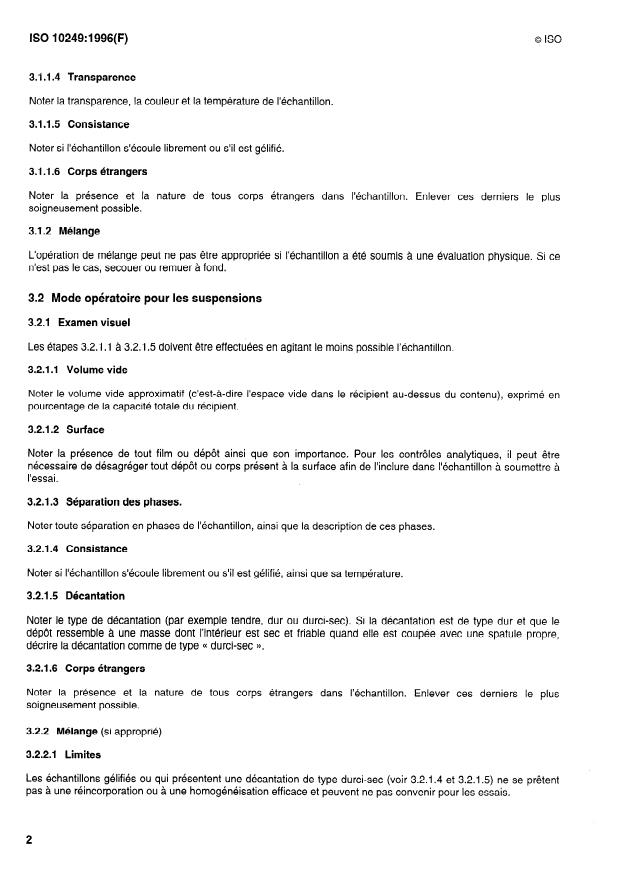
ISO 10249:1996 - Engrais liquides — Examen visuel préliminaire et préparation des échantillons pour essais physiques Released:12/19/1996

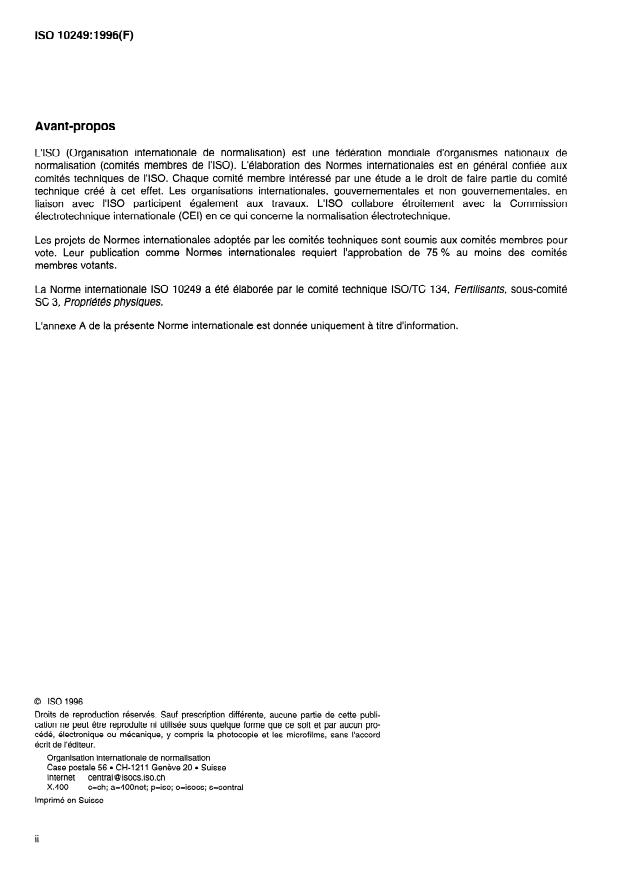

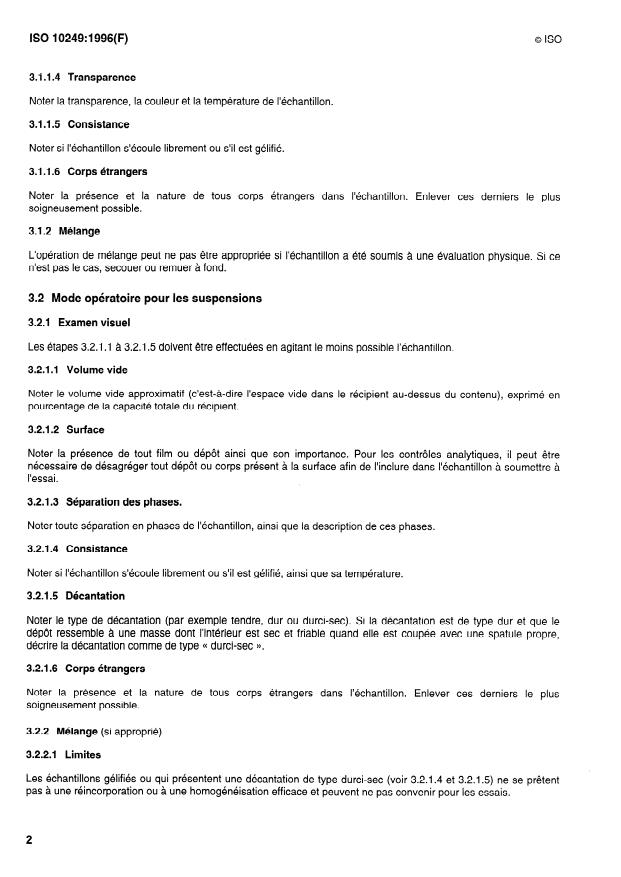
ISO 10249:1996 - Engrais liquides — Examen visuel préliminaire et préparation des échantillons pour essais physiques Released:12/19/1996
Get Certified
Connect with accredited certification bodies for this standard

Control Union Certifications
Global certification for agriculture and sustainability.

ECOCERT
Organic and sustainability certification.

FSC International
Forest Stewardship Council certification.
Sponsored listings
Frequently Asked Questions
ISO 10249:1996 is a standard published by the International Organization for Standardization (ISO). Its full title is "Fluid fertilizers — Preliminary visual examination and preparation of samples for physical testing". This standard covers: Specifies a procedure for preliminary examination of a single sample as received and a procedure for preparing a test sample by blending and reduction of a series of samples representative of a consignment of fluid fertilizer.
Specifies a procedure for preliminary examination of a single sample as received and a procedure for preparing a test sample by blending and reduction of a series of samples representative of a consignment of fluid fertilizer.
ISO 10249:1996 is classified under the following ICS (International Classification for Standards) categories: 65.080 - Fertilizers. The ICS classification helps identify the subject area and facilitates finding related standards.
ISO 10249:1996 has the following relationships with other standards: It is inter standard links to ISO 10249:2026. Understanding these relationships helps ensure you are using the most current and applicable version of the standard.
ISO 10249:1996 is available in PDF format for immediate download after purchase. The document can be added to your cart and obtained through the secure checkout process. Digital delivery ensures instant access to the complete standard document.
Standards Content (Sample)
INTERNATIONAL
IS0
STANDARD
First edition
1996-12-15
Fluid fertilizers - Preliminary visual
examination and preparation of samples for
physical testing
Engrais liquides - Examen visuel prkliminaire et pkpara tion des
kchantiilons pour essais physiques
Reference number
IS0 10249: 1996(E)
IS0 10249: 1996(E)
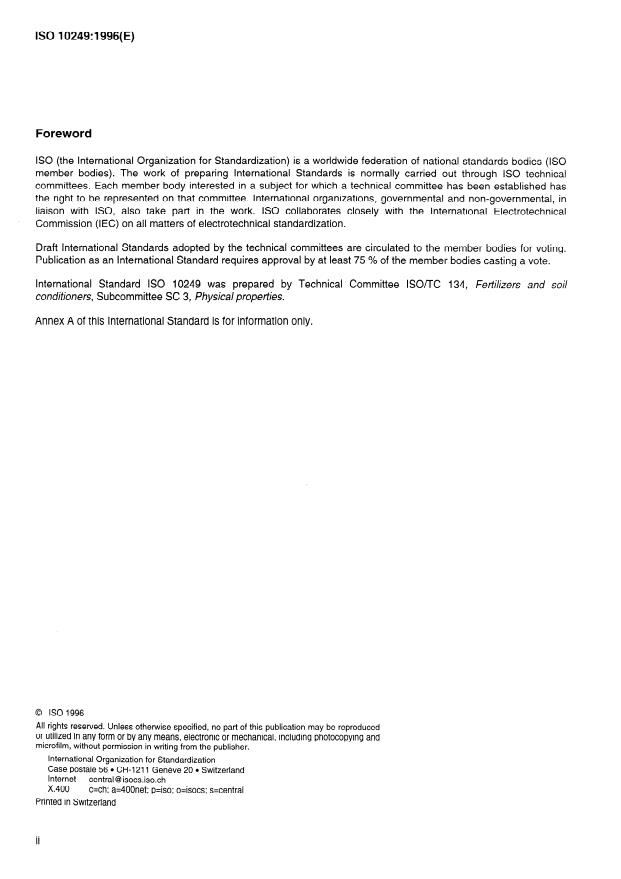
Foreword
IS0 (the International Organization for Standardization) is a worldwide federation of national standards bodies (IS0
member bodies). The work of preparing International Standards is normally carried out through IS0 technical
committees. Each member body interested in a subject for which a technical committee has been established has
the right to be represented on that committee. International organizations, governmental and non-governmental, in
liaison with ISO, also take part in the work. IS0 collaborates closely with the International Electrotechnical
Commission (IEC) on all matters of electrotechnical standardization.
Draft International Standards adopted by the technical committees are circulated to the member bodies for voting.
Publication as an International Standard requires approval by at least 75 % of the member bodies casting a vote.
International Standard IS0 10249 was prepared by Technical Committee lSO/TC 134, FeMizers and soil
conditioners, Subcommittee SC 3, Physical properties.
Annex A of this International Standard is for information only.
0 IS0 1996
All rights reserved. Unless otherwise specified, no part of this publication may be reproduced
or utilized in any form or by any means, electronic or mechanical, including photocopying and
microfilm, without permission in writing from the publisher.
International Organization for Standardization
Case postale 56 l CH-1211 Geneve 20 l Switzerland
Internet central @ isocs.iso.ch
x.400 c=ch; a=400net; p=iso; o=isocs; s=central
Printed in Switzerland
ii
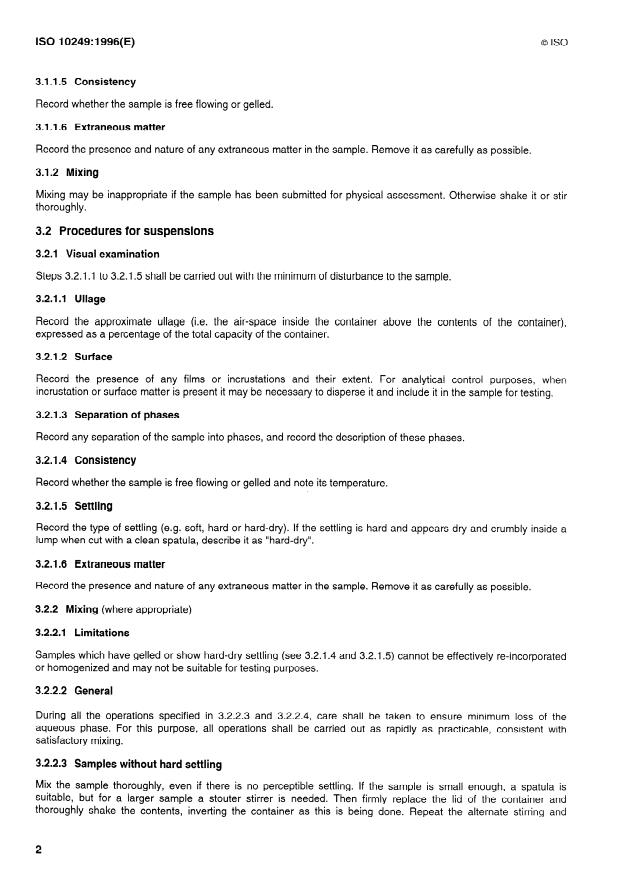
INTERNATIONAL STANDARD 0 IS0 IS0 10249:1996(E)
Fluid fertilizers - Preliminary visual examination and preparation
of samples for physical testing
1 Scope
This International Standard specifies both a procedure for preliminary examination of a single sample as received
for testing, and a procedure for preparing a test sample by blending and reduction of a series of samples
representative of a consignment or a bulk delivery of fluid fertilizer.
NOTE - This complements the corresponding standard for sohd fertilizers (IS0 8358).
2 Requirements
2.1 General
It is essential that the physical examination and any physical tests of fluid fertilizers be made as soon as possible
after sampling because of their sensitivity to both time and temperature.
2.2 Condition of container
Any defects in the laboratory sample container or any visible leakage shall be recorded. If it is possible that the
contents have been affected, the sample shall be rejected.
2.3 Opening of container
All packing materials (e.g. sawdust) and other debris shall be removed from the outer surface of the container,
particularly around the closure. The container shall be opened carefully so as not to disturb the contents. The
examination shall be carried out as rapidly as possible so as to minimize possible evaporation losses.
3 Procedure
3.1 Procedures for solutions
3.1 .I Visual examination
Wage
3.1 .l .I
Record the approximate ullage (i.e. the air-space in the container above the contents of the container), expressed
as a percentage of the total capacity of the container.
3.1 .I .2 Surface
Record the presence of any films or incrustations and their extent. For analytical control purposes, when
incrustation or surface matter is present it may be necessary to disperse it and include it in the sample for testing.
3.1 .I .3 Separation of phases
Record any separation of the sample into phases, noting the volume and nature of these phases (see 3.2.1 S).
3.1 A.4 Clarity
Record the clarity, colour and temperature of the sample.
0 IS0
IS0 10249:1996(E)
3.1 A.5 Consistency
Record whether the sample is free flowing or gelled.
3.1 .I .6 Extraneous matter
Record the presence and nature of any extraneous matter in the sample. Remove it as carefully as possible.
3.1.2 Mixing
Mixing may be inappropriate if the sample has been submitted for physical assessment. Otherwise shake it or stir
thoroughly.
3.2 Procedures for suspensions
3.2.1 Visual examination
Steps 3.2.1 .I to 3.2.1.5 shall be carried out with the minimum of disturbance to the sample.
3.2.1 .I Ullage
Record the approximate ullage (i.e. the air-space inside the container above the contents of the container),
expressed as a percentage of the total capacity of the container.
3.2.1.2 Surface
Record the presence of any films or incrustations and their extent. For analytical control purposes, when
incrustation or surface matter is present it may be necessary to disperse it and include it in the sample for testing.
3.2.1.3 Separation of phases
Record any separation of the sample into phases, and record the description of these phases.
3.2.1.4 Consistency
Record whether the sample
...
ISO
NORME
INTERNATIONALE
Première édition
1996-l 2-15
Engrais liquides - Examen visuel
préliminaire et préparation des échantillons
pour essais physiques
- Preliminary visual examina tion and prepara tion of
Fluid fellilizers
samples for physical testing
Numéro de référence
ISO 10249: 1996(F)
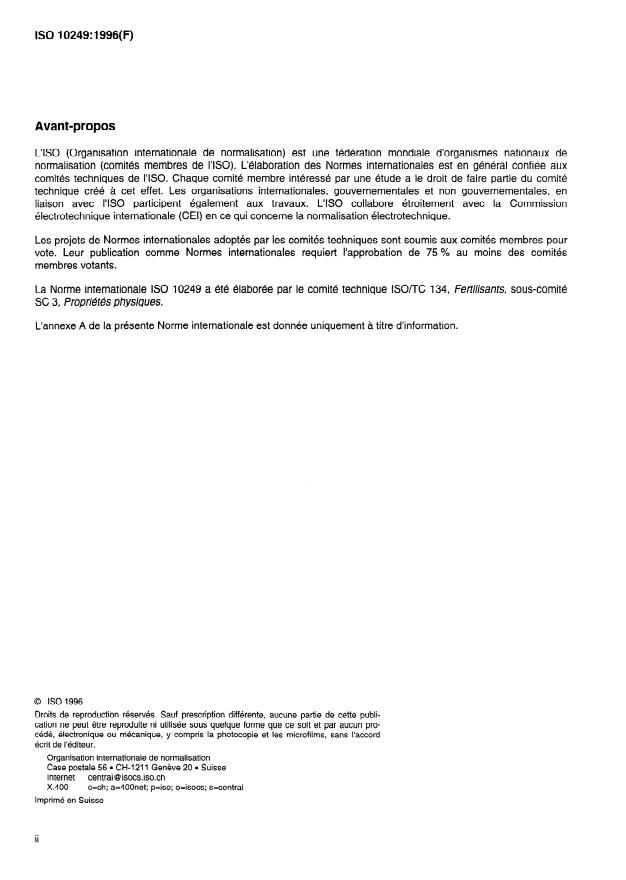
ISQ 10249: 1996(F)
Avant-propos
L’ISO (Organisation internationale de normalisation) est une fédération mondiale d’organismes nationaux de
normalisation (comités membres de I’ISO). L’élaboration des Normes internationales est en général confiée aux
comités techniques de I’ISO. Chaque comité membre intéressé par une étude a le droit de faire partie du comité
technique créé à cet effet. Les organisations internationales, gouvernementales et non gouvernementales, en
liaison avec I’ISO participent également aux travaux. L’ISO collabore étroitement avec la Commission
électrotechnique internationale (CEI) en ce qui concerne la normalisation électrotechnique.
Les projets de Normes internationales adoptés par les comités techniques sont soumis aux comités membres pour
vote. Leur publication comme Normes internationales requiert l’approbation de 75 % au moins des comités
membres votants.
La Norme internationale ISO 10249 a été élaborée par le comité technique ISO/TC 134, Fertiksants, sous-comité
SC 3, Propriétés physiques.
L’annexe A de la présente Norme internationale est donnée uniquement à titre d’information.
0 ISO 1996
Droits de reproduction réservés. Sauf prescription différente, aucune partie de cette publi-
cation ne peut être reproduite ni utilisée sous quelque forme que ce soit et par aucun pro-
cédé, électronique ou mécanique, y compris la photocopie et les microfilms, sans l’accord
écrit de l’éditeur.
Organisation internationale de normalisation
Case postale 56 l CH-121 1 Genève 20 l Suisse
Internet central @ isocs.iso.ch
x.400 c=ch; a=400net; p=iso; o=isocs; s=central
Imprimé en Suisse
NORME INTERNATIONALE @ ISO ISO 10249: 1996(F)
Engrais liquides - Examen visuel préliminaire et préparation des
échantillons pour essais physiques
1 Domaine d’application
La présente Norme internationale prescrit à la fois un mode opératoire pour l’examen préliminaire d’un échantillon
unique tel qu’il est reçu pour les essais, ainsi qu’un mode opératoire pour la préparation d’un échantillon pour essai
par mélange et réduction d’une série d’échantillons représentatifs d’un lot ou d’une livraison en vrac d’engrais
liquides.
NOTE - La présente Norme internationale complète la norme correspondante relative aux engrais solides (ISO 8358).
2 Exigences
2.1 Généralités
II est essentiel que l’examen physique ainsi que tout essai physique pour les engrais liquides soient effectués le
plus rapidement possible après l’échantillonnage du fait de leur sensibilité au temps et à la température.
2.2 Condition du récipient
Tous les défauts du récipient contenant l’échantillon pour laboratoire ou toute fuite visible doivent être notés. Si le
contenu semble endommagé, l’échantillon doit être rejeté.
2.3 Ouverture du récipient
Tous les matériaux d’emballage (par exemple la sciure de bois) et autres poussières doivent être éliminés de la
surface extérieure du récipient, en particulier près de la fermeture. Le récipient doit être soigneusement ouvert en
faisant attention de ne pas agiter le contenu. L’examen doit être effectué le plus rapidement possible afin de
minimiser les pertes éventuelles par évaporation.
3 Mode opératoire
3.1 Mode opératoire pour les solutions
3.1 .l Examen visuel
3.1 .l .l Volume vide
Noter le volume vide approximatif (c’est-à-dire l’espace vide dans le récipient au-dessus du contenu), exprimé en
pourcentage de la capacité totale du récipient.
3.1 .1.2 Surface
Noter la présence de tout film ou dépôt ainsi que son importance. Pour les contrôles analytiques, il peut être
nécessaire de désagréger tout dépôt ou corps présent à la surface afin de l’inclure dans l’échantillon à soumettre à
essai.
3.1 A.3 Séparation des phases
Noter toute séparation en phases de l’échantillon, ainsi que le volume et la nature de ces phases (voir 3.2.1.5).
3.1 A.4 Transparence
Noter la transparence, la couleur et la température de l’échantillon.
3.1 A.5 Consistance
Noter si l’échantillon s’écoule librement ou s’il est gélifié.
3.1 A.6 Corps étrangers
Noter la présence et la nature de tous corps étrangers dans l’échantillon. Enlever ces derniers le plus
soigneusement possible.
3.1.2 Mélange
si l’échantillon a été soumis
L’opération de mélange peut ne pas être appropriée à une évaluation physique. Si ce
n’est pas le cas, secouer ou remuer à fond.
3.2 Mode opératoire pour les suspensions
3.2.1 Examen visuel
Les étapes 3.2.1 .l à 3.2.1.5 doivent être effectuées en agitant le moins possible l’échantillon.
3.2.1 .l Volume vide
Noter le volume vide approximatif (c’est-à-dire l’espace vide dans le récipient au-dessus du contenu), exprimé en
pourcentage de la capacité totale du récipient.
3.2.1.2 Surface
Noter la présence de tout film ou dépôt ainsi que son importance. Pour les contrôles analytiques, il peut être
nécessaire de désagréger tout dépôt ou corps présent à la surface afin de l’inclure dans l’échantillon à soumettre à
l’essai.
3.2.1.3 Séparation des phases.
Noter toute séparation en phases de l’échantillon, ainsi que Oa description de ces phases.
3.2.1.4 Consistance
Noter si l’échantillon s’écoule librement ou s’il est gélifié, ainsi que sa température.
3.2.1.5 Décantation
Noter le type de
...
ISO
NORME
INTERNATIONALE
Première édition
1996-l 2-15
Engrais liquides - Examen visuel
préliminaire et préparation des échantillons
pour essais physiques
- Preliminary visual examina tion and prepara tion of
Fluid fellilizers
samples for physical testing
Numéro de référence
ISO 10249: 1996(F)
ISQ 10249: 1996(F)
Avant-propos
L’ISO (Organisation internationale de normalisation) est une fédération mondiale d’organismes nationaux de
normalisation (comités membres de I’ISO). L’élaboration des Normes internationales est en général confiée aux
comités techniques de I’ISO. Chaque comité membre intéressé par une étude a le droit de faire partie du comité
technique créé à cet effet. Les organisations internationales, gouvernementales et non gouvernementales, en
liaison avec I’ISO participent également aux travaux. L’ISO collabore étroitement avec la Commission
électrotechnique internationale (CEI) en ce qui concerne la normalisation électrotechnique.
Les projets de Normes internationales adoptés par les comités techniques sont soumis aux comités membres pour
vote. Leur publication comme Normes internationales requiert l’approbation de 75 % au moins des comités
membres votants.
La Norme internationale ISO 10249 a été élaborée par le comité technique ISO/TC 134, Fertiksants, sous-comité
SC 3, Propriétés physiques.
L’annexe A de la présente Norme internationale est donnée uniquement à titre d’information.
0 ISO 1996
Droits de reproduction réservés. Sauf prescription différente, aucune partie de cette publi-
cation ne peut être reproduite ni utilisée sous quelque forme que ce soit et par aucun pro-
cédé, électronique ou mécanique, y compris la photocopie et les microfilms, sans l’accord
écrit de l’éditeur.
Organisation internationale de normalisation
Case postale 56 l CH-121 1 Genève 20 l Suisse
Internet central @ isocs.iso.ch
x.400 c=ch; a=400net; p=iso; o=isocs; s=central
Imprimé en Suisse
NORME INTERNATIONALE @ ISO ISO 10249: 1996(F)
Engrais liquides - Examen visuel préliminaire et préparation des
échantillons pour essais physiques
1 Domaine d’application
La présente Norme internationale prescrit à la fois un mode opératoire pour l’examen préliminaire d’un échantillon
unique tel qu’il est reçu pour les essais, ainsi qu’un mode opératoire pour la préparation d’un échantillon pour essai
par mélange et réduction d’une série d’échantillons représentatifs d’un lot ou d’une livraison en vrac d’engrais
liquides.
NOTE - La présente Norme internationale complète la norme correspondante relative aux engrais solides (ISO 8358).
2 Exigences
2.1 Généralités
II est essentiel que l’examen physique ainsi que tout essai physique pour les engrais liquides soient effectués le
plus rapidement possible après l’échantillonnage du fait de leur sensibilité au temps et à la température.
2.2 Condition du récipient
Tous les défauts du récipient contenant l’échantillon pour laboratoire ou toute fuite visible doivent être notés. Si le
contenu semble endommagé, l’échantillon doit être rejeté.
2.3 Ouverture du récipient
Tous les matériaux d’emballage (par exemple la sciure de bois) et autres poussières doivent être éliminés de la
surface extérieure du récipient, en particulier près de la fermeture. Le récipient doit être soigneusement ouvert en
faisant attention de ne pas agiter le contenu. L’examen doit être effectué le plus rapidement possible afin de
minimiser les pertes éventuelles par évaporation.
3 Mode opératoire
3.1 Mode opératoire pour les solutions
3.1 .l Examen visuel
3.1 .l .l Volume vide
Noter le volume vide approximatif (c’est-à-dire l’espace vide dans le récipient au-dessus du contenu), exprimé en
pourcentage de la capacité totale du récipient.
3.1 .1.2 Surface
Noter la présence de tout film ou dépôt ainsi que son importance. Pour les contrôles analytiques, il peut être
nécessaire de désagréger tout dépôt ou corps présent à la surface afin de l’inclure dans l’échantillon à soumettre à
essai.
3.1 A.3 Séparation des phases
Noter toute séparation en phases de l’échantillon, ainsi que le volume et la nature de ces phases (voir 3.2.1.5).
3.1 A.4 Transparence
Noter la transparence, la couleur et la température de l’échantillon.
3.1 A.5 Consistance
Noter si l’échantillon s’écoule librement ou s’il est gélifié.
3.1 A.6 Corps étrangers
Noter la présence et la nature de tous corps étrangers dans l’échantillon. Enlever ces derniers le plus
soigneusement possible.
3.1.2 Mélange
si l’échantillon a été soumis
L’opération de mélange peut ne pas être appropriée à une évaluation physique. Si ce
n’est pas le cas, secouer ou remuer à fond.
3.2 Mode opératoire pour les suspensions
3.2.1 Examen visuel
Les étapes 3.2.1 .l à 3.2.1.5 doivent être effectuées en agitant le moins possible l’échantillon.
3.2.1 .l Volume vide
Noter le volume vide approximatif (c’est-à-dire l’espace vide dans le récipient au-dessus du contenu), exprimé en
pourcentage de la capacité totale du récipient.
3.2.1.2 Surface
Noter la présence de tout film ou dépôt ainsi que son importance. Pour les contrôles analytiques, il peut être
nécessaire de désagréger tout dépôt ou corps présent à la surface afin de l’inclure dans l’échantillon à soumettre à
l’essai.
3.2.1.3 Séparation des phases.
Noter toute séparation en phases de l’échantillon, ainsi que Oa description de ces phases.
3.2.1.4 Consistance
Noter si l’échantillon s’écoule librement ou s’il est gélifié, ainsi que sa température.
3.2.1.5 Décantation
Noter le type de
...
Questions, Comments and Discussion
Ask us and Technical Secretary will try to provide an answer. You can facilitate discussion about the standard in here.
Loading comments...