

ISO/TS 20224-1:2020
(Main)Molecular biomarker analysis — Detection of animal-derived materials in foodstuffs and feedstuffs by real-time PCR — Part 1: Bovine DNA detection method
General Information
- Abstract
This document specifies a real-time polymerase chain reaction (real-time PCR) method for the qualitative detection of bovine-specific DNA derived from food and feed. It requires the extraction of an adequate amount of PCR amplifiable DNA from the relevant matrix and can be applied to the detection of bovine material derived from cattle including taurine (Bos taurus) and zebu (Bos indicus). The assay also detects the species bison (Bison bison) and yak (Bos mutus). The target sequence is a partial fragment of the bovine nuclear beta actin gene in chromosome 25 (i.e. GenBank accession number NC_037352.1)[1][2][3], which is present as a single copy per haploid genome. The provided PCR assay for this target has an absolute limit of detection of five copies per reaction, with ≥ 95 % replicability at this concentration (LOD95 %).
- Status
- Published
- Publication Date
- 30-Jul-2020
- Technical Committee
- ISO/TC 34/SC 16 - Horizontal methods for molecular biomarker analysis
- Drafting Committee
- ISO/TC 34/SC 16/WG 8 - Meat speciation
- Current Stage
- 9093 - International Standard confirmed
- Start Date
- 06-May-2025
- Completion Date
- 29-Aug-2026
Buy Documents
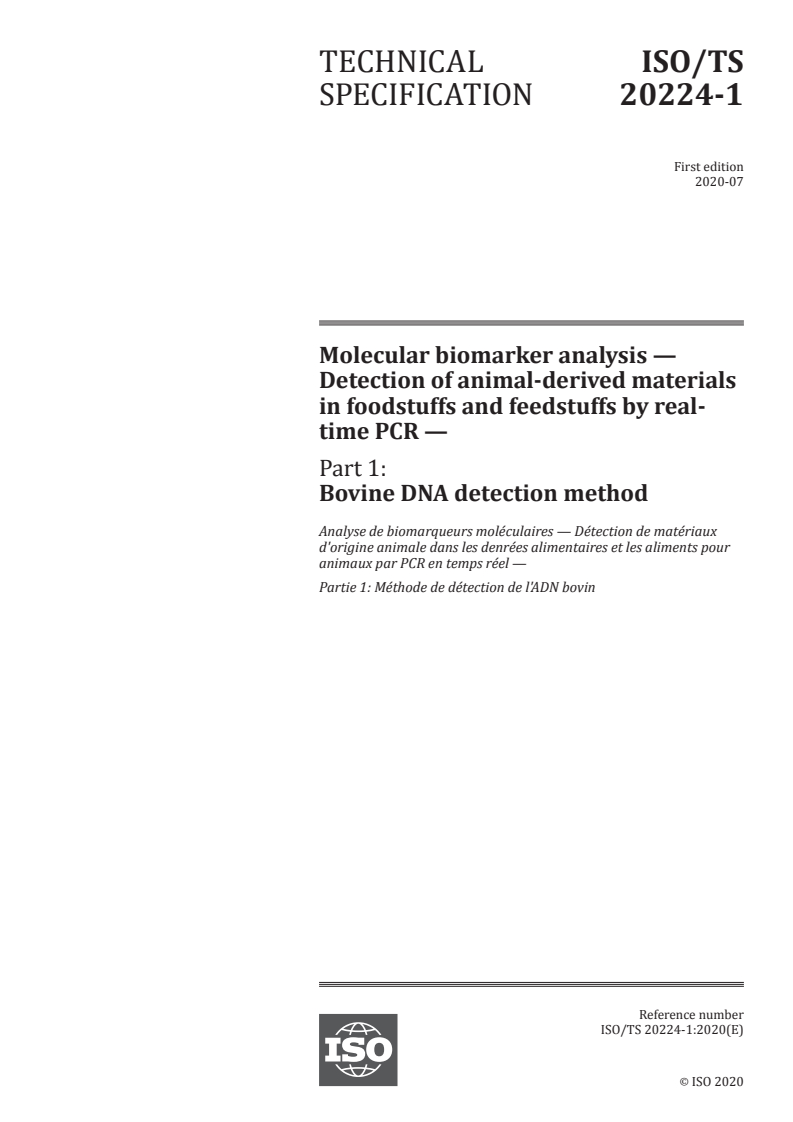
ISO/TS 20224-1:2020 - Molecular biomarker analysis — Detection of animal-derived materials in foodstuffs and feedstuffs by real-time PCR — Part 1: Bovine DNA detection method Released:7/31/2020
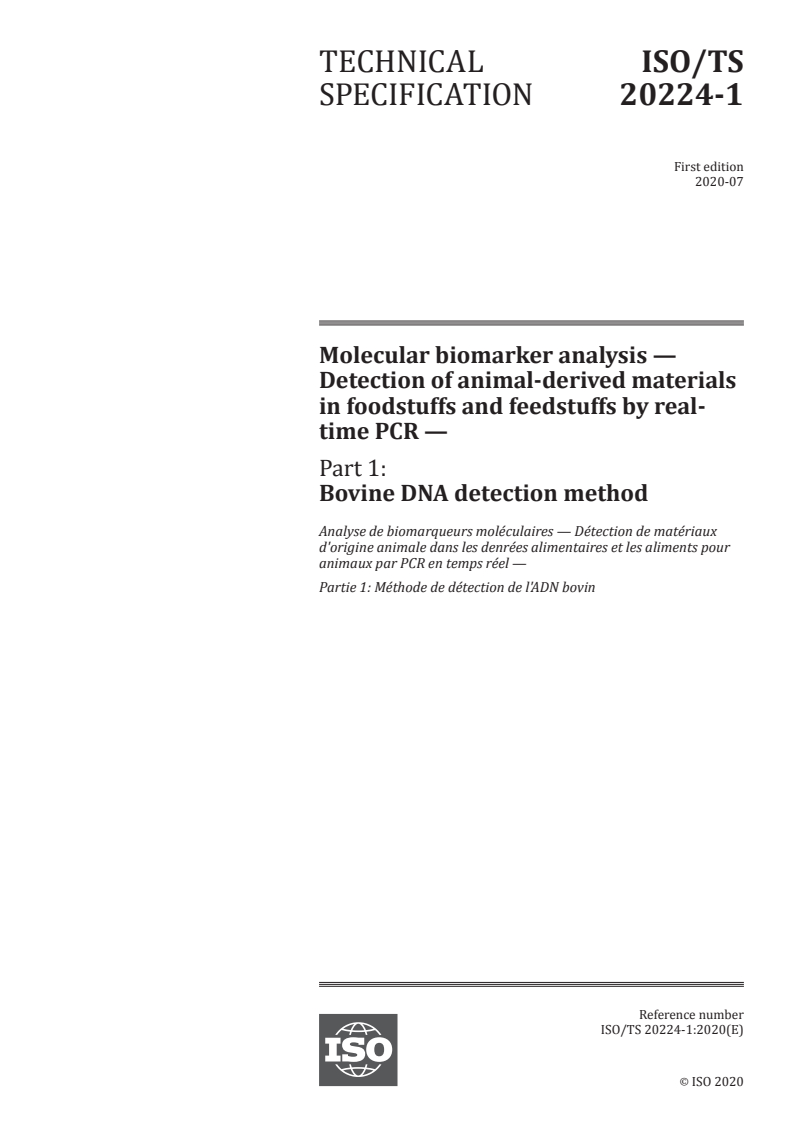
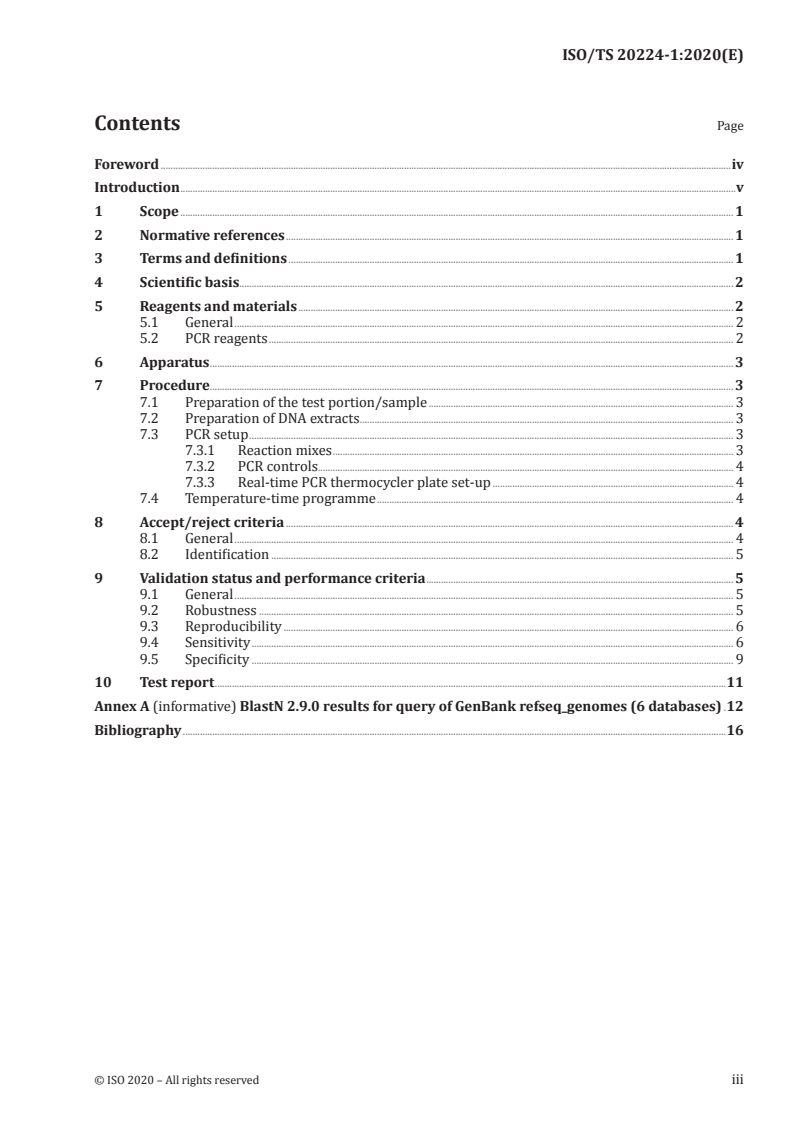
ISO/TS 20224-1:2020 - Molecular biomarker analysis — Detection of animal-derived materials in foodstuffs and feedstuffs by real-time PCR — Part 1: Bovine DNA detection method/31/2020
Overview
ISO/TS 20224-1:2020 specifies a real-time PCR method for qualitative detection of bovine DNA in foodstuffs and feedstuffs. The technique targets a partial fragment of the bovine nuclear beta actin gene on chromosome 25 (GenBank NC_037352.1), a single-copy locus per haploid genome. The assay is designed for routine bovine DNA detection (Bos taurus and Bos indicus) and also detects bison (Bison bison) and yak (Bos mutus). The provided PCR assay has an absolute limit of detection of five copies per reaction with ≥95% replicability (LOD95%).
Key topics and technical requirements
- Scope: Qualitative species identification of bovine-derived material in food and feed using real-time PCR.
- Target: Partial fragment of bovine nuclear beta actin gene (NC_037352.1), single-copy per haploid genome.
- Sensitivity: Absolute LOD = 5 copies/reaction, ≥95% replicability at LOD95%.
- Sample preparation: Requires extraction of an adequate amount of PCR-amplifiable DNA from the test matrix following ISO 21571 recommendations.
- Reaction setup (typical):
- Total volume: 25 µl; sample DNA 5 µl (recommended 20–200 ng/µl).
- 2× PCR master mix 12.5 µl; primers and probe at specified concentrations (primers ~400 nmol/L, probe ~200 nmol/L).
- Compatible with TaqMan-style real-time PCR chemistry; master mix may include UDG/dUTP to limit carry-over contamination.
- Controls and verification:
- Include inhibition/reference gene assay (e.g., 18S rRNA or myostatin) to confirm DNA amplifiability and avoid false negatives.
- Standard PCR controls and plate layout guidance to mitigate edge effects and contamination.
- Apparatus: Real-time thermocycler capable of fluorescence excitation/detection for TaqMan assays.
Applications and users
ISO/TS 20224-1:2020 is intended for laboratories performing:
- Food authenticity and fraud detection (identifying undeclared bovine ingredients).
- Regulatory and enforcement testing for food labeling and feed compliance.
- Supply-chain verification for religious (halal/kosher) or cultural dietary requirements.
- Quality control in food manufacturers, feed producers, and testing service providers. Typical users: public health and food control laboratories, contract testing labs, industry QC teams, and forensic analysts focused on species identification.
Related standards
- ISO 21571 - nucleic acid extraction for foodstuffs (recommended extraction methods)
- ISO 20813 - general requirements for nucleic acid-based species detection
- ISO 24276 - PCR method controls and requirements
- ISO 16577 - molecular biomarker analysis terminology
Keywords: ISO/TS 20224-1:2020, bovine DNA detection, real-time PCR, beta actin gene, food authenticity, species identification, LOD95%, food and feed testing.
Buy Documents
ISO/TS 20224-1:2020 - Molecular biomarker analysis — Detection of animal-derived materials in foodstuffs and feedstuffs by real-time PCR — Part 1: Bovine DNA detection method Released:7/31/2020
ISO/TS 20224-1:2020 - Molecular biomarker analysis — Detection of animal-derived materials in foodstuffs and feedstuffs by real-time PCR — Part 1: Bovine DNA detection method/31/2020
Get Certified
Connect with accredited certification bodies for this standard

BSI Group
BSI (British Standards Institution) is the business standards company that helps organizations make excellence a habit.

Bureau Veritas
Bureau Veritas is a world leader in laboratory testing, inspection and certification services.

DNV
DNV is an independent assurance and risk management provider.
Sponsored listings
Frequently Asked Questions
ISO/TS 20224-1:2020 is a technical specification published by the International Organization for Standardization (ISO). Its full title is "Molecular biomarker analysis — Detection of animal-derived materials in foodstuffs and feedstuffs by real-time PCR — Part 1: Bovine DNA detection method". This standard covers: This document specifies a real-time polymerase chain reaction (real-time PCR) method for the qualitative detection of bovine-specific DNA derived from food and feed. It requires the extraction of an adequate amount of PCR amplifiable DNA from the relevant matrix and can be applied to the detection of bovine material derived from cattle including taurine (Bos taurus) and zebu (Bos indicus). The assay also detects the species bison (Bison bison) and yak (Bos mutus). The target sequence is a partial fragment of the bovine nuclear beta actin gene in chromosome 25 (i.e. GenBank accession number NC_037352.1)[1][2][3], which is present as a single copy per haploid genome. The provided PCR assay for this target has an absolute limit of detection of five copies per reaction, with ≥ 95 % replicability at this concentration (LOD95 %).
This document specifies a real-time polymerase chain reaction (real-time PCR) method for the qualitative detection of bovine-specific DNA derived from food and feed. It requires the extraction of an adequate amount of PCR amplifiable DNA from the relevant matrix and can be applied to the detection of bovine material derived from cattle including taurine (Bos taurus) and zebu (Bos indicus). The assay also detects the species bison (Bison bison) and yak (Bos mutus). The target sequence is a partial fragment of the bovine nuclear beta actin gene in chromosome 25 (i.e. GenBank accession number NC_037352.1)[1][2][3], which is present as a single copy per haploid genome. The provided PCR assay for this target has an absolute limit of detection of five copies per reaction, with ≥ 95 % replicability at this concentration (LOD95 %).
ISO/TS 20224-1:2020 is classified under the following ICS (International Classification for Standards) categories: 67.050 - General methods of tests and analysis for food products. The ICS classification helps identify the subject area and facilitates finding related standards.
ISO/TS 20224-1:2020 is available in PDF format for immediate download after purchase. The document can be added to your cart and obtained through the secure checkout process. Digital delivery ensures instant access to the complete standard document.
Standards Content (Sample)
TECHNICAL ISO/TS
SPECIFICATION 20224-1
First edition
2020-07
Molecular biomarker analysis —
Detection of animal-derived materials
in foodstuffs and feedstuffs by real-
time PCR —
Part 1:
Bovine DNA detection method
Analyse de biomarqueurs moléculaires — Détection de matériaux
d'origine animale dans les denrées alimentaires et les aliments pour
animaux par PCR en temps réel —
Partie 1: Méthode de détection de l'ADN bovin
Reference number
©
ISO 2020
© ISO 2020
All rights reserved. Unless otherwise specified, or required in the context of its implementation, no part of this publication may
be reproduced or utilized otherwise in any form or by any means, electronic or mechanical, including photocopying, or posting
on the internet or an intranet, without prior written permission. Permission can be requested from either ISO at the address
below or ISO’s member body in the country of the requester.
ISO copyright office
CP 401 • Ch. de Blandonnet 8
CH-1214 Vernier, Geneva
Phone: +41 22 749 01 11
Email: copyright@iso.org
Website: www.iso.org
Published in Switzerland
ii © ISO 2020 – All rights reserved
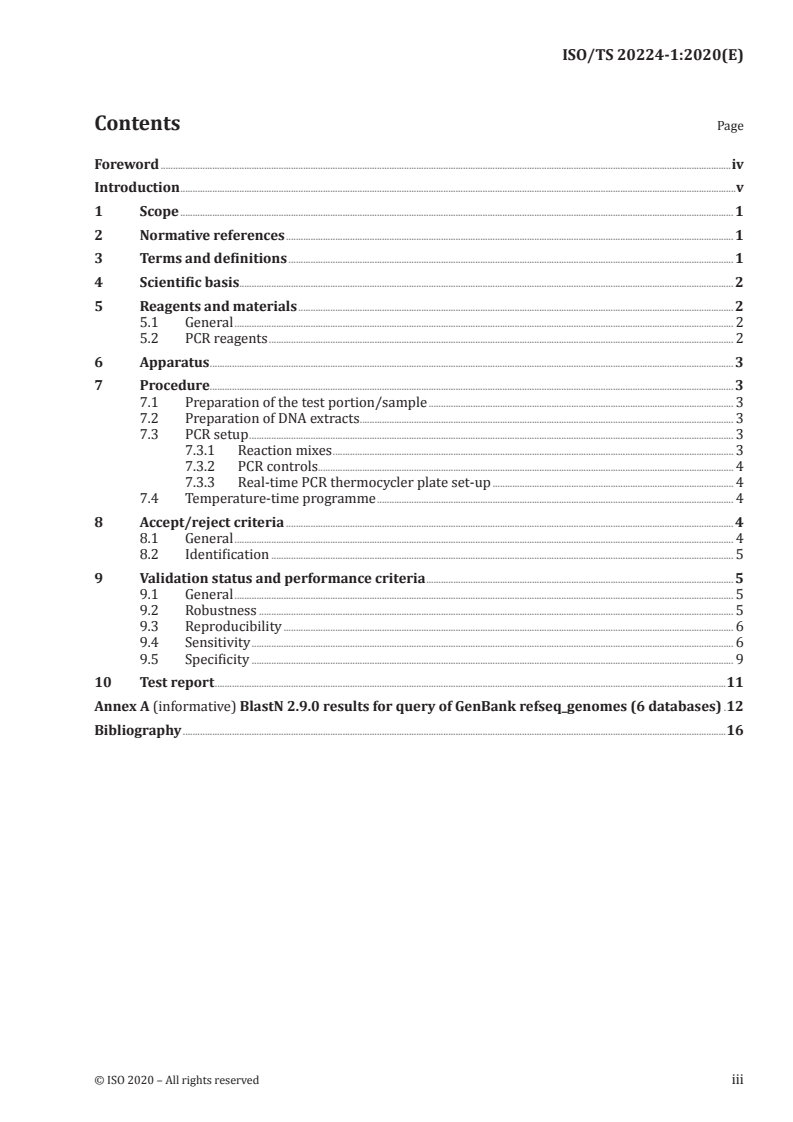
Contents Page
Foreword .iv
Introduction .v
1 Scope . 1
2 Normative references . 1
3 Terms and definitions . 1
4 Scientific basis . 2
5 Reagents and materials . 2
5.1 General . 2
5.2 PCR reagents . 2
6 Apparatus . 3
7 Procedure. 3
7.1 Preparation of the test portion/sample . 3
7.2 Preparation of DNA extracts . 3
7.3 PCR setup . 3
7.3.1 Reaction mixes . 3
7.3.2 PCR controls . . 4
7.3.3 Real-time PCR thermocycler plate set-up . 4
7.4 Temperature-time programme . 4
8 Accept/reject criteria . 4
8.1 General . 4
8.2 Identification . 5
9 Validation status and performance criteria . 5
9.1 General . 5
9.2 Robustness . 5
9.3 Reproducibility . 6
9.4 Sensitivity . 6
9.5 Specificity . 9
10 Test report .11
Annex A (informative) BlastN 2.9.0 results for query of GenBank refseq_genomes (6 databases) .12
Bibliography .16
Foreword
ISO (the International Organization for Standardization) is a worldwide federation of national standards
bodies (ISO member bodies). The work of preparing International Standards is normally carried out
through ISO technical committees. Each member body interested in a subject for which a technical
committee has been established has the right to be represented on that committee. International
organizations, governmental and non-governmental, in liaison with ISO, also take part in the work.
ISO collaborates closely with the International Electrotechnical Commission (IEC) on all matters of
electrotechnical standardization.
The procedures used to develop this document and those intended for its further maintenance are
described in the ISO/IEC Directives, Part 1. In particular, the different approval criteria needed for the
different types of ISO documents should be noted. This document was drafted in accordance with the
editorial rules of the ISO/IEC Directives, Part 2 (see www .iso .org/ directives).
Attention is drawn to the possibility that some of the elements of this document may be the subject of
patent rights. ISO shall not be held responsible for identifying any or all such patent rights. Details of
any patent rights identified during the development of the document will be in the Introduction and/or
on the ISO list of patent declarations received (see www .iso .org/ patents).
Any trade name used in this document is information given for the convenience of users and does not
constitute an endorsement.
For an explanation of the voluntary nature of standards, the meaning of ISO specific terms and
expressions related to conformity assessment, as well as information about ISO’s adherence to the
World Trade Organization (WTO) principles in the Technical Barriers to Trade (TBT), see www .iso .org/
iso/ foreword .html.
This document was prepared by Technical Committee ISO/TC 34, Food products, Subcommittee SC 16,
Horizontal methods for molecular biomarker analysis.
A list of all parts in the ISO 20224 series can be found on the ISO website.
Any feedback or questions on this document should be directed to the user’s national standards body. A
complete listing of these bodies can be found at www .iso .org/ members .html.
iv © ISO 2020 – All rights reserved
Introduction
Fraudulent adulteration of meat in food and feed threatens both public safety and commerce.
Adulteration can affect those adhering to ethnological dietary rules, economic development and social
stability. This document provides a real-time polymerase chain reaction (real-time PCR) analytical
method for the identification of meat animal species from nucleic acid present in the ingredients of food
and feed.
Animal-derived biological materials in food and feed are detected and identified in the laboratory with
the following successive (or simultaneous) steps: preparation of the test portion/sample, nucleic acid
extraction and purification, PCR amplification and interpretation of results. This document provides
guidance for PCR amplification and interpretation of results, specific to bovine DNA detection.
The ISO 20224 series consists of technical specifications that describe specific applications. New
species DNA detection methods established in the future will be added as independent parts.
TECHNICAL SPECIFICATION ISO/TS 20224-1:2020(E)
Molecular biomarker analysis — Detection of animal-
derived materials in foodstuffs and feedstuffs by real-
time PCR —
Part 1:
Bovine DNA detection method
1 Scope
This document specifies a real-time polymerase chain reaction (real-time PCR) method for the
qualitative detection of bovine-specific DNA derived from food and feed. It requires the extraction of an
adequate amount of PCR amplifiable DNA from the relevant matrix and can be applied to the detection
of bovine material derived from cattle including taurine (Bos taurus) and zebu (Bos indicus). The assay
also detects the species bison (Bison bison) and yak (Bos mutus).
The target sequence is a partial fragment of the bovine nuclear beta actin gene in chromosome 25 (i.e.
[1][2][3]
GenBank accession number NC_037352.1) , which is present as a single copy per haploid genome.
The provided PCR assay for this target has an absolute limit of detection of five copies per reaction,
with ≥ 95 % replicability at this concentration (LOD ).
95 %
2 Normative references
The following documents are referred to in the text in such a way that some or all of their content
constitutes requirements of this document. For dated references, only the edition cited applies. For
undated references, the latest edition of the referenced document (including any amendments) applies.
ISO 16577, Molecular biomarker analysis — Terms and definitions
ISO 20813, Molecular biomarker analysis — Methods of analysis for the detection and identification
of animal species in foods and food products (nucleic acid-based methods) — General requirements and
definitions
ISO 21571, Foodstuffs — Methods of analysis for the detection of genetically modified organisms and
derived products — Nucleic acid extraction
ISO 24276, Foodstuffs — Methods of analysis for the detection of genetically modified organisms and
derived products — General requirements and definitions
3 Terms and definitions
For the purposes of this document, the terms and definitions given in ISO 16577 apply.
ISO and IEC maintain terminological databases for use in standardization at the following addresses:
— ISO Online browsing platform: available at https:// www .iso .org/ obp
— IEC Electropedia: available at http:// www .electropedia .org/
4 Scientific basis
DNA is extracted from the test portion by applying a suitable method (see ISO 21571:2005, A.1). The
DNA analysis consists of two parts:
— verification of the quality and amplifiability of the extracted DNA using a PCR assay specific for
eukaryotes (e.g. 18S rRNA gene) or mammals and poultry (e.g. myostatin gene);
— detection of the bovine species-specific DNA sequence of the single-copy beta actin gene in
chromosome 25 (e.g. GenBank accession number NC_037352.1) in a real-time PCR.
NOTE The copy number of the eukaryotic ribosomal 18S RNA (18S rRNA) gene in a cell varies from several
hundred to several thousand, while the beta actin gene in the bovine genome and myostatin gene in mammals
and poultry genome are single copy. The copy number of the beta actin gene in the bovine genome was confirmed
by bioinformatics analysis at the whole genome scale (see Annex A) and digital PCR for absolute quantification.
5 Reagents and materials
5.1 General
For this document, only chemicals and water of recognized analytical grade, appropriate for molecular
biology, shall be used. Unless stated otherwise, solutions should be prepared by dissolving the
corresponding reagents in water followed by autoclave sterilization. For all operations in which gloves
are used, gloves shall be powder free. The use of aerosol protected pipette tips (protection against
cross-contamination) is recommended.
5.2 PCR reagents
5.2.1 PCR master mix.
PCR master mix contains thermostable DNA polymerase, pH buffer, KCl, MgCl , uracil-DNA glycosylase
(UDG) and the four dNTPS (dATP, dGTP, dUTP, dCTP) as a dilutable concentrate, which is ready to use.
5.2.2 Oligonucleotides.
The quality of the oligonucleotides shall be sufficient for their use as primers and probes. See Table 1.
Table 1 — Oligonucleotides
Final concentration
Name DNA sequence of the oligonucleotide
in PCR
a
Bovine beta actin gene as the target sequence (GenBank accession number NC_037352.1)
Bovine-62bp-F 5′-GGCCTCGGAGTGTGTATTCAG-3′ 400 nmol/l
Bovine-62bp-R 5′-GCCCCAGAATGAGGTTCACTT-3′ 400 nmol/l
b
Bovine-62bp-P 5′-[FAM]-AGGTGCACAGTACGTTC-[NFQ-MGB] -3′ 200 nmol/l
a
PCR product = 38 800 878 - GGCCTCGGAG TGTGTATTCA GTAGGTGCAC AGTACGTTCT GAAGTGAACC TCATTCTGGG
GC-38 800 939 - NC_037352.1.
b
FAM: 6-carboxyfluorescein, NFQ-MGB: non-fluorescent quencher minor groove binder.
Bovine-62bp-F is base pairs 38 800 878-38 800 898, Bovine-62bp-R is base pairs 38 800 919-
38 800 939 and Bovine-62bp-P is 38 800 900-38 800 916 of NC_037352.1 bovine nuclear beta actin
gene in chromosome 25. Equivalent reporter dyes and/or quencher dyes can be used if they yield the
same or better results.
2 © ISO 2020 – All rights reserved
6 Apparatus
Requirements concerning apparatus and materials shall follow ISO 20813. In addition to the usual
laboratory equipment, the following equipment is required.
6.1 Real-time thermocycler instrument.
A device that amplifies DNA in vitro and performs the temperature-time cycles is needed for PCR.
Additionally, the device shall be capable of exciting fluorescence molecules at specific wavelengths and
detecting sufficient emitted fluorescent light of the fluorophore used to perform TaqMan format assays.
7 Procedure
7.1 Preparation of the test portion/sample
The test sample used for DNA extraction shall be representative of the laboratory sample and
homogeneous, e.g. by grinding or homogenizing the laboratory sample to a fine mixture. Test portion/
sample preparation shall follow the general requirements and specific methods described in ISO 21571
and ISO 20813.
7.2 Preparation of DNA extracts
The extraction/purification and quantification of DNA from the test portion shall follow the
general requirements and methods provided in ISO 21571. DNA extraction methods described in
ISO 21571:2005, Annex A, are recommended.
7.3 PCR setup
7.3.1 Reaction mixes
The method is for a total volume of 25 μl per PCR. The reaction setup is given in Table 2. Reagents
shall be completely thawed at room temperature. Each reagent shall be carefully mixed and briefly
centrifuged immediately before pipetting. A PCR reagent mixture is prepared to contain all components
except for the sample DNA. The required total amount of the PCR reagent mixture prepared depends
on the number of reactions to be performed, including at least one additional reaction as a pipetting
reserve. The number of sample and control replicates shall follow ISO 20813. Set up the PCR tests as
follows:
a) mix the PCR reagent mixture, centrifuge briefly and pipette 20 µl into each reaction vial;
b) add 5 µl of each sample DNA (20 ng/µl to 200 ng/µl) or positive DNA target control or extraction
blank control or water to the respective reaction vials;
c) mix and centrifuge briefly.
Table 2 — Reaction setup for the amplification
Total reaction volume 25 µl
Sample DNA (20 ng/µl to 200 ng/µl) or controls 5 µl
a
2 × PCR master mix 12,5 µl
Primer Bovine-62bp-F, c = 10 μmol/l and Bovine-62bp-R, c = 10 μmol/l 1,0 µl for each
Probe Bovine-62bp-P, c = 10 μmol/l 0,5 µl
Water to 25 µl
a
In the collaborative trial, a ready-to-use optimized 2 × PCR master mix containing all of the components, excluding
the template and primers, was used. The 2 × PCR master mix contains thermostable DNA polymerase, a blend of dNTPs
with dUTP and uracil-UDG to minimize carry-over PCR contamination, and a passive internal reference based on ROX dye.
Equivalent products can be used if they yield the same or better results. If necessary, the amounts of the reagents and the
temperature-time programme can be adapted.
7.3.2 PCR controls
7.3.2.1 General
PCR controls shall be as described in ISO 24276 and ISO 20813.
7.3.2.2 Inhibition control (reference gene assay)
A reference control gene (e.g. 18S rRNA gene for eukaryotes, myostatin gene for mammals and poultry)
PCR assay using sample DNAs shall be performed to test nucleic acid amplifiability and provide control
to exclude false-negative results.
7.3.3 Real-time PCR thermocycler plate set-up
Transfer
...
TECHNICAL ISO/TS
SPECIFICATION 20224-1
First edition
2020-07
Molecular biomarker analysis —
Detection of animal-derived materials
in foodstuffs and feedstuffs by real-
time PCR —
Part 1:
Bovine DNA detection method
Analyse de biomarqueurs moléculaires — Détection de matériaux
d'origine animale dans les denrées alimentaires et les aliments pour
animaux par PCR en temps réel —
Partie 1: Méthode de détection de l'ADN bovin
Reference number
©
ISO 2020
© ISO 2020
All rights reserved. Unless otherwise specified, or required in the context of its implementation, no part of this publication may
be reproduced or utilized otherwise in any form or by any means, electronic or mechanical, including photocopying, or posting
on the internet or an intranet, without prior written permission. Permission can be requested from either ISO at the address
below or ISO’s member body in the country of the requester.
ISO copyright office
CP 401 • Ch. de Blandonnet 8
CH-1214 Vernier, Geneva
Phone: +41 22 749 01 11
Email: copyright@iso.org
Website: www.iso.org
Published in Switzerland
ii © ISO 2020 – All rights reserved
Contents Page
Foreword .iv
Introduction .v
1 Scope . 1
2 Normative references . 1
3 Terms and definitions . 1
4 Scientific basis . 2
5 Reagents and materials . 2
5.1 General . 2
5.2 PCR reagents . 2
6 Apparatus . 3
7 Procedure. 3
7.1 Preparation of the test portion/sample . 3
7.2 Preparation of DNA extracts . 3
7.3 PCR setup . 3
7.3.1 Reaction mixes . 3
7.3.2 PCR controls . . 4
7.3.3 Real-time PCR thermocycler plate set-up . 4
7.4 Temperature-time programme . 4
8 Accept/reject criteria . 4
8.1 General . 4
8.2 Identification . 5
9 Validation status and performance criteria . 5
9.1 General . 5
9.2 Robustness . 5
9.3 Reproducibility . 6
9.4 Sensitivity . 6
9.5 Specificity . 9
10 Test report .11
Annex A (informative) BlastN 2.9.0 results for query of GenBank refseq_genomes (6 databases) .12
Bibliography .16
Foreword
ISO (the International Organization for Standardization) is a worldwide federation of national standards
bodies (ISO member bodies). The work of preparing International Standards is normally carried out
through ISO technical committees. Each member body interested in a subject for which a technical
committee has been established has the right to be represented on that committee. International
organizations, governmental and non-governmental, in liaison with ISO, also take part in the work.
ISO collaborates closely with the International Electrotechnical Commission (IEC) on all matters of
electrotechnical standardization.
The procedures used to develop this document and those intended for its further maintenance are
described in the ISO/IEC Directives, Part 1. In particular, the different approval criteria needed for the
different types of ISO documents should be noted. This document was drafted in accordance with the
editorial rules of the ISO/IEC Directives, Part 2 (see www .iso .org/ directives).
Attention is drawn to the possibility that some of the elements of this document may be the subject of
patent rights. ISO shall not be held responsible for identifying any or all such patent rights. Details of
any patent rights identified during the development of the document will be in the Introduction and/or
on the ISO list of patent declarations received (see www .iso .org/ patents).
Any trade name used in this document is information given for the convenience of users and does not
constitute an endorsement.
For an explanation of the voluntary nature of standards, the meaning of ISO specific terms and
expressions related to conformity assessment, as well as information about ISO’s adherence to the
World Trade Organization (WTO) principles in the Technical Barriers to Trade (TBT), see www .iso .org/
iso/ foreword .html.
This document was prepared by Technical Committee ISO/TC 34, Food products, Subcommittee SC 16,
Horizontal methods for molecular biomarker analysis.
A list of all parts in the ISO 20224 series can be found on the ISO website.
Any feedback or questions on this document should be directed to the user’s national standards body. A
complete listing of these bodies can be found at www .iso .org/ members .html.
iv © ISO 2020 – All rights reserved
Introduction
Fraudulent adulteration of meat in food and feed threatens both public safety and commerce.
Adulteration can affect those adhering to ethnological dietary rules, economic development and social
stability. This document provides a real-time polymerase chain reaction (real-time PCR) analytical
method for the identification of meat animal species from nucleic acid present in the ingredients of food
and feed.
Animal-derived biological materials in food and feed are detected and identified in the laboratory with
the following successive (or simultaneous) steps: preparation of the test portion/sample, nucleic acid
extraction and purification, PCR amplification and interpretation of results. This document provides
guidance for PCR amplification and interpretation of results, specific to bovine DNA detection.
The ISO 20224 series consists of technical specifications that describe specific applications. New
species DNA detection methods established in the future will be added as independent parts.
TECHNICAL SPECIFICATION ISO/TS 20224-1:2020(E)
Molecular biomarker analysis — Detection of animal-
derived materials in foodstuffs and feedstuffs by real-
time PCR —
Part 1:
Bovine DNA detection method
1 Scope
This document specifies a real-time polymerase chain reaction (real-time PCR) method for the
qualitative detection of bovine-specific DNA derived from food and feed. It requires the extraction of an
adequate amount of PCR amplifiable DNA from the relevant matrix and can be applied to the detection
of bovine material derived from cattle including taurine (Bos taurus) and zebu (Bos indicus). The assay
also detects the species bison (Bison bison) and yak (Bos mutus).
The target sequence is a partial fragment of the bovine nuclear beta actin gene in chromosome 25 (i.e.
[1][2][3]
GenBank accession number NC_037352.1) , which is present as a single copy per haploid genome.
The provided PCR assay for this target has an absolute limit of detection of five copies per reaction,
with ≥ 95 % replicability at this concentration (LOD ).
95 %
2 Normative references
The following documents are referred to in the text in such a way that some or all of their content
constitutes requirements of this document. For dated references, only the edition cited applies. For
undated references, the latest edition of the referenced document (including any amendments) applies.
ISO 16577, Molecular biomarker analysis — Terms and definitions
ISO 20813, Molecular biomarker analysis — Methods of analysis for the detection and identification
of animal species in foods and food products (nucleic acid-based methods) — General requirements and
definitions
ISO 21571, Foodstuffs — Methods of analysis for the detection of genetically modified organisms and
derived products — Nucleic acid extraction
ISO 24276, Foodstuffs — Methods of analysis for the detection of genetically modified organisms and
derived products — General requirements and definitions
3 Terms and definitions
For the purposes of this document, the terms and definitions given in ISO 16577 apply.
ISO and IEC maintain terminological databases for use in standardization at the following addresses:
— ISO Online browsing platform: available at https:// www .iso .org/ obp
— IEC Electropedia: available at http:// www .electropedia .org/
4 Scientific basis
DNA is extracted from the test portion by applying a suitable method (see ISO 21571:2005, A.1). The
DNA analysis consists of two parts:
— verification of the quality and amplifiability of the extracted DNA using a PCR assay specific for
eukaryotes (e.g. 18S rRNA gene) or mammals and poultry (e.g. myostatin gene);
— detection of the bovine species-specific DNA sequence of the single-copy beta actin gene in
chromosome 25 (e.g. GenBank accession number NC_037352.1) in a real-time PCR.
NOTE The copy number of the eukaryotic ribosomal 18S RNA (18S rRNA) gene in a cell varies from several
hundred to several thousand, while the beta actin gene in the bovine genome and myostatin gene in mammals
and poultry genome are single copy. The copy number of the beta actin gene in the bovine genome was confirmed
by bioinformatics analysis at the whole genome scale (see Annex A) and digital PCR for absolute quantification.
5 Reagents and materials
5.1 General
For this document, only chemicals and water of recognized analytical grade, appropriate for molecular
biology, shall be used. Unless stated otherwise, solutions should be prepared by dissolving the
corresponding reagents in water followed by autoclave sterilization. For all operations in which gloves
are used, gloves shall be powder free. The use of aerosol protected pipette tips (protection against
cross-contamination) is recommended.
5.2 PCR reagents
5.2.1 PCR master mix.
PCR master mix contains thermostable DNA polymerase, pH buffer, KCl, MgCl , uracil-DNA glycosylase
(UDG) and the four dNTPS (dATP, dGTP, dUTP, dCTP) as a dilutable concentrate, which is ready to use.
5.2.2 Oligonucleotides.
The quality of the oligonucleotides shall be sufficient for their use as primers and probes. See Table 1.
Table 1 — Oligonucleotides
Final concentration
Name DNA sequence of the oligonucleotide
in PCR
a
Bovine beta actin gene as the target sequence (GenBank accession number NC_037352.1)
Bovine-62bp-F 5′-GGCCTCGGAGTGTGTATTCAG-3′ 400 nmol/l
Bovine-62bp-R 5′-GCCCCAGAATGAGGTTCACTT-3′ 400 nmol/l
b
Bovine-62bp-P 5′-[FAM]-AGGTGCACAGTACGTTC-[NFQ-MGB] -3′ 200 nmol/l
a
PCR product = 38 800 878 - GGCCTCGGAG TGTGTATTCA GTAGGTGCAC AGTACGTTCT GAAGTGAACC TCATTCTGGG
GC-38 800 939 - NC_037352.1.
b
FAM: 6-carboxyfluorescein, NFQ-MGB: non-fluorescent quencher minor groove binder.
Bovine-62bp-F is base pairs 38 800 878-38 800 898, Bovine-62bp-R is base pairs 38 800 919-
38 800 939 and Bovine-62bp-P is 38 800 900-38 800 916 of NC_037352.1 bovine nuclear beta actin
gene in chromosome 25. Equivalent reporter dyes and/or quencher dyes can be used if they yield the
same or better results.
2 © ISO 2020 – All rights reserved
6 Apparatus
Requirements concerning apparatus and materials shall follow ISO 20813. In addition to the usual
laboratory equipment, the following equipment is required.
6.1 Real-time thermocycler instrument.
A device that amplifies DNA in vitro and performs the temperature-time cycles is needed for PCR.
Additionally, the device shall be capable of exciting fluorescence molecules at specific wavelengths and
detecting sufficient emitted fluorescent light of the fluorophore used to perform TaqMan format assays.
7 Procedure
7.1 Preparation of the test portion/sample
The test sample used for DNA extraction shall be representative of the laboratory sample and
homogeneous, e.g. by grinding or homogenizing the laboratory sample to a fine mixture. Test portion/
sample preparation shall follow the general requirements and specific methods described in ISO 21571
and ISO 20813.
7.2 Preparation of DNA extracts
The extraction/purification and quantification of DNA from the test portion shall follow the
general requirements and methods provided in ISO 21571. DNA extraction methods described in
ISO 21571:2005, Annex A, are recommended.
7.3 PCR setup
7.3.1 Reaction mixes
The method is for a total volume of 25 μl per PCR. The reaction setup is given in Table 2. Reagents
shall be completely thawed at room temperature. Each reagent shall be carefully mixed and briefly
centrifuged immediately before pipetting. A PCR reagent mixture is prepared to contain all components
except for the sample DNA. The required total amount of the PCR reagent mixture prepared depends
on the number of reactions to be performed, including at least one additional reaction as a pipetting
reserve. The number of sample and control replicates shall follow ISO 20813. Set up the PCR tests as
follows:
a) mix the PCR reagent mixture, centrifuge briefly and pipette 20 µl into each reaction vial;
b) add 5 µl of each sample DNA (20 ng/µl to 200 ng/µl) or positive DNA target control or extraction
blank control or water to the respective reaction vials;
c) mix and centrifuge briefly.
Table 2 — Reaction setup for the amplification
Total reaction volume 25 µl
Sample DNA (20 ng/µl to 200 ng/µl) or controls 5 µl
a
2 × PCR master mix 12,5 µl
Primer Bovine-62bp-F, c = 10 μmol/l and Bovine-62bp-R, c = 10 μmol/l 1,0 µl for each
Probe Bovine-62bp-P, c = 10 μmol/l 0,5 µl
Water to 25 µl
a
In the collaborative trial, a ready-to-use optimized 2 × PCR master mix containing all of the components, excluding
the template and primers, was used. The 2 × PCR master mix contains thermostable DNA polymerase, a blend of dNTPs
with dUTP and uracil-UDG to minimize carry-over PCR contamination, and a passive internal reference based on ROX dye.
Equivalent products can be used if they yield the same or better results. If necessary, the amounts of the reagents and the
temperature-time programme can be adapted.
7.3.2 PCR controls
7.3.2.1 General
PCR controls shall be as described in ISO 24276 and ISO 20813.
7.3.2.2 Inhibition control (reference gene assay)
A reference control gene (e.g. 18S rRNA gene for eukaryotes, myostatin gene for mammals and poultry)
PCR assay using sample DNAs shall be performed to test nucleic acid amplifiability and provide control
to exclude false-negative results.
7.3.3 Real-time PCR thermocycler plate set-up
Transfer
...