

ISO/IEC 21122-2:2024/Amd 1
(Amendment)Information technology — JPEG XS low-latency lightweight image coding system — Part 2: Profiles and buffer models — Amendment 1: Additional levels and sublevels
- Status
- Not Published
- Current Stage
- 6000 - International Standard under publication - 60 Publication
- Start Date
- 10-Nov-2026
Buy Documents



ISO/IEC 21122-2:2024/PRF Amd 1 - Information technology — JPEG XS low-latency lightweight image coding system — Part 2: Profiles and buffer models — Amendment 1: Additional levels and sublevels

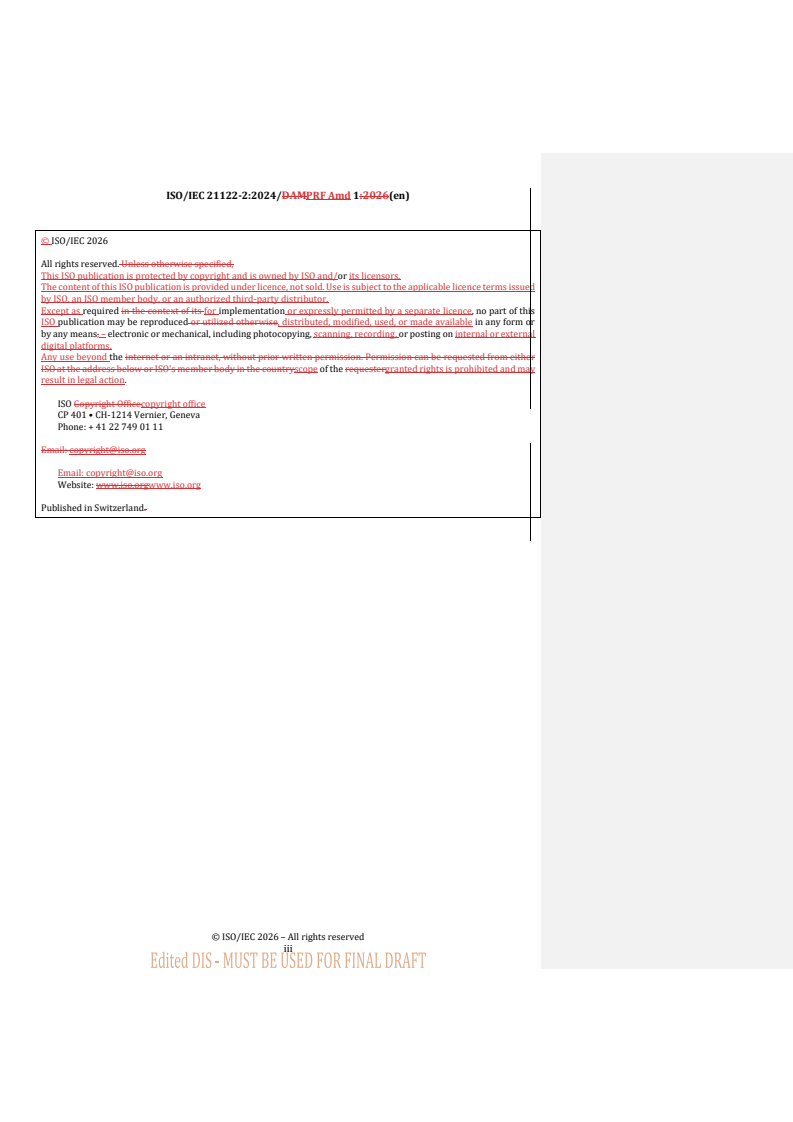
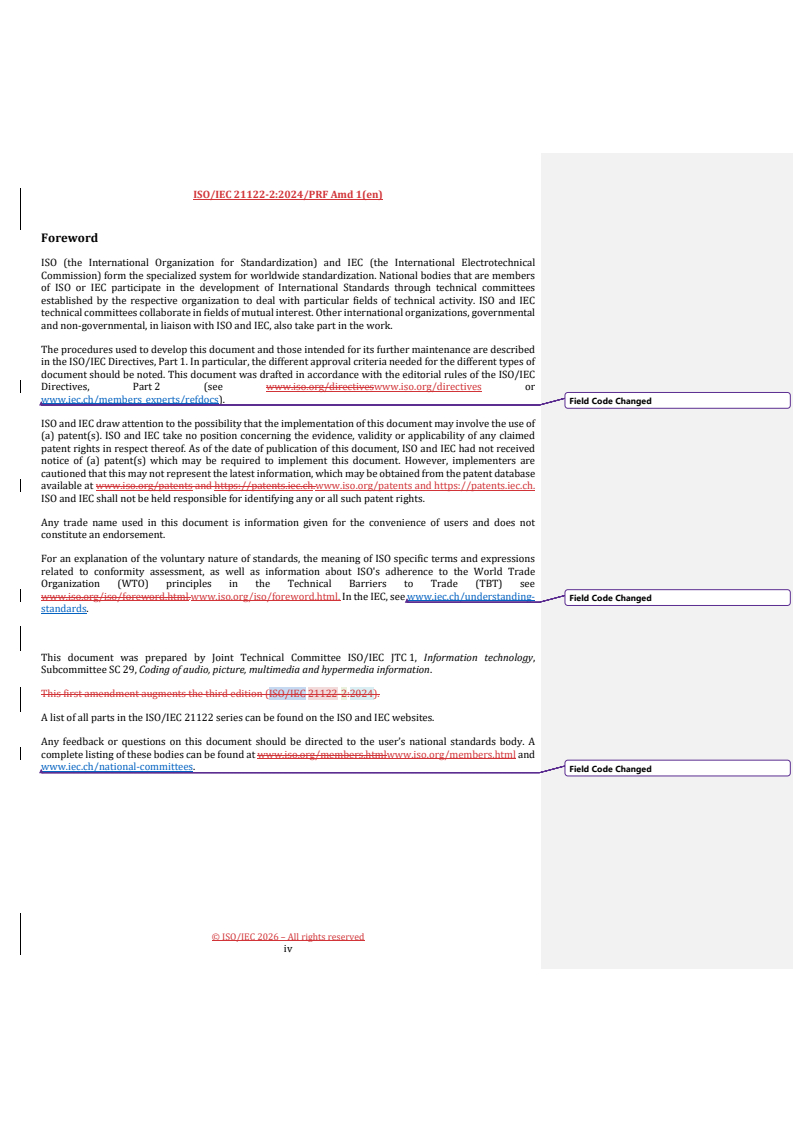
REDLINE ISO/IEC 21122-2:2024/PRF Amd 1 - Information technology — JPEG XS low-latency lightweight image coding system — Part 2: Profiles and buffer models — Amendment 1: Additional levels and sublevels
ISO/IEC 21122-2:2024/Amd 1 is an ISO amendment to the JPEG XS low-latency lightweight image coding system, Part 2: Profiles and buffer models. It adds additional levels and sublevels, updates how they are signalled in the codestream, and revises buffer-model details for implementers of JPEG XS encoders, decoders, and transcoding tools.
What does ISO/IEC 21122-2:2024/Amd 1 specify?
ISO/IEC 21122-2:2024/Amd 1 updates the profile and buffer-model part of JPEG XS by extending the level set, defining new sublevels, and adding FBB levels. It also revises the symbols and formula used in the buffer-model material.
The amendment is organized around Clause 5, Annex A, and Annex D. Annex A carries the updated tables for level, sublevel, and FBB level signalling, while Annex D updates a buffer-model formula.
| Clause / annex | What it covers |
|---|---|
| Clause 5 | New symbols used in the amended level and buffer-model text |
| A.3 | JPEG XS levels and their signalling in the P field |
| A.4 | JPEG XS sublevels and their signalling in the P field |
| A.5 | Guidance on transcoding, proxy levels, and buffer-model conformance |
| A.6 | JPEG XS FBB levels and their signalling in the P field |
| D.6 | Revised buffer-model formula |
What are the key requirements of ISO/IEC 21122-2:2024/Amd 1?
Clause 5 adds symbols for transmission latency, decoder smoothing-buffer sizing, and channel timing. In practice, these symbols support the amended buffer-model descriptions used to check whether a codestream fits a decoder.
Annex A.3 expands the level table in Table A.8 with additional JPEG XS levels and Bayer levels, together with example resolutions and maximum sample-count and sample-rate limits. The table also states that the level names have double names to match supported resolutions, and that for Bayer data each sampling grid point represents a super-pixel. This matters because implementers must map real image formats to the correct level, not just to pixel dimensions.
Level signalling in Table A.9 is updated. The P field carries the level value, and the table gives the bit patterns used for each level. For implementation, this is the codestream metadata that decoders inspect to identify the declared level.
Annex A.4 defines sublevels in Table A.10. The listed sublevels run from higher to lower nominal bpp values and are stated to arise when extracting the largest or second largest proxy level from an existing codestream to satisfy the buffer model. The amendment says these sublevels are intended for transcoding, not for encoding uncompressed source material.
Table A.11 updates sublevel signalling in the P field. This gives the bit patterns that identify each sublevel. That lets a transcoder or decoder distinguish a proxy-derived codestream from a full-source encode.
Annex A.5 adds guidance for transcoding. If the highest resolution level is removed, the resulting proxy-level codestream has half the width and half the height, rounded up. The note explains how to keep the new codestream conformant with the original buffer model: for one buffer-model type, the level can stay unchanged or be reduced with a corresponding increase in sublevel; for the other type, no simple rule is given because the buffer depends on subband rate distribution. The note also says a proxy level is not a constant bitrate stream and is signalled by setting the Lcod field of the picture header to 0.
Annex A.6 adds FBB levels. Tables A.18 and A.19 define the available FBB levels and their P-field signalling. This gives another layer of codestream classification for buffer-related handling.
Annex D.6 replaces Formula (D.20). In practice, this updates the mathematical bound used in the buffer-model section.
What terms does ISO/IEC 21122-2:2024/Amd 1 define?
- Level - A codestream class with a maximum sample count and sample rate, used to state what image sizes and rates a decoder can support.
- Sublevel - A finer codestream class, identified by nominal bpp values, used mainly when deriving proxy codestreams for transcoding.
- FBB level - A separate level classification listed in Annex A.6 with its own P-field signalling.
- P field - The codestream field used in Annex A tables to signal the level, sublevel, or FBB level.
- Proxy level - A level obtained by extracting the largest or second largest proxy level from an existing codestream.
- smoothing buffer - The decoder buffer used in the buffer model to check conformance.
- Tmbd - The buffer-model type named in the transcoding note, with different guidance for Tmbd=1 and Tmbd=2.
- Lcod field - The picture-header field used to signal whether a proxy level is a constant bitrate stream.
Who uses ISO/IEC 21122-2:2024/Amd 1?
ISO/IEC 21122-2:2024/Amd 1 is used by engineers and vendors building JPEG XS encoders, decoders, and transcoding systems. It is also relevant to system integrators and buyers who need to confirm which resolutions, sample rates, levels, sublevels, and buffer models a product supports.
The amendment matters most in products that declare conformance, parse the P field, or derive proxy codestreams from existing JPEG XS streams. It is also useful for quality and interoperability work, because the tables define how codestream declarations map to supported image classes.
What changed in ISO/IEC 21122-2:2024/Amd 1 from the previous edition?
ISO/IEC 21122-2:2024/Amd 1 augments the third edition, ISO/IEC 21122-2:2024. The amendment adds additional levels and sublevels, introduces FBB levels, updates P-field signalling tables, adds a transcoding note in Annex A.5, and replaces the buffer-model formula in Annex D.6.
What does the ISO/IEC 21122-2:2024/Amd 1 document contain?
ISO/IEC 21122-2:2024/Amd 1 contains revised tables for JPEG XS levels, sublevels, and FBB levels, plus the bit patterns used to signal them in the P field. It also contains explanatory notes on proxy-level transcoding and buffer-model conformance.
The amendment includes a revised symbol list in Clause 5 and a replaced formula in Annex D.6 for buffer-model calculations. For implementers, the main value is the codestream metadata and buffer-model detail needed for interoperability, conformance checking, and transcoding workflows.
Relations
- Effective Date
- 24-Jan-2026
Buy Documents
ISO/IEC 21122-2:2024/PRF Amd 1 - Information technology — JPEG XS low-latency lightweight image coding system — Part 2: Profiles and buffer models — Amendment 1: Additional levels and sublevels
REDLINE ISO/IEC 21122-2:2024/PRF Amd 1 - Information technology — JPEG XS low-latency lightweight image coding system — Part 2: Profiles and buffer models — Amendment 1: Additional levels and sublevels
Get Certified
Connect with accredited certification bodies for this standard

BSI Group
BSI (British Standards Institution) is the business standards company that helps organizations make excellence a habit.

NYCE
Mexican standards and certification body.
Sponsored listings
Frequently Asked Questions
ISO/IEC 21122-2:2024/Amd 1 is a draft published by the International Organization for Standardization (ISO). Its full title is "Information technology — JPEG XS low-latency lightweight image coding system — Part 2: Profiles and buffer models — Amendment 1: Additional levels and sublevels". This standard covers: Information technology — JPEG XS low-latency lightweight image coding system — Part 2: Profiles and buffer models — Amendment 1: Additional levels and sublevels
Information technology — JPEG XS low-latency lightweight image coding system — Part 2: Profiles and buffer models — Amendment 1: Additional levels and sublevels
ISO/IEC 21122-2:2024/Amd 1 is classified under the following ICS (International Classification for Standards) categories: 35.040.30 - Coding of graphical and photographical information. The ICS classification helps identify the subject area and facilitates finding related standards.
ISO/IEC 21122-2:2024/Amd 1 has the following relationships with other standards: It is inter standard links to ISO/IEC 21122-2:2024. Understanding these relationships helps ensure you are using the most current and applicable version of the standard.
ISO/IEC 21122-2:2024/Amd 1 is available in PDF format for immediate download after purchase. The document can be added to your cart and obtained through the secure checkout process. Digital delivery ensures instant access to the complete standard document.
Standards Content (Sample)
Contents
- Foreword
- 4.5 Fbblev3bpp
Foreword
ISO (the International Organization for Standardization) and IEC (the International Electrotechnical Commission) form the specialized system for worldwide standardization. National bodies that are members of ISO or IEC participate in the development of International Standards through technical committees established by the respective organization to deal with particular fields of technical activity. ISO and IEC technical committees collaborate in fields of mutual interest. Other international organizations, governmental and non-governmental, in liaison with ISO and IEC, also take part in the work. The procedures used to develop this document and those intended for its further maintenance are described in the ISO/IEC Directives, Part 1. In particular, the different approval criteria needed for the different types of document should be noted. This document was drafted in accordance with the editorial rules of the ISO/ IEC Directives, Part 2 (see www.iso.org/directives or www.iec.ch/members_experts/refdocs). ISO and IEC draw attention to the possibility that the implementation of this document may involve the use of (a) patent(s). ISO and IEC take no position concerning the evidence, validity or applicability of any claimed patent rights in respect thereof. As of the date of publication of this document, ISO and IEC had not received notice of (a) patent(s) which may be required to implement this document. However, implementers are cautioned that this may not represent the latest information, which may be obtained from the patent database available at www.iso.org/patents and https://patents.iec.ch. ISO and IEC shall not be held responsible for identifying any or all such patent rights.
Any trade name used in this document is information given for the convenience of users and does not constitute an endorsement.
For an explanation of the voluntary nature of standards, the meaning of ISO specific terms and expressions related to conformity assessment, as well as information about ISO's adherence to the World Trade Organization (WTO) principles in the Technical Barriers to Trade (TBT) see www.iso.org/iso/foreword.html. In the IEC, see www.iec.ch/understanding-standards.
This document was prepared by Joint Technical Committee ISO/IEC JTC 1, Information technology, Subcommittee SC 29, Coding of audio, picture, multimedia and hypermedia information. A list of all parts in the ISO/IEC 21122 series can be found on the ISO and IEC websites. Any feedback or questions on this document should be directed to the user’s national standards body. A complete listing of these bodies can be found at www.iso.org/members.html and www.iec.ch/national-committees.
PROOF/ÉPREUVE
ISO/IEC 21122-2/Amd. 1:2026(en) Information technology — JPEG XS low-latency lightweight image coding system — Part 2:
Profiles and buffer models AMENDMENT 1: Additional levels and sublevels
Clause 5 Remove the following symbol:
enc,max Add the following symbols:
upper bound for the transmission latency in lines, can be infinite ∆T max,lines cbr base size of the decoder smoothing buffer in bits, computed as NS×
sbusbu dec,max clock cycle in which the transmission channel writes the first bit of the considered codestream t channel,start into the decoding smoothing buffer
A.3.1, Table A.8 Replace Table A.8 with the following table:
Table A.8 — JPEG XS levels Maximum number Maximum grid Maximum Maximum of sampling grid point sample picture width image height points Example a rate Level W (sam- H (sammax max d L per image resolutions max R (sampling s,max pling grid pling grid (sampling grid b b b,c points) points) grid points/s) b points) 1k-1 1 280×720@60 1 280 5 120 2 621 440 83 558 400 2 048×1 080@60 Bayer2k-1 2 560×1 440@60 PROOF/ÉPREUVE
...
Contents
- Foreword
- 4.5 Fbblev3bpp
Foreword
ISO (the International Organization for Standardization) and IEC (the International Electrotechnical Commission) form the specialized system for worldwide standardization. National bodies that are members of ISO or IEC participate in the development of International Standards through technical committees established by the respective organization to deal with particular fields of technical activity. ISO and IEC technical committees collaborate in fields of mutual interest. Other international organizations, governmental and non-governmental, in liaison with ISO and IEC, also take part in the work. The procedures used to develop this document and those intended for its further maintenance are described in the ISO/IEC Directives, Part 1. In particular, the different approval criteria needed for the different types of document should be noted. This document was drafted in accordance with the editorial rules of the ISO/IEC Directives, Part 2 (see www.iso.org/directiveswww.iso.org/directives or www.iec.ch/members_experts/refdocs).
Field Code Changed ISO and IEC draw attention to the possibility that the implementation of this document may involve the use of (a) patent(s). ISO and IEC take no position concerning the evidence, validity or applicability of any claimed patent rights in respect thereof. As of the date of publication of this document, ISO and IEC had not received notice of (a) patent(s) which may be required to implement this document. However, implementers are cautioned that this may not represent the latest information, which may be obtained from the patent database available at www.iso.org/patents and https://patents.iec.ch.www.iso.org/patents and https://patents.iec.ch. ISO and IEC shall not be held responsible for identifying any or all such patent rights. Any trade name used in this document is information given for the convenience of users and does not constitute an endorsement.
For an explanation of the voluntary nature of standards, the meaning of ISO specific terms and expressions related to conformity assessment, as well as information about ISO's adherence to the World Trade Organization (WTO) principles in the Technical Barriers to Trade (TBT) see www.iso.org/iso/foreword.html.www.iso.org/iso/foreword.html. In the IEC, see www.iec.ch/understanding- Field Code Changed standards.
This document was prepared by Joint Technical Committee ISO/IEC JTC 1, Information technology, Subcommittee SC 29, Coding of audio, picture, multimedia and hypermedia information. This first amendment augments the third edition (ISO/IEC 21122-2:2024). A list of all parts in the ISO/IEC 21122 series can be found on the ISO and IEC websites. Any feedback or questions on this document should be directed to the user’s national standards body. A complete listing of these bodies can be found at www.iso.org/members.htmlwww.iso.org/members.html and www.iec.ch/national-committees.
Field Code Changed
ISO/IEC 21122-2:2024/DAM 1:2026(en) Information technology — - JPEG XS Lowlow-latency lightweight image coding system — — Part 2:
Profiles and buffer levels models AMENDMENT 1: Additional levels and sublevels
Clause 5 Remove the following symbol:
enc,max Add the following symbols:
upper bound for the transmission latency in lines, can be infinite ∆T max,lines cbr NS× l base size of the decoder smoothing buffer in bits, computed as dec,max sbu sbu the clock cycle in which the transmission channel writes the first bit of the considered t channel,start codestream into the decoding smoothing buffer
A.3.1, Table A.8 Replace Table A.8 with the following table:
Table A.8 — JPEG XS levels Maximum grid Maximum Maximum Maximum number of point sample picture rate image height sampling grid width Example points a H R Level s,max max d W resolutions max L per image (sampling max (sampling (sampling b grid points) (sampling grid grid b grid points) b bc points) points/s) 1k-1 1 280×720@60 1 280 5 120 2 621 440 83 558 400 2 048×1 080@60 Bayer2k-1 2 560×1 440@60
...