


ISO/DPAS 24874
(Main)Guidance on the use of smart contracts in contributing to the Sustainable Development Goals (SDGs)
General Information
- Abstract
- Status
- Not Published
- Technical Committee
- ISO/TC 307 - Blockchain and distributed ledger technologies
- Drafting Committee
- ISO/TC 307/WG 3 - Smart contracts and their applications
- Current Stage
- 5092 - FDIS referred back to TC or SC
- Start Date
- 26-Jun-2026
- Completion Date
- 11-Jul-2026
Buy Documents
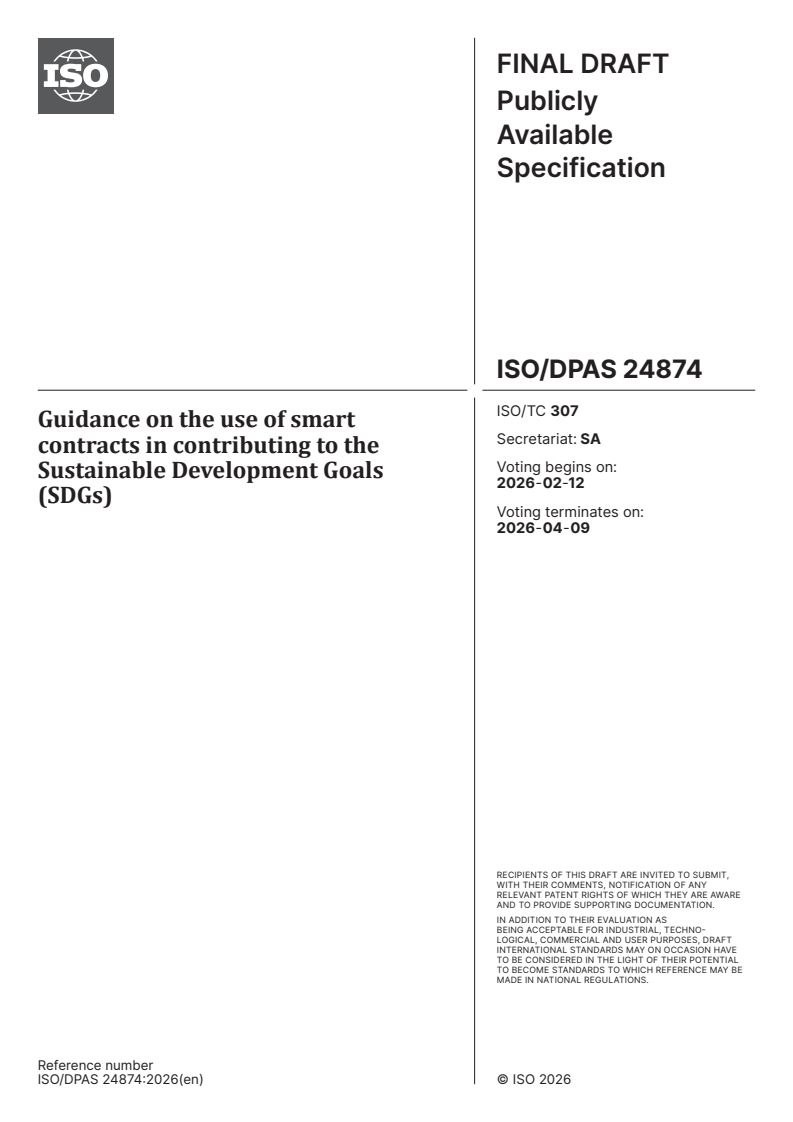
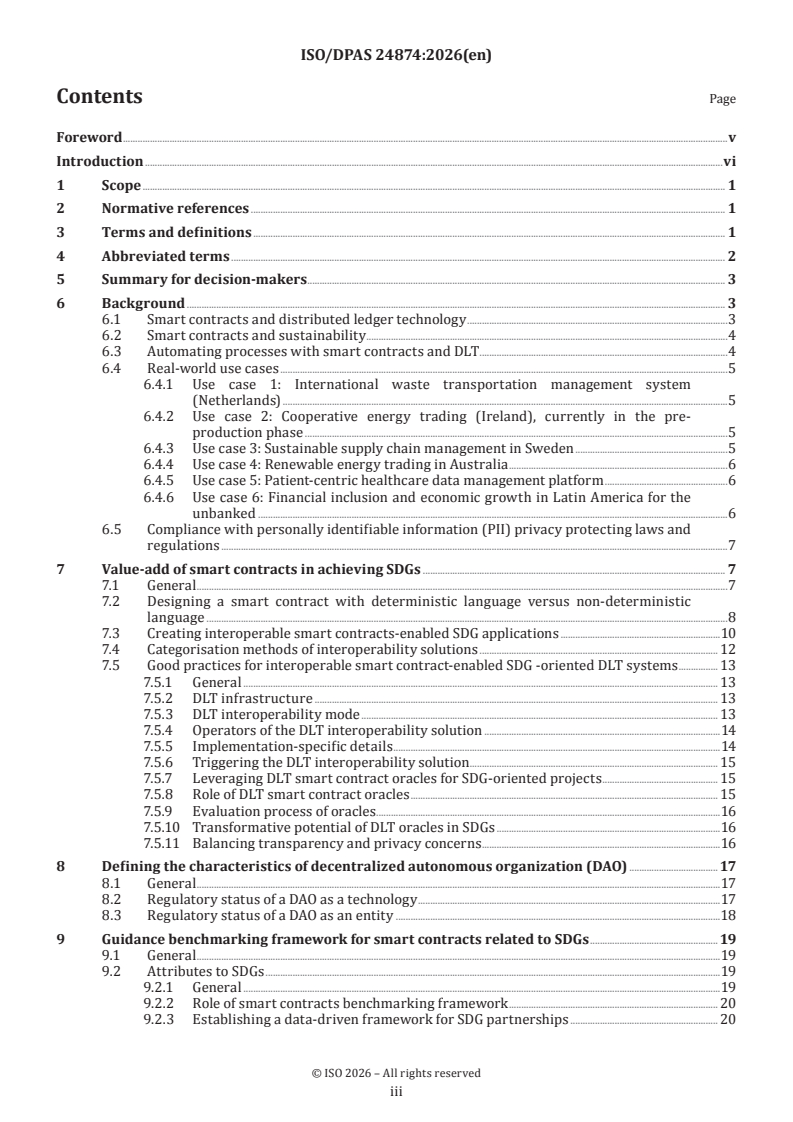
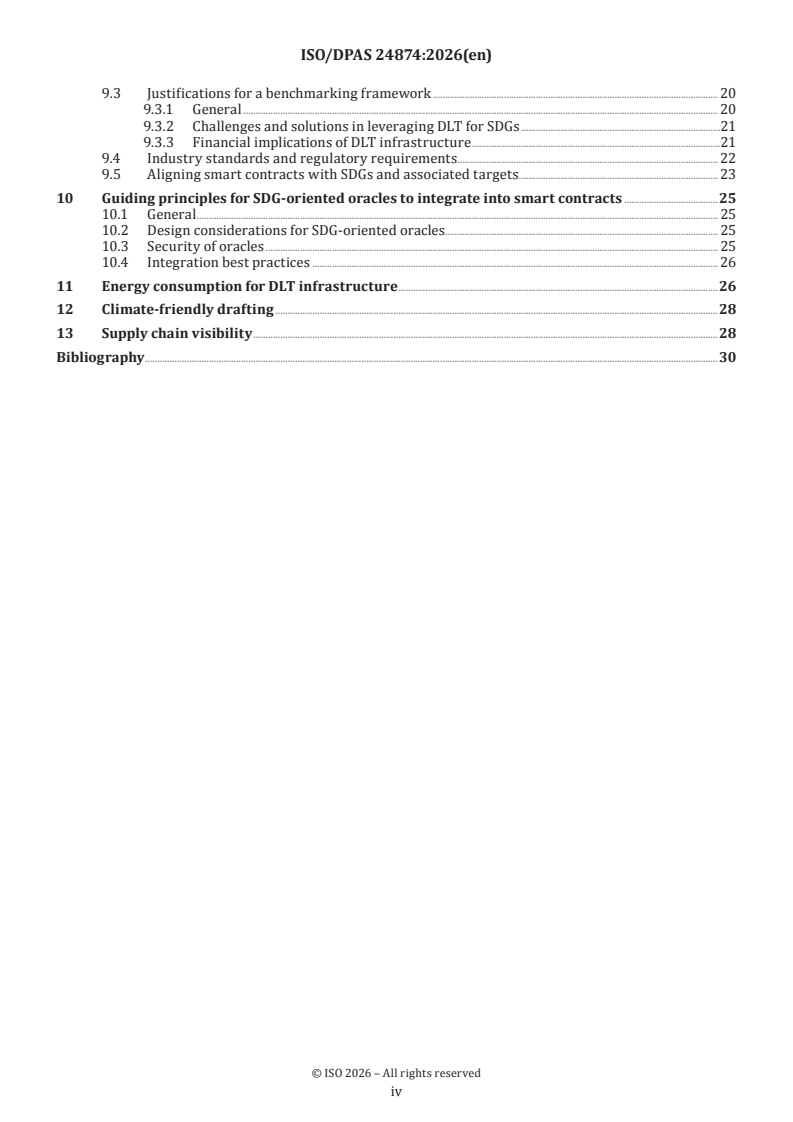
ISO/DPAS 24874 - Guidance on the use of smart contracts in contributing to the Sustainable Development Goals (SDGs) Released:29. 01. 2026
REDLINE ISO/DPAS 24874 - Guidance on the use of smart contracts in contributing to the Sustainable Development Goals (SDGs) Released:29. 01. 2026
Overview
ISO/DPAS 24874 provides comprehensive guidance on the use of smart contracts and distributed ledger technology (DLT) to contribute to the achievement of the United Nations Sustainable Development Goals (SDGs). Published by the International Organization for Standardization (ISO), this standard is designed to assist policymakers, regulators, technology developers, and stakeholders across industries in evaluating and implementing smart contracts for sustainable development. By promoting transparency, automation, and trust, the guidance aims to facilitate evidence-based decision-making and accelerate the adoption of blockchain-based solutions for sustainability.
Key Topics
ISO/DPAS 24874 covers essential considerations for leveraging smart contracts in pursuit of the SDGs:
- Smart Contracts and DLT: Explains how blockchain-based smart contracts automate agreements, increase transparency, and provide traceability within distributed networks.
- Integration with SDGs: Describes how automated, secure, and auditable contract execution can foster sustainable practices in areas such as supply chain management, renewable energy trading, and infrastructure.
- Guidance on Interoperability: Outlines the design of interoperable smart contract applications and good practices for implementation across different platforms and jurisdictions.
- Decentralized Autonomous Organizations (DAOs): Examines the regulatory status and operational frameworks for DAOs as technology-driven entities supporting SDG initiatives.
- Oracles and Data Integration: Addresses the role of DLT oracles in connecting smart contracts with external data sources, which is crucial for accurate measurement and validation of real-world SDG progress.
- Benchmarking and KPIs: Introduces key performance indicators (KPIs) and benchmarking frameworks to objectively measure the effectiveness of smart contract applications in SDG contexts.
- Energy Consumption and Climate Impact: Identifies best practices for minimizing energy usage of blockchain systems and ensuring environmentally friendly implementations.
Applications
The practical applications of ISO/DPAS 24874 span multiple sectors and can be tailored to support specific SDG targets:
- Sustainable Supply Chain Management: Automate verification of sourcing, ensure traceability, and comply with environmental standards using blockchain smart contracts.
- Renewable Energy Trading: Facilitate peer-to-peer trading of renewable energy and automate billing and compliance, increasing access to sustainable energy resources.
- Waste Management Systems: Streamline processes, reduce costs, and improve transparency in international waste transportation through automated permit management.
- Smart Infrastructure: Enable transparent and efficient operation of smart city infrastructure, from billing to resource allocation, while enhancing resilience and sustainability.
- Compliance and Reporting: Automate data capture and reporting of sustainability metrics using oracles, supporting audit readiness and regulatory compliance.
- Collaborative Innovation: Support decentralized, multi-stakeholder projects where interoperability and trust are critical, such as global partnerships for the SDGs.
Related Standards
For a holistic approach to smart contracts, DLT, and sustainable development, ISO/DPAS 24874 references or complements the following standards:
- ISO 22739: Terminology related to blockchain and DLT.
- ISO/IEC 20924: Internet of Things (IoT) vocabulary.
- ISO/IEC 29100: Privacy framework and personally identifiable information (PII).
- ISO/DIS 22400-2: Key performance indicators for enterprise operations.
- ISO/TC 307: Technical committee for blockchain and distributed ledger technologies.
Practical Value
Implementing the guidance from ISO/DPAS 24874 enables organizations to:
- Make informed decisions about integrating smart contracts into SDG-oriented initiatives.
- Promote transparency and accountability across sustainability projects.
- Benchmark smart contract solutions using standardized KPIs and best practices.
- Navigate regulatory challenges and foster trust among stakeholders and regulators.
- Accelerate digital transformation for sustainability by aligning technology adoption with SDG targets.
By adhering to this ISO standard, organizations and governments can ensure robust, secure, and sustainable use of blockchain technology, effectively contributing to the global effort of achieving the SDGs.
Buy Documents
ISO/DPAS 24874 - Guidance on the use of smart contracts in contributing to the Sustainable Development Goals (SDGs) Released:29. 01. 2026
REDLINE ISO/DPAS 24874 - Guidance on the use of smart contracts in contributing to the Sustainable Development Goals (SDGs) Released:29. 01. 2026
Get Certified
Connect with accredited certification bodies for this standard

BSI Group
BSI (British Standards Institution) is the business standards company that helps organizations make excellence a habit.

Bureau Veritas
Bureau Veritas is a world leader in laboratory testing, inspection and certification services.

DNV
DNV is an independent assurance and risk management provider.
Sponsored listings
Frequently Asked Questions
ISO/DPAS 24874 is a draft published by the International Organization for Standardization (ISO). Its full title is "Guidance on the use of smart contracts in contributing to the Sustainable Development Goals (SDGs)". This standard covers: Guidance on the use of smart contracts in contributing to the Sustainable Development Goals (SDGs)
Guidance on the use of smart contracts in contributing to the Sustainable Development Goals (SDGs)
ISO/DPAS 24874 is classified under the following ICS (International Classification for Standards) categories: 13.020.20 - Environmental economics. Sustainability; 35.240.99 - IT applications in other fields. The ICS classification helps identify the subject area and facilitates finding related standards.
ISO/DPAS 24874 is available in PDF format for immediate download after purchase. The document can be added to your cart and obtained through the secure checkout process. Digital delivery ensures instant access to the complete standard document.
Standards Content (Sample)
FINAL DRAFT
Publicly
Available
Specification
ISO/TC 307
Guidance on the use of smart
Secretariat: SA
contracts in contributing to the
Voting begins on:
Sustainable Development Goals
2026-02-12
(SDGs)
Voting terminates on:
2026-04-09
RECIPIENTS OF THIS DRAFT ARE INVITED TO SUBMIT,
WITH THEIR COMMENTS, NOTIFICATION OF ANY
RELEVANT PATENT RIGHTS OF WHICH THEY ARE AWARE
AND TO PROVIDE SUPPOR TING DOCUMENTATION.
IN ADDITION TO THEIR EVALUATION AS
BEING ACCEPTABLE FOR INDUSTRIAL, TECHNO
LOGICAL, COMMERCIAL AND USER PURPOSES, DRAFT
INTERNATIONAL STANDARDS MAY ON OCCASION HAVE
TO BE CONSIDERED IN THE LIGHT OF THEIR POTENTIAL
TO BECOME STAN DARDS TO WHICH REFERENCE MAY BE
MADE IN NATIONAL REGULATIONS.
Reference number
FINAL DRAFT
Publicly
Available
Specification
ISO/TC 307
Guidance on the use of smart
Secretariat: SA
contracts in contributing to the
Voting begins on:
Sustainable Development Goals
(SDGs)
Voting terminates on:
RECIPIENTS OF THIS DRAFT ARE INVITED TO SUBMIT,
WITH THEIR COMMENTS, NOTIFICATION OF ANY
RELEVANT PATENT RIGHTS OF WHICH THEY ARE AWARE
AND TO PROVIDE SUPPOR TING DOCUMENTATION.
© ISO 2026
IN ADDITION TO THEIR EVALUATION AS
All rights reserved. Unless otherwise specified, or required in the context of its implementation, no part of this publication may
BEING ACCEPTABLE FOR INDUSTRIAL, TECHNO
LOGICAL, COMMERCIAL AND USER PURPOSES, DRAFT
be reproduced or utilized otherwise in any form or by any means, electronic or mechanical, including photocopying, or posting on
INTERNATIONAL STANDARDS MAY ON OCCASION HAVE
the internet or an intranet, without prior written permission. Permission can be requested from either ISO at the address below
TO BE CONSIDERED IN THE LIGHT OF THEIR POTENTIAL
or ISO’s member body in the country of the requester.
TO BECOME STAN DARDS TO WHICH REFERENCE MAY BE
MADE IN NATIONAL REGULATIONS.
ISO copyright office
CP 401 • Ch. de Blandonnet 8
CH-1214 Vernier, Geneva
Phone: +41 22 749 01 11
Email: copyright@iso.org
Website: www.iso.org
Published in Switzerland Reference number
ii
Contents Page
Foreword .v
Introduction .vi
1 Scope . 1
2 Normative references . 1
3 Terms and definitions . 1
4 Abbreviated terms . 2
5 Summary for decision-makers . 3
6 Background . 3
6.1 Smart contracts and distributed ledger technology .3
6.2 Smart contracts and sustainability . .4
6.3 Automating processes with smart contracts and DLT .4
6.4 Real-world use cases .5
6.4.1 Use case 1: International waste transportation management system
(Netherlands) .5
6.4.2 Use case 2: Cooperative energy trading (Ireland), currently in the pre-
production phase .5
6.4.3 Use case 3: Sustainable supply chain management in Sweden .5
6.4.4 Use case 4: Renewable energy trading in Australia .6
6.4.5 Use case 5: Patient-centric healthcare data management platform .6
6.4.6 Use case 6: Financial inclusion and economic growth in Latin America for the
unbanked .6
6.5 Compliance with personally identifiable information (PII) privacy protecting laws and
regulations .7
7 Value-add of smart contracts in achieving SDGs . 7
7.1 General .7
7.2 Designing a smart contract with deterministic language versus non-deterministic
language .8
7.3 Creating interoperable smart contracts-enabled SDG applications .10
7.4 Categorisation methods of interoperability solutions . 12
7.5 Good practices for interoperable smart contract-enabled SDG -oriented DLT systems . 13
7.5.1 General . 13
7.5.2 DLT infrastructure . 13
7.5.3 DLT interoperability mode . 13
7.5.4 Operators of the DLT interoperability solution .14
7.5.5 Implementation-specific details .14
7.5.6 Triggering the DLT interoperability solution. 15
7.5.7 Leveraging DLT smart contract oracles for SDG-oriented projects . 15
7.5.8 Role of DLT smart contract oracles . 15
7.5.9 Evaluation process of oracles .16
7.5.10 Transformative potential of DLT oracles in SDGs .16
7.5.11 Balancing transparency and privacy concerns .16
8 Defining the characteristics of decentralized autonomous organization (DAO) . 17
8.1 General .17
8.2 Regulatory status of a DAO as a technology .17
8.3 Regulatory status of a DAO as an entity .18
9 Guidance benchmarking framework for smart contracts related to SDGs . 19
9.1 General .19
9.2 Attributes to SDGs .19
9.2.1 General .19
9.2.2 Role of smart contracts benchmarking framework . 20
9.2.3 Establishing a data-driven framework for SDG partnerships . 20
iii
9.3 Justifications for a benchmarking framework . 20
9.3.1 General . 20
9.3.2 Challenges and solutions in leveraging DLT for SDGs .21
9.3.3 Financial implications of DLT infrastructure .21
9.4 Industry standards and regulatory requirements . 22
9.5 Aligning smart contracts with SDGs and associated targets . 23
10 Guiding principles for SDG-oriented oracles to integrate into smart contracts .25
10.1 General . 25
10.2 Design considerations for SDG-oriented oracles. 25
10.3 Security of oracles . 25
10.4 Integration best practices . 26
11 Energy consumption for DLT infrastructure .26
12 Climate-friendly drafting .28
13 Supply chain visibility .28
Bibliography .30
iv
Foreword
ISO (the International Organization for Standardization) is a worldwide federation of national standards
bodies (ISO member bodies). The work of preparing International Standards is normally carried out through
ISO technical committees. Each member body interested in a subject for which a technical committee
has been established has the right to be represented on that committee. International organizations,
governmental and non-governmental, in liaison with ISO, also take part in the work. ISO collaborates closely
with the International Electrotechnical Commission (IEC) on all matters of electrotechnical standardization.
The procedures used to develop this document and those intended for its further maintenance are described
in the ISO/IEC Directives, Part 1. In particular, the different approval criteria needed for the different types
of ISO documents should be noted. This document was drafted in accordance with the editorial rules of the
ISO/IEC Directives, Part 2 (see www.iso.org/directives).
ISO draws attention to the possibility that the implementation of this document may involve the use of (a)
patent(s). ISO takes no position concerning the evidence, validity or applicability of any claimed patent
rights in respect thereof. As of the date of publication of this document, ISO had not received notice of (a)
patent(s) which may be expected to implement this document. However, implementers are cautioned that
this may not represent the latest information, which may be obtained from the patent database available at
www.iso.org/patents. ISO is not responsible for identifying any or all such patent rights.
Any trade name used in this document is information given for the convenience of users and does not
constitute an endorsement.
For an explanation of the voluntary nature of standards, the meaning of ISO specific terms and expressions
related to conformity assessment, as well as information about ISO's adherence to the World Trade
Organization (WTO) principles in the Technical Barriers to Trade (TBT), see www.iso.org/iso/foreword.html.
This document was prepared by Technical Committee, ISO/TC 307, Blockchain and distributed ledger
technologies.
Any feedback or questions on this document should be directed to the user’s national standards body. A
complete listing of these bodies can be found at www.iso.org/members.html.
v
Introduction
Smart contracts, when implemented through distributed ledger technology (DLT) such as blockchain,
have the potential to transform approaches to global challenges and facilitate collective progress toward
achieving the United Nations Sustainable Development Goals (SDGs). These smart contracts automate the
execution of contractual actions based on the fulfilment of the contractual conditions and criteria that
are agreed upon and enforced by the participating bodies. Participating bodies and agents can keep their
ownership and monitor the progress of actions within DLTs. This enhances transparency, efficiency and trust
in various processes, which ultimately contributes to the advancement of the SDGs. For smart contracts to
gain intuition about the real-world accomplishments of contractual criteria, DLT oracles are used as external
data sources. These DLT oracles are indispensable conduits that sense, track and observe events, processes
and actions in the interest of the smart contracts. They facilitate the seamless integration of existing data
sources, legacy systems and sophisticated computations into the decentralized ecosystem. In the context of
the SDGs, the transformative potential of DLT oracles is profound, as they facilitate the seamless transfer of
crucial data pertaining to various SDG-oriented metrics. In essence, the deployment of DLT smart contract
oracles within the SDG domain epitomizes a paradigm shift towards data-driven sustainability actions. The
holistic DLT framework injected with the smart contract and their oracles enables the DLT agents, acting
behind numerous SDGs, to work collaboratively and autonomously without the central point of monitoring
and processing.
In 2015, the United Nations member states adopted the 2030 Agenda for Sustainable Development,
introducing 17 SDGs as a comprehensive blueprint for global peace and prosperity. These goals demand
urgent collective actions from all nations in a global partnership. The SDGs are characterized by their holistic
and interconnected nature, universality, integration across sectors, ambitious targets and reliance on data-
driven decision-making. They align closely with ISO standards, which emphasize quality, sustainability,
accountability, and the integration of management systems. The emergence of DLT and related innovations
presents both opportunities and challenges for achieving the SDGs, necessitating alignment with ISO
standards and regulatory frameworks to harness their potential effectively. Given the need to validate the
improvements in real-world objectives/goals set by SDGs, autonomously and effectively across multiple
distributed parties, the smart contracts with oracles on DLTs play a crucial role.
vi
FINAL DRAFT Publicly Available Specification ISO/DPAS 24874:2026(en)
Guidance on the use of smart contracts in contributing to the
Sustainable Development Goals (SDGs)
1 Scope
This document provides comprehensive guidance on the use of smart contracts in contributing to the United
Nations Sustainable Development Goals (SDGs). Smart contracts and distributed ledger technology (DLT)
can transform sustainability efforts and drive revenue growth. It can be useful to develop guidance in the
context of smart contract-based sustainable supply chain management and renewable energy trading.
The guidance includes key performance indicators (KPIs) for evaluating smart contract applications across
various sectors, ensuring alignment with SDG targets. It is designed to assist policymakers, regulators,
industry stakeholders and technology developers in making evidence-based decisions regarding blockchain
adoption for sustainability. The document covers the integration of smart contracts with DLT, the design
of interoperable smart contract-enabled SDG applications and good practices for implementing these
technologies. Additionally, it addresses the regulatory status of decentralized autonomous organizations
(DAOs) and provides a guidance benchmarking framework for smart contracts related to SDGs. The
document aims to promote transparency, efficiency and trust in processes, ultimately contributing to the
advancement of the SDGs through innovative DLT solutions.
2 Normative references
There are no normative references in this document.
3 Terms and definitions
For the purposes of this document, the following terms and definitions apply.
ISO and IEC maintain terminology databases for use in standardization at the following addresses:
— IEC Electropedia: available at http:// www .electropedia .org/
— ISO Online browsing platform: available at http:// www .iso .org/ obp
3.1
blockchain
distributed ledger consisting of a growing list of records (blocks), which are securely linked together using
cryptographic techniques
[1]
Note 1 to entry: See also the definition of "blockchain" given in ISO 22739:2024 , 3.6.
3.2
smart contract
computer program stored in a DLT system wherein the outcome of any execution of the program is recorded
on the distributed ledger
Note 1 to entry: A smart contract can represent terms in a contract in law and create a legally enforceable obligation
under the legislation of an applicable jurisdiction.
[1]
[SOURCE: [ISO 22739:2024 , 3.88]]
3.3
oracle
mechanism or service that provides external data to a blockchain or distributed ledger system
[1]
Note 1 to entry: See also definition of "distributed ledger technology oracle" in ISO 22739:2024 , 3.32.
3.4
internet of things
IoT
network of entities that are capable of interacting with each other and with their environment to achieve
common goals via the exchange of data and control signals
[2]
Note 1 to entry: See also the definition of IOT in ISO/IEC 20924:2024 , 3.2.8.
3.5
personally identifiable information
PII
information that can be used to identify the PII principal, either directly or indirectly
Note 1 to entry: The PII principle is the individual to whom the information relates.
[3]
Note 2 to entry: See ISO/IEC 29100:2024 , 3.7 for another definition of PII.
3.6
decentralized autonomous organization
DAO
blockchain-based organizations fed by a peer-to-peer network of contributors
Note 1 to entry: The management of DAOs is decentralized without top executive teams. It is built on automated rules
encoded in smart contracts governance that works autonomously based on a combination of on-chain and off-chain
[4]
mechanisms that support community decision-making. See Reference for more information.
3.7
key performance indicator
KPI
quantifiable and strategic measurements that reflect an enterprise's critical success factors
[5]
Note 1 to entry: See ISO/DIS 22400-2 for more information on KPIs.
3.8
Sustainable Development Goals
SDGs
set of goals that recognize the need for ending poverty, building economic growth and addressing a range
of social needs including education, health, social protection and job opportunities, while tackling climate
change and environmental protection
[6]
Note 1 to entry: See Reference for more information about the SDGs.
4 Abbreviated terms
A list of common abbreviations used in this document:
DLT distributed ledger technology
SDGs sustainable development goals
P2P peer-to-peer
DAO decentralized autonomous organization
KPI key performance indicator
W3C World Wide Web Consortium
5 Summary for decision-makers
DLT and specifically smart contracts can help achieve the SDGs by improving automation, security and
transparency in sustainability-oriented transactions. However, without standardized benchmarking
criteria, their adoption remains fragmented, raising concerns over security, compliance and efficiency.
This document provides structured guidance for evaluating smart contract performance in SDG-aligned
applications, enabling evidence-based decision-making for policymakers, regulators, and industry leaders.
Key takeaways for decision-makers include:
a) Need for standardization: Smart contracts align with global regulatory, security and interoperability
standards to ensure widespread adoption.
b) Performance metrics: Establishing KPIs that measure scalability, cost efficiency and security and have
an impact on SDG implementation.
c) Transparency and trust: Ensuring smart contracts operate with clear governance, auditable execution
and secure data integration.
d) Scalability and adoption challenges: Addressing infrastructure, interoperability and energy
consumption concerns to make blockchain solutions viable for large-scale SDG initiatives.
e) Policy implications: Governments and regulatory bodies create enabling environments for blockchain
innovation while mitigating risks associated with fraud, data privacy and security.
By implementing this benchmarking guidance, stakeholders can better assess the contribution of blockchain-
based smart contracts to achieving the SDGs and make informed policy and investment decisions.
6 Background
6.1 Smart contracts and distributed ledger technology
Smart contracts represent the terms of an agreement between two or more parties and are smart enough to
process those terms to arrive at a contractual outcome. Given that the terms are encoded within a computer
program and executed automatically once pre-defined criteria are met, smart contracts offer enhanced
transparency and provenance within DLT systems. However, the complexity of smart contract code can
make its operation difficult for some stakeholders to fully comprehend. Additionally, smart contracts can be
obfuscated and do not necessarily adhere to the legal standards of all jurisdictions. Their recognition as legal
contracts varies depending on local regulatory frameworks. In some jurisdictions, these smart contracts are
[7]
treated as legal contracts . It is possible to use smart contracts to represent terms in a contract in law and
create legally enforceable agreements or contracts under certain legislations.
Smart contracts implemented within a DLT framework are essentially computer scripts that enable
autonomous operations. They serve as an automated mechanism for executing coded decisions, business
logic and the exchange of promises, duties, obligations and rights. In open crypto-economic systems, they
also cover contractual commitments related to fungible and non-fungible assets, economic or financial
[8]
exposure, and traditional securities, while adhering to legal standards across various jurisdictions . These
scripts often include conditional statements to execute different actions based on specific conditions. They
serve as automated pathways for executing code values, business logic and the exchange of commitments
like non-fungible assets, financial obligations and traditional securities while potentially complying with
[9]
legal regulations in certain jurisdictions . By leveraging cryptographic methods and the decentralized
nature of DLT networks, smart contracts enhance security and provide evidence of tampering. When
integrated into DLTs, the terms and their compounding agreements become immutable. This makes the
processing of contractual criteria based on the in-flow of term values more secure and trustworthy. After
processing the contracts, storing their outcomes within the DLTs makes it all manageable within the DLTs,
making them autonomous agents for executing smart contracts. Their key features include automation,
decentralisation, immutability, transparency, efficiency, conditional execution, cost-effectiveness, security
and programmability, which form the foundation of their operation. They automate certain features such
as executing code values, business logic and the exchange of commitments related to various assets and
financial instruments executing business logic and facilitating asset exchanges. Moreover, when legal
contractual terms are coded into smart contracts, this establishes enforceable obligations within certain
legal jurisdictions. However, the legal acceptance of smart contracts across the wider community of
legislation still faces challenges whilst it is thriving through these innovative smart contract DLT platforms.
The necessity of an intermediary to execute and control the smart contract is obviated by its integration
into a DLT. In DLTs, the encrypted transaction records are disseminated across participants, safeguarding
against unauthorised alterations through consensus mechanisms. Furthermore, the encryption of DLT
transaction records confers resistance against hacking, barring compromise of the entire network. Each
transaction record within a distributed ledger is interlinked with preceding and succeeding records
via cryptographically encoded key digest (signature) of the record itself, mandating the alteration of the
entire chain to manipulate a single record. These attributes form a hard-to-break layer of trust within the
distributed computing agents in a blockchain and streamline the transaction processes over its centralised
contract processing counterparts. This in turn mitigates the time delays and associated fees in centralised
systems thereby obviating the need for intermediaries.
Smart contracts can be integrated into DLTs to form decentralised autonomous agents/organisations
(DAOs). They can make programmable frameworks to create, manage, execute and terminate the DAOs by
enforcing contractual terms more consistently, openly, autonomously and uniformly without interference
from subjective third-parties. Keeping the programmed/coded smart contract scripts within the DLT and
its autonomous execution based on triggers driven by reliable input channels enables the universality of
contracts across different jurisdictions. The provenance and immutability of smart contract records in DLTs
makes the contracts more reliable, trustworthy and auditable. Within a DLT ecosystem, data undergoes
processing by adhering to a shared and chained protocol, ensuring network transparency and immutability.
This transparency, coupled with the open-source nature of some DLTs (e.g. public blockchains), renders the
external verification of system outputs more trustworthy and ensures that they are executed in accordance
with defined rules. Smart contracts deployed on distributed ledgers serve as potent instruments for
validating data and instituting automated logic for incentivising legitimate conduct or penalising misconduct
within on-chain interactions.
DLT imposes constraints on recording new data that conflicts with existing records or fails to conform
to specified parameters or input protocols. Transparent validation rules integral to DLT serve as filters
ensuring the consistency of data uploaded to distributed ledgers, underscoring the paramount importance
of validation in the DLT environment facilitated by smart contracts operating in open execution mode.
6.2 Smart contracts and sustainability
Since the smart contracts on DLTs help enable a self-sustainable digital ecosystem for contract management,
monitoring and execution via distributed autonomous agents, it is expected for the digitalisation of
the execution of the work programmes towards the UN Sustainable Development Goals (SDGs) with
disintermediated decision-making and processing. As autonomous monitoring, processing and execution
are strong drivers to build trust in any SDG-oriented projects, the smart contracts on DLTs leverage its
strengths and provide due scalability over largely distributed solution spaces.
[10] [11] [12] [13] [14]
Smart contracts and DLT have the potential to revolutionise various industries , including
sustainable supply chain management, green deals, sustainable infrastructure, policy developments and
renewable energy trading. By leveraging these technologies, organisations can automate processes related
to sourcing, monitoring, decision-making and payments, and thereby support the achievement of the UN
SDGs while enabling new sustainable business models.
6.3 Automating processes with smart contracts and DLT
Smart contracts are computer programs stored in DLTs enabling self-executing ability. They include terms
of agreements directly written into the code and define the processing, managing and termination of the
contracts within its lifecycle. They can also integrate the terms/codes defined external to the contract via
certain communication channels (e.g. oracles). When integrated into a DLT platform, smart contracts can
automate and enforce the execution of agreements between parties, eliminating the need for intermediaries
and reducing the risk of fraud or errors. In the context of sustainable supply chain management, smart
contracts can be used to automate processes such as verifying the origin of raw materials, tracking products
throughout the supply chain and ensuring conformance with sustainability standards.
Similarly, in renewable energy trading, Smart Contracts can facilitate peer-to-peer (P2P) energy trading
among producers and consumers. These contracts can automatically execute transactions based on pre-
defined conditions, such as energy prices or environmental factors, enabling more efficient and transparent
energy markets. In sustainable infrastructure projects such as smart cities, smart transport and smart
buildings, blockchains can enable many features such as P2P transactions and autonomous monitoring,
[15]
billing and notifications for distributed assets, systems, and stakeholders (see ISO 22739 for definitions
of these terms). By leveraging DLT, all transactions are recorded on a tamper-proof ledger, providing
transparency and traceability while reducing the risk of double-spending or fraud.
6.4 Real-world use cases
6.4.1 Use case 1: International waste transportation management system (Netherlands)
This project is currently in the implementation phase of a pilot involving 1 000 transports of non-hazardous
waste products between Belgium and the Netherlands. The objective is to demonstrate the efficiency and
transparency benefits of DLT by reducing supervision costs related to European waste transportation.
It is designed to use smart contracts to streamline permit processes and automate the execution of
predefined conditions and actions when specific criteria are met. DLT oracles are used to move external
[16]
internet of things (IoT) data regarding the weight of the waste onto the blockchain . By improving
waste management efficiency and reducing regulatory bottlenecks, this initiative directly supports
9.5.13 by promoting sustainable waste management and resource efficiency. Furthermore, the increased
transparency and automation of regulatory compliance contribute to 9.5.10 by fostering sustainable and
resilient infrastructure for waste management and transport. Additionally, by reducing unnecessary
administrative burdens and ensuring compliance with environmental regulations, the initiative indirectly
advances 9.5.14: as optimised waste transportation processes contribute to lower emissions and improved
environmental stability.
6.4.2 Use case 2: Cooperative energy trading (Ireland), currently in the pre-production phase
The CENTS platform aims to create and demonstrate a cooperative P2P energy trading technology that
complements the current electricity market structure. It brings together research and industry partners
in Ireland and focuses on enabling prosumers to engage in the trading of surplus renewable energy while
enhancing building performance. Smart contracts are employed to automate and enforce the terms of
energy trading agreements between prosumers and wind and solar farms ensuring secure and seamless
transactions. DLT oracles are used to move external smart meter data onto the DLT network. The goal is
to ensure that the terms and conditions are incorporated and aligned with established legal frameworks
and that the technical functionalities of smart contracts meet the legal requirements to create and execute
[17]
legally binding agreements . By promoting decentralised renewable energy trading and empowering
communities to participate in sustainable energy markets, this initiative directly supports 9.5.8 by
increasing access to renewable energy solutions. Additionally, by leveraging digital infrastructure to enhance
energy efficiency and optimise resource distribution, the project aligns with 9.5.10 by fostering resilient
and sustainable energy networks. Furthermore, by reducing reliance on centralised energy providers and
lowering carbon emissions through optimised renewable energy utilisation, the initiative contributes to
9.5.14 by supporting efforts to mitigate climate change.
6.4.3 Use case 3: Sustainable supply chain management in Sweden
Swedish furniture company utilises smart contracts and DLT to track the origin of wood used in its products.
By storing information about each batch of wood on a blockchain, the company ensures that only sustainably
sourced materials are used in its manufacturing process. This transparency not only satisfies consumer
demand for eco-friendly products but also helps the company comply with regulations and certifications
[18] [19]
related to sustainable forestry practices (see ISO/TR 6277 and ISO/TR 3242 ). By providing verifiable
proof of sustainable sourcing, the initiative meets growing consumer demand for eco-friendly products
while also ensuring compliance with environmental regulations and sustainability certifications. This effort
directly supports 9.5.13 by promoting sustainable resource management and ensuring that production
processes minimise environmental impact. Furthermore, by preventing deforestation and encouraging
responsible forestry, the initiative aligns with 9.5.16 which focuses on protecting, restoring and promoting
sustainable use of terrestrial ecosystems. Additionally, by fostering greater corporate responsibility
and supply chain accountability, the project contributes to 9.5.10 by driving innovation in sustainable
manufacturing and supply chain transparency.
6.4.4 Use case 4: Renewable energy trading in Australia
In Australia, a community-led initiative uses smart contracts to facilitate P2P trading of solar energy among
residents. Homeowners with solar panels can sell excess energy to their neighbours through an automated
system based on smart contracts deployed on a DLT platform. This initiative promotes the adoption of
renewable energy sources, reduces reliance on traditional energy grids and empowers individuals to
[18] [19]
participate in the transition to more sustainable energy (see ISO/TR 6277 and ISO/TR 3242 ). By
promoting the adoption of renewable energy sources and empowering individuals to take an active role in
energy markets, this initiative directly supports 9.5.8 through expanding access to clean and renewable
energy solutions. Additionally, by reducing strain on conventional energy infrastructure and enhancing
energy efficiency, it aligns with 9.5.10 by contributing to the development of resilient and sustainable energy
networks. Furthermore, by decreasing dependency on fossil fuels and lowering carbon emissions, this
project advances 9.5.14 by reinforcing global efforts to mitigate climate change and support environmental
sustainability.
6.4.5 Use case 5: Patient-centric healthcare data management platform
This is a healthcare service project focusing on SDG 3: Good Health and Well-Being. Through the app, patients
gain full access to their medical records, promoting autonomy and informed decision-making. The platform
enables secure sharing of anonymised health data for research, fostering collaboration between individuals
and researchers while addressing healthcare disparities. Using Web3 technologies such as smart contracts
and token-based rewards, the application ensures the security and transparency of health data while
maintaining privacy. Its decentralised nature strengthens patient-provider connections and enhances clinical
trial recruitment, contributing to better health outcomes and equitable healthcare access (see ISO/TR 6277
[18] [19]
and ISO/TR 3242 ). By enabling more efficient clinical trial recruitment and strengthening patient-
provider relationships, this initiative directly supports 9.5.4 through improving healthcare accessibility,
patient engagement and data-driven medical research. Additionally, by ensuring secure and equitable health
data management through decentralised infrastructure, it aligns with 9.5.10 promoting innovation in digital
healthcare solutions. Furthermore, by prioritising privacy and data protection, the platform contributes to
9.5.17 reinforcing ethical and secure data governance in the healthcare sector.
6.4.6 Use case 6: Financial inclusion and economic growth in Latin America for the unbanked
This project is a blockchain platform that addresses financial inclusion and literacy, aligning with SDG 8:
Decent Work and Economic Growth. Its self-custodial, multi-chain crypto wallet empowers underserved
populations in Latin America to manage finances securely and transparently. These smart contracts focus
on simplifying finance and promoting social mobility. It directly reduces barriers to financial access for
unbanked adults while fostering responsible investing and regional economic stability, demonstrating
blockchain’s potential to advance equitable financial systems and sustainable growth (see ISO/TR 6277
[18] [19]
and ISO/TR 3242 ). By expanding access to financial resources and fostering economic stability,
this initiative directly supports 9.5.9 by reducing financial exclusion and enabling responsible investing.
Additionally, by utilising decentralised financial (DeFi) tools to enhance financial security and transparency,
the project aligns with 9.5.11 by ensuring equitable access to financial services for marginalised communities.
Furthermore, by promoting sustainable and inclusive economic systems, this initiative contributes to 9.5.10
by showcasing blockchain’s potential to build resilient financial ecosystems that drive long-term regional
development.
6.5 Compliance with personally identifiable information (PII) privacy protecting laws and
regulations
As smart contracts on DLT gain traction across multinational and regional ecosystems, their compliance
with privacy and data protection laws is essential for widespread adoption by the public and private sectors
and regulatory bodies. Ensuring alignment with jurisdictional requirements is fundamental for responsible
implementation.
DLT decentralization presents opportunities to enhance personal data protection and streamline complex
[20]
regulatory integrations through several key mechanisms :
a) Data minimisation: By enabling decentralized storage and processing, DLT reduces reliance on central
authorities and ensures that only necessary data are retained. This approach mitigates excessive
personal data collection and aligns with privacy-preserving principles.
b) Data integrity and immutability: DLT provides an auditable and tamper-evident record of transactions,
reinforcing data accuracy and accountability while supporting regulatory compliance efforts.
c) User control and consent management: Smart contracts can facilitate explicit user consent mechanisms,
empowering individuals to manage how their data are shared and used. This transparency aligns with
privacy regulations that prioritize data subject righ
...
Style Definition: Heading 2: Indent: Left: 0 cm, First
line: 0 cm
ISO/TC 307
Style Definition: Heading 3: Indent: Left: 0 cm, First
line: 0 cm
ISO/CD PAS 24874(en)
Style Definition: Heading 4: Font: Bold, Indent: Left: 0
cm, First line: 0 cm
Secretariat: SA
Style Definition: Heading 5: Font: Bold, Indent: Left: 0
cm, First line: 0 cm
Date: 2026-01-28
Style Definition: Heading 6: Font: Bold
Style Definition: IntroHeading1: Font: Bold, Indent:
Left: 0 cm, First line: 0 cm
Style Definition: IntroHeading2: Font: Bold, Indent:
Left: 0 cm, First line: 0 cm
Style Definition: IntroHeading3: Font: Bold, Indent:
Guidance on the use of smart contracts in contributing to the
Left: 0 cm, First line: 0 cm
Sustainable Development Goals (SDGs)
Style Definition: IntroHeading4: Font: Bold, Indent:
Left: 0 cm, First line: 0 cm
Style Definition: IntroHeading5: Font: Bold, Indent:
Left: 0 cm, First line: 0 cm
Style Definition: IntroHeading6
Style Definition: IntroHeading7
Style Definition: IntroHeading8
Style Definition: IntroHeading9
Style Definition: TermNum2: Font: Bold, Indent: Left:
0 cm, First line: 0 cm
Style Definition: TermNum3: Font: Bold, Indent: Left:
0 cm, First line: 0 cm
Style Definition: TermNum4: Font: Bold, Indent: Left:
0 cm, First line: 0 cm
Style Definition: TermNum5: Font: Bold, Indent: Left:
0 cm, First line: 0 cm
Style Definition: TermNum6: Font: Bold
Formatted: French (Switzerland)
Formatted: French (Switzerland)
Formatted: English (United States)
Formatted: English (United States)
ISO/CD PASDPAS 24874:20252026(en)
All rights reserved. Unless otherwise specified, or required in the context of its implementation, no part of this publication
may be reproduced or utilized otherwise in any form or by any means, electronic or mechanical, including photocopying,
or posting on the internet or an intranet, without prior written permission. Permission can be requested from either ISO
at the address below or ISO’s member body in the country of the requester.
ISO copyright office
CP 401 • Ch. de Blandonnet 8
CH-1214 Vernier, Geneva
Phone: + 41 22 749 01 11
Formatted: French (Switzerland)
E-mail: copyright@iso.org
Website: www.iso.org
Formatted: German (Germany)
Formatted: German (Germany)
Published in Switzerland
Formatted: German (Germany)
Field Code Changed
ii
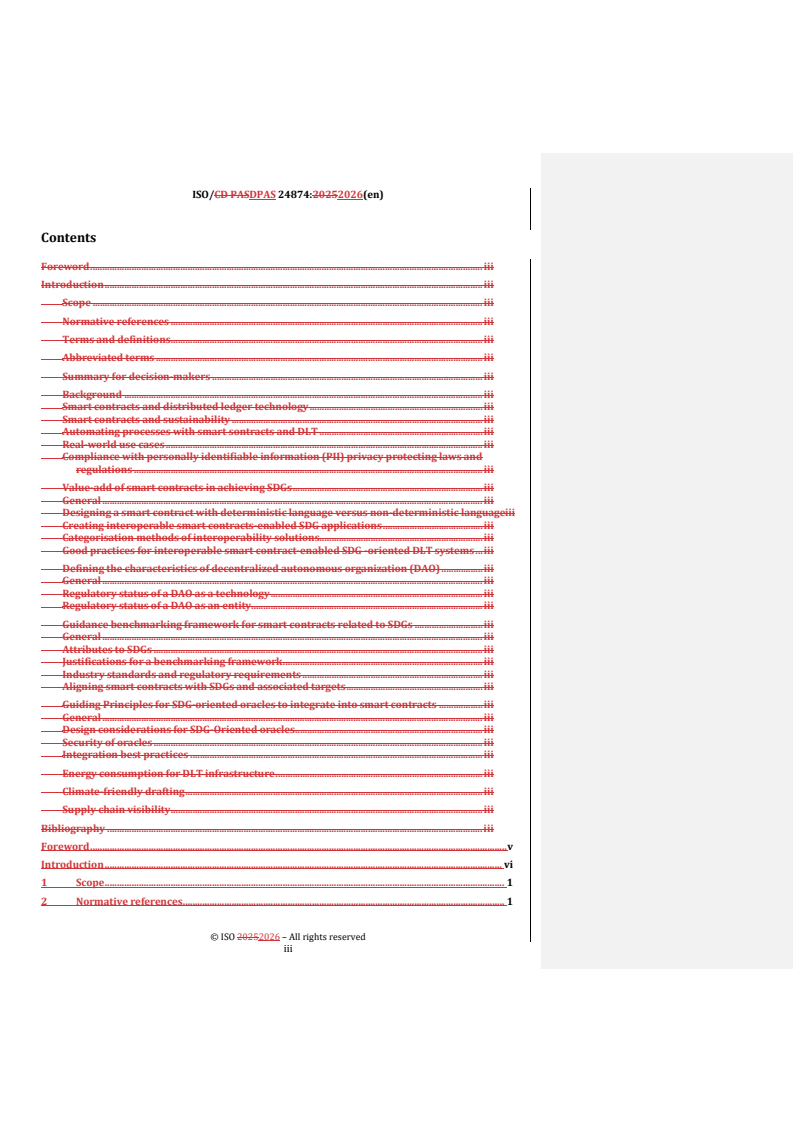
ISO/CD PASDPAS 24874:20252026(en)
Contents
Foreword . iii
Introduction . iii
Scope . iii
Normative references . iii
Terms and definitions . iii
Abbreviated terms . iii
Summary for decision-makers . iii
Background . iii
Smart contracts and distributed ledger technology . iii
Smart contracts and sustainability . iii
Automating processes with smart sontracts and DLT . iii
Real-world use cases . iii
Compliance with personally identifiable information (PII) privacy protecting laws and
regulations . iii
Value-add of smart contracts in achieving SDGs . iii
General . iii
Designing a smart contract with deterministic language versus non-deterministic languageiii
Creating interoperable smart contracts-enabled SDG applications . iii
Categorisation methods of interoperability solutions. iii
Good practices for interoperable smart contract-enabled SDG -oriented DLT systems . iii
Defining the characteristics of decentralized autonomous organization (DAO) . iii
General . iii
Regulatory status of a DAO as a technology . iii
Regulatory status of a DAO as an entity. iii
Guidance benchmarking framework for smart contracts related to SDGs . iii
General . iii
Attributes to SDGs . iii
Justifications for a benchmarking framework . iii
Industry standards and regulatory requirements . iii
Aligning smart contracts with SDGs and associated targets . iii
Guiding Principles for SDG-oriented oracles to integrate into smart contracts . iii
General . iii
Design considerations for SDG-Oriented oracles. iii
Security of oracles . iii
Integration best practices . iii
Energy consumption for DLT infrastructure . iii
Climate-friendly drafting . iii
Supply chain visibility . iii
Bibliography . iii
Foreword . v
Introduction . vi
1 Scope . 1
2 Normative references . 1
iii
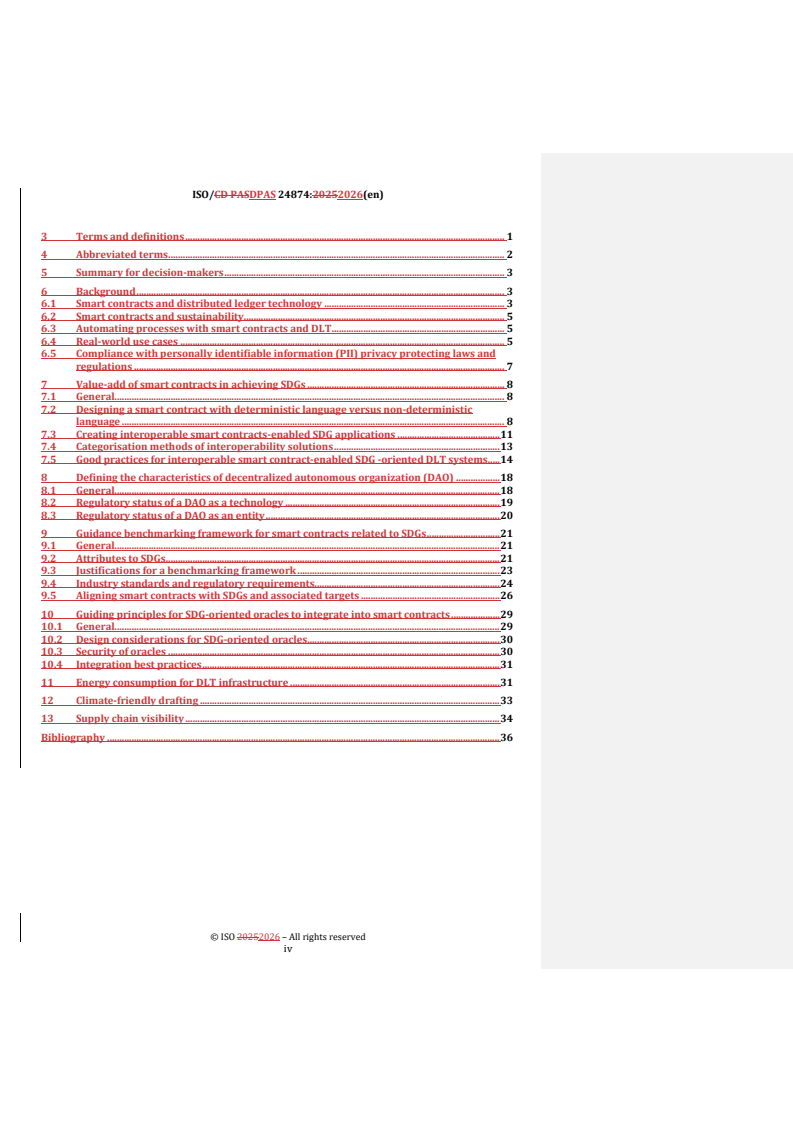
ISO/CD PASDPAS 24874:20252026(en)
3 Terms and definitions . 1
4 Abbreviated terms . 2
5 Summary for decision-makers . 3
6 Background . 3
6.1 Smart contracts and distributed ledger technology . 3
6.2 Smart contracts and sustainability . 5
6.3 Automating processes with smart contracts and DLT . 5
6.4 Real-world use cases . 5
6.5 Compliance with personally identifiable information (PII) privacy protecting laws and
regulations . 7
7 Value-add of smart contracts in achieving SDGs . 8
7.1 General. 8
7.2 Designing a smart contract with deterministic language versus non-deterministic
language . 8
7.3 Creating interoperable smart contracts-enabled SDG applications . 11
7.4 Categorisation methods of interoperability solutions . 13
7.5 Good practices for interoperable smart contract-enabled SDG -oriented DLT systems . 14
8 Defining the characteristics of decentralized autonomous organization (DAO) . 18
8.1 General. 18
8.2 Regulatory status of a DAO as a technology . 19
8.3 Regulatory status of a DAO as an entity . 20
9 Guidance benchmarking framework for smart contracts related to SDGs . 21
9.1 General. 21
9.2 Attributes to SDGs . 21
9.3 Justifications for a benchmarking framework . 23
9.4 Industry standards and regulatory requirements. 24
9.5 Aligning smart contracts with SDGs and associated targets . 26
10 Guiding principles for SDG-oriented oracles to integrate into smart contracts . 29
10.1 General. 29
10.2 Design considerations for SDG-oriented oracles. 30
10.3 Security of oracles . 30
10.4 Integration best practices . 31
11 Energy consumption for DLT infrastructure . 31
12 Climate-friendly drafting . 33
13 Supply chain visibility . 34
Bibliography . 36
iv
ISO/CD PASDPAS 24874:20252026(en)
Foreword
ISO (the International Organization for Standardization) is a worldwide federation of national standards
bodies (ISO member bodies). The work of preparing International Standards is normally carried out through
ISO technical committees. Each member body interested in a subject for which a technical committee has been
established has the right to be represented on that committee. International organizations, governmental and
non-governmental, in liaison with ISO, also take part in the work. ISO collaborates closely with the
International Electrotechnical Commission (IEC) on all matters of electrotechnical standardization.
The procedures used to develop this document and those intended for its further maintenance are described
in the ISO/IEC Directives, Part 1. In particular, the different approval criteria needed for the different types of
ISO documents should be noted. This document was drafted in accordance with the editorial rules of the
ISO/IEC Directives, Part 2 (see www.iso.org/directives).
ISO draws attention to the possibility that the implementation of this document may involve the use of (a)
patent(s). ISO takes no position concerning the evidence, validity or applicability of any claimed patent rights
in respect thereof. As of the date of publication of this document, ISO had not received notice of (a) patent(s)
which may be expected to implement this document. However, implementers are cautioned that this may not
represent the latest information, which may be obtained from the patent database available at
www.iso.org/patents. ISO is not responsible for identifying any or all such patent rights.
Any trade name used in this document is information given for the convenience of users and does not
constitute an endorsement.
For an explanation of the voluntary nature of standards, the meaning of ISO specific terms and expressions
related to conformity assessment, as well as information about ISO's adherence to the World Trade
Organization (WTO) principles in the Technical Barriers to Trade (TBT), see www.iso.org/iso/foreword.html.
This document was prepared by Technical Committee, ISO/TC 307, blockchainandBlockchain and distributed
ledger technologies.
Any feedback or questions on this document should be directed to the user’s national standards body. A
complete listing of these bodies can be found at www.iso.org/members.html.
v
ISO/CD PASDPAS 24874:20252026(en)
Introduction
Smart contracts, when implemented through distributed ledger technology (DLT) such as blockchain (3.1),,
Formatted: Font: Not Italic
have the potential to transform approaches to global challenges and facilitate collective progress toward
achieving the United Nations Sustainable Development Goals (SDGs). These smart contracts automate the
execution of contractual actions based on the fulfilment of the contractual conditions and criteria that are
agreed upon and enforced by the participating bodies. Participating bodies and agents can keep their
ownership and monitor the progress of actions within DLTs. This enhances transparency, efficiency and trust
in various processes, which ultimately contributes to the advancement of the SDGs. For smart contracts to gain
intuition about the real-world accomplishments of contractual criteria, DLT oracles are used as external data
sources. These DLT oracles are indispensable conduits that sense, track and observe events, processes and
actions in the interest of the smart contracts. They facilitate the seamless integration of existing data sources,
legacy systems, and sophisticated computations into the decentralized ecosystem. In the context of the SDGs,
the transformative potential of DLT oracles is profound, as they facilitate the seamless transfer of crucial data
pertaining to various SDG-oriented metrics. In essence, the deployment of DLT smart contract oracles within
the SDG domain epitomizes a paradigm shift towards data-driven sustainability actions. The holistic DLT
framework injected with the smart contract and their oracles enables the DLT agents, acting behind numerous
SDGs, to work collaboratively and autonomously without the central point of monitoring and processing.
In 2015, the United Nations member states adopted the 2030 Agenda for Sustainable Development,
introducing 17 SDGs as a comprehensive blueprint for global peace and prosperity. These goals demand
urgent collective actions from all nations in a global partnership. The SDGs are characterized by their holistic
and interconnected nature, universality, integration across sectors, ambitious targets, and reliance on data-
driven decision-making. They align closely with ISO standards, which emphasize quality, sustainability,
accountability, and the integration of management systems. The emergence of DLT and related innovations
presents both opportunities and challenges for achieving the SDGs, necessitating alignment with ISO
standards and regulatory frameworks to harness their potential effectively. Given the need to validate the
improvements in real-world objectives/goals set by SDGs, autonomously and effectively across multiple
distributed parties, the smart contracts with oracles on DLTs play a crucial role.
vi
ISO/CD PASDPAS 24874:20252026(en)
Guidance on the use of smart contracts in contributing to the
Sustainable Development Goals (SDGs)
1 Scope
This document provides comprehensive guidance on the use of smart contracts in contributing to the United
Nations Sustainable Development Goals (SDGs). Smart contracts and distributed ledger technology (DLT) can
transform sustainability efforts and drive revenue growth. It can be useful to develop guidance in the context
of smart contract-based sustainable supply chain management and renewable energy trading.
The guidance includes key performance indicators (KPIs) for evaluating smart contract applications across
various sectors, ensuring alignment with SDG targets. It is designed to assist policymakers, regulators,
industry stakeholders, and technology developers in making evidence-based decisions regarding blockchain
adoption for sustainability. The document covers the integration of smart contracts with distributed ledger
technology (DLT),, the design of interoperable smart contract-enabled SDG applications, and good practices
for implementing these technologies. Additionally, it addresses the regulatory status of decentralized
autonomous organizations (DAOs) and provides a guidance benchmarking framework for smart contracts
related to SDGs. The document aims to promote transparency, efficiency, and trust in processes, ultimately
contributing to the advancement of the SDGs through innovative DLT solutions.
2 Normative references
There are no normative references in this document.
3 Terms and definitions
For the purposes of this document, the following terms and definitions apply.
ISO and IEC maintain terminology databases for use in standardization at the following addresses:
— IEC Electropedia: available at http://www.electropedia.org/
— ISO Online browsing platform: available at http://www.iso.org/obp
3.1
Formatted: English (United States)
blockchain
distributed ledger consisting of a growing list of records (blocks), which are securely linked together using
cryptographic techniques
[1] [1]
Note 1 to entry: See also the definition of "blockchain" given in [ISO 22739 ],ISO 22739 , 3.6.
Formatted: Note
3.2
Formatted: English (United States)
smart contract
computer program stored in a DLT system wherein the outcome of any execution of the program is recorded
on the distributed ledger
Note 1 to entry: A smart contract can represent terms in a contract in law and create a legally enforceable obligation
Formatted: Note
[1]
under the legislation of an applicable jurisdiction ISO 22739 .
[1]
[SOURCE: [ISO 22739 , 3.88]]
3.3
oracle
[1]
mechanism or service that provides external data to a blockchain or distributed ledger system ISO 22739
ISO/CD PASDPAS 24874:20252026(en)
[1]
Note 1 to entry: See also definition of "distributed ledger technology oracle" in ISO 22739 , 3.32.
3.4
Formatted: English (United States)
internet of things (
IoT)
network of entities that are capable of interacting with each other and with their environment to achieve
[2]
common goals via the exchange of data and control signals ISO/IEC 20924
[2]
Note 1 to entry: See also the definition of IOT in ISO/IEC 20924 , 3.2.8.
3.5
Formatted: English (United States)
personally identifiable information
PII
[3]
information that can be used to identify the PII principal, either directly or indirectly ISO/IEC 29100
Note 1 to entry: The PII principle is the individual to whom the information relates.
Formatted: Note
[3]
Note 2 to entry: See ISO/IEC 29100 , 3.7 for another definition of PII.
3.6
Formatted: English (United States)
decentralized autonomous organization (
DAO)
blockchain-based organizations fed by a peer-to-peer network of contributors.
Note 1 to entry: The management of DAOs is decentralized without top executive teams and. It is built on automated
Formatted: Note
rules encoded in smart contracts governance that works autonomously based on a combination of on-chain and off-chain
[4]
mechanisms that support community decision-making . See Reference . for more information.
3.7
key performance indicator (
KPI)
Quantifiablequantifiable and strategic measurements that reflect an enterprise's critical success factors
[5] [5]
Note 1 to entry: See ISO/DIS 22400-2 ISO/DIS 22400-2 for more information on KPIs.
Formatted: Note
3.8
Formatted: English (United States)
Sustainable Development Goals
Formatted: Term(s)
sustainable development goals (SDGs)
SDGs
set of goals that recognize the need for ending poverty. They go hand-in-hand with strategies that build,
building economic growth and addressaddressing a range of social needs including education, health, social
protection, and job opportunities, while tackling climate change and environmental protection
[6]
Note 1 to entry: See Reference . for more information about the SDGs.
Formatted: Note
4 Abbreviated terms
A list of common abbreviations used in this document:
— DLT – Distributed Ledger Technology
SDGs –
DLT distributed ledger technology
ISO/CD PASDPAS 24874:20252026(en)
SDGs sustainable development goals
P2P peer-to-peer
DAO decentralized autonomous organization
KPI key performance indicator
W3C World Wide Web Consortium
— Sustainable Development Goals
Formatted: Term(s)
— P2P – Peer-to-Peer
— DAO – Decentralized Autonomous Organization
— KPI – Key Performance Indicator
— W3C – World Wide Web Consortium
5 Summary for decision-makers
Formatted: Space Before: 12 pt
DLT and specifically smart contracts can help achieve the SDGs by improving automation, security, and
transparency in sustainability-oriented transactions. However, without standardized benchmarking criteria,
their adoption remains fragmented, raising concerns over security, compliance, and efficiency. This document
provides structured guidance for evaluating smart contract performance in SDG-aligned applications,
enabling evidence-based decision-making for policymakers, regulators, and industry leaders.
Key takeaways for decision-makers include:
a) Need for standardization: Smart contracts align with global regulatory, security, and interoperability
Formatted: Numbered + Level: 1 + Numbering Style: a,
standards to ensure widespread adoption.
b, c, … + Start at: 1 + Alignment: Left + Aligned at: 0
cm + Indent at: 0 cm
b) Performance metrics: Establishing KPIs that measure scalability, cost efficiency, and security, and have an
Formatted: Numbered + Level: 1 + Numbering Style: a,
impact on SDG implementation.
b, c, … + Start at: 2 + Alignment: Left + Aligned at: 0
cm + Indent at: 0 cm
c) Transparency and trust: Ensuring smart contracts operate with clear governance, auditable execution,
and secure data integration.
d) Scalability and adoption challenges: Addressing infrastructure, interoperability, and energy consumption
concerns to make blockchain solutions viable for large-scale SDG initiatives.
e) Policy implications: Governments and regulatory bodies create enabling environments for blockchain
innovation while mitigating risks associated with fraud, data privacy, and security.
By implementing this benchmarking guidance, stakeholders can better assess the contribution of blockchain-
based smart contracts to achieving the SDGs and make informed policy and investment decisions.
6 Background
6.1 Smart contracts and distributed ledger technology
Formatted: English (United States)
TheseSmart contracts represent the terms of an agreement between two or more parties and are smart
enough to process those terms to arrive at a contractual outcome. Given that the terms are encoded within a
computer program and executed automatically once pre-defined criteria are met, smart contracts offer
ISO/CD PASDPAS 24874:20252026(en)
enhanced transparency and provenance within DLT systems. However, it is important to acknowledge that
the complexity of smart contract code can make its operation difficult for some stakeholders to fully
comprehend. Additionally, smart contracts maycan be obfuscated and do not necessarily adhere to the legal
standards of all jurisdictions. Their recognition as legal contracts varies depending on local regulatory
[7]
frameworks. In some jurisdictions, these smart contracts are treated as legal contracts . It is possible to use
smart contracts to represent terms in a contract in law and create legally enforceable agreements/ or
contracts under certain legislations.
Smart contracts implemented within a DLT framework are essentially computer scripts that enable
autonomous operations. They serve as an automated mechanism for executing coded decisions, business logic,
and the exchange of promises, duties, obligations, and rights. In open crypto-economic systems, they also
cover contractual commitments related to fungible and non-fungible assets, economic or financial exposure,
[8]
and traditional securities, while adhering to legal standards across various jurisdictions . These scripts often
include conditional statements to execute different actions based on specific conditions. They serve as
automated pathways for executing code values, business logic, and the exchange of commitments like non-
fungible assets, financial obligations, and traditional securities while potentially complying with legal
[9]
regulations in certain jurisdictions . By leveraging cryptographic methods and the decentralized nature of
DLT networks, smart contracts enhance security and provide evidence of tampering. When integrated into
DLTs, the terms and their compounding agreements become immutable, and then. This makes the processing
of contractual criteria based on the in-flow of term values is more secure and trustworthy. After processing
the contracts, storing their outcomes within the DLTs makes it all manageable within the DLTs, making them
autonomous agents for executing smart contracts. Their key features include automation, decentralisation,
immutability, transparency, efficiency, conditional execution, cost-effectiveness, security, and
programmability, which form the foundation of their operation. They automate certain features such as
executing code values, business logic, and the exchange of commitments related to various assets and financial
instruments executing business logic and facilitating asset exchanges. Moreover, when legal contractual terms
are coded into smart contracts, itthis establishes enforceable obligations within certain legal jurisdictions.
However, the legal acceptance of smart contracts across the wider community of legislation still faces
challenges whilst it is thriving through these innovative smart contract DLT platforms.
The necessity of an intermediary to execute and control the smart contract is obviated by its integration into
a DLT. In DLTs, the encrypted transaction records are disseminated across participants, safeguarding against
unauthorised alterations through consensus mechanisms. Furthermore, the encryption of DLT transaction
records confers resistance against hacking, barring compromise of the entire network. Each transaction
record within a distributed ledger is interlinked with preceding and succeeding records via cryptographically
encoded key digest (signature) of the record itself, mandating the alteration of the entire chain to manipulate
a single record. These attributes form a hard-to-break layer of trust within the distributed computing agents
in a blockchain and streamline the transaction processes over its centralised contract processing
counterparts. This in turn mitigates the time delays and associated fees in centralised systems thereby
obviating the need for intermediaries.
Smart contracts can be integrated into DLTs to form decentralised autonomusautonomous
agents/organisations (DAOs). They can make programmable frameworks to create, manage, execute and
terminate the DAOs by enforcing contractual terms more consistently, openly, autonomously and uniformly
without interference from subjective third-parties. Keeping the programmed/coded smart contract scripts
within the DLT and its autonomous execution based on triggers driven by reliable input channels enables the
universality of contracts across different jurisdictions. The provenance and immutability of smart contract
records in DLTs makes the contracts more reliable, trustworthy and auditable. Within a DLT ecosystem, data
undergoes processing by adhering to a shared and chained protocol, ensuring network transparency and
immutability. This transparency, coupled with the open-source nature of some DLTs (e.g. public blockchains),
renders the external verification of system outputs more trustworthy and ensures that they are executed in
accordance with defined rules. smartSmart contracts deployed on distributed ledgers serve as potent
instruments for validating data and instituting automated logic for incentivising legitimate conduct or
penalising misconduct within on-chain interactions.
ISO/CD PASDPAS 24874:20252026(en)
DLT imposes constraints on recording new data that conflicts with existing records or fails to comply
withconform to specified parameters or input protocols. Transparent validation rules integral to DLT serve as
filters ensuring the consistency of data uploaded to distributed ledgers, underscoring the paramount
importance of validation in the DLT environment facilitated by smart contracts operating in open execution
mode.
6.2 Smart contracts and sustainability
Since the smart contracts on DLTs help enable a self-sustainable digital ecosystem for contract management,
monitoring and execution via distributed autonomous agents, it is expected for the digitalisation of the
execution of the work programmes towards the UN Sustainable Development Goals (SDGs) with
disintermediated decision-making and processing. As autonomous monitoring, processing and execution are
strong drivers to build trust in any SDG-oriented projects, the smart contracts on DLTs leverage its strengths
and provide due scalability over largely distributed solution spaces.
[10][11][12][13][14]
Smart contracts and DLT have the potential to revolutionise various industries , including
sustainable supply chain management, green deals, sustainable infrastructure, policy developments and
renewable energy trading. By leveraging these technologies, organisations can automate processes related to
sourcing, monitoring, decision-making and payments, and thereby support the achievement of the UN SDGs
while enabling new sustainable business models.
6.3 Automating processes with smart sontractscontracts and DLT
Formatted: English (United States)
Formatted: English (United States)
Smart contracts are computer programs stored in DLTs enabling self-executing ability. They include terms of
agreements directly written into the code and define the processing, managing and termination of the
contracts within its lifecycle. They can also integrate the terms/codes defined external to the contract via
certain communication channels (e.g.:. oracles). When integrated into a DLT platform, smart contracts can
automate and enforce the execution of agreements between parties, eliminating the need for intermediaries
and reducing the risk of fraud or errors. In the context of sustainable supply chain management, smart
contracts can be used to automate processes such as verifying the origin of raw materials, tracking products
throughout the supply chain, and ensuring complianceconformance with sustainability standards.
Similarly, in renewable energy trading, Smart Contracts can facilitate peer-to-peer (P2P) energy trading
among producers and consumers. These contracts can automatically execute transactions based on pre-
defined conditions, such as energy prices or environmental factors, enabling more efficient and transparent
energy markets. In sustainable infrastructure projects such as smart cities, smart transport and smart
buildings, blockchains can enable many features such as P2P transactions and autonomous monitoring, billing
[1] [15]
and notifications for distributed assets, systems, and stakeholders (see ISO 22739 ISO 22739 . for
definitions of these terms). By leveraging DLT, all transactions are recorded on a tamper-proof ledger,
providing transparency and traceability while reducing the risk of double-spending or fraud.
6.4 Real-world use cases
There is no shortage of use cases featuring smart contract-driven applications designed with the SDGs in mind.
6.4.1 Use Casecase 1: An internationalInternational waste transportation management system
Formatted: English (United States)
(Netherlands) – a
Formatted: English (United States)
This project is currently in the implementation phase of a pilot involving 1 000 transports of non-hazardous
Formatted: English (United States)
waste products between Belgium and the Netherlands. The objective is to demonstrate the efficiency and
transparency benefits of DLT by reducing supervision costs related to European waste transportation. It is
designed to use smart contracts to streamline permit processes and automate the execution of predefined
conditions and actions when specific criteria are met. DLT oracles are used to move external internet of things
[15] [16]
(IoT) data regarding the weight of the waste onto the blockchain . . By improving waste management
efficiency and reducing regulatory bottlenecks, this initiative directly supports 9.5.13 by promoting
ISO/CD PASDPAS 24874:20252026(en)
sustainable waste management and resource efficiency. Furthermore, the increased transparency and
automation of regulatory compliance contribute to 9.5.10: by fostering sustainable and resilient infrastructure
for waste management and transport. Additionally, by reducing unnecessary administrative burdens and
ensuring compliance with environmental regulations, the initiative indirectly advances 9.5.14: as optimised
Formatted: Font: Not Bold
waste transportation processes contribute to lower emissions and improved environmental
sustainabilitystability.
6.4.2 Use Casecase 2: Cooperative energy trading (Ireland)), currently in the pre-production
Formatted: English (United States)
phase –
Formatted: English (United States)
The CENTS platform aims to create and demonstrate a cooperative P2P energy trading technology that
Formatted: English (United States)
complements the current electricity market structure. It brings together research and industry partners in
Ireland and focuses on enabling prosumers to engage in the trading of surplus renewable energy while
enhancing building performance. Smart contracts are employed to automate and enforce the terms of energy
trading agreements between prosumers, and wind and solar farms ensuring secure and seamless transactions.
DLT oracles are used to move external smart meter data onto the DLT network. The goal is to ensure that the
terms and conditions are incorporated and aligned with established legal frameworks and that the technical
functionalities of Smart Contractssmart contracts meet the legal requirements to create and execute legally
[16][17]
binding agreements and due execution thereof . By promoting decentralised renewable energy trading
and empowering communities to participate in sustainable energy markets, this initiative directly supports
9.5.8: by increasing access to renewable energy solutions. Additionally, by leveraging digital infrastructure to
enhance energy efficiency and optimise resource distribution, the project aligns with 9.5.10: by fostering
resilient and sustainable energy networks. Furthermore, by reducing reliance on centralised energy providers
and lowering carbon emissions through optimised renewable energy utilisation, the initiative contributes to
9.5.14: by supporting efforts to mitigate climate change.
6.4.3 Use Casecase 3: Sustainable Supply Chain Managementsupply chain management in Sweden
Formatted: English (United States)
– A
Formatted: English (United States)
Swedish furniture company utilises smart contracts and DLT to track the origin of wood used in its products.
Formatted: English (United States)
By storing information about each batch of wood on a blockchain, the company ensures that only sustainably
sourced materials are used in its manufacturing process. This transparency not only satisfies consumer
demand for eco-friendly products but also helps the company comply with regulations and certifications
[17] [18] [18]
related to sustainable forestry practices (see ISO/TR 6277 ISO/TR 6277 and ISO/TR 3242 ISO/TR
[19]
3242 .). By providing verifiable proof of sustainable sourcing, the initiative meets growing consumer
demand for eco-friendly products while also ensuring compliance with environmental regulations and
sustainability certifications. This effort directly supports 9.5.13: by promoting sustainable resource
management and ensuring that production processes minimise environmental impact. Furthermore, by
preventing deforestation and encouraging responsible forestry, the initiative aligns with 9.5.16: which focuses
on protecting, restoring, and promoting sustainable use of terrestrial ecosystems. Additionally, by fostering
greater corporate responsibility and supply chain accountability, the project contributes to 9.5.10: by driving
innovation in sustainable manufacturing and supply chain transparency.
6.4.4 Use Casecase 4: Renewable Energy Tradingenergy trading in Australia –
Formatted: English (United States)
Formatted: English (United States)
In Australia, a community-led initiative uses smart contracts to facilitate P2P trading of solar energy among
Formatted: English (United States)
residents. Homeowners with solar panels can sell excess energy to their neighbours through an automated
system based on smart contracts deployed on a DLT platform. This initiative promotes the adoption of
renewable energy sources, reduces reliance on traditional energy grids, and empowers individuals to
[17] [18]
participate in the transition to more sustainable energy (see ISO/TR 6277 ISO/TR 6277 and ISO/TR
[18] [19]
3242 ISO/TR 3242 .). By promoting the adoption of renewable energy sources and empowering
individuals to take an active role in energy markets, this initiative directly supports 9.5.8: through expanding
access to clean and renewable energy solutions. Additionally, by reducing strain on conventional energy
infrastructure and enhancing energy efficiency, it aligns with 9.5.10: by contributing to the development of
resilient and sustainable energy networks. Furthermore, by decreasing dependency on fossil fuels and
ISO/CD PASDPAS 24874:20252026(en)
lowering carbon emissions, this project advances 9.5.14: by reinforcing global efforts to mitigate climate
change and support environmental sustainability.
6.4.5 Use Casecase 5: Patient-centric Healthcarehealthcare data management platform –
Formatted: English (United States)
Formatted: English (United States)
This is a healthcare service project focusing on SDG 3: Good Health and Well-Being. Through the app, patients
gain full access to their medical records, promoting autonomy and informed decision-making. The platform Formatted: English (United States)
enables secure sharing of anonymised health data for research, fostering collaboration between individuals
and researchers while addressing healthcare disparities. Using Web3 technologies such as smart contracts
and token-based rewards, the application ensures the security and transparency of health data while
maintaining privacy. Its decentralised nature strengthens patient-provider connections and enhances clinical
trial recruitment, contributing to better health outcomes and equitable healthcare access (see ISO/TR
[17] [18] [18] [19]
6277 ISO/TR 6277 and ISO/TR 3242 ISO/TR 3242 .). By enabling more efficient clinical trial
recruitment and strengthening patient-provider relationships, this initiative directly supports 9.5.4 through
improving healthcare accessibility, patient engagement, and data-driven medical research. Additionally, by
ensuring secure and equitable health data management through decentralised infrastructure, it aligns with
9.5.10 promoting innovation in digital healthcare solutions. Furthermore, by prioritising privacy and data
protection, the platform contributes to 9.5.17: reinforcing ethical and secure data governance in the
healthcare sector.
6.4.6 Use Casecase 6: Financial Inclusioninclusion and Economic Growtheconomic growth in Latin
Formatted: English (United States)
America for the Unbanked – Itunbanked
Formatted: English (United States)
This
...