

ISO 21940-14:2012/Amd 1:2022
(Amendment)Mechanical vibration — Rotor balancing — Part 14: Procedures for assessing balance errors — Amendment 1
General Information
- Abstract
- Status
- Withdrawn
- Publication Date
- 11-May-2022
- Technical Committee
- ISO/TC 108/SC 2 - Measurement and evaluation of mechanical vibration and shock as applied to machines, vehicles and structures
- Drafting Committee
- ISO/TC 108/SC 2/WG 31 - Balancing
- Current Stage
- 9599 - Withdrawal of International Standard
- Start Date
- 30-Sep-2026
- Completion Date
- 03-Oct-2026

Overview
ISO 21940-14:2012/Amd 1:2022 is an amendment to the international standard focusing on mechanical vibration and rotor balancing. Specifically, it updates Part 14 of the ISO 21940 series, which covers procedures for assessing balance errors in rotating machinery. This amendment refines existing evaluation methodologies to enhance accuracy and clarity in determining rotor balance quality.
Maintained by ISO Technical Committee ISO/TC 108, Subcommittee SC 2, this document ensures harmonization of testing methods related to mechanical vibrations and rotor balancing for machines, vehicles, and structures.
Key Topics
Rotor Balancing Procedures
The amendment revises procedures for assessing rotor balance errors, emphasizing the correct summation of uncorrected errors assuming they occur in the same angular direction.Measurement Error Accounting
The updated guidance stresses the importance of incorporating measurement errors into balance quality verification, in accordance with ISO 21940-11:2016 Clause 10. This ensures that tolerance assessments consider all potential sources of error.Inter-standard References
ISO 21940-14:2012/Amd 1:2022 references related parts of the ISO 21940 series, including:- ISO 21940-11:2016 (Procedures and tolerances for rotors with rigid behaviour)
- Replacement of older documents by ISO 21940-2, ISO 21940-11, and ISO 21940-12 parts for consistency.
Balance Quality Verification
The amendment clarifies that acceptance of rotor unbalance states involves mutual agreement between parties, highlighting that standardization does not dictate these acceptance criteria.
Applications
ISO 21940-14:2012/Amd 1:2022 is essential for industries relying on precision rotor balancing to minimize mechanical vibration and enhance equipment reliability. Practical applications include:
Rotating Machinery Maintenance
Use in monitoring and correcting rotors in turbines, motors, compressors, and fans to prevent vibration-related failures.Manufacturing Quality Control
Ensures that rotor components meet balance tolerances during production, improving product quality and operational safety.Automotive and Aerospace Engineering
Critical for balancing rotating parts such as engine components, propellers, and driveshafts to maintain smooth operation and reduce noise and wear.Condition Monitoring and Predictive Maintenance
Supports assessment protocols for operational rotors, aiding in early detection of imbalance-related issues.
By adhering to the procedures set forth in this amendment, engineers and technicians can enhance the accuracy of balance error assessments, ultimately extending machinery life cycles and reducing maintenance costs.
Related Standards
This amendment integrates closely with several parts of the ISO 21940 series and other mechanical vibration standards:
ISO 21940-11:2016 – Procedures and tolerances for rotors with rigid behaviour, critical for applying the measurement error considerations introduced in this amendment.
ISO 21940-2 – Replacing earlier withdrawn documents, it defines terms and parameters fundamental to rotor balancing.
ISO 21940-12 – Addresses balancing procedures for rotors exhibiting flexible behavior.
General Standards on Mechanical Vibration – Other ISO/TC 108 standards covering vibration measurement and evaluation complement the rotor balancing series for comprehensive assessment and diagnostics.
Using this amendment in conjunction with related standards ensures a systematic and standardized approach to rotor vibration analysis and balancing across industries.
For detailed guidance, practitioners should consult the full ISO 21940-14:2012/Amd 1:2022 document and coordinate with their national standards body for implementation and compliance advice. This amendment aids in maintaining global consistency and reliability in rotor balancing assessments, supporting industrial efficiency and equipment safety.
Relations
- Effective Date
- 10-Jul-2021
- Effective Date
- 10-Dec-2022
Frequently Asked Questions
ISO 21940-14:2012/Amd 1:2022 is a standard published by the International Organization for Standardization (ISO). Its full title is "Mechanical vibration — Rotor balancing — Part 14: Procedures for assessing balance errors — Amendment 1". This standard covers: Mechanical vibration — Rotor balancing — Part 14: Procedures for assessing balance errors — Amendment 1
Mechanical vibration — Rotor balancing — Part 14: Procedures for assessing balance errors — Amendment 1
ISO 21940-14:2012/Amd 1:2022 is classified under the following ICS (International Classification for Standards) categories: 21.120.40 - Balancing and balancing machines. The ICS classification helps identify the subject area and facilitates finding related standards.
ISO 21940-14:2012/Amd 1:2022 has the following relationships with other standards: It is inter standard links to ISO 21940-14:2012, ISO 21940-14:2026. Understanding these relationships helps ensure you are using the most current and applicable version of the standard.
ISO 21940-14:2012/Amd 1:2022 is available in PDF format for immediate download after purchase. The document can be added to your cart and obtained through the secure checkout process. Digital delivery ensures instant access to the complete standard document.
Standards Content (Sample)
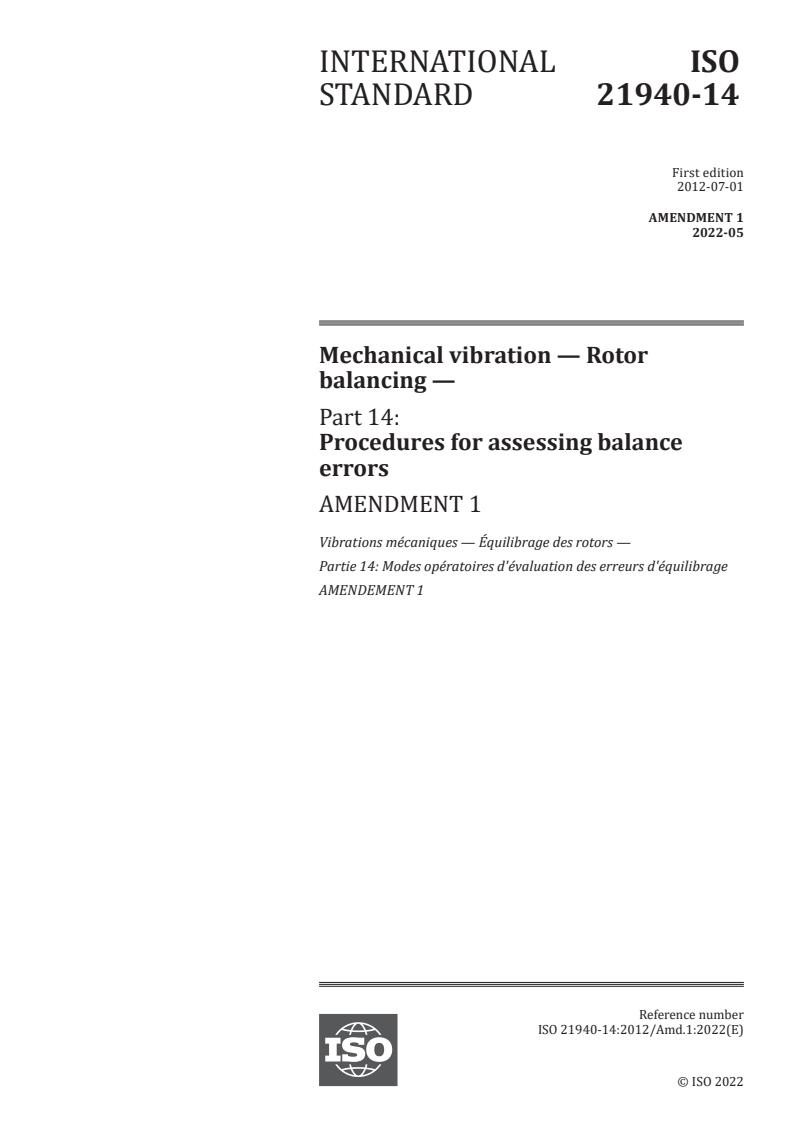
INTERNATIONAL ISO
STANDARD 21940-14
First edition
2012-07-01
AMENDMENT 1
2022-05
Mechanical vibration — Rotor
balancing —
Part 14:
Procedures for assessing balance
errors
AMENDMENT 1
Vibrations mécaniques — Équilibrage des rotors —
Partie 14: Modes opératoires d'évaluation des erreurs d'équilibrage
AMENDEMENT 1
Reference number
ISO 21940-14:2012/Amd.1:2022(E)
ISO 21940-14:2012/Amd.1:2022(E)
© ISO 2022
All rights reserved. Unless otherwise specified, or required in the context of its implementation, no part of this publication may
be reproduced or utilized otherwise in any form or by any means, electronic or mechanical, including photocopying, or posting on
the internet or an intranet, without prior written permission. Permission can be requested from either ISO at the address below
or ISO’s member body in the country of the requester.
ISO copyright office
CP 401 • Ch. de Blandonnet 8
CH-1214 Vernier, Geneva
Phone: +41 22 749 01 11
Email: copyright@iso.org
Website: www.iso.org
Published in Switzerland
ii
ISO 21940-14:2012/Amd.1:2022(E)
Foreword
ISO (the International Organization for Standardization) is a worldwide federation of national standards
bodies (ISO member bodies). The work of preparing International Standards is normally carried out
through ISO technical committees. Each member body interested in a subject for which a technical
committee has been established has the right to be represented on that committee. International
organizations, governmental and non-governmental, in liaison with ISO, also take part in the work.
ISO collaborates closely with the International Electrotechnical Commission (IEC) on all matters of
electrotechnical standardization.
The procedures used to develop this document and those intended for its further maintenance are
described in the ISO/IEC Directives, Part 1. In particular, the different approval criteria needed for the
different types of ISO documents should be noted. This document was drafted in accordance with the
editorial rules of the ISO/IEC Directives, Part 2 (see www.iso.org/directives).
Attention is drawn to the possibility that some of the elements of this document may be the subject of
patent rights. ISO shall not be held responsible for identifying any or all such patent rights. Details of
any patent rights identified during the development of the document will be in the Introduction and/or
on the ISO list of patent declaratio
...