

ISO/TR 19905-2:2012
(Main)Petroleum and natural gas industries — Site-specific assessment of mobile offshore units — Part 2: Jack-ups commentary and detailed sample calculation
- Abstract
ISO/TR 19905-2:2012 provides a commentary to some clauses of ISO 19905-1 including background information, supporting documentation, and additional or alternative calculation methods as applicable and also provides a detailed sample 'go-by' calculation. ISO 19905-1 specifies requirements and guidance for the site-specific assessment of independent leg jack‑up units for use in the petroleum and natural gas industries.
- Status
- Published
- Publication Date
- 14-Dec-2012
- Technical Committee
- ISO/TC 67/SC 7 - Offshore structures
- Current Stage
- 9093 - International Standard confirmed
- Start Date
- 07-Oct-2026
- Completion Date
- 10-Oct-2026
Buy Documents

ISO/TR 19905-2:2012 - Petroleum and natural gas industries -- Site-specific assessment of mobile offshore units

ISO/TR 19905-2:2012 - Petroleum and natural gas industries — Site-specific assessment of mobile offshore units — Part 2: Jack-ups commentary and detailed sample calculation/15/2012
Overview
ISO/TR 19905-2:2012 is a Technical Report that provides a detailed commentary and worked example for the site-specific assessment of independent leg jack-up mobile offshore units. It supplements ISO 19905-1:2012 by giving background, supporting documentation, alternative calculation approaches and a detailed “go-by” sample calculation (Annex A). The report is informative and intended for use together with ISO 19905-1 for reliable site-specific assessment of jack-ups in the petroleum and natural gas industries.
Key topics and requirements
This TR expands on selected clauses of ISO 19905-1 and addresses practical technical topics including:
- Metocean data: guidance on waves, currents, wind and water depth considerations for site-specific inputs.
- Hydrodynamic modelling: commentary on detailed vs equivalent leg models, member length, shielding and solidification effects, and spudcan behaviour.
- Wave, current and wind actions: methods to estimate environmental loads and associated coefficients (drag, inertia).
- Dynamic response: guidance on calculating jack-up natural period, effective stiffness (K), hysteretic damping and vertical radiation damping.
- Drag–inertia methods: explanation and application examples including SIPM “drag-inertia method” (Annex B).
- Foundation and spudcan interaction: commentary on soil–structure interaction, limiting horizontal reactions and skirted spudcan considerations.
- Structural acceptance and strength: guidance on nominal bending strength, interaction equations and design/assessment checks.
- Worked example: Annex A provides a step-by-step sample calculation for users to follow (“go-by” calculation).
Applications
ISO/TR 19905-2:2012 is used to:
- Support site-specific assessment and verification of jack-up units for design, decommissioning or relocation decisions.
- Provide practical calculation methods for hydrodynamic load estimation and dynamic response analysis.
- Serve as a reference for producing technically consistent assessment reports required by operators, owners and regulators.
- Benchmark analytical models and compare alternative modelling approaches.
Who should use this standard
- Offshore structural and geotechnical engineers
- Hydrodynamic and ocean engineers
- Technical consultants and engineering contractors
- Asset owners/operators and project planners
- Classification societies and regulatory authorities
Related standards
- ISO 19905-1:2012 - Jack-ups (mandatory companion document)
- Other ISO 19900-series standards covering metocean, geotechnical, seismic and offshore structural requirements (ISO 19900–19906)
Keywords: ISO/TR 19905-2:2012, jack-ups, site-specific assessment, mobile offshore units, metocean, hydrodynamic model, spudcan, drag-inertia, sample calculation.
Relations
- Effective Date
- 09-Feb-2026
- Effective Date
- 12-Feb-2026
- Effective Date
- 06-Jun-2022
Buy Documents
ISO/TR 19905-2:2012 - Petroleum and natural gas industries -- Site-specific assessment of mobile offshore units
ISO/TR 19905-2:2012 - Petroleum and natural gas industries — Site-specific assessment of mobile offshore units — Part 2: Jack-ups commentary and detailed sample calculation/15/2012
Get Certified
Connect with accredited certification bodies for this standard

Element Materials Technology
Materials testing and product certification.

ABS Group Brazil
ABS Group certification services in Brazil.

ABS Quality Evaluations Inc.
American Bureau of Shipping quality certification.
Sponsored listings
Frequently Asked Questions
ISO/TR 19905-2:2012 is a technical report published by the International Organization for Standardization (ISO). Its full title is "Petroleum and natural gas industries — Site-specific assessment of mobile offshore units — Part 2: Jack-ups commentary and detailed sample calculation". This standard covers: ISO/TR 19905-2:2012 provides a commentary to some clauses of ISO 19905-1 including background information, supporting documentation, and additional or alternative calculation methods as applicable and also provides a detailed sample 'go-by' calculation. ISO 19905-1 specifies requirements and guidance for the site-specific assessment of independent leg jack‑up units for use in the petroleum and natural gas industries.
ISO/TR 19905-2:2012 provides a commentary to some clauses of ISO 19905-1 including background information, supporting documentation, and additional or alternative calculation methods as applicable and also provides a detailed sample 'go-by' calculation. ISO 19905-1 specifies requirements and guidance for the site-specific assessment of independent leg jack‑up units for use in the petroleum and natural gas industries.
ISO/TR 19905-2:2012 is classified under the following ICS (International Classification for Standards) categories: 75.180.10 - Exploratory, drilling and extraction equipment. The ICS classification helps identify the subject area and facilitates finding related standards.
ISO/TR 19905-2:2012 has the following relationships with other standards: It is inter standard links to EN ISO 19901-4:2016, CEN ISO/TR 19905-2:2013, ISO 20182:2005. Understanding these relationships helps ensure you are using the most current and applicable version of the standard.
ISO/TR 19905-2:2012 is available in PDF format for immediate download after purchase. The document can be added to your cart and obtained through the secure checkout process. Digital delivery ensures instant access to the complete standard document.
Standards Content (Sample)
TECHNICAL ISO/TR
REPORT 19905-2
First edition
2012-12-15
Petroleum and natural gas industries —
Site-specific assessment of mobile
offshore units —
Part 2:
Jack-ups commentary and detailed
sample calculation
Industries du pétrole et du gaz naturel — Évaluation liée au site des
unités marines mobiles —
Partie 2: Compléments sur les plates-formes auto-élévatrices
Reference number
©
ISO 2012
© ISO 2012
All rights reserved. Unless otherwise specified, no part of this publication may be reproduced or utilized in any form or by any means,
electronic or mechanical, including photocopying and microfilm, without permission in writing from either ISO at the address below or
ISO's member body in the country of the requester.
ISO copyright office
Case postale 56 • CH-1211 Geneva 20
Tel. + 41 22 749 01 11
Fax + 41 22 749 09 47
E-mail copyright@iso.org
Web www.iso.org
Published in Switzerland
ii © ISO 2012 – All rights reserved
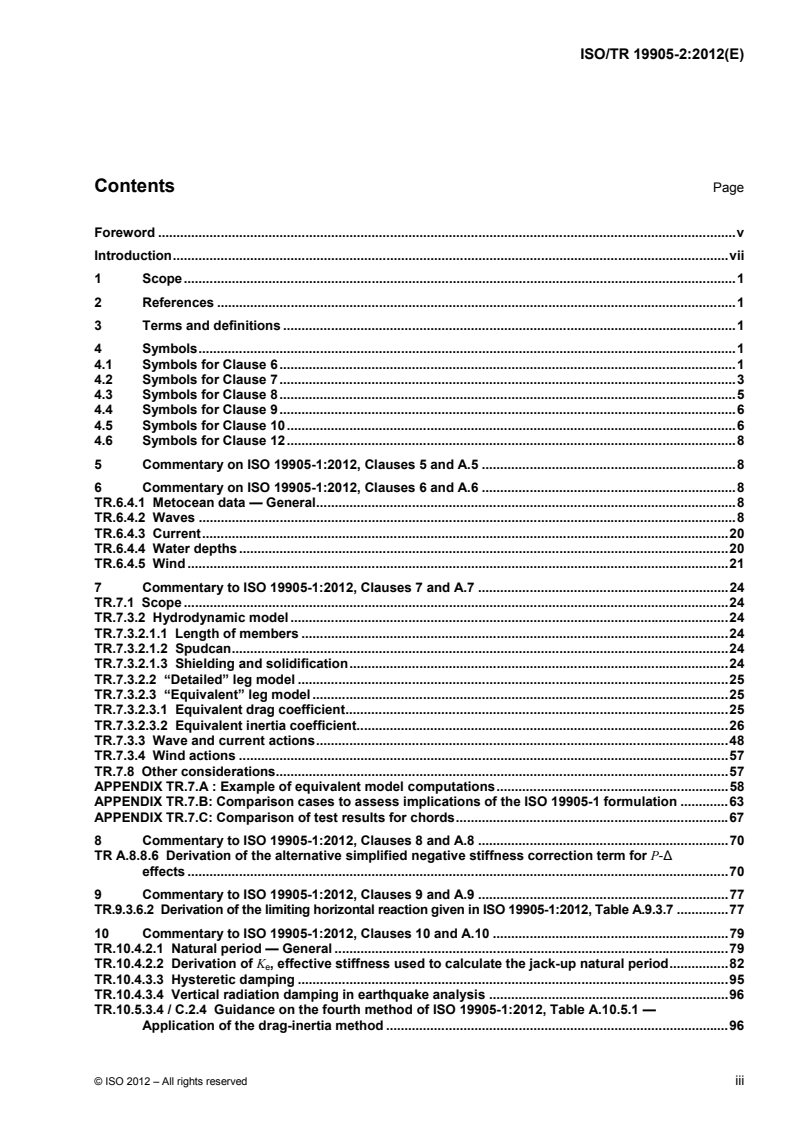
Contents Page
Foreword .v
Introduction.vii
1 Scope.1
2 References .1
3 Terms and definitions .1
4 Symbols.1
4.1 Symbols for Clause 6.1
4.2 Symbols for Clause 7.3
4.3 Symbols for Clause 8.5
4.4 Symbols for Clause 9.6
4.5 Symbols for Clause 10.6
4.6 Symbols for Clause 12.8
5 Commentary on ISO 19905-1:2012, Clauses 5 and A.5 .8
6 Commentary on ISO 19905-1:2012, Clauses 6 and A.6 .8
TR.6.4.1 Metocean data — General.8
TR.6.4.2 Waves .8
TR.6.4.3 Current.20
TR.6.4.4 Water depths.20
TR.6.4.5 Wind .21
7 Commentary to ISO 19905-1:2012, Clauses 7 and A.7 .24
TR.7.1 Scope .24
TR.7.3.2 Hydrodynamic model .24
TR.7.3.2.1.1 Length of members .24
TR.7.3.2.1.2 Spudcan.24
TR.7.3.2.1.3 Shielding and solidification.24
TR.7.3.2.2 “Detailed” leg model .25
TR.7.3.2.3 “Equivalent” leg model .25
TR.7.3.2.3.1 Equivalent drag coefficient.25
TR.7.3.2.3.2 Equivalent inertia coefficient.26
TR.7.3.3 Wave and current actions.48
TR.7.3.4 Wind actions .57
TR.7.8 Other considerations.57
APPENDIX TR.7.A : Example of equivalent model computations.58
APPENDIX TR.7.B: Comparison cases to assess implications of the ISO 19905-1 formulation .63
APPENDIX TR.7.C: Comparison of test results for chords.67
8 Commentary to ISO 19905-1:2012, Clauses 8 and A.8 .70
TR A.8.8.6 Derivation of the alternative simplified negative stiffness correction term for P-∆
effects .70
9 Commentary to ISO 19905-1:2012, Clauses 9 and A.9 .77
TR.9.3.6.2 Derivation of the limiting horizontal reaction given in ISO 19905-1:2012, Table A.9.3.7 .77
10 Commentary to ISO 19905-1:2012, Clauses 10 and A.10 .79
TR.10.4.2.1 Natural period — General .79
TR.10.4.2.2 Derivation of K , effective stiffness used to calculate the jack-up natural period.82
e
TR.10.4.3.3 Hysteretic damping .95
TR.10.4.3.4 Vertical radiation damping in earthquake analysis .96
TR.10.5.3.4 / C.2.4 Guidance on the fourth method of ISO 19905-1:2012, Table A.10.5.1 —
Application of the drag-inertia method .96
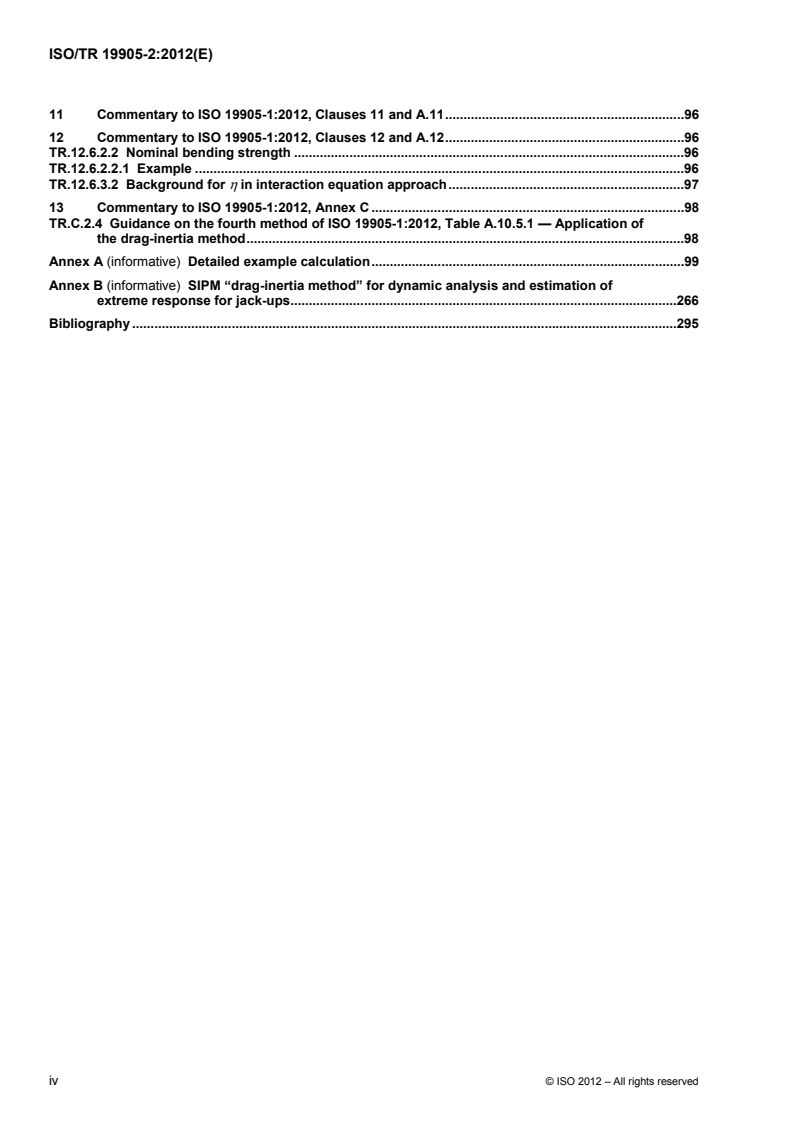
11 Commentary to ISO 19905-1:2012, Clauses 11 and A.11.96
12 Commentary to ISO 19905-1:2012, Clauses 12 and A.12.96
TR.12.6.2.2 Nominal bending strength .96
TR.12.6.2.2.1 Example .96
TR.12.6.3.2 Background for η in interaction equation approach.97
13 Commentary to ISO 19905-1:2012, Annex C .98
TR.C.2.4 Guidance on the fourth method of ISO 19905-1:2012, Table A.10.5.1 — Application of
the drag-inertia method.98
Annex A (informative) Detailed example calculation.99
Annex B (informative) SIPM “drag-inertia method” for dynamic analysis and estimation of
extreme response for jack-ups.266
Bibliography .295
iv © ISO 2012 – All rights reserved
Foreword
ISO (the International Organization for Standardization) is a worldwide federation of national standards bodies
(ISO member bodies). The work of preparing International Standards is normally carried out through ISO
technical committees. Each member body interested in a subject for which a technical committee has been
established has the right to be represented on that committee. International organizations, governmental and
non-governmental, in liaison with ISO, also take part in the work. ISO collaborates closely with the
International Electrotechnical Commission (IEC) on all matters of electrotechnical standardization.
International Standards are drafted in accordance with the rules given in the ISO/IEC Directives, Part 2.
The main task of technical committees is to prepare International Standards. Draft International Standards
adopted by the technical committees are circulated to the member bodies for voting. Publication as an
International Standard requires approval by at least 75 % of the member bodies casting a vote.
In exceptional circumstances, when a technical committee has collected data of a different kind from that
which is normally published as an International Standard (“state of the art”, for example), it may decide by a
simple majority vote of its participating members to publish a Technical Report. A Technical Report is entirely
informative in nature and does not have to be reviewed until the data it provides are considered to be no
longer valid or useful.
Attention is drawn to the possibility that some of the elements of this document may be the subject of patent
rights. ISO shall not be held responsible for identifying any or all such patent rights.
ISO/TR 19905-2 was prepared by Technical Committee ISO/TC 67, Materials, equipment and offshore
structures for petroleum, petrochemical and natural gas industries, Subcommittee SC 7, Offshore structures.
ISO 19905 consists of the following parts, under the general title Petroleum and natural gas industries — Site-
specific assessment of mobile offshore units:
⎯ Part 1: Jack-ups
⎯ Part 2: Jack-ups commentary and detailed sample calculation [Technical Report]
The following part is under preparation:
⎯ Part 3: Floating units
however, that it was published, and only became available, in 2013.
ISO 19905 is one of a series of International Standards for offshore structures. The full series consists of the
following International Standards:
⎯ ISO 19900, Petroleum and natural gas industries — General requirements for offshore structures
⎯ ISO 19901-1, Petroleum and natural gas industries — Specific requirements for offshore structures —
Part 1: Metocean design and operating considerations
⎯ ISO 19901-2, Petroleum and natural gas industries — Specific requirements for offshore structures —
Part 2: Seismic design procedures and criteria
⎯ ISO 19901-3, Petroleum and natural gas industries — Specific requirements for offshore structures —
Part 3: Topsides structure
⎯ ISO 19901-4, Petroleum and natural gas industries — Specific requirements for offshore structures —
Part 4: Geotechnical and foundation design considerations
⎯ ISO 19901-5, Petroleum and natural gas industries — Specific requirements for offshore structures —
Part 5: Weight control during engineering and construction
⎯ ISO 19901-6, Petroleum and natural gas industries — Specific requirements for offshore structures —
Part 6: Marine operations
⎯ ISO 19901-7, Petroleum and natural gas industries — Specific requirements for offshore structures —
Part 7: Stationkeeping systems for floating offshore structures and mobile offshore units
1)
⎯ ISO 19901-8 , Petroleum and natural gas industries — Specific requirements for offshore structures —
Part 8: Marine soil investigations
⎯ ISO 19902, Petroleum and natural gas industries — Fixed steel offshore structures
⎯ ISO 19903, Petroleum and natural gas industries — Fixed concrete offshore structures
⎯ ISO 19904-1, Petroleum and natural gas industries — Floating offshore structures — Part 1: Monohulls,
semi-submersibles and spars
⎯ ISO 19905-1, Petroleum and natural gas industries — Site-specific assessment of mobile offshore
units — Part 1: Jack-ups
⎯ ISO/TR 19905-2, Petroleum and natural gas industries — Site-specific assessment of mobile offshore
units — Part 2: Jack-ups commentary and detailed sample calculation
1)
⎯ ISO/TR 19905-3 , Petroleum and natural gas industries — Site-specific assessment of mobile offshore
units — Part 3: Floating units
⎯ ISO 19906, Petroleum and natural gas industries — Arctic offshore structures
1) Under preparation.
vi © ISO 2012 – All rights reserved
Introduction
The series of International Standards applicable to types of offshore structures, ISO 19900 to ISO 19906,
addresses design requirements and assessments for all offshore structures used by the petroleum and natural
gas industries worldwide. Through their application, the intention is to achieve reliability levels appropriate for
manned and unmanned offshore structures, whatever the type of structure and the nature or combination of
the materials used.
It is important to recognize that structural integrity is an overall concept comprising models for describing
actions, structural analyses, design or assessment rules, safety elements, workmanship, quality control
procedures and national requirements, all of which are mutually dependent. The modification of one aspect of
the design or assessment in isolation can disturb the balance of reliability inherent in the overall concept or
structural system. The implications involved in modifications, therefore, need to be considered in relation to
the overall reliability of offshore structural systems.
The series of International Standards applicable to the various types of offshore structure is intended to
provide a wide latitude in the choice of structural configurations, materials and techniques without hindering
innovation. Sound engineering judgement is therefore necessary in the use of these International Standards.
[5]
ISO 19905-1 was developed from SNAME T&R Bulletin 5-5A , but has been considerably altered from that
original document. Some of the alterations have involved a restructuring and modification of terminology, but
there have been additional changes of greater technical consequence. New material has been added based
on studies undertaken since the original development of SNAME T&R 5-5A; new calculation techniques have
been addressed because of improved computational capabilities allowing more complex assessments; gaps
that existed in the original SNAME T&R 5-5A have been filled, thereby ensuring a more thorough assessment;
and changes have been made to align ISO 19905-1 with other standards within the 19900 series. A
description of the more important changes, along with the reasoning for the changes, can be found in a series
of papers published in 2012 by Offshore Technology Conference. These papers can be of considerable value
in helping the analyst, particularly those who are familiar with SNAME T&R 5-5A, in understanding
ISO 19905-1. The papers, part of the Technical Session ISO 19905-1: A Site-Specific Assessment of Mobile
Jack-Up Units are listed in the Bibliography:
⎯ Reference [6], Background to the ISO 19905-Series and an Overview of the New ISO 19905-1 for the
Site-Specific Assessment of Mobile Jack-Up Units
⎯ Reference [7], Environmental Actions in the New ISO for the Site-Specific Assessment of Mobile Jack-Up Units
⎯ Reference [8], Structural Modeling and Response Analysis in the New ISO Standard for the Site-Specific
Assessment of Mobile Jack-Up Units
⎯ Reference [9], Foundation Modeling and Assessment in the New ISO Standard 19905-1
⎯ Reference [10], Long-Term Applications in the ISO Standard for Site Specific Assessment of Mobile
Jack-Up Units and the Use of Skirted Spudcans
⎯ Reference [11], Structural Acceptance Criteria in the New ISO for the Site-Specific Assessment of Mobile
Jack-Up Units
⎯ Reference [12], The Benchmarking of the New ISO for the Site-Specific Assessment of Mobile Jack-Up Units
This part of ISO 19905, which has been developed from SNAME T&R Bulletin 5-5A, provides a commentary
to some clauses of ISO 19905-1 including background information, supporting documentation, and additional
or alternative calculation methods as applicable and also provides a detailed sample “go-by” calculation in
Annex A. The reader is advised that the information presented herein is intended for use in conjunction with
ISO 19905-1 and that the cautions and limitations discussed in ISO 19905-1 apply.
TECHNICAL REPORT ISO/TR 19905-2:2012(E)
Petroleum and natural gas industries — Site-specific
assessment of mobile offshore units —
Part 2:
Jack-ups commentary and detailed sample calculation
1 Scope
This part of ISO 19905 provides a commentary to some clauses of ISO 19905-1 including background
information, supporting documentation, and additional or alternative calculation methods as applicable and
also provides a detailed sample 'go-by' calculation. ISO 19905-1 specifies requirements and guidance for the
site-specific assessment of independent leg jack-up units for use in the petroleum and natural gas industries.
2 References
The following referenced documents are indispensable for the application of this document. For dated
references, only the edition cited applies. For undated references, the latest edition of the referenced
document (including any amendments) applies.
ISO 19905-1:2012, Petroleum and natural gas industries — Site-specific assessment of mobile offshore
units — Part 1: Jack-ups
3 Terms and definitions
For the purposes of this document the terms and definitions given in ISO 19905-1 apply.
4 Symbols
4.1 Symbols for Clause 6
C drag coefficient
D
C D equivalent drag coefficient times effective diameter
De e
d water depth
D depth attenuation
D(θ ) directional spreading function from ISO 19901-1
F(α) directional spreading function from SNAME
f frequency (Hz)
g acceleration due to gravity
H wave height
H reduced wave height which may be used in deterministic/regular wave force calculations
det
H maximum wave height for a given return period; used for airgap calculations
max
H wave height associated with H , equivalent to the height between the extreme crest and the
mpm srp
following trough
H estimate of H significant wave height (metres)
mo s
H scaled significant wave height to be used in irregular seas simulation (metres)
s
H significant wave height for assessment return period
srp
k wave number
2m
m power constant in the ⎡⎤cos α spreading function
()
⎣⎦
S (f) power density of wave surface elevation as a function of wave frequency
nn
T wave period (seconds)
T wind averaging time (seconds)
T standard reference time averaging interval for wind speed of 1 h = 3 600 s
T peak period in wave spectrum (seconds)
p
T zero-upcrossing period of wave spectrum (seconds)
z
U wind speed
U (10) is the sustained wind speed at 10 m height above mean sea level
w,T
U is the 1 h sustained wind speed at the reference elevation 10 m above mean sea level
w0
u the computed velocity for long crested waves
u the reduced horizontal velocity
red
V current velocity
α equilibrium range parameter
α skewness
α kurtosis
γ peak enhancement factor
γ scaling of drag forces
d
κ kinematics reduction factor
η crest elevation by Airy theory
2 © ISO 2012 – All rights reserved
η crest elevation by Stokes
s
φ directional spreading factor defined in ISO 19901-1
σ spectral peakwidth parameter
4.2 Symbols for Clause 7
A cross-sectional area of member
A equivalent area of leg per unit height
e
A equivalent area of element
i
A sum of projected areas for all members in the considered plane
s
A total projected envelope area of the considered plane
t
C added mass coefficient
A
C drag coefficient
D
C drag coefficient for chord at direction θ = 0°
Do
C drag coefficient for flow normal to the rack, θ = 90°
D1
C equivalent drag coefficient
De
C equivalent drag coefficient of member i
Dei
C drag coefficient of an individual member, related to D
Di i
C (θ ) drag coefficient to the projected diameter
Dpr
C drag coefficient for a rough member
Drough
C drag coefficient for a smooth member
Dsmooth
C inertia coefficient
M
C equivalent inertia coefficient
Me
C equivalent inertia coefficient of member i
Mei
C inertia coefficient of a member, related to D
Mi i
d mean, undisturbed water depth (positive)
D member diameter
D equivalent diameter of leg bay
e
D face width of leg, outside dimensions
F
D reference dimension of individual leg members
i
D (θ) projected diameter of the chord
pr
f fundamental vibration frequencies of the member
i
H significant wave height
s
k roughness height
k/D relative roughness
KC Keulegan-Carpenter number
l length of member “i” node to node
i
m added mass contribution (per unit length) for the member
a
N constant in wind velocity power law
�
r velocity of the considered member, normal to the member axis and in the direction of the
n
combined particle velocity
�� acceleration of the considered member, normal to the member axis and in the direction of the
r
n
combined particle velocity
Re Reynolds number
s length of one bay, or part of bay considered
S Strouhal number
S average wave steepness
S outer diameter of an array of tubulars
T wave period
T first natural period of sway motion
n
T zero-upcrossing period
z
u particle velocity
u particle velocity normal to the member
n
u� particle acceleration normal to the member
n
u , u� horizontal water particle velocity and acceleration
x
x
U flow velocity at the depth of the considered element
U current particle velocity
C
U maximum orbital particle velocity
m
U reduced particle velocity for regular waves
red
U representative wave particle velocity
W
v total flow velocity normal to the member
n
V reduced current velocity for use in the hydrodynamic model; V should not be taken as less than
C C
0,7V
f
V current velocity normal to member used in the hydrodynamic model
Cn
V far field (undisturbed) current
f
4 © ISO 2012 – All rights reserved
W dimension from backplate to pitch point of triangular chord or dimension from root of one rack to
tip of other rack of split tubular chord
W width of the structure
z coordinate measured vertically upward from the mean water surface
z′ modified coordinate to be used in particle velocity formulation
α indicator for relative velocity, 0 or 1
α angle defining flow direction relative to member
i
β ratio of Re/KC, a parameter to describe the test environment
β angle defining the member inclination
i
∆F drag force per unit length
drag
∆F inertia force per unit length
inertia
∆F horizontal inertia force per unit length
inertiaH
λ wave length
ν kinematic viscosity
θ angle in degrees for waves relative to the chord orientation
θ angle where half the backplate is hidden behind the rackplate
o
ρ mass density of water or air
ζ instantaneous water surface elevation (same axis system as z)
ζ wave crest elevation (same axis system as z)
o
4.3 Symbols for Clause 8
K lateral stiffness without axial load
o
K lateral stiffness with axial load
K sum of individual leg stiffnesses
E
L distance from the spudcan point of rotation to the hull centre of gravity
P axial load in one leg
P total gravity load only
G
P effective hull gravity load; includes hull weight and weight of the legs above the hull
g
y deflection without axial load P
y additional lateral deflection due to axial load P
y total lateral deflection
max
4.4 Symbols for Clause 9
a depth interpolation parameter
B soil buoyancy of spudcan below bearing area, i.e. the submerged weight of soil displaced by
S
the spudcan below D, the greatest depth of maximum cross-sectional spudcan bearing area
below the sea floor
F horizontal force applied to the spudcan due to the assessment load case
H
F gross vertical force acting on the soil beneath the spudcan due to the assessment load case
V
Q gross ultimate vertical foundation capacity
V
V maximum vertical reaction under the spudcan considered required to support the in-water
Lo
weight of the jack-up during the entire preloading operation (this is not the soil capacity)
W submerged weight of the backfill
BF
γ preload resistance factor
R,PRE
4.5 Symbols for Clause 10
A axial area of one leg (equals sum of effective chord areas, including a contribution from rack
teeth; see ISO 19905-1:2012, A.8.3.3, Note)
A effective shear area of one leg
s
d distance between upper and lower guides
D hysteretic damping
hyst
E Young's modulus
F shear transmitted from the hull
F geometric factor; = 1,125 (three-leg jack-up), 1,0 (four-leg jack-up)
g
F factor to account for horizontal soil stiffness, K , and horizontal leg-hull connection stiffness, K
h hs hh
F modification factor to be applied to the leg lateral deformation stiffness
h
F factor to account for the number of chords; = 0,5 (three-chord leg), 1,0 (four-chord leg)
n
F modification factor to be applied to the leg-hull connection stiffness
r
F factor to account for vertical soil stiffness, K , and vertical leg-hull connection stiffness, K
v vs vh
g acceleration due to gravity
h distance between chord centres (opposed pinion chords) or pinion pitch points (single rack chords)
I second moment of area of leg
I representative second moment of area of the hull girder joining two legs about a horizontal axis
H
normal to the line of environmental action
K effective horizontal stiffness due to axial deformation
A
6 © ISO 2012 – All rights reserved
K effective bending stiffness
B
K effective stiffness associated with one leg
e
k combined vertical stiffness of all fixation system components on one chord
f
K horizontal leg-hull connection stiffness
hh
K hull rotational stiffness
hull
k combined vertical stiffness of all jacking system components on one chord
j
K leg-hull connection rotational stiffness
rh
K leg-soil connection rotational stiffness
rs
k total lateral stiffness of upper guides with respect to lower guides
u
K effective stiffness due to the series combination of all vertical pinion or fixation system
vh
stiffnesses, allowing for combined action with shock-pads, where fitted
L length of leg considered
M effective mass associated with one leg
e
M moment on leg-hull spring
h
M full mass of hull including maximum variable load
hull
M mass of leg above lower guide (in the absence of a clamping mechanism) or above the centre
la
of the clamping mechanism
M mass of leg below the point described for M , including added mass for the submerged part of
lb la
the leg ignoring spudcan
M moment on leg-soil spring
s
N number of legs
P axial load in leg
P mean force due to vertical fixed load and variable load acting on one leg
P Euler buckling strength of one leg
E
T highest (or first mode) natural period
n
x hull deflection
h
Y distance between centre of one leg and line joining centres of the other two legs (three-leg
jack-up), or distance between windward and leeward leg rows for direction under consideration
(four-leg jack-up)
ν Poisson's ratio
δ axial deflection
axial
∆ horizontal hull deflection
horz
θ hull rotation
hull
4.6 Symbols for Clause 12
Fy yield strength, in stress units, taken as the minimum of the yield strength and 90 % of the
ultimate tensile strength (UTS; see ISO 19905-1:2012, A.12.2.2)
M nominal bending strength
p
Z plastic section modulus
5 Commentary on ISO 19905-1:2012, Clauses 5 and A.5
No commentary is offered.
6 Commentary on ISO 19905-1:2012, Clauses 6 and A.6
TR.6.4.1 Metocean data — General
ISO 19905-1 permits the use of either 50-year return period individual extremes or 100-year joint probability
environmental data with associated and different load factors; see ISO 19905-1:2012, 6.4. For these alternative
environmental formulations, adjustments for season and directionality are permitted as given below:
⎯ Seasonally adjusted data may be used if appropriate (ISO 19905-1:2012, 6.4).
NOTE When seasonal data are specified, the data should not be divided into periods of less than one month
and the values so calculated should generally be factored such that the extreme for the most severe period equals
the all-year value for the required assessment return period.
⎯ Where directional data are available, these may be considered (ISO 19905-1:2012, 6.4).
NOTE When directional data are specified, the data should normally not be divided into sectors of less than 30°
and the directional values so calculated should generally be factored such that the extreme for the most severe
sector equals the omni-directional value for the required assessment return period and season where applicable. In
certain areas 30° sectors may be inappropriate; caution should be exercised if an assessment heading falls
marginally outside a sector with higher data or if data is highly directional.
⎯ The downwind (vector) component of the maximum surface flow of the mean spring tidal current is
specified rather than the maximum spring tidal current (ISO 19905-1:2012, A.6.4.3).
⎯ Site-specific information may be used to determine an appropriate combination of wind-driven and surge
currents (ISO 19905-1:2012, A.6.4.3).
TR.6.4.2 Waves
TR.6.4.2.2 Extreme wave height
The wave heights utilized by ISO 19905-1 for wave load calculations are related to the return period significant
wave height for a three-hour storm, H . ISO 19905-1 however recognizes that this data may not always be
srp
available to the assessor and therefore provides relationships between H and H , the individual extreme
srp max
wave height for the assessment return period with an annual probability of exceedance of 1/(return period). If
the assessment return period is taken as 50 years, H is the wave height with a 2 % annual probability of
max(50)
exceedance.
H and the associated period are normally determined through a direct extrapolation of measured or hindcast
srp
site-specific significant wave heights. H may be determined either from an extrapolation of the distribution of
max
individual wave heights over the assessment return period or by the application of a multiplication factor to H .
srp
8 © ISO 2012 – All rights reserved
It is noted that the “extreme wave height” of a regular wave, H , determined from a three-hour storm segment
mpm
is the most probable maximum (MPM) wave height, defined as the distance from the extreme crest to the
following trough. Using this definition, the MPM wave height from the three-hour storm segment is given by:
H = 1,68 H (TR.6.4-1)
mpm srp
This relationship is confirmed by the data of Reference [6-1] for individual storms. However, H must not be
mpm
confused with H and must not be used to determine the value of H on which an assessment is based.
max srp
This is because H includes site-specific considerations of potentially longer durations of storms (including
max
build up and decay) and the additional probability contributions of other return period storms (i.e. 20-, 30-, 40-,
100-year, etc. return period storms). Consequently, the ratio H /H is larger than the ratio H /H .
max srp mpm srp
A consequence of the site-specific nature of the derivation of H is that there is no unique relationship
max
between H and H applicable to all areas of the world. Thus, if a specified return period maximum wave
max srp
height is given at a particular location there is no consistent way to derive H without knowledge of how the
srp
maximum H wave height was derived originally.
max
Average factors between H and H have been derived for a North Sea and a Gulf of Mexico location for a
srp max
50-year return period. Without further information, the North Sea factors can be generalized to any non-
tropical revolving storm area and the Gulf of Mexico factors can be generalized to tropical revolving storm
areas. These factors are:
Environmental conditions H /H
max srp
Tropical revolving storms 1,75
Non-tropical storms 1,86
TR.6.4.2.3 Deterministic waves
The selection of wave height to be applied in a particular analysis approach (regular or irregular waves) is
recommended based on matching the loads resulting from the combination of the wave height and kinematics
models, as recommended in ISO 19905-1:2012, A.7.3.3.3.1. The scaling of wave heights is introduced as an
alternative to the scaling of drag coefficients.
For regular wave analyses using an appropriate wave theory, the wave asymmetry is properly accounted for,
but the irregularity of the sea surface and the wave spreading may not be modelled properly.
Considering that the computations with regular waves are made with a kinematics model that has been
documented in Reference [6-4] to be somewhat conservative, a reduction factor is appropriate to arrive at
realistic force estimates.
As indicated in Tables TR.6.4.2.2-1 and TR.6.4.2.2-2, a reduction factor is required to give similar forces as
predicted by an irregular seas simulation if H = 1,86H . There are a few ways that the reduction factor could
max s
be realized in the assessment. In Reference [6-2] a reduction of the drag coefficient by a factor of 0,7 is chosen
and in Reference [6-3] a reduction of wave kinematics is chosen. Some classification societies may specify lower
C values than specified in ISO 19905-1:2012, A.7.3.4, and these apply to regular wave analyses.
D
Accepting that a scaling factor on kinematics is applicable, the kinematics reduction factor κ is introduced in
ISO 19905-1:2012, A.6.4.2.3 for application to the kinematics obtained from H (preferred) or, alternatively,
max
to scale the wave height, but not both.
[5]
In the development of the SNAME T&R Bulletin 5-5A it was chosen to follow a practical way of implementing
the reduction in the Practice by reducing the wave height to be used for force computations in regular wave
analyses. This was found to be more practical than using a factor on kinematics, as most software on the
market did not allow such a scaling factor to be used. Equivalent wave heights are suggested as:
H = 1,60H (TR.6.4-2)
det srp
The scaling factors on kinematics could be implemented assuming that the load effect is proportional to wave
height to the power 2,2, remembering that drag coefficients (C ) should not be scaled. As a comparison with
D
previous practices, the relationship H ≈ 1,60H can also be compared with the reduction of C by a factor
det srp D
of 0,7 as recommended in Reference [6-2] in combination with the wave height H = 1,86H . By assuming
max s
that load effects are proportional to the ratio of wave heights to the power 2,2, the scaling becomes
2,2 2,2
(1,60/1,86) = (0,86) = 0,72, indicating that this is not lower than current practice. The computational
results of Table TR.6.4.2.2-2 indicate also that scaling of 0,66 would give similar static forces as the irregular
seas simulation at large water depths. See also Appendix TR.7.B for a comparison of the computational
results, related to other practices. In effect, in the SNAME T&R Bulletin 5-5A, the above resulted in a
kinematic reduction factor of 0,86 (= 1,60/1,86).
In the course of developing ISO 19905-1, new technology was introduced (see ISO 19905-1:2012, Reference
[A.6.4-1]), replacing the above definition of equivalent wave height H . The directional spreading factor
det
defined in ISO 19901-1 was taken as the basis. This factor φ may be applied directly as a kinematics
reduction factor κ. Depending on the type of storm region (see TR.6.4.2.2 above) and the latitude, φ may vary
between 0,87 and 0,94.
In short-crested waves, the wave energy propagates in different directions around the main wave direction.
The peak particle velocities under waves become smaller as the waves become more spread. As a result, the
directional spreading of waves tends to result in peak loading that is somewhat smaller than that predicted for
uni-directional seas. Design codes and practices have accounted for spreading by introducing a factor on
horizontal kinematics (either directly or via the wave height) in conjunction with the regular wave approach.
The reduction factor reflects the reduced kinematics under the highest point of the wave crest and is thus
appropriate for the calculation of quasi-static loads on a single pile. However, it does not account for all the
effects of spreading. The loads on offshore structures are reduced further due to the spatial distribution of the
wave-loaded structural components.
Thorough inclusion of both 3D and nonlinear effects of waves can reduce the extreme loads computed for a
jack-up. In the study reported in ISO 19905-1:2012, Reference [A.6.4-1], a systematic study of a variety of
jack-ups (LeTourneau 82SDC, LeTourneau 116C, F&G Mod V, LeTourneau Super 300 and MSC CJ70) in
different water depths and environments was performed to generalize the applicability of results. A formula
was developed which can robustly represent the above effects in an assessment context, without having to
perform the more complex and time consuming direct evaluation. The formulation is given in
ISO 19905-1:2012, A.6.4.2.3 in Equations (A.6.4-4) through (A.6.4-7).
The development of the formula was based on fitting the total wave actions on the legs of a typical jack-up by
regular wave analysis to the most probable maximum extreme (MPME) results from a stochastic wave
analysis. The fitting was done by a kinematics reduction factor. The stochastic wave analyses were performed
using the ISO directional spreading factor as the basis and a second order directional wave theory for the
irregular extreme wave kinematics coupled with an analysis model which simulates jack-up quasi-static
loading. The response quantities assessed were the base shear and the overturning moment. Using the
formulae given in ISO 19905-1:2012, A.6.4.2.3, the accuracy of the fit compared to the stochastic loads is
within ± 5 %. For the majority of the cases analysed, the resulting κ was between 0,70 and 0,85, but there
were cases that produced higher wave loads than the original SNAME which sets κ = 0,86, so when κ > 0,86
SNAME is unconservative.
Caution should be exercised if the above formulation is applied to cases other than three-legged drag-
dominated (truss legs) jack-ups in extreme storm conditions. The main reason for this is that only these typical
jack-up designs in ultimate limit state (ULS) conditions have been considered in the calculations that form the
basis of the formulation. For these jack-up types and conditions, the results are valid; for others, caution is
necessary.
TR.6.4.2.3.1 Comparison of wave loads obtained using different wave theories for regular and
irregular wave analyses
The Dean's stream function/Stokes’ fifth order theories predict higher peak than trough amplitudes, increasing
the maximum velocities and the wetted surface compared with the Airy theory. Figure TR.7.3.3.3-2 in
TR.7.3.3.3.2 illustrates the difference in the profiles. Using the same specified wave height, this difference can
be seen in terms of the overturning moment, base shear and/or deck displacement.
10 © ISO 2012 – All rights reserved
A number of computations were performed to determine the differences due to wave kinematics on selected
jack-up designs. Some results are summarized in Tables TR.6.4.2.2-1 and TR.6.4.2.2-2. See also
Appendix TR.7.B.
Table TR.6.4.2.2-1 — Regular wave analysis normalized results, C D = 5,13 over the full water depth
De e
Water Wave Crest Base Overturning. Dean's
Theory depth H & T amp. shear moment overturning/
max
m m/s m MN MNm other
Airy Const. 30 15/14 7,5 3,577 91,607 1,74
Airy Wheeler 15/14 7,5 3,266 82,782 1,93
Stokes’ fifth 15/14 10,22 5,211 156,16 1,02
Dean's stream 15/14 10,42 5,243 159,45 1,0
15/14 7,5 2,916 160,83 1,12
Airy Const. 70
28/16 14,0 14,121 677,69 1,44
15/15 7,5 2,563 138,80 1,30
Airy Wheeler
28/16 14,0 13,446 636,53 1,53
15/14 8,41 3,171 180,80 1,00
Stokes’ fifth
28.16 19,17 18,264 976,62 1,00
15/14 8,41 3,161 180,30 1,0
Dean's stream
28/16 19,33 18,136 972,54 1,0
In Table TR.6.4.2.2-2 the deterministic analysis is based on application of various H to H relationships.
max s
The stochastic analysis refers to extreme values determined from time domain analyses by fitting a three-
parameter Weibull distribution to the response peaks and reading the extreme as the 0,999 fractile,
approximating a three-hour storm extreme.
The results show dependence on the choice of wave kinematics differing with wave height.
[6-10]
Table TR.6.4.2.2-2 — Scaling factor γ on loads to comply with Airy Wheeler in irregular seas
d
Airy Airy Airy Stokes’
Wheeler No stretch Constant Fifth
BASE SHEAR
Stochastic
irregular seas 1,00 1,03 0,83 -
a
Deterministic 0,79 0,84 0,69 0,66
b
regular waves
0,66 0,69 0,56 0,66
c
0,71 0,75 0,61 0,66
d
— — — 0,92
OVERTURNING MOMENT
Stochastic
irregular seas 1,00 1,10 0,79 —
a
Deterministic 0,81 0,93 0,69 0,66
regular waves b
0,67 0,76 0,56 0,66
c
0,72 0,83 0,61 0,66
d
— — — 0,93
Water depth 110 m, H = 13,0m, T = T = 17,0 s, uniform current V = 0,4 m/s.
s p ass
Wheeler stretching basis for normalized results, i.e. Airy Wheeler stochastic load = γ (other load).
d
a
H = 1
...
TECHNICAL ISO/TR
REPORT 19905-2
First edition
2012-12-15
Petroleum and natural gas industries —
Site-specific assessment of mobile
offshore units —
Part 2:
Jack-ups commentary and detailed
sample calculation
Industries du pétrole et du gaz naturel — Évaluation liée au site des
unités marines mobiles —
Partie 2: Compléments sur les plates-formes auto-élévatrices
Reference number
©
ISO 2012
© ISO 2012
All rights reserved. Unless otherwise specified, no part of this publication may be reproduced or utilized in any form or by any means,
electronic or mechanical, including photocopying and microfilm, without permission in writing from either ISO at the address below or
ISO's member body in the country of the requester.
ISO copyright office
Case postale 56 • CH-1211 Geneva 20
Tel. + 41 22 749 01 11
Fax + 41 22 749 09 47
E-mail copyright@iso.org
Web www.iso.org
Published in Switzerland
ii © ISO 2012 – All rights reserved
Contents Page
Foreword .v
Introduction.vii
1 Scope.1
2 References .1
3 Terms and definitions .1
4 Symbols.1
4.1 Symbols for Clause 6.1
4.2 Symbols for Clause 7.3
4.3 Symbols for Clause 8.5
4.4 Symbols for Clause 9.6
4.5 Symbols for Clause 10.6
4.6 Symbols for Clause 12.8
5 Commentary on ISO 19905-1:2012, Clauses 5 and A.5 .8
6 Commentary on ISO 19905-1:2012, Clauses 6 and A.6 .8
TR.6.4.1 Metocean data — General.8
TR.6.4.2 Waves .8
TR.6.4.3 Current.20
TR.6.4.4 Water depths.20
TR.6.4.5 Wind .21
7 Commentary to ISO 19905-1:2012, Clauses 7 and A.7 .24
TR.7.1 Scope .24
TR.7.3.2 Hydrodynamic model .24
TR.7.3.2.1.1 Length of members .24
TR.7.3.2.1.2 Spudcan.24
TR.7.3.2.1.3 Shielding and solidification.24
TR.7.3.2.2 “Detailed” leg model .25
TR.7.3.2.3 “Equivalent” leg model .25
TR.7.3.2.3.1 Equivalent drag coefficient.25
TR.7.3.2.3.2 Equivalent inertia coefficient.26
TR.7.3.3 Wave and current actions.48
TR.7.3.4 Wind actions .57
TR.7.8 Other considerations.57
APPENDIX TR.7.A : Example of equivalent model computations.58
APPENDIX TR.7.B: Comparison cases to assess implications of the ISO 19905-1 formulation .63
APPENDIX TR.7.C: Comparison of test results for chords.67
8 Commentary to ISO 19905-1:2012, Clauses 8 and A.8 .70
TR A.8.8.6 Derivation of the alternative simplified negative stiffness correction term for P-∆
effects .70
9 Commentary to ISO 19905-1:2012, Clauses 9 and A.9 .77
TR.9.3.6.2 Derivation of the limiting horizontal reaction given in ISO 19905-1:2012, Table A.9.3.7 .77
10 Commentary to ISO 19905-1:2012, Clauses 10 and A.10 .79
TR.10.4.2.1 Natural period — General .79
TR.10.4.2.2 Derivation of K , effective stiffness used to calculate the jack-up natural period.82
e
TR.10.4.3.3 Hysteretic damping .95
TR.10.4.3.4 Vertical radiation damping in earthquake analysis .96
TR.10.5.3.4 / C.2.4 Guidance on the fourth method of ISO 19905-1:2012, Table A.10.5.1 —
Application of the drag-inertia method .96
11 Commentary to ISO 19905-1:2012, Clauses 11 and A.11.96
12 Commentary to ISO 19905-1:2012, Clauses 12 and A.12.96
TR.12.6.2.2 Nominal bending strength .96
TR.12.6.2.2.1 Example .96
TR.12.6.3.2 Background for η in interaction equation approach.97
13 Commentary to ISO 19905-1:2012, Annex C .98
TR.C.2.4 Guidance on the fourth method of ISO 19905-1:2012, Table A.10.5.1 — Application of
the drag-inertia method.98
Annex A (informative) Detailed example calculation.99
Annex B (informative) SIPM “drag-inertia method” for dynamic analysis and estimation of
extreme response for jack-ups.266
Bibliography .295
iv © ISO 2012 – All rights reserved
Foreword
ISO (the International Organization for Standardization) is a worldwide federation of national standards bodies
(ISO member bodies). The work of preparing International Standards is normally carried out through ISO
technical committees. Each member body interested in a subject for which a technical committee has been
established has the right to be represented on that committee. International organizations, governmental and
non-governmental, in liaison with ISO, also take part in the work. ISO collaborates closely with the
International Electrotechnical Commission (IEC) on all matters of electrotechnical standardization.
International Standards are drafted in accordance with the rules given in the ISO/IEC Directives, Part 2.
The main task of technical committees is to prepare International Standards. Draft International Standards
adopted by the technical committees are circulated to the member bodies for voting. Publication as an
International Standard requires approval by at least 75 % of the member bodies casting a vote.
In exceptional circumstances, when a technical committee has collected data of a different kind from that
which is normally published as an International Standard (“state of the art”, for example), it may decide by a
simple majority vote of its participating members to publish a Technical Report. A Technical Report is entirely
informative in nature and does not have to be reviewed until the data it provides are considered to be no
longer valid or useful.
Attention is drawn to the possibility that some of the elements of this document may be the subject of patent
rights. ISO shall not be held responsible for identifying any or all such patent rights.
ISO/TR 19905-2 was prepared by Technical Committee ISO/TC 67, Materials, equipment and offshore
structures for petroleum, petrochemical and natural gas industries, Subcommittee SC 7, Offshore structures.
ISO 19905 consists of the following parts, under the general title Petroleum and natural gas industries — Site-
specific assessment of mobile offshore units:
⎯ Part 1: Jack-ups
⎯ Part 2: Jack-ups commentary and detailed sample calculation [Technical Report]
The following part is under preparation:
⎯ Part 3: Floating units
however, that it was published, and only became available, in 2013.
ISO 19905 is one of a series of International Standards for offshore structures. The full series consists of the
following International Standards:
⎯ ISO 19900, Petroleum and natural gas industries — General requirements for offshore structures
⎯ ISO 19901-1, Petroleum and natural gas industries — Specific requirements for offshore structures —
Part 1: Metocean design and operating considerations
⎯ ISO 19901-2, Petroleum and natural gas industries — Specific requirements for offshore structures —
Part 2: Seismic design procedures and criteria
⎯ ISO 19901-3, Petroleum and natural gas industries — Specific requirements for offshore structures —
Part 3: Topsides structure
⎯ ISO 19901-4, Petroleum and natural gas industries — Specific requirements for offshore structures —
Part 4: Geotechnical and foundation design considerations
⎯ ISO 19901-5, Petroleum and natural gas industries — Specific requirements for offshore structures —
Part 5: Weight control during engineering and construction
⎯ ISO 19901-6, Petroleum and natural gas industries — Specific requirements for offshore structures —
Part 6: Marine operations
⎯ ISO 19901-7, Petroleum and natural gas industries — Specific requirements for offshore structures —
Part 7: Stationkeeping systems for floating offshore structures and mobile offshore units
1)
⎯ ISO 19901-8 , Petroleum and natural gas industries — Specific requirements for offshore structures —
Part 8: Marine soil investigations
⎯ ISO 19902, Petroleum and natural gas industries — Fixed steel offshore structures
⎯ ISO 19903, Petroleum and natural gas industries — Fixed concrete offshore structures
⎯ ISO 19904-1, Petroleum and natural gas industries — Floating offshore structures — Part 1: Monohulls,
semi-submersibles and spars
⎯ ISO 19905-1, Petroleum and natural gas industries — Site-specific assessment of mobile offshore
units — Part 1: Jack-ups
⎯ ISO/TR 19905-2, Petroleum and natural gas industries — Site-specific assessment of mobile offshore
units — Part 2: Jack-ups commentary and detailed sample calculation
1)
⎯ ISO/TR 19905-3 , Petroleum and natural gas industries — Site-specific assessment of mobile offshore
units — Part 3: Floating units
⎯ ISO 19906, Petroleum and natural gas industries — Arctic offshore structures
1) Under preparation.
vi © ISO 2012 – All rights reserved
Introduction
The series of International Standards applicable to types of offshore structures, ISO 19900 to ISO 19906,
addresses design requirements and assessments for all offshore structures used by the petroleum and natural
gas industries worldwide. Through their application, the intention is to achieve reliability levels appropriate for
manned and unmanned offshore structures, whatever the type of structure and the nature or combination of
the materials used.
It is important to recognize that structural integrity is an overall concept comprising models for describing
actions, structural analyses, design or assessment rules, safety elements, workmanship, quality control
procedures and national requirements, all of which are mutually dependent. The modification of one aspect of
the design or assessment in isolation can disturb the balance of reliability inherent in the overall concept or
structural system. The implications involved in modifications, therefore, need to be considered in relation to
the overall reliability of offshore structural systems.
The series of International Standards applicable to the various types of offshore structure is intended to
provide a wide latitude in the choice of structural configurations, materials and techniques without hindering
innovation. Sound engineering judgement is therefore necessary in the use of these International Standards.
[5]
ISO 19905-1 was developed from SNAME T&R Bulletin 5-5A , but has been considerably altered from that
original document. Some of the alterations have involved a restructuring and modification of terminology, but
there have been additional changes of greater technical consequence. New material has been added based
on studies undertaken since the original development of SNAME T&R 5-5A; new calculation techniques have
been addressed because of improved computational capabilities allowing more complex assessments; gaps
that existed in the original SNAME T&R 5-5A have been filled, thereby ensuring a more thorough assessment;
and changes have been made to align ISO 19905-1 with other standards within the 19900 series. A
description of the more important changes, along with the reasoning for the changes, can be found in a series
of papers published in 2012 by Offshore Technology Conference. These papers can be of considerable value
in helping the analyst, particularly those who are familiar with SNAME T&R 5-5A, in understanding
ISO 19905-1. The papers, part of the Technical Session ISO 19905-1: A Site-Specific Assessment of Mobile
Jack-Up Units are listed in the Bibliography:
⎯ Reference [6], Background to the ISO 19905-Series and an Overview of the New ISO 19905-1 for the
Site-Specific Assessment of Mobile Jack-Up Units
⎯ Reference [7], Environmental Actions in the New ISO for the Site-Specific Assessment of Mobile Jack-Up Units
⎯ Reference [8], Structural Modeling and Response Analysis in the New ISO Standard for the Site-Specific
Assessment of Mobile Jack-Up Units
⎯ Reference [9], Foundation Modeling and Assessment in the New ISO Standard 19905-1
⎯ Reference [10], Long-Term Applications in the ISO Standard for Site Specific Assessment of Mobile
Jack-Up Units and the Use of Skirted Spudcans
⎯ Reference [11], Structural Acceptance Criteria in the New ISO for the Site-Specific Assessment of Mobile
Jack-Up Units
⎯ Reference [12], The Benchmarking of the New ISO for the Site-Specific Assessment of Mobile Jack-Up Units
This part of ISO 19905, which has been developed from SNAME T&R Bulletin 5-5A, provides a commentary
to some clauses of ISO 19905-1 including background information, supporting documentation, and additional
or alternative calculation methods as applicable and also provides a detailed sample “go-by” calculation in
Annex A. The reader is advised that the information presented herein is intended for use in conjunction with
ISO 19905-1 and that the cautions and limitations discussed in ISO 19905-1 apply.
TECHNICAL REPORT ISO/TR 19905-2:2012(E)
Petroleum and natural gas industries — Site-specific
assessment of mobile offshore units —
Part 2:
Jack-ups commentary and detailed sample calculation
1 Scope
This part of ISO 19905 provides a commentary to some clauses of ISO 19905-1 including background
information, supporting documentation, and additional or alternative calculation methods as applicable and
also provides a detailed sample 'go-by' calculation. ISO 19905-1 specifies requirements and guidance for the
site-specific assessment of independent leg jack-up units for use in the petroleum and natural gas industries.
2 References
The following referenced documents are indispensable for the application of this document. For dated
references, only the edition cited applies. For undated references, the latest edition of the referenced
document (including any amendments) applies.
ISO 19905-1:2012, Petroleum and natural gas industries — Site-specific assessment of mobile offshore
units — Part 1: Jack-ups
3 Terms and definitions
For the purposes of this document the terms and definitions given in ISO 19905-1 apply.
4 Symbols
4.1 Symbols for Clause 6
C drag coefficient
D
C D equivalent drag coefficient times effective diameter
De e
d water depth
D depth attenuation
D(θ ) directional spreading function from ISO 19901-1
F(α) directional spreading function from SNAME
f frequency (Hz)
g acceleration due to gravity
H wave height
H reduced wave height which may be used in deterministic/regular wave force calculations
det
H maximum wave height for a given return period; used for airgap calculations
max
H wave height associated with H , equivalent to the height between the extreme crest and the
mpm srp
following trough
H estimate of H significant wave height (metres)
mo s
H scaled significant wave height to be used in irregular seas simulation (metres)
s
H significant wave height for assessment return period
srp
k wave number
2m
m power constant in the ⎡⎤cos α spreading function
()
⎣⎦
S (f) power density of wave surface elevation as a function of wave frequency
nn
T wave period (seconds)
T wind averaging time (seconds)
T standard reference time averaging interval for wind speed of 1 h = 3 600 s
T peak period in wave spectrum (seconds)
p
T zero-upcrossing period of wave spectrum (seconds)
z
U wind speed
U (10) is the sustained wind speed at 10 m height above mean sea level
w,T
U is the 1 h sustained wind speed at the reference elevation 10 m above mean sea level
w0
u the computed velocity for long crested waves
u the reduced horizontal velocity
red
V current velocity
α equilibrium range parameter
α skewness
α kurtosis
γ peak enhancement factor
γ scaling of drag forces
d
κ kinematics reduction factor
η crest elevation by Airy theory
2 © ISO 2012 – All rights reserved
η crest elevation by Stokes
s
φ directional spreading factor defined in ISO 19901-1
σ spectral peakwidth parameter
4.2 Symbols for Clause 7
A cross-sectional area of member
A equivalent area of leg per unit height
e
A equivalent area of element
i
A sum of projected areas for all members in the considered plane
s
A total projected envelope area of the considered plane
t
C added mass coefficient
A
C drag coefficient
D
C drag coefficient for chord at direction θ = 0°
Do
C drag coefficient for flow normal to the rack, θ = 90°
D1
C equivalent drag coefficient
De
C equivalent drag coefficient of member i
Dei
C drag coefficient of an individual member, related to D
Di i
C (θ ) drag coefficient to the projected diameter
Dpr
C drag coefficient for a rough member
Drough
C drag coefficient for a smooth member
Dsmooth
C inertia coefficient
M
C equivalent inertia coefficient
Me
C equivalent inertia coefficient of member i
Mei
C inertia coefficient of a member, related to D
Mi i
d mean, undisturbed water depth (positive)
D member diameter
D equivalent diameter of leg bay
e
D face width of leg, outside dimensions
F
D reference dimension of individual leg members
i
D (θ) projected diameter of the chord
pr
f fundamental vibration frequencies of the member
i
H significant wave height
s
k roughness height
k/D relative roughness
KC Keulegan-Carpenter number
l length of member “i” node to node
i
m added mass contribution (per unit length) for the member
a
N constant in wind velocity power law
�
r velocity of the considered member, normal to the member axis and in the direction of the
n
combined particle velocity
�� acceleration of the considered member, normal to the member axis and in the direction of the
r
n
combined particle velocity
Re Reynolds number
s length of one bay, or part of bay considered
S Strouhal number
S average wave steepness
S outer diameter of an array of tubulars
T wave period
T first natural period of sway motion
n
T zero-upcrossing period
z
u particle velocity
u particle velocity normal to the member
n
u� particle acceleration normal to the member
n
u , u� horizontal water particle velocity and acceleration
x
x
U flow velocity at the depth of the considered element
U current particle velocity
C
U maximum orbital particle velocity
m
U reduced particle velocity for regular waves
red
U representative wave particle velocity
W
v total flow velocity normal to the member
n
V reduced current velocity for use in the hydrodynamic model; V should not be taken as less than
C C
0,7V
f
V current velocity normal to member used in the hydrodynamic model
Cn
V far field (undisturbed) current
f
4 © ISO 2012 – All rights reserved
W dimension from backplate to pitch point of triangular chord or dimension from root of one rack to
tip of other rack of split tubular chord
W width of the structure
z coordinate measured vertically upward from the mean water surface
z′ modified coordinate to be used in particle velocity formulation
α indicator for relative velocity, 0 or 1
α angle defining flow direction relative to member
i
β ratio of Re/KC, a parameter to describe the test environment
β angle defining the member inclination
i
∆F drag force per unit length
drag
∆F inertia force per unit length
inertia
∆F horizontal inertia force per unit length
inertiaH
λ wave length
ν kinematic viscosity
θ angle in degrees for waves relative to the chord orientation
θ angle where half the backplate is hidden behind the rackplate
o
ρ mass density of water or air
ζ instantaneous water surface elevation (same axis system as z)
ζ wave crest elevation (same axis system as z)
o
4.3 Symbols for Clause 8
K lateral stiffness without axial load
o
K lateral stiffness with axial load
K sum of individual leg stiffnesses
E
L distance from the spudcan point of rotation to the hull centre of gravity
P axial load in one leg
P total gravity load only
G
P effective hull gravity load; includes hull weight and weight of the legs above the hull
g
y deflection without axial load P
y additional lateral deflection due to axial load P
y total lateral deflection
max
4.4 Symbols for Clause 9
a depth interpolation parameter
B soil buoyancy of spudcan below bearing area, i.e. the submerged weight of soil displaced by
S
the spudcan below D, the greatest depth of maximum cross-sectional spudcan bearing area
below the sea floor
F horizontal force applied to the spudcan due to the assessment load case
H
F gross vertical force acting on the soil beneath the spudcan due to the assessment load case
V
Q gross ultimate vertical foundation capacity
V
V maximum vertical reaction under the spudcan considered required to support the in-water
Lo
weight of the jack-up during the entire preloading operation (this is not the soil capacity)
W submerged weight of the backfill
BF
γ preload resistance factor
R,PRE
4.5 Symbols for Clause 10
A axial area of one leg (equals sum of effective chord areas, including a contribution from rack
teeth; see ISO 19905-1:2012, A.8.3.3, Note)
A effective shear area of one leg
s
d distance between upper and lower guides
D hysteretic damping
hyst
E Young's modulus
F shear transmitted from the hull
F geometric factor; = 1,125 (three-leg jack-up), 1,0 (four-leg jack-up)
g
F factor to account for horizontal soil stiffness, K , and horizontal leg-hull connection stiffness, K
h hs hh
F modification factor to be applied to the leg lateral deformation stiffness
h
F factor to account for the number of chords; = 0,5 (three-chord leg), 1,0 (four-chord leg)
n
F modification factor to be applied to the leg-hull connection stiffness
r
F factor to account for vertical soil stiffness, K , and vertical leg-hull connection stiffness, K
v vs vh
g acceleration due to gravity
h distance between chord centres (opposed pinion chords) or pinion pitch points (single rack chords)
I second moment of area of leg
I representative second moment of area of the hull girder joining two legs about a horizontal axis
H
normal to the line of environmental action
K effective horizontal stiffness due to axial deformation
A
6 © ISO 2012 – All rights reserved
K effective bending stiffness
B
K effective stiffness associated with one leg
e
k combined vertical stiffness of all fixation system components on one chord
f
K horizontal leg-hull connection stiffness
hh
K hull rotational stiffness
hull
k combined vertical stiffness of all jacking system components on one chord
j
K leg-hull connection rotational stiffness
rh
K leg-soil connection rotational stiffness
rs
k total lateral stiffness of upper guides with respect to lower guides
u
K effective stiffness due to the series combination of all vertical pinion or fixation system
vh
stiffnesses, allowing for combined action with shock-pads, where fitted
L length of leg considered
M effective mass associated with one leg
e
M moment on leg-hull spring
h
M full mass of hull including maximum variable load
hull
M mass of leg above lower guide (in the absence of a clamping mechanism) or above the centre
la
of the clamping mechanism
M mass of leg below the point described for M , including added mass for the submerged part of
lb la
the leg ignoring spudcan
M moment on leg-soil spring
s
N number of legs
P axial load in leg
P mean force due to vertical fixed load and variable load acting on one leg
P Euler buckling strength of one leg
E
T highest (or first mode) natural period
n
x hull deflection
h
Y distance between centre of one leg and line joining centres of the other two legs (three-leg
jack-up), or distance between windward and leeward leg rows for direction under consideration
(four-leg jack-up)
ν Poisson's ratio
δ axial deflection
axial
∆ horizontal hull deflection
horz
θ hull rotation
hull
4.6 Symbols for Clause 12
Fy yield strength, in stress units, taken as the minimum of the yield strength and 90 % of the
ultimate tensile strength (UTS; see ISO 19905-1:2012, A.12.2.2)
M nominal bending strength
p
Z plastic section modulus
5 Commentary on ISO 19905-1:2012, Clauses 5 and A.5
No commentary is offered.
6 Commentary on ISO 19905-1:2012, Clauses 6 and A.6
TR.6.4.1 Metocean data — General
ISO 19905-1 permits the use of either 50-year return period individual extremes or 100-year joint probability
environmental data with associated and different load factors; see ISO 19905-1:2012, 6.4. For these alternative
environmental formulations, adjustments for season and directionality are permitted as given below:
⎯ Seasonally adjusted data may be used if appropriate (ISO 19905-1:2012, 6.4).
NOTE When seasonal data are specified, the data should not be divided into periods of less than one month
and the values so calculated should generally be factored such that the extreme for the most severe period equals
the all-year value for the required assessment return period.
⎯ Where directional data are available, these may be considered (ISO 19905-1:2012, 6.4).
NOTE When directional data are specified, the data should normally not be divided into sectors of less than 30°
and the directional values so calculated should generally be factored such that the extreme for the most severe
sector equals the omni-directional value for the required assessment return period and season where applicable. In
certain areas 30° sectors may be inappropriate; caution should be exercised if an assessment heading falls
marginally outside a sector with higher data or if data is highly directional.
⎯ The downwind (vector) component of the maximum surface flow of the mean spring tidal current is
specified rather than the maximum spring tidal current (ISO 19905-1:2012, A.6.4.3).
⎯ Site-specific information may be used to determine an appropriate combination of wind-driven and surge
currents (ISO 19905-1:2012, A.6.4.3).
TR.6.4.2 Waves
TR.6.4.2.2 Extreme wave height
The wave heights utilized by ISO 19905-1 for wave load calculations are related to the return period significant
wave height for a three-hour storm, H . ISO 19905-1 however recognizes that this data may not always be
srp
available to the assessor and therefore provides relationships between H and H , the individual extreme
srp max
wave height for the assessment return period with an annual probability of exceedance of 1/(return period). If
the assessment return period is taken as 50 years, H is the wave height with a 2 % annual probability of
max(50)
exceedance.
H and the associated period are normally determined through a direct extrapolation of measured or hindcast
srp
site-specific significant wave heights. H may be determined either from an extrapolation of the distribution of
max
individual wave heights over the assessment return period or by the application of a multiplication factor to H .
srp
8 © ISO 2012 – All rights reserved
It is noted that the “extreme wave height” of a regular wave, H , determined from a three-hour storm segment
mpm
is the most probable maximum (MPM) wave height, defined as the distance from the extreme crest to the
following trough. Using this definition, the MPM wave height from the three-hour storm segment is given by:
H = 1,68 H (TR.6.4-1)
mpm srp
This relationship is confirmed by the data of Reference [6-1] for individual storms. However, H must not be
mpm
confused with H and must not be used to determine the value of H on which an assessment is based.
max srp
This is because H includes site-specific considerations of potentially longer durations of storms (including
max
build up and decay) and the additional probability contributions of other return period storms (i.e. 20-, 30-, 40-,
100-year, etc. return period storms). Consequently, the ratio H /H is larger than the ratio H /H .
max srp mpm srp
A consequence of the site-specific nature of the derivation of H is that there is no unique relationship
max
between H and H applicable to all areas of the world. Thus, if a specified return period maximum wave
max srp
height is given at a particular location there is no consistent way to derive H without knowledge of how the
srp
maximum H wave height was derived originally.
max
Average factors between H and H have been derived for a North Sea and a Gulf of Mexico location for a
srp max
50-year return period. Without further information, the North Sea factors can be generalized to any non-
tropical revolving storm area and the Gulf of Mexico factors can be generalized to tropical revolving storm
areas. These factors are:
Environmental conditions H /H
max srp
Tropical revolving storms 1,75
Non-tropical storms 1,86
TR.6.4.2.3 Deterministic waves
The selection of wave height to be applied in a particular analysis approach (regular or irregular waves) is
recommended based on matching the loads resulting from the combination of the wave height and kinematics
models, as recommended in ISO 19905-1:2012, A.7.3.3.3.1. The scaling of wave heights is introduced as an
alternative to the scaling of drag coefficients.
For regular wave analyses using an appropriate wave theory, the wave asymmetry is properly accounted for,
but the irregularity of the sea surface and the wave spreading may not be modelled properly.
Considering that the computations with regular waves are made with a kinematics model that has been
documented in Reference [6-4] to be somewhat conservative, a reduction factor is appropriate to arrive at
realistic force estimates.
As indicated in Tables TR.6.4.2.2-1 and TR.6.4.2.2-2, a reduction factor is required to give similar forces as
predicted by an irregular seas simulation if H = 1,86H . There are a few ways that the reduction factor could
max s
be realized in the assessment. In Reference [6-2] a reduction of the drag coefficient by a factor of 0,7 is chosen
and in Reference [6-3] a reduction of wave kinematics is chosen. Some classification societies may specify lower
C values than specified in ISO 19905-1:2012, A.7.3.4, and these apply to regular wave analyses.
D
Accepting that a scaling factor on kinematics is applicable, the kinematics reduction factor κ is introduced in
ISO 19905-1:2012, A.6.4.2.3 for application to the kinematics obtained from H (preferred) or, alternatively,
max
to scale the wave height, but not both.
[5]
In the development of the SNAME T&R Bulletin 5-5A it was chosen to follow a practical way of implementing
the reduction in the Practice by reducing the wave height to be used for force computations in regular wave
analyses. This was found to be more practical than using a factor on kinematics, as most software on the
market did not allow such a scaling factor to be used. Equivalent wave heights are suggested as:
H = 1,60H (TR.6.4-2)
det srp
The scaling factors on kinematics could be implemented assuming that the load effect is proportional to wave
height to the power 2,2, remembering that drag coefficients (C ) should not be scaled. As a comparison with
D
previous practices, the relationship H ≈ 1,60H can also be compared with the reduction of C by a factor
det srp D
of 0,7 as recommended in Reference [6-2] in combination with the wave height H = 1,86H . By assuming
max s
that load effects are proportional to the ratio of wave heights to the power 2,2, the scaling becomes
2,2 2,2
(1,60/1,86) = (0,86) = 0,72, indicating that this is not lower than current practice. The computational
results of Table TR.6.4.2.2-2 indicate also that scaling of 0,66 would give similar static forces as the irregular
seas simulation at large water depths. See also Appendix TR.7.B for a comparison of the computational
results, related to other practices. In effect, in the SNAME T&R Bulletin 5-5A, the above resulted in a
kinematic reduction factor of 0,86 (= 1,60/1,86).
In the course of developing ISO 19905-1, new technology was introduced (see ISO 19905-1:2012, Reference
[A.6.4-1]), replacing the above definition of equivalent wave height H . The directional spreading factor
det
defined in ISO 19901-1 was taken as the basis. This factor φ may be applied directly as a kinematics
reduction factor κ. Depending on the type of storm region (see TR.6.4.2.2 above) and the latitude, φ may vary
between 0,87 and 0,94.
In short-crested waves, the wave energy propagates in different directions around the main wave direction.
The peak particle velocities under waves become smaller as the waves become more spread. As a result, the
directional spreading of waves tends to result in peak loading that is somewhat smaller than that predicted for
uni-directional seas. Design codes and practices have accounted for spreading by introducing a factor on
horizontal kinematics (either directly or via the wave height) in conjunction with the regular wave approach.
The reduction factor reflects the reduced kinematics under the highest point of the wave crest and is thus
appropriate for the calculation of quasi-static loads on a single pile. However, it does not account for all the
effects of spreading. The loads on offshore structures are reduced further due to the spatial distribution of the
wave-loaded structural components.
Thorough inclusion of both 3D and nonlinear effects of waves can reduce the extreme loads computed for a
jack-up. In the study reported in ISO 19905-1:2012, Reference [A.6.4-1], a systematic study of a variety of
jack-ups (LeTourneau 82SDC, LeTourneau 116C, F&G Mod V, LeTourneau Super 300 and MSC CJ70) in
different water depths and environments was performed to generalize the applicability of results. A formula
was developed which can robustly represent the above effects in an assessment context, without having to
perform the more complex and time consuming direct evaluation. The formulation is given in
ISO 19905-1:2012, A.6.4.2.3 in Equations (A.6.4-4) through (A.6.4-7).
The development of the formula was based on fitting the total wave actions on the legs of a typical jack-up by
regular wave analysis to the most probable maximum extreme (MPME) results from a stochastic wave
analysis. The fitting was done by a kinematics reduction factor. The stochastic wave analyses were performed
using the ISO directional spreading factor as the basis and a second order directional wave theory for the
irregular extreme wave kinematics coupled with an analysis model which simulates jack-up quasi-static
loading. The response quantities assessed were the base shear and the overturning moment. Using the
formulae given in ISO 19905-1:2012, A.6.4.2.3, the accuracy of the fit compared to the stochastic loads is
within ± 5 %. For the majority of the cases analysed, the resulting κ was between 0,70 and 0,85, but there
were cases that produced higher wave loads than the original SNAME which sets κ = 0,86, so when κ > 0,86
SNAME is unconservative.
Caution should be exercised if the above formulation is applied to cases other than three-legged drag-
dominated (truss legs) jack-ups in extreme storm conditions. The main reason for this is that only these typical
jack-up designs in ultimate limit state (ULS) conditions have been considered in the calculations that form the
basis of the formulation. For these jack-up types and conditions, the results are valid; for others, caution is
necessary.
TR.6.4.2.3.1 Comparison of wave loads obtained using different wave theories for regular and
irregular wave analyses
The Dean's stream function/Stokes’ fifth order theories predict higher peak than trough amplitudes, increasing
the maximum velocities and the wetted surface compared with the Airy theory. Figure TR.7.3.3.3-2 in
TR.7.3.3.3.2 illustrates the difference in the profiles. Using the same specified wave height, this difference can
be seen in terms of the overturning moment, base shear and/or deck displacement.
10 © ISO 2012 – All rights reserved
A number of computations were performed to determine the differences due to wave kinematics on selected
jack-up designs. Some results are summarized in Tables TR.6.4.2.2-1 and TR.6.4.2.2-2. See also
Appendix TR.7.B.
Table TR.6.4.2.2-1 — Regular wave analysis normalized results, C D = 5,13 over the full water depth
De e
Water Wave Crest Base Overturning. Dean's
Theory depth H & T amp. shear moment overturning/
max
m m/s m MN MNm other
Airy Const. 30 15/14 7,5 3,577 91,607 1,74
Airy Wheeler 15/14 7,5 3,266 82,782 1,93
Stokes’ fifth 15/14 10,22 5,211 156,16 1,02
Dean's stream 15/14 10,42 5,243 159,45 1,0
15/14 7,5 2,916 160,83 1,12
Airy Const. 70
28/16 14,0 14,121 677,69 1,44
15/15 7,5 2,563 138,80 1,30
Airy Wheeler
28/16 14,0 13,446 636,53 1,53
15/14 8,41 3,171 180,80 1,00
Stokes’ fifth
28.16 19,17 18,264 976,62 1,00
15/14 8,41 3,161 180,30 1,0
Dean's stream
28/16 19,33 18,136 972,54 1,0
In Table TR.6.4.2.2-2 the deterministic analysis is based on application of various H to H relationships.
max s
The stochastic analysis refers to extreme values determined from time domain analyses by fitting a three-
parameter Weibull distribution to the response peaks and reading the extreme as the 0,999 fractile,
approximating a three-hour storm extreme.
The results show dependence on the choice of wave kinematics differing with wave height.
[6-10]
Table TR.6.4.2.2-2 — Scaling factor γ on loads to comply with Airy Wheeler in irregular seas
d
Airy Airy Airy Stokes’
Wheeler No stretch Constant Fifth
BASE SHEAR
Stochastic
irregular seas 1,00 1,03 0,83 -
a
Deterministic 0,79 0,84 0,69 0,66
b
regular waves
0,66 0,69 0,56 0,66
c
0,71 0,75 0,61 0,66
d
— — — 0,92
OVERTURNING MOMENT
Stochastic
irregular seas 1,00 1,10 0,79 —
a
Deterministic 0,81 0,93 0,69 0,66
regular waves b
0,67 0,76 0,56 0,66
c
0,72 0,83 0,61 0,66
d
— — — 0,93
Water depth 110 m, H = 13,0m, T = T = 17,0 s, uniform current V = 0,4 m/s.
s p ass
Wheeler stretching basis for normalized results, i.e. Airy Wheeler stochastic load = γ (other load).
d
a
H = 1
...