


ISO 19901-1:2005
(Main)Petroleum and natural gas industries — Specific requirements for offshore structures — Part 1: Metocean design and operating considerations
Petroleum and natural gas industries — Specific requirements for offshore structures — Part 1: Metocean design and operating considerations
ISO 19901-1:2005 gives general requirements for the determination and use of meteorological and oceanographic (metocean) conditions for the design, construction and operation of offshore structures of all types used in the petroleum and natural gas industries.
Industries du pétrole et du gaz naturel — Exigences spécifiques relatives aux structures en mer — Partie 1: Dispositions océano-météorologiques pour la conception et l'exploitation
General Information
- Status
- Withdrawn
- Publication Date
- 15-Nov-2005
- Withdrawal Date
- 15-Nov-2005
- Technical Committee
- ISO/TC 67/SC 7 - Offshore structures
- Drafting Committee
- ISO/TC 67/SC 7/WG 3 - Fixed steel structures
- Current Stage
- 9599 - Withdrawal of International Standard
- Start Date
- 14-Oct-2015
- Completion Date
- 12-Feb-2026
Relations
- Effective Date
- 12-Feb-2026
- Effective Date
- 06-Jun-2022
- Effective Date
- 30-Jul-2011
Get Certified
Connect with accredited certification bodies for this standard

ABS Quality Evaluations Inc.
American Bureau of Shipping quality certification.

Element Materials Technology
Materials testing and product certification.

ABS Group Brazil
ABS Group certification services in Brazil.
Sponsored listings
Frequently Asked Questions
ISO 19901-1:2005 is a standard published by the International Organization for Standardization (ISO). Its full title is "Petroleum and natural gas industries — Specific requirements for offshore structures — Part 1: Metocean design and operating considerations". This standard covers: ISO 19901-1:2005 gives general requirements for the determination and use of meteorological and oceanographic (metocean) conditions for the design, construction and operation of offshore structures of all types used in the petroleum and natural gas industries.
ISO 19901-1:2005 gives general requirements for the determination and use of meteorological and oceanographic (metocean) conditions for the design, construction and operation of offshore structures of all types used in the petroleum and natural gas industries.
ISO 19901-1:2005 is classified under the following ICS (International Classification for Standards) categories: 75.180.10 - Exploratory, drilling and extraction equipment. The ICS classification helps identify the subject area and facilitates finding related standards.
ISO 19901-1:2005 has the following relationships with other standards: It is inter standard links to EN ISO 19901-1:2005, ISO 12174:1998, ISO 19901-1:2015. Understanding these relationships helps ensure you are using the most current and applicable version of the standard.
ISO 19901-1:2005 is available in PDF format for immediate download after purchase. The document can be added to your cart and obtained through the secure checkout process. Digital delivery ensures instant access to the complete standard document.
Standards Content (Sample)
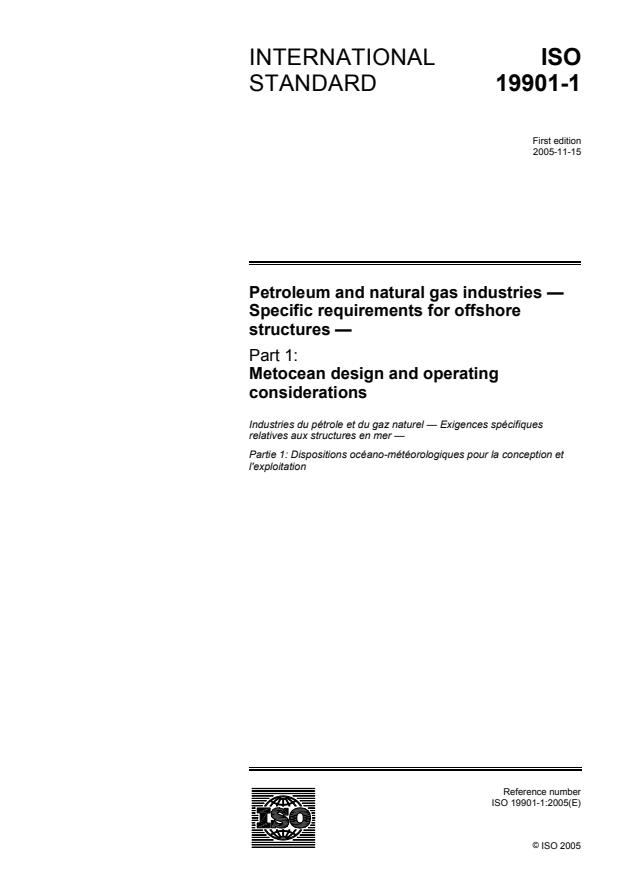
INTERNATIONAL ISO
STANDARD 19901-1
First edition
2005-11-15
Petroleum and natural gas industries —
Specific requirements for offshore
structures —
Part 1:
Metocean design and operating
considerations
Industries du pétrole et du gaz naturel — Exigences spécifiques
relatives aux structures en mer —
Partie 1: Dispositions océano-météorologiques pour la conception et
l'exploitation
Reference number
©
ISO 2005
PDF disclaimer
This PDF file may contain embedded typefaces. In accordance with Adobe's licensing policy, this file may be printed or viewed but
shall not be edited unless the typefaces which are embedded are licensed to and installed on the computer performing the editing. In
downloading this file, parties accept therein the responsibility of not infringing Adobe's licensing policy. The ISO Central Secretariat
accepts no liability in this area.
Adobe is a trademark of Adobe Systems Incorporated.
Details of the software products used to create this PDF file can be found in the General Info relative to the file; the PDF-creation
parameters were optimized for printing. Every care has been taken to ensure that the file is suitable for use by ISO member bodies. In
the unlikely event that a problem relating to it is found, please inform the Central Secretariat at the address given below.
© ISO 2005
All rights reserved. Unless otherwise specified, no part of this publication may be reproduced or utilized in any form or by any means,
electronic or mechanical, including photocopying and microfilm, without permission in writing from either ISO at the address below or
ISO's member body in the country of the requester.
ISO copyright office
Case postale 56 • CH-1211 Geneva 20
Tel. + 41 22 749 01 11
Fax + 41 22 749 09 47
E-mail copyright@iso.org
Web www.iso.org
Published in Switzerland
ii © ISO 2005 – All rights reserved
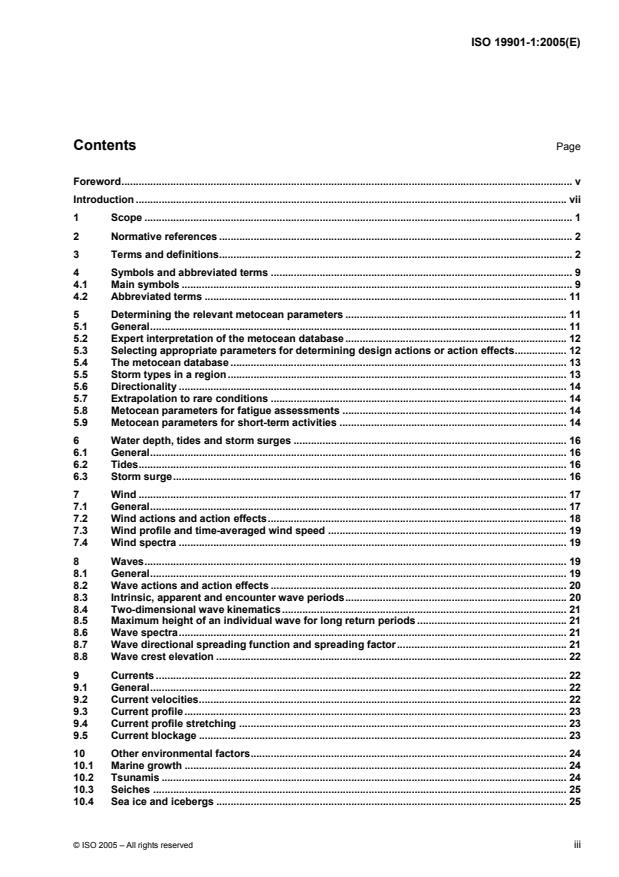
Contents Page
Foreword. v
Introduction . vii
1 Scope . 1
2 Normative references . 2
3 Terms and definitions. 2
4 Symbols and abbreviated terms . 9
4.1 Main symbols . 9
4.2 Abbreviated terms . 11
5 Determining the relevant metocean parameters . 11
5.1 General. 11
5.2 Expert interpretation of the metocean database . 12
5.3 Selecting appropriate parameters for determining design actions or action effects. 12
5.4 The metocean database . 13
5.5 Storm types in a region. 13
5.6 Directionality . 14
5.7 Extrapolation to rare conditions . 14
5.8 Metocean parameters for fatigue assessments . 14
5.9 Metocean parameters for short-term activities . 14
6 Water depth, tides and storm surges . 16
6.1 General. 16
6.2 Tides. 16
6.3 Storm surge. 16
7 Wind . 17
7.1 General. 17
7.2 Wind actions and action effects. 18
7.3 Wind profile and time-averaged wind speed . 19
7.4 Wind spectra . 19
8 Waves. 19
8.1 General. 19
8.2 Wave actions and action effects . 20
8.3 Intrinsic, apparent and encounter wave periods. 20
8.4 Two-dimensional wave kinematics . 21
8.5 Maximum height of an individual wave for long return periods . 21
8.6 Wave spectra. 21
8.7 Wave directional spreading function and spreading factor. 21
8.8 Wave crest elevation . 22
9 Currents . 22
9.1 General. 22
9.2 Current velocities. 22
9.3 Current profile . 23
9.4 Current profile stretching . 23
9.5 Current blockage . 23
10 Other environmental factors. 24
10.1 Marine growth . 24
10.2 Tsunamis . 24
10.3 Seiches . 25
10.4 Sea ice and icebergs . 25
10.5 Snow and ice accretion . 25
10.6 Miscellaneous. 25
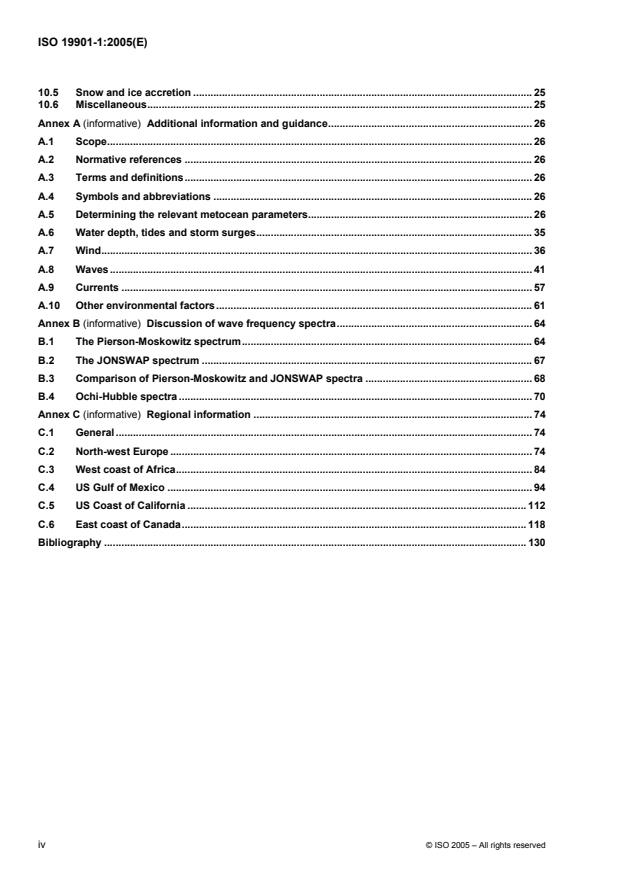
Annex A (informative) Additional information and guidance. 26
A.1 Scope. 26
A.2 Normative references . 26
A.3 Terms and definitions. 26
A.4 Symbols and abbreviations . 26
A.5 Determining the relevant metocean parameters. 26
A.6 Water depth, tides and storm surges. 35
A.7 Wind. 36
A.8 Waves. 41
A.9 Currents . 57
A.10 Other environmental factors. 61
Annex B (informative) Discussion of wave frequency spectra. 64
B.1 The Pierson-Moskowitz spectrum. 64
B.2 The JONSWAP spectrum . 67
B.3 Comparison of Pierson-Moskowitz and JONSWAP spectra . 68
B.4 Ochi-Hubble spectra . 70
Annex C (informative) Regional information . 74
C.1 General . 74
C.2 North-west Europe . 74
C.3 West coast of Africa. 84
C.4 US Gulf of Mexico . 94
C.5 US Coast of California . 112
C.6 East coast of Canada. 118
Bibliography . 130
iv © ISO 2005 – All rights reserved
Foreword
ISO (the International Organization for Standardization) is a worldwide federation of national standards bodies
(ISO member bodies). The work of preparing International Standards is normally carried out through ISO
technical committees. Each member body interested in a subject for which a technical committee has been
established has the right to be represented on that committee. International organizations, governmental and
non-governmental, in liaison with ISO, also take part in the work. ISO collaborates closely with the
International Electrotechnical Commission (IEC) on all matters of electrotechnical standardization.
International Standards are drafted in accordance with the rules given in the ISO/IEC Directives, Part 2.
The main task of technical committees is to prepare International Standards. Draft International Standards
adopted by the technical committees are circulated to the member bodies for voting. Publication as an
International Standard requires approval by at least 75 % of the member bodies casting a vote.
Attention is drawn to the possibility that some of the elements of this document may be the subject of patent
rights. ISO shall not be held responsible for identifying any or all such patent rights.
ISO 19901-1 was prepared by Technical Committee ISO/TC 67, Materials, equipment and offshore structures
for petroleum, petrochemical and natural gas industries, Subcommittee SC 7, Offshore structures.
ISO 19901 consists of the following parts, under the general title Petroleum and natural gas industries —
Specific requirements for offshore structures:
⎯ Part 1: Metocean design and operating considerations
⎯ Part 2: Seismic design procedures and criteria
⎯ Part 4: Geotechnical and foundation design considerations
⎯ Part 5: Weight control during engineering and construction
⎯ Part 7: Stationkeeping systems for floating offshore structures and mobile offshore units
The following parts are under preparation:
⎯ Part 3: Topsides structure
⎯ Part 6: Marine operations
ISO 19901 is one of a series of standards for offshore structures. The full series consists of the following
International Standards.
⎯ ISO 19900, Petroleum and natural gas industries — General requirements for offshore structures
⎯ ISO 19901 (all parts), Petroleum and natural gas industries — Specific requirements for offshore
structures
1)
⎯ ISO 19902, Petroleum and natural gas industries — Fixed steel offshore structures
1)
⎯ ISO 19903, Petroleum and natural gas industries — Fixed concrete offshore structures
1) To be published.
⎯ ISO 19904-1, Petroleum and natural gas industries — Floating offshore structures — Part 1: Monohulls,
2)
semi-submersibles and spars
⎯ ISO 19904-2, Petroleum and natural gas industries — Floating offshore structures — Part 2: Tension leg
3)
platforms
⎯ ISO 19905-1, Petroleum and natural gas industries — Site-specific assessment of mobile offshore
3)
units — Part 1: Jack-ups
⎯ ISO/TR 19905-2, Petroleum and natural gas industries — Site-specific assessment of mobile offshore
3)
units — Part 2: Jack-ups commentary
3)
⎯ ISO 19906, Petroleum and natural gas industries — Arctic offshore structures
2) To be published.
3) Under preparation.
vi © ISO 2005 – All rights reserved
Introduction
The series of International Standards applicable to types of offshore structure, ISO 19900 to ISO 19906,
constitutes a common basis covering those aspects that address design requirements and assessments of all
offshore structures used by the petroleum and natural gas industries worldwide. Through their application the
intention is to achieve reliability levels appropriate for manned and unmanned offshore structures, whatever
the type of structure and the nature or combination of the materials used.
It is important to recognize that structural integrity is an overall concept comprising models for describing
actions, structural analyses, design rules, safety elements, workmanship, quality control procedures and
national requirements, all of which are mutually dependent. The modification of one aspect of design in
isolation can disturb the balance of reliability inherent in the overall concept or structural system. The
implications involved in modifications, therefore, need to be considered in relation to the overall reliability of all
offshore structural systems.
The series of International Standards applicable to types of offshore structure is intended to provide a wide
latitude in the choice of structural configurations, materials and techniques without hindering innovation.
Sound engineering judgement is therefore necessary in the use of these International Standards.
The overall concept of structural integrity is described above. Some additional considerations apply for
metocean design and operating conditions. The term “metocean” is short for “meteorological and
oceanographic” and refers to the discipline concerned with the establishment of relevant environmental
conditions for the design and operation of offshore structures. A major consideration in the design and
operation of such a structure is the determination of actions on, and the behaviour of, the structure as a result
of winds, waves and currents.
Environmental conditions vary widely around the world. For the majority of offshore locations there are little
numerical data from historic conditions; comprehensive data often only start being collected when there is a
specific need, for example, when exploration for hydrocarbons is being considered. Despite the usually short
duration for which data are available, designers of offshore structures need estimates of extreme and
−2
abnormal environmental conditions (with an individual or joint probability of the order of 1 × 10 / year and
−3 −4
1 × 10 to 1 × 10 / year, respectively).
Even for areas like the Gulf of Mexico, offshore Indonesia and the North Sea, where there are up to 30 years
of fairly reliable measurements available, the data are insufficient for rigorous statistical determination of
appropriate extreme and abnormal environmental conditions. The determination of relevant design
parameters has therefore to rely on the interpretation of the available data by specialists, together with an
assessment of any other information, such as prevailing weather systems, ocean wave creation and regional
and local bathymetry, coupled with consideration of data from comparable locations. It is hence important to
employ specialists from both the metocean and structural communities in the determination of design
parameters for offshore structures, particularly since setting of appropriate environmental conditions depends
on the chosen option for the offshore structure.
This part of ISO 19901 provides procedures and guidance for the determination of environmental conditions
and their relevant parameters. Requirements for the determination of the actions on, and the behaviour of, a
structure in these environmental conditions are given in ISO 19901-3, ISO 19901-6, ISO 19901-7, ISO 19902,
ISO 19903, ISO 19904, ISO 19905 and ISO 19906.
Some background to, and guidance on, the use of this part of ISO 19901 is provided in informative Annex A.
The clause numbering in Annex A is the same as in the normative text to facilitate cross-referencing.
A discussion on wave spectra is provided in informative Annex B.
Regional information, where available, is provided in informative Annex C.
INTERNATIONAL STANDARD ISO 19901-1:2005(E)
Petroleum and natural gas industries — Specific requirements
for offshore structures —
Part 1:
Metocean design and operating considerations
1 Scope
This part of ISO 19901 gives general requirements for the determination and use of meteorological and
oceanographic (metocean) conditions for the design, construction and operation of offshore structures of all
types used in the petroleum and natural gas industries.
The requirements are divided into two broad types:
a) those that relate to the determination of environmental conditions in general, together with the metocean
parameters that are required to adequately describe them;
b) those that relate to the characterization and use of metocean parameters for the design, the construction
activities or the operation of offshore structures.
The environmental conditions and metocean parameters discussed comprise
⎯ extreme and abnormal values of metocean parameters that recur with given return periods that are
considerably longer than the design service life of the structure,
⎯ long-term distributions of metocean parameters, in the form of cumulative, conditional, marginal or joint
statistics of metocean parameters, and
⎯ normal environmental conditions that are expected to occur frequently during the design service life of the
structure.
Metocean parameters are applicable to
⎯ the determination of actions and action effects for the design of new structures,
⎯ the determination of actions and action effects for the assessment of existing structures,
⎯ the site-specific assessment of mobile offshore units,
⎯ the determination of limiting environmental conditions, weather windows, actions and action effects for
pre-service and post-service situations (i.e. fabrication, transportation and installation or decommissioning
and removal of a structure), and
⎯ the operation of the platform, where appropriate.
[1]
NOTE Specific metocean requirements for tension leg platforms are to be contained in ISO 19904-2 , for site-
[2] [3]
specific assessment of jack-ups in ISO 19905-1 , for arctic structures in ISO 19906 and for topsides structures in
[4]
ISO 19901-3 .
2 Normative references
The following referenced documents are indispensable for the application of this document. For dated
references, only the edition cited applies. For undated references, the latest edition of the referenced
document (including any amendments) applies.
ISO 19900, Petroleum and natural gas industries — General requirements for offshore structures
4)
ISO 19902, Petroleum and natural gas industries — Fixed steel offshore structures
ISO 19903, Petroleum and natural gas industries — Fixed concrete offshore structures
ISO 19904-1, Petroleum and natural gas industries — Floating offshore structures — Part 1: Monohulls, semi-
submersibles and spars
3 Terms and definitions
For the purpose of this document, the terms and definitions given in ISO 19900 and the following apply.
3.1
abnormal value
design value of a parameter of abnormal severity used in accidental limit state checks in which a structure is
intended not to suffer complete loss of integrity
−3 −4
NOTE Abnormal events have probabilities of the order of 10 to 10 per annum. In the limit state checks, some or
all of the partial factors are set to 1,0.
3.2
chart datum
local datum used to fix water depths on a chart or tidal heights over an area
NOTE Chart datum is usually an approximation to the level of the lowest astronomical tide.
3.3
conditional distribution
conditional probability
statistical distribution (probability) of the occurrence of a variable A, given that other variables B, C, … have
certain assigned values
NOTE The conditional probability of A given that B, C, … occur is written as P(A|B,C,…). The concept is applicable to
metocean parameters, as well as to actions and action effects.
EXAMPLE When considering wave parameters, A can be the individual crest elevation, B the water depth and C the
significant wave height, and so on.
3.4
design crest elevation
extreme crest elevation measured relative to still water level
NOTE The design crest elevation is used in combination with information on astronomical tide, storm surge, platform
settlement, reservoir subsidence and water depth uncertainty and is derived from an extreme value analysis. Because of
the simplified nature of the models used to estimate the kinematics of the design wave, the design crest elevation can be
different from, usually somewhat greater than, the crest elevation of the design wave used to calculate actions on the
structure.
4) To be published.
2 © ISO 2005 – All rights reserved
3.5
design wave
deterministic wave used for the design of an offshore structure
NOTE 1 The design wave is an engineering abstract. Most often it is a periodic wave with suitable characteristics (e.g.
height H, period T, steepness, crest elevation). The choice of a design wave depends on
⎯ the design purpose(s) considered,
⎯ the wave environment,
⎯ the geometry of the structure,
⎯ the type of action(s) or action effect(s) pursued.
NOTE 2 Normally, a design wave is only compatible with design situations in which the action effect(s) are quasi-
statically related to the associated wave actions on the structure.
3.6
extreme value
design value of a parameter used in ultimate limit state checks, in which a structure's global behaviour is
intended to stay in the elastic range
−2
NOTE Extreme events have probabilities of the order of 10 per annum.
3.7
gust
brief rise and fall in wind speed lasting less than 1 min
NOTE In some countries, gusts are reported in meteorological observations if the maximum wind speed exceeds
approximately 8 m/s.
3.8
gust wind speed
maximum value of the wind speed of a gust averaged over a short (3 s to 60 s) specified duration within a
longer (1 min to 1 h) specified duration
NOTE 1 For design purposes, the specified duration depends on the dimensions and natural period of the (part of the)
structure being designed such that the structure is designed for the most onerous conditions; thus, a small part of a
structure is designed for a shorter gust wind speed duration (and hence a higher gust wind speed) than a larger (part of a)
structure.
NOTE 2 In practice, for design purposes, the gust wind speeds for different durations (e.g. 3 s, 5 s, 15 s, 60 s) are
derived from the wind spectrum.
3.9
highest astronomical tide
HAT
level of high tide when all harmonic components causing the tides are in phase
NOTE The harmonic components are in phase approximately once every 19 years, but these conditions are
approached several times each year.
3.10
hindcasting
method of simulating historical (metocean) data for a region through numerical modelling
3.11
long-term distribution
probability distribution of a variable over a long time scale
NOTE The time scale exceeds the duration of a sea state, in which the statistics are assumed constant (see short-
term distribution in 3.29). The time scale is hence comparable to a season or to the design service life of a structure.
EXAMPLE Long-term distributions of
⎯ significant wave height,
⎯ significant wave height in the months May to September,
⎯ individual wave heights,
⎯ current speeds (such as for the vortex induced vibrations of drilling risers),
⎯ scatter diagrams with the joint distribution of significant wave height and wave period (such as for a fatigue analysis),
or
⎯ a particular action effect.
3.12
lowest astronomical tide
LAT
level of low tide when all harmonic components causing the tides are in phase
NOTE The harmonic components are in phase approximately once every 19 years, but these conditions are
approached several times each year.
3.13
marginal distribution
marginal probability
statistical distribution (probability) of the occurrence of a variable A that is obtained by integrating over all
values of the other variables B, C, …
NOTE The marginal probability of A for all values of B, C, … is written as P(A). The concept is applicable to metocean
parameters, as well as to actions and action effects.
EXAMPLE When considering wave conditions, A can be the individual crest elevation for all mean zero-crossing
periods B and all significant wave heights C, occurring at a particular site.
3.14
marine growth
living organisms attached to an offshore structure
3.15
mean sea level
MSL
arithmetic mean of all sea levels measured at hourly intervals over a long period, ideally 19 years
NOTE Seasonal changes in mean level can be expected in some regions and over many years the mean sea level
can change.
3.16
mean wind speed
time-averaged wind speed, averaged over a specified time interval
NOTE The mean wind speed varies with elevation above mean sea level and the averaging time interval; a standard
reference elevation is 10 m and a standard time interval is 1 h. See also sustained wind speed (3.37) and gust wind speed
(3.8).
4 © ISO 2005 – All rights reserved
3.17
mean zero-crossing period
average period of the (up or down) zero-crossing waves in a sea state
NOTE In practice the mean zero-crossing period is often estimated from the zeroth and second moments of the wave
spectrum as T==T mf mf = 2πm ω m ω .
() () () ()
z2 0 2 0 2
3.18
monsoon
wind which blows for several months approximately from one direction
NOTE The term was first applied to the winds over the Arabian Sea which blow for six months from north-east and
for six months from south-west, but it has been extended to similar winds in other parts of the world.
3.19
most probable maximum
value of the maximum of a variable with the highest probability of occurring
NOTE The most probable maximum is the value for which the probability density function of the maxima of the
variable has its peak. It is also called the mode or modus of the statistical distribution.
3.20
operating conditions
most severe combination of environmental conditions under which a given operation will be permitted to
proceed
NOTE Operating conditions are determined for operations that exert a significant action on the structure. Operating
conditions are usually a compromise: they are sufficiently severe that the operation can generally be performed without
excessive downtime, but they are not so severe that they have an undue impact on design.
3.21
polar low
depression that forms in polar air, often near a boundary between ice and sea
3.22
residual current
part of the total current that is not constituted from harmonic tidal components (i.e. the tidal stream)
NOTE Residual currents are caused by a variety of physical mechanisms and comprise a large range of natural
frequencies and magnitudes in different parts of the world.
3.23
return period
average period between occurrences of an event or of a particular value being exceeded
NOTE The offshore industry commonly uses a return period measured in years for environmental events. The return
period in years is equal to the reciprocal of the annual probability of exceedance of the event.
3.24
scatter diagram
joint probability of two or more (metocean) parameters
NOTE A scatter diagram is especially used with wave parameters in the metocean context, see A.5.8. The wave
scatter diagram is commonly understood to be the probability of the joint occurrence of the significant wave height (H )
s
and a representative period (T or T ).
z p
3.25
sea floor
interface between the sea and the seabed
[ISO 19901-4:2003]
3.26
sea state
condition of the sea during a period in which its statistics remain approximately constant
NOTE In a statistical sense the sea state does not change markedly within the period. The period during which this
condition exists is usually assumed to be three hours, although it depends on the particular weather situation at any given
time.
3.27
seabed
materials below the sea in which a structure is founded, whether of soils such as sand, silt or clay, cemented
material or of rock
NOTE The seabed can be considered as the half-space below the sea floor.
[ISO 19901-4:2003]
3.28
seiche
oscillation of a body of water at its natural period
3.29
short-term distribution
probability distribution of a variable within a short interval of time during which conditions are assumed to be
statistically constant
NOTE The interval chosen is most often the duration of a sea state.
3.30
significant wave height
statistical measure of the height of waves in a sea state
NOTE The significant wave height was originally defined as the mean height of the highest one-third of the zero up-
crossing waves in a sea state. In most offshore data acquisition systems the significant wave height is currently taken as
4 m (where m is the zeroth spectral moment, see 3.31) or 4σ, where σ is the standard deviation of the time series of
0 0
water surface elevation over the duration of the measurement, typically a period of approximately 30 min.
3.31
spectral moment
th
n spectral moment
integral over frequency of the spectral density function multiplied by the nth power of the frequency, either
∞
n
expressed in hertz (cycles per second) as mf() = f S(f)df or expressed in circular frequency
n
∞ ∫
n 0
(radians/second) as mS()ω = ωω()dω
n
∫
n
NOTE 1 As ω = 2 π f, the relationship between the two moment expressions is: m (ω ) = (2π) m (f).
n n
NOTE 2 The integration extends over the entire frequency range from zero to infinity. In practice the integration is often
truncated at a frequency beyond which the contribution to the integral is negligible and/or the sensor no longer responds
accurately.
3.32
spectral peak period
period of the maximum (peak) energy density in the spectrum
NOTE In practice there is often more than one peak in a spectrum.
6 © ISO 2005 – All rights reserved
3.33
spectral density function
energy density function
spectrum
measure of the variance associated with a time-varying variable per unit frequency band and per unit
directional sector
NOTE 1 Spectrum is a shorthand expression for the full and formal name of spectral density function or energy density
function.
NOTE 2 The spectral density function is the variance (the mean square) of the time-varying variable concerned in each
frequency band and directional sector. Therefore the spectrum is in general written with two arguments: one for the
frequency variable and one for a direction variable.
NOTE 3 Within this document the concept of a spectrum applies to waves, wind turbulence and action effects
(responses) that are caused by waves or wind turbulence. For waves, the spectrum is a measure of the energy traversing
a given space.
3.34
squall
strong wind event characterized by a sudden onset, a duration of the order of minutes and a rather sudden
decrease in speed
NOTE 1 A squall is often accompanied by a change in wind direction, a drop in air temperature and by heavy
precipitation.
NOTE 2 To be classed as a squall the wind speed would typically be greater than about 8 m/s and last for longer than
2 min (thereby distinguishing it from a gust).
3.35
still water level
abstract water level typically used for the calculation of wave kinematics for global actions and wave crest
elevation for minimum deck elevations
NOTE Still water level is an engineering abstract calculated by adding the effects of tides and storm surge to the
water depth but excluding variations due to waves (see Figure 1). It can be above or below mean sea level.
3.36
storm surge
change in sea level (either positive or negative) that is due to meteorological (rather than tidal) forcing
3.37
sustained wind speed
time-averaged wind speed with an averaging duration of 10 min or longer
3.38
swell
sea state in which waves generated by winds remote from the site have travelled to the site, rather than being
locally generated
3.39
tropical cyclone
closed atmospheric or oceanic circulation around a zone of low pressure that originates over the tropical
oceans
NOTE 1 The circulation is counter-clockwise in the northern hemisphere and clockwise in the southern hemisphere.
NOTE 2 At maturity, the tropical cyclone can be one of the most intense storms in the world, with wind speeds
exceeding 90 m/s and accompanied by torrential rain.
NOTE 3 In some areas, local terms for tropical cyclones are used. For example, tropical cyclones are typically referred
to as hurricanes in the Gulf of Mexico and North Atlantic, while in the South China Sea and NW Pacific they are called
typhoons. In the South Pacific and South Indian Ocean, however, they are commonly referred to as cyclones.
NOTE 4 The term cyclone is also used to refer to a tropical storm with sustained wind speeds in excess of 32 m/s
(Beaufort Force 12).
3.40
tsunami
long period sea waves caused by rapid vertical movements of the sea floor
NOTE The vertical movement of the sea floor is often associated with fault rupture during earthquakes or with
seabed mud slides.
3.41
water depth
vertical distance between the sea floor and still water level
NOTE 1 As there are several options for the still water level (see 3.35), there can be several water depth values.
Generally, design water depth is determined to LAT or to mean sea level.
NOTE 2 The water depth used for calculating wave kinematics varies between the maximum water depth of the highest
astronomical tide plus a positive storm surge, and the minimum water depth of the lowest astronomical tide less a negative
storm surge, where applicable. The same maximum and minimum water depths are applicable to bottom founded and
floating structures, although water depth is usually a much less important parameter for floating structures. Water depth is,
however, important for the design and analysis of the mooring system and risers for floating structures.
3.42
wave spectrum
measure of the amount of energy associated with the fluctuation of the sea surface elevation per unit
frequency band and per unit directional sector
NOTE 1 The wave frequency spectrum (integrated over all directions) is often described by use of some parametric
form such as the Pierson-Moskowitz or JONSWAP wave spectrum.
NOTE 2 The area under the wave spectrum is the zeroth spectral moment m , which is a measure of the total energy in
the sea state; m is used in contemporary definitions of the significant wave height.
3.43
wave steepness
characteristic of individual waves calculated as wave height divided by wave length
NOTE For periodic waves, the concept is straightforward as H / λ. For random waves, the definition is used with the
significant wave height (H ) and the wave length that corresponds with the peak period (T ) of the wave spectrum in deep
s p
water. The significant wave steepness is then defined as H / λ = H / [(g/2π) T 2] and is typically in the range of 1/16 to
s p s p
1/20 for severe sea states.
3.44
wind spectrum
measure of the variance associated with the fluctuating wind speed per unit frequency band
NOTE 1 The wind spectrum is an expression of the dynamic properties of the wind (turbulence). It reflects the
fluctuations about and in the same direction as a certain mean wind speed, usually the 1 h sustained wind speed. There is
hence no direction variable associated with the wind spectrum within this document.
NOTE 2 As the sustained wind speed varies with elevation, the wind spectrum is a function of elevation.
8 © ISO 2005 – All rights reserved
4 Symbols and abbreviated terms
4.1 Main symbols
A parameter in the Pierson-Moskowitz spectrum
B parameter in the Pierson-Moskowitz spectrum
c wave celerity (wave phase speed)
D(θ) wave directional spreading function
D(ω,θ) general form of the wave directional spreading function
d water depth
F (f;P1,P2) coherence function between turbulence fluctuations at P (x , y , z ) and at P (x , y , z )
coh 1 1 1 1 2 2 2 2
F normalizing (scaling) factor for the JONSWAP spectrum
n
F normalizing (scaling) factor for the swell spectrum
n,sw
F stretching factor
s
f frequency in cycles per second (hertz)
g acceleration due to gravity
H height of an individual wave
H breaking wave height
b
H maximum height of an individual wave having a return period of N years
N
H significant wave height
s
I (z) wind turbulence intensity at z m above mean sea level, see Equation (A.4)
u
k wave number = 2 π / λ
th
m n spectral moment (either in terms of f or ω). In particular, m is the zeroth spectral
n 0
moment and is equivalent to σ , the variance of the corresponding time series
S spectral density function, energy density function
S(f), S(ω) wave frequency spectrum
S(f, θ), S(ω, θ) directional wave spectrum
S general formulation of the spectrum for a sea state
gen
S JONSWAP spectrum for a sea state
JS
S Pierson-Moskowitz spectrum for a sea state
PM
S Ochi-Hubble spectrum for a total sea state consisting of a combination of two sea
OH
states with a general formulation (see Annex B)
S (f), S (ω) swell spectrum
sw sw
T wave period; also period in general
T standard reference time-averaging interval for wind speed of 1 h = 3 600 s
T apparent period of a periodic wave (to an observer in an earth bound reference frame)
a
T encounter period of a periodic wave (to an observer in a reference frame that moves
e
with respect to earth as well as the wave; the frame is usually fixed to a moving vessel)
T intrinsic period of a periodic wave (in a reference frame that is stationary with respect to
i
the wave, i.e. with no current present)
T modal or peak period of the spectrum
p
T mean zero-crossing period of the water surface elevation in a sea state
z
T mean period of the water surface elevation in a sea state, defined by the zero and first
order spectral moments
t time
U free stream current velocity
c
U surface current speed at z = 0
c0
U reference wind speed, U = 10 m/s
ref ref
U (z) current speed at elevation z (z u 0)
c
U (z,t) spatially and temporally varying wind speed at elevation z above mean sea level and at
w
time instant t
U (z) mean wind speed at elevation z above mean sea level averaged over a specified time
w
interval
U (z) 1 h sustained wind speed at elevation z above mean sea level
w,1h
U (z) sustained wind speed at elevation z above mean sea level, averaged over time interval
w,T
T < 1 h
U 1 h sustained wind speed at 10 m above mean sea level (the standard reference speed
w0
for sustained winds)
u (z,t) fluctuating wind speed at elevation z around U (z) and in the same direction as the
w w
mean wind
V component of the current velocity in-line with the direction of wave propagation
in-line
x,y,z coordinates of a right-handed orthogonal coordinate system with the xy-plane in the
undisturbed still water level (for waves and currents) or mean sea l
...
Questions, Comments and Discussion
Ask us and Technical Secretary will try to provide an answer. You can facilitate discussion about the standard in here.
Loading comments...