

ISO/IEC 13247:1997
(Main)Information technology — Telecommunications and information exchange between systems — Broadband Private Integrated Services Network — Inter-exchange signalling protocol — Basic call/connection control
General Information
- Abstract
- Status
- Published
- Publication Date
- 19-Nov-1997
- Current Stage
- 9093 - International Standard confirmed
- Start Date
- 23-May-2025
- Completion Date
- 29-Aug-2026
Buy Documents
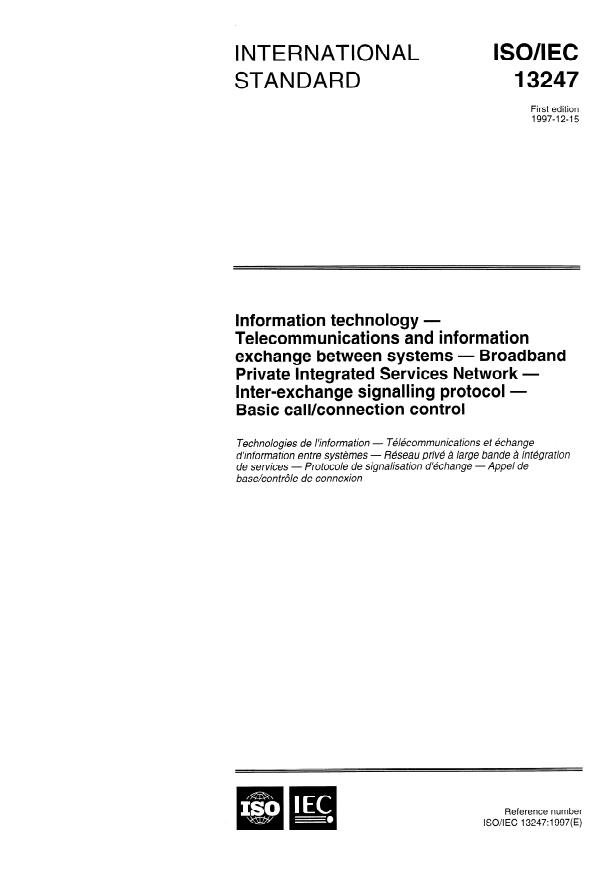
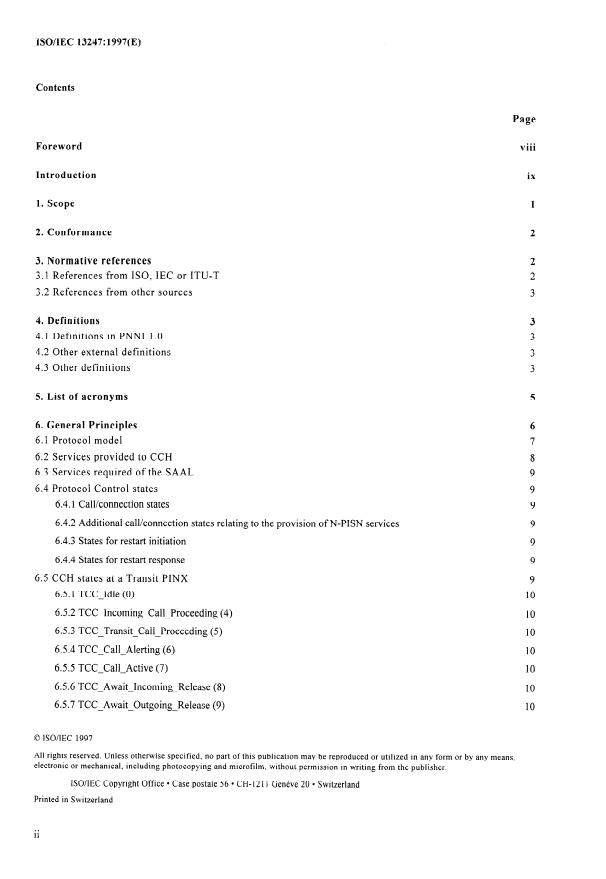
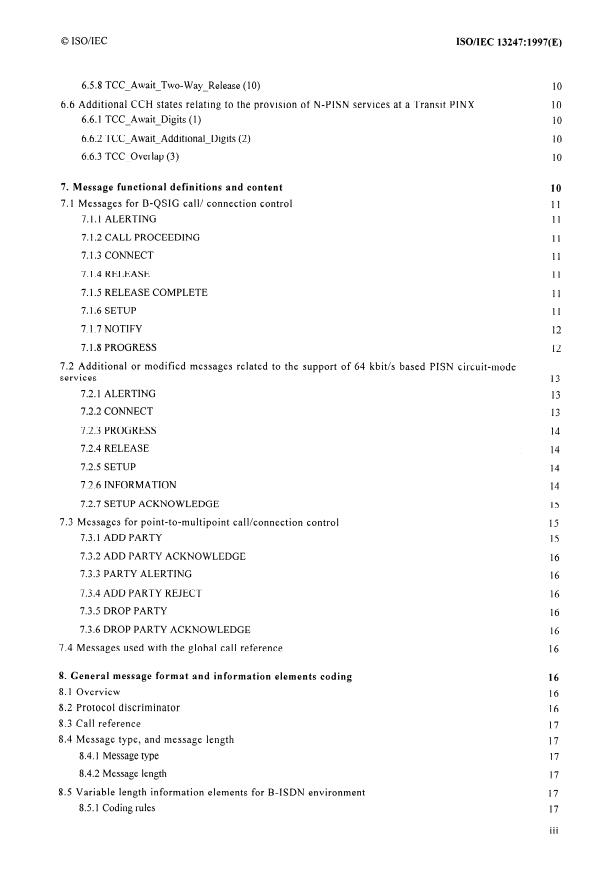
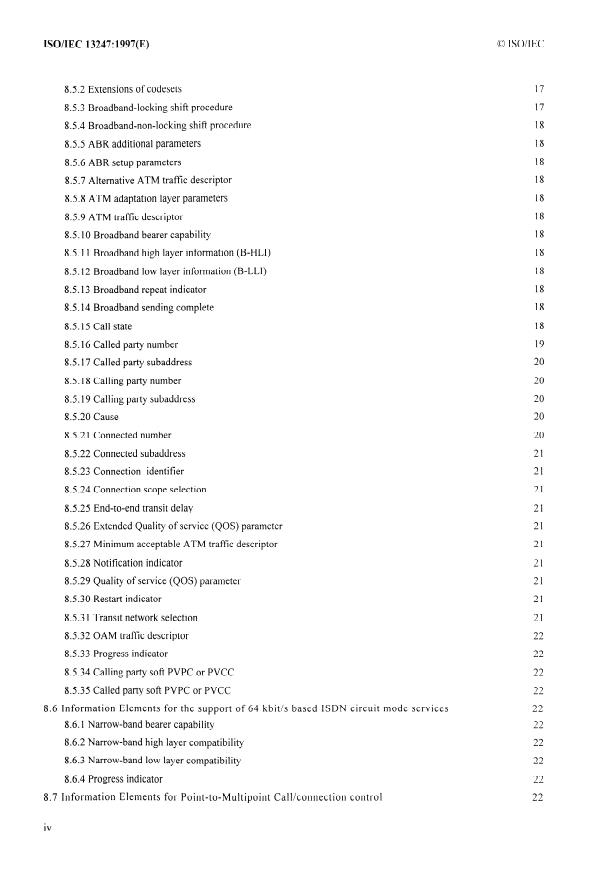
ISO/IEC 13247:1997 - Information technology — Telecommunications and information exchange between systems — Broadband Private Integrated Services Network — Inter-exchange signalling protocol — Basic call/connection control Released:11/20/1997
Overview
ISO/IEC 13247:1997 specifies the signalling protocol for basic call/connection control at the Q reference Point between Private Integrated Services Network Exchanges (PINXs) within a Broadband Private Integrated Services Network (B-PISN) using ATM. As part of the B-QSIG family, this International Standard defines message formats, states, information elements and procedures to establish, manage and clear point-to-point and point-to-multipoint virtual channel/virtual path connections.
Key topics and technical requirements
- Scope: Signalling at the Q reference Point for B-PISN inter-exchange control (B-QSIG-BC).
- Protocol model and states: Detailed protocol and call/connection state machines for PINX roles (Originating, Terminating, Transit, Gateway, Interworking).
- Message sets and IEs: ALERTING, SETUP, CONNECT, PROGRESS, RELEASE, ADD/DROP PARTY and related information elements for broadband and 64 kbit/s circuit-mode support.
- Traffic and QoS: Support for CBR, VBR (realtime/non-realtime), UBR, ABR, negotiation of ATM traffic descriptors and individual QoS parameters.
- Connection types: Demand (switched) VC/VP; point-to-point and point-to-multipoint; symmetric/asymmetric bandwidth.
- Interworking: Mapping and procedures for interworking with Narrow-band PISNs (N-PISN) and guidelines for interworking with ATM Forum PNNI 1.0 (based on ITU‑T Q.2931).
- Operational features: IPVCI negotiation, out-of-band signalling, error recovery, forward compatibility, ATM anycast addresses, soft PVPC/PVCC support.
- Conformance & testability: Protocol Implementation Conformance Statement (PICS) proforma (Annex A) and SDL representations (Annexes D, G, K).
Applications and who uses it
- Telecommunications equipment vendors implementing B-QSIG signalling stacks for ATM-based private networks.
- Network architects and operators designing enterprise or carrier private ATM networks (B-PISNs) seeking standardized inter-PINX signalling and QoS negotiation.
- Interoperability and test labs that perform conformance testing, PICS validation and protocol debugging.
- Systems integrators working on interworking between broadband and narrowband PISNs or integrating legacy 64 kbit/s circuit-mode services.
Related standards and references
- ISO/IEC 11579-1 (PINX reference configuration)
- ISO/IEC 13246 (Signalling AAL)
- ISO/IEC 11572, 11574 (PISN circuit-mode services)
- ITU‑T Q.2931 (B-ISDN signalling)
- ATM Forum PNNI 1.0 (source for signalling application)
- Annexes in ISO/IEC 13247: PICS, SDL models, mapping for 64 kbit/s interworking and PNNI interworking guidelines
Keywords: ISO/IEC 13247:1997, B-QSIG, B-PISN signalling, ATM signalling protocol, Q reference Point, call connection control, PINX, PNNI 1.0, ITU‑T Q.2931.
Relations
- Effective Date
- 06-Jun-2022
Buy Documents
ISO/IEC 13247:1997 - Information technology — Telecommunications and information exchange between systems — Broadband Private Integrated Services Network — Inter-exchange signalling protocol — Basic call/connection control Released:11/20/1997
Get Certified
Connect with accredited certification bodies for this standard

ANCE
Mexican certification and testing association.

Intertek Slovenia
Intertek testing, inspection, and certification services in Slovenia.

LNE (Laboratoire National de Métrologie et d'Essais)
French national laboratory for metrology and testing.
Sponsored listings
Frequently Asked Questions
ISO/IEC 13247:1997 is a standard published by the International Organization for Standardization (ISO). Its full title is "Information technology — Telecommunications and information exchange between systems — Broadband Private Integrated Services Network — Inter-exchange signalling protocol — Basic call/connection control". This standard covers: Information technology — Telecommunications and information exchange between systems — Broadband Private Integrated Services Network — Inter-exchange signalling protocol — Basic call/connection control
Information technology — Telecommunications and information exchange between systems — Broadband Private Integrated Services Network — Inter-exchange signalling protocol — Basic call/connection control
ISO/IEC 13247:1997 is classified under the following ICS (International Classification for Standards) categories: 33.040.35 - Telephone networks. The ICS classification helps identify the subject area and facilitates finding related standards.
ISO/IEC 13247:1997 has the following relationships with other standards: It is inter standard links to ISO 9773:1998/Amd 1:2003. Understanding these relationships helps ensure you are using the most current and applicable version of the standard.
ISO/IEC 13247:1997 is available in PDF format for immediate download after purchase. The document can be added to your cart and obtained through the secure checkout process. Digital delivery ensures instant access to the complete standard document.
Standards Content (Sample)
ISOAEC
INTERNATIONAL
STANDARD
First edition
1997-12-15
Information technology -
Telecommunications and information
exchange between Systems - Broadband
Private Integrated Services Network -
Inter-exchange signalling protocol-
Basic call/connection control
- T6kcommunications et khange
Technologies de I’informa tion
d ‘in forma tion en tre sys fernes - ßkseau priv6 6 /arge bande ti integration
- Protocole de signalisation d ’kchange - Appel de
de Services
basekon tr6le de connexion
Reference number
ISO/1 EC 13247: 1997(E)
ISWIEC 13247: 1997(E)
Contents
Page
. . .
Vlll
Foreword
ix
Introduction
1. Scope
2. Conformance
3. Normative references
3. W References from ISO, IEC or ITU-T
3.2 References from other sources
4. Definitions
4.1 Definitions in PNNI 1 .O
4.2 Other external definitions
4.3 Other definitions
5. List of acronyms
6. General Principles
6.1 Protocol model
6.2 Services provided to CCH
6.3 Services required of the SAAL
6.4 Protocol Control states
6.4. P Callkonnection states
6.4.2 Additional callkonnection states relating to the Provision of N-PISN Services
6.4.3 States for restart initiation
6.4.4 States for restart response
6.5 CCH states at a Transit PINX
6-5.1 TC@ Idle (0)
-
Incoming Cal1 Proceeding (4) 10
6.5.2 TCC
- - -
6.5.3 TCC Transit Cal1 Proceeding (5) 10
- - -
6.5.4 TCC Cal1 Alerting (6)
- -
6.5.5 TCC Cal1 Active (7)
- -
6.5.6 TCC Await Incoming Release (8) 10
- - -
Release (9)
6.5.7 TCC Await Outgoing 10
- - -
0 ISOAEC 1997
All rights reserved. Unless otherwise specified, no part sf this publication may be reproduced or utilized in any form or by any means,
electronie or mechanical, including ghotocogying and mncrofilm, without permission in writing from the publisher.
ISO/IEC Copyright Office l Case gostale 56 l CI-LI2ä X Geneve 20 Q Switzerland
Printed in Switzerland
ii
0 ISO/IEC ISO/IEC 13247: 1997(E)
6.5.8 TCC Await Two-Way Release (10) 10
- - -
6.6 Additional CCH states relating to the Provision of N-PISN Services at a Transit PINX 10
6.6.1 TCC Await Digits (1) 10
-
-
6.6.2 TCC Await Additional Digits (2) 10
- - -
6.6.3 TCC Overlap (3) 10
-
7. Message functional definitions and content 10
7.1 Messages for B-QSIG call/ connection control 11
7.1.1 ALERTING 11
7.1.2 CALL PROCEEDING
7.1.3 CONNECT 11
7.1.4 RELEASE
7.1.5 RELEASE COMPLETE 11
7.1.6 SETUP
7.1.7 NOTIFY 12
7.1.8 PROGRESS
7.2 Additional or modified messages related to the support of 64 kbit/s based PISN circuit-mode
Services
7.2.1 ALERTING 13
'7.2.2 CONNECT 13
7.2.3 PROGRESS 14
7.2.4 RELEASE 14
7.2.5 SETUP
7.2.6 INFORMATION 14
7.2.7 SETUP ACKNOWLEDGE 15
7.3 Messages for Point-to-multipoint call/connection control 15
7.3.1 ADD PARTY 15
7.3.2 ADD PARTY ACKNOWLEDGE 16
7.3.3 PARTY ALERTING 16
7.3.4 ADD PARTY REJECT 16
7.3.5 DROP PARTY 16
7.3.6 DROP PARTY ACKNOWLEDGE 16
7.4 Messages used with the global cal1 reference 16
8. General message format and information elements coding
8.1 Overview 16
8.2 Protocol discriminator
8.3 Cal1 reference 17
8.4 Message type, and message length 17
8.4.1 Message type 17
8.4.2 Message length 17
8.5 Variable length information elements for B-ISDN environment 17
8.5.1 Coding rules 17
. . .
0 lSO/IEC
ISOAEC 13247: 1997(E)
8.5.2 Extensions of Codesets
8.5.3 Broadband-locking shift procedure
8.5.4 Broadband-non-locking shift procedure
8.5.5 ABR additional Parameters
8.5.6 ABR setup Parameters
8.5.7 Alternative ATM traffit descriptor
8.5.8 ATM adaptation layer Parameters
8.5.9 ATM traffit descriptor
8.5.10 Broadband bearer capability
8.5.11 Broadband high layer information (B-HLI)
8.5.12 Broadband low layer information (B-LLI)
8.5.13 Broadband repeat indicator
8.5.14 Broadband sending complete
8.5.15 Cal1 state
8.5.16 Called Party number
8.5.17 Called Party subaddress
8.5.18 Calling Party number
8.5.19 Calling Party subaddress 20
8.5.20 Cause
8.5.2 1 Connected number
8.5.22 Connected subaddress
8.5.23 Connection identifier
8.5.24 Connection scope selection
8.5.25 End-to-end transit delay
8.5.26 Extended Quality of Service (QOS) Parameter
8.5.27 Minimum acceptable ATM traffit descriptor
8.5.28 Notification indicator
8.5.29 Quality of Service (QOS) Parameter
8.5.30 Restart indicator
8.5.3 1 Transit network selection 21
8.5.32 OAM traffit descriptor
8.5.33 Progress indicator 22
8.5.34 Calling Party soft PVPC or PVCC
8.5.35 Called Party soft PVPC or PVCC 22
8.6 Information Elements for the support of 64 kbit/s based ISDN circuit mode services
8.6.1 Narrow-band bearer capability
8.6.2 Narrow-band high layer compatibility 22
8.6.3 Narrow-band low layer compatibility
8.6.4 Progress indicator 22
8.7 Information Elements for Point-to-Multipoint CalUconnection control
ISO/IEC 13247: 1997(E)
0 ISO/IEC
9. Protocol control procedures for B-QSIG Point-to-Point calls/connections
9.1 Establishment of a signalling AAL
CallKonnection establishment
9.2
9.2. I Handling of a PROGRESS message
9.2.2 CalVconnection failure
9.3 Call/Connection Clearing
9.4 Call/connection collisions
9.5 Restart procedure
9.6 Handling of error conditions
message
9.6.1 Sending a STATUS
9.6.2 Determination of protocol state compatibility on receipt of a STATUS message containing a cal1 reference
other than the global cal1 reference
9.7 Error procedures with explicit action indication
9.8 Handling of messages with insufficient information
9.9 Notification procedures
9.10 Notification of interworking
9.11 List of Timers
10. Call/connection Controi Procedures for Point-to-Multipoint Calls
11. Procedures for the support of 64 kbit/s based circuit mode basic Services in B-PISN and
interworking between N-PISNs and B-PISNs
1 f . P Introduction
11.2 Use of information elements for N-PISN Services
11.2.1 General aspects
11.2.2 Bearer Service related information
11.2.3 Low layer related information
11.2.4 Higher layer related information
11.25 Handling of inconsistent combination of Service Parameters
11.3 Interworking PINX procedures for the succeeding side
11.3.1 Mapping of Service related information
11.3.2 Mapping of Cause information
11.4 Interworking PINX procedures for the precedincr side
11.4.1 General aspects
11.4.2 Mapping of Service related information
11.4.3 Mapping of Cause information
11.5 Overlap sending
11.51 Preceding side procedures
11.5.2 Succeeding side procedures
11.6 Notification of interworking
11.7 Tones and announcements
I 1.7.11 Tones and announcements during cal1 establishment
and announcements are provided
11.7.2 Clearing when tones
0 ISO/IEC
ISO/IEC 13247: 1997(E)
12. Callkonnection handling requirements
12.1 Transit PINX call/connection handling requirements
12.1.1 Receipt of SETUP message
12.1.2 Channel through connection procedures
12.1.3 State TCC Tncoming Cal1 Proceeding
-
- -
Proceeding
12.1.4 State TCC Transit Cal1
- -
-
12.1.5 State TCC Cal1 Alerting
- -
12.1.6 State TCC Cal1 Active
- -
12.1.7 Clearing at a Transit PINX
12.1.8 Additional procedures for N-PISN interworking
12.1.9 Handling of basic cal1 information elements at a Transit PINX
12.1.10 Notifications
12.2 Originating PINX call/connection handling requirements
12.2.1 Transmission of the SETUP message
12.2.2 Connection to the user plane virtual channel
12.2.3 Receipt of an ALERTING message
12.2.4 Receipt of a CONNECT message
12.2.5 Receipt of PROGRESS message
12.2.6 Notifications
12.2.7 CalVconnection Clearing initiated by the Originating PINX
12.2.8 Receipt of an indication of call/connection Clearing
12.3 Terminating PINX call/connection handling requirements
12.3.1 Receipt of the SETUP message
12.3.2 Transmission of an ALERTING message
12.3.3 Transmission of a CONNECT message
12.3.4 Notifications
12.3.5 CalI/connection Clearing initiated by the Terminating PINX
12.3.6 Receipt of an indication of call/connection Clearing
12.4 Incoming Gateway PINX call/connection handling requirements
12.4.1 Transmission of the SETUP message
12.4.2 Connection of the user plane virtual channel
12.4.3 Receipt of ALERTING imessage 45
12.4.4 Receipt of CONNECT message
12.4.5 Receipt of PROGRESS message 45
12.4.6 Notifications
12.4.7 CaWconnection Clearing initiated by the Gateway PINX 45
12.4.8 Receipt of an indication of call/connection Clearing
12.5 Outgoing Gateway PINX call/connection handling requirements
12.5.1 Receipt of the SETUP message
12.5.2 Connection of the user plane virtual channel 46
12.5.3 Transmission of ALERTING message
0 ISO/IEC ISO/IEC 13247: 1997(E)
12.54 Transmission of CONNECT message
12.5.5 Transmission of PROGRESS message 46
12.56 Notifcations
12.5.7 Call/connection Clearing initiated by the Gateway PINX 46
12.5.8 Receipt of an indication of call/connection Clearing
12.6 Interworking PINX call/connection handling requirements for N-PISN -> B-PISN
interworking
12.6.1 Transmission of the SETUP message 47
12.6.2 Connection of the user plane virtual channel
12.6.3 Receipt of progress indicators 47
12.6.4 Receipt sf CONNECT message
12.6.5 CalVconnection Clearing initiated by the interworking PINX 47
12.7 Interworking PINX call/connection handling requirements for B-PISN -> N-PISN
interworking
12.7.1 Receipt of the SETUP message 48
12.7.2 Transmission of progress indications 48
12.7.3 Transmission of CONNECT message
12.7.4 CalVconnection Clearing initiated by the Interworking PINX 48
Annex A - Prstocol Implementation Conformance Statement (PICS) proforma
Annex B - Soft permanent virtual connection procedures
Annex C - Mapping functions to support 64 kbit/s based circuit-mode PISN Services in
B-PISNs and interworking between N-PISNs and B-PISNs (QSIG/B-QSIG) 73
Annex D - Specification and Description Language (SDL) representation of protocol control
procedures
Annex E - Guidelines for the use of instruction indicators
- Description of the capabilities supported by the protocol defined in this
Annex F
International Standard 119
Annex G - Specification and Description Language (SDL) representation of CCH at a
Transit PINX and at an Interworking PINX
Annex H - Manufacturer specific information
Annex 1 - Possible strategies for avoidance of IPVCI collisions
Annex J - Differentes between this International Standard and PNNI 1.0 137
Annex K - Specification and Description Language (SDL) representation of point-to-
multipoint procedures 838
Annex L - Guidelines for interworking with ATM Forum PNNI I.0 Y40
vii
ISO/IEC 13247: 1997(E) 0 ISO/IEC
Foreword
ISO (the International Organization for Standardization) and IEC (the International Electrotechnical Commission) form
the specialized System for worldwide standardization. National bodies that are members of ISO or IEC participate in the
development of International Standards through technical committees established by the respective organization to deal
with particular fields of technical activity. ISO and IEC technical committees collaborate in Felds of mutual interest.
Other international organizations, govemmental and non-govemmental, in liaison with ISO and IEC, also take part in
the work.
In the field of information technology, ISO and IEC have established a joint technical committee, ISO/IEC JTC I . Draft
International Standards adopted by the Joint technical committee are circulated to national bodies for voting. Publication
as an International Standard requires approval by at least 75 % of the national bodies casting a vote.
International Standard ISO/IEC 13247 was prepared by Joint Technical Committee ISO/IEC JTC 1, Information
technology, Subcommittee SC 6, Telecommunications and information exchange between Systems.
Annexes A and B form an integral part of this International Standard. Annexes C to L are for information only.
0.0
VllP
0 ISOAEC ISO/IEC 13247: 1997(E)
Introduction
This International Standard is one of a series of International Standards def-ining Services and signalling protocols
applicable to Broadband Private Integrated Services Networks (B-PISNs). The series uses B-ISDN concepts as
developed by ITU-T and conforms to the fiamework of International Standards for Open Systems Interconnection as
defined by ISOAEC.
This particular International Standard specifies the signalling protocol for use at the Q reference Point for basic
call/connection control (B-QSIG-BC).
iX
This page intentionally left blank
INTERNATIONAL STANDARD 0 ISO/IEC ISO/IEC 13247: 1997(E)
Information technology - Telecommunications and information exchange
between Systems - Broadband Private Integrated Services Network -
Inter-exchange signalling protocol- Basic call/connection control
1 Scope
This International Standard defines the signalling protocol for the purpose of basic call/connection control at the Q
reference Point between Private Integrated Services Network Exchanges (PINXs) connected together within a
Broadband Private Integrated Services Network (B-PISN) employing Asynchronous Transfer Mode (ATM). This
International Standard is gart of the B-QSIG signalling System.
The Q reference Point is defined in ISO/IEC 11579-1.
This International Standard is an application of the signalling protocol that forms part of the ATM Forum ’s PNNI 1 .O
specification, which in turn is based on ITU-T Recommendation 4.293 1, including the provisions for symmetrical
Operation described in annex H of recommendation Q.293 1. Technical differentes compared with the signalling
protocol specified in PNNI 1 .O are summarized in annex J. Guidelines for interworking between a network employing
the signalling protocol specified in this International Standard and a network employing the ATM Forum ’s PNNI 1.0
specification are given in annex L.
This International Standard is applicable to PINXs which interconnect to form a B-PISN using static hop-by-hop
routeing. It therefore complements the ATM Forum ’s PNNI 1.0 specification, which is applicable to networks that
employ dynamic Source routeing.
The basic capabilities supported by the protocol specified in this International Standard are listed below and described
in more detail in annex F:
- demand (switched) virtual channel and virtual path connections;
- Point-to-Point switched virtual channel and virtual path connections;
- Point-to-multipoint virtual channel connections;
-
connections with symmetric or asymmetric bandwidth requirements;
-
Single-connection (Point-to-Point) calls;
- basic signalling functions via protocol messages, information elements, and procedures;
- CBR, VBR (realtime and non-realtime), UBR and ABR Service categories;
-
negotiation of certain signalling Parameters;
-
inter-PINX virtual channel identifier (IPVCI) negotiation;
-
out-of-band signalling for all signalling messages;
- error recovery;
- B-PISN addressing formats;
-
end-to-end compatibility Parameter identification;
-
signalling interworking with N-PISN and Provision of N-PISN Services;
- forward compatibility;
- call/connection handling at different types of PINX, including Transit PINX, Originating PINX, Terminating PINX,
Incoming Gateway PINX, Outgoing Gateway PINX and Interworking PINX;
- Signalling of individual QOS Parameters
- ATM anycast addresses
- Negotiation of ATM traffit descriptors
0 ISO/IEC
ISO/IEC 13247: 1997(E)
- Soft PVPC and PVCC support
Generic Identifier Transport
Conformance
In Order to conform to this International Standard, a PINX shall satisfy the requirements identified in the Protocol
Implementation Conformance Statement (PICS) proforma in annex A.
3 Normative references
References from ISO, IEC or ITU-T
31 .
through reference in this text, constitute provisions of this
The following Standards contain provisions which,
International Standard. At the time of publication, the editions indicated were valid. All Standards are subject to
revision, and Parties to agreements based on this International Standard are encouraged to investigate the possibility of
applying the most recent editions of the Standards indicated below. Members of IEC and ISO maintain registers of
currently valid International Standards.
- Open Systems Interconnection - Network Service Definition.
ISO/IEC 8348: 1996, Information technology
Open Systems Interconnection - Conformance testing methodology
ISO/IEC 9646- 1: 1994, Information technology -
andframework - Part 1: General concepts.
ISO/IEC 9646-7: 1995, Information technology - Open Systems Interconnection - Conformance testing methodology
andframework - Part 7: Implementation Conformance Statements.
Telecommunications and information exchange between Systems -
ISO/IEC 1157 1: 1994, Information technology -
Numbering and sub-addressing in private integrated Services networks.
ISO/IEC 11572: 1997, Information technology - Telecommunications and information exchange between Systems -
Private Integrated Services Network - Circuit mode bearer Services - Inter-exchange signalling procedures and
protocol.
ISO/IEC 11574: 1994, Information technology - Telecommunications and information exchange between Systems -
Circuit-mode 64 kbit/s bearer Services - Service description, functional
Private Integrated Services Network -
capabilities and informationflows.
ISO/IEC 11584: 1996, Information technology - Telecommunications and information exchange between Systems -
- Service description, functional
Private Integrated Services Network - Circuit-mode multi-rate bearer Services
capabilities and informationflows.
ISO/IEC 11579- 1: 1994, Information technology - Telecommunications and information exchange between Systems --
Private integrated Services network - Part 1: Reference configuration for PISN exchanges (PINX).
ISO/IEC 13246: 1997, Information technology - Telecommunications and information exchange between Systems -
Broadband Private Integrated Services Network - Inter-exchange signalling protocol - Signalling ATM adaptation
layer.
CCITT Rec. E. 164: 199 1, Numbering plan for the ISDN era.
CCITT Rec. 1.112: 1988, Vocabulary of terms for ISDNs (Blue Book).
CCITT Rec. 1.330: 1988, ISDN numbering and addressingprinciples (Blue Book).
CCITT Rec. Q.9: 1988, Vocabulary of switching and signalling terms (Blue Book).
CCITT Rec. 2.100: 1988, SpeciJication and Description Language (Blue Book).
ITU-T Rec. 1.32 I : 199 1, B-ISDNprotocol reference model and its application.
ITU-T Rec. 1.363:1996, B-ISDN ATM adaptation layer (AAL) specification.
ITU-T Rec. 1.37 1: 1996, Traffit control and congestion control in B-ISDN.
ITU-T Rec. 1.6 IO: 1994, B-ISDN Operation and maintenance principles andfunctions.
ITU-T Rec. Q.293 I : 1995, Broadband Integrated Services Digital Network (B-ISDN) - Digital Subscriber Signalling
User-Network Interface (UNI) layer 3 specification for basic call/connection control.
System No. 2 (DSSZ) -
ISO/IEC 13247: 1997(E)
0 ISO/IEC
ITU-T Rec. 4.297 I : 1996, Broadband Integrated Services Digital Network (B-ISDN) - Digital Subscriber Signalling
User-Network Interface (UNI) layer 3 specification for Point-to-multipoint caU/connection
System No. 2 (DSSZ) -
control.
References from other sources
32 .
All references in this subclause were correct at the time of approval of this International Standard. The provisions of the
referenced specifications, as identified in this subclause, are valid within the context of this 1s. The reference to a
specification within this IS does not give it any further Status within ISO/IEC; in particular, it does not give the
referenced specification the Status of an International Standard.
ATM Forum PNNI 1 .O: 1996, Private Network-Network Interface Specification Version 1.0 (af-pnni-0055.000).
ATM Forum UNI 4.0: 1996, User-Network Interface (UN4 Signalling Specification Version 4.0 (af-sig-0061.000)
4 Definitions
For the purposes of this International Standard, the following definitions apply.
41 . Definitions in PNNI 1.0
References contained in sections 2.2 and 6.1 of PNNI 1 .O are applicable with the exception of the definitions applicable
to the routing sections of PNNI 1 .O and with the exception of terms for which there are replacement definitions in 4.2
and 4.3 of this International Standard.
Where text of PNNI 1 .O is referenced from this International Standard, terms used within the referenced text shall be
interpreted a shown in Table 1.
Table 1 - Interpretation of PNNI terms
Term used in PNNI referenced text Interpretation for the purposes of this
International Standard
PTNX
network node
I
I
cal1 call/connection
I I I
logical link inter-PINX link (IPL)
I I
physical link inter-PINX link (IPL)
I I
virtual channel identifier (VCI) inter-PINX virtual channel identifier (IPVCI)
I I
virtual path identifier (VPI) inter-PINX virtual path identifier (IPVPI)
I
I I
PNNI interface inter-PINX link (IPL)
I I
PNNI link inter-PINX link (IPL)
I I
42 . Other external definitions
This International Standard uses the following terms defined in other documents:
- ATM transfer capability (ATC) (ITU-T Rec. 1.371)
(CCITT Rec. Q.9)
- connection
- FS (ITU-T Rec. 1.610)
- private integrated Services network (PISN) (ISO/IEC 11579-1)
- private integrated Services network exchange (PINX) (ISO/IEC 11579-1)
-
signahing (CCITT Rec. 1.112)
-
(CCITT Rec. 1.321)
user plane
43 . Other definitions
4.3.1 ATM endsystem address: the address of a Point of attachment to an ATM network.
4.3.2 broadband private integrated Services network (B-PISN): a PISN that offers ATM Services to its users and
0 ISO/IEC
ISO/IEC 13247: 1997(E)
employs ATM transmission between PINXs and ATM switching.
4.3.3 caII: an association between two or more users for the use or attempted use of a telecommunication Service.
4.3.4 call/connection: a cal1 combined with a Single connection in the user plane for the transfer of user information.
of signalling the called number information in which all called number digits are
4.3.5 en bloc: a method
Party Pa*Y
sent in the first message.
4.3.6 gateway PINX: within the context of a call/connection, a PINX which performs interworking between B-QSIG
and another signahing System.
4.3.7 incoming call/connection: a call/connection using an IPL from the Point of view sf the succeeding side of that
IPL.
4.3.8 incoming gateway PINX: a Gateway PINX that routes a call/connection from a route employing another
signahing System on to an IPL employing B-QSIG signalling. (See Figure 1.)
4.3.9 information element: a component of a message.
4.3.10 information element with invalid contents: an information element that is recognized, but whose contents
cannot be interpreted as valid using the rules specified in clause 8 of this International Standard, or that contains field
values that are marked as ((reserved» in clause 8 of this International Standard.
4.3.11 inter-PINX link (IPL): a link between the Q reference Points of two PINXs, the link comprising a signahing
IPVC together with one or more user information IPVCs under the control sf that signalling IPVC.
4.3.12 inter-PINX virtual channel (IPVC): one of a number of bi-directional transfers of digital information,
multiplexed at the ATM layer, between two PINXs.
NOTE 1. An IPVC tan be a Single virtual channel or a concatenation of virtual channels.
4.3.13 inter-PINX virtual channel identifier (IPVCI): an integer that identifies an IPVC within the context of an
IPVP.
4.3.14 inter-PINX virtual path (IPVP): a grouping of one or more IPVCs within a Single IPL.
4.3.15 inter-PINX virtual path identifier (IPVPI): an integer that identifies an IPVP within the context of an IPL.
4.3.16 interworking PINX: within the context of a call/connection, a PINX that performs interworking between a
B-PISN and a N-PISN.
NOTE 2. An interworking PINX will also be either an Originating PINX, a Terminating PINX or a Gateway PINX.
4.3.17 narrow-band private integrated Services network (N-PISN): a PISN that offers only 64 kbit/s-based Services
to its users.
4.3.18 originating PINX: within the context of a call/connection, the PINX to which the calling user is attached. (See
Figure 1.)
4.3.19 outgoing call/connection: a call/connection using an IPL from the Point of view of the preceding side of that
IPL.
4.3.20 outgoing gateway PINX: a Gateway PINX that routes an incoming call/connection f?om an IPL employing
B-QSIG signalling on to a route employing another signalling System. (See Figure 1.)
4.3.21 overlap: a method of signalling the called Party number information in which no& all called Party number
information is sent in the same message.
4.3.22 preceding PINX: within the context of a call/connection using an IPL, the PINX to which the preceding side of
the IPL belongs, from the Point of view of the PINX to which the succeeding side of the IPL belongs.
4.3.23 preceding side: in the context of a call/connection using an IPL, the side that initiates call/connection
establishment over that IPL. (See Figure 1.)
4.3.24 public broadband ISDN (public B-ISDN): a public ISDN that offers ATM Services to its users and employs
ATM transmission and switching.
4.3.25 public integrated Services digital network (public ISDN): a network that provides to the general public a
range of different telecommunication Services using digital connections.
4.3.26 public narrow-band ISDN (public N-ISDN): a public ISDN that offers to the general public only 64 kbit/s-
based Services.
ISO/IEC 13247: 1997(E)
0 ISO/IEC
4.3.27 side: the Protocol Control entity in a PINX at one end of an IPL.
4.3.28 signalling AAL (SAAL): the AAL used for the bi-directional transfer of layer 3 signalling information.
4.3.29 succeeding PINX: within the context of a callkonnection using an IPL, the PINX to which the succeeding side
of the IPL belongs, from the Point of view of the PINX to which the preceding side of the IPL belongs.
4.3.30 succeeding side: in the context of a callkonnection using an IPL, the opposite side from the side that initiates
callkonnection establishment over that IPL. (See Figure 1.)
4.3.31 terminating PINX: within the context of a callkonnection, the PINX to which the called user is attached. (See
Figure 1.)
4.3.32 transit PINX: within the context of a callkonnection, any PINX through which the calkonnection Passes,
excluding any Originating PINX, Terminating PINX, Incoming Gateway PINX or Outgoing Gateway PINX. (See
Figure 1.)
4.3.33 unexpected message: within the context of a particular Protocol Control state, a message that is recognized, but
for which no procedures are defined in 9.6 of this International Standard (or in any other Standard relating to B-QSIG to
which the PINX Claims conformance) for receipt in that Protocol Control state.
4.3.34 unrecognized information element: an information element received in a particular message which is not
specified as part of that message in clause 7 of this International Standard or in any other Standard relating to B-QSIG to
which the PINX Claims conformance (e.g., a Standard specifying generic procedures for supplementary Services).
NOTE 3. The handling of national/private information elements is outside the scope of this International Standard (see annex H).
4.3.35 unrecognized message: a message that is not specified in clause 7 of this International Standard or in any other
Standard relating to B-QSIG to which the PINX Claims conformance (e.g., a Standard specifling generic procedures for
supplementary Services).
NOTE 4, The handling of national/private messages is outside the scope of this International Standard (see annex H).
4.3.36 unspecified bit rate (UBR): an ATM Service category for which no traffit-related Service guarantees are
specified.
4.3.37 virtual channel: one of a number of multiplexed, bi-directional transfers of digital data provided by the ATM
layer across an Interface between two ATM switching Points.
4.3.38 virtual channel connection: a concatenation of virtual channels that extends between two Points where the
ATM adaptation layer is accessed.
Backward direction
Transit PINX
Originating PINX (succeeding PINX with respect to the Terminating PINX
or Incoming Gateway PINX Originating or Incoming Gateway PINX) or Outgoing Gateway PINX
(preceding PINX with (preceding PINX with respect to the (succeeding PINX with
respect to the Transit PINX) Terminating or Outgoing Gateway PINX) respect to the Transit PINX)
hter-PI NX Link Inter-PINX Link
/
Preceding Succeeding Preceding Succeeding
Side Side Side Side
Figure l- Illustration of terminology through examgle of a callkonnection routed over two inter-
PINX links
5 List of acronyms
Abbreviations contained in section 2.1 of ATM Forum? PNNI 1 .O are applicable with the following additions and/or
0 ISO/IEC
HSOIIEC 13247: 8997(E)
replacements:
ATC ATM transfer capability
B-BC Broadband bearer capability
B-HL1 Broadband high layer information
B-ISDN Broadband ISDN
B-LLI Broadband low layer information
B-PISN Broadband PISN.
Broadband Connection Orientated Bearer class
BCOB
CCH Call/connection handling
CPCS Common Part Convergence Sublayer (of AAL)
DSS2 Digital Subscriber Signalling System Number 2
DTL designated transit list
IE Information Element
IPL Inter-PINX Link
IPVC Inter-PINX Virtual Channel
IPVCI Inter-PINX Virtual Channel Identifier
Inter-PINX Virtual Path
IPVP
IPVPI Inter-PINX Virtual Path Identifer
ISDN Integrated Services Digital Network
MP Mapping (functional grouping)
N-ISDN Narrow-band ISDN
N-PISN Narr-OW-band PISN
N-BC Narrow-band bearer capability
N-HLC Narrow-band high layer compatibility
N-EL@ Narrow-band low layer compatibility
OAM Operations, Administration and Maintenance
Protocol Implementation Conformance Statement
PICS
PISN Private Integrated Services Network
PINX Private Services Network Exchange
PSSB Private Signalling System Number 1
Quality Of Service
QOS
SDL Specification and Description Language
SDU Service Data Unit
6 General Principles
This International Standard specifies the layer 3 signalling procedures operating within the control plane for
establishing, maintaining and Clearing a broadband basic call/connection across an inter-PINX link (IPL). These
signalling procedures are defined in terms of messages exchanged over a Signalling ATM Adaptation Layer (SAAL)
connection within the signalling inter-PINX virtual channel (IPVC) of the IPL. The result of successful basic
call/connection establishment is a virtual channel connection within the user plane for the purpose of user information
transfer. This virtual channel connection uses an IPVC other than the signalling IPVC within the Inter-PINX link.
Conceptually, an IPL is attached to a PINX at the Q-reference Point and comprises a signalling IPVC and one or more
user information IPVCs. User information IPVCs are grouped into one or more inter-PINX virtual paths (IPVPs). A user
0 ISO/IEC ISO/IEC 13247: 1997(E)
information IPVC is uniquely identified within the context of an IPL by the combination of its inter-PINX virtual path
identifier (IPVPI) and its inter-PINX virtual channel identifier (IPVCI).
NOTE 5. For example, an IPVP might comprise those IPVCs tbat share a co99ective trafflc capability through the intervening network.
In practice, these IPVCs are provided by an intervening network. The nature of the intervening network and the way it
provides IPVCs are outside the scope of this International Standard.
NOTE 6. ExampPes of intervening network types include dedicated transmission Systems, Cross-connect networks and switched networks.
Furthermore they tan provide constant bit rate connections or ATM switching/cross-connection. The virtual path identity and virtual channel identity
that appear in ATM cell headers at the interface between one of the PINXs and the intervening network need not equate to the IPVPI/IPVCI of the
corresponding IPVC at the Q reference Point.
An example of an IPL comprising a signalling IPVC and a number of user information IPVCs, the latter grouped into
two IPVPs, is shown in Figure 2.
signalling I PVC
user information PVCS
7t
,
(first IPVP)
+
etc.
+
user information I PVCs
-
(second I PVP)
+
etc.
/
I
Figure 2 - Example of IPL Provision
. ProtocoP modell
Figure 3 shows the relationship, within the control plane, between layer 3 and the adjacent layers.
The layer 3 entity within each PINX is known as Protocol Control, and this provides Services to CallKonnection
Handling (CCH). CCH handles each call/connection in accordance with the role of the PINX for that call/connection
(e.g., Originating PINX, Transit PINX). The Services of Protocol Control are accessed by n ieans of primitives
exchanged across the boundary between CCH and Protocol Control. Protocol Control provides th e mapping between
these primitives and the messages transferred across the IPL.
NOTE 7. CCH corresponds to “Ca91 Control” in PNNI 1.0.
In Order to transfer messages, Protocol Control uses the Services of the Signalling ATM Adaptation Layer (SAAL). The
SAAL uses the Services of the ATM layer, which in turn uses the Services of the physical layer.
This International Standard specifies the behaviour of Protocol Control. In addition, certain aspects of CCH are
specified for various types of PINX: Transit PINX, Originating PINX, Terminating PINX, Incoming Gateway PINX and
Outgoing Gateway PINX. The SAAL and ATM layer are outside the scope of this International Standard.
0 ISO/IEC
ISO/IEC 13247: 1997(E)
PINX
PINX
Protocol Contral
Protocol Control
Inter-PINX Link
Figure 3 - Csntrol plane protocoll nmdel
62 . Services provided to CCH
Protocol Control provides Services to CCH whereby CCH tan send information flows to and receive information flows
from a peer CCH. A primitive from CCH to Protocol Control of type “request” or “response” normally results in the
associated information flow being presented to the peer CCH as a primitive of type “indication” or “confirmation”
respectively. The following primitives are used:
- SETUP.Request/Indication/Response/Confirmation for the establishment of a call/connection;
- MORE INFORMATION.Request/Indication for requesting more called Party number information during
call/comrection establishment (for support of 64 kbit/s Services only);
- INFORMATION.Request/Indication for providing more called Party number information during call/connection
establishment (for support of 64 kbit/s Services only);
- PROCEED.Request/Indication for indicating that sufficient called Party number information has been received and
call/connection establishment is proceeding;
- ALERTING.Request/Indication for indicating that the called User is being alerted (for support of 64 kbit/s Services
only);
- PROGRESS.Request/Indication for indicating interworking conditions and/or the availability of in-band Patterns (for
support of 64 kbit/s Services only);
-
REJECT.Request/Indication for the immediate rejection of a call/connection;
- RELEASE.Request/Indication/Response/Confirmation for releasing a call/connection.
NOTIFY .Request/Indication for the delivery of bearer-related notifications.
-
ISO/IEC 13247: 1997(E)
0 ISO/IEC
- STATUS.Request for causing the sending of a STATUS message.
63 . Services required of the SAAL
The Services required of the SAAL tan be defined in terms of the Services provided by the SAAL Service Specific
Coordination Function specified in ISO/IEC 13246. Protocol Control uses the following SAAL Services and their
associated primitives:
- Assured transfer of data (for Protocol Control message transfer), using the AAL-DATA.request/indication
primitives;
- SAAL connection establishment, using the AAL-ESTABLISH.request/indication/confirm primitives;
- SAAL connection release, using the AAL-RELEASE.indication primitive.
NOTE 8. Because the SAAL should normally remain established for the lifetime of the IPL, no procedures are specified for layer 3 to request SAAL
connection release. Hence the AAL-RELEASE-Request and AAL-RELEASE-Confirmation primitives are not used.
64 . Protocol Control states
Protocol Control procedures for calls/connections and restart are specified in terms of:
a) messages which are transferred across the Inter-PINX link;
b) primitives to and from the SAAL;
c) the primitives to and from CCH at each PINX;
d) the information processing and actions that take place within Protocol Control at each PINX; and
e) the states that tan exist within Protocol Control at each PINX.
A state machine is deemed to exist for each call/connection. Two further state machines are deemed to exist for restart
initiation and restart response.
6.4.1 Calkonnection states
Refer to section 6.2.1 of PNNI 1 .O for “ATM Point-to-Point cal1 states ”.
6.4.2 Additional callkonnection states relating to the Provision of N-PISN Services
6.4.2.1 Overlap Sending (NN2)
This state exists for an outgoing call/connection when the preceding side has received acknowledgement that the
succeeding side is able to receive additional called Party number information in overlap mode.
6.4.2.2 Overlap Receiving (NN25)
This state exists for an incoming call/connection when the succeeding side has sent acknowledgement to the preceding
side that it is able to receive additional called Party number information in overlap mode.
6.4.3 States for restart initiation
The states below are used in association with the global cal1 reference for a side that initiates restart.
Null (Rest 0)
6.4.3.1
This state exists when there is no restart transaction initiated by this side and still in progress.
6.4.3.2 Restart Request (Rest 1)
This state exists when a restart transaction has been initiated from this side and is still in progress.
6.4.4 States for restart response
responds to a restart
The states below are used in association with the global cal1 reference for a side that request.
6.4.4.1 Null (Rest 0)
This state exists when there is no restart transaction initiated by the other side and still in progress.
6.4.4.2 Restart (Rest 2)
This state exists when a restart transaction has been initiated by the other side and is still in progress.
CCH states at a Transit PINX
6% a
The states below exist within CCH at a Transit PINX for each individual call/connection.
NOTE 9. These states are used in Order to specify essential @Cl-I requirements for a Transit PINX. These internal states are a descriptive tool and are
mplementations
not intended to constrain i
0 ISO/IEC
ISO/IEC 13247: 1997(E)
6.5.1
TC@ Idle (0)
-
No call/connection exists.
6.5.2 TCC Incoming Cal1 Proceeding (4)
- - -
This state exists when CCH has determined that it has received all called Party number information necessary to effect
call/connection establishment and has informed the Preceding PINX, but no response to the request for call/connection
establishment has been received fi-om the Succeeding PINX.
6.5.3 TCC Transit Cal1 Proceeding (5)
- - -
This state exists when CCH has received from the Succeeding PINX a response to the request for call/connection
establishment.
information is no langer from the Preceding PINX, i.e., overlap
NOTE 10. In the case of N-PISN Services, additional called Party number
mode is not used or is complete.
6.5.4
TCC Cal1 Alerting (6)
- -
This state exists when CCH has received from the Succeeding PINX an indication that the called user is being alerted
and has relayed the indication on to the Preceding PINX .
TCC Cal1 Active (7)
6.5.5
- -
This state exists when CCH has received from the Succeeding PINX and relayed on to the Preceding PINX an indication
that the called user has answered the call.
NOTE 11. “answered” is the act of the end user accepting the call.
6.5.6 TCC Await Incoming Release (8)
- - -
This state exists when CCH has initiated call/connection Clearing towards the Preceding PINX and is awaiting an
acknowledgement.
TCC Await Outgoing Release (9)
6.5.7
- - -
This state exists when CCH has initiated call/connection Clearing towards the Succeeding PINX and is awaiting an
acknowledgement.
TCC Await Two-Way
6.5.8 Release (10)
- - -
This state exists when CCH has initiated call/connection Clearing towards the Preceding PINX and towards the
Succeeding PINX and is awaiting an acknowledgement from each.
66 Additional CCH states relating to the Provision of N-PISN Services at a Transit
PINX
6.6.1 TCC Await Digits (1)
- -
This state exists when CCH has received a request for call/connection establishment from the Preceding PINX and is
awaiting additional called Party number information in Order to select a route to the Succeeding PINX
6.6.2 TCC Await Additional Digits (2)
- - -
This state exists when CCH has sent a request for call/connection establishment to the Succeeding PINX and is awaiting
possible additional called Party number Information fi-om the Preceding PINX.
6.6.3 TCC Overlap (3)
-
This state exists when CCH is awaiting possible additional called Party number information from the Preceding PINX,
having received acknowledgement that the Succeeding PINX is able to receive additional called Party number
Information in overlap mode.
Message functional definitions and content
Refer to section 6.3 (excluding its subsections) of PNNI 1 .O. The following modifications apply:
1. For each codeset 0 information element, either the subclause of this International Standard or the subsection of PNNI
describing the information element is indicated.
2. The definitions of “incoming call/connection ”, “outgoing call/connection ’“, “preceding side” and “succeeding side”
in 4.3 apply.
NOTE 12. All messages may contain information elements from Codesets 4, 5, 6 and 7 and corresponding Broadband locking shift and Broadband
non-locking shift information elements which comply with the coding rules specified in 8.5.2 to 8.54. None of these information elements, however,
arc listed in this clause.
0 ISO/IEC ISO/IEC 13247: 1997(E)
71 . Messages for B-QSIG call/ connection control
Table 6-l in 6.3.1 of PNNI 1 .O summarizes the messages for ATM Point-to-Point call/connection control. In addition,
the message shown in Table 2 applies.
Table 2 - Additional message for ATM Point-to-Point callkonnection control
Message Reference
Cal1 establishment messages:
7.1.8
PROGRESS
l
7.1.1 ALERTING
Refer to section 6.3.1.1 of PNNI 1 .O. The following modifications apply:
1. The Notification indicator Information element may be repeated. The maximum number of occurrences is
implementation dependent.
2. The additional content specified in Table 3 applies.
Table 3 - Additional ALERTING message content
Information element Reference Length
Type
Progress indicator 0 6
8.5.33
7.1.2 CALL PROCEEDING
Refer to section 6.3.1.2 of PNNI 1.0.
7.1.3 CONNECT
Refer to section 6.3.1.3 of PNNI 1 .O. The following modifications apply:
1. The Notification indicator information element may be repeated. The maximum number of occurrences is
implementation dependent.
2. The additional content specified in Table 4 applies
...