


ISO/IEC/IEEE 26531:2023
(Main)Systems and software engineering - Content management for product life cycle, user and service management information for users
Systems and software engineering - Content management for product life cycle, user and service management information for users
This document specifies requirements for efficient development and management of information produced - throughout the life cycle of a system and software product; - for the provision of information for users of systems and software; - for the management of IT and support services. This document is independent of the tools, protocols, and systems used for content management. It does not address configuration management of software assets. The content management process presented in Clauses 6 to 10 is a specialization (lower-level process) of the information management process specified in ISO/IEC/IEEE 15288 and ISO/IEC/IEEE 12207.
Ingénierie des systèmes et du logiciel — Gestion de contenu relatif aux informations concernant le cycle de vie du produit, l'utilisateur et la gestion de service, à destination des utilisateurs
General Information
- Status
- Published
- Publication Date
- 29-Mar-2023
- Technical Committee
- ISO/IEC JTC 1/SC 7 - Software and systems engineering
- Drafting Committee
- ISO/IEC JTC 1/SC 7/WG 2 - System software documentation
- Current Stage
- 6060 - International Standard published
- Start Date
- 30-Mar-2023
- Due Date
- 10-Dec-2023
- Completion Date
- 30-Mar-2023
Relations
- Effective Date
- 18-Dec-2021
Overview
ISO/IEC/IEEE 26531:2023 - second edition - defines requirements and guidance for content management used across the product life cycle, for user information, and for IT/service management information. The standard focuses on efficient development, storage, reuse, delivery and publication of content for users and services. It is tool‑agnostic (independent of protocols and systems) and does not address software configuration management. Clauses 6–10 present a content management process that is a specialization of the information management processes in ISO/IEC/IEEE 15288 and ISO/IEC/IEEE 12207.
Key topics and technical requirements
The standard covers practical, technical topics essential for any Component Content Management System (CCMS) and organized content program:
- Content management project initiation: business case, CCMS requirements and output, storage and retrieval, assembly and linking, writing/review/workflow needs.
- Project planning for CCMS implementation: implementation plan, information model and specification, writing guidelines, automation‑assisted reviews, reuse strategies (conditional processing, inclusion, variables), metadata schema, workflow design, training, pilot projects, and organizational rollout.
- Content development: structured and unstructured writing, content granularity, conversion practices, and microcontent.
- Management and control: quality management, review and approval processes, search and retrieval strategies, localization/translation workflow, content deletion, archiving and lifecycle control.
- Publication: release and version management, publication processes and multilingual publication considerations.
- CCMS functional requirements: storage frameworks, supported content types, metadata structures (administrative, descriptive, processing), classification, organizational structures, import/export, bulk operations, link management, advanced search (full‑text, metadata, structured), versioning, branching/merge and archiving.
Practical applications and users
ISO/IEC/IEEE 26531:2023 is intended for practitioners who design, implement, or manage technical content and documentation systems:
- Technical writers and content strategists establishing structured writing and reuse.
- Information architects and content engineers defining information models and metadata schemas.
- Documentation managers and localization teams planning translation workflows and multilingual publication.
- DevOps, product and service managers integrating user/service management information across the product life cycle.
- Tool vendors and integrators building or validating CCMS capabilities (versioning, search, import/export, link management).
Adopting ISO/IEC/IEEE 26531 helps organizations improve content reuse, searchability, translation efficiency, and controlled publication across product, user, and service information lifecycles.
Related standards
- ISO/IEC/IEEE 15288 (systems life cycle processes)
- ISO/IEC/IEEE 12207 (software life cycle processes)
Frequently Asked Questions
ISO/IEC/IEEE 26531:2023 is a standard published by the International Organization for Standardization (ISO). Its full title is "Systems and software engineering - Content management for product life cycle, user and service management information for users". This standard covers: This document specifies requirements for efficient development and management of information produced - throughout the life cycle of a system and software product; - for the provision of information for users of systems and software; - for the management of IT and support services. This document is independent of the tools, protocols, and systems used for content management. It does not address configuration management of software assets. The content management process presented in Clauses 6 to 10 is a specialization (lower-level process) of the information management process specified in ISO/IEC/IEEE 15288 and ISO/IEC/IEEE 12207.
This document specifies requirements for efficient development and management of information produced - throughout the life cycle of a system and software product; - for the provision of information for users of systems and software; - for the management of IT and support services. This document is independent of the tools, protocols, and systems used for content management. It does not address configuration management of software assets. The content management process presented in Clauses 6 to 10 is a specialization (lower-level process) of the information management process specified in ISO/IEC/IEEE 15288 and ISO/IEC/IEEE 12207.
ISO/IEC/IEEE 26531:2023 is classified under the following ICS (International Classification for Standards) categories: 35.080 - Software. The ICS classification helps identify the subject area and facilitates finding related standards.
ISO/IEC/IEEE 26531:2023 has the following relationships with other standards: It is inter standard links to ISO/IEC/IEEE 26531:2015. Understanding these relationships helps ensure you are using the most current and applicable version of the standard.
You can purchase ISO/IEC/IEEE 26531:2023 directly from iTeh Standards. The document is available in PDF format and is delivered instantly after payment. Add the standard to your cart and complete the secure checkout process. iTeh Standards is an authorized distributor of ISO standards.
Standards Content (Sample)
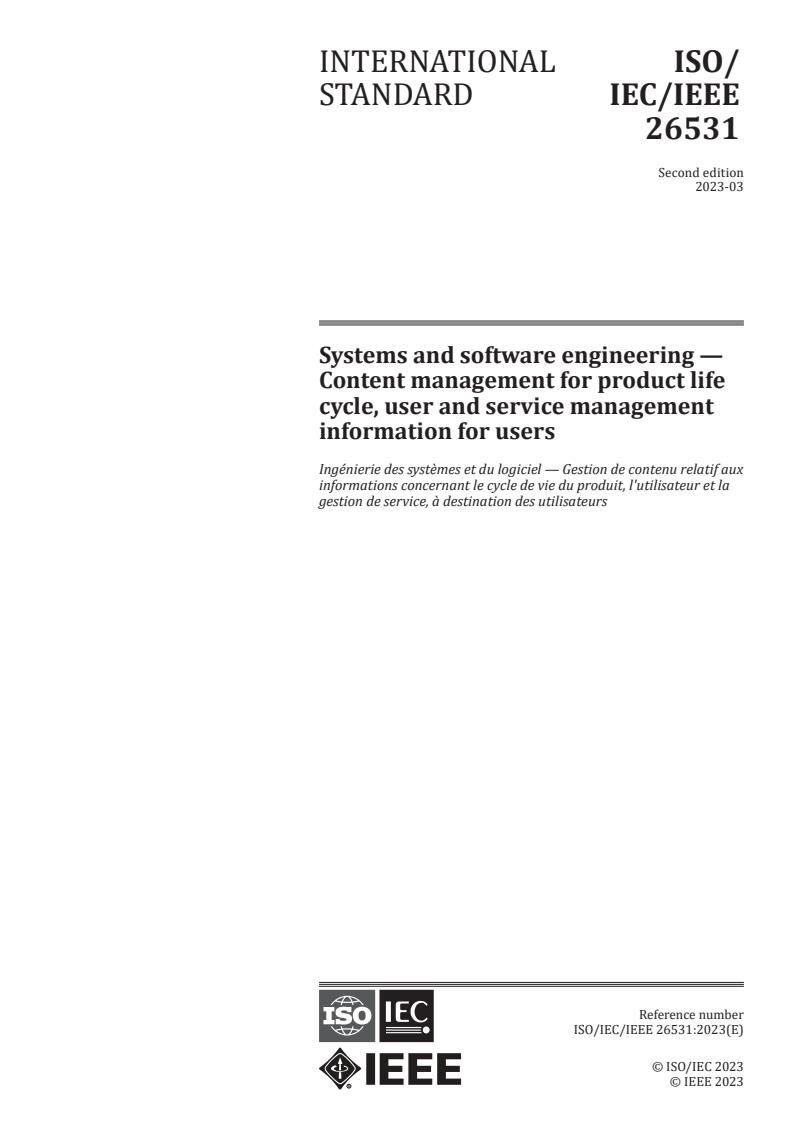
INTERNATIONAL ISO/
STANDARD IEC/IEEE
Second edition
2023-03
Systems and software engineering —
Content management for product life
cycle, user and service management
information for users
Ingénierie des systèmes et du logiciel — Gestion de contenu relatif aux
informations concernant le cycle de vie du produit, l'utilisateur et la
gestion de service, à destination des utilisateurs
Reference number
© ISO/IEC 2023
© IEEE 2023
© ISO/IEC 2023
© IEEE 2023
All rights reserved. Unless otherwise specified, or required in the context of its implementation, no part of this publication may
be reproduced or utilized otherwise in any form or by any means, electronic or mechanical, including photocopying, or posting
on the internet or an intranet, without prior written permission. Permission can be requested from either ISO or IEEE at the
respective address below or ISO’s member body in the country of the requester.
ISO copyright office Institute of Electrical and Electronics Engineers, Inc
CP 401 • Ch. de Blandonnet 8 3 Park Avenue, New York
CH-1214 Vernier, Geneva NY 10016-5997, USA
Phone: +41 22 749 01 11
Fax: +41 22 749 09 47
Email: copyright@iso.org Email: stds.ipr@ieee.org
Website: www.iso.org Website: www.ieee.org
Published in Switzerland
ii
© ISO/IEC 2023 – All rights reserved
© IEEE 2023 – All rights reserved
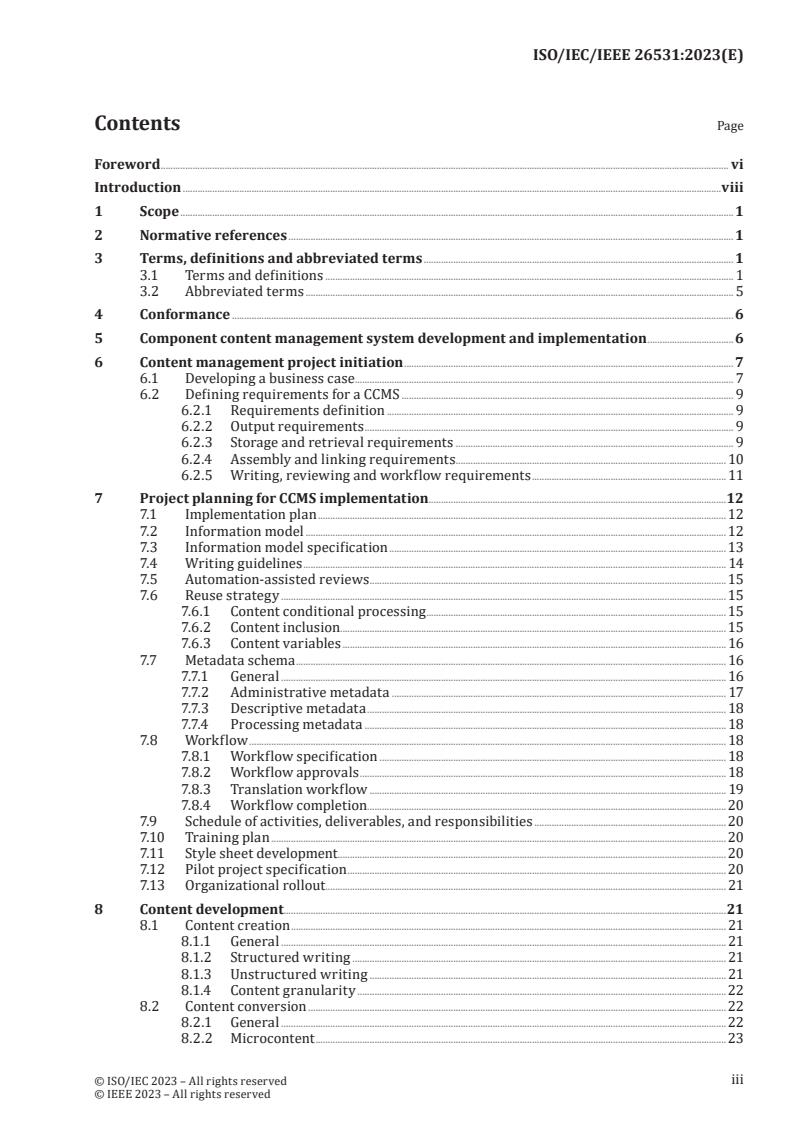
Contents Page
Foreword . vi
Introduction .viii
1 Scope . 1
2 Normative references . 1
3 Terms, definitions and abbreviated terms . 1
3.1 Terms and definitions . 1
3.2 Abbreviated terms . 5
4 Conformance . 6
5 Component content management system development and implementation .6
6 Content management project initiation . 7
6.1 Developing a business case. 7
6.2 Defining requirements for a CCMS . 9
6.2.1 Requirements definition . 9
6.2.2 Output requirements . 9
6.2.3 Storage and retrieval requirements . 9
6.2.4 Assembly and linking requirements . 10
6.2.5 Writing, reviewing and workflow requirements . 11
7 Project planning for CCMS implementation .12
7.1 Implementation plan . 12
7.2 Information model .12
7.3 Information model specification . 13
7.4 Writing guidelines . 14
7.5 Automation-assisted reviews .15
7.6 Reuse strategy . 15
7.6.1 Content conditional processing . 15
7.6.2 Content inclusion . 15
7.6.3 Content variables . 16
7.7 Metadata schema . 16
7.7.1 General . 16
7.7.2 Administrative metadata . 17
7.7.3 Descriptive metadata . 18
7.7.4 Processing metadata . 18
7.8 Workflow . 18
7.8.1 Workflow specification . 18
7.8.2 Workflow approvals . 18
7.8.3 Translation workflow . 19
7.8.4 Workflow completion . . .20
7.9 Schedule of activities, deliverables, and responsibilities . 20
7.10 Training plan . 20
7.11 Style sheet development. 20
7.12 Pilot project specification . 20
7.13 Organizational rollout . 21
8 Content development.21
8.1 Content creation . 21
8.1.1 General . 21
8.1.2 Structured writing . 21
8.1.3 Unstructured writing . 21
8.1.4 Content granularity .22
8.2 Content conversion . 22
8.2.1 General .22
8.2.2 Microcontent .23
iii
© ISO/IEC 2023 – All rights reserved
© IEEE 2023 – All rights reserved
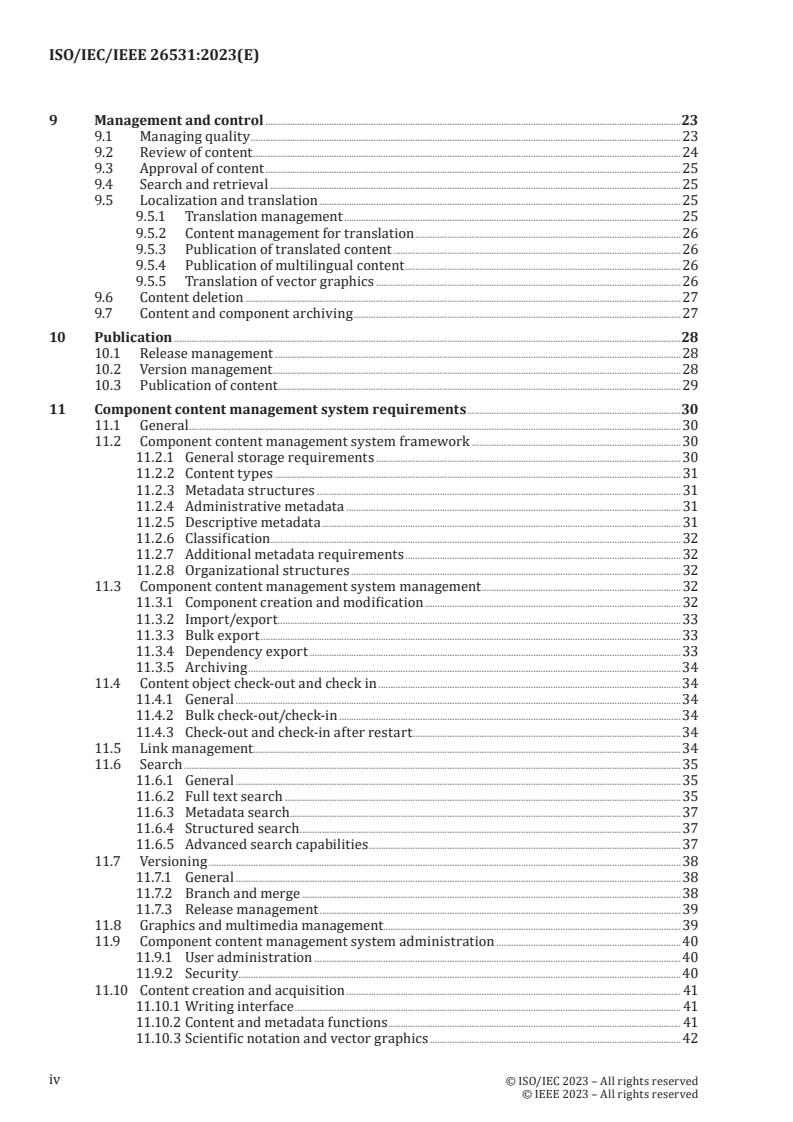
9 Management and control .23
9.1 Managing quality .23
9.2 Review of content . 24
9.3 Approval of content . 25
9.4 Search and retrieval . 25
9.5 Localization and translation . 25
9.5.1 Translation management . 25
9.5.2 Content management for translation . 26
9.5.3 Publication of translated content . 26
9.5.4 Publication of multilingual content . 26
9.5.5 Translation of vector graphics . 26
9.6 Content deletion . 27
9.7 Content and component archiving . 27
10 Publication .28
10.1 Release management .28
10.2 Version management .28
10.3 Publication of content.29
11 Component content management system requirements .30
11.1 General .30
11.2 Component content management system framework .30
11.2.1 General storage requirements .30
11.2.2 Content types . 31
11.2.3 Metadata structures . 31
11.2.4 Administrative metadata . 31
11.2.5 Descriptive metadata . 31
11.2.6 Classification . . 32
11.2.7 Additional metadata requirements . 32
11.2.8 Organizational structures . 32
11.3 Component content management system management . 32
11.3.1 Component creation and modification . 32
11.3.2 Import/export.33
11.3.3 Bulk export . 33
11.3.4 Dependency export . 33
11.3.5 Archiving .34
11.4 Content object check-out and check in .34
11.4.1 General .34
11.4.2 Bulk check-out/check-in .34
11.4.3 Check-out and check-in after restart .34
11.5 Link management.34
11.6 Search . 35
11.6.1 General . 35
11.6.2 Full text search . 35
11.6.3 Metadata search . . 37
11.6.4 Structured search . 37
11.6.5 Advanced search capabilities . 37
11.7 Versioning .38
11.7.1 General .38
11.7.2 Branch and merge .38
11.7.3 Release management . 39
11.8 Graphics and multimedia management . 39
11.9 Component content management system administration .40
11.9.1 User administration .40
11.9.2 Security . . .40
11.10 Content creation and acquisition . 41
11.10.1 Writing interface . 41
11.10.2 Content and metadata functions . 41
11.10.3 Scientific notation and vector graphics . 42
iv
© ISO/IEC 2023 – All rights reserved
© IEEE 2023 – All rights reserved
11.10.4 Writing integration . 42
11.10.5 Acquisition . 42
11.11 Workflow . 43
11.11.1 Workflow creation . 43
11.11.2 Workflow specification . 43
11.11.3 Workflow reporting.44
11.12 Content publication . 45
11.12.1 General . 45
11.12.2 Export to publishing support . 45
11.12.3 Centralized publishing support . 45
11.12.4 Publishing interface . . 45
11.12.5 XML publishing pipeline .46
11.12.6 Dynamic publishing .46
11.13 Localization and translation management .46
11.13.1 General .46
11.13.2 XLIFF support . 47
11.14 Component content management system interoperability . 47
11.14.1 General . 47
11.14.2 Libraries and frameworks . 47
11.14.3 Web services . 47
11.14.4 Application Programming Interface methods .48
11.14.5 Webhooks and triggers .49
Annex A (informative) Business case considerations for content management .50
Bibliography .52
IEEE notices and abstract .54
v
© ISO/IEC 2023 – All rights reserved
© IEEE 2023 – All rights reserved
Foreword
ISO (the International Organization for Standardization) and IEC (the International Electrotechnical
Commission) form the specialized system for worldwide standardization. National bodies that are
members of ISO or IEC participate in the development of International Standards through technical
committees established by the respective organization to deal with particular fields of technical
activity. ISO and IEC technical committees collaborate in fields of mutual interest. Other international
organizations, governmental and non-governmental, in liaison with ISO and IEC, also take part in the
work.
The procedures used to develop this document and those intended for its further maintenance are
described in the ISO/IEC Directives, Part 1. In particular, the different approval criteria needed
for the different types of ISO/IEC documents should be noted. This document was drafted in
accordance with the editorial rules of the ISO/IEC Directives, Part 2 (see www.iso.org/directives or
www.iec.ch/members_experts/refdocs).
IEEE Standards documents are developed within the IEEE Societies and the Standards Coordinating
Committees of the IEEE Standards Association (IEEE-SA) Standards Board. The IEEE develops its
standards through a consensus development process, approved by the American National Standards
Institute, which brings together volunteers representing varied viewpoints and interests to achieve the
final product. Volunteers are not necessarily members of the Institute and serve without compensation.
While the IEEE administers the process and establishes rules to promote fairness in the consensus
development process, the IEEE does not independently evaluate, test, or verify the accuracy of any of
the information contained in its standards.
Attention is drawn to the possibility that some of the elements of this document may be the subject
of patent rights. ISO and IEC shall not be held responsible for identifying any or all such patent
rights. Details of any patent rights identified during the development of the document will be in the
Introduction and/or on the ISO list of patent declarations received (see www.iso.org/patents) or the IEC
list of patent declarations received (see https://patents.iec.ch).
Any trade name used in this document is information given for the convenience of users and does not
constitute an endorsement.
For an explanation of the voluntary nature of standards, the meaning of ISO specific terms and
expressions related to conformity assessment, as well as information about ISO's adherence to
the World Trade Organization (WTO) principles in the Technical Barriers to Trade (TBT), see
www.iso.org/iso/foreword.html. In the IEC, see www.iec.ch/understanding-standards.
ISO/IEC/IEEE 26531 was prepared by Joint Technical Committee ISO/IEC JTC 1, Information technology,
Subcommittee SC 7, Software and systems engineering, in cooperation with the Systems and Software
Engineering Standards Committee of the IEEE Computer Society, under the Partner Standards
Development Organization cooperation agreement between ISO and IEEE.
This second edition cancels and replaces the first edition (ISO/IEC/IEEE 26531:2015), which has been
technically revised.
The main changes are as follows:
— addition of information on the development of microcontent;
— addition of mathematics and vector graphics;
— addition of classification of objects using metadata and taxonomies;
— addition of webhooks and triggers;
— addition of XML reviews using Schematron or other similar systems;
— addition of reporting capabilities;
vi
© ISO/IEC 2023 – All rights reserved
© IEEE 2023 – All rights reserved
— addition of dynamic content generation.
Any feedback or questions on this document should be directed to the user’s national standards
body. A complete listing of these bodies can be found at www.iso.org/members.html and
www.iec.ch/national-committees.
vii
© ISO/IEC 2023 – All rights reserved
© IEEE 2023 – All rights reserved
Introduction
This document was developed to assist users of ISO/IEC/IEEE 15288 and ISO/IEC/IEEE 12207 in the
acquisition of a content management system and the use of that content management system to manage
content used in product life cycle, user, and service management information. The accurate description
of the requirements for content management helps organizations create information that meets the
needs of its users and is efficiently produced.
This document is independent of the software tools that may be used to manage information for users
and applies to both printed information for use and on-screen information for use.
Content management allows an organization to control the storage and retrieval of content objects,
track content revisions, maintain a content audit trail, produce different types of reports, and enable
a collaborative environment. Component content management supports the reuse of content objects
among deliverables and supports multiple deliverable formats.
The use of content management functions can facilitate increased collaboration on content development
across the enterprise. Technical writers, instructional designers, support staff, and others can develop
a body of content together that is written once and supports many needs.
Information for users is often regarded as something done after the system or software has been
implemented. However, for high-quality information for users, its development should be regarded as
an integral part of the system or software development life cycle. In fact, quality information for users
or information management services are important enough to justify specific planning.
This document is consistent with ISO/IEC/IEEE 15288 and ISO/IEC/IEEE 12207, as an elaboration of
the information management process.
This document is not a management system standard.
This document is intended for use in all types of organizations, whether they have a dedicated
information-development organization or not. It may be used as a basis for local standards and
procedures. Users are assumed to have experience or knowledge of general processes for information
management, project management, and information development.
This document is intended for those engaged in the management of information, such as that included
in:
a) information for users such as topic collections, manuals, guides, user assistance displayed with
software, style guides, knowledge-based articles, and other content that supports the effective use
of a system or software product;
b) product life cycle information such as design documents, use cases, personas, project management
plans, feature requests, and testing plans;
c) service management items such as service level agreements, records, policies, procedures,
documents in response to tender offers, and other documents.
The order of clauses in this document does not imply that the content management activities should be
performed in this order, nor that information for users should be developed in this order or presented
to the organization in this order.
In each clause, the requirements are independent of media and document creation and management
specifications.
In this document, the following verbal forms are used:
— “shall” indicates a requirement;
— “should” indicates a recommendation;
viii
© ISO/IEC 2023 – All rights reserved
© IEEE 2023 – All rights reserved
— “may” indicates a permission;
— “can” indicates a possibility or a capability.
ix
© ISO/IEC 2023 – All rights reserved
© IEEE 2023 – All rights reserved
INTERNATIONAL STANDARD ISO/IEC/IEEE 26531:2023(E)
Systems and software engineering — Content management
for product life cycle, user and service management
information for users
1 Scope
This document specifies requirements for efficient development and management of information
produced
— throughout the life cycle of a system and software product;
— for the provision of information for users of systems and software;
— for the management of IT and support services.
This document is independent of the tools, protocols, and systems used for content management. It does
not address configuration management of software assets.
The content management process presented in Clauses 6 to 10 is a specialization (lower-level process)
of the information management process specified in ISO/IEC/IEEE 15288 and ISO/IEC/IEEE 12207.
2 Normative references
There are no normative references in this document.
3 Terms, definitions and abbreviated terms
3.1 Terms and definitions
For the purposes of this document, the following terms and definitions apply.
ISO, IEC, and IEEE maintain terminology databases for use in standardization at the following addresses:
— ISO Online browsing platform: available at https:// www .iso .org/ obp
— IEC Electropedia: available at https:// www .electropedia .org/
— IEEE Standards Dictionary Online: available at https:// dictionary .ieee .org/
NOTE 1 For additional terms and definitions in the field of systems and software engineering, see
ISO/IEC/IEEE 24765, which is published periodically as a “snapshot” of the SEVOCAB (Systems and software
Engineering Vocabulary) database and is publicly accessible at www .computer .org/ sevocab.
NOTE 2 Throughout this document, the term “information for users” refers to information for users of
hardware and software.
3.1.1
application programming interface
API
set of functions, protocols, parameters, and objects (3.1.23) of different formats, used to create software
that interfaces with the features or data of an external system or service
© ISO/IEC 2023 – All rights reserved
© IEEE 2023 – All rights reserved
3.1.2
branching
method of development in which a set of components (3.1.3) is duplicated so the components can be
modified in parallel and optionally synchronized at a later time
3.1.3
component
object (3.1.23) with a discrete information type (3.1.20) that is stored in a CCMS (3.1.4), such as a topic
(3.1.31), prerequisite, section, image, or video
3.1.4
component content management system
CCMS
content management system (3.1.5) that supports the entire information-development life cycle from
writing through review and publishing, including the reuse of modular content
Note 1 to entry: In case the modular content is XML-based, the individual XML elements available for management
are defined by the XML schema or DTD (3.1.12). This document is protocol-independent, and it is not necessary to
specify numerous markup languages.
3.1.5
content management system
system that makes components (3.1.3) available for reuse and linking to build content objects (3.1.6) and
deconstructs large content objects into components that can be individually managed
Note 1 to entry: See also document management system (3.1.11).
3.1.6
content object
self-contained unit of content
3.1.7
content type
specific indicator of content
3.1.8
content unit
identifiable and manageable part of larger information objects (3.1.23)
Note 1 to entry: The individual content units available for management are typically defined by an XML schema
or DTD (3.1.12).
3.1.9
customization
modification of a document type definition (3.1.12) to add new structures or change the document type
definition in a way that is not compatible with a previous structure
3.1.10
dependency export
operation in which a component (3.1.3) and all its dependencies are exported from the CCMS (3.1.4) as a
single process
3.1.11
document management system
system that supports the storage, retrieval, the production of a version (3.1.32), and the manipulation of
whole documents, images, and other media
Note 1 to entry: See also content management system (3.1.5).
© ISO/IEC 2023 – All rights reserved
© IEEE 2023 – All rights reserved
3.1.12
document type definition
DTD
template for the structure, content, and semantics of documents
3.1.13
effectiveness
accuracy and completeness with which users achieve specified goals
[SOURCE: ISO/IEC 25062:2006, 4.2]
3.1.14
eXtensible Markup Language
XML
platform-independent markup language that carries rules for generating text formats that contain
structured data
[SOURCE: ISO/IEC 19770-5:2015, 3.15, modified — "license-free and" has been removed from the
beginning of the definition.]
3.1.15
faceted search
progressive search that allows users to narrow the results by selecting values for one or more attributes
3.1.16
framework
essential data structures, operations, and rules that form the foundation from which all other
features of the CCMS (3.1.4) are built
3.1.17
Hypertext Markup Language
HTML
language for creating web pages
3.1.18
Hypertext Transfer Protocol
HTTP
application-level protocol for distributed, collaborative, hypermedia information systems
3.1.19
information item
separately identifiable body of information that is produced, stored, and delivered for human use
Note 1 to entry: An information item can be produced in several versions (3.1.32) during a project life cycle.
[SOURCE: ISO/IEC/IEEE 15289:2019, 3.1.12, modified — The preferred term "information product" has
been removed; the original note 1 to entry has been removed; note 2 to entry becomes note 1 to entry.]
3.1.20
information type
class of topics (3.1.31) that addresses a particular user question
EXAMPLE An information type that answers the question “how do I …” is called a task information type.
3.1.21
Levenshtein distance
measure of the difference between two-character sequences based on the minimum number of single
character edits (insertion, deletion, or substitution) needed to convert one word to the other
© ISO/IEC 2023 – All rights reserved
© IEEE 2023 – All rights reserved
3.1.22
link
part of a computer program, often a single instruction or address, that passes control and parameters
between separate modules (3.1.24) of the program
3.1.23
object
encapsulation of content units (3.1.8) in a CCMS (3.1.4)
3.1.24
module
appropriate independent information unit
3.1.25
publishing pipeline
series of defined processing steps that are connected to transform content from its source format into
a final deliverable format
3.1.26
regular expression
Regex
string of characters that allows patterns to be used to match search results
Note 1 to entry: Patterns can dictate that matches start or end with specific sequences of characters or allow the
use of wildcards to match any characters in a sequence.
EXAMPLE 1
^admin* - Find all matches that start with 'admin' and contain any sequence of characters afterwards
\d{5}$ - Find all matches that end with the number 5
^[0-9()-]+$ - Find matches that contain a 10-digit phone number
EXAMPLE 2 A semantic label such as prerequisite describes the content as a pre-requisite to the following
task information. In contrast, a format label simply describes the content as a paragraph or a list.
3.1.27
Schematron
language for making assertions about the presence or absence of patterns in XML (3.1.14) documents
3.1.28
specialization
specification of targeted document type definitions (3.1.12) that share the common output
transformations and design rules developed for more general types and domains
3.1.29
structured writing
development of content elements according to a pre-defined and enforced organization of content
elements including metadata in specified templates
Note 1 to entry: In structured writing, content elements are labelled according to the nature of the content they
contain. Structured writing also permits quasi-semantic labelling, such as Heading1 or NestedList, to indicate
the hierarchical position and function of a content element.
3.1.30
taxonomy
scheme that partitions a body of knowledge and defines the relationships among the parts
3.1.31
topic
unique label or identifier, with which one or more items of information may be associated
© ISO/IEC 2023 – All rights reserved
© IEEE 2023 – All rights reserved
3.1.32
version
form of a text or illustration differing in certain respects from an earlier form
3.1.33
XML schema definition
XML (3.1.14) based language that specifies a set of rules and structure for the creation of XML documents
3.2 Abbreviated terms
BMP Bitmap Image File
CSS Cascading Style Sheets
DITA Darwin Information Typing Architecture
FAQ frequently asked questions
FOAF Friend of a Friend
GIF Graphics Interchange Format
JPEG Joint Photographic Experts Group
JWT JSON Web Token
QTFF QuickTime File Format (abbreviated as.mov)
MP3/MP4 See MPEG
MPEG Moving Picture Experts Group
PDF Portable Document Format
PGP Pretty Good Privacy
PNG Portable Network Graphics
RNG REgular LAnguage for XML Next Generation
RDF Resource Description Framework
SKOS Simple Knowledge Organization System
SVG Scalable Vector Graphics
WAV waveform audio file format
WMV Windows Media Video
XLIFF XML Localisation Interchange File Format
XSL-FO XML Stylesheet Language-Formatting Objects
XSLT XML Stylesheet Language Transformations
XHTML eXtensible HyperText Markup Language
© ISO/IEC 2023 – All rights reserved
© IEEE 2023 – All rights reserved
4 Conformance
The purpose of this document is to define a process for the development and acquisition of a component
content management system and the requirements of a component content management system
through which content is created, gathered, managed, and published, including the requirements of
a system that is supported by an electronic database. Such a database should support documents or
topics and content units that can be assembled to produce complete documents for print, electronic
output, or content published through electronic media. This database is defined as a component content
management system (CCMS), which differs from a document management system. The objective
of component content management is to create content objects once and use them through linking
...
Questions, Comments and Discussion
Ask us and Technical Secretary will try to provide an answer. You can facilitate discussion about the standard in here.
Loading comments...