


ISO 236-1:1976
(Main)Hand reamers
Hand reamers
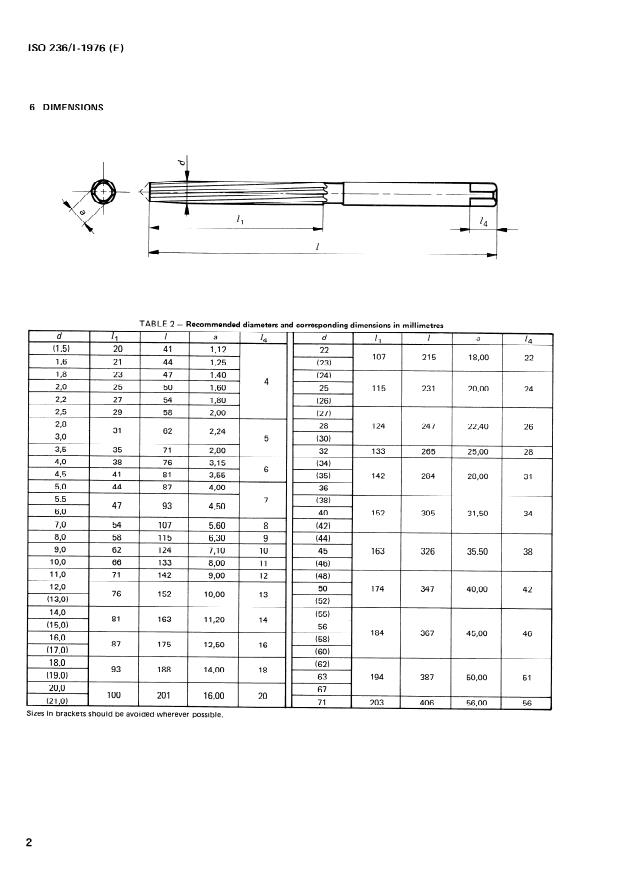
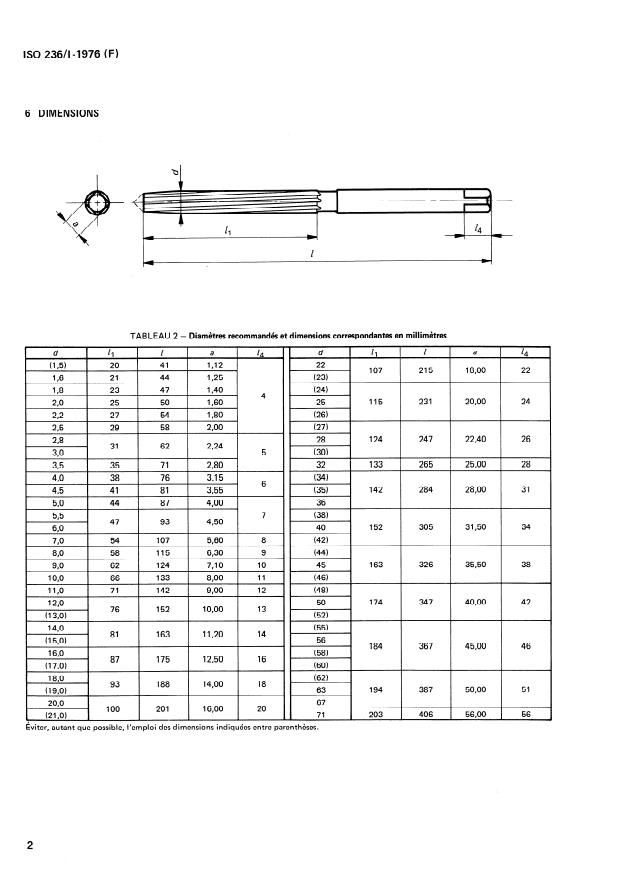
This part of ISO 236 specifies the dimensions of hand reamers. It comprises three tables giving respectively the preferred sizes with corresponding dimensions in millimetres and in inches, the corresponding sizes, in millimetres and in inches, set out as functions of diameter steps. Provision is also made for tolerances on lengths, cutting diameters and the diameter of parallel shanks.
Alésoirs à main
General Information
- Status
- Published
- Publication Date
- 31-Oct-1976
- Current Stage
- 9093 - International Standard confirmed
- Start Date
- 27-Mar-2023
- Completion Date
- 12-Feb-2026
Relations
- Consolidated By
ISO 12543-6:1998 - Glass in building — Laminated glass and laminated safety glass — Part 6: Appearance - Effective Date
- 06-Jun-2022
Overview
ISO 236-1:1976 - Hand reamers (first edition, 1976) specifies standardized dimensions and tolerances for hand reamers. The part focuses on dimensional data needed for design, manufacture, inspection and procurement of hand reamers and ensures interchangeability between metric and inch sizes. The standard presents three principal tables giving: preferred diameters in millimetres, preferred diameters in inches, and corresponding sizes and lengths set out as functions of diameter steps.
Key topics and technical requirements
- Dimension tables: Recommended nominal diameters and corresponding dimensional data are provided both in millimetres and in inches to support dual-unit manufacturing and conversion.
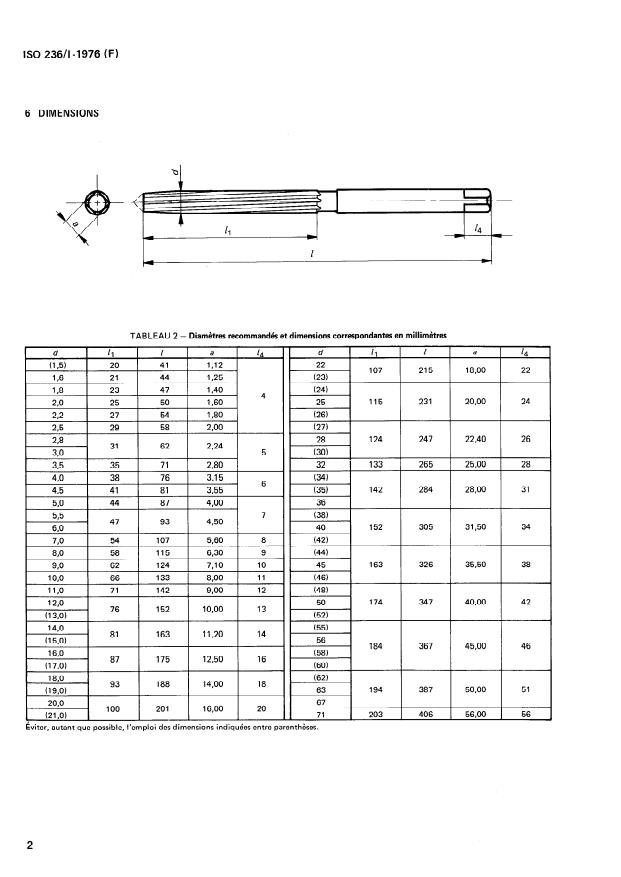
- Diameter steps and lengths: Sizes are grouped by diameter steps; corresponding overall and cutting-edge lengths (Z, Z1, Z2) are given so length tolerances remain consistent across metric and inch ranges.
- Tolerances:
- Cutting diameter tolerance: specified as m6 for reamers supplied from stock.
- Shank diameter tolerance: specified as h9 (shank diameter is identical to the cutting portion diameter per this Part).
- Length tolerances: tabulated values define permissible variation for overall and cutting-edge lengths.
- Shank and drive: driving square dimensions follow ISO 237; shank diameters and recommended driving-square sizes are coordinated with that standard.
- Practical notes: the standard flags certain bracketed sizes to be avoided where possible and allows selection of alternate nominal lengths from adjacent ranges in special cases while retaining the same tolerances.
Applications and who uses it
ISO 236-1:1976 is used by:
- Tool manufacturers specifying and producing hand reamers to ensure dimensional conformity.
- Tool designers and engineering departments creating jigs, fixtures and tool-holding arrangements.
- Quality control and inspection teams verifying reamer diameters, shank fits and length tolerances.
- Purchasing and supply chain professionals sourcing standardized reamers for maintenance and production.
- Machine shops and maintenance workshops that require interchangeability between metric and inch reamers.
Typical applications include precision hole finishing in metalworking, maintenance tool kits, and production lines where consistent reamer sizing and fit to chucks or driving squares is essential.
Related standards
Referenced standards in ISO 236-1:1976 include:
- ISO 236/11 - Long fluted machine reamers (Morse taper shanks) (as cited in the document)
- ISO 237 - Diameters of shanks and sizes of driving squares for rotating tools with parallel shanks
- ISO 521 - Machine chucking reamers with parallel shanks or Morse taper shanks
Keywords: ISO 236-1:1976, hand reamers, reamer dimensions, reamer tolerances, shank diameter, cutting diameter, metric and inch sizes, tool interchangeability.

Get Certified
Connect with accredited certification bodies for this standard

National Aerospace and Defense Contractors Accreditation Program (NADCAP)
Global cooperative program for special process quality in aerospace.
CARES (UK Certification Authority for Reinforcing Steels)
UK certification for reinforcing steels and construction.
DVS-ZERT GmbH
German welding certification society.
Sponsored listings
Frequently Asked Questions
ISO 236-1:1976 is a standard published by the International Organization for Standardization (ISO). Its full title is "Hand reamers". This standard covers: This part of ISO 236 specifies the dimensions of hand reamers. It comprises three tables giving respectively the preferred sizes with corresponding dimensions in millimetres and in inches, the corresponding sizes, in millimetres and in inches, set out as functions of diameter steps. Provision is also made for tolerances on lengths, cutting diameters and the diameter of parallel shanks.
This part of ISO 236 specifies the dimensions of hand reamers. It comprises three tables giving respectively the preferred sizes with corresponding dimensions in millimetres and in inches, the corresponding sizes, in millimetres and in inches, set out as functions of diameter steps. Provision is also made for tolerances on lengths, cutting diameters and the diameter of parallel shanks.
ISO 236-1:1976 is classified under the following ICS (International Classification for Standards) categories: 25.100.30 - Drills, countersinks, reamers. The ICS classification helps identify the subject area and facilitates finding related standards.
ISO 236-1:1976 has the following relationships with other standards: It is inter standard links to ISO 12543-6:1998. Understanding these relationships helps ensure you are using the most current and applicable version of the standard.
ISO 236-1:1976 is available in PDF format for immediate download after purchase. The document can be added to your cart and obtained through the secure checkout process. Digital delivery ensures instant access to the complete standard document.
Standards Content (Sample)
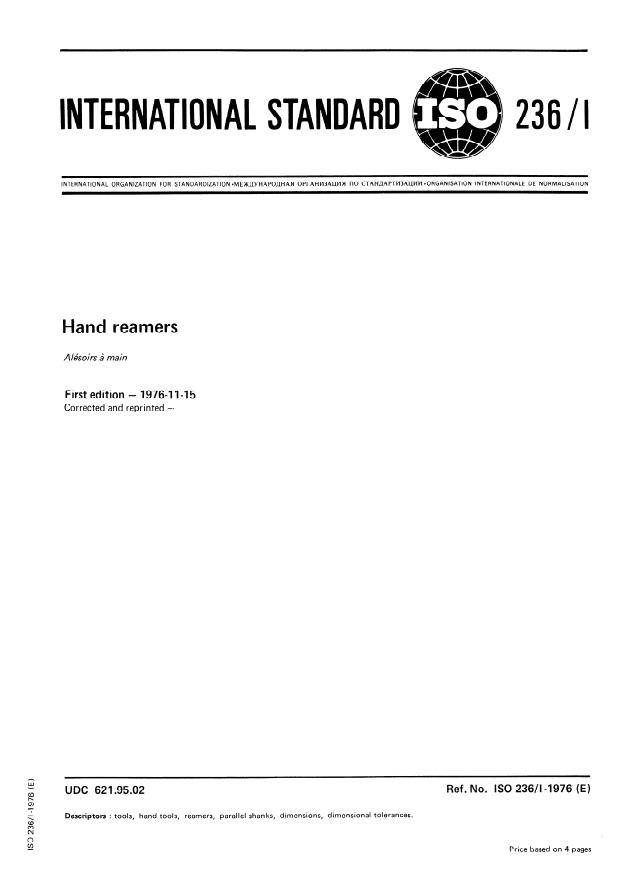
INTERNATIONAL STANDARD
INTERNATIONAL ORGANIZATION FOR STANDARDIZATION l MEXAYHAPOAHAII OPI-AHM3AUM~ l-IO CT-AHAAPTM3ALMM *ORGANISATION INTERNATIONALE DE NORMALISATION
Hand reamers
Al&soir-s 5 main
First edition - 1976-11-15
Corrected and reprinted --
Ref. No. ISO 236/1-1976 (E)
UDC 621.95.02
: tools, hand tools, reamers, parallel shanks, dimensions, dimensional tolerantes.
Descriptors
Price based on 4 pages
FOREWORD
ISO (the International Organization for Standardization) is a worldwide federation
of national Standards institutes (ISO Member Bodies). The work of developing
International Standards is carried out through ISO Technical Committees. Every
Member Body interested in a subject for which a Technical Committee has been set
up has the right to be represented on that Committee. International organizations,
governmental and non-governmental, in liaison with ISO, also take part in the work.
Draft International Standards adopted by the Technical Committees are circulated
to the Member Bodies for approval before their acceptance as International
Standards by the ISO Council.
International Standard ISO 236/l results from the subdivision into two Parts
of ISO Recommendation R 236-1961. lt was drawn up by Technical Committee
ISO/TC 29, Small tools, and was circulated to the Member Bodies in
November 1975.
lt has been approved by the Member Bodies of the foilowing countries :
Austral ia Hungary Romania
Austria lndia South Africa, Rep. of
Belgium Israel Sweden
Bulgaria Italy Switzerland
Canada Japan Turkey
Czechoslovakia Korea, Rep. of United Kingdom
Egypt, Arab Rep. of Mexico U.S.A.
France U.S.S.R.
Netherlands
Germany
Poland
No Member Body expressed disapproval of the document.
This International Standard, together with International Standard ISO 236/lI,
cancels and replaces ISO Recommendation R 236-1961, of which they constitute
a technical revision.
0 International Organkation for Standardkation, 1976 l
Printed in Switzerland
ISO 236~101976 (E)
INTERNATIONAL STANDARD
Hand reamers
4 SHANKS
1 SCOPE AND FIELD OF APPLICATION
The shank diameter is identical to the cutting Portion
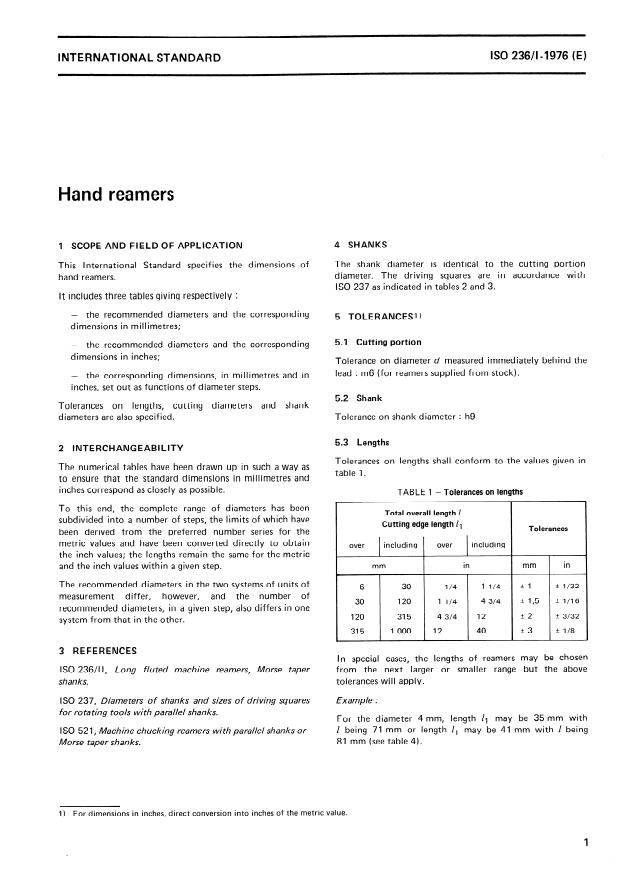
This International Standard specifies the dimensions of
diameter. The driving squares are in accordance with
hand reamers.
ISO 237 as indicated in tables 2 and 3.
lt includes three tables giving respectively :
-
the recommended diameters and the corresponding
5 TOLERANCES ’)
dimensions in millimetres;
- 5.1 Cutting Portion
the recommended diameters and the corresponding
dimensions in inches;
Tolerante on diameter d measured immediately behind the
- lead : m6 (for reamers supplied from stock).
the corresponding dimensions, in millimetres and in
inches, set out as functions of diameter Steps.
5.2 Shank
Tolerantes on lengths, cutting diameters and shank
diameters are also specified. Tolerante on shank diameter : h9
5.3 Lengths
2 INTERCHANGEABILITY
Tolerantes on lengths shall conform to the values given in
The numerical tables have been drawn up in such a way as
table 1.
to ensure that the Standard dimensions in millimetres and
inches correspond as closely as possible.
TABLE 1 - Tolerantes on lengths
To this end, the complete range of diameters has been
Total Overall length 2
I I
subdivided into a number of Steps, the limits of which have
Cutting edge length 2,
Tolerantes
I I
been derived from the preferred number series for the
metric values and have been converted directly to obtain
over including
over including
the inch values; the lengths remain the same for the metric
in mm in
and the inch values within a given Step. mm
l-4
The recommended diameters in the two Systems of units of
6 30 1/4 11/4 +l 2 1/32
measurement differ, however, and the number of
30 120 1 1/4 4 3/4 tr 1,5 + 1/16
recommended diameters, in a given Step, also differs in one
120 315 43/4 12 +2 + 3/32
System from that in the other.
315 1 000 12 40 +3 2 1/8
...
. N*ORME INTERNATIONALE
INTERNATIONAL ORGANIZATION FOR STANDARDIZATION l MEXLIYHAPOAHAR OPI-AHM3ALWl II0 CTAHlXAPTW3ALWW .ORGANISATION INTERNATIONALE DE NORMALISATION
Alésoirs à main
Hand rearners
Première édition - 1976-l 1-15
Corrigée et réimprimée - ~
iî
-
CDU 621 l 95.02 Réf. no : ISO 236/1-1976 (F)
Descripteurs : outil, outil à main, alésoir, queue cylindrique, dimension, tolérance de dimension.
Prix basé sur 4 pages
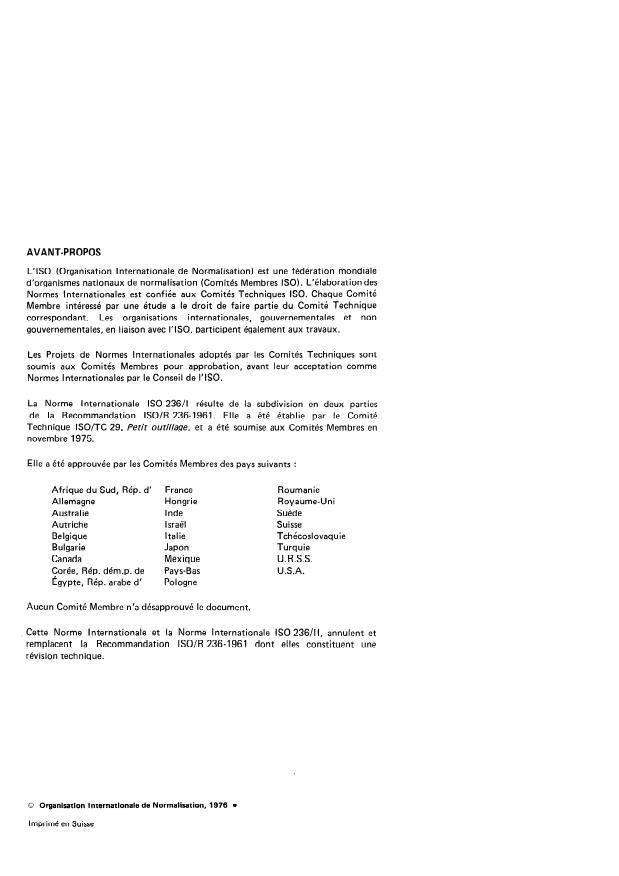
AVANT-PROPOS
L’ISO (Organisation Internationale de Normalisation) est une fédération mondiale
d’organismes nationaux de normalisation (Comités Membres KO). L’élaboration des
Normes Internationales est confiée aux Comités Techniques ISO. Chaque Comité
Membre intéressé par une étude a le droit de faire partie du Comité Technique
correspondant. Les organisations internationales, gouvernementales et non
gouvernementales, en liaison avec I’ISO, participent également aux travaux.
Les Projets de Normes Internationales adoptés par les Comités Techniques sont
soumis aux Comités Membres pour approbation, avant leur acceptation comme
Normes Internationales par le Conseil de I’ISO.
La Norme Internationale ISO 236/l résulte de la subdivision en deux parties
de la Recommandation ISO/R 236-1961. Elle a été établie par le Comité
Technique ISO/TC 29, Petit ouMage, et a été soumise aux Comités Membres en
novembre 1975.
Elle a été approuvée par les Comités Membres des pays suivants :
Afrique du Sud, Rép. d’ France Roumanie
Allemagne Hongrie Royaume-Uni
Australie Inde Suède
Autriche Israël Suisse
Belgique Italie Tchécoslovaquie
Bulgarie Japon Turquie
Canada Mexique U.R.S.S.
Corée, Rép. dém.p. de Pays-Bas U.S.A.
Egypte, Rép. arabe d’ Pologne
Aucun Comité Membre n’a désapprouvé le document.
Cette Norme Internationale et la Norme Internationale ISO 236/ll, annulent et
remplacent la Recommandation ISO/R 236-1961 dont elles constituent une
révision technique.
0 Organisation Internationale de Normalisation, 1976 l
Imprimé en Suisse
ISO 236/l-1976 (F)
NORME INTERNATIONALE
Alésoirs à main
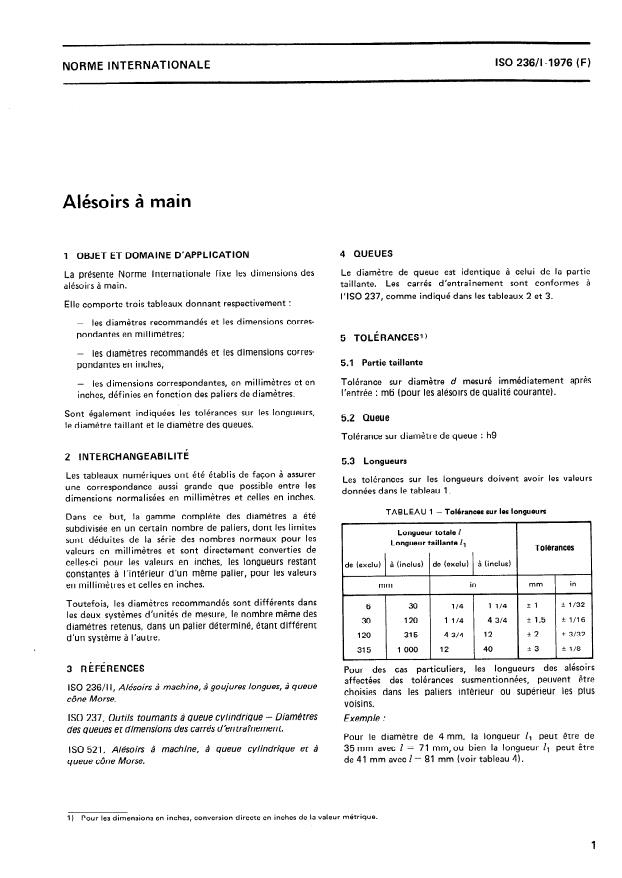
1 OBJET ET DOMAINE D’APPLICATION 4 QUEUES
La présente Norme Internationale fixe les dimensions des Le diamètre de queue est identique à celui de la partie
alésoirs à main. taillante. Les carrés d’entraînement sont conformes à
I’ISO 237, comme indiqué dans les tableaux 2 et 3.
Elle comporte trois tableaux donnant respectivement :
-
les diamètres recommandés et les dimensions corres-
pondantes en millimètres;
5 TOLÉRANCES1 )
-
les diamètres recommandés et les dimensions corres-
5.1 Partie taillante
pondantes en inches;
-
les dimensions correspondantes, en millimètres et en Tolérance sur diamètre d mesuré immédiatement après
l’entrée : m6 (pour les alésoirs de qualité courante).
inches, définies en fonction des paliers de diamètres.
Sont également indiquées les tolérances sur les longueurs,
5.2 Queue
le diamètre taillant et le diamètre des queues.
Tolérance sur diamètre de queue : h9
2 INTERCHANGEABILITÉ
5.3 Longueurs
Les tableaux numériques ont été établis de facon à assurer
Les tolérances sur les longueurs doivent avoir les valeurs
une correspondance aussi grande que possible entre les
données dans le tableau 1.
dimensions normalisées en millimètres et celles en inches.
TABLEAU 1 - Tokances sur les longueurs
Dans ce but, la gamme complète des diamètres a été
II
subdivisée en un certain nombre de paliers, dont les limites
Longueur totale 2
sont déduites de la série des nombres normaux pour les
Longueur taillante 21
Tolbrances
valeurs en millimètres et sont directement converties de
celles-ci pour les valeurs en inches, les longueurs restant
de (exclu) à (inclus) de (exclu) à (inclus)
constantes à l’intérieur d’un même palier, pour les valeurs
en millimètres et celles en inches. mm in
mm in
I
Toutefois, les diamètres recommandés sont différents dans
6 30 1/4 Il/4 +1 z!z 1/32
les deux systèmes d’unités de mesure, le nombre même des
30 120
1 1/4 4 3/4 I!I 1,5 zk I/l6
diamètres retenus, dans un palier déterminé, étant différent
315 43/4 12 --:2 2 3132
d’un système à l’autre.
315 1 1000 1
12 1 40 1 *3 1’118
I
1 I 1 I
b
3 RÉFÉRENCES
Pour des cas particuliers, les longueurs des alésoirs
affectées des tolérances susmentionnées, peuvent être
ISO 236111, Alésoirs à machine, à goujures longues, à queue
choisies dans les paliers inférieur ou supérieur les plus
cône Morse.
voisins.
ISO 237, Outils tournants à queue cylindrique - Diamètres
Exemple :
des queues et dimensions des carrés d /en traînemen t.
Pour le diamètre de 4 mm, la longueur II peut être de
...
. N*ORME INTERNATIONALE
INTERNATIONAL ORGANIZATION FOR STANDARDIZATION l MEXLIYHAPOAHAR OPI-AHM3ALWl II0 CTAHlXAPTW3ALWW .ORGANISATION INTERNATIONALE DE NORMALISATION
Alésoirs à main
Hand rearners
Première édition - 1976-l 1-15
Corrigée et réimprimée - ~
iî
-
CDU 621 l 95.02 Réf. no : ISO 236/1-1976 (F)
Descripteurs : outil, outil à main, alésoir, queue cylindrique, dimension, tolérance de dimension.
Prix basé sur 4 pages
AVANT-PROPOS
L’ISO (Organisation Internationale de Normalisation) est une fédération mondiale
d’organismes nationaux de normalisation (Comités Membres KO). L’élaboration des
Normes Internationales est confiée aux Comités Techniques ISO. Chaque Comité
Membre intéressé par une étude a le droit de faire partie du Comité Technique
correspondant. Les organisations internationales, gouvernementales et non
gouvernementales, en liaison avec I’ISO, participent également aux travaux.
Les Projets de Normes Internationales adoptés par les Comités Techniques sont
soumis aux Comités Membres pour approbation, avant leur acceptation comme
Normes Internationales par le Conseil de I’ISO.
La Norme Internationale ISO 236/l résulte de la subdivision en deux parties
de la Recommandation ISO/R 236-1961. Elle a été établie par le Comité
Technique ISO/TC 29, Petit ouMage, et a été soumise aux Comités Membres en
novembre 1975.
Elle a été approuvée par les Comités Membres des pays suivants :
Afrique du Sud, Rép. d’ France Roumanie
Allemagne Hongrie Royaume-Uni
Australie Inde Suède
Autriche Israël Suisse
Belgique Italie Tchécoslovaquie
Bulgarie Japon Turquie
Canada Mexique U.R.S.S.
Corée, Rép. dém.p. de Pays-Bas U.S.A.
Egypte, Rép. arabe d’ Pologne
Aucun Comité Membre n’a désapprouvé le document.
Cette Norme Internationale et la Norme Internationale ISO 236/ll, annulent et
remplacent la Recommandation ISO/R 236-1961 dont elles constituent une
révision technique.
0 Organisation Internationale de Normalisation, 1976 l
Imprimé en Suisse
ISO 236/l-1976 (F)
NORME INTERNATIONALE
Alésoirs à main
1 OBJET ET DOMAINE D’APPLICATION 4 QUEUES
La présente Norme Internationale fixe les dimensions des Le diamètre de queue est identique à celui de la partie
alésoirs à main. taillante. Les carrés d’entraînement sont conformes à
I’ISO 237, comme indiqué dans les tableaux 2 et 3.
Elle comporte trois tableaux donnant respectivement :
-
les diamètres recommandés et les dimensions corres-
pondantes en millimètres;
5 TOLÉRANCES1 )
-
les diamètres recommandés et les dimensions corres-
5.1 Partie taillante
pondantes en inches;
-
les dimensions correspondantes, en millimètres et en Tolérance sur diamètre d mesuré immédiatement après
l’entrée : m6 (pour les alésoirs de qualité courante).
inches, définies en fonction des paliers de diamètres.
Sont également indiquées les tolérances sur les longueurs,
5.2 Queue
le diamètre taillant et le diamètre des queues.
Tolérance sur diamètre de queue : h9
2 INTERCHANGEABILITÉ
5.3 Longueurs
Les tableaux numériques ont été établis de facon à assurer
Les tolérances sur les longueurs doivent avoir les valeurs
une correspondance aussi grande que possible entre les
données dans le tableau 1.
dimensions normalisées en millimètres et celles en inches.
TABLEAU 1 - Tokances sur les longueurs
Dans ce but, la gamme complète des diamètres a été
II
subdivisée en un certain nombre de paliers, dont les limites
Longueur totale 2
sont déduites de la série des nombres normaux pour les
Longueur taillante 21
Tolbrances
valeurs en millimètres et sont directement converties de
celles-ci pour les valeurs en inches, les longueurs restant
de (exclu) à (inclus) de (exclu) à (inclus)
constantes à l’intérieur d’un même palier, pour les valeurs
en millimètres et celles en inches. mm in
mm in
I
Toutefois, les diamètres recommandés sont différents dans
6 30 1/4 Il/4 +1 z!z 1/32
les deux systèmes d’unités de mesure, le nombre même des
30 120
1 1/4 4 3/4 I!I 1,5 zk I/l6
diamètres retenus, dans un palier déterminé, étant différent
315 43/4 12 --:2 2 3132
d’un système à l’autre.
315 1 1000 1
12 1 40 1 *3 1’118
I
1 I 1 I
b
3 RÉFÉRENCES
Pour des cas particuliers, les longueurs des alésoirs
affectées des tolérances susmentionnées, peuvent être
ISO 236111, Alésoirs à machine, à goujures longues, à queue
choisies dans les paliers inférieur ou supérieur les plus
cône Morse.
voisins.
ISO 237, Outils tournants à queue cylindrique - Diamètres
Exemple :
des queues et dimensions des carrés d /en traînemen t.
Pour le diamètre de 4 mm, la longueur II peut être de
...
Questions, Comments and Discussion
Ask us and Technical Secretary will try to provide an answer. You can facilitate discussion about the standard in here.
Loading comments...