


ISO 24976
(Main)Traditional Chinese medicine — Pueraria lobata root
Traditional Chinese medicine — Pueraria lobata root
This document specifies the quality and safety requirements of Pueraria lobata root. This document applies to Pueraria lobata root that is sold and used as natural medicine in international trade, including Chinese materia medica (whole medicinal materials) and decoction pieces derived from this root.
Médecine traditionnelle chinoise — Racine de Pueraria lobata
General Information
- Status
- Not Published
- Technical Committee
- ISO/TC 249 - Traditional Chinese medicine
- Current Stage
- 6000 - International Standard under publication
- Start Date
- 05-Dec-2025
- Completion Date
- 10-Jan-2026
Overview
ISO 24976:2025 - Traditional Chinese medicine - Pueraria lobata root specifies international quality and safety requirements for Pueraria lobata root (Ge Gen), including whole Chinese materia medica and decoction pieces intended for international trade. Published as ISO/FDIS 24976:2025 (ISO/TC 249/WG SC 1, secretariat SAC), the standard aims to ensure clinical effectiveness, safety and consistency of Pueraria lobata root across supply chains and regulatory jurisdictions.
Key topics and technical requirements
The standard lays out mandatory and recommended items for sampling, testing and product description, including:
Descriptions and identification
- Macroscopic and microscopic features (root morphology, transverse section anatomy).
- Organoleptic description (odourless, slightly sweet taste) and typical appearance (brown exterior, concentric rings).
Analytical identification
- Thin-layer chromatography (TLC) identification and HPLC characteristic fingerprint requirements to confirm identity and consistency.
- Marker compound determination - puerarin content must be measured; minimum content specified: ≥ 2.0%.
Quality limits
- Total ash - not more than 7.0%.
- Moisture - not more than 14.0%.
- Acid-insoluble ash, ethanol‑soluble extractives and foreign matter to be determined.
Safety testing
- Determination of heavy metals (arsenic, mercury, lead, cadmium).
- Pesticide residues (e.g., total DDT, dieldrin, total BHC, aldrin).
- Aflatoxins (aflatoxin B1 and total aflatoxins).
- Sulfur dioxide determination.
Sampling and test methods
- Sampling per ISO 23723 and detailed test methods are cross‑referenced to other ISO documents (e.g., ISO 18664, ISO/TS 21310, ISO 22258, ISO 22283, ISO 22590).
Labelling, packaging, storage, transport
- Requirements for marking and labelling of products and guidance on packaging and storage to preserve quality.
Applications
ISO 24976 is used to:
- Support quality control and batch release testing in herbal manufacturers and contract testing laboratories.
- Provide a harmonized specification for exporters/importers and customs to assess product compliance in international trade.
- Serve as a reference in regulatory dossiers, pharmacopoeial harmonization and supplier qualification.
- Guide formulation and product development teams that use Pueraria lobata root in traditional medicine products, nutraceuticals or research.
Who should use this standard
- Herbal product manufacturers and suppliers
- Analytical and quality‑assurance laboratories
- Regulatory authorities, customs and trade compliance officers
- Traditional Chinese medicine practitioners involved in procurement
- Research institutions studying Pueraria lobata root compounds
Related standards
Normative references include ISO 23723 (general herbal raw material requirements) and test method standards such as ISO 18664, ISO/TS 21310, ISO 22258, ISO 22283, ISO 22590 and ISO 21371. These cross‑references provide validated methods for heavy metals, microscopy, pesticide residues, aflatoxins and labelling.
ISO/FDIS 24976 - Traditional Chinese medicine — Pueraria lobata root Released:9/25/2025
REDLINE ISO/FDIS 24976 - Traditional Chinese medicine — Pueraria lobata root Released:9/25/2025
Frequently Asked Questions
ISO 24976 is a draft published by the International Organization for Standardization (ISO). Its full title is "Traditional Chinese medicine — Pueraria lobata root". This standard covers: This document specifies the quality and safety requirements of Pueraria lobata root. This document applies to Pueraria lobata root that is sold and used as natural medicine in international trade, including Chinese materia medica (whole medicinal materials) and decoction pieces derived from this root.
This document specifies the quality and safety requirements of Pueraria lobata root. This document applies to Pueraria lobata root that is sold and used as natural medicine in international trade, including Chinese materia medica (whole medicinal materials) and decoction pieces derived from this root.
ISO 24976 is classified under the following ICS (International Classification for Standards) categories: 11.120.10 - Medicaments. The ICS classification helps identify the subject area and facilitates finding related standards.
ISO 24976 is available in PDF format for immediate download after purchase. The document can be added to your cart and obtained through the secure checkout process. Digital delivery ensures instant access to the complete standard document.
Standards Content (Sample)
FINAL DRAFT
International
Standard
ISO/FDIS 24976
ISO/TC 249/SC 1
Traditional Chinese medicine —
Secretariat: SAC
Pueraria lobata root
Voting begins on:
2025-10-09
Voting terminates on:
2025-12-04
RECIPIENTS OF THIS DRAFT ARE INVITED TO SUBMIT,
WITH THEIR COMMENTS, NOTIFICATION OF ANY
RELEVANT PATENT RIGHTS OF WHICH THEY ARE AWARE
AND TO PROVIDE SUPPOR TING DOCUMENTATION.
IN ADDITION TO THEIR EVALUATION AS
BEING ACCEPTABLE FOR INDUSTRIAL, TECHNO
LOGICAL, COMMERCIAL AND USER PURPOSES, DRAFT
INTERNATIONAL STANDARDS MAY ON OCCASION HAVE
TO BE CONSIDERED IN THE LIGHT OF THEIR POTENTIAL
TO BECOME STAN DARDS TO WHICH REFERENCE MAY BE
MADE IN NATIONAL REGULATIONS.
Reference number
ISO/FDIS 24976:2025(en) © ISO 2025
FINAL DRAFT
ISO/FDIS 24976:2025(en)
International
Standard
ISO/FDIS 24976
ISO/TC 249/SC 1
Traditional Chinese medicine —
Secretariat: SAC
Pueraria lobata root
Voting begins on:
Voting terminates on:
RECIPIENTS OF THIS DRAFT ARE INVITED TO SUBMIT,
WITH THEIR COMMENTS, NOTIFICATION OF ANY
RELEVANT PATENT RIGHTS OF WHICH THEY ARE AWARE
AND TO PROVIDE SUPPOR TING DOCUMENTATION.
© ISO 2025
IN ADDITION TO THEIR EVALUATION AS
All rights reserved. Unless otherwise specified, or required in the context of its implementation, no part of this publication may
BEING ACCEPTABLE FOR INDUSTRIAL, TECHNO
LOGICAL, COMMERCIAL AND USER PURPOSES, DRAFT
be reproduced or utilized otherwise in any form or by any means, electronic or mechanical, including photocopying, or posting on
INTERNATIONAL STANDARDS MAY ON OCCASION HAVE
the internet or an intranet, without prior written permission. Permission can be requested from either ISO at the address below
TO BE CONSIDERED IN THE LIGHT OF THEIR POTENTIAL
or ISO’s member body in the country of the requester.
TO BECOME STAN DARDS TO WHICH REFERENCE MAY BE
MADE IN NATIONAL REGULATIONS.
ISO copyright office
CP 401 • Ch. de Blandonnet 8
CH-1214 Vernier, Geneva
Phone: +41 22 749 01 11
Email: copyright@iso.org
Website: www.iso.org
Published in Switzerland Reference number
ISO/FDIS 24976:2025(en) © ISO 2025
ii
ISO/FDIS 24976:2025(en)
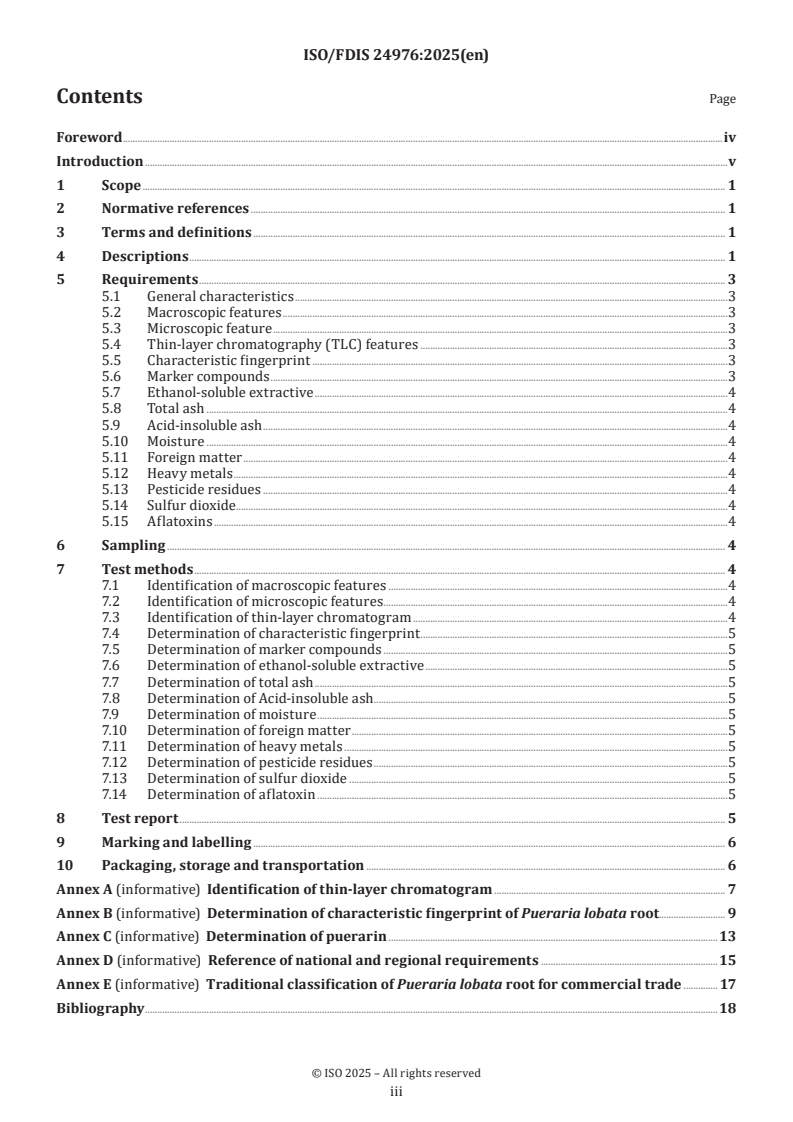
Contents Page
Foreword .iv
Introduction .v
1 Scope . 1
2 Normative references . 1
3 Terms and definitions . 1
4 Descriptions . 1
5 Requirements . 3
5.1 General characteristics .3
5.2 Macroscopic features .3
5.3 Microscopic feature .3
5.4 Thin-layer chromatography (TLC) features .3
5.5 Characteristic fingerprint .3
5.6 Marker compounds .3
5.7 Ethanol-soluble extractive .4
5.8 Total ash .4
5.9 Acid-insoluble ash .4
5.10 Moisture .4
5.11 Foreign matter .4
5.12 Heavy metals .4
5.13 Pesticide residues .4
5.14 Sulfur dioxide . .4
5.15 Aflatoxins .4
6 Sampling . 4
7 Test methods . 4
7.1 Identification of macroscopic features .4
7.2 Identification of microscopic features .4
7.3 Identification of thin-layer chromatogram .4
7.4 Determination of characteristic fingerprint .5
7.5 Determination of marker compounds .5
7.6 Determination of ethanol-soluble extractive .5
7.7 Determination of total ash .5
7.8 Determination of Acid-insoluble ash . .5
7.9 Determination of moisture .5
7.10 Determination of foreign matter .5
7.11 Determination of heavy metals .5
7.12 Determination of pesticide residues .5
7.13 Determination of sulfur dioxide .5
7.14 Determination of aflatoxin .5
8 Test report . 5
9 Marking and labelling . 6
10 Packaging, storage and transportation . 6
Annex A (informative) Identification of thin-layer chromatogram . 7
Annex B (informative) Determination of characteristic fingerprint of Pueraria lobata root. 9
Annex C (informative) Determination of puerarin .13
Annex D (informative) Reference of national and regional requirements .15
Annex E (informative) Traditional classification of Pueraria lobata root for commercial trade . 17
Bibliography .18
iii
ISO/FDIS 24976:2025(en)
Foreword
ISO (the International Organization for Standardization) is a worldwide federation of national standards
bodies (ISO member bodies). The work of preparing International Standards is normally carried out through
ISO technical committees. Each member body interested in a subject for which a technical committee
has been established has the right to be represented on that committee. International organizations,
governmental and non-governmental, in liaison with ISO, also take part in the work. ISO collaborates closely
with the International Electrotechnical Commission (IEC) on all matters of electrotechnical standardization.
The procedures used to develop this document and those intended for its further maintenance are described
in the ISO/IEC Directives, Part 1. In particular, the different approval criteria needed for the different types
of ISO document should be noted. This document was drafted in accordance with the editorial rules of the
ISO/IEC Directives, Part 2 (see www.iso.org/directives).
ISO draws attention to the possibility that the implementation of this document may involve the use of (a)
patent(s). ISO takes no position concerning the evidence, validity or applicability of any claimed patent
rights in respect thereof. As of the date of publication of this document, ISO had not received notice of (a)
patent(s) which may be required to implement this document. However, implementers are cautioned that
this may not represent the latest information, which may be obtained from the patent database available at
www.iso.org/patents. ISO shall not be held responsible for identifying any or all such patent rights.
Any trade name used in this document is information given for the convenience of users and does not
constitute an endorsement.
For an explanation of the voluntary nature of standards, the meaning of ISO specific terms and expressions
related to conformity assessment, as well as information about ISO's adherence to the World Trade
Organization (WTO) principles in the Technical Barriers to Trade (TBT), see www.iso.org/iso/foreword.html.
This document was prepared by Technical Committee ISO/TC 249, Traditional medicine, Subcommittee SC 1,
Traditional Chinese medicine.
Any feedback or questions on this document should be directed to the user’s national standards body. A
complete listing of these bodies can be found at www.iso.org/members.html.
iv
ISO/FDIS 24976:2025(en)
Introduction
The medicinal history of Pueraria lobata root (Chinese Pinyin name: Ge Gen) dates back over 2 000 years. Pueraria
lobata root has been used as a traditional herbal medicine in China, Japan, South Korea, United Kingdom and
other countries. It has exhibited diverse therapeutic effects, such as antipyretic, hypolipidemic, hypoglycemic
and hypotensive, intended for the treatment of arrhythmia, myocardial ischemia, osteoporosis etc.
The establishment of an international standard for Pueraria lobata root is necessary to guarantee the clinical
effectiveness, safety and controllability in global commerce and trade.
As national implementation can differ, national standards bodies are invited to modify the values given in
5.6, 5.8 and 5.10 in their national standards. Examples of national and regional values are given in Annex D.
In addition, grading information of Pueraria lobata root are given in Annex E.
v
FINAL DRAFT International Standard ISO/FDIS 24976:2025(en)
Traditional Chinese medicine — Pueraria lobata root
1 Scope
This document specifies the quality and safety requirements of Pueraria lobata root.
This document applies to Pueraria lobata root that is sold and used as natural medicine in international trade,
including Chinese materia medica (whole medicinal materials) and decoction pieces derived from this root.
2 Normative references
The following documents are referred to in the text in such a way that some or all of their content constitutes
requirements of this document. For dated references, only the edition cited applies. For undated references,
the latest edition of the referenced document (including any amendments) applies.
ISO 18664, Traditional Chinese Medicine — Determination of heavy metals in herbal medicines used in
Traditional Chinese Medicine
ISO/TS 21310, Traditional Chinese medicine — Microscopic examination of medicinal herbs
ISO 21371, Traditional Chinese medicine — Labelling requirements of products intended for oral or topical use
ISO 22217, Traditional Chinese medicine — Storage requirements for raw materials and decoction pieces
ISO 22258, Traditional Chinese medicine — Determination of pesticide residues in natural products by gas
chromatography
ISO 22283, Traditional Chinese medicine — Determination of aflatoxins in natural products by LC-FLD
ISO 22590, Traditional Chinese medicine — Determination of sulfur dioxide in natural products by titration
ISO 23723, Traditional Chinese medicine — General requirements for herbal raw material and materia medica
3 Terms and definitions
For the purposes of this document, the following terms and definitions apply.
ISO and IEC maintain terminology databases for use in standardization at the following addresses:
— ISO Online browsing platform: available at https:// www .iso .org/ obp
— IEC Electropedia: available at https:// www .electropedia .org/
3.1
Pueraria lobata root
dried root of Pueraria lobata (Willd.) Ohwi (Fam. Leguminosae) after primary processing
Note 1 to entry: Pueraria lobata root is harvested in autumn or winter. The primary processing includes washing,
cutting into small cubes or into thick slices when fresh, and drying in the sun or in the oven (usually below 60 °C).
4 Descriptions
Pueraria lobata root is the dried root of Pueraria lobata (Willd.) Ohwi. (Fam. Leguminosae) as shown in
Figure 1.
ISO/FDIS 24976:2025(en)
a) inflorescence of Pueraria lobata b) leaf of Pueraria lobata c) root of Pueraria lobata
d) inner side of thick slice (Pueraria lobata root)
e) outer surface of thick slice (Pueraria lobata root)
g) microscopic features of root transverse
f) small cubes (Pueraria lobata root)
section of Pueraria lobata
ISO/FDIS 24976:2025(en)
Key
1 cork
2 fibre bundle
3 phloem
4 xylem ray
5 xylem
Figure 1 — Structure of Pueraria lobata root
5 Requirements
5.1 General characteristics
The following requirements shall be met before sampling:
a) the sample shall be clean and free from rootlets;
b) the presence of living insects, mouldy root and rhizome, and external contaminants which are visible to
the naked eye shall not be permitted.
5.2 Macroscopic features
5.2.1 Tuberous root, wholly cylindric-like and thick. Usually in thick, longitudinally cut slice, or in small
irregular cube, variable in size. Externally brown, with longitudinal wrinkles (Figure 1).
5.2.2 Odourless. Taste slightly sweetish.
5.2.3 Transverse section rough, pale yell
...
ISO/FDIS 24976:2025(en)
Date: 2025-07-28
ISO/TC 249/WG SC 1
Secretariat: SAC
Date:
Traditional Chinese medicine — Pueraria lobata root
FDIS stage
ISO/FDIS 24976:2025(en)
All rights reserved. Unless otherwise specified, or required in the context of its implementation, no part of this publication
may be reproduced or utilized otherwise in any form or by any means, electronic or mechanical, including photocopying,
or posting on the internet or an intranet, without prior written permission. Permission can be requested from either ISO
at the address below or ISO’s member body in the country of the requester.
ISO copyright office
CP 401 • Ch. de Blandonnet 8
CH-1214 Vernier, Geneva
Phone: + 41 22 749 01 11
Fax: +41 22 749 09 47
EmailE-mail: copyright@iso.org
Website: www.iso.org
Published in Switzerland
ii
ISO/FDIS 24976:2025(en)
Contents
Foreword . v
Introduction . vi
1 Scope . 1
2 Normative references . 1
3 Terms and definitions . 1
4 Descriptions . 1
5 Requirements . 4
5.1 General characteristics . 4
5.2 Macroscopic features . 4
5.3 Microscopic feature . 4
5.4 Thin-layer chromatography (TLC) features . 4
5.5 Characteristic fingerprint . 4
5.6 Marker compounds . 4
5.7 Ethanol-soluble extractive. 4
5.8 Total ash . 4
5.9 Acid-insoluble ash . 4
5.10 Moisture . 5
5.11 Foreign matter . 5
5.12 Heavy metals . 5
5.13 Pesticide residues . 5
5.14 Sulfur dioxide . 5
5.15 Aflatoxins . 5
6 Sampling . 5
7 Test methods . 5
7.1 Identification of macroscopic features . 5
7.2 Identification of microscopic features . 5
7.3 Identification of thin-layer chromatogram . 5
7.4 Determination of characteristic fingerprint . 5
7.5 Determination of marker compounds . 5
7.6 Determination of ethanol-soluble extractive . 5
7.7 Determination of total ash . 6
7.8 Determination of Acid-insoluble ash . 6
7.9 Determination of moisture . 6
7.10 Determination of foreign matter . 6
7.11 Determination of heavy metals . 6
7.12 Determination of pesticide residues . 6
7.13 Determination of sulfur dioxide . 6
7.14 Determination of aflatoxin . 6
8 Test report . 6
9 Marking and labelling . 6
10 Packaging, storage and transportation . 7
Annex A (informative) Identification of thin-layer chromatogram . 8
Annex B (informative) Determination of characteristic fingerprint of Pueraria lobata root . 10
Annex C (informative) Determination of puerarin . 15
Annex D (informative) Reference of national and regional requirements . 17
iii
ISO/FDIS 24976:2025(en)
Annex E (informative) Traditional classification of Pueraria lobata root for commercial trade . 19
Bibliography . 20
iv
ISO/FDIS 24976:2025(en)
Foreword
ISO (the International Organization for Standardization) is a worldwide federation of national standards
bodies (ISO member bodies). The work of preparing International Standards is normally carried out through
ISO technical committees. Each member body interested in a subject for which a technical committee has been
established has the right to be represented on that committee. International organizations, governmental and
non-governmental, in liaison with ISO, also take part in the work. ISO collaborates closely with the
International Electrotechnical Commission (IEC) on all matters of electrotechnical standardization.
The procedures used to develop this document and those intended for its further maintenance are described
in the ISO/IEC Directives, Part 1. In particular, the different approval criteria needed for the different types of
ISO documentsdocument should be noted. This document was drafted in accordance with the editorial rules
of the ISO/IEC Directives, Part 2 (see www.iso.org/directives).
ISO draws attention to the possibility that the implementation of this document may involve the use of (a)
patent(s). ISO takes no position concerning the evidence, validity or applicability of any claimed patent rights
in respect thereof. As of the date of publication of this document, ISO had not received notice of (a) patent(s)
which may be required to implement this document. However, implementers are cautioned that this may not
represent the latest information, which may be obtained from the patent database available at
www.iso.org/patents. ISO shall not be held responsible for identifying any or all such patent rights.
Any trade name used in this document is information given for the convenience of users and does not
constitute an endorsement.
For an explanation of the voluntary nature of standards, the meaning of ISO specific terms and expressions
related to conformity assessment, as well as information about ISO's adherence to the World Trade
Organization (WTO) principles in the Technical Barriers to Trade (TBT), see www.iso.org/iso/foreword.html.
This document was prepared by Technical Committee ISO/TC 249, Traditional medicine, Subcommittee SC 1,
Traditional Chinese medicine.
Any feedback or questions on this document should be directed to the user’s national standards body. A
complete listing of these bodies can be found at www.iso.org/members.html.
v
ISO/FDIS 24976:2025(en)
Introduction
The medicinal history of Pueraria lobata root (Chinese Pinyin name: Ge Gen) dates back over 2 000 years.
Pueraria lobata root has been used as a traditional herbal medicine in China, Japan, South Korea, United
Kingdom and other countries. It has exhibited diverse therapeutic effects, such as antipyretic, hypolipidemic,
hypoglycemic and hypotensive, intended for the treatment of arrhythmia, myocardial ischemia, osteoporosis
etc.
The establishment of an international standard for Pueraria lobata root is necessary to guarantee the clinical
effectiveness, safety and controllability in global commerce and trade.
As national implementation can differ, national standards bodies are invited to modify the values given in
5.65.6, 5.8, 5.8 and 5.105.10 in their national standards. Examples of national and regional values are given in
Annex DAnnex D. In addition, grading information of Pueraria lobata root are given in Annex EAnnex E.
vi
ISO/FDIS 24976:2025(en)
Traditional Chinese medicine — Pueraria lobata root
1 Scope
This document specifies the quality and safety requirements of Pueraria lobata root.
This document applies to Pueraria lobata root that is sold and used as natural medicine in international trade,
including Chinese materia medica (whole medicinal materials) and decoction pieces derived from this root.
2 Normative references
The following documents are referred to in the text in such a way that some or all of their content constitutes
requirements of this document. For dated references, only the edition cited applies. For undated references,
the latest edition of the referenced document (including any amendments) applies.
ISO 18664, Traditional Chinese Medicine — Determination of heavy metals in herbal medicines used in
Traditional Chinese Medicine
ISO/TS 21310, Traditional Chinese medicine — Microscopic examination of medicinal herbs
ISO 21371, Traditional Chinese medicine — Labelling requirements of products intended for oral or topical use
ISO 22217, Traditional Chinese medicine — Storage requirements for raw materials and decoction pieces
ISO 22258, Traditional Chinese medicine — Determination of pesticide residues in natural products by gas
chromatography
ISO 22283, Traditional Chinese medicine — Determination of aflatoxins in natural products by LC-FLD
ISO 22590, Traditional Chinese medicine — Determination of sulfur dioxide in natural products by titration
ISO 23723, Traditional Chinese medicine — General requirements for herbal raw material and materia medica
3 Terms and definitions
For the purposes of this document, the following terms and definitions apply.
ISO and IEC maintain terminology databases for use in standardization at the following addresses:
— — ISO Online browsing platform: available at https://www.iso.org/obp
— — IEC Electropedia: available at https://www.electropedia.org/
3.1 3.1
Pueraria lobata root
dried root of Pueraria lobata (Willd.) Ohwi (Fam. Leguminosae) after primary processing
Note 1 to entry: Pueraria lobata root is harvested in autumn or winter. The primary processing includes washing, cutting
into small cubes or into thick slices when fresh, and drying in the sun or in the oven (usually below 60 °C).
4 Descriptions
Pueraria lobata root is the dried root of Pueraria lobata (Willd.) Ohwi. (Fam. Leguminosae) as shown in
Figure 1Figure 1.
ISO/FDIS 24976:2025(en)
a) inflorescence of Pueraria lobata b) leaf of Pueraria lobata c) root of Pueraria lobata
d) inner side of thick slice (Pueraria lobata root)
ISO/FDIS 24976:2025(en)
e) outer surface of thick slice (Pueraria lobata root)
g) microscopic features of root transverse section of
f) small cubes (Pueraria lobata root)
Pueraria lobata
Key
1 cork
2 fibre bundle
3 phloem
4 xylem ray
5 xylem
1 cork
2 fibre bundle
3 phloem
4 xylem ray
5 xylem
Figure 1 — Structure of Pueraria lobata root
ISO/FDIS 24976:2025(en)
5 Requirements
5.1 General characteristics
The following requirements shall be met before sampling:
a) a) the sample shall be clean and free from rootlets;
b) b) the presence of living insects, mouldy root and rhizome, and external contaminants which are
visible to the naked eye shall not be permitted.
5.2 Macroscopic features
5.2.1 5.2.1 Tuberous root, wholly cylindric-like and thick. Usually in thick, longitudinally cut slice, or in
small irregular cube, variable in size. Externally brown, with longitudinal wrinkles (Figure 1(Figure 1).).
5.2.2 5.2.2 Odourless. Taste slightly sweetish.
5.2.3 5.2.3 Transverse section rough, pale yellowish-brown, several concentric annular rings indistinctly
visible. Texture tough, pliable and strongly fibrous.
5.3 Microscopic feature
Examine the transverse section under a microscope. Fibre bundles multiple, associated with the vessels,
surrounded by parenchyma cells containing prisms of calcium oxalate, appearing as crystal fibres. Phloem and
xylem are arranged alternately as hetero-vascular bundles; vessels distinct, numerous, densely and alternately
arranged with fibre bundles, rays narrow, a few of starch granules in the parenchyma. See Figure 1Figure 1
g.).
5.4 Thin-layer chromatography (TLC) features
The identification of extract by thin-layer chromatography (TLC) shall present the spots or bands with the
same colour and position corresponding to those of reference solutions (see Figure A.1Figure A.1).).
5.5 Characteristic fingerprint
When HPLC fingerprinting is performed, characteristic peaks (see Figure B.1Figure B.1)) should be consistent
with the relative retention time range (see Table B.2Table B.2)) of the control fingerprint (reference
standard).
5.6 Marker compounds
The content of marker compound, such as puerarin, should be determined. The content of puerarin should not
be less than 2,0 %.
5.7 Ethanol-soluble extractive
The content of ethanol-soluble extractive should be determined.
5.8 Total ash
The content of total ash should not be more than 7,0 %.
5.9 Acid-insoluble ash
The content of acid-insoluble ash should be determined.
ISO/FDIS 24976:2025(en)
5.10 Moisture
The content of moisture in percentage mass should not be more than 14,0 %.
5.11 Foreign matter
The foreign matter rate should be determined.
5.12 Heavy metals
The contents of heavy metals such as arsenic, mercury, lead and cadmium shall be determined.
5.13 Pesticide residues
The contents of pesticide residues such as total DDT, dieldrin, total BHC (benzene hexachloride) and aldrin
should be determined.
5.14 Sulfur dioxide
The content of sulfur dioxide should be determined.
5.15 Aflatoxins
The contents of aflatoxin B1 and total aflatoxins (B1,
...
Questions, Comments and Discussion
Ask us and Technical Secretary will try to provide an answer. You can facilitate discussion about the standard in here.
Loading comments...