

ISO 22146:2018
(Main)Carbonate liming materials — Determination of reactivity — Automatic titration method with citric acid
General Information
- Abstract
This document specifies a method for determining the reactivity of calcium carbonate and calcium magnesium carbonate liming materials. It assesses the speed and effectiveness of their neutralising potential by automatic titration with citric acid. This method is applicable only to liming materials with a maximum particle size of 6,3 mm determined in accordance with ISO 20977. NOTE For marble dolomite (BET procedure as defined in ISO 9277 below 500 m2/kg), see EN 14984.
- Status
- Published
- Publication Date
- 04-Dec-2018
- Technical Committee
- ISO/TC 134 - Fertilizers, soil conditioners and beneficial substances
- Drafting Committee
- ISO/TC 134/WG 4 - Mineral soil amendments
- Current Stage
- 9093 - International Standard confirmed
- Start Date
- 07-Apr-2024
- Completion Date
- 29-Aug-2026
Buy Documents



ISO 22146:2018 - Carbonate liming materials -- Determination of reactivity -- Automatic titration method with citric acid
ISO 22146:2018 - Carbonate liming materials — Determination of reactivity — Automatic titration method with citric acid/5/2018

ISO 22146:2018 - Amendements minéraux basiques carbonatés -- Détermination de la réactivité -- Méthode par titration automatique a l’acide citrique
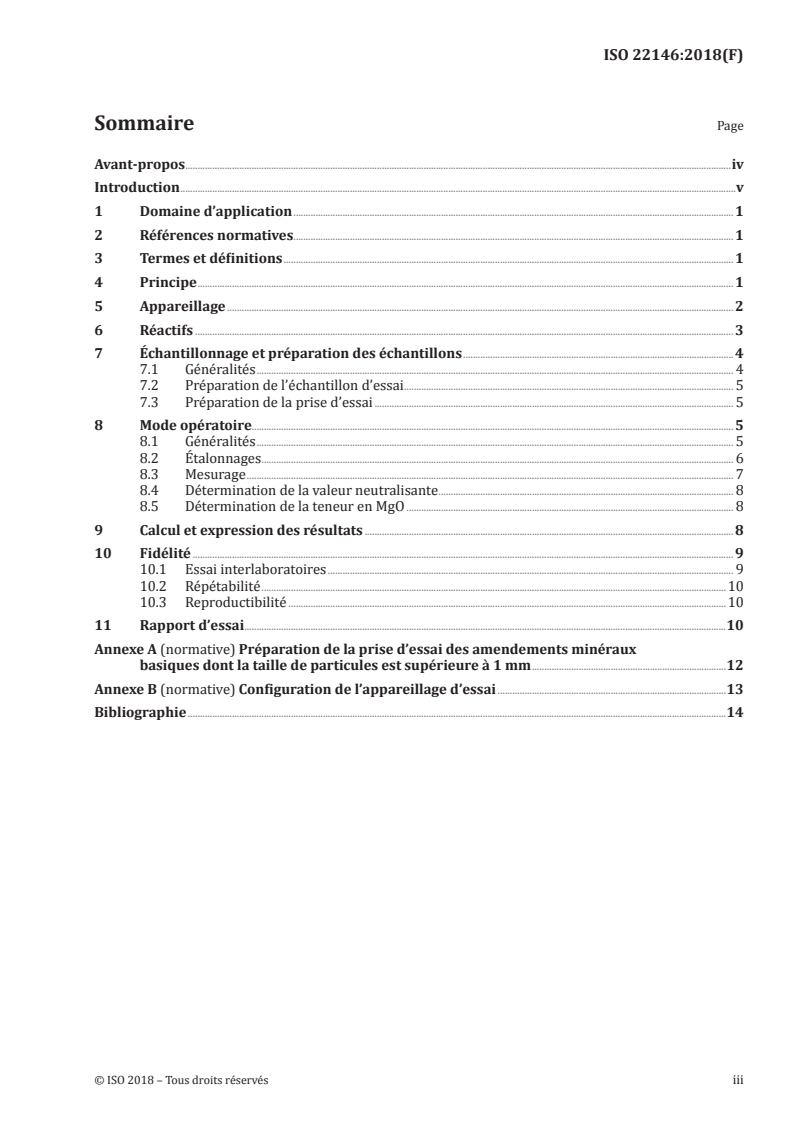
ISO 22146:2018 - Amendements minéraux basiques carbonatés — Détermination de la réactivité — Méthode par titration automatique à l’acide citrique/5/2018
Overview
ISO 22146:2018 specifies an automatic titration method with citric acid to determine the reactivity of carbonate liming materials - specifically calcium carbonate and calcium magnesium carbonate. The method measures the speed and effectiveness of a liming material’s neutralising potential by maintaining pH at 4.5 and recording citric acid consumption over a fixed time (15 minutes). It applies to materials with a maximum particle size of 6.3 mm (per ISO 20977). Note: marble dolomite with low BET surface area is covered by EN 14984.
Keywords: ISO 22146:2018, carbonate liming materials, reactivity, automatic titration, citric acid, neutralising value.
Key Topics and Requirements
- Principle: Limited acid decomposition of carbonates; citric acid consumption at pH 4.5 over 15 min is the reactivity metric.
- Scope: Applies to CaCO3 and Ca/Mg carbonate liming materials with particle size ≤ 6.3 mm.
- Critical steps:
- Accurate identification of liming material type (affects precision).
- Correct sample preparation and size distribution (ISO 14820-2 / ISO 20977).
- Calibration and performance of the pH electrode and pH-stat program in the titrator.
- Use of a suitable precipitated calcium carbonate (PCC) reference.
- Appropriate stirring (propeller or non-grinding magnetic stirrer) to ensure homogeneous dispersion.
- Apparatus & reagents:
- Automatic burette/titrator with pH-stat, pH meter, propeller or magnetic stirrer, beakers.
- Citric acid monohydrate solution (conventional concentration ρ = 457.17 g/L).
- PCC reference material, silicone defoamer, pH buffers (pH 4 and 7), water per ISO 3696.
- Testing practice: Samples are tested “as received” to align reactivity with neutralising value and MgO measurements; correction factors are applied later (additional uncertainty should be evaluated).
Applications and Users
- Quality control and batch testing for lime producers and fertilizer manufacturers.
- Independent analytical laboratories performing reactivity and neutralising value assessments.
- Agronomists, soil scientists and regulatory bodies verifying liming materials for agricultural use.
- Product certification, specification compliance, and R&D into liming product performance.
Benefits: faster, more representative automated testing closer to soil conditions; improved repeatability and suitability for routine QC.
Related Standards
- ISO 20977 - size distribution of liming materials
- ISO 20978 - determination of neutralising value (titrimetric methods)
- ISO 14820-2 - sample preparation for liming materials
- ISO 3696 - water for laboratory use
- EN 14984 - marble dolomite reactivity (low BET)
- EN 12048 - moisture determination for solid fertilizers and liming materials
For laboratories and manufacturers, ISO 22146:2018 provides a practical, automated procedure to quantify carbonate liming material reactivity for quality assurance and agronomic performance assessment.
Relations
- Effective Date
- 12-Feb-2026
- Effective Date
- 06-Jun-2022
- Effective Date
- 06-Jun-2022
Buy Documents
ISO 22146:2018 - Carbonate liming materials -- Determination of reactivity -- Automatic titration method with citric acid
ISO 22146:2018 - Carbonate liming materials — Determination of reactivity — Automatic titration method with citric acid/5/2018
ISO 22146:2018 - Amendements minéraux basiques carbonatés -- Détermination de la réactivité -- Méthode par titration automatique a l’acide citrique
ISO 22146:2018 - Amendements minéraux basiques carbonatés — Détermination de la réactivité — Méthode par titration automatique à l’acide citrique/5/2018
Get Certified
Connect with accredited certification bodies for this standard

Control Union Certifications
Global certification for agriculture and sustainability.

ECOCERT
Organic and sustainability certification.

FSC International
Forest Stewardship Council certification.
Sponsored listings
Frequently Asked Questions
ISO 22146:2018 is a standard published by the International Organization for Standardization (ISO). Its full title is "Carbonate liming materials — Determination of reactivity — Automatic titration method with citric acid". This standard covers: This document specifies a method for determining the reactivity of calcium carbonate and calcium magnesium carbonate liming materials. It assesses the speed and effectiveness of their neutralising potential by automatic titration with citric acid. This method is applicable only to liming materials with a maximum particle size of 6,3 mm determined in accordance with ISO 20977. NOTE For marble dolomite (BET procedure as defined in ISO 9277 below 500 m2/kg), see EN 14984.
This document specifies a method for determining the reactivity of calcium carbonate and calcium magnesium carbonate liming materials. It assesses the speed and effectiveness of their neutralising potential by automatic titration with citric acid. This method is applicable only to liming materials with a maximum particle size of 6,3 mm determined in accordance with ISO 20977. NOTE For marble dolomite (BET procedure as defined in ISO 9277 below 500 m2/kg), see EN 14984.
ISO 22146:2018 is classified under the following ICS (International Classification for Standards) categories: 65.080 - Fertilizers. The ICS classification helps identify the subject area and facilitates finding related standards.
ISO 22146:2018 has the following relationships with other standards: It is inter standard links to EN 16357:2013, ISO 21848:2005, ISO 11137-2:2013/Amd 1:2022. Understanding these relationships helps ensure you are using the most current and applicable version of the standard.
ISO 22146:2018 is available in PDF format for immediate download after purchase. The document can be added to your cart and obtained through the secure checkout process. Digital delivery ensures instant access to the complete standard document.
Standards Content (Sample)
INTERNATIONAL ISO
STANDARD 22146
First edition
2018-12
Carbonate liming materials —
Determination of reactivity —
Automatic titration method with
citric acid
Amendements minéraux basiques carbonatés — Détermination de la
réactivité — Méthode par titration automatique à l’acide citrique
Reference number
©
ISO 2018
© ISO 2018
All rights reserved. Unless otherwise specified, or required in the context of its implementation, no part of this publication may
be reproduced or utilized otherwise in any form or by any means, electronic or mechanical, including photocopying, or posting
on the internet or an intranet, without prior written permission. Permission can be requested from either ISO at the address
below or ISO’s member body in the country of the requester.
ISO copyright office
CP 401 • Ch. de Blandonnet 8
CH-1214 Vernier, Geneva
Phone: +41 22 749 01 11
Fax: +41 22 749 09 47
Email: copyright@iso.org
Website: www.iso.org
Published in Switzerland
ii © ISO 2018 – All rights reserved
Contents Page
Foreword .iv
Introduction .v
1 Scope . 1
2 Normative references . 1
3 Terms and definitions . 1
4 Principle . 1
5 Apparatus . 2
6 Reagents . 3
7 Sampling and sample preparation . 4
7.1 General . 4
7.2 Preparation of the test sample . 5
7.3 Preparation of the test portion . 5
8 Procedure. 5
8.1 General . 5
8.2 Calibrations . 5
8.3 Measurement . 7
8.4 Determination of neutralising value . 7
8.5 Determination of MgO content . . 7
9 Calculation and expression of the results . 8
10 Precision . 8
10.1 Inter-laboratory tests . 8
10.2 Repeatability . 9
10.3 Reproducibility . 9
11 Test report .10
Annex A (normative) Preparation of the test portion of liming materials coarser than 1 mm .11
Annex B (normative) Arrangement of the test apparatus .12
Bibliography .13
Foreword
ISO (the International Organization for Standardization) is a worldwide federation of national standards
bodies (ISO member bodies). The work of preparing International Standards is normally carried out
through ISO technical committees. Each member body interested in a subject for which a technical
committee has been established has the right to be represented on that committee. International
organizations, governmental and non-governmental, in liaison with ISO, also take part in the work.
ISO collaborates closely with the International Electrotechnical Commission (IEC) on all matters of
electrotechnical standardization.
The procedures used to develop this document and those intended for its further maintenance are
described in the ISO/IEC Directives, Part 1. In particular, the different approval criteria needed for the
different types of ISO documents should be noted. This document was drafted in accordance with the
editorial rules of the ISO/IEC Directives, Part 2 (see www .iso .org/directives).
Attention is drawn to the possibility that some of the elements of this document may be the subject of
patent rights. ISO shall not be held responsible for identifying any or all such patent rights. Details of
any patent rights identified during the development of the document will be in the Introduction and/or
on the ISO list of patent declarations received (see www .iso .org/patents).
Any trade name used in this document is information given for the convenience of users and does not
constitute an endorsement.
For an explanation of the voluntary nature of standards, the meaning of ISO specific terms and
expressions related to conformity assessment, as well as information about ISO's adherence to the
World Trade Organization (WTO) principles in the Technical Barriers to Trade (TBT) see www .iso
.org/iso/foreword .html.
This document was prepared by the European Committee for Standardization (CEN) (as EN 16357/2013)
and was adopted, without modification apart from editorial corrections, by Technical Committee ISO/
TC 134, Fertilizers, soil conditioners and beneficial substances.
Any feedback or questions on this document should be directed to the user’s national standards body. A
complete listing of these bodies can be found at www .iso .org/members .html.
iv © ISO 2018 – All rights reserved
Introduction
This document has been prepared to improve the existing agricultural reactivity methods
(see References [8], [9], [10], [11] and [12]) for carbonate liming materials: duration, accuracy,
representativeness, closer from soil conditions, automation.
INTERNATIONAL STANDARD ISO 22146:2018(E)
Carbonate liming materials — Determination of reactivity
— Automatic titration method with citric acid
1 Scope
This document specifies a method for determining the reactivity of calcium carbonate and calcium
magnesium carbonate liming materials. It assesses the speed and effectiveness of their neutralising
potential by automatic titration with citric acid.
This method is applicable only to liming materials with a maximum particle size of 6,3 mm determined
in accordance with ISO 20977.
NOTE For marble dolomite (BET procedure as defined in ISO 9277 below 500 m /kg), see EN 14984.
2 Normative references
The following documents are referred to in the text in such a way that some or all of their content
constitutes requirements of this document. For dated references, only the edition cited applies. For
undated references, the latest edition of the referenced document (including any amendments) applies.
ISO 3696, Water for analytical laboratory use — Specification and test methods
ISO 14820-2, Fertilizers and liming materials — Sampling and sample preparation — Part 2: Sample
preparation
ISO 20977, Liming materials — Determination of size distribution by dry and wet sieving
ISO 20978, Liming materials — Determination of neutralizing value — Titrimetric methods
EN 12048, Solid fertilizers and liming materials — Determination of moisture content — Gravimetric
method by drying at (105 ± 2) °C
3 Terms and definitions
No terms and definitions are listed in this document.
ISO and IEC maintain terminological databases for use in standardization at the following addresses:
— ISO Online browsing platform: available at https: //www .iso .org/obp
— IEC Electropedia: available at http: //www .electropedia .org/
4 Principle
The principle of the method is based on the following points:
— Limited decomposition of carbonates in a given time with acid according to the following reaction:
++2
MeCO +→2H Me ++HO CO
3 22
where Me represents Ca, Mg, etc;
— Titration under stable pH conditions (pH = 4,5) with an automatic titration apparatus. The citric
acid consumption during a given time (15 min) is a direct measure for the reaction of the liming
materials being tested.
Attention is drawn to the following critical steps:
— identification of the liming material type (influence on precision data);
— size distribution (influence on test portion preparation and amount);
— calibration of pH electrode (influence on titrator’s pH adjustments);
— pH stat programme setting (influence on the accuracy of added amounts of citric acid solution);
— suitability of precipitated calcium carbonate (PCC) used to check calibration;
— stirring device (provides homogeneousness without grinding);
— additional uncertainty with neutralising value and MgO content determination.
5 Apparatus
The usual laboratory apparatus and, in particular, the following:
5.1 pH meter with electrode.
This instrument is generally included in the automatic motor-driven burette device.
5.2 Automatic motor-driven burette, with a capacity of 20 ml.
This kind of burette is generally equipped with all necessary accessories such as pH regulation
programme (pH stat), automatic refilling device, pH electrode, continuous pH measurement and
propeller stirring device.
Though a propeller stirring device is preferred, a magnetic stirring device (5.7) may be used, provided
the central ring of the stirring rod is thick enough and does not lead to the grinding of the tested
material. Make sure the rotation speed of the stirring rod is fast enough to make a homogeneous
dispersion in the beaker. If not, increase the speed up to the appropriate value.
The burette shall deliver at least 0,05 ml/s of citric acid solution (6.3). This is to ensure the first part
of the reaction [pH dropping from initial pH value to target pH value (4,5) is not a limiting factor for
liming material dissolution speed. This figure is higher than the flow rate obtained with the fastest
reaction observed in preliminary tests.
The burette shall deliver its whole content in at least 4 000 steps to ensure accuracy for small amounts
of citric acid solution (6.3).
NOTE This condition is always fulfilled with modern titrators. All contemporary (less than 10 years old)
titrators allow such accuracy, with a minimum step amount of 0,002 5 ml for a 10 ml burette or 0,012 5 ml for a
50 ml burette. This is sufficient, even for small amounts. However, this accuracy is obtained only if the correct
(minimal) step volume is specified in the titrator setup. If not, the precision of the method is altered.
Use the burette only for the citric acid solution (6.3).
For liming materials coarser than 1 mm, use a 50 ml burette.
2 © ISO 2018 – All rights reserved
For most products, a 10 ml burette is sufficient. However, a 20 ml burette is necessary for highly
reactive chalks and precipitated calcium carbonate (PCC). Because refilling takes a significant amount
of time, this can alter the results. If volumes higher than 10 ml are expected, do not use the automatic
refilling possibility and use a 20 ml or a 50 ml burette.
5.3 Glass beaker, with a capacity of 100 ml.
For liming materials coarser than 1 mm, use a 200 ml beaker.
Minimum diameter in case of magnetic stirring device (5.7): 50 mm.
5.4 Stop-watch.
5.5 Balance, capable of weighing 10 g to the nearest 0,01 g.
5.6 Sample changer, optional.
If a sample changer is utilized, a beaker of water (6.1) shall be inserted between two samples.
5.7 Magnetic stirring device, optional, (see 5.2).
−1
Capable of a minimum rotational speed of 500 min .
Stirring rod minimum length: 40 mm.
6 Reagents
All reagents shall be of recognized analytical grade.
6.1 Water, meeting the requirements of ISO 3696, grade 2.
6.2 Citric acid monohydrate, C H O H O, crystallized or powdered, molar mass: 210,14 g/mol.
6 8 7 2
Do not use anhydrous citric acid having a different molar mass and can partially hydrate when stored.
6.3 Citric acid solution, ρ = 457,17 g/l.
Preferably, use a fresh home-made solution as described below. Its pure citric acid concentration is
conventionally supposed to be the required one, i.e. ρ = 457,17 g/l.
ca
The solution may be used for up to one month if stored in a closed, dark glass vessel. If the solution has
been stored for more than one week, check its concentration by any means, for example by titration
with a strong base (NaOH) solution of known concentration, and report the result in Formula (2).
Weigh 500 g of citric acid monohydrate (6.2) to the nearest 0,1 g. Pour it quantitatively into a 1 l
measuring vessel. Rinse the weighing material and pour the rinsing water into the vessel in a way that
it takes any acid stuck on the edge or on the bottom. Add about 500 ml of water (6.1) to the measuring
vessel. Heat the vessel until full dissolution (at a temperature of about 80 °C). Let the vessel cool to
ambient temperature. Make up the volume with water to 1 l. Stir to get a homogeneous solution.
The pure citric acid concentration of this solution, ρ (C H O ), in grams per litre, is calculated
ca 6 8 7
according to Formula (1) as follows.
500×192,14
ρ ==457,17 (1)
ca
210,14
where
500 is the added mass of citric acid monohydrate (6.2), in grams (g);
192,14 is the molar mass of anhydrous citric acid, in grams per mole (g/mol);
210,14 is the molar mass of citric acid monohydrate, in grams per mole (g/mol).
6.4 Calcium carbonate, precipitated (PCC), with a mass fraction w(CaCO ) of at least 99 %.
Commercial PCC for analysis is certified for its chemical characteristics. However, its physical
characteristics are not certified. As reactivity depends on fineness, even for PCC, it is essential to take
1)
a highly reactive PCC as a reference, which consumes 15 ml in 15 min. This type of PCC was used
in the ring test before launching measurements. By experience, some types of PCC do not meet this
requirement. See also the note in 8.2.6.
6.5 Silicone defoamer.
6.6 Standard buffer solution, pH = 4 (commercial solution, pH = 4,01).
NOTE This solution has a limited lifetime.
6.7 Standard buffer solution, pH = 7 (commercial solution, pH = 6,98).
NOTE This solution has a limited lifetime.
7 Sampling and sample preparation
7.1 General
Sampling is not part of the methods specified in this document. A recommended sampling method is
given in ISO 14820-1.
Sample preparation shall be carried out in accordance with ISO 14820-2.
This document specifies that samples are tested “as received” in order to allow immediate starting of
all the necessary measurements (Neutralizing Value, MgO). No preliminary determination is required
to calculate the mass of the tested samples. However, make sure that sample moisture is the same in the
reactivity test portion as in the neutralising value measurement.
Correcting factors are to be applied later on in the expression of results: actual citric acid concentration,
exact mass of sample, as received neutralising value, MgO content. Such a procedure shortens the
total necessary time for analysis because required measurements are made simultaneously instead
of successively. However, the additional uncertainty introduced by the correction factors is neither
described in this document nor taken into account for the precision data mentioned in Clause 10.
All implemented correction factors should be evaluated to quantify the additional uncertainty they
introduce to the expression of the reactivity.
NOTE This procedure is also better than drying the sample before titrating, because drying can modify
fineness or physical presentation and consequently have an impact on the reactivity of some products.
1) Such as commercial PCC from VWR / BDH Prolabo ®, GPR, Rectapur®, Ref 22296.294, Molar mass 100,09.
This information is given for the convenience of users of this document and does not constitute an endorsement by
ISO of the product named. Equivalent products may be used if they can be shown to lead to the same results.
4 © ISO 2018 – All rights reserved
7.2 Preparation of the test sample
Measure the moisture content of the tested material in accordance with EN 12048 and record the result
for information.
Make sure there is no oxide or hydroxide in the material to be tested (pH with 1/10 dilution shall be
below 10). An oxide or hydroxide fraction in the product alters the result. Oxide or hydroxide chemical
forms are not included in the scope of this method.
Use the test sample without any further preparation, e.g. grinding or drying.
NOTE The procedure (8.3.2) includ
...
INTERNATIONAL ISO
STANDARD 22146
First edition
2018-12
Carbonate liming materials —
Determination of reactivity —
Automatic titration method with
citric acid
Amendements minéraux basiques carbonatés — Détermination de la
réactivité — Méthode par titration automatique à l’acide citrique
Reference number
©
ISO 2018
© ISO 2018
All rights reserved. Unless otherwise specified, or required in the context of its implementation, no part of this publication may
be reproduced or utilized otherwise in any form or by any means, electronic or mechanical, including photocopying, or posting
on the internet or an intranet, without prior written permission. Permission can be requested from either ISO at the address
below or ISO’s member body in the country of the requester.
ISO copyright office
CP 401 • Ch. de Blandonnet 8
CH-1214 Vernier, Geneva
Phone: +41 22 749 01 11
Fax: +41 22 749 09 47
Email: copyright@iso.org
Website: www.iso.org
Published in Switzerland
ii © ISO 2018 – All rights reserved
Contents Page
Foreword .iv
Introduction .v
1 Scope . 1
2 Normative references . 1
3 Terms and definitions . 1
4 Principle . 1
5 Apparatus . 2
6 Reagents . 3
7 Sampling and sample preparation . 4
7.1 General . 4
7.2 Preparation of the test sample . 5
7.3 Preparation of the test portion . 5
8 Procedure. 5
8.1 General . 5
8.2 Calibrations . 5
8.3 Measurement . 7
8.4 Determination of neutralising value . 7
8.5 Determination of MgO content . . 7
9 Calculation and expression of the results . 8
10 Precision . 8
10.1 Inter-laboratory tests . 8
10.2 Repeatability . 9
10.3 Reproducibility . 9
11 Test report .10
Annex A (normative) Preparation of the test portion of liming materials coarser than 1 mm .11
Annex B (normative) Arrangement of the test apparatus .12
Bibliography .13
Foreword
ISO (the International Organization for Standardization) is a worldwide federation of national standards
bodies (ISO member bodies). The work of preparing International Standards is normally carried out
through ISO technical committees. Each member body interested in a subject for which a technical
committee has been established has the right to be represented on that committee. International
organizations, governmental and non-governmental, in liaison with ISO, also take part in the work.
ISO collaborates closely with the International Electrotechnical Commission (IEC) on all matters of
electrotechnical standardization.
The procedures used to develop this document and those intended for its further maintenance are
described in the ISO/IEC Directives, Part 1. In particular, the different approval criteria needed for the
different types of ISO documents should be noted. This document was drafted in accordance with the
editorial rules of the ISO/IEC Directives, Part 2 (see www .iso .org/directives).
Attention is drawn to the possibility that some of the elements of this document may be the subject of
patent rights. ISO shall not be held responsible for identifying any or all such patent rights. Details of
any patent rights identified during the development of the document will be in the Introduction and/or
on the ISO list of patent declarations received (see www .iso .org/patents).
Any trade name used in this document is information given for the convenience of users and does not
constitute an endorsement.
For an explanation of the voluntary nature of standards, the meaning of ISO specific terms and
expressions related to conformity assessment, as well as information about ISO's adherence to the
World Trade Organization (WTO) principles in the Technical Barriers to Trade (TBT) see www .iso
.org/iso/foreword .html.
This document was prepared by the European Committee for Standardization (CEN) (as EN 16357/2013)
and was adopted, without modification apart from editorial corrections, by Technical Committee ISO/
TC 134, Fertilizers, soil conditioners and beneficial substances.
Any feedback or questions on this document should be directed to the user’s national standards body. A
complete listing of these bodies can be found at www .iso .org/members .html.
iv © ISO 2018 – All rights reserved
Introduction
This document has been prepared to improve the existing agricultural reactivity methods
(see References [8], [9], [10], [11] and [12]) for carbonate liming materials: duration, accuracy,
representativeness, closer from soil conditions, automation.
INTERNATIONAL STANDARD ISO 22146:2018(E)
Carbonate liming materials — Determination of reactivity
— Automatic titration method with citric acid
1 Scope
This document specifies a method for determining the reactivity of calcium carbonate and calcium
magnesium carbonate liming materials. It assesses the speed and effectiveness of their neutralising
potential by automatic titration with citric acid.
This method is applicable only to liming materials with a maximum particle size of 6,3 mm determined
in accordance with ISO 20977.
NOTE For marble dolomite (BET procedure as defined in ISO 9277 below 500 m /kg), see EN 14984.
2 Normative references
The following documents are referred to in the text in such a way that some or all of their content
constitutes requirements of this document. For dated references, only the edition cited applies. For
undated references, the latest edition of the referenced document (including any amendments) applies.
ISO 3696, Water for analytical laboratory use — Specification and test methods
ISO 14820-2, Fertilizers and liming materials — Sampling and sample preparation — Part 2: Sample
preparation
ISO 20977, Liming materials — Determination of size distribution by dry and wet sieving
ISO 20978, Liming materials — Determination of neutralizing value — Titrimetric methods
EN 12048, Solid fertilizers and liming materials — Determination of moisture content — Gravimetric
method by drying at (105 ± 2) °C
3 Terms and definitions
No terms and definitions are listed in this document.
ISO and IEC maintain terminological databases for use in standardization at the following addresses:
— ISO Online browsing platform: available at https: //www .iso .org/obp
— IEC Electropedia: available at http: //www .electropedia .org/
4 Principle
The principle of the method is based on the following points:
— Limited decomposition of carbonates in a given time with acid according to the following reaction:
++2
MeCO +→2H Me ++HO CO
3 22
where Me represents Ca, Mg, etc;
— Titration under stable pH conditions (pH = 4,5) with an automatic titration apparatus. The citric
acid consumption during a given time (15 min) is a direct measure for the reaction of the liming
materials being tested.
Attention is drawn to the following critical steps:
— identification of the liming material type (influence on precision data);
— size distribution (influence on test portion preparation and amount);
— calibration of pH electrode (influence on titrator’s pH adjustments);
— pH stat programme setting (influence on the accuracy of added amounts of citric acid solution);
— suitability of precipitated calcium carbonate (PCC) used to check calibration;
— stirring device (provides homogeneousness without grinding);
— additional uncertainty with neutralising value and MgO content determination.
5 Apparatus
The usual laboratory apparatus and, in particular, the following:
5.1 pH meter with electrode.
This instrument is generally included in the automatic motor-driven burette device.
5.2 Automatic motor-driven burette, with a capacity of 20 ml.
This kind of burette is generally equipped with all necessary accessories such as pH regulation
programme (pH stat), automatic refilling device, pH electrode, continuous pH measurement and
propeller stirring device.
Though a propeller stirring device is preferred, a magnetic stirring device (5.7) may be used, provided
the central ring of the stirring rod is thick enough and does not lead to the grinding of the tested
material. Make sure the rotation speed of the stirring rod is fast enough to make a homogeneous
dispersion in the beaker. If not, increase the speed up to the appropriate value.
The burette shall deliver at least 0,05 ml/s of citric acid solution (6.3). This is to ensure the first part
of the reaction [pH dropping from initial pH value to target pH value (4,5) is not a limiting factor for
liming material dissolution speed. This figure is higher than the flow rate obtained with the fastest
reaction observed in preliminary tests.
The burette shall deliver its whole content in at least 4 000 steps to ensure accuracy for small amounts
of citric acid solution (6.3).
NOTE This condition is always fulfilled with modern titrators. All contemporary (less than 10 years old)
titrators allow such accuracy, with a minimum step amount of 0,002 5 ml for a 10 ml burette or 0,012 5 ml for a
50 ml burette. This is sufficient, even for small amounts. However, this accuracy is obtained only if the correct
(minimal) step volume is specified in the titrator setup. If not, the precision of the method is altered.
Use the burette only for the citric acid solution (6.3).
For liming materials coarser than 1 mm, use a 50 ml burette.
2 © ISO 2018 – All rights reserved
For most products, a 10 ml burette is sufficient. However, a 20 ml burette is necessary for highly
reactive chalks and precipitated calcium carbonate (PCC). Because refilling takes a significant amount
of time, this can alter the results. If volumes higher than 10 ml are expected, do not use the automatic
refilling possibility and use a 20 ml or a 50 ml burette.
5.3 Glass beaker, with a capacity of 100 ml.
For liming materials coarser than 1 mm, use a 200 ml beaker.
Minimum diameter in case of magnetic stirring device (5.7): 50 mm.
5.4 Stop-watch.
5.5 Balance, capable of weighing 10 g to the nearest 0,01 g.
5.6 Sample changer, optional.
If a sample changer is utilized, a beaker of water (6.1) shall be inserted between two samples.
5.7 Magnetic stirring device, optional, (see 5.2).
−1
Capable of a minimum rotational speed of 500 min .
Stirring rod minimum length: 40 mm.
6 Reagents
All reagents shall be of recognized analytical grade.
6.1 Water, meeting the requirements of ISO 3696, grade 2.
6.2 Citric acid monohydrate, C H O H O, crystallized or powdered, molar mass: 210,14 g/mol.
6 8 7 2
Do not use anhydrous citric acid having a different molar mass and can partially hydrate when stored.
6.3 Citric acid solution, ρ = 457,17 g/l.
Preferably, use a fresh home-made solution as described below. Its pure citric acid concentration is
conventionally supposed to be the required one, i.e. ρ = 457,17 g/l.
ca
The solution may be used for up to one month if stored in a closed, dark glass vessel. If the solution has
been stored for more than one week, check its concentration by any means, for example by titration
with a strong base (NaOH) solution of known concentration, and report the result in Formula (2).
Weigh 500 g of citric acid monohydrate (6.2) to the nearest 0,1 g. Pour it quantitatively into a 1 l
measuring vessel. Rinse the weighing material and pour the rinsing water into the vessel in a way that
it takes any acid stuck on the edge or on the bottom. Add about 500 ml of water (6.1) to the measuring
vessel. Heat the vessel until full dissolution (at a temperature of about 80 °C). Let the vessel cool to
ambient temperature. Make up the volume with water to 1 l. Stir to get a homogeneous solution.
The pure citric acid concentration of this solution, ρ (C H O ), in grams per litre, is calculated
ca 6 8 7
according to Formula (1) as follows.
500×192,14
ρ ==457,17 (1)
ca
210,14
where
500 is the added mass of citric acid monohydrate (6.2), in grams (g);
192,14 is the molar mass of anhydrous citric acid, in grams per mole (g/mol);
210,14 is the molar mass of citric acid monohydrate, in grams per mole (g/mol).
6.4 Calcium carbonate, precipitated (PCC), with a mass fraction w(CaCO ) of at least 99 %.
Commercial PCC for analysis is certified for its chemical characteristics. However, its physical
characteristics are not certified. As reactivity depends on fineness, even for PCC, it is essential to take
1)
a highly reactive PCC as a reference, which consumes 15 ml in 15 min. This type of PCC was used
in the ring test before launching measurements. By experience, some types of PCC do not meet this
requirement. See also the note in 8.2.6.
6.5 Silicone defoamer.
6.6 Standard buffer solution, pH = 4 (commercial solution, pH = 4,01).
NOTE This solution has a limited lifetime.
6.7 Standard buffer solution, pH = 7 (commercial solution, pH = 6,98).
NOTE This solution has a limited lifetime.
7 Sampling and sample preparation
7.1 General
Sampling is not part of the methods specified in this document. A recommended sampling method is
given in ISO 14820-1.
Sample preparation shall be carried out in accordance with ISO 14820-2.
This document specifies that samples are tested “as received” in order to allow immediate starting of
all the necessary measurements (Neutralizing Value, MgO). No preliminary determination is required
to calculate the mass of the tested samples. However, make sure that sample moisture is the same in the
reactivity test portion as in the neutralising value measurement.
Correcting factors are to be applied later on in the expression of results: actual citric acid concentration,
exact mass of sample, as received neutralising value, MgO content. Such a procedure shortens the
total necessary time for analysis because required measurements are made simultaneously instead
of successively. However, the additional uncertainty introduced by the correction factors is neither
described in this document nor taken into account for the precision data mentioned in Clause 10.
All implemented correction factors should be evaluated to quantify the additional uncertainty they
introduce to the expression of the reactivity.
NOTE This procedure is also better than drying the sample before titrating, because drying can modify
fineness or physical presentation and consequently have an impact on the reactivity of some products.
1) Such as commercial PCC from VWR / BDH Prolabo ®, GPR, Rectapur®, Ref 22296.294, Molar mass 100,09.
This information is given for the convenience of users of this document and does not constitute an endorsement by
ISO of the product named. Equivalent products may be used if they can be shown to lead to the same results.
4 © ISO 2018 – All rights reserved
7.2 Preparation of the test sample
Measure the moisture content of the tested material in accordance with EN 12048 and record the result
for information.
Make sure there is no oxide or hydroxide in the material to be tested (pH with 1/10 dilution shall be
below 10). An oxide or hydroxide fraction in the product alters the result. Oxide or hydroxide chemical
forms are not included in the scope of this method.
Use the test sample without any further preparation, e.g. grinding or drying.
NOTE The procedure (8.3.2) includ
...
NORME ISO
INTERNATIONALE 22146
Première édition
2018-12
Amendements minéraux basiques
carbonatés — Détermination de la
réactivité — Méthode par titration
automatique à l’acide citrique
Carbonate liming materials — Determination of reactivity —
Automatic titration method with citric acid
Numéro de référence
©
ISO 2018
DOCUMENT PROTÉGÉ PAR COPYRIGHT
© ISO 2018
Tous droits réservés. Sauf prescription différente ou nécessité dans le contexte de sa mise en œuvre, aucune partie de cette
publication ne peut être reproduite ni utilisée sous quelque forme que ce soit et par aucun procédé, électronique ou mécanique,
y compris la photocopie, ou la diffusion sur l’internet ou sur un intranet, sans autorisation écrite préalable. Une autorisation peut
être demandée à l’ISO à l’adresse ci-après ou au comité membre de l’ISO dans le pays du demandeur.
ISO copyright office
Case postale 401 • Ch. de Blandonnet 8
CH-1214 Vernier, Genève
Tél.: +41 22 749 01 11
Fax: +41 22 749 09 47
E-mail: copyright@iso.org
Web: www.iso.org
Publié en Suisse
ii © ISO 2018 – Tous droits réservés
Sommaire Page
Avant-propos .iv
Introduction .v
1 Domaine d’application . 1
2 Références normatives . 1
3 Termes et définitions . 1
4 Principe . 1
5 Appareillage . 2
6 Réactifs . 3
7 Échantillonnage et préparation des échantillons . 4
7.1 Généralités . 4
7.2 Préparation de l’échantillon d’essai . 5
7.3 Préparation de la prise d’essai . 5
8 Mode opératoire. 5
8.1 Généralités . 5
8.2 Étalonnages . 6
8.3 Mesurage . 7
8.4 Détermination de la valeur neutralisante . 8
8.5 Détermination de la teneur en MgO . 8
9 Calcul et expression des résultats . 8
10 Fidélité . 9
10.1 Essai interlaboratoires . 9
10.2 Répétabilité .10
10.3 Reproductibilité .10
11 Rapport d’essai .10
Annexe A (normative) Préparation de la prise d’essai des amendements minéraux
basiques dont la taille de particules est supérieure à 1 mm .12
Annexe B (normative) Configuration de l’appareillage d’essai .13
Bibliographie .14
Avant-propos
L’ISO (Organisation internationale de normalisation) est une fédération mondiale d’organismes
nationaux de normalisation (comités membres de l’ISO). L’élaboration des Normes internationales est
en général confiée aux comités techniques de l’ISO. Chaque comité membre intéressé par une étude
a le droit de faire partie du comité technique créé à cet effet. Les organisations internationales,
gouvernementales et non gouvernementales, en liaison avec l’ISO participent également aux travaux.
L’ISO collabore étroitement avec la Commission Electrotechnique Internationale (IEC) en ce qui
concerne la normalisation électrotechnique.
Les procédures utilisées pour élaborer le présent document et celles destinées à sa mise à jour sont
décrites dans les Directives ISO/IEC, Partie 1. Il convient, en particulier, de prendre note des différents
critères d’approbation requis pour les différents types de documents ISO. Le présent document a été
rédigé conformément aux règles de rédaction données dans les Directives ISO/IEC, Partie 2 (voir www
.iso .org/directives).
L’attention est attirée sur le fait que certains des éléments du présent document peuvent faire l’objet de
droits de propriété intellectuelle ou de droits analogues. L’ISO ne saurait être tenue pour responsable
de ne pas avoir identifié de tels droits de propriété et averti de leur existence. Les détails concernant
les références aux droits de propriété intellectuelle ou autres droits analogues identifiés lors de
l’élaboration du document sont indiqués dans l’Introduction et/ou dans la liste des déclarations de
brevets reçues par l’ISO (voir www .iso .org/brevets).
Les appellations commerciales éventuellement mentionnées dans le présent document sont données
pour information, par souci de commodité, à l’intention des utilisateurs et ne sauraient constituer un
engagement.
Pour une explication de la nature volontaire des normes, la signification des termes et expressions
spécifiques de l’ISO liés à l’évaluation de la conformité, ou pour toute information au sujet de l’adhésion
de l’ISO aux principes de l’Organisation mondiale du commerce (OMC) concernant les obstacles
techniques au commerce (OTC), voir www .iso .org/iso/fr/foreword .html.
Ce document a été préparé par le Comité Européen de Normalisation (CEN) (en tant que EN 16357/2013)
et a été adopté, sans modification à part les corrections éditoriales, par le Comité Technique ISO/TC
134, Engrais, amendements et substances bénéfiques.
Tout commentaire ou question sur ce document doit être adressé à l’organisme de normalisation
national de l’utilisateur. Une liste complète de ces organismes est disponible à l'adresse www .iso
.org/members .html.
iv © ISO 2018 – Tous droits réservés
Introduction
Ce document a été préparé à des fins d’amélioration des méthodes existantes de détermination de la
réactivité des amendements minéraux basiques carbonatés pour l’agriculture (voir Références [8], [9],
[10], [11] et [12]): durée, précision et représentativité plus proches des conditions du sol, automatisation.
NORME INTERNATIONALE ISO 22146:2018(F)
Amendements minéraux basiques carbonatés —
Détermination de la réactivité — Méthode par titration
automatique à l’acide citrique
1 Domaine d’application
Le présent document spécifie une méthode pour la détermination de la réactivité des amendements
minéraux basiques à base de carbonate de calcium ou à base de carbonate de calcium et de magnésium.
Il évalue la rapidité et l’efficacité de leur potentiel de neutralisation par titration automatique à l’acide
citrique.
Cette méthode s’applique uniquement aux amendements minéraux basiques ayant une taille de
particules maximale de 6,3 mm déterminée selon l’ISO 20977.
NOTE Pour les dolomies d’origine métamorphique (de type marbre) (procédure BET tel que défini dans
l’ISO 9277 en dessous de 500 m /kg), voir l’EN 14984.
2 Références normatives
Les documents suivants cités dans le texte constituent, pour tout ou partie de leur contenu, des
exigences du présent document. Pour les références datées, seule l’édition citée s’applique. Pour les
références non datées, la dernière édition du document de référence s’applique (y compris les éventuels
amendements).
ISO 3696, Eau pour laboratoire à usage analytique — Spécification et méthodes d'essai
ISO 14820-2, Engrais et amendements minéraux basiques — Échantillonnage et préparation de
l'échantillon — Partie 2: Préparation des échantillons
ISO 20977, Amendements minéraux basiques — Détermination de la distribution granulométrique par
tamisage par voie sèche et par voie humide
ISO 20978, Amendements minéraux basiques — Détermination de la valeur neutralisante — Méthodes par
titrimétrie
EN 12048, Engrais solides et amendements calciques et/ou magnésiens — Détermination de la teneur en
eau — Méthode gravimétrique par séchage à (105 ± 2) °C
3 Termes et définitions
Aucun terme n’est défini dans le présent document.
L’ISO et l’IEC tiennent à jour des bases de données terminologiques destinées à être utilisées en
normalisation, consultables aux adresses suivantes:
— ISO Online browsing platform: disponible à l’adresse https: //www .iso .org/obp
— IEC Electropedia: disponible à l’adresse http: //www .electropedia .org/
4 Principe
Le principe de la méthode est basé sur les points suivants:
— Décomposition partielle des carbonates en un temps donné avec un acide selon la réaction suivante:
++2
MeCO +→2H Me ++HO CO
3 22
où Me représente Ca, Mg, etc.;
— Titration à pH constant (pH = 4,5) à l’aide d’un titrateur automatique. La consommation d’acide
citrique en un temps donné (15 min) est une mesure directe de la réaction des amendements
minéraux basiques analysés
L’attention est attirée sur les points critiques suivants:
— identification du type d’amendement minéral basique (influence sur les données de fidélité);
— granulométrie (influence sur la préparation et la quantité de la prise d’essai);
— étalonnage de l’électrode pH (influence sur le réglage du pH du titrateur);
— configuration du programme pH stat (influence sur la précision des quantités ajoutées de solution
d’acide citrique);
— adéquation du CCP (carbonate de calcium précipité) utilisé pour vérifier l’étalonnage;
— agitateur (doit apporter une homogénéité sans broyer);
— incertitude supplémentaire liée à la détermination de la valeur neutralisante et de la teneur en MgO.
5 Appareillage
Matériel courant de laboratoire et en particulier les éléments suivants:
5.1 pH-mètre avec électrode.
Cet instrument est généralement inclus dans le dispositif à burette automatique motorisée.
5.2 Burette automatique motorisée, d’une capacité de 20 ml.
Ce type de burette est généralement équipé de tous les accessoires nécessaires tels qu’un programme
de régulation du pH (pH stat), un dispositif de remplissage automatique, une électrode pH, un dispositif
de mesure en continu du pH et un agitateur hélicoïdal.
Bien que l’agitateur hélicoïdal soit préféré, il est possible d’utiliser un agitateur magnétique (5.7)
à condition que l’anneau central de la tige d’agitation soit suffisamment épais et qu’il ne broie pas le
matériau analysé. S’assurer que la vitesse de rotation de la tige d’agitation est suffisamment élevée
pour obtenir une dispersion homogène dans le bécher. Si ce n’est pas le cas, augmenter la vitesse.
La burette doit fournir un débit de solution d’acide citrique (6.3) d’au moins 0,05 ml/s. Cela permet de
s’assurer que la première partie de la réaction [chute du pH de la valeur initiale à la valeur cible (4,5)]
n’ai pas un facteur limitant de la vitesse de dissolution de l’amendement minéral basique. Ce chiffre est
supérieur au débit obtenu lors de la réaction la plus rapide observée lors des essais préliminaires.
La burette doit se vider entièrement en un minimum de 4 000 incréments afin de garantir la précision
pour de petites quantités de solution d’acide citrique (6.3).
NOTE Les titrateurs modernes remplissent toujours cette condition. Tous les titrateurs actuels (de moins
de dix ans) permettent une telle précision, avec une quantité minimale par incrément de 0,002 5 ml pour une
burette de 10 ml ou de 0,012 5 ml pour une burette de 50 ml. Cela est suffisant, même pour les petites quantités.
Toutefois, cette précision n’est atteinte que si le volume incrémentiel correct (minimal) est spécifié lors de la
configuration du titrateur. Si ce n’est pas le cas, la fidélité de la méthode est altérée.
Utiliser la burette uniquement pour la solution d’acide citrique (6.3).
2 © ISO 2018 – Tous droits réservés
Pour les amendements minéraux basiques ayant une taille de particules supérieure à 1 mm, utiliser une
burette de 50 ml.
Pour la plupart des produits, une burette de 10 ml suffit. Toutefois, une burette de 20 ml est nécessaire
pour les craies très réactives et le carbonate de calcium précipité (CCP). En raison de la durée de
remplissage relativement longue, les résultats peuvent être altérés. Si des volumes supérieurs à 10 ml
sont attendus, ne pas utiliser la fonction de remplissage automatique et prévoir une burette de 20 ml ou
de 50 ml.
5.3 Bécher en verre, d’une capacité de 100 ml.
Pour les amendements minéraux basiques ayant une taille de particules supérieure à 1 mm, utiliser un
bécher de 200 ml.
Diamètre minimal en cas d’utilisation d’un agitateur magnétique (5.7): 50 mm.
5.4 Chronomètre.
5.5 Balance, capable de peser 10 g à 0,01 g près.
5.6 Passeur d’échantillons, facultatif.
Si un passeur d’échantillon est utilisé, un bécher d’eau (6.1) doit être introduit entre deux échantillons.
5.7 Agitateur magnétique, facultatif, voir 5.2.
Capable d’atteindre une vitesse de rotation d’au moins 500 r/min.
Longueur minimale de la tige d’agitation: 40 mm.
6 Réactifs
Tous les réactifs doivent être de qualité analytique reconnue.
6.1 Eau, conformément aux exigences de l’ISO 3696, qualité 2.
6.2 Acide citrique monohydraté, C H O H O, cristallisé ou en poudre, de masse molaire:
6 8 7 2
210,14 g/mol.
Ne pas utiliser d’acide citrique anhydre dont la masse molaire est différente, et qui peut s’hydrater
partiellement une fois stocké.
6.3 Solution d’acide citrique, ρ = 457,17 g/l.
De préférence, utiliser une solution fraîchement préparée sur place, comme décrit ci-dessous. La
concentration d’acide citrique pure est par convention supposée être égale à la concentration requise,
c’est-à-dire ρ = 457,17 g/l.
ca
La solution peut être utilisée jusqu’à une durée d’un mois si elle est conservée dans un récipient
fermé en verre brun. Si la solution date de plus d’une semaine, vérifier sa concentration par un moyen
quelconque, par exemple par titration avec une solution de base forte (NaOH) de concentration connue
et reporter le résultat dans la Formule (2).
Peser 500 g d’acide citrique monohydraté (6.2) à 0,1 g près. Le verser quantitativement dans un récipient
de mesure de 1 l. Rincer le matériel de pesée et verser l’eau de rinçage dans le récipient de manière à
emporter l’acide collé sur les bords ou au fond du récipient. Ajouter environ 500 ml d’eau (6.1) dans
le récipient de mesure. Chauffer le récipient jusqu’à dissolution totale (à une température d’environ
80 °C). Laisser le récipient refroidir à température ambiante. Compléter avec de l’eau pour atteindre 1 l.
Agiter pour obtenir une solution homogène.
La teneur en acide citrique pur, ρ , (C H O ), en grammes par litre, est calculée selon la Formule (1)
ca 6 8 7
comme suit.
500×192,14
ρ = =457,17 (1)
ca
210,14
où
500 est la masse ajoutée d’acide citrique monohydraté (6.2), en grammes (g);
192,14 est la masse molaire de l’acide citrique anhydre, en grammes par mole (g/mol);
210,14 est la masse molaire de l’acide citrique monohydraté, en grammes par mole (g/mol).
6.4 Carbonate de calcium précipité (CCP), de fraction massique w(CaCO ) au moins égale à 99 %.
Les caractéristiques chimiques du CCP pour analyse disponible dans le commerce sont certifiées.
Toutefois, ce n’est pas le cas des caractéristiques physiques. Dans la mesure où la réactivité dépend de
1)
la finesse, même pour le CCP, il est essentiel de prendre un CCP hautement réactif comme référence,
qui consomme 15 ml en 15 min. Ce type de CCP a été utilisé pour l’essai interlaboratoires avant de
commencer les mesurages. L’expérience indique que certains types de CCP ne remplissent pas cette
exigence. Voir également la note en 8.2.6.
6.5 Anti-mousse à base de silicone.
6.6 Solution tampon étalon, de pH = 4 (solution disponible dans le commerce: pH = 4,01).
NOTE Cette solution a une durée de vie limitée.
6.7 Solution tampon étalon, de pH = 7 (solution disponible dans le commerce, pH = 6,98).
NOTE Cette solution a une durée de vie limitée.
7 Échantillonnage et préparation des échantillons
7.1 Généralités
L’échantillonnage ne fait pas partie des méthodes spécifiées dans ce document. Une méthode
d’échantillonnage recommandée est donnée dans l’ISO 14820-1.
La préparation des échantillons doit s’effectuer conformément à l’ISO 14820-2.
Le présent document spécifie que les échantillons sont analysés « tels qu’ils sont livrés » afin de pouvoir
lancer immédiatement les mesures nécessaires (Valeur Neutralisante, MgO). Aucune détermination
préalable n’est exigée pour calculer la masse des échantillons à analyser. Toutefois, s’assurer que
la teneur en eau de l’échantillon est identique à celle de la prise d’essai pour la détermination de la
réactivité et pour la mesure de la valeur neutralisante.
Des coefficients correcteurs doivent être appliqués plus tard pour l’expression des résultats:
concentration réelle en acide citrique, masse exacte de l’échantillon, valeur neutralisante de l’échantillon
tel qu’il est livré, teneur en MgO. Un tel mode opératoire diminue le temps d’analyse nécessaire au total
1) Tel que le CCP commercialisé par VWR/Prolabo/BDH, de référence GPR, Rectapur, Réf. 22296.294, de masse
molaire 100,09. Cette information est donnée à l’intention des utilisateurs du présent document et ne signifie
nullement que le CEN approuve ou recommande l’emploi exclusif du produit ainsi désigné.
4 © ISO 2018 – Tous droits réservés
car les mesures exigées sont réalisées simultanément au lieu de successivement. Toutefois, l’incertitude
supplémentaire introduite par les coefficients correcteurs n’est pas décrite dans le présent document et
n’est pas pris en compte dans les données de fidélité indiquées à l’Article 10. Il convient d’évaluer tous
les coefficients correcteurs appliqués afin de quantifier l’incertitude supplémentaire introduite dans
l’expression de la réactivité.
NOTE Ce mode opératoire est préférable à la dessiccation de l’échantillon avant la titration, car la dessiccation
peut modifier la finesse ou la présentation physique de certains produits et par conséquent avoir un impact sur
leur réactivité.
7.2 Préparation de l’échantillon d’essai
Mesurer la teneur en eau de la substance à analyser selon l’EN 12048 et enregistrer le résultat à titre
d’information.
S’assurer que la substance à analyser ne contient ni oxyde, ni hydroxyde (le pH doit être inférieur à
10 pour une dilution au 1/10). La présence d’oxyde ou d’hydroxyde dans le produit altère le résultat.
Les formes chimiques oxyde et hydroxyde ne font pas partie du domaine d’application de la présente
méthode.
Utiliser l’échantillon d’essai sans autre préparation, par exemple broyage ou dessiccation.
NOTE Le mode opératoire (8.3.2) prévoit une durée fixe d’agitation préalable.
7.3 Préparation de la prise d’essai
Peser (5,0 ± 0,2) g de l’échantillon d’essai tel qu’il est livré, à 0,01 g
...
NORME ISO
INTERNATIONALE 22146
Première édition
2018-12
Amendements minéraux basiques
carbonatés — Détermination de la
réactivité — Méthode par titration
automatique à l’acide citrique
Carbonate liming materials — Determination of reactivity —
Automatic titration method with citric acid
Numéro de référence
©
ISO 2018
DOCUMENT PROTÉGÉ PAR COPYRIGHT
© ISO 2018
Tous droits réservés. Sauf prescription différente ou nécessité dans le contexte de sa mise en œuvre, aucune partie de cette
publication ne peut être reproduite ni utilisée sous quelque forme que ce soit et par aucun procédé, électronique ou mécanique,
y compris la photocopie, ou la diffusion sur l’internet ou sur un intranet, sans autorisation écrite préalable. Une autorisation peut
être demandée à l’ISO à l’adresse ci-après ou au comité membre de l’ISO dans le pays du demandeur.
ISO copyright office
Case postale 401 • Ch. de Blandonnet 8
CH-1214 Vernier, Genève
Tél.: +41 22 749 01 11
Fax: +41 22 749 09 47
E-mail: copyright@iso.org
Web: www.iso.org
Publié en Suisse
ii © ISO 2018 – Tous droits réservés
Sommaire Page
Avant-propos .iv
Introduction .v
1 Domaine d’application . 1
2 Références normatives . 1
3 Termes et définitions . 1
4 Principe . 1
5 Appareillage . 2
6 Réactifs . 3
7 Échantillonnage et préparation des échantillons . 4
7.1 Généralités . 4
7.2 Préparation de l’échantillon d’essai . 5
7.3 Préparation de la prise d’essai . 5
8 Mode opératoire. 5
8.1 Généralités . 5
8.2 Étalonnages . 6
8.3 Mesurage . 7
8.4 Détermination de la valeur neutralisante . 8
8.5 Détermination de la teneur en MgO . 8
9 Calcul et expression des résultats . 8
10 Fidélité . 9
10.1 Essai interlaboratoires . 9
10.2 Répétabilité .10
10.3 Reproductibilité .10
11 Rapport d’essai .10
Annexe A (normative) Préparation de la prise d’essai des amendements minéraux
basiques dont la taille de particules est supérieure à 1 mm .12
Annexe B (normative) Configuration de l’appareillage d’essai .13
Bibliographie .14
Avant-propos
L’ISO (Organisation internationale de normalisation) est une fédération mondiale d’organismes
nationaux de normalisation (comités membres de l’ISO). L’élaboration des Normes internationales est
en général confiée aux comités techniques de l’ISO. Chaque comité membre intéressé par une étude
a le droit de faire partie du comité technique créé à cet effet. Les organisations internationales,
gouvernementales et non gouvernementales, en liaison avec l’ISO participent également aux travaux.
L’ISO collabore étroitement avec la Commission Electrotechnique Internationale (IEC) en ce qui
concerne la normalisation électrotechnique.
Les procédures utilisées pour élaborer le présent document et celles destinées à sa mise à jour sont
décrites dans les Directives ISO/IEC, Partie 1. Il convient, en particulier, de prendre note des différents
critères d’approbation requis pour les différents types de documents ISO. Le présent document a été
rédigé conformément aux règles de rédaction données dans les Directives ISO/IEC, Partie 2 (voir www
.iso .org/directives).
L’attention est attirée sur le fait que certains des éléments du présent document peuvent faire l’objet de
droits de propriété intellectuelle ou de droits analogues. L’ISO ne saurait être tenue pour responsable
de ne pas avoir identifié de tels droits de propriété et averti de leur existence. Les détails concernant
les références aux droits de propriété intellectuelle ou autres droits analogues identifiés lors de
l’élaboration du document sont indiqués dans l’Introduction et/ou dans la liste des déclarations de
brevets reçues par l’ISO (voir www .iso .org/brevets).
Les appellations commerciales éventuellement mentionnées dans le présent document sont données
pour information, par souci de commodité, à l’intention des utilisateurs et ne sauraient constituer un
engagement.
Pour une explication de la nature volontaire des normes, la signification des termes et expressions
spécifiques de l’ISO liés à l’évaluation de la conformité, ou pour toute information au sujet de l’adhésion
de l’ISO aux principes de l’Organisation mondiale du commerce (OMC) concernant les obstacles
techniques au commerce (OTC), voir www .iso .org/iso/fr/foreword .html.
Ce document a été préparé par le Comité Européen de Normalisation (CEN) (en tant que EN 16357/2013)
et a été adopté, sans modification à part les corrections éditoriales, par le Comité Technique ISO/TC
134, Engrais, amendements et substances bénéfiques.
Tout commentaire ou question sur ce document doit être adressé à l’organisme de normalisation
national de l’utilisateur. Une liste complète de ces organismes est disponible à l'adresse www .iso
.org/members .html.
iv © ISO 2018 – Tous droits réservés
Introduction
Ce document a été préparé à des fins d’amélioration des méthodes existantes de détermination de la
réactivité des amendements minéraux basiques carbonatés pour l’agriculture (voir Références [8], [9],
[10], [11] et [12]): durée, précision et représentativité plus proches des conditions du sol, automatisation.
NORME INTERNATIONALE ISO 22146:2018(F)
Amendements minéraux basiques carbonatés —
Détermination de la réactivité — Méthode par titration
automatique à l’acide citrique
1 Domaine d’application
Le présent document spécifie une méthode pour la détermination de la réactivité des amendements
minéraux basiques à base de carbonate de calcium ou à base de carbonate de calcium et de magnésium.
Il évalue la rapidité et l’efficacité de leur potentiel de neutralisation par titration automatique à l’acide
citrique.
Cette méthode s’applique uniquement aux amendements minéraux basiques ayant une taille de
particules maximale de 6,3 mm déterminée selon l’ISO 20977.
NOTE Pour les dolomies d’origine métamorphique (de type marbre) (procédure BET tel que défini dans
l’ISO 9277 en dessous de 500 m /kg), voir l’EN 14984.
2 Références normatives
Les documents suivants cités dans le texte constituent, pour tout ou partie de leur contenu, des
exigences du présent document. Pour les références datées, seule l’édition citée s’applique. Pour les
références non datées, la dernière édition du document de référence s’applique (y compris les éventuels
amendements).
ISO 3696, Eau pour laboratoire à usage analytique — Spécification et méthodes d'essai
ISO 14820-2, Engrais et amendements minéraux basiques — Échantillonnage et préparation de
l'échantillon — Partie 2: Préparation des échantillons
ISO 20977, Amendements minéraux basiques — Détermination de la distribution granulométrique par
tamisage par voie sèche et par voie humide
ISO 20978, Amendements minéraux basiques — Détermination de la valeur neutralisante — Méthodes par
titrimétrie
EN 12048, Engrais solides et amendements calciques et/ou magnésiens — Détermination de la teneur en
eau — Méthode gravimétrique par séchage à (105 ± 2) °C
3 Termes et définitions
Aucun terme n’est défini dans le présent document.
L’ISO et l’IEC tiennent à jour des bases de données terminologiques destinées à être utilisées en
normalisation, consultables aux adresses suivantes:
— ISO Online browsing platform: disponible à l’adresse https: //www .iso .org/obp
— IEC Electropedia: disponible à l’adresse http: //www .electropedia .org/
4 Principe
Le principe de la méthode est basé sur les points suivants:
— Décomposition partielle des carbonates en un temps donné avec un acide selon la réaction suivante:
++2
MeCO +→2H Me ++HO CO
3 22
où Me représente Ca, Mg, etc.;
— Titration à pH constant (pH = 4,5) à l’aide d’un titrateur automatique. La consommation d’acide
citrique en un temps donné (15 min) est une mesure directe de la réaction des amendements
minéraux basiques analysés
L’attention est attirée sur les points critiques suivants:
— identification du type d’amendement minéral basique (influence sur les données de fidélité);
— granulométrie (influence sur la préparation et la quantité de la prise d’essai);
— étalonnage de l’électrode pH (influence sur le réglage du pH du titrateur);
— configuration du programme pH stat (influence sur la précision des quantités ajoutées de solution
d’acide citrique);
— adéquation du CCP (carbonate de calcium précipité) utilisé pour vérifier l’étalonnage;
— agitateur (doit apporter une homogénéité sans broyer);
— incertitude supplémentaire liée à la détermination de la valeur neutralisante et de la teneur en MgO.
5 Appareillage
Matériel courant de laboratoire et en particulier les éléments suivants:
5.1 pH-mètre avec électrode.
Cet instrument est généralement inclus dans le dispositif à burette automatique motorisée.
5.2 Burette automatique motorisée, d’une capacité de 20 ml.
Ce type de burette est généralement équipé de tous les accessoires nécessaires tels qu’un programme
de régulation du pH (pH stat), un dispositif de remplissage automatique, une électrode pH, un dispositif
de mesure en continu du pH et un agitateur hélicoïdal.
Bien que l’agitateur hélicoïdal soit préféré, il est possible d’utiliser un agitateur magnétique (5.7)
à condition que l’anneau central de la tige d’agitation soit suffisamment épais et qu’il ne broie pas le
matériau analysé. S’assurer que la vitesse de rotation de la tige d’agitation est suffisamment élevée
pour obtenir une dispersion homogène dans le bécher. Si ce n’est pas le cas, augmenter la vitesse.
La burette doit fournir un débit de solution d’acide citrique (6.3) d’au moins 0,05 ml/s. Cela permet de
s’assurer que la première partie de la réaction [chute du pH de la valeur initiale à la valeur cible (4,5)]
n’ai pas un facteur limitant de la vitesse de dissolution de l’amendement minéral basique. Ce chiffre est
supérieur au débit obtenu lors de la réaction la plus rapide observée lors des essais préliminaires.
La burette doit se vider entièrement en un minimum de 4 000 incréments afin de garantir la précision
pour de petites quantités de solution d’acide citrique (6.3).
NOTE Les titrateurs modernes remplissent toujours cette condition. Tous les titrateurs actuels (de moins
de dix ans) permettent une telle précision, avec une quantité minimale par incrément de 0,002 5 ml pour une
burette de 10 ml ou de 0,012 5 ml pour une burette de 50 ml. Cela est suffisant, même pour les petites quantités.
Toutefois, cette précision n’est atteinte que si le volume incrémentiel correct (minimal) est spécifié lors de la
configuration du titrateur. Si ce n’est pas le cas, la fidélité de la méthode est altérée.
Utiliser la burette uniquement pour la solution d’acide citrique (6.3).
2 © ISO 2018 – Tous droits réservés
Pour les amendements minéraux basiques ayant une taille de particules supérieure à 1 mm, utiliser une
burette de 50 ml.
Pour la plupart des produits, une burette de 10 ml suffit. Toutefois, une burette de 20 ml est nécessaire
pour les craies très réactives et le carbonate de calcium précipité (CCP). En raison de la durée de
remplissage relativement longue, les résultats peuvent être altérés. Si des volumes supérieurs à 10 ml
sont attendus, ne pas utiliser la fonction de remplissage automatique et prévoir une burette de 20 ml ou
de 50 ml.
5.3 Bécher en verre, d’une capacité de 100 ml.
Pour les amendements minéraux basiques ayant une taille de particules supérieure à 1 mm, utiliser un
bécher de 200 ml.
Diamètre minimal en cas d’utilisation d’un agitateur magnétique (5.7): 50 mm.
5.4 Chronomètre.
5.5 Balance, capable de peser 10 g à 0,01 g près.
5.6 Passeur d’échantillons, facultatif.
Si un passeur d’échantillon est utilisé, un bécher d’eau (6.1) doit être introduit entre deux échantillons.
5.7 Agitateur magnétique, facultatif, voir 5.2.
Capable d’atteindre une vitesse de rotation d’au moins 500 r/min.
Longueur minimale de la tige d’agitation: 40 mm.
6 Réactifs
Tous les réactifs doivent être de qualité analytique reconnue.
6.1 Eau, conformément aux exigences de l’ISO 3696, qualité 2.
6.2 Acide citrique monohydraté, C H O H O, cristallisé ou en poudre, de masse molaire:
6 8 7 2
210,14 g/mol.
Ne pas utiliser d’acide citrique anhydre dont la masse molaire est différente, et qui peut s’hydrater
partiellement une fois stocké.
6.3 Solution d’acide citrique, ρ = 457,17 g/l.
De préférence, utiliser une solution fraîchement préparée sur place, comme décrit ci-dessous. La
concentration d’acide citrique pure est par convention supposée être égale à la concentration requise,
c’est-à-dire ρ = 457,17 g/l.
ca
La solution peut être utilisée jusqu’à une durée d’un mois si elle est conservée dans un récipient
fermé en verre brun. Si la solution date de plus d’une semaine, vérifier sa concentration par un moyen
quelconque, par exemple par titration avec une solution de base forte (NaOH) de concentration connue
et reporter le résultat dans la Formule (2).
Peser 500 g d’acide citrique monohydraté (6.2) à 0,1 g près. Le verser quantitativement dans un récipient
de mesure de 1 l. Rincer le matériel de pesée et verser l’eau de rinçage dans le récipient de manière à
emporter l’acide collé sur les bords ou au fond du récipient. Ajouter environ 500 ml d’eau (6.1) dans
le récipient de mesure. Chauffer le récipient jusqu’à dissolution totale (à une température d’environ
80 °C). Laisser le récipient refroidir à température ambiante. Compléter avec de l’eau pour atteindre 1 l.
Agiter pour obtenir une solution homogène.
La teneur en acide citrique pur, ρ , (C H O ), en grammes par litre, est calculée selon la Formule (1)
ca 6 8 7
comme suit.
500×192,14
ρ = =457,17 (1)
ca
210,14
où
500 est la masse ajoutée d’acide citrique monohydraté (6.2), en grammes (g);
192,14 est la masse molaire de l’acide citrique anhydre, en grammes par mole (g/mol);
210,14 est la masse molaire de l’acide citrique monohydraté, en grammes par mole (g/mol).
6.4 Carbonate de calcium précipité (CCP), de fraction massique w(CaCO ) au moins égale à 99 %.
Les caractéristiques chimiques du CCP pour analyse disponible dans le commerce sont certifiées.
Toutefois, ce n’est pas le cas des caractéristiques physiques. Dans la mesure où la réactivité dépend de
1)
la finesse, même pour le CCP, il est essentiel de prendre un CCP hautement réactif comme référence,
qui consomme 15 ml en 15 min. Ce type de CCP a été utilisé pour l’essai interlaboratoires avant de
commencer les mesurages. L’expérience indique que certains types de CCP ne remplissent pas cette
exigence. Voir également la note en 8.2.6.
6.5 Anti-mousse à base de silicone.
6.6 Solution tampon étalon, de pH = 4 (solution disponible dans le commerce: pH = 4,01).
NOTE Cette solution a une durée de vie limitée.
6.7 Solution tampon étalon, de pH = 7 (solution disponible dans le commerce, pH = 6,98).
NOTE Cette solution a une durée de vie limitée.
7 Échantillonnage et préparation des échantillons
7.1 Généralités
L’échantillonnage ne fait pas partie des méthodes spécifiées dans ce document. Une méthode
d’échantillonnage recommandée est donnée dans l’ISO 14820-1.
La préparation des échantillons doit s’effectuer conformément à l’ISO 14820-2.
Le présent document spécifie que les échantillons sont analysés « tels qu’ils sont livrés » afin de pouvoir
lancer immédiatement les mesures nécessaires (Valeur Neutralisante, MgO). Aucune détermination
préalable n’est exigée pour calculer la masse des échantillons à analyser. Toutefois, s’assurer que
la teneur en eau de l’échantillon est identique à celle de la prise d’essai pour la détermination de la
réactivité et pour la mesure de la valeur neutralisante.
Des coefficients correcteurs doivent être appliqués plus tard pour l’expression des résultats:
concentration réelle en acide citrique, masse exacte de l’échantillon, valeur neutralisante de l’échantillon
tel qu’il est livré, teneur en MgO. Un tel mode opératoire diminue le temps d’analyse nécessaire au total
1) Tel que le CCP commercialisé par VWR/Prolabo/BDH, de référence GPR, Rectapur, Réf. 22296.294, de masse
molaire 100,09. Cette information est donnée à l’intention des utilisateurs du présent document et ne signifie
nullement que le CEN approuve ou recommande l’emploi exclusif du produit ainsi désigné.
4 © ISO 2018 – Tous droits réservés
car les mesures exigées sont réalisées simultanément au lieu de successivement. Toutefois, l’incertitude
supplémentaire introduite par les coefficients correcteurs n’est pas décrite dans le présent document et
n’est pas pris en compte dans les données de fidélité indiquées à l’Article 10. Il convient d’évaluer tous
les coefficients correcteurs appliqués afin de quantifier l’incertitude supplémentaire introduite dans
l’expression de la réactivité.
NOTE Ce mode opératoire est préférable à la dessiccation de l’échantillon avant la titration, car la dessiccation
peut modifier la finesse ou la présentation physique de certains produits et par conséquent avoir un impact sur
leur réactivité.
7.2 Préparation de l’échantillon d’essai
Mesurer la teneur en eau de la substance à analyser selon l’EN 12048 et enregistrer le résultat à titre
d’information.
S’assurer que la substance à analyser ne contient ni oxyde, ni hydroxyde (le pH doit être inférieur à
10 pour une dilution au 1/10). La présence d’oxyde ou d’hydroxyde dans le produit altère le résultat.
Les formes chimiques oxyde et hydroxyde ne font pas partie du domaine d’application de la présente
méthode.
Utiliser l’échantillon d’essai sans autre préparation, par exemple broyage ou dessiccation.
NOTE Le mode opératoire (8.3.2) prévoit une durée fixe d’agitation préalable.
7.3 Préparation de la prise d’essai
Peser (5,0 ± 0,2) g de l’échantillon d’essai tel qu’il est livré, à 0,01 g
...