


ISO/FDIS 25115
(Main)Traditional Chinese medicine — Cultivated Cistanche deserticola stem
Traditional Chinese medicine — Cultivated Cistanche deserticola stem
This document specifies the quality and safety requirements of cultivated Cistanche deserticola stem derived from the plant of Cistanche deserticola Y.C.Ma. It is applicable to cultivated Cistanche deserticola stem that is sold as natural medicine in international trade, including Chinese materia medica (whole medicinal materials) and decoction pieces derived from this plant.
Médecine traditionnelle chinoise — Tige de Cistanche deserticola cultivée
General Information
- Status
- Not Published
- Technical Committee
- ISO/TC 249 - Traditional Chinese medicine
- Current Stage
- 5020 - FDIS ballot initiated: 2 months. Proof sent to secretariat
- Start Date
- 09-Dec-2025
- Completion Date
- 09-Dec-2025
Overview
ISO/FDIS 25115:2025 - Traditional Chinese medicine - Cultivated Cistanche deserticola stem provides internationally harmonized quality and safety requirements for cultivated Cistanche deserticola Y.C.Ma stems. The standard applies to cultivated material sold as natural medicine in international trade, including Chinese materia medica (whole medicinal materials) and decoction pieces. Prepared by ISO/TC 249 (Traditional medicine), SC 1/WG 1, this FDIS consolidates testing, labeling and handling practices to support safe commerce and consistent product quality.
Key topics and technical requirements
The standard organizes requirements across descriptive, analytical and administrative elements. Major technical topics include:
- Descriptions and macroscopic characteristics for visual identification of cultivated Cistanche deserticola stem.
- Physical and chemical quality tests such as moisture content, total ash and dilute ethanol‑soluble extractives.
- Identification and marker compound analysis - includes Thin‑Layer Chromatography (TLC) and determination of marker compounds (for example, echinacoside and verbascoside are addressed in the informative annexes).
- Safety limits and testing for heavy metals and pesticide residues.
- Sampling and test methods with guidance on how to collect representative lots and report results.
- Packaging, storage, transportation, marking and labelling requirements to preserve quality during trade.
- Informative annexes providing detailed procedures: extractives determination, TLC identification, quantitative assays for marker compounds, national/regional requirement comparisons, and methods to differentiate Cistanche species (C. deserticola, C. tubulosa, C. salsa).
Note: the standard provides methods and reference information rather than prescribing a single national limit - national bodies may adapt values in their own implementation.
Applications and who uses it
ISO/FDIS 25115 is useful for:
- Producers and cultivators who need to demonstrate cultivated-source certification and meet export quality standards.
- Quality control and analytical laboratories performing moisture, ash, TLC, marker compound, heavy metal and pesticide tests.
- Pharmaceutical, herbal product and supplement manufacturers sourcing cultivated Cistanche for formulations or decoction pieces.
- Regulators, customs and traders applying harmonized criteria for import/export of traditional Chinese medicine.
- Researchers and standards developers working on species differentiation, chemical characterization and sustainable cultivation.
Practical benefits include improved traceability, protection of wild stocks by promoting cultivated material, consistent product quality for consumers, and reduced trade barriers through harmonized test methods.
Related standards
- References to national pharmacopeias (Chinese, Japanese, Korean) are noted and compared in annexes.
- ISO/TC 249 publications on traditional medicine provide complementary guidance for other herbal materials and testing methods.
ISO/FDIS 25115 - Traditional Chinese medicine — Cultivated Cistanche deserticola stem Released:11/25/2025
REDLINE ISO/FDIS 25115 - Traditional Chinese medicine — Cultivated Cistanche deserticola stem Released:11/25/2025
Frequently Asked Questions
ISO/FDIS 25115 is a draft published by the International Organization for Standardization (ISO). Its full title is "Traditional Chinese medicine — Cultivated Cistanche deserticola stem". This standard covers: This document specifies the quality and safety requirements of cultivated Cistanche deserticola stem derived from the plant of Cistanche deserticola Y.C.Ma. It is applicable to cultivated Cistanche deserticola stem that is sold as natural medicine in international trade, including Chinese materia medica (whole medicinal materials) and decoction pieces derived from this plant.
This document specifies the quality and safety requirements of cultivated Cistanche deserticola stem derived from the plant of Cistanche deserticola Y.C.Ma. It is applicable to cultivated Cistanche deserticola stem that is sold as natural medicine in international trade, including Chinese materia medica (whole medicinal materials) and decoction pieces derived from this plant.
ISO/FDIS 25115 is classified under the following ICS (International Classification for Standards) categories: 11.120.10 - Medicaments. The ICS classification helps identify the subject area and facilitates finding related standards.
ISO/FDIS 25115 is available in PDF format for immediate download after purchase. The document can be added to your cart and obtained through the secure checkout process. Digital delivery ensures instant access to the complete standard document.
Standards Content (Sample)
FINAL DRAFT
International
Standard
ISO/TC 249/SC 1
Traditional Chinese medicine —
Secretariat: SAC
Cultivated Cistanche deserticola
Voting begins on:
stem
2025-12-09
Voting terminates on:
2026-02-03
RECIPIENTS OF THIS DRAFT ARE INVITED TO SUBMIT,
WITH THEIR COMMENTS, NOTIFICATION OF ANY
RELEVANT PATENT RIGHTS OF WHICH THEY ARE AWARE
AND TO PROVIDE SUPPOR TING DOCUMENTATION.
IN ADDITION TO THEIR EVALUATION AS
BEING ACCEPTABLE FOR INDUSTRIAL, TECHNO
LOGICAL, COMMERCIAL AND USER PURPOSES, DRAFT
INTERNATIONAL STANDARDS MAY ON OCCASION HAVE
TO BE CONSIDERED IN THE LIGHT OF THEIR POTENTIAL
TO BECOME STAN DARDS TO WHICH REFERENCE MAY BE
MADE IN NATIONAL REGULATIONS.
Reference number
FINAL DRAFT
International
Standard
ISO/TC 249/SC 1
Traditional Chinese medicine —
Secretariat: SAC
cultivated Cistanche deserticola stem
Voting begins on:
Voting terminates on:
RECIPIENTS OF THIS DRAFT ARE INVITED TO SUBMIT,
WITH THEIR COMMENTS, NOTIFICATION OF ANY
RELEVANT PATENT RIGHTS OF WHICH THEY ARE AWARE
AND TO PROVIDE SUPPOR TING DOCUMENTATION.
© ISO 2025
IN ADDITION TO THEIR EVALUATION AS
All rights reserved. Unless otherwise specified, or required in the context of its implementation, no part of this publication may
BEING ACCEPTABLE FOR INDUSTRIAL, TECHNO
LOGICAL, COMMERCIAL AND USER PURPOSES, DRAFT
be reproduced or utilized otherwise in any form or by any means, electronic or mechanical, including photocopying, or posting on
INTERNATIONAL STANDARDS MAY ON OCCASION HAVE
the internet or an intranet, without prior written permission. Permission can be requested from either ISO at the address below
TO BE CONSIDERED IN THE LIGHT OF THEIR POTENTIAL
or ISO’s member body in the country of the requester.
TO BECOME STAN DARDS TO WHICH REFERENCE MAY BE
MADE IN NATIONAL REGULATIONS.
ISO copyright office
CP 401 • Ch. de Blandonnet 8
CH-1214 Vernier, Geneva
Phone: +41 22 749 01 11
Email: copyright@iso.org
Website: www.iso.org
Published in Switzerland Reference number
ii
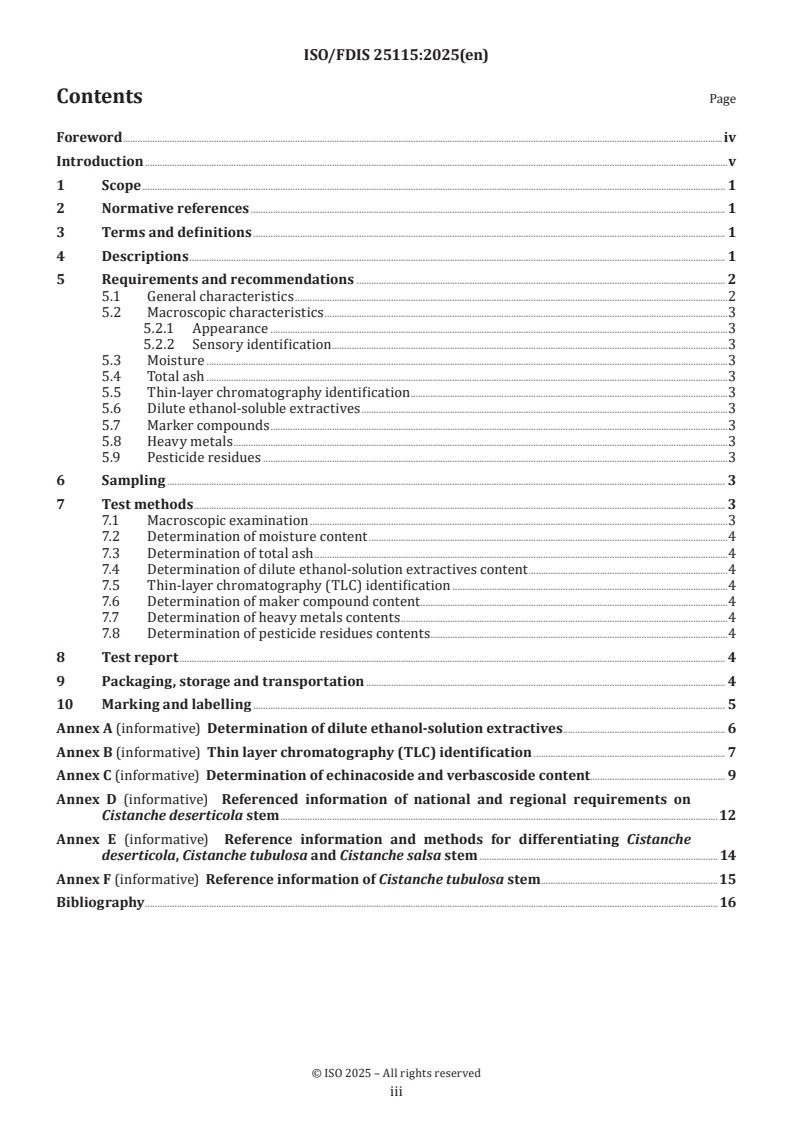
Contents Page
Foreword .iv
Introduction .v
1 Scope . 1
2 Normative references . 1
3 Terms and definitions . 1
4 Descriptions . 1
5 Requirements and recommendations . 2
5.1 General characteristics .2
5.2 Macroscopic characteristics .3
5.2.1 Appearance .3
5.2.2 Sensory identification .3
5.3 Moisture .3
5.4 Total ash .3
5.5 Thin-layer chromatography identification .3
5.6 Dilute ethanol-soluble extractives .3
5.7 Marker compounds .3
5.8 Heavy metals .3
5.9 Pesticide residues .3
6 Sampling . 3
7 Test methods . 3
7.1 Macroscopic examination .3
7.2 Determination of moisture content .4
7.3 Determination of total ash .4
7.4 Determination of dilute ethanol-solution extractives content .4
7.5 Thin-layer chromatography (TLC) identification .4
7.6 Determination of maker compound content .4
7.7 Determination of heavy metals contents .4
7.8 Determination of pesticide residues contents.4
8 Test report . 4
9 Packaging, storage and transportation . 4
10 Marking and labelling . 5
Annex A (informative) Determination of dilute ethanol-solution extractives . 6
Annex B (informative) Thin layer chromatography (TLC) identification . 7
Annex C (informative) Determination of echinacoside and verbascoside content. 9
Annex D (informative) Referenced information of national and regional requirements on
Cistanche deserticola stem .12
Annex E (informative) Reference information and methods for differentiating Cistanche
deserticola, Cistanche tubulosa and Cistanche salsa stem . 14
Annex F (informative) Reference information of Cistanche tubulosa stem .15
Bibliography .16
iii
Foreword
ISO (the International Organization for Standardization) is a worldwide federation of national standards
bodies (ISO member bodies). The work of preparing International Standards is normally carried out through
ISO technical committees. Each member body interested in a subject for which a technical committee
has been established has the right to be represented on that committee. International organizations,
governmental and non-governmental, in liaison with ISO, also take part in the work. ISO collaborates closely
with the International Electrotechnical Commission (IEC) on all matters of electrotechnical standardization.
The procedures used to develop this document and those intended for its further maintenance are described
in the ISO/IEC Directives, Part 1. In particular, the different approval criteria needed for the different types
of ISO document should be noted. This document was drafted in accordance with the editorial rules of the
ISO/IEC Directives, Part 2 (see www.iso.org/directives).
ISO draws attention to the possibility that the implementation of this document may involve the use of (a)
patent(s). ISO takes no position concerning the evidence, validity or applicability of any claimed patent
rights in respect thereof. As of the date of publication of this document, ISO had not received notice of (a)
patent(s) which may be required to implement this document. However, implementers are cautioned that
this may not represent the latest information, which may be obtained from the patent database available at
www.iso.org/patents. ISO shall not be held responsible for identifying any or all such patent rights.
Any trade name used in this document is information given for the convenience of users and does not
constitute an endorsement.
For an explanation of the voluntary nature of standards, the meaning of ISO specific terms and expressions
related to conformity assessment, as well as information about ISO's adherence to the World Trade
Organization (WTO) principles in the Technical Barriers to Trade (TBT), see www.iso.org/iso/foreword.html.
This document was prepared by Technical Committee ISO/TC 249, Traditional medicine, Subcommittee SC 1,
Traditional Chinese medicine.
Any feedback or questions on this document should be directed to the user’s national standards body. A
complete listing of these bodies can be found at www.iso.org/members.html.
iv
Introduction
Cistanche deserticola stem (Rou Cong Rong) is the dried stout stem of Cistanche deserticola Y. C. Ma. It
was first recorded in the book Shennong Bencao Jing, a commonly used reference for traditional Chinese
medicine. Cistanche deserticola stem has long been used in traditional Chinese medicine for its multiple
therapeutic properties (warming kidney yang, reinforcing essence and blood, relaxing bowel). Modern
pharmacological studies have shown that it has significant effects in improving renal function, enhancing
memory, preventing Alzheimer's disease, anti-aging, anti-fatigue, regulating immune function, etc. It is a
highly regarded traditional Chinese medicine with significant medicinal and economic value around the
world. The quantity of Cistanche deserticola has declined sharply due to its extensive exploitation. The
Convention on International Trade in Endangered Species of Wild Fauna and Flora classifies it as an endangered
species, which is not conducive to trade. With the increasing demand, researchers and farmers began to
study the artificial cultivation of Cistanche deserticola in the 1990s, and the cultivated products have
gradually replaced the wild products in the market. So far, the output of cultivated Cistanche deserticola
stem has largely met the market demand, forming an industrial chain integrating planting, processing,
production and sales. From the perspective of protecting wild Cistanche deserticola, the use of cultivated
Cistanche deserticola stem is encouraged. Therefore, it is advisable to provide a certificate of cultivation for
the product during trade. Futhermore, Cistanche tubulosa and Cistanche salsa stem are also used as Cistanche
herbs in some countries. For the distinctions among the three species in terms of morphological features,
chemistry and molecular levels, see Annex E. Among them, Cistanche tubulosa stem is also explicitly included
in the Chinese Pharmacopoeia and the Japanese Pharmacopoeia, and its specific quality requirements can
be found in Annex F.
Cultivated Cistanche deserticola stem is mainly produced in the following provinces of China: Inner Mongolia,
as well as Ningxia, Gansu, Xinjiang and Qinghai with a relatively smaller volume. There is no significant
difference in the quality of Cistanche deserticola stem produced in these provinces, and it is exported to
Japan, South Korea, Southeast Asia and other regions every year, with a large international and domestic
demand. Although Cistanche deserticola stem has been recorded in Chinese Pharmacopoeia (2020 edition),
Japanese Pharmacopoeia (18th edition) and Korean Herbal Pharmacopoeia (version 4), these standards
are not harmonized and can be unsuitable for the purpose of international trade of cultivated Cistanche
deserticola stem. Therefore, it is of utmost urgency to standardize the quality of cultivated Cistanche
deserticola stem in the world. This can benefit consumers (patients), farmers, enterprises and companies
related to the planting, management and trade of Cistanche deserticola stem.
As national implementation can differ, national standards bodies are invited to modify the values given in
5.3, 5.4 and 5.6 in their national standards. Examples of national and regional values are given in Annex D.
v
FINAL DRAFT International Standard ISO/FDIS 25115:2025(en)
Traditional Chinese medicine — cultivated Cistanche
deserticola stem
1 Scope
This document specifies the quality and safety requirements for cultivated Cistanche deserticola stem
derived from the plant of Cistanche deserticola Y.C.Ma.
It is applicable to cultivated Cistanche deserticola stem that is sold as natural medicine in international trade,
including Chinese materia medica (whole medicinal materials) and decoction pieces derived from this plant.
2 Normative references
The following documents are referred to in the text in such a way that some or all of their content constitutes
requirements of this document. For dated references, only the edition cited applies. For undated references,
the latest edition of the referenced document (including any amendments) applies.
ISO 18664, Traditional Chinese Medicine — Determination of heavy metals in herbal medicines used in
Traditional Chinese Medicine
ISO 21371, Traditional Chinese medicine — Labelling requirements of products intended for oral or topical use
ISO 22217, Traditional Chinese medicine —Storage requirements for raw materials and decoction pieces
ISO 22258, Traditional Chinese medicine — Determination of pesticide residues in natural products by gas
chromatography
ISO 23723, Traditional Chinese medicine — General requirements for herbal raw material and materia medica
3 Terms and definitions
For the purposes of this document, the following terms and definitions apply.
ISO and IEC maintain terminology databases for use in standardization at the following addresses:
— ISO Online browsing platform: available at https:// www .iso .org/ obp
— IEC Electropedia: available at https:// www .electropedia .org/
3.1
Cistanche deserticola stem
dried stout stem of Cistanche deserticola Y.C.Ma with scaly leaves and spadices (in case of f
...
Style Definition
...
Style Definition
...
Style Definition
...
Style Definition
...
Style Definition
...
Style Definition
...
ISO/TC 249/SC 1/WG 1
Style Definition
...
Style Definition
...
Secretariat: SAC
Style Definition
...
Date: 2025-09-0911-24
Style Definition
...
Style Definition
...
Style Definition
...
Style Definition
...
Style Definition
...
Style Definition
...
Traditional Chinese medicine — Cultivated — cultivated Cistanche
Style Definition
...
deserticola stem
Style Definition
...
Style Definition
...
Style Definition
...
Style Definition
...
Style Definition
...
Style Definition
...
Style Definition
...
Style Definition
...
FDIS stage
Style Definition
...
Style Definition
...
Style Definition
...
Style Definition
...
Style Definition
...
Style Definition
...
Style Definition
...
Style Definition
...
Style Definition
...
Style Definition
...
Style Definition
...
Style Definition
...
Style Definition
...
Style Definition
...
Style Definition
...
Style Definition
...
Style Definition
...
Style Definition
...
Style Definition
...
Style Definition
...
Style Definition
...
Style Definition
...
Style Definition
...
Style Definition
...
Style Definition
...
Style Definition
...
Style Definition
...
Style Definition
...
Style Definition
...
Style Definition
...
Style Definition
...
Style Definition
...
Style Definition
...
St l D fi iti
Formatted: Font: Bold
Formatted: HeaderCentered
Formatted: Default Paragraph Font
Formatted: Default Paragraph Font
All rights reserved. Unless otherwise specified, or required in the context of its implementation, no part of this publication
may be reproduced or utilized otherwise in any form or by any means, electronic or mechanical, including photocopying,
Formatted: Indent: Left: 0 cm, Right: 0 cm, Space
or posting on the internet or an intranet, without prior written permission. Permission can be requested from either ISO
Before: 0 pt, No page break before, Adjust space
at the address below or ISO'sISO’s member body in the country of the requester.
between Latin and Asian text, Adjust space between
Asian text and numbers
ISO copyright office
Case postale 56 • CP 401 • Ch. de Blandonnet 8
CH-12111214 Vernier, Geneva 20
Formatted: zzCopyright address, Indent: Left: 0 cm,
Tel.Phone: + 41 22 749 01 11
First line: 0 cm, Right: 0 cm, Adjust space between
Latin and Asian text, Adjust space between Asian text
and numbers
Fax + 41 22 749 09 47
Formatted: French (France)
E-mail: copyright@iso.org
Formatted: French (France)
Formatted: French (France)
Web www.iso.org
Formatted: zzCopyright address, Indent: Left: 0 cm,
First line: 0 cm, Right: 0 cm, Adjust space between
Latin and Asian text, Adjust space between Asian text
Website: www.iso.org
and numbers
Published in Switzerland.
Formatted: Indent: Left: 0 cm, Right: 0 cm, Adjust
space between Latin and Asian text, Adjust space
between Asian text and numbers
Formatted: FooterPageRomanNumber
ii
Formatted: English (United Kingdom)
Formatted: HeaderCentered, Left, Space After: 0 pt
Contents Page
Introduction . V
1 Scope . 1
2 Normative references . 1
3 Terms and definitions . 1
4 Descriptions . 1
5 Requirements and recommendations . 2
6 Sampling . 3
7 Test methods . 4
8 Test Report . 4
9 Packaging, storage and transportation . 4
10 Marking and labeling . 5
Annex A (informative)Determination of dilute ethanol-solution extractives . 6
Annex B (informative)Thin layer chromatography (TLC) identification . 7
Annex C (informative)Determination of echinacoside and verbascoside content. 9
Annex D (informative)Referenced information of national and regional requirements on Cistanche
deserticola stem . 12
Annex E (informative)Reference information and methods for differentiating Cistanche deserticola,
Cistanche tubulosa and Cistanche salsa stem . 14
Annex F (informative)Reference information of Cistanche tubulosa stem错误!未定义书签。Bibliography 16
Formatted: Font: 10 pt
Formatted: Font: 10 pt
Formatted: Font: 10 pt
Formatted: FooterCentered, Left, Space Before: 0 pt,
Tab stops: Not at 17.2 cm
Formatted: Font: 11 pt
Formatted: FooterPageRomanNumber, Left, Space
After: 0 pt, Tab stops: Not at 17.2 cm
© ISO 2025 – All rights reserved
iii
Formatted: Font: Bold
Formatted: HeaderCentered
Contents
Foreword . v
Introduction . vi
1 Scope . 1
2 Normative references . 1
3 Terms and definitions . 1
4 Descriptions . 2
5 Requirements and recommendations . 4
5.1 General characteristics . 4
5.2 Macroscopic characteristics . 5
5.3 Moisture . 5
5.4 Total ash . 5
5.5 Thin-layer chromatography identification . 5
5.6 Dilute ethanol-soluble extractives . 5
5.7 Marker compounds . 5
5.8 Heavy metals . 5
5.9 Pesticide residues . 5
6 Sampling . 5
7 Test methods . 5
7.1 Macroscopic examination . 5
7.2 Determination of moisture content . 6
7.3 Determination of total ash . 6
7.4 Determination of dilute ethanol-solution extractives content . 6
7.5 Thin-layer chromatography (TLC) identification . 6
7.6 Determination of maker compound content . 6
7.7 Determination of heavy metals contents . 6
7.8 Determination of pesticide residues contents . 6
8 Test report . 6
9 Packaging, storage and transportation . 6
10 Marking and labelling . 7
Annex A (informative) Determination of dilute ethanol-solution extractives . 8
Annex B (informative) Thin layer chromatography (TLC) identification . 9
Annex C (informative) Determination of echinacoside and verbascoside content . 11
Annex D (informative) Referenced information of national and regional requirements on
Cistanche deserticola stem . 1
Annex E (informative) Reference information and methods for differentiating Cistanche
deserticola, Cistanche tubulosa and Cistanche salsa stem . 3
Annex F (informative) Reference information of Cistanche tubulosa stem . 4
Bibliography . 5
Formatted: FooterPageRomanNumber
iv
Formatted: English (United Kingdom)
Formatted: HeaderCentered, Left, Space After: 0 pt
Foreword Formatted: Adjust space between Latin and Asian text,
Adjust space between Asian text and numbers
ISO (the International Organization for Standardization) is a worldwide federation of national standards
bodies (ISO member bodies). The work of preparing International Standards is normally carried out through
ISO technical committees. Each member body interested in a subject for which a technical committee has been
established has the right to be represented on that committee. International organizations, governmental and
non-governmental, in liaison with ISO, also take part in the work. ISO collaborates closely with the
International Electrotechnical Commission (IEC) on all matters of electrotechnical standardization.
The procedures used to develop this document and those intended for its further maintenance are described
in the ISO/IEC Directives, Part 1. In particular, the different approval criteria needed for the different types of
ISO document should be noted. This document was drafted in accordance with the editorial rules of the
ISO/IEC Directives, Part 2 (see www.iso.org/directives).
Formatted: English (United Kingdom)
ISO draws attention to the possibility that the implementation of this document may involve the use of (a)
patent(s). ISO takes no position concerning the evidence, validity or applicability of any claimed patent rights
in respect thereof. As of the date of publication of this document, ISO had not received notice of (a) patent(s)
which may be required to implement this document. However, implementers are cautioned that this may not
represent the latest information, which may be obtained from the patent database available at
www.iso.org/patents.www.iso.org/patents. ISO shall not be held responsible for identifying any or all such
patent rights.
Any trade name used in this document is information given for the convenience of users and does not
constitute an endorsement.
For an explanation of the voluntary nature of standards, the meaning of ISO specific terms and expressions
related to conformity assessment, as well as information about ISO's adherence to the World Trade
Organization (WTO) principles in the Technical Barriers to Trade (TBT), see
www.iso.org/iso/foreword.htmlwww.iso.org/iso/foreword.html.
Formatted: English (United Kingdom)
This document was prepared by Technical Committee ISO/TC 249, Traditional medicine, Subcommittee SC 1,
Formatted: Adjust space between Latin and Asian text,
Traditional Chinese medicine. Adjust space between Asian text and numbers
Any feedback or questions on this document should be directed to the user’s national standards body. A
complete listing of these bodies can be found at www.iso.org/members.htmlwww.iso.org/members.html.
Formatted: Font: 10 pt
Formatted: Font: 10 pt
Formatted: Font: 10 pt
Formatted: FooterCentered, Left, Space Before: 0 pt,
Tab stops: Not at 17.2 cm
Formatted: Font: 11 pt
Formatted: FooterPageRomanNumber, Left, Space
After: 0 pt, Tab stops: Not at 17.2 cm
© ISO 2025 – All rights reserved
v
Formatted: Font: Bold
Formatted: HeaderCentered
Introduction
Cistanche deserticola stem (Rou Cong Rong) is the dried stout stem of Cistanche deserticola Y. C. Ma. It was first
Formatted: English (United Kingdom)
recorded in the book Shennong Bencao Jing, a commonly used reference for traditional Chinese medicine.
Formatted: English (United Kingdom)
Cistanche deserticola stem has long been used in traditional Chinese medicine for its multiple therapeutic
properties (warming kidney yang, reinforcing essence and blood, relaxing bowel). Modern pharmacological
studies have shown that it has significant effects in improving renal function, enhancing memory, preventing
Alzheimer's disease, anti-aging, anti-fatigue, regulating immune function, etc. It is a highly regarded traditional
Chinese medicine with significant medicinal and economic value around the world. The quantity of Cistanche
deserticola has declined sharply due to its extensive exploitation. The Convention on International Trade in
Endangered Species of Wild Fauna and Flora classifies it as an endangered species, which is not conducive to
trade. With the increasing demand, researchers and farmers began to study the artificial cultivation of
Cistanche deserticola in the 1990s;, and the cultivated products have gradually replaced the wild products in
the market. So far, the output of cultivated Cistanche deserticola stem has largely met the market demand,
forming an industrial chain integrating planting, processing, production and sales. From the perspective of
Formatted: English (United Kingdom)
protecting wild Cistanche deserticola, the use of cultivated Cistanche deserticola stem is encouraged. Therefore,
it is advisable to provide a certificate of cultivation for the product during trade. Futhermore, Cistanche
tubulosa and Cistanche salsa stem are also used as Cistanche herbs in some countries. For the distinctions
among the three species in terms of morphological features, chemistry, and molecular levels, please refer to
Formatted: English (United Kingdom)
Annex E.see Annex E. Among them, Cistanche tubulosa stem is also explicitly included in the Chinese
Formatted: English (United Kingdom)
Pharmacopoeia and the Japanese Pharmacopoeia, and its specific quality requirements can be found in Annex
F.Annex F.
Cultivated Cistanche deserticola stem is mainly produced in the following provinces of China: Inner Mongolia,
as well as Ningxia, Gansu, Xinjiang and Qinghai with a relatively smaller volume. There is no significant
difference in the quality of Cistanche deserticola stem produced in these provinces, and it is exported to Japan,
South Korea, Southeast Asia and other regions every year, with a large international and domestic demand.
Although Cistanche deserticola stem has been recorded in Chinese Pharmacopoeia (2020 edition), Japanese
Pharmacopoeia (18th edition) and Korean Herbal Pharmacopoeia (version 4), these standards are not
harmonized and can be unsuitable for the purpose of international trade of cultivated Cistanche deserticola
stem. Therefore, it is of utmost urgency to standardize the quality of cultivated Cistanche deserticola stem in
the world. This can benefit consumers (patients), farmers, enterprises and companies related to the planting,
management and trade of Cistanche deserticola stem.
As national implementation can differ, national standards bodies are invited to modify the values given in 5.3,
5.45.3, 5.4 and 5.65.6 in their national standards. Examples of national and regional values are given in
Formatted: Default Paragraph Font
Annex D.Annex D.
Formatted: FooterPageRomanNumber
vi
FINAL DRAFT International Standard ISO/FDIS 25115:2025(en)
Formatted: Bold Italic, Font: Not Italic, (Asian) Japanese
Traditional Chinese medicine —Cultivated — cultivated Cistanche
Formatted: Main Title 1, Space Before: 0 pt
deserticola stem
1 Scope
Formatted: Adjust space between Latin and Asian text,
Adjust space between Asian text and numbers
This document specifies the quality and safety requirements for cultivated Cistanche deserticola stem
derived from the plant of Cistanche deserticola Y.C.Ma.
It is applicable to cultivated Cistanche deserticola stem that is sold as natural medicine in international
trade, including Chinese materia medica (whole medicinal materials) and decoction pieces derived from
this plant.
Formatted: Default Paragraph Font
Formatted: Default Paragraph Font
2 Normative references
Formatted: Default Paragraph Font
The following documents are referred to in the text in such a way that some or all of their content
Formatted: Adjust space between Latin and Asian text,
constitutes requirements of this document. For dated references, only the edition cited applies. For
Adjust space between Asian text and numbers, Tab
undated references, the latest edition of the referenced document (including any amendments) applies.
stops: Not at 0.7 cm + 1.4 cm + 2.1 cm + 2.8 cm +
3.5 cm + 4.2 cm + 4.9 cm + 5.6 cm + 6.3 cm + 7 cm
ISO 18664, Traditional Chinese Medicine — Determination of heavy metals in herbal medicines used in
Formatted: Default Paragraph Font
Traditional Chinese Medicine
Formatted: Default Paragraph Font
ISO 21371, Traditional Chinese medicine — Labelling requirements of products intended for oral or
Formatted: Default Paragraph Font
topical use
Formatted: Default Paragraph Font
ISO 22217, Traditional Chinese medicine —Storage requirements for raw materials and decoction pieces
Formatted: Default Paragraph Font
Formatted: Default Paragraph Font
ISO 22258, Traditional Chinese medicine — Determination of pesticide residues in natural products by
gas chromatography Formatted: Default Paragraph Font
Formatted: Default Paragraph Font
ISO 23723, Traditional Chinese medicine — General requirements for herbal raw material and materia
Formatted: Default Paragraph Font
medica
Formatted: Default Paragraph Font
3 Terms and definitions
Formatted: Default Paragraph Font
Formatted: Default Paragraph Font
For the purposes of this document, the following terms and definitions apply.
Formatted: Adjust space between Latin and Asian text,
ISO and IEC maintain terminology databases for use in standardization at the following addresses: Adjust space between Asian text and numbers
Formatted: Adjust space between Latin and Asian text,
— — ISO Online browsing platform: available at https://www.iso.org/obphttps://www.iso.org/obp
Adjust space between Asian text and numbers, Tab
stops: Not at 0.7 cm + 1.4 cm + 2.1 cm + 2.8 cm +
— — IEC Electropedia: available at https://www.electropedia.org/https://www.electropedia.org/
3.5 cm + 4.2 cm + 4.9 cm + 5.6 cm + 6.3 cm + 7 cm
Formatted: TermNum2, Adjust space between Latin and
3.1 3.1
Asian text, Adjust space between Asian text and
Cistanche deserticola stem
numbers
dried stout stem of Cistanche deserticola Y.C.Ma with scaly leaves and spadices (in case of flowering)
Formatted: English (United Kingdom)
removed
Formatted: Font: Not Italic
Formatted: English (United Kingdom)
Formatted: English (United Kingdom)
Formatted: Font: Bold
Formatted: HeaderCentered
4 Descriptions
Cultivated Cistanche deserticola stem is shown in Figure 1.Figure 1.
Formatted: FooterPageRomanNumber
Formatted: Adjust space between Latin and Asian text,
Adjust space between Asian text and numbers, Tab
stops: Not at 0.7 cm + 1.4 cm + 2.1 cm + 2.8 cm +
3.5 cm + 4.2 cm + 4.9 cm + 5.6 cm + 6.3 cm + 7 cm
Formatted Table
Formatted: Font: Bold
Formatted: HeaderCentered
Formatted: Font: Not Bold
Formatted: Font: Not Bold
Formatted: Key Text
Formatted: Font: Not Bold
Formatted: Key Title, Space Before: 12 pt, Adjust space
between Latin and Asian text, Adjust space between
Asian text and numbers
Formatted: Adjust space between Latin and Asian text,
a) Plant of Cistanche deserticola Y.C.Ma b) Transverse section of the stem c) Cultivated Cistanche deserticola
Adjust space between Asian text and numbers, Tab
stem
stops: Not at 0.7 cm + 1.4 cm + 2.8 cm + 3.5 cm +
4.2 cm + 4.9 cm + 5.6 cm + 6.3 cm + 7 cm
Key
Formatted: None, Adjust space between Latin and Asian
1 inflorescence
text, Adjust space between Asian text and numbers
2 stem
3 vascular bundle
Formatted: Adjust space between Latin and Asian text,
4 thick scales
Adjust space between Asian text and numbers
Formatted: English (United Kingdom)
Figure 1 — Structure of cultivated Cistanche deserticola stem
Formatted: Adjust space between Latin and Asian text,
Adjust space between Asian text and numbers
5 Requirements and recommendations
Formatted: English (United Kingdom)
5.1 General characteristics
Formatted: Numbered + Level: 1 + Numbering Style: a,
b, c, … + Start at: 1 + Alignment: Left + Aligned at: 0 cm
The following requirements shall be met before the sampling.
+ Indent at: 0 cm, Adjust space between Latin and Asian
text, Adjust space between Asian text and numbers
a) a) Cultivated Cistanche deserticola stem shall be clean and free from foreign matter.
Formatted: English (United Kingdom)
b) b) The presence of living insects, mildew and external contaminants which are visible to the
naked eye shall not be permitted.
Formatted: FooterPageRomanNumber
5.2 Macroscopic characteristics
5.2.1 Appearance
The stem is flat cylindrical, slightly curved, 3 cm to 15cm15 cm in length, 2 cm to 8cm8 cm in diameter.
Formatted: English (United Kingdom)
Formatted: English (United Kingdom)
5.2.2 Sensory identification
Formatted: English (United Kingdom)
The surface is brown to blackish brown, densely covered with thick scales, fleshy and solid, slightly soft
Formatted: English (United Kingdom)
and oily, hardly broken. The fractured surface is yellow-brown to brown, with light brown vascular
Formatted: English (United Kingdom)
bundles arranged in a wavy ring. The odour is slight; the taste is slightly sweet, followed by slight
bitterness.
Formatted: English (United Kingdom)
Formatted: English (United Kingdom)
5.3 Moisture
Formatted: Adjust space between Latin and Asian text,
Adjust space between Asian text and numbers
The mass fraction of moisture should not be more than 20,0 %.
Formatted: Adjust space between Latin and Asian text,
5.4 Total ash
Adjust space between Asian text and numbers
Formatted: Adjust space between Latin and Asian text,
The mass fraction of total ash should not be more than 11,0 %.
Adjust space between Asian text and numbers
5.5 Thin-layer chromatography identification
Formatted: Adjust space between Latin and Asian text,
Adjust space between Asian text and numbers
The identification of cultivated Cistanche deserticola stem with thin-layer chromatography (TLC) should
Formatted: Adjust space between Latin and Asian text,
present spots or bands obtained from the test and reference solution in the same position with the same
Adjust space between Asian text and numbers
colour.
5.6 Dilute ethanol-soluble extractives
The mass fraction of dilute ethanol-soluble extracts should not be less than 35,0 %.
Formatted: Adjust space between Latin and Asian text,
Adjust space between Asian text and numbers
5.7 Marker compounds
Formatted: Dutch (Netherlands)
The mass fractions of marker compounds, such as echinacoside and verbascoside, should be determined.
Formatted: Adjust space between Latin and Asian text,
Adjust space between Asian text and numbers
5.8 Heavy metals
The mass fractions of heavy metals, such as arsenic, mercury, lead and cadmium, should be determined.
Formatted: Adjust space between Latin and Asian text,
Adjust space between Asian text and numbers
5.9 Pesticide residues
The mass fractions of pesticide residues should be determined.
Formatted: Adjust space between Latin and Asian text,
Adjust space between Asian text and numbers
6 Sampling
Sampling of cultivated Cistanche de
...
Questions, Comments and Discussion
Ask us and Technical Secretary will try to provide an answer. You can facilitate discussion about the standard in here.
Loading comments...