


ISO/FDIS 14908-1
(Main)Interconnection of information technology equipment — Control Network Protocol — Part 1: Protocol Stack
Interconnection of information technology equipment — Control Network Protocol — Part 1: Protocol Stack
ISO 14908-1:2011 applies to a communication protocol for local area control networks. The protocol provides peer-to-peer communication for networked control and is suitable for implementing both peer-to-peer and master-slave control strategies. This specification describes services in layers 2 to 7. In the layer 2 (data link layer) specification, it also describes the MAC sub-layer interface to the physical layer. The physical layer provides a choice of transmission media. The interface described in ISO 14908-1:2011 supports multiple transmission media at the physical layer. In the layer 7 specification, it includes a description of the types of messages used by applications to exchange application and network management data.
Interconnexion des équipements des technologies de l'information — Protocole de réseau de contrôle — Partie 1: Pile de protocole
General Information
- Status
- Withdrawn
- Technical Committee
- ISO/TC 205 - Building environment design
- Drafting Committee
- ISO/TC 205 - Building environment design
- Current Stage
- 5098 - Project deleted
- Start Date
- 21-Jul-2011
- Completion Date
- 12-Feb-2026
Relations
- Replaced By
ISO/IEC 14908-1:2012 - Information technology — Control network protocol — Part 1: Protocol stack - Effective Date
- 30-Jul-2011


Get Certified
Connect with accredited certification bodies for this standard

BSI Group
BSI (British Standards Institution) is the business standards company that helps organizations make excellence a habit.

NYCE
Mexican standards and certification body.
Sponsored listings
Frequently Asked Questions
ISO/FDIS 14908-1 is a draft published by the International Organization for Standardization (ISO). Its full title is "Interconnection of information technology equipment — Control Network Protocol — Part 1: Protocol Stack". This standard covers: ISO 14908-1:2011 applies to a communication protocol for local area control networks. The protocol provides peer-to-peer communication for networked control and is suitable for implementing both peer-to-peer and master-slave control strategies. This specification describes services in layers 2 to 7. In the layer 2 (data link layer) specification, it also describes the MAC sub-layer interface to the physical layer. The physical layer provides a choice of transmission media. The interface described in ISO 14908-1:2011 supports multiple transmission media at the physical layer. In the layer 7 specification, it includes a description of the types of messages used by applications to exchange application and network management data.
ISO 14908-1:2011 applies to a communication protocol for local area control networks. The protocol provides peer-to-peer communication for networked control and is suitable for implementing both peer-to-peer and master-slave control strategies. This specification describes services in layers 2 to 7. In the layer 2 (data link layer) specification, it also describes the MAC sub-layer interface to the physical layer. The physical layer provides a choice of transmission media. The interface described in ISO 14908-1:2011 supports multiple transmission media at the physical layer. In the layer 7 specification, it includes a description of the types of messages used by applications to exchange application and network management data.
ISO/FDIS 14908-1 is classified under the following ICS (International Classification for Standards) categories: 35.200 - Interface and interconnection equipment; 35.240.99 - IT applications in other fields. The ICS classification helps identify the subject area and facilitates finding related standards.
ISO/FDIS 14908-1 has the following relationships with other standards: It is inter standard links to ISO/IEC 14908-1:2012. Understanding these relationships helps ensure you are using the most current and applicable version of the standard.
ISO/FDIS 14908-1 is available in PDF format for immediate download after purchase. The document can be added to your cart and obtained through the secure checkout process. Digital delivery ensures instant access to the complete standard document.
Standards Content (Sample)
FINAL
INTERNATIONAL ISO/FDIS
DRAFT
STANDARD 14908-1
ISO/TC 205
Interconnection of information
Secretariat: ANSI
technology equipment — Control
Voting begins on:
Network Protocol —
2011-01-04
Part 1:
Voting terminates on:
2011-03-04
Protocol Stack
Interconnexion des équipements des technologies de l'information —
Protocole de réseau de contrôle —
Partie 1: Pile de protocole
Please see the administrative notes on page iii
RECIPIENTS OF THIS DRAFT ARE INVITED TO
SUBMIT, WITH THEIR COMMENTS, NOTIFICATION
OF ANY RELEVANT PATENT RIGHTS OF WHICH
THEY ARE AWARE AND TO PROVIDE SUPPORT-
ING DOCUMENTATION.
IN ADDITION TO THEIR EVALUATION AS
Reference number
BEING ACCEPTABLE FOR INDUSTRIAL, TECHNO-
LOGICAL, COMMERCIAL AND USER PURPOSES,
DRAFT INTERNATIONAL STANDARDS MAY ON
OCCASION HAVE TO BE CONSIDERED IN THE
LIGHT OF THEIR POTENTIAL TO BECOME STAN-
DARDS TO WHICH REFERENCE MAY BE MADE IN
©
NATIONAL REGULATIONS. ISO 2011
PDF disclaimer
This PDF file may contain embedded typefaces. In accordance with Adobe's licensing policy, this file may be printed or viewed but
shall not be edited unless the typefaces which are embedded are licensed to and installed on the computer performing the editing. In
downloading this file, parties accept therein the responsibility of not infringing Adobe's licensing policy. The ISO Central Secretariat
accepts no liability in this area.
Adobe is a trademark of Adobe Systems Incorporated.
Details of the software products used to create this PDF file can be found in the General Info relative to the file; the PDF-creation
parameters were optimized for printing. Every care has been taken to ensure that the file is suitable for use by ISO member bodies. In
the unlikely event that a problem relating to it is found, please inform the Central Secretariat at the address given below.
Copyright notice
This ISO document is a Draft International Standard and is copyright-protected by ISO. Except as permitted
under the applicable laws of the user's country, neither this ISO draft nor any extract from it may be
reproduced, stored in a retrieval system or transmitted in any form or by any means, electronic,
photocopying, recording or otherwise, without prior written permission being secured.
Requests for permission to reproduce should be addressed to either ISO at the address below or ISO's
member body in the country of the requester.
ISO copyright office
Case postale 56 • CH-1211 Geneva 20
Tel. + 41 22 749 01 11
Fax + 41 22 749 09 47
E-mail copyright@iso.org
Web www.iso.org
Reproduction may be subject to royalty payments or a licensing agreement.
Violators may be prosecuted.
ii © ISO 2011 – All rights reserved
In accordance with the provisions of Council Resolution 15/1993, this document is circulated in the
English language only.
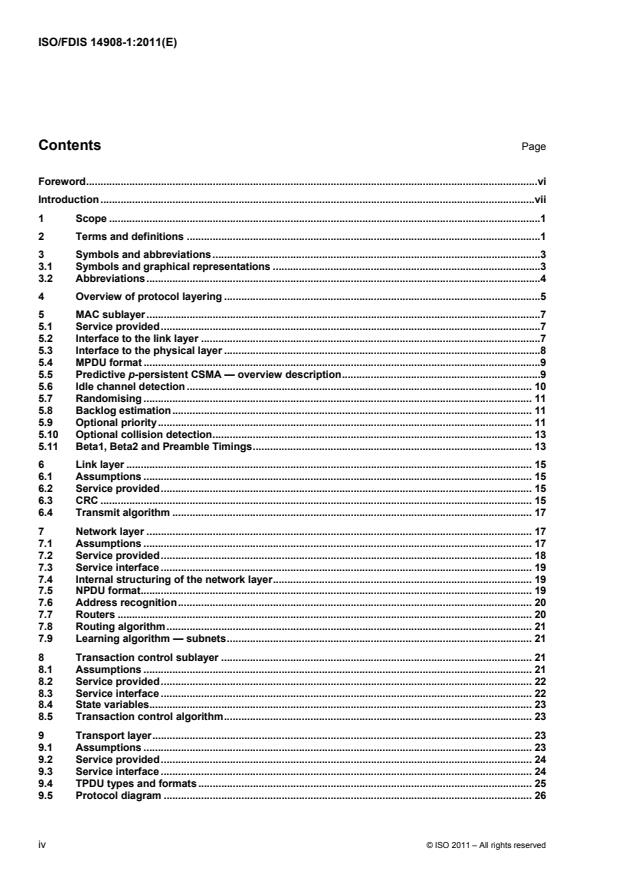
Contents Page
Foreword.vi
Introduction.vii
1 Scope .1
2 Terms and definitions .1
3 Symbols and abbreviations .3
3.1 Symbols and graphical representations .3
3.2 Abbreviations.4
4 Overview of protocol layering .5
5 MAC sublayer.7
5.1 Service provided.7
5.2 Interface to the link layer .7
5.3 Interface to the physical layer .8
5.4 MPDU format .9
5.5 Predictive p-persistent CSMA — overview description.9
5.6 Idle channel detection . 10
5.7 Randomising . 11
5.8 Backlog estimation. 11
5.9 Optional priority. 11
5.10 Optional collision detection. 13
5.11 Beta1, Beta2 and Preamble Timings. 13
6 Link layer . 15
6.1 Assumptions . 15
6.2 Service provided. 15
6.3 CRC . 15
6.4 Transmit algorithm . 17
7 Network layer . 17
7.1 Assumptions . 17
7.2 Service provided. 18
7.3 Service interface . 19
7.4 Internal structuring of the network layer. 19
7.5 NPDU format. 19
7.6 Address recognition. 20
7.7 Routers . 20
7.8 Routing algorithm. 21
7.9 Learning algorithm — subnets. 21
8 Transaction control sublayer . 21
8.1 Assumptions . 21
8.2 Service provided. 22
8.3 Service interface . 22
8.4 State variables. 23
8.5 Transaction control algorithm. 23
9 Transport layer. 23
9.1 Assumptions . 23
9.2 Service provided. 24
9.3 Service interface . 24
9.4 TPDU types and formats . 25
9.5 Protocol diagram . 26
iv © ISO 2011 – All rights reserved
9.6 Transport protocol state variables .26
9.7 Send algorithm .27
9.8 Receive algorithm.27
9.9 Receive transaction record pool size and configuration engineering.27
10 Session layer .29
10.1 Assumptions.29
10.2 Service provided.29
10.3 Service interface.30
10.4 Internal structure of the session layer .30
10.5 SPDU types and formats.31
10.6 Protocol timing diagrams .32
10.7 Request-response state variables .35
10.8 Request-response protocol — client part.35
10.9 Request-response protocol — server part .35
10.10 Request-response protocol timers.35
10.11 Authentication protocol.36
10.12 Encryption algorithm .36
10.13 Retries and the role of the checksum function .36
10.14 Random Number Generation .37
10.15 Using Authentication .37
11 Presentation/application layer .37
11.1 Assumptions.37
11.2 Service provided.37
11.3 Service interface.38
11.4 APDU types and formats .39
11.5 Protocol diagrams.40
11.6 Application protocol state variables .41
11.7 Request - response messaging in offline state.41
11.8 Network variables.42
11.9 Error notification to the application program.43
12 Network management & diagnostics .43
12.1 Assumptions.43
12.2 Services provided.44
12.3 Network management and diagnostics application structure.44
12.4 Node states .44
12.5 Using the network management services.45
12.6 Using router network management commands.48
12.7 NMPDU formats and types .49
12.8 DPDU types and formats .70
Annex A (normative) Reference implementation.75
Annex B (normative) Additional Data Structures .356
Annex C (informative) Behavioral characteristics.378
Annex D (normative) PDU summary.382
Annex E (normative) Naming and addressing.384
Annex F (normative) List of patents that pertain to this International Standard .388
Bibliography.390
Foreword
ISO (the International Organization for Standardization) is a worldwide federation of national standards bodies
(ISO member bodies). The work of preparing International Standards is normally carried out through ISO
technical committees. Each member body interested in a subject for which a technical committee has been
established has the right to be represented on that committee. International organizations, governmental and
non-governmental, in liaison with ISO, also take part in the work. ISO collaborates closely with the
International Electrotechnical Commission (IEC) on all matters of electrotechnical standardization.
International Standards are drafted in accordance with the rules given in the ISO/IEC Directives, Part 2.
The main task of technical committees is to prepare International Standards. Draft International Standards
adopted by the technical committees are circulated to the member bodies for voting. Publication as an
International Standard requires approval by at least 75 % of the member bodies casting a vote.
Attention is drawn to the possibility that some of the elements of this document may be the subject of patent
rights. ISO shall not be held responsible for identifying any or all such patent rights.
ISO 14908-1 was prepared by CEN/TC 247, was adopted, under the fast track procedure, by joint Technical
Committee ISO/IEC JTC 1, Information technology, and was assigned to SC 25, Interconnection of
information technology equipment. It was then transferred to ISO/TC 205, Building environment design.
ISO 14908 consists of the following parts, under the general title Interconnection of information technology
equipment — Control Network Protocol:
⎯ Part 1: Protocol Stack
⎯ Part 2: Twisted-pair communication
⎯ Part 3: Power line channel specification
⎯ Part 4: IP communication
vi © ISO 2011 – All rights reserved
Introduction
This International Standard has been prepared to provide mechanisms through which various vendors of local
area control networks may exchange information in a standardized way. It defines communication capabilities.
This International Standard is to be used by anyone involved in design, manufacture, engineering, installation
and commissioning activities.
The International Organization for Standardization (ISO) and the International Electrotechnical
Commission (IEC) draw attention to the fact that it is claimed that compliance with this International Standard
may involve the use of patents held by Echelon Corporation.
ISO and the IEC take no position concerning the evidence, validity and scope of this patent right.
The holder of this patent right has assured ISO and the IEC that they are willing to negotiate licences under
reasonable and non-discriminatory terms and conditions with applicants throughout the world. In this respect,
the statement of the holder of the patent rights is registered with ISO and the IEC. Information may be
obtained from:
Echelon Corporation, 4015 Meridian Avenue, San Jose, CA 94304, USA, phone +1-408-938-5234,
fax: +1-408-790-3800, http://www.echelon.com.
FINAL DRAFT INTERNATIONAL STANDARD ISO/FDIS 14908-1:2011(E)
Interconnection of information technology equipment —
Control Network Protocol —
Part 1:
Protocol Stack
1 Scope
This part of ISO 14908 applies to a communication protocol for local area control networks. The protocol
provides peer-to-peer communication for networked control and is suitable for implementing both peer-to-peer
and master-slave control strategies. This specification describes services in layers 2 to 7. In the layer 2 (data
link layer) specification, it also describes the MAC sub-layer interface to the physical layer. The physical layer
provides a choice of transmission media. The interface described in this part of ISO 14908 supports multiple
transmission media at the physical layer. In the layer 7 specification, it includes a description of the types of
messages used by applications to exchange application and network management data.
2 Terms and definitions
For the purposes of this document, the following terms and definitions apply.
NOTE Most of the terms are commonly used and have the same meaning in both the general and the standard
context. However, for some terms, there are subtle differences. For example, in general, bridges do selective forwarding
based on the layer 2 destination address. There are no layer 2 addresses in this standard protocol, so bridges forward all
packets, as long as the domain address in the packet matches a domain of which the bridge is a member. Routers, in
general, perform network address modification so that two protocols with the same transport layer but different network
layers can be connected to form a single logical network. Routers of this International Standard may perform network
address modification, but, typically, they only examine the network address fields and selectively forward packets based
on the network layer address fields.
2.1
channel
physical unit of bandwidth linking one or more communication nodes
NOTE See Annex E for further explanation of the relationship between a channel and a subnet.
2.2
physical repeater
device that reconditions the incoming physical layer signal on one channel and transmits it on to another
channel
2.3
store-and-forward repeater
device that stores and then reproduces data packets on a second channel
2.4
bridge
device that connects two channels (x and y), forwards all packets from x to y and vice versa, as long as the
packets originate on one of the domain(s) to which the bridge belongs
2.5
configuration
non-volatile information used by the device to customise its operation
NOTE There is configuration data for the correct operation of the protocol in each device and, optionally, for
application operation. The network configuration data stored in each device has a checksum associated with the data.
Examples of network configuration data are node addresses, communication media parameters such as priority settings,
etc. Application configuration information is application-specific.
2.6
domain
virtual network that is the network unit of management and administration
NOTE Group (2.10) and subnet (2.8) addresses are assigned by the administrator responsible for the domain and
have meaning only in the context of that domain.
2.7
flexible domain
transitory domain entry at a node used in conjunction with Unique_Node_ID and broadcast addressing
NOTE A node responds to a Unique_Node_ID-addressed message if the address matches, regardless of the domain
on which the message was sent. To respond so that the sender receives it, the response must be sent on the domain in
which it was received. Furthermore, this domain must be remembered for the duration of the transaction so that duplicate
detection of any retries is possible. How many flexible domain entries a node supports is up to the implementation.
However, a minimum of one is required.
2.8
subnet
set of nodes accessible through the same link layer protocol, a routing abstraction for a channel
NOTE In this International Standard, subnets are limited to a maximum of 127 nodes.
2.9
node
abstraction for a physical node that represents the highest degree of address resolvability on a network
NOTE A node is identified (addressed) within a subnet by its (logical) node identifier. A physical node can belong to
more than one subnet. When it does, it is assigned one (logical) node number for each subnet to which it belongs. A
physical node can belong to at most two subnets; these subnets must be in different domains. A node can also be
identified (absolutely) within a network by its Unique_Node_ID.
2.10
group
uniquely identifiable set of nodes within a domain
NOTE Within this set, individual members are identified by their member number. Groups facilitate one-to-many
communication and are intended to support functional addressing.
2.11
router
device that routes data packets to their respective destinations by selectively forwarding from subnet to subnet
NOTE A router always connects two (sets of) subnets; routers may modify network layer address fields. Routers can
be set to one of four modes: repeater mode, bridge mode, learning mode, and configured mode. In repeater mode,
packets are forwarded if they are received with no errors. In bridge mode, packets are forwarded if they are received with
no errors and match a domain of which the router is a member. Routers in learning mode learn the topology by examining
packet traffic, while routers that are set to configured mode have the network topology stored in their memory and make
their routing decisions solely upon the contents of their configured tables.
2 © ISO 2011 – All rights reserved
2.12
(application) gateway
gateway that interconnects networks at their highest protocol layers (often two different protocols)
NOTE Two domains can also be connected through an application gateway.
2.13
Beta1
β
period immediately following the end of a packet cycle
NOTE A node attempting to transmit data packets monitors the state of the channel and, if it detects no transmission
during the Beta1 period, determines the channel to be idle.
2.14
Beta2
β
randomising slot
NOTE A node wishing to transmit data packets generates a random delay T. This delay is an integer number of
randomising slots of duration Beta2.
2.15
network variable
variable in an application program whose value is automatically propagated over the network whenever a new
value is assigned to it
2.16
Standard Network Variable Types
SNVTs
variables with agreed-upon semantics
NOTE These variables are interpreted by all applications in the same way, and are the basis for interoperability.
Definition of specific SNVTs is beyond the scope of this International Standard.
2.17
manual service request message
network management message containing a node's Unique_Node_ID
NOTE Used by a network management device that receives this message to install and configure the node. May be
generated by application or system code. May be triggered by an external hardware event, e.g. driving a “manual service
request” input low.
2.18
transaction
sequence of messages that are correlated together
NOTE A request and the responses to the request are all part of a single transaction. A transaction succeeds when
all the expected messages from every node involved in the transaction are received at least once. A transaction fails in
this International Standard if any of the expected messages within the transaction are not received. Retries of messages
within a transaction are used to increase the probability of success of a transaction in the presence of transient errors.
3 Symbols and abbreviations
3.1 Symbols and graphical representations
Figure 1 shows the basic topology of networks based on this protocol and the symbolic representations used
in this International Standard.
Figure 1 — Network topology & symbols
The layering of this protocol is described using standard OSI terminology, as shown in Figure 2.
Figure 2 — Protocol terminology
3.2 Abbreviations
⎯ CNP Control Network Protocol
The Protocol Data Unit (PDU) abbreviations used throughout this International Standard are:
⎯ PPDU Physical Protocol Data Unit, or frame
⎯ MPDU MAC Protocol Data Unit, or frame
⎯ LPDU Link Protocol Data Unit, or frame
4 © ISO 2011 – All rights reserved
⎯ NPDU Network Protocol Data Unit, or packet
⎯ TPDU Transport Protocol Data Unit, or a message/ack
⎯ SPDU Session Protocol Data Unit, or request/response
⎯ NMPDU Network Management Protocol Data Unit
⎯ DPDU Diagnostic Protocol Data Unit
⎯ APDU Application Protocol Data Unit
⎯ FSM Finite State Machine (diagram)
Annex D (PDU Summary) contains the details of these PDUs.
4 Overview of protocol layering
The protocol specified by this Standard consists of the layers shown in Figure 3. Each layer is described
below.
Multiple physical layer protocols and data encoding methods are allowed in systems based on this
International Standard. Each encoding scheme is medium-dependent.
The MAC (Medium Access Control) sublayer employs a collision avoidance algorithm called Predictive
p-persistent CSMA (Carrier Sense, Multiple Access). For a number of reasons, including simplicity and
compatibility with the multicast protocol, the link layer supports a simple connectionless service. Its functions
are limited to framing, frame encoding, and error detection, with no error recovery by re-transmission.
Figure 3 — Protocol layering
The Network layer handles packet delivery within a single domain, with no provisions for inter-domain
communication. The Network service is connection-less, unacknowledged, and supports neither segmentation
nor re-assembly of messages. The routing algorithms employed by the network layer to learn the topology
assumes a tree-like network topology; routers with configured tables may operate on topologies with physical
loops, as long as the communication paths are logically tree-like. In this topology, a packet may never appear
more than once at the router on the side on which the packet originated. The unicast routing algorithm uses
learning for minimal over-head and no additional routing traffic. Use of configured routing tables is supported
for both unicast and group addresses, although in many applications a simple flooding of group addressed
messages is sufficient.
The heart of the protocol hierarchy is the Transport and Session layers. A common Transaction Control
Sublayer handles transaction ordering and duplicate detection for both. The Transport layer is connection-less
and provides reliable message delivery to both single and multiple destinations. Authentication of the
message sender’s identity is included as a transport layer service, for use when the security of sender
authentication is required. The authentication server requires only the Transaction Control Sublayer to
accomplish its function. Thus Transport and Session layer messages may be authenticated using all of the
addressing modes other than broadcast.
6 © ISO 2011 – All rights reserved
The session layer provides a simple Request-Response mechanism for access to remote servers. This
mechanism provides a platform upon which application specific remote procedure calls can be built. The
network management protocol, for example, depends upon the Request-Response mechanism in the Session
layer.
A transport layer acknowledged message expects indication of message delivery from remote destination(s).
A session layer request message expects indication that application-specific remote task(s) have been
completed. A given message uses only one or the other type of service, but not both.
This specification includes the Presentation Layer and the lowest level of the Application Layer. These layers
provide services for sending and receiving application messages including network variables, and other types
of messages such as network management and diagnostic messages and foreign frames (see clause 12). For
a network variable update, the APDU header provides information on how to interpret the APDU. This
application-independent interpretation of the data allows data to be shared among nodes without prior
arrangement.
5 MAC sublayer
In this International Standard the following Media Access Control sublayer is defined. If there is a need for
other MAC sublayers they are defined in additional parts of this International Standard.
5.1 Service provided
The Media Access Control (MAC) sublayer facilitates media access with optional priority and optional collision
detection/collision resolution. It uses a protocol called Predictive p-persistent CSMA (Carrier Sense, Multiple
Access), that has some resemblance to the p-persistent CSMA protocol family.
Predictive p-persistent CSMA is a collision avoidance technique that randomises channel access using
knowledge of the expected channel load. A node wishing to transmit always accesses the channel with a
random delay in the range (0.w). To avoid throughput degradation under high load, the size of the
randomising window, w, is a function of estimated channel backlog BL:
w =×(BL W )-1, (1)
base
where
W is the base window size. W is measured in time. Its duration, derived from Beta2 (see 5.7), equals 16
base base
Beta2 slots.
5.2 Interface to the link layer
The MAC sublayer is closely coupled to the Link layer, described in clause 6. With the MAC sublayer being
responsible for media access, the Link layer deals with all other layer 2 issues, including framing and error
detection. For explanatory purposes, the interface between the two layers is described in the form shown in
Figure 4.
Figure 4 — Interface between the MAC and the link layers
Although the service interface primitives are defined using a syntax similar to programming language
procedure calls, no implementation technique is implied. Frame reception is handled entirely by the Link layer,
that notifies the MAC sublayer about the backlog increment via the Frame_OK() primitive.
The following service interface primitives facilitate the interface between the Link and the MAC layers:
M_Data_Request (Priority, delta_BL, ALT_Path, LPDU)
This primitive is used by the Link layer to pass an outbound LPDU/MPDU to the MAC sublayer. Priority
defines the priority with which the frame is to be transmitted; delta_BL is the backlog increment expected
as a result of delivering this MPDU. ALT_Path is a binary flag indicating whether the LPDU is to be
transmitted on the primary or alternate channel, baud rate, etc. See 5.4 for how ALT_Path is set.
Frame_OK (delta_BL)
On receiving a frame and verifying that its CRC is correct, the Link layer invokes this primitive to notify the
MAC sublayer about the backlog increment associated with the frame just received.
M_Data_Indication()
The MAC sublayer provides this indication to the link layer once per incoming LPDU/MPDU.
5.3 Interface to the physical layer
The Physical layer handles the actual transmission and reception of binary data. Multiple physical layer
protocols are supported by the control network protocol. The bit error rate presented to the link layer must be
-4
equal to or better than 1 in 10 . For compatibility with the higher layers, all physical protocols must support the
defined service interface (see figure 4):
P_Data_Indication (Frame)
Physical layer provides this indication to the MAC sublayer and the link layer once per in-coming
LPDU/MPDU.
P_Data_Request (Frame)
8 © ISO 2011 – All rights reserved
The MAC sublayer uses this primitive to pass the Frame, the encoded LPDU/MPDU, to the physical layer
for immediate transmission. The bit transmission order is defined in Annex D.
P_Data_Confirm (Status)
The physical layer returns Status as to whether the frame was transmitted. Status has three possible
values: success—indicating the frame was transmitted, request_denied—indicating that activity was
detected on the line prior to transmission, and collision—indicating that transmission began, but a
collision was detected. Whether or not the transmission is aborted depends on when the collision is
detected (see 5.10).
P_Channel_Active ()
The physical layer uses this primitive to pass the status of the channel to the MAC sublayer. This is an
indication of activity, not necessarily of valid data.
5.4 MPDU format
The combined MPDU/LPDU format is shown in Figure 5. (Annex D contains the details of the NPDU frame).
Figure 5 — MPDU/LPDU format
The MAC sublayer uses the L2Hdr field, that has the following syntax and semantics:
Pri 1-bit field specifying the priority of this MPDU: 0 = Normal, 1 = High.
Alt_Path 1-bit field specifying the channel to use. This is a provision for transceivers that have the
ability to transmit on two different channels and receive on either one without the need to
instruct the transceiver to explicitly receive on a specific channel. The transport layer sets
this bit for the last two attempts (for acknowledged and request/response services), unless
requested to specify the alternate path for every transmission. For any packet received that
has the alt_path bit set and that requires an acknowledgement, response, challenge, or
reply, the alt_path bit shall be set in the corresponding acknowledgement, response,
challenge, or reply.
Delta_BL
6-bit unsigned field (≥ 0); specifies channel backlog increment to be generated as a result of
deliver-ing this MPDU.
5.5 Predictive p-persistent CSMA — overview description
Like CSMA, Predictive p-persistent CSMA senses the medium before transmitting. A node attempting to
transmit monitors the state of the channel (see Figure 6), and determines the channel to be idle if it detects no
transmission during the Beta1 period. Nodes without a packet to transmit during this Beta1 period shall remain
in synchronisation for the duration of the priority slots (see 5.10), and at least W randomising slots. This
base
maintenance of synchronisation allows a packet that arrives in the output queue of the MAC sublayer after the
end of the Beta1 time to be transmitted in a valid slot according to the other nodes with a packet to transmit.
Next, the node generates a random delay T (transmit) from the interval (0.(BL x W )-1, where W is the
base base
number of randomising slots within the basic randomising window and BL is an estimate of the current
channel backlog. T (transmit) is defined as an integer number of randomising slots of duration Beta2 (see 5.7
and 5.8). If the channel is idle when the delay expires, the node transmits; otherwise, the node receives the
incoming packet, and then repeats the MAC algorithm. In Figure 6, D is the average randomisation delay
mean
between packets, and, since the random delay T is uniformly distributed, D is given as (W -1)/2 for small
mean base
values of BL.
Figure 6 — Predictive p-persistent CSMA concepts and parameters
By adjusting the size of the randomising window as a function of the predicted load, the algorithm keeps the
collision rate constant and independent of the load. Provided that the estimated backlog is greater than or
equal to the real back-log, the following holds:
Collision Rate =≤ Error Pkt Cycles / Error Free Pkt Cycles 1 / 2W
base
A base window size of 16 is used. This implies that there are an average of 8 randomising slots of width Beta2
and one slot of width Beta1 between each packet. Also, the width of the Beta2 period is crucial to efficient
utilisation of the channel.
The algorithm for Predictive CSMA is in A.2.
5.6 Idle channel detection
The idle channel condition is asserted whenever the following two conditions are met:
1) The current channel state reported by the physical layer via the P_Data_Indication () primitive is low;
and
2) No transition has been detected during the last period of Beta1. Note that the MAC sublayer may be
configured to ignore transitions during a portion of the Beta1 period. This portion of time that
transitions are ignored (the channel is assumed to be idle during this time even in the presence of
transitions) is called the indeterminate time (see 5.11 for the details).
The length of the Beta1 period is defined by the following constraint:
Beta1 >+ 1 bit time (2 × Tau + Tau ) (2)
p m
The first term assumes a data encoding method that guarantees a transition and/or carrier during every bit
time. If encoding methods are used that do not meet this constraint, then the first term must be adjusted to be
the longest time that the channel may appear idle without being idle, i.e., the longest run in legal data
transmission without a transition and/or carrier asserted on the medium. The second term takes care of
propagation and turnaround delays, that are:
Tau is the physical propagation delay defined by the media length;
p
Tau is the detection and turnaround delay within the MAC sublayer; this is the period from the
m
time the idle channel condition is detected, to the point when the first output transition
appears on the output. On media where there is a carrier, this time must include the time
between turning on the carrier, and it being asserted as a valid carrier on the medium.
10 © ISO 2011 – All rights reserved
5.7 Randomising
At the beginning of the randomising period, a node wishing to transmit generates a random delay T (transmit)
from the interval (0. (BL x W )-1. The node then waits for this period, while continuing to monitor channel
base
status; if the channel is still idle when the delay expires, the node transmits.
The transmit delay T (transmit) is an integer number of randomising slots of duration Beta2; the length of the
randomising slot must meet the following constraint:
Beta2 >× 2 Tau + Tau (3)
p m
Parameters Tau and Tau are defined in 5.6.
p m
5.8 Backlog estimation
The predictive aspect of the MAC algorithm is based on backlog estimation. Each node maintains an estimate
of the current channel backlog BL, that is incremented as a result of sending or receiving an MPDU and
decrements periodically — once every packet cycle. The increment to the backlog is encoded into the link
layer header, and represents the number of messages that the packet shall cause to be generated upon
reception. The backlog is initially set to one. After sending or receiving a packet with a non-zero backlog
increment, the node’s backlog estimation is incremented by the backlog increment. The maximum backlog
value is 63. If the backlog exceeds 63, then the backlog overflow statistic is incremented (see 12.7.14 and
B.8).
The backlog decrements under one of the following conditions:
⎯ On waiting to transmit: If W randomising slots go by without channel activity.
base
⎯ On receive: If a packet is received with a backlog increment of ‘0’.
⎯ On transmit: If a packet is transmitted with a backlog increment of ‘0’.
⎯ On idle: If a packet cycle time expires without channel activity.
The packet cycle timer is reset to its initial value whenever the backlog is changed. It is started (begins
counting down at its current value) whenever the MAC layer becomes idle. An idle MAC layer is defined as:
1) not receiving;
2) not transmitting;
3) not waiting to transmit;
4) not timing Beta1;
5) not waitin
...
Questions, Comments and Discussion
Ask us and Technical Secretary will try to provide an answer. You can facilitate discussion about the standard in here.
Loading comments...