

ISO/IEC 21122-3:2024
(Main)Information technology — JPEG XS low-latency lightweight image coding system — Part 3: Transport and container formats
General Information
- Abstract
This document defines transport and container formats for JPEG XS codestreams as specified in ISO/IEC 21122-1. It defines file formats for working with still image and motion image sequence files on computer platforms and gives guidance on how to embed the codestream in transport streams, allowing internet-based communication. This document uses already existing specifications for file formats and extends them for the embedding of JPEG XS codestreams.
- Status
- Published
- Publication Date
- 15-Aug-2024
- Current Stage
- 6060 - International Standard published
- Start Date
- 16-Aug-2024
- Due Date
- 18-Jul-2024
- Completion Date
- 16-Aug-2024


Overview
ISO/IEC 21122-3:2024 specifies transport and container formats for JPEG XS codestreams (as defined in ISO/IEC 21122-1). It defines file formats and embedding rules for working with still images (JXS) and motion image sequences on computer platforms, and gives guidance for embedding JPEG XS codestreams in transport streams for internet-based communication. The third edition adds support for temporal differential coding (TDC) and clarifies handling of interlaced signals.
Key topics and requirements
- Container and transport definitions
- Specifies how to wrap JPEG XS codestreams in file containers and transport streams using box/superbox structures.
- Extends existing file-format specifications to support embedding of JPEG XS codestreams.
- File formats
- Normative guidance for a JXS still-image file format (Annex B).
- Integration into ISO Base Media File Format (ISOBMFF) for motion sequences (Annex C).
- Integration into HEIF for combined still and motion workflows (Annex D).
- Metadata and signalling
- Defines metadata boxes to signal colourspace, timing, presentation and other image properties; ensures proper interpretation and presentation.
- Uses coding-independent code points (CICP) and references Rec. ITU‑T H.273 / ISO/IEC 23091-2 for colour specification.
- Transport and internet use
- Guidance on embedding codestreams in transport streams to enable low-latency internet communication and editing workflows.
- Conformance rules
- Readers must ignore unrecognized boxes; Annex A provides the common syntax elements and box definitions used throughout.
- Practical performance targets
- Addresses JPEG XS use cases where low latency and robustness under multiple recompression cycles matter; typical visually lossless compression ratios ~2:1 to 20:1 and end-to-end latency can be a fraction of a frame.
Applications
- Live production and broadcast workflows requiring low-latency, low-complexity image transport.
- Real-time video contribution, remote production, and editing systems where recompression robustness and minimal latency are critical.
- File-based storage and interchange of JPEG XS stills and movies in media asset management, archiving, and cloud workflows.
- Web and internet streaming scenarios needing efficient embedding of JPEG XS in transport streams.
Who should use this standard
- Systems integrators, codec implementers, and software developers building JPEG XS encoders/decoders and muxers.
- Broadcast engineers, live-production vendors, media-asset managers, and OTT platform architects.
- Standards and compliance teams ensuring interoperability of JPEG XS media files and transport streams.
Related standards
- ISO/IEC 21122-1 (JPEG XS core coding system)
- ISO/IEC 21122-2 (Profiles and buffer models)
- ISO/IEC 14496-12 (ISOBMFF)
- ISO/IEC 23008-12 (HEIF)
- Rec. ITU‑T H.273 | ISO/IEC 23091-2 (coding-independent code points / colourspaces)
Keywords: JPEG XS, low-latency, transport and container formats, JXS, ISOBMFF, HEIF, codestream, metadata, temporal differential coding, interlaced signals.
Relations
- Effective Date
- 28-Jan-2023
Get Certified
Connect with accredited certification bodies for this standard

BSI Group
BSI (British Standards Institution) is the business standards company that helps organizations make excellence a habit.

NYCE
Mexican standards and certification body.
Sponsored listings
Frequently Asked Questions
ISO/IEC 21122-3:2024 is a standard published by the International Organization for Standardization (ISO). Its full title is "Information technology — JPEG XS low-latency lightweight image coding system — Part 3: Transport and container formats". This standard covers: This document defines transport and container formats for JPEG XS codestreams as specified in ISO/IEC 21122-1. It defines file formats for working with still image and motion image sequence files on computer platforms and gives guidance on how to embed the codestream in transport streams, allowing internet-based communication. This document uses already existing specifications for file formats and extends them for the embedding of JPEG XS codestreams.
This document defines transport and container formats for JPEG XS codestreams as specified in ISO/IEC 21122-1. It defines file formats for working with still image and motion image sequence files on computer platforms and gives guidance on how to embed the codestream in transport streams, allowing internet-based communication. This document uses already existing specifications for file formats and extends them for the embedding of JPEG XS codestreams.
ISO/IEC 21122-3:2024 is classified under the following ICS (International Classification for Standards) categories: 35.040.30 - Coding of graphical and photographical information. The ICS classification helps identify the subject area and facilitates finding related standards.
ISO/IEC 21122-3:2024 has the following relationships with other standards: It is inter standard links to ISO/IEC 21122-3:2022. Understanding these relationships helps ensure you are using the most current and applicable version of the standard.
ISO/IEC 21122-3:2024 is available in PDF format for immediate download after purchase. The document can be added to your cart and obtained through the secure checkout process. Digital delivery ensures instant access to the complete standard document.
Standards Content (Sample)
International
Standard
ISO/IEC 21122-3
Third edition
Information technology — JPEG
2024-08
XS low-latency lightweight image
coding system —
Part 3:
Transport and container formats
Reference number
© ISO/IEC 2024
All rights reserved. Unless otherwise specified, or required in the context of its implementation, no part of this publication may
be reproduced or utilized otherwise in any form or by any means, electronic or mechanical, including photocopying, or posting on
the internet or an intranet, without prior written permission. Permission can be requested from either ISO at the address below
or ISO’s member body in the country of the requester.
ISO copyright office
CP 401 • Ch. de Blandonnet 8
CH-1214 Vernier, Geneva
Phone: +41 22 749 01 11
Email: copyright@iso.org
Website: www.iso.org
Published in Switzerland
© ISO/IEC 2024 – All rights reserved
ii
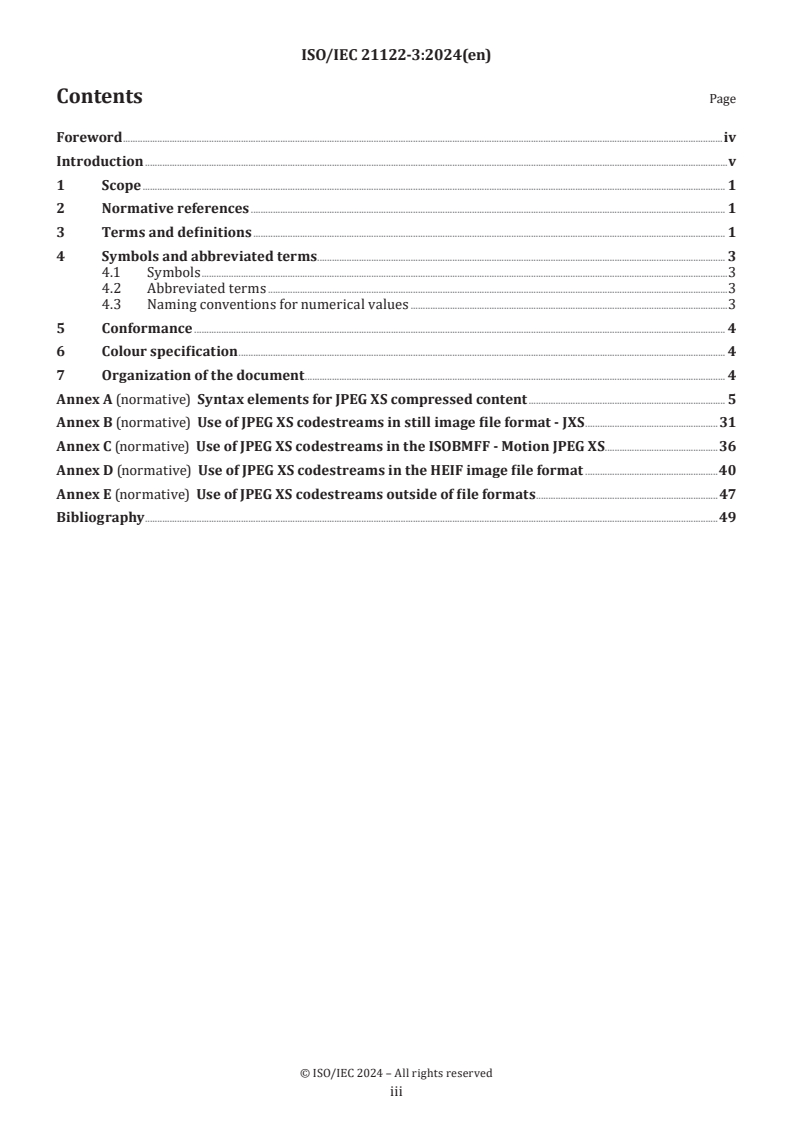
Contents Page
Foreword .iv
Introduction .v
1 Scope . 1
2 Normative references . 1
3 Terms and definitions . 1
4 Symbols and abbreviated terms. 3
4.1 Symbols .3
4.2 Abbreviated terms .3
4.3 Naming conventions for numerical values .3
5 Conformance . 4
6 Colour specification . 4
7 Organization of the document . 4
Annex A (normative) Syntax elements for JPEG XS compressed content . 5
Annex B (normative) Use of JPEG XS codestreams in still image file format - JXS .31
Annex C (normative) Use of JPEG XS codestreams in the ISOBMFF - Motion JPEG XS.36
Annex D (normative) Use of JPEG XS codestreams in the HEIF image file format .40
Annex E (normative) Use of JPEG XS codestreams outside of file formats . 47
Bibliography .49
© ISO/IEC 2024 – All rights reserved
iii
Foreword
ISO (the International Organization for Standardization) and IEC (the International Electrotechnical
Commission) form the specialized system for worldwide standardization. National bodies that are
members of ISO or IEC participate in the development of International Standards through technical
committees established by the respective organization to deal with particular fields of technical activity.
ISO and IEC technical committees collaborate in fields of mutual interest. Other international organizations,
governmental and non-governmental, in liaison with ISO and IEC, also take part in the work.
The procedures used to develop this document and those intended for its further maintenance are described
in the ISO/IEC Directives, Part 1. In particular, the different approval criteria needed for the different types
of document should be noted. This document was drafted in accordance with the editorial rules of the ISO/
IEC Directives, Part 2 (see www.iso.org/directives or www.iec.ch/members_experts/refdocs).
ISO and IEC draw attention to the possibility that the implementation of this document may involve the
use of (a) patent(s). ISO and IEC take no position concerning the evidence, validity or applicability of any
claimed patent rights in respect thereof. As of the date of publication of this document, ISO and IEC had not
received notice of (a) patent(s) which may be required to implement this document. However, implementers
are cautioned that this may not represent the latest information, which may be obtained from the patent
database available at www.iso.org/patents and https://patents.iec.ch. ISO and IEC shall not be held
responsible for identifying any or all such patent rights.
Any trade name used in this document is information given for the convenience of users and does not
constitute an endorsement.
For an explanation of the voluntary nature of standards, the meaning of ISO specific terms and expressions
related to conformity assessment, as well as information about ISO's adherence to the World Trade
Organization (WTO) principles in the Technical Barriers to Trade (TBT) see www.iso.org/iso/foreword.html.
In the IEC, see www.iec.ch/understanding-standards.
This document was prepared by Joint Technical Committee ISO/IEC JTC 1, Information technology,
Subcommittee SC 29, Coding of audio, picture, multimedia and hypermedia information.
This third edition cancels and replaces the second edition (ISO/IEC 21122-3:2022), which has been
technically revised.
The main changes are as follows:
— support for JPEG XS codestreams using temporal differential coding (TDC).
— clarifications on coding of interlaced signals.
A list of all parts in the ISO/IEC 21122 series can be found on the ISO and IEC websites.
Any feedback or questions on this document should be directed to the user’s national standards
body. A complete listing of these bodies can be found at www.iso.org/members.html and
www.iec.ch/national-committees.
© ISO/IEC 2024 – All rights reserved
iv
Introduction
This document is part of a series of standards for a low-latency lightweight image coding system, denoted
JPEG XS.
In many use cases during production or transmission of a movie, limiting the latency and the recompression
loss is a more important aspect than the compression efficiency. The JPEG XS coding system offers
compression and recompression of image sequences with very moderate computational resources while
remaining robust under multiple compression and decompression cycles and mixing of content sources, e.g.
embedding of subtitles, overlays or logos. Typical target compression ratios ensuring visually lossless quality
are in the range of 2:1 to 20:1, depending on the nature of the source material. The end-to-end latency can
be confined to a fraction of a frame, typically between a small number of lines down to below a single line.
This document specifies transport and container formats for JPEG XS codestreams. It also defines metadata
that enriches transport protocols for transmission of image sequences, in order to facilitate transport,
editing and presentation.
© ISO/IEC 2024 – All rights reserved
v
International Standard ISO/IEC 21122-3:2024(en)
Information technology — JPEG XS low-latency lightweight
image coding system —
Part 3:
Transport and container formats
1 Scope
This document defines transport and container formats for JPEG XS codestreams as specified in
ISO/IEC 21122-1. It defines file formats for working with still image and motion image sequence files on
computer platforms and gives guidance on how to embed the codestream in transport streams, allowing
internet-based communication.
This document uses already existing specifications for file formats and extends them for the embedding of
JPEG XS codestreams.
2 Normative references
The following documents are referred to in the text in such a way that some or all of their content constitutes
requirements of this document. For dated references, only the edition cited applies. For undated references,
the latest edition of the referenced document (including any amendments) applies.
ISO 15076-1, Image technology colour management — Architecture, profile format and data structure — Part
1: Based on ICC.1:2010
ISO/IEC 646, Information technology — ISO 7-bit coded character set for information interchange
ISO/IEC 10646, Information technology — Universal coded character set (UCS)
ISO/IEC 11578, Information technology — Open Systems Interconnection — Remote Procedure Call (RPC)
ISO/IEC 14496-12, Coding of audio-visual objects — Part 12: ISO base media file format
ISO/IEC 21122-1, JPEG XS low-latency lightweight image coding system — Part 1: Core coding system
ISO/IEC 21122-2, JPEG XS low-latency lightweight image coding system — Part 2: Profiles and buffer models
ISO/IEC 23008-12:2022, Information technology — High efficiency coding and media delivery in heterogeneous
environments — Part 12: Image File Format
ISO/CIE 11664-1, Colorimetry — Part 1: CIE standard colorimetric observers
Rec. ITU-T H.273 | ISO/IEC 23091-2, Coding-independent code points — Part 2: Video
ANSI/CTA 861-G:2016, A DTV Profile for Uncompressed High Speed Digital Interfaces
W3C Recommendation, Extensible Markup Language (XML) 1.0 (Fifth Edition), 26 Nov. 2008 (https:// www
.w3 .org/ TR/ REC -xml/ )
3 Terms and definitions
For the purposes of this document the terms and definitions given in ISO/IEC 14496-12, ISO/IEC 21122-1,
ISO/IEC 21122-2, ISO/IEC 23008-12 and the following apply.
© ISO/IEC 2024 – All rights reserved
ISO and IEC maintain terminology databases for use in standardization at the following addresses:
— ISO Online browsing platform: available at https:// www .iso .org/ obp
— IEC Electropedia: available at https:// www .electropedia .org/
3.1
aux
auxiliary component channel typically used as opacity channel or alpha mask
3.2
big-endian
byte ordering from the most significant to the least significant byte of multi-byte value representations
3.3
box
structured collection of data describing the image or the image decoding process
3.4
box content
data wrapped within the box (3.3) structure
3.5
box type
kind of information stored with the box (3.3)
3.6
byte
group of 8 bits
3.7
coding-independent code point
code point based on enumerated values for the definition of the colourspaces
Note 1 to entry: Code points defined in Rec. ITU-T H.273 | ISO/IEC 23091-2.
3.8
high efficiency image file format
image file format which can embed still images and motion sequences (3.11)
Note 1 to entry: Based on ISO/IEC 23008-12.
3.9
image collection
unordered set of images without an implied or signalled presentation order or presentation time stamps
3.10
JXS
still image file format with JPEG XS compressed images
3.11
motion sequence
movie
timed sequence (3.15) of images
3.12
sample
single element in the two-dimensional image array which comprises a component
Note 1 to entry: This definition is used in Annex A.
© ISO/IEC 2024 – All rights reserved
3.13
sample
all the data associated with a single time
Note 1 to entry: This definition is used in Annexes B and C as data associated with one coded image in a sequence.
3.14
superbox
box (3.3) that carries other boxes as payload data
3.15
timed sequence
linearly ordered sequence of media entities such as images where each entity is presented at a well defined
time stamp
4 Symbols and abbreviated terms
4.1 Symbols
N number of components in an image as defined in ISO/IEC 21122-1
c
P Level, sublevel and frame-buffer level (if applicable) a particular codestream
lev
conforms to as defined in ISO/IEC 21122-2
P profile a particular codestream conforms to as defined in ISO/IEC 21122-2
pih
Picture()
JPEG XS codestream as defined in ISO/IEC 21122-1
Codestream_Header()
codestream header preceding the image data in the codestream without any
tpc_marker() as defined in subclause A.5.5
Codestream_Body()
coded image data in the codestream including any tpc_marker() if such a marker
is present, without Codestream_Header() as defined in subclause A.5.5
4.2 Abbreviated terms
For the purposes of this document the abbreviated terms given in ISO/IEC 14496-12, ISO/IEC 21122-1,
ISO/IEC 21122-2, ISO/IEC 23008-12 and the following apply.
CICP coding-independent code points
CIE Commision Internationale de l’Eclairage
HEIF high efficiency image file format
ISOBMFF iso base media file format
LSB least significant bit
MSB most significant bit
UTF-8 8-bit Unicode transformation format as defined in ISO/IEC 10646
4.3 Naming conventions for numerical values
Integer numbers are expressed as bit patterns, hexadecimal values, or decimal numbers. Bit patterns and
hexadecimal values have both a numerical value and an associated particular length in bits.
© ISO/IEC 2024 – All rights reserved
Hexadecimal notation, indicated by prefixing the hexadecimal number by "0x", may be used instead of
binary notation to denote a bit pattern having a length that is an integer multiple of 4. For example, 0x41
represents an eight-bit pattern having only its second most significant bit and its least significant bit equal
to 1. Numerical values that are specified under a "Code" heading in tables that are referred to as "code tables"
are bit pattern values (specified as a string of digits equal to 0 or 1 in which the left-most bit is considered
the most-significant bit). Other numerical values not prefixed by "0x" are decimal values. When used in
expressions, a hexadecimal value is interpreted as having a value equal to the value of the corresponding bit
pattern evaluated as a binary representation of an unsigned integer (i.e., as the value of the number formed
by prefixing the bit pattern with a sign bit equal to 0 and interpreting the result as a two's complement
representation of an integer value). For example, the hexadecimal value 0xF is equivalent to the 4-bit pattern
'1111' and is interpreted in expressions as being equal to the decimal number 15.
5 Conformance
This document shares common definitions for the structure of files (a sequence of objects, called boxes here,
and atoms in other similar file formats), and a common definition of the general structure of an object (the
size and type) as specified in Annex A.
File formats representing either images, or image sequences shall follow the specifications in Annexes B, C
and D. All these specifications require that readers ignore objects that are unrecognizable to them.
This document takes precedence over those on which it is based, in any case where there are differences or
conflicts; however, no such conflicts are known to exist.
For better readability and understanding, the syntax description for the different file formats is done in the
same way as in the base formats.
6 Colour specification
JPEG XS (as defined in ISO/IEC 21122-1) describes only the encoded bitstream of an image. The integrated
multiple component transformation is only responsible for a decorrelation of the different colour components
allowing for the reduction of the entropy in the data. In order to properly display or interpret the image, it is
essential that the colourspace of that image data is properly characterized. For this purpose, the respective
container format or transport channel signals the correct colourspace. The defined formats in this document
for JPEG XS signals the colour space as specified in Rec. ITU-T H.273 | ISO/IEC 23091-2.
7 Organization of the document
Annex A specifies boxes and superboxes that can be used to signal metadata for isolated JPEG XS codestreams
or sequencs of JPEG XS codestreams. The boxes are identical or similar to the boxes defined in other ISO
standards, e.g. JPEG 2000 (Rec. ITU-T T.800 | ISO/IEC 15444-1). The boxes defined in this annex are used
throughout all other annexes of this document.
Annex B defines the JXS file format for still images based on JPEG XS codestreams and the boxes specified in
Annex A.
Annex C specifies the integration of JPEG XS codestreams in the ISOBMFF (as defined in ISO/IEC 14496-12)
for use of image sequences as movie in a file format.
Annex D specifies the integration of JPEG XS codestreams in the HEIF file format (as defined in
ISO/IEC 23008-12) allowing the integration of both still images as well as movies in one format.
Annex E specifies the Media Type registration for JPEG XS codestreams solely any file format container, i.e.
not contained within the file formats specified by Annex B, Annex C or Annex D.
© ISO/IEC 2024 – All rights reserved
Annex A
(normative)
Syntax elements for JPEG XS compressed content
A.1 General
This annex defines syntax elements identifying and representing meta data of JPEG XS compressed images,
image collections or image sequences. It forms the basis for file formats that applications may choose to
wrap one or multiple JPEG XS codestreams. Annex B describes a concrete file format that represents an
individual JPEG XS image. This specification is based on the same syntax as the box-based file format for
JPEG 2000 in ISO/IEC 15444-1:2019, Annex I or ISO/IEC 15444-2:2021, Annex M.
This annex:
— specifies a binary container for image, image collections, image sequences and metadata;
— specifies a mechanism by which metadata (including vendor-specific information) can be included in
files or transport streams specified by this document;
— specifies a mechanism to indicate image properties, such as the tonescale or colourspace of the image;
— specifies a mechanism by which readers can recognize the existence of intellectual property rights
information in the file.
A.2 Specification of syntax elements
A.2.1 General
The syntax elements defined in this annex provide foundations for storing application specific data
(metadata) in association with JPEG XS codestreams, such as information which is required to display the
images or stream of images. As many applications require a similar set of information to be associated with
the compressed image data, it is useful to define the format of that set of data along with the definition of the
compression technology and codestream syntax.
Conceptually, the syntax elements specified in this annex encapsulate JPEG XS codestreams along with other
core pieces of information about such codestreams. A file created from the syntax elements defined in this
annex is loosely called a JPEG XS enabled file. However, this annex does not define a file format itself, it
only provides syntax elements upon which a file format can be defined. A concrete file format based on this
annex is specified in Annex B.
The building-block of all JPEG XS enabled files is called a box. All information is encapsulated in boxes. This
annex defines several types of boxes; the definition of each specific box type defines the kinds of information
that can be found within a box of that type. Some boxes will be defined to contain other boxes.
A.2.2 Greyscale, colour, multi-component specification
One of the most important aspects of a file format is that it specifies the colourspace of the contained image
data. In order to properly display or interpret the image data, it is essential that the colourspace of that image
is properly characterized. The syntax elements defined in this subclause provide one method to specify the
colourspace of the image based on coding-independent code points (CICP). The CICP enumerated method
specifies the colourspace of an image by the use of three numeric values that identifies the colourspace.
The set of supported colourspaces is specified in A.5.4.3. The allowed values are a subset of the code points
defined in Rec. ITU-T H.273 | ISO/IEC 23091-2.
© ISO/IEC 2024 – All rights reserved
A.2.3 Inclusion of auxilliary channels
In many applications, components other than the colour channels are required (auxilliary channels). For
example, many images used on web pages contain opacity information; the browser uses this information
to blend the image into the background. Another example is the use of alpha channels in video production;
video mixers use this alpha channel to mix multiple images. It is thus desirable to include both the colour
and auxiliary channels within a single codestream.
Syntax elements defined in Annex A provide means to indicate the presence of auxiliary channels (such as
opacity), to define the type of these channels, and to specify the ordering and source of these. When a reader
opens a JPEG XS enabled file, it determines the ordering and type of each component. The application shall
then match the component definition and ordering from the JPEG XS enabled file with the component ordering
as defined by the colourspace specification. Once the file components have been mapped to the colour
channels, the decompressed image can be processed through any needed colourspace transformations.
How applications respond to opacity or other auxiliary channels is outside the scope of this document.
A.2.4 Metadata
One important aspect of the syntax elements defined in Annex A is the ability to add metadata to a JPEG XS
enabled file.
Some of the boxes provide a set of tools by which applications can add vendor-specific information to the
JPEG XS enabled file format, like the Exif box or the XML box. These boxes are optional in conforming files
and may be ignored by conforming readers.
A.2.5 Temporal differential coding of interlaced signals
Each field of an interlaced frame constitutes an independent image in the sense of ISO/IEC 21122-1. Coding
parameters of the two fields shall then match, i.e. if temporal differential coding is enabled for the top field, it
shall also be enabled for the bottom field and vice versa. Temporal differential coding then predicts between
identical fields, i.e. the top field shall be predicted from the last top field in the past, and the bottom field
shall be predicted from the bottom field in the past.
Conceptionally, an interlaced encoded JPEG XS file can therefore be understood as two otherwise
independent JPEG XS streams interleaved within each other, where one stream consists of all top fields and
the other consists of all bottom fields.
A.3 Concept of boxes
A.3.1 Key to graphical descriptions
Each box is described in terms of its function, usage and length. The function describes the information
contained in the box. The usage describes the logical location and frequency of this box in the file. The length
describes which parameters determine the length of the box.
These descriptions are followed by a figure that shows the order and relationship of the parameters in the
box. Figure A.1 shows an example of this type of figure. A rectangle is used to indicate the parameters in the
box. The width of the rectangle is proportional to the number of bytes in the parameter. A shaded rectangle
(diagonal stripes) indicates that the parameter is of varying size. Two parameters with superscripts and a
grey area between them indicate a run of several of these parameters. A sequence of two groups of multiple
parameters with superscripts separated by a grey area indicates a run of that group of parameters (one set of
each parameter in the group, followed by the next set of each parameter in the group). Optional parameters
or boxes are shown with a dashed rectangle.
© ISO/IEC 2024 – All rights reserved
Figure A.1 — Example of a box description
The figure is followed by a list that describes the meaning of each parameter in the box. If parameters are
repeated, the length and nature of the run of parameters is defined. As an example, in Figure A.1, parameters
0 N–1
C, D, E and F are 8-, 16-, 32-bit and variable lengths, respectively. The notation G and G implies that there
i 0 M–1 0 M–1
are N different parameters, G , in a row. The group of parameters H and H , and J and J specify that
0 0 1 1 M–1 M–1
the box will contain H , followed by J , followed by H and J , continuing to H and J (M instances of
each parameter in total). Also, the field L is optional and may not be found in this box.
After the list is a table that either describes the allowed parameter values or provides references to other
tables that describe these values.
Some boxes may carry other boxes as payload data. Such boxes are denoted as superboxes. The payload size
of a superbox is given by the sum of the box lengths of all the boxes it contains.
In addition, in a figure describing the contents of a superbox, an ellipsis (…) is used to indicate that the
contents of the file between two boxes are not specifically defined. Any box (or sequence of boxes), unless
otherwise specified by the definition of that box, may be found in place of the ellipsis.
For example, the superbox shown in Figure A.2 shall contain an AA box and a BB box, and the BB box shall
follow the AA box. However, there may be other boxes found between boxes AA and BB. Dealing with
unknown boxes is discussed in A.6.
Figure A.2 — Example of a superbox description
A.3.2 Box definition
Physically, each object in the file is encapsulated within a binary structure called a box. That binary structure
is as in Figure A.3, and detailed in Table A.1.
Figure A.3 — Organization of a box
© ISO/IEC 2024 – All rights reserved
LBox Box length. This field specifies the length of the box, stored as a 32-bit big-endian unsigned in-
teger. This value includes all of the fields of the box, including the length and type. If the value of
this field is 1, then the XLBox field shall exist and the value of that field shall be the actual length
of the box. If the value of this field is 0, then the length of the box was not known when the LBox
field was written. In this case, this box contains all bytes up to the end of the file. If a box of length
0 is contained within another box (its superbox), then the length of that superbox shall also be
0. This means that this box is the last box in the file. The values 2-7 are reserved for ISO/IEC use.
TBox Box type. This field specifies the type of information found in the DBox field. The value of this
field is encoded as a 32-bit big-endian unsigned integer. However, boxes are generally referred to
by an ISO/IEC 10646 character string translation of the integer value. For all box types defined
within this document, box types are indicated as both character string (normative) and as 4-byte
hexadecimal integers (informative). Also, a space character is shown in the character string
translation of the box type as “\040”. All values of TBox not defined within this documentare are
reserved for ISO/IEC use.
XLBox Box extended length. This field specifies the actual length of the box if the value of the LBox field
is 1. This field is stored as an 64-bit big-endian unsigned integer. The value includes all of the
fields of the box, including the LBox, TBox and XLBox fields.
DBox Box contents. This field contains the actual information contained within this box. The format of
the box contents depends on the box type and is defined individually for each type.
Table A.1 — Binary structure of a box
Field name Size (bits) Value
0, 1, or
LBox 32
8 to (2 – 1)
TBox 32 Variable
64 16 to (2 – 1); if LBox = 1
XLBox
0 Not applicable; if LBox ≠ 1
DBox Variable Variable
For example, consider the illustration in Figure A.4 of a sequence of boxes, including one box that contains
other boxes:
Figure A.4 — Illustration of box lengths
As shown in Figure A.4, the length of each box includes any boxes contained within that box. For example,
the length of Box 1 includes the length of Boxes 2 and 3, in addition to the LBox and TBox fields for Box 1
itself. In this case, if the type of Box 1 was not understood by a reader, it would not recognize the existence of
Boxes 2 and 3 because they would be completely skipped by jumping the length of Box 1 from the beginning
of Box 1.
A.4 Overview of defined boxes
Table A.2 lists all boxes defined in Annex A. Indentation within the table indicates the hierarchical
containment structure of the boxes within a JXS file as defined in Annex B.
© ISO/IEC 2024 – All rights reserved
The following boxes shall properly be interpreted by all readers. Each of these boxes conforms to the
standard box structure as defined in A.3. The following clauses define the value of the DBox field from
Table A.1 (the contents of the box). It is assumed that the LBox, TBox and XLBox fields exist for each box in
the file as defined in A.3.
Table A.2 — Defined boxes
Box name Type Superbox Comments
JPEG XS Signature box 'JXS\040' This box uniquely identifies the file as being part of
No
the JPEG XS family of files.
(A.5.1) (0x4A58 5320)
File Type box 'ftyp' This box specifies file type, version and compati-
No
bility information.
(A.5.2) (0x6674 7970)
'jpvs' This box supports video information for JPEG XS
JPEG XS Video Support box
Yes
codestreams.
(A.5.3)
(0x6A70 7673)
'jpvi' This box describes video information.
JPEG XS Video
No
Information box
(0x6A70 7669)
'jxpl' This box specifies the used profile and level.
JPEG XS Profile and
No
Level box
(0x6A78 706c)
'bmdm' This box defines buffer model
Buffer Model
No
parameters.
Description box
(0x626D 646D)
'dmon' This box describes the display characteristics of
Mastering Display
No
the mastering display.
Metadata box
(0x646D 6f6E)
JPEG XS Video This box describes parameters for packet-based
'jptp'
Transport No video stream transport.
(0x6A70 7470)
Parameter box
JPEG XS Header box 'jp2h' This box contains a series of boxes that contain
Yes
header-type information about the file.
(A.5.4) (0x6A70 3268)
This box specifies aspects of the image geometry,
'ihdr'
Image Header box No number of
(0x6968 6472)
components and bit depth.
'colr' This box specifies the colourspace of the image.
Colour Specification box No
(0x636F 6C72)
'cdef' This box specifies the type and ordering of the
Channel Definition box No
components within the codestream.
(0x6364 6566)
'Exif' This box contains metadata for photographic imag-
Exif box No
es as specified in ISO/IEC 23008-12
(0x4578 6966)
Contiguous Codestream This box contains the codestream as defined by
'jp2c'
box ISO/IEC 21122-1.
No
(0x6A70 3263)
(A.5.5)
Intellectual Property box 'jp2i' This box contains intellectual property informa-
No
tion about the image.
(A.5.6) (0x6A70 3269)
XML box 'xml\040' This box provides a tool by which vendors can add
No
XML formatted information.
(A.5.7) (0x786D 6C20)
This box provides a tool by which vendors can add
UUID box 'uuid'
No additional information to a file without risking
(A.5.8) (0x7575 6964)
conflict with other vendors.
This box provides a tool by which a vendor can pro-
UUID Info box 'uinf'
Yes vide access to additional information associated
(A.5.9) (0x7569 6E66)
with a UUID.
'ulst' This box specifies a list of UUIDs.
UUID List box No
(0x756C 7374)
'url\040' This box specifies a URL.
URL box No
(0x7572 6C20)
© ISO/IEC 2024 – All rights reserved
NOTE Indented box names indicate that the corresponding boxes are contained within the non-indented superbox
preceding it.
A JPEG XS enabled file may contain boxes not known to applications based solely on this document. If a
reader finds a box that it does not understand, it shall skip and ignore that box.
A.5 Defined boxes
A.5.1 JPEG XS Signature box
The JPEG XS Signature box identifies that the format of this file is defined by the JPEG XS International
Standard, as well as providing a small amount of information which can help determine the validity of the
rest of the file. The JPEG XS Signature box shall be the first box in the file.
The type of the JPEG XS Signature box shall be 'JXS\040' (0x4A58 5320). The length of this box shall be
12 bytes. The contents of this box shall be the 4-byte character string '<0x87>' (0x0D0A
870A). For file verification purposes, this box can be considered a fixed-length 12-byte string which shall
have the value: 0x0000 000C 4A58 5320 0D0A 870A.
The combination of the particular type and contents for this box enable an application to detect a common
set of file transmission errors. The CR-LF sequence in the contents catches bad file transfers that alter
newline sequences. The final linefeed checks for the inverse of the CR-LF translation problem. The third
character of the box contents has its high-bit set to catch bad file transfers that clear bit 7.
A.5.2 File Type box
The File Type box specifies the International Standard which completely defines all of the contents of this
file, as well as a separate list of readers, defined by other Recommendations | International Standards, with
which this file is compatible, and thus the file can be properly interpreted within the scope of that other
standard. This box shall immediately follow the JPEG XS Signature box. This differentiates the standard
which completely describes the file from other standards that interpret a subset of the file.
All files shall contain one and only one File Type box. The type of the File Type box is 'ftyp' (0x6674 7970).
The contents of this box shall be as in Figure A.5 and Table A.4.
Figure A.5 — Organization of the contents of a File Type box
© ISO/IEC 2024 – All rights reserved
BR Brand. This field specifies the International Standard which completely defines this file. This
field is specified by a four-byte string of ISO/IEC 10646 characters. Brand values are defined by a
concrete file format, for example, the file format in Annex B does suggest a brand value. Vendors
can define their own brand values, and conforming readers shall instead check the compatibility
i
list CL to learn whether they are able to interpret a file as intended by its creator.
MinV Minor version. This parameter defines the minor version number of this JXS specification to which
the file conforms. The parameter is defined as a 32-bit big-endian unsigned integer. The value
of this field shall be zero. However, readers shall continue to parse and interpret this file even if
the value of this field is not zero.
i
CL Compatibility list. This field specifies a code representing this document, another standard, or a
profile of another standard, to which the file conforms. This field is encoded as a four-byte string
of ISO/IEC 10646 characters. The number of CLi fields is determined by the length of this box.
i
Concrete file formats based on this annex define values for the CL field by which such files can
be identified. Readers shall check the compatibility list to learn whether they are able to interpret
the file contents according to the intent of its creator. Table A.3 lists compatibility values defined
in this document
i
Table A.3 — Compatibility values CL
Value Meaning
'jxs\040'
Files conforming to the file format specified in Annexes B, C or D
of this document.
'jxsi'
Files conforming to the file format specified in Annex D of this
document.
'jxss'
Files conforming to the file format specified in Annexes C or D of
this document.
Other values Reserved for other ISO/IEC uses
Table A.4 — Format of the contents of the File Type box
Field name Size (bits) Value
BR 32 0 to (2 – 1)
MinV 32 0
i 32
CL 32 0 to (2 – 1)
A.5.3 JPEG XS Video Support box (superbox)
A.5.3.1 General
The JPEG XS Video Support box contains information relevant for using JPEG XS codestreams in a video,
such as video information (framerate, no. of fields, etc.), buffer model description data or mastering display
metadata. This box is an optional superbox. If the JPEG XS Video Support box is used in a JXS file, at least the
JPEG XS video information box and the JPEGXS Profile and Level box are mandatory. For retransmitting of
JPEG XS codestreams over Internet protocols or over SDI link channels, it is recommended to store also the
original buffer model description data used during the encoding.
The type of the JPEG XS Video Support box is 'jpvs' (0x6A70 7673).
This box contains several boxes. Other boxes may be defined in other standards and may be ignored by
conforming readers. Those boxes contained within the JPEG XS Video Support box that are defined within
this document are as in Figure A.6:
© ISO/IEC 2024 – All rights reserved
Figure A.6 — Organization of the contents of a JPEG XS Video Support box
jpvi JPEG XS Video Information box. This box specifies video specific data about frame rate, field cod-
ing, time code and max. bit rate. This box shall be the first box in the JPEG XS Video Support box.
jxpl JPEG XS Profile and Level box. This box stores information about the used JPEG XS profile and level
as described in ISO/IEC 21122-2. This box shall be the second box in the JPEG XS Video Support box.
bmdm Buffer Model Description box (optional). This box specifies metadata about the buffer model used
during the encoding.
dmon Mastering Display Metadata box (optional). This box specifies information on the Mastering Display.
jptp JPEG XS Video Transport Parameter box (optional). This box specifies information how a decoder
should be best parametrized for packet-based video transport.
A.5.3.2 JPEG XS Video Information box
If the JPEG XS codestream is used as part of a video stream or recorded from a video stream, this box
specifies the characteristics of the video stream.
The type of the JPEG XS Video Information box is 'jpvi' (0x6A70 7669) and contents of the box shall have
the format as in Figure A.7 and Table A.5:
Figure A.7 — Organization of the contents of a JPEG XS Video Information box
Table A.5 — Format of the contents of the JPEG XS Video Information box
Field name Size (bits) Value
brat 32 1 to (2 – 1)
frat 32 Variable, four sub fields, 0
if frame rate unknown
schar 16 Variable, three sub fields
tcod 32 HHMMSSFF
brat The brat parameter specifies the maximum bit rate of a video stream. This parameter is defined
as a 32-bit big-endian unsigned integer which specifies a maximum instantaneous bit rate that
is not to be exceeded, expressed in Mbits per second for the video stream at the specified frame
rate. The maximum bit rate shall not exceed the bit rate specified for a given profile and level.
frat The frat parameter specifies the frame rate in frames per second and is a 32-bit big endian unsigned
integer. The frame rate is expressed by a rational number of the form numerator/denominator.
If the frame rate is an integer, the denominator value shall be equal to 1. If there are two video
fields per frame, then the video field rate is twice the frame rate. If the frame rate is unknown,
the parameter is 0. The encoding of this parameter is specified in Table A.6:
© ISO/IEC 2024 – All rights reserved
Table A.6 — Format of the frat parameter
Field position Size (bits) Field name
Bit 31 (MSB) –Bit 30 2 Interlace_Mode
Bit 29 –Bit 24 6 Framerate_Denominator
Bit 23 – Bit 16 8 Framerate_Reserved
Bit 15- Bit 0 (LSB) 16 Framerate_Numerator
Interlace_Mode:
Interlace_Mode specifies whether the original picture is progressive or interlaced, and in the latter case also
the field order and the order of codestreams within a file. Values and their meanings are listed in Table A.7.
Table A.7 — Format of the contents of frat Interlace_Mode
Field value Meaning
0 Progressive frame (frame contains one full-height
picture)
1 Interlaced frame, first picture is top video field (top
field first)
2 Interlaced frame, first picture is bottom video field
(bottom field first)
3 Reserved
NOTE 1 The frat field does not change between the two fields of an interlaced frame. It specifies which of the two
fields comes first in the frame, and which of the two codestreams comes first in a file. It is therefore not an indicator of
the field type itself.
Framerate_Denominator:
Framerate_Denominator code specifies the denominator value for calculating the frame rate as listed in
Table A.8.
Table A.8 — Format of the contents of frat Framerate_Denominator
Field Value Meaning – denominator value
0 Reserved
1 denominator value is 1
2 denominator value is 1.001
3 – 63 Reserved
Framerate_Reserved:
Reserved for ISO/IEC, should be 0.
Framerate_Numerator:
Framerate_Numerator code shall specify directly the numerator value for calculating the frame rate.
NOTE 2 The NTSC frame rate 30/1.001 is correctly expressed as Framerate_Numerator field value 30 divided
by Framerate_Denominator field value 2 (relates to denominator of 1.001). A frame rate of 24 frames/s is coded as
Framerate_Numerator field value 24 divided by Framerate_Denominator field value 1 (relates to denominator value
1) and the frame rate typically referred to as 23.98 frames/s is coded as Framerate_Numerator 24 and Framerate_
Denominator 2.
schar The schar parameter specifies the sample (3.11) characteristics of the image pixels and is defined
as 2-Byte big-endian unsigned integer. Its encoding is specified in Table A.9:
© ISO/IEC 2024 – All rights reserved
Table A.9 — Format of the schar parameter
Field position Size (bits) Field name
Bit 15 (MSB) 1 Valid_Flag
Bit 14 – Bit 8 7 Sample_Reserved
Bit 7 – Bit 4 4 Sample_Bitdepth
Bit3 - Bit 0 (LSB) 4 Sampling_Structure
Valid_Flag:
Valid Flag specifies if other schar subfields contain valid data, 1 for valid, 0 for invalid. In the case of invalid
signalling, all schar subfields shall be 0.
Sample_Reserved:
Reserved for ISO/IEC, should be 0.
Sample_Bitdepth:
Sample_Bitdepth code shall specify directly the bitdepth of the components minus 1 as defined also in the
ihdr BPC. If not defined otherwise, it relates to all components.
Sampling_Structure:
Sampling_Structure code shall specify the sampling structure of the image. Values and their meanings are
listed in Table A.10.
Table A.10 — Format of the contents of schar Sampling_Structure
Field value Meaning N
c
0 4:2:2 (YCbCr) 3
1 4:4:4 (YCbCr) 3
2 4:4:4 (RGB) 3
3 4:2:0 (YCbCr) 3
...