


IEC 61753-021-06:2023
(Main)Fibre optic interconnecting devices and passive components - Performance standard - Part 021-06: Single-mode fibre optic connectors terminated as pigtails and patchcords for category OP+ – Extended outdoor protected environment
Fibre optic interconnecting devices and passive components - Performance standard - Part 021-06: Single-mode fibre optic connectors terminated as pigtails and patchcords for category OP+ – Extended outdoor protected environment
IEC 61753-021-06:2023 defines the minimum initial test and measurement requirements and severities which single-mode fibre optic connectors terminated as a pigtail or a patchcord satisfy in order to be categorised as meeting the IEC standard category OP+ (extended outdoor protected environment), as defined in IEC 61753-1. If tests were performed on the connectors terminated as pigtails or patchcords for category OP+HD and the product passed, the product will be automatically qualified or categorized as meeting the IEC standard for category OP+. If tests are performed on the connectors terminated as pigtails or patchcords for category OP+, and the product passes, the product will be automatically qualified or categorized as meeting the IEC standard for categories OP and C. This first edition cancels and replaces the first edition of IEC 61753-021-6 published in 2007. This edition constitutes a technical revision. This edition includes the following significant technical changes with respect to IEC 61753-021-6:2007:
a) updated environmental category (from O to OP+), tests and their severities according to IEC 61753-1:2018;
b) removed the copyright notice as it is no longer needed;
c) changed title and scope to remove restrictions on attenuation and return loss grades;
d) changed the term and definitions of the different types of test samples (pigtail test samples and patchcord test samples) used in the various tests to avoid confusion;
e) removed the term and definition for small form factor (SFF) connectors as it is no longer used in the document;
f) updated fibre naming conventions according to IEC 60793-2-50: and added provisions for B-657 fibres;
g) added all the attenuation and return loss grades defined in IEC 61753-1;
h) removed the static side load test;
i) removed the need to perform all tests sequentially to align with other performance standards;
j) added provisions for rectangular ferrule connectors;
k) added Annex B for visual examination of the outer cable sheath movement of reinforced cables as an additional requirement for change of temperature, cable retention and flexing of the strain relief tests.
Dispositifs d’interconnexion et composants passifs fibroniques - Norme de performance - Partie 021-06: Connecteurs à fibres optiques unimodales raccordés comme des fibres amorces ou des cordons de brassage pour la catégorie OP+ – Environnement extérieur protégé étendu
IEC 61753-021-06: 2023 définit les exigences minimales initiales d’essai et de mesure, ainsi que les sévérités auxquelles les connecteurs à fibres optiques unimodales raccordés comme des fibres amorces ou des cordons de brassage satisfont afin d’être considérés comme satisfaisant aux critères de la catégorie OP+ (environnement extérieur protégé étendu) des normes IEC, telle que définie dans l’IEC 61753-1. Si des essais ont été réalisés sur les connecteurs raccordés comme des fibres amorces ou des cordons de brassage pour la catégorie OP+HD et que le produit a satisfait aux exigences, le produit est automatiquement qualifié ou classé comme satisfaisant à la norme IEC pour la catégorie OP+. Si des essais sont réalisés sur les connecteurs raccordés comme des fibres amorces ou des cordons de brassage pour la catégorie OP+ et que le produit satisfait aux exigences, le produit est automatiquement qualifié ou classé comme satisfaisant à la norme IEC pour les catégories OP et C. Cette première édition annule et remplace la première édition de l’IEC 61753‑021‑6 parue en 2007. Cette édition constitue une révision technique.
Cette édition inclut les modifications techniques majeures suivantes par rapport à l’IEC 61753‑021‑6:2007:
a) les essais de la catégorie d’environnement ont été mis à jour (de O à OP+) ainsi que les sévérités associées conformément à l’IEC 61753-1:2018;
b) l’avis de droit d’auteur a été supprimé car il n’est plus nécessaire;
c) le titre et le domaine d’application ont été modifiés afin de lever les restrictions concernant les classes d’affaiblissement et d’affaiblissement de réflexion;
d) les termes et définitions des différents types d’échantillons d’essai (échantillon d’essai de fibre amorce et échantillon d’essai de cordon de brassage) utilisés dans les différents essais ont été changés afin d’éviter toute confusion;
e) le terme et la définition du connecteur à faible facteur de forme (SFF) ont été supprimés car il n’est plus utilisé dans le document;
f) les conventions de désignation des fibres ont été mises à jour conformément à l’IEC 60793-2-50 et des dispositions ont été ajoutées pour les fibres B-657;
g) toutes les classes d’affaiblissement et d’affaiblissement de réflexion définies dans l’IEC 61753-1 ont été ajoutées;
h) l’essai de charge latérale statique a été supprimé;
i) la nécessité d’effectuer tous les essais de façon séquentielle a été supprimée par souci d’alignement sur les autres normes de performance;
j) des dispositions ont été ajoutées pour les connecteurs à férules rectangulaires;
k) l’Annexe B a été ajoutée pour l’examen visuel du mouvement de la gaine extérieure des câbles renforcés, en tant qu’exigence supplémentaire pour les essais de variations de température, de rétention de câble et de flexion du serre-câble.
General Information
- Status
- Published
- Publication Date
- 05-Oct-2023
- Technical Committee
- SC 86B - Fibre optic interconnecting devices and passive components
- Current Stage
- PPUB - Publication issued
- Start Date
- 06-Oct-2023
- Completion Date
- 10-Nov-2023
Relations
- Effective Date
- 05-Sep-2023
Overview
IEC 61753-021-06:2023 is an international standard published by the International Electrotechnical Commission (IEC) focusing on the performance requirements for single-mode fibre optic connectors terminated as pigtails and patchcords. Specifically, it addresses category OP+-the extended outdoor protected environment-ensuring robust performance under harsh environmental conditions. This latest edition, a technical revision of the 2007 version, sets minimum initial test and measurement criteria to qualify fibre optic connectors under this category, aligning with the updated IEC 61753-1 environmental classifications.
The standard covers rigorous testing protocols that verify the physical and optical performance of connectors such as attenuation, return loss, and mechanical integrity. It also caters to newest fibre types and connector innovations, ensuring contemporary relevance for outdoor fibre optic deployment.
Key Topics
Scope and Application
Defines test criteria and severities for single-mode fibre optic connectors terminated as pigtails or patchcords suitable for extended outdoor protected environments (category OP+). It supersedes previous environmental classification O with updated tests based on IEC 61753-1:2018.Test Requirements and Performance Criteria
Includes tests for endface geometry, visual examination, mechanical stability, temperature cycling, cable retention, and flexing of strain reliefs. Attenuation and return loss grades are no longer restricted and follow IEC 61753-1 parameters.Sample Types and Terminology
Clarifies test samples: pigtail test samples and patchcord test samples, removing ambiguous terms like small form factor (SFF) connectors to avoid confusion.Innovations and Updates
- Updated fibre naming conventions compliant with IEC 60793-2-50 and provisions for B-657 fibres
- Added support for rectangular ferrule connectors
- Removed obsolete static side load test
- Allows non-sequential testing for efficiency and alignment with other IEC performance standards
- Introduced Annex B for visual examination of outer cable sheath movement on reinforced cables during environmental stress tests
Applications
IEC 61753-021-06:2023 is critical for manufacturers, test laboratories, system integrators, and network planners working with fibre optic interconnection devices in outdoor environments where protective enclosures provide extended environmental resistance. Typical applications include:
Telecommunications and Broadband Networks
Ensuring reliable outdoor fibre optic connections for telecom operators deploying fibre to the home/business or metropolitan and long-haul networks.Outdoor Data Centers and Network Infrastructure
Maintaining connector performance in outdoor protected environments requiring extended durability against temperature extremes, humidity, and mechanical stress.Industrial and Utility Networks
Deployments in harsh environments such as energy distribution, transport, or smart grid systems where fibre optic link integrity is critical.Military and Aerospace Communications
Applications where connectors must withstand demanding environmental conditions while maintaining optical performance.
By conforming to IEC 61753-021-06, stakeholders can guarantee that connector components meet minimum performance standards essential for longevity and reliability in extended outdoor environments.
Related Standards
- IEC 61753-1:2018 - General environmental, mechanical, and optical test methods and severities for fibre optic interconnecting devices.
- IEC 60793-2-50 - Fibre optic cables and fibre specifications, including naming conventions for single-mode fibres.
- IEC 61300 Series - Test methods for fibre optic interconnecting devices and passive components, referenced for measuring optical and mechanical performance.
- IEC 62005 Series - Recommended reliability testing procedures for fibre optic components.
- Other Parts of IEC 61753 Series - Performance standards for various fibre optic interconnecting components tailored to different environmental and mechanical categories.
Keywords: IEC 61753-021-06, fibre optic connectors, single-mode fibre, pigtails, patchcords, OP+ category, outdoor protected environment, fibre optic standards, optical connector testing, insertion loss, return loss, environmental durability, IEC fibre optic standards, extended outdoor fibre deployments, fibre optic interconnection.
Buy Documents
IEC 61753-021-06:2023 - Fibre optic interconnecting devices and passive components - Performance standard - Part 021-06: Single-mode fibre optic connectors terminated as pigtails and patchcords for category OP+ – Extended outdoor protected environment Released:10/6/2023 Isbn:9782832276136
Get Certified
Connect with accredited certification bodies for this standard

TL 9000 QuEST Forum
Telecommunications quality management system.

ANCE
Mexican certification and testing association.

Intertek Slovenia
Intertek testing, inspection, and certification services in Slovenia.
Sponsored listings
Frequently Asked Questions
IEC 61753-021-06:2023 is a standard published by the International Electrotechnical Commission (IEC). Its full title is "Fibre optic interconnecting devices and passive components - Performance standard - Part 021-06: Single-mode fibre optic connectors terminated as pigtails and patchcords for category OP+ – Extended outdoor protected environment". This standard covers: IEC 61753-021-06:2023 defines the minimum initial test and measurement requirements and severities which single-mode fibre optic connectors terminated as a pigtail or a patchcord satisfy in order to be categorised as meeting the IEC standard category OP+ (extended outdoor protected environment), as defined in IEC 61753-1. If tests were performed on the connectors terminated as pigtails or patchcords for category OP+HD and the product passed, the product will be automatically qualified or categorized as meeting the IEC standard for category OP+. If tests are performed on the connectors terminated as pigtails or patchcords for category OP+, and the product passes, the product will be automatically qualified or categorized as meeting the IEC standard for categories OP and C. This first edition cancels and replaces the first edition of IEC 61753-021-6 published in 2007. This edition constitutes a technical revision. This edition includes the following significant technical changes with respect to IEC 61753-021-6:2007: a) updated environmental category (from O to OP+), tests and their severities according to IEC 61753-1:2018; b) removed the copyright notice as it is no longer needed; c) changed title and scope to remove restrictions on attenuation and return loss grades; d) changed the term and definitions of the different types of test samples (pigtail test samples and patchcord test samples) used in the various tests to avoid confusion; e) removed the term and definition for small form factor (SFF) connectors as it is no longer used in the document; f) updated fibre naming conventions according to IEC 60793-2-50: and added provisions for B-657 fibres; g) added all the attenuation and return loss grades defined in IEC 61753-1; h) removed the static side load test; i) removed the need to perform all tests sequentially to align with other performance standards; j) added provisions for rectangular ferrule connectors; k) added Annex B for visual examination of the outer cable sheath movement of reinforced cables as an additional requirement for change of temperature, cable retention and flexing of the strain relief tests.
IEC 61753-021-06:2023 defines the minimum initial test and measurement requirements and severities which single-mode fibre optic connectors terminated as a pigtail or a patchcord satisfy in order to be categorised as meeting the IEC standard category OP+ (extended outdoor protected environment), as defined in IEC 61753-1. If tests were performed on the connectors terminated as pigtails or patchcords for category OP+HD and the product passed, the product will be automatically qualified or categorized as meeting the IEC standard for category OP+. If tests are performed on the connectors terminated as pigtails or patchcords for category OP+, and the product passes, the product will be automatically qualified or categorized as meeting the IEC standard for categories OP and C. This first edition cancels and replaces the first edition of IEC 61753-021-6 published in 2007. This edition constitutes a technical revision. This edition includes the following significant technical changes with respect to IEC 61753-021-6:2007: a) updated environmental category (from O to OP+), tests and their severities according to IEC 61753-1:2018; b) removed the copyright notice as it is no longer needed; c) changed title and scope to remove restrictions on attenuation and return loss grades; d) changed the term and definitions of the different types of test samples (pigtail test samples and patchcord test samples) used in the various tests to avoid confusion; e) removed the term and definition for small form factor (SFF) connectors as it is no longer used in the document; f) updated fibre naming conventions according to IEC 60793-2-50: and added provisions for B-657 fibres; g) added all the attenuation and return loss grades defined in IEC 61753-1; h) removed the static side load test; i) removed the need to perform all tests sequentially to align with other performance standards; j) added provisions for rectangular ferrule connectors; k) added Annex B for visual examination of the outer cable sheath movement of reinforced cables as an additional requirement for change of temperature, cable retention and flexing of the strain relief tests.
IEC 61753-021-06:2023 is classified under the following ICS (International Classification for Standards) categories: 33.180.20 - Fibre optic interconnecting devices. The ICS classification helps identify the subject area and facilitates finding related standards.
IEC 61753-021-06:2023 has the following relationships with other standards: It is inter standard links to IEC 61753-021-6:2007. Understanding these relationships helps ensure you are using the most current and applicable version of the standard.
IEC 61753-021-06:2023 is available in PDF format for immediate download after purchase. The document can be added to your cart and obtained through the secure checkout process. Digital delivery ensures instant access to the complete standard document.
Standards Content (Sample)
IEC 61753-021-06 ®
Edition 1.0 2023-10
INTERNATIONAL
STANDARD
NORME
INTERNATIONALE
Fibre optic interconnecting devices and passive components – Performance
standard –
Part 021-06: Single-mode fibre optic connectors terminated as pigtails and
patchcords for category OP+ – Extended outdoor protected environment
Dispositifs d’interconnexion et composants passifs fibroniques – Norme de
performance –
Partie 021-06: Connecteurs à fibres optiques unimodales raccordés comme des
fibres amorces ou des cordons de brassage pour la catégorie OP+ –
Environnement extérieur protégé étendu
All rights reserved. Unless otherwise specified, no part of this publication may be reproduced or utilized in any form
or by any means, electronic or mechanical, including photocopying and microfilm, without permission in writing from
either IEC or IEC's member National Committee in the country of the requester. If you have any questions about IEC
copyright or have an enquiry about obtaining additional rights to this publication, please contact the address below or
your local IEC member National Committee for further information.
Droits de reproduction réservés. Sauf indication contraire, aucune partie de cette publication ne peut être reproduite ni
utilisée sous quelque forme que ce soit et par aucun procédé, électronique ou mécanique, y compris la photocopie et
les microfilms, sans l'accord écrit de l'IEC ou du Comité national de l'IEC du pays du demandeur. Si vous avez des
questions sur le copyright de l'IEC ou si vous désirez obtenir des droits supplémentaires sur cette publication, utilisez
les coordonnées ci-après ou contactez le Comité national de l'IEC de votre pays de résidence.
IEC Secretariat Tel.: +41 22 919 02 11
3, rue de Varembé info@iec.ch
CH-1211 Geneva 20 www.iec.ch
Switzerland
About the IEC
The International Electrotechnical Commission (IEC) is the leading global organization that prepares and publishes
International Standards for all electrical, electronic and related technologies.
About IEC publications
The technical content of IEC publications is kept under constant review by the IEC. Please make sure that you have the
latest edition, a corrigendum or an amendment might have been published.
IEC publications search - webstore.iec.ch/advsearchform IEC Products & Services Portal - products.iec.ch
The advanced search enables to find IEC publications by a Discover our powerful search engine and read freely all the
variety of criteria (reference number, text, technical publications previews. With a subscription you will always have
committee, …). It also gives information on projects, replaced access to up to date content tailored to your needs.
and withdrawn publications.
Electropedia - www.electropedia.org
IEC Just Published - webstore.iec.ch/justpublished
The world's leading online dictionary on electrotechnology,
Stay up to date on all new IEC publications. Just Published
containing more than 22 300 terminological entries in English
details all new publications released. Available online and once
and French, with equivalent terms in 19 additional languages.
a month by email.
Also known as the International Electrotechnical Vocabulary
(IEV) online.
IEC Customer Service Centre - webstore.iec.ch/csc
If you wish to give us your feedback on this publication or need
further assistance, please contact the Customer Service
Centre: sales@iec.ch.
A propos de l'IEC
La Commission Electrotechnique Internationale (IEC) est la première organisation mondiale qui élabore et publie des
Normes internationales pour tout ce qui a trait à l'électricité, à l'électronique et aux technologies apparentées.
A propos des publications IEC
Le contenu technique des publications IEC est constamment revu. Veuillez vous assurer que vous possédez l’édition la
plus récente, un corrigendum ou amendement peut avoir été publié.
Recherche de publications IEC - IEC Products & Services Portal - products.iec.ch
webstore.iec.ch/advsearchform Découvrez notre puissant moteur de recherche et consultez
La recherche avancée permet de trouver des publications IEC gratuitement tous les aperçus des publications. Avec un
en utilisant différents critères (numéro de référence, texte, abonnement, vous aurez toujours accès à un contenu à jour
comité d’études, …). Elle donne aussi des informations sur les adapté à vos besoins.
projets et les publications remplacées ou retirées.
Electropedia - www.electropedia.org
IEC Just Published - webstore.iec.ch/justpublished
Le premier dictionnaire d'électrotechnologie en ligne au monde,
Restez informé sur les nouvelles publications IEC. Just
avec plus de 22 300 articles terminologiques en anglais et en
Published détaille les nouvelles publications parues.
français, ainsi que les termes équivalents dans 19 langues
Disponible en ligne et une fois par mois par email.
additionnelles. Egalement appelé Vocabulaire
Electrotechnique International (IEV) en ligne.
Service Clients - webstore.iec.ch/csc
Si vous désirez nous donner des commentaires sur cette
publication ou si vous avez des questions contactez-nous:
sales@iec.ch.
IEC 61753-021-06 ®
Edition 1.0 2023-10
INTERNATIONAL
STANDARD
NORME
INTERNATIONALE
Fibre optic interconnecting devices and passive components – Performance
standard –
Part 021-06: Single-mode fibre optic connectors terminated as pigtails and
patchcords for category OP+ – Extended outdoor protected environment
Dispositifs d’interconnexion et composants passifs fibroniques – Norme de
performance –
Partie 021-06: Connecteurs à fibres optiques unimodales raccordés comme des
fibres amorces ou des cordons de brassage pour la catégorie OP+ –
Environnement extérieur protégé étendu
INTERNATIONAL
ELECTROTECHNICAL
COMMISSION
COMMISSION
ELECTROTECHNIQUE
INTERNATIONALE
ICS 33.180.20 ISBN 978-2-8322-7613-6
– 2 – IEC 61753-021-06:2023 © IEC 2023
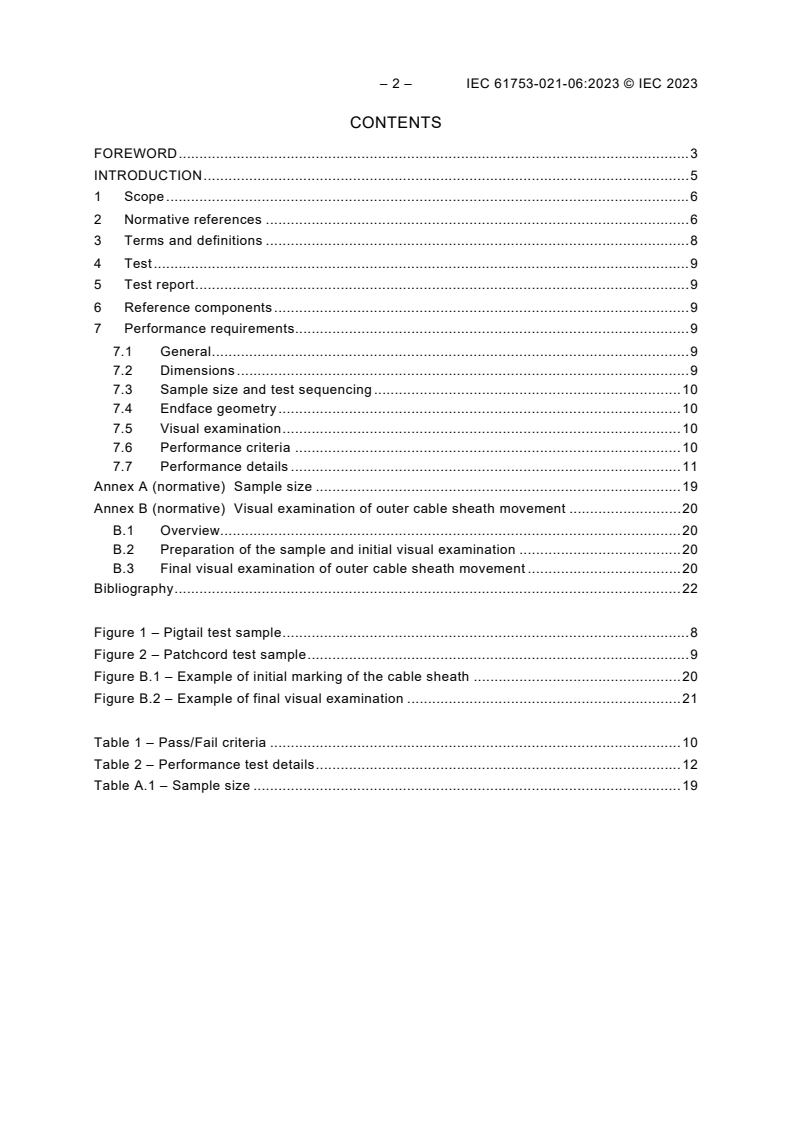
CONTENTS
FOREWORD . 3
INTRODUCTION . 5
1 Scope . 6
2 Normative references . 6
3 Terms and definitions . 8
4 Test . 9
5 Test report . 9
6 Reference components . 9
7 Performance requirements. 9
7.1 General . 9
7.2 Dimensions . 9
7.3 Sample size and test sequencing . 10
7.4 Endface geometry . 10
7.5 Visual examination . 10
7.6 Performance criteria . 10
7.7 Performance details . 11
Annex A (normative) Sample size . 19
Annex B (normative) Visual examination of outer cable sheath movement . 20
B.1 Overview. 20
B.2 Preparation of the sample and initial visual examination . 20
B.3 Final visual examination of outer cable sheath movement . 20
Bibliography . 22
Figure 1 – Pigtail test sample . 8
Figure 2 – Patchcord test sample . 9
Figure B.1 – Example of initial marking of the cable sheath . 20
Figure B.2 – Example of final visual examination . 21
Table 1 – Pass/Fail criteria . 10
Table 2 – Performance test details . 12
Table A.1 – Sample size . 19
INTERNATIONAL ELECTROTECHNICAL COMMISSION
____________
FIBRE OPTIC INTERCONNECTING DEVICES AND
PASSIVE COMPONENTS – PERFORMANCE STANDARD –
Part 021-06: Single-mode fibre optic connectors terminated
as pigtails and patchcords for category OP+ –
Extended outdoor protected environment
FOREWORD
1) The International Electrotechnical Commission (IEC) is a worldwide organization for standardization comprising
all national electrotechnical committees (IEC National Committees). The object of IEC is to promote international
co-operation on all questions concerning standardization in the electrical and electronic fields. To this end and
in addition to other activities, IEC publishes International Standards, Technical Specifications, Technical Reports,
Publicly Available Specifications (PAS) and Guides (hereafter referred to as “IEC Publication(s)”). Their
preparation is entrusted to technical committees; any IEC National Committee interested in the subject dealt with
may participate in this preparatory work. International, governmental and non-governmental organizations liaising
with the IEC also participate in this preparation. IEC collaborates closely with the International Organization for
Standardization (ISO) in accordance with conditions determined by agreement between the two organizations.
2) The formal decisions or agreements of IEC on technical matters express, as nearly as possible, an international
consensus of opinion on the relevant subjects since each technical committee has representation from all
interested IEC National Committees.
3) IEC Publications have the form of recommendations for international use and are accepted by IEC National
Committees in that sense. While all reasonable efforts are made to ensure that the technical content of IEC
Publications is accurate, IEC cannot be held responsible for the way in which they are used or for any
misinterpretation by any end user.
4) In order to promote international uniformity, IEC National Committees undertake to apply IEC Publications
transparently to the maximum extent possible in their national and regional publications. Any divergence between
any IEC Publication and the corresponding national or regional publication shall be clearly indicated in the latter.
5) IEC itself does not provide any attestation of conformity. Independent certification bodies provide conformity
assessment services and, in some areas, access to IEC marks of conformity. IEC is not responsible for any
services carried out by independent certification bodies.
6) All users should ensure that they have the latest edition of this publication.
7) No liability shall attach to IEC or its directors, employees, servants or agents including individual experts and
members of its technical committees and IEC National Committees for any personal injury, property damage or
other damage of any nature whatsoever, whether direct or indirect, or for costs (including legal fees) and
expenses arising out of the publication, use of, or reliance upon, this IEC Publication or any other IEC
Publications.
8) Attention is drawn to the Normative references cited in this publication. Use of the referenced publications is
indispensable for the correct application of this publication.
9) IEC draws attention to the possibility that the implementation of this document may involve the use of (a)
patent(s). IEC takes no position concerning the evidence, validity or applicability of any claimed patent rights in
respect thereof. As of the date of publication of this document, IEC had not received notice of (a) patent(s), which
may be required to implement this document. However, implementers are cautioned that this may not represent
the latest information, which may be obtained from the patent database available at https://patents.iec.ch. IEC
shall not be held responsible for identifying any or all such patent rights.
IEC 61753-021-06 has been prepared by subcommittee 86B: Fibre optic interconnecting
devices and passive components, of IEC technical committee 86: Fibre optics. It is an
International Standard.
This first edition cancels and replaces the first edition of IEC 61753‑021‑6 published in 2007.
This edition constitutes a technical revision.
– 4 – IEC 61753-021-06:2023 © IEC 2023
This edition includes the following significant technical changes with respect to
IEC 61753‑021‑6:2007:
a) updated environmental category (from O to OP+), tests and their severities according to
IEC 61753-1:2018;
b) removed the copyright notice as it is no longer needed;
c) changed title and scope to remove restrictions on attenuation and return loss grades;
d) changed the term and definitions of the different types of test samples (pigtail test samples
and patchcord test samples) used in the various tests to avoid confusion;
e) removed the term and definition for small form factor (SFF) connectors as it is no longer
used in the document;
f) updated fibre naming conventions according to IEC 60793-2-50: and added provisions for
B-657 fibres;
g) added all the attenuation and return loss grades defined in IEC 61753-1;
h) removed the static side load test;
i) removed the need to perform all tests sequentially to align with other performance
standards;
j) added provisions for rectangular ferrule connectors;
k) added Annex B for visual examination of the outer cable sheath movement of reinforced
cables as an additional requirement for change of temperature, cable retention and flexing
of the strain relief tests.
The text of this International Standard is based on the following documents:
Draft Report on voting
86B/4792/FDIS 86B/4813/RVD
Full information on the voting for its approval can be found in the report on voting indicated in
the above table.
The language used for the development of this International Standard is English.
This document was drafted in accordance with ISO/IEC Directives, Part 2, and developed in
accordance with ISO/IEC Directives, Part 1 and ISO/IEC Directives, IEC Supplement, available
at www.iec.ch/members_experts/refdocs. The main document types developed by IEC are
described in greater detail at www.iec.ch/publications.
A list of all parts of the IEC 61753 series, published under the general title Fibre optic
interconnecting devices and passive components – Performance standard, can be found on the
IEC website.
The committee has decided that the contents of this document will remain unchanged until the
stability date indicated on the IEC website under webstore.iec.ch in the data related to the
specific document. At this date, the document will be
• reconfirmed,
• withdrawn, or
• revised.
INTRODUCTION
Performance standards define the requirements for standard optical performance under a set
of specified conditions. Each standard contains a series or a set of tests and measurements
with clearly stated conditions, severities and pass/fail criteria. The series of tests, commonly
referred to as an operating service environment or performance category, is intended to be run
on a "one-off" basis to prove the product’s ability to satisfy the requirements of a specific
application, market sector or user group.
The subsequent parts of this document define those sets of tests which form each operating
service environment or performance category, and which have been standardized for
international use. A product that has been shown to meet all the requirements of a performance
standard may be declared as complying with that performance standard.
Products having the same classification from one manufacturer that satisfy a performance
standard will operate within the boundaries set by the performance standard. Intermateability
or interchangeability of products from different suppliers (having the same classification and
conforming to the same performance standard) can only be guaranteed when these products
also meet the interface standards. Only in this condition will an equivalent level of performance
be provided when they are used together (for example, in the case of optical connectors).
Conformance to a performance standard is not a guarantee of lifetime assured performance or
reliability.
Reliability testing is subjected to a separate test schedule, where the tests and severities
selected are truly representative of the requirements of this reliability test programme.
Consistency of manufacture should be maintained using a recognized quality assurance
programme whilst the reliability of the product should be evaluated using the procedures
recommended in the IEC 62005 series.
Tests and measurements should be selected from the IEC 61300 series. Where this is not
possible, the required test method should be attached as an annex to the performance standard.
– 6 – IEC 61753-021-06:2023 © IEC 2023
FIBRE OPTIC INTERCONNECTING DEVICES AND
PASSIVE COMPONENTS – PERFORMANCE STANDARD –
Part 021-06: Single-mode fibre optic connectors terminated
as pigtails and patchcords for category OP+ –
Extended outdoor protected environment
1 Scope
This part of IEC 61753 defines the minimum initial test and measurement requirements and
severities which single-mode fibre optic connectors terminated as a pigtail or a patchcord satisfy
in order to be categorised as meeting the IEC standard category OP+ (extended outdoor
protected environment), as defined in IEC 61753-1.
If tests were performed on the connectors terminated as pigtails or patchcords for category
HD
OP+ and the product passed, the product will be automatically qualified or categorized as
meeting the IEC standard for category OP+. If tests are performed on the connectors terminated
as pigtails or patchcords for category OP+, and the product passes, the product will be
automatically qualified or categorized as meeting the IEC standard for categories OP and C.
2 Normative references
The following documents are referred to in the text in such a way that some or all of their content
constitutes requirements of this document. For dated references, only the edition cited applies.
For undated references, the latest edition of the referenced document (including any
amendments) applies.
IEC 60793-2-50, Optical fibres – Part 2-50: Product specifications – Sectional specification for
class B single-mode fibres
IEC 60794-2-50, Optical fibre cables – Part 2-50: Indoor cables – Family specification for
simplex and duplex cables for use in terminated cable assemblies
IEC 61300-1, Fibre optic interconnecting devices and passive components – Basic test and
measurement procedures – Part 1: General and guidance
IEC 61300-2-1, Fibre optic interconnecting devices and passive components – Basic test and
measurement procedures – Part 2-1: Tests – Vibration (sinusoidal)
IEC 61300-2-2, Fibre optic interconnecting devices and passive components – Basic test and
measurement procedures – Part 2-2: Tests – Mating durability
IEC 61300-2-4, Fibre optic interconnecting devices and passive components – Basic test and
measurement procedures – Part 2-4: Tests – Fibre or cable retention
IEC 61300-2-5, Fibre optic interconnecting devices and passive components – Basic test and
measurement procedures – Part 2-5: Tests – Torsion
IEC 61300-2-6, Fibre optic interconnecting devices and passive components – Basic test and
measurement procedures – Part 2-6: Tests – Tensile strength of coupling mechanism
IEC 61300-2-7, Fibre optic interconnecting devices and passive components – Basic test and
measurement procedures – Part 2-7: Tests – Bending moment
IEC 61300-2-12, Fibre optic interconnecting devices and passive components – Basic test and
measurement procedures – Part 2-12: Tests – Impact
IEC 61300-2-17, Fibre optic interconnecting devices and passive components – Basic test and
measurement procedures – Part 2-17: Tests – Cold
IEC 61300-2-18, Fibre optic interconnecting devices and passive components – Basic test and
measurement procedures – Part 2-18: Tests – Dry heat
IEC 61300-2-21, Fibre optic interconnecting devices and passive components – Basic test and
measurement procedures – Part 2-21: Tests – Composite temperature/humidity cyclic test
IEC 61300-2-22, Fibre optic interconnecting devices and passive components – Basic test and
measurement procedures – Part 2-22: Tests – Change of temperature
IEC 61300-2-26, Fibre optic interconnecting devices and passive components – Basic test and
measurement procedures – Part 2-26: Tests – Salt mist
IEC 61300-2-27, Fibre optic interconnecting devices and passive components – Basic test and
measurement procedures – Part 2-27: Tests – Dust – Laminar flow
IEC 61300-2-44, Fibre optic interconnecting devices and passive components – Basic test and
measurement procedures – Part 2-44: Tests – Flexing of the strain relief of fibre optic devices
IEC 61300-2-50, Fibre optic interconnecting devices and passive components – Basic test and
measurement procedures – Part 2-50: Tests – Fibre optic connector proof test with static load
– Singlemode and multimode
IEC 61300-3-1, Fibre optic interconnecting devices and passive components – Basic test and
measurement procedures – Part 3-1: Examinations and measurements – Visual examination
IEC 61300-3-3, Fibre optic interconnecting devices and passive components – Basic test and
measurement procedures – Part 3-3: Examinations and measurements – Active monitoring of
changes in attenuation and return loss
IEC 61300-3-4, Fibre optic interconnecting devices and passive components – Basic test and
measurement procedures – Part 3-4: Examinations and measurements – Attenuation
IEC 61300-3-6, Fibre optic interconnecting devices and passive components – Basic test and
measurement procedures – Part 3-6: Examinations and measurements – Return loss
IEC 61300-3-28, Fibre optic interconnecting devices and passive components – Basic test and
measurement procedures – Part 3-28: Examinations and measurements – Transient loss
IEC 61300-3-34, Fibre optic interconnecting devices and passive components – Basic test and
measurement procedures – Part 3-34: Examinations and measurements – Attenuation of
random mated connectors
IEC 61300-3-45, Fibre optic interconnecting devices and passive components – Basic test and
measurement procedures – Part 3-45: Examinations and measurements – Attenuation of
random mated multi-fibre connectors
– 8 – IEC 61753-021-06:2023 © IEC 2023
IEC 61753-1, Fibre optic interconnecting devices and passive components – Performance
standard – Part 1: General and guidance
IEC 61754 (all parts), Fibre optic interconnecting devices and passive components – Fibre optic
connector interfaces
IEC 61755 (all parts), Fibre optic interconnecting devices and passive components – Connector
optical interfaces for single-mode fibres
IEC 61755-2 (all parts), Fibre optic interconnecting devices and passive components –
Connector optical interfaces for single-mode fibres – Part 2: Connection parameters of
dispersion unshifted physically contacting fibres
IEC 61755-3 (all parts), Fibre optic interconnecting devices and passive components –
Connector optical interfaces for single-mode fibres – Part 3: Connector parameters of
dispersion unshifted physically contacting fibres
3 Terms and definitions
For the purposes of this document, the terms and definitions given in IEC 61753-1 and the
following apply.
ISO and IEC maintain terminology databases for use in standardization at the following
addresses:
• IEC Electropedia: available at https://www.electropedia.org/
• ISO Online browsing platform: available at https://www.iso.org/obp
3.1
change in attenuation
δ
large or small deviation from the original value of the transmitted power at the start of the test
3.2
sample
complete set of connector components required to provide demountable coupling between one
or more pairs of optical fibres
3.3
pigtail test sample
two pigtails mated with an adaptor
Note 1 to entry: See Figure 1.
Figure 1 – Pigtail test sample
3.4
patchcord test sample
patchcord mated to two pigtails using adaptors
Note 1 to entry: See Figure 2.
Figure 2 – Patchcord test sample
4 Test
All test and measurement methods have been selected from the IEC 61300 series and the test
parameters and requirements from IEC 61753-1 as defined in 7.6 and 7.7. Additional
requirements to certain tests are given in Annex B.
The connector plugs under test shall be terminated onto single-mode fibre in accordance with
IEC 60793‑2‑50, type B-652 or B-657, in either buffered or reinforced cable format. The
reinforced cable used for the pigtails or patchcords shall conform to the requirements of
IEC 60794-2-50. The minimum bend radius of the cable shall be maintained. The connector
interface standard shall meet the dimensions of the relevant part of the IEC 61754 series and
the connector optical interface standard shall meet the relevant requirements of the IEC 61755
series.
5 Test report
Fully documented test reports and supporting evidence shall be prepared and available for
inspection as evidence that the tests have been carried out and the results are satisfactory.
6 Reference components
No reference components are required to perform the tests in this document.
7 Performance requirements
7.1 General
Unless otherwise specified, all tests shall be carried out at standard atmospheric conditions as
specified in IEC 61300-1.
7.2 Dimensions
Dimensions shall comply with the appropriate IEC interface standard as defined in the
IEC 61754 series.
– 10 – IEC 61753-021-06:2023 © IEC 2023
7.3 Sample size and test sequencing
For the purposes of this document, a sample is composed of pigtail test samples or patchcord
test samples (see Clause 3). The sample sizes to be used for the tests shall be as defined in
Annex A. The tests are not intended to be performed in any particular sequence or grouping,
but rather, individually on new samples. Samples for the first test (attenuation) are to be
randomly selected and randomly mated new products. Samples for the second test (return loss)
are the same plugs selected and mated for the first test. Samples from the previous tests may
be used if desired. If a failure occurs on a sample that was tested in a previous test, a new set
of samples shall be prepared, and the failed test shall be re-done.
7.4 Endface geometry
The connector endface shall comply with the endface geometry requirements of the applicable
IEC optical interface standard as defined in the IEC 61755-3 series. Compliance to the
appropriate optical interface standard shall be confirmed on all samples before the start of
testing and after each of the tests have been completed. Non-compliance with the endface
geometry requirements of the applicable optical interface standard on any connector tested
results in a failure of this document.
7.5 Visual examination
A visual examination shall be carried out on all samples before and after each of the mechanical
and climatic tests (see Table 2). The outer cable sheath of the samples with reinforced cable
shall be marked at the end of the connector boot during the initial visual examination (see
Annex B).
The connector endface shall comply with the visual requirements for defects and scratches
according to the relevant part of the IEC 61755-2 series.
7.6 Performance criteria
The optical performance levels shall meet the requirements of one specific grade as defined in
IEC 61753-1 (see Table 1).
Table 1 – Pass/Fail criteria
Criterion Examinations and
Initial During or after test, or both
No. measurements
1 Attenuation – random Grade B:
mate
≤ 0,12 dB mean
IEC 61300-3-34 for
≤ 0,25 dB max. for ≥ 97 %
cylindrical ferrules
of samples
IEC 61300-3-45 for
Grade C:
rectangular ferrules
≤ 0,25 dB mean
≤ 0,50 dB max. for ≥ 97 %
of samples
Grade D:
≤ 0,50 dB mean
≤ 1,00 dB max. for ≥ 97 %
of samples
At 1 310 nm, 1 550 nm
a
and 1 625 nm
2 Return loss Grade 1: ≥ 60 dB The initial requirement shall be met.
IEC 61300-3-6 Grade 2: ≥ 45 dB
Grade 3: ≥ 35 dB
Grade 4: ≥ 26 dB
Criterion Examinations and
Initial During or after test, or both
No. measurements
a
3 Active monitoring of
Change in attenuation during test :
changes in attenuation
δ ≤ 0,2 dB at 1 310 nm and 1 550 nm and
and return loss (multiple
δ ≤ 0,3 at 1 625 nm for pigtail test samples
path)
(1 connection)
IEC 61300-3-3
δ ≤ 0,5 dB at 1 310 nm, δ ≤ 0,6 dB at
1 550 nm and δ ≤ 0,8 dB at 1 625 nm for
patchcord test samples (2 connections)
a
Change in attenuation after test :
δ ≤ 0,2 dB at 1 310 nm, 1 550 nm and
1 625 nm for pigtail test samples
(1 connection)
δ ≤ 0,4 dB at 1 310 nm, 1 550 nm and
1 625 nm for patchcord test samples
(2 connections)
The initial return loss requirement shall be
met.
a
4 Transient Loss
Change in attenuation during test :
IEC 61300-3-28
δ ≤ 0,5 dB at 1 550 nm per connection
δ ≤ 1,0 dB at 1 625 nm per connection
a
Change in attenuation after test :
δ ≤ 0,2 dB at 1 550 nm and 1 625 nm per
connection
5 Visual inspection The connector plugs and After the test, the sample shall be inspected
adaptors shall be and comply with the initial requirements.
IEC 61300-3-1
inspected for damage that
might impair the
performance. This
inspection shall include:
– distortion of housing
parts, as indicated by
difficulty in insertion,
improper snap-fits,
etc.;
– distortion of ferrules
and sleeves, as
indicated by change in
mating force, changes
in endface geometry,
etc.;
– housing cracks;
– presence of debris,
shavings, etc.;
– corrosion or residue;
– ferrule endface
cracks, chips, or
scratches;
– other potentially
service-affecting
damage.
a
Testing at 1 625 nm is optional for enterprise applications but required for carrier applications.
7.7 Performance details
Performance details are specified in Table 2.
– 12 – IEC 61753-021-06:2023 © IEC 2023
Table 2 – Performance test details
No. Test Requirements Details
1 Attenuation Criterion no. 1 (Table 1) IEC 61300-3-34, method 1 (cylindrical ferrules)
(random mate)
IEC 61300-3-45, method 1 (rectangular ferrules)
Launch mode conditions: only the fundamental mode
shall propagate at the connector interface and at the
detector.
Source characteristics: reference to IEC 61300-3-4
(attenuation)
Sample shall be optically functioning.
Preconditioning procedure: clean plug and adaptor
according to manufacturer’s instructions.
2 Return loss Criterion no. 2 (Table 1) IEC 61300-3-6, method 1
(random mate)
Mating combinations according to:
IEC 61300-3-34, method 1 (cylindrical ferrules)
IEC 61300-3-45, method 1 (rectangular ferrules)
Launch fibre length: L > 2 m
Source stability: ±0,20 dB from the initial value over
the measuring period or at least 1 h
Detector linearity: ±2,5 % of the power levels to be
measured
Directivity: > 65 dB
Sample shall be optically functioning.
Preconditioning procedure: clean plug and adaptor
according to manufacturer’s instructions.
Alternative method: IEC 61300-3-6, method 2
Launch fibre length: L ≥ 500 m, L ≥ 6 m, L ≥ 6 m
1 2 3
Pulse duration: ≤ 10 ns
Sample shall be optically functioning.
Preconditioning procedure: clean plug and adaptor
according to manufacturer’s instructions.
3 Dry heat During and after: IEC 61300-2-18
Criterion no. 3 (Table 1) Temperature: +75 °C ± 2 °C for 96 h
After:
Test sample configuration in the environmental
chamber: see IEC 61300-1
Criterion no. 5 (Table 1)
Sampling rate: before and after test and at a
maximum interval of 1 h during the test.
Preconditioning procedure: before test, samples
shall be maintained at standard atmospheric
conditions for 2 h. Clean plug and adaptor according
to manufacturer’s instructions.
Recovery procedure: after test, samples shall be
maintained at standard atmospheric conditions for
2 h.
The connector samples shall not be uncoupled or
cleaned at any time before, during, or after the test.
No. Test Requirements Details
4 Change of During and after: IEC 61300-2-22
temperature
Criterion no. 3 (Table 1) High temperature dwell: +75 °C ± 2 °C
After:
Low temperature dwell: -40 °C ± 2 °C
Criterion no. 5 (Table 1)
Duration at each dwell temperature: 1 h
Sheath visual examination for
Ramp time: 1 °C/min
test samples with reinforced
cable: see Annex B Number of cycles: 12
Test sample configuration in the environmental
chamber: see IEC 61300-1
Sample shall be optically functioning.
Sampling rate: initially at room ambient, after 0,5 h
during each dwell (measurements to be completed
during dwell) and at the end of the test at standard
atmospheric conditions.
Preconditioning procedure: before test, samples
shall be maintained at standard atmospheric
conditions for 2 h.
Recovery procedure: after test, samples shall be
maintained at standard atmospheric conditions for
2 h.
The connector samples shall not be uncoupled or
cleaned anytime before, during or after the test.
5 Cold During and after: IEC 61300-2-17
Criterion no. 3 (Table 1) Temperature: -40 °C ± 2 °C
After: Duration of exposure: 96 h
Criterion no. 5 (Table 1)
Test sample configuration in the environmental
chamber: see IEC 61300-1
Sample shall be optically functioning.
Sampling rate: before and after test and at a
maximum interval of 1 h during the test.
Preconditioning procedure: before test, samples
shall be maintained at standard atmospheric
conditions for 2 h.
Recovery procedure: after test, samples shall be
maintained at standard atmospheric conditions for
2 h.
The connector samples shall not be uncoupled or
cleaned any time before, during, or after the test.
– 14 – IEC 61753-021-06:2023 © IEC 2023
No. Test Requirements Details
6 Composite During and after: IEC 61300-2-21
temperature
Criterion no. 3 (Table 1) High temperature dwell: +65 °C ± 2 °C
humidity cyclic
test
After:
Low temperature dwell: -10 °C ± 2 °C
Criterion no. 5 (Table 1)
Relative humidity: 93 % ± 3 % during dwells at
+23 °C and +65 °C. 88 % ± 8% during falls to
+23 °C. Uncontrolled but not dehumidified during
change between +23 °C to –10 °C and during dwells
at –10 °C .
Cycle profile with cold exposure: +23 °C to +65 °C
to +23 °C to +65 °C to +23 °C to -10 °C to +23 °C.
Cycle profile without cold exposure: +23 °C to
+65 °C to +23 °C to +65 °C to +23 °C.
Ramp time: 2 h, except change from +23 °C to
–10 °C and –10 °C to +23 °C shall occur faster
(30 min max.) to maximize condensation.
Duration at each extreme dwell temperature: 3 h
Duration and number of cycles: 24 h per cycle,
10 cycles. Five of the first nine cycles shall have
cold exposure, the remaining four of the first nine
cycles shall not have cold exposure. The final cycle
will follow the cycle profile without cold exposure
with temperature and relative humidity being
maintained at +23 °C and 93 % RH ± 3 % RH for
3,5 h before measurements are made.
Test sample configuration in the environmental
chamber: see IEC 61300-1
Sample shall be optically functioning.
Sampling rate: initially at standard atmospheric
conditions, after 1 h during each dwell
(measurements to be completed during dwell) and at
the end of the test at standard atmospheric
conditions.
Preconditioning procedure: before test, samples
shall be subjected to +55 °C ± 2 °C and relative
humidity not exceeding 20 % for a period of 24 h.
The sample shall then be allowed to attain thermal
stability at standard atmospheric conditions for
testing before initial measurements are made.
Recovery procedure: after test, samples shall be
maintained at standard atmospheric conditions for
2 h.
The connector samples shall not be uncoupled or
cleaned any time before, during, or after the test.
7 Vibration During and after: IEC 61300-2-1
(sinusoidal)
Criterion no. 4 (Table 1) Frequency range: 10 Hz to 55 Hz
After:
Change in frequency: 1 octave/min
Criterion no. 2 (Table 1)
Number of axes: three orthogonal
Criterion no. 5 (Table 1)
Number of sweeps per axis: 15 (10 Hz to 55 Hz to
10 Hz)
Vibration amplitude: 0,75 mm
Sampling rate: before, during and after each axis
Method of mounting: an adaptor shall be mounted
rigidly to the mounting fixture
Sample shall be optically functioning.
Preconditioning procedure: clean plug and adaptor
according to manufacturer’s instructions.
The connector samples shall not be uncoupled or
cleaned at any time during the test.
No. Test Requirements Details
8 Flexing of the During and after: IEC 61300-2-44
strain relief of
Criterion no. 4 (Table 1) Magnitude of the tensile load: 5 N ± 0,5 N for
fibre optic
connectors with reinforced cable
devices
After:
Cycle: 0 ° to +90 ° to 0 ° to –90 ° to 0 ° (continuous
Criterion no. 2 (Table 1)
with reversing at ±90°)
Criterion no. 5 (Table 1)
Number of cycles: 50
Sheath visual examination for
test samples with reinforced
Rate of application of the tensile load: gradually
cable: see Annex B apply load to avoid any sudden jerking or straining
of the cable
NOTE This test does not apply
to connectors without reinforced Point of application of tensile load: 25 cm ± 5 cm
cable. from cable entrance to plug
Method of mounting: an adaptor shall be mounted
rigidly to the test fixture. The orientation of the
connector plug shall be reported in the test report.
Preconditioning procedure: clean plug and adaptor
according to manufacturer’s instructions.
The connector samples shall not be uncoupled or
cleaned at any time during the test.
9 Torsion During:
IEC 61300-2-5
Criterion no. 3, attenuation only Magnitude of the tensile load for reinforced cables:
(Table 1) 10 N ± 2 N
After:
Magnitude of the tensile load for buffered and
primary coated fibres: 2,0 N ± 0,5 N
Criterion no. 3 (Table 1)
Rate of application of the tensile load: gradually
Criterion no. 5 (Table 1)
apply load to avoid any sudden jerking or straining
of the cable
Cycle: ±180° minimum
Number of cycles: 25
Point of application of tensile load: 25 cm ± 5 cm
from cable entrance to plug
Sampling rate: initially, after the load has reached
its maximum level and been maintained for a
minimum of 10 s, and during test while load remains
applied and torsion rotation is at maximum
positions.
Preconditioning procedure: Clean the mechanical
and optical alignment parts of the sample according
to the manufacturer's instructions.
The connector samples shall not be uncoupled or
cleaned at any time during the test.
– 16 – IEC 61753-021-06:2023 © IEC 2023
No. Test Requirements Details
10 Fibre or cable During and after: IEC 61300-2-4
retention
Criterion no. 3 (Table 1) Magnitude and rate of application of the load for
reinforced cables: 70 N ± 2 N at 5 N/s
After:
Magnitude and rate of application of the load for
Criterion no. 5 (Table 1)
tubes or cables without aramid yarns: 10 N ± 2 N at
Sheath visual examination for
2 N/s
test samples with reinforced
Magnitude and rate of application of the load for
cable: see Annex B
buffered fibres: 5,0 N ± 0,5 N at 0,5 N/s
Magnitude and rate of application of the load for
primary coated fibres: 2,0 N ± 0,5 N at 0,5 N/s
Point of application of tensile load: 200 mm to
300 mm from cable entrance to plug
Duration of the test (maintaining the load): 60 s
minimum
Sampling rate: initially and after the load has
reached its maximum level and been maintained for
a minimum of 30 s.
Sample shall be optically functioning during the test.
Preconditioning procedure: clean plug and adaptor
according to manufacturer’s instructions.
The connector samples shall not be uncoupled or
cleaned at anytime during the test.
11 Fibre optic After: IEC 61300-2-50
connector proof
Criterion no. 3 (Table 1) Magnitude and rate of application of the load for
test 90°
reinforced cables: 15 N ± 2 N at 2 N/s
Criterion no. 5 (Table 1)
Magnitude and rate of application of the load for
buffered fibres: 5 N ± 0,5 N at 0,5 N/s
Point of application of tensile load: 220 mm to
280 mm from cable entrance to plug
Duration of the test (maintaining the load): 5 s
Sampling rate: initially and at least 10 s after the
end of the test with no load applied.
Sample does not need to be optically functioning
during the test.
Preconditioning procedure: clean plug and adaptor
according to manufacturer’s instructions.
The connector samples shall not be uncoupled or
cleaned at anytime during the test.
12 Impact After: IEC 61300-2-12, method A
Criterion no. 3 (Table 1) Number of drops: 5 for each plug
Criterion no. 5 (Table 1)
Drop height: 1,5 m
Sampling rate: Initially and after the last drop.
Sample shall be unmated during drop cycles.
Preconditioning procedure: clean plug and adaptor
according to manufacturer’s instructions. Place a
dust cap over the ferrule to protect the fibre
endface.
Recovery procedure: the connector may be cleaned
after each drop before measurement.
No. Test Requirements Details
13 Mating During and after: IEC 61300-2-2, measurement condition A
durability
Criterion no. 3 (Table 1) Coupling mechanism to be cycled: plug-adaptor
After:
Cycling rate: not less than 3 s between each
engagement and separation
Criterion no. 5 (Table 1)
Number of cycles: 200 (cylindrical ferru
...
Questions, Comments and Discussion
Ask us and Technical Secretary will try to provide an answer. You can facilitate discussion about the standard in here.
Loading comments...