

IEC 60335-2-7:2000
(Main)Safety of household and similar electrical appliances - Part 2-7: Particular requirements for washing machines
General Information
- Abstract
Deals with the safety of electric washing machines for household and similar purposes, intended for washing clothes and textiles. Therated voltage is not more than 250 V for single-phase appliances and 480 V for other appliances. It includes washing machines for communal use in blocks of flats and in laundrettes. Washing machines with a spin extraction function must comply with IEC 60335-2-4, and with a drying function must comply with IEC 60335-2-11.
- Status
- Published
- Publication Date
- 30-Jan-2000
- Technical Committee
- TC 61 - Safety of household and similar electrical appliances
- Current Stage
- DELPUB - Deleted Publication
- Start Date
- 29-Jul-2002
- Completion Date
- 28-Aug-2026
Overview
IEC 60335-2-7:2000 - Safety of household and similar electrical appliances - Part 2-7: Particular requirements for washing machines - is a product‑specific safety standard published by the IEC. It supplements the general safety rules in IEC 60335-1 and applies to electric washing machines for household and similar purposes (rated voltage ≤ 250 V single‑phase, ≤ 480 V other appliances). The scope explicitly includes communal machines (blocks of flats, launderettes) and covers machines that heat water, extract water (spin), or incorporate drying - with spin and drying functions requiring compliance with IEC 60335-2-4 and IEC 60335-2-11 respectively.
Key topics and technical requirements
- Scope and definitions: Clarifies normal operation conditions (load, water temperature) and machine types covered.
- Electrical protection: Classification into Class I, II or III and minimum ingress protection IPX4.
- Marking & instructions: Mandatory user and safety information - e.g., maximum dry cloth mass, maximum/minimum inlet water pressure, warning about replacing hose‑sets, "off" labelling, and wringer safety.
- Safety tests and construction: Includes requirements and tests for leakage current, dielectric strength, moisture resistance, heating/temperature limits, stability, mechanical strength, endurance, abnormal operation and component protection.
- Special annexes: Normative Annex AA (detergent extract from IEC 60456) and Annex BB (ageing tests for elastomeric parts).
- Test conditions: Prescribed ambient and water temperatures and procedures for representative operating periods; interaction with temperature‑sensitive devices is addressed.
- Referenced symbols and vocabularies: Links to IEC vocabulary and symbol standards (e.g., IEC 60050, IEC 60417).
Practical applications - who uses IEC 60335-2-7
- Appliance manufacturers and product designers - to design compliant washing machines and prepare technical documentation.
- Test laboratories and conformity assessment bodies - to perform safety testing and certification against harmonized international criteria.
- Regulatory authorities and specifiers - to reference minimum safety requirements for household and communal washing machines.
- Safety and compliance engineers - for risk assessment, labeling, instructions and selection of protective measures (earthing, IP rating, wiring).
Related standards
- IEC 60335-1 - General requirements for household electrical appliance safety (mandatory companion).
- IEC 60335-2-4 - Particular requirements for spin‑extraction appliances.
- IEC 60335-2-11 - Particular requirements for tumble dryers (for machines with drying).
- IEC 60456 - Performance/detergent reference (Annex AA excerpt).
- Other IEC references: IEC 60050, IEC 60027, IEC 60417 for terminology and symbols.
Keywords: IEC 60335-2-7, washing machines safety, household appliance standard, electrical safety, IEC 60335-1, IPX4, conformity testing, marking and instructions.
Relations
- Effective Date
- 05-Sep-2023
- Effective Date
- 05-Sep-2023
- Effective Date
- 05-Sep-2023
- Effective Date
- 05-Sep-2023
Get Certified
Connect with accredited certification bodies for this standard

CIS Institut d.o.o.
Personal Protective Equipment (PPE) certification body. Notified Body NB-2890 for EU Regulation 2016/425 PPE.

Kiwa BDA Testing
Building and construction product certification.
Kmetijski inštitut Slovenije
Agricultural Institute of Slovenia. Soil testing, plant health, agricultural product analysis.
Sponsored listings
Frequently Asked Questions
IEC 60335-2-7:2000 is a standard published by the International Electrotechnical Commission (IEC). Its full title is "Safety of household and similar electrical appliances - Part 2-7: Particular requirements for washing machines". This standard covers: Deals with the safety of electric washing machines for household and similar purposes, intended for washing clothes and textiles. Therated voltage is not more than 250 V for single-phase appliances and 480 V for other appliances. It includes washing machines for communal use in blocks of flats and in laundrettes. Washing machines with a spin extraction function must comply with IEC 60335-2-4, and with a drying function must comply with IEC 60335-2-11.
Deals with the safety of electric washing machines for household and similar purposes, intended for washing clothes and textiles. Therated voltage is not more than 250 V for single-phase appliances and 480 V for other appliances. It includes washing machines for communal use in blocks of flats and in laundrettes. Washing machines with a spin extraction function must comply with IEC 60335-2-4, and with a drying function must comply with IEC 60335-2-11.
IEC 60335-2-7:2000 is classified under the following ICS (International Classification for Standards) categories: 13.120 - Domestic safety; 97.060 - Laundry appliances. The ICS classification helps identify the subject area and facilitates finding related standards.
IEC 60335-2-7:2000 has the following relationships with other standards: It is inter standard links to IEC 60335-2-7:2002, IEC 60335-2-7:1993/AMD2:1999, IEC 60335-2-7:1993/AMD1:1998, IEC 60335-2-7:1993. Understanding these relationships helps ensure you are using the most current and applicable version of the standard.
IEC 60335-2-7:2000 is available in PDF format for immediate download after purchase. The document can be added to your cart and obtained through the secure checkout process. Digital delivery ensures instant access to the complete standard document.
Standards Content (Sample)
INTERNATIONAL IEC
STANDARD
60335-2-7
Fifth edition
2000-01
Safety of household and similar electrical
appliances –
Part 2-7:
Particular requirements for washing machines
Sécurité des appareils électrodomestiques et analogues –
Partie 2-7:
Règles particulières pour les machines à laver le linge
Reference number
Numbering
As from 1 January 1997 all IEC publications are issued with a designation in the
60000 series.
Consolidated publications
Consolidated versions of some IEC publications including amendments are
available. For example, edition numbers 1.0, 1.1 and 1.2 refer, respectively, to the
base publication, the base publication incorporating amendment 1 and the base
publication incorporating amendments 1 and 2.
Validity of this publication
The technical content of IEC publications is kept under constant review by the IEC,
thus ensuring that the content reflects current technology.
Information relating to the date of the reconfirmation of the publication is available
in the IEC catalogue.
Information on the subjects under consideration and work in progress undertaken
by the technical committee which has prepared this publication, as well as the list
of publications issued, is to be found at the following IEC sources:
• IEC web site*
• Catalogue of IEC publications
Published yearly with regular updates
(On-line catalogue)*
• IEC Bulletin
Available both at the IEC web site* and as a printed periodical
Terminology, graphical and letter symbols
For general terminology, readers are referred to IEC 60050: International
Electrotechnical Vocabulary (IEV).
For graphical symbols, and letter symbols and signs approved by the IEC for
general use, readers are referred to publications IEC 60027: Letter symbols to be
used in electrical technology, IEC 60417: Graphical symbols for use on equipment.
Index, survey and compilation of the single sheets and IEC 60617: Graphical symbols
for diagrams.
* See web site address on title page.
INTERNATIONAL IEC
STANDARD
60335-2-7
Fifth edition
2000-01
Safety of household and similar electrical
appliances –
Part 2-7:
Particular requirements for washing machines
Sécurité des appareils électrodomestiques et analogues –
Partie 2-7:
Règles particulières pour les machines à laver le linge
IEC 2000 Copyright - all rights reserved
No part of this publication may be reproduced or utilized in any form or by any means, electronic or
mechanical, including photocopying and microfilm, without permission in writing from the publisher.
International Electrotechnical Commission 3, rue de Varembé Geneva, Switzerland
Telefax: +41 22 919 0300 e-mail: inmail@iec.ch IEC web site http://www.iec.ch
Commission Electrotechnique Internationale
PRICE CODE
R
International Electrotechnical Commission
For price, see current catalogue
– 2 – 60335-2-7 © IEC:2000(E)
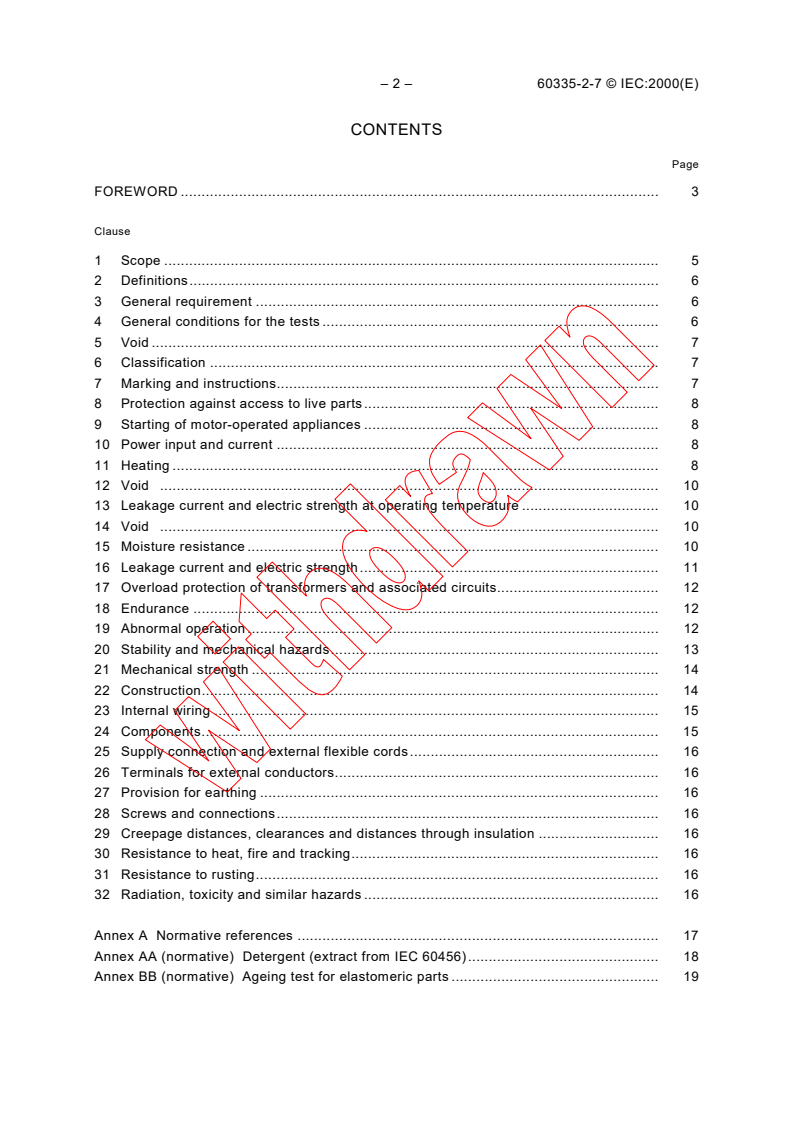
CONTENTS
Page
FOREWORD . 3
Clause
1 Scope . 5
2 Definitions. 6
3 General requirement . 6
4 General conditions for the tests . 6
5 Void . 7
6 Classification . 7
7 Marking and instructions. 7
8 Protection against access to live parts. 8
9 Starting of motor-operated appliances . 8
10 Power input and current . 8
11 Heating . 8
12 Void . 10
13 Leakage current and electric strength at operating temperature . 10
14 Void . 10
15 Moisture resistance . 10
16 Leakage current and electric strength. 11
17 Overload protection of transformers and associated circuits. 12
18 Endurance . 12
19 Abnormal operation . 12
20 Stability and mechanical hazards. 13
21 Mechanical strength . 14
22 Construction. 14
23 Internal wiring . 15
24 Components. 15
25 Supply connection and external flexible cords. 16
26 Terminals for external conductors. 16
27 Provision for earthing . 16
28 Screws and connections. 16
29 Creepage distances, clearances and distances through insulation . 16
30 Resistance to heat, fire and tracking. 16
31 Resistance to rusting. 16
32 Radiation, toxicity and similar hazards . 16
Annex A Normative references . 17
Annex AA (normative) Detergent (extract from IEC 60456). 18
Annex BB (normative) Ageing test for elastomeric parts . 19
60335-2-7 © IEC:2000(E) – 3 –
INTERNATIONAL ELECTROTECHNICAL COMMISSION
____________
SAFETY OF HOUSEHOLD AND SIMILAR ELECTRICAL APPLIANCES –
Part 2-7: Particular requirements for washing machines
FOREWORD
1) The IEC (International Electrotechnical Commission) is a worldwide organization for standardization comprising
all national electrotechnical committees (IEC National Committees). The object of the IEC is to promote
international co-operation on all questions concerning standardization in the electrical and electronic fields. To
this end and in addition to other activities, the IEC publishes International Standards. Their preparation is
entrusted to technical committees; any IEC National Committee interested in the subject dealt with may
participate in this preparatory work. International, governmental and non-governmental organizations liaising
with the IEC also participate in this preparation. The IEC collaborates closely with the International Organization
for Standardization (ISO) in accordance with conditions determined by agreement between the two
organizations.
2) The formal decisions or agreements of the IEC on technical matters express, as nearly as possible, an
international consensus of opinion on the relevant subjects since each technical committee has representation
from all interested National Committees.
3) The documents produced have the form of recommendations for international use and are published in the form
of standards, technical specifications, technical reports or guides and they are accepted by the National
Committees in that sense.
4) In order to promote international unification, IEC National Committees undertake to apply IEC International
Standards transparently to the maximum extent possible in their national and regional standards. Any
divergence between the IEC Standard and the corresponding national or regional standard shall be clearly
indicated in the latter.
5) The IEC provides no marking procedure to indicate its approval and cannot be rendered responsible for any
equipment declared to be in conformity with one of its standards.
6) Attention is drawn to the possibility that some of the elements of this International Standard may be the subject
of patent rights. The IEC shall not be held responsible for identifying any or all such patent rights.
International Standard IEC 60335-2-7 has been prepared by IEC technical committee 61:
Safety of household and similar electrical appliances.
This fifth edition cancels and replaces the fourth edition published in 1993, amendment 1
(1998) and amendment 2 (1999). This fifth edition constitutes a technical revision.
The text of this standard is based on the fourth edition, amendments 1 and 2 and the following
documents:
FDIS Report on voting
61/1644/FDIS 61/1740/RVD
Full information on the voting for the approval of this standard can be found in the report on
voting indicated in the above table.
This part 2 is intended to be used in conjunction with the latest edition of IEC 60335-1 and its
amendments. It was established on the basis of the third edition (1991) of that standard.
This part 2 supplements or modifies the corresponding clauses of IEC 60335-1 so as to convert
it into the IEC standard: Safety requirements for electric washing machines.
Where a particular subclause of part 1 is not mentioned in this part 2, that subclause applies
as far as is reasonable. Where this standard states "addition", "modification" or "replacement",
the relevant text in part 1 is to be adapted accordingly.
– 4 – 60335-2-7 © IEC:2000(E)
NOTE 1 The following print types are used:
– requirements: in roman type;
– test specifications: in italic type;
– notes: in small roman type;
Words in bold in the text are defined in clause 2.
NOTE 2 Subclauses which are additional to those in part 1 are numbered starting from 101. Annexes which are
additional to those in part 1 are lettered AA, BB, etc.
The following additional differences exist in some countries:
– 2.2.9: Different size cloths are used. The initial water temperature for machines without heating elements and
without a wringer is 71 °C (USA).
– 6.1: Class 01 appliances are permitted (China and Japan).
– 6.2: IPX0 appliances are permitted (Canada and USA).
– 11.7: The test durations are different (USA).
– 15.101: The test is carried out differently (USA).
– 19.7: Appliances without a programmer are operated until steady conditions are established (USA).
– 19.101: A redundant set of contacts is not required as shown in note 2. Operation without water as specified in
note 4 is not considered an abnormal condition (USA).
– 22.6: A different test is made (USA).
The test is carried out at twice the permissible inlet pressure or 2,0 MPa, whichever is greater (Norway).
The test is not conducted (USA).
– Annex AA: A different detergent is used (USA).
– Annex BB: Other tests are made on elastomeric parts (USA).
A bilingual version of this standard may be issued at a later date.
60335-2-7 © IEC:2000(E) – 5 –
SAFETY OF HOUSEHOLD AND SIMILAR ELECTRICAL APPLIANCES –
Part 2-7: Particular requirements for washing machines
1 Scope
This clause of part 1 is replaced by:
This standard deals with the safety of electric washing machines for household and similar
purposes, intended for washing clothes and textiles, their rated voltage being not more than
250 V for single-phase appliances and 480 V for other appliances.
NOTE 1 Washing machines may incorporate means for heating water, water extraction and drying.
NOTE 2 Washing machines having a spin extraction function also have to comply with the relevant requirements
of IEC 60335-2-4.
Washing machines having a drying function also have to comply with the relevant requirements of IEC 60335-2-11.
NOTE 3 Washing machines supplied with electricity together with other forms of energy are also within the scope
of this standard.
Appliances not intended for normal household use but which nevertheless may be a source of
danger to the public, such as appliances intended to be used by laymen in shops, in light
industry and on farms, are within the scope of this standard.
NOTE 4 Examples of such appliances are washing machines for communal use in blocks of flats or in
launderettes.
So far as is practicable, this standard deals with the common hazards presented by appliances
which are encountered by all persons in and around the home.
This standard does not in general take into account
– the use of appliances by young children or infirm persons without supervision;
– playing with the appliance by young children.
NOTE 5 Attention is drawn to the fact that:
– for appliances intended to be used in vehicles or on board ships or aircraft, additional requirements may be
necessary;
– for appliances intended to be used in tropical countries special requirements may be necessary;
– in many countries additional requirements are specified by the national health authorities, the national
authorities responsible for the protection of labour, the national water supply authorities and similar authorities.
NOTE 6 This standard does not apply to:
– appliances designed exclusively for industrial purposes;
– appliances intended to be used in locations where special conditions prevail, such as the presence of a
corrosive or explosive atmosphere (dust, vapour or gas).
– 6 – 60335-2-7 © IEC:2000(E)
2 Definitions
This clause of part 1 is applicable except as follows:
2.2.9 Replacement:
normal operation: Appliances are operated filled with a quantity of cloth, having a mass in the
dry condition equal to the maximum mass specified in the instructions for use, and with the
maximum quantity of water for which they are designed. However, if the power input or current
is higher when only 50 % of the cloth is used, the appliance is operated with this load instead.
The temperature of the water is:
– 65 °C ± 5 °C for appliances without heating elements;
– 15 °C ± 5 °C for other appliances.
If the appliance does not incorporate a programmer, the water is heated to 90 °C ± 5 °C or
lower if steady conditions are established, before starting the first washing period.
The cloth is pre-washed double-hemmed cotton sheets having dimensions of approximately
70 cm × 70 cm and a mass between 140 g/m² and 175 g/m² in the dry condition.
NOTE If the cloth in washing machines of the continuously rotating impeller type does not move properly during
operation, its quantity is reduced until the maximum motor power input is attained.
3 General requirement
This clause of part 1 is applicable.
4 General conditions for the tests
This clause of part 1 is applicable except as follows:
4.3 Addition:
The test of 15.101 is made before that of 15.3.
4.7 Replacement:
The tests are made in a draught-free location and in general at an ambient temperature of
20 °C ± 5 °C.
If the temperature attained by any part is limited by a temperature sensitive device or is influenced by
the temperature of the water, the ambient temperature is maintained at 23 °C ± 2 °C if all three
of the following conditions are met:
– the temperature of the water is within 6 K of the boiling point or the temperature of the
water or any part of the washing machine is limited by a thermal control;
– the room temperature during the test is less than 21 °C;
– the difference between the temperature rise of the relevant part and the limit specified does
not exceed 25 K minus the room temperature.
60335-2-7 © IEC:2000(E) – 7 –
5 Void
6 Classification
This clause of part 1 is applicable except as follows:
6.1 Replacement:
Appliances shall be of class I, class II or class III with respect to protection against electric
shock.
Compliance is checked by inspection and by the relevant tests.
6.2 Addition:
Appliances shall be at least IPX4.
7 Marking and instructions
This clause of part 1 is applicable except as follows:
7.1 Addition:
Appliances without automatic water level control shall also be marked with the maximum water
level.
The safety release mechanism of power-driven wringers shall be marked to indicate its method
of operation, unless its operating means has to be continuously actuated by the user.
NOTE This marking may be near the mechanism.
7.10 Addition:
If the off position is only indicated by letters, the word "off" shall be used.
7.12 Addition:
The instructions for use shall specify the maximum mass of dry cloth in kilogrammes, for which
the appliance is designed.
The instructions for use for washing machines incorporating a power-driven wringer shall draw
attention to the potential hazards involved when operating the wringer and shall state that
– the wringer must be disengaged or switched off when not in use;
– the appliance must not be operated by children.
– 8 – 60335-2-7 © IEC:2000(E)
7.12.1 Addition:
The instructions shall state:
– the maximum permissible inlet water pressure, in pascals or bars, for appliances intended
to be connected to the water mains;
– the minimum permissible inlet water pressure, in pascals or bars, if this is necessary for the
correct operation of the appliance;
– for washing machines with ventilation openings in the base, that a carpet must not obstruct
the openings.
The instructions shall state that the appliance is to be connected to the water mains using new
hose-sets and that old hose-sets should not be reused.
NOTE This instruction is not required if the hoses are permanently attached to the appliance.
7.101 The enclosure of magnetic valves and similar components incorporated in external
hoses for direct connection to the water mains, shall be marked with the symbol No. 5036 of
IEC 60417 if their working voltage exceeds extra-low voltage.
Compliance is checked by inspection.
8 Protection against access to live parts
This clause of part 1 is applicable.
9 Starting of motor-operated appliances
This clause of part 1 is not applicable.
10 Power input and current
This clause of part 1 is applicable except as follows:
10.1 Addition:
NOTE The selected representative period is the period during which the power input is the highest.
10.2 Addition:
NOTE The selected representative period is the period during which the current is the highest.
11 Heating
This clause of part 1 is applicable except as follows:
11.2 Addition:
Appliances are placed as specified for motor-operated appliances unless they incorporate a
heating element for drying.
11.7 Replacement:
Appliances incorporating a programmer are operated for three cycles with the programme
which gives the highest temperature rises, with a rest period of 4 min between cycles.
60335-2-7 © IEC:2000(E) – 9 –
Other appliances are operated according to the following sequence of operation in which
W stands for washing,
R stands for rest,
E stands for water extraction,
Wr stands for wringing,
D stands for drying:
– for appliances without means for water extraction:
WR W R W
– for appliances having a single drum for washing and water extraction:
WE R W E R W E
– for appliances having separate drums for washing and water extraction, which
cannot be used simultaneously:
W R E R WR E R WR E
– for appliances having separate drums for washing and water extraction, which can
be used simultaneously:
LLL
RR
CCC
– for appliances incorporating a power-driven wringer:
W WrR W WrR W Wr
– for appliances having a single drum for washing, water extraction and drying:
• for appliances which allow the same quantity of cloth to be washed and dried in
the drum:
W E D R WE D R WE D
• for appliances which according to the instructions for use only allow a part of the
washed cloth to be dried in the drum.
W E RD RDR W E RD RD
For appliances incorporating a timer, the washing period, the water extraction period and the
drying period are equal to the maximum period allowed by the timer.
– 10 – 60335-2-7 © IEC:2000(E)
For appliances without a timer,
– the washing period has a duration of:
• 6 min for washing machines of the continuously rotating impeller type,
• 18 min for washing machines of the agitator type,
• 25 min for washing machines of the drum type,
unless a longer period is specified in the instructions for use;
– the water extraction period has a duration of 5 min, the drum being filled with saturated
cloth having the same mass, in the dry condition, as the load used for washing.
For power-driven wringers, the duration of each wringing period is 8 min. The wringer is loaded
by passing a board through the rollers once a minute, the roller pressure being adjusted to the
maximum value. The board is approximately 20 mm thick and 80 cm long, its width being at
least equal to 3/4 of the effective length of the rollers. The board is uniformly tapered at each
end down to a thickness of approximately 3 mm, over a distance of 20 cm.
The rest period, including any braking time, has a duration of 4 min.
After the specified sequence of operation, discharge pumps which are driven by a separate
motor and switched on and off manually, are subjected to three operating periods separated by
rest periods of 4 min. Each operating period is equal to 1,5 times the period necessary to
empty the appliance when filled to the maximum normal water level. The outlet of the water
discharge pipe is 90 cm above the floor.
NOTE Washing machines with a hand-operated wringer are tested as appliances without means for water
extraction.
12 Void
13 Leakage current and electric strength at operating temperature
This clause of part 1 is applicable except as follows:
13.2 Modification:
Instead of the leakage current values specified for stationary class I appliances, the following
applies:
For stationary class I appliances, the leakage current shall not exceed 3,5 mA or 1 mA
per kW rated power input, whichever is the grea
...