

IEC TR 61156-1-3:2011
(Main)Multicore and symmetrical pair/quad cables for digital communications - Part 1-3: Electrical transmission parameters for modelling cable assemblies using symmetrical pair/quad cables
General Information
- Abstract
IEC/TR 61156-1-3:2011(E) is a supplement to IEC 61156-1 Edition 3 (2007): Multicore and symmetrical pair/quad cables for digital communications - Part 1: Generic specification. It covers the following topics:
- the near-end crosstalk test methods and length correction procedures of 6.3.5;
- the far-end crosstalk test methods and length correction procedures of 6.3.6;
- the concatenation of measured cable segments, even if they are of different design.
- Status
- Published
- Publication Date
- 06-Apr-2011
- Technical Committee
- SC 46C - Wires and symmetric cables
- Drafting Committee
- PT 61156-1-3 - TC 46/SC 46C/PT 61156-1-3
- Current Stage
- PPUB - Publication issued
- Start Date
- 07-Apr-2011
- Completion Date
- 30-Jun-2011
Buy Documents


IEC TR 61156-1-3:2011 - Multicore and symmetrical pair/quad cables for digital communications - Part 1-3: Electrical transmission parameters for modelling cable assemblies using symmetrical pair/quad cables Released:4/7/2011
Overview
IEC TR 61156-1-3:2011 is an International Electrotechnical Commission (IEC) technical report that serves as a supplement to IEC 61156-1 Edition 3. This document focuses on electrical transmission parameters critical for modelling cable assemblies composed of multicore and symmetrical pair/quad cables for digital communications. It provides detailed methodologies and formulae relevant to crosstalk measurements and correction, which are foundational for accurate cable assembly modelling, particularly in structured cabling and network infrastructure environments.
Key Topics
Near-End Crosstalk (NEXT) Test Methods and Length Correction Procedures:
The document outlines approaches to measure and adjust for near-end crosstalk in cable assemblies, ensuring results can be accurately compared or referenced against standard lengths (typically 100 meters).Far-End Crosstalk (FEXT) Test Methods and Length Correction:
Detailed procedures for far-end crosstalk testing and corresponding length corrections are presented, enabling consistent crosstalk characterisation across different cable sections.Concatenation of Cable Segments:
The report addresses methods for mathematically modelling the concatenation (joining) of measured cable segments, even if the segments differ in design or specifications. This enables comprehensive channel modelling for complex installations.Length Correction Formulae:
Mathematical relationships are provided for adjusting crosstalk and attenuation values based on cable length, supporting precise specification and performance evaluation.Transmission Parameters:
The report further defines key electrical parameters such as attenuation, impedance, and propagation constants, which are critical for network performance and electromagnetic compatibility (EMC).
Applications
Cable Assembly Design and Modelling:
Manufacturers and engineers use the test methods and correction procedures in IEC TR 61156-1-3 to accurately model and predict the electrical performance of cable assemblies before installation.Structured Cabling Systems:
The standard is particularly relevant for structured cabling in commercial buildings, data centers, and industrial environments, where maintaining signal quality and minimizing crosstalk are essential.Quality Assurance and Product Certification:
The length correction methodologies and concatenation models help ensure cable products meet international performance requirements across various installations and lengths.Channel Modelling for Network Planning:
By enabling the simulation of multiple cable sections with differing properties, network planners can anticipate and mitigate signal integrity issues, optimizing data transmission reliability.
Related Standards
Several standards complement or are referenced by IEC TR 61156-1-3:
IEC 61156-1:
Generic specification for multicore and symmetrical pair/quad cables for digital communications.IEC/TR 61156-1-2:
Electrical transmission characteristics and test methods for symmetrical pair/quad cables.IEC 61156-5:
Specific to symmetrical pair/quad cables used in horizontal floor wiring.IEC 61156-6:
Specifications for cables for work area wiring with transmission characteristics up to 1000 MHz.IEC/TR 62152:
Transmission properties of cascaded two-ports or quadripols, providing further background on terms and definitions used in modelling.IEC 60050-726:
International Electrotechnical Vocabulary for transmission lines and waveguides.
Practical Value
IEC TR 61156-1-3:2011 is indispensable for stakeholders in digital communication infrastructure-such as cable manufacturers, installers, and network engineers-seeking consistent and reliable methods for assessing and modelling the transmission performance of symmetrical cable assemblies. By standardizing approaches to crosstalk measurement, length correction, and cable concatenation, the document supports the deployment of high-performance, scalable communication networks compliant with international best practices.
For continued reference and application, users are encouraged to consult related IEC standards and stay informed on updates through the IEC webstore and technical resources.
Buy Documents
IEC TR 61156-1-3:2011 - Multicore and symmetrical pair/quad cables for digital communications - Part 1-3: Electrical transmission parameters for modelling cable assemblies using symmetrical pair/quad cables Released:4/7/2011
Get Certified
Connect with accredited certification bodies for this standard

ANCE
Mexican certification and testing association.

Intertek Slovenia
Intertek testing, inspection, and certification services in Slovenia.

LNE (Laboratoire National de Métrologie et d'Essais)
French national laboratory for metrology and testing.
Sponsored listings
Frequently Asked Questions
IEC TR 61156-1-3:2011 is a technical report published by the International Electrotechnical Commission (IEC). Its full title is "Multicore and symmetrical pair/quad cables for digital communications - Part 1-3: Electrical transmission parameters for modelling cable assemblies using symmetrical pair/quad cables". This standard covers: IEC/TR 61156-1-3:2011(E) is a supplement to IEC 61156-1 Edition 3 (2007): Multicore and symmetrical pair/quad cables for digital communications - Part 1: Generic specification. It covers the following topics: - the near-end crosstalk test methods and length correction procedures of 6.3.5; - the far-end crosstalk test methods and length correction procedures of 6.3.6; - the concatenation of measured cable segments, even if they are of different design.
IEC/TR 61156-1-3:2011(E) is a supplement to IEC 61156-1 Edition 3 (2007): Multicore and symmetrical pair/quad cables for digital communications - Part 1: Generic specification. It covers the following topics: - the near-end crosstalk test methods and length correction procedures of 6.3.5; - the far-end crosstalk test methods and length correction procedures of 6.3.6; - the concatenation of measured cable segments, even if they are of different design.
IEC TR 61156-1-3:2011 is classified under the following ICS (International Classification for Standards) categories: 33.120.20 - Wires and symmetrical cables. The ICS classification helps identify the subject area and facilitates finding related standards.
IEC TR 61156-1-3:2011 is available in PDF format for immediate download after purchase. The document can be added to your cart and obtained through the secure checkout process. Digital delivery ensures instant access to the complete standard document.
Standards Content (Sample)
IEC/TR 61156-1-3 ®
Edition 1.0 2011-04
TECHNICAL
REPORT
colour
inside
Multicore and symmetrical pair/quad cables for digital communications –
Part 1-3: Electrical transmission parameters for modelling cable assemblies
using symmetrical pair/quad cables
IEC/TR 61156-1-3:2011(E)
All rights reserved. Unless otherwise specified, no part of this publication may be reproduced or utilized in any form or by
any means, electronic or mechanical, including photocopying and microfilm, without permission in writing from either IEC or
IEC's member National Committee in the country of the requester.
If you have any questions about IEC copyright or have an enquiry about obtaining additional rights to this publication,
please contact the address below or your local IEC member National Committee for further information.
Droits de reproduction réservés. Sauf indication contraire, aucune partie de cette publication ne peut être reproduite
ni utilisée sous quelque forme que ce soit et par aucun procédé, électronique ou mécanique, y compris la photocopie
et les microfilms, sans l'accord écrit de la CEI ou du Comité national de la CEI du pays du demandeur.
Si vous avez des questions sur le copyright de la CEI ou si vous désirez obtenir des droits supplémentaires sur cette
publication, utilisez les coordonnées ci-après ou contactez le Comité national de la CEI de votre pays de résidence.
IEC Central Office
3, rue de Varembé
CH-1211 Geneva 20
Switzerland
Email: inmail@iec.ch
Web: www.iec.ch
About IEC publications
The technical content of IEC publications is kept under constant review by the IEC. Please make sure that you have the
latest edition, a corrigenda or an amendment might have been published.
Catalogue of IEC publications: www.iec.ch/searchpub
The IEC on-line Catalogue enables you to search by a variety of criteria (reference number, text, technical committee,…).
It also gives information on projects, withdrawn and replaced publications.
IEC Just Published: www.iec.ch/online_news/justpub
Stay up to date on all new IEC publications. Just Published details twice a month all new publications released. Available
on-line and also by email.
Electropedia: www.electropedia.org
The world's leading online dictionary of electronic and electrical terms containing more than 20 000 terms and definitions
in English and French, with equivalent terms in additional languages. Also known as the International Electrotechnical
Vocabulary online.
Customer Service Centre: www.iec.ch/webstore/custserv
If you wish to give us your feedback on this publication or need further assistance, please visit the Customer Service
Centre FAQ or contact us:
Email: csc@iec.ch
Tel.: +41 22 919 02 11
Fax: +41 22 919 03 00
IEC/TR 61156-1-3 ®
Edition 1.0 2011-04
TECHNICAL
REPORT
colour
inside
Multicore and symmetrical pair/quad cables for digital communications –
Part 1-3: Electrical transmission parameters for modelling cable assemblies
using symmetrical pair/quad cables
INTERNATIONAL
ELECTROTECHNICAL
COMMISSION
PRICE CODE
U
ICS 33.120.20 ISBN 978-2-88912-429-9
– 2 – TR 61156-1-3 IEC:2011(E)
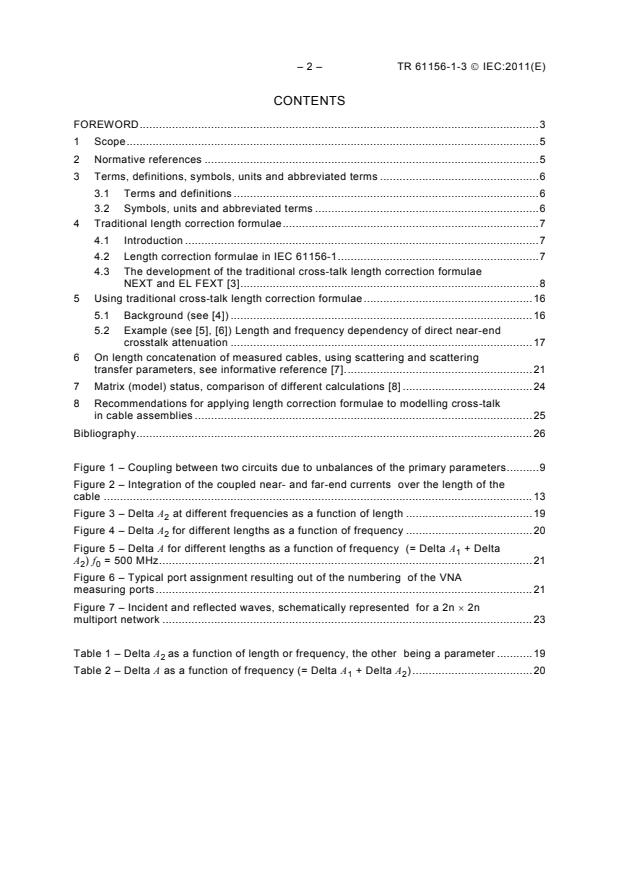
CONTENTS
FOREWORD . 3
1 Scope . 5
2 Normative references . 5
3 Terms, definitions, symbols, units and abbreviated terms . 6
3.1 Terms and definitions . 6
3.2 Symbols, units and abbreviated terms . 6
4 Traditional length correction formulae . 7
4.1 Introduction . 7
4.2 Length correction formulae in IEC 61156-1 . 7
4.3 The development of the traditional cross-talk length correction formulae
NEXT and EL FEXT [3] . 8
5 Using traditional cross-talk length correction formulae . 16
5.1 Background (see [4]) . 16
5.2 Example (see [5], [6]) Length and frequency dependency of direct near-end
crosstalk attenuation . 17
6 On length concatenation of measured cables, using scattering and scattering
transfer parameters, see informative reference [7]. . 21
7 Matrix (model) status, comparison of different calculations [8] . 24
8 Recommendations for applying length correction formulae to modelling cross-talk
in cable assemblies . 25
Bibliography . 26
Figure 1 – Coupling between two circuits due to unbalances of the primary parameters . 9
Figure 2 – Integration of the coupled near- and far-end currents over the length of the
cable . 13
Figure 3 – Delta A at different frequencies as a function of length . 19
Figure 4 – Delta A for different lengths as a function of frequency . 20
Figure 5 – Delta A for different lengths as a function of frequency (= Delta A + Delta
A ) f = 500 MHz . 21
2 0
Figure 6 – Typical port assignment resulting out of the numbering of the VNA
measuring ports . 21
Figure 7 – Incident and reflected waves, schematically represented for a 2n × 2n
multiport network . 23
Table 1 – Delta A as a function of length or frequency, the other being a parameter . 19
Table 2 – Delta A as a function of frequency (= Delta A + Delta A ) . 20
1 2
TR 61156-1-3 IEC:2011(E) – 3 –
INTERNATIONAL ELECTROTECHNICAL COMMISSION
____________
MULTICORE AND SYMMETRICAL PAIR/QUAD
CABLES FOR DIGITAL COMMUNICATIONS –
Part 1-3: Electrical transmission parameters for modelling cable
assemblies using symmetrical pair/quad cables
FOREWORD
1) The International Electrotechnical Commission (IEC) is a worldwide organization for standardization comprising
all national electrotechnical committees (IEC National Committees). The object of IEC is to promote
international co-operation on all questions concerning standardization in the electrical and electronic fields. To
this end and in addition to other activities, IEC publishes International Standards, Technical Specifications,
Technical Reports, Publicly Available Specifications (PAS) and Guides (hereafter referred to as “IEC
Publication(s)”). Their preparation is entrusted to technical committees; any IEC National Committee interested
in the subject dealt with may participate in this preparatory work. International, governmental and non-
governmental organizations liaising with the IEC also participate in this preparation. IEC collaborates closely
with the International Organization for Standardization (ISO) in accordance with conditions determined by
agreement between the two organizations.
2) The formal decisions or agreements of IEC on technical matters express, as nearly as possible, an international
consensus of opinion on the relevant subjects since each technical committee has representation from all
interested IEC National Committees.
3) IEC Publications have the form of recommendations for international use and are accepted by IEC National
Committees in that sense. While all reasonable efforts are made to ensure that the technical content of IEC
Publications is accurate, IEC cannot be held responsible for the way in which they are used or for any
misinterpretation by any end user.
4) In order to promote international uniformity, IEC National Committees undertake to apply IEC Publications
transparently to the maximum extent possible in their national and regional publications. Any divergence
between any IEC Publication and the corresponding national or regional publication shall be clearly indicated in
the latter.
5) IEC itself does not provide any attestation of conformity. Independent certification bodies provide conformity
assessment services and, in some areas, access to IEC marks of conformity. IEC is not responsible for any
services carried out by independent certification bodies.
6) All users should ensure that they have the latest edition of this publication.
7) No liability shall attach to IEC or its directors, employees, servants or agents including individual experts and
members of its technical committees and IEC National Committees for any personal injury, property damage or
other damage of any nature whatsoever, whether direct or indirect, or for costs (including legal fees) and
expenses arising out of the publication, use of, or reliance upon, this IEC Publication or any other IEC
Publications.
8) Attention is drawn to the Normative references cited in this publication. Use of the referenced publications is
indispensable for the correct application of this publication.
9) Attention is drawn to the possibility that some of the elements of this IEC Publication may be the subject of
patent rights. IEC shall not be held responsible for identifying any or all such patent rights.
The main task of IEC technical committees is to prepare International Standards. However, a
technical committee may propose the publication of a technical report when it has collected
data of a different kind from that which is normally published as an International Standard, for
example "state of the art".
IEC/TR 61156-1-3, which is a technical report, has been prepared by subcommittee 46C:
Wires and symmetric cables, of IEC technical committee 46: Cables, wires, waveguides, R.F.
connectors, R.F. and microwave passive components and accessories.
– 4 – TR 61156-1-3 IEC:2011(E)
The text of this technical report is based on the following documents:
Enquiry draft Report on voting
46C/924/DTR 46C/932/RVC
Full information on the voting for the approval of this technical report can be found in the
report on voting indicated in the above table.
This publication has been drafted in accordance with the ISO/IEC Directives, Part 2.
A list of all the parts in the IEC 61156 series, published under the general title Multicore and
symmetrical pair/quad cables for digital communications, can be found on the IEC website.
The committee has decided that the contents of this publication will remain unchanged until
the stability date indicated on the IEC web site under "http://webstore.iec.ch" in the data
related to the specific publication. At this date, the publication will be
• reconfirmed,
• withdrawn,
• replaced by a revised edition, or
• amended.
A bilingual version of this publication may be issued at a later date.
IMPORTANT – The 'colour inside' logo on the cover page of this publication indicates
that it contains colours which are considered to be useful for the correct
understanding of its contents. Users should therefore print this document using a
colour printer.
TR 61156-1-3 IEC:2011(E) – 5 –
MULTICORE AND SYMMETRICAL PAIR/QUAD
CABLES FOR DIGITAL COMMUNICATIONS –
Part 1-3: Electrical transmission parameters for modelling cable
assemblies using symmetrical pair/quad cables
1 Scope
This technical report is a supplement to IEC 61156-1 Edition 3 (2007): Multicore and
symmetrical pair/quad cables for digital communications – Part 1: Generic specification.
This technical report covers the following topics following this standard:
– the near-end crosstalk test methods and length correction procedures of 6.3.5;
– the far-end crosstalk test methods and length correction procedures of 6.3.6;
– the concatenation of measured cable segments, even if they are of different design.
The final objective of this technical report is to describe the mathematics involved to model
the concatenation of cable sections of different length, not based upon measurements but
based upon the specification limits of the cables involved. This is required as a base
foundation of the complete channel modelling, involving also the connectivity covered by IEC
SC48B towards channels, as required and requested by ISO/IEC JTC1/SC25 WG3 for
incorporation into ISO/IEC 11801:2002 [1] .
This TR is informative and contains observations and recommendations applicable to using
the length correction formulas for either measurements or modelling of balanced cables.
2 Normative references
The following referenced documents are indispensable for the application of this document.
For dated references, only the edition cited applies. For undated references, the latest edition
of the referenced document (including any amendments) applies.
IEC 60050-726, International Electrotechnical Vocabulary – Part 726: Transmission lines and
waveguides
IEC 61156-1:2007, Multicore and symmetrical pair/quad cables for digital communications –
Part 1: Generic specification
IEC/TR 61156-1-2, Multicore and symmetrical pair/quad cables for digital communications –
Part 1-2: Electrical transmission characteristics and test methods of symmetrical pair/quad
cables
IEC 61156-5, Multicore and symmetrical pair/quad cables for digital communications – Part 5:
Symmetrical pair/quad cables with transmission characteristics up to 1 000 MHz – Horizontal
floor wiring – Sectional specification
___________
The figures in square brackets refer to the Bibliography.
– 6 – TR 61156-1-3 IEC:2011(E)
IEC 61156-6, Multicore and symmetrical pair/quad cables for digital communications – Part 6:
Symmetrical pair/quad cables with transmission characteristics up to 1 000 MHz – Work area
wiring – Sectional specification
IEC/TR 62152, Transmission properties of cascaded two-ports or quadripols – Background of
terms and definitions
3 Terms, definitions, symbols, units and abbreviated terms
3.1 Terms and definitions
For the purposes of this document, the terms and definitions given in IEC 60050-726,
IEC/TR 61156-1-2, and IEC/TR 62152 apply.
3.2 Symbols, units and abbreviated terms
For the purposes of this document, the following symbols, units and abbreviated terms apply.
Transmission line equation electrical symbols and related terms and symbols:
R pair resistance (Ω/m)
L pair inductance (H/m)
G pair conductance (S/m)
C pair capacitance (F/m)
α attenuation coefficient (Np/m, or dB as indicated)
β phase coefficient (rad/m)
γ propagation coefficient (Np/m, rad/m)
x length coordinate (m)
Z
complex characteristic impedance, or mean characteristic impedance if the pair
o
is homogeneous or free of structure (also used to represent a function fitted
result) (Ω)
l length, variable (m)
M length, reference, disturbing (m)
Λ length, reference, disturbed (m)
j imaginary denominator
ω radian frequency (rad/s)
f frequency (Hz)
I current, coupled
I current in the differential-mode circuit (I)
diff
I current in the common-mode circuit (I)
com
U voltage in the differential-mode circuit (V)
diff
U voltage in the common-mode circuit (V)
com
index to designate the pair 1 and pair 2, respectively
1, 2
index to designate the near end and far end, respectively
N, F
TU transverse unbalance
LU longitudinal unbalance
K coupling coefficient
near end cross-talk coupling coefficient
K
N
far end cross-talk coupling coefficient
K
F
TR 61156-1-3 IEC:2011(E) – 7 –
k , k , k attenuation coefficients for the twisted pair
1 2 3
FEXT far-end crosstalk loss (dB)
NEXT near-end crosstalk loss (dB)
EL FEXT equal-level far-end crosstalk loss (dB)
ACR-F attenuation-to-crosstalk-ratio far-end loss (dB)
∆ length correction coefficient
S
S parameter matrix
S
S parameter
T
T parameter matrix
T
T parameter
index to designate the incident port and reflected port, of multiport parameter
ab
4 Traditional length correction formulae
4.1 Introduction
The traditional length correction formulae were intended for measurements on long
manufactured lengths to be corrected to the specified nominal length; i.e. for cables
complying to IEC 61156-5 and IEC 61156-6, as outlined in IEC 61156-1. Therein the length
corrections apply to measurements made on longer lengths than 100 m, to be corrected to the
100 m specification. Moreover, these formulae were normally used in the cable industry for
quality assurance purposes.
The formulae are intended for measurements of crosstalk within cables with length
uncorrelated crosstalk coupling characteristics. Thus they do not readily adapt to the limit
lines for crosstalk loss, which are the upper-bounds for the characteristic length correlated
crosstalk coupling, i.e. a homogeneous coupling along a cable that is at the limit line at every
frequency, at the specified length.
4.2 Length correction formulae in IEC 61156-1
The formulae are
FEXT = FEXT − 10⋅log −α +α (1)
M 10 M
M
and
4α
−
1− 10
NEXT = NEXT − 10⋅log (2)
M 10
4α
M
−
20
1− 10
where
ℓ is the actual cable conversion length;
M is the reference cable specification length;
α is the attenuation for the indexed length in dB.
Normally, we measure FEXT and derive from it, using the corresponding attenuation, either
the EL FEXT or more pertinent to data grade cables the ACR-F.
– 8 – TR 61156-1-3 IEC:2011(E)
For these last two values, we have then the following length corrections:
EL FEXT = EL FEXT − 10⋅ log (3)
M 10
M
and
ACR− F = ACR− F − 10⋅log (4)
Λ 10
Λ
Here a distinction between the length M and Λ is made to indicate the difference between
disturbing and disturbed pair attenuation, respectively.
The measurement magnitude values or the complex values of the actual cable may be used to
compute the crosstalk parameter when applying the traditional length correction formula,
though these formulae refer only to magnitude values.
4.3 The development of the traditional cross-talk length correction formulae NEXT
and EL FEXT [3]
First only in-put to out-put and the out-put to out-put cross-talk coupling are considered.
These correspond to the near-end cross-talk and the equal level far-end cross-talk. These are
called in the cable industry generally NEXT (IO–NEXT though this denomination is in the
present case irrelevant) and EL FEXT (or OO–FEXT). These two terms are treated first,
before going over to the in-put to out-put FEXT (IO–FEXT).
NOTE It should be noted that the following derivation was first published by the members of the technical staff of
the Bell telephone laboratories [6].
If we consider the coupling between two infinitesimal short circuits, we have to take first the
unbalances of the primary parameters of both circuits 1 and 2 into account. This inherently
implies the assumption that the primary parameters as prime responsible factor for the
crosstalk coupling are statistically distributed over the length of the cable.
TR 61156-1-3 IEC:2011(E) – 9 –
Z R /2 L /2
o
1 1
I (x)
o
L /2 R /2
1 1
L /2 R /2
2 2
I (x)
L
dI (x) I (x)
N C dI (x)
F
R /2 L /2
2 2
dx
IEC 631/11
Key
I (x) current induced at the length x due to capacitive coupling
C
I (x) current going into the infinitesimal length of the line dx at the length x
o
I (x) current induced at the length x due to inductive coupling
L
dI (x) current increment flowing through the near end termination of the infinitesimal length
N
element
dI (x) current increment flowing through the far end termination of the infinitesimal length
F
element
Z impedance of the termination of the length element. It is assumed here to be identical
o
for all source and load impedances, and corresponds additionally to the characteristic
impedance of the pairs
Figure 1 – Coupling between two circuits due to unbalances
of the primary parameters
We get then according to Figure 1 for the corresponding crosstalk values of interest between
two infinitesimally short circuits.
As a result of the above, it is implied that the integration direction of the infinitesimal current
or voltage increments is reversed in direction.
Besides the mathematically easier treatment, this has also an historical background. Thus the
telephone linesmen could not determine the IO-FEXT, but they could easily measure the OO-
FEXT on the poles.
For the transverse and the longitudinal unbalances of the primary parameters, we get
following the indications in Figure 1:
TU= ( G + j⋅ω⋅ C )− ( G + j⋅ω⋅ C ) (5)
21 21 12 12
LU= ( R + j⋅ω⋅ L )− ( R + j⋅ω⋅ L ) (6)
2 2 1 1
where
TU is the transverse unbalance between the pairs of the corresponding primary
parameters G and C;
LU is the longitudinal unbalance between the pairs of the corresponding primary
parameters R and L;
Z
o
G /2
C /2
G /2
C /2
C /2
G /2
C /2
G /2
Z Z
o o
– 10 – TR 61156-1-3 IEC:2011(E)
1,2 are indices indicating pair 1 and 2;
G is the conductance unbalance between the pairs;
C is the capacitance unbalance between the pairs;
R is the mutual resistance unbalance of the pairs;
L is the mutual inductance unbalance of the pairs;
j is the complex operator;
ω is the circular frequency.
We neglect the conductance unbalance between the pairs which we can – at least for modern
data grade cables – assume to be zero. This is the result of the use of insulating materials
with a very low tanδ, like PE or FEP. In fact, the resulting conductance unbalance is generally
so small that it would be extremely hard to determine it at all.
We then get
G = G ≈ 0 (7)
12 21
TU= j⋅ω⋅ C − j⋅ω⋅ C = j⋅ω⋅(C − C ) (8)
21 12 21 12
LU= ( R − R )+ j⋅ω⋅( L − L ) (9)
2 1 2 1
We can furthermore assume that both infinitesimal elements of Figure 1 are on each side
terminated in Z , which is also the characteristic impedance of the pairs considered. In other
o
words, we consider only the case of perfectly matched pairs. The impedance of the
capacitance unbalances is as a result much higher than the characteristic impedance, such
that we may neglect the latter one to calculate the current going through each termination. In
this case – due to the fact of matched impedances – we have then for the infinitesimal
element the transverse and the longitudinal unbalances of the primary parameters of the pairs
considered:
We then get
C − C Z ⋅ I (x)
12 21 o o
(10)
2⋅ I (x)=− j⋅ω⋅ ⋅
C
2 2
and
R − R L − L
2 1 1 2
I (x)=− − j⋅ω⋅ (11)
L
2⋅ Z 2⋅ Z
o o
or with
(12)
C= C − C
12 21
(13)
R= R − R
2 1
(14)
L= L − L
1 2
we get
C⋅ Z ⋅ I (x)
o o
I (x)=− j⋅ω⋅ (15)
C
TR 61156-1-3 IEC:2011(E) – 11 –
and
R L
I (x)=− + j⋅ω⋅ ⋅ I (x) (16)
L o
2⋅ Z 2⋅ Z
o o
In a further step, we can neglect also the longitudinal resistance unbalance between the pairs,
i.e. we assume R ≈ 0. This is
...