

ISO/IEC 14543-3-10:2020
(Main)Information technology - Home electronic system (HES) architecture - Part 3-10: Amplitude modulated wireless short-packet (AMWSP) protocol optimized for energy harvesting - Architecture and lower layer protocols
General Information
- Abstract
ISO/IEC 14543-3-10:2020(E) specifies a wireless protocol for low-powered devices such as energy harvesting devices in a home environment. This wireless protocol is specifically designed to keep the energy consumption of such sensors and switches extremely low. The design is characterized by • keeping the communications very short, infrequent and mostly unidirectional, and • using communication frequencies that provide a good range even at low transmit power and avoid collisions from disturbers. This allows the use of small and low-cost energy harvesting devices that can compete with similar battery-powered devices. The messages sent by energy harvesting devices are received and processed mainly by line-powered devices such as relay switch actuators, repeaters or gateways. Together these form part of a home automation system, which, when conforming to ISO/IEC 14543 (all parts), is defined as a home electronic system. This document specifies OSI Layers 1 to 3 of the amplitude modulated wireless short-packet (AMWSP) protocols. The AMWSP protocol system consists of two and optionally three types of components that are specified in this document. These are the transmitter, the receiver and optionally the repeater. Repeaters are needed when the transmitter and the receiver are located in such a way that no good direct communication between them can be established. Protection against malicious attacks is handled in the upper layers and thus not treated in this document.
- Status
- Published
- Publication Date
- 29-Mar-2020
- Technical Committee
- ISO/IEC JTC 1/SC 25 - Interconnection of information technology equipment
- Drafting Committee
- WG 1 - ISO/IEC JTC 1/SC 25/WG 1
- Current Stage
- PPUB - Publication issued
- Start Date
- 30-Mar-2020
- Completion Date
- 18-Mar-2020
Buy Documents
ISO/IEC 14543-3-10:2020 - Information technology - Home electronic system (HES) architecture - Part 3-10: Amplitude modulated wireless short-packet (AMWSP) protocol optimized for energy harvesting - Architecture and lower layer protocols Released:3/30/2020
Overview
ISO/IEC 14543-3-10:2020 defines the amplitude modulated wireless short-packet (AMWSP) protocol optimized for energy-harvesting devices within a Home Electronic System (HES). Published as part of the ISO/IEC 14543 series, this standard specifies OSI Layers 1–3 (Physical, Data Link and Network layers) for very low‑power, short, infrequent and mostly unidirectional wireless communications that enable battery‑less or ultra‑low‑power sensors and switches to interoperate with line‑powered devices (relays, repeaters, gateways) in home automation environments.
Key technical topics and requirements
- Physical layer (Layer 1): Defines amplitude‑modulated (AM) signalling optimized for energy harvesting, including frame formats for typical frequencies (notably 315 MHz and 868.3 MHz), ASK envelope characteristics and parameters to support long range at low transmit power.
- Data link layer (Layer 2): Specifies short-packet framing, subtelegram timing, listen‑before‑talk behavior and mechanisms for data integrity such as 4‑bit/8‑bit summation hashes and 8‑bit CRC options.
- Network layer (Layer 3): Covers addressing, encapsulation, switch telegrams and optional repeater behavior (including repeater level bits and collision‑avoidance timing) to bridge transmitters and receivers when direct links are impractical.
- Energy‑efficiency design principles: Communications are kept very short and infrequent; modulation and channel choices are selected to reduce collisions and maximize range at minimal transmit power.
- Scope limitations: Security against malicious attacks is explicitly out of scope and handled in upper OSI layers (application/session/presentation).
Practical applications and users
- Applications:
- Energy‑harvesting sensor nodes (mechanical, solar, thermal sources)
- Batteryless wall switches and pushbuttons
- Low‑power environmental sensors for lighting, HVAC, blinds, security and energy management
- Gateways, relay switch actuators and repeaters within smart homes
- Who should use this standard:
- Embedded hardware and RF designers building energy‑harvesting devices
- Firmware and protocol engineers implementing low‑power wireless stacks
- Home automation solution integrators and OEMs seeking interoperability
- Test labs and certification bodies validating HES compliance
Related standards
- ISO/IEC 14543 (all parts) - Home Electronic System (HES) architecture (series overview)
- ISO/IEC 14543-3-11 - FM‑based short‑packet protocol optimized for energy harvesting (alternative modulation)
ISO/IEC 14543-3-10 is essential for anyone designing or deploying ultra‑low‑power, amplitude‑modulated wireless components in interoperable home automation ecosystems, providing the lower‑layer building blocks that enable batteryless and low‑maintenance smart home devices.
Relations
- Effective Date
- 05-Sep-2023
Buy Documents
ISO/IEC 14543-3-10:2020 - Information technology - Home electronic system (HES) architecture - Part 3-10: Amplitude modulated wireless short-packet (AMWSP) protocol optimized for energy harvesting - Architecture and lower layer protocols Released:3/30/2020
Get Certified
Connect with accredited certification bodies for this standard

BSI Group
BSI (British Standards Institution) is the business standards company that helps organizations make excellence a habit.

NYCE
Mexican standards and certification body.
Sponsored listings
Frequently Asked Questions
ISO/IEC 14543-3-10:2020 is a standard published by the International Electrotechnical Commission (IEC). Its full title is "Information technology - Home electronic system (HES) architecture - Part 3-10: Amplitude modulated wireless short-packet (AMWSP) protocol optimized for energy harvesting - Architecture and lower layer protocols". This standard covers: ISO/IEC 14543-3-10:2020(E) specifies a wireless protocol for low-powered devices such as energy harvesting devices in a home environment. This wireless protocol is specifically designed to keep the energy consumption of such sensors and switches extremely low. The design is characterized by • keeping the communications very short, infrequent and mostly unidirectional, and • using communication frequencies that provide a good range even at low transmit power and avoid collisions from disturbers. This allows the use of small and low-cost energy harvesting devices that can compete with similar battery-powered devices. The messages sent by energy harvesting devices are received and processed mainly by line-powered devices such as relay switch actuators, repeaters or gateways. Together these form part of a home automation system, which, when conforming to ISO/IEC 14543 (all parts), is defined as a home electronic system. This document specifies OSI Layers 1 to 3 of the amplitude modulated wireless short-packet (AMWSP) protocols. The AMWSP protocol system consists of two and optionally three types of components that are specified in this document. These are the transmitter, the receiver and optionally the repeater. Repeaters are needed when the transmitter and the receiver are located in such a way that no good direct communication between them can be established. Protection against malicious attacks is handled in the upper layers and thus not treated in this document.
ISO/IEC 14543-3-10:2020(E) specifies a wireless protocol for low-powered devices such as energy harvesting devices in a home environment. This wireless protocol is specifically designed to keep the energy consumption of such sensors and switches extremely low. The design is characterized by • keeping the communications very short, infrequent and mostly unidirectional, and • using communication frequencies that provide a good range even at low transmit power and avoid collisions from disturbers. This allows the use of small and low-cost energy harvesting devices that can compete with similar battery-powered devices. The messages sent by energy harvesting devices are received and processed mainly by line-powered devices such as relay switch actuators, repeaters or gateways. Together these form part of a home automation system, which, when conforming to ISO/IEC 14543 (all parts), is defined as a home electronic system. This document specifies OSI Layers 1 to 3 of the amplitude modulated wireless short-packet (AMWSP) protocols. The AMWSP protocol system consists of two and optionally three types of components that are specified in this document. These are the transmitter, the receiver and optionally the repeater. Repeaters are needed when the transmitter and the receiver are located in such a way that no good direct communication between them can be established. Protection against malicious attacks is handled in the upper layers and thus not treated in this document.
ISO/IEC 14543-3-10:2020 is classified under the following ICS (International Classification for Standards) categories: 35.240.67 - IT applications in building and construction industry. The ICS classification helps identify the subject area and facilitates finding related standards.
ISO/IEC 14543-3-10:2020 has the following relationships with other standards: It is inter standard links to ISO/IEC 14543-3-10:2012. Understanding these relationships helps ensure you are using the most current and applicable version of the standard.
ISO/IEC 14543-3-10:2020 is available in PDF format for immediate download after purchase. The document can be added to your cart and obtained through the secure checkout process. Digital delivery ensures instant access to the complete standard document.
Standards Content (Sample)
ISO/IEC 14543-3-10
Edition 2.0 2020-03
INTERNATIONAL
STANDARD
colour
inside
Information technology – Home electronic system (HES) architecture –
Part 3-10: Amplitude modulated wireless short-packet (AMWSP) protocol
optimized for energy harvesting – Architecture and lower layer protocols
All rights reserved. Unless otherwise specified, no part of this publication may be reproduced or utilized in any form
or by any means, electronic or mechanical, including photocopying and microfilm, without permission in writing from
either IEC or IEC's member National Committee in the country of the requester. If you have any questions about
ISO/IEC copyright or have an enquiry about obtaining additional rights to this publication, please contact the address
below or your local IEC member National Committee for further information.
IEC Central Office Tel.: +41 22 919 02 11
3, rue de Varembé info@iec.ch
CH-1211 Geneva 20 www.iec.ch
Switzerland
About the IEC
The International Electrotechnical Commission (IEC) is the leading global organization that prepares and publishes
International Standards for all electrical, electronic and related technologies.
About IEC publications
The technical content of IEC publications is kept under constant review by the IEC. Please make sure that you have the
latest edition, a corrigendum or an amendment might have been published.
IEC publications search - webstore.iec.ch/advsearchform Electropedia - www.electropedia.org
The advanced search enables to find IEC publications by a The world's leading online dictionary on electrotechnology,
variety of criteria (reference number, text, technical containing more than 22 000 terminological entries in English
committee,…). It also gives information on projects, replaced and French, with equivalent terms in 16 additional languages.
and withdrawn publications. Also known as the International Electrotechnical Vocabulary
(IEV) online.
IEC Just Published - webstore.iec.ch/justpublished
Stay up to date on all new IEC publications. Just Published IEC Glossary - std.iec.ch/glossary
details all new publications released. Available online and 67 000 electrotechnical terminology entries in English and
once a month by email. French extracted from the Terms and Definitions clause of
IEC publications issued since 2002. Some entries have been
IEC Customer Service Centre - webstore.iec.ch/csc collected from earlier publications of IEC TC 37, 77, 86 and
If you wish to give us your feedback on this publication or CISPR.
need further assistance, please contact the Customer Service
Centre: sales@iec.ch.
ISO/IEC 14543-3-10
Edition 2.0 2020-03
INTERNATIONAL
STANDARD
Information technology – Home electronic system (HES) architecture –
Part 3-10: Amplitude modulated wireless short-packet (AMWSP) protocol
optimized for energy harvesting – Architecture and lower layer protocols
INTERNATIONAL
ELECTROTECHNICAL
COMMISSION
ICS 35.240.67 ISBN 978-2-8322-7979-3
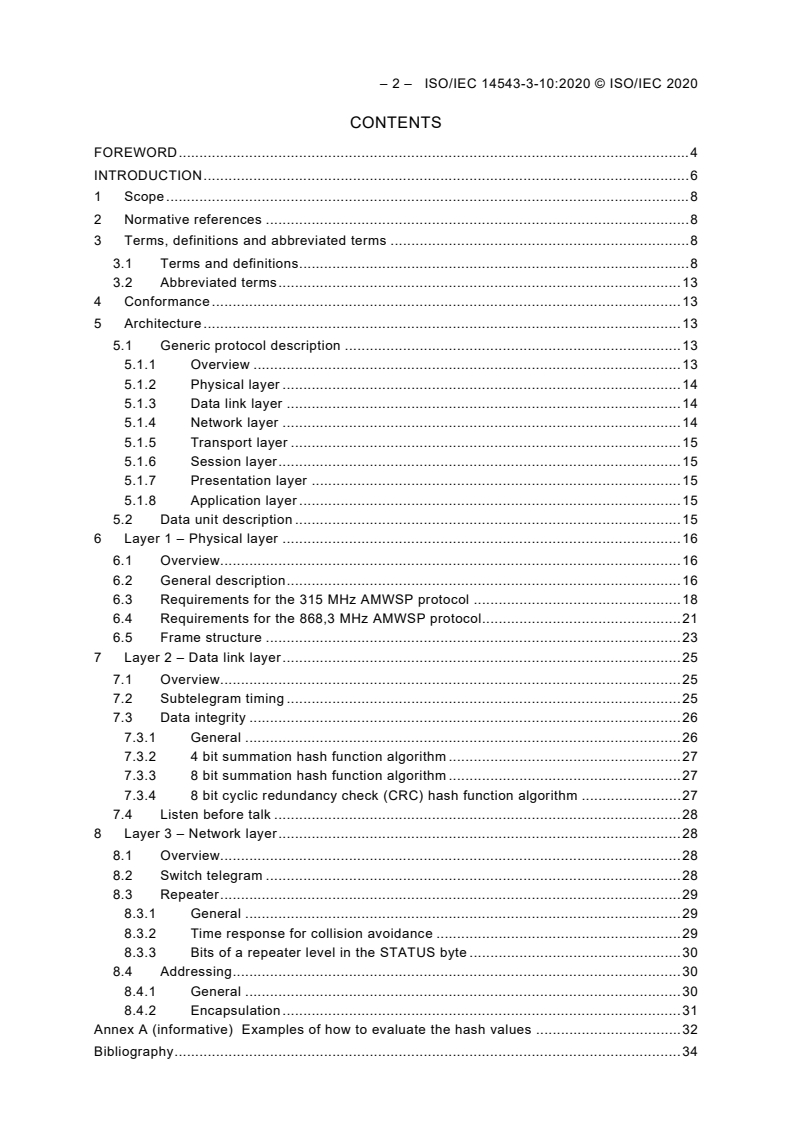
– 2 – ISO/IEC 14543-3-10:2020 © ISO/IEC 2020
CONTENTS
FOREWORD . 4
INTRODUCTION . 6
1 Scope . 8
2 Normative references . 8
3 Terms, definitions and abbreviated terms . 8
3.1 Terms and definitions . 8
3.2 Abbreviated terms . 13
4 Conformance . 13
5 Architecture . 13
5.1 Generic protocol description . 13
5.1.1 Overview . 13
5.1.2 Physical layer . 14
5.1.3 Data link layer . 14
5.1.4 Network layer . 14
5.1.5 Transport layer . 15
5.1.6 Session layer . 15
5.1.7 Presentation layer . 15
5.1.8 Application layer . 15
5.2 Data unit description . 15
6 Layer 1 – Physical layer . 16
6.1 Overview. 16
6.2 General description . 16
6.3 Requirements for the 315 MHz AMWSP protocol . 18
6.4 Requirements for the 868,3 MHz AMWSP protocol. 21
6.5 Frame structure . 23
7 Layer 2 – Data link layer . 25
7.1 Overview. 25
7.2 Subtelegram timing . 25
7.3 Data integrity . 26
7.3.1 General . 26
7.3.2 4 bit summation hash function algorithm . 27
7.3.3 8 bit summation hash function algorithm . 27
7.3.4 8 bit cyclic redundancy check (CRC) hash function algorithm . 27
7.4 Listen before talk . 28
8 Layer 3 – Network layer . 28
8.1 Overview. 28
8.2 Switch telegram . 28
8.3 Repeater . 29
8.3.1 General . 29
8.3.2 Time response for collision avoidance . 29
8.3.3 Bits of a repeater level in the STATUS byte . 30
8.4 Addressing . 30
8.4.1 General . 30
8.4.2 Encapsulation . 31
Annex A (informative) Examples of how to evaluate the hash values . 32
Bibliography . 34
Figure 1 – Structure of a subtelegram . 15
Figure 2 – Illustration of an ASK envelope and various physical parameters . 17
Figure 3 – Complete frame structure for the 868,3 MHz AMWSP protocol . 23
Figure 4 – Encoded subframe . 24
Figure 5 – TX maturity time divided into four 10 ms time ranges . 25
Figure 6 – Conversion of a switch telegram to a normal telegram. 29
Figure 7 – Example of an encapsulation . 31
Figure A.1 – Example of a C code program of the 4 bit long summation hash value . 32
Figure A.2 – Example of a C code program of the 8 bit long summation hash value . 32
Figure A.3 – Efficient C code program for the evaluation of an 8 bit long CRC type
hash value . 33
Table 1 – AMWSP protocol stack structure (OSI) . 14
Table 2 – Transmitter requirements for the 315 MHz AMWSP protocol . 19
Table 3 – Receiver requirements for the 315 MHz AMWSP protocol . 20
Table 4 – Minimum required link budget for the 315 MHz AMWSP protocol . 20
Table 5 – Maximum RX power for the 315 MHz AMWSP protocol . 21
Table 6 – Transmitter requirements for the 868,3 MHz AMWSP protocol. 21
Table 7 – Receiver requirements for the 868,3 MHz AMWSP protocol . 22
Table 8 – Minimum required link budget for the 868,3 MHz AMWSP protocol . 22
Table 9 – Maximum RX power for the 868,3 MHz AMWSP protocol . 23
Table 10 – Frame definition for the 315 MHz AMWSP protocol . 24
Table 11 – Frame definition for the 868,3 MHz AMWSP protocol . 24
Table 12 – Maturity time parameters . 25
Table 13 – Allocation of time slots to the different subtelegrams . 26
Table 14 – Identification of the hash function used in the telegram . 27
Table 15 – Conversion of the telegram type and STATUS fields from a switch telegram
to a telegram . 29
Table 16 – STATUS byte with repeater level bits . 30
Table 17 – Repeating bits in STATUS byte . 30
– 4 – ISO/IEC 14543-3-10:2020 © ISO/IEC 2020
INFORMATION TECHNOLOGY –
HOME ELECTRONIC SYSTEM (HES) ARCHITECTURE –
Part 3-10: Amplitude modulated wireless short-packet (AMWSP)
protocol optimized for energy harvesting –
Architecture and lower layer protocols
FOREWORD
1) ISO (International Organization for Standardization) and IEC (International Electrotechnical Commission) form the
specialized system for worldwide standardization. National bodies that are members of ISO or IEC participate in
the development of International Standards. Their preparation is entrusted to technical committees; any ISO and
IEC member body interested in the subject dealt with may participate in this preparatory work. International
governmental and non-governmental organizations liaising with ISO and IEC also participate in this preparation.
2) In the field of information technology, ISO and IEC have established a joint technical committee, ISO/IEC JTC 1.
Draft International Standards adopted by the joint technical committee are circulated to national bodies for voting.
Publication as an International Standard requires approval by at least 75 % of the national bodies casting a vote.
3) The formal decisions or agreements of IEC and ISO on technical matters express, as nearly as possible, an
international consensus of opinion on the relevant subjects since each technical committee has representation
from all interested IEC and ISO member bodies.
4) IEC, ISO and ISO/IEC publications have the form of recommendations for international use and are accepted
by IEC and ISO member bodies in that sense. While all reasonable efforts are made to ensure that the
technical content of IEC, ISO and ISO/IEC publications is accurate, IEC or ISO cannot be held responsible for
the way in which they are used or for any misinterpretation by any end user.
5) In order to promote international uniformity, IEC and ISO member bodies undertake to apply IEC, ISO and
ISO/IEC publications transparently to the maximum extent possible in their national and regional publications.
Any divergence between any ISO/IEC publication and the corresponding national or regional publication
should be clearly indicated in the latter.
6) ISO and IEC provide no marking procedure to indicate their approval and cannot be rendered responsible for
any equipment declared to be in conformity with an ISO/IEC publication.
7) All users should ensure that they have the latest edition of this publication.
8) No liability shall attach to IEC or ISO or its directors, employees, servants or agents including individual experts
and members of their technical committees and IEC or ISO member bodies for any personal injury, property
damage or other damage of any nature whatsoever, whether direct or indirect, or for costs (including legal fees)
and expenses arising out of the publication of, use of, or reliance upon, this ISO/IEC publication or any other IEC,
ISO or ISO/IEC publications.
9) Attention is drawn to the normative references cited in this publication. Use of the referenced publications is
indispensable for the correct application of this publication.
10) Attention is drawn to the possibility that some of the elements of this International Standard may be the subject of
patent rights. ISO and IEC shall not be held responsible for identifying any or all such patent rights.
International Standard ISO/IEC 14543-3-10 was prepared by subcommittee 25:
Interconnection of information technology equipment, of ISO/IEC joint technical committee 1:
Information technology.
The list of all currently available parts of the ISO/IEC 14543 series, under the general title
Information technology – Home electronic system (HES) architecture, can be found on the
IEC and ISO websites.
This second edition cancels and replaces the first edition published in 2012. This edition
constitutes a technical revision.
The text of this standard is based on the following documents:
CDV Report on voting
JTC1-SC25/2842/CDV JTC1-SC25/2864/RVC
Full information on the voting for the approval of this standard can be found in the report on
voting indicated in the above table.
This publication has been drafted in accordance with the ISO/IEC Directives, Part 2.
IMPORTANT – The 'colour inside' logo on the cover page of this publication indicates
that it contains colours which are considered to be useful for the correct
understanding of its contents. Users should therefore print this document using a
colour printer.
– 6 – ISO/IEC 14543-3-10:2020 © ISO/IEC 2020
INTRODUCTION
Various electrically controlled sensors and switches are used in homes and similar
environments for many different applications. Examples of such applications are lighting,
heating, energy management, blinds control, different forms of security control and
entertainment (audio and video).
In most cases the device, e.g. a switch initiating an action, and the device, e.g. a lamp, are
installed at different places. The distance can be bridged by wires, infrared or radio
transmission. Presently equipment at both ends of a wireless transmission link needs to be
powered by line or battery.
While wireless transmissions are especially attractive to retrofit homes, power maintenance of
battery-driven devices is a burden. In addition, these batteries require scarce materials. Since
the command and control messages sent by control and sensor devices in homes are very
short, they can be powered using new techniques for energy harvesting, provided they use a
wireless protocol that operates on relatively low power. Energy available in the environment of
a device is captured and stored (harvested) to power operation of the device. Examples of
energy sources are mechanical actuation, solar radiation, temperature differences, etc. If this
is executed, at least one device in the link neither needs a battery nor a wire. Energy
harvesting devices need very limited power and use an energy efficient radio protocol to send
data to other conventionally powered devices in the home. In order to ensure interoperability
of such devices from different sources within a home, an International Standard for a protocol
is required that uses the little power that energy harvesting devices can provide and at the
same time spans distances to be bridged within a home environment.
Several such devices used within a home often come from different sources. They are
required to interwork with each other using a common internal network (in this document
called a home network) and supporting a home automation system. When a home automation
system meets ISO/IEC HES Standards, it is called a home electronic system (HES).
Alternative transmission technologies are specified by ISO/IEC 14543 (all parts).
ISO/IEC 14543-3-10 and ISO/IEC 14543-3-11 are optimized for energy harvesting based on
similar techniques, but with different modulation schemes. ISO/IEC 14543-3-10 and
ISO/IEC 14543-3-11 specify two lower layer wireless short-packet protocols:
ISO/IEC 14543-3-10 uses an amplitude modulated (AM) signal and ISO/IEC 14543-3-11 a
frequency modulated (FM) signal.
Amplitude modulated wireless communications are more energy efficient but less adapted to
mobile devices. This is because the impedance of a mobile antenna is affected by the
environment of the mobile device, for example, when the device is held in the hand or moved
to metal surface. Changes in impedance affect the amplitude linearity of the radio frequency
output amplifier, but have no impact on the frequency itself. Thus an AM wireless system is
more sensitive to changes in environment than an FM wireless system. Also frequencies
above 800 MHz are better suited for mobile devices, since they require smaller antennas.
Thus the frequency 315 MHz is not used in the FM specification, which makes the FM
wireless system more efficient for mobile devices.
Compared to the AM wireless system, the FM wireless system provides more flexibility in the
size of various pieces of information that can be transmitted. This includes the possibility to
have larger payloads, different lengths of the identifiers of originators and destinations, and
greater variability of structures and lengths of the telegram types. The number of steps a
telegram can be repeated is two for the AM wireless system and 15 for the FM wireless
system.
They are both efficient enough to
• support energy harvesting products for sensors and switches that require neither cabling
nor batteries, and
• extend the life of battery-operated devices.
Both an AM and an FM system can be active at the same time, since each system is so
constructed that only permitted messages are accepted. Collisions can be avoided by listen-
before-talk (LBT) technology or overcome by redundant transmissions.
– 8 – ISO/IEC 14543-3-10:2020 © ISO/IEC 2020
INFORMATION TECHNOLOGY –
HOME ELECTRONIC SYSTEM (HES) ARCHITECTURE –
Part 3-10: Amplitude modulated wireless short-packet (AMWSP)
protocol optimized for energy harvesting –
Architecture and lower layer protocols
1 Scope
This part of ISO/IEC 14543 specifies a wireless protocol for low-powered devices such as
energy harvesting devices in a home environment. This wireless protocol is specifically
designed to keep the energy consumption of such sensors and switches extremely low.
The design is characterized by
• keeping the communications very short, infrequent and mostly unidirectional, and
• using communication frequencies that provide a good range even at low transmit power
and avoid collisions from disturbers.
This allows the use of small and low-cost energy harvesting devices that can compete with
similar battery-powered devices. The messages sent by energy harvesting devices are
received and processed mainly by line-powered devices such as relay switch actuators,
repeaters or gateways. Together these form part of a home automation system, which, when
conforming to ISO/IEC 14543 (all parts), is defined as a home electronic system.
This document specifies OSI Layers 1 to 3 of the amplitude modulated wireless short-packet
(AMWSP) protocols.
The AMWSP protocol system consists of two and optionally three types of components that
are specified in this document. These are the transmitter, the receiver and optionally the
repeater. Repeaters are needed when the transmitter and the receiver are located in such a
way that no good direct communication between them can be established.
Protection against malicious attacks is handled in the upper layers and thus not treated in this
document.
2 Normative references
The following documents, in whole or in part, are normatively referenced in this document and
are indispensable for its application. For dated references, only the edition cited applies. For
undated references, the latest edition of the referenced document (including any
amendments) applies.
ETSI EN 300 220-1 V3.1.1, Short Range Devices (SRD) operating in the frequency range
25 MHz to 1 000 MHz; Part 1: Technical characteristics and methods of measurement
3 Terms, definitions and abbreviated terms
3.1 Terms and definitions
For the purposes of this document the following terms and definitions apply.
ISO and IEC maintain terminological databases for use in standardization at the following
addresses:
• IEC Electropedia: available at http://www.electropedia.org/
• ISO Online browsing platform: available at http://www.iso.org/obp
3.1.1
amplitude shift keying envelope
ASK envelope
envelope of the modulated signal
3.1.2
bit duration
time between transitions of the mesial amplitude of an ASK envelope in an alternating
sequence
Note 1 to entry Figure 2 shows this in detail.
3.1.3
bit duration error
deviation of bit duration from specified bit duration
3.1.4
byte
ordered set of eight binary digits, operated on as an entity
Note 1 to entry: The non-qualified term "byte" designates an 8-bit byte.
[SOURCE: IEC 60050-702:2016, 702-05-09]
3.1.5
collision
state which exists when two wireless transmitters use the same wireless channel and transmit
data at the same time
3.1.6
cyclic redundancy check
CRC
integrity hash algorithm based on a polynomial division
3.1.7
DATA
application payload data transmitted in the telegram
3.1.8
energy harvesting device
device able to capture and store (harvest) energy from the environment to power its
operations
Note 1 to entry Examples of energy sources are mechanical actuation, solar radiation, temperature differences,
etc.
3.1.9
frame
set of data to be transmitted as a complete unit on the physical layer
Note 1 to entry A frame contains the necessary protocol control and synchronization data for transmission
between network nodes.
– 10 – ISO/IEC 14543-3-10:2020 © ISO/IEC 2020
3.1.10
HASH
field in which the hash value for the data integrity control of each transmitted telegram and
subtelegram is specified
3.1.11
high nibble
upper four bits of the byte
Note 1 to entry The N value from the byte 0xNM.
3.1.12
high state amplitude
amplitude corresponding to the physical high state level
3.1.13
high state level
level of the ASK envelope that represents the high state amplitude
Note 1 to entry The definition aligns with IEEE 194-1977, 5.2.2.5, static levels. Figure 2 gives an illustration.
3.1.14
identity of the destination device
DESTID
unique identity of the destination device of an AMWSP telegram consisting of four bytes
3.1.15
identity of the transmitting device
TXID
unique identity of the AMWSP protocol transmitting device consisting of four bytes
3.1.16
inverse bits
INV
bits added by the encoding procedure into a subframe behind the third and the sixth bit to
reduce the DC content of the data
3.1.17
listen before talk
LBT
technique of checking the occupancy of the wireless channel before transmitting any frames
3.1.18
low nibble
lower four bits of the byte
Note 1 to entry The M value from the byte 0xNM.
3.1.19
low state amplitude
amplitude corresponding to the physical low state level
3.1.20
low state level
level of the ASK envelope that represents the low state amplitude
Note 1 to entry The definition aligns with IEEE 194-1977, 5.2.2.5, static levels. Figure 2 gives an illustration.
3.1.21
mesial power level
median between high state level and low state level of an ASK envelope
Note 1 to entry Figure 2 gives an illustration.
3.1.22
negative overshoot
difference between minimum peak level and low state level of an ASK envelope after a
transition from a high state to a low state has occurred
Note 1 to entry Figure 2 gives an illustration.
3.1.23
negative undershoot
difference between maximum peak level and low state level of an ASK envelope after a
transition from a high state to a low state has occurred
Note 1 to entry Figure 2 gives an illustration.
3.1.24
nibble
four-bit aggregation or half a byte
3.1.25
positive overshoot
difference between maximum peak level and high state level of ASK envelope after a
transition from a low state to a high state has occurred
Note 1 to entry Figure 2 gives an illustration.
3.1.26
positive undershoot
difference between minimum peak level and high state level of ASK envelope after a transition
from a low state to a high state has occurred
Note 1 to entry Figure 2 gives an illustration.
3.1.27
receiving device maturity time
RX maturity time
maximum time, determined at the receiving device, between the end of the first subtelegram
and the end of the last subtelegram belonging to the same telegram
3.1.28
repeated telegram
telegram transmitted by a repeater
3.1.29
repeater
device that receives telegrams and sends refreshed signals to any AMWSP receiver
3.1.30
subframe
subtelegram byte expanded by protocol control and synchronization information
3.1.31
subtelegram
smallest interpreted data unit containing the fields telegram type (RORG), payload (DATA),
transmitter identity (TXID), STATUS and HASH
– 12 – ISO/IEC 14543-3-10:2020 © ISO/IEC 2020
3.1.32
switch telegram
telegram with fields telegram type (RORG), payload (DATA), transmitter identity (TXID) and
HASH
Note 1 to entry The switch telegram structure differs from the telegram in that the fields of RORG and HASH are
only four bits long and that it does not contain a STATUS field.
3.1.33
synchronization bits
SYNC
bits inserted by an encoding procedure at the end of each subframe (except for the last
subframe) to provide clock resynchronization
Note 1 to entry Synchronization bits also reduce the DC content of transmitted data and can be used to ensure
data reliability and integrity.
3.1.34
telegram
data unit composed of one or more identical subtelegrams
Note 1 to entry A telegram has the same structure and contains the same information as a subtelegram.
3.1.35
telegram type
RORG
field that identifies the type of a telegram in the AMWSP protocol
Note 1 to entry This type of telegram is denoted CHOICE in ISO/IEC 8825-2.
Note 2 to entry There are several types of telegram; however, with the exception of the switch telegram, they are
not defined in this document.
3.1.36
time slot
unit of 1 ms of RX maturity time or TX maturity time
3.1.37
transmitting device lead time
time between activation of transmitting device and the start of the transmission of second
preamble bit
3.1.38
transmitting device maturity time
TX maturity time
maximum time for the transmission of one complete telegram as determined at the sending
device
3.1.39
transmitting device overtravel time
time a signal is still emitted from the transmitter after the last '0' bit of end of frame (EOF) has
been transmitted
3.2 Abbreviated terms
ASK amplitude shift keying
CRC cyclic redundancy check
DC direct current
DESTID destination device identity
EIRP effective isotropic radiated power
ERP effective radiated power
EOF end of frame
INV inverse bits
LBT listen before talk
MSB most significant bit
PRE preamble
RX receiver
RORG telegram type
SOF start of frame
SYNC synchronization bits
TX transmitter
TXID transmitting device identity
AMWSP amplitude modulated wireless short-packet
4 Conformance
The three components of the AMWSP protocol system that are specified in this document are
the transmitter, the receiver and the repeaters. The repeaters shall be able both to transmit
and to receive telegrams and thus shall support both the requirements for the transmitters and
the receivers.
To conform to this document, the components shall support one of the two wireless
frequencies specified unless another frequency is mandated by local regulations. For the
frequency chosen, the transmitter shall support all the transmitter requirements that are not
explicitly listed as optional, and the receiver shall support all the receiver requirements that
are not explicitly listed as optional. These requirements are specified in 5.2 and Clauses 6, 7
and 8.
5 Architecture
5.1 Generic protocol description
5.1.1 Overview
Subclause 5.1.1 provides a comprehensive overview of the amplitude modulated wireless
short-packet (AMWSP) protocol stack (see Table 1). The AMWSP is a lightweight layered
protocol designed to minimize both energy demand and the probability of a transmission
collision. The AMWSP protocol stack accommodates the structure of the OSI reference model
(see ISO/IEC 7498-1).
– 14 – ISO/IEC 14543-3-10:2020 © ISO/IEC 2020
Table 1 – AMWSP protocol stack structure (OSI)
Amplitude modulated wireless short-packet protocol (AMWSP) stack
Standard Layer Services Data units
Application
Not defined
Presentation
in this
Session
document
Transport
Destination addressed telegrams
(encapsulation/decapsulation)
Network Switch telegram conversion TELEGRAM
(RORG and STATUS processing)
Repeating (STATUS processing)
Subtelegram structure
ISO/IEC
14543-3-10
Hash algorithms
Data link layer SUBTELEGRAM
Subtelegram timing
Listen before talk
Encoding/decoding (INV and SYNC)
Physical BITS / FRAME
Wireless receiving/transmitting
5.1.2 Physical layer
At the physical layer the data are transmitted on either the 315 MHz or the 868,3 MHz
frequency band with 125 kbit/s data rate using amplitude shift keying (ASK). The functional
distance of the system is up to 300 m line-of-sight including the Fresnel zone and up to 30 m
in buildings. This may be subject to national regulations. One bit duration is 8 μs. The data
are transmitted in frames. A frame consists of the preamble (PRE), the start-of-frame
sequence (SOF), the subframes (with inverse (INV) and synchronization (SYNC) bits) as well
as the end-of-frame sequence (EOF). For further details see Clause 6.
5.1.3 Data link layer
A subtelegram is the part of a frame from which the preamble (PRE), start of frame (SOF),
inverse bits (INV), synchronization bits (SYNC) and end of frame (EOF) have been removed.
The subtelegram is transferred to the data link layer where the data integrity of the
subtelegram is checked. If the data integrity check fails, the subtelegram is discarded. An
additional task of the data link layer is to manage the subtelegram timing of the
received/transmitted subtelegram. The subtelegram timing is based on an algorithm that
ensures that the probability of subtelegram collisions in transit is as low as possible.
To reduce the collision risk the AMWSP protocol uses, if possible, a listen before talk (LBT)
technique. This algorithm (see 7.4) ensures that no transmission is initiated while the wireless
channel is occupied.
5.1.4 Network layer
Three tasks are performed at the network layer: a conversion process, a repeating process
and potentially a targeting process. The first of these performs a conversion between switch
and normal telegrams (see 8.2). The repeating process is used when the wireless signals are
too weak to reach the receiver directly and involves intermediate devices, i.e. repeaters that
have been installed between the sender and the final recipient of the wireless signal (see 8.3).
Another process at this layer involves a telegram that contains target addresses. Most
telegrams are broadcast, and thus contain no destination identity (DESTID). However, if a
telegram is addressed, it is in an encapsulated format (see 8.4).
5.1.5 Transport layer
This layer is not described in this document.
5.1.6 Session layer
This layer is not described in this document.
5.1.7 Presentation layer
This layer is not described in this document.
5.1.8 Application layer
This layer is not described in this document.
5.2 Data unit description
The communication protocol is packet based and the data units can be of three different
types:
• frame;
• subtelegram;
• telegram.
A frame is the representation of the encoded data on the physical layer. It includes control
and synchronization information for the receiver. A frame is transmitted as a bit by bit serial
sequence. A subtelegram is the result of a decoding process, in which these control (PRE,
SOF, INV and EOF) and synchronization (SYNC) data are removed from the frame. The
reverse mechanism to extract a frame from a subtelegram is the encoding process.
Subtelegrams are processed at the data link layer. The AMWSP protocol is designed to work
mostly as a unidirectional protocol without handshaking. To ensure transmission reliability, up
to three identical subtelegrams are transmitted within a specified time range. Each transmitted
subtelegram is an atomic unit and contains all the data that the composed telegram contains.
The data structure of a subtelegram is shown in Figure 1, where each byte is represented by
eight bits.
Figure 1 – Structure of a subtelegram
The universal fields are:
• RORG – identifies the subtelegram type. With the exception of switch subtelegrams
(8.2) and encapsulated subtelegrams (8.4), these types are not defined in
this document;
• DATA – the payload of the transmitted subtelegram;
• TXID – identifies the transmitter, each transmitter has a unique four-byte identity;
• STATUS – identifies if the subtelegram is transmitted from a repeater and the type of
integrity control mechanism used. This field is not present in a switch
telegram;
• HASH – data integrity check value of all the bytes, see 7.3.
– 16 – ISO/IEC 14543-3-10:2020 © ISO/IEC 2020
The length of the subtelegram is not transmitted in the subtelegram structure. The length is
determined by counting the number of bytes starting with RORG and ending with HASH.
6 Layer 1 – Physical layer
6.1 Overview
The physical parameters that shall be supported by the AMWSP protocol are described in
Clause 6. Subclause 6.2 defines and illustrates the physical parameters for which
specifications for the AMWSP protocols are provided. Subclauses 6.3 and 6.4 specify the
values that shall be supported by the two wireless frequencies specified in this document.
They also provide the link budget for these protocols.
The structure and encoding of the wireless protocol frames are found in 6.5.
6.2 General description
Subclause 6.2 describes the physical parameters for the two wireless frequencies 315 MHz
and 868,3 MHz of the AMWSP protocol, which shall be supported by the AMWSP signalling
system. This includes all electrical parameters and associated tolerances for the transmitter
and the receiver.
• The TX centre frequency is the frequency the transmitter should emit. The centre of the
actual TX frequency may deviate from this value only by the maximum TX frequency
tolerance.
NOTE 1 TX centre frequencies have been chosen below 1 GHz so as to achieve good penetration in buildings
together with low power consumption.
• The maximum TX duty cycle defines the maximum time a transmitter may transmit related
to the total time. The reason for this parameter is that there are duty cycle regulations
applicable for the selected frequencies. For example, the AMWSP protocol at 315 MHz
can choose to either send 10 ms in a single transmission or transmit 10 times 1 ms during
a 100 ms time frame, both within the maximum of 10 ms per 100 ms time range.
• TX modulation type, logical ‘0’ and logical ‘1’. The AMWSP protocol uses amplitude shift
keying (ASK) as modulation type. This means that the amplitude of the TX signal is
modified to transmit the information. The information is inverted on the physical layer. So
when a logical ‘1’ is transmitted, the TX amplitude is low. The amplitude is high when
transmitting a logical ‘0’. ASK has been selected in order to reduce power consumption
when transmitting a logical ‘1’.
Figure 2 shows an ASK envelope with one transition from a logical ‘1’ to ‘0’ and back to
‘1’. The ASK envelope is the amplitude of the wireless signal over a given time. Figure 2
also illustrates various physical parameters. These are needed for the understanding of
how the AMWSP protocol is defined.
Figure 2 – Illustration of an ASK envelope and various physical parameters
• The TX high state to low state amplitude ratio defines how much the TX signal is reduced
when transmitting a logical ‘1’. This ratio shall not be too low as most receivers need a
minimum TX high state to low state amplitude ratio. But it shall also not be too high as this
imposes problems for some automatic gain control mechanisms. The high state level is
defined by the static high level. The static high level can be determined by switching the
transmitter to high state level and waiting for all oscillations to cease. The low state level
is defined by the static low level. The static low level can be determined by switching the
transmitter to low state level and waiting for all oscillations to cease.
• The maximum TX positive overshoot to high state amplitude ratio defines how much
higher the amplitude of the wireless signal is permitted to be with respect to the static high
amplitude (see Figure 2).
• The maximum TX negative overshoot to low state amplitude ratio defines how much lower
the amplitude of the wireless signal is permitted to be with respect to the static low
amplitude (see Figure 2).
• The maximum TX positive undershoot to high state amplitude ratio defines how much
lower the amplitude of the wireless signal is permitted to be with respect to the static high
amplitude (see Figure 2).
• The maximum TX negative undershoot to low state amplitude ratio defines how much
higher the amplitude of the wireless signal is permitted to be with respect to the static low
amplitude (see Figure 2).
• The TX bit rate is the rate at which bits are transmitted.
NOTE 2 A relatively high data rate has been chosen in order to get short bursts. This helps to reduce energy
consumption in the transmitter.
• The mesial amplitude is defined as the average of the high state and low state amplitudes
(high state amplitude plus low state amplitude divided by two).
• The TX bit duration is defined as the time between two transitions of the mesial amplitude
from a logical ‘1’ to a logical ‘0’ and back to a logical ‘1’ (see Figure 2).
• The maximum TX bit rate tolerance is the maximum tolerable deviation from the TX bit
rate under which the transmitter is permitted to operate.
• The maximum TX bit duration error is the maximum tolerable deviation from the TX bit
duration that the transmitter is permitted to use.
– 18 – ISO/IEC 14543-3-10:2020 © ISO/IEC 2020
• The TX lead time is defined as the time a signal starts to be emitted from the transmitter
until the first bit of the preamble starts.
• The TX overtravel time is defined as the time a signal is still being emitted from the
transmitter after the last bit of the EOF has been transmitted.
• The TX EIRP (effective isotropic radiated power) is the radiated power of an antenna
related to an ideal isotropic antenna. An ideal isotropic antenna has a gain of 0 dBi. The
TX EIRP can be calculated from the TX power and the antenna gain.
• The antenna gain describes how well an antenna converts input power into radio waves
headed in a specified direction.
• The link margin is the difference between the receiver sensitivity and the received power
for extra losses due to fade or other external factors.
• The link budget is the accounting of all the gains and losses from the transmitter, through
the medium (free space, cable, waveguide, fibre, etc.) to the receiver in a
telecommunication system. In this document, it excludes the link margin.
• The RX blocking performance defines how resistant the receiver is to other signals. It
depends on the power level ratio between the other signal and that of the AMWSP
protocol and its deviation from the TX centre frequency.
• The RX centre frequency is the frequency the receiver is intended to receive at.
• Maximum RX frequency tolerance. The RX frequency may only deviate from the centre
frequency by the maximum RX frequency tolerance. The receiver bandwidth shall be large
enough to take account of the TX frequency deviation.
NOTE 3 The typical receiver for such a system will have a bandwidth lower than 500 kHz.
The de
...